MaC BGIE4: Central Banks
          & Monetary Policy Tools


                      April 4, 2012


Prof. Nestor Azcona
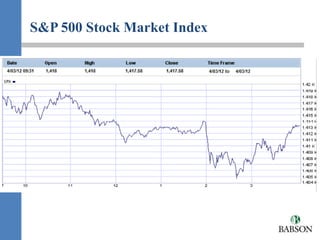
S&P 500 Stock Market Index
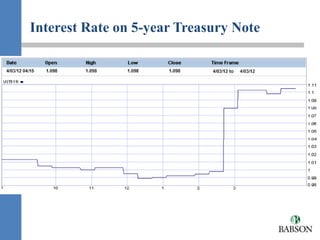
Interest Rate on 5-year Treasury Note
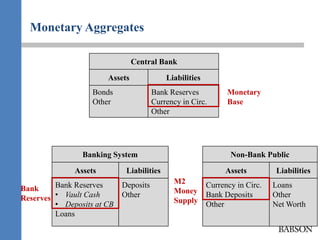
Monetary Aggregates

                                Central Bank

                       Assets              Liabilities
                   Bonds               Bank Reserves           Monetary
                   Other               Currency in Circ.       Base
                                       Other


                Banking System                                  Non-Bank Public

              Assets         Liabilities                      Assets         Liabilities
         Bank Reserves      Deposits         M2          Currency in Circ.   Loans
Bank                                         Money
Reserves • Vault Cash       Other
                                             Supply
                                                         Bank Deposits       Other
         • Deposits at CB                                Other               Net Worth
         Loans
The M1 & M2 Money Multipliers


                      M1 Money Supply     720
M1 Money Multiplier                              3
                       Monetary Base    220 20

                      M1 Money Supply    1080
M2 Money Multiplier                              4.5
                       Monetary Base    220 20
The Money Multipliers


M2 Money Supply = M2 Money Multiplier              Monetary Base


• How much money banks create (by making loans) depends on:
   – Central Bank’s Required Reserve Ratio (rr)
   – Households’ Currency to Checking Deposits ratio (Cc/D)
   – Households’ Near Money to Checking Deposits ratio (N/D)
   – Banks’ Excess Reserves to Checking Deposits ratio (U/D)


   (Excess Reserves = Customary Reserves)
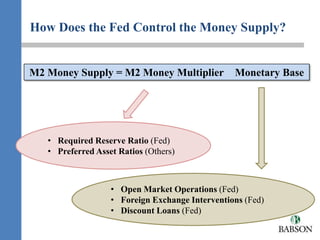
How Does the Fed Control the Money Supply?


M2 Money Supply = M2 Money Multiplier            Monetary Base


   • Required Reserve Ratio (Fed)
   • Preferred Asset Ratios (Others)


                   • Open Market Operations (Fed)
                   • Foreign Exchange Interventions (Fed)
                   • Discount Loans (Fed)
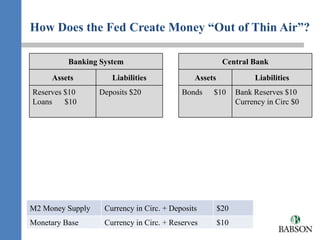
How Does the Fed Create Money “Out of Thin Air”?

          Banking System                                Central Bank

     Assets          Liabilities              Assets              Liabilities
Reserves $10      Deposits $20            Bonds    $10       Bank Reserves $10
Loans    $10                                                 Currency in Circ $0


M2 Money Supply    Currency in Circ. + Deposits        $20
Monetary Base      Currency in Circ. + Reserves        $10
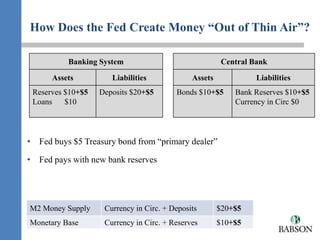
How Does the Fed Create Money “Out of Thin Air”?

          Banking System                                Central Bank

      Assets          Liabilities             Assets             Liabilities
 Reserves $10+$5   Deposits $20+$5       Bonds $10+$5      Bank Reserves $10+$5
 Loans    $10                                              Currency in Circ $0


• Fed buys $5 Treasury bond from “primary dealer”

• Fed pays with new bank reserves


M2 Money Supply     Currency in Circ. + Deposits       $20+$5
Monetary Base       Currency in Circ. + Reserves       $10+$5
Takeaway Points

• Central Bank can change money supply by changing
  monetary base or by changing required reserve ratio

• Only the central bank can change the monetary base

• Money supply can also change if preferred asset ratios
  change

MaC BGIE4 central bank azcona

  • 1.
    MaC BGIE4: CentralBanks & Monetary Policy Tools April 4, 2012 Prof. Nestor Azcona
  • 2.
    S&P 500 StockMarket Index
  • 3.
    Interest Rate on5-year Treasury Note
  • 4.
    Monetary Aggregates Central Bank Assets Liabilities Bonds Bank Reserves Monetary Other Currency in Circ. Base Other Banking System Non-Bank Public Assets Liabilities Assets Liabilities Bank Reserves Deposits M2 Currency in Circ. Loans Bank Money Reserves • Vault Cash Other Supply Bank Deposits Other • Deposits at CB Other Net Worth Loans
  • 5.
    The M1 &M2 Money Multipliers M1 Money Supply 720 M1 Money Multiplier 3 Monetary Base 220 20 M1 Money Supply 1080 M2 Money Multiplier 4.5 Monetary Base 220 20
  • 6.
    The Money Multipliers M2Money Supply = M2 Money Multiplier Monetary Base • How much money banks create (by making loans) depends on: – Central Bank’s Required Reserve Ratio (rr) – Households’ Currency to Checking Deposits ratio (Cc/D) – Households’ Near Money to Checking Deposits ratio (N/D) – Banks’ Excess Reserves to Checking Deposits ratio (U/D) (Excess Reserves = Customary Reserves)
  • 7.
    How Does theFed Control the Money Supply? M2 Money Supply = M2 Money Multiplier Monetary Base • Required Reserve Ratio (Fed) • Preferred Asset Ratios (Others) • Open Market Operations (Fed) • Foreign Exchange Interventions (Fed) • Discount Loans (Fed)
  • 8.
    How Does theFed Create Money “Out of Thin Air”? Banking System Central Bank Assets Liabilities Assets Liabilities Reserves $10 Deposits $20 Bonds $10 Bank Reserves $10 Loans $10 Currency in Circ $0 M2 Money Supply Currency in Circ. + Deposits $20 Monetary Base Currency in Circ. + Reserves $10
  • 9.
    How Does theFed Create Money “Out of Thin Air”? Banking System Central Bank Assets Liabilities Assets Liabilities Reserves $10+$5 Deposits $20+$5 Bonds $10+$5 Bank Reserves $10+$5 Loans $10 Currency in Circ $0 • Fed buys $5 Treasury bond from “primary dealer” • Fed pays with new bank reserves M2 Money Supply Currency in Circ. + Deposits $20+$5 Monetary Base Currency in Circ. + Reserves $10+$5
  • 10.
    Takeaway Points • CentralBank can change money supply by changing monetary base or by changing required reserve ratio • Only the central bank can change the monetary base • Money supply can also change if preferred asset ratios change

Editor's Notes

  • #5 This is an example of open market purchasePrimary dealers are about 20 large securities firms (banks or broker-dealers) authorized to trade with the FedTypically banks will use the new excess reserves to make additional loans  money supply will eventually rise by more than $5
  • #7 Savings accounts are also referred to as “near money”Excess reserves are also referred to as “customary reserves”In previous example, with those two extreme assumptions, the money multiplier equals 1/(reserve ratio)= 1/(10%) = 10. Under normal circumstances it is smaller than that.
  • #8 Required reserve ratio and preferred asset ratios determine how much banks can lend
  • #10 This is an example of open market purchasePrimary dealers are about 20 large securities firms (banks or broker-dealers) authorized to trade with the FedTypically banks will use the new excess reserves to make additional loans  money supply will eventually rise by more than $5