9
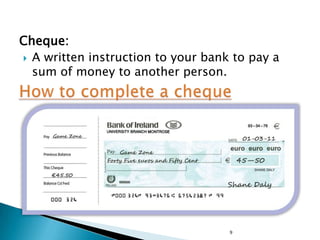
Cheque:
 A written instruction to your bank to pay a
  sum of money to another person.


                                    9
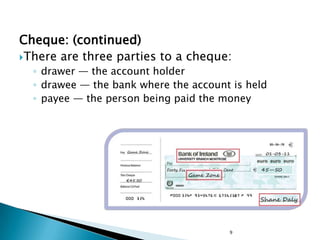
Cheque: (continued)
There are three parties to a cheque:
  ◦ drawer — the account holder
  ◦ drawee — the bank where the account is held
  ◦ payee — the person being paid the money


                                       9
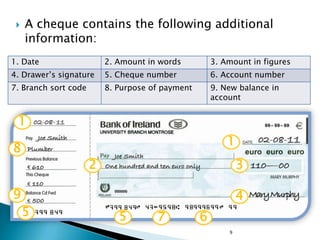
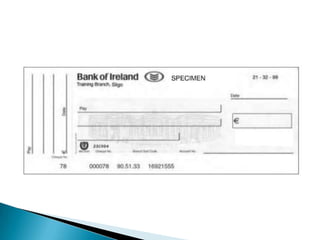
   A cheque contains the following additional
     information:
1. Date                   2. Amount in words          3. Amount in figures
4. Drawer’s signature     5. Cheque number            6. Account number
7. Branch sort code       8. Purpose of payment       9. New balance in
                                                      account


 1
                                                          1
8
                      2                                       3

9                                                             4
     5                       5        7           6
                                                          9
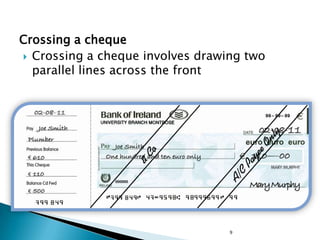
Crossing a cheque
 Crossing a cheque involves drawing two
  parallel lines across the front


                                  9
Advantages:   Disadvantages:
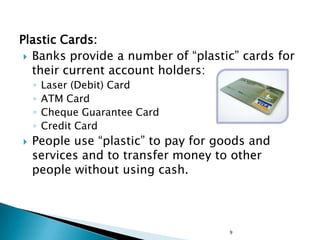
Plastic Cards:
  Banks provide a number of ―plastic‖ cards for
   their current account holders:
    ◦   Laser (Debit) Card
    ◦   ATM Card
    ◦   Cheque Guarantee Card
    ◦   Credit Card
   People use ―plastic‖ to pay for goods and
    services and to transfer money to other
    people without using cash.


                                     9
   Money can be transferred electronically in the
    following ways:
     Direct Debit
     A direct debit can be used to make a regular
     payment where the amount changes each time, e.g.
     the electricity bill
     Standing Order
     A standing order can be used to make a regular
     payment where the amount is the same each time,
     e.g. a regular donation to charity


                                        9
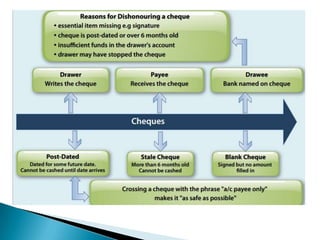
   A stopped cheque – A cheque which the
    drawer informs the bank not to honour
   A postdated cheque – A cheque that has a
    date on it sometime in the future
   A stale cheque – A cheque that is more than 6
    months old
   A blank cheque – A cheque with some of the
    details missing
   A crossed cheque – A cheque with two
    parallel lines on the face of it
   An open cheque – A cheque which is not
    crossed
   An endorsed cheque – a cheque which is
    signed on the back by the payee
   Payee – the person who receives the cheque
   Drawer – the person who writes the cheque
    and from whose account the money will be
    taken
   Direct Debit – A method of paying bills where
    the amount may change
   Standing Order - A method of paying regular
    bills of a fixed amount
   Money can be transferred electronically in the
    following ways:
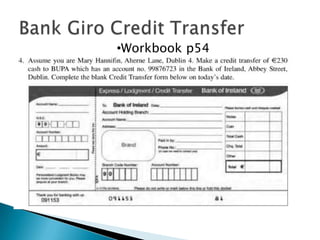
     Bank Giro Credit Transfer
     A bank giro credit transfer is used to make a single
     payment to another person through the bank, e.g.
     paying your TV licence
     Paypath
     Paypath is used by employers to transfer the wages of
     their employees directly into their bank accounts each
     payday
     Bank draft
     A bank draft is a form of a cheque which a bank draws
     on itself. You pay the bank and they issue a bank draft
     made out to the person you want to pay


                                               9
•Workbook p54
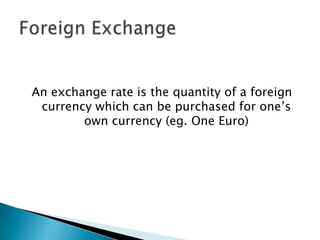
An exchange rate is the quantity of a foreign
 currency which can be purchased for one’s
        own currency (eg. One Euro)
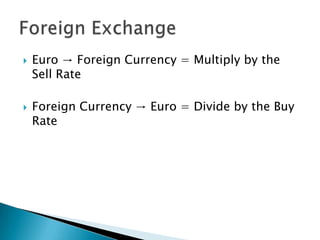
   Euro → Foreign Currency = Multiply by the
    Sell Rate

   Foreign Currency → Euro = Divide by the Buy
    Rate
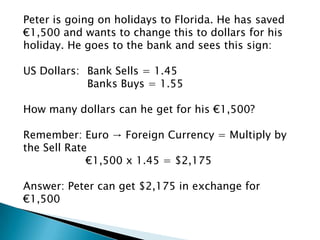
Peter is going on holidays to Florida. He has saved
€1,500 and wants to change this to dollars for his
holiday. He goes to the bank and sees this sign:

US Dollars: Bank Sells = 1.45
            Banks Buys = 1.55

How many dollars can he get for his €1,500?

Remember: Euro → Foreign Currency = Multiply by
the Sell Rate
             €1,500 x 1.45 = $2,175

Answer: Peter can get $2,175 in exchange for
€1,500
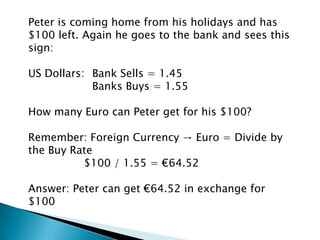
Peter is coming home from his holidays and has
$100 left. Again he goes to the bank and sees this
sign:

US Dollars: Bank Sells = 1.45
            Banks Buys = 1.55

How many Euro can Peter get for his $100?

Remember: Foreign Currency → Euro = Divide by
the Buy Rate
          $100 / 1.55 = €64.52

Answer: Peter can get €64.52 in exchange for
$100
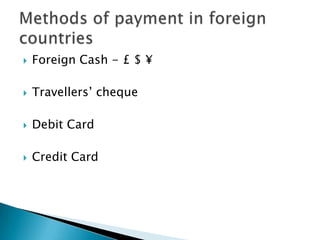
   Foreign Cash - £ $ ¥

   Travellers’ cheque

   Debit Card

   Credit Card

Making payments

  • 1.
  • 2.
    Cheque:  A writteninstruction to your bank to pay a sum of money to another person. 9
  • 3.
    Cheque: (continued) There arethree parties to a cheque: ◦ drawer — the account holder ◦ drawee — the bank where the account is held ◦ payee — the person being paid the money 9
  • 4.
    A cheque contains the following additional information: 1. Date 2. Amount in words 3. Amount in figures 4. Drawer’s signature 5. Cheque number 6. Account number 7. Branch sort code 8. Purpose of payment 9. New balance in account 1 1 8 2 3 9 4 5 5 7 6 9
  • 5.
    Crossing a cheque Crossing a cheque involves drawing two parallel lines across the front 9
  • 7.
    Advantages: Disadvantages:
  • 9.
    Plastic Cards: Banks provide a number of ―plastic‖ cards for their current account holders: ◦ Laser (Debit) Card ◦ ATM Card ◦ Cheque Guarantee Card ◦ Credit Card  People use ―plastic‖ to pay for goods and services and to transfer money to other people without using cash. 9
  • 10.
    Money can be transferred electronically in the following ways:  Direct Debit A direct debit can be used to make a regular payment where the amount changes each time, e.g. the electricity bill  Standing Order A standing order can be used to make a regular payment where the amount is the same each time, e.g. a regular donation to charity 9
  • 12.
    A stopped cheque – A cheque which the drawer informs the bank not to honour  A postdated cheque – A cheque that has a date on it sometime in the future  A stale cheque – A cheque that is more than 6 months old  A blank cheque – A cheque with some of the details missing
  • 13.
    A crossed cheque – A cheque with two parallel lines on the face of it  An open cheque – A cheque which is not crossed  An endorsed cheque – a cheque which is signed on the back by the payee
  • 14.
    Payee – the person who receives the cheque  Drawer – the person who writes the cheque and from whose account the money will be taken  Direct Debit – A method of paying bills where the amount may change  Standing Order - A method of paying regular bills of a fixed amount
  • 15.
    Money can be transferred electronically in the following ways:  Bank Giro Credit Transfer A bank giro credit transfer is used to make a single payment to another person through the bank, e.g. paying your TV licence  Paypath Paypath is used by employers to transfer the wages of their employees directly into their bank accounts each payday  Bank draft A bank draft is a form of a cheque which a bank draws on itself. You pay the bank and they issue a bank draft made out to the person you want to pay 9
  • 16.
  • 19.
    An exchange rateis the quantity of a foreign currency which can be purchased for one’s own currency (eg. One Euro)
  • 20.
    Euro → Foreign Currency = Multiply by the Sell Rate  Foreign Currency → Euro = Divide by the Buy Rate
  • 21.
    Peter is goingon holidays to Florida. He has saved €1,500 and wants to change this to dollars for his holiday. He goes to the bank and sees this sign: US Dollars: Bank Sells = 1.45 Banks Buys = 1.55 How many dollars can he get for his €1,500? Remember: Euro → Foreign Currency = Multiply by the Sell Rate €1,500 x 1.45 = $2,175 Answer: Peter can get $2,175 in exchange for €1,500
  • 22.
    Peter is cominghome from his holidays and has $100 left. Again he goes to the bank and sees this sign: US Dollars: Bank Sells = 1.45 Banks Buys = 1.55 How many Euro can Peter get for his $100? Remember: Foreign Currency → Euro = Divide by the Buy Rate $100 / 1.55 = €64.52 Answer: Peter can get €64.52 in exchange for $100
  • 23.
    Foreign Cash - £ $ ¥  Travellers’ cheque  Debit Card  Credit Card