Managerial Accounting
Fifteenth Edition
Chapter 15
Statement of Cash
Flows
Copyright © 2019 Cengage. All Rights Reserved.
Learning Objectives (1 of 2)
• Obj. 1: Describe the cash flow activities reported on
the statement of cash flows.
• Obj. 2: Prepare the cash flows from operating activities
section of the statement of cash flows using the indirect
method.
• Obj. 3: Prepare the cash flows from investing activities
section of the statement of cash flows.
• Obj. 4: Prepare the cash flows from financing activities
section of the statement of cash flows.
Copyright © 2019 Cengage. All Rights Reserved.
Learning Objectives (2 of 2)
• Obj. 5: Prepare a statement of cash flows.
• Obj. 6: Describe and illustrate the use of free cash flow
in evaluating a company’s cash flow.
• Obj. App 1: Use a spreadsheet to prepare the
statement of cash flows under the indirect method.
• Obj. App 2: Prepare a statement of cash flows under
the direct method.
Copyright © 2019 Cengage. All Rights Reserved.
Reporting Cash Flows (1 of 6)
• The statement of cash flows reports a company’s
cash inflows and outflows for a period.
• The statement of cash flows provides useful
information about a company’s ability to do the
following:
– Generate cash from operations
– Maintain and expand its operating capacity
– Meet its financial obligations
– Pay dividends
Copyright © 2019 Cengage. All Rights Reserved.
Reporting Cash Flows (2 of 6)
• The statement of cash flows is used by managers in
evaluating past operations and in planning future
investing and financing activities.
• It is also used by external users such as investors and
creditors to assess a company’s profit potential and
ability to pay its debt and pay dividends.
Copyright © 2019 Cengage. All Rights Reserved.
Reporting Cash Flows (3 of 6)
• The statement of cash flows reports three types of
cash flow activities, as follows:
1. Cash flows from operating activities are the cash
flows from transactions that affect the net income of the
company.
 Example: Purchase and sale of merchandise by a retailer.
Copyright © 2019 Cengage. All Rights Reserved.
Reporting Cash Flows (4 of 6)
2. Cash flows from investing activities are the cash
flows from transactions that affect investments in the
noncurrent assets of the company.
 Example: Purchase and sale of fixed assets, such as
equipment and buildings.
3. Cash flows from financing activities are the cash
flows from transactions that affect the debt and equity of
the company.
 Example: Issuing or retiring equity and debt securities.
Copyright © 2019 Cengage. All Rights Reserved.
Reporting Cash Flows (5 of 6)
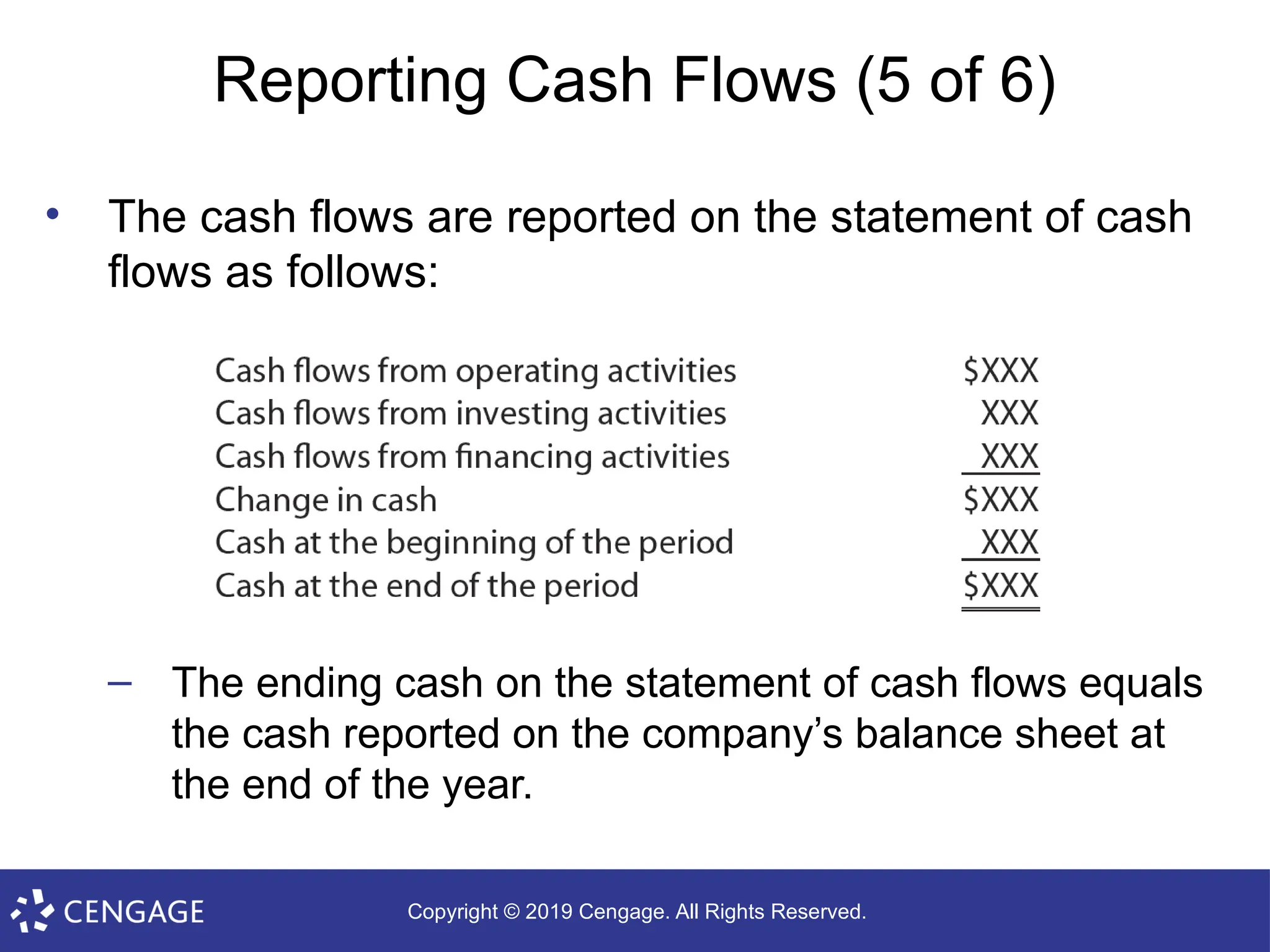
• The cash flows are reported on the statement of cash
flows as follows:
– The ending cash on the statement of cash flows equals
the cash reported on the company’s balance sheet at
the end of the year.
Copyright © 2019 Cengage. All Rights Reserved.
Reporting Cash Flows (6 of 6)
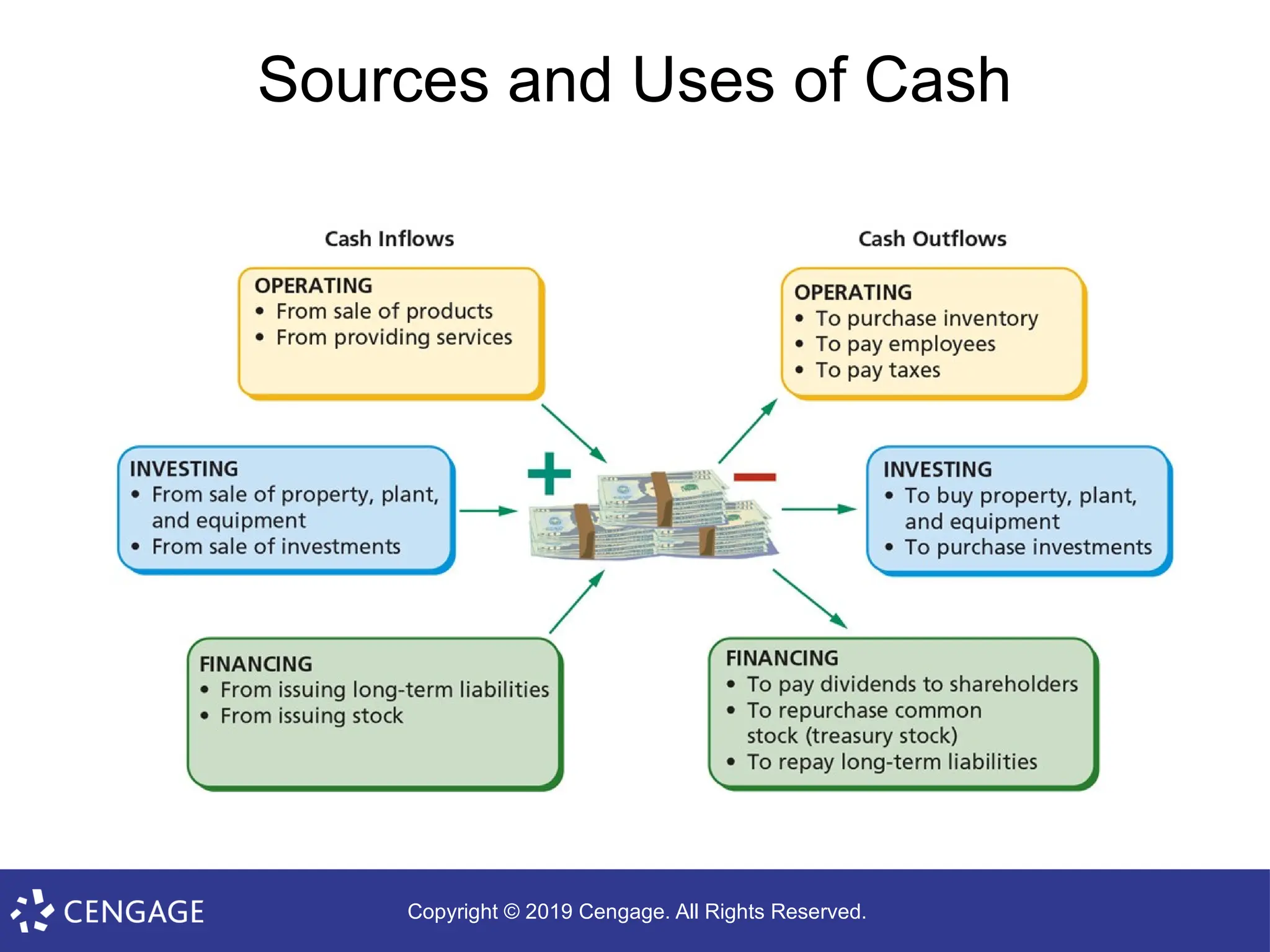
• A source of cash causes the cash flow to increase and
is called a cash inflow.
• A use of cash causes cash flow to decrease and is
called cash outflow.
Copyright © 2019 Cengage. All Rights Reserved.
Sources and Uses of Cash
Copyright © 2019 Cengage. All Rights Reserved.
Cash Flows from Operating Activities
• Cash flows from operating activities report the cash
inflows and outflows from a company’s day-to-day
operations.
• Companies may select one of the following two
alternative methods for reporting cash flows from
operating activities on the statement of cash flows:
– The direct method
– The indirect method
• Both methods result in the same amount of cash flow
from operating activities. They differ in the way they
report cash flows from operating activities.
Copyright © 2019 Cengage. All Rights Reserved.
Cash Flows from Operating Activities: The
Direct Method (1 of 3)
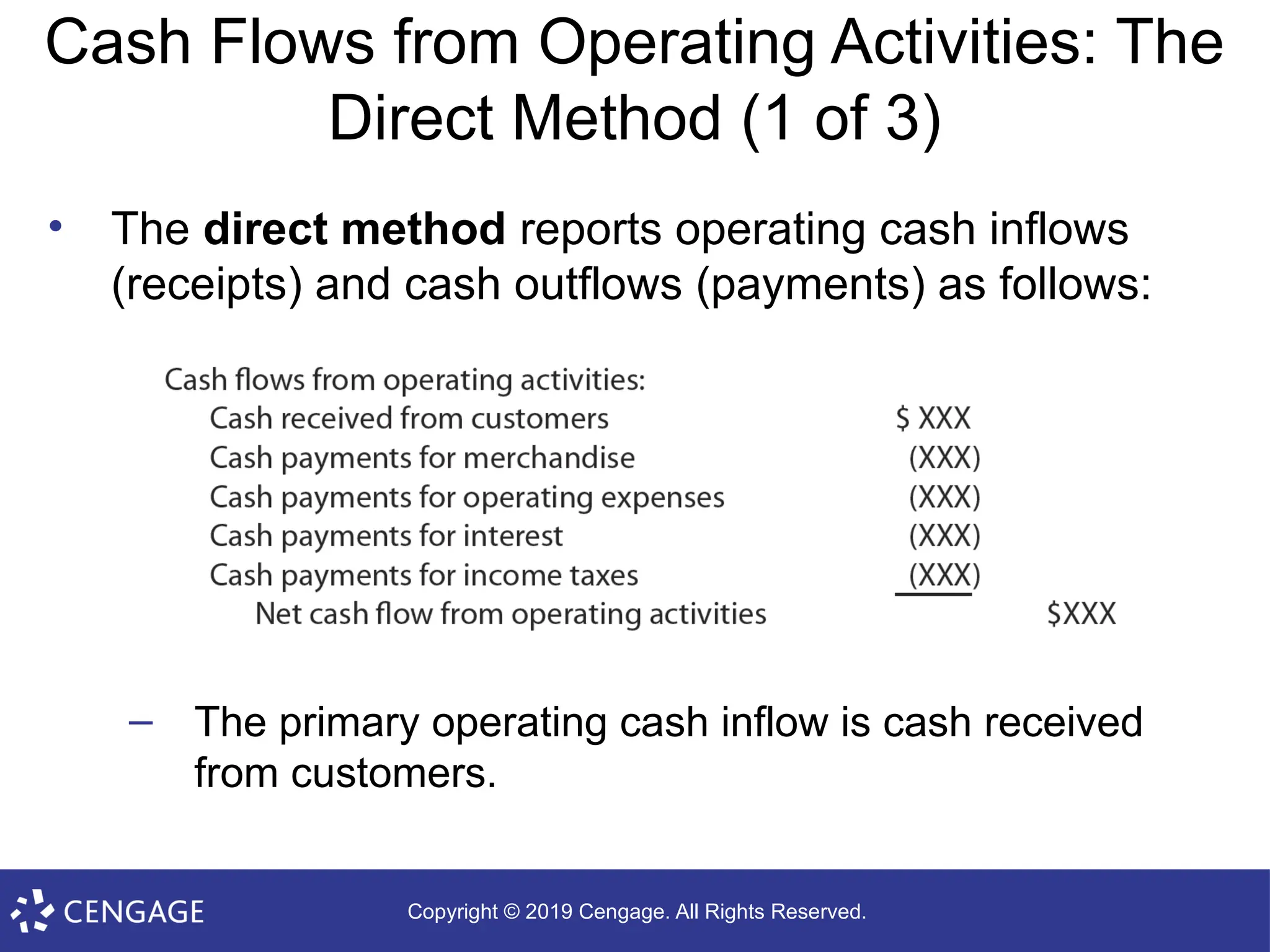
• The direct method reports operating cash inflows
(receipts) and cash outflows (payments) as follows:
– The primary operating cash inflow is cash received
from customers.
Copyright © 2019 Cengage. All Rights Reserved.
Cash Flows from Operating Activities: The
Direct Method (2 of 3)
– The primary operating cash outflows are cash payments
for merchandise, operating expenses, interest, and
income tax payments.
– The cash received from operating activities less the cash
payments for operating activities is the net cash flow
from operating activities.
Copyright © 2019 Cengage. All Rights Reserved.
Cash Flows from Operating Activities: The
Direct Method (3 of 3)
• The primary advantage of the direct method is that it
directly reports cash receipts and cash payments on
the statement of cash flows.
• Its primary disadvantage is that these data may not be
readily available in the accounting records.
– Thus, the direct method is normally more costly to
prepare and, as a result, is used infrequently in practice.
Copyright © 2019 Cengage. All Rights Reserved.
Cash Flows from Operating Activities: The
Indirect Method (1 of 3)
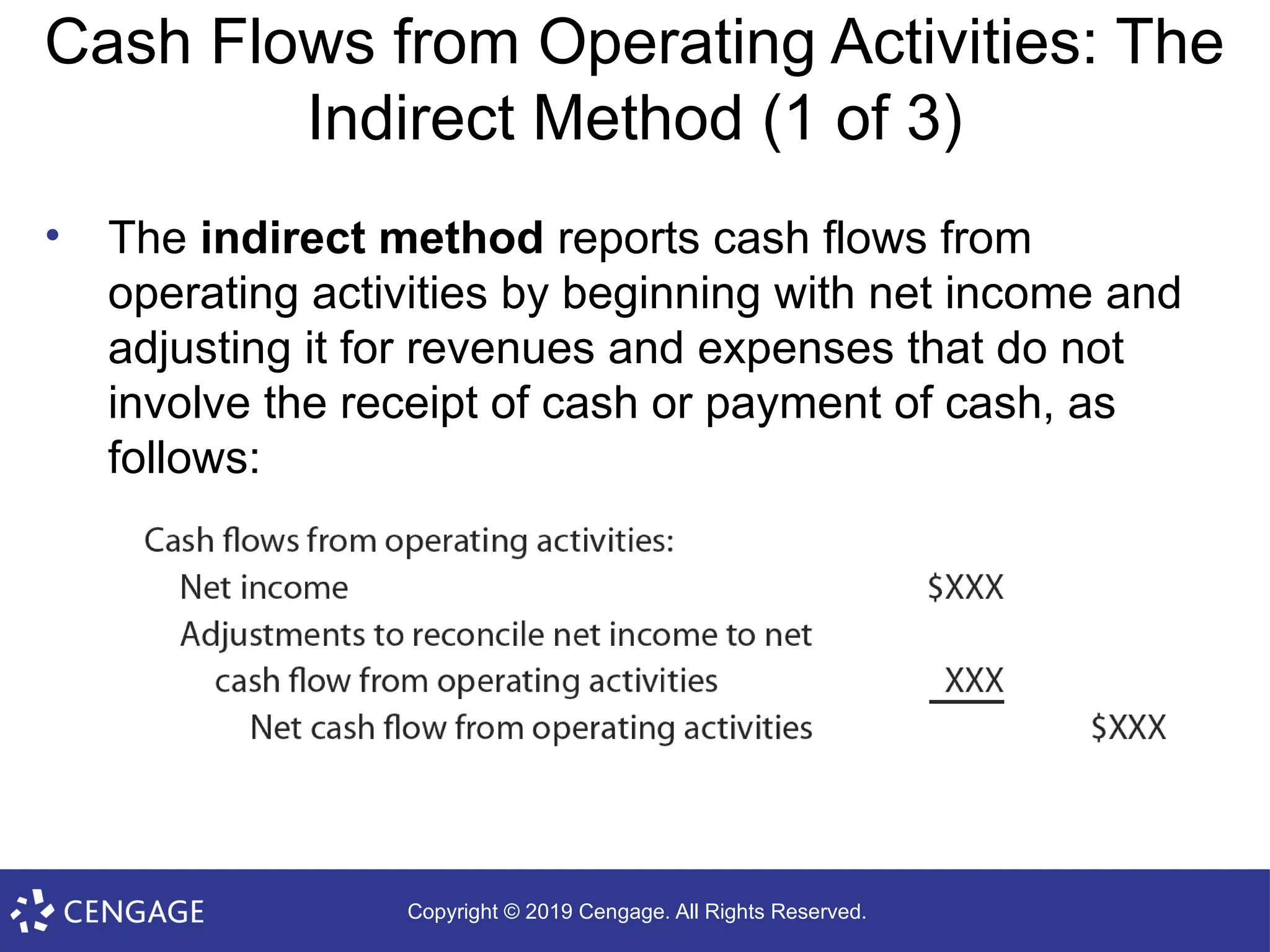
• The indirect method reports cash flows from
operating activities by beginning with net income and
adjusting it for revenues and expenses that do not
involve the receipt of cash or payment of cash, as
follows:
Copyright © 2019 Cengage. All Rights Reserved.
Cash Flows from Operating Activities: The
Indirect Method (2 of 3)
– The adjustments to reconcile net income to net cash
flow from operating activities include such items as
depreciation and gains or losses on fixed assets.
– Changes in current operating assets and liabilities such
as accounts receivable or accounts payable are also
added or deducted, depending on their effect on cash
flows.
Copyright © 2019 Cengage. All Rights Reserved.
Cash Flows from Operating Activities: The
Indirect Method (3 of 3)
• A primary advantage of the indirect method is that it
reconciles the differences between net income and net
cash flows from operations.
• Because the data are readily available, the indirect
method is less costly to prepare than the direct
method.
– As a result, the indirect method of reporting cash flows
from operations is most commonly used in practice.
Copyright © 2019 Cengage. All Rights Reserved.
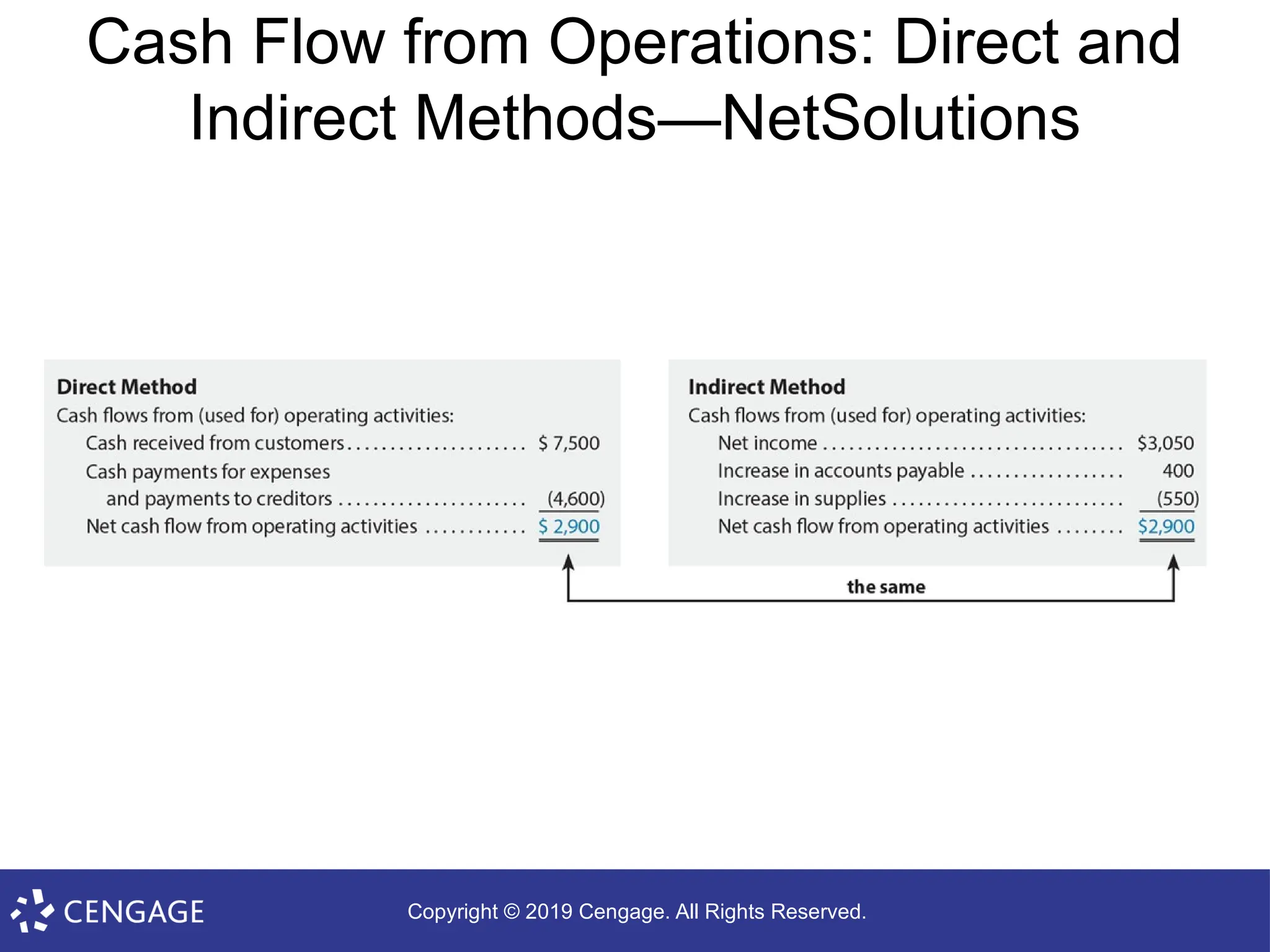
Cash Flow from Operations: Direct and
Indirect Methods—NetSolutions
Copyright © 2019 Cengage. All Rights Reserved.
Cash Flows from Investing Activities
• Cash flows from investing activities show the cash inflows
and outflows related to changes in a company’s long-term
assets.
• Cash flows from investing activities are reported on the
statement of cash flows as follows:
– Cash inflows from investing activities normally arise from
selling fixed assets, investments, and intangible assets.
– Cash outflows normally include payments to purchase fixed
assets, investments, and intangible assets.
Copyright © 2019 Cengage. All Rights Reserved.
Cash Flows from Financing Activities
(1 of 2)
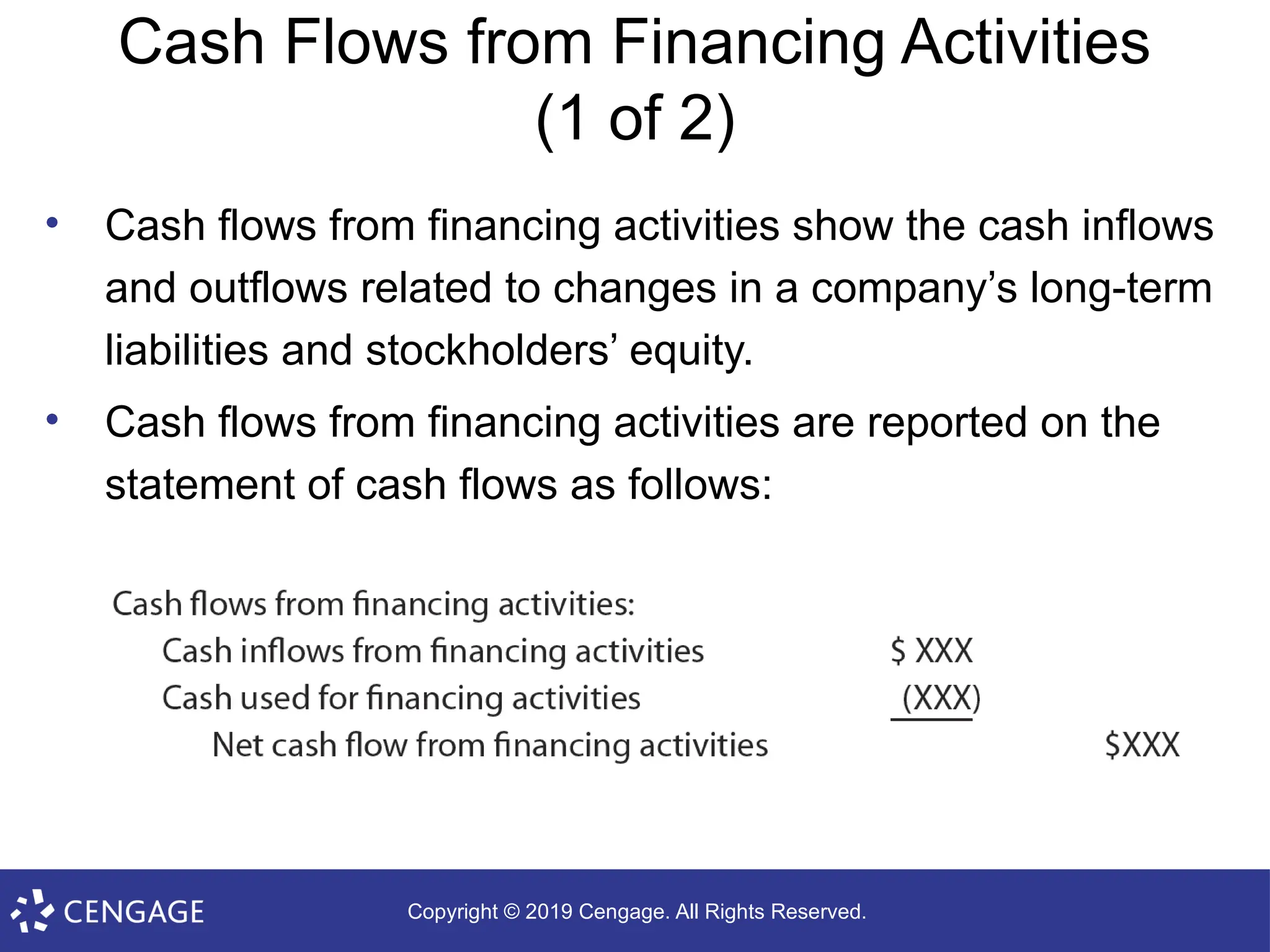
• Cash flows from financing activities show the cash inflows
and outflows related to changes in a company’s long-term
liabilities and stockholders’ equity.
• Cash flows from financing activities are reported on the
statement of cash flows as follows:
Copyright © 2019 Cengage. All Rights Reserved.
Cash Flows from Financing Activities (2
of 2)
– Cash inflows from financing activities normally arise from
issuing long-term debt or equity securities.
 Example: issuing bonds, notes payable, preferred stock,
and common stock creates cash inflows from financing
activities.
– Cash outflows from financing activities normally include
paying cash dividends, repaying long-term debt, and
acquiring treasury stock.
Copyright © 2019 Cengage. All Rights Reserved.
Noncash Investing and Financing Activities
• A company may enter into transactions involving
investing and financing activities that do not directly
affect cash.
– For example, a company may issue common stock to
retire long-term debt.
• Because such transactions indirectly affect cash flows,
they are reported in a separate section that usually
appears at the bottom of the statement of cash flows.
Copyright © 2019 Cengage. All Rights Reserved.
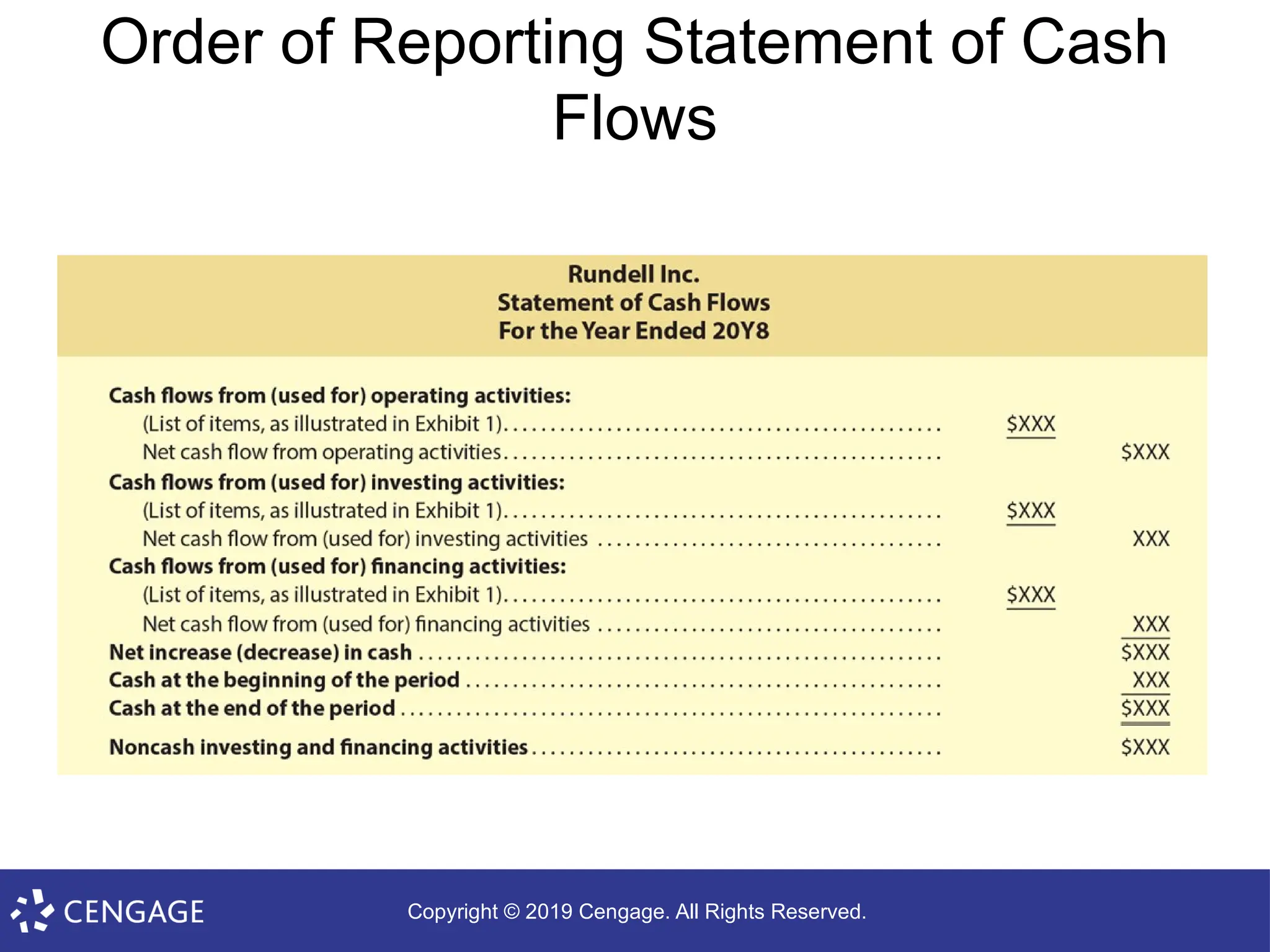
Order of Reporting Statement of Cash
Flows
Copyright © 2019 Cengage. All Rights Reserved.
No Cash Flow Per Share
• Cash flow per share is computed as follows:
g
Outstandin
Shares
Common
of
Number
Operations
from
Flow
Cash
share
per
Flow
Cash 
• Cash flow per share should not be reported on a
company’s financial statements for the following reasons:
– Users may misinterpret cash flow per share as the per-
share amount available for dividends.
– Users may misinterpret cash flow per share as equivalent
to (or better than) earnings per share.
Copyright © 2019 Cengage. All Rights Reserved.
Check Up Corner: Classifications of Cash
Flows (1 of 2)
During its first month of operations, Templeton Company
had the following cash transactions:
A. Issued 30,000 shares of common stock.
B. Purchased a new piece of equipment.
C. Sold merchandise to customers.
D. Paid employees’ wages.
E. Paid a dividend.
Identify whether each of these transactions would be
reported as an operating, investing, or financing activity on
the statement of cash flows.
Copyright © 2019 Cengage. All Rights Reserved.
Check Up Corner: Classifications of Cash
Flows (2 of 2)
Copyright © 2019 Cengage. All Rights Reserved.
Cash Flows from Operating Activities— The
Indirect Method (1 of 2)
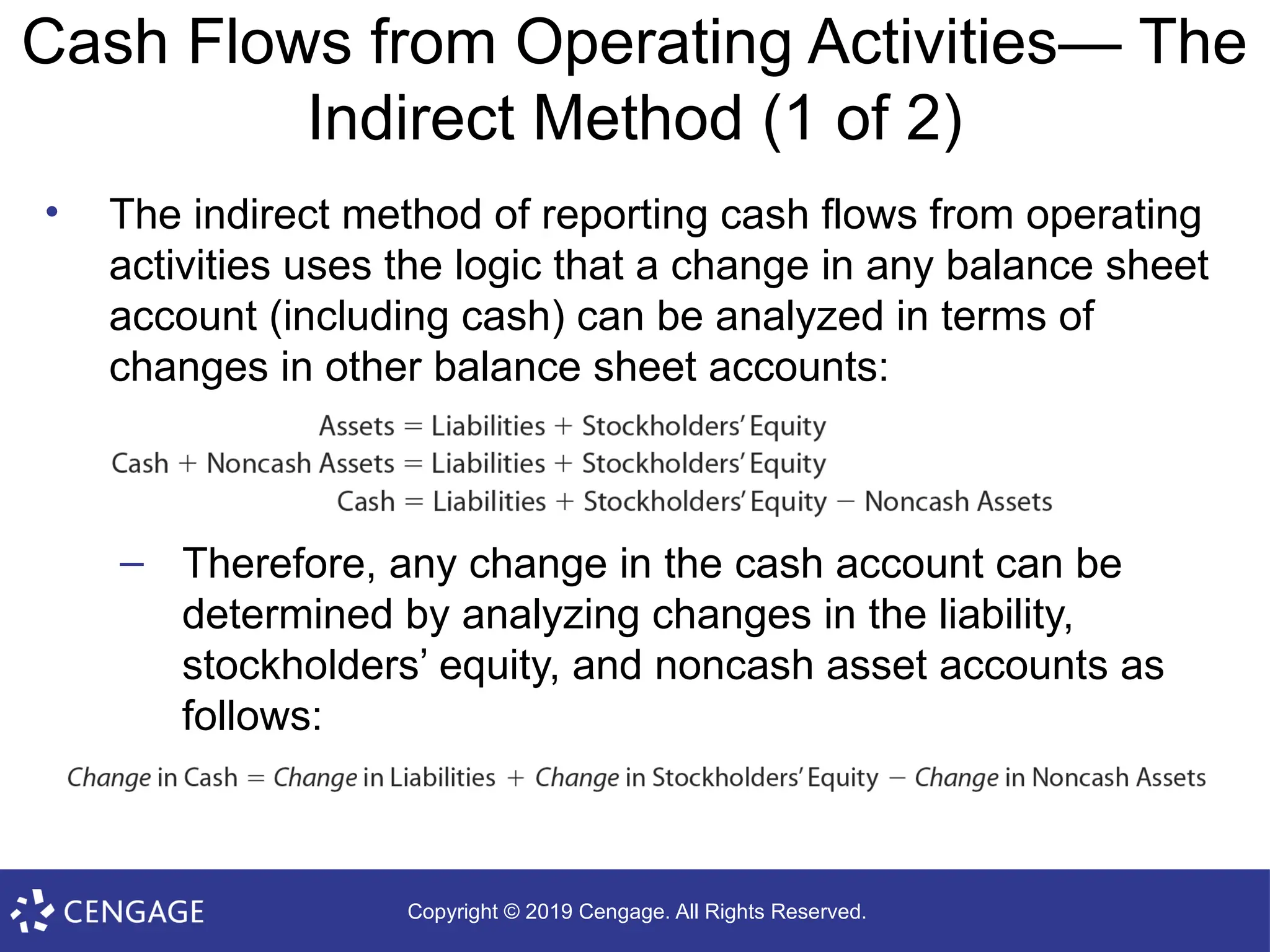
• The indirect method of reporting cash flows from operating
activities uses the logic that a change in any balance sheet
account (including cash) can be analyzed in terms of
changes in other balance sheet accounts:
– Therefore, any change in the cash account can be
determined by analyzing changes in the liability,
stockholders’ equity, and noncash asset accounts as
follows:
Copyright © 2019 Cengage. All Rights Reserved.
Cash Flows from Operating Activities— The
Indirect Method (2 of 2)
• Under the indirect method, there is no order in which
the balance sheet accounts must be analyzed.
However, because net income (or net loss) is a
component of any change in Retained Earnings, the
first account normally analyzed is Retained Earnings.
Copyright © 2019 Cengage. All Rights Reserved.
Income Statement and Comparative
Balance Sheet (1 of 2)
Copyright © 2019 Cengage. All Rights Reserved.
Income Statement and Comparative
Balance Sheet (2 of 2)
Copyright © 2019 Cengage. All Rights Reserved.
Net Income (1 of 2)
• Rundell Inc.’s net income for 20Y8 is $108,000 as
shown in the income statement on slide 26.
• Since net income is closed to Retained Earnings, net
income also helps explain the change in retained
earnings during the year.
Copyright © 2019 Cengage. All Rights Reserved.
Net Income (2 of 2)
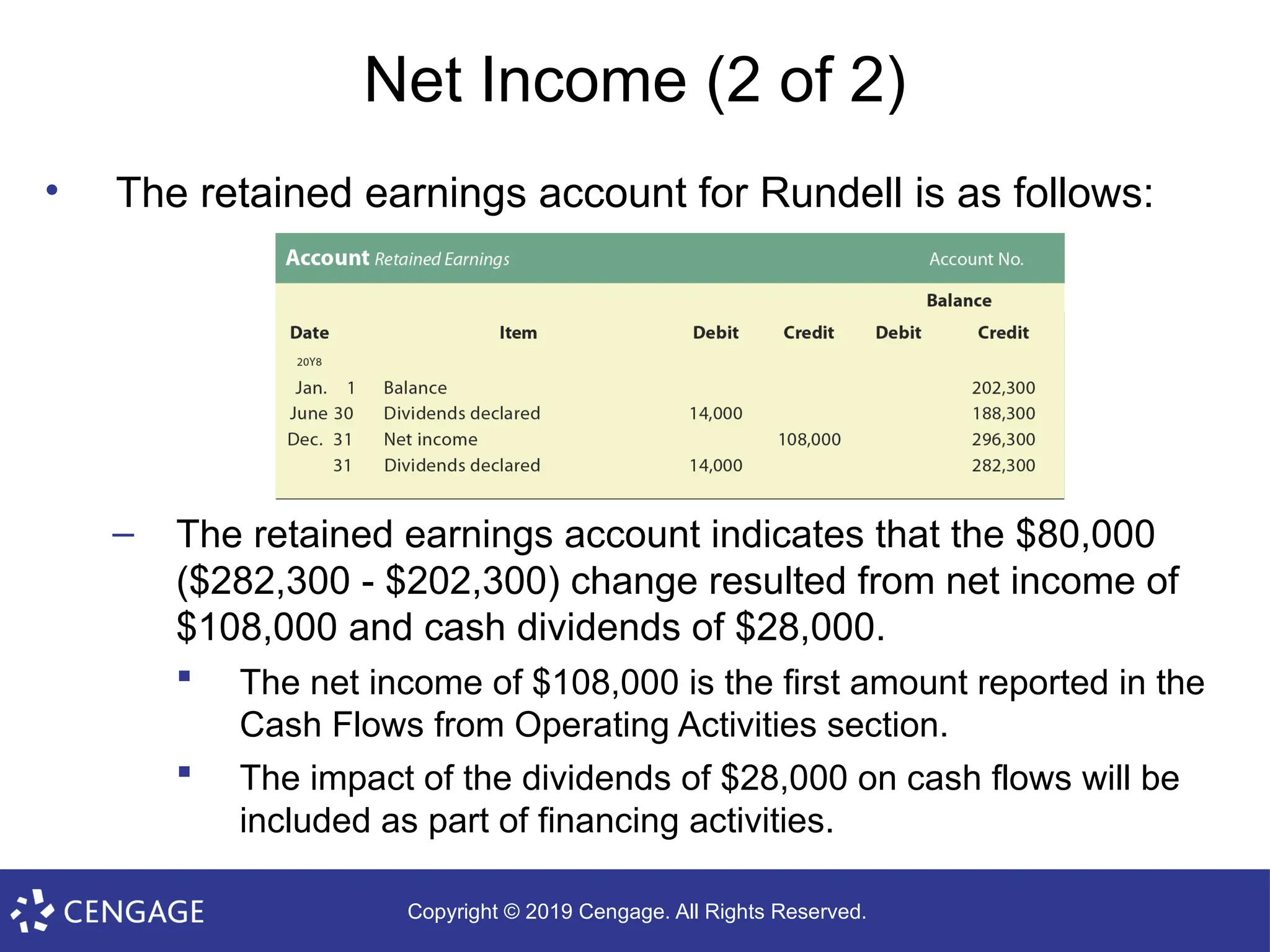
• The retained earnings account for Rundell is as follows:
– The retained earnings account indicates that the $80,000
($282,300 - $202,300) change resulted from net income of
$108,000 and cash dividends of $28,000.
 The net income of $108,000 is the first amount reported in the
Cash Flows from Operating Activities section.
 The impact of the dividends of $28,000 on cash flows will be
included as part of financing activities.
Copyright © 2019 Cengage. All Rights Reserved.
Adjustments to Net Income (1 of 16)
• The net income of $108,000 reported by Rundell Inc.
does not equal the cash flows from operating activities
for the period.
– This is because net income is determined using the
accrual method of accounting.
 Under the accrual method of accounting, revenues and
expenses are recorded at different times from when cash
is received or paid. Thus, under the indirect method,
adjustments to net income must be made to determine
cash flows from operating activities.
Copyright © 2019 Cengage. All Rights Reserved.
Adjustments to Net Income (Loss) Using
the Indirect Method
Copyright © 2019 Cengage. All Rights Reserved.
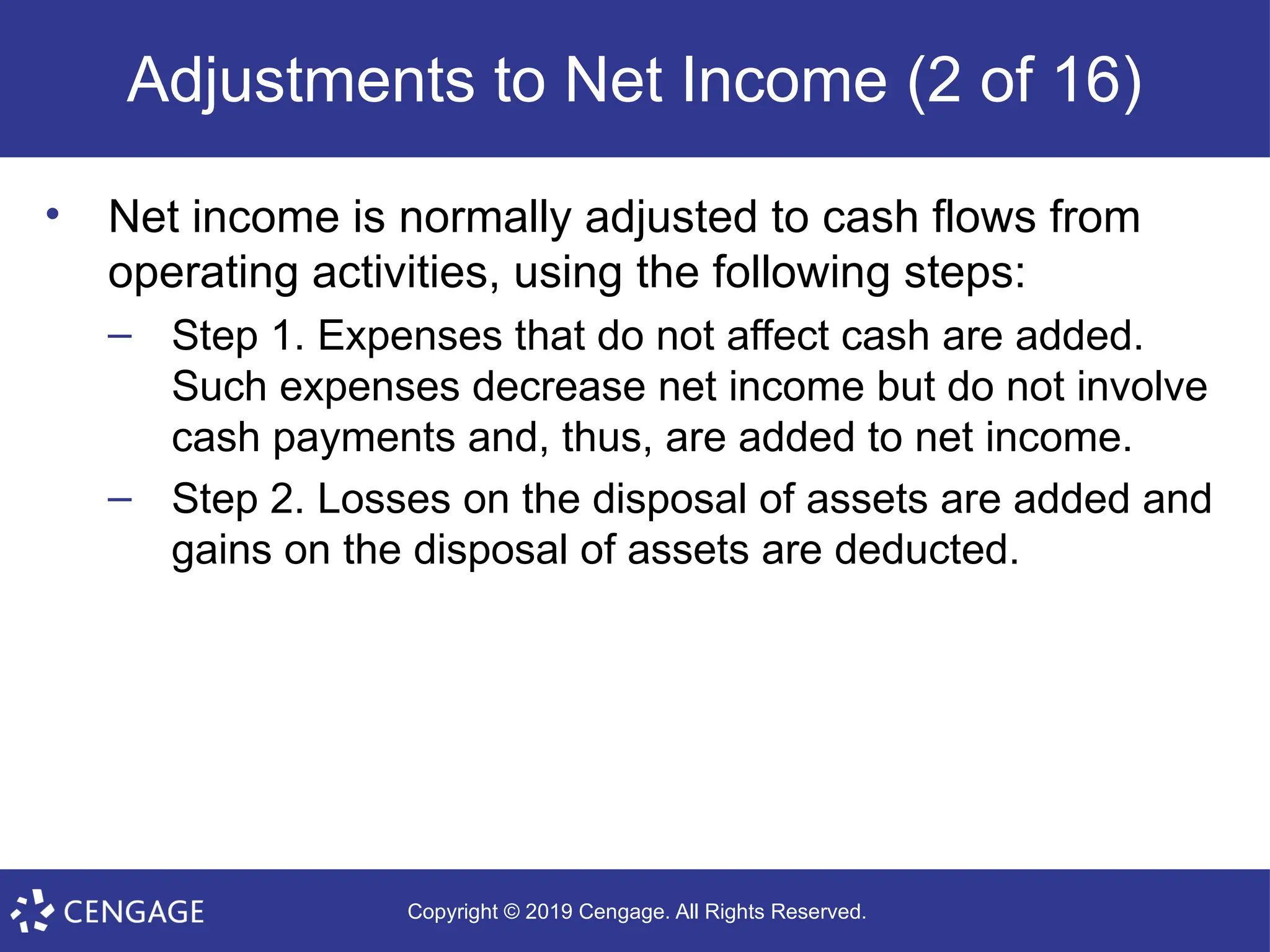
Adjustments to Net Income (2 of 16)
• Net income is normally adjusted to cash flows from
operating activities, using the following steps:
– Step 1. Expenses that do not affect cash are added.
Such expenses decrease net income but do not involve
cash payments and, thus, are added to net income.
– Step 2. Losses on the disposal of assets are added and
gains on the disposal of assets are deducted.
Copyright © 2019 Cengage. All Rights Reserved.
Adjustments to Net Income (3 of 16)
– Step 3. Changes in current operating assets and
liabilities are added or deducted as follows:
 Increases in noncash current operating assets are
deducted.
 Decrease in noncash current operating assets are added.
 Increases in current operating liabilities are added.
 Decreases in current operating liabilities are deducted.
Copyright © 2019 Cengage. All Rights Reserved.
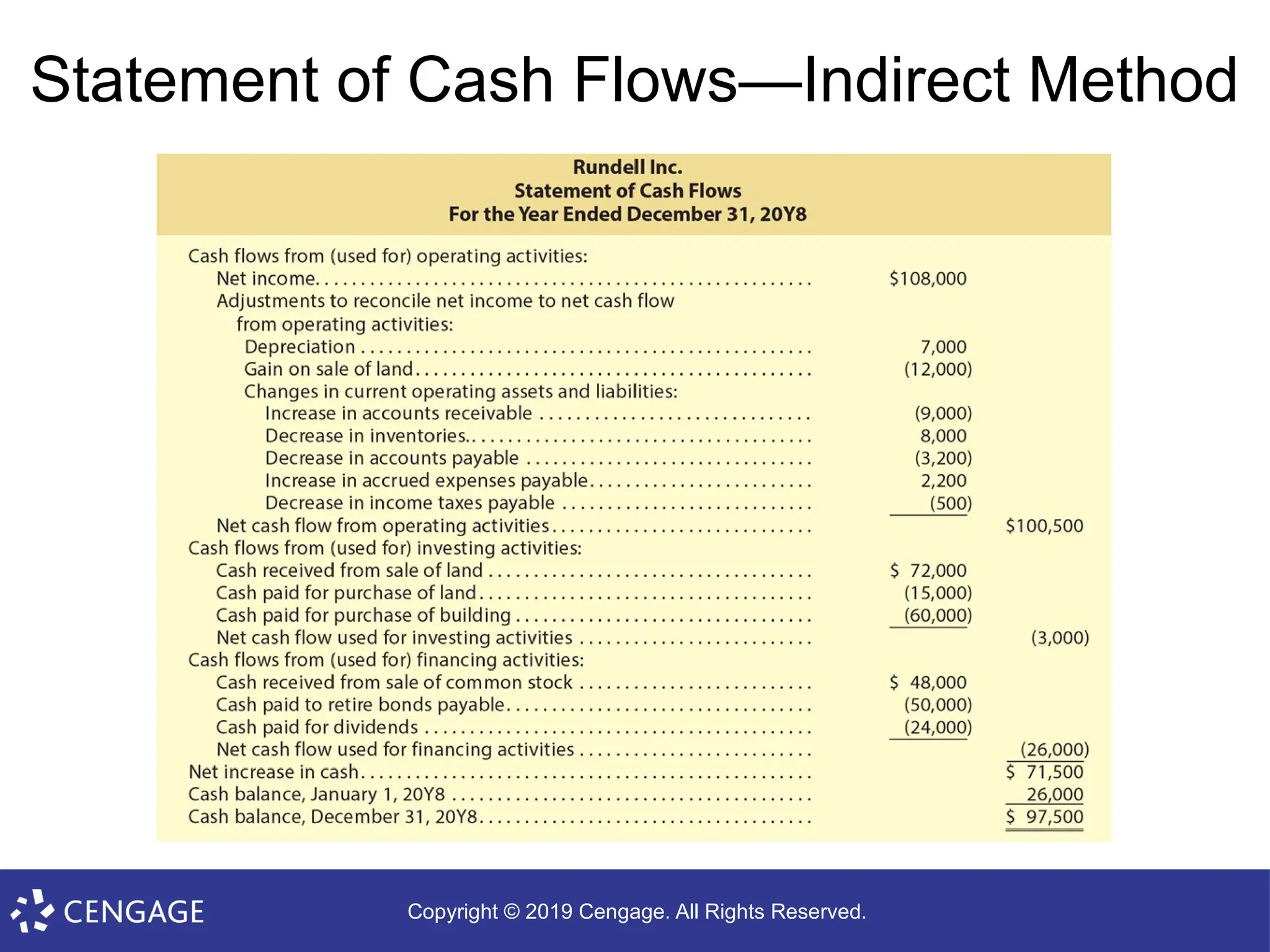
Net Cash Flow from Operating Activities—
Indirect Method
Copyright © 2019 Cengage. All Rights Reserved.
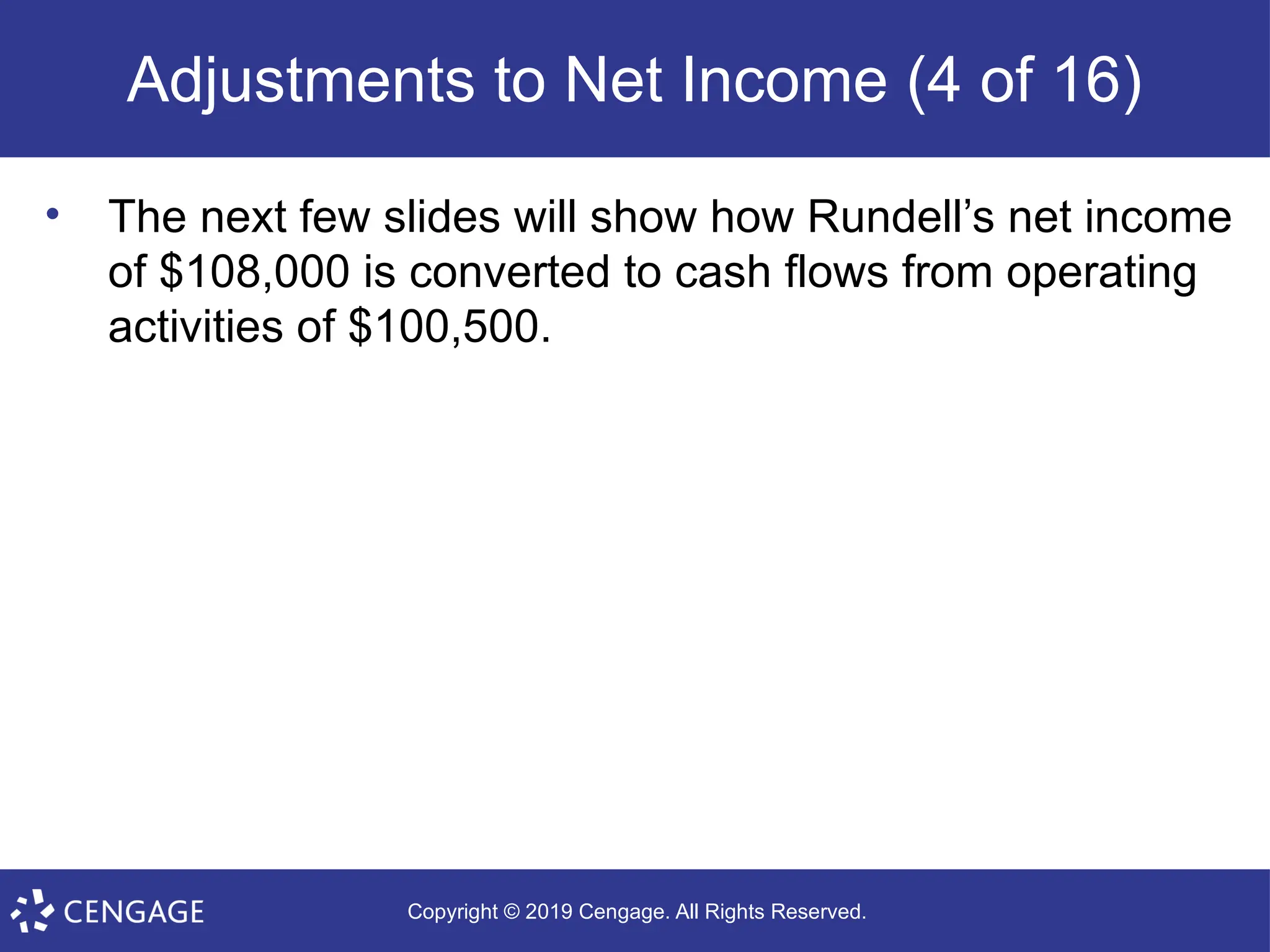
Adjustments to Net Income (4 of 16)
• The next few slides will show how Rundell’s net income
of $108,000 is converted to cash flows from operating
activities of $100,500.
Copyright © 2019 Cengage. All Rights Reserved.
Adjustments to Net Income (5 of 16)
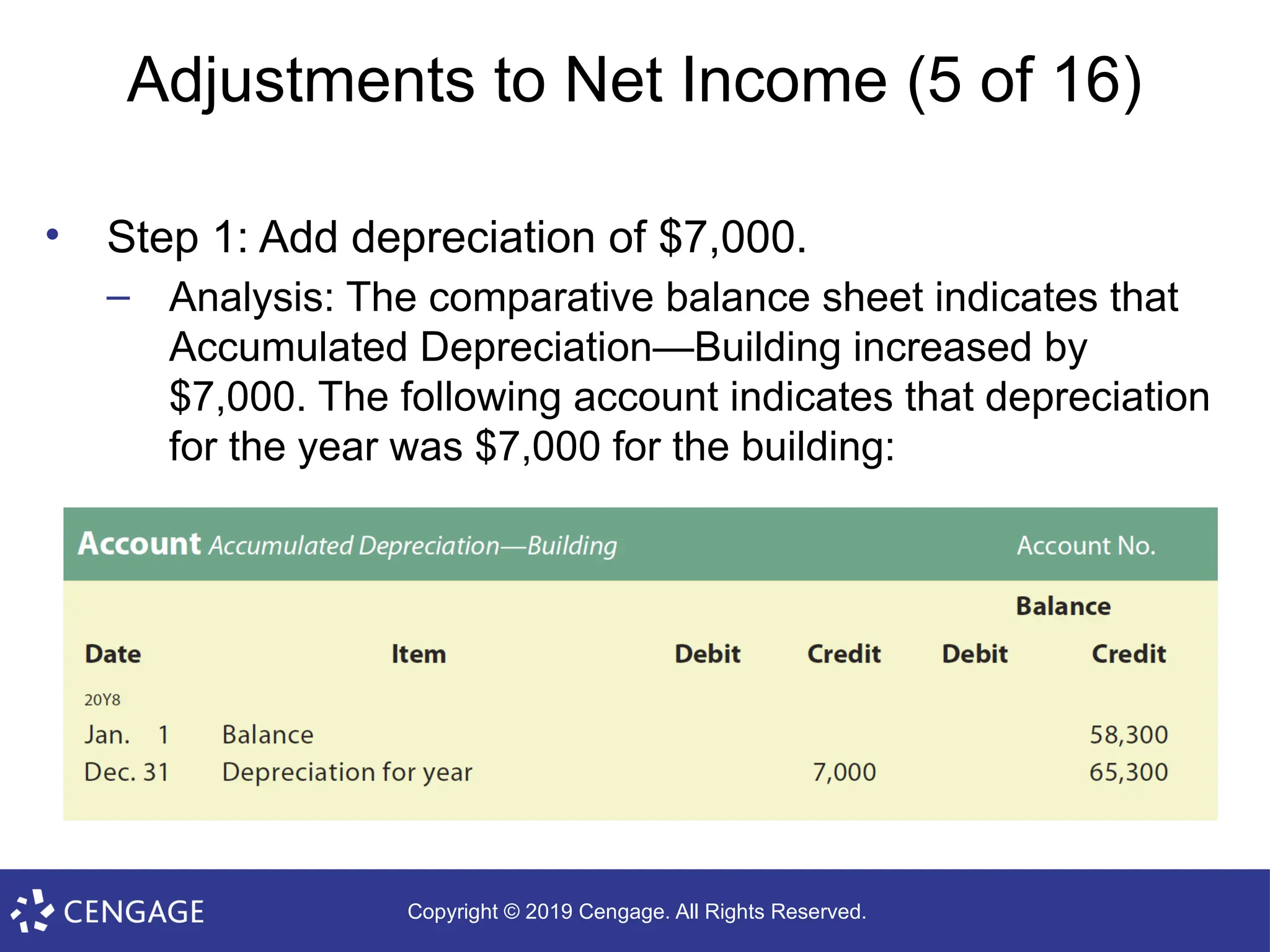
• Step 1: Add depreciation of $7,000.
– Analysis: The comparative balance sheet indicates that
Accumulated Depreciation—Building increased by
$7,000. The following account indicates that depreciation
for the year was $7,000 for the building:
Copyright © 2019 Cengage. All Rights Reserved.
Adjustments to Net Income (6 of 16)
• Step 2: Deduct the gain on the sale of land of $12,000.
– Analysis: The income statement reports a gain of
$12,000 from the sale of land. The proceeds, which
include the gain, are reported in the Investing section of
the statement of cash flows. Thus, the gain of $12,000 is
deducted from net income in determining cash flows
from operating activities.
Copyright © 2019 Cengage. All Rights Reserved.
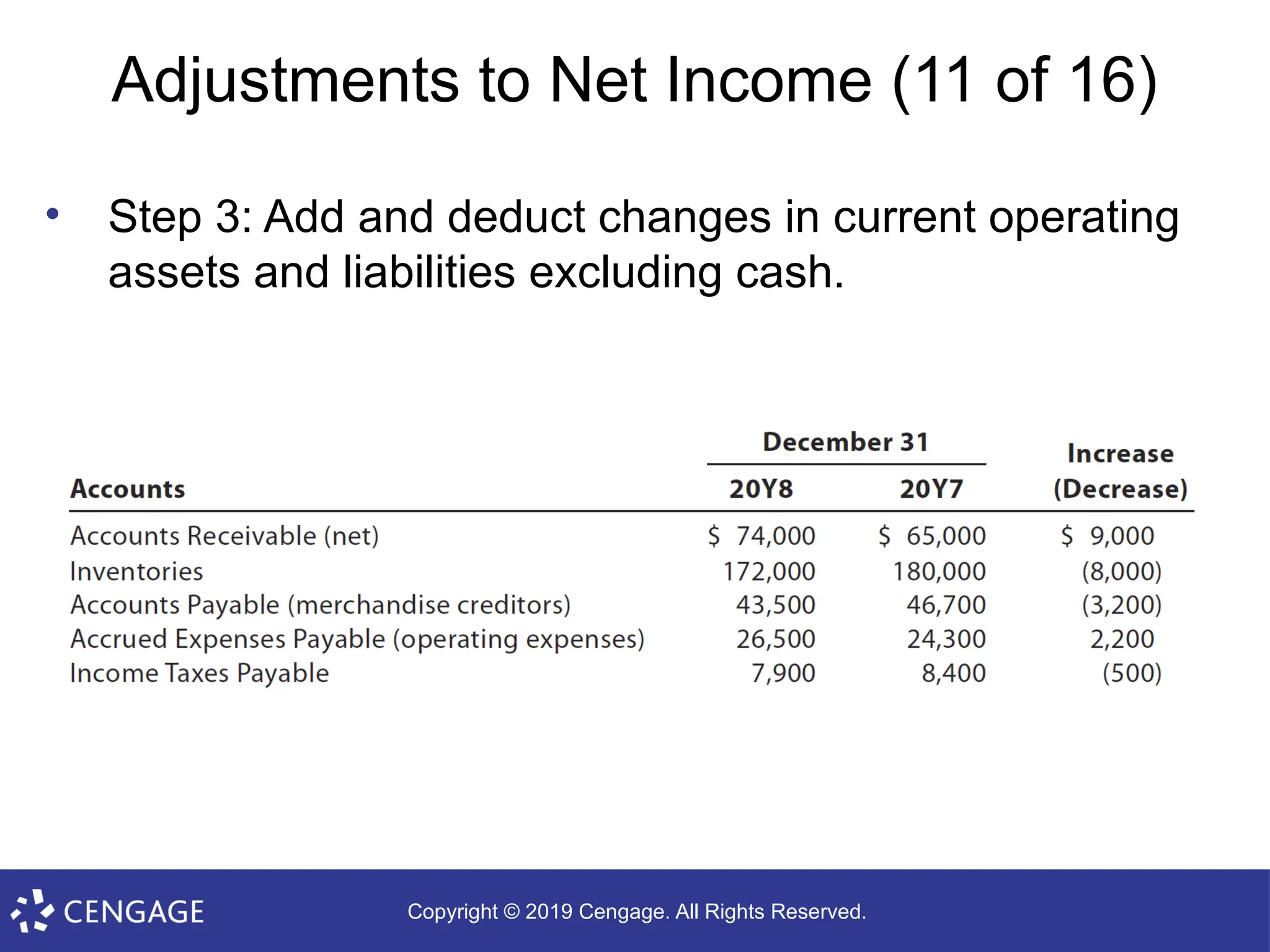
Adjustments to Net Income (7 of 16)
• Step 3: Add and deduct changes in current operating
assets and liabilities excluding cash.
Copyright © 2019 Cengage. All Rights Reserved.
Adjustments to Net Income (8 of 16)
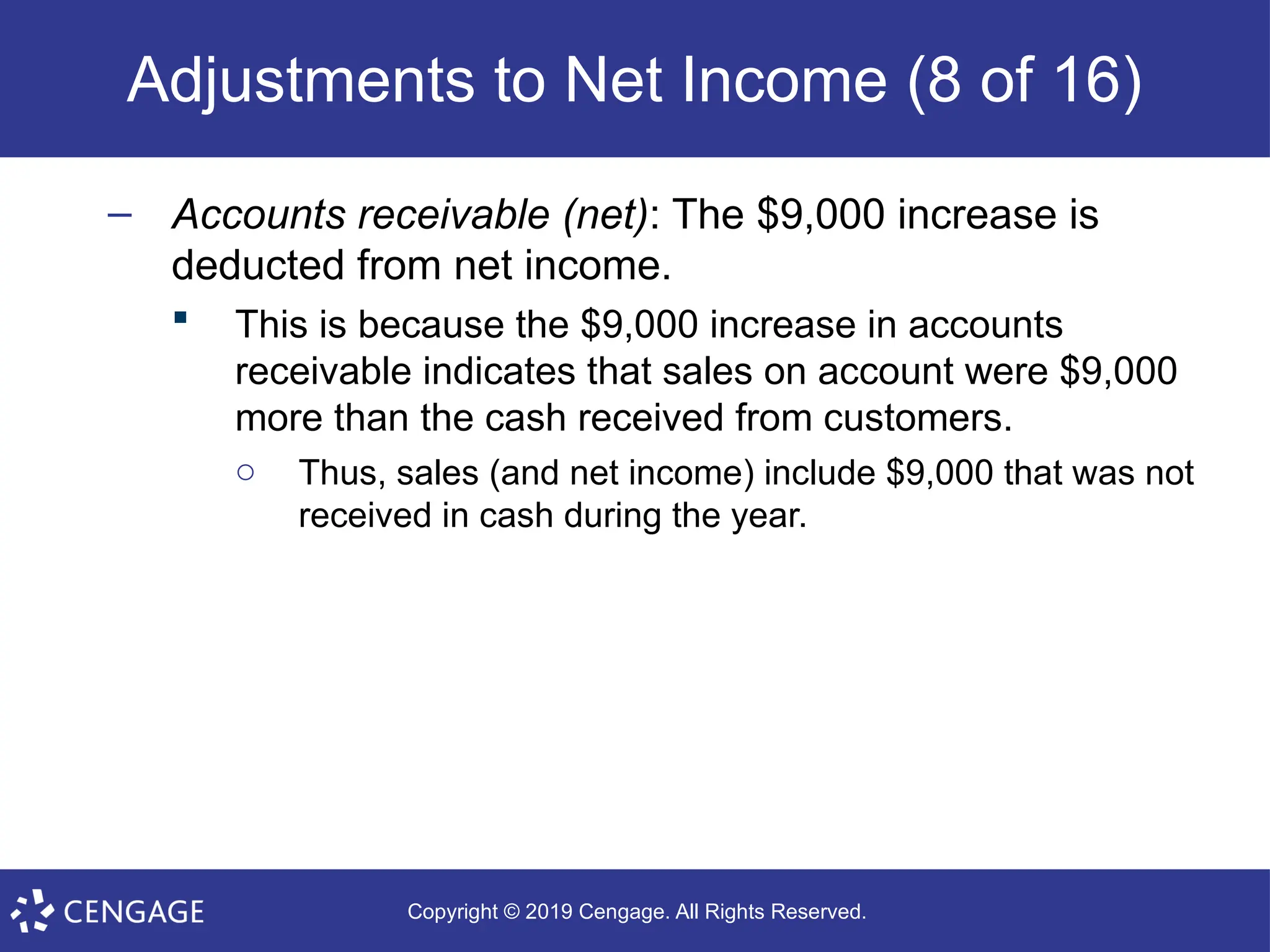
– Accounts receivable (net): The $9,000 increase is
deducted from net income.
 This is because the $9,000 increase in accounts
receivable indicates that sales on account were $9,000
more than the cash received from customers.
o Thus, sales (and net income) include $9,000 that was not
received in cash during the year.
Copyright © 2019 Cengage. All Rights Reserved.
Adjustments to Net Income (9 of 16)
• Step 3: Add and deduct changes in current operating
assets and liabilities excluding cash.
Copyright © 2019 Cengage. All Rights Reserved.
Adjustments to Net Income (10 of 16)
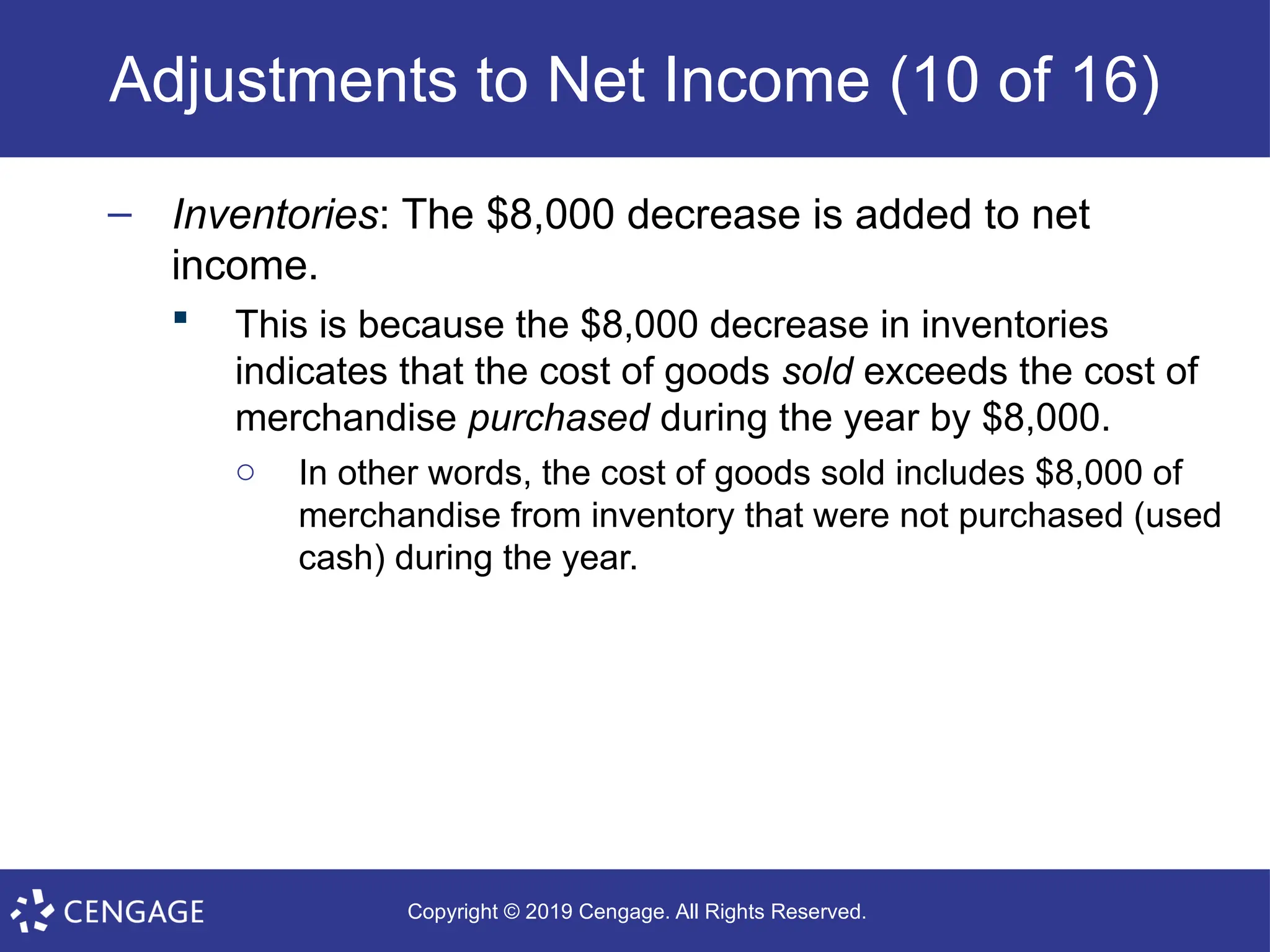
– Inventories: The $8,000 decrease is added to net
income.
 This is because the $8,000 decrease in inventories
indicates that the cost of goods sold exceeds the cost of
merchandise purchased during the year by $8,000.
o In other words, the cost of goods sold includes $8,000 of
merchandise from inventory that were not purchased (used
cash) during the year.
Copyright © 2019 Cengage. All Rights Reserved.
Adjustments to Net Income (11 of 16)
• Step 3: Add and deduct changes in current operating
assets and liabilities excluding cash.
Copyright © 2019 Cengage. All Rights Reserved.
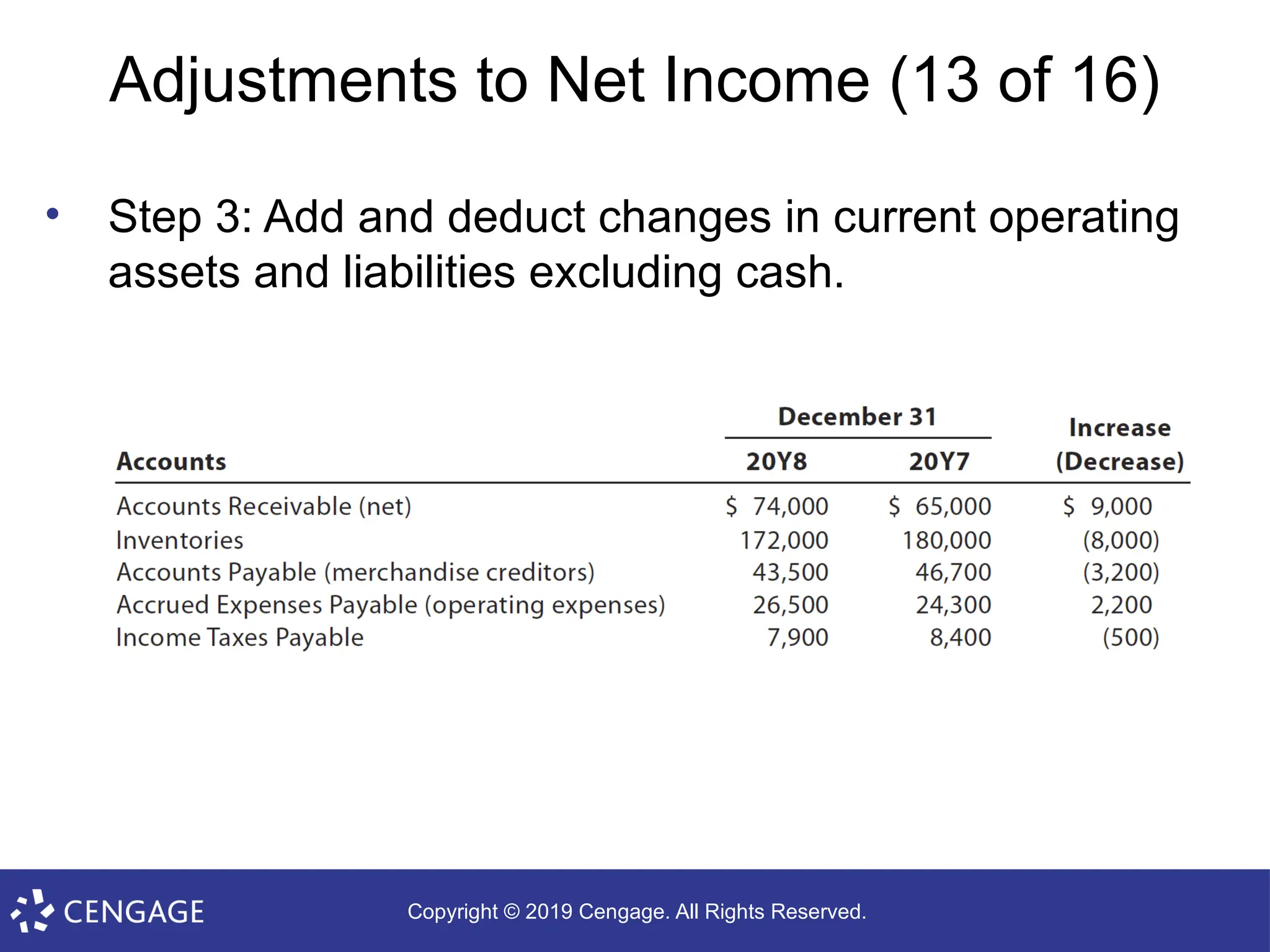
Adjustments to Net Income (12 of 16)
– Accounts payable (merchandise creditors): The $3,200
decrease is deducted from net income.
 This is because a decrease in accounts payable indicates
that the cash payments to merchandise creditors exceed
the merchandise purchased on account by $3,200.
o Therefore, the cost of goods sold is $3,200 less than the
cash paid to merchandise creditors during the year.
Copyright © 2019 Cengage. All Rights Reserved.
Adjustments to Net Income (13 of 16)
• Step 3: Add and deduct changes in current operating
assets and liabilities excluding cash.
Copyright © 2019 Cengage. All Rights Reserved.
Adjustments to Net Income (14 of 16)
– Accrued expenses payable (operating expenses): The
$2,200 increase is added to net income.
 This is because an increase in accrued expenses payable
indicates that operating expenses exceed the cash
payments for operating expenses by $2,200.
o In other words, operating expenses reported on the income
statement include $2,200 that did not require a cash outflow
during the year.
Copyright © 2019 Cengage. All Rights Reserved.
Adjustments to Net Income (15 of 16)
• Step 3: Add and deduct changes in current operating
assets and liabilities excluding cash.
Copyright © 2019 Cengage. All Rights Reserved.
Adjustments to Net Income (16 of 16)
– Income taxes payable: The $500 decrease is deducted
from net income.
 This is because a decrease in income taxes payable
indicates that taxes paid exceed the amount of taxes
incurred during the year by $500.
o In other words, the amount reported on the income
statement for income tax expense is less than the amount
paid by $500.
Copyright © 2019 Cengage. All Rights Reserved.
Check Up Corner: Cash Flow from
Operating Activities (1 of 2)
Omicron Inc. reported net income of $120,000 for 20Y2. In
addition, the income statement reported $12,000 of
depreciation expense and a $15,000 loss on the disposal
of equipment. The current operating assets and liabilities
from the company’s comparative balance sheet are as
follows:
Prepare the Cash Flows from Operating Activities section
of the statement of cash flows, using the indirect method.
Copyright © 2019 Cengage. All Rights Reserved.
Check Up Corner: Cash Flow from
Operating Activities (2 of 2)
Copyright © 2019 Cengage. All Rights Reserved.
Cash Flows from Investing Activities—
Rundell Inc.
• Cash flows from investing activities reports the cash
inflows and outflows related to changes in a company’s
long-term assets.
• Rundell Inc.’s comparative balance sheet lists land,
building and accumulated depreciation—building as
long-term assets.
• Similar to preparing the cash flows from operating
activities section, each change in each long-term asset
account is analyzed for its effect on cash flows from
investing activities.
Copyright © 2019 Cengage. All Rights Reserved.
Land (1 of 2)
• The $45,000 decline in the land account of Rundell Inc.
was from two transactions, as follows:
Copyright © 2019 Cengage. All Rights Reserved.
Land (2 of 2)
• The June 8 transaction is the sale of land with a cost of
$60,000 for $72,000 in cash. The $72,000 proceeds from the
sale are reported in the Investing Activities section as follows:
• The October 12 transaction is the purchase of land for
cash of $15,000. This transaction is reported as an outflow
of cash in the Investing Activities section as follows:
Copyright © 2019 Cengage. All Rights Reserved.
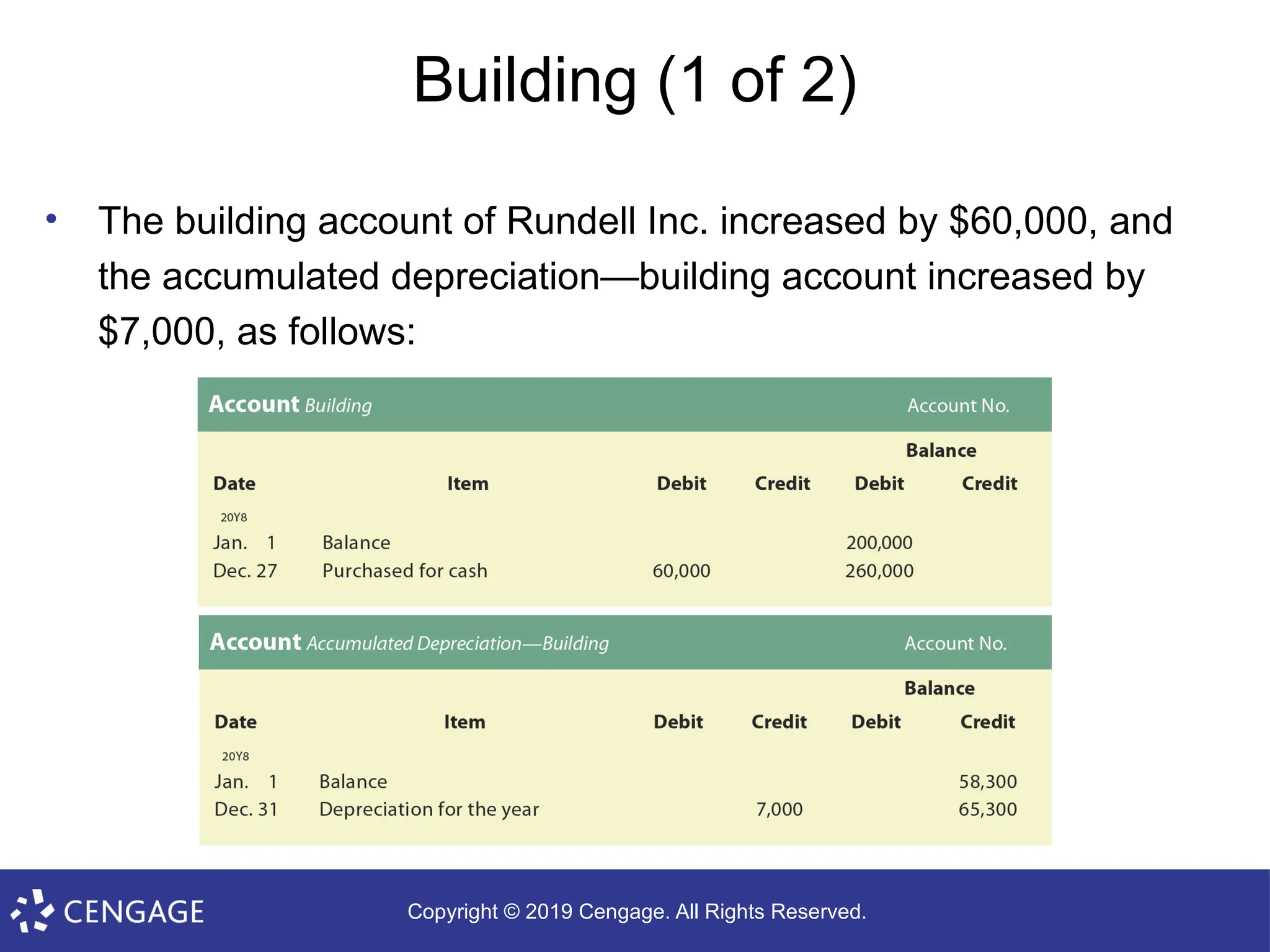
Building (1 of 2)
• The building account of Rundell Inc. increased by $60,000, and
the accumulated depreciation—building account increased by
$7,000, as follows:
Copyright © 2019 Cengage. All Rights Reserved.
Building (2 of 2)
• The purchase of a building for cash of $60,000 is
reported as an outflow of cash in the Investing
Activities section as follows:
Copyright © 2019 Cengage. All Rights Reserved.
Check Up Corner: Cash Flow from
Investing Activities (1 of 2)
Mercury Inc. reported net income of $100,000 for 20Y2. In
addition, the income statement reported $20,000 of
depreciation expense and a $10,000 gain on the sale of
land. The noncurrent assets from the company’s
comparative balance sheet are as follows:
Copyright © 2019 Cengage. All Rights Reserved.
Check Up Corner: Cash Flow from Investing
Activities (2 of 2)
There were no disposals of equipment, and all purchases
of equipment were for cash. Prepare the Cash Flows from
Investing Activities section of the statement of cash flows.
Copyright © 2019 Cengage. All Rights Reserved.
Cash Flows from Financing Activities—
Rundell Inc.
• Cash flows from financing activities reports the cash
inflows and outflows related to changes in a company’s
long-term liabilities and stockholders’ equity.
• Rundell Inc.’s comparative balance sheet reports
changes in bonds payable, common stock, and paid-in
capital in excess of par.
• In addition, dividends payable has changed, which
impacts retained earnings.
• Each change must be analyzed to determine its effect
on cash flows from financing activities
Copyright © 2019 Cengage. All Rights Reserved.
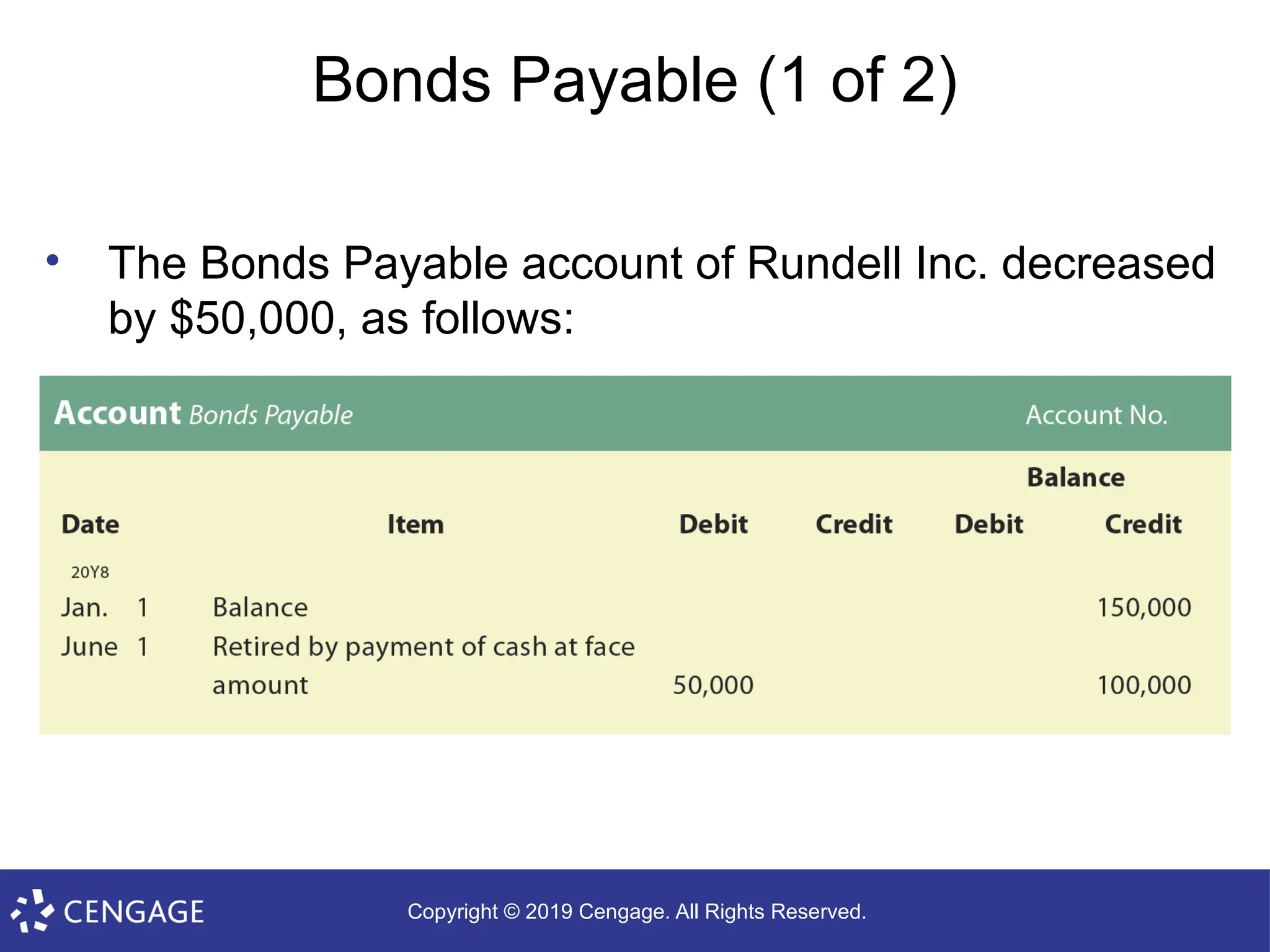
Bonds Payable (1 of 2)
• The Bonds Payable account of Rundell Inc. decreased
by $50,000, as follows:
Copyright © 2019 Cengage. All Rights Reserved.
Bonds Payable (2 of 2)
• This decrease is from retiring the bonds by a cash
payment for their face amount. This cash outflow is
reported in the Financing Activities section as follows:
Copyright © 2019 Cengage. All Rights Reserved.
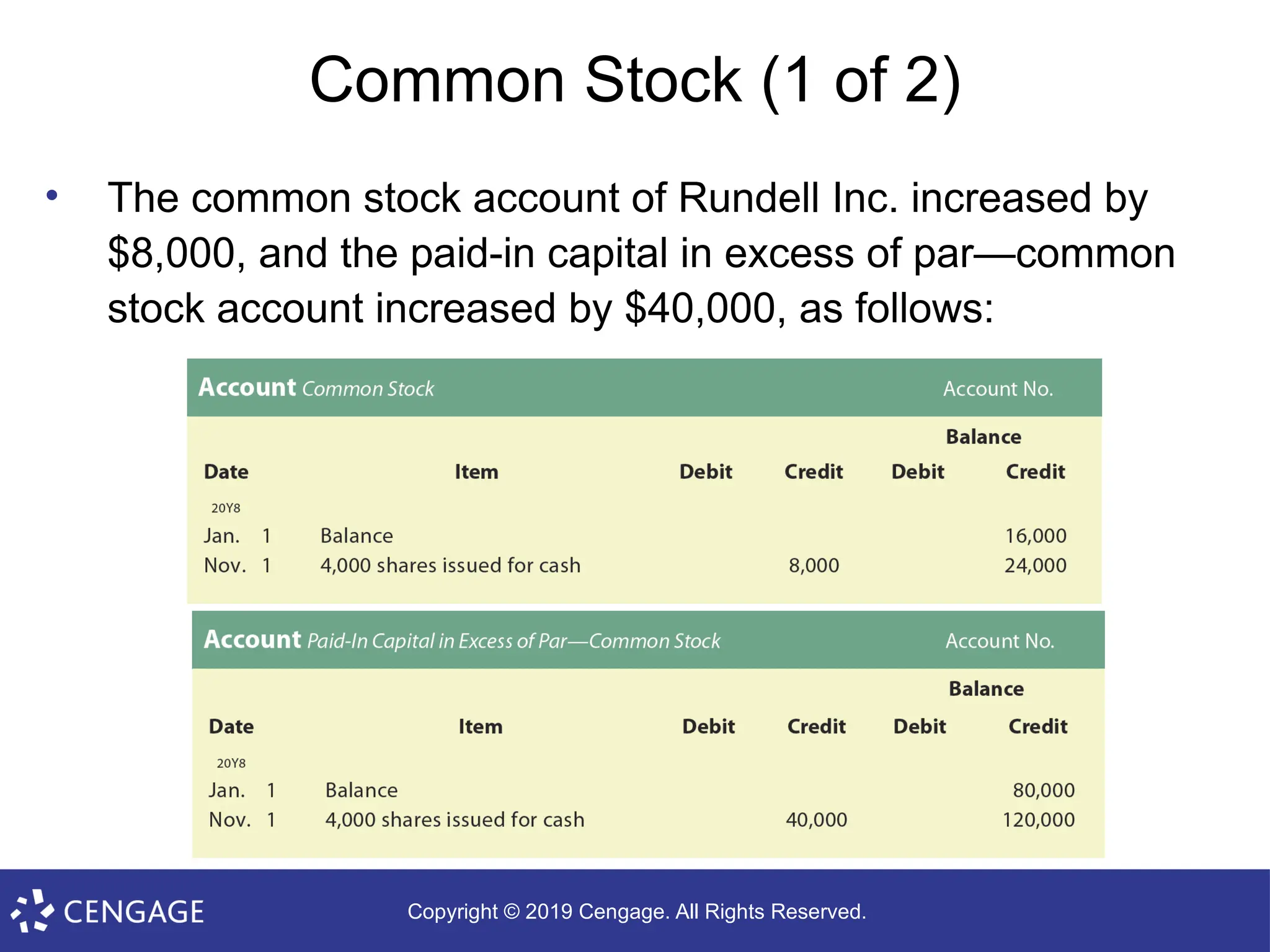
Common Stock (1 of 2)
• The common stock account of Rundell Inc. increased by
$8,000, and the paid-in capital in excess of par—common
stock account increased by $40,000, as follows:
Copyright © 2019 Cengage. All Rights Reserved.
Common Stock (2 of 2)
• These increases were from issuing 4,000 shares of
common stock for $12 per share. This cash inflow is
reported in the Financing Activities section as follows:
Copyright © 2019 Cengage. All Rights Reserved.
Dividends and Dividends Payable (1 of 5)
• The retained earnings account of Rundell Inc. indicates
cash dividends of $28,000 were declared during the
year. However, the following dividends payable account
indicates that only $24,000 ($10,000 + $14,000) of
dividends were paid during the year:
Copyright © 2019 Cengage. All Rights Reserved.
Dividends and Dividends Payable (2 of 5)
• Cash dividends paid during the year can also be computed
by adjusting the dividends declared during the year for the
change in the dividends payable account as follows:
Copyright © 2019 Cengage. All Rights Reserved.
Dividends and Dividends Payable (3 of 5)
• The cash received from customers is $ 1,171,000,
computed as follows:
Sales $ 1,180,000
Increase in accounts receivable (9,000)
Cash received from customers $ 1,171,000
Copyright © 2019 Cengage. All Rights Reserved.
Dividends and Dividends Payable (4 of 5)
• The cash dividends paid by Rundell Inc. during 20Y8
are $24,000, computed as follows:
Dividends declared($14,000+$14,000) $28,000
Increase in Dividends Payable (4,000)
Cash dividends paid $24,000
Copyright © 2019 Cengage. All Rights Reserved.
Dividends and Dividends Payable (5 of 5)
• Because dividend payments are a financing activity,
the cash dividends paid of $24,000 are reported in the
Financing Activities section of the statement of cash
flows, as follows:
Copyright © 2019 Cengage. All Rights Reserved.
Check Up Corner: Cash Flow from
Financing Activities (1 of 2)
Mohroman Inc. reported net income of $80,000 for 20Y2.
The liability and equity accounts from the company’s
comparative balance sheet are as follows:
Copyright © 2019 Cengage. All Rights Reserved.
Check Up Corner: Cash Flow from
Financing Activities (2 of 2)
During the year, the company retired bonds payable at
their face amount, declared dividends of $20,000, and
issued 2,000 shares of common stock for $60 per share.
Prepare the Cash Flows from Financing Activities section
of the statement of cash flows.
Copyright © 2019 Cengage. All Rights Reserved.
Statement of Cash Flows—Indirect Method
Copyright © 2019 Cengage. All Rights Reserved.
Analysis for Decision Making: Free Cash
Flow (1 of 5)
• Free cash flow measures the operating cash flow
available to a company to use after it purchases the
property, plant, and equipment (PP&E) necessary to
maintain its current operations.
• Free cash flow is computed as follows:
Copyright © 2019 Cengage. All Rights Reserved.
Analysis for Decision Making: Free Cash
Flow (2 of 5)
• The free cash flow can also be expressed as a
percentage of sales in order to provide a relative
measure that can be compared over time or to other
companies.
• This ratio is computed as follows:
Sales
Flow
Cash
Free
Sales
to
Flow
Cash
Free
of
Ratio 
Copyright © 2019 Cengage. All Rights Reserved.
Analysis for Decision Making: Free Cash
Flow (3 of 5)
• Positive free cash flow is considered favorable.
• A company that has free cash flow is able to fund
growth and acquisitions, retire debt, purchase treasury
stock, and pay dividends.
• A company with no free cash flow may have limited
financial flexibility, potentially leading to liquidity
problems.
Copyright © 2019 Cengage. All Rights Reserved.
Analysis for Decision Making: Free Cash
Flow (4 of 5)
• To illustrate, information from the annual reports of
National Beverage Corp. (FIZZ) for three recent years
is as follows (in thousands):
Copyright © 2019 Cengage. All Rights Reserved.
Analysis for Decision Making: Free Cash
Flow (5 of 5)
• The free cash flow is computed for the three years as
follows:
• The ratio of free cash flow to sales is as follows
(rounded to one decimal place):
Copyright © 2019 Cengage. All Rights Reserved.
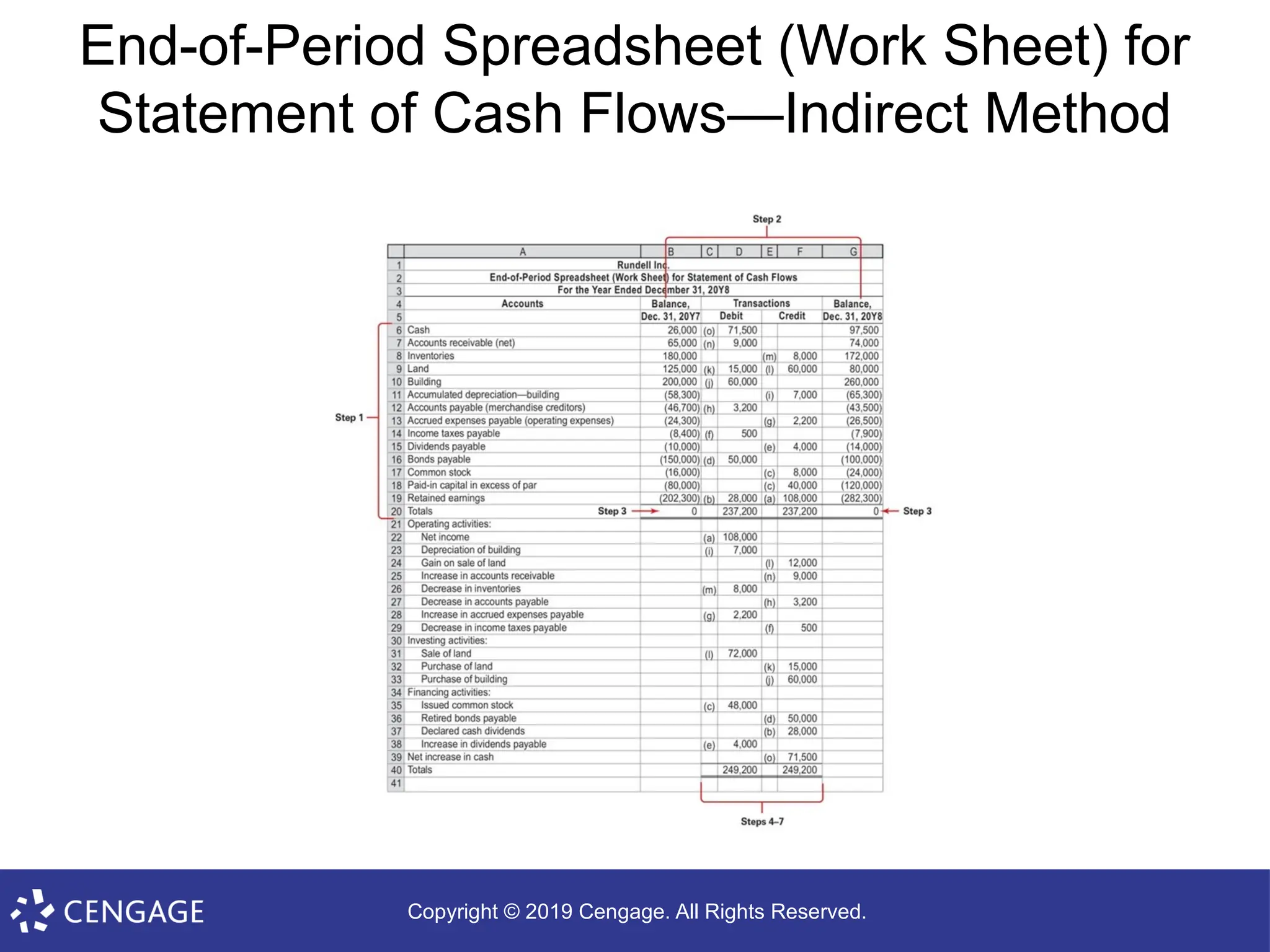
Appendix 1: Spreadsheet (Work Sheet) for Statement of
Cash Flows—The Indirect Method (1 of 3)
• A spreadsheet (work sheet) may be used in preparing
the statement of cash flows. However, whether or not a
spreadsheet (work sheet) is used, the concepts
presented in this chapter are not affected.
Copyright © 2019 Cengage. All Rights Reserved.
End-of-Period Spreadsheet (Work Sheet) for
Statement of Cash Flows—Indirect Method
Copyright © 2019 Cengage. All Rights Reserved.
Appendix 1: Spreadsheet (Work Sheet) for Statement of
Cash Flows—The Indirect Method (2 of 3)
• The steps in preparing this spreadsheet (work sheet)
are as follows:
– Step 1. List the title of each balance sheet account in the
Accounts column.
– Step 2. For each balance sheet account, enter its
balance in the two Balance columns. Place the credit
balances in parentheses.
– Step 3. Add both of the Balance columns, which should
total zero.
Copyright © 2019 Cengage. All Rights Reserved.
Appendix 1: Spreadsheet (Work Sheet) for Statement of
Cash Flows—The Indirect Method (3 of 3)
– Step 4. Analyze the change during the year in each
noncash account to determine its net increase
(decrease) and classify the change as affecting cash
flows from operating activities, investing activities,
financing activities, or noncash investing and financing
activities.
– Step 5. Indicate the effect of the change on cash flows
by making entries in the Transactions columns.
– Step 6. After all noncash accounts have been analyzed,
enter the net increase (decrease) in cash during the
period.
– Step 7. Add the Debit and Credit Transactions columns.
The total should be equal.
Copyright © 2019 Cengage. All Rights Reserved.
Appendix 2: Preparing the Statement of
Cash Flows—The Direct Method (1 of 3)
• The direct method reports cash flows from operating
activities as follows:
Copyright © 2019 Cengage. All Rights Reserved.
Appendix 2: Preparing the Statement of
Cash Flows—The Direct Method (2 of 3)
• The Cash Flows from Investing and Financing Activities
sections of the statement of cash flows are exactly the
same under both the direct and indirect methods.
• The amount of net cash flow from operating activities is
also the same, but the manner in which it is reported is
different.
– Depreciation expense is not adjusted or reported as part
of cash flows from operating activities.
 This is because depreciation expense does not involve a
cash outflow.
Copyright © 2019 Cengage. All Rights Reserved.
Appendix 2: Preparing the Statement of
Cash Flows—The Direct Method (3 of 3)
– The gain on the sale of the land is also not adjusted and
is not reported as part of cash flows from operating
activities.
 This is because the cash flow from operating activities is
determined directly, rather than by reconciling net income.
The cash proceeds from the sale of the land are reported
as an investing activity.
Copyright © 2019 Cengage. All Rights Reserved.
Converting Income Statement to Cash Flows
from Operating Activities Using the Direct
Method
Copyright © 2019 Cengage. All Rights Reserved.
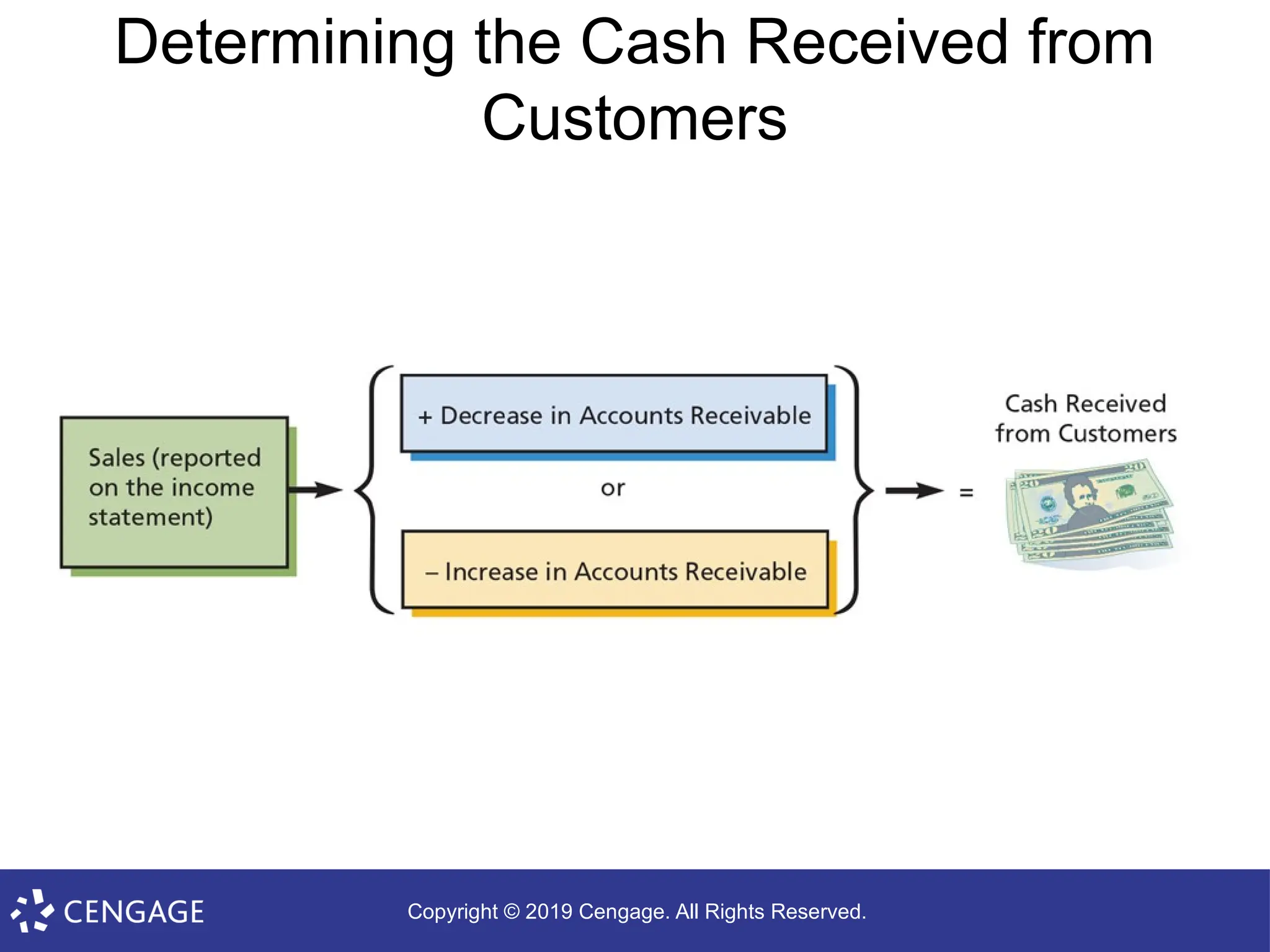
Cash Received from Customers (1 of 2)
• The income statement of Rundell Inc. (see slide 24)
reports sales of $1,180,000. To determine the cash
received from customers, the $1,180,000 is adjusted
for any increase or decrease in accounts receivable.
Copyright © 2019 Cengage. All Rights Reserved.
Determining the Cash Received from
Customers
Copyright © 2019 Cengage. All Rights Reserved.
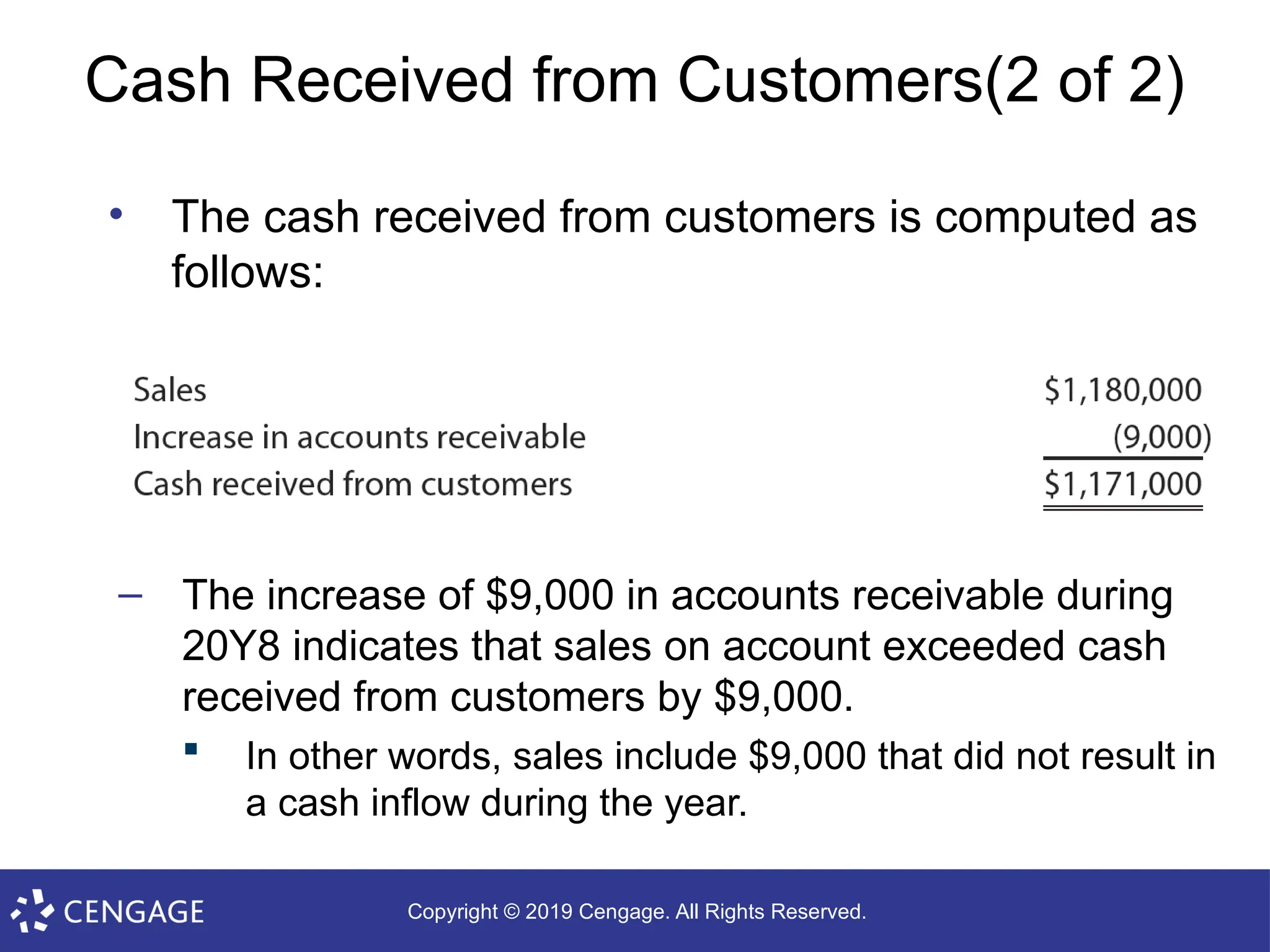
Cash Received from Customers(2 of 2)
• The cash received from customers is computed as
follows:
– The increase of $9,000 in accounts receivable during
20Y8 indicates that sales on account exceeded cash
received from customers by $9,000.
 In other words, sales include $9,000 that did not result in
a cash inflow during the year.
Copyright © 2019 Cengage. All Rights Reserved.
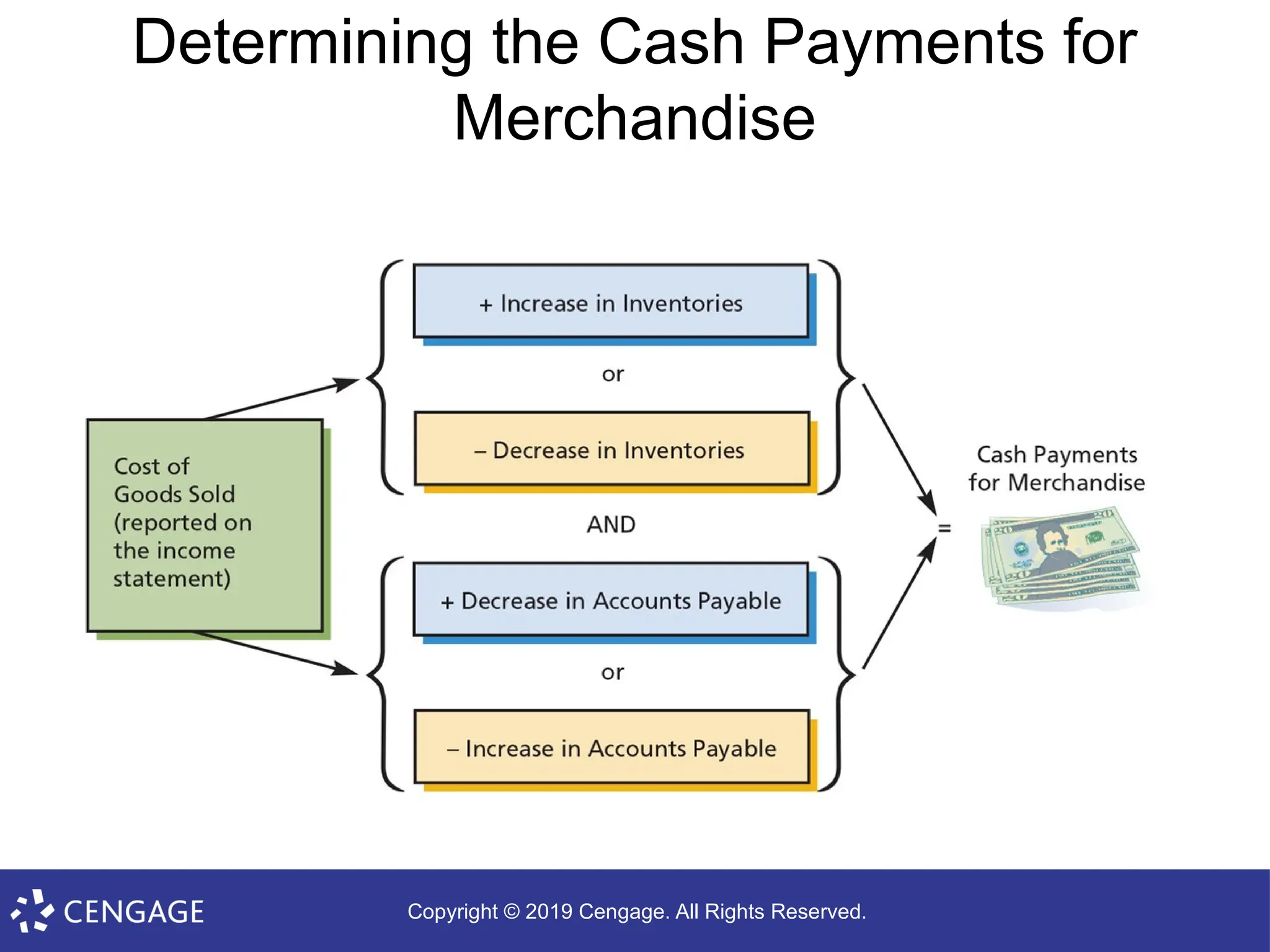
Cash Payments for Merchandise (1 of 3)
• The income statement of Rundell Inc. (see slide 26)
reports cost of goods sold of $790,000. To determine
the cash payments for merchandise, the $790,000 is
adjusted for any increases or decreases in inventories
and accounts payable.
Copyright © 2019 Cengage. All Rights Reserved.
Determining the Cash Payments for
Merchandise
Copyright © 2019 Cengage. All Rights Reserved.
Cash Payments for Merchandise(2 of 3)
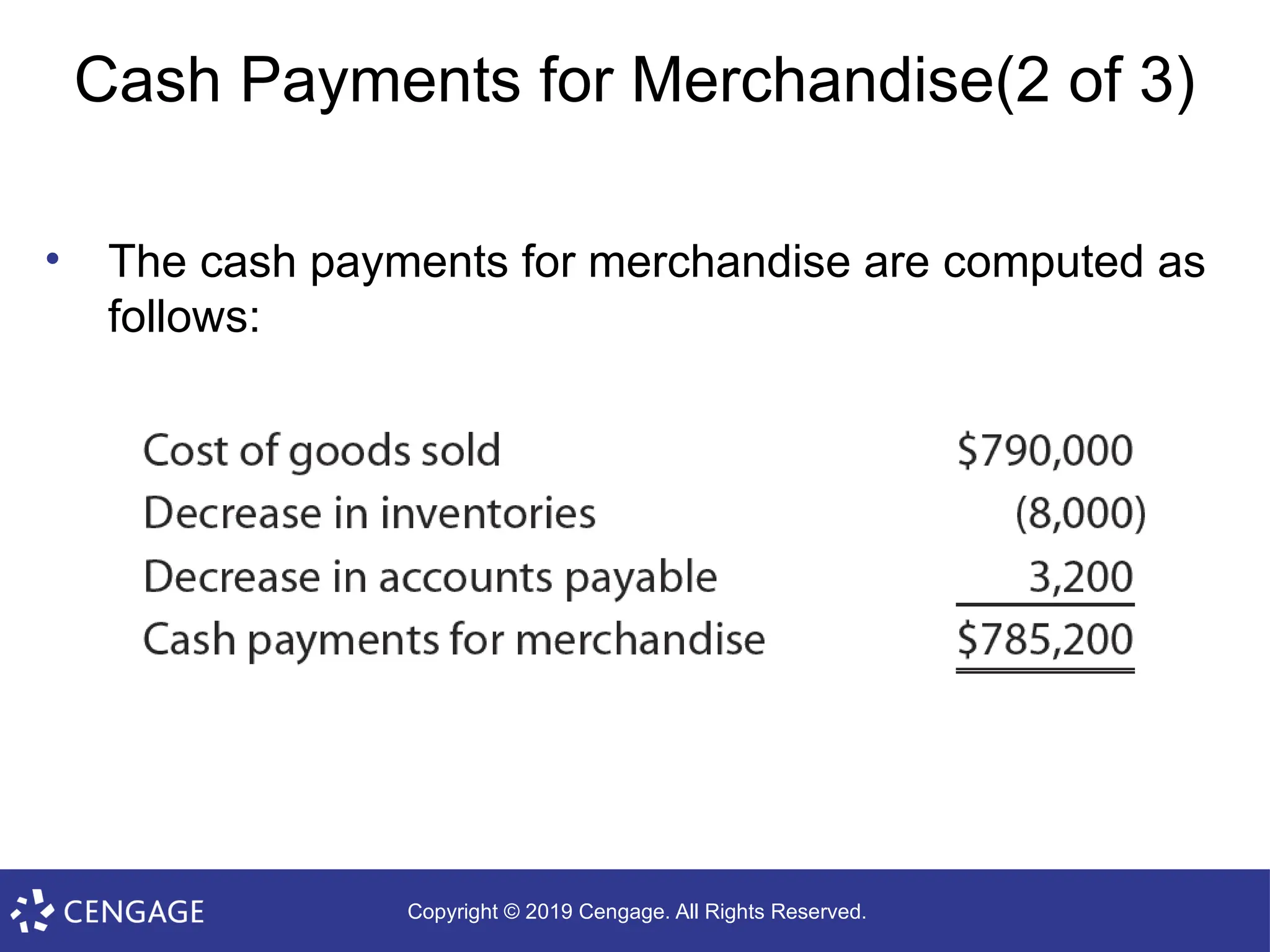
• The cash payments for merchandise are computed as
follows:
Copyright © 2019 Cengage. All Rights Reserved.
Cash Payments for Merchandise (3 of 3)
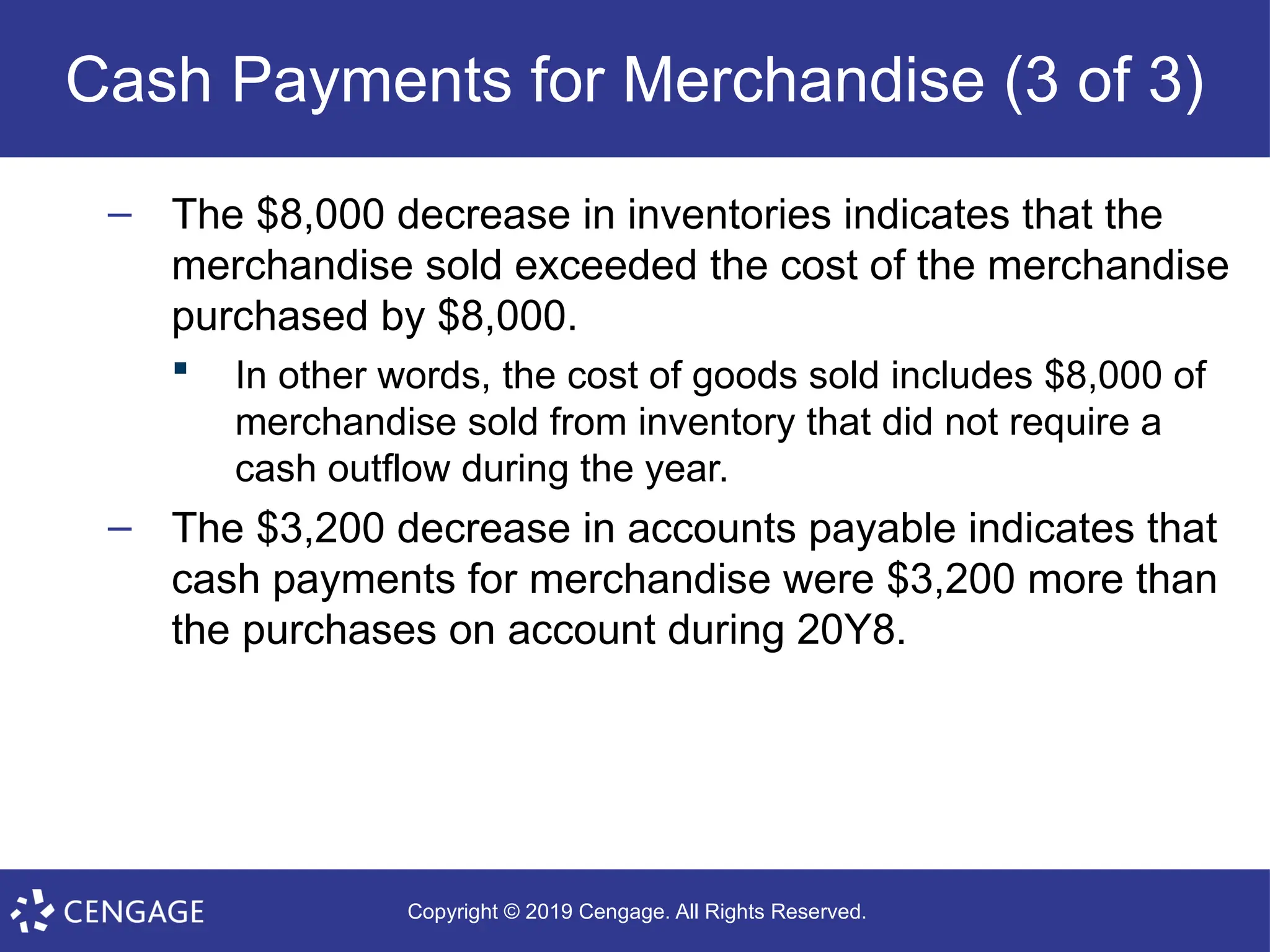
– The $8,000 decrease in inventories indicates that the
merchandise sold exceeded the cost of the merchandise
purchased by $8,000.
 In other words, the cost of goods sold includes $8,000 of
merchandise sold from inventory that did not require a
cash outflow during the year.
– The $3,200 decrease in accounts payable indicates that
cash payments for merchandise were $3,200 more than
the purchases on account during 20Y8.
Copyright © 2019 Cengage. All Rights Reserved.
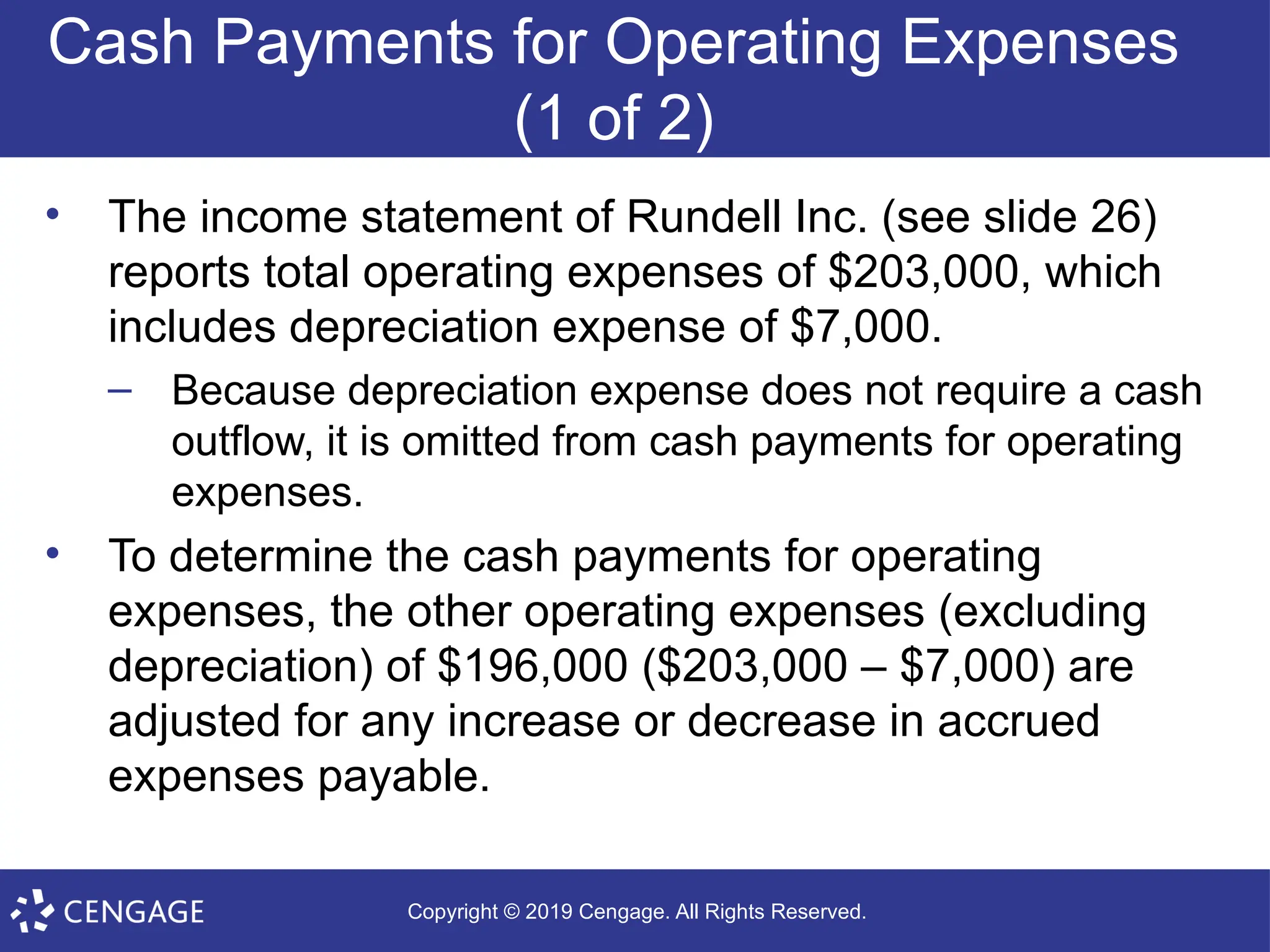
Cash Payments for Operating Expenses
(1 of 2)
• The income statement of Rundell Inc. (see slide 26)
reports total operating expenses of $203,000, which
includes depreciation expense of $7,000.
– Because depreciation expense does not require a cash
outflow, it is omitted from cash payments for operating
expenses.
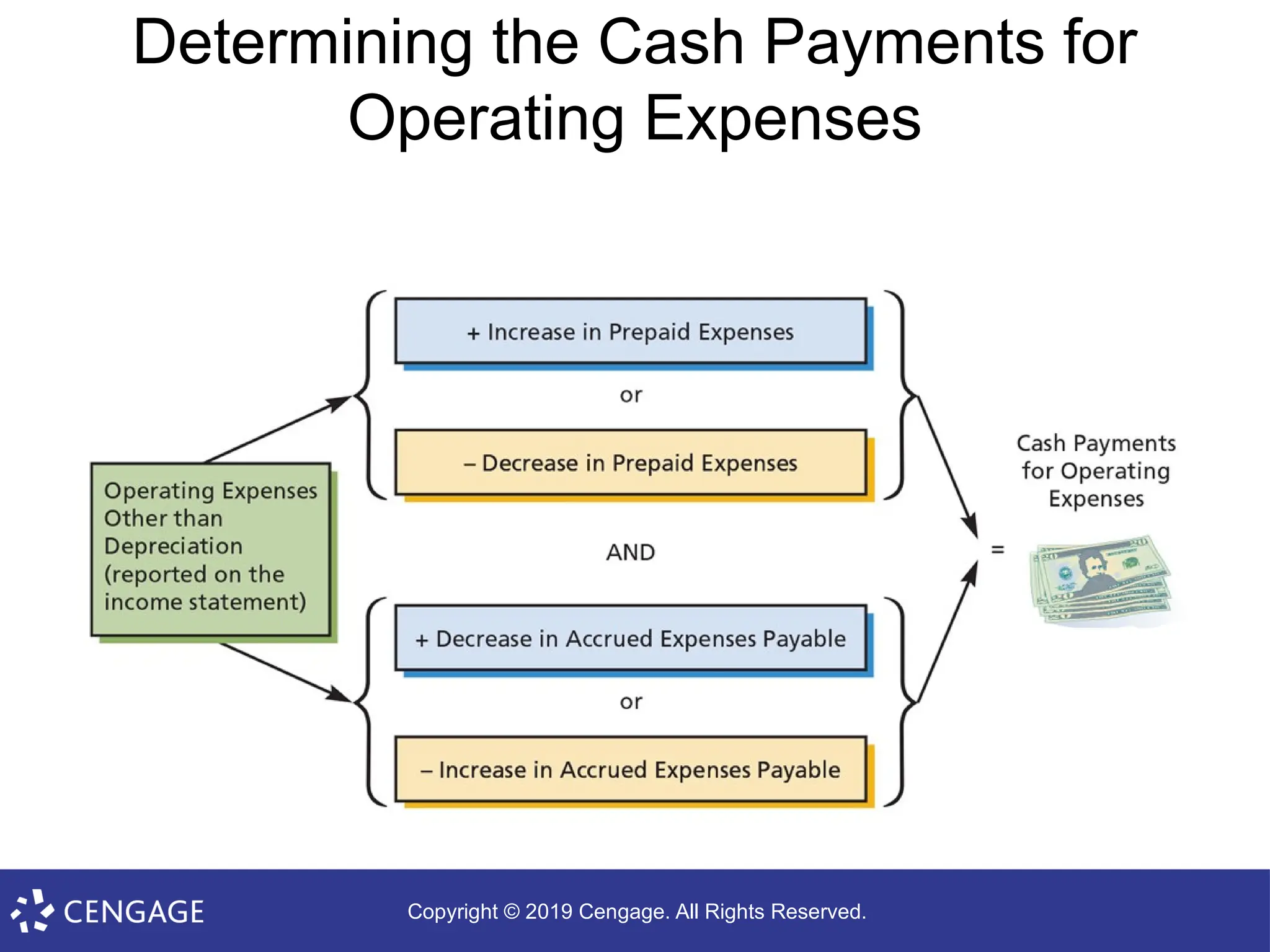
• To determine the cash payments for operating
expenses, the other operating expenses (excluding
depreciation) of $196,000 ($203,000 – $7,000) are
adjusted for any increase or decrease in accrued
expenses payable.
Copyright © 2019 Cengage. All Rights Reserved.
Determining the Cash Payments for
Operating Expenses
Copyright © 2019 Cengage. All Rights Reserved.
Cash Payments for Operating Expenses
(2 of 2)
• The cash payments for operating expenses are
computed as follows:
– The increase in accrued expenses payable indicates
that the cash payments for operating expenses were
$2,200 less than the amount reported for operating
expenses during the year.
Copyright © 2019 Cengage. All Rights Reserved.
Gain on Sale of Land
• The income statement for Rundell Inc. (see slide 24)
reports a gain of $12,000 on the sale of land.
– The sale of land is an investing activity. Thus, the
proceeds from the sale, which include the gain, are
reported as part of the cash flows from investing
activities.
Copyright © 2019 Cengage. All Rights Reserved.
Interest Expense (1 of 2)
• The income statement of Rundell Inc. (see slide 26)
reports interest expense of $8,000.
• To determine the cash payments for interest, the
$8,000 is adjusted for any increases or decreases in
interest payable.
Copyright © 2019 Cengage. All Rights Reserved.
Determining the Cash Payments for
Interest
Copyright © 2019 Cengage. All Rights Reserved.
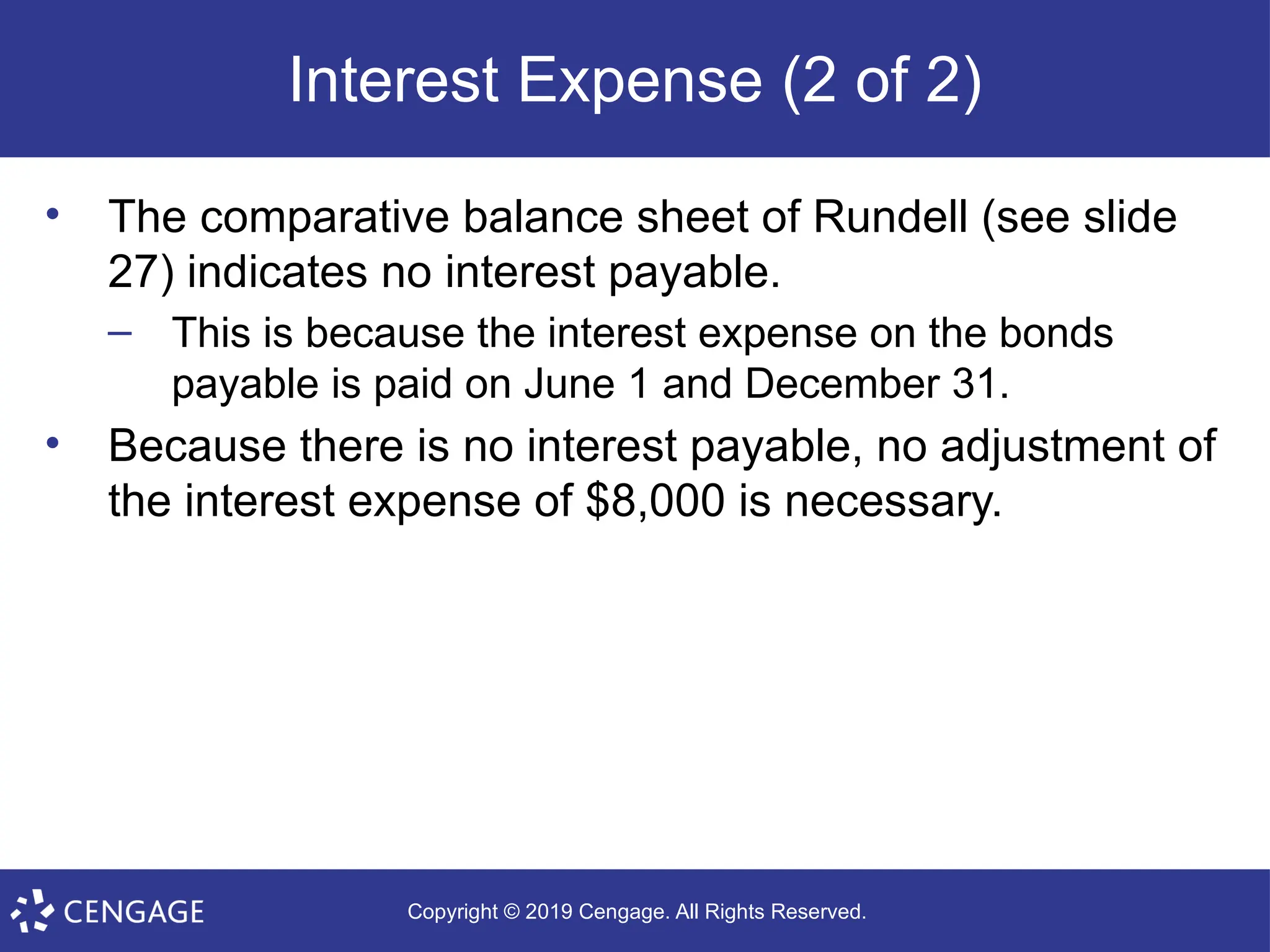
Interest Expense (2 of 2)
• The comparative balance sheet of Rundell (see slide
27) indicates no interest payable.
– This is because the interest expense on the bonds
payable is paid on June 1 and December 31.
• Because there is no interest payable, no adjustment of
the interest expense of $8,000 is necessary.
Copyright © 2019 Cengage. All Rights Reserved.
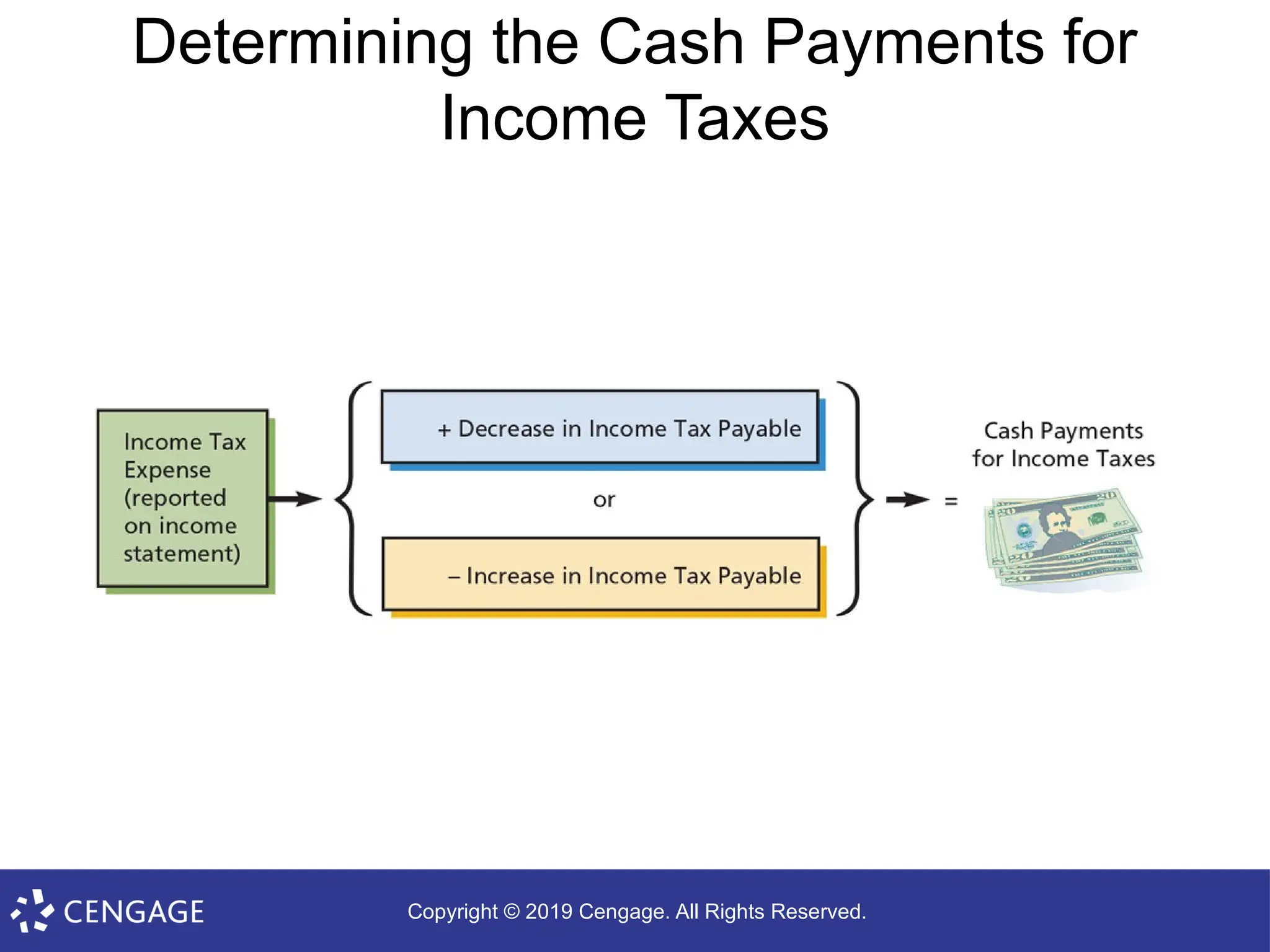
Cash Payments for Income Taxes (1 of 2)
• The income statement of Rundell Inc. (see slide 26)
reports income tax expense of $83,000.
• To determine the cash payments for income taxes, the
$83,000 is adjusted for any increases or decreases in
income taxes payable.
Copyright © 2019 Cengage. All Rights Reserved.
Determining the Cash Payments for
Income Taxes
Copyright © 2019 Cengage. All Rights Reserved.
Cash Payments for Income Taxes (2 of 2)
• The cash payments for income taxes are computed as
follows:
– The $500 decrease in income taxes payable indicates
that the cash payments for income taxes were $500
more than the amount reported for income tax expense
during 20Y8.
Copyright © 2019 Cengage. All Rights Reserved.
Statement of Cash Flows—Direct Method

MA-15e_IE-PPT_Ch15 (1).pptxPPPPPPPPPPPPP

  • 1.
    Managerial Accounting Fifteenth Edition Chapter15 Statement of Cash Flows Copyright © 2019 Cengage. All Rights Reserved.
  • 2.
    Copyright © 2019Cengage. All Rights Reserved. Learning Objectives (1 of 2) • Obj. 1: Describe the cash flow activities reported on the statement of cash flows. • Obj. 2: Prepare the cash flows from operating activities section of the statement of cash flows using the indirect method. • Obj. 3: Prepare the cash flows from investing activities section of the statement of cash flows. • Obj. 4: Prepare the cash flows from financing activities section of the statement of cash flows.
  • 3.
    Copyright © 2019Cengage. All Rights Reserved. Learning Objectives (2 of 2) • Obj. 5: Prepare a statement of cash flows. • Obj. 6: Describe and illustrate the use of free cash flow in evaluating a company’s cash flow. • Obj. App 1: Use a spreadsheet to prepare the statement of cash flows under the indirect method. • Obj. App 2: Prepare a statement of cash flows under the direct method.
  • 4.
    Copyright © 2019Cengage. All Rights Reserved. Reporting Cash Flows (1 of 6) • The statement of cash flows reports a company’s cash inflows and outflows for a period. • The statement of cash flows provides useful information about a company’s ability to do the following: – Generate cash from operations – Maintain and expand its operating capacity – Meet its financial obligations – Pay dividends
  • 5.
    Copyright © 2019Cengage. All Rights Reserved. Reporting Cash Flows (2 of 6) • The statement of cash flows is used by managers in evaluating past operations and in planning future investing and financing activities. • It is also used by external users such as investors and creditors to assess a company’s profit potential and ability to pay its debt and pay dividends.
  • 6.
    Copyright © 2019Cengage. All Rights Reserved. Reporting Cash Flows (3 of 6) • The statement of cash flows reports three types of cash flow activities, as follows: 1. Cash flows from operating activities are the cash flows from transactions that affect the net income of the company.  Example: Purchase and sale of merchandise by a retailer.
  • 7.
    Copyright © 2019Cengage. All Rights Reserved. Reporting Cash Flows (4 of 6) 2. Cash flows from investing activities are the cash flows from transactions that affect investments in the noncurrent assets of the company.  Example: Purchase and sale of fixed assets, such as equipment and buildings. 3. Cash flows from financing activities are the cash flows from transactions that affect the debt and equity of the company.  Example: Issuing or retiring equity and debt securities.
  • 8.
    Copyright © 2019Cengage. All Rights Reserved. Reporting Cash Flows (5 of 6) • The cash flows are reported on the statement of cash flows as follows: – The ending cash on the statement of cash flows equals the cash reported on the company’s balance sheet at the end of the year.
  • 9.
    Copyright © 2019Cengage. All Rights Reserved. Reporting Cash Flows (6 of 6) • A source of cash causes the cash flow to increase and is called a cash inflow. • A use of cash causes cash flow to decrease and is called cash outflow.
  • 10.
    Copyright © 2019Cengage. All Rights Reserved. Sources and Uses of Cash
  • 11.
    Copyright © 2019Cengage. All Rights Reserved. Cash Flows from Operating Activities • Cash flows from operating activities report the cash inflows and outflows from a company’s day-to-day operations. • Companies may select one of the following two alternative methods for reporting cash flows from operating activities on the statement of cash flows: – The direct method – The indirect method • Both methods result in the same amount of cash flow from operating activities. They differ in the way they report cash flows from operating activities.
  • 12.
    Copyright © 2019Cengage. All Rights Reserved. Cash Flows from Operating Activities: The Direct Method (1 of 3) • The direct method reports operating cash inflows (receipts) and cash outflows (payments) as follows: – The primary operating cash inflow is cash received from customers.
  • 13.
    Copyright © 2019Cengage. All Rights Reserved. Cash Flows from Operating Activities: The Direct Method (2 of 3) – The primary operating cash outflows are cash payments for merchandise, operating expenses, interest, and income tax payments. – The cash received from operating activities less the cash payments for operating activities is the net cash flow from operating activities.
  • 14.
    Copyright © 2019Cengage. All Rights Reserved. Cash Flows from Operating Activities: The Direct Method (3 of 3) • The primary advantage of the direct method is that it directly reports cash receipts and cash payments on the statement of cash flows. • Its primary disadvantage is that these data may not be readily available in the accounting records. – Thus, the direct method is normally more costly to prepare and, as a result, is used infrequently in practice.
  • 15.
    Copyright © 2019Cengage. All Rights Reserved. Cash Flows from Operating Activities: The Indirect Method (1 of 3) • The indirect method reports cash flows from operating activities by beginning with net income and adjusting it for revenues and expenses that do not involve the receipt of cash or payment of cash, as follows:
  • 16.
    Copyright © 2019Cengage. All Rights Reserved. Cash Flows from Operating Activities: The Indirect Method (2 of 3) – The adjustments to reconcile net income to net cash flow from operating activities include such items as depreciation and gains or losses on fixed assets. – Changes in current operating assets and liabilities such as accounts receivable or accounts payable are also added or deducted, depending on their effect on cash flows.
  • 17.
    Copyright © 2019Cengage. All Rights Reserved. Cash Flows from Operating Activities: The Indirect Method (3 of 3) • A primary advantage of the indirect method is that it reconciles the differences between net income and net cash flows from operations. • Because the data are readily available, the indirect method is less costly to prepare than the direct method. – As a result, the indirect method of reporting cash flows from operations is most commonly used in practice.
  • 18.
    Copyright © 2019Cengage. All Rights Reserved. Cash Flow from Operations: Direct and Indirect Methods—NetSolutions
  • 19.
    Copyright © 2019Cengage. All Rights Reserved. Cash Flows from Investing Activities • Cash flows from investing activities show the cash inflows and outflows related to changes in a company’s long-term assets. • Cash flows from investing activities are reported on the statement of cash flows as follows: – Cash inflows from investing activities normally arise from selling fixed assets, investments, and intangible assets. – Cash outflows normally include payments to purchase fixed assets, investments, and intangible assets.
  • 20.
    Copyright © 2019Cengage. All Rights Reserved. Cash Flows from Financing Activities (1 of 2) • Cash flows from financing activities show the cash inflows and outflows related to changes in a company’s long-term liabilities and stockholders’ equity. • Cash flows from financing activities are reported on the statement of cash flows as follows:
  • 21.
    Copyright © 2019Cengage. All Rights Reserved. Cash Flows from Financing Activities (2 of 2) – Cash inflows from financing activities normally arise from issuing long-term debt or equity securities.  Example: issuing bonds, notes payable, preferred stock, and common stock creates cash inflows from financing activities. – Cash outflows from financing activities normally include paying cash dividends, repaying long-term debt, and acquiring treasury stock.
  • 22.
    Copyright © 2019Cengage. All Rights Reserved. Noncash Investing and Financing Activities • A company may enter into transactions involving investing and financing activities that do not directly affect cash. – For example, a company may issue common stock to retire long-term debt. • Because such transactions indirectly affect cash flows, they are reported in a separate section that usually appears at the bottom of the statement of cash flows.
  • 23.
    Copyright © 2019Cengage. All Rights Reserved. Order of Reporting Statement of Cash Flows
  • 24.
    Copyright © 2019Cengage. All Rights Reserved. No Cash Flow Per Share • Cash flow per share is computed as follows: g Outstandin Shares Common of Number Operations from Flow Cash share per Flow Cash  • Cash flow per share should not be reported on a company’s financial statements for the following reasons: – Users may misinterpret cash flow per share as the per- share amount available for dividends. – Users may misinterpret cash flow per share as equivalent to (or better than) earnings per share.
  • 25.
    Copyright © 2019Cengage. All Rights Reserved. Check Up Corner: Classifications of Cash Flows (1 of 2) During its first month of operations, Templeton Company had the following cash transactions: A. Issued 30,000 shares of common stock. B. Purchased a new piece of equipment. C. Sold merchandise to customers. D. Paid employees’ wages. E. Paid a dividend. Identify whether each of these transactions would be reported as an operating, investing, or financing activity on the statement of cash flows.
  • 26.
    Copyright © 2019Cengage. All Rights Reserved. Check Up Corner: Classifications of Cash Flows (2 of 2)
  • 27.
    Copyright © 2019Cengage. All Rights Reserved. Cash Flows from Operating Activities— The Indirect Method (1 of 2) • The indirect method of reporting cash flows from operating activities uses the logic that a change in any balance sheet account (including cash) can be analyzed in terms of changes in other balance sheet accounts: – Therefore, any change in the cash account can be determined by analyzing changes in the liability, stockholders’ equity, and noncash asset accounts as follows:
  • 28.
    Copyright © 2019Cengage. All Rights Reserved. Cash Flows from Operating Activities— The Indirect Method (2 of 2) • Under the indirect method, there is no order in which the balance sheet accounts must be analyzed. However, because net income (or net loss) is a component of any change in Retained Earnings, the first account normally analyzed is Retained Earnings.
  • 29.
    Copyright © 2019Cengage. All Rights Reserved. Income Statement and Comparative Balance Sheet (1 of 2)
  • 30.
    Copyright © 2019Cengage. All Rights Reserved. Income Statement and Comparative Balance Sheet (2 of 2)
  • 31.
    Copyright © 2019Cengage. All Rights Reserved. Net Income (1 of 2) • Rundell Inc.’s net income for 20Y8 is $108,000 as shown in the income statement on slide 26. • Since net income is closed to Retained Earnings, net income also helps explain the change in retained earnings during the year.
  • 32.
    Copyright © 2019Cengage. All Rights Reserved. Net Income (2 of 2) • The retained earnings account for Rundell is as follows: – The retained earnings account indicates that the $80,000 ($282,300 - $202,300) change resulted from net income of $108,000 and cash dividends of $28,000.  The net income of $108,000 is the first amount reported in the Cash Flows from Operating Activities section.  The impact of the dividends of $28,000 on cash flows will be included as part of financing activities.
  • 33.
    Copyright © 2019Cengage. All Rights Reserved. Adjustments to Net Income (1 of 16) • The net income of $108,000 reported by Rundell Inc. does not equal the cash flows from operating activities for the period. – This is because net income is determined using the accrual method of accounting.  Under the accrual method of accounting, revenues and expenses are recorded at different times from when cash is received or paid. Thus, under the indirect method, adjustments to net income must be made to determine cash flows from operating activities.
  • 34.
    Copyright © 2019Cengage. All Rights Reserved. Adjustments to Net Income (Loss) Using the Indirect Method
  • 35.
    Copyright © 2019Cengage. All Rights Reserved. Adjustments to Net Income (2 of 16) • Net income is normally adjusted to cash flows from operating activities, using the following steps: – Step 1. Expenses that do not affect cash are added. Such expenses decrease net income but do not involve cash payments and, thus, are added to net income. – Step 2. Losses on the disposal of assets are added and gains on the disposal of assets are deducted.
  • 36.
    Copyright © 2019Cengage. All Rights Reserved. Adjustments to Net Income (3 of 16) – Step 3. Changes in current operating assets and liabilities are added or deducted as follows:  Increases in noncash current operating assets are deducted.  Decrease in noncash current operating assets are added.  Increases in current operating liabilities are added.  Decreases in current operating liabilities are deducted.
  • 37.
    Copyright © 2019Cengage. All Rights Reserved. Net Cash Flow from Operating Activities— Indirect Method
  • 38.
    Copyright © 2019Cengage. All Rights Reserved. Adjustments to Net Income (4 of 16) • The next few slides will show how Rundell’s net income of $108,000 is converted to cash flows from operating activities of $100,500.
  • 39.
    Copyright © 2019Cengage. All Rights Reserved. Adjustments to Net Income (5 of 16) • Step 1: Add depreciation of $7,000. – Analysis: The comparative balance sheet indicates that Accumulated Depreciation—Building increased by $7,000. The following account indicates that depreciation for the year was $7,000 for the building:
  • 40.
    Copyright © 2019Cengage. All Rights Reserved. Adjustments to Net Income (6 of 16) • Step 2: Deduct the gain on the sale of land of $12,000. – Analysis: The income statement reports a gain of $12,000 from the sale of land. The proceeds, which include the gain, are reported in the Investing section of the statement of cash flows. Thus, the gain of $12,000 is deducted from net income in determining cash flows from operating activities.
  • 41.
    Copyright © 2019Cengage. All Rights Reserved. Adjustments to Net Income (7 of 16) • Step 3: Add and deduct changes in current operating assets and liabilities excluding cash.
  • 42.
    Copyright © 2019Cengage. All Rights Reserved. Adjustments to Net Income (8 of 16) – Accounts receivable (net): The $9,000 increase is deducted from net income.  This is because the $9,000 increase in accounts receivable indicates that sales on account were $9,000 more than the cash received from customers. o Thus, sales (and net income) include $9,000 that was not received in cash during the year.
  • 43.
    Copyright © 2019Cengage. All Rights Reserved. Adjustments to Net Income (9 of 16) • Step 3: Add and deduct changes in current operating assets and liabilities excluding cash.
  • 44.
    Copyright © 2019Cengage. All Rights Reserved. Adjustments to Net Income (10 of 16) – Inventories: The $8,000 decrease is added to net income.  This is because the $8,000 decrease in inventories indicates that the cost of goods sold exceeds the cost of merchandise purchased during the year by $8,000. o In other words, the cost of goods sold includes $8,000 of merchandise from inventory that were not purchased (used cash) during the year.
  • 45.
    Copyright © 2019Cengage. All Rights Reserved. Adjustments to Net Income (11 of 16) • Step 3: Add and deduct changes in current operating assets and liabilities excluding cash.
  • 46.
    Copyright © 2019Cengage. All Rights Reserved. Adjustments to Net Income (12 of 16) – Accounts payable (merchandise creditors): The $3,200 decrease is deducted from net income.  This is because a decrease in accounts payable indicates that the cash payments to merchandise creditors exceed the merchandise purchased on account by $3,200. o Therefore, the cost of goods sold is $3,200 less than the cash paid to merchandise creditors during the year.
  • 47.
    Copyright © 2019Cengage. All Rights Reserved. Adjustments to Net Income (13 of 16) • Step 3: Add and deduct changes in current operating assets and liabilities excluding cash.
  • 48.
    Copyright © 2019Cengage. All Rights Reserved. Adjustments to Net Income (14 of 16) – Accrued expenses payable (operating expenses): The $2,200 increase is added to net income.  This is because an increase in accrued expenses payable indicates that operating expenses exceed the cash payments for operating expenses by $2,200. o In other words, operating expenses reported on the income statement include $2,200 that did not require a cash outflow during the year.
  • 49.
    Copyright © 2019Cengage. All Rights Reserved. Adjustments to Net Income (15 of 16) • Step 3: Add and deduct changes in current operating assets and liabilities excluding cash.
  • 50.
    Copyright © 2019Cengage. All Rights Reserved. Adjustments to Net Income (16 of 16) – Income taxes payable: The $500 decrease is deducted from net income.  This is because a decrease in income taxes payable indicates that taxes paid exceed the amount of taxes incurred during the year by $500. o In other words, the amount reported on the income statement for income tax expense is less than the amount paid by $500.
  • 51.
    Copyright © 2019Cengage. All Rights Reserved. Check Up Corner: Cash Flow from Operating Activities (1 of 2) Omicron Inc. reported net income of $120,000 for 20Y2. In addition, the income statement reported $12,000 of depreciation expense and a $15,000 loss on the disposal of equipment. The current operating assets and liabilities from the company’s comparative balance sheet are as follows: Prepare the Cash Flows from Operating Activities section of the statement of cash flows, using the indirect method.
  • 52.
    Copyright © 2019Cengage. All Rights Reserved. Check Up Corner: Cash Flow from Operating Activities (2 of 2)
  • 53.
    Copyright © 2019Cengage. All Rights Reserved. Cash Flows from Investing Activities— Rundell Inc. • Cash flows from investing activities reports the cash inflows and outflows related to changes in a company’s long-term assets. • Rundell Inc.’s comparative balance sheet lists land, building and accumulated depreciation—building as long-term assets. • Similar to preparing the cash flows from operating activities section, each change in each long-term asset account is analyzed for its effect on cash flows from investing activities.
  • 54.
    Copyright © 2019Cengage. All Rights Reserved. Land (1 of 2) • The $45,000 decline in the land account of Rundell Inc. was from two transactions, as follows:
  • 55.
    Copyright © 2019Cengage. All Rights Reserved. Land (2 of 2) • The June 8 transaction is the sale of land with a cost of $60,000 for $72,000 in cash. The $72,000 proceeds from the sale are reported in the Investing Activities section as follows: • The October 12 transaction is the purchase of land for cash of $15,000. This transaction is reported as an outflow of cash in the Investing Activities section as follows:
  • 56.
    Copyright © 2019Cengage. All Rights Reserved. Building (1 of 2) • The building account of Rundell Inc. increased by $60,000, and the accumulated depreciation—building account increased by $7,000, as follows:
  • 57.
    Copyright © 2019Cengage. All Rights Reserved. Building (2 of 2) • The purchase of a building for cash of $60,000 is reported as an outflow of cash in the Investing Activities section as follows:
  • 58.
    Copyright © 2019Cengage. All Rights Reserved. Check Up Corner: Cash Flow from Investing Activities (1 of 2) Mercury Inc. reported net income of $100,000 for 20Y2. In addition, the income statement reported $20,000 of depreciation expense and a $10,000 gain on the sale of land. The noncurrent assets from the company’s comparative balance sheet are as follows:
  • 59.
    Copyright © 2019Cengage. All Rights Reserved. Check Up Corner: Cash Flow from Investing Activities (2 of 2) There were no disposals of equipment, and all purchases of equipment were for cash. Prepare the Cash Flows from Investing Activities section of the statement of cash flows.
  • 60.
    Copyright © 2019Cengage. All Rights Reserved. Cash Flows from Financing Activities— Rundell Inc. • Cash flows from financing activities reports the cash inflows and outflows related to changes in a company’s long-term liabilities and stockholders’ equity. • Rundell Inc.’s comparative balance sheet reports changes in bonds payable, common stock, and paid-in capital in excess of par. • In addition, dividends payable has changed, which impacts retained earnings. • Each change must be analyzed to determine its effect on cash flows from financing activities
  • 61.
    Copyright © 2019Cengage. All Rights Reserved. Bonds Payable (1 of 2) • The Bonds Payable account of Rundell Inc. decreased by $50,000, as follows:
  • 62.
    Copyright © 2019Cengage. All Rights Reserved. Bonds Payable (2 of 2) • This decrease is from retiring the bonds by a cash payment for their face amount. This cash outflow is reported in the Financing Activities section as follows:
  • 63.
    Copyright © 2019Cengage. All Rights Reserved. Common Stock (1 of 2) • The common stock account of Rundell Inc. increased by $8,000, and the paid-in capital in excess of par—common stock account increased by $40,000, as follows:
  • 64.
    Copyright © 2019Cengage. All Rights Reserved. Common Stock (2 of 2) • These increases were from issuing 4,000 shares of common stock for $12 per share. This cash inflow is reported in the Financing Activities section as follows:
  • 65.
    Copyright © 2019Cengage. All Rights Reserved. Dividends and Dividends Payable (1 of 5) • The retained earnings account of Rundell Inc. indicates cash dividends of $28,000 were declared during the year. However, the following dividends payable account indicates that only $24,000 ($10,000 + $14,000) of dividends were paid during the year:
  • 66.
    Copyright © 2019Cengage. All Rights Reserved. Dividends and Dividends Payable (2 of 5) • Cash dividends paid during the year can also be computed by adjusting the dividends declared during the year for the change in the dividends payable account as follows:
  • 67.
    Copyright © 2019Cengage. All Rights Reserved. Dividends and Dividends Payable (3 of 5) • The cash received from customers is $ 1,171,000, computed as follows: Sales $ 1,180,000 Increase in accounts receivable (9,000) Cash received from customers $ 1,171,000
  • 68.
    Copyright © 2019Cengage. All Rights Reserved. Dividends and Dividends Payable (4 of 5) • The cash dividends paid by Rundell Inc. during 20Y8 are $24,000, computed as follows: Dividends declared($14,000+$14,000) $28,000 Increase in Dividends Payable (4,000) Cash dividends paid $24,000
  • 69.
    Copyright © 2019Cengage. All Rights Reserved. Dividends and Dividends Payable (5 of 5) • Because dividend payments are a financing activity, the cash dividends paid of $24,000 are reported in the Financing Activities section of the statement of cash flows, as follows:
  • 70.
    Copyright © 2019Cengage. All Rights Reserved. Check Up Corner: Cash Flow from Financing Activities (1 of 2) Mohroman Inc. reported net income of $80,000 for 20Y2. The liability and equity accounts from the company’s comparative balance sheet are as follows:
  • 71.
    Copyright © 2019Cengage. All Rights Reserved. Check Up Corner: Cash Flow from Financing Activities (2 of 2) During the year, the company retired bonds payable at their face amount, declared dividends of $20,000, and issued 2,000 shares of common stock for $60 per share. Prepare the Cash Flows from Financing Activities section of the statement of cash flows.
  • 72.
    Copyright © 2019Cengage. All Rights Reserved. Statement of Cash Flows—Indirect Method
  • 73.
    Copyright © 2019Cengage. All Rights Reserved. Analysis for Decision Making: Free Cash Flow (1 of 5) • Free cash flow measures the operating cash flow available to a company to use after it purchases the property, plant, and equipment (PP&E) necessary to maintain its current operations. • Free cash flow is computed as follows:
  • 74.
    Copyright © 2019Cengage. All Rights Reserved. Analysis for Decision Making: Free Cash Flow (2 of 5) • The free cash flow can also be expressed as a percentage of sales in order to provide a relative measure that can be compared over time or to other companies. • This ratio is computed as follows: Sales Flow Cash Free Sales to Flow Cash Free of Ratio 
  • 75.
    Copyright © 2019Cengage. All Rights Reserved. Analysis for Decision Making: Free Cash Flow (3 of 5) • Positive free cash flow is considered favorable. • A company that has free cash flow is able to fund growth and acquisitions, retire debt, purchase treasury stock, and pay dividends. • A company with no free cash flow may have limited financial flexibility, potentially leading to liquidity problems.
  • 76.
    Copyright © 2019Cengage. All Rights Reserved. Analysis for Decision Making: Free Cash Flow (4 of 5) • To illustrate, information from the annual reports of National Beverage Corp. (FIZZ) for three recent years is as follows (in thousands):
  • 77.
    Copyright © 2019Cengage. All Rights Reserved. Analysis for Decision Making: Free Cash Flow (5 of 5) • The free cash flow is computed for the three years as follows: • The ratio of free cash flow to sales is as follows (rounded to one decimal place):
  • 78.
    Copyright © 2019Cengage. All Rights Reserved. Appendix 1: Spreadsheet (Work Sheet) for Statement of Cash Flows—The Indirect Method (1 of 3) • A spreadsheet (work sheet) may be used in preparing the statement of cash flows. However, whether or not a spreadsheet (work sheet) is used, the concepts presented in this chapter are not affected.
  • 79.
    Copyright © 2019Cengage. All Rights Reserved. End-of-Period Spreadsheet (Work Sheet) for Statement of Cash Flows—Indirect Method
  • 80.
    Copyright © 2019Cengage. All Rights Reserved. Appendix 1: Spreadsheet (Work Sheet) for Statement of Cash Flows—The Indirect Method (2 of 3) • The steps in preparing this spreadsheet (work sheet) are as follows: – Step 1. List the title of each balance sheet account in the Accounts column. – Step 2. For each balance sheet account, enter its balance in the two Balance columns. Place the credit balances in parentheses. – Step 3. Add both of the Balance columns, which should total zero.
  • 81.
    Copyright © 2019Cengage. All Rights Reserved. Appendix 1: Spreadsheet (Work Sheet) for Statement of Cash Flows—The Indirect Method (3 of 3) – Step 4. Analyze the change during the year in each noncash account to determine its net increase (decrease) and classify the change as affecting cash flows from operating activities, investing activities, financing activities, or noncash investing and financing activities. – Step 5. Indicate the effect of the change on cash flows by making entries in the Transactions columns. – Step 6. After all noncash accounts have been analyzed, enter the net increase (decrease) in cash during the period. – Step 7. Add the Debit and Credit Transactions columns. The total should be equal.
  • 82.
    Copyright © 2019Cengage. All Rights Reserved. Appendix 2: Preparing the Statement of Cash Flows—The Direct Method (1 of 3) • The direct method reports cash flows from operating activities as follows:
  • 83.
    Copyright © 2019Cengage. All Rights Reserved. Appendix 2: Preparing the Statement of Cash Flows—The Direct Method (2 of 3) • The Cash Flows from Investing and Financing Activities sections of the statement of cash flows are exactly the same under both the direct and indirect methods. • The amount of net cash flow from operating activities is also the same, but the manner in which it is reported is different. – Depreciation expense is not adjusted or reported as part of cash flows from operating activities.  This is because depreciation expense does not involve a cash outflow.
  • 84.
    Copyright © 2019Cengage. All Rights Reserved. Appendix 2: Preparing the Statement of Cash Flows—The Direct Method (3 of 3) – The gain on the sale of the land is also not adjusted and is not reported as part of cash flows from operating activities.  This is because the cash flow from operating activities is determined directly, rather than by reconciling net income. The cash proceeds from the sale of the land are reported as an investing activity.
  • 85.
    Copyright © 2019Cengage. All Rights Reserved. Converting Income Statement to Cash Flows from Operating Activities Using the Direct Method
  • 86.
    Copyright © 2019Cengage. All Rights Reserved. Cash Received from Customers (1 of 2) • The income statement of Rundell Inc. (see slide 24) reports sales of $1,180,000. To determine the cash received from customers, the $1,180,000 is adjusted for any increase or decrease in accounts receivable.
  • 87.
    Copyright © 2019Cengage. All Rights Reserved. Determining the Cash Received from Customers
  • 88.
    Copyright © 2019Cengage. All Rights Reserved. Cash Received from Customers(2 of 2) • The cash received from customers is computed as follows: – The increase of $9,000 in accounts receivable during 20Y8 indicates that sales on account exceeded cash received from customers by $9,000.  In other words, sales include $9,000 that did not result in a cash inflow during the year.
  • 89.
    Copyright © 2019Cengage. All Rights Reserved. Cash Payments for Merchandise (1 of 3) • The income statement of Rundell Inc. (see slide 26) reports cost of goods sold of $790,000. To determine the cash payments for merchandise, the $790,000 is adjusted for any increases or decreases in inventories and accounts payable.
  • 90.
    Copyright © 2019Cengage. All Rights Reserved. Determining the Cash Payments for Merchandise
  • 91.
    Copyright © 2019Cengage. All Rights Reserved. Cash Payments for Merchandise(2 of 3) • The cash payments for merchandise are computed as follows:
  • 92.
    Copyright © 2019Cengage. All Rights Reserved. Cash Payments for Merchandise (3 of 3) – The $8,000 decrease in inventories indicates that the merchandise sold exceeded the cost of the merchandise purchased by $8,000.  In other words, the cost of goods sold includes $8,000 of merchandise sold from inventory that did not require a cash outflow during the year. – The $3,200 decrease in accounts payable indicates that cash payments for merchandise were $3,200 more than the purchases on account during 20Y8.
  • 93.
    Copyright © 2019Cengage. All Rights Reserved. Cash Payments for Operating Expenses (1 of 2) • The income statement of Rundell Inc. (see slide 26) reports total operating expenses of $203,000, which includes depreciation expense of $7,000. – Because depreciation expense does not require a cash outflow, it is omitted from cash payments for operating expenses. • To determine the cash payments for operating expenses, the other operating expenses (excluding depreciation) of $196,000 ($203,000 – $7,000) are adjusted for any increase or decrease in accrued expenses payable.
  • 94.
    Copyright © 2019Cengage. All Rights Reserved. Determining the Cash Payments for Operating Expenses
  • 95.
    Copyright © 2019Cengage. All Rights Reserved. Cash Payments for Operating Expenses (2 of 2) • The cash payments for operating expenses are computed as follows: – The increase in accrued expenses payable indicates that the cash payments for operating expenses were $2,200 less than the amount reported for operating expenses during the year.
  • 96.
    Copyright © 2019Cengage. All Rights Reserved. Gain on Sale of Land • The income statement for Rundell Inc. (see slide 24) reports a gain of $12,000 on the sale of land. – The sale of land is an investing activity. Thus, the proceeds from the sale, which include the gain, are reported as part of the cash flows from investing activities.
  • 97.
    Copyright © 2019Cengage. All Rights Reserved. Interest Expense (1 of 2) • The income statement of Rundell Inc. (see slide 26) reports interest expense of $8,000. • To determine the cash payments for interest, the $8,000 is adjusted for any increases or decreases in interest payable.
  • 98.
    Copyright © 2019Cengage. All Rights Reserved. Determining the Cash Payments for Interest
  • 99.
    Copyright © 2019Cengage. All Rights Reserved. Interest Expense (2 of 2) • The comparative balance sheet of Rundell (see slide 27) indicates no interest payable. – This is because the interest expense on the bonds payable is paid on June 1 and December 31. • Because there is no interest payable, no adjustment of the interest expense of $8,000 is necessary.
  • 100.
    Copyright © 2019Cengage. All Rights Reserved. Cash Payments for Income Taxes (1 of 2) • The income statement of Rundell Inc. (see slide 26) reports income tax expense of $83,000. • To determine the cash payments for income taxes, the $83,000 is adjusted for any increases or decreases in income taxes payable.
  • 101.
    Copyright © 2019Cengage. All Rights Reserved. Determining the Cash Payments for Income Taxes
  • 102.
    Copyright © 2019Cengage. All Rights Reserved. Cash Payments for Income Taxes (2 of 2) • The cash payments for income taxes are computed as follows: – The $500 decrease in income taxes payable indicates that the cash payments for income taxes were $500 more than the amount reported for income tax expense during 20Y8.
  • 103.
    Copyright © 2019Cengage. All Rights Reserved. Statement of Cash Flows—Direct Method