About the M3
Program
M3
is a mindfulness and healthy lifestyle intervention program geared towards
youth (ages 15-25) with First Episode Psychosis (FEP).
The intervention occurred once per week for 4 hours and lasted for a duration of 6
weeks.
The curriculum included mindfulness techniques, nutrition education and cooking
skills, and an array of ways to increase physical activity.
Each participant enrolled with a study partner of their choosing who fully
participated in all program activities.
Andie Thompson, MScN², Angela Senders, ND, MCR²,
³, Alena Borgatti, BA², Kathryn Bodden, BS³,
Craigan Usher, MD1
, Celeste Seibel, MS4
, Lynne Shinto, ND, MPH²
1
Department of Psychiatry, Oregon Health & Science University, ²Department of Neurology, Oregon Health & Science University,
³National University of Natural Medicine, 4
Portland State University
On ‘Dignity’ and Finding a ‘New Path’:
A Qualitative Analysis of Participant
Experiences in the M³ Program
Holistic lifestyle training programs may reduce the cardiometabolic risk factors associated with
psychosis and further compounded by the use of antipsychotic medication. While multi-modal
approaches are showing promise (see references), there is limited information on the specific
features of such programs that create positive benefits for youth experiencing first episode
psychosis (FEP). Qualitative research can serve to illuminate these features and increase the
likelihood that FEP programs will be successful at improving the wellbeing of participants.
Introduction & Background
•	The primary objective of the M3
pilot study was to assess feasibility based on attendance as
well as the physiological, anthropometric, and psychological effects (see poster B132).
•	The qualitative component, presented here, sought to understand the participant experience
of the M3 program, including:
Objective
What program components
did participants find most
meaningful?
A
What motivated
participants to continue
to attend the program
once enrolled?
B
Was there a sustained
behavior change post
intervention?
C
Methods
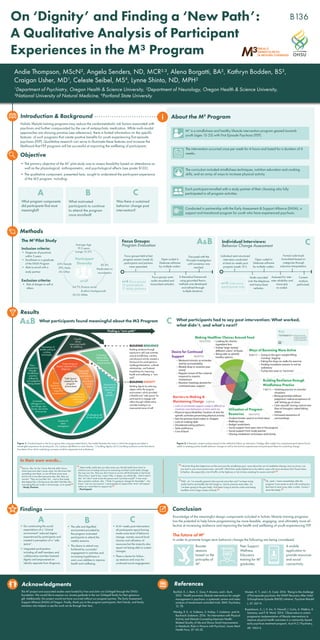
What participants found meaningful about the M3 Program
Findings
•	De-constructing the social
expectations of a “clinical
environment” reduced stigma
experienced by participants and
created a perception of a “safe
space”.
•	Integrated participation
including all staff members and
collaborative activities fostered
dignity and empowered an
identity separate from diagnosis.
A
•	The safe and dignified
environment provided by
the program motivated
participants to attend the
weekly sessions.
•	The desire to attend was
furthered by successful
engagement in activities and
increasing hopefulness in
one’s own abilities to improve
health and wellbeing.
B •	At 6+ weeks post intervention
all participants report having
made some level of behavior
change, namely around food
choices and utilization of
resources but the majority also
report not being able to sustain
changes.
•	There is desire for follow-
up sessions and ways for
continued social engagement.
C
Results
Knowledge of the meaningful design components included in holistic lifestyle training programs
has the potential to help future programming be more feasible, engaging, and ultimately more ef-
fective at increasing resilience and improving the health and wellbeing of youth experiencing FEP.
The future of M3
In order to promote longer-term behavior change the following are being considered.
Conclusion
The M3
project and associated studies were funded by Fran and John von Schlegell through the OHSU
foundation. We would like to express our sincere gratitude to the von Schlegell family for their generous
gift. Additionally, this project would not have occurred without our program partner, The Early Assessment
Support Alliance (EASA) of Oregon. Finally, thank you to the program participants, their friends, and family
members who helped us see the work we do through their lens.
Acknowledgments
Bonfioli, E., L. Berti, C. Goss, F. Muraro, and L. Burti.
2012. ‘Health promotion lifestyle interventions for weight
management in psychosis: a systematic review and meta-
analysis of randomised controlled trials’, BMC Psychiatry,
12: 78.
Wardig, R. E., A. Foldemo, S. Hultsjo, T. Lindstrom, and M.
Bachrach-Lindstrom. 2016. ‘An Intervention with Physical
Activity and Lifestyle Counseling Improves Health-
Related Quality of Life and Shows Small Improvements
in Metabolic Risks in Persons with Psychosis’, Issues Ment
Health Nurs, 37: 43-52.
Mueser, K. T., and J. A. Cook. 2014. ‘Rising to the challenge
of first episode psychosis: the NIMH Recovery After Initial
Schizophrenia Episode (RAISE) initiative’, Psychiatr Rehabil
J, 37: 267-9.
Rosenbaum, S., L. X. Lim, H. Newall, J. Curtis, A. Watkins, K.
Samaras, and P. B. Ward. 2014. ‘Observation to action:
progressive implementation of lifestyle interventions to
improve physical health outcomes in a community-based
early psychosis treatment program’, Aust N Z J Psychiatry,
48: 1063-4.
References
Booster
sessions
based on the
principles of
M3
.
Peer Support
Wellness
Educators
training for M3
graduates.
A mobile
application to
provide resources
and social
connectivity.
Conducted in partnership with the Early Assessment & Support Alliance (EASA), a
support and transitional program for youth who have experienced psychosis.
Focus groups held at last
program session (week 6),
participants and partners
were separated.
Open coded in
Dedoose software
by multiple coders.
Discussed with the
Principle Investigators
until consensus was
reached.
n=4 (focus groups)
13 participants
11 study partners
A theoretical framework
using grounded theory
methods was developed
and refined through
multiple iterations.
Focus groups were
audio recorded and
transcribed verbatim.
Formal code book
formulated based on
categories through
inductive interpretation.
Open coded in
Dedoose software
by multiple coders.
Assessed for inter-
rater reliability and
transcripts
re-coded.
Content
analysis
performed.
Individual semi-structured
interviews conducted
at least six weeks post
program (week 12+).
Audio recorded
over the telephone
and transcribed
verbatim.
The M3
Pilot Study Focus Groups:
Program Evaluation
Individual Interviews:
Behavior Change Assessment
A&B C
Inclusion criteria:
•	Diagnosis of psychosis
within 3 years
•	Enrollment or a graduate
of the EASA Program
•	Able to enroll with a
study partner
Exclusion criteria:
•	 Risk of danger to self or
others.
Average Age
19.5 years
(range 13-27)
65% Female
29% Male
6% Other
64.7% Diverse racial
& ethnic backgrounds
35.3% White
82.4%
Medicated on
neuroleptics
Participant
Diversity
n=17
n=11 (interviews)
participants only
And so, like, for her I know that she didn’t know
what everyone else’s issues were, but she knew that
something was there, so we all have some issue
but for her it was like everyone else, like, they act
normal. “They act just like I do”, and so that really,
that helped her a lot because she didn’t feel like she
was being like put under a microscope, so to speak.
- Study Partner
Figure 1: Created based on the focus group data using grounded theory, the model illustrates the ways in which the program provided a
meaningful experience for participants. Our analysis identified two main themes: 1.) building dignity and 2.) building resilience as the theoretical
foundation from which underlying concepts could be organized and understood.
In their own words...
What participants had to say post intervention: What worked,
what didn’t, and what’s next?
A&B C
Figure 2: A thematic content analysis based on the individual follow-up interviews. Findings offer insight into components participants found
useful in creating positive health behavior change as well as the barriers experienced and participant ideas for sustaining change.
I think the thing that helped me out the most was the mindfulness part, more about the sort of meditation therapy and you know, you
can look in your environment more, and stuff. I think that’s really helped me to be able to cope with more situations that I found stress-
ful before. Like especially a lot of traffic on the highway or lots of stress studying for exams and stuff.
“
”
Uh, yeah, I mean immediately after the
program it was easier to stick with cooking but
that kind of went away after a while, I haven’t
done that lately.
“
”
Well…uh, I’ve actually gained a few pounds since then and I’ve been trying
really hard to eat healthy like M3 taught us. And to exercise more often. So
I’ve been going to the gym lately. And been trying to eat less carbs and eating
healthier and a large variety of foods.
“
”
“
”
…these really useful tips you take away you should really know how to
balance you’re eating and you’re exercising and that could really change
the way you live. That you don’t have to survive off McDonalds or fast food.
That is how I used to be. I wasn’t like, in shape, my whole life... And it wasn’t
like “oh I don’t want to be this person and I just hate myself” it was more
like a positive outlook. Like, “I think I’m going to change for the better”...You
know. I am my own person. I want people to respect that. And I will respect
others as I want them to respect me.
- Participant
“
”
B136

M3 Qual Poster 36x72 2.3

  • 1.
    About the M3 Program M3 isa mindfulness and healthy lifestyle intervention program geared towards youth (ages 15-25) with First Episode Psychosis (FEP). The intervention occurred once per week for 4 hours and lasted for a duration of 6 weeks. The curriculum included mindfulness techniques, nutrition education and cooking skills, and an array of ways to increase physical activity. Each participant enrolled with a study partner of their choosing who fully participated in all program activities. Andie Thompson, MScN², Angela Senders, ND, MCR², ³, Alena Borgatti, BA², Kathryn Bodden, BS³, Craigan Usher, MD1 , Celeste Seibel, MS4 , Lynne Shinto, ND, MPH² 1 Department of Psychiatry, Oregon Health & Science University, ²Department of Neurology, Oregon Health & Science University, ³National University of Natural Medicine, 4 Portland State University On ‘Dignity’ and Finding a ‘New Path’: A Qualitative Analysis of Participant Experiences in the M³ Program Holistic lifestyle training programs may reduce the cardiometabolic risk factors associated with psychosis and further compounded by the use of antipsychotic medication. While multi-modal approaches are showing promise (see references), there is limited information on the specific features of such programs that create positive benefits for youth experiencing first episode psychosis (FEP). Qualitative research can serve to illuminate these features and increase the likelihood that FEP programs will be successful at improving the wellbeing of participants. Introduction & Background • The primary objective of the M3 pilot study was to assess feasibility based on attendance as well as the physiological, anthropometric, and psychological effects (see poster B132). • The qualitative component, presented here, sought to understand the participant experience of the M3 program, including: Objective What program components did participants find most meaningful? A What motivated participants to continue to attend the program once enrolled? B Was there a sustained behavior change post intervention? C Methods What participants found meaningful about the M3 Program Findings • De-constructing the social expectations of a “clinical environment” reduced stigma experienced by participants and created a perception of a “safe space”. • Integrated participation including all staff members and collaborative activities fostered dignity and empowered an identity separate from diagnosis. A • The safe and dignified environment provided by the program motivated participants to attend the weekly sessions. • The desire to attend was furthered by successful engagement in activities and increasing hopefulness in one’s own abilities to improve health and wellbeing. B • At 6+ weeks post intervention all participants report having made some level of behavior change, namely around food choices and utilization of resources but the majority also report not being able to sustain changes. • There is desire for follow- up sessions and ways for continued social engagement. C Results Knowledge of the meaningful design components included in holistic lifestyle training programs has the potential to help future programming be more feasible, engaging, and ultimately more ef- fective at increasing resilience and improving the health and wellbeing of youth experiencing FEP. The future of M3 In order to promote longer-term behavior change the following are being considered. Conclusion The M3 project and associated studies were funded by Fran and John von Schlegell through the OHSU foundation. We would like to express our sincere gratitude to the von Schlegell family for their generous gift. Additionally, this project would not have occurred without our program partner, The Early Assessment Support Alliance (EASA) of Oregon. Finally, thank you to the program participants, their friends, and family members who helped us see the work we do through their lens. Acknowledgments Bonfioli, E., L. Berti, C. Goss, F. Muraro, and L. Burti. 2012. ‘Health promotion lifestyle interventions for weight management in psychosis: a systematic review and meta- analysis of randomised controlled trials’, BMC Psychiatry, 12: 78. Wardig, R. E., A. Foldemo, S. Hultsjo, T. Lindstrom, and M. Bachrach-Lindstrom. 2016. ‘An Intervention with Physical Activity and Lifestyle Counseling Improves Health- Related Quality of Life and Shows Small Improvements in Metabolic Risks in Persons with Psychosis’, Issues Ment Health Nurs, 37: 43-52. Mueser, K. T., and J. A. Cook. 2014. ‘Rising to the challenge of first episode psychosis: the NIMH Recovery After Initial Schizophrenia Episode (RAISE) initiative’, Psychiatr Rehabil J, 37: 267-9. Rosenbaum, S., L. X. Lim, H. Newall, J. Curtis, A. Watkins, K. Samaras, and P. B. Ward. 2014. ‘Observation to action: progressive implementation of lifestyle interventions to improve physical health outcomes in a community-based early psychosis treatment program’, Aust N Z J Psychiatry, 48: 1063-4. References Booster sessions based on the principles of M3 . Peer Support Wellness Educators training for M3 graduates. A mobile application to provide resources and social connectivity. Conducted in partnership with the Early Assessment & Support Alliance (EASA), a support and transitional program for youth who have experienced psychosis. Focus groups held at last program session (week 6), participants and partners were separated. Open coded in Dedoose software by multiple coders. Discussed with the Principle Investigators until consensus was reached. n=4 (focus groups) 13 participants 11 study partners A theoretical framework using grounded theory methods was developed and refined through multiple iterations. Focus groups were audio recorded and transcribed verbatim. Formal code book formulated based on categories through inductive interpretation. Open coded in Dedoose software by multiple coders. Assessed for inter- rater reliability and transcripts re-coded. Content analysis performed. Individual semi-structured interviews conducted at least six weeks post program (week 12+). Audio recorded over the telephone and transcribed verbatim. The M3 Pilot Study Focus Groups: Program Evaluation Individual Interviews: Behavior Change Assessment A&B C Inclusion criteria: • Diagnosis of psychosis within 3 years • Enrollment or a graduate of the EASA Program • Able to enroll with a study partner Exclusion criteria: • Risk of danger to self or others. Average Age 19.5 years (range 13-27) 65% Female 29% Male 6% Other 64.7% Diverse racial & ethnic backgrounds 35.3% White 82.4% Medicated on neuroleptics Participant Diversity n=17 n=11 (interviews) participants only And so, like, for her I know that she didn’t know what everyone else’s issues were, but she knew that something was there, so we all have some issue but for her it was like everyone else, like, they act normal. “They act just like I do”, and so that really, that helped her a lot because she didn’t feel like she was being like put under a microscope, so to speak. - Study Partner Figure 1: Created based on the focus group data using grounded theory, the model illustrates the ways in which the program provided a meaningful experience for participants. Our analysis identified two main themes: 1.) building dignity and 2.) building resilience as the theoretical foundation from which underlying concepts could be organized and understood. In their own words... What participants had to say post intervention: What worked, what didn’t, and what’s next? A&B C Figure 2: A thematic content analysis based on the individual follow-up interviews. Findings offer insight into components participants found useful in creating positive health behavior change as well as the barriers experienced and participant ideas for sustaining change. I think the thing that helped me out the most was the mindfulness part, more about the sort of meditation therapy and you know, you can look in your environment more, and stuff. I think that’s really helped me to be able to cope with more situations that I found stress- ful before. Like especially a lot of traffic on the highway or lots of stress studying for exams and stuff. “ ” Uh, yeah, I mean immediately after the program it was easier to stick with cooking but that kind of went away after a while, I haven’t done that lately. “ ” Well…uh, I’ve actually gained a few pounds since then and I’ve been trying really hard to eat healthy like M3 taught us. And to exercise more often. So I’ve been going to the gym lately. And been trying to eat less carbs and eating healthier and a large variety of foods. “ ” “ ” …these really useful tips you take away you should really know how to balance you’re eating and you’re exercising and that could really change the way you live. That you don’t have to survive off McDonalds or fast food. That is how I used to be. I wasn’t like, in shape, my whole life... And it wasn’t like “oh I don’t want to be this person and I just hate myself” it was more like a positive outlook. Like, “I think I’m going to change for the better”...You know. I am my own person. I want people to respect that. And I will respect others as I want them to respect me. - Participant “ ” B136