Integrative Medicine/Oncology:
An Evolving Discipline
or what was called

Complementary and Alternative
Medicine
David S. Rosenthal, MD
Leonard P. Zakim Center for Integrative Therapies
Dana-Farber Cancer Institute
May 29, 2013

NewBridge on the Charles
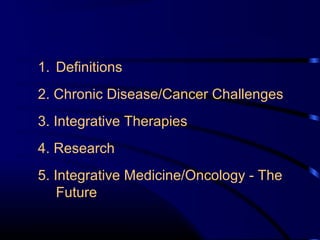
1. Definitions
2. Chronic Disease/Cancer Challenges
3. Integrative Therapies
4. Research
5. Integrative Medicine/Oncology - The
Future
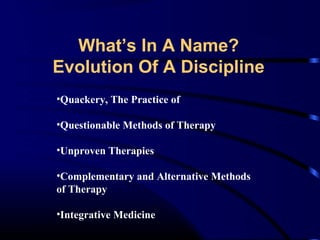
What’s In A Name?
Evolution Of A Discipline
•Quackery, The Practice of
•Questionable Methods of Therapy
•Unproven Therapies
•Complementary and Alternative Methods
of Therapy
•Integrative Medicine
Integrative Oncology

We have come a long way
But
We still have a ways to go.
What Is CAM?
… medical and health care
practices outside the realm of
conventional medicine, which
are yet to be validated using
scientific methods
Complementary: together with
conventional practices
Alternative: in place of
conventional practices
NCCAM
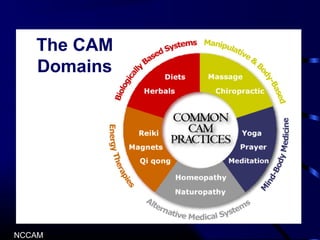
The CAM
Domains

NCCAM
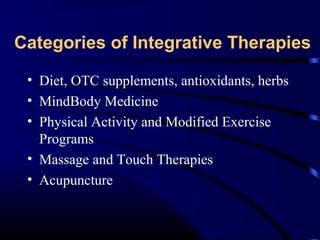
Categories of Integrative Therapies
• Diet, OTC supplements, antioxidants, herbs
• MindBody Medicine
• Physical Activity and Modified Exercise
Programs
• Massage and Touch Therapies
• Acupuncture
ACS Challenge Goals
1996-1998
•Reduce cancer mortality by 50% by 2015
•Reduce incidence of cancer by 25% by 2015
• Show measurable improvement in the
quality of life; physical, psychological,
social and spiritual
QOL Measures
• Assure appropriate care for cancer and
treatment related symptom control
• Include palliative care, end of life care and
survivorship issues
Cancer as a Chronic Disease
• With a decrease in cancer mortality and a
steady incidence of cancer, there are more
cancer survivors
• Result is that QOL issues become more
important and Integrative Oncology
becomes more significant
Integrative Medicine/Oncology
 Combines the best of both conventional and evidence-based
integrative therapies
 Emphasizes patient participation (e.g. exercise, diet, stress
management) in maximizing health
 Emphasizes the primacy of the patient provider relationship
and the importance of shared decision making
 Emphasizes the contribution of the therapeutic encounter
itself
 Seeks to optimize and individuals’ innate healing capacity

Snyderman R, Weil AT, Arch Inter Med; 2002;162:395-397
Why a Zakim Center for
Integrative Therapies?
• Cancer patients often have interest in or
questions about Integrative Therapies
e.g., acupuncture, massage, herbs

• Many patients benefit from Complementary
Therapies in conjunction with conventional
cancer care
• Patients need advice from clinicians about
contraindicated therapies
e.g., “alternative” medicine clinics, drug-herb
interactions
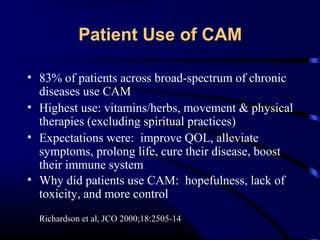
Patient Use of CAM
• 83% of patients across broad-spectrum of chronic
diseases use CAM
• Highest use: vitamins/herbs, movement & physical
therapies (excluding spiritual practices)
• Expectations were: improve QOL, alleviate
symptoms, prolong life, cure their disease, boost
their immune system
• Why did patients use CAM: hopefulness, lack of
toxicity, and more control
Richardson et al, JCO 2000;18:2505-14
About CAM users:
70% saw their physician concurrently with
CAM provider.

Eisenberg et al. AM Int Med 2001;135:344-51
About CAM users:
63-72% did not disclose their CAM
therapy to their physician.

Eisenberg et al. AM Int Med 2001;135:344-51
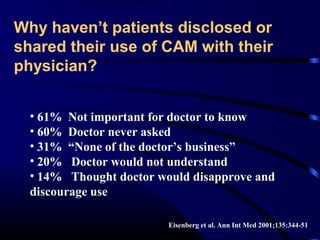
Why haven’t patients disclosed or
shared their use of CAM with their
physician?
• 61% Not important for doctor to know
• 60% Doctor never asked
• 31% “None of the doctor’s business”
• 20% Doctor would not understand
• 14% Thought doctor would disapprove and
discourage use
Eisenberg et al. Ann Int Med 2001;135:344-51
Mission Statement
The Leonard P. Zakim Center for Integrative
Therapies at Dana-Farber Cancer Institute is
dedicated to enhancing the quality of life for
cancer patients and families by incorporating
complementary medicine into traditional cancer
care. The Center provides affordable clinical
services for pediatric and adult patients and their
families, educates and empowers patients about
their use, and conducts peer-reviewed research.
Clinical Services Offered
at Zakim Center
Individual:
• Acupuncture
• Massage
• Reiki
• Integrative Medicine Consults
• Integrative Nutritional Consults
Group:
• Music Therapy
• Expressive Arts Therapy
• QiGong
• Meditation
• yoga
Who uses Integrative Therapies at
Dana-Farber Cancer Institute ?
• Patients with:
• Pain
• Fatigue
• Anxiety
• Other Symptoms (e.g., nausea; neuropathy)
• Interest in nutrition counseling for special diets
or supplements or other therapies
Integrative Nutrition Consults
• Respond to pt inquiries re: diets,
supplements, herbs
• Therapies with potential benefit:
–
–
–
–

Fish oil for cachexia
Probiotics for bowel irregularities
Glutamine for chronic diarrhea
Various dietary manipulations for symptom
control
• Ex: a low fiber/residue diet for patients with
acute or chronic diarrhea
Nutrition Guidelines
•
•
•
•
•
•

Avoid being overweight, obesity
Be physically active
Avoid sugar
Consume a phytonutrient rich diet
Limit red meats, avoid processed foods
Limit alcohol
ACS, AICR
Integrative Medicine Consults
Respond to questions about CAM:
• Safety
• Efficacy
Discuss role of integrative therapies alongside
conventional therapy
Mind Body Therapies
•
•
•
•
•
•
•
•
•
•
•
•

Relaxation response and biofeedback
Mindfulness meditation
Guided imagery
Self-hypnosis
Self-expression in words
Music therapy
Expressive arts therapy
Dance
Yoga
Tai chi
Qi gong
Support groups
Massage and Touch Therapies
•
•
•
•
•
•
•
•
•

Swedish massage
Aromatherapy massage
Reflexology
Acupressure
Shiatsu
Manual lymphatic drainage
Reiki
Deep tissue massage
Rolfing
Acupuncture
 Benefit in QOL of cancer patients
 May be recommended:
 Chemotherapy-induced nausea and vomiting
 Cancer pain
 May be acceptable:
 Post-chemotherapy fatigue
 Radiation-induced xerostomia
 Insomnia
 Anxiety
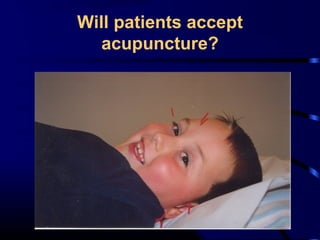
Will patients accept
acupuncture?
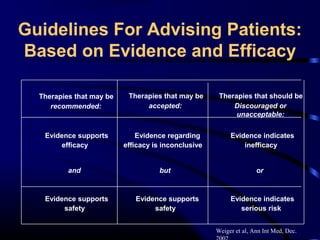
Guidelines For Advising Patients:
Based on Evidence and Efficacy
Therapies that may be
recommended:

Evidence supports
efficacy
and

Evidence supports
safety

Therapies that may be
accepted:

Evidence regarding
efficacy is inconclusive
but

Evidence supports
safety

Therapies that should be
Discouraged or
unacceptable:
Evidence indicates
inefficacy
or

Evidence indicates
serious risk
Weiger et al, Ann Int Med, Dec.
Potential Concerns of
Physicians – Re Herbs and
botanicals:







Direct toxic effects
Interactions with other medicine
Reduced effectiveness of “standard therapy”
Toxicity not related to cancer
Impairment in overall “quality-of-life”
Delay in obtaining known effective therapy
Drug-Herb Interactions
• Cytochrome P450 system can be stimulated
or inhibited
• Anti-inflammatory effect usually implies
antiplatelet effect
Websites
•

•
•
•
•
•
•

Memorial Sloan-Kettering Cancer Center:
http://www.mskcc.org/mskcc/html/5707.cfm?Criteria=about+herbs&x
=13&y=
The University of Texas MD Anderson Cancer Center: http://
www.mdanderson.org/departments/CIMER
American Cancer Society:
http://www.cancer.org/docroot/ETO/ETO_5.asp
National Center for Complementary and Alternative Medicine: http://
nccam.hih.gov/
National Cancer Institute’s Office of Cancer Complementary and
Alternative Medicine: http://www.cancer.gov/cam/
Natural Medicines Comprehensive Database: http://
www.naturaldatabase.com
Natural Standard: http://www.naturalstandard.com
Delay In Obtaining Known
Effective Therapy
 Delay seeking medical attending for symptoms suggestive
of a serious illness
Brienza RS, et al. J Women’s Health & Gender- Based Medicine 2002; 11:79

 Delay initiation of “standard effective treatment” for a
malignancy
Coppes MJ, et al. NEJM 1998; 339-846. Ernst E. JCO 2001; 19:2365
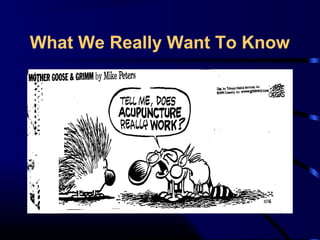
What We Really Want To Know
Why Research
• Use of research studies & technology to
better understand acupuncture & other
integrative therapies
• Recognition that patients are continuing
to use these therapies, so that questions
of dose, synergy, and potential
interactions can be investigated through
established & refined research methods
Research Issues
• Do the same rules apply as studying a new
pharmaceutical agent?
• What is the best control for massage or a
mind/body intervention?
• Sham acupuncture
• Whole systems vs reductionist research
DFCI Research
•

•
•
•
•

Immunologic Activity, Physical Status, and QOL in Connection with Two
Exercise Programs (Modified Exercise and Qigong)
PI: Paul Richardson
Acupuncture on Pain, Nausea and Quality of Life in Advanced Cancer
PI: David S. Rosenthal, MD
Acupuncture and Neutropenia in Ovarian Cancer
Co-PIs: Ursula Matulonis, MD, Weidong Lu, MB, MPH, Lic.Ac.
QiGong on Mood and Cortisol in Breast Cancer
PI: Ursula Matulonis, MD
Use of Music Therapy with Metastatic Breast Cancer
Co-PIs: Susan Bauer-Wu, D.N Sc., Suzanne Hanser, Ed.D., MT-BC

•

Reiki and Relaxation Response in Prostate Cancer Pts Receiving Radiation
PI: Clair Beard, M.D.
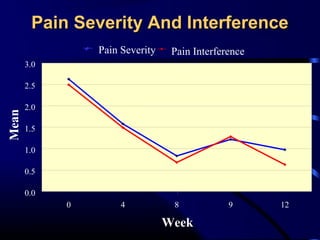
Pain Severity And Interference
Pain Severity

Pain Interference

3.0

Mean

2.5
2.0
1.5
1.0
0.5
0.0
0

4

8

Week

9

12
History of
Federal Involvement
• Office of Alternative Medicine
• NCCAM
• NCI – OCCAM
• Affordable Care Act
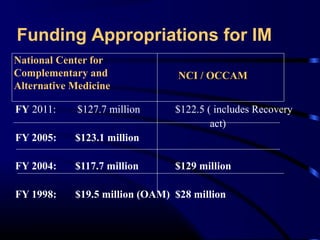
Funding Appropriations for IM
National Center for
Complementary and
Alternative Medicine

NCI / OCCAM

FY 2011:

$127.7 million

$122.5 ( includes Recovery
act)

FY 2005:

$123.1 million

FY 2004:

$117.7 million

FY 1998:

$19.5 million (OAM) $28 million

$129 million
Integrative Oncology
The Future
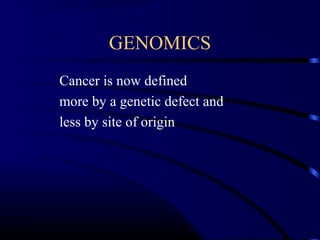
GENOMICS
Cancer is now defined
more by a genetic defect and
less by site of origin
GENOMICS
Gene Profiling
• Individualizing cancer risk
• Individualizing cancer therapy
• Individualizing integrative therapies
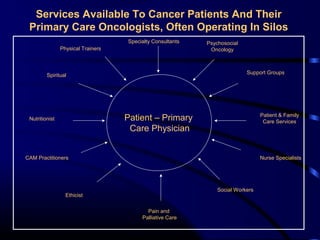
Services Available To Cancer Patients And Their
Primary Care Oncologists, Often Operating In Silos
Specialty Consultants
Physical Trainers

Psychosocial
Oncology

Support Groups

Spiritual

Patient & Family
Care Services

Patient – Primary
Care Physician

Nutritionist

CAM Practitioners

Nurse Specialists

Social Workers

Ethicist
Pain and
Palliative Care
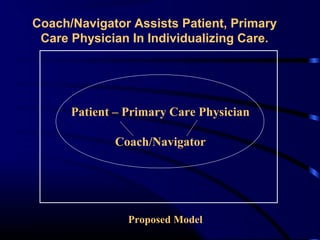
Coach/Navigator Assists Patient, Primary
Care Physician In Individualizing Care.

Patient – Primary Care Physician
Coach/Navigator

Proposed Model
SAVE THE DATE

10th International Conference of the Society for
Integrative Oncology

Oct. 20-22, 2013
The Fairmont
Hotel Vancouver
Vancouver, BC
integrativeonc.org

Co-Chairs:
Lynda Balneaves, RN, PhD
Associate Professor, Nursing
Faculty of Applied Science
University of British Columbia

Emma Guns, PhD
Associate Professor, Dept. Urology
Faculty of Medicine
University of British Columbia

Richard Lee, MD
Assistant Professor, General Oncology
MD Anderson Cancer Centre
University of Texas
“It only takes one person to start a revolution of thought and spirit.”
Lenny Zakim

Newbridge talk,may 29, 2013

  • 1.
    Integrative Medicine/Oncology: An EvolvingDiscipline or what was called Complementary and Alternative Medicine David S. Rosenthal, MD Leonard P. Zakim Center for Integrative Therapies Dana-Farber Cancer Institute May 29, 2013 NewBridge on the Charles
  • 2.
    1. Definitions 2. ChronicDisease/Cancer Challenges 3. Integrative Therapies 4. Research 5. Integrative Medicine/Oncology - The Future
  • 3.
    What’s In AName? Evolution Of A Discipline •Quackery, The Practice of •Questionable Methods of Therapy •Unproven Therapies •Complementary and Alternative Methods of Therapy •Integrative Medicine
  • 4.
    Integrative Oncology We havecome a long way But We still have a ways to go.
  • 5.
    What Is CAM? …medical and health care practices outside the realm of conventional medicine, which are yet to be validated using scientific methods Complementary: together with conventional practices Alternative: in place of conventional practices NCCAM
  • 6.
  • 7.
    Categories of IntegrativeTherapies • Diet, OTC supplements, antioxidants, herbs • MindBody Medicine • Physical Activity and Modified Exercise Programs • Massage and Touch Therapies • Acupuncture
  • 8.
    ACS Challenge Goals 1996-1998 •Reducecancer mortality by 50% by 2015 •Reduce incidence of cancer by 25% by 2015 • Show measurable improvement in the quality of life; physical, psychological, social and spiritual
  • 9.
    QOL Measures • Assureappropriate care for cancer and treatment related symptom control • Include palliative care, end of life care and survivorship issues
  • 10.
    Cancer as aChronic Disease • With a decrease in cancer mortality and a steady incidence of cancer, there are more cancer survivors • Result is that QOL issues become more important and Integrative Oncology becomes more significant
  • 11.
    Integrative Medicine/Oncology  Combinesthe best of both conventional and evidence-based integrative therapies  Emphasizes patient participation (e.g. exercise, diet, stress management) in maximizing health  Emphasizes the primacy of the patient provider relationship and the importance of shared decision making  Emphasizes the contribution of the therapeutic encounter itself  Seeks to optimize and individuals’ innate healing capacity Snyderman R, Weil AT, Arch Inter Med; 2002;162:395-397
  • 12.
    Why a ZakimCenter for Integrative Therapies? • Cancer patients often have interest in or questions about Integrative Therapies e.g., acupuncture, massage, herbs • Many patients benefit from Complementary Therapies in conjunction with conventional cancer care • Patients need advice from clinicians about contraindicated therapies e.g., “alternative” medicine clinics, drug-herb interactions
  • 13.
    Patient Use ofCAM • 83% of patients across broad-spectrum of chronic diseases use CAM • Highest use: vitamins/herbs, movement & physical therapies (excluding spiritual practices) • Expectations were: improve QOL, alleviate symptoms, prolong life, cure their disease, boost their immune system • Why did patients use CAM: hopefulness, lack of toxicity, and more control Richardson et al, JCO 2000;18:2505-14
  • 14.
    About CAM users: 70%saw their physician concurrently with CAM provider. Eisenberg et al. AM Int Med 2001;135:344-51
  • 15.
    About CAM users: 63-72%did not disclose their CAM therapy to their physician. Eisenberg et al. AM Int Med 2001;135:344-51
  • 16.
    Why haven’t patientsdisclosed or shared their use of CAM with their physician? • 61% Not important for doctor to know • 60% Doctor never asked • 31% “None of the doctor’s business” • 20% Doctor would not understand • 14% Thought doctor would disapprove and discourage use Eisenberg et al. Ann Int Med 2001;135:344-51
  • 17.
    Mission Statement The LeonardP. Zakim Center for Integrative Therapies at Dana-Farber Cancer Institute is dedicated to enhancing the quality of life for cancer patients and families by incorporating complementary medicine into traditional cancer care. The Center provides affordable clinical services for pediatric and adult patients and their families, educates and empowers patients about their use, and conducts peer-reviewed research.
  • 18.
    Clinical Services Offered atZakim Center Individual: • Acupuncture • Massage • Reiki • Integrative Medicine Consults • Integrative Nutritional Consults Group: • Music Therapy • Expressive Arts Therapy • QiGong • Meditation • yoga
  • 19.
    Who uses IntegrativeTherapies at Dana-Farber Cancer Institute ? • Patients with: • Pain • Fatigue • Anxiety • Other Symptoms (e.g., nausea; neuropathy) • Interest in nutrition counseling for special diets or supplements or other therapies
  • 20.
    Integrative Nutrition Consults •Respond to pt inquiries re: diets, supplements, herbs • Therapies with potential benefit: – – – – Fish oil for cachexia Probiotics for bowel irregularities Glutamine for chronic diarrhea Various dietary manipulations for symptom control • Ex: a low fiber/residue diet for patients with acute or chronic diarrhea
  • 21.
    Nutrition Guidelines • • • • • • Avoid beingoverweight, obesity Be physically active Avoid sugar Consume a phytonutrient rich diet Limit red meats, avoid processed foods Limit alcohol ACS, AICR
  • 22.
    Integrative Medicine Consults Respondto questions about CAM: • Safety • Efficacy Discuss role of integrative therapies alongside conventional therapy
  • 24.
    Mind Body Therapies • • • • • • • • • • • • Relaxationresponse and biofeedback Mindfulness meditation Guided imagery Self-hypnosis Self-expression in words Music therapy Expressive arts therapy Dance Yoga Tai chi Qi gong Support groups
  • 25.
    Massage and TouchTherapies • • • • • • • • • Swedish massage Aromatherapy massage Reflexology Acupressure Shiatsu Manual lymphatic drainage Reiki Deep tissue massage Rolfing
  • 26.
    Acupuncture  Benefit inQOL of cancer patients  May be recommended:  Chemotherapy-induced nausea and vomiting  Cancer pain  May be acceptable:  Post-chemotherapy fatigue  Radiation-induced xerostomia  Insomnia  Anxiety
  • 27.
  • 28.
    Guidelines For AdvisingPatients: Based on Evidence and Efficacy Therapies that may be recommended: Evidence supports efficacy and Evidence supports safety Therapies that may be accepted: Evidence regarding efficacy is inconclusive but Evidence supports safety Therapies that should be Discouraged or unacceptable: Evidence indicates inefficacy or Evidence indicates serious risk Weiger et al, Ann Int Med, Dec.
  • 29.
    Potential Concerns of Physicians– Re Herbs and botanicals:       Direct toxic effects Interactions with other medicine Reduced effectiveness of “standard therapy” Toxicity not related to cancer Impairment in overall “quality-of-life” Delay in obtaining known effective therapy
  • 30.
    Drug-Herb Interactions • CytochromeP450 system can be stimulated or inhibited • Anti-inflammatory effect usually implies antiplatelet effect
  • 31.
    Websites • • • • • • • Memorial Sloan-Kettering CancerCenter: http://www.mskcc.org/mskcc/html/5707.cfm?Criteria=about+herbs&x =13&y= The University of Texas MD Anderson Cancer Center: http:// www.mdanderson.org/departments/CIMER American Cancer Society: http://www.cancer.org/docroot/ETO/ETO_5.asp National Center for Complementary and Alternative Medicine: http:// nccam.hih.gov/ National Cancer Institute’s Office of Cancer Complementary and Alternative Medicine: http://www.cancer.gov/cam/ Natural Medicines Comprehensive Database: http:// www.naturaldatabase.com Natural Standard: http://www.naturalstandard.com
  • 32.
    Delay In ObtainingKnown Effective Therapy  Delay seeking medical attending for symptoms suggestive of a serious illness Brienza RS, et al. J Women’s Health & Gender- Based Medicine 2002; 11:79  Delay initiation of “standard effective treatment” for a malignancy Coppes MJ, et al. NEJM 1998; 339-846. Ernst E. JCO 2001; 19:2365
  • 33.
    What We ReallyWant To Know
  • 34.
    Why Research • Useof research studies & technology to better understand acupuncture & other integrative therapies • Recognition that patients are continuing to use these therapies, so that questions of dose, synergy, and potential interactions can be investigated through established & refined research methods
  • 35.
    Research Issues • Dothe same rules apply as studying a new pharmaceutical agent? • What is the best control for massage or a mind/body intervention? • Sham acupuncture • Whole systems vs reductionist research
  • 36.
    DFCI Research • • • • • Immunologic Activity,Physical Status, and QOL in Connection with Two Exercise Programs (Modified Exercise and Qigong) PI: Paul Richardson Acupuncture on Pain, Nausea and Quality of Life in Advanced Cancer PI: David S. Rosenthal, MD Acupuncture and Neutropenia in Ovarian Cancer Co-PIs: Ursula Matulonis, MD, Weidong Lu, MB, MPH, Lic.Ac. QiGong on Mood and Cortisol in Breast Cancer PI: Ursula Matulonis, MD Use of Music Therapy with Metastatic Breast Cancer Co-PIs: Susan Bauer-Wu, D.N Sc., Suzanne Hanser, Ed.D., MT-BC • Reiki and Relaxation Response in Prostate Cancer Pts Receiving Radiation PI: Clair Beard, M.D.
  • 37.
    Pain Severity AndInterference Pain Severity Pain Interference 3.0 Mean 2.5 2.0 1.5 1.0 0.5 0.0 0 4 8 Week 9 12
  • 38.
    History of Federal Involvement •Office of Alternative Medicine • NCCAM • NCI – OCCAM • Affordable Care Act
  • 39.
    Funding Appropriations forIM National Center for Complementary and Alternative Medicine NCI / OCCAM FY 2011: $127.7 million $122.5 ( includes Recovery act) FY 2005: $123.1 million FY 2004: $117.7 million FY 1998: $19.5 million (OAM) $28 million $129 million
  • 40.
  • 41.
    GENOMICS Cancer is nowdefined more by a genetic defect and less by site of origin
  • 42.
    GENOMICS Gene Profiling • Individualizingcancer risk • Individualizing cancer therapy • Individualizing integrative therapies
  • 43.
    Services Available ToCancer Patients And Their Primary Care Oncologists, Often Operating In Silos Specialty Consultants Physical Trainers Psychosocial Oncology Support Groups Spiritual Patient & Family Care Services Patient – Primary Care Physician Nutritionist CAM Practitioners Nurse Specialists Social Workers Ethicist Pain and Palliative Care
  • 44.
    Coach/Navigator Assists Patient,Primary Care Physician In Individualizing Care. Patient – Primary Care Physician Coach/Navigator Proposed Model
  • 45.
    SAVE THE DATE 10thInternational Conference of the Society for Integrative Oncology Oct. 20-22, 2013 The Fairmont Hotel Vancouver Vancouver, BC integrativeonc.org Co-Chairs: Lynda Balneaves, RN, PhD Associate Professor, Nursing Faculty of Applied Science University of British Columbia Emma Guns, PhD Associate Professor, Dept. Urology Faculty of Medicine University of British Columbia Richard Lee, MD Assistant Professor, General Oncology MD Anderson Cancer Centre University of Texas
  • 46.
    “It only takesone person to start a revolution of thought and spirit.” Lenny Zakim