Module-2
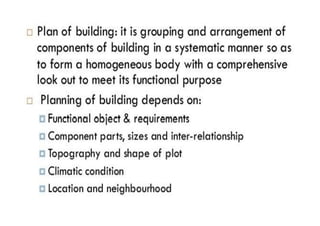
Introduction to building and Town
Planning
Planning
Subject:- BCE Code:-3110004
Introduction
• Residential building is one which is used
wholly or partly for considerable time or
permanently for human habitation.
• A house gives the shelter against weathering
elements like sun, rain, wind, snow.
• Detached house, semi-detached house, Row
house, flats are used for residential purpose for
long time or life time.
• Hotel and hostel used for residential purpose
for short duration.
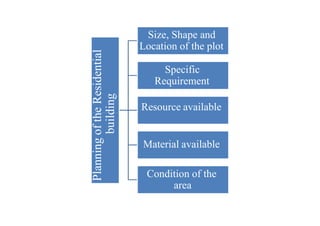
Size, Shape and
Location of the plot
Specific
Requirement
Resource available
Planning
of
the
Residential
building
Material available
Condition of the
area
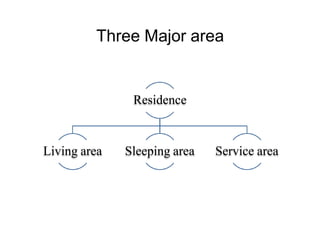
Three Major area
Residence
Living area Sleeping area Service area
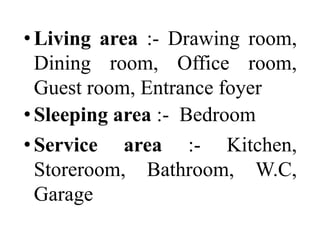
•Living area :- Drawing room,
Dining room, Office room,
Guest room, Entrance foyer
•Sleeping area :- Bedroom
•Service area :- Kitchen,
Storeroom, Bathroom, W.C,
Garage
Principles of
planning
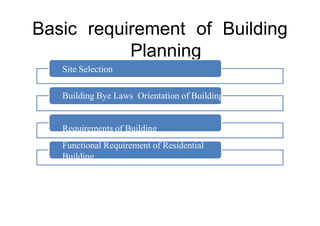
Basic requirement of Building
Planning
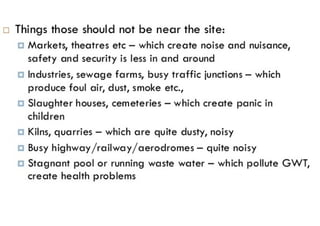
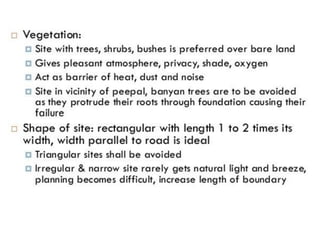
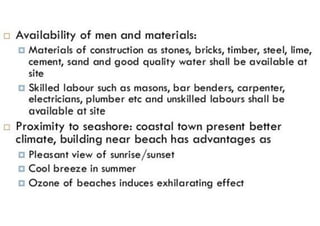
Site Selection
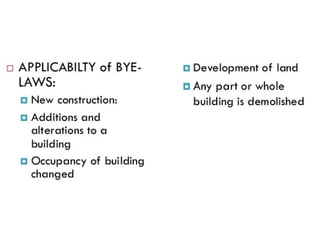
Building Bye Laws Orientation of Building
Requirements of Building
Functional Requirement of Residential
Building
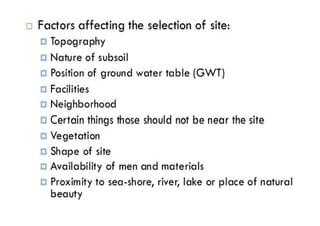
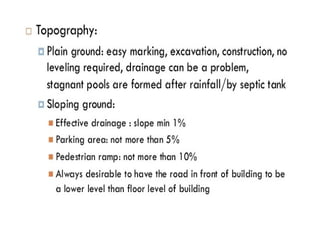
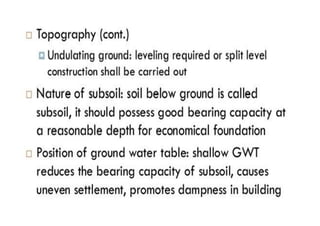
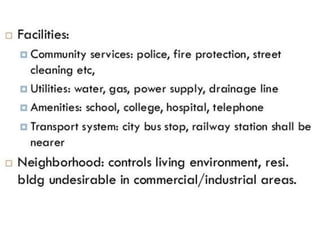
Site selection
Building By-laws
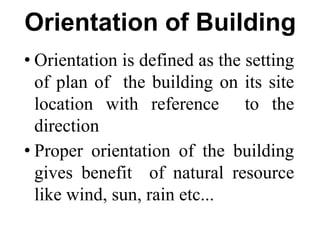
Orientation of Building
• Orientation is defined as the setting
of plan of the building on its site
location with reference to the
direction
• Proper orientation of the building
gives benefit of natural resource
like wind, sun, rain etc...
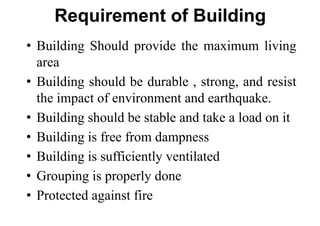
Requirement of Building
• Building Should provide the maximum living
area
• Building should be durable , strong, and resist
the impact of environment and earthquake.
• Building should be stable and take a load on it
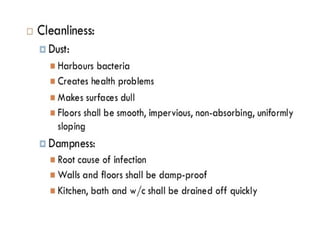
• Building is free from dampness
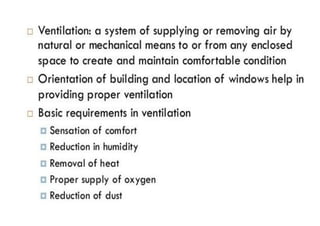
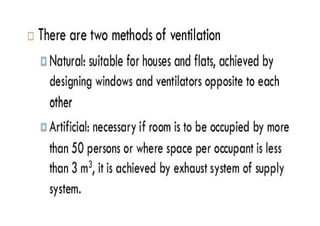
• Building is sufficiently ventilated
• Grouping is properly done
• Protected against fire
Functional Requirement of
Residential building
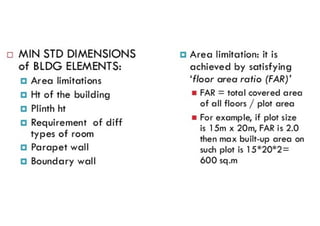
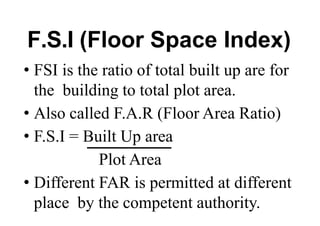
F.S.I (Floor Space Index)
• FSI is the ratio of total built up are for
the building to total plot area.
• Also called F.A.R (Floor Area Ratio)
• F.S.I = Built Up area
Plot Area
• Different FAR is permitted at different
place by the competent authority.
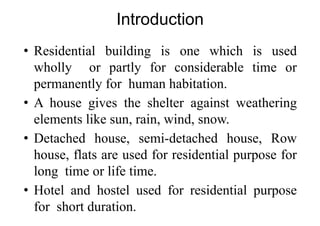
Town Planning
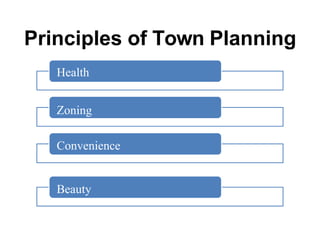
Principles of Town Planning
Health
Zoning
Convenience
Beauty
Health
•To create and promote healthy
conditions and environments
for all the peoples rich and
poor, to live, to work, to play
or relax.
Zoning
• Use of the land for the right purpose.
1. Residential
2. Industrial
3. Institutional
4. Recreational
Convenience
• The object of convenience is meant
in the form of various need of the
community such as social,
economic, cultural and recreational
amenities etc...
Beauty
•To create the beautiful of the
town by developing natural
conditions like natural
greenery, improve buildings,
temples, churches, historical
building.
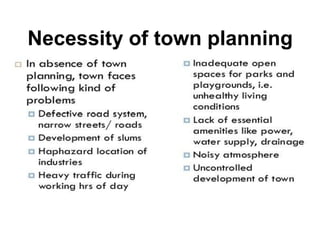
Necessity of town planning
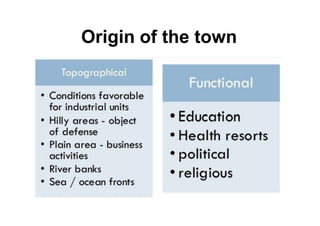
Origin of the town
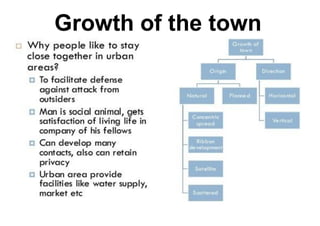
Growth of the town
Land Use
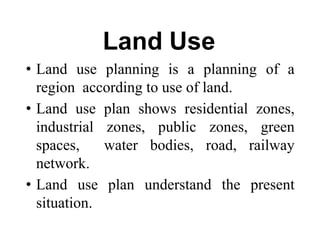
• Land use planning is a planning of a
region according to use of land.
• Land use plan shows residential zones,
industrial zones, public zones, green
spaces, water bodies, road, railway
network.
• Land use plan understand the present
situation.
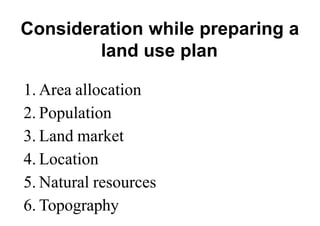
Consideration while preparing a
land use plan
1. Area allocation
2. Population
3. Land market
4. Location
5. Natural resources
6. Topography
1. Area allocation
•Area allocation for
residential, commercial, and
industrial areas are decided
depending on city and its
activity
2. Population
•Population are important factors
while deciding residential,
commercial, and industrial area
3. Land Market
•Land plan can be
measured to control land
prices and also a reason
to increase land prices.
4. Location
•Location for industrial,
commercial, and
residential area are
considered while making
land use plan.
5. Natural Resources
•River, lakes, hills, Sea are
considered in Land use
6. Topography
•Topography of Region
(Hilly or Valley) are
considered in land use.
Zoning
•Zoning is defined as the
regulation by law of the use of
land for the purpose of securing
convenience, health, safety, and
general welfare of the
community.
Principles of Zoning
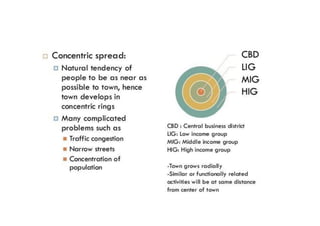
1.Concentric growth
2.Boundary
3.Existing town
4.Flexibility
5.New town
1. Concentric growth
• Definition : When the growth of building spread from a
centre of town, then it is termed as concentric growth.
• If population increase concentric circle increase and
create growth of town.
• The central area of town is followed by
1.Developed area
2.Green are
3.Undeveloped area
2. Boundary
• Boundary between two zones usually be road,
railway line, river, or a green belt.
3. Existing town
• The planning of zoning of new towns should be
done in the convenience of the existing towns
without disturbing the ecosystem.
4. Flexibility
• Zoning should be done by considering the new
town in future expansion.
5. New town
• To construct a new town areas is planned
1. Residential
2. Industries
3. Business
Objects of town
• Future growth and development of
the town due to zoning.
• Zoning affords a coordination
between transport, water supply,
drainage, electricity.
• Making town planning scheme
effective and successful.
Advantages of Zoning
• Allocation of land for specific use
• Control of use, height, and construction of
building.
• Use of Land divided into two part.
1.Profitable (Offices, industries, Residence
society)
2.Non profitable (Roads, Park, Play ground,
Gov. Offices)
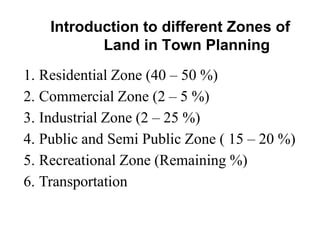
Introduction to different Zones of
Land in Town Planning
1. Residential Zone (40 – 50 %)
2. Commercial Zone (2 – 5 %)
3. Industrial Zone (2 – 25 %)
4. Public and Semi Public Zone ( 15 – 20 %)
5. Recreational Zone (Remaining %)
6. Transportation
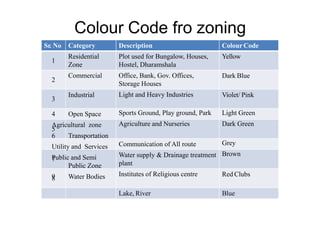
Colour Code fro zoning
Sr. No
1
Colour Code
Yellow
2
Category
Residential
Zone
Commercial Dark Blue
3
Industrial
Description
Plot used for Bungalow, Houses,
Hostel, Dharamshala
Office, Bank, Gov. Offices,
Storage Houses
Light and Heavy Industries Violet/ Pink
5
Sports Ground, Play ground, Park
Agriculture and Nurseries
Light Green
Dark Green
7
Grey
Brown
8
Communication of All route
Water supply & Drainage treatment
plant
Institutes of Religious centre Red Clubs
4 Open Space
Agricultural zone
6 Transportation
Utility and Services
Public and Semi
Public Zone
9 Water Bodies
Lake, River Blue
Low Cost houses
• Effective budgeting houses to reduce the
cost of construction through the use of
locally available material.
• Cost of construction divided in to two part
1.Building material cost (65 to 70 %)
2.Labour Cost (65 to 70 %)
Areas to reduce the housing Cost
• Use of thinner wall of solid concrete block
• Use locally available material
• Use eco-friendly material like in place of
wooden frame of door and window use
RCC or stone Frame.
• Use alternate material
• Prepare simple design of construction
Cost Reduction using adhoc
methods in various building
component
1. Foundation
2. Lintel & Chajjas
3. Filler Slabs
4. Roofing
5. Ferro cement channel
6. Roof or Floor
7. Plinth
8. Rat-rap bond wall
9.Concrete block walling
10.Walling
11.Doors and windows
12.Soil cement block
technology
13.Finishing Work

M-2_introduction-to-building-_-town-planning.pdf

  • 1.
    Module-2 Introduction to buildingand Town Planning Planning Subject:- BCE Code:-3110004
  • 2.
    Introduction • Residential buildingis one which is used wholly or partly for considerable time or permanently for human habitation. • A house gives the shelter against weathering elements like sun, rain, wind, snow. • Detached house, semi-detached house, Row house, flats are used for residential purpose for long time or life time. • Hotel and hostel used for residential purpose for short duration.
  • 3.
    Size, Shape and Locationof the plot Specific Requirement Resource available Planning of the Residential building Material available Condition of the area
  • 4.
    Three Major area Residence Livingarea Sleeping area Service area
  • 5.
    •Living area :-Drawing room, Dining room, Office room, Guest room, Entrance foyer •Sleeping area :- Bedroom •Service area :- Kitchen, Storeroom, Bathroom, W.C, Garage
  • 6.
  • 26.
    Basic requirement ofBuilding Planning Site Selection Building Bye Laws Orientation of Building Requirements of Building Functional Requirement of Residential Building
  • 27.
  • 36.
  • 57.
    Orientation of Building •Orientation is defined as the setting of plan of the building on its site location with reference to the direction • Proper orientation of the building gives benefit of natural resource like wind, sun, rain etc...
  • 58.
    Requirement of Building •Building Should provide the maximum living area • Building should be durable , strong, and resist the impact of environment and earthquake. • Building should be stable and take a load on it • Building is free from dampness • Building is sufficiently ventilated • Grouping is properly done • Protected against fire
  • 59.
  • 60.
    F.S.I (Floor SpaceIndex) • FSI is the ratio of total built up are for the building to total plot area. • Also called F.A.R (Floor Area Ratio) • F.S.I = Built Up area Plot Area • Different FAR is permitted at different place by the competent authority.
  • 61.
  • 62.
    Principles of TownPlanning Health Zoning Convenience Beauty
  • 63.
    Health •To create andpromote healthy conditions and environments for all the peoples rich and poor, to live, to work, to play or relax.
  • 64.
    Zoning • Use ofthe land for the right purpose. 1. Residential 2. Industrial 3. Institutional 4. Recreational
  • 65.
    Convenience • The objectof convenience is meant in the form of various need of the community such as social, economic, cultural and recreational amenities etc...
  • 66.
    Beauty •To create thebeautiful of the town by developing natural conditions like natural greenery, improve buildings, temples, churches, historical building.
  • 67.
  • 68.
  • 69.
  • 79.
    Land Use • Landuse planning is a planning of a region according to use of land. • Land use plan shows residential zones, industrial zones, public zones, green spaces, water bodies, road, railway network. • Land use plan understand the present situation.
  • 80.
    Consideration while preparinga land use plan 1. Area allocation 2. Population 3. Land market 4. Location 5. Natural resources 6. Topography
  • 81.
    1. Area allocation •Areaallocation for residential, commercial, and industrial areas are decided depending on city and its activity
  • 82.
    2. Population •Population areimportant factors while deciding residential, commercial, and industrial area
  • 83.
    3. Land Market •Landplan can be measured to control land prices and also a reason to increase land prices.
  • 84.
    4. Location •Location forindustrial, commercial, and residential area are considered while making land use plan.
  • 85.
    5. Natural Resources •River,lakes, hills, Sea are considered in Land use
  • 86.
    6. Topography •Topography ofRegion (Hilly or Valley) are considered in land use.
  • 87.
    Zoning •Zoning is definedas the regulation by law of the use of land for the purpose of securing convenience, health, safety, and general welfare of the community.
  • 88.
    Principles of Zoning 1.Concentricgrowth 2.Boundary 3.Existing town 4.Flexibility 5.New town
  • 89.
    1. Concentric growth •Definition : When the growth of building spread from a centre of town, then it is termed as concentric growth. • If population increase concentric circle increase and create growth of town. • The central area of town is followed by 1.Developed area 2.Green are 3.Undeveloped area
  • 90.
    2. Boundary • Boundarybetween two zones usually be road, railway line, river, or a green belt. 3. Existing town • The planning of zoning of new towns should be done in the convenience of the existing towns without disturbing the ecosystem.
  • 91.
    4. Flexibility • Zoningshould be done by considering the new town in future expansion. 5. New town • To construct a new town areas is planned 1. Residential 2. Industries 3. Business
  • 92.
    Objects of town •Future growth and development of the town due to zoning. • Zoning affords a coordination between transport, water supply, drainage, electricity. • Making town planning scheme effective and successful.
  • 93.
    Advantages of Zoning •Allocation of land for specific use • Control of use, height, and construction of building. • Use of Land divided into two part. 1.Profitable (Offices, industries, Residence society) 2.Non profitable (Roads, Park, Play ground, Gov. Offices)
  • 94.
    Introduction to differentZones of Land in Town Planning 1. Residential Zone (40 – 50 %) 2. Commercial Zone (2 – 5 %) 3. Industrial Zone (2 – 25 %) 4. Public and Semi Public Zone ( 15 – 20 %) 5. Recreational Zone (Remaining %) 6. Transportation
  • 95.
    Colour Code frozoning Sr. No 1 Colour Code Yellow 2 Category Residential Zone Commercial Dark Blue 3 Industrial Description Plot used for Bungalow, Houses, Hostel, Dharamshala Office, Bank, Gov. Offices, Storage Houses Light and Heavy Industries Violet/ Pink 5 Sports Ground, Play ground, Park Agriculture and Nurseries Light Green Dark Green 7 Grey Brown 8 Communication of All route Water supply & Drainage treatment plant Institutes of Religious centre Red Clubs 4 Open Space Agricultural zone 6 Transportation Utility and Services Public and Semi Public Zone 9 Water Bodies Lake, River Blue
  • 96.
    Low Cost houses •Effective budgeting houses to reduce the cost of construction through the use of locally available material. • Cost of construction divided in to two part 1.Building material cost (65 to 70 %) 2.Labour Cost (65 to 70 %)
  • 97.
    Areas to reducethe housing Cost • Use of thinner wall of solid concrete block • Use locally available material • Use eco-friendly material like in place of wooden frame of door and window use RCC or stone Frame. • Use alternate material • Prepare simple design of construction
  • 98.
    Cost Reduction usingadhoc methods in various building component 1. Foundation 2. Lintel & Chajjas 3. Filler Slabs 4. Roofing 5. Ferro cement channel 6. Roof or Floor 7. Plinth 8. Rat-rap bond wall 9.Concrete block walling 10.Walling 11.Doors and windows 12.Soil cement block technology 13.Finishing Work