EKOHYDROLOGICZNE PODSTAWY OGRANICZANIA EUTROFIZACJI W
SYSTEMACH RZECZNYCH I ZBIORNIKACH ZAPOROWYCH
Professor MACIEJ ZALEWSKI
Director European Regional Centre for Ecohydrology PAS u/a UNESCO
Chairman of Department Applied Ecology University of Łódz
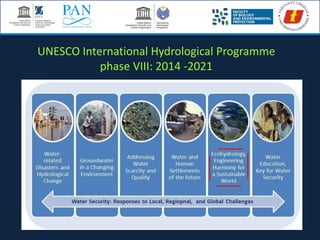
UNESCO International Hydrological Programme
phase VIII: 2014 -2021
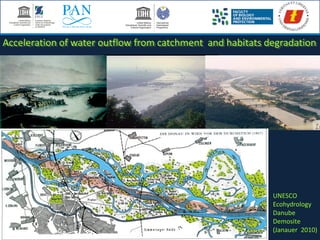
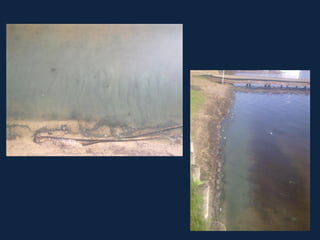
Acceleration of water outflow from catchment and habitats degradation
UNESCO
Ecohydrology
Danube
Demosite
(Janauer 2010)
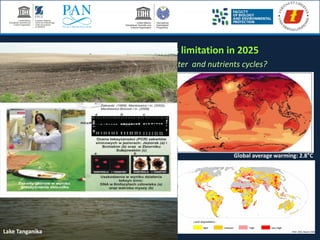
What we have done with climate, water and nutrients cycles?
The forecast of water resources limitation in 2025
1/ Water - acceleration the outflow to the
seas from the agricultural and urbanized
land (70%)
2/ Carbon and nutrients - reduction of the
organic carbon amount in the
catchments landscapes in soils and
biomass
3/ Above two processes reduce biological
productivity and resilience of
ecosystems and increase load of the
nutrients and pollutants in to aquatic
ecosystems where they generate
siltation and secondary pollution
0
Global average warming: 2.8°C
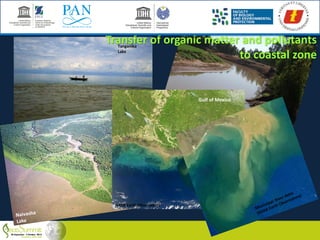
Lake Tanganika
Tanganika
Lake
NASA Earth Observatory
Gulf of Mexico
Transfer of organic matter and pollutants
to coastal zone
Ecohydrological – Process - oriented thinking
Modification of water cycle due to
- Deforestation
- Unification of agricultural
landscape
- Stream channelization
- Impermeable urbanised space
- Storm water and drainage systems
Catchment’s deforestation in Ethiopia Climate change Warta River Poland
Annualevaporation[mm]
D – atmospheric water vapour deficit [hPa]
V – wind speed [ms-1]
R – solar radiation balance [Wm-2]
M = D*V*R/100
- Stream channelization
- Impermeable urbanised space
- Storm water and drainage systems
TerrestrialphaseAcquaticphase
Drying air
Drying air
Drying land
Drying river
Kędziora 2012-2014
Drought area (%) in central Poland
Meanannualdischarge[m3s-1]
WartaRiver
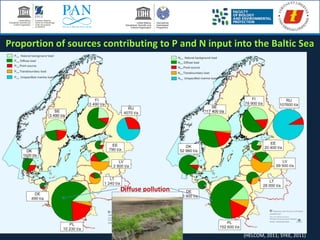
(HELCOM, 2011; SYKE, 2011)
Diffuse pollution
Proportion of sources contributing to P and N input into the Baltic Sea
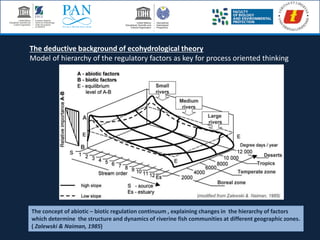
The concept of abiotic – biotic regulation continuum , explaining changes in the hierarchy of factors
which determine the structure and dynamics of riverine fish communities at different geographic zones.
( Zalewski & Naiman, 1985)
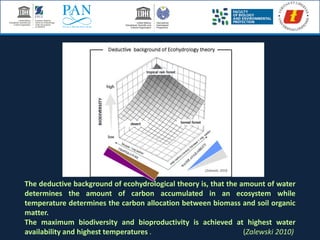
The deductive background of ecohydrological theory
Model of hierarchy of the regulatory factors as key for process oriented thinking
The deductive background of ecohydrological theory is, that the amount of water
determines the amount of carbon accumulated in an ecosystem while
temperature determines the carbon allocation between biomass and soil organic
matter.
The maximum biodiversity and bioproductivity is achieved at highest water
availability and highest temperatures . (Zalewski 2010)
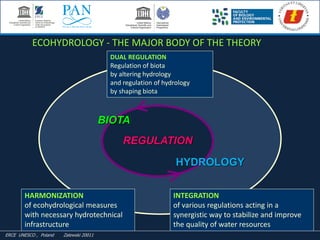
DUAL REGULATION
Regulation of biota
by altering hydrology
and regulation of hydrology
by shaping biota
HARMONIZATION
of ecohydrological measures
with necessary hydrotechnical
infrastructure
INTEGRATION
of various regulations acting in a
synergistic way to stabilize and improve
the quality of water resources
REGULATION
ECOHYDROLOGY - THE MAJOR BODY OF THE THEORY
ERCE UNESCO , Poland Zalewski 20011
BIOTA
HYDROLOGY
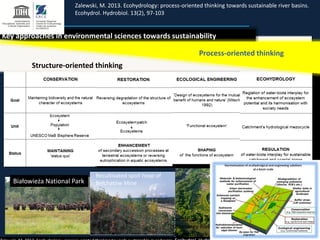
Białowieża National Park
Recultivated spoil heap of
Bełchatów Mine
Constructed ecosystems in
Olentangy River Wetland
Research Park, Ohio
Key approaches in environmental sciences towards sustainability
Process-oriented thinking
Structure-oriented thinking
Zalewski, M. 2013. Ecohydrology: process-oriented thinking towards sustainable river basins.
Ecohydrol. Hydrobiol. 13(2), 97-103
FLOOD PROCESSES IN THE PILICA FLOODPLAIN
Digital
Terrain
Model
Quantification of flood sedimentation on the experimental floodplain
MASS OF FLOOD
SEDIMENTS
(1+2)
MASS OF
PLANTS
COMPONENT
(1)
MASS OF FINE-
GRAIN FLOOD
SEDIMENTS
(2)
PHOSPHORUS CONTENT IN
FINE-GRAIN FLOOD
SEDIMENTS
[g m-2] [g m-2] [g m-2] [mg P g s.m.
osadu-1]
[mg P m-2]
153,1 68,3 84,8 3,3 202,9
Sedimen
-tation
Kiedrzyńska E., Kiedrzyński M., Zalewski M., 2008. Ecohydrology & Hydrobiology, Vol. 8, No 2-4, 281-289.
W. L.
(260 cm)
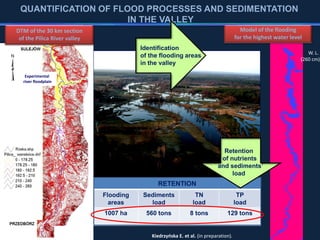
Model of the flooding
for the highest water level
DTM of the 30 km section
of the Pilica River valley
QUANTIFICATION OF FLOOD PROCESSES AND SEDIMENTATION
IN THE VALLEY
RETENTION
Flooding
areas
Sediments
load
TN
load
TP
load
1007 ha 560 tons 8 tons 129 tons
Experimental
river floodplain
Identification
of the flooding areas
in the valley
Retention
of nutrients
and sediments’
load
Kiedrzyńska E. et al. (in preparation).
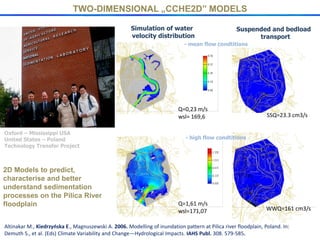
MODELS - CCHE2D
Q=0,23 m/s
wsl= 169,6
Q=1,61 m/s
wsl=171,07 WWQ=161 cm3/s
SSQ=23.3 cm3/s
Oxford – Mississippi USA
United States – Poland
Technology Transfer Project
- mean flow condtitions
- high flow condtitions
Simulation of water
velocity distribution
Suspended and bedload
transport
Magnuszewski, Kiedrzyńska, Wagner, Zalewski. 2005
2D Models to predict,
characterise and better
understand sedimentation
processes on the Pilica River
floodplain
TWO-DIMENSIONAL „CCHE2D” MODELS
Altinakar M., Kiedrzyńska E., Magnuszewski A. 2006. Modelling of inundation pattern at Pilica river floodplain, Poland. In:
Demuth S., et al. (Eds) Climate Variability and Change—Hydrological Impacts. IAHS Publ. 308. 579-585.
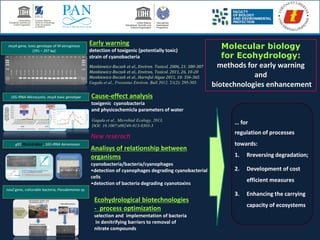
Molecular biology
for Ecohydrology:
methods for early warning
and
biotechnologies enhancement
Cause-effect analysis
toxigenic cyanobacteria
and physicochemicla parameters of water
Analisys of relationship between
organisms
cyanobacteria/bacteria/cyanophages
•detection of cyanophages degrading cyanobacterial
cells
•detection of bacteria degrading cyanotoxins
mcyA gene, toxic genotype of M aeruginosa
(291 – 297 bp)
16S rRNA Microcystis, mcyA toxic genotype
g91 Myoviridae , 16S rRNA Aeromonas
Early warning
detection of toxigenic (potentially toxic)
strain of cyanobacteria
… for
regulation of processes
towards:
1. Rreversing degradation;
2. Development of cost
efficient measures
3. Enhancing the carrying
capacity of ecosystems
nosZ gene, culturable bacteria, Pseudomonas sp.
New reserach
Gagała et al., Microbial Ecology, 2013,
DOI: 10.1007/s00248-013-0303-3
Mankiewicz-Boczek et al., Environ. Toxicol. 2006, 21: 380-387
Mankiewicz-Boczek et al., Environ, Toxicol. 2011, 26, 10-20
Mankiewicz-Boczek et al., Harmful Algae 2011, 10: 356-365
Gagała et al., Fresenius Environ. Bull 2012, 21(2): 295-303
Ecohydrological biotechnologies
- process optimization
selection and implementation of bacteria
in denitrifying barriers to removal of
nitrate compounds
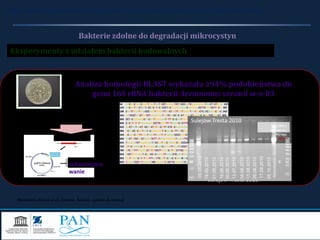
Eksperymenty z udziałem bakterii hodowalnych
Rola mikroorganizmów w dynamice występowania toksycznych zakwitów sinic
Bakterie zdolne do degradacji mikrocystyn
Analiza homologii BLAST wykazała ≥94% podobieństwa do
genu 16S rRNA bakterii Aeromonas veronii w-s-03
sekwencjono
wanie
16S rRNA gene
64 AGCGGCGGACGGGTGAGTAATGCCTGGGGATCTGCCCAGTCGAGGGGGATAACTACTGGA 123
124 AACGGTAGCTAATACCGCATACGCCCTACGGGGGAAAGCAGGGGACCTTCGGGCCTTGCG 183
184 CGATTGGATGAACCCAGGTGGGATTAGCTAGTTGGTGAGGTAATGGCTCACCAAGGCGAC 243
244 GATCCCTAGCTGGTCTGAGAGGATGATCAGCCACACTGGAACTGAGACACGGTCCAGACT 303
304 CCTACGGGAGGCAGCAGTGGGGAATATTGCACAATGGGGGAAACCCTGATGCAGCCATGC 363
364 CGCGTGTGTGAAGAAGGCCTTCGGGTTGTAAAGCACTTTCAGCGAGGAGGAAAGGTTGGT 423
424 AGCTAATAACTGCCAGCTGTGACGTTACTCGCAGAAGAAGCACCGGCTAACTCCGTGCCA 483
484 GCAGCCGCGGTAATACGGAGGGTGCAAGCGTTAATCGGAATTACTGGGCGTAAAGCGCAC 543
544 GCAGGCGGTTGGATAAGTTAGATGTGAAAGCCCCGGGCTCAACCTGGGAATTGCATTTAA 603
604 AACTGTCCAGCTAGAGTCTTGTAGAGGGGGGTAGAATTCCAGGTGTAGCGGTGAAATGCG 663
664 TAGAGATCTGGAGGAATACCGGTGGCGAAGGCGGCCCCCTGGACAAAGACTGACGCTCAG 723
724 GTGCGAAAGCGTGGGGAGCAAACAGGATTAGATACCCTGGTAGTCCACGCCGTAAACGAT 783
784 GTCGATTTGGAGGCTGTGTCCTTGAGACGTGGCTTCCGGAGCTAACGCGTTAA-TCGACC 842
843 GCCTGGGGAGTACGGCCGCAAGGTTAAAACTCAAATGAATTGACGGGGGCCCGCACAAGC 902
903 GGTGGAGCATGTGGTTTAATTCGATGCAACGCGAARAACCTTACCTGGCCTTGACATGTC 962
963 TGGAATCCTGTAGAGATRCGGGAGTGCCTTCGGGAATCAGAACACAGGTGCTGCATGGCT 1022
Sulejów Tresta 2010
05.05.2010
19.05.2010
01.06.2010
16.06.2010
30.06.2010
13.07.2010
04.08.2010
11.08.2010
26.08.2010
17.09.2010
05.10.2010
Aeromonasisolate
B MM
900 bp
800 bp
600 bp
400 bp
300 bp
200 bp
100 bp
500
bp
700
bp
1000
bp
16S rRNA
Aeromonas
(953 bp)
Sulejów Tresta 2010
Mankiewicz-Boczek et al., Environ. Toxicol., wysłano do recenzji
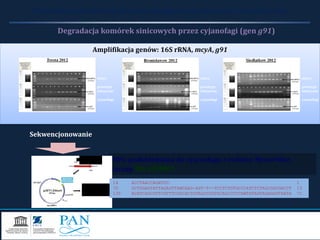
90% podobieństwa do cyjanofaga z rodziny Myoviridae,
szczep Ma-LMM01
g91
14 ACCTAACCAGATTG 1
70 GCTGGAGTATTAGAGTTAMCAAG-AST-T--TCCTCTGTGCCCATCTCTAGCGGCGACCT 15
130 ACATCAGCGTTCGTTTCGGCACTGTAGCCGGTGCAGCCCTCAWTATAGTAGAGGGTAATA 71
Sulejów Reservoir
Amplifikacja genów: 16S rRNA, mcyA, g91
Rola mikroorganizmów w dynamice występowania toksycznych zakwitów sinic
sinice
genotypy
toksyczne
cyjanofagi
sinice
genotypy
toksyczne
cyjanofagi
sinice
genotypy
toksyczne
cyjanofagi
Degradacja komórek sinicowych przez cyjanofagi (gen g91)
Sekwencjonowanie
1 m
1, 3
mbrown
coal
calcium
coal
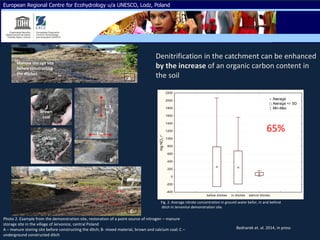
Manure storage site
before constructing
the ditches
A
C
B
Photo 2. Example from the demonstration site, restoration of a point source of nitrogen – manure
storage site in the village of Jervonice, central Poland
A – manure storing site before constructing the ditch; B- mixed material, brown and calcium coal; C –
underground constructed ditch
before ditches in ditches behind ditches
-400
-200
0
200
400
600
800
1000
1200
1400
1600
1800
2000
2200
mgNO3l-1
Average
Average +/- SD
Min-Max
Fig. 2. Average nitrate concentration in ground water befor, in and behind
ditch in Jervonice demonstration site.
Denitrification in the catchment can be enhanced
by the increase of an organic carbon content in
the soil
65%
Bednarek et. al. 2014, in press
European Regional Centre for Ecohydrology u/a UNESCO, Lodz, Poland
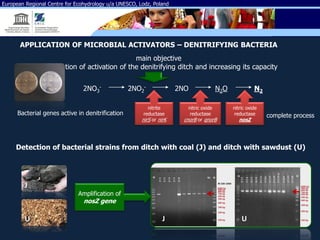
APPLICATION OF MICROBIAL ACTIVATORS – DENITRIFYING BACTERIA
2NO3
- 2NO2
- 2NO N2O N2
main objective
acceleration of activation of the denitrifying ditch and increasing its capacity
nitrite
reductase
nirS or nirK
nitric oxide
reductase
cnorB or qnorB
nitric oxide
reductase
nosZ
Bacterial genes active in denitrification complete process
Amplification of
nosZ gene
Detection of bacterial strains from ditch with coal (J) and ditch with sawdust (U)
J U
J
U
(www.geoportal.gov.pl)
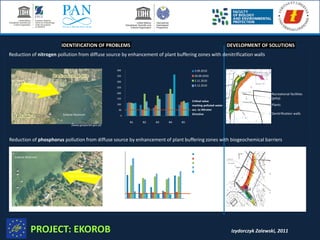
Nitrogen
load
from agricultural land
Sulejow Reservoir Denitrification walls
Plants
Recreational facilities
(jetty)
Recreational facilities
(jetty)
Biogeochemical
barriers
Plants
0
50
100
150
200
250
300
350
400
B1 B2 B3 B4 B5
3.09.2010
30.09.2010
3.11.2010
9.12.2010
Critical value
marking polluted water
acc. to Nitrates
Directive
0
1
2
3
4
5
6
7
Z1 Z2 Z3 Z4 Z5
3.09.2010
30.09.2010
3.11.2010
9.12.2010
19.01.2011
Critical value
for appearance of
cyanobacterial bloom
(www.geoportal.gov.pl)
Sulejow Reservoir
Phosphorus
loadfrom recreational area
DEVELOPMENT OF SOLUTIONSIDENTIFICATION OF PROBLEMS
Reduction of nitrogen pollution from diffuse source by enhancement of plant buffering zones with denitrification walls
Reduction of phosphorus pollution from diffuse source by enhancement of plant buffering zones with biogeochemical barriers
Izydorczyk Zalewski, 2011PROJECT: EKOROB
European Regional Centre for Ecohydrology u/a UNESCO, Lodz, Poland
Biogeochemical limestone-based barriers
to enhance phosphorus reduction in buffer zone
(Izydorczyk et al. Ecohydrology & Hydrobiology 2013)
Phosphate
concentration
ingroundwater
[mgPO4/l]
przed za
0
2
4
6
8
10
12
14
Upstream
of barrier
Downstream
of barrier
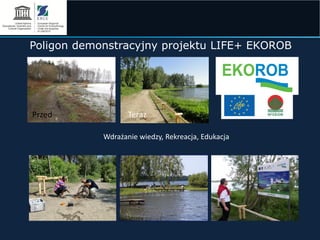
Przed
Poligon demonstracyjny projektu LIFE+ EKOROB
Teraz
Wdrażanie wiedzy, Rekreacja, Edukacja
European Regional Centre for Ecohydrology u/a UNESCO, Lodz, Poland
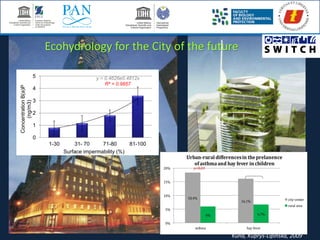
Ecohydrology for the City of the future
18,4%
16,1%
6% 6,7%
0%
5%
10%
15%
20%
asthma hay fever
Urban-rural differencesin theprelanence
ofasthmaand hay fever in children
city-center
rural area
Kuna, Kuprys-Lipinska, 2009
y = 0.4626e0.4812x
R² = 0.9857
0
1
2
3
4
5
1-30 31- 70 71-80 81-100
ConcentrationB(a)P
(ng/m3)
Surface impermability (%)
LIFE08 ENV/PL/000517
www.arturowek.pl
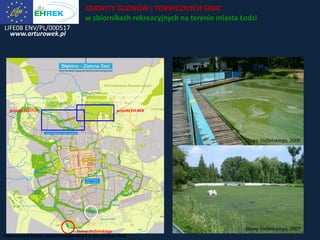
ZAKWITY GLONÓW I TOKSYCZNYCH SINIC
w zbiornikach rekreacyjnych na terenie miasta Łodzi
Stawy Stefańskiego, 2006
prototyp SSSB* skonstruowany
na rzece Sokołówce,
projekt SWITCH
*Sekwencyjny System Sedymentacyjno-Biofiltracyjny (patent ERCE)
wariantowe rozwiązania SSSB*
skonstruowane na rzece Bzurze
w Arturówku,
projekt EH-REK
Stawy Stefańskiego
Stawy Jana
Stawy Stefańskiego, 2007
+38%
Stormwater inflow
in to SBS
Enhanced sedymentation zone
Outflow purified
stormwaters
Ca3(PO4)2↓
Geochemical barirere enhanced by
geotextile curtains
Biofiltration zone
C6H12O6 + 6O2---->6CO2 + 6H2O
Filtering bed
regeneration system
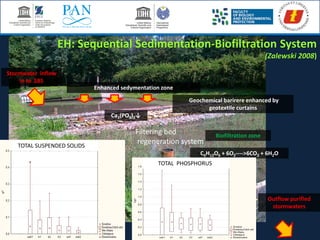
EH: Sequential Sedimentation-Biofiltration System
(Zalewski 2008)
TOTAL SUSPENDED SOLIDS
TOTAL PHOSPHORUS
Kiedrzyńska E., et. al. (in preparation).
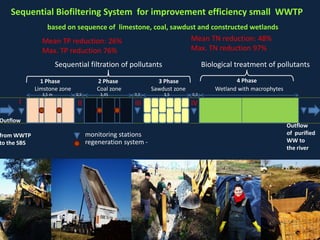
Limstone zone Coal zone Sawdust zone
1 Phase 2 Phase 3 Phase 4 Phase
Wetland with macrophytes
3,5 m 3,45 3,50,5 0,50,5
monitoring stations
regeneration system -
Sequential Biofiltering System for improvement efficiency small WWTP
based on sequence of limestone, coal, sawdust and constructed wetlands
Sequential filtration of pollutants Biological treatment of pollutants
Outflow
from WWTP
to the SBS
Outflow
of purified
WW to
the river
I II III IV
Mean TP reduction: 26%
Max. TP reduction 76%
Mean TN reduction: 48%
Max. TN reduction 97%
LIFE08 ENV/PL/000517
www.arturowek.pl
VI.2013 V.2013
VI.2013
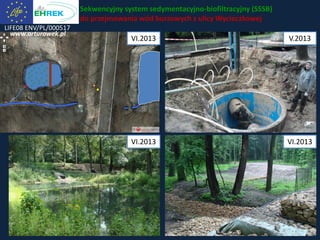
Sekwencyjny system sedymentacyjno-biofiltracyjny (SSSB)
do przejmowania wód burzowych z ulicy Wycieczkowej
VI.2013
LIFE08 ENV/PL/000517
www.arturowek.pl
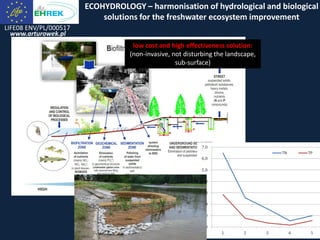
ECOHYDROLOGY – harmonisation of hydrological and biological
solutions for the freshwater ecosystem improvement
low cost and high effectiveness solution:
(non-invasive, not disturbing the landscape,
sub-surface)
LIFE08 ENV/PL/000517
www.arturowek.pl
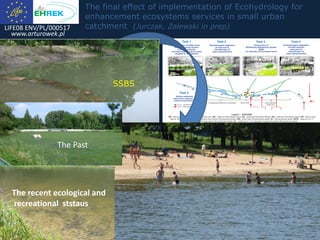
The final effect of implementation of Ecohydrology for
enhancement ecosystems services in small urban
catchment (Jurczak, Zalewski in prep)
The recent ecological and
recreational ststaus
Good water quality
of recreational lake
SSBS
The Past
biomasa chwastow w
pierwszym roku t s m na ha
~
utrata biomasa wierzby na skutek
zachwaszczenia w 1roku %
Biomasa
czynnik 1
czynnik 2
~
gestosc obsady a biomasa
biomasa chwastow
w drugim roku t s m na ha
~
utrata biomasy wierzbyna skutek
zachwaszczenia w 2 roku %
procent utraty
biomasy przez 1 rok
procent utraty biomasy
przez drugi rok
utrata biomasy wierzby na skutek
zachwaszczenia w ciagu 4 lat
wilgotnosc
gleby %
wzrost biomasy a N
przez 4 lata
procentowa ilosc zaatakowanych
sadzonek przez szkodniki
gestosc obsady
ilosc sadzonek na ha
~
srednia miesieczna
temperatura dla Lodzi oC
~
srednie miesieczne
opady dla Lodzi
wilgotnosc
gleby %
~
srednia miesieczna
temperatura dla Lodzi oC
gestosc obsady
ilosc sadzonek na ha
~
pH gleby
a biomasa
pH gleby
~
aktywnosc zwierzyny
a jej ilosc
ilosc sadzonek zaatakowanych
przez szkodniki na ha
~
wspolczynnik wilgotnosci
~
biomasa
zjedzona przez zwierzyne
w kolejnych latach
~
biomasa a
zwierzyna
~
wilgotnosc
a temperatura
~
wilgotnosc a opady
~
poziom wody
a opady
~
fotosynteza
ilosc
zwierzyny
~
przezywalnosc
a sila ssaca gleby
~
sila ssaca
gleby pF
wzrost biomasy a P
przez 4 lata
wzrost biomasy a K
przez 4 lata
przyzywalnosc a poziom wod
gruntowych w ciagu 4 lat
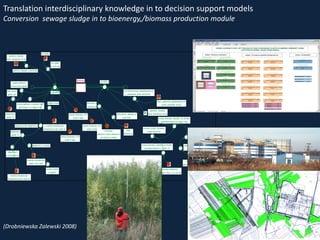
Translation interdisciplinary knowledge in to decision support models
Conversion sewage sludge in to bioenergy,/biomass production module
(Drobniewska Zalewski 2008)
Use of biodegradable geofibers for erosion controll
Construction of the sequentional biofiltration system for turbidity,
eutrophication and dioxin toxicity reduction in the Asella BioFarm
Park lake
Dioxin toxicity reduction in
the Asella
BioFarm Park lake
Use of sediments for
bioenergy production
Sedimentation
Stock watering site and use of manure collected at the site
as a fertilizer
Before After
0
0,5
1
1,5
2
2,5
Sediment trap Biofiter Lake
toxicity[ngTEQ/kgd.w.]
0
0,5
1
1,5
2
2,5
Inflow Lake Otflow
Toxicity[ngTEQ/kgd.w.]
toxicity limit ccording to
SQG
Zalewski, Urbaniak, Negussie 2013
The implementation of the ecohydrology
methods and systemic solutions
for reduction of sedimentation,
eutophication
and dioxin-induced toxicity
in the Asalla BioFarm
Park lake
ETHIOPIA
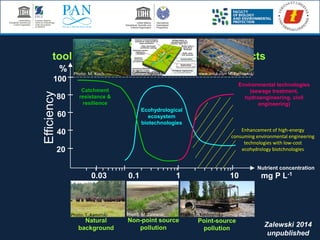
Ecohydrology:
tool for mitigation of intermediate impacts
Photo: E. Kiedrzyńska
%
Ecohydrological
ecosystem
biotechnologies
Environmental technologies
(sewage treatment,
hydroengineering, civil
engineering)
Point-source
pollution
Non-point source
pollution
Natural
background
20
40
60
100
Zalewski 2014
unpublished
Efficiency
80
Nutrient concentration
Catchment
resistance &
resilience
0.03 0.1 1 10 mg P L-1
Photo: T. Kamiński
www.uriuk.com M. PieńkowskiPhoto: M. Koch
Photo: M. Zalewski
Zalewski, 2013
Enhancement of high-energy
consuming environmental engineering
technologies with low-cost
ecohydrology biotchnologies
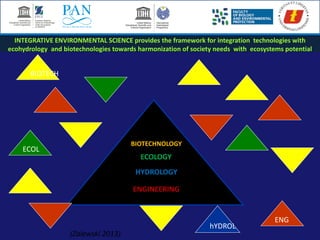
hYDROL
ECOL
ENG
BIOTECH
HYDROLOGY
ECOLOGY
ENGINEERING
BIOTECHNOLOGY
(Zalewski 2013)
INTEGRATIVE ENVIRONMENTAL SCIENCE provides the framework for integration technologies with
ecohydrology and biotechnologies towards harmonization of society needs with ecosystems potential
Now I have
understood what
”top down”
means in
Ecohydrology.
http://colliercitizen.fl.newsmemory.com
Thank you
The inspiring cooperation of my colleagues from
ERCE PAS u/a UNESCO, Department of Applied Ecology, UŁ
UNESCO Division of Water Sciences and IHP
is highly appreciated and made the introduced projects happened

M. zalewski lublin 2015 final

  • 1.
    EKOHYDROLOGICZNE PODSTAWY OGRANICZANIAEUTROFIZACJI W SYSTEMACH RZECZNYCH I ZBIORNIKACH ZAPOROWYCH Professor MACIEJ ZALEWSKI Director European Regional Centre for Ecohydrology PAS u/a UNESCO Chairman of Department Applied Ecology University of Łódz
  • 2.
    UNESCO International HydrologicalProgramme phase VIII: 2014 -2021
  • 3.
    Acceleration of wateroutflow from catchment and habitats degradation UNESCO Ecohydrology Danube Demosite (Janauer 2010)
  • 4.
    What we havedone with climate, water and nutrients cycles? The forecast of water resources limitation in 2025 1/ Water - acceleration the outflow to the seas from the agricultural and urbanized land (70%) 2/ Carbon and nutrients - reduction of the organic carbon amount in the catchments landscapes in soils and biomass 3/ Above two processes reduce biological productivity and resilience of ecosystems and increase load of the nutrients and pollutants in to aquatic ecosystems where they generate siltation and secondary pollution 0 Global average warming: 2.8°C Lake Tanganika
  • 6.
    Tanganika Lake NASA Earth Observatory Gulfof Mexico Transfer of organic matter and pollutants to coastal zone
  • 7.
    Ecohydrological – Process- oriented thinking Modification of water cycle due to - Deforestation - Unification of agricultural landscape - Stream channelization - Impermeable urbanised space - Storm water and drainage systems Catchment’s deforestation in Ethiopia Climate change Warta River Poland Annualevaporation[mm] D – atmospheric water vapour deficit [hPa] V – wind speed [ms-1] R – solar radiation balance [Wm-2] M = D*V*R/100 - Stream channelization - Impermeable urbanised space - Storm water and drainage systems TerrestrialphaseAcquaticphase Drying air Drying air Drying land Drying river Kędziora 2012-2014 Drought area (%) in central Poland Meanannualdischarge[m3s-1] WartaRiver
  • 8.
    (HELCOM, 2011; SYKE,2011) Diffuse pollution Proportion of sources contributing to P and N input into the Baltic Sea
  • 9.
    The concept ofabiotic – biotic regulation continuum , explaining changes in the hierarchy of factors which determine the structure and dynamics of riverine fish communities at different geographic zones. ( Zalewski & Naiman, 1985) The deductive background of ecohydrological theory Model of hierarchy of the regulatory factors as key for process oriented thinking
  • 10.
    The deductive backgroundof ecohydrological theory is, that the amount of water determines the amount of carbon accumulated in an ecosystem while temperature determines the carbon allocation between biomass and soil organic matter. The maximum biodiversity and bioproductivity is achieved at highest water availability and highest temperatures . (Zalewski 2010)
  • 11.
    DUAL REGULATION Regulation ofbiota by altering hydrology and regulation of hydrology by shaping biota HARMONIZATION of ecohydrological measures with necessary hydrotechnical infrastructure INTEGRATION of various regulations acting in a synergistic way to stabilize and improve the quality of water resources REGULATION ECOHYDROLOGY - THE MAJOR BODY OF THE THEORY ERCE UNESCO , Poland Zalewski 20011 BIOTA HYDROLOGY
  • 12.
    Białowieża National Park Recultivatedspoil heap of Bełchatów Mine Constructed ecosystems in Olentangy River Wetland Research Park, Ohio Key approaches in environmental sciences towards sustainability Process-oriented thinking Structure-oriented thinking Zalewski, M. 2013. Ecohydrology: process-oriented thinking towards sustainable river basins. Ecohydrol. Hydrobiol. 13(2), 97-103
  • 13.
    FLOOD PROCESSES INTHE PILICA FLOODPLAIN Digital Terrain Model Quantification of flood sedimentation on the experimental floodplain MASS OF FLOOD SEDIMENTS (1+2) MASS OF PLANTS COMPONENT (1) MASS OF FINE- GRAIN FLOOD SEDIMENTS (2) PHOSPHORUS CONTENT IN FINE-GRAIN FLOOD SEDIMENTS [g m-2] [g m-2] [g m-2] [mg P g s.m. osadu-1] [mg P m-2] 153,1 68,3 84,8 3,3 202,9 Sedimen -tation Kiedrzyńska E., Kiedrzyński M., Zalewski M., 2008. Ecohydrology & Hydrobiology, Vol. 8, No 2-4, 281-289.
  • 14.
    W. L. (260 cm) Modelof the flooding for the highest water level DTM of the 30 km section of the Pilica River valley QUANTIFICATION OF FLOOD PROCESSES AND SEDIMENTATION IN THE VALLEY RETENTION Flooding areas Sediments load TN load TP load 1007 ha 560 tons 8 tons 129 tons Experimental river floodplain Identification of the flooding areas in the valley Retention of nutrients and sediments’ load Kiedrzyńska E. et al. (in preparation).
  • 15.
    MODELS - CCHE2D Q=0,23m/s wsl= 169,6 Q=1,61 m/s wsl=171,07 WWQ=161 cm3/s SSQ=23.3 cm3/s Oxford – Mississippi USA United States – Poland Technology Transfer Project - mean flow condtitions - high flow condtitions Simulation of water velocity distribution Suspended and bedload transport Magnuszewski, Kiedrzyńska, Wagner, Zalewski. 2005 2D Models to predict, characterise and better understand sedimentation processes on the Pilica River floodplain TWO-DIMENSIONAL „CCHE2D” MODELS Altinakar M., Kiedrzyńska E., Magnuszewski A. 2006. Modelling of inundation pattern at Pilica river floodplain, Poland. In: Demuth S., et al. (Eds) Climate Variability and Change—Hydrological Impacts. IAHS Publ. 308. 579-585.
  • 16.
    Molecular biology for Ecohydrology: methodsfor early warning and biotechnologies enhancement Cause-effect analysis toxigenic cyanobacteria and physicochemicla parameters of water Analisys of relationship between organisms cyanobacteria/bacteria/cyanophages •detection of cyanophages degrading cyanobacterial cells •detection of bacteria degrading cyanotoxins mcyA gene, toxic genotype of M aeruginosa (291 – 297 bp) 16S rRNA Microcystis, mcyA toxic genotype g91 Myoviridae , 16S rRNA Aeromonas Early warning detection of toxigenic (potentially toxic) strain of cyanobacteria … for regulation of processes towards: 1. Rreversing degradation; 2. Development of cost efficient measures 3. Enhancing the carrying capacity of ecosystems nosZ gene, culturable bacteria, Pseudomonas sp. New reserach Gagała et al., Microbial Ecology, 2013, DOI: 10.1007/s00248-013-0303-3 Mankiewicz-Boczek et al., Environ. Toxicol. 2006, 21: 380-387 Mankiewicz-Boczek et al., Environ, Toxicol. 2011, 26, 10-20 Mankiewicz-Boczek et al., Harmful Algae 2011, 10: 356-365 Gagała et al., Fresenius Environ. Bull 2012, 21(2): 295-303 Ecohydrological biotechnologies - process optimization selection and implementation of bacteria in denitrifying barriers to removal of nitrate compounds
  • 17.
    Eksperymenty z udziałembakterii hodowalnych Rola mikroorganizmów w dynamice występowania toksycznych zakwitów sinic Bakterie zdolne do degradacji mikrocystyn Analiza homologii BLAST wykazała ≥94% podobieństwa do genu 16S rRNA bakterii Aeromonas veronii w-s-03 sekwencjono wanie 16S rRNA gene 64 AGCGGCGGACGGGTGAGTAATGCCTGGGGATCTGCCCAGTCGAGGGGGATAACTACTGGA 123 124 AACGGTAGCTAATACCGCATACGCCCTACGGGGGAAAGCAGGGGACCTTCGGGCCTTGCG 183 184 CGATTGGATGAACCCAGGTGGGATTAGCTAGTTGGTGAGGTAATGGCTCACCAAGGCGAC 243 244 GATCCCTAGCTGGTCTGAGAGGATGATCAGCCACACTGGAACTGAGACACGGTCCAGACT 303 304 CCTACGGGAGGCAGCAGTGGGGAATATTGCACAATGGGGGAAACCCTGATGCAGCCATGC 363 364 CGCGTGTGTGAAGAAGGCCTTCGGGTTGTAAAGCACTTTCAGCGAGGAGGAAAGGTTGGT 423 424 AGCTAATAACTGCCAGCTGTGACGTTACTCGCAGAAGAAGCACCGGCTAACTCCGTGCCA 483 484 GCAGCCGCGGTAATACGGAGGGTGCAAGCGTTAATCGGAATTACTGGGCGTAAAGCGCAC 543 544 GCAGGCGGTTGGATAAGTTAGATGTGAAAGCCCCGGGCTCAACCTGGGAATTGCATTTAA 603 604 AACTGTCCAGCTAGAGTCTTGTAGAGGGGGGTAGAATTCCAGGTGTAGCGGTGAAATGCG 663 664 TAGAGATCTGGAGGAATACCGGTGGCGAAGGCGGCCCCCTGGACAAAGACTGACGCTCAG 723 724 GTGCGAAAGCGTGGGGAGCAAACAGGATTAGATACCCTGGTAGTCCACGCCGTAAACGAT 783 784 GTCGATTTGGAGGCTGTGTCCTTGAGACGTGGCTTCCGGAGCTAACGCGTTAA-TCGACC 842 843 GCCTGGGGAGTACGGCCGCAAGGTTAAAACTCAAATGAATTGACGGGGGCCCGCACAAGC 902 903 GGTGGAGCATGTGGTTTAATTCGATGCAACGCGAARAACCTTACCTGGCCTTGACATGTC 962 963 TGGAATCCTGTAGAGATRCGGGAGTGCCTTCGGGAATCAGAACACAGGTGCTGCATGGCT 1022 Sulejów Tresta 2010 05.05.2010 19.05.2010 01.06.2010 16.06.2010 30.06.2010 13.07.2010 04.08.2010 11.08.2010 26.08.2010 17.09.2010 05.10.2010 Aeromonasisolate B MM 900 bp 800 bp 600 bp 400 bp 300 bp 200 bp 100 bp 500 bp 700 bp 1000 bp 16S rRNA Aeromonas (953 bp) Sulejów Tresta 2010 Mankiewicz-Boczek et al., Environ. Toxicol., wysłano do recenzji
  • 18.
    90% podobieństwa docyjanofaga z rodziny Myoviridae, szczep Ma-LMM01 g91 14 ACCTAACCAGATTG 1 70 GCTGGAGTATTAGAGTTAMCAAG-AST-T--TCCTCTGTGCCCATCTCTAGCGGCGACCT 15 130 ACATCAGCGTTCGTTTCGGCACTGTAGCCGGTGCAGCCCTCAWTATAGTAGAGGGTAATA 71 Sulejów Reservoir Amplifikacja genów: 16S rRNA, mcyA, g91 Rola mikroorganizmów w dynamice występowania toksycznych zakwitów sinic sinice genotypy toksyczne cyjanofagi sinice genotypy toksyczne cyjanofagi sinice genotypy toksyczne cyjanofagi Degradacja komórek sinicowych przez cyjanofagi (gen g91) Sekwencjonowanie
  • 19.
    1 m 1, 3 mbrown coal calcium coal Manurestorage site before constructing the ditches A C B Photo 2. Example from the demonstration site, restoration of a point source of nitrogen – manure storage site in the village of Jervonice, central Poland A – manure storing site before constructing the ditch; B- mixed material, brown and calcium coal; C – underground constructed ditch before ditches in ditches behind ditches -400 -200 0 200 400 600 800 1000 1200 1400 1600 1800 2000 2200 mgNO3l-1 Average Average +/- SD Min-Max Fig. 2. Average nitrate concentration in ground water befor, in and behind ditch in Jervonice demonstration site. Denitrification in the catchment can be enhanced by the increase of an organic carbon content in the soil 65% Bednarek et. al. 2014, in press European Regional Centre for Ecohydrology u/a UNESCO, Lodz, Poland
  • 20.
    European Regional Centrefor Ecohydrology u/a UNESCO, Lodz, Poland APPLICATION OF MICROBIAL ACTIVATORS – DENITRIFYING BACTERIA 2NO3 - 2NO2 - 2NO N2O N2 main objective acceleration of activation of the denitrifying ditch and increasing its capacity nitrite reductase nirS or nirK nitric oxide reductase cnorB or qnorB nitric oxide reductase nosZ Bacterial genes active in denitrification complete process Amplification of nosZ gene Detection of bacterial strains from ditch with coal (J) and ditch with sawdust (U) J U J U
  • 21.
    (www.geoportal.gov.pl) Nitrogen load from agricultural land SulejowReservoir Denitrification walls Plants Recreational facilities (jetty) Recreational facilities (jetty) Biogeochemical barriers Plants 0 50 100 150 200 250 300 350 400 B1 B2 B3 B4 B5 3.09.2010 30.09.2010 3.11.2010 9.12.2010 Critical value marking polluted water acc. to Nitrates Directive 0 1 2 3 4 5 6 7 Z1 Z2 Z3 Z4 Z5 3.09.2010 30.09.2010 3.11.2010 9.12.2010 19.01.2011 Critical value for appearance of cyanobacterial bloom (www.geoportal.gov.pl) Sulejow Reservoir Phosphorus loadfrom recreational area DEVELOPMENT OF SOLUTIONSIDENTIFICATION OF PROBLEMS Reduction of nitrogen pollution from diffuse source by enhancement of plant buffering zones with denitrification walls Reduction of phosphorus pollution from diffuse source by enhancement of plant buffering zones with biogeochemical barriers Izydorczyk Zalewski, 2011PROJECT: EKOROB
  • 22.
    European Regional Centrefor Ecohydrology u/a UNESCO, Lodz, Poland Biogeochemical limestone-based barriers to enhance phosphorus reduction in buffer zone (Izydorczyk et al. Ecohydrology & Hydrobiology 2013) Phosphate concentration ingroundwater [mgPO4/l] przed za 0 2 4 6 8 10 12 14 Upstream of barrier Downstream of barrier
  • 23.
    Przed Poligon demonstracyjny projektuLIFE+ EKOROB Teraz Wdrażanie wiedzy, Rekreacja, Edukacja
  • 24.
    European Regional Centrefor Ecohydrology u/a UNESCO, Lodz, Poland
  • 25.
    Ecohydrology for theCity of the future 18,4% 16,1% 6% 6,7% 0% 5% 10% 15% 20% asthma hay fever Urban-rural differencesin theprelanence ofasthmaand hay fever in children city-center rural area Kuna, Kuprys-Lipinska, 2009 y = 0.4626e0.4812x R² = 0.9857 0 1 2 3 4 5 1-30 31- 70 71-80 81-100 ConcentrationB(a)P (ng/m3) Surface impermability (%)
  • 26.
    LIFE08 ENV/PL/000517 www.arturowek.pl ZAKWITY GLONÓWI TOKSYCZNYCH SINIC w zbiornikach rekreacyjnych na terenie miasta Łodzi Stawy Stefańskiego, 2006 prototyp SSSB* skonstruowany na rzece Sokołówce, projekt SWITCH *Sekwencyjny System Sedymentacyjno-Biofiltracyjny (patent ERCE) wariantowe rozwiązania SSSB* skonstruowane na rzece Bzurze w Arturówku, projekt EH-REK Stawy Stefańskiego Stawy Jana Stawy Stefańskiego, 2007
  • 27.
    +38% Stormwater inflow in toSBS Enhanced sedymentation zone Outflow purified stormwaters Ca3(PO4)2↓ Geochemical barirere enhanced by geotextile curtains Biofiltration zone C6H12O6 + 6O2---->6CO2 + 6H2O Filtering bed regeneration system EH: Sequential Sedimentation-Biofiltration System (Zalewski 2008) TOTAL SUSPENDED SOLIDS TOTAL PHOSPHORUS
  • 28.
    Kiedrzyńska E., et.al. (in preparation). Limstone zone Coal zone Sawdust zone 1 Phase 2 Phase 3 Phase 4 Phase Wetland with macrophytes 3,5 m 3,45 3,50,5 0,50,5 monitoring stations regeneration system - Sequential Biofiltering System for improvement efficiency small WWTP based on sequence of limestone, coal, sawdust and constructed wetlands Sequential filtration of pollutants Biological treatment of pollutants Outflow from WWTP to the SBS Outflow of purified WW to the river I II III IV Mean TP reduction: 26% Max. TP reduction 76% Mean TN reduction: 48% Max. TN reduction 97%
  • 29.
    LIFE08 ENV/PL/000517 www.arturowek.pl VI.2013 V.2013 VI.2013 Sekwencyjnysystem sedymentacyjno-biofiltracyjny (SSSB) do przejmowania wód burzowych z ulicy Wycieczkowej VI.2013
  • 30.
    LIFE08 ENV/PL/000517 www.arturowek.pl ECOHYDROLOGY –harmonisation of hydrological and biological solutions for the freshwater ecosystem improvement low cost and high effectiveness solution: (non-invasive, not disturbing the landscape, sub-surface)
  • 31.
    LIFE08 ENV/PL/000517 www.arturowek.pl The finaleffect of implementation of Ecohydrology for enhancement ecosystems services in small urban catchment (Jurczak, Zalewski in prep) The recent ecological and recreational ststaus Good water quality of recreational lake SSBS The Past
  • 32.
    biomasa chwastow w pierwszymroku t s m na ha ~ utrata biomasa wierzby na skutek zachwaszczenia w 1roku % Biomasa czynnik 1 czynnik 2 ~ gestosc obsady a biomasa biomasa chwastow w drugim roku t s m na ha ~ utrata biomasy wierzbyna skutek zachwaszczenia w 2 roku % procent utraty biomasy przez 1 rok procent utraty biomasy przez drugi rok utrata biomasy wierzby na skutek zachwaszczenia w ciagu 4 lat wilgotnosc gleby % wzrost biomasy a N przez 4 lata procentowa ilosc zaatakowanych sadzonek przez szkodniki gestosc obsady ilosc sadzonek na ha ~ srednia miesieczna temperatura dla Lodzi oC ~ srednie miesieczne opady dla Lodzi wilgotnosc gleby % ~ srednia miesieczna temperatura dla Lodzi oC gestosc obsady ilosc sadzonek na ha ~ pH gleby a biomasa pH gleby ~ aktywnosc zwierzyny a jej ilosc ilosc sadzonek zaatakowanych przez szkodniki na ha ~ wspolczynnik wilgotnosci ~ biomasa zjedzona przez zwierzyne w kolejnych latach ~ biomasa a zwierzyna ~ wilgotnosc a temperatura ~ wilgotnosc a opady ~ poziom wody a opady ~ fotosynteza ilosc zwierzyny ~ przezywalnosc a sila ssaca gleby ~ sila ssaca gleby pF wzrost biomasy a P przez 4 lata wzrost biomasy a K przez 4 lata przyzywalnosc a poziom wod gruntowych w ciagu 4 lat Translation interdisciplinary knowledge in to decision support models Conversion sewage sludge in to bioenergy,/biomass production module (Drobniewska Zalewski 2008)
  • 33.
    Use of biodegradablegeofibers for erosion controll Construction of the sequentional biofiltration system for turbidity, eutrophication and dioxin toxicity reduction in the Asella BioFarm Park lake Dioxin toxicity reduction in the Asella BioFarm Park lake Use of sediments for bioenergy production Sedimentation Stock watering site and use of manure collected at the site as a fertilizer Before After 0 0,5 1 1,5 2 2,5 Sediment trap Biofiter Lake toxicity[ngTEQ/kgd.w.] 0 0,5 1 1,5 2 2,5 Inflow Lake Otflow Toxicity[ngTEQ/kgd.w.] toxicity limit ccording to SQG Zalewski, Urbaniak, Negussie 2013 The implementation of the ecohydrology methods and systemic solutions for reduction of sedimentation, eutophication and dioxin-induced toxicity in the Asalla BioFarm Park lake ETHIOPIA
  • 34.
    Ecohydrology: tool for mitigationof intermediate impacts Photo: E. Kiedrzyńska % Ecohydrological ecosystem biotechnologies Environmental technologies (sewage treatment, hydroengineering, civil engineering) Point-source pollution Non-point source pollution Natural background 20 40 60 100 Zalewski 2014 unpublished Efficiency 80 Nutrient concentration Catchment resistance & resilience 0.03 0.1 1 10 mg P L-1 Photo: T. Kamiński www.uriuk.com M. PieńkowskiPhoto: M. Koch Photo: M. Zalewski Zalewski, 2013 Enhancement of high-energy consuming environmental engineering technologies with low-cost ecohydrology biotchnologies
  • 35.
    hYDROL ECOL ENG BIOTECH HYDROLOGY ECOLOGY ENGINEERING BIOTECHNOLOGY (Zalewski 2013) INTEGRATIVE ENVIRONMENTALSCIENCE provides the framework for integration technologies with ecohydrology and biotechnologies towards harmonization of society needs with ecosystems potential
  • 36.
    Now I have understoodwhat ”top down” means in Ecohydrology. http://colliercitizen.fl.newsmemory.com
  • 37.
    Thank you The inspiringcooperation of my colleagues from ERCE PAS u/a UNESCO, Department of Applied Ecology, UŁ UNESCO Division of Water Sciences and IHP is highly appreciated and made the introduced projects happened