M Payments
(Regulation & Guidelines)
By-Rajeshwari Raju
Shambhu Singh
Vikas Jain
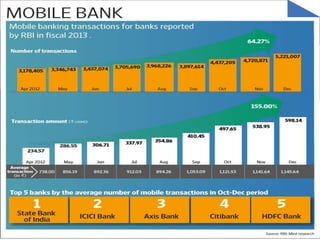
M-Payments
• It’s a payment services operated under financial
regulation and performed from or via a mobile device.
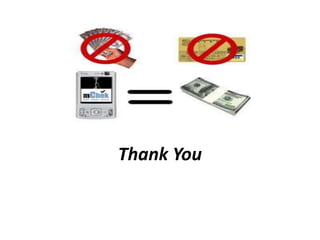
• Instead of paying with cash, cheque, or credit cards, a
consumer can use a mobile phone to pay.
• MPFI is the umbrella organization which is responsible
for deploying mobile payments in India.
• This service is being offered by several major banks in
India.
• Customers send money by SMS, using a Java
application over GPRS, a WAP service or other mobile
communication technologies.
Models
• Premium SMS based transactional payments
• Direct Mobile Billing
• Mobile web payments (WAP)
• Contactless NFC (Near Field Communication)
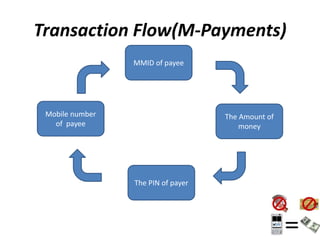
Transaction Flow(M-Payments)
Mobile number
of payee
The PIN of payer
The Amount of
money
MMID of payee
Regulations in India
• Banks which are licensed and supervised in India and
have a physical presence in India will be permitted to
offer mobile payment services.
• The services should be restricted to only to bank
accounts/ credit card accounts in India which are
KYC/AML compliant.
• Only Indian Rupee based services should be provided.
• Banks may use the services of Business Correspondents
for extending this facility, to their customers.
• The guidelines issued by RBI on ‘Risks and Controls in C
&T will equally apply to Mobile payments.
• The RBI guidelines on KYC and Anti Money Laundering
(AML) as prescribed by RBI would be applicable to
customers opting for mobile based banking service.
Registration of customers for M-Service
• Banks should offer mobile based banking service only
to their own customers.
• Banks should have a system of registration before
commencing mobile based payment service to a
customer.
• There can be two level of services-
Basic Level
Standard Level
Advantages
• Secure
• Convenience
• Easy
• Fast
• Reliable
Technology and Security Standards
• The technology used for mobile payments must be
secure and should ensure confidentiality, integrity &
authenticity.
• The information Security Policy of the banks should be
suitably updated and enforced to take care of the
security controls required specially for mobile phone
based delivery channel.
• Proper system of verification of the mobile phone
number should be implemented.
• Proper level of encryption should be implemented for
communicating from the mobile handset to the bank’s.
• Use strong encryption for protecting the sensitive and
confidential information of bank and customers in
transit.
• Separate login ID and password should be provided For
WAP and Web.
• The Data Centre of the Bank and Service Providers
should have proper wired and wireless data network
protection mechanisms.
Some More Guidelines-
• Inter-operability
• Clearing and Settlement for inter-bank funds transfer
transactions.
• Customer Complaints and Grievance Redressal
Mechanism.
• Board level approval
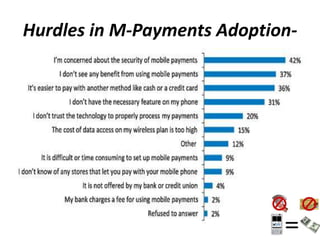
Hurdles in M-Payments Adoption-
Challenges for M-Services in India
• Poor levels of literacy are a major problem in India.
• Voice-based solutions.
• Uncomfortable with technology.
• Financial inclusion.
• The mobile services have to be effective in terms of
usability, cost, efficiency, and security for
transactions of all sizes.
• M-payments options should be available even on
low end mobile handsets.
Consumer Protection Issues
• Banks must make mandatory disclosures of risks,
responsibilities and liabilities of the customers in doing
business through Mobile phone.
• There must be agreement between the banks and
customers.
• Bilateral contracts between the payee and payee’s bank.
• It would be the responsibility of the service providing
bank, to address the customer grievances.
• The jurisdiction of legal settlement would be within India.
Thank You

M payments Regulation and Guidelines in india

  • 1.
    M Payments (Regulation &Guidelines) By-Rajeshwari Raju Shambhu Singh Vikas Jain
  • 2.
    M-Payments • It’s apayment services operated under financial regulation and performed from or via a mobile device. • Instead of paying with cash, cheque, or credit cards, a consumer can use a mobile phone to pay. • MPFI is the umbrella organization which is responsible for deploying mobile payments in India. • This service is being offered by several major banks in India. • Customers send money by SMS, using a Java application over GPRS, a WAP service or other mobile communication technologies.
  • 3.
    Models • Premium SMSbased transactional payments • Direct Mobile Billing • Mobile web payments (WAP) • Contactless NFC (Near Field Communication)
  • 4.
    Transaction Flow(M-Payments) Mobile number ofpayee The PIN of payer The Amount of money MMID of payee
  • 5.
    Regulations in India •Banks which are licensed and supervised in India and have a physical presence in India will be permitted to offer mobile payment services. • The services should be restricted to only to bank accounts/ credit card accounts in India which are KYC/AML compliant. • Only Indian Rupee based services should be provided. • Banks may use the services of Business Correspondents for extending this facility, to their customers.
  • 6.
    • The guidelinesissued by RBI on ‘Risks and Controls in C &T will equally apply to Mobile payments. • The RBI guidelines on KYC and Anti Money Laundering (AML) as prescribed by RBI would be applicable to customers opting for mobile based banking service.
  • 7.
    Registration of customersfor M-Service • Banks should offer mobile based banking service only to their own customers. • Banks should have a system of registration before commencing mobile based payment service to a customer. • There can be two level of services- Basic Level Standard Level
  • 8.
  • 9.
    Technology and SecurityStandards • The technology used for mobile payments must be secure and should ensure confidentiality, integrity & authenticity. • The information Security Policy of the banks should be suitably updated and enforced to take care of the security controls required specially for mobile phone based delivery channel.
  • 10.
    • Proper systemof verification of the mobile phone number should be implemented. • Proper level of encryption should be implemented for communicating from the mobile handset to the bank’s. • Use strong encryption for protecting the sensitive and confidential information of bank and customers in transit. • Separate login ID and password should be provided For WAP and Web. • The Data Centre of the Bank and Service Providers should have proper wired and wireless data network protection mechanisms.
  • 11.
    Some More Guidelines- •Inter-operability • Clearing and Settlement for inter-bank funds transfer transactions. • Customer Complaints and Grievance Redressal Mechanism. • Board level approval
  • 12.
  • 14.
    Challenges for M-Servicesin India • Poor levels of literacy are a major problem in India. • Voice-based solutions. • Uncomfortable with technology. • Financial inclusion. • The mobile services have to be effective in terms of usability, cost, efficiency, and security for transactions of all sizes. • M-payments options should be available even on low end mobile handsets.
  • 15.
    Consumer Protection Issues •Banks must make mandatory disclosures of risks, responsibilities and liabilities of the customers in doing business through Mobile phone. • There must be agreement between the banks and customers. • Bilateral contracts between the payee and payee’s bank. • It would be the responsibility of the service providing bank, to address the customer grievances. • The jurisdiction of legal settlement would be within India.
  • 16.