Lyman-alpha line
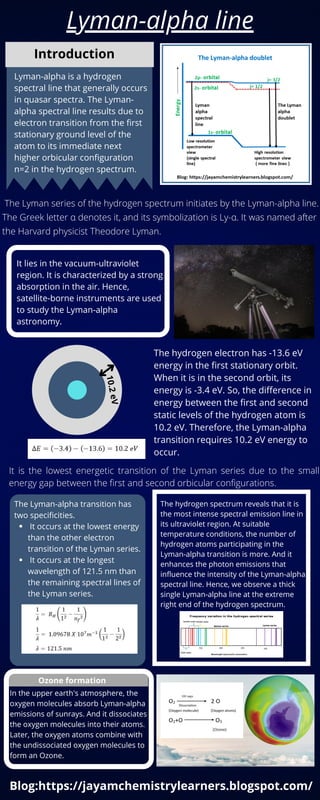
Lyman-alpha is a hydrogen
spectral line that generally occurs
in quasar spectra. The Lyman-
alpha spectral line results due to
electron transition from the first
stationary ground level of the
atom to its immediate next
higher orbicular configuration
n=2 in the hydrogen spectrum.
The Lyman series of the hydrogen spectrum initiates by the Lyman-alpha line.
The Greek letter α denotes it, and its symbolization is Ly-α. It was named after
the Harvard physicist Theodore Lyman.
It lies in the vacuum-ultraviolet
region. It is characterized by a strong
absorption in the air. Hence,
satellite-borne instruments are used
to study the Lyman-alpha
astronomy.
The hydrogen electron has -13.6 eV
energy in the first stationary orbit.
When it is in the second orbit, its
energy is -3.4 eV. So, the difference in
energy between the first and second
static levels of the hydrogen atom is
10.2 eV. Therefore, the Lyman-alpha
transition requires 10.2 eV energy to
occur.
1
0
.
2
e
V
It is the lowest energetic transition of the Lyman series due to the small
energy gap between the first and second orbicular configurations.
It occurs at the lowest energy
than the other electron
transition of the Lyman series.
It occurs at the longest
wavelength of 121.5 nm than
the remaining spectral lines of
the Lyman series.
The Lyman-alpha transition has
two specificities.
The hydrogen spectrum reveals that it is
the most intense spectral emission line in
its ultraviolet region. At suitable
temperature conditions, the number of
hydrogen atoms participating in the
Lyman-alpha transition is more. And it
enhances the photon emissions that
influence the intensity of the Lyman-alpha
spectral line. Hence, we observe a thick
single Lyman-alpha line at the extreme
right end of the hydrogen spectrum.
Introduction
In the upper earth's atmosphere, the
oxygen molecules absorb Lyman-alpha
emissions of sunrays. And it dissociates
the oxygen molecules into their atoms.
Later, the oxygen atoms combine with
the undissociated oxygen molecules to
form an Ozone.
Ozone formation
Blog:https://jayamchemistrylearners.blogspot.com/

Lyman-alpha line.pdf

  • 1.
    Lyman-alpha line Lyman-alpha isa hydrogen spectral line that generally occurs in quasar spectra. The Lyman- alpha spectral line results due to electron transition from the first stationary ground level of the atom to its immediate next higher orbicular configuration n=2 in the hydrogen spectrum. The Lyman series of the hydrogen spectrum initiates by the Lyman-alpha line. The Greek letter α denotes it, and its symbolization is Ly-α. It was named after the Harvard physicist Theodore Lyman. It lies in the vacuum-ultraviolet region. It is characterized by a strong absorption in the air. Hence, satellite-borne instruments are used to study the Lyman-alpha astronomy. The hydrogen electron has -13.6 eV energy in the first stationary orbit. When it is in the second orbit, its energy is -3.4 eV. So, the difference in energy between the first and second static levels of the hydrogen atom is 10.2 eV. Therefore, the Lyman-alpha transition requires 10.2 eV energy to occur. 1 0 . 2 e V It is the lowest energetic transition of the Lyman series due to the small energy gap between the first and second orbicular configurations. It occurs at the lowest energy than the other electron transition of the Lyman series. It occurs at the longest wavelength of 121.5 nm than the remaining spectral lines of the Lyman series. The Lyman-alpha transition has two specificities. The hydrogen spectrum reveals that it is the most intense spectral emission line in its ultraviolet region. At suitable temperature conditions, the number of hydrogen atoms participating in the Lyman-alpha transition is more. And it enhances the photon emissions that influence the intensity of the Lyman-alpha spectral line. Hence, we observe a thick single Lyman-alpha line at the extreme right end of the hydrogen spectrum. Introduction In the upper earth's atmosphere, the oxygen molecules absorb Lyman-alpha emissions of sunrays. And it dissociates the oxygen molecules into their atoms. Later, the oxygen atoms combine with the undissociated oxygen molecules to form an Ozone. Ozone formation Blog:https://jayamchemistrylearners.blogspot.com/