the Benelux Countries
What are the Benelux
Countries?
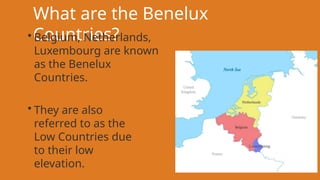
• Belgium, Netherlands,
Luxembourg are known
as the Benelux
Countries.
• They are also
referred to as the
Low Countries due
to their low
elevation.
Historical Overview of the Benelux Region
Belgium
Before independence (1830), it belonged to:
Spain, Austria, France, Netherlands
Netherlands
Before independence (1648), it belonged to:
Holy Roman Empire, Spain
Luxembourg
Before Independence (1867), it belonged to:
Holy Roman Empire, Spain, Austria, France, Netherlands,
Prussia
Historical Overview of the Benelux Region
Many nations and empires dominated the Benelux
region.
In World War II, Germany occupied the Benelux
Countries.
After the war, they joined the North Atlantic Treaty
Organization (NATO) for protection. NATO is an
alliance of nations.
In the 1950s the Benelux Countries joined the
group of nations now known as the EU.
Modern Governance
Each Benelux country
has its own parliament
and a ceremonial
monarch. Their strategic
location has led to both
invasions and trade
opportunities,
contributing to their
wealthy economies.
Belgium: King Philippe has been reigning since 2013.
​
Netherlands: King Willem-Alexander has been on
the throne since 2013
Luxembourg: Grand Duke Henri is the current
monarch.
The Netherlands:
Geography and Economy
•The Netherlands is known for
its low and flat landscape, with
some areas below sea level.
Rotterdam is one of the world's
busiest seaports and the second
after Amsterdam, and Dutch
agriculture is famous for cheese
and tulips.
The Netherlands: Interesting fact
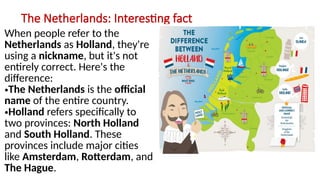
When people refer to the
Netherlands as Holland, they're
using a nickname, but it's not
entirely correct. Here's the
difference:
•The Netherlands is the official
name of the entire country.
•Holland refers specifically to
two provinces: North Holland
and South Holland. These
provinces include major cities
like Amsterdam, Rotterdam, and
The Hague.
Belgium: Urban Culture and Languages
Belgium is a highly urbanized
country, with over 95% of its
population living in cities.
Brussels is a cosmopolitan
capital and the headquarters for
the EU and NATO.
The country has language
divisions between Flemish and
French speakers.
Luxembourg: A Small but Wealthy Nation
Luxembourg is a small,
forested, and hilly country with
a high standard of living.
The economy is focused on
banking, steel, and chemicals,
and the population primarily
speaks French and German.
Fun Fact about Belgium
Belgium is famous for its delicious chocolates and is
home to over 2,000 chocolatiers!
The Netherlands is known for its mountainous terrain.
1.True 2.False
1. Identify Who was Charlemagne?
A ruler of Franks, built Christian empire
2. Explain Why is Napoleon considered a significant figure in
French history?
Because he conquered much of Europe.
3. Develop Why might the French be proud of their long history?
They have always been strong kingdom, great empire, colonial
power, leader of Europe,
Let’s work on the assessment (SECTION 2 ASSESSMENT)
4. Define What is impressionism?
style of painting using rippling light to cre-ate an impression of a
scene
5. Summarize What are some major contributions of French
culture?
cuisine, impressionism, cathedrals, ideas about government,
fashion and film.
6. Elaborate How has immigration influenced French culture?
brought other languages, religions, customs
7. Describe Why is Paris an important city?
Because It is France's capital and largest city.
8. Summarize What is the French economy like?
Diverse, based on agriculture, manufacturing, trade, tourism.
9. Describe How does language divide Belgium?
Flanders in north and coast speak Flemish; Walloons in southern
interior speak French; these cultural differences have caused
tensions.
10. Draw Conclusions Why might Brussels be such a
cosmopolitan city?.
It has many foreign influences since it's home to many
international organizations.

Benelux Countries.......................

  • 1.
  • 2.
    What are theBenelux Countries? • Belgium, Netherlands, Luxembourg are known as the Benelux Countries. • They are also referred to as the Low Countries due to their low elevation.
  • 3.
    Historical Overview ofthe Benelux Region Belgium Before independence (1830), it belonged to: Spain, Austria, France, Netherlands Netherlands Before independence (1648), it belonged to: Holy Roman Empire, Spain Luxembourg Before Independence (1867), it belonged to: Holy Roman Empire, Spain, Austria, France, Netherlands, Prussia
  • 4.
    Historical Overview ofthe Benelux Region Many nations and empires dominated the Benelux region. In World War II, Germany occupied the Benelux Countries. After the war, they joined the North Atlantic Treaty Organization (NATO) for protection. NATO is an alliance of nations. In the 1950s the Benelux Countries joined the group of nations now known as the EU.
  • 5.
    Modern Governance Each Beneluxcountry has its own parliament and a ceremonial monarch. Their strategic location has led to both invasions and trade opportunities, contributing to their wealthy economies. Belgium: King Philippe has been reigning since 2013. ​ Netherlands: King Willem-Alexander has been on the throne since 2013 Luxembourg: Grand Duke Henri is the current monarch.
  • 6.
    The Netherlands: Geography andEconomy •The Netherlands is known for its low and flat landscape, with some areas below sea level. Rotterdam is one of the world's busiest seaports and the second after Amsterdam, and Dutch agriculture is famous for cheese and tulips.
  • 7.
    The Netherlands: Interestingfact When people refer to the Netherlands as Holland, they're using a nickname, but it's not entirely correct. Here's the difference: •The Netherlands is the official name of the entire country. •Holland refers specifically to two provinces: North Holland and South Holland. These provinces include major cities like Amsterdam, Rotterdam, and The Hague.
  • 8.
    Belgium: Urban Cultureand Languages Belgium is a highly urbanized country, with over 95% of its population living in cities. Brussels is a cosmopolitan capital and the headquarters for the EU and NATO. The country has language divisions between Flemish and French speakers.
  • 9.
    Luxembourg: A Smallbut Wealthy Nation Luxembourg is a small, forested, and hilly country with a high standard of living. The economy is focused on banking, steel, and chemicals, and the population primarily speaks French and German.
  • 10.
    Fun Fact aboutBelgium Belgium is famous for its delicious chocolates and is home to over 2,000 chocolatiers!
  • 11.
    The Netherlands isknown for its mountainous terrain. 1.True 2.False
  • 12.
    1. Identify Whowas Charlemagne? A ruler of Franks, built Christian empire 2. Explain Why is Napoleon considered a significant figure in French history? Because he conquered much of Europe. 3. Develop Why might the French be proud of their long history? They have always been strong kingdom, great empire, colonial power, leader of Europe, Let’s work on the assessment (SECTION 2 ASSESSMENT)
  • 13.
    4. Define Whatis impressionism? style of painting using rippling light to cre-ate an impression of a scene 5. Summarize What are some major contributions of French culture? cuisine, impressionism, cathedrals, ideas about government, fashion and film. 6. Elaborate How has immigration influenced French culture? brought other languages, religions, customs 7. Describe Why is Paris an important city? Because It is France's capital and largest city.
  • 14.
    8. Summarize Whatis the French economy like? Diverse, based on agriculture, manufacturing, trade, tourism. 9. Describe How does language divide Belgium? Flanders in north and coast speak Flemish; Walloons in southern interior speak French; these cultural differences have caused tensions. 10. Draw Conclusions Why might Brussels be such a cosmopolitan city?. It has many foreign influences since it's home to many international organizations.