Computer Science & Engineering: An International Journal (CSEIJ), Vol 15, No 4/5, October 2025
DOI:10.5121/cseij.2025.15501 1
SECURE INTEGRATION OF LLMS WITH
PRODUCTION DATABASES THROUGH CONTEXT
BASED DATA ANONYMIZATION
Hassane Tahir 1
and Patrick Brezillon 2
1
Department of Computer Science, IUT de Paris - Rives de Seine, Université Paris Cité
143 Av. de Versailles, 75016 Paris, France
2
LIP6 - Sorbonne Université 4 Place Jussieu75005 Paris (France).
ABSTRACT
The integration of Large Language Models (LLMs) with production databases introduces powerful
capabilities for natural language querying and intelligent data access. However, this fusion also raises
critical concerns around privacy, ethics, and compliance. In this work, we investigate possible approaches
for designing a context-based framework that secures anonymization in LLMs. Our research explores how
organizational, functional, technical, and social contexts can be embedded into anonymization strategies to
enforce role-based access, ethical safeguards, and social sensitivity. Social context specifically involves
cultural sensitivity, ethical implications, and the societal effects of exposing or obscuring information,
ensuring that anonymization extends beyond compliance to address broader human-centered
considerations. By combining schema-aware controls with differential privacy, the framework reduces
risks of data leakage and re-identification. The approach is evaluated through a case study in finance,
demonstrating effectiveness in balancing utility with privacy. Moreover, we highlight open challenges such
as latency, bias mitigation, and integration with regulatory frameworks like GDPR (General Data
Protection Regulation) and HIPAA (Health Insurance Portability and Accountability Act). Ultimately, this
work contributes a systematic foundation for trustworthy LLM adoption in sensitive enterprise
environments.
KEYWORDS
Context-Based Framework, Large Language Models (LLMs), Privacy and Compliance, Production
Databases, Secure Data Access, Social Context in AI, Data Anonymization.
1. INTRODUCTION
Large Language Models (LLMs) represent a major breakthrough for businesses, offering
capabilities that range from automating customer service interactions to accelerating innovation
in research and development. LLMs like GPT-4 have transformed how users interact with
structured data, enabling natural language queries that translate into SQL. While this
democratizes data access, it also raises concerns about unauthorized exposure of sensitive
information when accessed by new GenAI users, as well as risks of biased query generation and
non-compliance with privacy regulations. Organizations and companies require a secure
framework that not only protects data but also considers the social and ethical context of each
query. Production databases often contain sensitive information such as names, emails, account
numbers, and financial records. Traditional access control mechanisms are insufficient when
LLMs dynamically generate queries, as these models may unintentionally access or expose
private data. Further more,users may submit queries with biased or unethicalintent, which
Complicates responsible data handling. In our recent research on anonymization, we identified
Computer Science & Engineering: An International Journal (CSEIJ), Vol 15, No 4/5, October 2025
2
three key context-related challenges: organizational, functional, and technical.
Industry reports show that these risks are well recognized among security professionals [1]. In
fact, more than seven out of ten Chief Information Security Officers (CISOs) express concern that
generative AI could become a source of serious security incidents. This cautious stance is not
theoretical — it is reflected in concrete actions taken by some of the world’s leading companies.
High-profile organizations have already responded to these risks by restricting or prohibiting the
use of generative AI tools. For example, Samsung famously limited access to ChatGPT after
employees inadvertently shared sensitive internal data through the platform [2]. Apple also
imposed internal restrictions, motivated by fears that confidential product development details
could unintentionally be disclosed. Amazon issued warnings to its work force after detecting that
ChatGPT responses occasionally reproduced fragments of proprietary source code [3]. This
incident suggested that training data might have contained internal materials, raising alarms about
how information could resurface in unintended ways.
Similarly, major financial institutions have taken decisive measures to reduce exposure. In early
2023, JPMorgan Chase, Citigroup, and Goldman Sachs all blocked employee use of ChatGPT.
Our core challenge lies in designing a system that can integrate multiple layers of context to
ensure both security and ethical compliance when working with production data. First, the system
must be able to detect and filter sensitive queries by evaluating user roles, permissions, and the
underlying intent of the request. This requires distinguishing between legitimate analytical needs
and attempts to extract private or restricted information. Second, the system should be capable of
generating SQL queries that align with both the database schema and ethical constraints. This
involves preventing queries that could expose personally identifiable information (PII), financial
records, or any fields deemed confidential. Third, query execution must be supported by
contextual safeguards and filtering mechanisms. These safeguards should enforce security
policies, prevent data leakage, and adapt dynamically to organizational and regulatory
requirements. Fourth, the system must be designed to return results in a privacy- preserving
manner. This means applying anonymization, pseudonymization, or aggregation techniques to
ensure that individual records cannot be traced back to specific users. Finally, anonymization
policies should consider context, adapting based on levels of trust, user roles,and jurisdictional
rules such as GDPR (General Data Protection Regulation) or HIPAA (Health Insurance
Portability and Accountability Act). For example, internal analysts in a trusted environment may
receive aggregated insights, while external stakeholders only receive fully anonymized outputs.
This paper examines the secure integration of large language models (LLMs) with production
databases through a context-based data anonymization framework. It begins by discussing the
challenges of incorporating contextual considerations to ensure security within LLM
anonymization pipelines, followed by a review of related research in this domain. The paperthen
introduces a context-based anonymization for large language models, detailing its underlying
principles and design considerations. Subsequently, we present the architectural overview of a
contextual LLM anonymization pipeline, illustrating how multiple layers of contextual
information contribute to privacy preservation and access control. Finally, the paper concludes
with a summary of key findings and potential directions for future research.
Computer Science & Engineering: An International Journal (CSEIJ), Vol 15, No 4/5, October 2025
3
2. CHALLENGES IN CONSIDERING CONTEXT FOR SECURE LLM
ANONYMIZATION PIPELINES
As organizations increasingly integrate Large Language Models into data-driven environments,
ensuring that privacy-preserving mechanisms remain effective across dynamic contexts has
become a critical challenge. In contemporary enterprise systems, anonymization must extend
beyond static data protection to encompass adaptive, context-sensitive mechanisms capable of
responding to evolving user intents, regulatory constraints, and operational settings. The
challenge lies not only in safeguarding sensitive information but also in preserving analytical
utility while ensuring that anonymization practices remain aligned with ethical, legal, and
organizational principles across heterogeneous environments. The following sections firstrevisit
the foundations of data anonymization before examining how context awareness shapes its
implementation in secure LLM pipelines.
2.1. Data Anonymization
Data anonymization is the process of transforming personal or sensitive data in such a way that
individuals cannot be directly or indirectly identified, while preserving the data’s utility for
analysis, testing, or research. Its importance lies in protecting privacy, ensuring regulatory
compliance under frameworks like GDPR and HIPAA, and reducing risks of data misuse or
breaches. Common examples of anonymization techniques include masking names with
pseudonyms, replacing exact ages with age ranges, generalizing detailed geographic locations
into broader regions, or adding statistical noise to numerical values. These methods allow
organizations to use realistic datasets without exposing identifiable information. However,
anonymization is not foolproof: even when data is anonymized, it can sometimes be re- identified
through inference, correlation, or modelling. For example, combining information about a
person’s location patterns, daily commute, or pseudonymous reservations could allowan attacker
to link anonymized records back to specific individuals.
We have provided in our research in [4] and [5] a detailed examination of data anonymization,
particularly in situations where production data must be repurposed for testing, analytics, or
development. We highlight the critical role anonymization plays in ensuring compliance with
regulations such as GDPR, which strictly prohibit exposing personal and sensitive data outside
secure environments. A recurring challenge is that test environments often rely on production
copies containing identifiers like names, addresses, or account numbers, thereby creating serious
privacy risks. We have outlined anonymization as a multi-step process involving discovery of
sensitive attributes, classification, transformation, and verification. Sensitive data must first be
identified, including not only explicit identifiers but also quasi-identifiers and metadata that may
enable re-identification when combined with external sources. Transformation techniques such as
masking, generalization, suppression, and pseudonymization are then applied. Each technique
carries trade-offs between privacy and data utility: heavy suppression reduces re identification
risk but may destroy analytical value, while lighter generalization balances privacy with usability.
We emphasized hybrid approaches, for example replacing detailed attributes with ranges or
approximate values to retain structural fidelity while protecting individuals. We also stressed the
importance of verification, where anonymized data is tested against potential re-identification
threats. Case studies in banking demonstrate practical techniques, such as anonymizing customer
names and credit scores while preserving logical database relationships.
With the rise of Large Language Models (LLMs) in enterprise environments, data anonymization
has taken on a new level of importance. Unlike traditional testing or analytics, LLMs generate
queries dynamically from natural language, which may inadvertently expose sensitive attributes if
Computer Science & Engineering: An International Journal (CSEIJ), Vol 15, No 4/5, October 2025
4
not properly controlled. In this context, inference attacks or data modelling could also bypass
anonymization measures, for example by correlating patterns in user queries, outputs, or external
datasets to identify individuals. Addressing these risks requires combining anonymization with
safeguards and monitoring that explicitly consider context. Anonymization in this context
involves cleansing both user inputs and database outputs before they interact with the model. This
ensures that prompts containing personal identifiers are masked or generalized, and that results
returned by the model are aggregated or obfuscated to prevent re-identification. By combining
schema-aware transformations with anonymization techniques, organizations can enable powerful
LLM-driven data access while safeguarding privacy and regulatory compliance. The following
section describes a case study of anonymizing LLM-Driven Database Queries in Smart Auto
Bank.
2.2. A Case Study
This case study concerns a European bank that provides vehicle financing, leasing, and insurance
services to both individual and corporate clients in countries such as France, Germany, and Spain.
For confidentiality, we refer to it as Smart Auto Bank (SAB).
With the rising demand for digital services, SAB launched an LLM-powered assistant called
SmartFinAssistant to support both customers and internal analysts in interacting with the bank’s
loan database through natural language queries. The assistant enables users to ask questions such
as: “What is the average loan amount for electric vehicles in Paris?” or “How many loans were
approved for clients under 25 last year?” These queries are automatically translated into SQL and
executed against SAB’s production loan database, which contains sensitive information including
client names, addresses, income, and vehicle details.
To safeguard privacy, the LLM-powered assistant incorporates an anonymization process that
masks sensitive identifiers before the query reaches the model. For instance, a request such as
“Show me loans for John Dupont” is transformed into “Show me loans for Subject A.” The query
is then enriched using schema metadata and ethical constraints. For example, “electric vehicles”
maps to Vehicle.Type = 'EV', while “under 25” maps to Client.Age < 25.
Once anonymized, the SQL query is executed. Access control policies and sensitivity filters are
applied so that analysts can only view aggregated insights, such as loan volumes or averages,
rather than sensitive attributes like individual credit scores. Finally, the results returned to the user
undergo an additional anonymization layer. For example, instead of providing exact outputs such
as “3 clients under 25 in Lyon,” SmartFinAssistant generalizes the result to “fewer than 5 clients
in Region A.”
Through this design, SAB demonstrates how LLM-powered database interaction can be made
both useful and compliant with privacy requirements by using efficient anonymization.
2.3. Lack of Integration Context in LLM-Anonymization Process
The case study on Smart Auto Bank effectively demonstrates technical anonymization but
overlooks the broader social implications of data use. While privacy safeguards and compliance
are emphasized, the design fails to address cultural sensitivity, fairness, or the societal impact of
anonymized queries. For instance, filtering “clients under 25” protects identities but may
unintentionally reinforce age-related bias in lending, while geographic generalization obscures
locations yet leaves room for discriminatory interpretations. By reducing anonymization to a
purely technical and legal measure, the system risks perpetuating inequalities embedded in
historical loan data. Sensitive variables like income, credit scores, and vehicle ownership intersect
Computer Science & Engineering: An International Journal (CSEIJ), Vol 15, No 4/5, October 2025
5
with socioeconomic disparities, meaning that anonymization may protect individuals but not
prevent structural bias. Moreover, anonymized results can be interpreted differently across
cultural or social contexts. Embedding social context is therefore essential to ensure
anonymization not only safeguards privacy but also supports fairness and ethical responsibility.
The integration of context into anonymization process for LLM-database systems presents a
multidimensional challenge that spans technical, organizational, and ethical domains. While
traditional anonymization techniques focus on static data masking or rule-based redaction, the
dynamic nature of LLMs—especially their ability to generate queries and interpret results based
on natural language—requires a more nuanced and adaptive approach. Context is not merely an
auxiliary feature; it is central to determining what constitutes sensitive data, who is authorized to
access it, and how outputs should be shaped to preserve privacy.
One of the primary difficulties lies in the ambiguity of user intent. LLMs are designed to interpret
and respond to human language, but they lack intrinsic understanding of organizational norms,
ethical boundaries, or social sensitivities. For example, a query like “Show me all transactions
over €10,000 from last month” may be legitimate for a compliance officer but inappropriate for a
junior analyst. Without contextual awareness of the user’s role, the system risks exposing
confidential financial data. This highlights the need for organizational context— metadata about
user identity, role, and trust level—to be embedded into the anonymization pipeline.
Functional context adds another layer of complexity (see table 1). Different departments or use
cases may require different levels of data granularity. A marketing team analyzing customer
behavior might need aggregated statistics, while a fraud detection unit may require access to
transaction-level details. The system must dynamically adjust anonymization policies based on
the function being served, ensuring that data utility is preserved without compromising privacy.
This requires a flexible policy engine capable of interpreting functional metadata and applying
appropriate anonymization techniques such as k-anonymity, differential privacy, or
pseudonymization.
Technical context, meanwhile, governs how the system interprets schema, query structure, and
data lineage. LLMs often hallucinate or misinterpret schema elements, generating queries that
inadvertently access sensitive fields. Embedding schema-aware context into the LLM prompt or
middleware layer can mitigate this risk, but doing so securely requires careful design. For
instance, exposing schema metadata to the LLM must be done in a way that does not reveal
sensitive table names or column descriptions. Moreover, the system must be able to detect when a
query crosses ethical boundaries—such as attempting to correlate health records with
employment data—and block or rewrite such queries accordingly.
The challenge is further compounded by the need to support jurisdictional context. Regulations
like GDPR, HIPAA, and CCPA impose different constraints on data access and anonymization. A
query permissible under U.S. law may violate European privacy standards. The system must
therefore incorporate legal context into its decision-making process, adapting anonymization
strategies based on the geographic origin of the data, the location of the user, and the applicable
regulatory framework.
Finally, social context—often the most overlooked dimension—plays a critical role in ethical
anonymization. Queries that reflect biased assumptions, discriminatory intent, or exploitative
goals must be flagged and filtered. For example, a query asking for “top-performing employees
under 30” may reflect age bias, while one seeking “customer profiles by ethnicity” could violate
ethical norms. Detecting such intent requires not only linguistic analysis but also an
understanding of societal values and organizational ethics. This calls for the integration of ethical
Computer Science & Engineering: An International Journal (CSEIJ), Vol 15, No 4/5, October 2025
6
reasoning modules or bias detection algorithms into the LLM middleware.
Table 1. Examples of Anonymization in LLMs in different types of contexts.
3. RELATED WORK
Integrating large language models with production databases presents both significant
opportunities and serious risks. On one hand, LLMs unlock natural language access to structured
data, enabling users to query and retrieve insights without deep technical expertise. On the other,
they introduce substantial privacy and security concerns when handling sensitive data such as
personal identifiers, financial records, and healthcare information. Researchers have therefore
sought frameworks that combine technical robustness with privacy-preserving mechanisms to
ensure safe deployment in enterprise environments.
One of the most influential contributions in this area is the work of Kim and Ailamaki [6], who
propose a middleware system linking LLMs to production databases. Their approach emphasizes
schema-aware query generation to minimize hallucinations and enforce compliance with privacy
rules. In addition, they introduce query-level masking and result-level suppression based on
sensitivity scores, ensuring that personally identifiable information (PII) is not inadvertently
Computer Science & Engineering: An International Journal (CSEIJ), Vol 15, No 4/5, October 2025
7
revealed. This model shows how structured schema guidance can serve as a foundation for both
utility and security. Complementing this perspective, Strick van Linschoten [7] has documented
numerous real-world implementations of LLMOps across sectors such as healthcare, finance, and
government. His case studies highlight anonymization pipelines designed to sanitize sensitive
data before interaction with LLMs. By combining metadata filters with embedding-based
retrieval, these pipelines enforce context-aware anonymization. Strick van Linschoten also argues
that anonymization is not merely a technical add-on but a prerequisite for responsible adoption of
LLMs, particularly in regulated industries.
However, many existing approaches still consider only limited aspects of context—often focusing
on technical or data-related parameters—while overlooking other essential dimensions such as
the actor, their activity, the situation in which it occurs, and the local environment where
resources (e.g., databases) reside. A more holistic understanding of context, encompassing
organizational, functional, and social elements, is necessary to design truly effective and context-
sensitive anonymization frameworks.
The StartupSoft research team [8] extends these ideas with a practical guide for enterprises using
LLMs with sensitive data. Their framework integrates role-based access control and schema-
aware prompt templates, ensuring that only authorized users can retrieve certain fields. Additional
methods such as token-level redaction and context-aware generalization are deployed to sanitize
inputs and outputs. This approach demonstrates how enterprise-grade data governance and
anonymization can be integrated into prompt engineering workflows. Meanwhile, Microsoft
Research has explored hardware-based protections through Azure Confidential AI [9]. Their work
leverages confidential computing environments where LLMs operate on encrypted data inside
secure enclaves. Within these enclaves, schema-aware access policies are enforced, and
inference-time masking and encrypted result filtering add further layers of protection. This
architecture illustrates how cryptographic isolation can complement software-level
anonymization techniques.
Recent advances such as Adaptive Linguistic Sanitization and Anonymization (ALSA)
demonstrate that privacy preservation and contextual integrity can be dynamically balanced
through adaptive mechanisms [10]. ALSA introduces a three-dimensional scoring system that
integrates privacy risk, contextual importance, and task relevance to maintain both security and
semantic fidelity in anonymization.
Across these contributions, several anonymization methods appear consistently. Schema
prompting embeds metadata into the prompt to guide SQL generation and reduce errors. Role
based context adapts queries to a user’s permissions. Differential privacy introduces calibrated
noise into results to reduce re-identification risks. K-anonymity groups records together to
obscure individual identities. Prompt sanitization removes sensitive terms from queries before
they reach the LLM. Collectively, these techniques form a toolbox for reducing privacy leakage
while preserving query fidelity. Evaluation is another area of convergence. Researchers employ
metrics such as privacy leakage scores to quantify risk exposure, query fidelity to measure
accuracy, context alignment indices to test compliance with schema and user roles, and latency
impact to evaluate system performance. These measures provide a balance between usability,
efficiency, and privacy protection. Looking forward, new directions are emerging. Federated
LLM querying distributes anonymization across data silos, reducing centralization risks. Zero
knowledge prompting allows models to operate without direct exposure to raw data. Explainable
anonymization provides transparency, enabling users to understand how and why their data is
masked. Context-aware fine-tuning involves training LLMs with privacy-preserving schema
embeddings, reducing dependence on post-processing anonymization.
Computer Science & Engineering: An International Journal (CSEIJ), Vol 15, No 4/5, October 2025
8
Building on these architectural and privacy-focused frameworks, recent efforts have begun to
standardize how LLMs interface with external data systems. The Model Context Protocol (MCP)
introduces a protocol-level framework for connecting LLMs with external data sources and tools,
enabling modular, auditable, and context-rich workflows that go beyond traditional prompt-based
integrations [11]. Unlike earlier systems that focused primarily on anonymization policies or
schema control, MCP emphasizes the infrastructure of LLM–data connectivity— providing fine-
grained permissions, controlled tool invocation, and secure context exchange mechanisms.
However, MCP does not yet fully address challenges such as re-identification through inference
or the social and ethical dimensions of anonymized outputs, which remain key gaps highlighted
in this review.
Despite this progress, much of the literature emphasizes technical, architectural, and regulatory
contexts such as schema-awareness, role-based control, and compliance with GDPR or HIPAA.
What remains underexplored is the social dimension of anonymization. Social context involves
cultural sensitivity, ethical implications, and the societal effects of exposing or obscuring
information. For example, Strick van Linschoten’s case studies focus heavily on metadata
tracking, infrastructure, and compliance. While these touch on organizational norms, they rarely
address issues such as cultural bias, socioeconomic disparities, or community-level expectations
of privacy. StartupSoft’s guide similarly frames anonymization around governance and risk
management, without addressing how anonymization strategies might need to adapt to protect
vulnerable populations or mitigate algorithmic bias. A partial exception is the study by Singh et
al. [12], LLMs in the SOC: An Empirical Study of Human-AI Collaboration in Security
Operations Centres. While primarily focused on cybersecurity, this work illustrates how analysts
use LLMs for sensemaking and shared understanding—processes that are inherently social. The
authors call for human-centered, context-aware AI, indirectly pointing toward a more holistic
view of anonymization that incorporates social factors.
In summary, current research has made significant strides in securing LLM integration with
production databases through structured data anonymization. Contributions by Kim, Ailamaki,
Strick van Linschoten, StartupSoft, and Microsoft highlight technical and architectural solutions
that safeguard sensitive data while maintaining query performance. However, social and ethical
considerations remain less developed, representing a critical frontier for future work. As LLMs
become embedded in decision-making systems, ensuring that anonymization strategies
incorporate not only technical and legal requirements, but also social and cultural contexts will be
essential to building systems that are both intelligent and trustworthy.
4. CONTEXT-BASED ANONYMIZATION IN LARGE LANGUAGE MODEL
Context-based anonymization in Large Language Models draws inspiration from the Contextual
Graph formalism, adhering to its conceptual and structural guidelines [13][14]. It is grounded in
the integration of multiple layers of contextual awareness—organizational, functional, technical,
and social—into the anonymization pipeline to ensure secure, ethical, and human-centered data
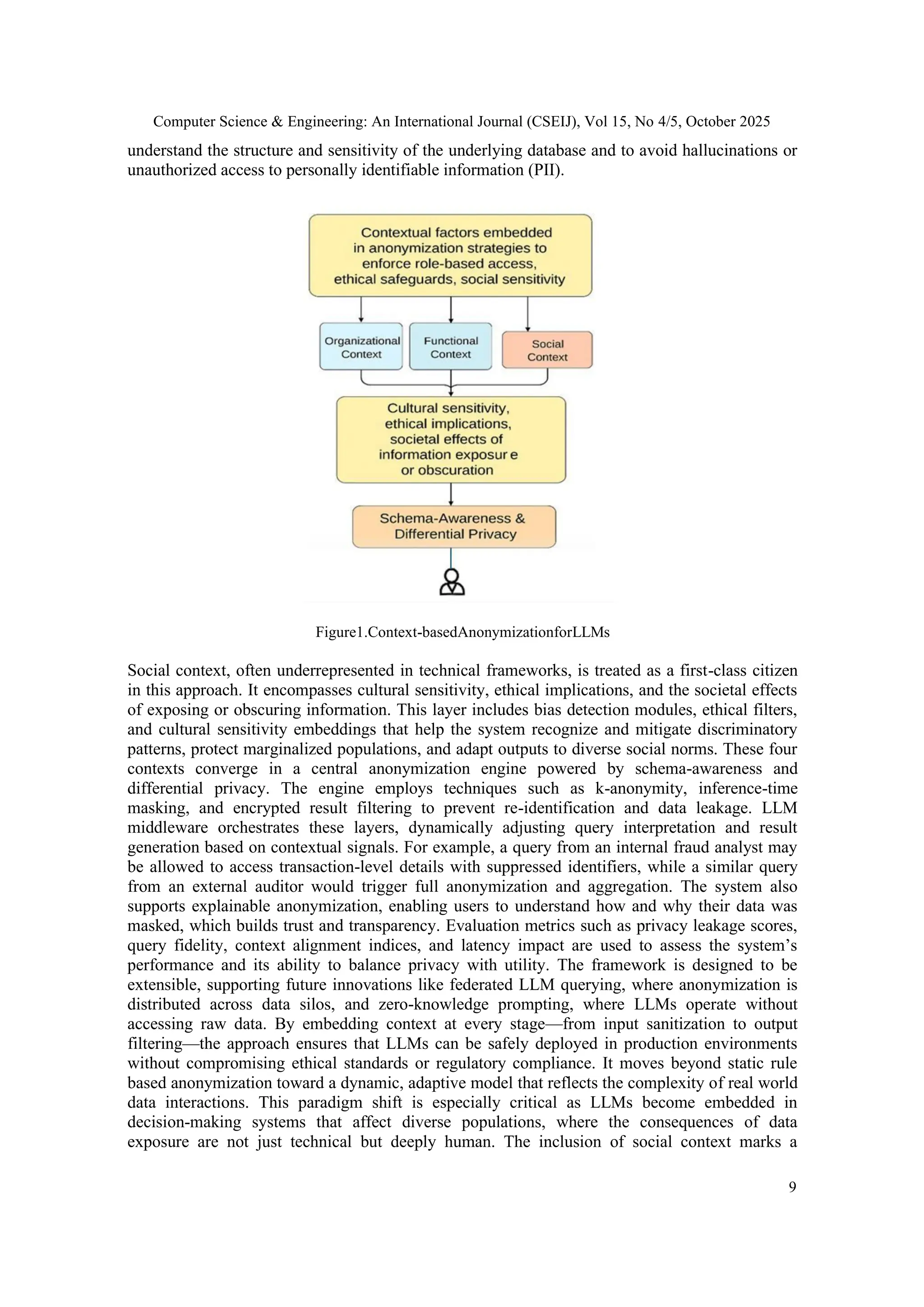
handling (Fig. 1). At its core, this framework recognizes that anonymization is not merely a
technical safeguard but a dynamic, context-sensitive process that must adapt to the roles,
intentions, and societal implications of each query. Organizational context involves embedding
user roles, such as client, analyst, or auditor, into the LLM’s decision-making process through
mechanisms like role-based embeddings and access control tokens. This ensures that the scope of
data exposure aligns with the user’s trust level and institutional permissions. Functional context
captures the purpose behind each query—whether it serves fraud detection, compliance auditing,
marketing analysis, or personal inquiry—and maps it to appropriate anonymization strategies
using prompt intent classification and use case mapping. Technical context introduces schema-
aware prompting, token-level redaction, and field sensitivity scoring, allowing the LLM to
Computer Science & Engineering: An International Journal (CSEIJ), Vol 15, No 4/5, October 2025
9
understand the structure and sensitivity of the underlying database and to avoid hallucinations or
unauthorized access to personally identifiable information (PII).
Figure1.Context-basedAnonymizationforLLMs
Social context, often underrepresented in technical frameworks, is treated as a first-class citizen
in this approach. It encompasses cultural sensitivity, ethical implications, and the societal effects
of exposing or obscuring information. This layer includes bias detection modules, ethical filters,
and cultural sensitivity embeddings that help the system recognize and mitigate discriminatory
patterns, protect marginalized populations, and adapt outputs to diverse social norms. These four
contexts converge in a central anonymization engine powered by schema-awareness and
differential privacy. The engine employs techniques such as k-anonymity, inference-time
masking, and encrypted result filtering to prevent re-identification and data leakage. LLM
middleware orchestrates these layers, dynamically adjusting query interpretation and result
generation based on contextual signals. For example, a query from an internal fraud analyst may
be allowed to access transaction-level details with suppressed identifiers, while a similar query
from an external auditor would trigger full anonymization and aggregation. The system also
supports explainable anonymization, enabling users to understand how and why their data was
masked, which builds trust and transparency. Evaluation metrics such as privacy leakage scores,
query fidelity, context alignment indices, and latency impact are used to assess the system’s
performance and its ability to balance privacy with utility. The framework is designed to be
extensible, supporting future innovations like federated LLM querying, where anonymization is
distributed across data silos, and zero-knowledge prompting, where LLMs operate without
accessing raw data. By embedding context at every stage—from input sanitization to output
filtering—the approach ensures that LLMs can be safely deployed in production environments
without compromising ethical standards or regulatory compliance. It moves beyond static rule
based anonymization toward a dynamic, adaptive model that reflects the complexity of real world
data interactions. This paradigm shift is especially critical as LLMs become embedded in
decision-making systems that affect diverse populations, where the consequences of data
exposure are not just technical but deeply human. The inclusion of social context marks a
Computer Science & Engineering: An International Journal (CSEIJ), Vol 15, No 4/5, October 2025
10
significant evolution in anonymization research, acknowledging that privacy is not only about
protecting data but also about respecting identities, relationships, and communities. In this light,
anonymization becomes a form of ethical mediation—balancing the need for insight with the
imperative of dignity. The framework’s layered design allows for modular implementation, where
each context can be tuned independently or in concert, depending on the application domain and
risk profile. It also supports continuous learning, enabling the system to refine its anonymization
strategies based on feedback, audit trails, and evolving norms. Ultimately, this research approach
offers a blueprint for building LLM systems that are not only intelligent and efficient but also
responsible, inclusive, and resilient in the face of complex privacy challenges.
5. ARCHITECTURE OVERVIEW FOR A CONTEXTUAL LLM
ANONYMIZATION PIPELINE
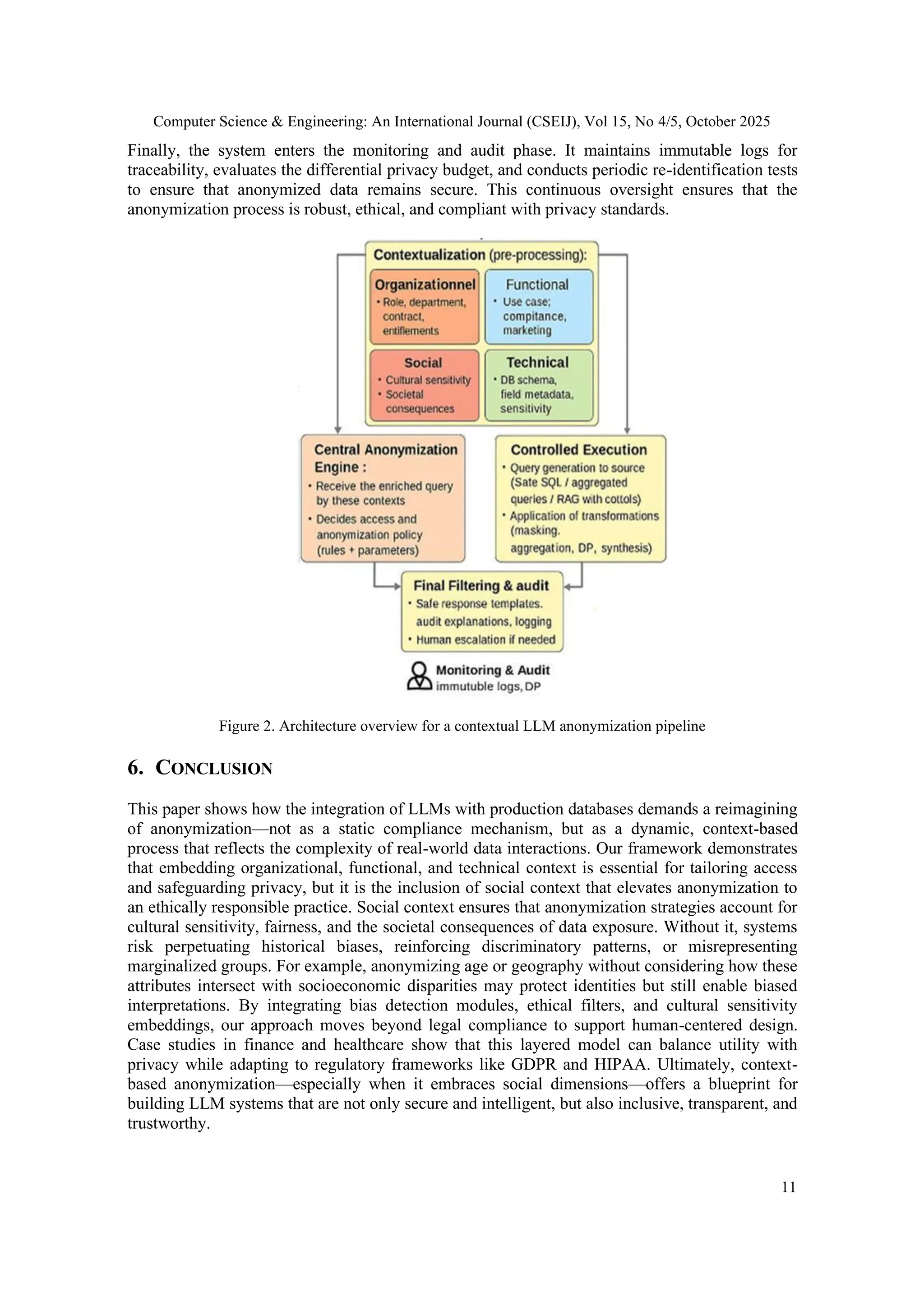
Figure 2 presents the architectural overview of a contextual anonymization pipeline for large
language models. The figure provides a comprehensive depiction of how a structured, context
aware framework governs the anonymization process within LLM-driven data interactions.
Specifically, it illustrates how a user’s natural language query is sequentially processed through
multiple contextual layers—organizational, functional, technical, and social—prior to
anonymization, execution, post-processing, and auditing. The process begins when a user submits
a natural language query, such as “Show me clients with active loans in Paris.” In parallel, the
system captures identity metadata, including the user’s role (e.g., analyst, auditor, or client),
department, and assigned access level. This initial contextualization stage is pivotal, as it
determines both the scope of permissible data access and the corresponding degree of
anonymization to be enforced across subsequent stages of the pipeline.
Next, the query undergoes contextual enrichment through a pre-processing phase that integrates
four dimensions. The organizational context includes the user’s role, department, contract type,
and entitlements. This helps define access rights and visibility restrictions. The functional context
captures the intended use case—whether the query serves compliance, marketing, research, or
audit purposes. This dimension guides the anonymization strategy based on business objectives.
The social context addresses cultural sensitivity and societal consequences. It considers factors
such as age, gender, and origin, and evaluates whether the query could lead to stigmatization or
discrimination. Queries deemed ethically risky may be filtered or reformulated. The technical
context involves metadata from the database schema and sensitivity classification of fields like
name, income, or credit score. This layer enables masking or aggregation of sensitive attributes.
Once the query is enriched with these contextual layers, it is passed to the central anonymization
engine, the system’s decision-making core. This engine applies access policies and
anonymization strategies based on predefined rules and parameters. It may authorize, block, or
rewrite the query depending on its risk profile and compliance requirements.
The controlled execution phase follows where the system generates queries to the data source.
These may include secure SQL statements, aggregated queries, or retrieval-augmented generation
(RAG) with embedded controls. The system then applies transformations such as masking (e.g.,
removing names), aggregation (e.g., grouping by age), differential privacy (adding statistical
noise), and synthesis (producing narrative summaries).
After execution, the output undergoes final filtering and presentation. The system generates safe
response templates, includes audit explanations, and logs all decisions. If the query is too
ambiguous or risky, it may be escalated to a human expert or ethics committee for review.
Computer Science & Engineering: An International Journal (CSEIJ), Vol 15, No 4/5, October 2025
11
Finally, the system enters the monitoring and audit phase. It maintains immutable logs for
traceability, evaluates the differential privacy budget, and conducts periodic re-identification tests
to ensure that anonymized data remains secure. This continuous oversight ensures that the
anonymization process is robust, ethical, and compliant with privacy standards.
Figure 2. Architecture overview for a contextual LLM anonymization pipeline
6. CONCLUSION
This paper shows how the integration of LLMs with production databases demands a reimagining
of anonymization—not as a static compliance mechanism, but as a dynamic, context-based
process that reflects the complexity of real-world data interactions. Our framework demonstrates
that embedding organizational, functional, and technical context is essential for tailoring access
and safeguarding privacy, but it is the inclusion of social context that elevates anonymization to
an ethically responsible practice. Social context ensures that anonymization strategies account for
cultural sensitivity, fairness, and the societal consequences of data exposure. Without it, systems
risk perpetuating historical biases, reinforcing discriminatory patterns, or misrepresenting
marginalized groups. For example, anonymizing age or geography without considering how these
attributes intersect with socioeconomic disparities may protect identities but still enable biased
interpretations. By integrating bias detection modules, ethical filters, and cultural sensitivity
embeddings, our approach moves beyond legal compliance to support human-centered design.
Case studies in finance and healthcare show that this layered model can balance utility with
privacy while adapting to regulatory frameworks like GDPR and HIPAA. Ultimately, context-
based anonymization—especially when it embraces social dimensions—offers a blueprint for
building LLM systems that are not only secure and intelligent, but also inclusive, transparent, and
trustworthy.
Computer Science & Engineering: An International Journal (CSEIJ), Vol 15, No 4/5, October 2025
12
REFERENCES
[1] Darktrace Press Release (2025), New Report Finds that 78% of Chief Information Security Officers
Globally are Seeing a Significant Impact from AI-Powered Cyber Threats,
https://www.darktrace.com/news/new-report-finds-that-78-of-chief-information-security officers-
globally-are-seeing-a-significant-impact-from-ai-powered-cyber-threats, accessed on september 2025.
[2] Samsung (2023), Samsung Bans ChatGPT Among Employees After Sensitive Code Leak,
https://www.forbes.com/sites/siladityaray/2023/05/02/samsung-bans-chatgpt-and-other-chatbots for-
employees-after-sensitive-code-leak, accessed on september 2025.
[3] Deccanherald (2024), Explained | Why Amazon is restricting its employees from using generative AI
tools like ChatGPT, https://www.deccanherald.com/business/companies/explained-why-amazon-is-
restricting-its employees-from-using-generative-ai-tools-like-chatgpt-2909975, accessed on
september 2025.
[4] Tahir, H., & Brézillon, P. (2023). Data Anonymization Process Challenges and Context, International
Journal of Database Management Systems (IJDMS) Vol.15, No.6, December 2023DOI:
10.5121/ijdms.2023.15601.
[5] Tahir, H. (2022). Context-Based Personal Data Discovery for Anonymization. In P. Brézillon & R.
M. Turner (Eds.), Modeling and Use of Context in Action. ISTE Ltd & John Wiley & Sons.
[6] Kim, Kyoungmin & Ailamaki, Anastasia (2024), Trustworthy and Efficient LLMs Meet Databases,
https://arxiv.org/abs/2412.18022.
[7] Strick van Linschoten, Alex (2025), LLMOps in Production: 457 Case Studies of What Actually
Works, https://www.zenml.io/blog/llmops-in-production-457-case-studies-of-what-actually works.
[8] StartupSoft Research Team – How to Use LLMs with Enterprise and Sensitive Data,
https://www.startupsoft.com/llm-sensitive-data-best-practices-guide/, accessed on September 2025.
[9] Microsoft Azure Confidential Computing Team – Confidential AI: Secure LLMs for Sensitive
Workloads, https://azure.microsoft.com/en-us/solutions/confidential-compute/, accessed on
September 2025.
[10] Ma, H., Lu, W., Liang, Y., Wang, T., Zhang, Q., Zhu, Y., & Si, J. (2025), ALSA: Context sensitive
prompt privacy preservation in large language models. In Proceedings of the 31st ACM SIGKDD
Conference on Knowledge Discovery and Data Mining (KDD ’25), Vol. 2 (pp. 2042 2053). ACM.
https://doi.og/10.1145/3711896.3736840.
[11] MCP (2025), What is the Model Context Protocol (MCP)?,
https://modelcontextprotocol.io/docs/getting-started/intro, accessed on september 2025.
[12] Singh, Ronal et al. – LLMs in the SOC: An Empirical Study of Human-AI Collaboration in Security
Operations Centres, https://arxiv.org/abs/2508.18947, accessed on september 2025.
[13] Brézillon, P. (Ed.). (2023). Research on modeling and using context over 25 years. Springer Briefs in
Computer Science. https://doi.org/10.1007/978-3-031-39338-9
[14] Brézillon, P. (in press, 2026). Context-based modeling of activity in real-world projects. ISTE Wiley.

Secure Integration of LLMs with Production Databases through Context Based Data Anonymization

  • 1.
    Computer Science &Engineering: An International Journal (CSEIJ), Vol 15, No 4/5, October 2025 DOI:10.5121/cseij.2025.15501 1 SECURE INTEGRATION OF LLMS WITH PRODUCTION DATABASES THROUGH CONTEXT BASED DATA ANONYMIZATION Hassane Tahir 1 and Patrick Brezillon 2 1 Department of Computer Science, IUT de Paris - Rives de Seine, Université Paris Cité 143 Av. de Versailles, 75016 Paris, France 2 LIP6 - Sorbonne Université 4 Place Jussieu75005 Paris (France). ABSTRACT The integration of Large Language Models (LLMs) with production databases introduces powerful capabilities for natural language querying and intelligent data access. However, this fusion also raises critical concerns around privacy, ethics, and compliance. In this work, we investigate possible approaches for designing a context-based framework that secures anonymization in LLMs. Our research explores how organizational, functional, technical, and social contexts can be embedded into anonymization strategies to enforce role-based access, ethical safeguards, and social sensitivity. Social context specifically involves cultural sensitivity, ethical implications, and the societal effects of exposing or obscuring information, ensuring that anonymization extends beyond compliance to address broader human-centered considerations. By combining schema-aware controls with differential privacy, the framework reduces risks of data leakage and re-identification. The approach is evaluated through a case study in finance, demonstrating effectiveness in balancing utility with privacy. Moreover, we highlight open challenges such as latency, bias mitigation, and integration with regulatory frameworks like GDPR (General Data Protection Regulation) and HIPAA (Health Insurance Portability and Accountability Act). Ultimately, this work contributes a systematic foundation for trustworthy LLM adoption in sensitive enterprise environments. KEYWORDS Context-Based Framework, Large Language Models (LLMs), Privacy and Compliance, Production Databases, Secure Data Access, Social Context in AI, Data Anonymization. 1. INTRODUCTION Large Language Models (LLMs) represent a major breakthrough for businesses, offering capabilities that range from automating customer service interactions to accelerating innovation in research and development. LLMs like GPT-4 have transformed how users interact with structured data, enabling natural language queries that translate into SQL. While this democratizes data access, it also raises concerns about unauthorized exposure of sensitive information when accessed by new GenAI users, as well as risks of biased query generation and non-compliance with privacy regulations. Organizations and companies require a secure framework that not only protects data but also considers the social and ethical context of each query. Production databases often contain sensitive information such as names, emails, account numbers, and financial records. Traditional access control mechanisms are insufficient when LLMs dynamically generate queries, as these models may unintentionally access or expose private data. Further more,users may submit queries with biased or unethicalintent, which Complicates responsible data handling. In our recent research on anonymization, we identified
  • 2.
    Computer Science &Engineering: An International Journal (CSEIJ), Vol 15, No 4/5, October 2025 2 three key context-related challenges: organizational, functional, and technical. Industry reports show that these risks are well recognized among security professionals [1]. In fact, more than seven out of ten Chief Information Security Officers (CISOs) express concern that generative AI could become a source of serious security incidents. This cautious stance is not theoretical — it is reflected in concrete actions taken by some of the world’s leading companies. High-profile organizations have already responded to these risks by restricting or prohibiting the use of generative AI tools. For example, Samsung famously limited access to ChatGPT after employees inadvertently shared sensitive internal data through the platform [2]. Apple also imposed internal restrictions, motivated by fears that confidential product development details could unintentionally be disclosed. Amazon issued warnings to its work force after detecting that ChatGPT responses occasionally reproduced fragments of proprietary source code [3]. This incident suggested that training data might have contained internal materials, raising alarms about how information could resurface in unintended ways. Similarly, major financial institutions have taken decisive measures to reduce exposure. In early 2023, JPMorgan Chase, Citigroup, and Goldman Sachs all blocked employee use of ChatGPT. Our core challenge lies in designing a system that can integrate multiple layers of context to ensure both security and ethical compliance when working with production data. First, the system must be able to detect and filter sensitive queries by evaluating user roles, permissions, and the underlying intent of the request. This requires distinguishing between legitimate analytical needs and attempts to extract private or restricted information. Second, the system should be capable of generating SQL queries that align with both the database schema and ethical constraints. This involves preventing queries that could expose personally identifiable information (PII), financial records, or any fields deemed confidential. Third, query execution must be supported by contextual safeguards and filtering mechanisms. These safeguards should enforce security policies, prevent data leakage, and adapt dynamically to organizational and regulatory requirements. Fourth, the system must be designed to return results in a privacy- preserving manner. This means applying anonymization, pseudonymization, or aggregation techniques to ensure that individual records cannot be traced back to specific users. Finally, anonymization policies should consider context, adapting based on levels of trust, user roles,and jurisdictional rules such as GDPR (General Data Protection Regulation) or HIPAA (Health Insurance Portability and Accountability Act). For example, internal analysts in a trusted environment may receive aggregated insights, while external stakeholders only receive fully anonymized outputs. This paper examines the secure integration of large language models (LLMs) with production databases through a context-based data anonymization framework. It begins by discussing the challenges of incorporating contextual considerations to ensure security within LLM anonymization pipelines, followed by a review of related research in this domain. The paperthen introduces a context-based anonymization for large language models, detailing its underlying principles and design considerations. Subsequently, we present the architectural overview of a contextual LLM anonymization pipeline, illustrating how multiple layers of contextual information contribute to privacy preservation and access control. Finally, the paper concludes with a summary of key findings and potential directions for future research.
  • 3.
    Computer Science &Engineering: An International Journal (CSEIJ), Vol 15, No 4/5, October 2025 3 2. CHALLENGES IN CONSIDERING CONTEXT FOR SECURE LLM ANONYMIZATION PIPELINES As organizations increasingly integrate Large Language Models into data-driven environments, ensuring that privacy-preserving mechanisms remain effective across dynamic contexts has become a critical challenge. In contemporary enterprise systems, anonymization must extend beyond static data protection to encompass adaptive, context-sensitive mechanisms capable of responding to evolving user intents, regulatory constraints, and operational settings. The challenge lies not only in safeguarding sensitive information but also in preserving analytical utility while ensuring that anonymization practices remain aligned with ethical, legal, and organizational principles across heterogeneous environments. The following sections firstrevisit the foundations of data anonymization before examining how context awareness shapes its implementation in secure LLM pipelines. 2.1. Data Anonymization Data anonymization is the process of transforming personal or sensitive data in such a way that individuals cannot be directly or indirectly identified, while preserving the data’s utility for analysis, testing, or research. Its importance lies in protecting privacy, ensuring regulatory compliance under frameworks like GDPR and HIPAA, and reducing risks of data misuse or breaches. Common examples of anonymization techniques include masking names with pseudonyms, replacing exact ages with age ranges, generalizing detailed geographic locations into broader regions, or adding statistical noise to numerical values. These methods allow organizations to use realistic datasets without exposing identifiable information. However, anonymization is not foolproof: even when data is anonymized, it can sometimes be re- identified through inference, correlation, or modelling. For example, combining information about a person’s location patterns, daily commute, or pseudonymous reservations could allowan attacker to link anonymized records back to specific individuals. We have provided in our research in [4] and [5] a detailed examination of data anonymization, particularly in situations where production data must be repurposed for testing, analytics, or development. We highlight the critical role anonymization plays in ensuring compliance with regulations such as GDPR, which strictly prohibit exposing personal and sensitive data outside secure environments. A recurring challenge is that test environments often rely on production copies containing identifiers like names, addresses, or account numbers, thereby creating serious privacy risks. We have outlined anonymization as a multi-step process involving discovery of sensitive attributes, classification, transformation, and verification. Sensitive data must first be identified, including not only explicit identifiers but also quasi-identifiers and metadata that may enable re-identification when combined with external sources. Transformation techniques such as masking, generalization, suppression, and pseudonymization are then applied. Each technique carries trade-offs between privacy and data utility: heavy suppression reduces re identification risk but may destroy analytical value, while lighter generalization balances privacy with usability. We emphasized hybrid approaches, for example replacing detailed attributes with ranges or approximate values to retain structural fidelity while protecting individuals. We also stressed the importance of verification, where anonymized data is tested against potential re-identification threats. Case studies in banking demonstrate practical techniques, such as anonymizing customer names and credit scores while preserving logical database relationships. With the rise of Large Language Models (LLMs) in enterprise environments, data anonymization has taken on a new level of importance. Unlike traditional testing or analytics, LLMs generate queries dynamically from natural language, which may inadvertently expose sensitive attributes if
  • 4.
    Computer Science &Engineering: An International Journal (CSEIJ), Vol 15, No 4/5, October 2025 4 not properly controlled. In this context, inference attacks or data modelling could also bypass anonymization measures, for example by correlating patterns in user queries, outputs, or external datasets to identify individuals. Addressing these risks requires combining anonymization with safeguards and monitoring that explicitly consider context. Anonymization in this context involves cleansing both user inputs and database outputs before they interact with the model. This ensures that prompts containing personal identifiers are masked or generalized, and that results returned by the model are aggregated or obfuscated to prevent re-identification. By combining schema-aware transformations with anonymization techniques, organizations can enable powerful LLM-driven data access while safeguarding privacy and regulatory compliance. The following section describes a case study of anonymizing LLM-Driven Database Queries in Smart Auto Bank. 2.2. A Case Study This case study concerns a European bank that provides vehicle financing, leasing, and insurance services to both individual and corporate clients in countries such as France, Germany, and Spain. For confidentiality, we refer to it as Smart Auto Bank (SAB). With the rising demand for digital services, SAB launched an LLM-powered assistant called SmartFinAssistant to support both customers and internal analysts in interacting with the bank’s loan database through natural language queries. The assistant enables users to ask questions such as: “What is the average loan amount for electric vehicles in Paris?” or “How many loans were approved for clients under 25 last year?” These queries are automatically translated into SQL and executed against SAB’s production loan database, which contains sensitive information including client names, addresses, income, and vehicle details. To safeguard privacy, the LLM-powered assistant incorporates an anonymization process that masks sensitive identifiers before the query reaches the model. For instance, a request such as “Show me loans for John Dupont” is transformed into “Show me loans for Subject A.” The query is then enriched using schema metadata and ethical constraints. For example, “electric vehicles” maps to Vehicle.Type = 'EV', while “under 25” maps to Client.Age < 25. Once anonymized, the SQL query is executed. Access control policies and sensitivity filters are applied so that analysts can only view aggregated insights, such as loan volumes or averages, rather than sensitive attributes like individual credit scores. Finally, the results returned to the user undergo an additional anonymization layer. For example, instead of providing exact outputs such as “3 clients under 25 in Lyon,” SmartFinAssistant generalizes the result to “fewer than 5 clients in Region A.” Through this design, SAB demonstrates how LLM-powered database interaction can be made both useful and compliant with privacy requirements by using efficient anonymization. 2.3. Lack of Integration Context in LLM-Anonymization Process The case study on Smart Auto Bank effectively demonstrates technical anonymization but overlooks the broader social implications of data use. While privacy safeguards and compliance are emphasized, the design fails to address cultural sensitivity, fairness, or the societal impact of anonymized queries. For instance, filtering “clients under 25” protects identities but may unintentionally reinforce age-related bias in lending, while geographic generalization obscures locations yet leaves room for discriminatory interpretations. By reducing anonymization to a purely technical and legal measure, the system risks perpetuating inequalities embedded in historical loan data. Sensitive variables like income, credit scores, and vehicle ownership intersect
  • 5.
    Computer Science &Engineering: An International Journal (CSEIJ), Vol 15, No 4/5, October 2025 5 with socioeconomic disparities, meaning that anonymization may protect individuals but not prevent structural bias. Moreover, anonymized results can be interpreted differently across cultural or social contexts. Embedding social context is therefore essential to ensure anonymization not only safeguards privacy but also supports fairness and ethical responsibility. The integration of context into anonymization process for LLM-database systems presents a multidimensional challenge that spans technical, organizational, and ethical domains. While traditional anonymization techniques focus on static data masking or rule-based redaction, the dynamic nature of LLMs—especially their ability to generate queries and interpret results based on natural language—requires a more nuanced and adaptive approach. Context is not merely an auxiliary feature; it is central to determining what constitutes sensitive data, who is authorized to access it, and how outputs should be shaped to preserve privacy. One of the primary difficulties lies in the ambiguity of user intent. LLMs are designed to interpret and respond to human language, but they lack intrinsic understanding of organizational norms, ethical boundaries, or social sensitivities. For example, a query like “Show me all transactions over €10,000 from last month” may be legitimate for a compliance officer but inappropriate for a junior analyst. Without contextual awareness of the user’s role, the system risks exposing confidential financial data. This highlights the need for organizational context— metadata about user identity, role, and trust level—to be embedded into the anonymization pipeline. Functional context adds another layer of complexity (see table 1). Different departments or use cases may require different levels of data granularity. A marketing team analyzing customer behavior might need aggregated statistics, while a fraud detection unit may require access to transaction-level details. The system must dynamically adjust anonymization policies based on the function being served, ensuring that data utility is preserved without compromising privacy. This requires a flexible policy engine capable of interpreting functional metadata and applying appropriate anonymization techniques such as k-anonymity, differential privacy, or pseudonymization. Technical context, meanwhile, governs how the system interprets schema, query structure, and data lineage. LLMs often hallucinate or misinterpret schema elements, generating queries that inadvertently access sensitive fields. Embedding schema-aware context into the LLM prompt or middleware layer can mitigate this risk, but doing so securely requires careful design. For instance, exposing schema metadata to the LLM must be done in a way that does not reveal sensitive table names or column descriptions. Moreover, the system must be able to detect when a query crosses ethical boundaries—such as attempting to correlate health records with employment data—and block or rewrite such queries accordingly. The challenge is further compounded by the need to support jurisdictional context. Regulations like GDPR, HIPAA, and CCPA impose different constraints on data access and anonymization. A query permissible under U.S. law may violate European privacy standards. The system must therefore incorporate legal context into its decision-making process, adapting anonymization strategies based on the geographic origin of the data, the location of the user, and the applicable regulatory framework. Finally, social context—often the most overlooked dimension—plays a critical role in ethical anonymization. Queries that reflect biased assumptions, discriminatory intent, or exploitative goals must be flagged and filtered. For example, a query asking for “top-performing employees under 30” may reflect age bias, while one seeking “customer profiles by ethnicity” could violate ethical norms. Detecting such intent requires not only linguistic analysis but also an understanding of societal values and organizational ethics. This calls for the integration of ethical
  • 6.
    Computer Science &Engineering: An International Journal (CSEIJ), Vol 15, No 4/5, October 2025 6 reasoning modules or bias detection algorithms into the LLM middleware. Table 1. Examples of Anonymization in LLMs in different types of contexts. 3. RELATED WORK Integrating large language models with production databases presents both significant opportunities and serious risks. On one hand, LLMs unlock natural language access to structured data, enabling users to query and retrieve insights without deep technical expertise. On the other, they introduce substantial privacy and security concerns when handling sensitive data such as personal identifiers, financial records, and healthcare information. Researchers have therefore sought frameworks that combine technical robustness with privacy-preserving mechanisms to ensure safe deployment in enterprise environments. One of the most influential contributions in this area is the work of Kim and Ailamaki [6], who propose a middleware system linking LLMs to production databases. Their approach emphasizes schema-aware query generation to minimize hallucinations and enforce compliance with privacy rules. In addition, they introduce query-level masking and result-level suppression based on sensitivity scores, ensuring that personally identifiable information (PII) is not inadvertently
  • 7.
    Computer Science &Engineering: An International Journal (CSEIJ), Vol 15, No 4/5, October 2025 7 revealed. This model shows how structured schema guidance can serve as a foundation for both utility and security. Complementing this perspective, Strick van Linschoten [7] has documented numerous real-world implementations of LLMOps across sectors such as healthcare, finance, and government. His case studies highlight anonymization pipelines designed to sanitize sensitive data before interaction with LLMs. By combining metadata filters with embedding-based retrieval, these pipelines enforce context-aware anonymization. Strick van Linschoten also argues that anonymization is not merely a technical add-on but a prerequisite for responsible adoption of LLMs, particularly in regulated industries. However, many existing approaches still consider only limited aspects of context—often focusing on technical or data-related parameters—while overlooking other essential dimensions such as the actor, their activity, the situation in which it occurs, and the local environment where resources (e.g., databases) reside. A more holistic understanding of context, encompassing organizational, functional, and social elements, is necessary to design truly effective and context- sensitive anonymization frameworks. The StartupSoft research team [8] extends these ideas with a practical guide for enterprises using LLMs with sensitive data. Their framework integrates role-based access control and schema- aware prompt templates, ensuring that only authorized users can retrieve certain fields. Additional methods such as token-level redaction and context-aware generalization are deployed to sanitize inputs and outputs. This approach demonstrates how enterprise-grade data governance and anonymization can be integrated into prompt engineering workflows. Meanwhile, Microsoft Research has explored hardware-based protections through Azure Confidential AI [9]. Their work leverages confidential computing environments where LLMs operate on encrypted data inside secure enclaves. Within these enclaves, schema-aware access policies are enforced, and inference-time masking and encrypted result filtering add further layers of protection. This architecture illustrates how cryptographic isolation can complement software-level anonymization techniques. Recent advances such as Adaptive Linguistic Sanitization and Anonymization (ALSA) demonstrate that privacy preservation and contextual integrity can be dynamically balanced through adaptive mechanisms [10]. ALSA introduces a three-dimensional scoring system that integrates privacy risk, contextual importance, and task relevance to maintain both security and semantic fidelity in anonymization. Across these contributions, several anonymization methods appear consistently. Schema prompting embeds metadata into the prompt to guide SQL generation and reduce errors. Role based context adapts queries to a user’s permissions. Differential privacy introduces calibrated noise into results to reduce re-identification risks. K-anonymity groups records together to obscure individual identities. Prompt sanitization removes sensitive terms from queries before they reach the LLM. Collectively, these techniques form a toolbox for reducing privacy leakage while preserving query fidelity. Evaluation is another area of convergence. Researchers employ metrics such as privacy leakage scores to quantify risk exposure, query fidelity to measure accuracy, context alignment indices to test compliance with schema and user roles, and latency impact to evaluate system performance. These measures provide a balance between usability, efficiency, and privacy protection. Looking forward, new directions are emerging. Federated LLM querying distributes anonymization across data silos, reducing centralization risks. Zero knowledge prompting allows models to operate without direct exposure to raw data. Explainable anonymization provides transparency, enabling users to understand how and why their data is masked. Context-aware fine-tuning involves training LLMs with privacy-preserving schema embeddings, reducing dependence on post-processing anonymization.
  • 8.
    Computer Science &Engineering: An International Journal (CSEIJ), Vol 15, No 4/5, October 2025 8 Building on these architectural and privacy-focused frameworks, recent efforts have begun to standardize how LLMs interface with external data systems. The Model Context Protocol (MCP) introduces a protocol-level framework for connecting LLMs with external data sources and tools, enabling modular, auditable, and context-rich workflows that go beyond traditional prompt-based integrations [11]. Unlike earlier systems that focused primarily on anonymization policies or schema control, MCP emphasizes the infrastructure of LLM–data connectivity— providing fine- grained permissions, controlled tool invocation, and secure context exchange mechanisms. However, MCP does not yet fully address challenges such as re-identification through inference or the social and ethical dimensions of anonymized outputs, which remain key gaps highlighted in this review. Despite this progress, much of the literature emphasizes technical, architectural, and regulatory contexts such as schema-awareness, role-based control, and compliance with GDPR or HIPAA. What remains underexplored is the social dimension of anonymization. Social context involves cultural sensitivity, ethical implications, and the societal effects of exposing or obscuring information. For example, Strick van Linschoten’s case studies focus heavily on metadata tracking, infrastructure, and compliance. While these touch on organizational norms, they rarely address issues such as cultural bias, socioeconomic disparities, or community-level expectations of privacy. StartupSoft’s guide similarly frames anonymization around governance and risk management, without addressing how anonymization strategies might need to adapt to protect vulnerable populations or mitigate algorithmic bias. A partial exception is the study by Singh et al. [12], LLMs in the SOC: An Empirical Study of Human-AI Collaboration in Security Operations Centres. While primarily focused on cybersecurity, this work illustrates how analysts use LLMs for sensemaking and shared understanding—processes that are inherently social. The authors call for human-centered, context-aware AI, indirectly pointing toward a more holistic view of anonymization that incorporates social factors. In summary, current research has made significant strides in securing LLM integration with production databases through structured data anonymization. Contributions by Kim, Ailamaki, Strick van Linschoten, StartupSoft, and Microsoft highlight technical and architectural solutions that safeguard sensitive data while maintaining query performance. However, social and ethical considerations remain less developed, representing a critical frontier for future work. As LLMs become embedded in decision-making systems, ensuring that anonymization strategies incorporate not only technical and legal requirements, but also social and cultural contexts will be essential to building systems that are both intelligent and trustworthy. 4. CONTEXT-BASED ANONYMIZATION IN LARGE LANGUAGE MODEL Context-based anonymization in Large Language Models draws inspiration from the Contextual Graph formalism, adhering to its conceptual and structural guidelines [13][14]. It is grounded in the integration of multiple layers of contextual awareness—organizational, functional, technical, and social—into the anonymization pipeline to ensure secure, ethical, and human-centered data handling (Fig. 1). At its core, this framework recognizes that anonymization is not merely a technical safeguard but a dynamic, context-sensitive process that must adapt to the roles, intentions, and societal implications of each query. Organizational context involves embedding user roles, such as client, analyst, or auditor, into the LLM’s decision-making process through mechanisms like role-based embeddings and access control tokens. This ensures that the scope of data exposure aligns with the user’s trust level and institutional permissions. Functional context captures the purpose behind each query—whether it serves fraud detection, compliance auditing, marketing analysis, or personal inquiry—and maps it to appropriate anonymization strategies using prompt intent classification and use case mapping. Technical context introduces schema- aware prompting, token-level redaction, and field sensitivity scoring, allowing the LLM to
  • 9.
    Computer Science &Engineering: An International Journal (CSEIJ), Vol 15, No 4/5, October 2025 9 understand the structure and sensitivity of the underlying database and to avoid hallucinations or unauthorized access to personally identifiable information (PII). Figure1.Context-basedAnonymizationforLLMs Social context, often underrepresented in technical frameworks, is treated as a first-class citizen in this approach. It encompasses cultural sensitivity, ethical implications, and the societal effects of exposing or obscuring information. This layer includes bias detection modules, ethical filters, and cultural sensitivity embeddings that help the system recognize and mitigate discriminatory patterns, protect marginalized populations, and adapt outputs to diverse social norms. These four contexts converge in a central anonymization engine powered by schema-awareness and differential privacy. The engine employs techniques such as k-anonymity, inference-time masking, and encrypted result filtering to prevent re-identification and data leakage. LLM middleware orchestrates these layers, dynamically adjusting query interpretation and result generation based on contextual signals. For example, a query from an internal fraud analyst may be allowed to access transaction-level details with suppressed identifiers, while a similar query from an external auditor would trigger full anonymization and aggregation. The system also supports explainable anonymization, enabling users to understand how and why their data was masked, which builds trust and transparency. Evaluation metrics such as privacy leakage scores, query fidelity, context alignment indices, and latency impact are used to assess the system’s performance and its ability to balance privacy with utility. The framework is designed to be extensible, supporting future innovations like federated LLM querying, where anonymization is distributed across data silos, and zero-knowledge prompting, where LLMs operate without accessing raw data. By embedding context at every stage—from input sanitization to output filtering—the approach ensures that LLMs can be safely deployed in production environments without compromising ethical standards or regulatory compliance. It moves beyond static rule based anonymization toward a dynamic, adaptive model that reflects the complexity of real world data interactions. This paradigm shift is especially critical as LLMs become embedded in decision-making systems that affect diverse populations, where the consequences of data exposure are not just technical but deeply human. The inclusion of social context marks a
  • 10.
    Computer Science &Engineering: An International Journal (CSEIJ), Vol 15, No 4/5, October 2025 10 significant evolution in anonymization research, acknowledging that privacy is not only about protecting data but also about respecting identities, relationships, and communities. In this light, anonymization becomes a form of ethical mediation—balancing the need for insight with the imperative of dignity. The framework’s layered design allows for modular implementation, where each context can be tuned independently or in concert, depending on the application domain and risk profile. It also supports continuous learning, enabling the system to refine its anonymization strategies based on feedback, audit trails, and evolving norms. Ultimately, this research approach offers a blueprint for building LLM systems that are not only intelligent and efficient but also responsible, inclusive, and resilient in the face of complex privacy challenges. 5. ARCHITECTURE OVERVIEW FOR A CONTEXTUAL LLM ANONYMIZATION PIPELINE Figure 2 presents the architectural overview of a contextual anonymization pipeline for large language models. The figure provides a comprehensive depiction of how a structured, context aware framework governs the anonymization process within LLM-driven data interactions. Specifically, it illustrates how a user’s natural language query is sequentially processed through multiple contextual layers—organizational, functional, technical, and social—prior to anonymization, execution, post-processing, and auditing. The process begins when a user submits a natural language query, such as “Show me clients with active loans in Paris.” In parallel, the system captures identity metadata, including the user’s role (e.g., analyst, auditor, or client), department, and assigned access level. This initial contextualization stage is pivotal, as it determines both the scope of permissible data access and the corresponding degree of anonymization to be enforced across subsequent stages of the pipeline. Next, the query undergoes contextual enrichment through a pre-processing phase that integrates four dimensions. The organizational context includes the user’s role, department, contract type, and entitlements. This helps define access rights and visibility restrictions. The functional context captures the intended use case—whether the query serves compliance, marketing, research, or audit purposes. This dimension guides the anonymization strategy based on business objectives. The social context addresses cultural sensitivity and societal consequences. It considers factors such as age, gender, and origin, and evaluates whether the query could lead to stigmatization or discrimination. Queries deemed ethically risky may be filtered or reformulated. The technical context involves metadata from the database schema and sensitivity classification of fields like name, income, or credit score. This layer enables masking or aggregation of sensitive attributes. Once the query is enriched with these contextual layers, it is passed to the central anonymization engine, the system’s decision-making core. This engine applies access policies and anonymization strategies based on predefined rules and parameters. It may authorize, block, or rewrite the query depending on its risk profile and compliance requirements. The controlled execution phase follows where the system generates queries to the data source. These may include secure SQL statements, aggregated queries, or retrieval-augmented generation (RAG) with embedded controls. The system then applies transformations such as masking (e.g., removing names), aggregation (e.g., grouping by age), differential privacy (adding statistical noise), and synthesis (producing narrative summaries). After execution, the output undergoes final filtering and presentation. The system generates safe response templates, includes audit explanations, and logs all decisions. If the query is too ambiguous or risky, it may be escalated to a human expert or ethics committee for review.
  • 11.
    Computer Science &Engineering: An International Journal (CSEIJ), Vol 15, No 4/5, October 2025 11 Finally, the system enters the monitoring and audit phase. It maintains immutable logs for traceability, evaluates the differential privacy budget, and conducts periodic re-identification tests to ensure that anonymized data remains secure. This continuous oversight ensures that the anonymization process is robust, ethical, and compliant with privacy standards. Figure 2. Architecture overview for a contextual LLM anonymization pipeline 6. CONCLUSION This paper shows how the integration of LLMs with production databases demands a reimagining of anonymization—not as a static compliance mechanism, but as a dynamic, context-based process that reflects the complexity of real-world data interactions. Our framework demonstrates that embedding organizational, functional, and technical context is essential for tailoring access and safeguarding privacy, but it is the inclusion of social context that elevates anonymization to an ethically responsible practice. Social context ensures that anonymization strategies account for cultural sensitivity, fairness, and the societal consequences of data exposure. Without it, systems risk perpetuating historical biases, reinforcing discriminatory patterns, or misrepresenting marginalized groups. For example, anonymizing age or geography without considering how these attributes intersect with socioeconomic disparities may protect identities but still enable biased interpretations. By integrating bias detection modules, ethical filters, and cultural sensitivity embeddings, our approach moves beyond legal compliance to support human-centered design. Case studies in finance and healthcare show that this layered model can balance utility with privacy while adapting to regulatory frameworks like GDPR and HIPAA. Ultimately, context- based anonymization—especially when it embraces social dimensions—offers a blueprint for building LLM systems that are not only secure and intelligent, but also inclusive, transparent, and trustworthy.
  • 12.
    Computer Science &Engineering: An International Journal (CSEIJ), Vol 15, No 4/5, October 2025 12 REFERENCES [1] Darktrace Press Release (2025), New Report Finds that 78% of Chief Information Security Officers Globally are Seeing a Significant Impact from AI-Powered Cyber Threats, https://www.darktrace.com/news/new-report-finds-that-78-of-chief-information-security officers- globally-are-seeing-a-significant-impact-from-ai-powered-cyber-threats, accessed on september 2025. [2] Samsung (2023), Samsung Bans ChatGPT Among Employees After Sensitive Code Leak, https://www.forbes.com/sites/siladityaray/2023/05/02/samsung-bans-chatgpt-and-other-chatbots for- employees-after-sensitive-code-leak, accessed on september 2025. [3] Deccanherald (2024), Explained | Why Amazon is restricting its employees from using generative AI tools like ChatGPT, https://www.deccanherald.com/business/companies/explained-why-amazon-is- restricting-its employees-from-using-generative-ai-tools-like-chatgpt-2909975, accessed on september 2025. [4] Tahir, H., & Brézillon, P. (2023). Data Anonymization Process Challenges and Context, International Journal of Database Management Systems (IJDMS) Vol.15, No.6, December 2023DOI: 10.5121/ijdms.2023.15601. [5] Tahir, H. (2022). Context-Based Personal Data Discovery for Anonymization. In P. Brézillon & R. M. Turner (Eds.), Modeling and Use of Context in Action. ISTE Ltd & John Wiley & Sons. [6] Kim, Kyoungmin & Ailamaki, Anastasia (2024), Trustworthy and Efficient LLMs Meet Databases, https://arxiv.org/abs/2412.18022. [7] Strick van Linschoten, Alex (2025), LLMOps in Production: 457 Case Studies of What Actually Works, https://www.zenml.io/blog/llmops-in-production-457-case-studies-of-what-actually works. [8] StartupSoft Research Team – How to Use LLMs with Enterprise and Sensitive Data, https://www.startupsoft.com/llm-sensitive-data-best-practices-guide/, accessed on September 2025. [9] Microsoft Azure Confidential Computing Team – Confidential AI: Secure LLMs for Sensitive Workloads, https://azure.microsoft.com/en-us/solutions/confidential-compute/, accessed on September 2025. [10] Ma, H., Lu, W., Liang, Y., Wang, T., Zhang, Q., Zhu, Y., & Si, J. (2025), ALSA: Context sensitive prompt privacy preservation in large language models. In Proceedings of the 31st ACM SIGKDD Conference on Knowledge Discovery and Data Mining (KDD ’25), Vol. 2 (pp. 2042 2053). ACM. https://doi.og/10.1145/3711896.3736840. [11] MCP (2025), What is the Model Context Protocol (MCP)?, https://modelcontextprotocol.io/docs/getting-started/intro, accessed on september 2025. [12] Singh, Ronal et al. – LLMs in the SOC: An Empirical Study of Human-AI Collaboration in Security Operations Centres, https://arxiv.org/abs/2508.18947, accessed on september 2025. [13] Brézillon, P. (Ed.). (2023). Research on modeling and using context over 25 years. Springer Briefs in Computer Science. https://doi.org/10.1007/978-3-031-39338-9 [14] Brézillon, P. (in press, 2026). Context-based modeling of activity in real-world projects. ISTE Wiley.