Ludwig Van
Beethoven
Beethoven’s Early
Life and Career
Beethoven’s Ancestors
Beethoven was the namesake of his paternal grandfather Ludwig van
Beethoven (1712-1773). His Grandpa was from the town Mechelen which
is in the Flemish region of what is now Belgium. At the age of twenty-one,
he moved from Mechelen to Bonn, where he became a very prominent
musician. He had one son named Johann who worked at the same musical
establishment as Ludwig and also taught lessons in violin and keyboard.
Johann married Maria in 1767. The couple had seven children, but only
three survived past infancy. The oldest of which was Beethoven.
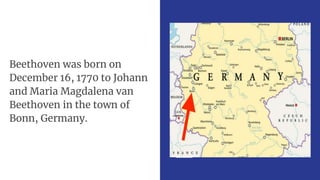
Beethoven was born on
December 16, 1770 to Johann
and Maria Magdalena van
Beethoven in the town of
Bonn, Germany.
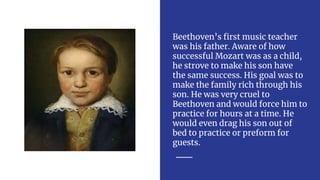
Beethoven’s first music teacher
was his father. Aware of how
successful Mozart was as a child,
he strove to make his son have
the same success. His goal was to
make the family rich through his
son. He was very cruel to
Beethoven and would force him to
practice for hours at a time. He
would even drag his son out of
bed to practice or preform for
guests.
At age eleven, Beethoven was
forced to quit school before he
had even learned how to multiply
or divide. When he was in his
adolescent years he began to
attract mild attention for his
musical talent.
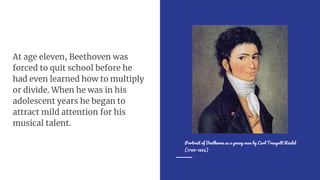
Portrait of Beethoven as a young man by Carl Traugott Riedel
(1769–1832)
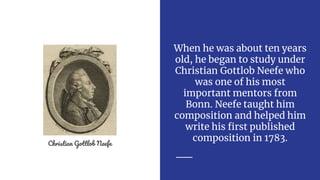
When he was about ten years
old, he began to study under
Christian Gottlob Neefe who
was one of his most
important mentors from
Bonn. Neefe taught him
composition and helped him
write his first published
composition in 1783.
Christian Gottlob Neefe
Beethoven’s Career
In 1783, Beethoven was appointed continuo player to the Bonn opera. By
1878, he had made such waves in the music community, that the
Archbishop-Elector sent him to Vienna to study with Mozart himself.
However his time in Vienna was short lived because he was called back to
Bonn after receiving word that his mother had passed away. His time in
Vienna did not go unnoticed however as he was said to have impressed
Mozart in a big way. According to legend, Mozart noted to his some of his
companions that “this young man will make a great name for himself in
the world”.
For the next five years, Beethoven took the responsibility of caring for his
younger siblings very seriously. Even to the point of
choosing who they could and couldn’t marry.
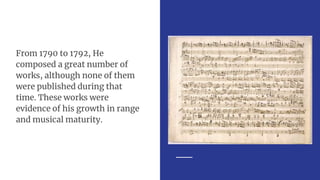
From 1790 to 1792, He
composed a great number of
works, although none of them
were published during that
time. These works were
evidence of his growth in range
and musical maturity.
A little before 1793, Beethoven left for Vienna once again. Very soon after
he arrived, he learned that Mozart had passed away. Through the next
couple years, there was a sense that Beethoven was the successor to the
infamous Mozart. In the effort to live up to that expectation, he threw
himself into studying the works of the master and tried to compose works
with a Mozartean vibe. Over the next couple years he was mentored by
The Father of the Symphony, Joseph Haydn. He refined his skills in the
violin under the teaching of Ignaz Schuppanzigh, and briefly received
tutelage from Antonio Salieri.
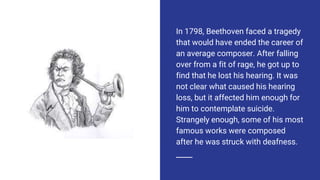
In 1798, Beethoven faced a tragedy
that would have ended the career of
an average composer. After falling
over from a fit of rage, he got up to
find that he lost his hearing. It was
not clear what caused his hearing
loss, but it affected him enough for
him to contemplate suicide.
Strangely enough, some of his most
famous works were composed
after he was struck with deafness.
Beethoven’s Most Famous Compositions
● Septet (Op. 20)
● Moonlight Sonata (No. 14 Op. 27)
● Pathetique (No. 8 Op. 30)
● Adelaide (Op. 46)
● Eroica Symphony (Op. 55)
● Fifth Symphony (Op. 67)
● Fidelio (Op. 72)
● Kreutzer Sonata
● Emperor Piano Concerto (Op. 73)
● Missa Solemnis (Op. 123)
● Choral Symphony (Op. 125)
● Grand Fugue (Op. 133)
● Fur Elise (No Opus Number)
● Symphony No. 7 (Op. 92)
● Egmont Overture (Op. 84)
Impact
and
Conclusion
Ludwig Van Beethoven was a German composer and
pianist who lived from 1770 to 1827 (57 years).
Although most of his lifetime took place during what is
technically considered the classical period of musical
history, (1750-1820) Beethoven is usually classified as
a Romantic composer.
Beethoven is credited as being the composer who
initiated the Romantic Movement in music. He is the
crucial figure in the transition between the Classical
and Romantic eras in Western classical music, and
remains one of the most famous and influential
composer of all time.
Fun Facts about Ludwig van Beethoven
� Beethoven was always ill. The catalogue of his ailments is long and his suffering would have
been very real. During his life, he was known to have suffered from deafness, colitis,
rheumatism, rheumatic fever, typhus, abscesses, ophthalmia, jaundice, chronic hepatitis,
infections and cirrhosis of the liver.
� Beethoven taught for most of his life although he would only teach pupils if they had the
genuine talent or were pretty girls. The girls weren’t required to have any talent.
� Beethoven drunk a lot of alcohol; his father had been an alcoholic. He was once even
arrested as a vagrant due to his drunkenness. The cirrhosis of his liver was only discovered
after his death.
� Beethoven’s final words are believed to have been ‘Pity, pity, too late!’ Apparently, this was
in response to having just received the gift of a case of wine from a music publisher.
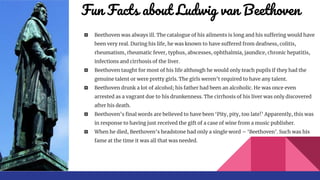
� When he died, Beethoven’s headstone had only a single word – ‘Beethoven’. Such was his
fame at the time it was all that was needed.
Information Citations
“30 Beethoven Facts – Interesting Facts About Ludwig Van Beethoven.” CMUSE, 13 July 2018, www.cmuse.org/ludwig-
van-beethoven-facts/.
“Beethoven's Music - Essential Works by the Classical Master.” The Life and Works of the World's Favorite Classical
Composers, www.favorite-classical-composers.com/beethoven-music.html.
Budden, Julian Medforth, and Raymond L. Knapp. “Ludwig Van Beethoven.” Encyclopædia Britannica, Encyclopædia
Britannica, Inc., 21 Sept. 2018, www.britannica.com/biography/Ludwig-van-Beethoven.
“Ludwig Van Beethoven.” Wikipedia, Wikimedia Foundation, 15 Nov. 2018,
en.wikipedia.org/wiki/Ludwig_van_Beethoven#Background_and_early_life.
Image Source
Bedell, Janet E. “Symphony No. 3 in E-Flat Major, ‘Eroica.’” By the Numbers: Female Composers, 2018, www.bsomusic.org/calendar/events/2018-2019-
events/beethoven-eroica-symphony/beethoven-symphony-no-3-in-e-flat-major-eroica/.
BMSB Music Magazine. “Mozart's vs. Beethoven's Handwritten Sheet Music – BMSB Music Magazine – Medium.” Medium.com, Medium, 23 Feb. 2017,
medium.com/@bmsbmusic/mozarts-vs-beethoven-s-handwritten-sheet-music-687a68070456.
“Christian Gottlob Neefe.” Wikipedia, Wikimedia Foundation, 25 Nov. 2018, en.wikipedia.org/wiki/Christian_Gottlob_Neefe.
Grey Matter. “Beethoven and His Loss of Hearing.” Grey Matter, 9 Oct. 2012, davidstrouddotcom.wordpress.com/2012/10/09/beethoven-and-his-loss-of-hearing/.
“Ludwig Van Beethoven.” Wikipedia, Wikimedia Foundation, 15 Nov. 2018, en.wikipedia.org/wiki/Ludwig_van_Beethoven#Background_and_early_life.
“Ludwig Van Beethoven.” Wikipedia, Wikimedia Foundation, 19 Nov. 2018, simple.wikipedia.org/wiki/Ludwig_van_Beethoven.
“Photo D1089_8_761, from Dissolve.” Dissolve, dissolve.com/stock-photo/Germany-Bonn-Beethoven-statue-royalty-free-image/101-D1089-8-761.
Playbuzz, cdn.playbuzz.com/cdn//1de4a61f-70f6-409d-9136-2b2e14ccbc1e/127625d4-055e-4b8e-901c-9d4efa8b579a.jpg.

Ludwig van Beethoven

  • 1.
  • 2.
  • 3.
    Beethoven’s Ancestors Beethoven wasthe namesake of his paternal grandfather Ludwig van Beethoven (1712-1773). His Grandpa was from the town Mechelen which is in the Flemish region of what is now Belgium. At the age of twenty-one, he moved from Mechelen to Bonn, where he became a very prominent musician. He had one son named Johann who worked at the same musical establishment as Ludwig and also taught lessons in violin and keyboard. Johann married Maria in 1767. The couple had seven children, but only three survived past infancy. The oldest of which was Beethoven.
  • 4.
    Beethoven was bornon December 16, 1770 to Johann and Maria Magdalena van Beethoven in the town of Bonn, Germany.
  • 5.
    Beethoven’s first musicteacher was his father. Aware of how successful Mozart was as a child, he strove to make his son have the same success. His goal was to make the family rich through his son. He was very cruel to Beethoven and would force him to practice for hours at a time. He would even drag his son out of bed to practice or preform for guests.
  • 6.
    At age eleven,Beethoven was forced to quit school before he had even learned how to multiply or divide. When he was in his adolescent years he began to attract mild attention for his musical talent. Portrait of Beethoven as a young man by Carl Traugott Riedel (1769–1832)
  • 7.
    When he wasabout ten years old, he began to study under Christian Gottlob Neefe who was one of his most important mentors from Bonn. Neefe taught him composition and helped him write his first published composition in 1783. Christian Gottlob Neefe
  • 8.
  • 9.
    In 1783, Beethovenwas appointed continuo player to the Bonn opera. By 1878, he had made such waves in the music community, that the Archbishop-Elector sent him to Vienna to study with Mozart himself. However his time in Vienna was short lived because he was called back to Bonn after receiving word that his mother had passed away. His time in Vienna did not go unnoticed however as he was said to have impressed Mozart in a big way. According to legend, Mozart noted to his some of his companions that “this young man will make a great name for himself in the world”. For the next five years, Beethoven took the responsibility of caring for his younger siblings very seriously. Even to the point of choosing who they could and couldn’t marry.
  • 10.
    From 1790 to1792, He composed a great number of works, although none of them were published during that time. These works were evidence of his growth in range and musical maturity.
  • 11.
    A little before1793, Beethoven left for Vienna once again. Very soon after he arrived, he learned that Mozart had passed away. Through the next couple years, there was a sense that Beethoven was the successor to the infamous Mozart. In the effort to live up to that expectation, he threw himself into studying the works of the master and tried to compose works with a Mozartean vibe. Over the next couple years he was mentored by The Father of the Symphony, Joseph Haydn. He refined his skills in the violin under the teaching of Ignaz Schuppanzigh, and briefly received tutelage from Antonio Salieri.
  • 12.
    In 1798, Beethovenfaced a tragedy that would have ended the career of an average composer. After falling over from a fit of rage, he got up to find that he lost his hearing. It was not clear what caused his hearing loss, but it affected him enough for him to contemplate suicide. Strangely enough, some of his most famous works were composed after he was struck with deafness.
  • 13.
    Beethoven’s Most FamousCompositions ● Septet (Op. 20) ● Moonlight Sonata (No. 14 Op. 27) ● Pathetique (No. 8 Op. 30) ● Adelaide (Op. 46) ● Eroica Symphony (Op. 55) ● Fifth Symphony (Op. 67) ● Fidelio (Op. 72) ● Kreutzer Sonata ● Emperor Piano Concerto (Op. 73) ● Missa Solemnis (Op. 123) ● Choral Symphony (Op. 125) ● Grand Fugue (Op. 133) ● Fur Elise (No Opus Number) ● Symphony No. 7 (Op. 92) ● Egmont Overture (Op. 84)
  • 14.
  • 15.
    Ludwig Van Beethovenwas a German composer and pianist who lived from 1770 to 1827 (57 years). Although most of his lifetime took place during what is technically considered the classical period of musical history, (1750-1820) Beethoven is usually classified as a Romantic composer.
  • 16.
    Beethoven is creditedas being the composer who initiated the Romantic Movement in music. He is the crucial figure in the transition between the Classical and Romantic eras in Western classical music, and remains one of the most famous and influential composer of all time.
  • 17.
    Fun Facts aboutLudwig van Beethoven � Beethoven was always ill. The catalogue of his ailments is long and his suffering would have been very real. During his life, he was known to have suffered from deafness, colitis, rheumatism, rheumatic fever, typhus, abscesses, ophthalmia, jaundice, chronic hepatitis, infections and cirrhosis of the liver. � Beethoven taught for most of his life although he would only teach pupils if they had the genuine talent or were pretty girls. The girls weren’t required to have any talent. � Beethoven drunk a lot of alcohol; his father had been an alcoholic. He was once even arrested as a vagrant due to his drunkenness. The cirrhosis of his liver was only discovered after his death. � Beethoven’s final words are believed to have been ‘Pity, pity, too late!’ Apparently, this was in response to having just received the gift of a case of wine from a music publisher. � When he died, Beethoven’s headstone had only a single word – ‘Beethoven’. Such was his fame at the time it was all that was needed.
  • 18.
    Information Citations “30 BeethovenFacts – Interesting Facts About Ludwig Van Beethoven.” CMUSE, 13 July 2018, www.cmuse.org/ludwig- van-beethoven-facts/. “Beethoven's Music - Essential Works by the Classical Master.” The Life and Works of the World's Favorite Classical Composers, www.favorite-classical-composers.com/beethoven-music.html. Budden, Julian Medforth, and Raymond L. Knapp. “Ludwig Van Beethoven.” Encyclopædia Britannica, Encyclopædia Britannica, Inc., 21 Sept. 2018, www.britannica.com/biography/Ludwig-van-Beethoven. “Ludwig Van Beethoven.” Wikipedia, Wikimedia Foundation, 15 Nov. 2018, en.wikipedia.org/wiki/Ludwig_van_Beethoven#Background_and_early_life.
  • 19.
    Image Source Bedell, JanetE. “Symphony No. 3 in E-Flat Major, ‘Eroica.’” By the Numbers: Female Composers, 2018, www.bsomusic.org/calendar/events/2018-2019- events/beethoven-eroica-symphony/beethoven-symphony-no-3-in-e-flat-major-eroica/. BMSB Music Magazine. “Mozart's vs. Beethoven's Handwritten Sheet Music – BMSB Music Magazine – Medium.” Medium.com, Medium, 23 Feb. 2017, medium.com/@bmsbmusic/mozarts-vs-beethoven-s-handwritten-sheet-music-687a68070456. “Christian Gottlob Neefe.” Wikipedia, Wikimedia Foundation, 25 Nov. 2018, en.wikipedia.org/wiki/Christian_Gottlob_Neefe. Grey Matter. “Beethoven and His Loss of Hearing.” Grey Matter, 9 Oct. 2012, davidstrouddotcom.wordpress.com/2012/10/09/beethoven-and-his-loss-of-hearing/. “Ludwig Van Beethoven.” Wikipedia, Wikimedia Foundation, 15 Nov. 2018, en.wikipedia.org/wiki/Ludwig_van_Beethoven#Background_and_early_life. “Ludwig Van Beethoven.” Wikipedia, Wikimedia Foundation, 19 Nov. 2018, simple.wikipedia.org/wiki/Ludwig_van_Beethoven. “Photo D1089_8_761, from Dissolve.” Dissolve, dissolve.com/stock-photo/Germany-Bonn-Beethoven-statue-royalty-free-image/101-D1089-8-761. Playbuzz, cdn.playbuzz.com/cdn//1de4a61f-70f6-409d-9136-2b2e14ccbc1e/127625d4-055e-4b8e-901c-9d4efa8b579a.jpg.