I n t e g r i t y - S e r v i c e - E x c e l l e n c e
Headquarters U.S. Air Force
BTCC for GMU/AFCEA C4I Symposium
19 May 2016
1
Lt. Gen. Arnold W. Bunch, Jr.
Military Deputy,
Office of the Assistant Secretary of the Air Force for Acquisition
I n t e g r i t y - S e r v i c e - E x c e l l e n c e
BTCC Overview
 BTCC includes a growing and evolving set
of acquisition reform activities
 All activities defined in collaboration
with industry
 Activities are focused on promptly
achieving tangible actions
 Emphasis on measurable outcomes
 BTCC activities identified in 3 categories:
 Improve internal AF acquisition
processes
 Enhance interactions with industry
throughout acquisition lifecycle
 Expand competition among traditional
and non-traditional industry partners
 21 BTCC projects launched to date
2
I n t e g r i t y - S e r v i c e - E x c e l l e n c e
Examples BTCC Project #1
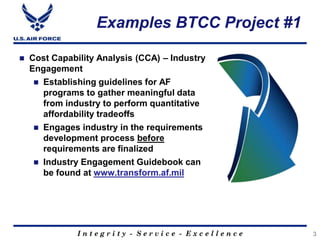
 Cost Capability Analysis (CCA) – Industry
Engagement
 Establishing guidelines for AF
programs to gather meaningful data
from industry to perform quantitative
affordability tradeoffs
 Engages industry in the requirements
development process before
requirements are finalized
 Industry Engagement Guidebook can
be found at www.transform.af.mil
3
I n t e g r i t y - S e r v i c e - E x c e l l e n c e4
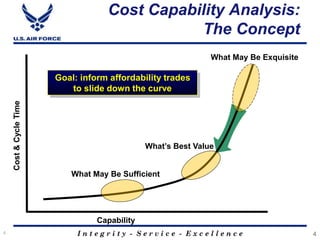
Cost Capability Analysis:
The Concept
Cost&CycleTime
What May Be Exquisite
Capability
What’s Best Value
What May Be Sufficient
Goal: inform affordability trades
to slide down the curve
4
I n t e g r i t y - S e r v i c e - E x c e l l e n c e
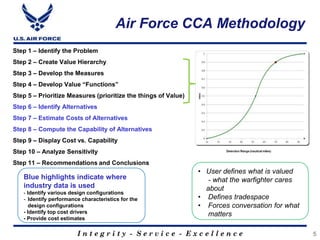
Air Force CCA Methodology
Step 1 – Identify the Problem
Step 2 – Create Value Hierarchy
Step 3 – Develop the Measures
Step 4 – Develop Value “Functions”
Step 5 – Prioritize Measures (prioritize the things of Value)
Step 6 – Identify Alternatives
Step 7 – Estimate Costs of Alternatives
Step 8 – Compute the Capability of Alternatives
Step 9 – Display Cost vs. Capability
Step 10 – Analyze Sensitivity
Step 11 – Recommendations and Conclusions
5
Blue highlights indicate where
industry data is used
- Identify various design configurations
- Identify performance characteristics for the
design configurations
- Identify top cost drivers
- Provide cost estimates
• User defines what is valued
- what the warfighter cares
about
• Defines tradespace
• Forces conversation for what
matters
I n t e g r i t y - S e r v i c e - E x c e l l e n c e
Examples BTCC Project #2
 Open System Acquisition (OSA)
 Established a new acquisition process
to build capabilities for open
architecture systems
 Emphasizes accelerated time to
acquire (~3 weeks from RFP response
to award) and expanded competition
among traditional and non-traditional
defense contractors
 Utilizes “Other Transaction
Consortium” model for acquisitions
 More information can be found at
www.transform.af.mil
6
I n t e g r i t y - S e r v i c e - E x c e l l e n c e
Open System Architectures
 Transitioning Air Force systems to open architectures is a cost,
schedule, and capability imperative. But why aren’t we there yet?
 Agreement on standards…or even basic principles of open
architectures
 Requires PMs to challenge and disrupt current acquisition
processes
 Requires enterprise-wide flexibility to embrace changes to the
status-quo technical planning and supporting business/contracting
strategies
7
Download an App using the Defense Acquisition System
• 2+ years to procure
• ~2 years for A&A
Would you buy the app…or the phone?
I n t e g r i t y - S e r v i c e - E x c e l l e n c e
Open System Acquisition Goals
8
 Develop and institutionalize an acquisition process that captures
the full value of open system architectures:
 Achieve technology refresh cycles aligned with global innovation
 Enable iterative system development and fielding
 Broaden pool of technologies available to meet mission requirements
 Reduce costs to develop and sustain Air Force systems
 Acquisition process is only one barrier to timely fielding of new
technologies
 Process must also minimally incorporate expedited DT&E and A&A
 Reducing costs and expanding technology options requires
significant expansion in pool of companies willing and able to do
business with the Air Force
 Traditional FAR-based contracting is unlikely to achieve these results
to the extent necessary
I n t e g r i t y - S e r v i c e - E x c e l l e n c e
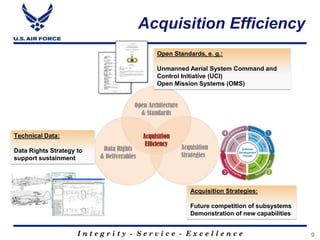
Acquisition Efficiency
Open Standards, e. g.:
Unmanned Aerial System Command and
Control Initiative (UCI)
Open Mission Systems (OMS)
Acquisition Strategies:
Future competition of subsystems
Demonstration of new capabilities
Technical Data:
Data Rights Strategy to
support sustainment
9
I n t e g r i t y - S e r v i c e - E x c e l l e n c e
Open Systems Standards
Update
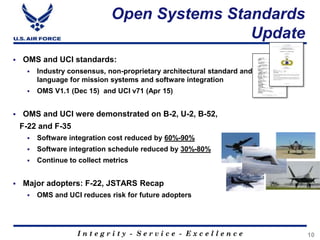
 OMS and UCI standards:
 Industry consensus, non-proprietary architectural standard and messaging
language for mission systems and software integration
 OMS V1.1 (Dec 15) and UCI v71 (Apr 15)
 OMS and UCI were demonstrated on B-2, U-2, B-52,
F-22 and F-35
 Software integration cost reduced by 60%-90%
 Software integration schedule reduced by 30%-80%
 Continue to collect metrics
 Major adopters: F-22, JSTARS Recap
 OMS and UCI reduces risk for future adopters
10
I n t e g r i t y - S e r v i c e - E x c e l l e n c e
Defining the Cost Curve
11
 How do we know when we’re successfully “bending the cost
curve” with a given BTCC activity or as an organization?
 The Air Force lacks a useful definition of the “cost curve,” as
related to enterprise-level acquisition system performance
 Lack of meaningful “cost curve” baselines
 The means to measure are not often evident or available
 Timescales for a meaningful assessment can be very long
 Practical limitations to performing controlled experiments within the
acquisition system
 The Innovator’s Dilemma
 SAF/AQ-OTI is developing multiple strategies to assess
enterprise-level acquisition performance, including an
Acquisition Value Assurance Initiative.
I n t e g r i t y - S e r v i c e - E x c e l l e n c e
Measuring Acquisition
Performance
12
“We have got to stop
spending more and more in
order to get less and less.”
Secretary Deborah Lee James on
USAF BTCC Initiative
“Price is what you pay.
Value is what you get.”
Warren Buffett
 Relevant timescales to evaluate
acquisition performance span decades
 Evaluation of acquisition performance
should compare utility, cost, and time to
deliver capabilities to the warfighter
 BTCC aims to establish a value metric
related to historical baselines
Is Bending the Cost
Curve really about
cost, or is it actually
about value?
I n t e g r i t y - S e r v i c e - E x c e l l e n c e
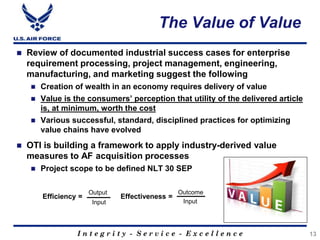
The Value of Value
 Review of documented industrial success cases for enterprise
requirement processing, project management, engineering,
manufacturing, and marketing suggest the following
 Creation of wealth in an economy requires delivery of value
 Value is the consumers’ perception that utility of the delivered article
is, at minimum, worth the cost
 Various successful, standard, disciplined practices for optimizing
value chains have evolved
 OTI is building a framework to apply industry-derived value
measures to AF acquisition processes
 Project scope to be defined NLT 30 SEP
13
Output
Input
Outcome
Input
Efficiency = Effectiveness =
I n t e g r i t y - S e r v i c e - E x c e l l e n c e
Other Acquisition Enterprise
Agility Driven Initiatives
14
 Speeding Smaller Acquisition Programs
 Should Cost Management
 Should Schedule
 Experimentation and Prototyping
 Development Planning
 Competition
These agility driven acquisition initiatives challenge the Air Force to think
critically about our business practices to ensure that critical technologies are
available for our warfighters now and in the future.
I n t e g r i t y - S e r v i c e - E x c e l l e n c e
In Summary
15
 The Air Force is committed to fundamentally improving its
acquisition processes to deliver better capabilities to our Airmen,
faster and cheaper (i.e. delivering greater value)
 Under the Better Buying Power, the Acquisition Priorities and
BTCC Initiative, progress has been made toward implementing
meaningful reforms and establishing meaningful measures of
performance
 CCA, OSA, and the Acquisition Value Assurance Initiative are
examples of how BTCC aims to provide a clearer picture of
enterprise-level acquisition performance and support
quantitative value-based decision making
 We need your help! Please share your ideas during today’s
panel discussion, and join our community of government and
industry game changers if you haven’t already.

Lt Gen Arnold W. Bunch, Jr

  • 1.
    I n te g r i t y - S e r v i c e - E x c e l l e n c e Headquarters U.S. Air Force BTCC for GMU/AFCEA C4I Symposium 19 May 2016 1 Lt. Gen. Arnold W. Bunch, Jr. Military Deputy, Office of the Assistant Secretary of the Air Force for Acquisition
  • 2.
    I n te g r i t y - S e r v i c e - E x c e l l e n c e BTCC Overview  BTCC includes a growing and evolving set of acquisition reform activities  All activities defined in collaboration with industry  Activities are focused on promptly achieving tangible actions  Emphasis on measurable outcomes  BTCC activities identified in 3 categories:  Improve internal AF acquisition processes  Enhance interactions with industry throughout acquisition lifecycle  Expand competition among traditional and non-traditional industry partners  21 BTCC projects launched to date 2
  • 3.
    I n te g r i t y - S e r v i c e - E x c e l l e n c e Examples BTCC Project #1  Cost Capability Analysis (CCA) – Industry Engagement  Establishing guidelines for AF programs to gather meaningful data from industry to perform quantitative affordability tradeoffs  Engages industry in the requirements development process before requirements are finalized  Industry Engagement Guidebook can be found at www.transform.af.mil 3
  • 4.
    I n te g r i t y - S e r v i c e - E x c e l l e n c e4 Cost Capability Analysis: The Concept Cost&CycleTime What May Be Exquisite Capability What’s Best Value What May Be Sufficient Goal: inform affordability trades to slide down the curve 4
  • 5.
    I n te g r i t y - S e r v i c e - E x c e l l e n c e Air Force CCA Methodology Step 1 – Identify the Problem Step 2 – Create Value Hierarchy Step 3 – Develop the Measures Step 4 – Develop Value “Functions” Step 5 – Prioritize Measures (prioritize the things of Value) Step 6 – Identify Alternatives Step 7 – Estimate Costs of Alternatives Step 8 – Compute the Capability of Alternatives Step 9 – Display Cost vs. Capability Step 10 – Analyze Sensitivity Step 11 – Recommendations and Conclusions 5 Blue highlights indicate where industry data is used - Identify various design configurations - Identify performance characteristics for the design configurations - Identify top cost drivers - Provide cost estimates • User defines what is valued - what the warfighter cares about • Defines tradespace • Forces conversation for what matters
  • 6.
    I n te g r i t y - S e r v i c e - E x c e l l e n c e Examples BTCC Project #2  Open System Acquisition (OSA)  Established a new acquisition process to build capabilities for open architecture systems  Emphasizes accelerated time to acquire (~3 weeks from RFP response to award) and expanded competition among traditional and non-traditional defense contractors  Utilizes “Other Transaction Consortium” model for acquisitions  More information can be found at www.transform.af.mil 6
  • 7.
    I n te g r i t y - S e r v i c e - E x c e l l e n c e Open System Architectures  Transitioning Air Force systems to open architectures is a cost, schedule, and capability imperative. But why aren’t we there yet?  Agreement on standards…or even basic principles of open architectures  Requires PMs to challenge and disrupt current acquisition processes  Requires enterprise-wide flexibility to embrace changes to the status-quo technical planning and supporting business/contracting strategies 7 Download an App using the Defense Acquisition System • 2+ years to procure • ~2 years for A&A Would you buy the app…or the phone?
  • 8.
    I n te g r i t y - S e r v i c e - E x c e l l e n c e Open System Acquisition Goals 8  Develop and institutionalize an acquisition process that captures the full value of open system architectures:  Achieve technology refresh cycles aligned with global innovation  Enable iterative system development and fielding  Broaden pool of technologies available to meet mission requirements  Reduce costs to develop and sustain Air Force systems  Acquisition process is only one barrier to timely fielding of new technologies  Process must also minimally incorporate expedited DT&E and A&A  Reducing costs and expanding technology options requires significant expansion in pool of companies willing and able to do business with the Air Force  Traditional FAR-based contracting is unlikely to achieve these results to the extent necessary
  • 9.
    I n te g r i t y - S e r v i c e - E x c e l l e n c e Acquisition Efficiency Open Standards, e. g.: Unmanned Aerial System Command and Control Initiative (UCI) Open Mission Systems (OMS) Acquisition Strategies: Future competition of subsystems Demonstration of new capabilities Technical Data: Data Rights Strategy to support sustainment 9
  • 10.
    I n te g r i t y - S e r v i c e - E x c e l l e n c e Open Systems Standards Update  OMS and UCI standards:  Industry consensus, non-proprietary architectural standard and messaging language for mission systems and software integration  OMS V1.1 (Dec 15) and UCI v71 (Apr 15)  OMS and UCI were demonstrated on B-2, U-2, B-52, F-22 and F-35  Software integration cost reduced by 60%-90%  Software integration schedule reduced by 30%-80%  Continue to collect metrics  Major adopters: F-22, JSTARS Recap  OMS and UCI reduces risk for future adopters 10
  • 11.
    I n te g r i t y - S e r v i c e - E x c e l l e n c e Defining the Cost Curve 11  How do we know when we’re successfully “bending the cost curve” with a given BTCC activity or as an organization?  The Air Force lacks a useful definition of the “cost curve,” as related to enterprise-level acquisition system performance  Lack of meaningful “cost curve” baselines  The means to measure are not often evident or available  Timescales for a meaningful assessment can be very long  Practical limitations to performing controlled experiments within the acquisition system  The Innovator’s Dilemma  SAF/AQ-OTI is developing multiple strategies to assess enterprise-level acquisition performance, including an Acquisition Value Assurance Initiative.
  • 12.
    I n te g r i t y - S e r v i c e - E x c e l l e n c e Measuring Acquisition Performance 12 “We have got to stop spending more and more in order to get less and less.” Secretary Deborah Lee James on USAF BTCC Initiative “Price is what you pay. Value is what you get.” Warren Buffett  Relevant timescales to evaluate acquisition performance span decades  Evaluation of acquisition performance should compare utility, cost, and time to deliver capabilities to the warfighter  BTCC aims to establish a value metric related to historical baselines Is Bending the Cost Curve really about cost, or is it actually about value?
  • 13.
    I n te g r i t y - S e r v i c e - E x c e l l e n c e The Value of Value  Review of documented industrial success cases for enterprise requirement processing, project management, engineering, manufacturing, and marketing suggest the following  Creation of wealth in an economy requires delivery of value  Value is the consumers’ perception that utility of the delivered article is, at minimum, worth the cost  Various successful, standard, disciplined practices for optimizing value chains have evolved  OTI is building a framework to apply industry-derived value measures to AF acquisition processes  Project scope to be defined NLT 30 SEP 13 Output Input Outcome Input Efficiency = Effectiveness =
  • 14.
    I n te g r i t y - S e r v i c e - E x c e l l e n c e Other Acquisition Enterprise Agility Driven Initiatives 14  Speeding Smaller Acquisition Programs  Should Cost Management  Should Schedule  Experimentation and Prototyping  Development Planning  Competition These agility driven acquisition initiatives challenge the Air Force to think critically about our business practices to ensure that critical technologies are available for our warfighters now and in the future.
  • 15.
    I n te g r i t y - S e r v i c e - E x c e l l e n c e In Summary 15  The Air Force is committed to fundamentally improving its acquisition processes to deliver better capabilities to our Airmen, faster and cheaper (i.e. delivering greater value)  Under the Better Buying Power, the Acquisition Priorities and BTCC Initiative, progress has been made toward implementing meaningful reforms and establishing meaningful measures of performance  CCA, OSA, and the Acquisition Value Assurance Initiative are examples of how BTCC aims to provide a clearer picture of enterprise-level acquisition performance and support quantitative value-based decision making  We need your help! Please share your ideas during today’s panel discussion, and join our community of government and industry game changers if you haven’t already.