SOLVE LP
THROUGH
GRAPHICAL
REPRESENTATION
AND EXCEL
SOLVER
BUSINESS ANALYTICS FOR OPTIMAL
PERFORMANCE
ARPEE
C. ARRUEJO,
MIT
Linear Programming
Back to
Topics
SOLUTIONS
GRAPH
A graphicalmethod involvesformulating a set of linear
inequalitiessubject tothe constraints.
Example: Problem
Back to
Topics
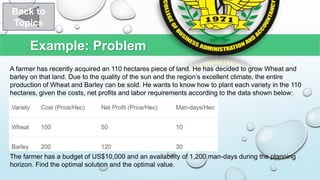
A farmer has recently acquired an 110 hectares piece of land. He has decided to grow Wheat and
barley on that land. Due to the quality of the sun and the region’s excellent climate, the entire
production of Wheat and Barley can be sold. He wants to know how to plant each variety in the 110
hectares, given the costs, net profits and labor requirements according to the data shown below:
The farmer has a budget of US$10,000 and an availability of 1,200 man-days during the planning
horizon. Find the optimal solution and the optimal value.
Example: Solution
Back to
Topics
A. Formulation of Linear Problem
Step 1: Identify the decision variables
The total area for growing Wheat = X (in hectares)
The total area for growing Barley = Y (in hectares)
X and Y are my decision variables.
Example: Solution
Back to
Topics
Step 2: Write the objective function
Since the production from the entire land can be sold in the
market. The farmer would want to maximize the profit for his
total produce. We are given net profit for both Wheat and
Barley. The farmer earns a net profit of US$50 for each
hectare of Wheat and US$120 for each Barley.
Our objective function (given by Z) is,
Max Z = 50X + 120Y
Example: Solution
Back to
Topics
Step 3: Writing the constraints
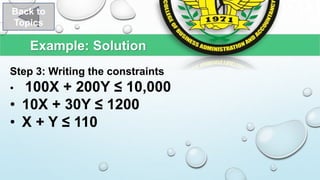
• 100X + 200Y ≤ 10,000
• 10X + 30Y ≤ 1200
• X + Y ≤ 110
Example: Solution
Back to
Topics
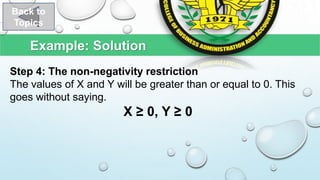
Step 4: The non-negativity restriction
The values of X and Y will be greater than or equal to 0. This
goes without saying.
X ≥ 0, Y ≥ 0
Example: Graphical
Method
Back to
Topics
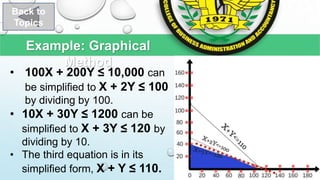
• 100X + 200Y ≤ 10,000 can
be simplified to X + 2Y ≤ 100
by dividing by 100.
• 10X + 30Y ≤ 1200 can be
simplified to X + 3Y ≤ 120 by
dividing by 10.
• The third equation is in its
simplified form, X + Y ≤ 110.
Example: Graphical
Method
Back to
Topics
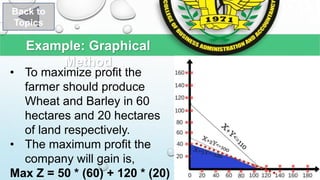
• To maximize profit the
farmer should produce
Wheat and Barley in 60
hectares and 20 hectares
of land respectively.
• The maximum profit the
company will gain is,
Max Z = 50 * (60) + 120 * (20)
Example
Back to
Topics

LP formulation and solution

  • 1.
    SOLVE LP THROUGH GRAPHICAL REPRESENTATION AND EXCEL SOLVER BUSINESSANALYTICS FOR OPTIMAL PERFORMANCE ARPEE C. ARRUEJO, MIT
  • 2.
    Linear Programming Back to Topics SOLUTIONS GRAPH Agraphicalmethod involvesformulating a set of linear inequalitiessubject tothe constraints.
  • 3.
    Example: Problem Back to Topics Afarmer has recently acquired an 110 hectares piece of land. He has decided to grow Wheat and barley on that land. Due to the quality of the sun and the region’s excellent climate, the entire production of Wheat and Barley can be sold. He wants to know how to plant each variety in the 110 hectares, given the costs, net profits and labor requirements according to the data shown below: The farmer has a budget of US$10,000 and an availability of 1,200 man-days during the planning horizon. Find the optimal solution and the optimal value.
  • 4.
    Example: Solution Back to Topics A.Formulation of Linear Problem Step 1: Identify the decision variables The total area for growing Wheat = X (in hectares) The total area for growing Barley = Y (in hectares) X and Y are my decision variables.
  • 5.
    Example: Solution Back to Topics Step2: Write the objective function Since the production from the entire land can be sold in the market. The farmer would want to maximize the profit for his total produce. We are given net profit for both Wheat and Barley. The farmer earns a net profit of US$50 for each hectare of Wheat and US$120 for each Barley. Our objective function (given by Z) is, Max Z = 50X + 120Y
  • 6.
    Example: Solution Back to Topics Step3: Writing the constraints • 100X + 200Y ≤ 10,000 • 10X + 30Y ≤ 1200 • X + Y ≤ 110
  • 7.
    Example: Solution Back to Topics Step4: The non-negativity restriction The values of X and Y will be greater than or equal to 0. This goes without saying. X ≥ 0, Y ≥ 0
  • 8.
    Example: Graphical Method Back to Topics •100X + 200Y ≤ 10,000 can be simplified to X + 2Y ≤ 100 by dividing by 100. • 10X + 30Y ≤ 1200 can be simplified to X + 3Y ≤ 120 by dividing by 10. • The third equation is in its simplified form, X + Y ≤ 110.
  • 9.
    Example: Graphical Method Back to Topics •To maximize profit the farmer should produce Wheat and Barley in 60 hectares and 20 hectares of land respectively. • The maximum profit the company will gain is, Max Z = 50 * (60) + 120 * (20)
  • 10.

Editor's Notes

  • #3 Then the inequalities are plotted on a X-Y plane. Once we have plotted all the inequalities on a graph the intersecting region gives us a feasible region. The feasible region explains what all values our model can take. And it also gives us the optimal solution.
  • #5 To solve this problem, first we gonna formulate our linear program. Formulation of Linear Problem
  • #6 To solve this problem, first we gonna formulate our linear program. Formulation of Linear Problem
  • #7 Step 3: Writing the constraints  1. It is given that the farmer has a total budget of US$10,000. The cost of producing Wheat and Barley per hectare is also given to us. We have an upper cap on the total cost spent by the farmer. So our equation becomes: 100X + 200Y ≤ 10,000  2. The next constraint is, the upper cap on the availability on the total number of man-days for planning horizon. The total number of man-days available are 1200. As per the table, we are given the man-days per hectare for Wheat and Barley. 10X + 30Y ≤ 1200 3. The third constraint is the total area present for plantation. The total available area is 110 hectares. So the equation becomes, X + Y ≤ 110
  • #8 Step 3: Writing the constraints  1. It is given that the farmer has a total budget of US$10,000. The cost of producing Wheat and Barley per hectare is also given to us. We have an upper cap on the total cost spent by the farmer. So our equation becomes: 100X + 200Y ≤ 10,000  2. The next constraint is, the upper cap on the availability on the total number of man-days for planning horizon. The total number of man-days available are 1200. As per the table, we are given the man-days per hectare for Wheat and Barley. 10X + 30Y ≤ 1200 3. The third constraint is the total area present for plantation. The total available area is 110 hectares. So the equation becomes, X + Y ≤ 110
  • #9 Step 3: Writing the constraints  100X + 200Y ≤ 10,000  10X + 30Y ≤ 1200 X + Y ≤ 110 Since we know that X, Y ≥ 0. We will consider only the first quadrant. To plot for the graph for the above equations, first I will simplify all the equations. 100X + 200Y ≤ 10,000 can be simplified to X + 2Y ≤ 100 by dividing by 100. 10X + 30Y ≤ 1200 can be simplified to X + 3Y ≤ 120 by dividing by 10. The third equation is in its simplified form, X + Y ≤ 110. Plot the first 2 lines on a graph in first quadrant (like shown below) The optimal feasible solution is achieved at the point of intersection where the budget & man-days constraints are active. This means the point at which the equations X + 2Y ≤ 100 and X + 3Y ≤ 120 intersect gives us the optimal solution. The values for X and Y which gives the optimal solution is at (60,20). To maximize profit the farmer should produce Wheat and Barley in 60 hectares and 20 hectares of land respectively. The maximum profit the company will gain is, Max Z = 50 * (60) + 120 * (20) =  US$5400
  • #10 Plot the first 2 lines on a graph in first quadrant (like shown below) The optimal feasible solution is achieved at the point of intersection where the budget & man-days constraints are active. This means the point at which the equations X + 2Y ≤ 100 and X + 3Y ≤ 120 intersect gives us the optimal solution. The values for X and Y which gives the optimal solution is at (60,20). To maximize profit the farmer should produce Wheat and Barley in 60 hectares and 20 hectares of land respectively. The maximum profit the company will gain is, Max Z = 50 * (60) + 120 * (20) =  US$5400
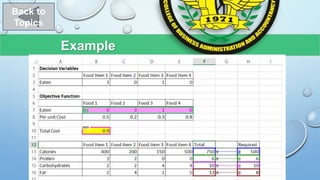
  • #11 Step 9: Once the model is saved click on Data tab then click solve. The optimal solution and values are displayed in the corresponding cells. The optimal minimum cost is US$0.90. Sara should consume 3 units of Food Item 2 and 1 unit of Food Item 3 for the required nutrient content at the minimum cost. This is solves our linear program.