LOW LEVEL DESIGN
(LLD)
LOW LEVEL DESIGN
• It’s a component level design process
• It gives the internal logical design of the software being developed
• It defines the class diagrams that has attributes and methods, defining
relationships between them etc
• It helps to develop the code directly with LLD document with minimal debugging
& testing.
OOAD
• Object Oriented Analysis & Design
• OOA – Its an investigation of the objects needed to develop a system
• OOD – Collaboration of identified objects during the analysis
• Purpose of OOAD
• identifying the objects,
• recognizing the relationship between them
• make design out of it
• convert it to code using OO languages
UML
• Unified Modelling Language
• It’s a pictorial language used to make software blueprints
• It’s used to define, specify, visualize and document the artifacts of a software
systems
• The output from OOAD is the input to UML diagrams
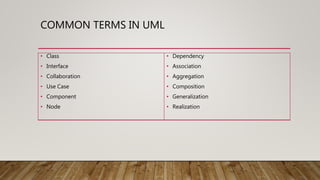
COMMON TERMS IN UML
• Class
• Interface
• Collaboration
• Use Case
• Component
• Node
• Dependency
• Association
• Aggregation
• Composition
• Generalization
• Realization
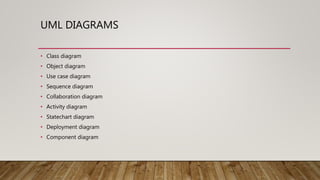
UML DIAGRAMS
• Class diagram
• Object diagram
• Use case diagram
• Sequence diagram
• Collaboration diagram
• Activity diagram
• Statechart diagram
• Deployment diagram
• Component diagram
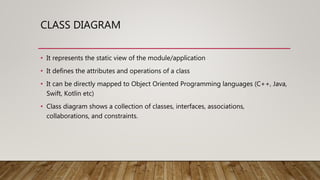
CLASS DIAGRAM
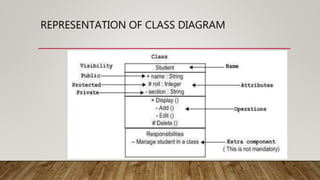
• It represents the static view of the module/application
• It defines the attributes and operations of a class
• It can be directly mapped to Object Oriented Programming languages (C++, Java,
Swift, Kotlin etc)
• Class diagram shows a collection of classes, interfaces, associations,
collaborations, and constraints.
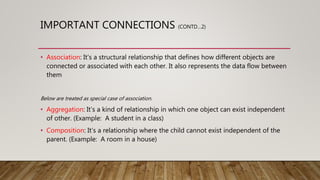
IMPORTANT CONNECTIONS (CONTD…2)
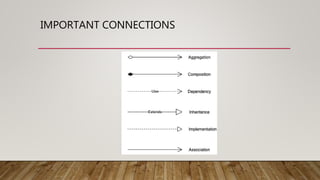
• Association: It’s a structural relationship that defines how different objects are
connected or associated with each other. It also represents the data flow between
them
Below are treated as special case of association.
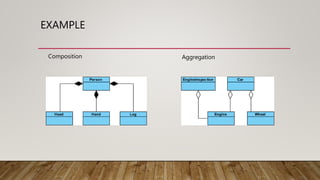
• Aggregation: It’s a kind of relationship in which one object can exist independent
of other. (Example: A student in a class)
• Composition: It’s a relationship where the child cannot exist independent of the
parent. (Example: A room in a house)
EXAMPLE
Composition Aggregation
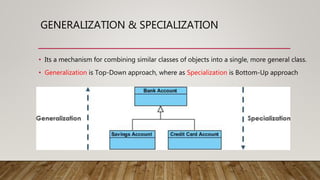
GENERALIZATION & SPECIALIZATION
• Its a mechanism for combining similar classes of objects into a single, more general class.
• Generalization is Top-Down approach, where as Specialization is Bottom-Up approach
IMPORTANT CONNECTIONS
REPRESENTATION OF CLASS DIAGRAM
Example & Questions

Low Level Design

  • 1.
  • 2.
    LOW LEVEL DESIGN •It’s a component level design process • It gives the internal logical design of the software being developed • It defines the class diagrams that has attributes and methods, defining relationships between them etc • It helps to develop the code directly with LLD document with minimal debugging & testing.
  • 3.
    OOAD • Object OrientedAnalysis & Design • OOA – Its an investigation of the objects needed to develop a system • OOD – Collaboration of identified objects during the analysis • Purpose of OOAD • identifying the objects, • recognizing the relationship between them • make design out of it • convert it to code using OO languages
  • 4.
    UML • Unified ModellingLanguage • It’s a pictorial language used to make software blueprints • It’s used to define, specify, visualize and document the artifacts of a software systems • The output from OOAD is the input to UML diagrams
  • 5.
    COMMON TERMS INUML • Class • Interface • Collaboration • Use Case • Component • Node • Dependency • Association • Aggregation • Composition • Generalization • Realization
  • 6.
    UML DIAGRAMS • Classdiagram • Object diagram • Use case diagram • Sequence diagram • Collaboration diagram • Activity diagram • Statechart diagram • Deployment diagram • Component diagram
  • 7.
    CLASS DIAGRAM • Itrepresents the static view of the module/application • It defines the attributes and operations of a class • It can be directly mapped to Object Oriented Programming languages (C++, Java, Swift, Kotlin etc) • Class diagram shows a collection of classes, interfaces, associations, collaborations, and constraints.
  • 8.
    IMPORTANT CONNECTIONS (CONTD…2) •Association: It’s a structural relationship that defines how different objects are connected or associated with each other. It also represents the data flow between them Below are treated as special case of association. • Aggregation: It’s a kind of relationship in which one object can exist independent of other. (Example: A student in a class) • Composition: It’s a relationship where the child cannot exist independent of the parent. (Example: A room in a house)
  • 9.
  • 10.
    GENERALIZATION & SPECIALIZATION •Its a mechanism for combining similar classes of objects into a single, more general class. • Generalization is Top-Down approach, where as Specialization is Bottom-Up approach
  • 11.
  • 12.
  • 13.