Hadoop Ecosystem and Low
Latency Streaming Architecture
InSemble Inc.
http://www.insemble.com
Agenda
What is Big Data and why it is relevant ?1
Flume, Kafka and Storm4
Reference Architecture for Low Latency Streaming3
Hadoop Ecosystem2
Demo5
Big Data Definitions
• Wikipedia defines it as “Data Sets with sizes beyond the ability of
commonly used software tools to capture, curate, manage and process
data within a tolerable elapsed time”
• Gartner defines it as Data with the following characteristics
– High Velocity
– High Variety
– High Volume
• Another Definition is “Big Data is a large volume, unstructured data
which cannot be handled by traditional database management systems
”
Why a game changer
• Schema on Read
– Interpreting data at processing time
– Key, Values are not intrinsic properties of data but chosen by
person analyzing the data
• Move code to data
– With traditional, we bring data to code and I/O becomes a
bottleneck
– With distributed systems, we have to deal with our own
checkpointing/recovery
• More data beats better algorithms
Enterprise Relevance
• Missed Opportunities
– Channels
– Data that is analyzed
• Constraint was high cost
– Storage
– Processing
• Future-proof your business
– Schema on Read
– Access pattern not as relevant
– Not just future-proofing your architecture
Hadoop Ecosystem
Source: Apache Hadoop Documentation
Hadoop 2 with YARN
Source: Hadoop In Practice by Alex Holmes
Big Data Journey
➢ Real time Insight from all channels
➢ IT is key differentiator for your business
➢ Perfect alignment of Business and IT
➢ Ad Hoc Data Exploration
➢ Batch, Interactive, Real time use cases
➢ Predictive Analytics, Machine Learning
➢ Consolidated Analytics
➢ ETL
➢ Time Constraints
➢ Security standards defined
➢ Governance Standards Defined
➢ Integrated with the Enterprise
➢ Evaluate Business Benefits
➢ Understand Ecosystem
➢ Identify Platform
Aware of Benefits
Execute
Expand
Managed
Optimized
- Scout for Opportunities
- Pilot project
- Multiple Use cases
- Governance Model
- Core competency
Journey Over Time
BusinessValue
Effects
GREAT
GOOD
Real time Stream Processing
Architecture with Hadoop
Flume Architecture
• Distributed system for
collecting and aggregating
from multiple data stores to
a centralized data store
• Agent is a JVM that hosts
the Flume components
• Channel will store
message until picked by a
sink
• Different types of Flume
sources
• Source and Sink are
decoupled
Consolidation Architecture
Multiplexing Architecture
Kafka Introduction
• Messaging System which is distributed, partitioned and replicated
• Kafka brokers run as a cluster
• Producers and Consumers can be written in any language
Topic
• Ordered, immutable sequence numbers
• Retains messages until a period of time
• “Offset” of where they are is controlled by the consumer
• Each partition is replicated and has “leader” and 0 or more “follower”.
R/W only done on leader
Producers and Consumers
• Producer controls which partition messages goes to
• Supports both Queuing and Pub/Sub
– Abstraction called Consumer group
• Ordering within Partition
– Ordering for subscriber has to be done with only one subscriber to that
partition
Storm Introduction
• Distributed real time computational system
–Process unbounded streams of data
–Can use multiple programming languages
–Scalable, fault-tolerant and guarantees that data will be processed
• Use Cases
–Real time analytics, online machine learning
–Continuous Computation
–Distributed RPC
–ETL
• Concepts
–Topology
–Spouts
–Bolts
Concepts
• Storm Cluster
– Master node(Nimbus)
• Distributing code
• Assigns tasks to machines
• Monitors for failures
– Worker nodes(Supervisor)
• Starts/stops worker processes
• Each worker process executes subset of a topology
– Zookeeper
• Coordinates between Nimbus and Supervisors
• Nimbus and Supervisors completely stateless
• State maintained by Zookeeper or local disks
Details
• Stream
– Unbounded sequence of tuples
• Spout(write logic)
– Source of stream. Emits tuples
• Bolt(write logic)
– Processes streams and emits tuples
• Topology
– DAG of spouts and bolts
– Submit a topology to a Storm cluster
– Each node runs in parallel and parallelism is controlled
Stream groupings
• Tells a topology how to send tuples between two components
• Since tasks are executed in parallel, how do we control which tasks the
tuples are being sent to
Why Use Twitter as Data Source
Demo - Twitter TopN Trending Topic
• Method 1 — Flume with interceptor
• Method 2 — Storm with custom Twitter
Spout
• Method 3 — Flume + Kafka + Storm
Demo - Twitter TopN Trending Topic
• Use Flume Twitter Source to ingest data and
publish event to Kafka topic
• Use Kafka as messaging backbone
• Use Storm as an Real-Time event processing
system to calculate TopN trending topic
• Use Redis to store the TopN Result
• Use Node.js/JQuery for visualization
Flow Chart
Demo: Start Redis Server
Demo: Start Node.js server
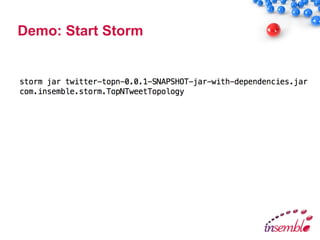
Demo: Start Storm
Demo: Start Flume Agent
Demo: Storm Console Output
Demo: Trending Result
Flume Agent — Source
Flume Agent — Channel
Flume Agent — Sink
Storm Topology Design
Submit Topology to Storm
Production Cluster
Submit Topology to Test Cluster
ParseTweetBolt Code
ParseTweetBolt Code
ParseTweetBolt Code
Questions?


Vijay Mandava: vijay@insemble.com
Lan Jiang: lan@insemble.com / @Lan_Jiang


Hadoop Ecosystem and Low Latency Streaming Architecture

  • 1.
    Hadoop Ecosystem andLow Latency Streaming Architecture InSemble Inc. http://www.insemble.com
  • 2.
    Agenda What is BigData and why it is relevant ?1 Flume, Kafka and Storm4 Reference Architecture for Low Latency Streaming3 Hadoop Ecosystem2 Demo5
  • 3.
    Big Data Definitions •Wikipedia defines it as “Data Sets with sizes beyond the ability of commonly used software tools to capture, curate, manage and process data within a tolerable elapsed time” • Gartner defines it as Data with the following characteristics – High Velocity – High Variety – High Volume • Another Definition is “Big Data is a large volume, unstructured data which cannot be handled by traditional database management systems ”
  • 4.
    Why a gamechanger • Schema on Read – Interpreting data at processing time – Key, Values are not intrinsic properties of data but chosen by person analyzing the data • Move code to data – With traditional, we bring data to code and I/O becomes a bottleneck – With distributed systems, we have to deal with our own checkpointing/recovery • More data beats better algorithms
  • 5.
    Enterprise Relevance • MissedOpportunities – Channels – Data that is analyzed • Constraint was high cost – Storage – Processing • Future-proof your business – Schema on Read – Access pattern not as relevant – Not just future-proofing your architecture
  • 6.
    Hadoop Ecosystem Source: ApacheHadoop Documentation
  • 7.
    Hadoop 2 withYARN Source: Hadoop In Practice by Alex Holmes
  • 8.
    Big Data Journey ➢Real time Insight from all channels ➢ IT is key differentiator for your business ➢ Perfect alignment of Business and IT ➢ Ad Hoc Data Exploration ➢ Batch, Interactive, Real time use cases ➢ Predictive Analytics, Machine Learning ➢ Consolidated Analytics ➢ ETL ➢ Time Constraints ➢ Security standards defined ➢ Governance Standards Defined ➢ Integrated with the Enterprise ➢ Evaluate Business Benefits ➢ Understand Ecosystem ➢ Identify Platform Aware of Benefits Execute Expand Managed Optimized - Scout for Opportunities - Pilot project - Multiple Use cases - Governance Model - Core competency Journey Over Time BusinessValue Effects GREAT GOOD
  • 9.
    Real time StreamProcessing Architecture with Hadoop
  • 10.
    Flume Architecture • Distributedsystem for collecting and aggregating from multiple data stores to a centralized data store • Agent is a JVM that hosts the Flume components • Channel will store message until picked by a sink • Different types of Flume sources • Source and Sink are decoupled
  • 11.
  • 12.
  • 13.
    Kafka Introduction • MessagingSystem which is distributed, partitioned and replicated • Kafka brokers run as a cluster • Producers and Consumers can be written in any language
  • 14.
    Topic • Ordered, immutablesequence numbers • Retains messages until a period of time • “Offset” of where they are is controlled by the consumer • Each partition is replicated and has “leader” and 0 or more “follower”. R/W only done on leader
  • 15.
    Producers and Consumers •Producer controls which partition messages goes to • Supports both Queuing and Pub/Sub – Abstraction called Consumer group • Ordering within Partition – Ordering for subscriber has to be done with only one subscriber to that partition
  • 16.
    Storm Introduction • Distributedreal time computational system –Process unbounded streams of data –Can use multiple programming languages –Scalable, fault-tolerant and guarantees that data will be processed • Use Cases –Real time analytics, online machine learning –Continuous Computation –Distributed RPC –ETL • Concepts –Topology –Spouts –Bolts
  • 17.
    Concepts • Storm Cluster –Master node(Nimbus) • Distributing code • Assigns tasks to machines • Monitors for failures – Worker nodes(Supervisor) • Starts/stops worker processes • Each worker process executes subset of a topology – Zookeeper • Coordinates between Nimbus and Supervisors • Nimbus and Supervisors completely stateless • State maintained by Zookeeper or local disks
  • 18.
    Details • Stream – Unboundedsequence of tuples • Spout(write logic) – Source of stream. Emits tuples • Bolt(write logic) – Processes streams and emits tuples • Topology – DAG of spouts and bolts – Submit a topology to a Storm cluster – Each node runs in parallel and parallelism is controlled
  • 19.
    Stream groupings • Tellsa topology how to send tuples between two components • Since tasks are executed in parallel, how do we control which tasks the tuples are being sent to
  • 20.
    Why Use Twitteras Data Source
  • 21.
    Demo - TwitterTopN Trending Topic • Method 1 — Flume with interceptor • Method 2 — Storm with custom Twitter Spout • Method 3 — Flume + Kafka + Storm
  • 22.
    Demo - TwitterTopN Trending Topic • Use Flume Twitter Source to ingest data and publish event to Kafka topic • Use Kafka as messaging backbone • Use Storm as an Real-Time event processing system to calculate TopN trending topic • Use Redis to store the TopN Result • Use Node.js/JQuery for visualization
  • 23.
  • 24.
  • 25.
  • 26.
  • 27.
  • 28.
  • 29.
  • 30.
  • 31.
  • 32.
  • 33.
  • 34.
    Submit Topology toStorm Production Cluster
  • 35.
    Submit Topology toTest Cluster
  • 36.
  • 37.
  • 38.
  • 39.
    Questions? 
 Vijay Mandava: vijay@insemble.com LanJiang: lan@insemble.com / @Lan_Jiang