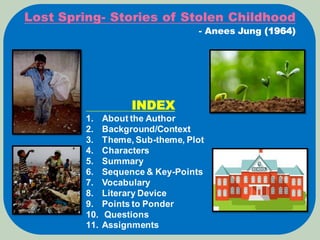
INDEX
1. About the Author
2. Background/Context
3. Theme, Sub-theme, Plot
4. Characters
5. Summary
6. Sequence & Key-Points
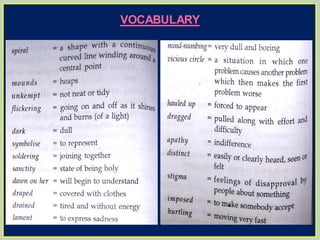
7. Vocabulary
8. Literary Device
9. Points to Ponder
10. Questions
11. Assignments
- Anees Jung (1964)
Lost Spring- Stories of Stolen Childhood
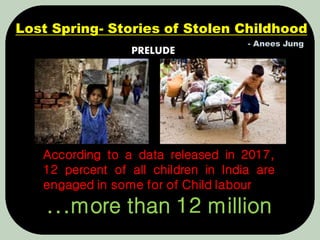
According to a data released in 2017,
12 percent of all children in India are
engaged in some for of Child labour
...more than 12 million
PRELUDE
Lost Spring- Stories of Stolen Childhood
- Anees Jung
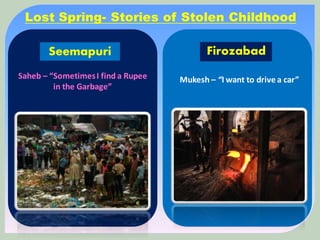
Firozabad
Mukesh – “I want to drive a car”
Seemapuri
Saheb – “SometimesI find a Rupee
in the Garbage”
Lost Spring- Stories of Stolen Childhood
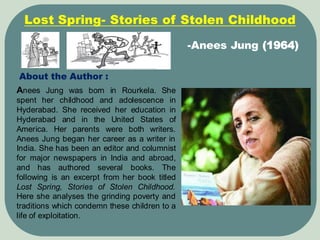
About the Author :
Anees Jung was born in Rourkela. She
spent her childhood and adolescence in
Hyderabad. She received her education in
Hyderabad and in the United States of
America. Her parents were both writers.
Anees Jung began her career as a writer in
India. She has been an editor and columnist
for major newspapers in India and abroad,
and has authored several books. The
following is an excerpt from her book titled
Lost Spring, Stories of Stolen Childhood.
Here she analyses the grinding poverty and
traditions which condemn these children to a
life of exploitation.
-Anees Jung (1964)
Lost Spring- Stories of Stolen Childhood
Background/Context :
Lost Spring- Stories of Stolen Childhood
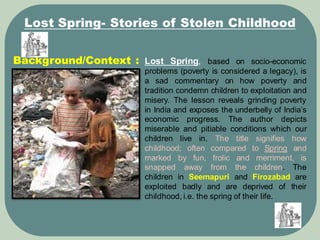
Lost Spring, based on socio-economic
problems (poverty is considered a legacy), is
a sad commentary on how poverty and
tradition condemn children to exploitation and
misery. The lesson reveals grinding poverty
in India and exposes the underbelly of India’s
economic progress. The author depicts
miserable and pitiable conditions which our
children live in. The title signifies how
childhood; often compared to Spring and
marked by fun, frolic and merriment, is
snapped away from the children. The
children in Seemapuri and Firozabad are
exploited badly and are deprived of their
childhood, i.e. the spring of their life.
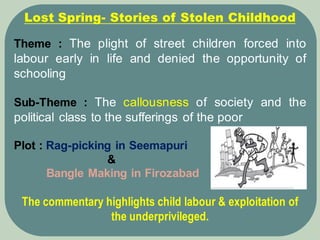
Theme : The plight of street children forced into
labour early in life and denied the opportunity of
schooling
Sub-Theme : The callousness of society and the
political class to the sufferings of the poor
Plot : Rag-picking in Seemapuri
&
Bangle Making in Firozabad
The commentary highlights child labour & exploitation of
the underprivileged.
Lost Spring- Stories of Stolen Childhood
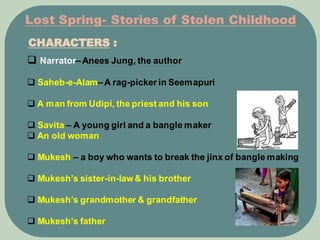
❑ Narrator–Anees Jung, the author
❑ Saheb-e-Alam–A rag-picker in Seemapuri
❑ A man from Udipi, the priest and his son
❑ Savita – A young girl and a bangle maker
❑ An old woman
❑ Mukesh – a boy who wants to break the jinx of bangle making
❑ Mukesh’s sister-in-law& his brother
❑ Mukesh’s grandmother & grandfather
❑ Mukesh’s father
Lost Spring- Stories of Stolen Childhood
CHARACTERS :
SUMMARY
Lost Spring- Stories of Stolen Childhood
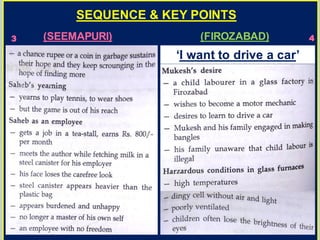
‘SOMETIMES I FIND A RUPEE IN THE GARBAGE’ - Saheb - the rag-picker
Saheb is a rag-picker who scrounges the garbage deposits to sustain his
living. He and his family, refugees from Bangladesh, have come to the big city
“looking for gold”. He is unable to study due to lack of schools in his
neighbourhood. The narrator jokingly makes a false promise to open a school
for him but is later left embarrassed when he keeps approaching her enquiring
about the school. Saheb’s full name, Saheb-e-Alam meaning “lord of the
universe”, is ironical because he, along with others like him, is outright
downtrodden. The author wonders if staying barefoot is just a tradition among
the poor or “only an excuse to explain away a perpetual state of poverty”.
Recollecting the story of a priest’s son
The author recalls a story about a man from Udipi who, as a young son of a
priest, used to pray for a pair of shoes. After thirty years, when the author visits
the place, she finds that the situation has slightly improved because the son of
the present priest now wears shoes and goes to school. However, the author
pines at the thought of the still barefooted rag pickers of her neighbourhood.
SUMMARY
Lost Spring- Stories of Stolen Childhood
Seemapuri- The haven for rag-pickers
Seemapuri in Delhi, is home to 10,000 rag-pickers, mostly Bangladeshi
refugees who came here in 1971. These people live in mud structures with
roofs made of tin and tarpaulin. The ration cards, which allow them to buy
grains, and the garbage are their means of survival. They believe that their
transit shacks are a better place than their native villages that provide no food.
Once in a while the children manage to find coins and rupee notes in the
garbage heaps. The author notices how such occasional findings help the
children to cling on to hope and life.
Discrepancy between Saheb’s desire and reality
Saheb reveals his desire of playing tennis to the author. Even though he has
managed to find a discarded pair of tennis shoes, the author knows, the game
itself “is out of his reach”. Contrary to his heartfelt desire, Saheb eventually ends
up picking up a job in a tea stall where he is paid 800 rupees and all his meals.
One morning, he meets the author on his way to a milk booth carrying a
canister to fetch milk for his master, and the author observes how, in the
process of earning a few hundred rupees, Saheb has lost his freedom and
‘carefree look’.
SUMMARY
Lost Spring- Stories of Stolen Childhood
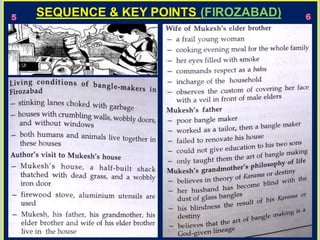
“I WANT TO DRIVE A CAR”- Mukesh and his family
Mukesh belongs to a family of bangle-makers in Firozabad. Most of the families in the
place are unaware of the illegality of their action in engaging children in such a
hazardous industry. Even though children in such families take up the family
profession, Mukesh wants to be a motor mechanic and drive a car.
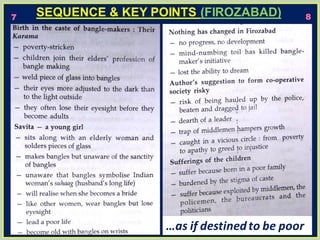
Mukesh takes the author to his house which is one among many of the dilapidated
houses of bangle makers, constructed in stinking lanes. Mukesh’s father has been
unable to change the condition of the house and the family, in spite of working very
hard. The family now consisted of the father, the grandmother, the elder brother and
his wife, and Mukesh.
Mechanical life of a bangle maker
According to Mukesh’s grandmother, once born into the caste of bangle-makers, they
have no way out but to surrender to their destiny. The grandmother recalls how her
husband finally turned blind after working for years in the glass-blowing industry.
The lives of the people of Firozabad are centred on bangle-making. All their lives they
work with colourful bangles only to go blind in their later years.
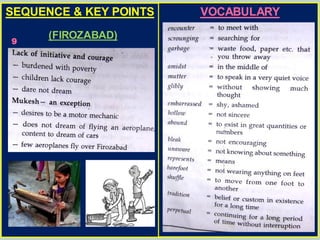
The author observes a young girl, Savita and ponders over the life of women in that
region. Before marriage they make bangles, possibly without ever realising its
sanctity, and after marriage wear them. The only boon some of these people have is
a roof over their heads; but, they are not able to manage a proper full time meal.
SUMMARY
Lost Spring- Stories of Stolen Childhood
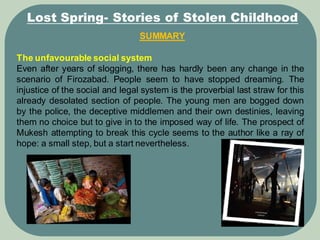
The unfavourable social system
Even after years of slogging, there has hardly been any change in the
scenario of Firozabad. People seem to have stopped dreaming. The
injustice of the social and legal system is the proverbial last straw for this
already desolated section of people. The young men are bogged down
by the police, the deceptive middlemen and their own destinies, leaving
them no choice but to give in to the imposed way of life. The prospect of
Mukesh attempting to break this cycle seems to the author like a ray of
hope: a small step, but a start nevertheless.
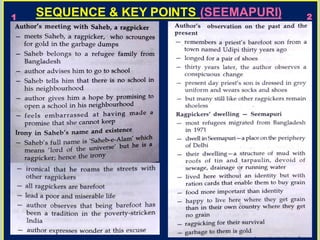
SEQUENCE & KEY POINTS (SEEMAPURI)
1 2
SEQUENCE & KEY POINTS
3 4
(SEEMAPURI) (FIROZABAD)
‘I want to drive a car’
SEQUENCE & KEY POINTS (FIROZABAD)
5 6
SEQUENCE & KEY POINTS (FIROZABAD)
7 8
…as if destinedto be poor
SEQUENCE & KEY POINTS
9
(FIROZABAD)
VOCABULARY
VOCABULARY
VOCABULARY
Lost Spring- Stories of Stolen Childhood
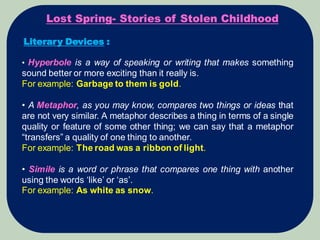
Literary Devices :
• Hyperbole is a way of speaking or writing that makes something
sound better or more exciting than it really is.
For example: Garbage to them is gold.
• A Metaphor, as you may know, compares two things or ideas that
are not very similar. A metaphor describes a thing in terms of a single
quality or feature of some other thing; we can say that a metaphor
“transfers” a quality of one thing to another.
For example: The road was a ribbon of light.
• Simile is a word or phrase that compares one thing with another
using the words ‘like’ or ‘as’.
For example: As white as snow.
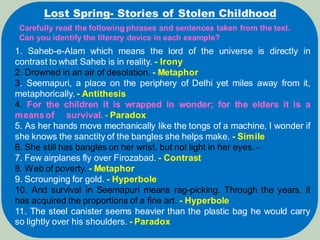
Lost Spring- Stories of Stolen Childhood
1. Saheb-e-Alam which means the lord of the universe is directly in
contrast to what Saheb is in reality. - Irony
2. Drowned in an air of desolation. - Metaphor
3. Seemapuri, a place on the periphery of Delhi yet miles away from it,
metaphorically. - Antithesis
4. For the children it is wrapped in wonder; for the elders it is a
meansof survival. - Paradox
5. As her hands move mechanically like the tongs of a machine, I wonder if
she knows the sanctity of the bangles she helps make. - Simile
6. She still has bangles on her wrist, but not light in her eyes. -
7. Few airplanes fly over Firozabad. - Contrast
8. Web of poverty. - Metaphor
9. Scrounging for gold. - Hyperbole
10. And survival in Seemapuri means rag-picking. Through the years, it
has acquired the proportions of a fine art. - Hyperbole
11. The steel canister seems heavier than the plastic bag he would carry
so lightly over his shoulders. - Paradox
Carefully read the following phrases and sentences taken from the text.
Can you identify the literary device in each example?
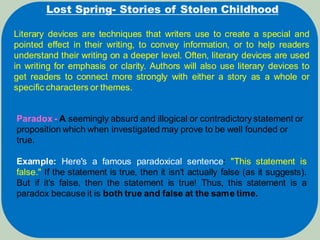
Lost Spring- Stories of Stolen Childhood
Literary devices are techniques that writers use to create a special and
pointed effect in their writing, to convey information, or to help readers
understand their writing on a deeper level. Often, literary devices are used
in writing for emphasis or clarity. Authors will also use literary devices to
get readers to connect more strongly with either a story as a whole or
specific characters or themes.
Paradox - A seemingly absurd and illogical or contradictory statement or
proposition which when investigated may prove to be well founded or
true.
Example: Here's a famous paradoxical sentence: "This statement is
false." If the statement is true, then it isn't actually false (as it suggests).
But if it's false, then the statement is true! Thus, this statement is a
paradox because it is both true and false at the same time.
Lost Spring- Stories of Stolen Childhood
Irony - The expression of one's meaning by using language that normally
signifies the opposite, typically for humorous or emphatic effect. Irony is
a statement in which words are used in such a way that their intended
meaning is different from the actual meaning of the words. It may also be a
situation that ends up in quite a different way than what is generally
anticipated. In simple words, it is a difference between appearance and
reality.
Example: Ref – Irony in the poem ‘The Frog and The Nightingale’
Antithesis- Literally means “opposite,” is a rhetorical device in which two
opposite ideas are put together in a sentence to achieve a contrasting
effect.
e.g. Man proposes, God disposes.
The opening lines of Charles Dickens’ novel A Tale of Two Cities provides
an unforgettable antithesis example:
“It was the best of times, it was the worst of times, it was the age
of wisdom, it was the age of foolishness, …
POINTS TO PONDER
Lost Spring- Stories of Stolen Childhood
Seemapuri (metaphoricallyfar away from Delhi, 10,000 rag-pickers)
* Background of Saheb’s family – refugees from Bangladesh
* Food more important than identity
* Political gimmick – Ration Card
* Saheb’s desire to join a school
* Irony in his name and existence
* Saheb’s yearning – Tennis beyond reach
* The story of Udipi
* Reality behind not wearing footwear – a perpetual state of poverty
* Garbage is gold –different meanings for adults & children, fine arts
* Saheb as an employee– lost carefree look, no longer his own master
POINTS TO PONDER
Lost Spring- Stories of Stolen Childhood
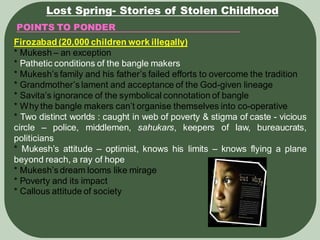
Firozabad (20,000 children work illegally)
* Mukesh – an exception
* Pathetic conditions of the bangle makers
* Mukesh’s family and his father’s failed efforts to overcome the tradition
* Grandmother’s lament and acceptance of the God-given lineage
* Savita’s ignorance of the symbolical connotation of bangle
* Why the bangle makers can’t organise themselves into co-operative
* Two distinct worlds : caught in web of poverty & stigma of caste - vicious
circle – police, middlemen, sahukars, keepers of law, bureaucrats,
politicians
* Mukesh’s attitude – optimist, knows his limits – knows flying a plane
beyond reach, a ray of hope
* Mukesh’s dream looms like mirage
* Poverty and its impact
* Callous attitude of society
POINTS TO PONDER
Lost Spring- Stories of Stolen Childhood
HEALTH HAZARDS
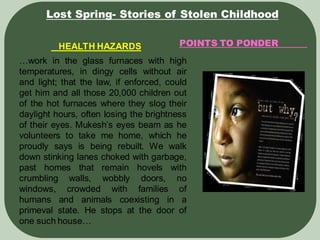
…work in the glass furnaces with high
temperatures, in dingy cells without air
and light; that the law, if enforced, could
get him and all those 20,000 children out
of the hot furnaces where they slog their
daylight hours, often losing the brightness
of their eyes. Mukesh’s eyes beam as he
volunteers to take me home, which he
proudly says is being rebuilt. We walk
down stinking lanes choked with garbage,
past homes that remain hovels with
crumbling walls, wobbly doors, no
windows, crowded with families of
humans and animals coexisting in a
primeval state. He stops at the door of
one such house…
POINTS TO PONDER
Two Distinct Worlds:
Lost Spring- Stories of Stolen Childhood
- one of the family,
caught in a web of
poverty, burdened by
the stigma of caste in
which they are born;
- the other a vicious circle of
the sahukars, the middlemen,
the policemen, the keepers of
law, the bureaucrats and the
politicians. Together they have
imposed the baggage on the
child that he cannot put down.
Lost Spring- Stories of Stolen Childhood
Understanding the text
1. What could be some of the reasons for the migration of people from
villages to cities?
2. Would you agree that promises made to poor children are rarely
kept? Why do you think this happens in the incidents narrated in the
text?
3. What forces conspire to keep the workers in the bangle industry of
Firozabad in poverty?
Talking about the text
1. How, in your opinion, can Mukesh realise his dream?
2. Mention the hazards of working in the glass bangles industry.
3. Why should child labour be eliminated and how?
ASSIGNMENT : QUESTIONS TO TEST COMPREHENSION
Short Answer Questions (30-40 words)
1. What is the significance of garbage in Seemapuri?
2. Bring out the paradox in the story.
3. Is Saheb happy working at the tea stall?
4. What explanations does the author offer for the children not wearing footwear?
5. What is ironic about Saheb’s name?
6. Why is Seemapuri miles away from Delhi metaphorically?
7. How is Mukesh’s attitude to his situation different from that of his family?
8. How does Mukesh’s grandmother accept the tradition of bangle making?
9. Justify the title of the story?
10. What does the author say about Savita?
Long Answer Questions (150 words) :
1. Why can’t the bangle makers in Firozabad organise themselves into co-operative?
How are they trapped in the web of poverty?
2. Mention the hazards of working in the glass bangle industry in Firozabad.
3. Can Mukesh realize his dreams? Why does his dream ‘loom like mirage’?
4. How does the author draw a contrast between the two worlds?
5. ‘Lost Spring’ is a sad commentary on the political system of our country that
condemns thousands of people to a life of abject poverty. Elucidate.
6. ‘Lost Spring’ examines the grinding poverty and traditions that condemn
thousands of children to a life of exploitation. Elaborate.
Lost Spring- Stories of Stolen Childhood

Lost-Spring.pdf book for Read and to study

  • 1.
    INDEX 1. About theAuthor 2. Background/Context 3. Theme, Sub-theme, Plot 4. Characters 5. Summary 6. Sequence & Key-Points 7. Vocabulary 8. Literary Device 9. Points to Ponder 10. Questions 11. Assignments - Anees Jung (1964) Lost Spring- Stories of Stolen Childhood
  • 2.
    According to adata released in 2017, 12 percent of all children in India are engaged in some for of Child labour ...more than 12 million PRELUDE Lost Spring- Stories of Stolen Childhood - Anees Jung
  • 3.
    Firozabad Mukesh – “Iwant to drive a car” Seemapuri Saheb – “SometimesI find a Rupee in the Garbage” Lost Spring- Stories of Stolen Childhood
  • 4.
    About the Author: Anees Jung was born in Rourkela. She spent her childhood and adolescence in Hyderabad. She received her education in Hyderabad and in the United States of America. Her parents were both writers. Anees Jung began her career as a writer in India. She has been an editor and columnist for major newspapers in India and abroad, and has authored several books. The following is an excerpt from her book titled Lost Spring, Stories of Stolen Childhood. Here she analyses the grinding poverty and traditions which condemn these children to a life of exploitation. -Anees Jung (1964) Lost Spring- Stories of Stolen Childhood
  • 5.
    Background/Context : Lost Spring-Stories of Stolen Childhood Lost Spring, based on socio-economic problems (poverty is considered a legacy), is a sad commentary on how poverty and tradition condemn children to exploitation and misery. The lesson reveals grinding poverty in India and exposes the underbelly of India’s economic progress. The author depicts miserable and pitiable conditions which our children live in. The title signifies how childhood; often compared to Spring and marked by fun, frolic and merriment, is snapped away from the children. The children in Seemapuri and Firozabad are exploited badly and are deprived of their childhood, i.e. the spring of their life.
  • 6.
    Theme : Theplight of street children forced into labour early in life and denied the opportunity of schooling Sub-Theme : The callousness of society and the political class to the sufferings of the poor Plot : Rag-picking in Seemapuri & Bangle Making in Firozabad The commentary highlights child labour & exploitation of the underprivileged. Lost Spring- Stories of Stolen Childhood
  • 7.
    ❑ Narrator–Anees Jung,the author ❑ Saheb-e-Alam–A rag-picker in Seemapuri ❑ A man from Udipi, the priest and his son ❑ Savita – A young girl and a bangle maker ❑ An old woman ❑ Mukesh – a boy who wants to break the jinx of bangle making ❑ Mukesh’s sister-in-law& his brother ❑ Mukesh’s grandmother & grandfather ❑ Mukesh’s father Lost Spring- Stories of Stolen Childhood CHARACTERS :
  • 8.
    SUMMARY Lost Spring- Storiesof Stolen Childhood ‘SOMETIMES I FIND A RUPEE IN THE GARBAGE’ - Saheb - the rag-picker Saheb is a rag-picker who scrounges the garbage deposits to sustain his living. He and his family, refugees from Bangladesh, have come to the big city “looking for gold”. He is unable to study due to lack of schools in his neighbourhood. The narrator jokingly makes a false promise to open a school for him but is later left embarrassed when he keeps approaching her enquiring about the school. Saheb’s full name, Saheb-e-Alam meaning “lord of the universe”, is ironical because he, along with others like him, is outright downtrodden. The author wonders if staying barefoot is just a tradition among the poor or “only an excuse to explain away a perpetual state of poverty”. Recollecting the story of a priest’s son The author recalls a story about a man from Udipi who, as a young son of a priest, used to pray for a pair of shoes. After thirty years, when the author visits the place, she finds that the situation has slightly improved because the son of the present priest now wears shoes and goes to school. However, the author pines at the thought of the still barefooted rag pickers of her neighbourhood.
  • 9.
    SUMMARY Lost Spring- Storiesof Stolen Childhood Seemapuri- The haven for rag-pickers Seemapuri in Delhi, is home to 10,000 rag-pickers, mostly Bangladeshi refugees who came here in 1971. These people live in mud structures with roofs made of tin and tarpaulin. The ration cards, which allow them to buy grains, and the garbage are their means of survival. They believe that their transit shacks are a better place than their native villages that provide no food. Once in a while the children manage to find coins and rupee notes in the garbage heaps. The author notices how such occasional findings help the children to cling on to hope and life. Discrepancy between Saheb’s desire and reality Saheb reveals his desire of playing tennis to the author. Even though he has managed to find a discarded pair of tennis shoes, the author knows, the game itself “is out of his reach”. Contrary to his heartfelt desire, Saheb eventually ends up picking up a job in a tea stall where he is paid 800 rupees and all his meals. One morning, he meets the author on his way to a milk booth carrying a canister to fetch milk for his master, and the author observes how, in the process of earning a few hundred rupees, Saheb has lost his freedom and ‘carefree look’.
  • 10.
    SUMMARY Lost Spring- Storiesof Stolen Childhood “I WANT TO DRIVE A CAR”- Mukesh and his family Mukesh belongs to a family of bangle-makers in Firozabad. Most of the families in the place are unaware of the illegality of their action in engaging children in such a hazardous industry. Even though children in such families take up the family profession, Mukesh wants to be a motor mechanic and drive a car. Mukesh takes the author to his house which is one among many of the dilapidated houses of bangle makers, constructed in stinking lanes. Mukesh’s father has been unable to change the condition of the house and the family, in spite of working very hard. The family now consisted of the father, the grandmother, the elder brother and his wife, and Mukesh. Mechanical life of a bangle maker According to Mukesh’s grandmother, once born into the caste of bangle-makers, they have no way out but to surrender to their destiny. The grandmother recalls how her husband finally turned blind after working for years in the glass-blowing industry. The lives of the people of Firozabad are centred on bangle-making. All their lives they work with colourful bangles only to go blind in their later years. The author observes a young girl, Savita and ponders over the life of women in that region. Before marriage they make bangles, possibly without ever realising its sanctity, and after marriage wear them. The only boon some of these people have is a roof over their heads; but, they are not able to manage a proper full time meal.
  • 11.
    SUMMARY Lost Spring- Storiesof Stolen Childhood The unfavourable social system Even after years of slogging, there has hardly been any change in the scenario of Firozabad. People seem to have stopped dreaming. The injustice of the social and legal system is the proverbial last straw for this already desolated section of people. The young men are bogged down by the police, the deceptive middlemen and their own destinies, leaving them no choice but to give in to the imposed way of life. The prospect of Mukesh attempting to break this cycle seems to the author like a ray of hope: a small step, but a start nevertheless.
  • 12.
    SEQUENCE & KEYPOINTS (SEEMAPURI) 1 2
  • 13.
    SEQUENCE & KEYPOINTS 3 4 (SEEMAPURI) (FIROZABAD) ‘I want to drive a car’
  • 14.
    SEQUENCE & KEYPOINTS (FIROZABAD) 5 6
  • 15.
    SEQUENCE & KEYPOINTS (FIROZABAD) 7 8 …as if destinedto be poor
  • 16.
    SEQUENCE & KEYPOINTS 9 (FIROZABAD) VOCABULARY
  • 17.
  • 18.
  • 19.
    Lost Spring- Storiesof Stolen Childhood Literary Devices : • Hyperbole is a way of speaking or writing that makes something sound better or more exciting than it really is. For example: Garbage to them is gold. • A Metaphor, as you may know, compares two things or ideas that are not very similar. A metaphor describes a thing in terms of a single quality or feature of some other thing; we can say that a metaphor “transfers” a quality of one thing to another. For example: The road was a ribbon of light. • Simile is a word or phrase that compares one thing with another using the words ‘like’ or ‘as’. For example: As white as snow.
  • 20.
    Lost Spring- Storiesof Stolen Childhood 1. Saheb-e-Alam which means the lord of the universe is directly in contrast to what Saheb is in reality. - Irony 2. Drowned in an air of desolation. - Metaphor 3. Seemapuri, a place on the periphery of Delhi yet miles away from it, metaphorically. - Antithesis 4. For the children it is wrapped in wonder; for the elders it is a meansof survival. - Paradox 5. As her hands move mechanically like the tongs of a machine, I wonder if she knows the sanctity of the bangles she helps make. - Simile 6. She still has bangles on her wrist, but not light in her eyes. - 7. Few airplanes fly over Firozabad. - Contrast 8. Web of poverty. - Metaphor 9. Scrounging for gold. - Hyperbole 10. And survival in Seemapuri means rag-picking. Through the years, it has acquired the proportions of a fine art. - Hyperbole 11. The steel canister seems heavier than the plastic bag he would carry so lightly over his shoulders. - Paradox Carefully read the following phrases and sentences taken from the text. Can you identify the literary device in each example?
  • 21.
    Lost Spring- Storiesof Stolen Childhood Literary devices are techniques that writers use to create a special and pointed effect in their writing, to convey information, or to help readers understand their writing on a deeper level. Often, literary devices are used in writing for emphasis or clarity. Authors will also use literary devices to get readers to connect more strongly with either a story as a whole or specific characters or themes. Paradox - A seemingly absurd and illogical or contradictory statement or proposition which when investigated may prove to be well founded or true. Example: Here's a famous paradoxical sentence: "This statement is false." If the statement is true, then it isn't actually false (as it suggests). But if it's false, then the statement is true! Thus, this statement is a paradox because it is both true and false at the same time.
  • 22.
    Lost Spring- Storiesof Stolen Childhood Irony - The expression of one's meaning by using language that normally signifies the opposite, typically for humorous or emphatic effect. Irony is a statement in which words are used in such a way that their intended meaning is different from the actual meaning of the words. It may also be a situation that ends up in quite a different way than what is generally anticipated. In simple words, it is a difference between appearance and reality. Example: Ref – Irony in the poem ‘The Frog and The Nightingale’ Antithesis- Literally means “opposite,” is a rhetorical device in which two opposite ideas are put together in a sentence to achieve a contrasting effect. e.g. Man proposes, God disposes. The opening lines of Charles Dickens’ novel A Tale of Two Cities provides an unforgettable antithesis example: “It was the best of times, it was the worst of times, it was the age of wisdom, it was the age of foolishness, …
  • 23.
    POINTS TO PONDER LostSpring- Stories of Stolen Childhood Seemapuri (metaphoricallyfar away from Delhi, 10,000 rag-pickers) * Background of Saheb’s family – refugees from Bangladesh * Food more important than identity * Political gimmick – Ration Card * Saheb’s desire to join a school * Irony in his name and existence * Saheb’s yearning – Tennis beyond reach * The story of Udipi * Reality behind not wearing footwear – a perpetual state of poverty * Garbage is gold –different meanings for adults & children, fine arts * Saheb as an employee– lost carefree look, no longer his own master
  • 24.
    POINTS TO PONDER LostSpring- Stories of Stolen Childhood Firozabad (20,000 children work illegally) * Mukesh – an exception * Pathetic conditions of the bangle makers * Mukesh’s family and his father’s failed efforts to overcome the tradition * Grandmother’s lament and acceptance of the God-given lineage * Savita’s ignorance of the symbolical connotation of bangle * Why the bangle makers can’t organise themselves into co-operative * Two distinct worlds : caught in web of poverty & stigma of caste - vicious circle – police, middlemen, sahukars, keepers of law, bureaucrats, politicians * Mukesh’s attitude – optimist, knows his limits – knows flying a plane beyond reach, a ray of hope * Mukesh’s dream looms like mirage * Poverty and its impact * Callous attitude of society
  • 25.
    POINTS TO PONDER LostSpring- Stories of Stolen Childhood HEALTH HAZARDS …work in the glass furnaces with high temperatures, in dingy cells without air and light; that the law, if enforced, could get him and all those 20,000 children out of the hot furnaces where they slog their daylight hours, often losing the brightness of their eyes. Mukesh’s eyes beam as he volunteers to take me home, which he proudly says is being rebuilt. We walk down stinking lanes choked with garbage, past homes that remain hovels with crumbling walls, wobbly doors, no windows, crowded with families of humans and animals coexisting in a primeval state. He stops at the door of one such house…
  • 26.
    POINTS TO PONDER TwoDistinct Worlds: Lost Spring- Stories of Stolen Childhood - one of the family, caught in a web of poverty, burdened by the stigma of caste in which they are born; - the other a vicious circle of the sahukars, the middlemen, the policemen, the keepers of law, the bureaucrats and the politicians. Together they have imposed the baggage on the child that he cannot put down.
  • 27.
    Lost Spring- Storiesof Stolen Childhood Understanding the text 1. What could be some of the reasons for the migration of people from villages to cities? 2. Would you agree that promises made to poor children are rarely kept? Why do you think this happens in the incidents narrated in the text? 3. What forces conspire to keep the workers in the bangle industry of Firozabad in poverty? Talking about the text 1. How, in your opinion, can Mukesh realise his dream? 2. Mention the hazards of working in the glass bangles industry. 3. Why should child labour be eliminated and how?
  • 28.
    ASSIGNMENT : QUESTIONSTO TEST COMPREHENSION Short Answer Questions (30-40 words) 1. What is the significance of garbage in Seemapuri? 2. Bring out the paradox in the story. 3. Is Saheb happy working at the tea stall? 4. What explanations does the author offer for the children not wearing footwear? 5. What is ironic about Saheb’s name? 6. Why is Seemapuri miles away from Delhi metaphorically? 7. How is Mukesh’s attitude to his situation different from that of his family? 8. How does Mukesh’s grandmother accept the tradition of bangle making? 9. Justify the title of the story? 10. What does the author say about Savita? Long Answer Questions (150 words) : 1. Why can’t the bangle makers in Firozabad organise themselves into co-operative? How are they trapped in the web of poverty? 2. Mention the hazards of working in the glass bangle industry in Firozabad. 3. Can Mukesh realize his dreams? Why does his dream ‘loom like mirage’? 4. How does the author draw a contrast between the two worlds? 5. ‘Lost Spring’ is a sad commentary on the political system of our country that condemns thousands of people to a life of abject poverty. Elucidate. 6. ‘Lost Spring’ examines the grinding poverty and traditions that condemn thousands of children to a life of exploitation. Elaborate. Lost Spring- Stories of Stolen Childhood