C&T RF Antennas Inc
www.ctrfantennasinc.com www.ctrfantennas.com
coco@ctrfantennasinc.com
Please Contact us for more information, thank you.
 Coco Lu (+86)13412239096
Lora VS NB-IoT
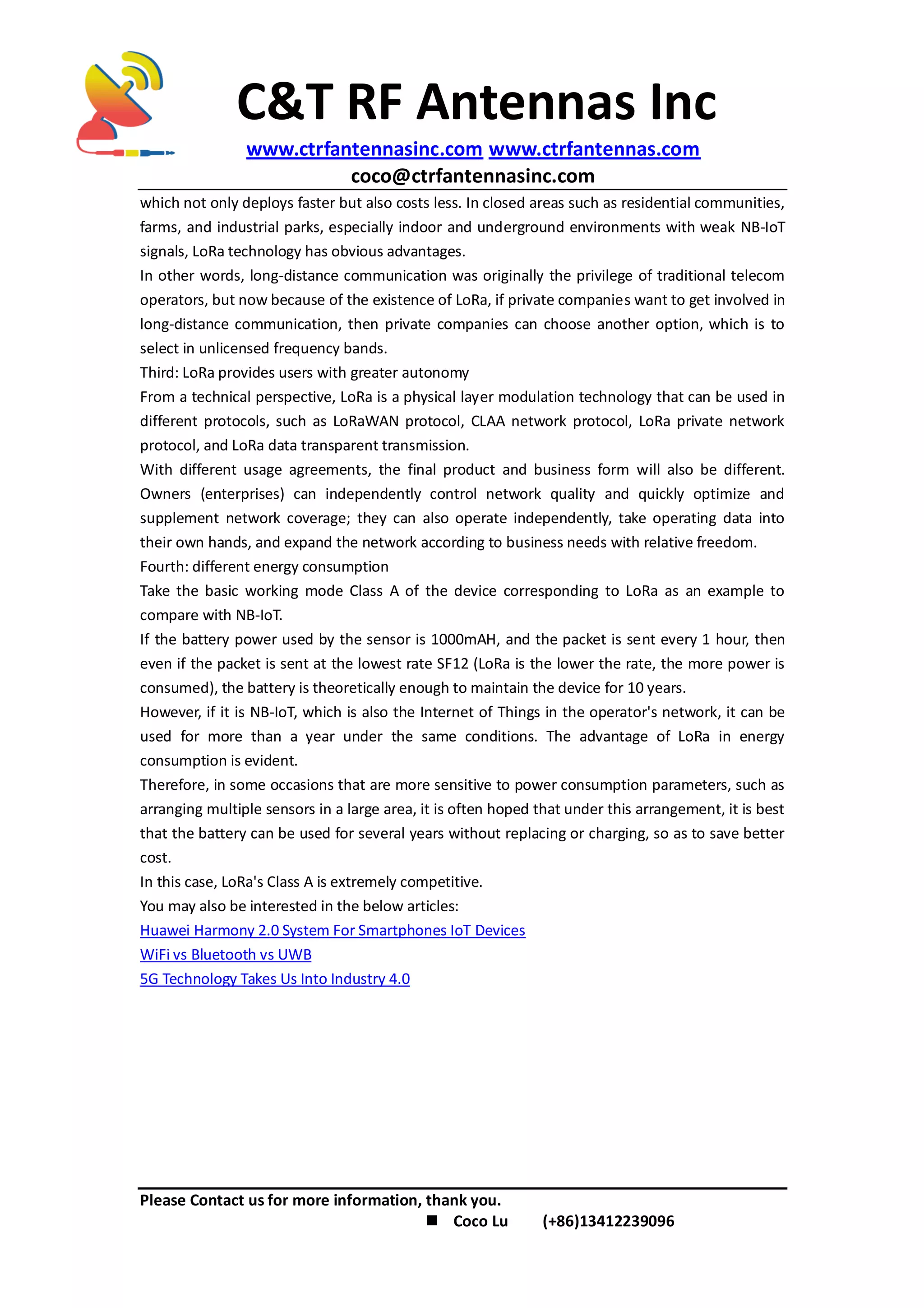
Lora and NB-IoT are both IoT technologies, but there are obvious differences between the two.
First: the two operating frequency bands are different
NB-IoT operates in an authorized frequency band. The so-called authorized frequency band is
officially authorized and authorized for use. Ordinary people cannot send signals within the
frequency range mentioned in this frequency band.
The three major domestic operators: China Telecom, China Mobile, and China Unicom have all set
foot in NB-IoT, and Huawei also participates in vigorous promotion in China.
Lora works in unlicensed frequency bands, and the main promoters are unofficial Internet
companies. For example:
Alibaba Cloud claims to connect 10 billion devices in the next five years, while Tencent is focusing
on investments in LoRaWANTM technology and applications.
Alibaba Cloud also proposed the integration requirements for the network management platform
of the Internet of Things platform products, so that different companies can adapt to the
platform requirements to produce products with matching specifications.
Second: The operator can master the data channel of NB-IoT and charge, while LoRa is an
independent network construction of the enterprise, and there is no need to pay the operator
NB-IoT can be modified on the basis of the communication base station itself, and the network
can be built with not too much workload. Then the operator can master this data channel to
charge.
But LoRa is different. Users can complete LoRa network deployment without relying on operators,
C&T RF Antennas Inc
www.ctrfantennasinc.com www.ctrfantennas.com
coco@ctrfantennasinc.com
Please Contact us for more information, thank you.
 Coco Lu (+86)13412239096
which not only deploys faster but also costs less. In closed areas such as residential communities,
farms, and industrial parks, especially indoor and underground environments with weak NB-IoT
signals, LoRa technology has obvious advantages.
In other words, long-distance communication was originally the privilege of traditional telecom
operators, but now because of the existence of LoRa, if private companies want to get involved in
long-distance communication, then private companies can choose another option, which is to
select in unlicensed frequency bands.
Third: LoRa provides users with greater autonomy
From a technical perspective, LoRa is a physical layer modulation technology that can be used in
different protocols, such as LoRaWAN protocol, CLAA network protocol, LoRa private network
protocol, and LoRa data transparent transmission.
With different usage agreements, the final product and business form will also be different.
Owners (enterprises) can independently control network quality and quickly optimize and
supplement network coverage; they can also operate independently, take operating data into
their own hands, and expand the network according to business needs with relative freedom.
Fourth: different energy consumption
Take the basic working mode Class A of the device corresponding to LoRa as an example to
compare with NB-IoT.
If the battery power used by the sensor is 1000mAH, and the packet is sent every 1 hour, then
even if the packet is sent at the lowest rate SF12 (LoRa is the lower the rate, the more power is
consumed), the battery is theoretically enough to maintain the device for 10 years.
However, if it is NB-IoT, which is also the Internet of Things in the operator's network, it can be
used for more than a year under the same conditions. The advantage of LoRa in energy
consumption is evident.
Therefore, in some occasions that are more sensitive to power consumption parameters, such as
arranging multiple sensors in a large area, it is often hoped that under this arrangement, it is best
that the battery can be used for several years without replacing or charging, so as to save better
cost.
In this case, LoRa's Class A is extremely competitive.
You may also be interested in the below articles:
Huawei Harmony 2.0 System For Smartphones IoT Devices
WiFi vs Bluetooth vs UWB
5G Technology Takes Us Into Industry 4.0

Lora vs NB-IoT

  • 1.
    C&T RF AntennasInc www.ctrfantennasinc.com www.ctrfantennas.com coco@ctrfantennasinc.com Please Contact us for more information, thank you.  Coco Lu (+86)13412239096 Lora VS NB-IoT Lora and NB-IoT are both IoT technologies, but there are obvious differences between the two. First: the two operating frequency bands are different NB-IoT operates in an authorized frequency band. The so-called authorized frequency band is officially authorized and authorized for use. Ordinary people cannot send signals within the frequency range mentioned in this frequency band. The three major domestic operators: China Telecom, China Mobile, and China Unicom have all set foot in NB-IoT, and Huawei also participates in vigorous promotion in China. Lora works in unlicensed frequency bands, and the main promoters are unofficial Internet companies. For example: Alibaba Cloud claims to connect 10 billion devices in the next five years, while Tencent is focusing on investments in LoRaWANTM technology and applications. Alibaba Cloud also proposed the integration requirements for the network management platform of the Internet of Things platform products, so that different companies can adapt to the platform requirements to produce products with matching specifications. Second: The operator can master the data channel of NB-IoT and charge, while LoRa is an independent network construction of the enterprise, and there is no need to pay the operator NB-IoT can be modified on the basis of the communication base station itself, and the network can be built with not too much workload. Then the operator can master this data channel to charge. But LoRa is different. Users can complete LoRa network deployment without relying on operators,
  • 2.
    C&T RF AntennasInc www.ctrfantennasinc.com www.ctrfantennas.com coco@ctrfantennasinc.com Please Contact us for more information, thank you.  Coco Lu (+86)13412239096 which not only deploys faster but also costs less. In closed areas such as residential communities, farms, and industrial parks, especially indoor and underground environments with weak NB-IoT signals, LoRa technology has obvious advantages. In other words, long-distance communication was originally the privilege of traditional telecom operators, but now because of the existence of LoRa, if private companies want to get involved in long-distance communication, then private companies can choose another option, which is to select in unlicensed frequency bands. Third: LoRa provides users with greater autonomy From a technical perspective, LoRa is a physical layer modulation technology that can be used in different protocols, such as LoRaWAN protocol, CLAA network protocol, LoRa private network protocol, and LoRa data transparent transmission. With different usage agreements, the final product and business form will also be different. Owners (enterprises) can independently control network quality and quickly optimize and supplement network coverage; they can also operate independently, take operating data into their own hands, and expand the network according to business needs with relative freedom. Fourth: different energy consumption Take the basic working mode Class A of the device corresponding to LoRa as an example to compare with NB-IoT. If the battery power used by the sensor is 1000mAH, and the packet is sent every 1 hour, then even if the packet is sent at the lowest rate SF12 (LoRa is the lower the rate, the more power is consumed), the battery is theoretically enough to maintain the device for 10 years. However, if it is NB-IoT, which is also the Internet of Things in the operator's network, it can be used for more than a year under the same conditions. The advantage of LoRa in energy consumption is evident. Therefore, in some occasions that are more sensitive to power consumption parameters, such as arranging multiple sensors in a large area, it is often hoped that under this arrangement, it is best that the battery can be used for several years without replacing or charging, so as to save better cost. In this case, LoRa's Class A is extremely competitive. You may also be interested in the below articles: Huawei Harmony 2.0 System For Smartphones IoT Devices WiFi vs Bluetooth vs UWB 5G Technology Takes Us Into Industry 4.0