Latest news
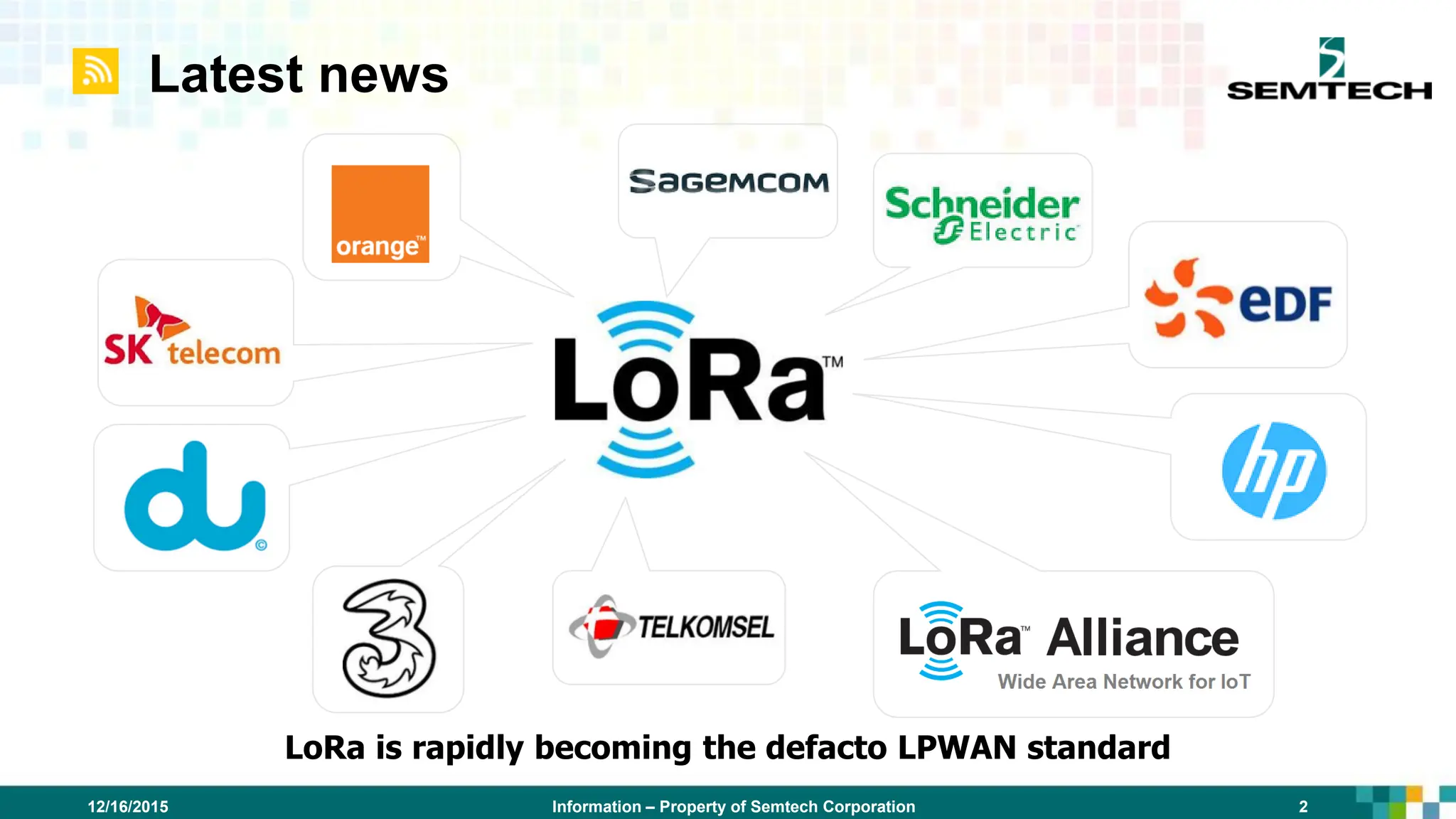
LoRa israpidly becoming the defacto LPWAN standard
Information – Property of Semtech Corporation 2
12/16/2015
3.
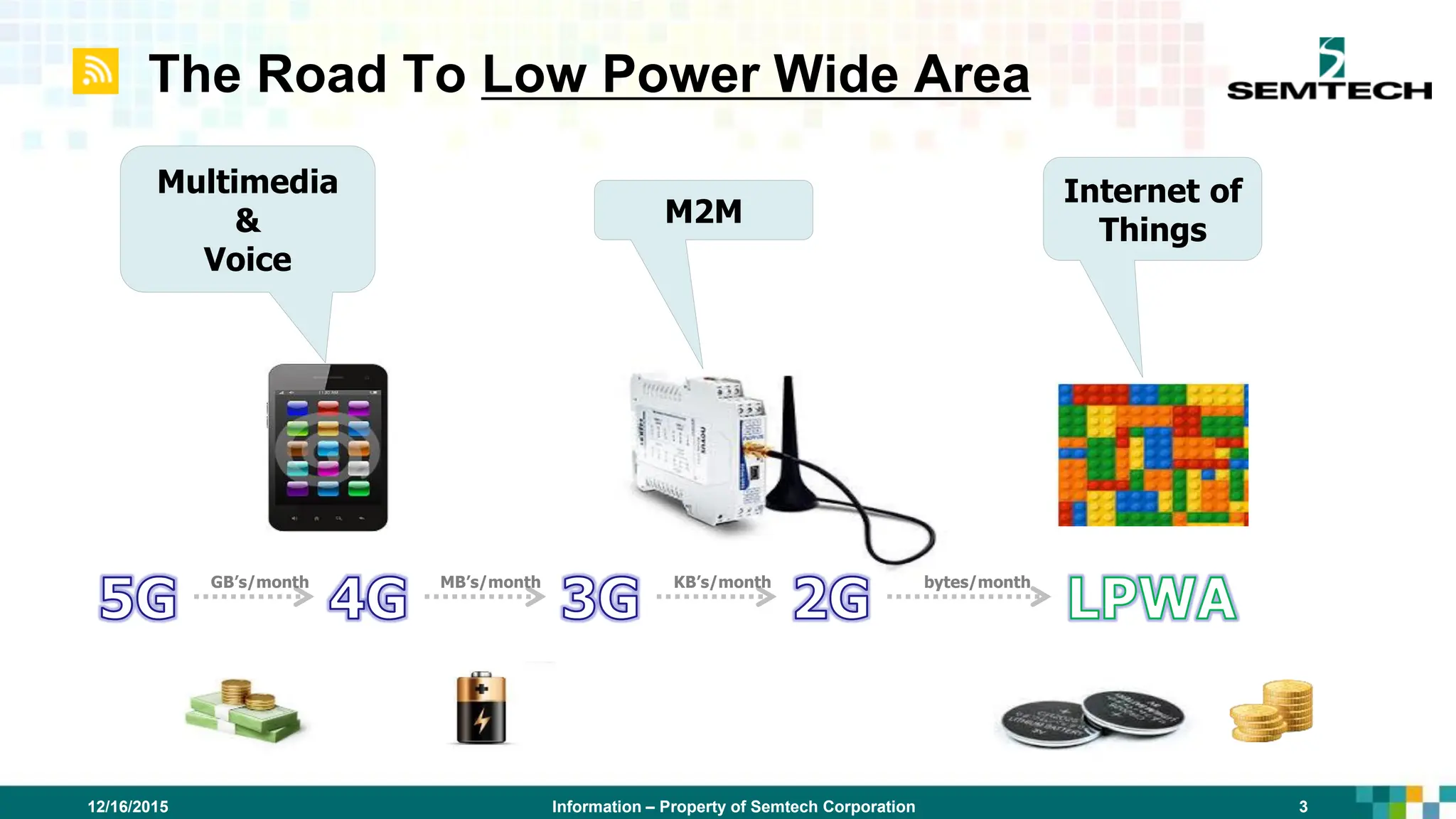
The Road ToLow Power Wide Area
Multimedia
&
Voice
M2M
Internet of
Things
GB’s/month MB’s/month KB’s/month bytes/month
Information – Property of Semtech Corporation 3
12/16/2015
4.
Information – Propertyof Semtech Corporation 4
12/16/2015
Where Does LPWAN Fit
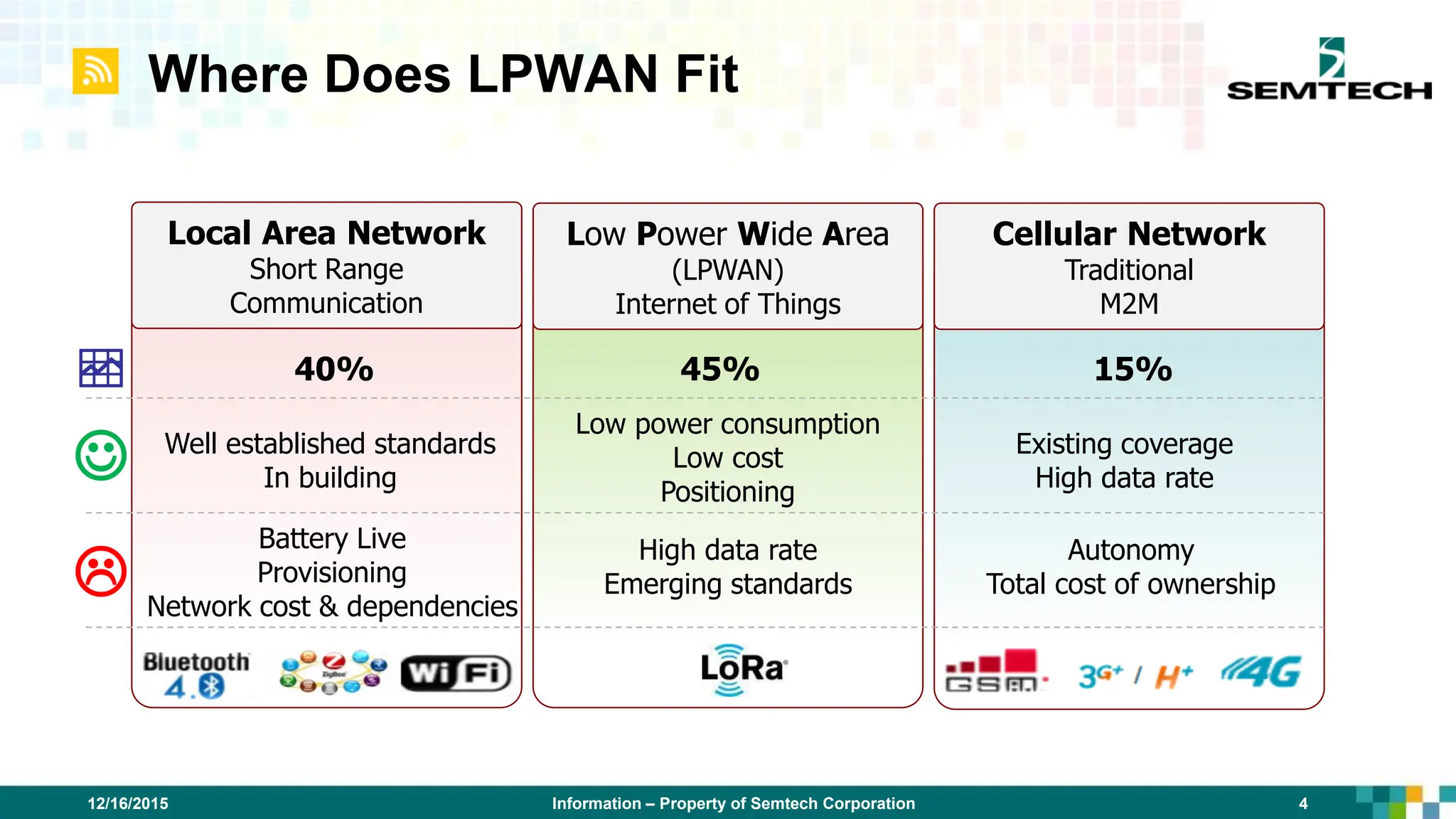
Local Area Network
Short Range
Communication
Low Power Wide Area
(LPWAN)
Internet of Things
Cellular Network
Traditional
M2M
40% 45% 15%
Battery Live
Provisioning
Network cost & dependencies
Well established standards
In building
Low power consumption
Low cost
Positioning
Existing coverage
High data rate
Autonomy
Total cost of ownership
High data rate
Emerging standards
5.
LoRa®
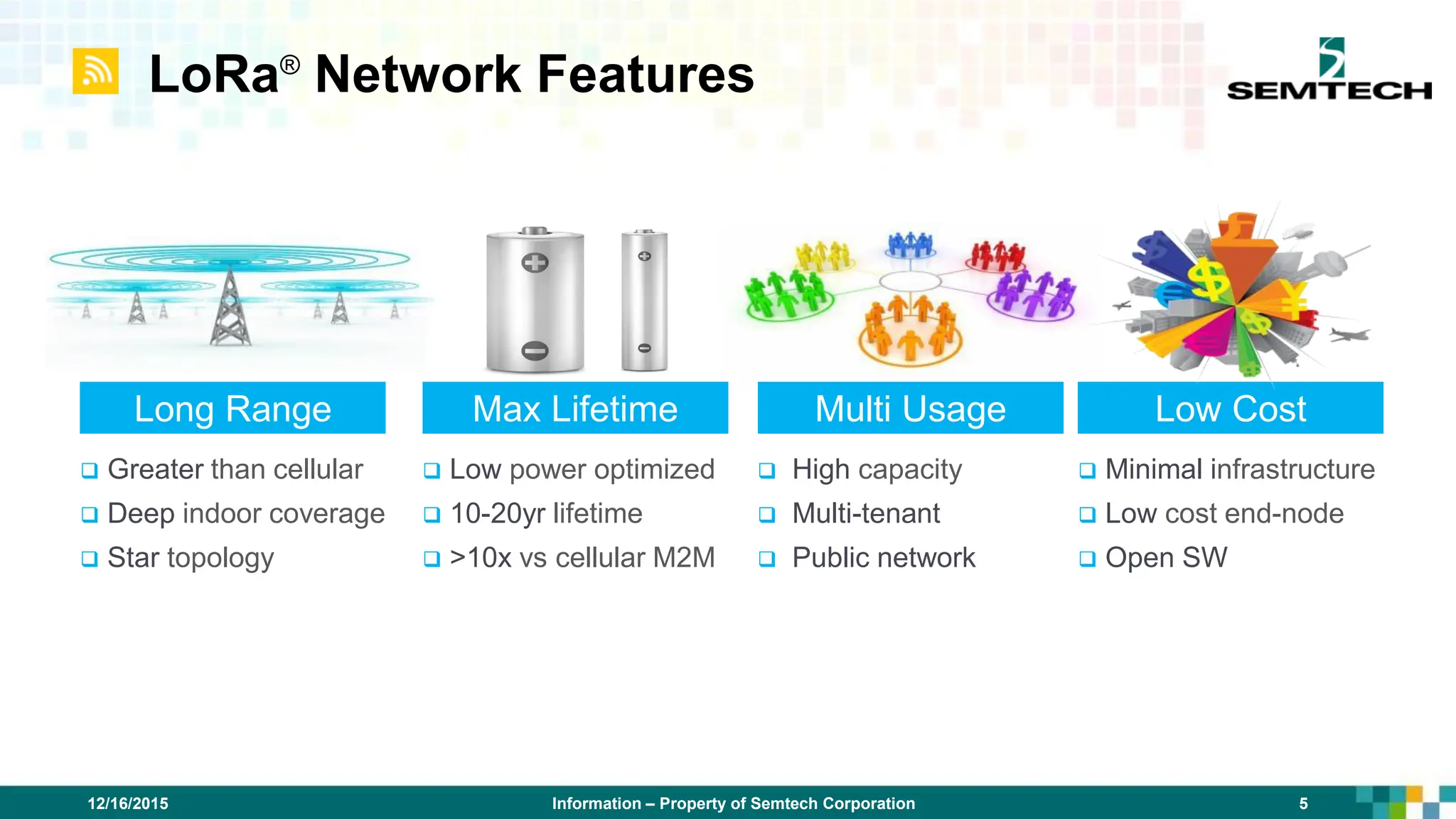
Network Features
Long RangeMax Lifetime Multi Usage Low Cost
Minimal infrastructure
Low cost end-node
Open SW
Greater than cellular
Deep indoor coverage
Star topology
Low power optimized
10-20yr lifetime
>10x vs cellular M2M
High capacity
Multi-tenant
Public network
Information – Property of Semtech Corporation 5
12/16/2015
6.
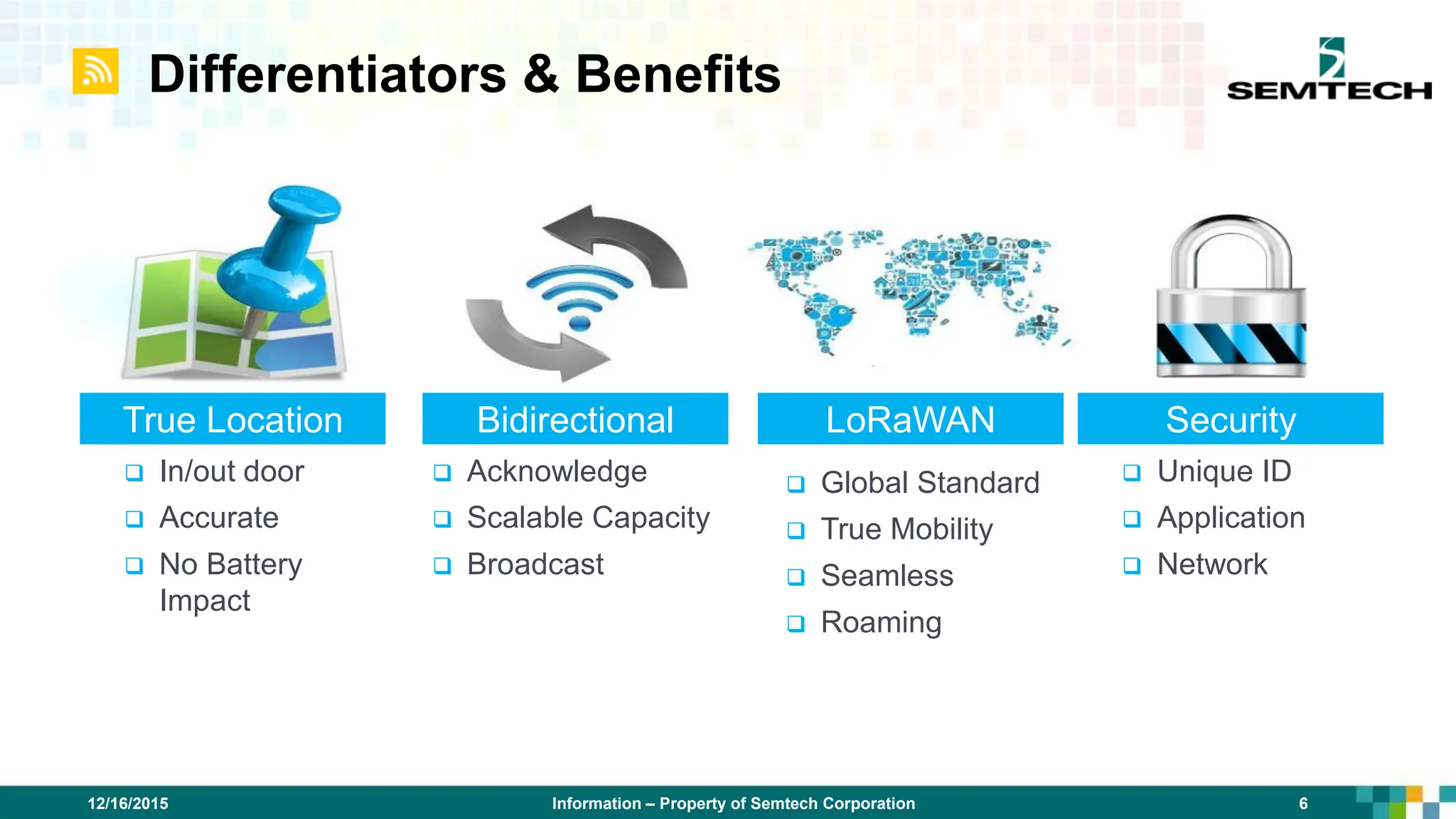
Differentiators & Benefits
TrueLocation Bidirectional LoRaWAN Security
In/out door
Accurate
No Battery
Impact
Acknowledge
Scalable Capacity
Broadcast
Global Standard
True Mobility
Seamless
Roaming
Unique ID
Application
Network
12/16/2015 Information – Property of Semtech Corporation 6
7.
Information – Propertyof Semtech Corporation 7
12/16/2015
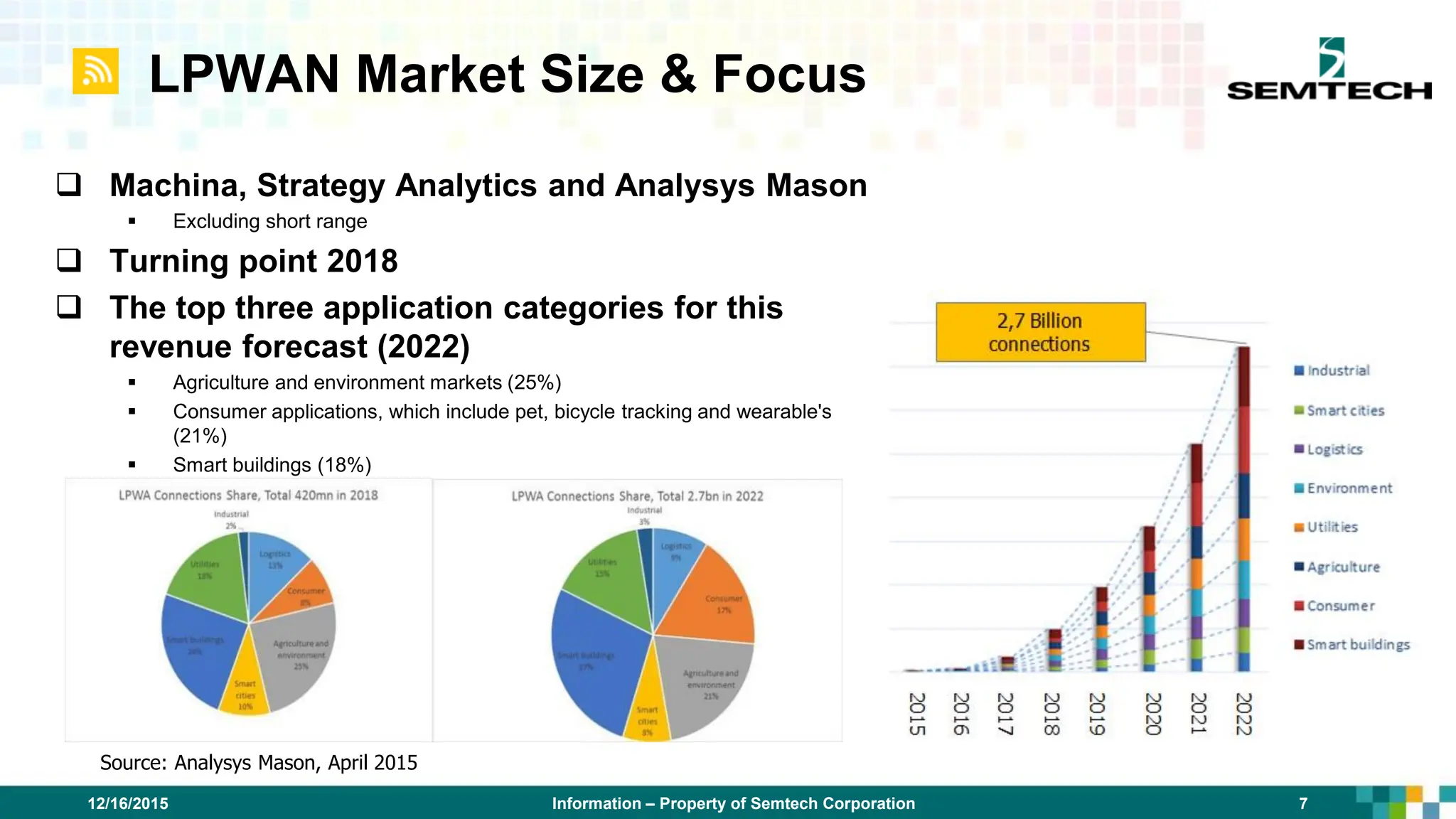
LPWAN Market Size & Focus
Machina, Strategy Analytics and Analysys Mason
Excluding short range
Turning point 2018
The top three application categories for this
revenue forecast (2022)
Agriculture and environment markets (25%)
Consumer applications, which include pet, bicycle tracking and wearable's
(21%)
Smart buildings (18%)
Source: Analysys Mason, April 2015
Information – Propertyof Semtech Corporation 10
12/16/2015
Examples
Agriculture
Smart Building
Supply Chain
11.
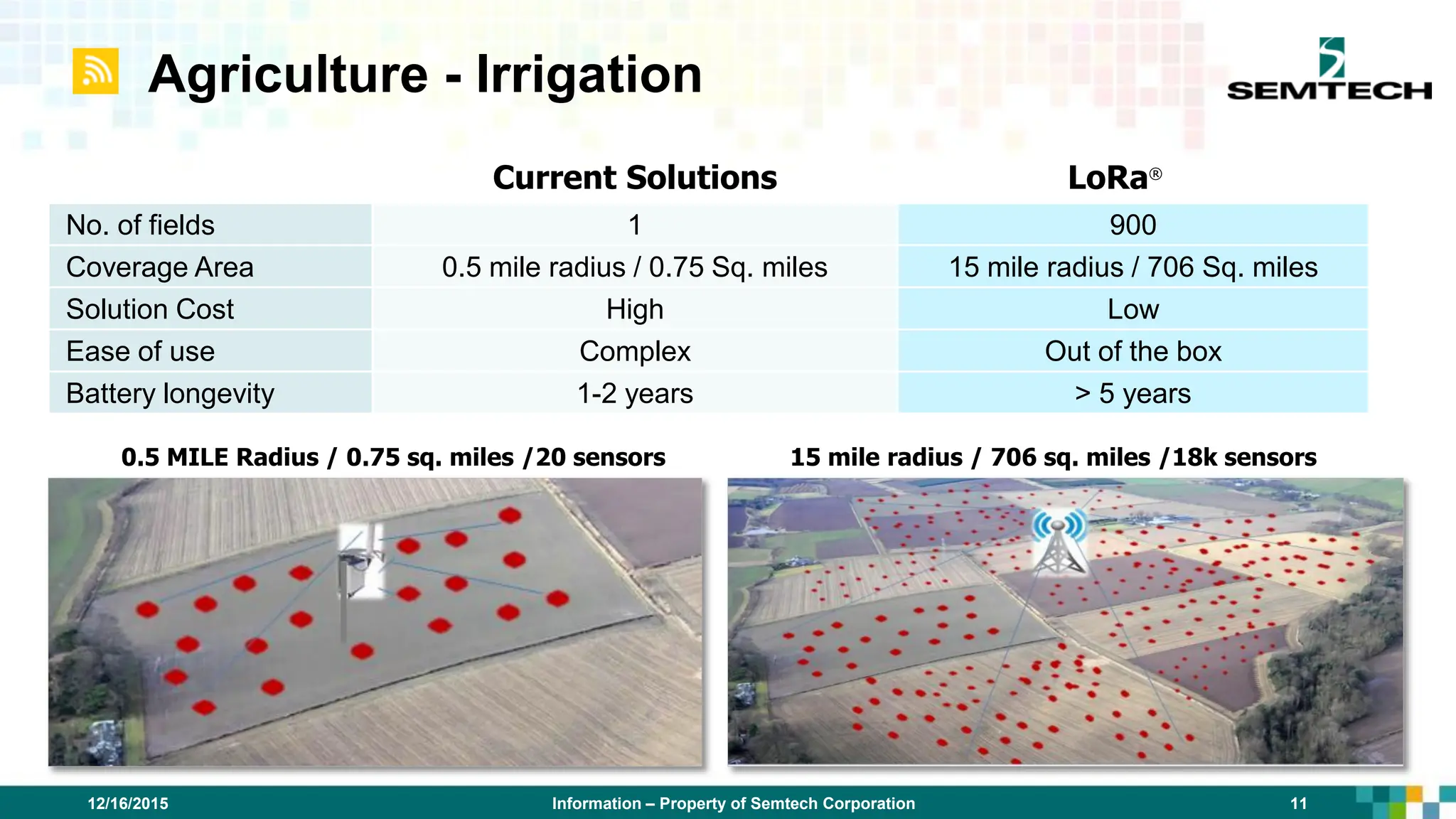
Agriculture - Irrigation
0.5MILE Radius / 0.75 sq. miles /20 sensors 15 mile radius / 706 sq. miles /18k sensors
No. of fields 1 900
Coverage Area 0.5 mile radius / 0.75 Sq. miles 15 mile radius / 706 Sq. miles
Solution Cost High Low
Ease of use Complex Out of the box
Battery longevity 1-2 years > 5 years
Current Solutions LoRa®
Information – Property of Semtech Corporation 11
12/16/2015
12.
Information – Propertyof Semtech Corporation 12
12/16/2015
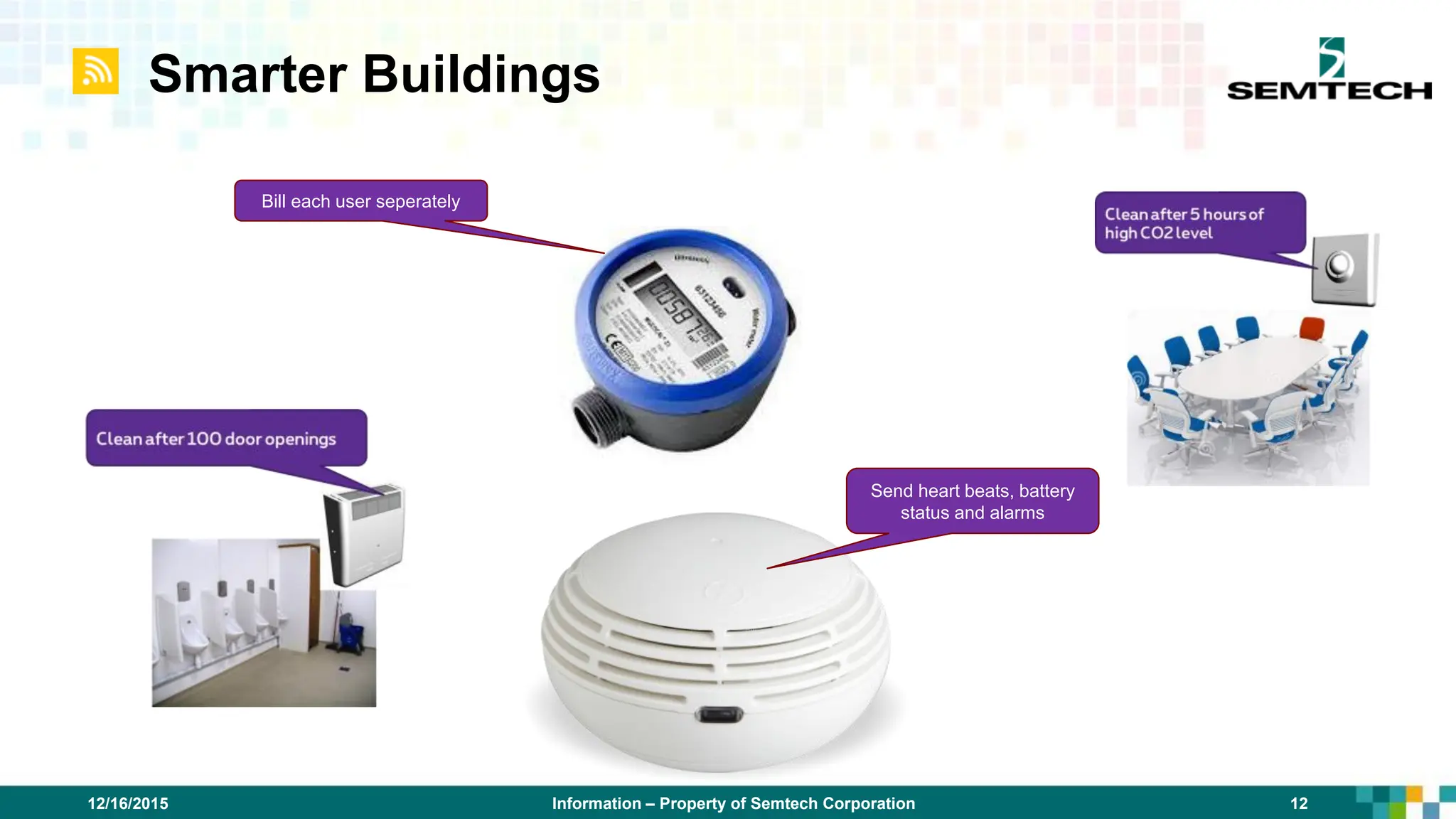
Smarter Buildings
Bill each user seperately
Send heart beats, battery
status and alarms
13.
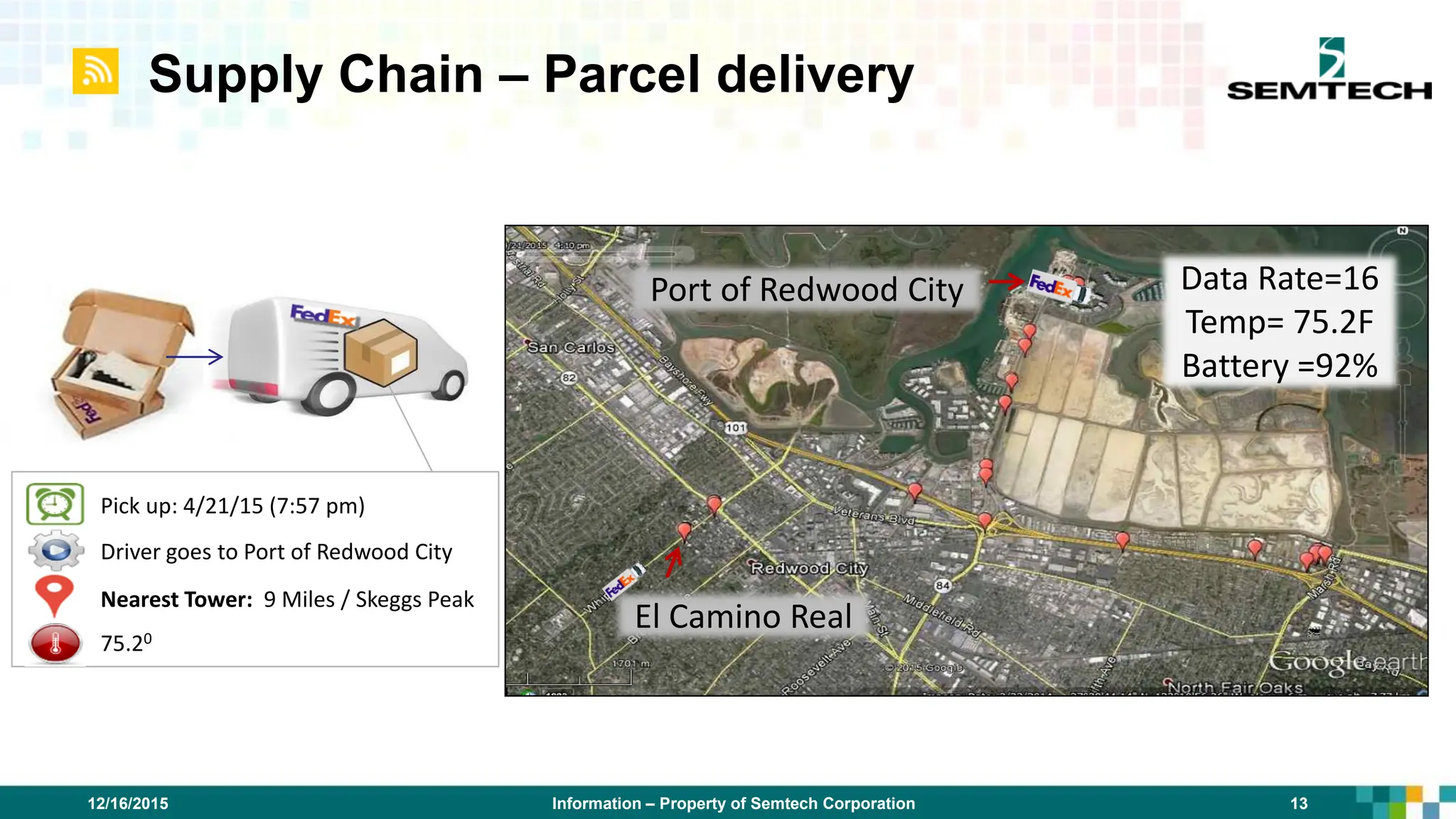
Supply Chain –Parcel delivery
Data Rate=16
Temp= 75.2F
Battery =92%
El Camino Real
Port of Redwood City
Driver goes to Port of Redwood City
Pick up: 4/21/15 (7:57 pm)
Nearest Tower: 9 Miles / Skeggs Peak
75.20
Information – Property of Semtech Corporation 13
12/16/2015
Information – Propertyof Semtech Corporation 16
12/16/2015
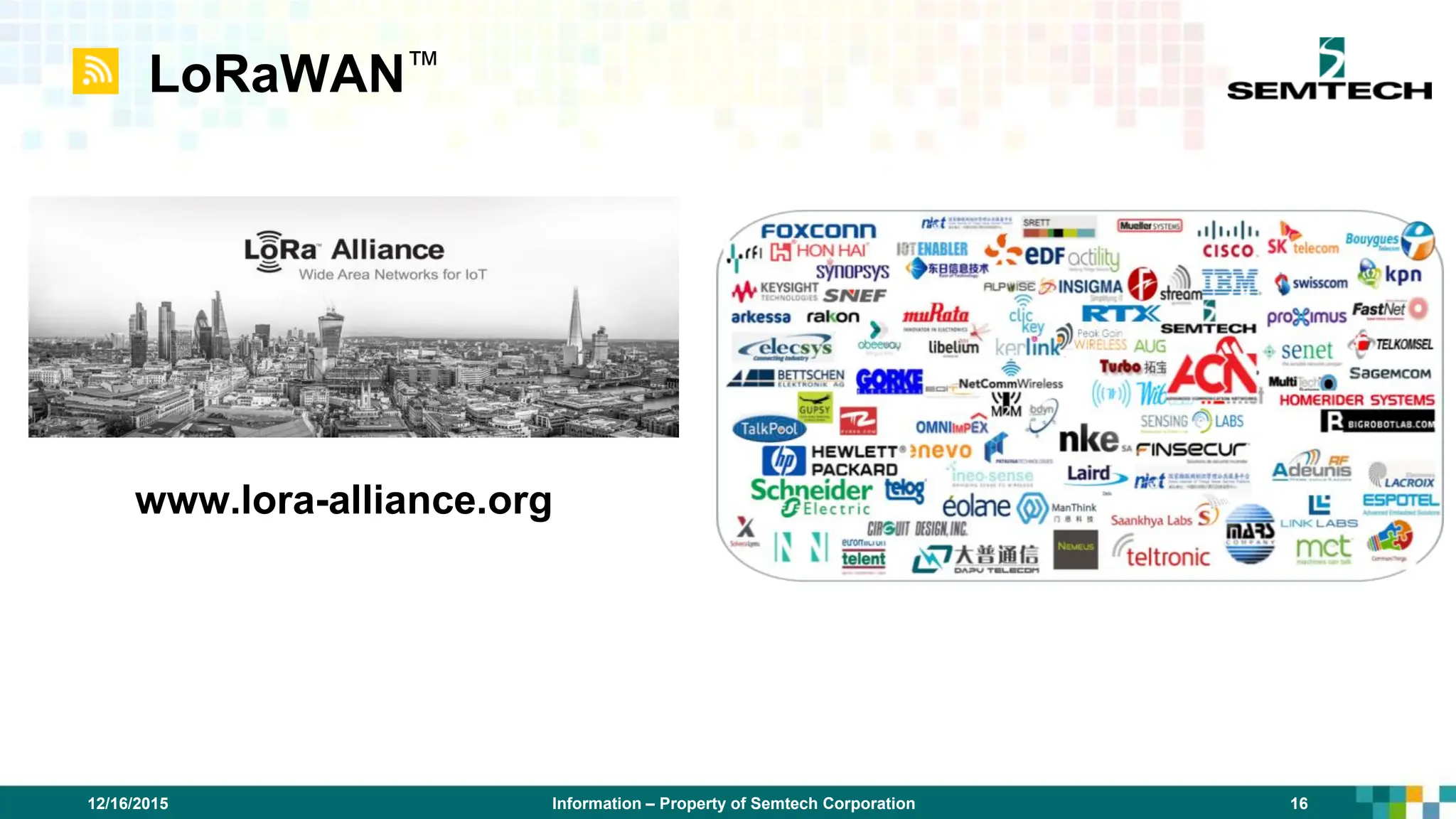
LoRaWAN™
www.lora-alliance.org
17.
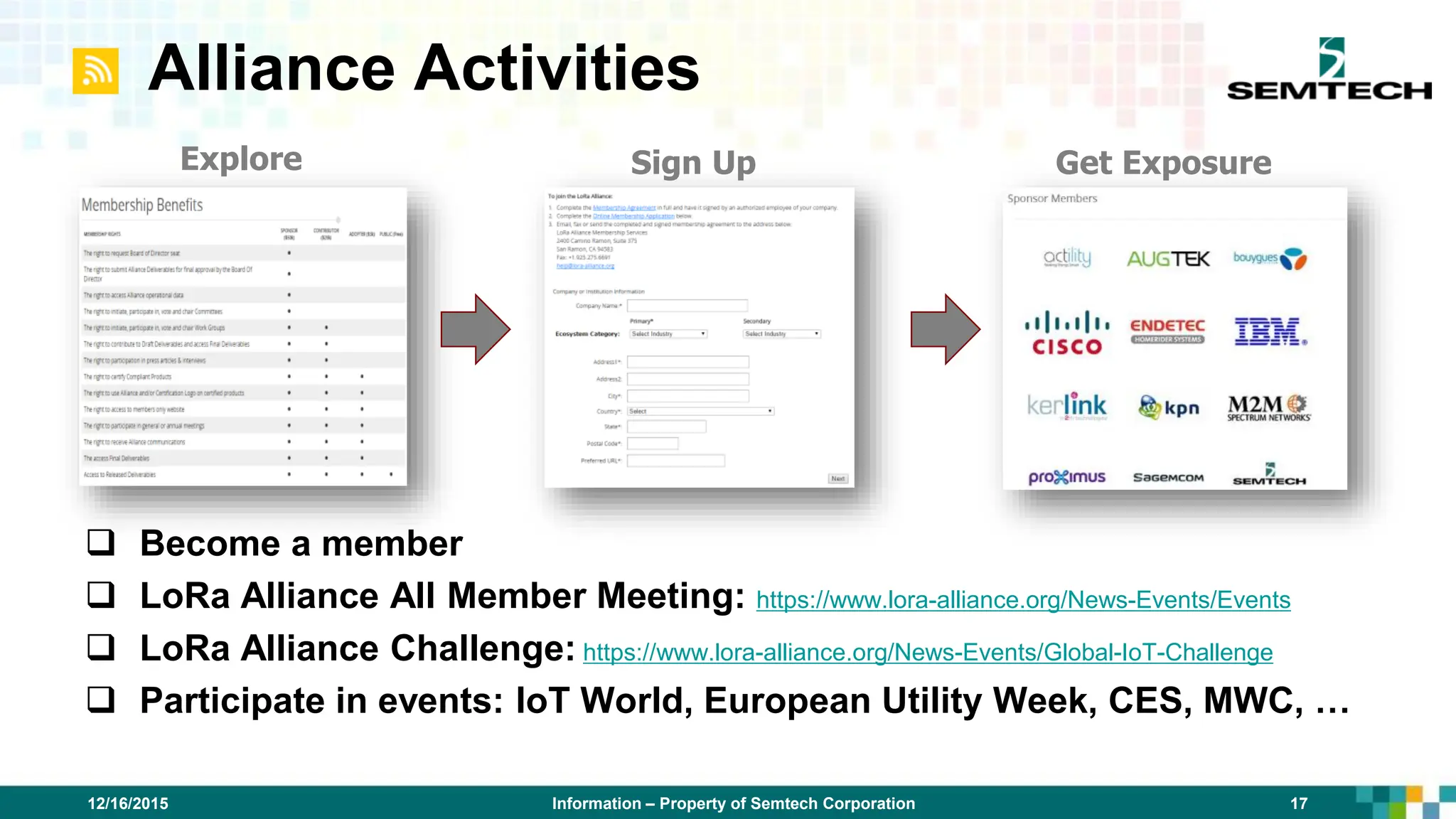
Alliance Activities
Becomea member
LoRa Alliance All Member Meeting: https://www.lora-alliance.org/News-Events/Events
LoRa Alliance Challenge: https://www.lora-alliance.org/News-Events/Global-IoT-Challenge
Participate in events: IoT World, European Utility Week, CES, MWC, …
12/16/2015 Information – Property of Semtech Corporation 17
Explore Sign Up Get Exposure
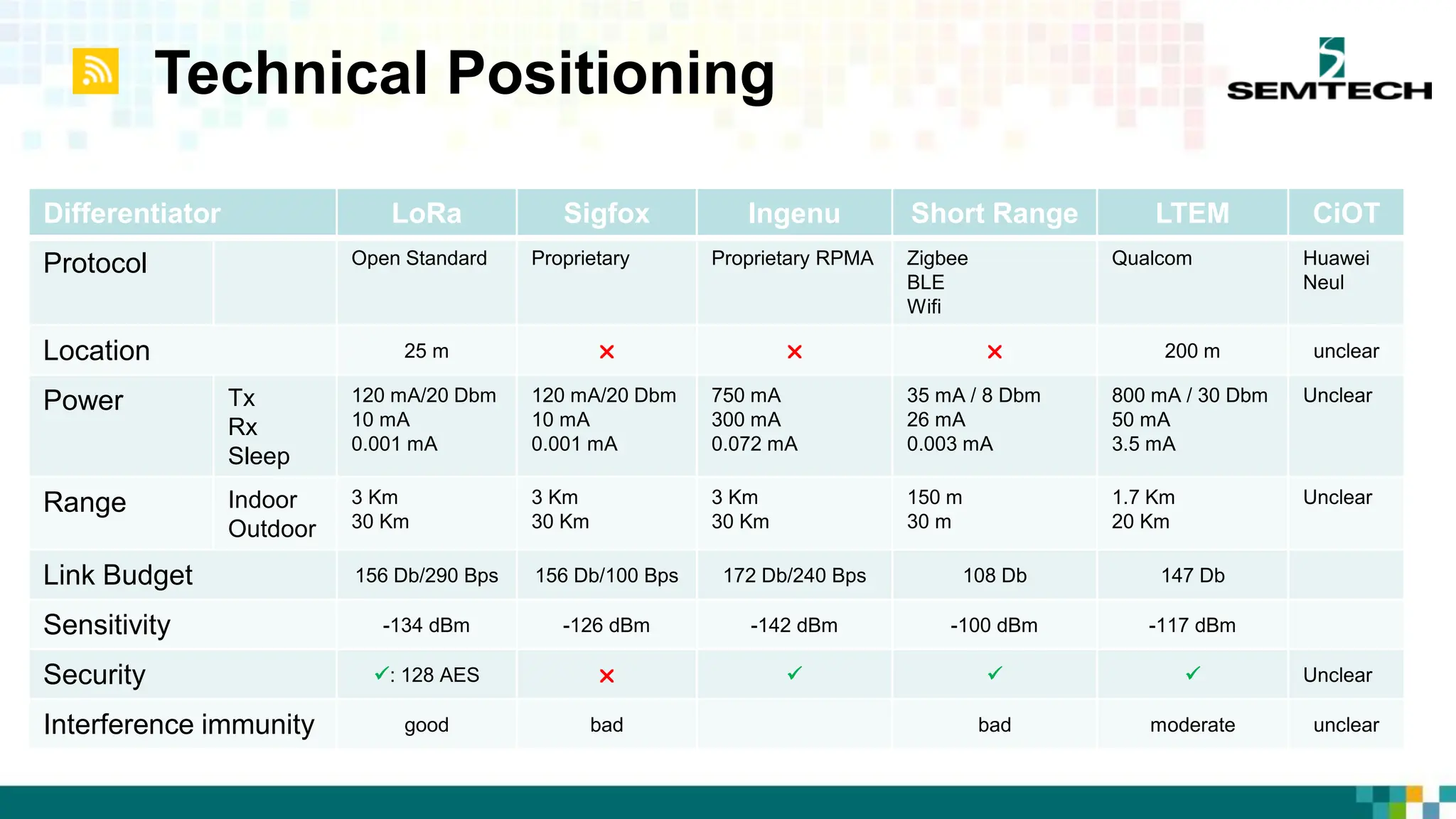
Technical Positioning
Differentiator LoRaSigfox Ingenu Short Range LTEM CiOT
Protocol Open Standard Proprietary Proprietary RPMA Zigbee
BLE
Wifi
Qualcom Huawei
Neul
Location 25 m 200 m unclear
Power Tx
Rx
Sleep
120 mA/20 Dbm
10 mA
0.001 mA
120 mA/20 Dbm
10 mA
0.001 mA
750 mA
300 mA
0.072 mA
35 mA / 8 Dbm
26 mA
0.003 mA
800 mA / 30 Dbm
50 mA
3.5 mA
Unclear
Range Indoor
Outdoor
3 Km
30 Km
3 Km
30 Km
3 Km
30 Km
150 m
30 m
1.7 Km
20 Km
Unclear
Link Budget 156 Db/290 Bps 156 Db/100 Bps 172 Db/240 Bps 108 Db 147 Db
Sensitivity -134 dBm -126 dBm -142 dBm -100 dBm -117 dBm
Security : 128 AES Unclear
Interference immunity good bad bad moderate unclear
21.
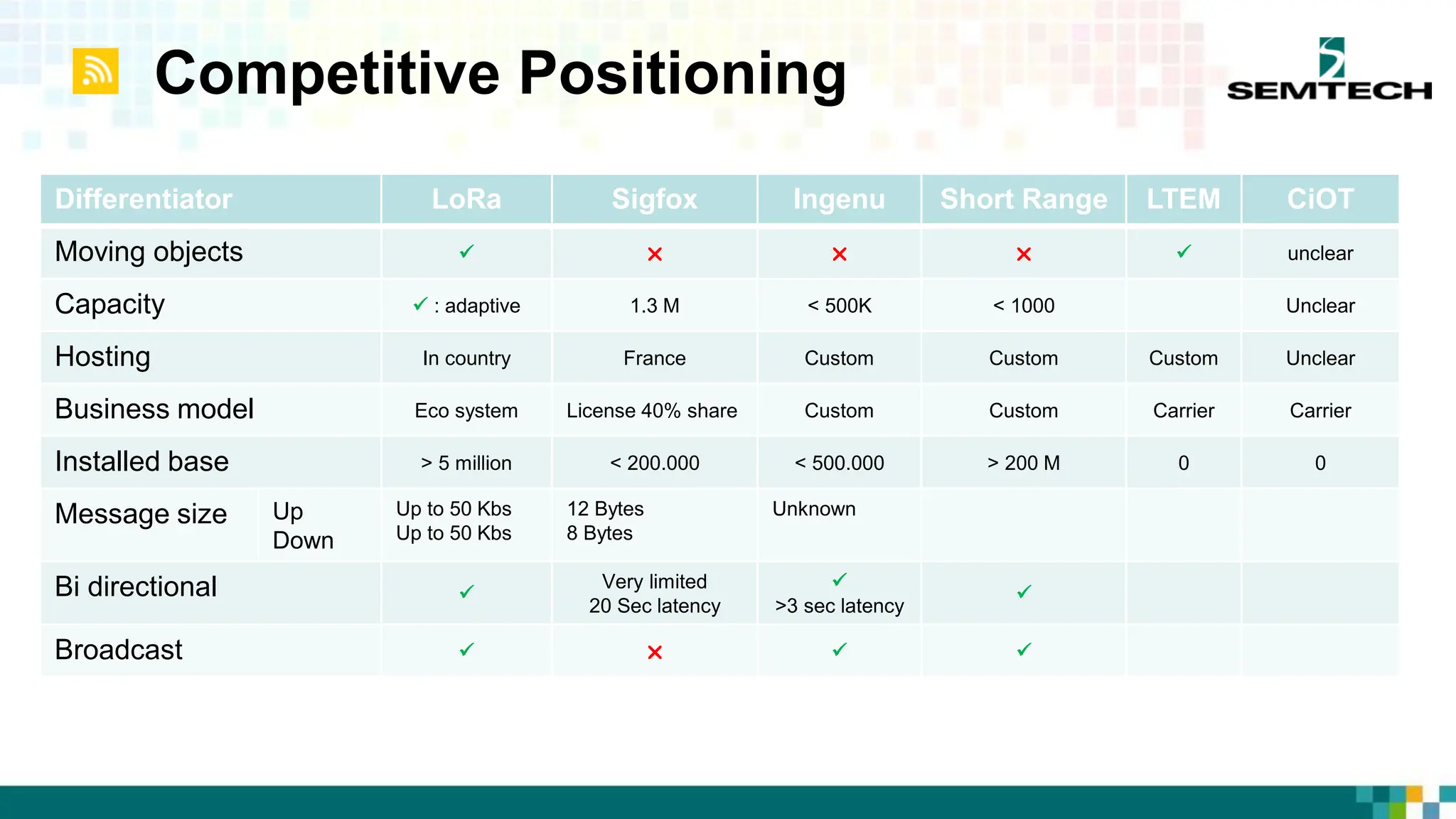
Competitive Positioning
Differentiator LoRaSigfox Ingenu Short Range LTEM CiOT
Moving objects unclear
Capacity : adaptive 1.3 M < 500K < 1000 Unclear
Hosting In country France Custom Custom Custom Unclear
Business model Eco system License 40% share Custom Custom Carrier Carrier
Installed base > 5 million < 200.000 < 500.000 > 200 M 0 0
Message size Up
Down
Up to 50 Kbs
Up to 50 Kbs
12 Bytes
8 Bytes
Unknown
Bi directional
Very limited
20 Sec latency
>3 sec latency
Broadcast
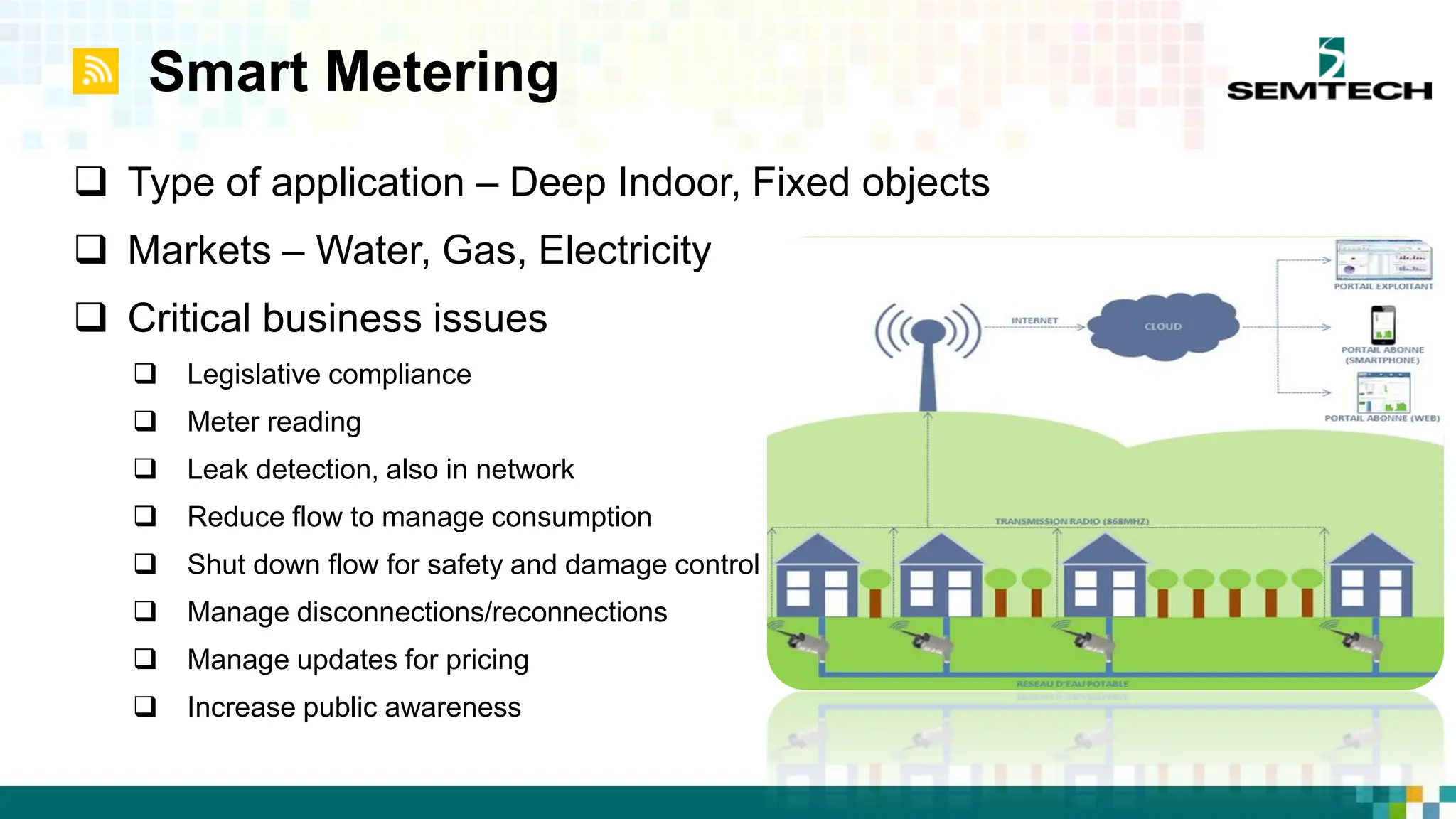
Smart Metering
Typeof application – Deep Indoor, Fixed objects
Markets – Water, Gas, Electricity
Critical business issues
Legislative compliance
Meter reading
Leak detection, also in network
Reduce flow to manage consumption
Shut down flow for safety and damage control
Manage disconnections/reconnections
Manage updates for pricing
Increase public awareness
24.
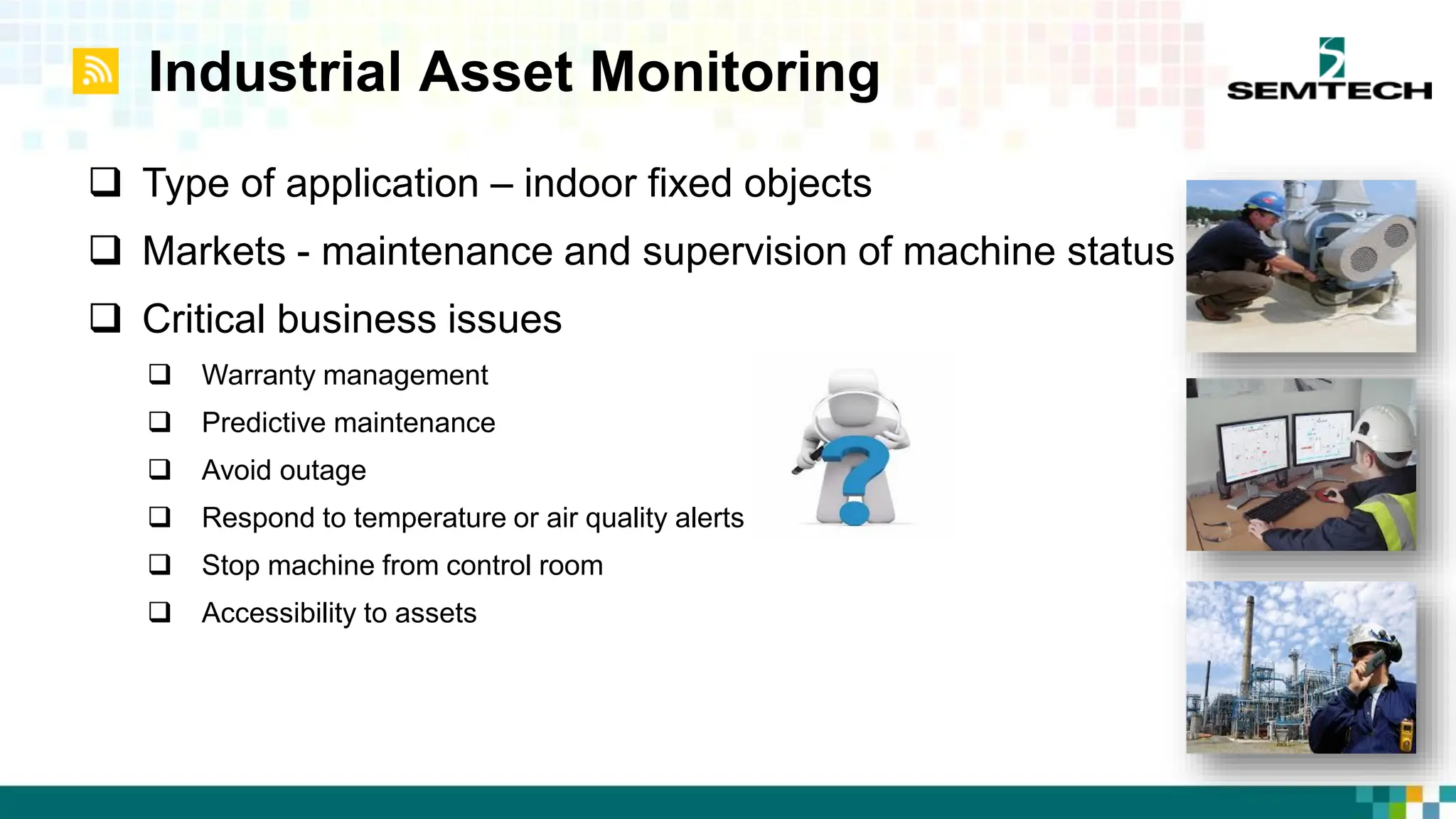
Industrial Asset Monitoring
Type of application – indoor fixed objects
Markets - maintenance and supervision of machine status
Critical business issues
Warranty management
Predictive maintenance
Avoid outage
Respond to temperature or air quality alerts
Stop machine from control room
Accessibility to assets
25.
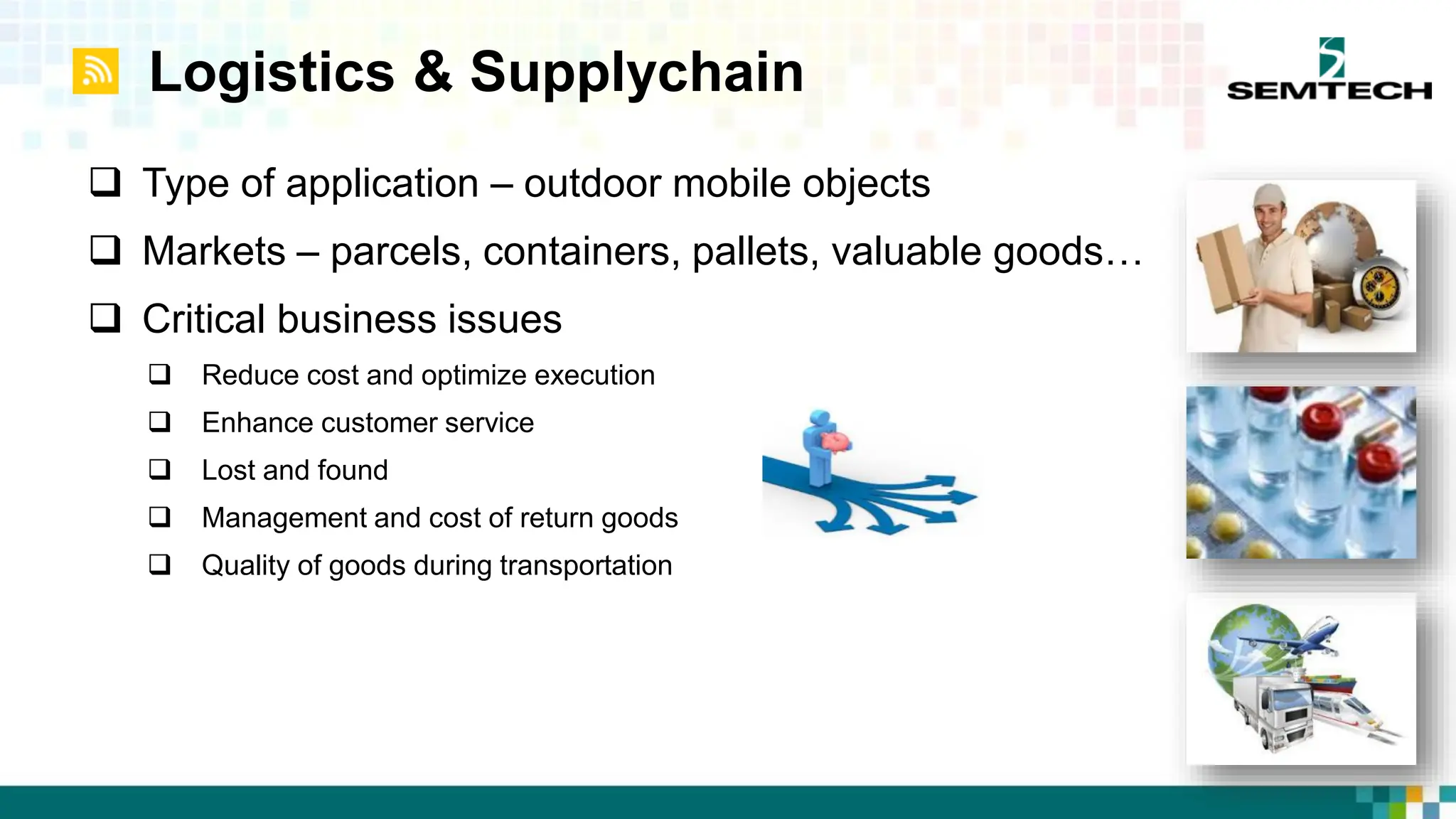
Logistics & Supplychain
Type of application – outdoor mobile objects
Markets – parcels, containers, pallets, valuable goods…
Critical business issues
Reduce cost and optimize execution
Enhance customer service
Lost and found
Management and cost of return goods
Quality of goods during transportation
26.
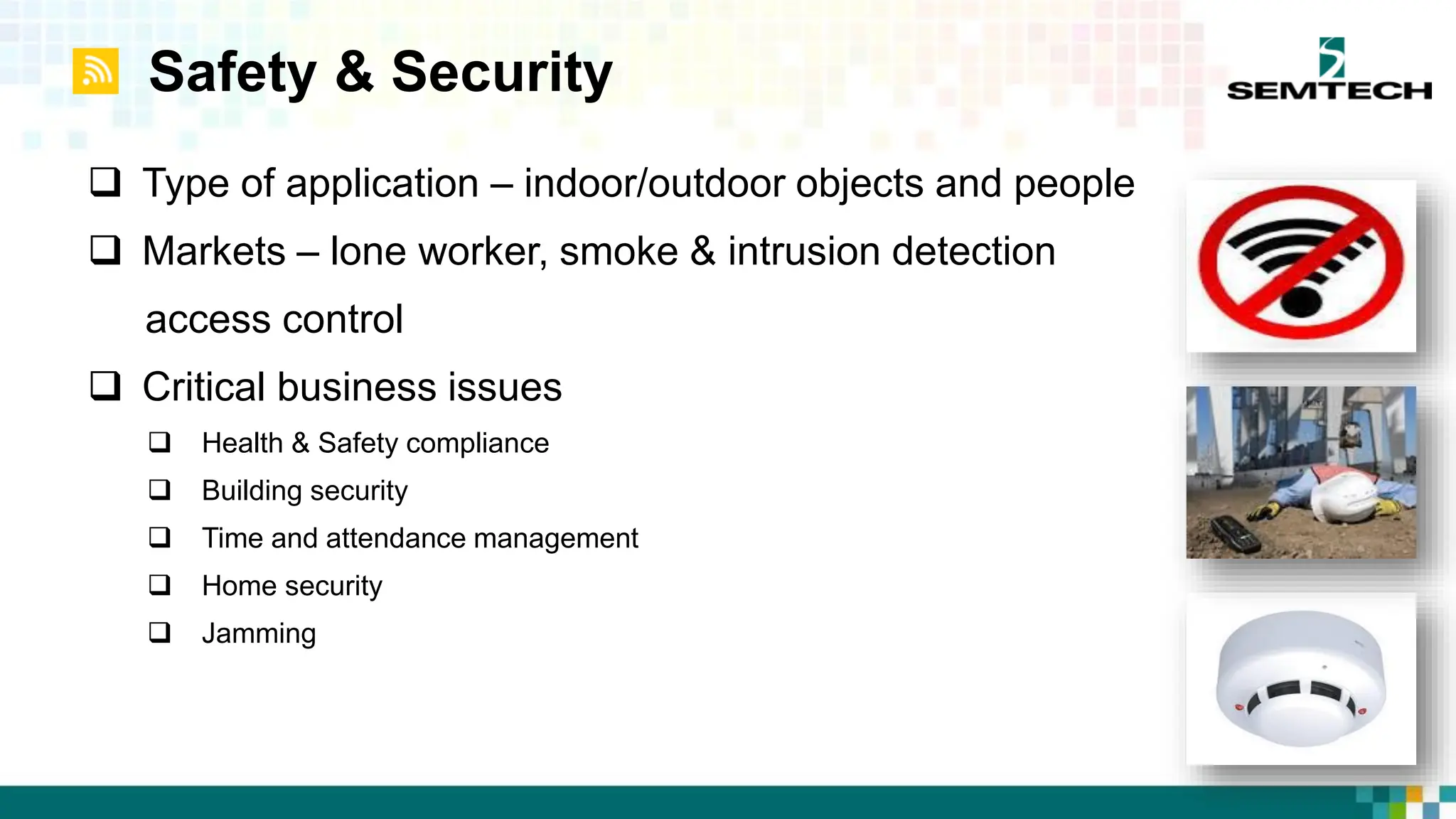
Safety & Security
Type of application – indoor/outdoor objects and people
Markets – lone worker, smoke & intrusion detection
access control
Critical business issues
Health & Safety compliance
Building security
Time and attendance management
Home security
Jamming
27.
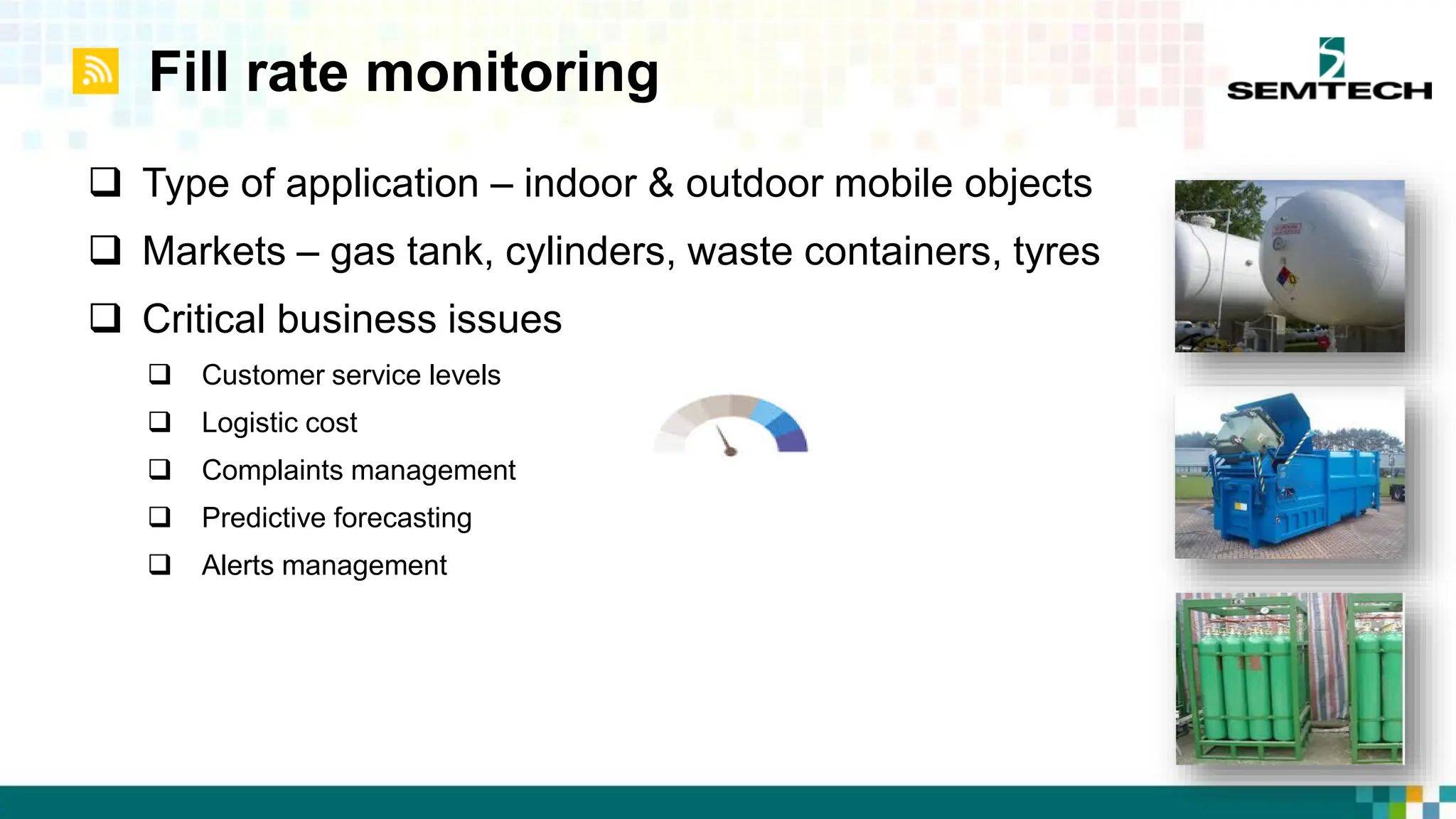
Fill rate monitoring
Type of application – indoor & outdoor mobile objects
Markets – gas tank, cylinders, waste containers, tyres
Critical business issues
Customer service levels
Logistic cost
Complaints management
Predictive forecasting
Alerts management
What is anLPWAN network
New enabling networks Low Power Wide Access Network
Low cost and small chipsets
Extreme low power consumption
Long range
Low throughput
LoRa by Semtech
Technology available to MNO’s and sensor/module manufacturers : radio technology based on
Direct Spread Spectrum for secure, bidirectional and flexible payload messages
Growing feature footprint for example to enable location determination
LoRa Alliance: Strategic non-profit partnership to drive optimal value
creation
Define and manage the LoRaWAN specification
Ensure inter-operability and standardization
Drive the development of a global eco system and strategic partnerships
31.
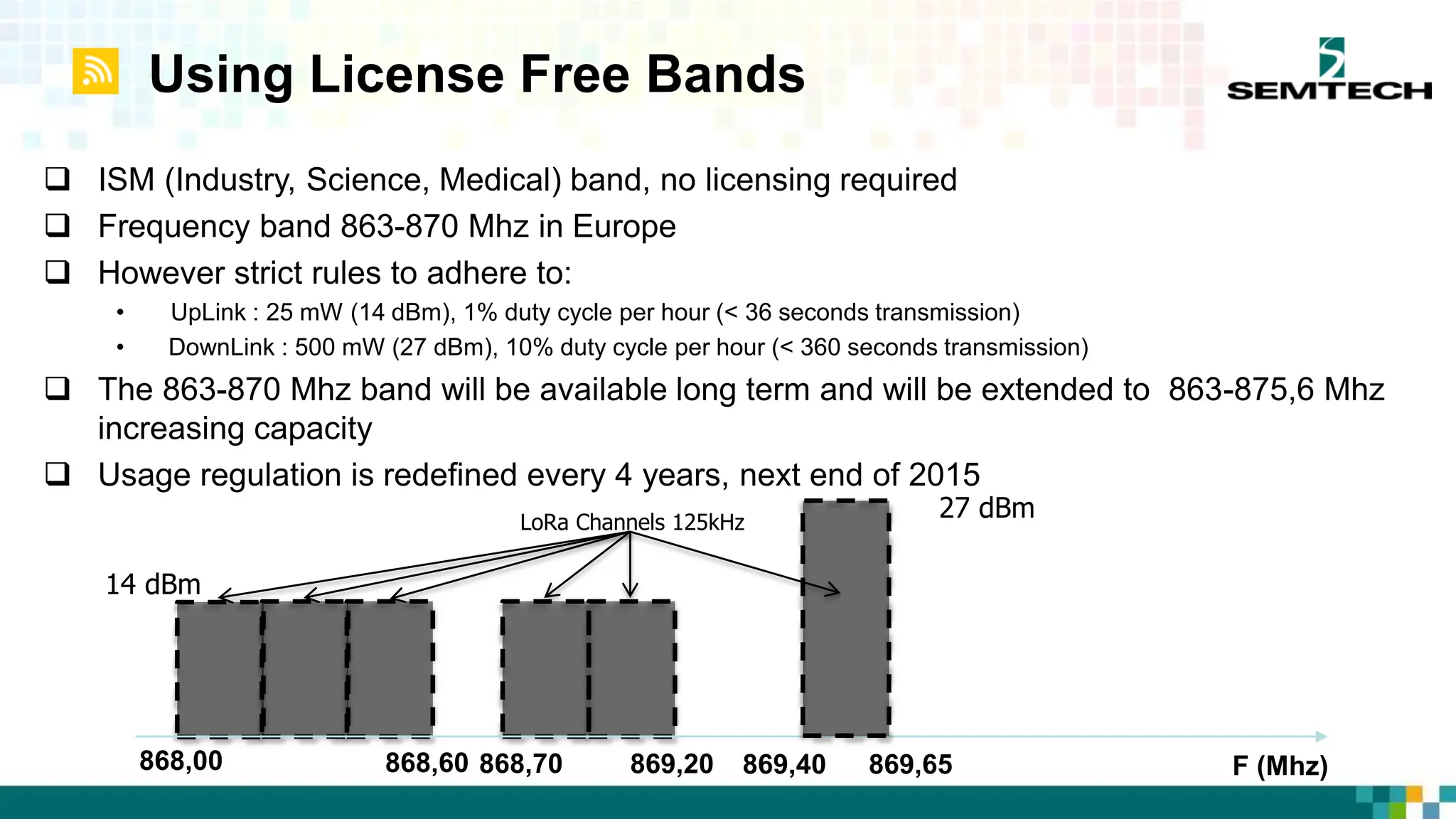
ISM (Industry,Science, Medical) band, no licensing required
Frequency band 863-870 Mhz in Europe
However strict rules to adhere to:
• UpLink : 25 mW (14 dBm), 1% duty cycle per hour (< 36 seconds transmission)
• DownLink : 500 mW (27 dBm), 10% duty cycle per hour (< 360 seconds transmission)
The 863-870 Mhz band will be available long term and will be extended to 863-875,6 Mhz
increasing capacity
Usage regulation is redefined every 4 years, next end of 2015
Using License Free Bands
LoRa Channels 125kHz
868,00 868,60 868,70 869,20 869,40 869,65 F (Mhz)
14 dBm
27 dBm
32.
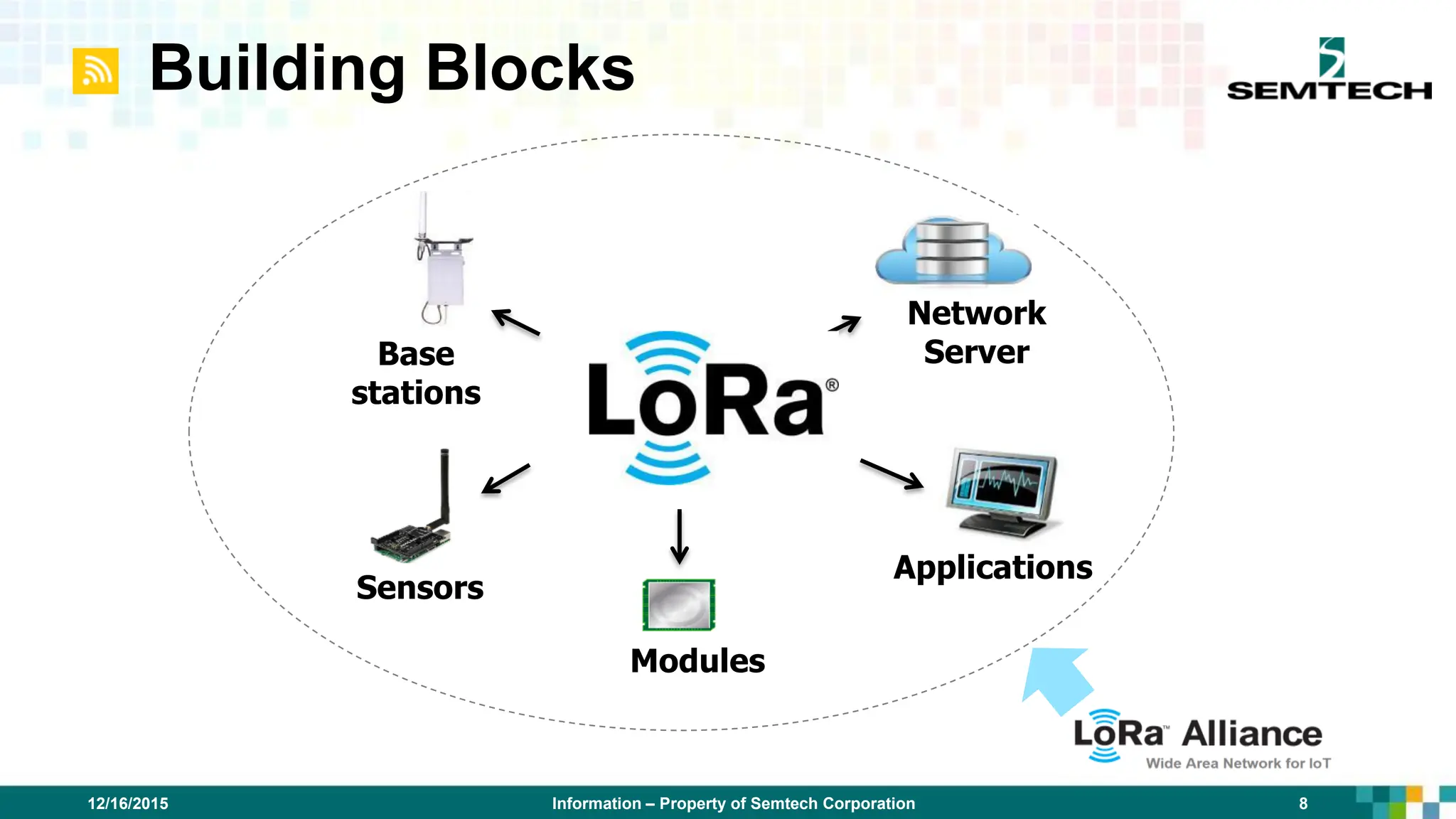
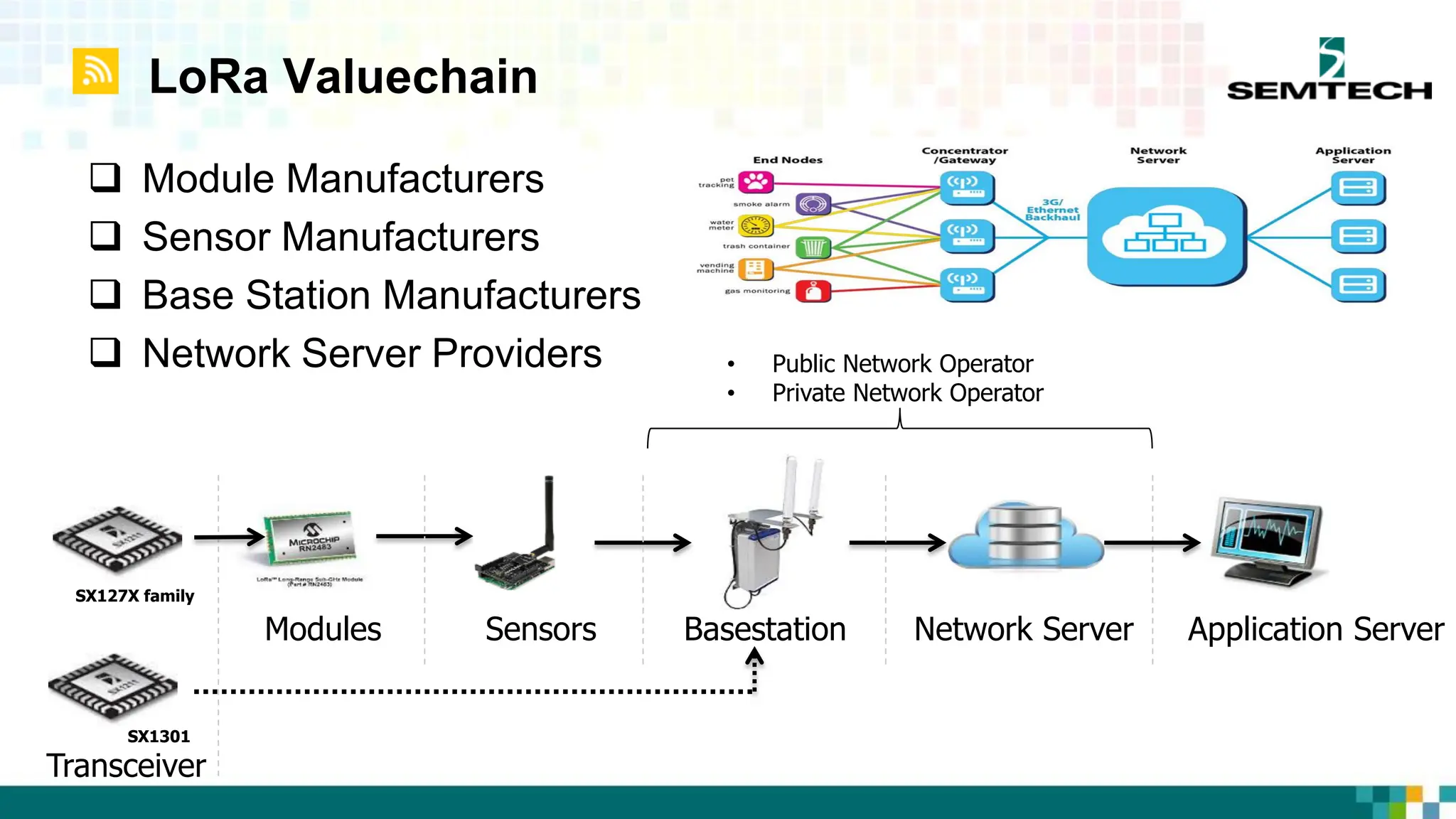
LoRa Valuechain
ModuleManufacturers
Sensor Manufacturers
Base Station Manufacturers
Network Server Providers
Transceiver
Network Server Application Server
SX127X family
Sensors
Modules Basestation
SX1301
• Public Network Operator
• Private Network Operator
33.
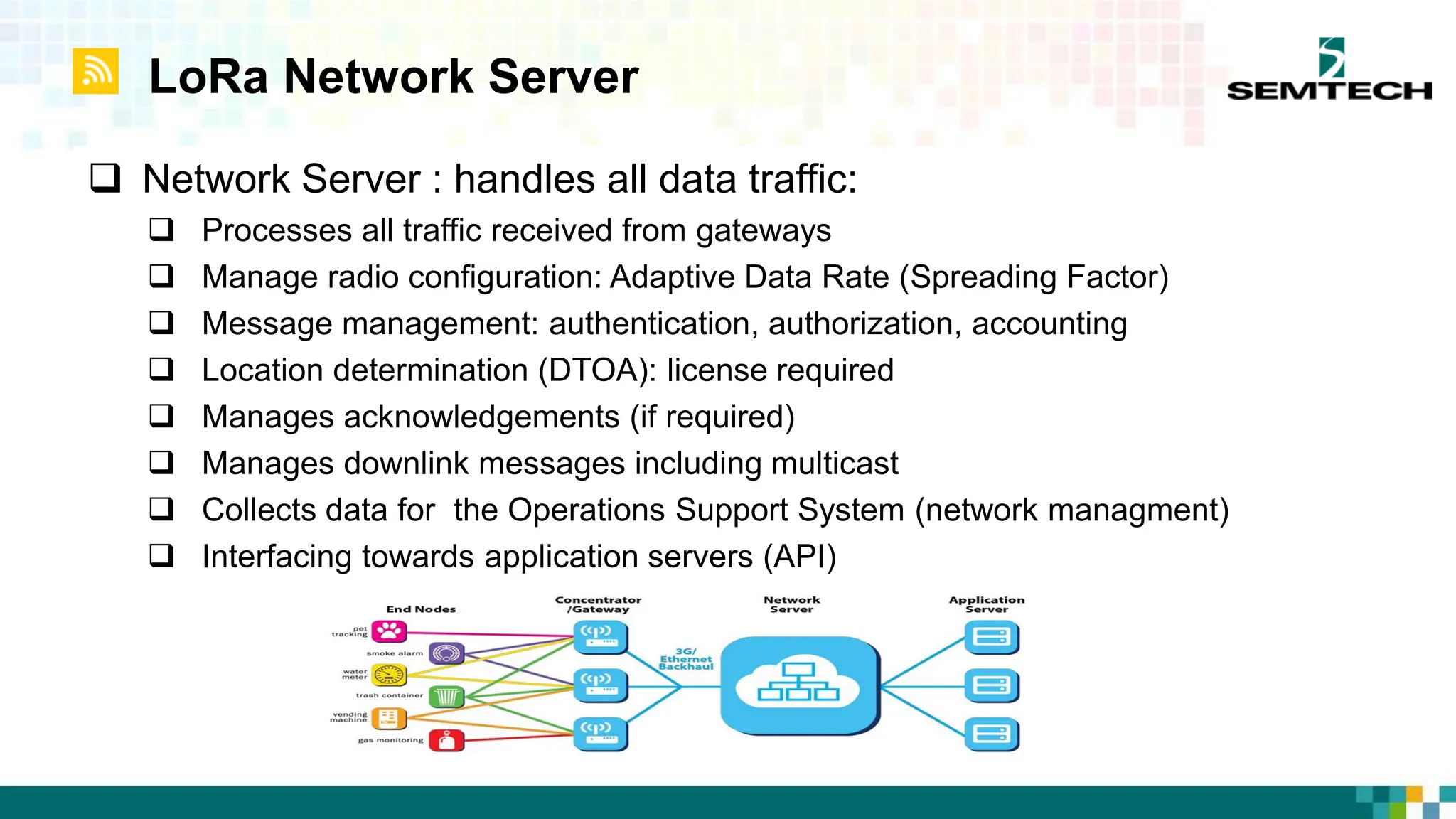
LoRa Network Server
Network Server : handles all data traffic:
Processes all traffic received from gateways
Manage radio configuration: Adaptive Data Rate (Spreading Factor)
Message management: authentication, authorization, accounting
Location determination (DTOA): license required
Manages acknowledgements (if required)
Manages downlink messages including multicast
Collects data for the Operations Support System (network managment)
Interfacing towards application servers (API)
34.
Spectrum usage
BasicRadio Transmission
• Messages are received by multiple base stations to deal with local interference resulting in
optimal Quality of Service
Spread Spectrum
• Each string of bytes (a message) is increased with a redundant string for optimal Quality of
Service. This ensures excellent demodulation of messages at the base stations even in an
environment with high noise floors and other interferers
Adaptive Data Rate
• A unique, and variable, spreading factor is used to increase the robustness of a message
• The Spreading Factor can vary between SF6 to SF12
• The higher a spreading factor the better the robustness of a message as the distance between sensor and
base station (range) can be longer
• A lower spreading factor results in decreased robustness against interference, however due to faster
transmission (Time on Air) one can send bigger messages resulting in lower power consumption
• The network manages these spreading factors automatically
35.
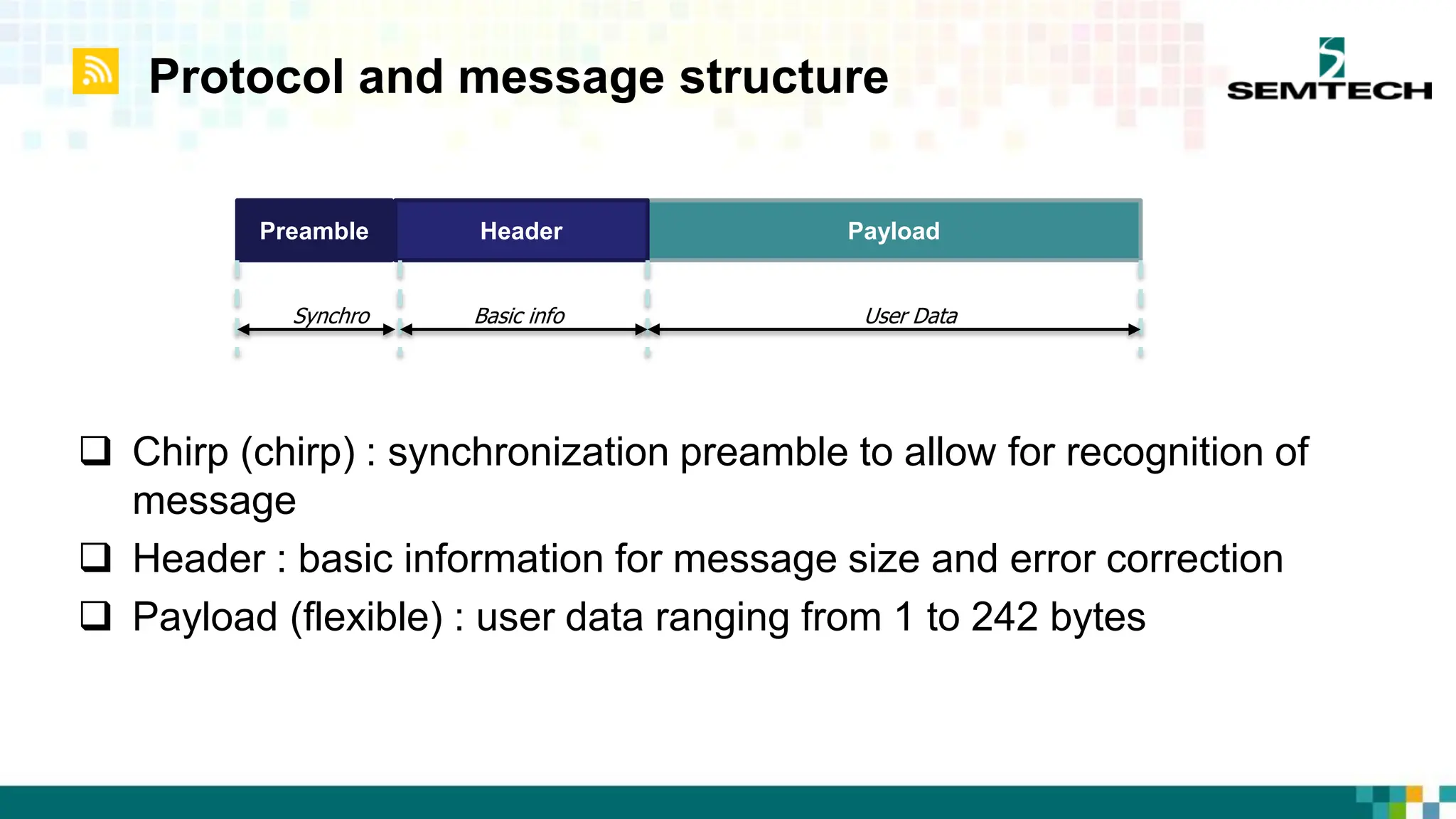
Protocol and messagestructure
Payload
Header
Preamble
Synchro Basic info User Data
Chirp (chirp) : synchronization preamble to allow for recognition of
message
Header : basic information for message size and error correction
Payload (flexible) : user data ranging from 1 to 242 bytes
36.
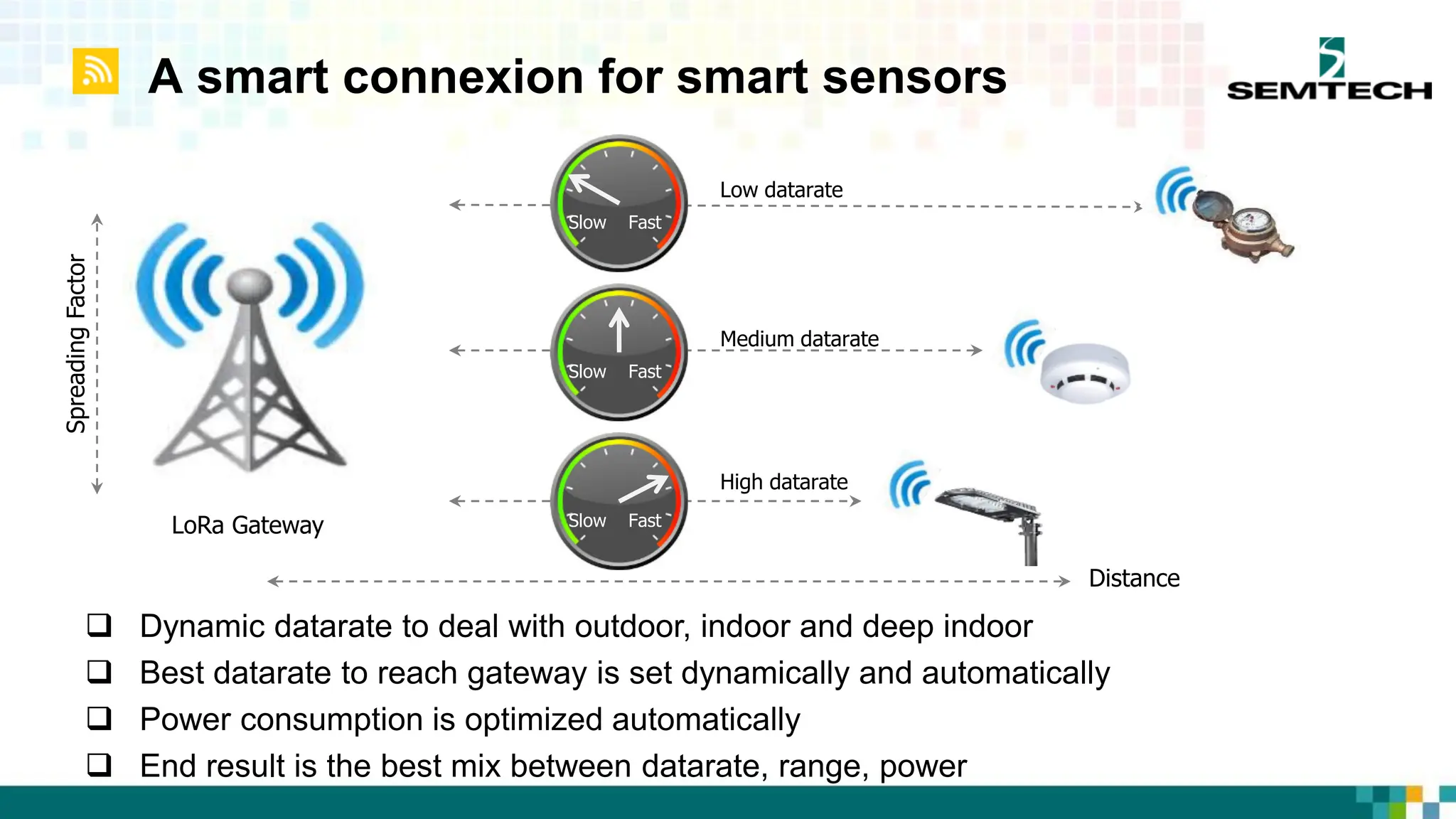
A smart connexionfor smart sensors
Dynamic datarate to deal with outdoor, indoor and deep indoor
Best datarate to reach gateway is set dynamically and automatically
Power consumption is optimized automatically
End result is the best mix between datarate, range, power
LoRa Gateway
Low datarate
Medium datarate
Slow Fast
High datarate
Distance
Spreading
Factor
Slow Fast
Slow Fast
37.
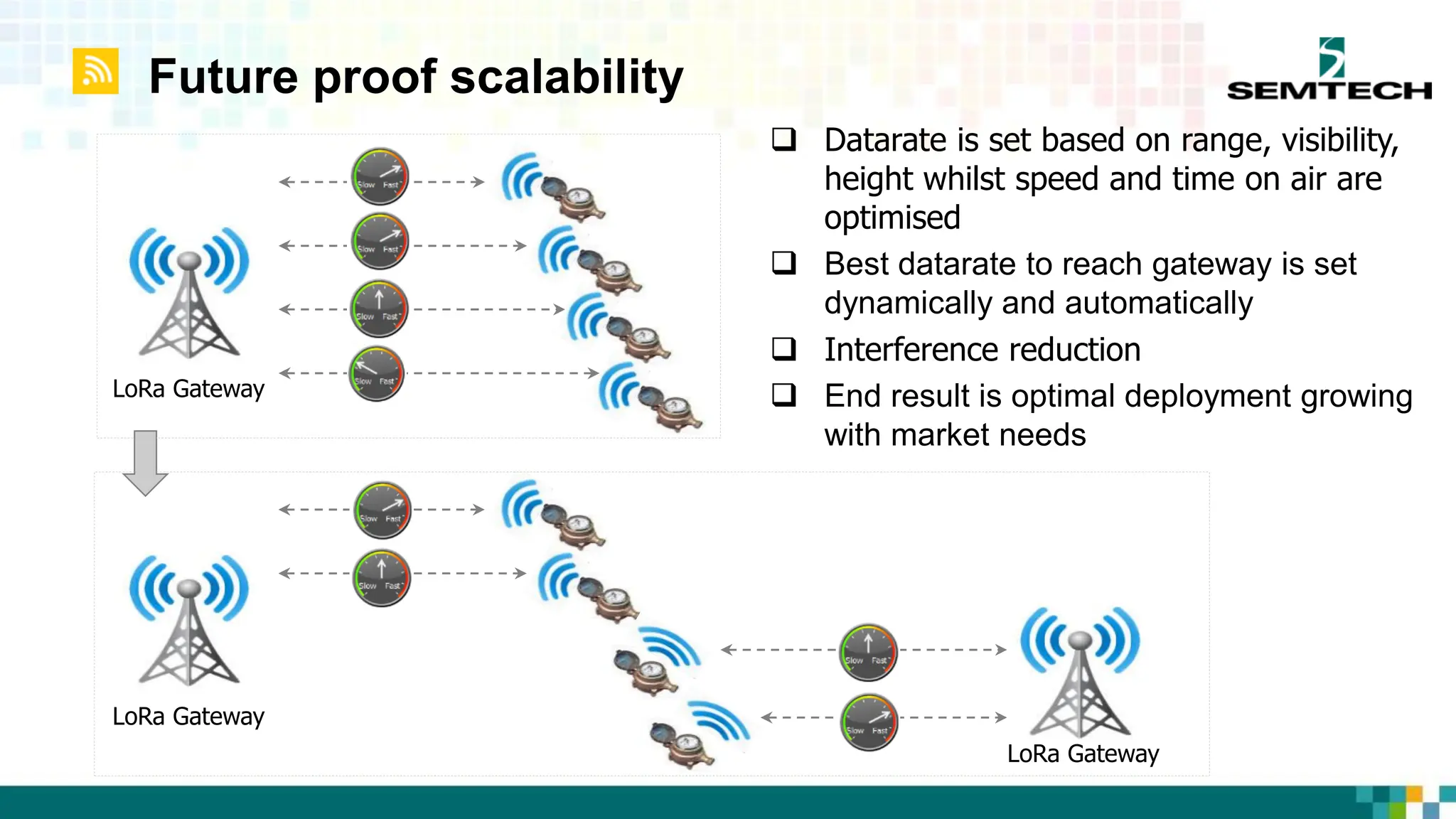
Future proof scalability
LoRaGateway
LoRa Gateway
LoRa Gateway
Datarate is set based on range, visibility,
height whilst speed and time on air are
optimised
Best datarate to reach gateway is set
dynamically and automatically
Interference reduction
End result is optimal deployment growing
with market needs
Fast
38.
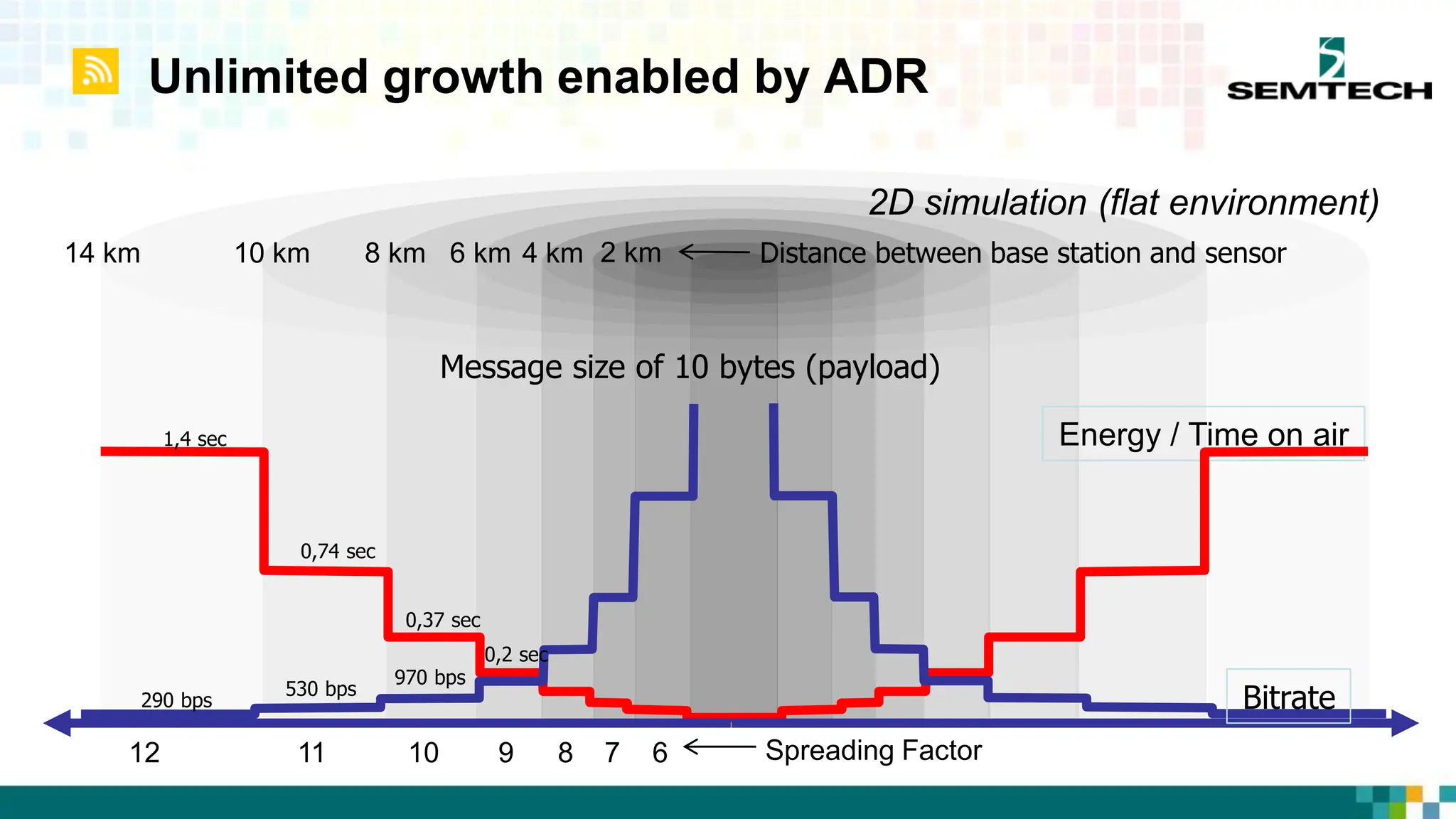
Unlimited growth enabledby ADR
Energy / Time on air
Bitrate
12 11 10 9 8 7
14 km 10 km 8 km 6 km 4 km
290 bps
530 bps
970 bps
2D simulation (flat environment)
1,4 sec
Message size of 10 bytes (payload)
0,74 sec
0,37 sec
0,2 sec
2 km
Spreading Factor
6
Distance between base station and sensor
39.
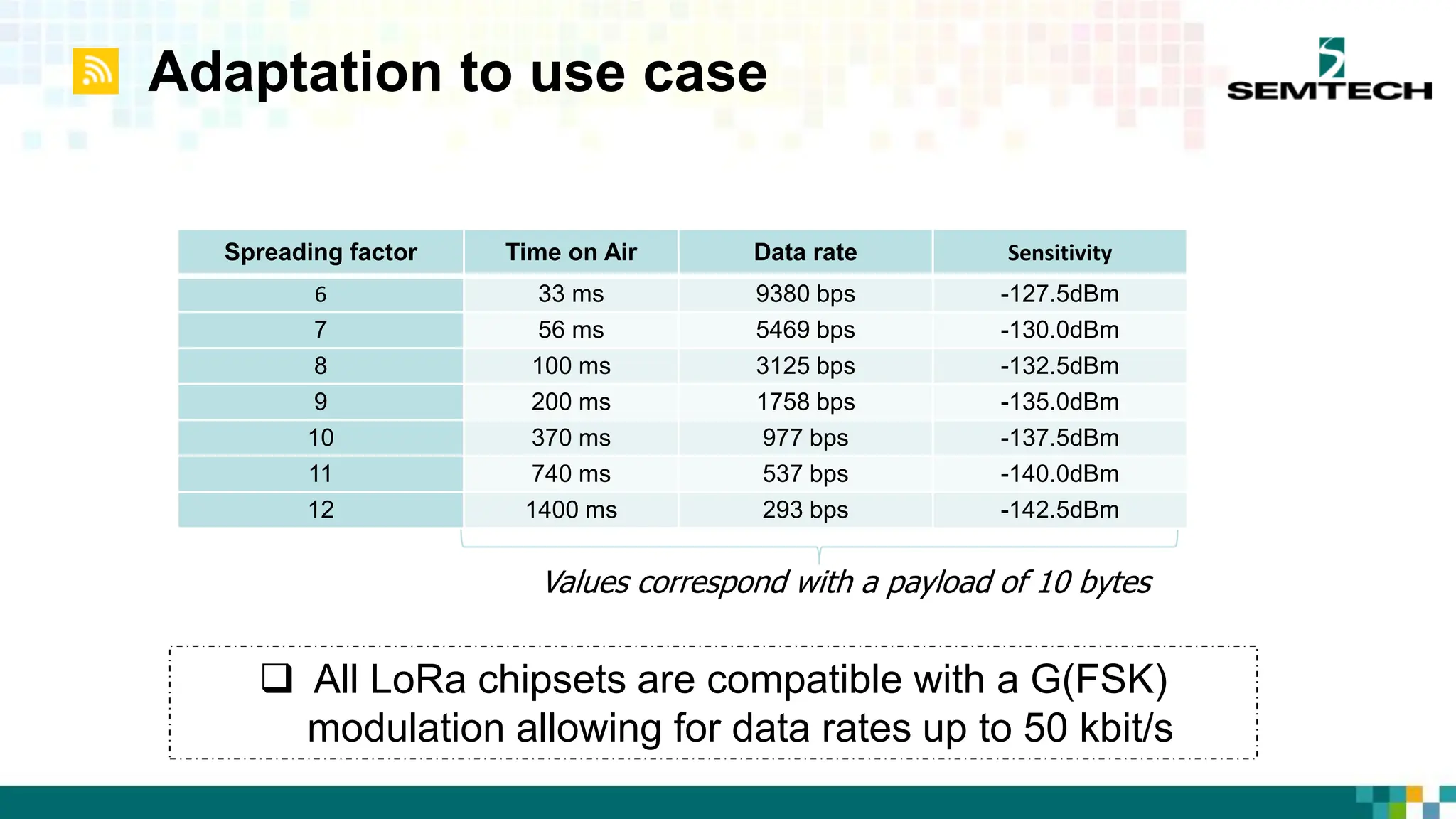
Adaptation to usecase
Spreading factor Time on Air Data rate Sensitivity
6 33 ms 9380 bps -127.5dBm
7 56 ms 5469 bps -130.0dBm
8 100 ms 3125 bps -132.5dBm
9 200 ms 1758 bps -135.0dBm
10 370 ms 977 bps -137.5dBm
11 740 ms 537 bps -140.0dBm
12 1400 ms 293 bps -142.5dBm
Values correspond with a payload of 10 bytes
All LoRa chipsets are compatible with a G(FSK)
modulation allowing for data rates up to 50 kbit/s
40.
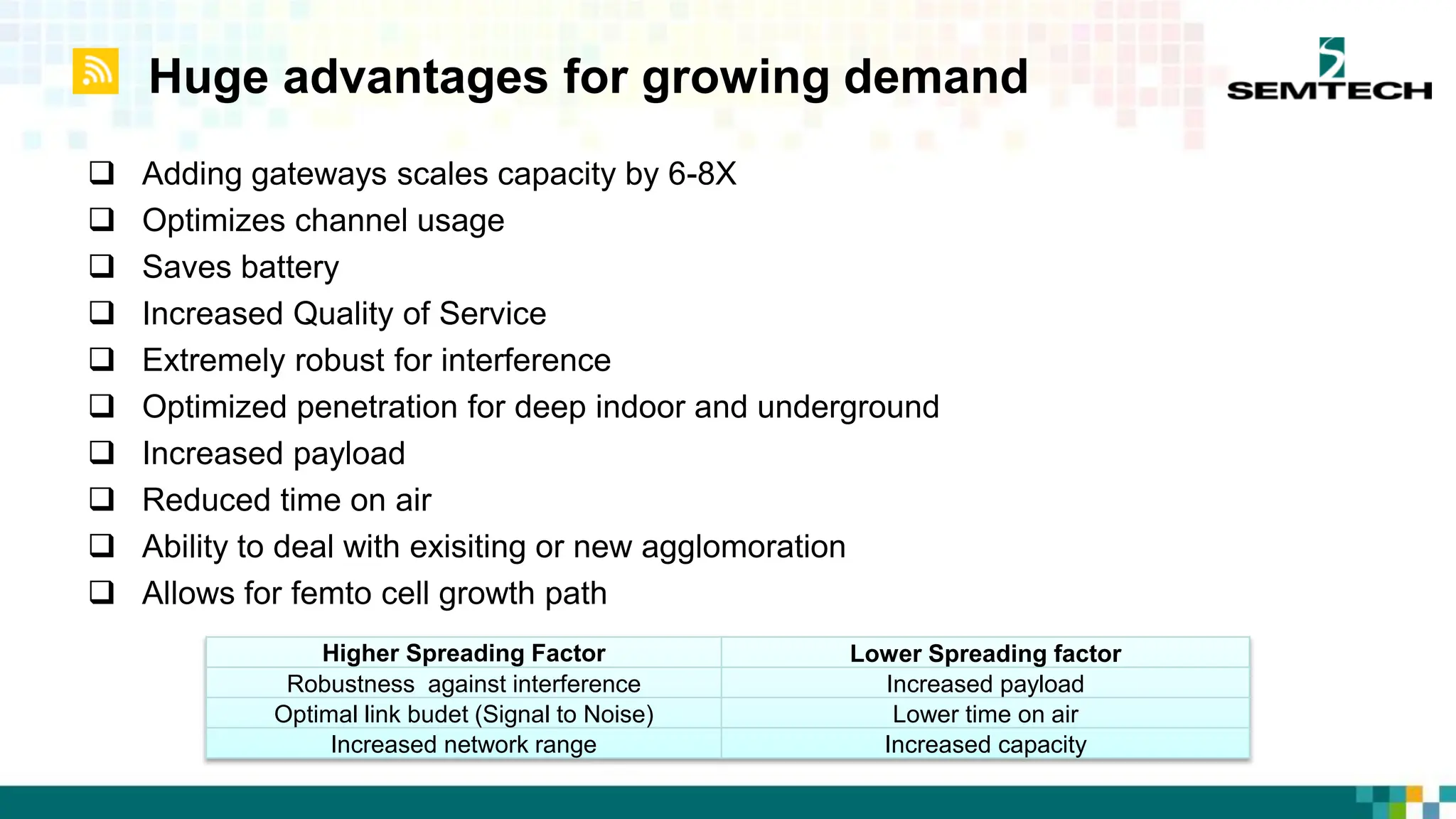
Huge advantages forgrowing demand
Adding gateways scales capacity by 6-8X
Optimizes channel usage
Saves battery
Increased Quality of Service
Extremely robust for interference
Optimized penetration for deep indoor and underground
Increased payload
Reduced time on air
Ability to deal with exisiting or new agglomoration
Allows for femto cell growth path
Higher Spreading Factor Lower Spreading factor
Robustness against interference Increased payload
Optimal link budet (Signal to Noise) Lower time on air
Increased network range Increased capacity
41.
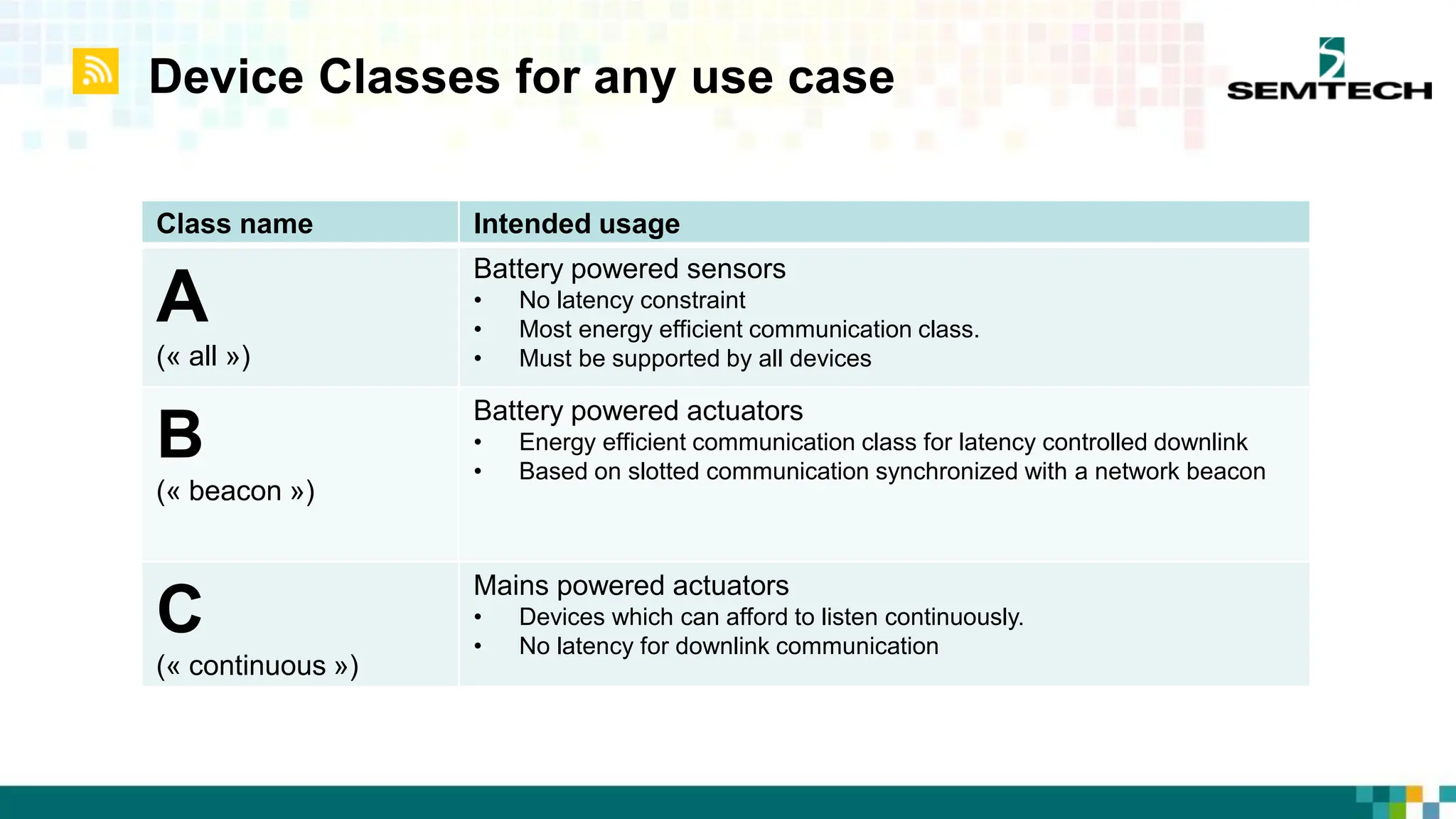
Device Classes forany use case
Class name Intended usage
A
(« all »)
Battery powered sensors
• No latency constraint
• Most energy efficient communication class.
• Must be supported by all devices
B
(« beacon »)
Battery powered actuators
• Energy efficient communication class for latency controlled downlink
• Based on slotted communication synchronized with a network beacon
C
(« continuous »)
Mains powered actuators
• Devices which can afford to listen continuously.
• No latency for downlink communication
42.
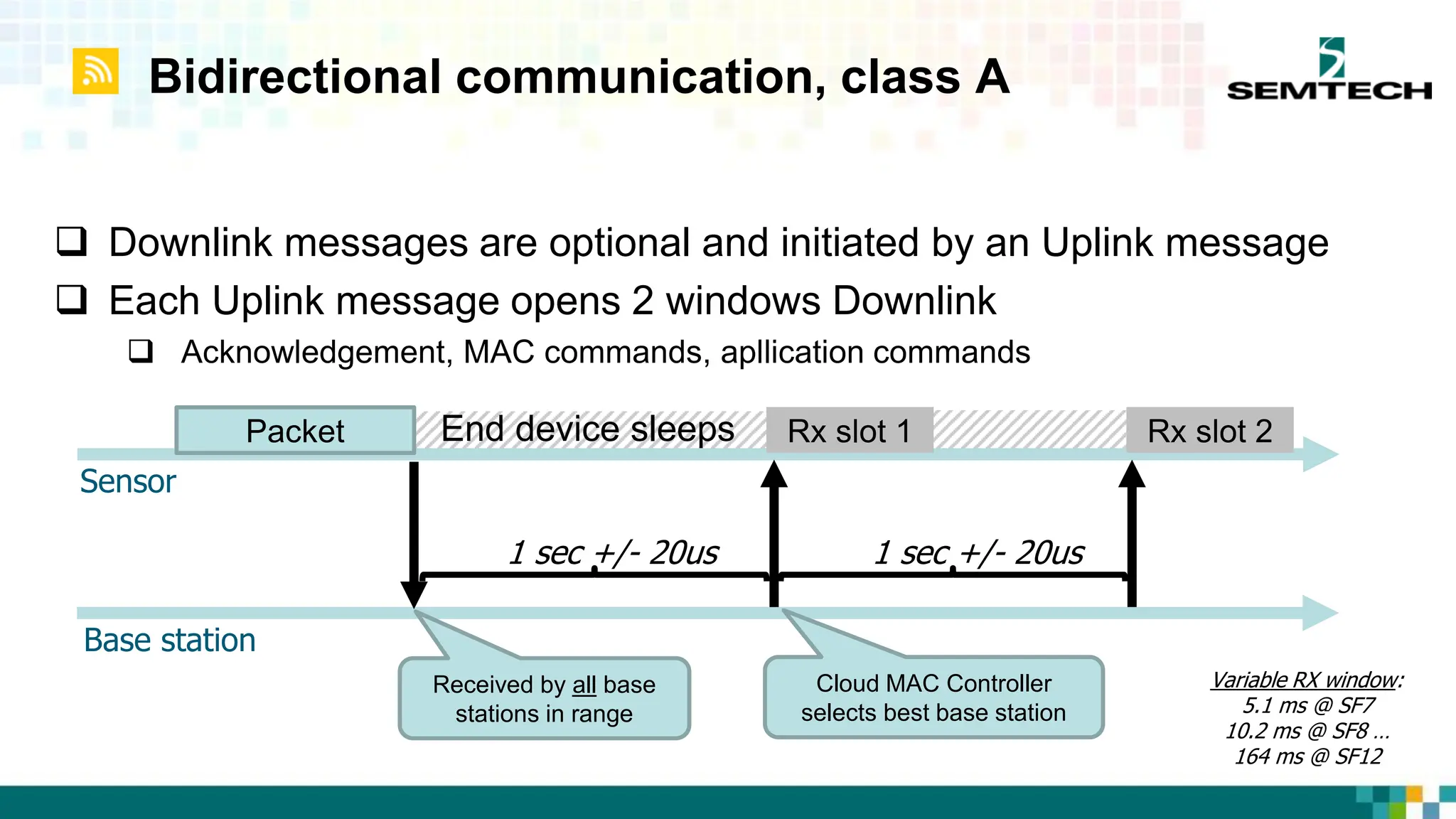
Bidirectional communication, classA
Sensor
Base station
Packet
Received by all base
stations in range
End device sleeps Rx slot 1 Rx slot 2
Cloud MAC Controller
selects best base station
1 sec +/- 20us
1 sec +/- 20us
Downlink messages are optional and initiated by an Uplink message
Each Uplink message opens 2 windows Downlink
Acknowledgement, MAC commands, apllication commands
Variable RX window:
5.1 ms @ SF7
10.2 ms @ SF8 …
164 ms @ SF12
43.
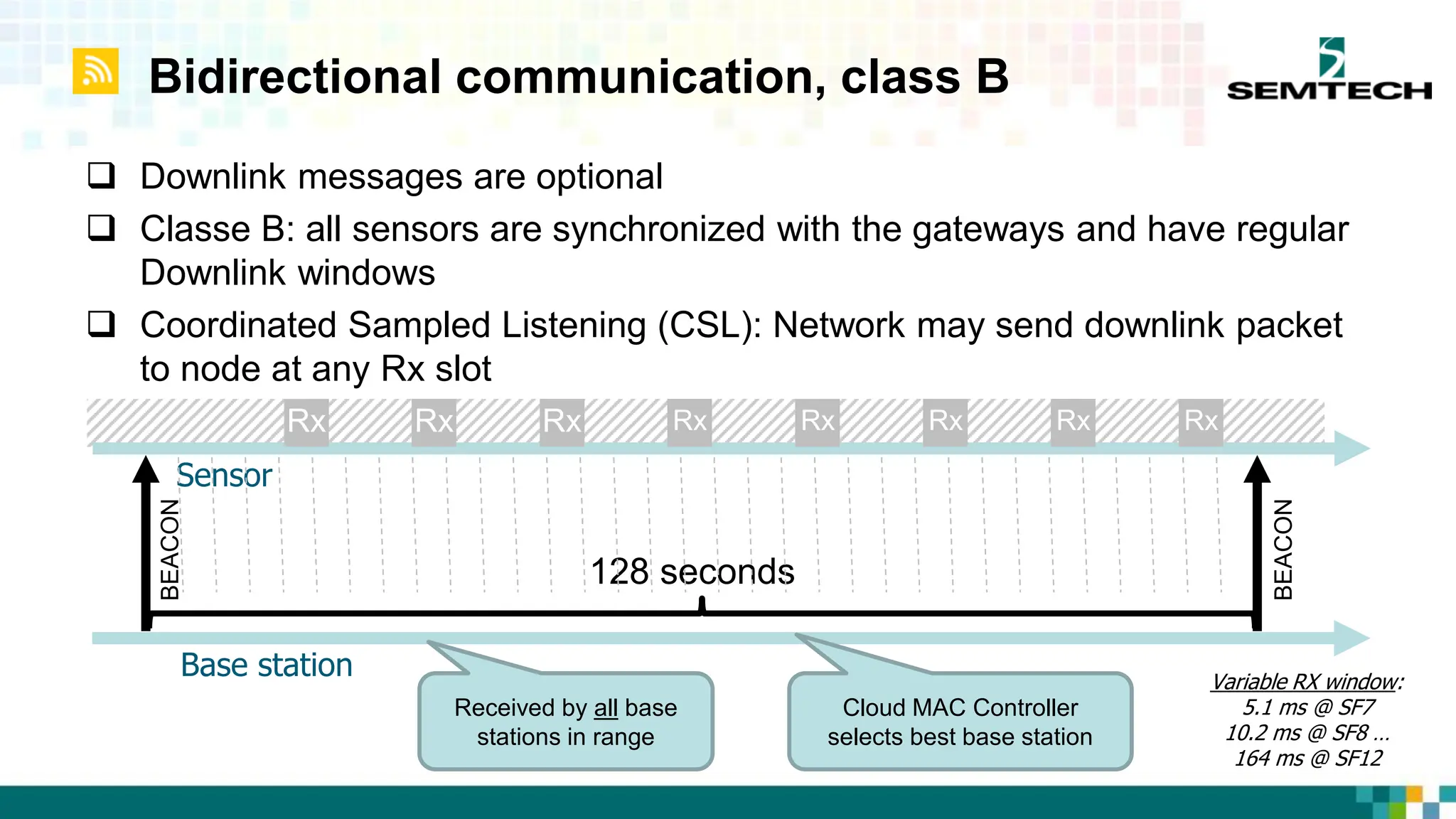
Bidirectional communication, classB
Sensor
Base station
Received by all base
stations in range
128 seconds
Rx
Cloud MAC Controller
selects best base station
BEACON
BEACON
Rx Rx Rx Rx Rx Rx Rx
Downlink messages are optional
Classe B: all sensors are synchronized with the gateways and have regular
Downlink windows
Coordinated Sampled Listening (CSL): Network may send downlink packet
to node at any Rx slot
Variable RX window:
5.1 ms @ SF7
10.2 ms @ SF8 …
164 ms @ SF12
44.
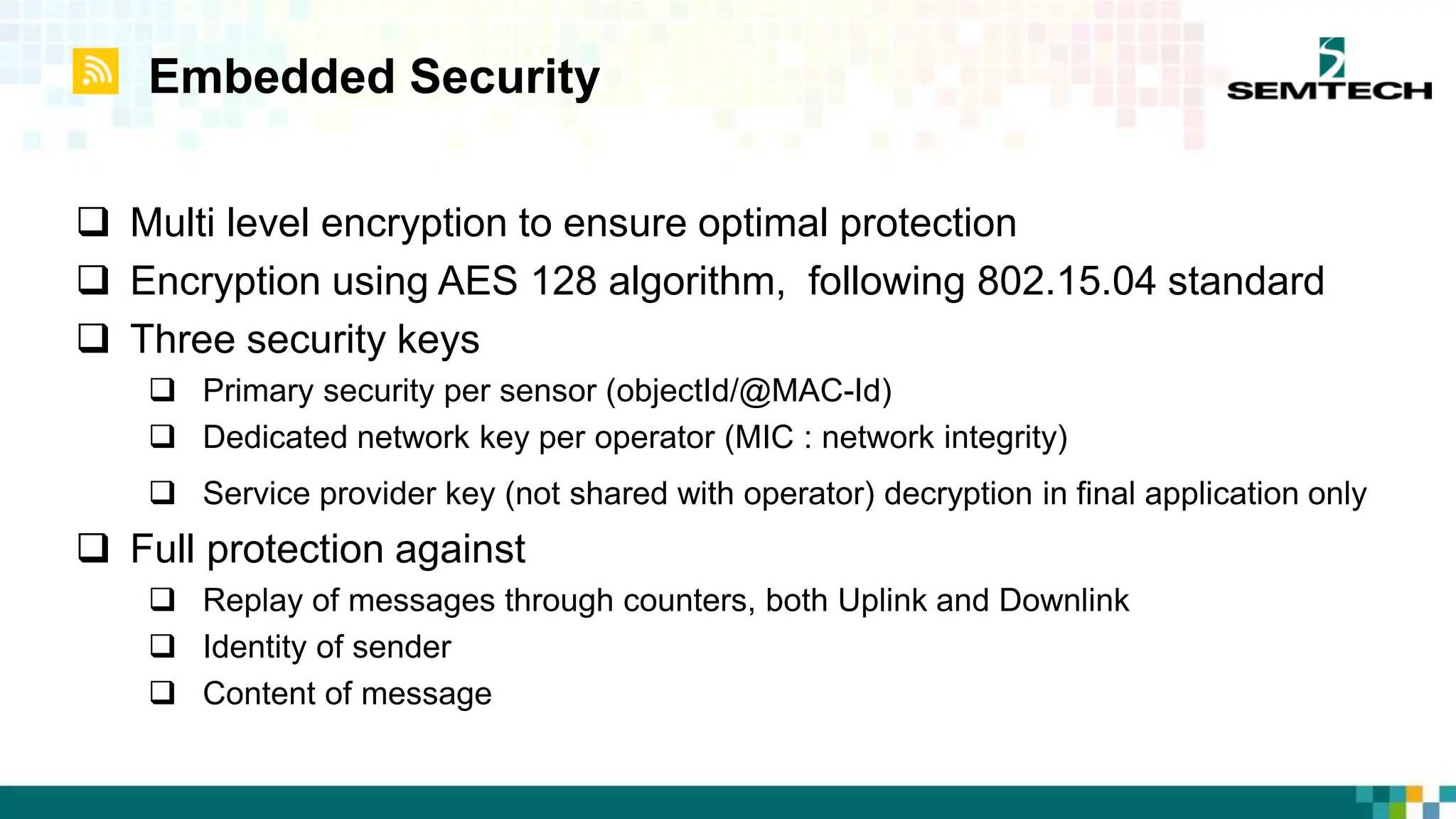
Embedded Security
Multilevel encryption to ensure optimal protection
Encryption using AES 128 algorithm, following 802.15.04 standard
Three security keys
Primary security per sensor (objectId/@MAC-Id)
Dedicated network key per operator (MIC : network integrity)
Service provider key (not shared with operator) decryption in final application only
Full protection against
Replay of messages through counters, both Uplink and Downlink
Identity of sender
Content of message
45.
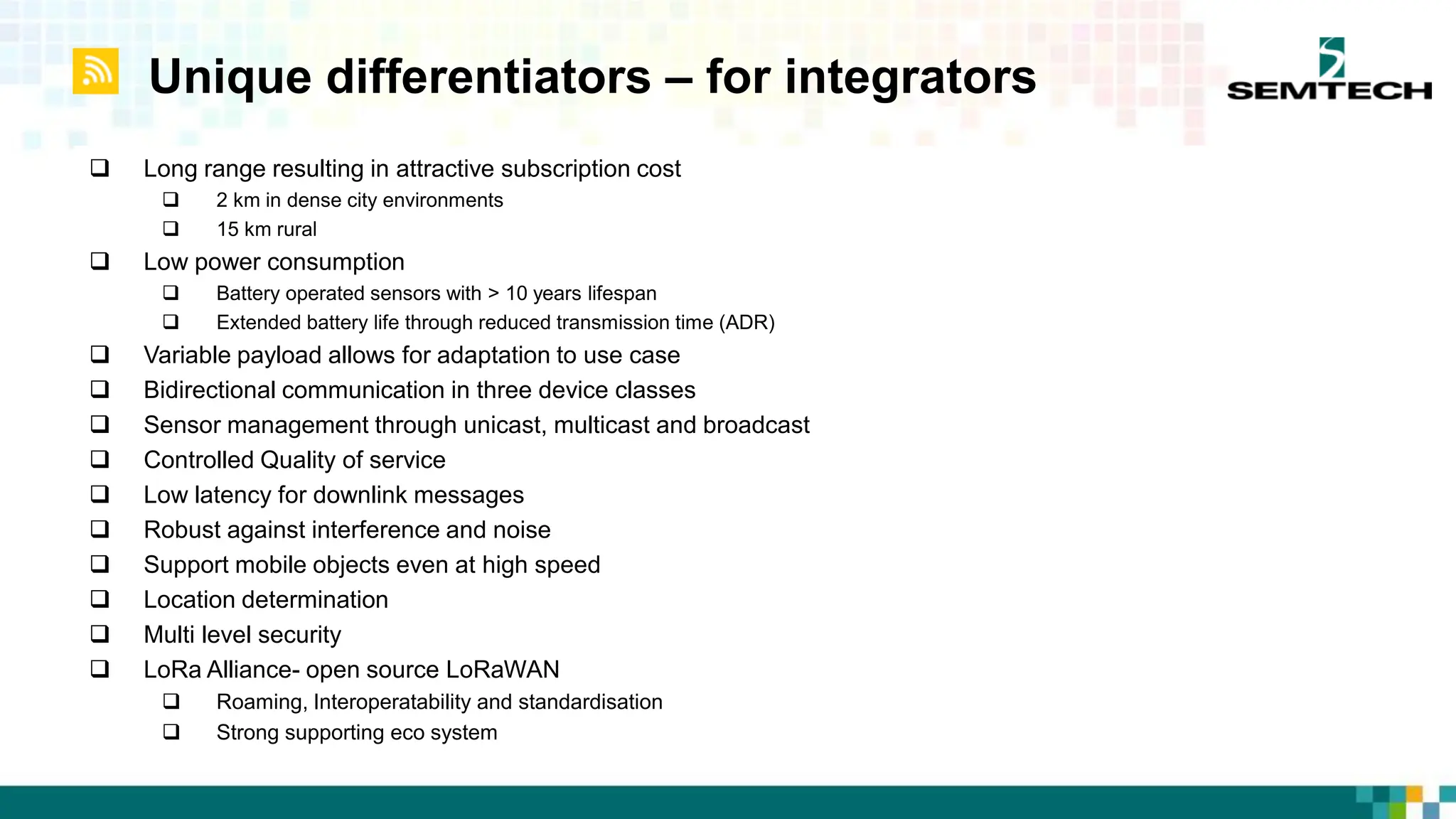
Unique differentiators –for integrators
Long range resulting in attractive subscription cost
2 km in dense city environments
15 km rural
Low power consumption
Battery operated sensors with > 10 years lifespan
Extended battery life through reduced transmission time (ADR)
Variable payload allows for adaptation to use case
Bidirectional communication in three device classes
Sensor management through unicast, multicast and broadcast
Controlled Quality of service
Low latency for downlink messages
Robust against interference and noise
Support mobile objects even at high speed
Location determination
Multi level security
LoRa Alliance- open source LoRaWAN
Roaming, Interoperatability and standardisation
Strong supporting eco system
46.
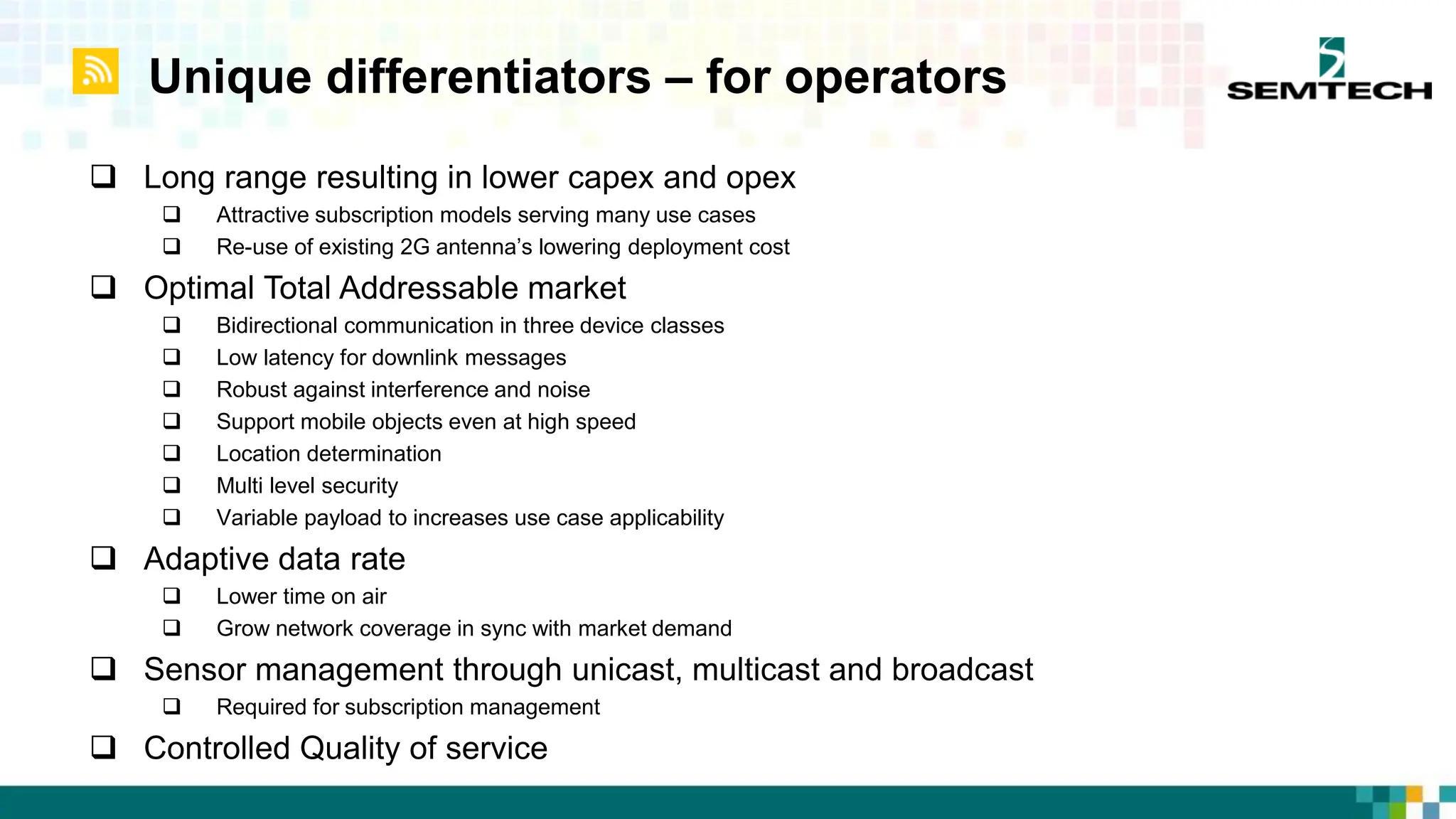
Unique differentiators –for operators
Long range resulting in lower capex and opex
Attractive subscription models serving many use cases
Re-use of existing 2G antenna’s lowering deployment cost
Optimal Total Addressable market
Bidirectional communication in three device classes
Low latency for downlink messages
Robust against interference and noise
Support mobile objects even at high speed
Location determination
Multi level security
Variable payload to increases use case applicability
Adaptive data rate
Lower time on air
Grow network coverage in sync with market demand
Sensor management through unicast, multicast and broadcast
Required for subscription management
Controlled Quality of service
Confidential Information –Property of Semtech Corporation 48
12/16/2015
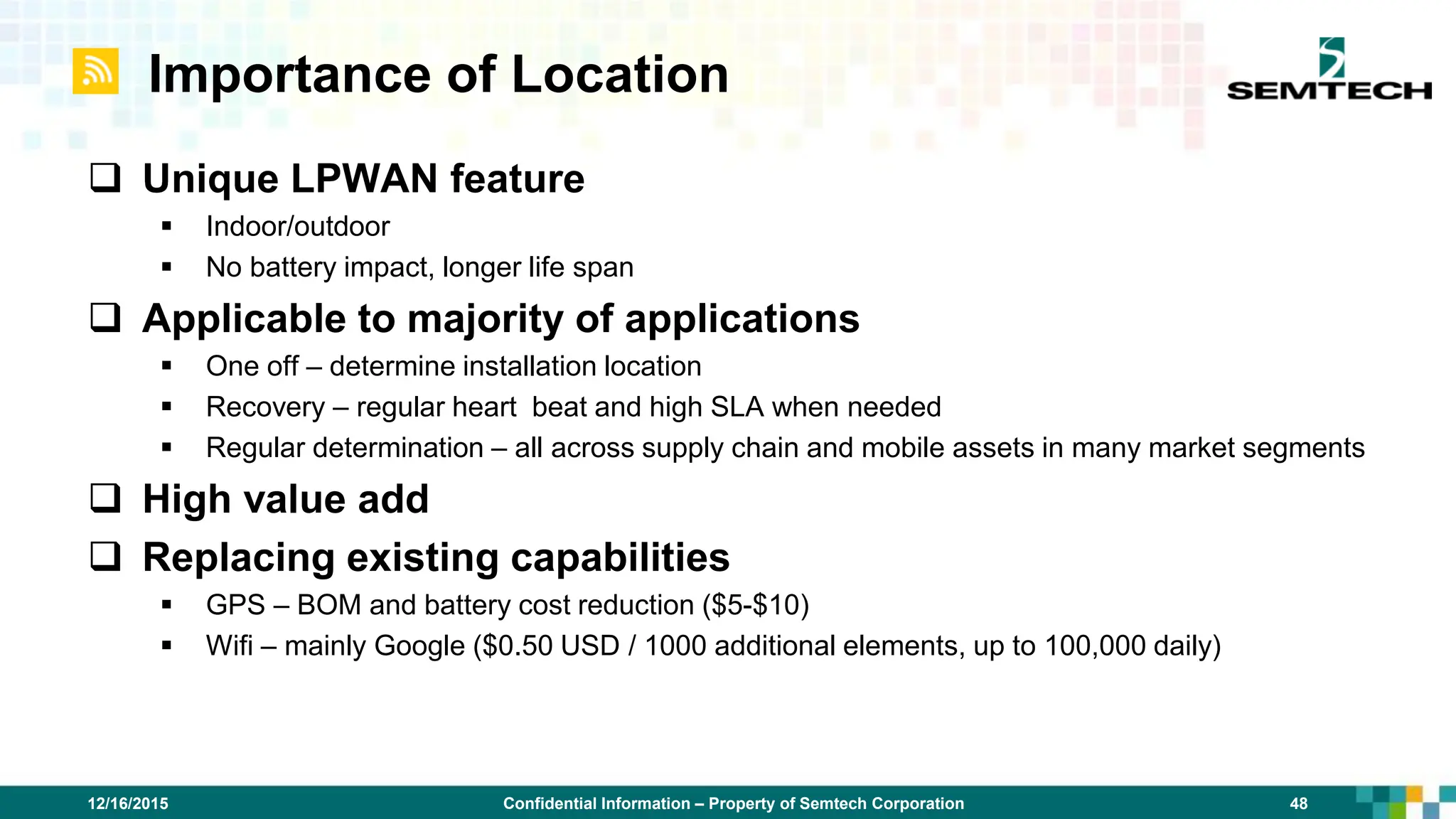
Importance of Location
Unique LPWAN feature
Indoor/outdoor
No battery impact, longer life span
Applicable to majority of applications
One off – determine installation location
Recovery – regular heart beat and high SLA when needed
Regular determination – all across supply chain and mobile assets in many market segments
High value add
Replacing existing capabilities
GPS – BOM and battery cost reduction ($5-$10)
Wifi – mainly Google ($0.50 USD / 1000 additional elements, up to 100,000 daily)
49.
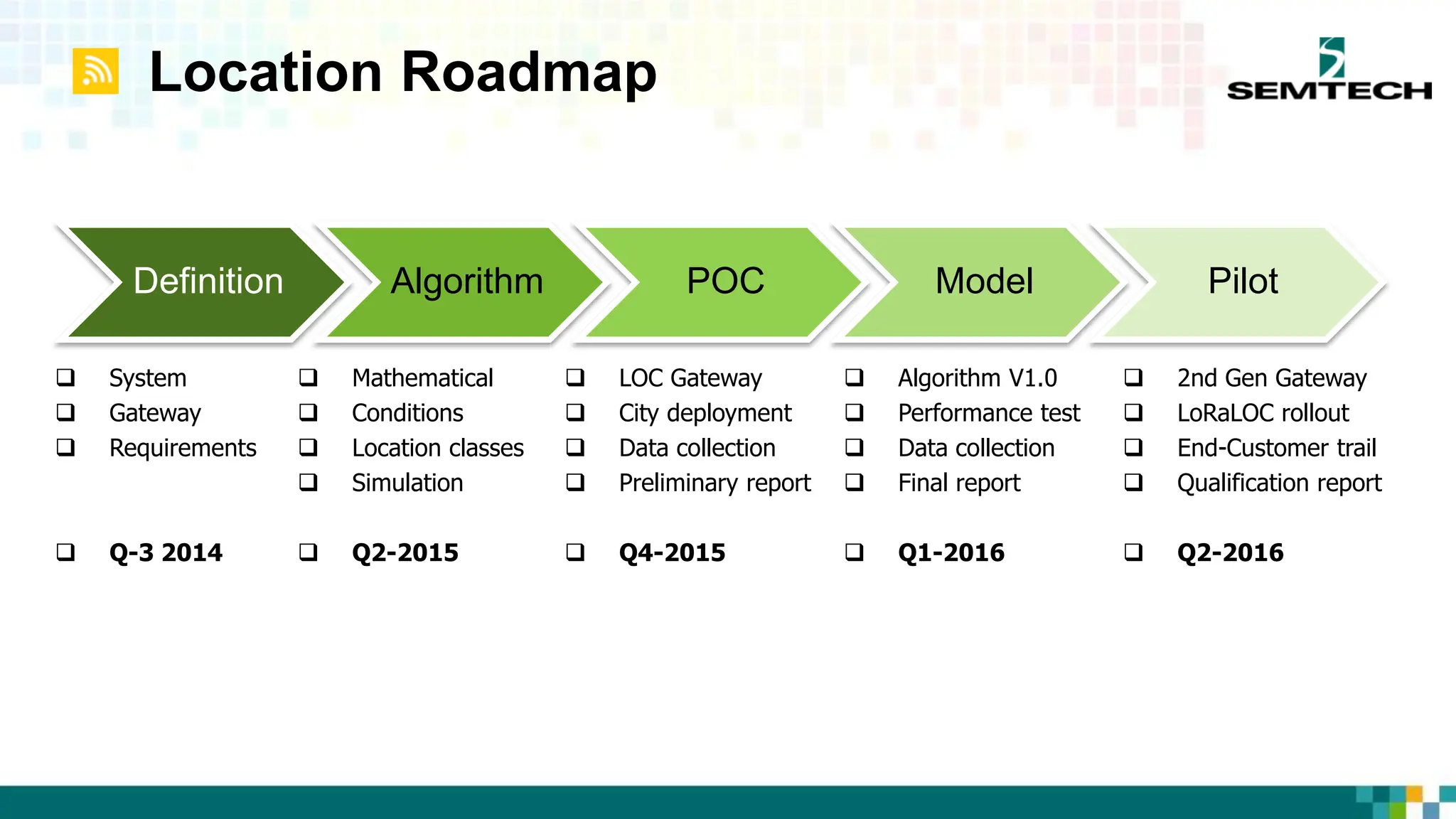
Location Roadmap
Definition AlgorithmPOC Model Pilot
System
Gateway
Requirements
Q-3 2014
Mathematical
Conditions
Location classes
Simulation
Q2-2015
LOC Gateway
City deployment
Data collection
Preliminary report
Q4-2015
Algorithm V1.0
Performance test
Data collection
Final report
Q1-2016
2nd Gen Gateway
LoRaLOC rollout
End-Customer trail
Qualification report
Q2-2016
50.
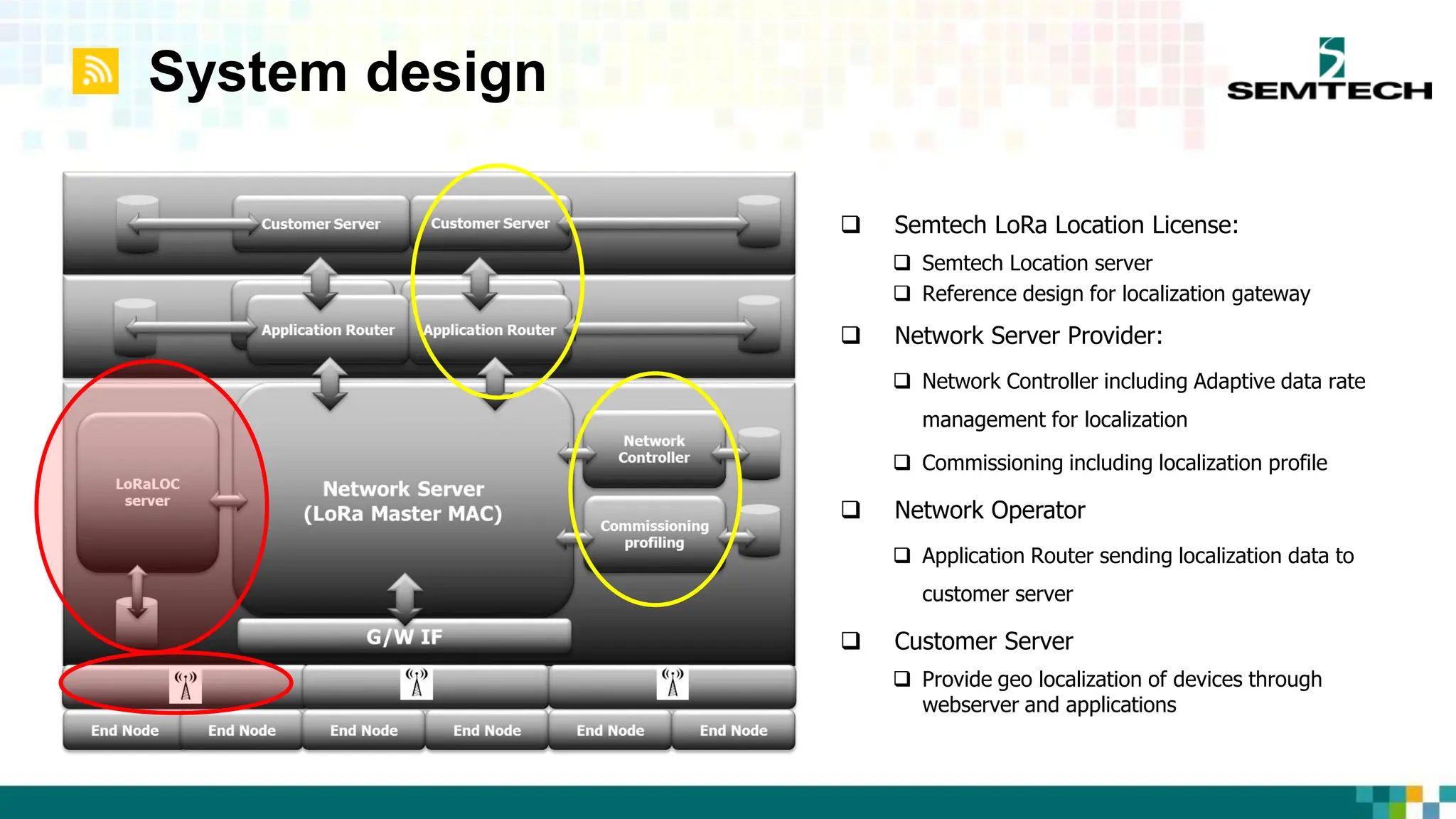
System design
SemtechLoRa Location License:
Semtech Location server
Reference design for localization gateway
Network Server Provider:
Network Controller including Adaptive data rate
management for localization
Commissioning including localization profile
Network Operator
Application Router sending localization data to
customer server
Customer Server
Provide geo localization of devices through
webserver and applications
51.
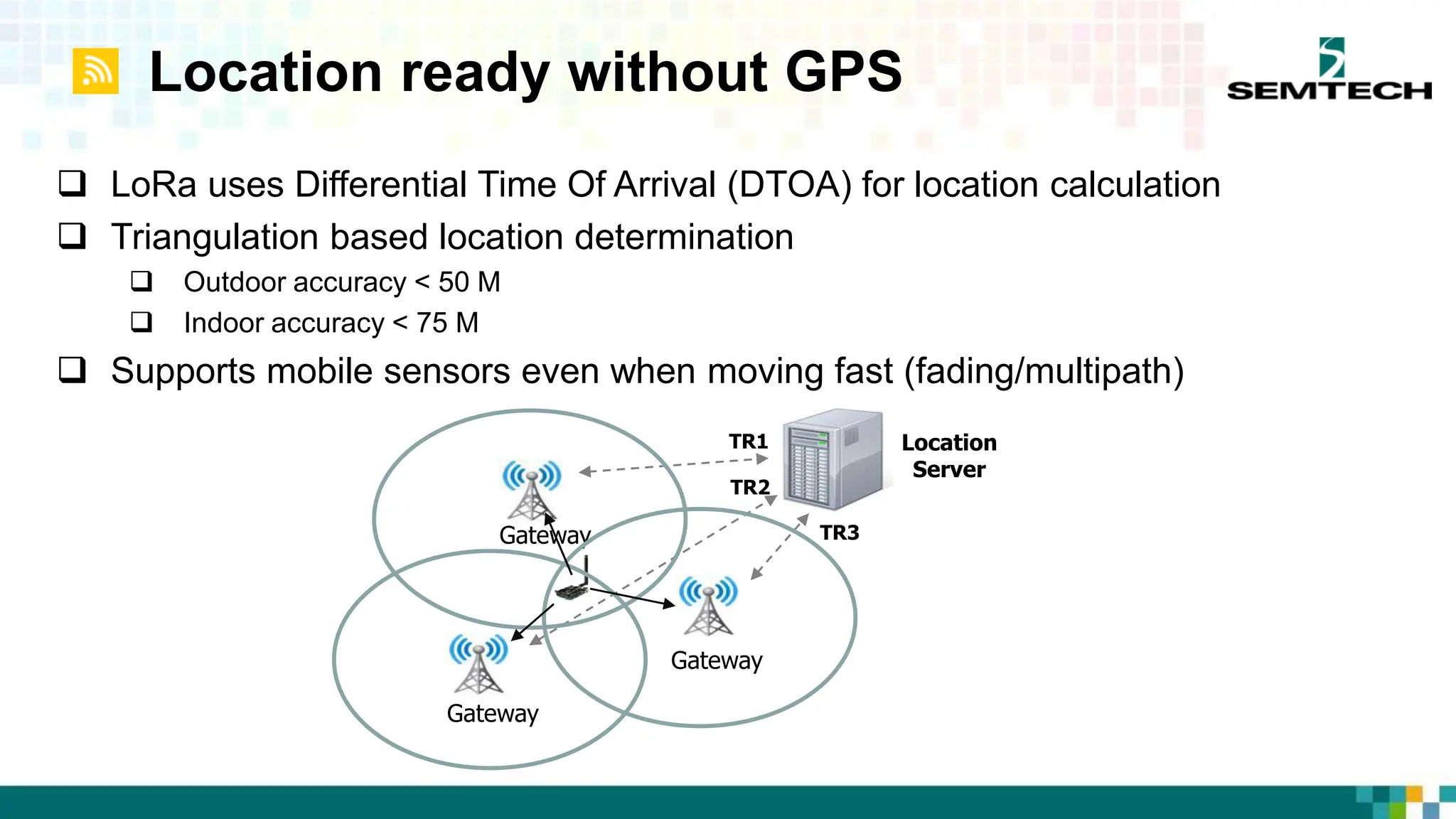
Location ready withoutGPS
LoRa uses Differential Time Of Arrival (DTOA) for location calculation
Triangulation based location determination
Outdoor accuracy < 50 M
Indoor accuracy < 75 M
Supports mobile sensors even when moving fast (fading/multipath)
Gateway
Location
Server
TR1
TR2
TR3
Gateway
Gateway
52.
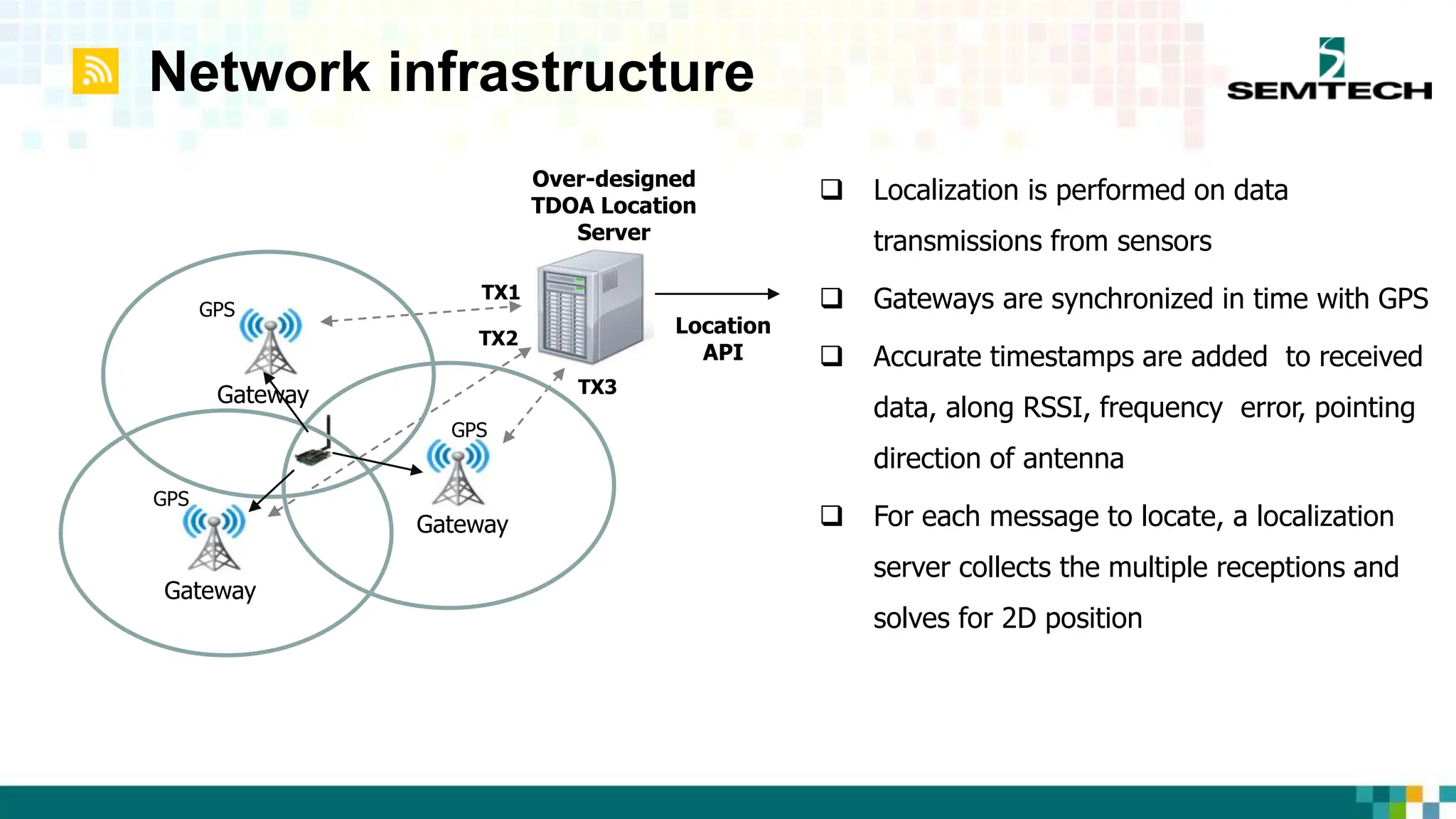
Network infrastructure
Localizationis performed on data
transmissions from sensors
Gateways are synchronized in time with GPS
Accurate timestamps are added to received
data, along RSSI, frequency error, pointing
direction of antenna
For each message to locate, a localization
server collects the multiple receptions and
solves for 2D position
Gateway
Over-designed
TDOA Location
Server
TX1
TX2
TX3
Gateway
Gateway
Location
API
GPS
GPS
GPS
53.
FAQ - LoRa
How much data can be transmitted - What is the data througput with LoRa
What is the latency – how fast will data be delivered
Capacity - how many sensors can be supported
Capacity – what is the future strategy for ISM
Capacity – how much data can LoRa handle
Security – how is security and privacy managed
Penetration – how deep indoor does LoRa work
54.
COMPARATIF LORA SIGFOX– PAYLOAD/DEBITS
UTILES
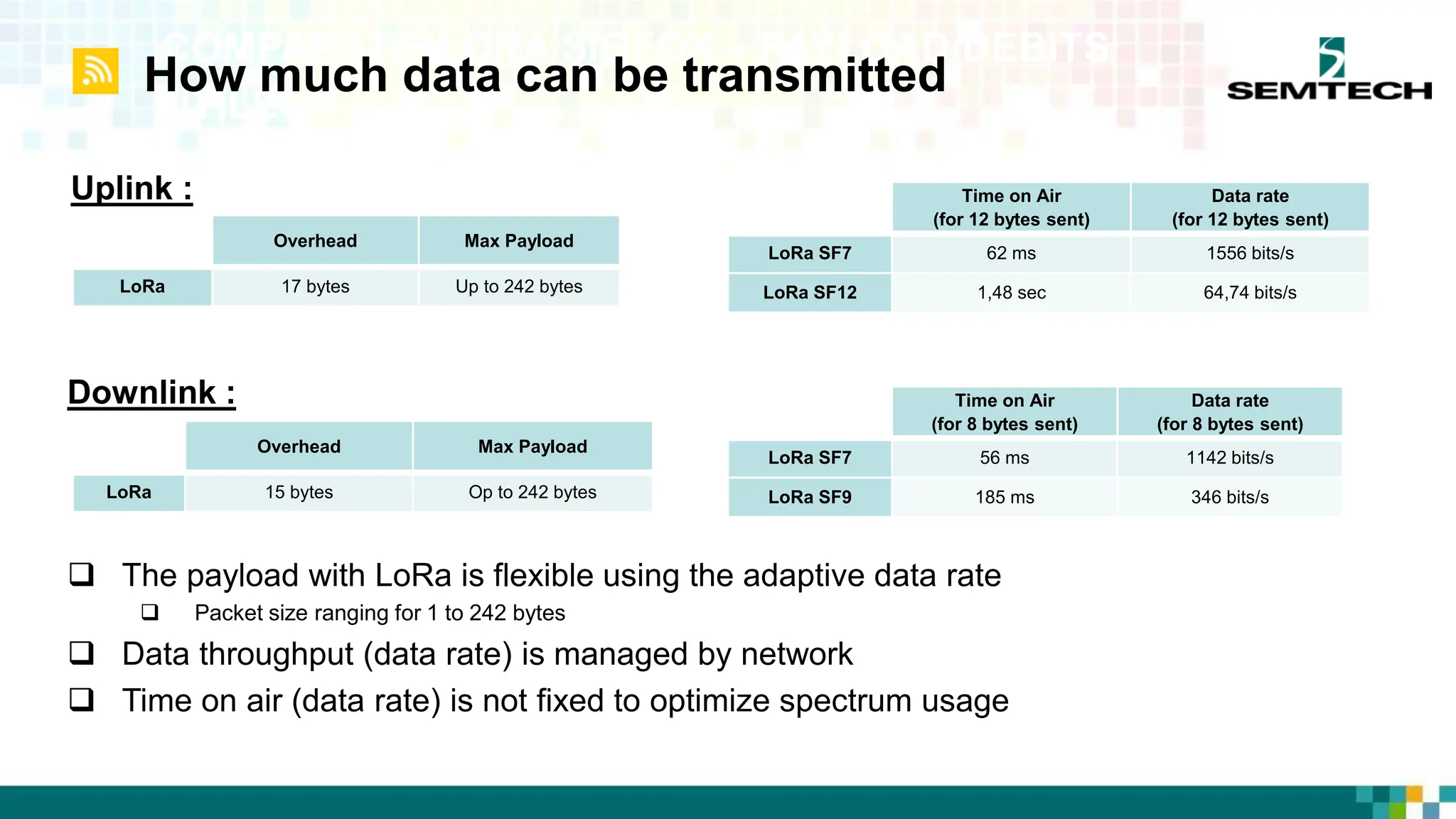
Uplink :
Overhead Max Payload
LoRa 17 bytes Up to 242 bytes
Overhead Max Payload
LoRa 15 bytes Op to 242 bytes
Time on Air
(for 12 bytes sent)
Data rate
(for 12 bytes sent)
LoRa SF7 62 ms 1556 bits/s
LoRa SF12 1,48 sec 64,74 bits/s
Time on Air
(for 8 bytes sent)
Data rate
(for 8 bytes sent)
LoRa SF7 56 ms 1142 bits/s
LoRa SF9 185 ms 346 bits/s
The payload with LoRa is flexible using the adaptive data rate
Packet size ranging for 1 to 242 bytes
Data throughput (data rate) is managed by network
Time on air (data rate) is not fixed to optimize spectrum usage
Downlink :
How much data can be transmitted
55.
COMPARATIF LORA SIGFOXCONSOMMATION -
BIDIRECTIONNALITE
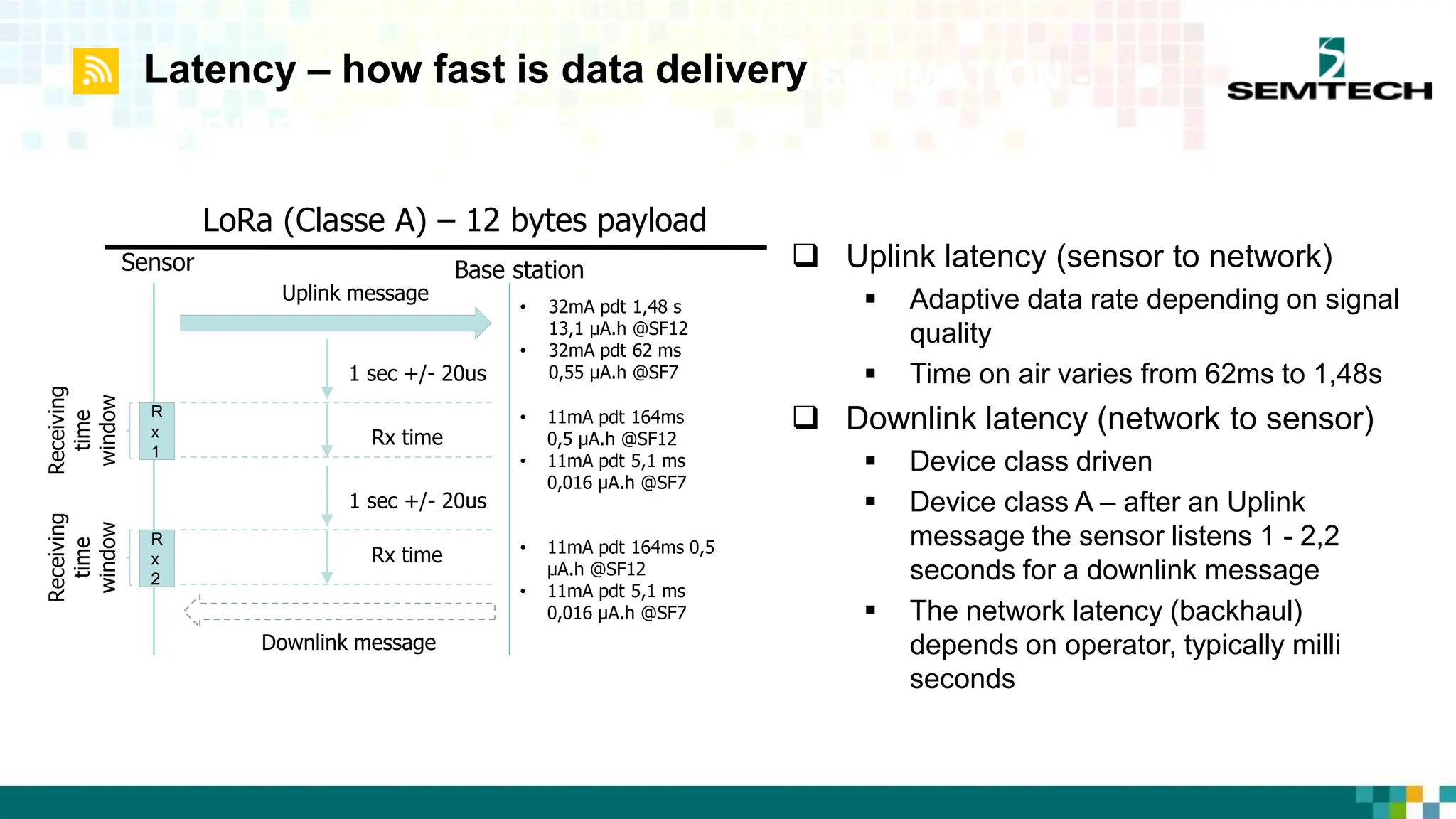
Uplink message
1 sec +/- 20us
R
x
1
Receiving
time
window
1 sec +/- 20us
R
x
2
Rx time
Receiving
time
window
LoRa (Classe A) – 12 bytes payload
Downlink message
Rx time
• 32mA pdt 1,48 s
13,1 μA.h @SF12
• 32mA pdt 62 ms
0,55 μA.h @SF7
• 11mA pdt 164ms
0,5 μA.h @SF12
• 11mA pdt 5,1 ms
0,016 μA.h @SF7
• 11mA pdt 164ms 0,5
μA.h @SF12
• 11mA pdt 5,1 ms
0,016 μA.h @SF7
Sensor Base station Uplink latency (sensor to network)
Adaptive data rate depending on signal
quality
Time on air varies from 62ms to 1,48s
Downlink latency (network to sensor)
Device class driven
Device class A – after an Uplink
message the sensor listens 1 - 2,2
seconds for a downlink message
The network latency (backhaul)
depends on operator, typically milli
seconds
Latency – how fast is data delivery
56.
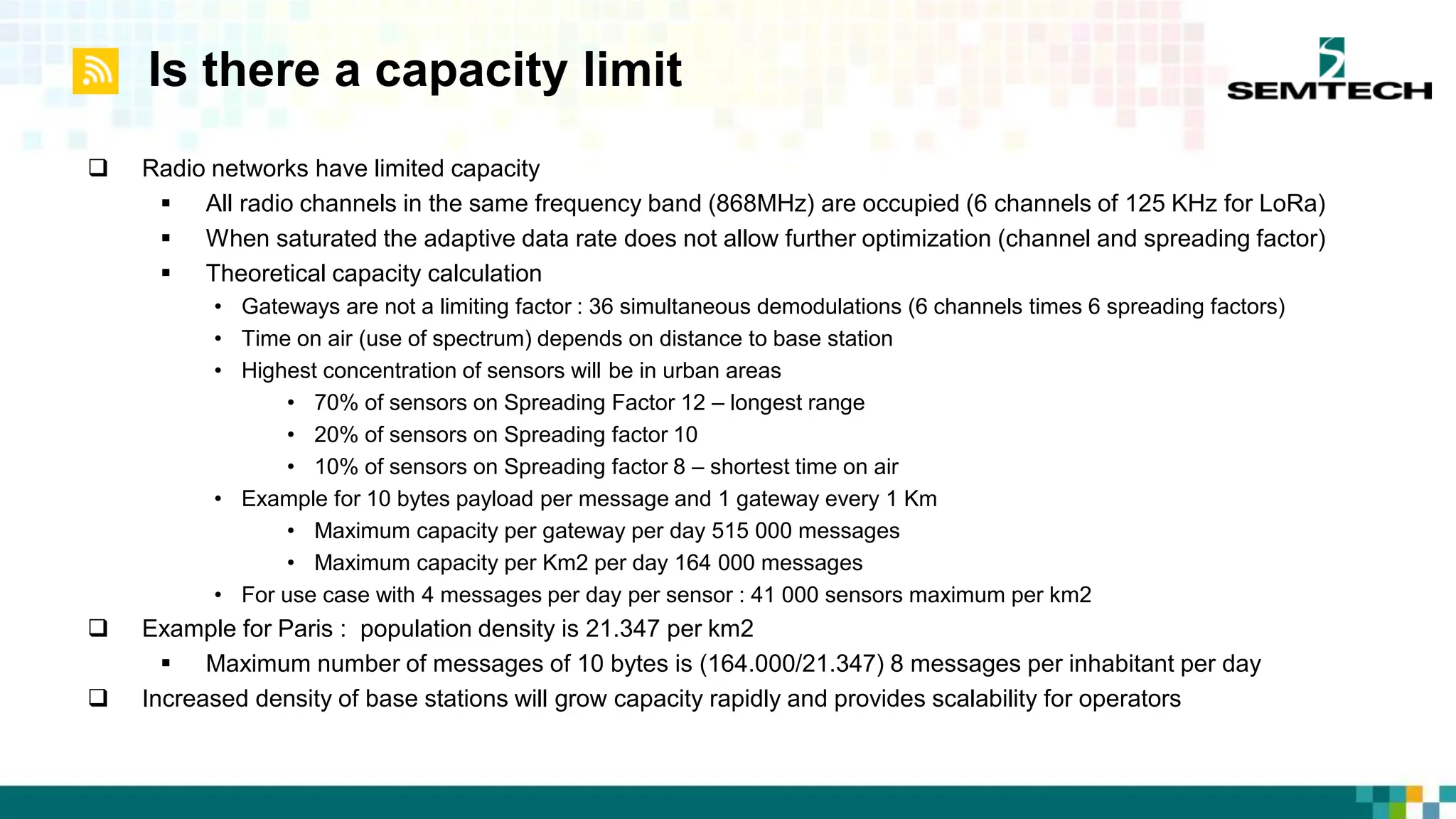
Is there acapacity limit
Radio networks have limited capacity
All radio channels in the same frequency band (868MHz) are occupied (6 channels of 125 KHz for LoRa)
When saturated the adaptive data rate does not allow further optimization (channel and spreading factor)
Theoretical capacity calculation
• Gateways are not a limiting factor : 36 simultaneous demodulations (6 channels times 6 spreading factors)
• Time on air (use of spectrum) depends on distance to base station
• Highest concentration of sensors will be in urban areas
• 70% of sensors on Spreading Factor 12 – longest range
• 20% of sensors on Spreading factor 10
• 10% of sensors on Spreading factor 8 – shortest time on air
• Example for 10 bytes payload per message and 1 gateway every 1 Km
• Maximum capacity per gateway per day 515 000 messages
• Maximum capacity per Km2 per day 164 000 messages
• For use case with 4 messages per day per sensor : 41 000 sensors maximum per km2
Example for Paris : population density is 21.347 per km2
Maximum number of messages of 10 bytes is (164.000/21.347) 8 messages per inhabitant per day
Increased density of base stations will grow capacity rapidly and provides scalability for operators
57.
How much datacan LoRa handle
LoRa technology has been built from scratch to serve the IoT
The adaptive data rate means change speed of transmission when there is a better
quality of the radio signal
The closer a sensor is to a base station the better the quality of the radio signal
Outdoor sensors typically have better signal quality as indoor or underground placed
sensors
The faster the speed of the radio transmission, called data rate, the shorter the
sensor consumes battery power
Faster transmission increases the capacity of the band as more messages can be
transmitted
LoRa can handle from 300bps up to 9,4kbps
The ADR is automatically managed by the network
58.
Optimal security management
Network encryption is AES 128 (as per the 802.15.04 standard)
Multi level security management
One security key per sensor
Network security key per operator (MIC : integrated key)
re-use of the standard encryption as per the 802.15.04 : CCM standard
encryption key only known to operator (always)
Solution provider security key different for each partner and only known to the
partner
encryption of payload to ensure security up to the processing partner
server
Message counter – protection against piracy and identity theft
59.
Underground or deepindoor
Attenuation is higher when sensors are placed underground or deep indoor,
up to the level that radio signals do not
Signal strength is influenced by concrete walls, metal and even human
bodies
Each building has its own specific constraints
If in doubt local measurements need to proof applicability
Network coverage is mostly expressed in % coverage of territory and %
coverage of population
In difficult environments additional base stations will resolve coverage
issues (keep in mind ADR is needed)
The link budget of LoRa, defining the sensitivity of the network, is very close
to the physical limit which leaves no room for competitors to be much better
60.
FAQ – LoRaAlliance
Are there variations of LoRaWAN
Currently LoRaWAN R1.0 is published, enhancements of the standard is driven by the Technical
Committee of the Alliance to which all members contribute
What is the process for upgrades to LoRaWAN
The Technical committee drives the future of the LoRaWAN standard and publishes fixes and new
releases when they become available
How does roaming work with LoRaWAN
Are there exisiting Quality of Service and SLA’s for LoRaWAN
How does hand-over work with LoRaWAN
Why do carriers prefer LoRaWAN
61.
Roaming ready
Roamingis driven by a working group in the Strategy Committee in the
Alliance
Roaming : a sensor joins another network as its Home Network
Technical optimization – use additional base stations in other networks
Location determination
Faster transmission
Lower latency
Lower power consumption
Roaming tariffs are not mandatory and bilateral, through the LoRa Alliance
Network security keys enable proper management of roaming
Message counters are available to allow for proper clearing
Commercial offers including roaming are at each operators discretion
62.
Quality of Service
All data communication is executed at best effort - technology needs to
be robust
Operate in different frequency bands
Limit time on air to avoid collision through ADR
Increase the link budget through higher spreading factor (up to + 20
dB)
Reconstruction of messages even if only parts are received
Automatic band hopping if needed
Balanced link budget for UL and DL
Several device classes to increase QoS when needed
63.
Service Level Agreements
QoS and SLA are network operator responsibilities and defined by each operator as
these depend on network deployment strategies and customer contracts
Through deployment strategies LoRa Network Operators can deliver high service levels
in terms of coverage
LoRaWAN is open and standard protocol guaranteeing compliance throughout the
value chain
Certification guarantees legal compliance and device class for optimal connectivity and
clear coverage maps
Service Level Agreement
Interoperability and roaming
Strong encryption to protect data
Test house involved for certification of sensors
SRD 863-870 MHz : 300-220 (EMITECH)
LoRaWAN compliant
ETSI/FCC compliance
64.
How does handoverwork
Handover like in GSM Networks does not exist with LoRa Networks
Communication is not continuous, sensors transmit only when
needed and receive responses accordingly
Messages are received by one or more base stations and forwarded
to a network server for further processing
Message transmission time is very limited (< a few seconds)
65.
Why carriers preferLoRaWAN
Benefits of scale and experience leading to reduced Capex & Opex
MNO’s have access to tower locations
MNO’s have experience in rolling out networks
ADR enables to grow coverage with market demand
Optimized Quality of Service
Experience in managing and mantaining data com networks
ADR (adaptif data rate) allows for densification without capacity constraints
For outdoor applications the majority of use cases can operate under SF 7
or SF 8, thus extreme low power consumption and high capacity