Longest common
subsequence
(LCS)
Table of contents
01
03
02
04
Understanding
the problem Recursion
Memoization Tabulation
Understanding
The Problem
01
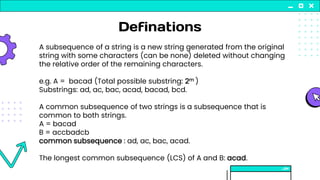
Definations
A subsequence of a string is a new string generated from the original
string with some characters (can be none) deleted without changing
the relative order of the remaining characters.
e.g. A = bacad (Total possible substring: 2m )
Substrings: ad, ac, bac, acad, bacad, bcd.
A common subsequence of two strings is a subsequence that is
common to both strings.
A = bacad
B = accbadcb
common subsequence : ad, ac, bac, acad.
The longest common subsequence (LCS) of A and B: acad.
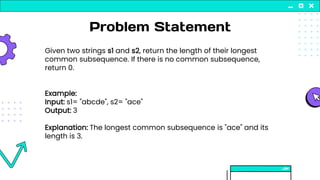
Problem Statement
Given two strings s1 and s2, return the length of their longest
common subsequence. If there is no common subsequence,
return 0.
Example:
Input: s1= "abcde", s2= "ace"
Output: 3
Explanation: The longest common subsequence is "ace" and its
length is 3.
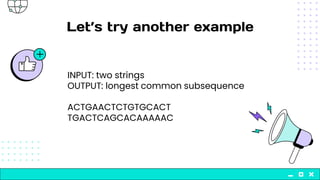
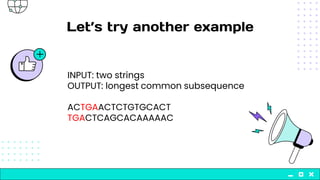
Let’s try another example
INPUT: two strings
OUTPUT: longest common subsequence
ACTGAACTCTGTGCACT
TGACTCAGCACAAAAAC
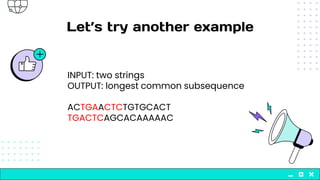
Let’s try another example
INPUT: two strings
OUTPUT: longest common subsequence
ACTGAACTCTGTGCACT
TGACTCAGCACAAAAAC
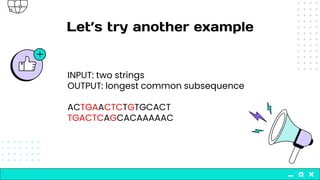
Let’s try another example
INPUT: two strings
OUTPUT: longest common subsequence
ACTGAACTCTGTGCACT
TGACTCAGCACAAAAAC
Let’s try another example
INPUT: two strings
OUTPUT: longest common subsequence
ACTGAACTCTGTGCACT
TGACTCAGCACAAAAAC
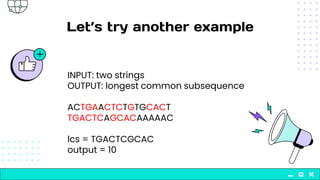
Let’s try another example
INPUT: two strings
OUTPUT: longest common subsequence
ACTGAACTCTGTGCACT
TGACTCAGCACAAAAAC
lcs = TGACTCGCAC
output = 10
Brute Force:
For every subsequence of s1, check whether it’s a
subsequence of s2.
s1 has 2m subsequences.
Each subsequence takes Θ(n) time to check: scan s2 for
first letter, for second, and so on.
Time Complexity : Θ(n2m).
m = length of s1
n = length of s2
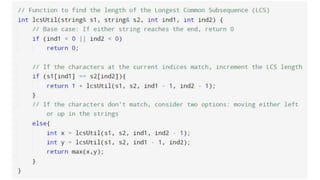
Reccursion
02
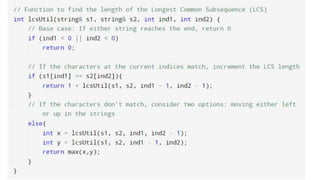
Alogrithm:
Condition 1: Check if both character arrays are empty. If they are
empty, return 0.
Condition 2: If the character arrays are not empty, then check if the
last character of both character arrays matches or not. If you get a
match, then return 1 + LCS (Both character arrays with reduced size).
Condition 3: If you don’t get a character match, move either one
character in the first character array A or the second character
array B. Pick whichever produces maximum value.
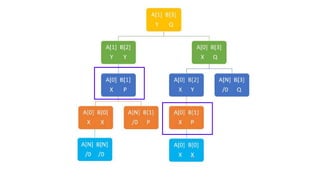
Recursion
Tree
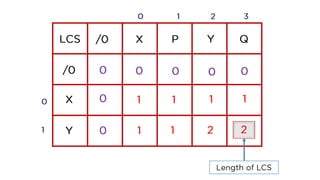
let’s consider two string
A = “XY”, length = 2
B = “XPYQ”, length = 4
XY
XPYQ
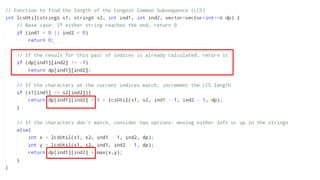
Memoization
(Top down)
03
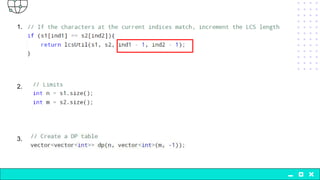
1.
2.
3.
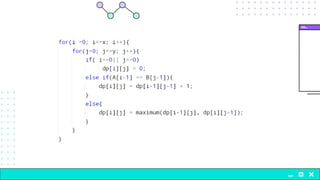
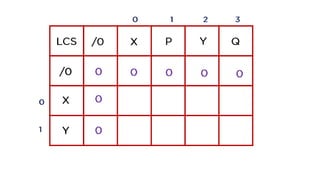
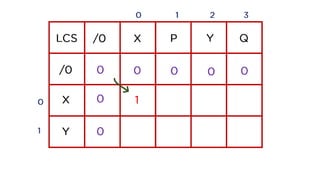
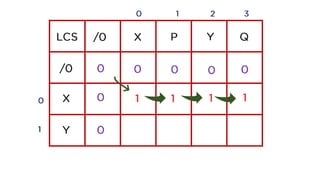
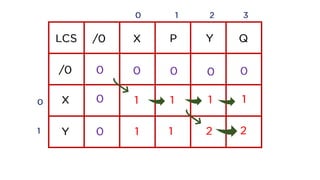
Tabulation
(Bottom up)
04
Refrences
Videos
● Abdul Bari
Articles
● Leetcode
● Algotree
● Simplelearn
● TakeUForward
CREDITS: This presentation template was created by Slidesgo, and
includes icons by Flaticon and infographics & images by Freepik
Thanks!

Longest Common subsequence.pptx

  • 1.
  • 2.
    Table of contents 01 03 02 04 Understanding theproblem Recursion Memoization Tabulation
  • 3.
  • 4.
    Definations A subsequence ofa string is a new string generated from the original string with some characters (can be none) deleted without changing the relative order of the remaining characters. e.g. A = bacad (Total possible substring: 2m ) Substrings: ad, ac, bac, acad, bacad, bcd. A common subsequence of two strings is a subsequence that is common to both strings. A = bacad B = accbadcb common subsequence : ad, ac, bac, acad. The longest common subsequence (LCS) of A and B: acad.
  • 5.
    Problem Statement Given twostrings s1 and s2, return the length of their longest common subsequence. If there is no common subsequence, return 0. Example: Input: s1= "abcde", s2= "ace" Output: 3 Explanation: The longest common subsequence is "ace" and its length is 3.
  • 6.
    Let’s try anotherexample INPUT: two strings OUTPUT: longest common subsequence ACTGAACTCTGTGCACT TGACTCAGCACAAAAAC
  • 7.
    Let’s try anotherexample INPUT: two strings OUTPUT: longest common subsequence ACTGAACTCTGTGCACT TGACTCAGCACAAAAAC
  • 8.
    Let’s try anotherexample INPUT: two strings OUTPUT: longest common subsequence ACTGAACTCTGTGCACT TGACTCAGCACAAAAAC
  • 9.
    Let’s try anotherexample INPUT: two strings OUTPUT: longest common subsequence ACTGAACTCTGTGCACT TGACTCAGCACAAAAAC
  • 10.
    Let’s try anotherexample INPUT: two strings OUTPUT: longest common subsequence ACTGAACTCTGTGCACT TGACTCAGCACAAAAAC lcs = TGACTCGCAC output = 10
  • 11.
    Brute Force: For everysubsequence of s1, check whether it’s a subsequence of s2. s1 has 2m subsequences. Each subsequence takes Θ(n) time to check: scan s2 for first letter, for second, and so on. Time Complexity : Θ(n2m). m = length of s1 n = length of s2
  • 12.
  • 13.
    Alogrithm: Condition 1: Checkif both character arrays are empty. If they are empty, return 0. Condition 2: If the character arrays are not empty, then check if the last character of both character arrays matches or not. If you get a match, then return 1 + LCS (Both character arrays with reduced size). Condition 3: If you don’t get a character match, move either one character in the first character array A or the second character array B. Pick whichever produces maximum value.
  • 14.
    Recursion Tree let’s consider twostring A = “XY”, length = 2 B = “XPYQ”, length = 4 XY XPYQ
  • 16.
  • 19.
  • 21.
  • 28.
    Refrences Videos ● Abdul Bari Articles ●Leetcode ● Algotree ● Simplelearn ● TakeUForward
  • 29.
    CREDITS: This presentationtemplate was created by Slidesgo, and includes icons by Flaticon and infographics & images by Freepik Thanks!