Address,
Name: Loko Galchu Ware
Mail:galchu.loko@gmail.com
Phone: +251925598743
Nationality: ETHIOPIA
Coll. Of Education & Behavioral Science
Dep. Of Psychology
TITTLE: THE ASSESSMENT OF PSYCHOSOCIAL FACTOR ASSOCIATED WITH
AMONG COUPLES BEING CHILDLESSNESS: In the Case of Gubre Town (Conducted as
Essay or For BA graduation In Wolkite University)
June, 2018
Acknowledgment
First of all I would like to thanks my God, next to that I would like to thanks my adviser
Mr.Henok Legesse (MA in Guidance &counseling psychology) for his appreciable support in
my senior essay research, all psychology department instructors for their contribution to shape
me from 1st year up to now by sharing knowledge they have without keep it, Finally; I thanks
my all family members and friends.
Abstract
This study conducted on assessment of psychosocial factor associated with among being
childlessness or infertile of couples in Gubre town. General objective of the presented study was
to assess psychosocial factors Associated with couples being childlessness. More specifically the
study assessed to the level of discrimination among being childlessness of couples; the level of
psychological damage or problem caused by childlessness; the level of available psychosocial
supports for couples being childlessness. Non probability or purposive sample techniques was
used to select respondents of the study. Sample size of this study was 20 respondents were
purposively selected for the study; childless couples affected at high level 45% of
psychologically, gained little of psychosocial support of 70%, and discrimination at 55%
affected by facing little level of discrimination. As conducted study in Gubre town couples being
childlessness were affected psychologically at high level, obtained low level of supports from
society, and discriminated most of them at little level. Key words: infertile or childlessness,
couples
CHAPTER ONE
INTRODUCTION
1.1 Backgroundof the Study
Infertility or being childlessness is a global problem that affects the social, economic and
psychological wellbeing of couples. According to the World Health Organization (WHO,
2011), infertility defined as an inability of a couple to conceive within two years of regular and
unprotected sex. Infertility can be of two types: primary and Secondary infertility (ibid). While
primary infertility refers to the inability of a couple to conceive a child at all, secondary infertility
implies inability to conceive again after a previous pregnancy (ibid).
According to Reproductive Health Outlook (RHO, 2003), infertility is a global problem
affecting about 8-10% of couples worldwide. In Africa, as Reproductive Health Outlook (2003)
noted that Sub Saharan Africa has the highest infertility prevalence ranging from 7% - 29%.
In Ethiopia, as conducted study in Southwest Ethiopia by Deribe and colleagues (2007) noted
that some infertile women were divorced due to their childlessness. Others reported that their
husbands had lost interest in them. This are also results couples in to the discrimination. Some
husbands on the other hand told that they were planning to marry another woman to get a child.
These practices of divorce and remarriage exposed childless women and men to STDs and
HIV/AIDS (Deribe, 2007).This paper examines psychosocial factor through assessing level of
discrimination, level of psychological problem, and level of psychosocial support of couples
being childlessness who live in Gubre town. Infertility in Southwest Ethiopia (Illubabor Zone) is
commonly attributed to God’s wrath (Deribe et al., 2007).
These are also causes couples for psychosocial problem like: depression, anxiety, feeling of
loneliness, low self-esteem and think of peoples talk about them behinds. Particularly, in Gubre
town also what noted that by study conducted in other parts of Ethiopia will be really faced with
both women and men or couples being childlessness/infertile. While men and women are
assumed to have equal probability of being infertile, in many societies of Africa the problem of
infertility is perceived mainly as women’s problem (Deribe et al., 2007; Inhorn, 1996; Kimani
and Olenja, 2001).
1.2. Statementof problem
In most rural parts of Ethiopia, children are considered as assets and having many children is a
symbol of high status and in urban considered as shaping marital satisfaction. In the Ethiopian
context, giving birth is considered as a main purpose in life for couples. As children are assumed
to be God’s blessings, life is meaningless for couples who fail to have children. Fertility has thus
a great value in Ethiopian context (Deribe et al., 2007).
However, most Ethiopian research focused on the problems of how to reduce the fertility rate of
the country and what factors contribute towards a small family size (Alene and Worku, 2008).
The other side of the story, infertility as a social and personal problem, is almost ignored, but this
study considered infertility as a social and personal problem has many dimensions in rural Parts
of Ethiopia. This research explores the psychosocial factor associated among being childlessness
of couples in Gubre town with its level of discrimination, psychological problem, and
psychosocial supports. Most Ethiopian researchers conducted research on reproductive health
issues focused on the problems of how to reduce the fertility rate of the country, but they don’t
see the problem of couples who doesn’t give birth or those who are infertile. Just now the aim is
to fill this gap that jumped over by different researchers before.
1.3. Objectives of the study
1.3.1. Generalobjective
General objective of this study was to assess psychosocialfactors
Associated with the couple’s being childlessness.
1.3.2. Specific objective
The specific objectives of this study were to assess:
• The level of discrimination among being childlessness of couples
• The level of psychological damage or problem caused by childlessness
• The level of available psychosocial supports for couples being childlessness
1.4 ResearchQuestion
1. What are the level discriminations among couples being childlessness?
2. What are the levels of psychological damage or problems caused by childlessness?
3. What are the levels of available psychosocial support for couples being childlessness?
1.5. Significance ofthe study
The significance of this study will be to develop the ways of understanding psychosocial factors
of couples being childlessness and to give awareness of coping strategies for those who are being
infertile through identifying their social, personal, psychological, emotional problem related with
their self-concept among being infertile.
1.6. Scope ofthe study
The delimitation of this study will be the area of purposively selected for the study which is
Gubre sub city and will focus on only participants selected for the study those who are being
childless couples to conduct study about their psychosocial factors among being infertile.
1.7. Operational Definition
Infertility or childlessness is an inability of a couple to conceive within Two
years of regular and unprotected sex.
CHAPTER TWO
REVIEW OF RELATED LITERATURE
In recent years, however, there has been a growing interest in study in the problem of infertility
also in the majority world. There are some recent infertility studies from sub-Saharan Africa.
Most of these studies are quantitative in nature and are based on big surveys. The major focus of
the studies include: the prevalence of primary and secondary infertility, perceptions of causes and
treatments of infertility, and experiences of infertile women. Most of these studies have
documented somehow similar results regarding these themes. According to the studies, the
perceived
Causes of infertility in many parts of Africa are mainly nonmedical and are commonly associated
with supernatural or evil powers, and the treatment often involves traditional healers and
spiritualists (Deribe et al., 2007; Gerrits, 1997; Pearce, 1999; Runganga et al., 2001). Women’s
experience of infertility are documented to be multi-dimensional and includes stigmatization,
ostracism and neglect, marital instability, abuse, loss of social status and security (Hollos and
Larsen, 2008; Hollos et al., 2009; Kimani and Olenja, 2001; Orji et al., 2002; Samuel N, 2006).
In this chapter, I will review infertility studies from Africa in general and from Ethiopia in
particular. I will also include some studies from other parts of the world in order to capture
variation and similarities. It is good to first look at the value of children so that we can have a
better picture on the seriousness of infertility related problems especially in the African context.
2.1. The Values of Children
Some of the societies value children for their contribution to parents’ emotional wellbeing, other
societies emphasize the economic value of children (Lancy, 2008). By reviewing infertility
studies in African countries, Dyer (2007) identified six major values of children: (1) marital
stability, (2) social security and domestic support, (3) gender identity and parenthood, (4) social
status and stigmatization, (5) continuity and religious beliefs, and (6) emotional values. Marital
stability: In many parts of Africa the dominant purpose of marriage is to have children since
marriage without children is incomplete and insecure (Dyer, 2007).
Infertility studies documented multi-dimensional impacts of childlessness on marital life which
include polygamy, divorce, remarriage, abuse, neglect, and abandonment (Deribe et al., 2007;
Hollos et al., 2009; Inhorn, 1996; Orji et al., 2002; Pearce, 1999). For example, Orji and
colleagues (2002, p. 61) conducted a quantitative study on the impact of infertility on marital life
in Ile Ife Nigeria which included 236 women. The study found out that 38.9% of the respondents
had divorced and remarried because of infertility. A study in Southwest Ethiopia by Deribe and
colleagues (2007) noted that some infertile women were divorced due to their childlessness.
Others reported that their husbands had lost interest in them. Some husbands on the other hand
told that they were planning to marry another woman to get a child (ibid). Social security and
domestic support: “In African communities, land is commonly owned by men and land claims
are negotiated through the number of their children” (Dyer, 2007, p. 73).
Children are also seen as old age insurances and guarantors of generational continuity. A study in
southwest Ethiopia found out that most of the childless respondents are worried about not having
helpers in their old age (Deribe et al., 2007). Gender identity and parenthood: In many African
communities, having own children is the only way to achieve full adult womanhood and
manhood. A study from Zimbabwe found that a man who failed to have children was not
considered as a real man but as a boy (Runganga et al., 2001).
Social status and stigmatization: Having children is related to parents’ social status, wealth, and
prestige in many African communities. Consequently, infertility results in stigmatization and loss
of social status. A wealthy person without children might not get recognition in a community
(Dyer, 2007). Continuity and religious beliefs: “In African communities, children continue the
family name and lineage, inherit family land and wealth, and confer a sense of continuity and
belonging” (Dyer, 2007, p. 74). From a religious perspective, children are often seen as a gift of
God and consequently, inability to conceive may be seen as resulting from a sin or that the
infertile is unworthy to receive God’s gift (ibid).
Emotional values: Inhorn and van Balen (2002) argue that the existence of strong socio economic
reasons for having children in many non-Western settings doesn’t mean that personal happiness
and the joy of having children are not motivating factors too. Affectionate parents are found
throughout the world and are, of course, abundant in non-Western settings too (ibid). Several
studies support this argument. For example, a study in Zimbabwe (Harare and two villages)
about the cultural meaning of reproductive failure found out that children are seen as a sense of
purpose to life, offering companionship and providing emotional support (Runganga et al., 2001,
p. 325).
Childless women also believed that children fulfill the need to love and to be loved (ibid).Dyer et
al. (2002) noted that the main reason for wanting children in an urban community in South Africa
was to give life a purpose and to be able to give love to the child. Similarly, a study in five major
Ethiopian cities (Addis Ababa, Nazareth, Bahir Dar, Jimma and Harar) found out that children
were considered as sources of happiness (Sahleyesus, 2005).
CHAPTER THREE
3.1 RESEARCH DESIGN AND METHODOLOGY
This chapter includes description of the study area, research design, population of the
study, sampling size, sampling techniques, data collection instruments, data analysis,
ethical considerations, and limitation of the study.
3.1. Area
This study was conducted in Gubre town, SNNP. Gubre town is found SNNP region and an
administrative sub city of Gurage zone with a total population of 1000-1200 approximately. Its
capital, Wolkite, has a population of 5000-6000 approximately and will be above.
3.2. RESEARCHDESIGN
Descriptive research design was used to describe psychosocial factors associated with among
being childlessness of the couples. AS it indicates from descriptive research design only describe
something as it is.
3.3. Population of the Study
The target population of this study was only couples being childlessness those who were live
Gubre town.
3.4. Sampling Technique and Sampling Size
Non probability or purposive sample techniques was used to select respondents of the study. To
selecting respondents, the researcher was passed long term duration above one year, because the
researcher had long period interest to conduct study on the title to understand psychosocial
problems of couples being childlessness. Sample size of this study was 20 respondents were
purposively selected for the study.
3.5. Instruments
Data was collected through questionnaire and structured interview from selected respondents by
translating questionnaire of ENGLISH in to AMHARIC as it could clearly understand for
respondents.
3.6. Data Analysis
Collected data was analyzed through table, graphs, and percentile under chapter four.
3.7. EthicalConsideration
This research was fulfilled all the necessary requirements of the Norwegian Social Science Data
Services (NSD) regarding confidentiality of the information, anonymity of the informants, and
safe storage of the data. Research topics which touch on deeply personal experiences can be
considered as sensitive topics (Lee and Renzetti, 1990). Infertility is one of the sensitive issues
that touch persona and emotional issues such as marital and extra marital relations, abortion, and
sexually transmitted infections. To deal with this sensitive topic, key ethical principles such as
informed consent and confidentiality will adhered to in relation to the informants (Davis, 1999).
3.8. Limitation of the Study
The limitation of this study was lack of generalization and being congruence or realness of
participants informs their inner feeling and emotion can be considered. Lack of generalization
was because of fewness of sample sizes.
CHAPTER FOUR
4. RESULT
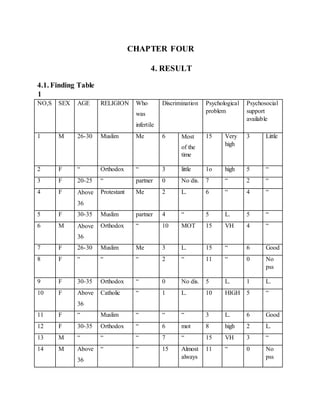
4.1. Finding Table
1
NO,S SEX AGE RELIGION Who
was
infertile
Discrimination Psychological
problem
Psychosocial
support
available
1 M 26-30 Muslim Me 6 Most
of the
time
15 Very
high
3 Little
2 F “ Orthodox “ 3 little 1o high 5 “
3 F 20-25 “ partner 0 No dis. 7 “ 2 “
4 F Above
36
Protestant Me 2 L. 6 “ 4 “
5 F 30-35 Muslim partner 4 “ 5 L. 5 “
6 M Above
36
Orthodox “ 10 MOT 15 VH 4 “
7 F 26-30 Muslim Me 3 L. 15 “ 6 Good
8 F “ “ “ 2 “ 11 “ 0 No
pss
9 F 30-35 Orthodox “ 0 No dis. 5 L. 1 L.
10 F Above
36
Catholic “ 1 L. 10 HIGH 5 “
11 F “ Muslim “ “ “ 3 L. 6 Good
12 F 30-35 Orthodox “ 6 mot 8 high 2 L.
13 M “ “ “ 7 “ 15 VH 3 “
14 M Above
36
“ “ 15 Almost
always
11 “ 0 No
pss
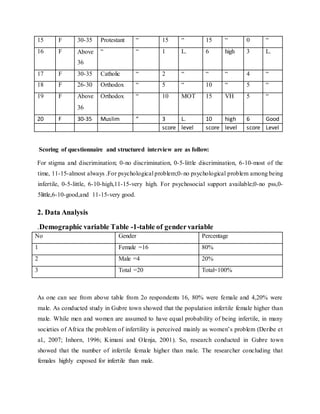
15 F 30-35 Protestant “ 15 “ 15 “ 0 “
16 F Above
36
“ “ 1 L. 6 high 3 L.
17 F 30-35 Catholic “ 2 “ “ “ 4 “
18 F 26-30 Orthodox “ 5 “ 10 “ 5 “
19 F Above
36
Orthodox “ 10 MOT 15 VH 5 “
20 F 30-35 Muslim “ 3 L. 10 high 6 Good
score level score level score Level
Scoring of questionnaire and structured interview are as follow:
For stigma and discrimination; 0-no discrimination, 0-5-little discrimination, 6-10-most of the
time, 11-15-almost always .For psychological problem;0-no psychological problem among being
infertile, 0-5-little, 6-10-high,11-15-very high. For psychosocial support available;0-no pss,0-
5little,6-10-good,and 11-15-very good.
2. Data Analysis
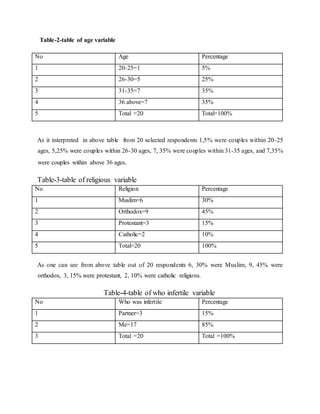
.Demographic variable Table -1-table of gendervariable
No Gender Percentage
1 Female =16 80%
2 Male =4 20%
3 Total =20 Total=100%
As one can see from above table from 2o respondents 16, 80% were female and 4,20% were
male. As conducted study in Gubre town showed that the population infertile female higher than
male. While men and women are assumed to have equal probability of being infertile, in many
societies of Africa the problem of infertility is perceived mainly as women’s problem (Deribe et
al., 2007; Inhorn, 1996; Kimani and Olenja, 2001). So, research conducted in Gubre town
showed that the number of infertile female higher than male. The researcher concluding that
females highly exposed for infertile than male.
Table-2-table of age variable
No Age Percentage
1 20-25=1 5%
2 26-30=5 25%
3 31-35=7 35%
4 36 above=7 35%
5 Total =20 Total=100%
As it interpreted in above table from 20 selected respondents 1,5% were couples within 20-25
ages, 5,25% were couples within 26-30 ages, 7, 35% were couples within 31-35 ages, and 7,35%
were couples within above 36 ages.
Table-3-table of religious variable
No Religion Percentage
1 Muslim=6 30%
2 Orthodox=9 45%
3 Protestant=3 15%
4 Catholic=2 10%
5 Total=20 100%
As one can see from above table out of 20 respondents 6, 30% were Muslim, 9, 45% were
orthodox, 3, 15% were protestant, 2, 10% were catholic religions.
Table-4-table of who infertile variable
No Who was infertile Percentage
1 Partner=3 15%
2 Me=17 85%
3 Total =20 Total =100%
As anyone can see from the above table out of 20 respondents 3, 15% were infertile was partner
and 17, 85% were those who was being infertile.
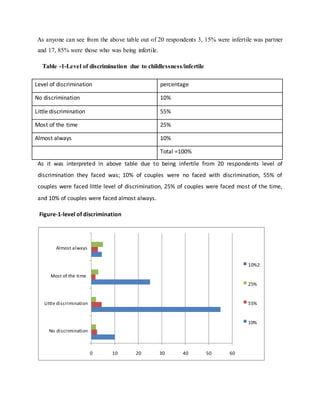
Table -1-Level of discrimination due to childlessness/infertile
Level of discrimination percentage
No discrimination 10%
Little discrimination 55%
Most of the time 25%
Almost always 10%
Total =100%
As it was interpreted in above table due to being infertile from 20 respondents level of
discrimination they faced was; 10% of couples were no faced with discrimination, 55% of
couples were faced little level of discrimination, 25% of couples were faced most of the time,
and 10% of couples were faced almost always.
Figure-1-level of discrimination
0 10 20 30 40 50 60
No discrimination
Little discrimination
Most of the time
Almost always
2
%
10
%
25
%
55
10%
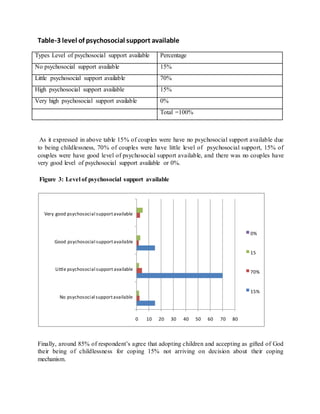
Table-2-Level of psychological problem
Level of psychological problem Percentage
No psychological problem 0%
Little psychological problem 15%
High 45%
Very high 40%
Total =100%
As one can see from above table there was no couples being free from psychological problem
among infertile or 0%, 15% were couples with little level of psychological problem, 45% were
couples with high level of psychological problem, and 40% were couples with very high level of
psychological problem.
Figure-2 Level of psychological problem
0 10 20 30 40 50
No psychological problem
Little psychological problem
High psychological problem
Very high psychological
problem
40%
45%
15%
0%
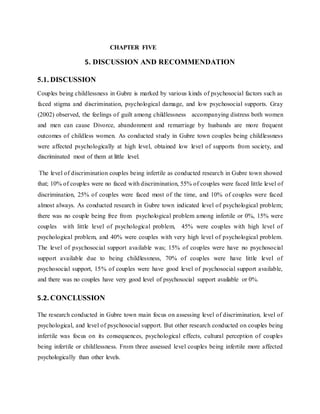
Table-3 level of psychosocial support available
Types Level of psychosocial support available Percentage
No psychosocial support available 15%
Little psychosocial support available 70%
High psychosocial support available 15%
Very high psychosocial support available 0%
Total =100%
As it expressed in above table 15% of couples were have no psychosocial support available due
to being childlessness, 70% of couples were have little level of psychosocial support, 15% of
couples were have good level of psychosocial support available, and there was no couples have
very good level of psychosocial support available or 0%.
Figure 3: Level of psychosocial support available
Finally, around 85% of respondent’s agree that adopting children and accepting as gifted of God
their being of childlessness for coping 15% not arriving on decision about their coping
mechanism.
0 10 20 30 40 50 60 70 80
No psychosocial supportavailable
Little psychosocial support available
Good psychosocial supportavailable
Very good psychosocial supportavailable
0%
15
%
70
15%
CHAPTER FIVE
5. DISCUSSION AND RECOMMENDATION
5.1. DISCUSSION
Couples being childlessness in Gubre is marked by various kinds of psychosocial factors such as
faced stigma and discrimination, psychological damage, and low psychosocial supports. Gray
(2002) observed, the feelings of guilt among childlessness accompanying distress both women
and men can cause Divorce, abandonment and remarriage by husbands are more frequent
outcomes of childless women. As conducted study in Gubre town couples being childlessness
were affected psychologically at high level, obtained low level of supports from society, and
discriminated most of them at little level.
The level of discrimination couples being infertile as conducted research in Gubre town showed
that; 10% of couples were no faced with discrimination, 55% of couples were faced little level of
discrimination, 25% of couples were faced most of the time, and 10% of couples were faced
almost always. As conducted research in Gubre town indicated level of psychological problem;
there was no couple being free from psychological problem among infertile or 0%, 15% were
couples with little level of psychological problem, 45% were couples with high level of
psychological problem, and 40% were couples with very high level of psychological problem.
The level of psychosocial support available was; 15% of couples were have no psychosocial
support available due to being childlessness, 70% of couples were have little level of
psychosocial support, 15% of couples were have good level of psychosocial support available,
and there was no couples have very good level of psychosocial support available or 0%.
5.2. CONCLUSSION
The research conducted in Gubre town main focus on assessing level of discrimination, level of
psychological, and level of psychosocial support. But other research conducted on couples being
infertile was focus on its consequences, psychological effects, cultural perception of couples
being infertile or childlessness. From three assessed level couples being infertile more affected
psychologically than other levels.
5.3. RECOMMENDATIONS
The study hereby recommends the following:
1. Sexual activity at early age and promiscuousness should be discouraged. Many conducted
research noted that this practice could be cause for infertility.
2. When a couple is unable to conceive, it is important to find and treat the underlying cause(s),
whether medical or psychosocial or both
3. Good counseling can also help both men and women. They have to seek family therapy.
4. There is dire need for providing adequate and accurate information at the community level to
correct the misconception and myths about childlessness.
5. It is clear that childlessness in a woman increases the chances that her human rights will be
violated even when etiology of the problem is not directly attributed to her. In view of these,
women health advocate and the Government at various levels should endeavor to provide
adequate preventive and counseling service to improve the reproductive health and rights of
women in Gubre town.
REFERENCE
.Alene, G. D. and Worku, A. (2008). Differentials of fertility in North and South Gondarzones, North
WestEthiopia:Acomparativecrosssectionstudt.BMCpublichealth.Retrievedfromhttp://127.0.0.1:4664/
search?q=biomed+central&flags=1048576&s=s5xCCCs2EO9da2c_QbvqlEtxwW0
.
.Davis, C. A. (1999). Reflexive Ethnography: A guide to researching selves and others.
London and New York: Routledge.
.Deribe, K., Anberbir, A., Regassa, G., Belachew, T. and Biadgilign, S. (2007). Infertility
percieved causes and experiances in rural South West Ethiopia. Ethiopian Journal of
.Dyer, S. J. (2007). The value of children in African countries: Insights from studies on
infertility. Journal of Psychosomatic Obstetric & Gynecology, 28(2), 69-77.
.
.Dyer, S. J., Abrahams, A., Hoffman, M. and Van der Spuy, Z. M. (2002). Men leave me as I can
not have children: Women's experiances with childlessness. 17(6), 1663-1668.
.
.Gray, A. J. (2002). Stigma in psychiatry. Jornal of the Royal Society of Medicine, 95(2), 72- 76.
Inhorn, M. C. and van Balen, F. (2002). Infertility arond the Globe: 2ew thinking on
Childlessness, Gender, and Reproductive Technologies. Berkeley, Los Angeles,
London: University of California Press.
..
.Kimani, V. and Olenja, J. (2001). Infertility: Cultural Dimentions and Impact on Women in
Selected Communities in Kenya. The African Anthropologist, 8(2), 200-214.
. .
.Larsen, U. (2005). Research on Infertility: Which definition should we use? Infertility and
Sterility, 83(4), 846-852.
.
.
.Orji, E. O., Kuti, O. and Fasubaa, O. B. (2002). Impact of infertility on marital life in Nigeria.
International Journal of Gynecology and Obtetrics, 79,61-62.
.
RHO. (2003). Infertility: Overview and lessons learned. Reproductive Health Outlook., from
http://www.icmer.org/RHO/html/infertility_overview.htm#levels-and-causes
.Runganga, A. O., Sundby, J. and Aggleton, P. (2001). Culture, identity and reproductive
failure in Zimbabwe. Sexualities, 4(3), 315-332.
.Sahleyesus, D. (2005). Attitudes toward family size preferences among urban Ethiopians.
discussion paper. Retrieved from http://sociology.uwo.ca/popstudies/dp/dp05-10.pdf
.Samuel N, O. (2006). Extramarital sexual activity among infertile women in southeast Nigeria.
The Journal of Obstetrics and Gynecology of India, 56(1), 72-195). .WHO.
(2011, 8.10.2010). Infertility. World Health Organization., from
http://www.who.int/topics/infertility/en/
Appendix
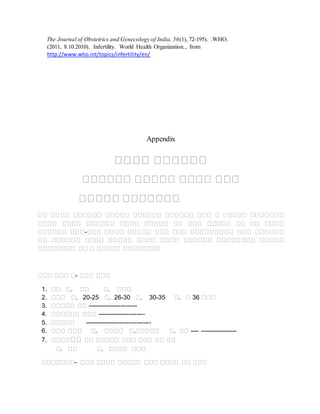
ወወወወ ወወወወወወ
ወወወወወወ ወወወወወ ወወወወ ወወወ
ወወወወወ ወወወወወወወ
ወወ ወወወወ ወወወወወወ ወወወወወ ወወወወወወ ወወወወወወ ወወወ ወ ወወወወወ ወወወወወወወ
ወወወወ ወወወወ ወወወወወወ ወወወወ ወወወወወ ወወ ወወወ ወወወወወ ወወ ወወ ወወወወ
ወወወወወወ ወወወ-ወወወ ወወወወ ወወወወወ ወወወ ወወወ ወወወወወወወወወ ወወወ ወወወወወወ
ወወ ወወወወወወ ወወወወ ወወወወወ ወወወወ ወወወወ ወወወወወወ ወወወወወወወወ ወወወወወ
ወወወወወወወወ ወወ ወ ወወወወወ ወወወወወወወወ
ወወወ ወወወ ወ- ወወወ ወወወ
1. ወወ ወ. ወወ ወ. ወወወ
2. ወወወ ወ. 20-25 ወ. 26-30 ወ. 30-35 ወ. ወ 36 ወወወ
3. ወወወወወ ወወ ------------------------
4. ወወወወወወ ወወወ -----------------------
5. ወወወወወ --------------------------------
6. ወወወ ወወወ ወ. ወወወወ ወ.ወወወወወ ወ. ወወ ---- ------------------
7. ወወወወወወ ወወ ወወወወወ ወወወ ወወወ ወወ ወወ
ወ. ወወ ወ. ወወወወ ወወወ
ወወወወወወወ- ወወወ ወወወወ ወወወወወ ወወወ ወወወወ ወወ ወወወ
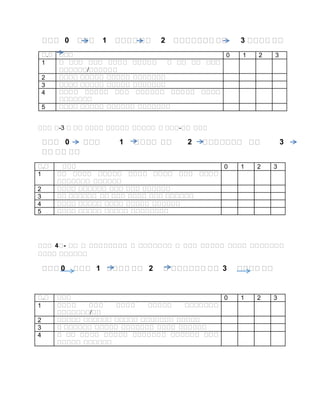
መመመ 0 መመመ 1 መመመመ መመ 2 መመመመመመመ መመ 3 መመመመ መመ
ወ.ወ ወወወ 0 1 2 3
1 ወ ወወወ ወወወ ወወወወ ወወወወወ ወ ወወ ወወ ወወወ
ወወወወወወ/ወወወወወወ
2 ወወወወ ወወወወወ ወወወወወ ወወወወወወወ
3 ወወወወ ወወወወወ ወወወወወ ወወወወወወወ
4 ወወወወ ወወወወወ ወወወ ወወወወወወ ወወወወወ ወወወወ
ወወወወወወወ
5 ወወወወ ወወወወወ ወወወወወወ ወወወወወወወ
ወወወ ወ-3 ወ ወወ ወወወወ ወወወወወ ወወወወወ ወ ወወወ-ወወ ወወወ
መመመ 0 መመመ 1 መመመመ መመ 2 መመመመመመመ መመ 3
መመ መመ መመ
ወ.ወ ወወወ 0 1 2 3
1 ወወ ወወወወ ወወወወወ ወወወወ ወወወወ ወወወ ወወወወ
ወወወወወወወ ወወወወወወ
2 ወወወወ ወወወወወወ ወወወ ወወወ ወወወወወወ
3 ወወ ወወወወወወ ወወ ወወወ ወወወወ ወወወ ወወወወወወ
4 ወወወወ ወወወወወ ወወወወ ወወወወወ ወወወወወወ
5 ወወወወ ወወወወወ ወወወወወ ወወወወወወወወ
መመመ 4መ- መመ መ መመመመመመመመ መ መመመመመመመ መ መመመ መመመመመ መመመመ መመመመመመመ
መመመመ መመመመመመ
መመመ 0 መመመ 1 መመመመ መመ 2 መ መመመመመመ መመ 3 መመመመ መመ
ወ.ወ ወወወ 0 1 2 3
1 ወወወወ ወወወ ወወወወ ወወወወወ ወወወወወወወ
ወወወወወወወ/ወወ
2 ወወወወወ ወወወወወወ ወወወወወ ወወወወወወወ ወወወወወ
3 ወ ወወወወወወ ወወወወወ ወወወወወወወ ወወወወ ወወወወወወ
4 ወ ወወ ወወወወ ወወወወወ ወወወወወወወ ወወወወወወ ወወወ
ወወወወወ ወወወወወወ
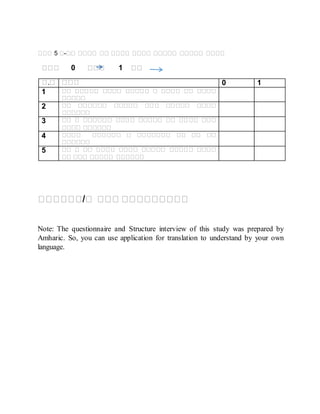
ወወወ 5 ወ-ወወ ወወወወ ወወ ወወወወ ወወወወ ወወወወወ ወወወወወ ወወወወ
መመመ 0 መመመ 1 መመ
ወ.ወ ወወወ 0 1
1 ወወ ወወወወወ ወወወወ ወወወወወ ወ ወወወወ ወወ ወወወወ
ወወወወወ
2 ወወ ወወወወወወ ወወወወወ ወወወ ወወወወወ ወወወወ
ወወወወወወ
3 ወወ ወ ወወወወወወ ወወወወ ወወወወወ ወወ ወወወወ ወወወ
ወወወወ ወወወወወወ
4 ወወወወ ወወወወወወ ወ ወወወወወወወ ወወ ወወ ወወ
ወወወወወወ
5 ወወ ወ ወወ ወወወወ ወወወወ ወወወወወ ወወወወወ ወወወወ
ወወ ወወወ ወወወወወ ወወወወወወ
መመመመመመ/መ መመመ መመመመመመመመመ
Note: The questionnaire and Structure interview of this study was prepared by
Amharic. So, you can use application for translation to understand by your own
language.

Loko research last

  • 1.
    Address, Name: Loko GalchuWare Mail:galchu.loko@gmail.com Phone: +251925598743 Nationality: ETHIOPIA Coll. Of Education & Behavioral Science Dep. Of Psychology TITTLE: THE ASSESSMENT OF PSYCHOSOCIAL FACTOR ASSOCIATED WITH AMONG COUPLES BEING CHILDLESSNESS: In the Case of Gubre Town (Conducted as Essay or For BA graduation In Wolkite University) June, 2018
  • 2.
    Acknowledgment First of allI would like to thanks my God, next to that I would like to thanks my adviser Mr.Henok Legesse (MA in Guidance &counseling psychology) for his appreciable support in my senior essay research, all psychology department instructors for their contribution to shape me from 1st year up to now by sharing knowledge they have without keep it, Finally; I thanks my all family members and friends.
  • 3.
    Abstract This study conductedon assessment of psychosocial factor associated with among being childlessness or infertile of couples in Gubre town. General objective of the presented study was to assess psychosocial factors Associated with couples being childlessness. More specifically the study assessed to the level of discrimination among being childlessness of couples; the level of psychological damage or problem caused by childlessness; the level of available psychosocial supports for couples being childlessness. Non probability or purposive sample techniques was used to select respondents of the study. Sample size of this study was 20 respondents were purposively selected for the study; childless couples affected at high level 45% of psychologically, gained little of psychosocial support of 70%, and discrimination at 55% affected by facing little level of discrimination. As conducted study in Gubre town couples being childlessness were affected psychologically at high level, obtained low level of supports from society, and discriminated most of them at little level. Key words: infertile or childlessness, couples
  • 4.
    CHAPTER ONE INTRODUCTION 1.1 Backgroundofthe Study Infertility or being childlessness is a global problem that affects the social, economic and psychological wellbeing of couples. According to the World Health Organization (WHO, 2011), infertility defined as an inability of a couple to conceive within two years of regular and unprotected sex. Infertility can be of two types: primary and Secondary infertility (ibid). While primary infertility refers to the inability of a couple to conceive a child at all, secondary infertility implies inability to conceive again after a previous pregnancy (ibid). According to Reproductive Health Outlook (RHO, 2003), infertility is a global problem affecting about 8-10% of couples worldwide. In Africa, as Reproductive Health Outlook (2003) noted that Sub Saharan Africa has the highest infertility prevalence ranging from 7% - 29%. In Ethiopia, as conducted study in Southwest Ethiopia by Deribe and colleagues (2007) noted that some infertile women were divorced due to their childlessness. Others reported that their husbands had lost interest in them. This are also results couples in to the discrimination. Some husbands on the other hand told that they were planning to marry another woman to get a child. These practices of divorce and remarriage exposed childless women and men to STDs and HIV/AIDS (Deribe, 2007).This paper examines psychosocial factor through assessing level of discrimination, level of psychological problem, and level of psychosocial support of couples being childlessness who live in Gubre town. Infertility in Southwest Ethiopia (Illubabor Zone) is commonly attributed to God’s wrath (Deribe et al., 2007). These are also causes couples for psychosocial problem like: depression, anxiety, feeling of loneliness, low self-esteem and think of peoples talk about them behinds. Particularly, in Gubre town also what noted that by study conducted in other parts of Ethiopia will be really faced with both women and men or couples being childlessness/infertile. While men and women are assumed to have equal probability of being infertile, in many societies of Africa the problem of infertility is perceived mainly as women’s problem (Deribe et al., 2007; Inhorn, 1996; Kimani and Olenja, 2001).
  • 5.
    1.2. Statementof problem Inmost rural parts of Ethiopia, children are considered as assets and having many children is a symbol of high status and in urban considered as shaping marital satisfaction. In the Ethiopian context, giving birth is considered as a main purpose in life for couples. As children are assumed to be God’s blessings, life is meaningless for couples who fail to have children. Fertility has thus a great value in Ethiopian context (Deribe et al., 2007). However, most Ethiopian research focused on the problems of how to reduce the fertility rate of the country and what factors contribute towards a small family size (Alene and Worku, 2008). The other side of the story, infertility as a social and personal problem, is almost ignored, but this study considered infertility as a social and personal problem has many dimensions in rural Parts of Ethiopia. This research explores the psychosocial factor associated among being childlessness of couples in Gubre town with its level of discrimination, psychological problem, and psychosocial supports. Most Ethiopian researchers conducted research on reproductive health issues focused on the problems of how to reduce the fertility rate of the country, but they don’t see the problem of couples who doesn’t give birth or those who are infertile. Just now the aim is to fill this gap that jumped over by different researchers before. 1.3. Objectives of the study 1.3.1. Generalobjective General objective of this study was to assess psychosocialfactors Associated with the couple’s being childlessness. 1.3.2. Specific objective The specific objectives of this study were to assess: • The level of discrimination among being childlessness of couples • The level of psychological damage or problem caused by childlessness • The level of available psychosocial supports for couples being childlessness
  • 6.
    1.4 ResearchQuestion 1. Whatare the level discriminations among couples being childlessness? 2. What are the levels of psychological damage or problems caused by childlessness? 3. What are the levels of available psychosocial support for couples being childlessness? 1.5. Significance ofthe study The significance of this study will be to develop the ways of understanding psychosocial factors of couples being childlessness and to give awareness of coping strategies for those who are being infertile through identifying their social, personal, psychological, emotional problem related with their self-concept among being infertile. 1.6. Scope ofthe study The delimitation of this study will be the area of purposively selected for the study which is Gubre sub city and will focus on only participants selected for the study those who are being childless couples to conduct study about their psychosocial factors among being infertile. 1.7. Operational Definition Infertility or childlessness is an inability of a couple to conceive within Two years of regular and unprotected sex.
  • 7.
    CHAPTER TWO REVIEW OFRELATED LITERATURE In recent years, however, there has been a growing interest in study in the problem of infertility also in the majority world. There are some recent infertility studies from sub-Saharan Africa. Most of these studies are quantitative in nature and are based on big surveys. The major focus of the studies include: the prevalence of primary and secondary infertility, perceptions of causes and treatments of infertility, and experiences of infertile women. Most of these studies have documented somehow similar results regarding these themes. According to the studies, the perceived Causes of infertility in many parts of Africa are mainly nonmedical and are commonly associated with supernatural or evil powers, and the treatment often involves traditional healers and spiritualists (Deribe et al., 2007; Gerrits, 1997; Pearce, 1999; Runganga et al., 2001). Women’s experience of infertility are documented to be multi-dimensional and includes stigmatization, ostracism and neglect, marital instability, abuse, loss of social status and security (Hollos and Larsen, 2008; Hollos et al., 2009; Kimani and Olenja, 2001; Orji et al., 2002; Samuel N, 2006). In this chapter, I will review infertility studies from Africa in general and from Ethiopia in particular. I will also include some studies from other parts of the world in order to capture variation and similarities. It is good to first look at the value of children so that we can have a better picture on the seriousness of infertility related problems especially in the African context. 2.1. The Values of Children Some of the societies value children for their contribution to parents’ emotional wellbeing, other societies emphasize the economic value of children (Lancy, 2008). By reviewing infertility studies in African countries, Dyer (2007) identified six major values of children: (1) marital stability, (2) social security and domestic support, (3) gender identity and parenthood, (4) social status and stigmatization, (5) continuity and religious beliefs, and (6) emotional values. Marital stability: In many parts of Africa the dominant purpose of marriage is to have children since marriage without children is incomplete and insecure (Dyer, 2007). Infertility studies documented multi-dimensional impacts of childlessness on marital life which include polygamy, divorce, remarriage, abuse, neglect, and abandonment (Deribe et al., 2007; Hollos et al., 2009; Inhorn, 1996; Orji et al., 2002; Pearce, 1999). For example, Orji and
  • 8.
    colleagues (2002, p.61) conducted a quantitative study on the impact of infertility on marital life in Ile Ife Nigeria which included 236 women. The study found out that 38.9% of the respondents had divorced and remarried because of infertility. A study in Southwest Ethiopia by Deribe and colleagues (2007) noted that some infertile women were divorced due to their childlessness. Others reported that their husbands had lost interest in them. Some husbands on the other hand told that they were planning to marry another woman to get a child (ibid). Social security and domestic support: “In African communities, land is commonly owned by men and land claims are negotiated through the number of their children” (Dyer, 2007, p. 73). Children are also seen as old age insurances and guarantors of generational continuity. A study in southwest Ethiopia found out that most of the childless respondents are worried about not having helpers in their old age (Deribe et al., 2007). Gender identity and parenthood: In many African communities, having own children is the only way to achieve full adult womanhood and manhood. A study from Zimbabwe found that a man who failed to have children was not considered as a real man but as a boy (Runganga et al., 2001). Social status and stigmatization: Having children is related to parents’ social status, wealth, and prestige in many African communities. Consequently, infertility results in stigmatization and loss of social status. A wealthy person without children might not get recognition in a community (Dyer, 2007). Continuity and religious beliefs: “In African communities, children continue the family name and lineage, inherit family land and wealth, and confer a sense of continuity and belonging” (Dyer, 2007, p. 74). From a religious perspective, children are often seen as a gift of God and consequently, inability to conceive may be seen as resulting from a sin or that the infertile is unworthy to receive God’s gift (ibid). Emotional values: Inhorn and van Balen (2002) argue that the existence of strong socio economic reasons for having children in many non-Western settings doesn’t mean that personal happiness and the joy of having children are not motivating factors too. Affectionate parents are found throughout the world and are, of course, abundant in non-Western settings too (ibid). Several studies support this argument. For example, a study in Zimbabwe (Harare and two villages) about the cultural meaning of reproductive failure found out that children are seen as a sense of purpose to life, offering companionship and providing emotional support (Runganga et al., 2001, p. 325). Childless women also believed that children fulfill the need to love and to be loved (ibid).Dyer et al. (2002) noted that the main reason for wanting children in an urban community in South Africa
  • 9.
    was to givelife a purpose and to be able to give love to the child. Similarly, a study in five major Ethiopian cities (Addis Ababa, Nazareth, Bahir Dar, Jimma and Harar) found out that children were considered as sources of happiness (Sahleyesus, 2005). CHAPTER THREE 3.1 RESEARCH DESIGN AND METHODOLOGY This chapter includes description of the study area, research design, population of the study, sampling size, sampling techniques, data collection instruments, data analysis, ethical considerations, and limitation of the study. 3.1. Area This study was conducted in Gubre town, SNNP. Gubre town is found SNNP region and an administrative sub city of Gurage zone with a total population of 1000-1200 approximately. Its capital, Wolkite, has a population of 5000-6000 approximately and will be above. 3.2. RESEARCHDESIGN Descriptive research design was used to describe psychosocial factors associated with among being childlessness of the couples. AS it indicates from descriptive research design only describe something as it is. 3.3. Population of the Study The target population of this study was only couples being childlessness those who were live Gubre town. 3.4. Sampling Technique and Sampling Size Non probability or purposive sample techniques was used to select respondents of the study. To selecting respondents, the researcher was passed long term duration above one year, because the researcher had long period interest to conduct study on the title to understand psychosocial problems of couples being childlessness. Sample size of this study was 20 respondents were purposively selected for the study.
  • 10.
    3.5. Instruments Data wascollected through questionnaire and structured interview from selected respondents by translating questionnaire of ENGLISH in to AMHARIC as it could clearly understand for respondents. 3.6. Data Analysis Collected data was analyzed through table, graphs, and percentile under chapter four. 3.7. EthicalConsideration This research was fulfilled all the necessary requirements of the Norwegian Social Science Data Services (NSD) regarding confidentiality of the information, anonymity of the informants, and safe storage of the data. Research topics which touch on deeply personal experiences can be considered as sensitive topics (Lee and Renzetti, 1990). Infertility is one of the sensitive issues that touch persona and emotional issues such as marital and extra marital relations, abortion, and sexually transmitted infections. To deal with this sensitive topic, key ethical principles such as informed consent and confidentiality will adhered to in relation to the informants (Davis, 1999). 3.8. Limitation of the Study The limitation of this study was lack of generalization and being congruence or realness of participants informs their inner feeling and emotion can be considered. Lack of generalization was because of fewness of sample sizes.
  • 11.
    CHAPTER FOUR 4. RESULT 4.1.Finding Table 1 NO,S SEX AGE RELIGION Who was infertile Discrimination Psychological problem Psychosocial support available 1 M 26-30 Muslim Me 6 Most of the time 15 Very high 3 Little 2 F “ Orthodox “ 3 little 1o high 5 “ 3 F 20-25 “ partner 0 No dis. 7 “ 2 “ 4 F Above 36 Protestant Me 2 L. 6 “ 4 “ 5 F 30-35 Muslim partner 4 “ 5 L. 5 “ 6 M Above 36 Orthodox “ 10 MOT 15 VH 4 “ 7 F 26-30 Muslim Me 3 L. 15 “ 6 Good 8 F “ “ “ 2 “ 11 “ 0 No pss 9 F 30-35 Orthodox “ 0 No dis. 5 L. 1 L. 10 F Above 36 Catholic “ 1 L. 10 HIGH 5 “ 11 F “ Muslim “ “ “ 3 L. 6 Good 12 F 30-35 Orthodox “ 6 mot 8 high 2 L. 13 M “ “ “ 7 “ 15 VH 3 “ 14 M Above 36 “ “ 15 Almost always 11 “ 0 No pss
  • 12.
    15 F 30-35Protestant “ 15 “ 15 “ 0 “ 16 F Above 36 “ “ 1 L. 6 high 3 L. 17 F 30-35 Catholic “ 2 “ “ “ 4 “ 18 F 26-30 Orthodox “ 5 “ 10 “ 5 “ 19 F Above 36 Orthodox “ 10 MOT 15 VH 5 “ 20 F 30-35 Muslim “ 3 L. 10 high 6 Good score level score level score Level Scoring of questionnaire and structured interview are as follow: For stigma and discrimination; 0-no discrimination, 0-5-little discrimination, 6-10-most of the time, 11-15-almost always .For psychological problem;0-no psychological problem among being infertile, 0-5-little, 6-10-high,11-15-very high. For psychosocial support available;0-no pss,0- 5little,6-10-good,and 11-15-very good. 2. Data Analysis .Demographic variable Table -1-table of gendervariable No Gender Percentage 1 Female =16 80% 2 Male =4 20% 3 Total =20 Total=100% As one can see from above table from 2o respondents 16, 80% were female and 4,20% were male. As conducted study in Gubre town showed that the population infertile female higher than male. While men and women are assumed to have equal probability of being infertile, in many societies of Africa the problem of infertility is perceived mainly as women’s problem (Deribe et al., 2007; Inhorn, 1996; Kimani and Olenja, 2001). So, research conducted in Gubre town showed that the number of infertile female higher than male. The researcher concluding that females highly exposed for infertile than male.
  • 13.
    Table-2-table of agevariable No Age Percentage 1 20-25=1 5% 2 26-30=5 25% 3 31-35=7 35% 4 36 above=7 35% 5 Total =20 Total=100% As it interpreted in above table from 20 selected respondents 1,5% were couples within 20-25 ages, 5,25% were couples within 26-30 ages, 7, 35% were couples within 31-35 ages, and 7,35% were couples within above 36 ages. Table-3-table of religious variable No Religion Percentage 1 Muslim=6 30% 2 Orthodox=9 45% 3 Protestant=3 15% 4 Catholic=2 10% 5 Total=20 100% As one can see from above table out of 20 respondents 6, 30% were Muslim, 9, 45% were orthodox, 3, 15% were protestant, 2, 10% were catholic religions. Table-4-table of who infertile variable No Who was infertile Percentage 1 Partner=3 15% 2 Me=17 85% 3 Total =20 Total =100%
  • 14.
    As anyone cansee from the above table out of 20 respondents 3, 15% were infertile was partner and 17, 85% were those who was being infertile. Table -1-Level of discrimination due to childlessness/infertile Level of discrimination percentage No discrimination 10% Little discrimination 55% Most of the time 25% Almost always 10% Total =100% As it was interpreted in above table due to being infertile from 20 respondents level of discrimination they faced was; 10% of couples were no faced with discrimination, 55% of couples were faced little level of discrimination, 25% of couples were faced most of the time, and 10% of couples were faced almost always. Figure-1-level of discrimination 0 10 20 30 40 50 60 No discrimination Little discrimination Most of the time Almost always 2 % 10 % 25 % 55 10%
  • 15.
    Table-2-Level of psychologicalproblem Level of psychological problem Percentage No psychological problem 0% Little psychological problem 15% High 45% Very high 40% Total =100% As one can see from above table there was no couples being free from psychological problem among infertile or 0%, 15% were couples with little level of psychological problem, 45% were couples with high level of psychological problem, and 40% were couples with very high level of psychological problem. Figure-2 Level of psychological problem 0 10 20 30 40 50 No psychological problem Little psychological problem High psychological problem Very high psychological problem 40% 45% 15% 0%
  • 16.
    Table-3 level ofpsychosocial support available Types Level of psychosocial support available Percentage No psychosocial support available 15% Little psychosocial support available 70% High psychosocial support available 15% Very high psychosocial support available 0% Total =100% As it expressed in above table 15% of couples were have no psychosocial support available due to being childlessness, 70% of couples were have little level of psychosocial support, 15% of couples were have good level of psychosocial support available, and there was no couples have very good level of psychosocial support available or 0%. Figure 3: Level of psychosocial support available Finally, around 85% of respondent’s agree that adopting children and accepting as gifted of God their being of childlessness for coping 15% not arriving on decision about their coping mechanism. 0 10 20 30 40 50 60 70 80 No psychosocial supportavailable Little psychosocial support available Good psychosocial supportavailable Very good psychosocial supportavailable 0% 15 % 70 15%
  • 17.
    CHAPTER FIVE 5. DISCUSSIONAND RECOMMENDATION 5.1. DISCUSSION Couples being childlessness in Gubre is marked by various kinds of psychosocial factors such as faced stigma and discrimination, psychological damage, and low psychosocial supports. Gray (2002) observed, the feelings of guilt among childlessness accompanying distress both women and men can cause Divorce, abandonment and remarriage by husbands are more frequent outcomes of childless women. As conducted study in Gubre town couples being childlessness were affected psychologically at high level, obtained low level of supports from society, and discriminated most of them at little level. The level of discrimination couples being infertile as conducted research in Gubre town showed that; 10% of couples were no faced with discrimination, 55% of couples were faced little level of discrimination, 25% of couples were faced most of the time, and 10% of couples were faced almost always. As conducted research in Gubre town indicated level of psychological problem; there was no couple being free from psychological problem among infertile or 0%, 15% were couples with little level of psychological problem, 45% were couples with high level of psychological problem, and 40% were couples with very high level of psychological problem. The level of psychosocial support available was; 15% of couples were have no psychosocial support available due to being childlessness, 70% of couples were have little level of psychosocial support, 15% of couples were have good level of psychosocial support available, and there was no couples have very good level of psychosocial support available or 0%. 5.2. CONCLUSSION The research conducted in Gubre town main focus on assessing level of discrimination, level of psychological, and level of psychosocial support. But other research conducted on couples being infertile was focus on its consequences, psychological effects, cultural perception of couples being infertile or childlessness. From three assessed level couples being infertile more affected psychologically than other levels.
  • 18.
    5.3. RECOMMENDATIONS The studyhereby recommends the following: 1. Sexual activity at early age and promiscuousness should be discouraged. Many conducted research noted that this practice could be cause for infertility. 2. When a couple is unable to conceive, it is important to find and treat the underlying cause(s), whether medical or psychosocial or both 3. Good counseling can also help both men and women. They have to seek family therapy. 4. There is dire need for providing adequate and accurate information at the community level to correct the misconception and myths about childlessness. 5. It is clear that childlessness in a woman increases the chances that her human rights will be violated even when etiology of the problem is not directly attributed to her. In view of these, women health advocate and the Government at various levels should endeavor to provide adequate preventive and counseling service to improve the reproductive health and rights of women in Gubre town.
  • 19.
    REFERENCE .Alene, G. D.and Worku, A. (2008). Differentials of fertility in North and South Gondarzones, North WestEthiopia:Acomparativecrosssectionstudt.BMCpublichealth.Retrievedfromhttp://127.0.0.1:4664/ search?q=biomed+central&flags=1048576&s=s5xCCCs2EO9da2c_QbvqlEtxwW0 . .Davis, C. A. (1999). Reflexive Ethnography: A guide to researching selves and others. London and New York: Routledge. .Deribe, K., Anberbir, A., Regassa, G., Belachew, T. and Biadgilign, S. (2007). Infertility percieved causes and experiances in rural South West Ethiopia. Ethiopian Journal of .Dyer, S. J. (2007). The value of children in African countries: Insights from studies on infertility. Journal of Psychosomatic Obstetric & Gynecology, 28(2), 69-77. . .Dyer, S. J., Abrahams, A., Hoffman, M. and Van der Spuy, Z. M. (2002). Men leave me as I can not have children: Women's experiances with childlessness. 17(6), 1663-1668. . .Gray, A. J. (2002). Stigma in psychiatry. Jornal of the Royal Society of Medicine, 95(2), 72- 76. Inhorn, M. C. and van Balen, F. (2002). Infertility arond the Globe: 2ew thinking on Childlessness, Gender, and Reproductive Technologies. Berkeley, Los Angeles, London: University of California Press. .. .Kimani, V. and Olenja, J. (2001). Infertility: Cultural Dimentions and Impact on Women in Selected Communities in Kenya. The African Anthropologist, 8(2), 200-214. . . .Larsen, U. (2005). Research on Infertility: Which definition should we use? Infertility and Sterility, 83(4), 846-852. . . .Orji, E. O., Kuti, O. and Fasubaa, O. B. (2002). Impact of infertility on marital life in Nigeria. International Journal of Gynecology and Obtetrics, 79,61-62. . RHO. (2003). Infertility: Overview and lessons learned. Reproductive Health Outlook., from http://www.icmer.org/RHO/html/infertility_overview.htm#levels-and-causes .Runganga, A. O., Sundby, J. and Aggleton, P. (2001). Culture, identity and reproductive failure in Zimbabwe. Sexualities, 4(3), 315-332. .Sahleyesus, D. (2005). Attitudes toward family size preferences among urban Ethiopians. discussion paper. Retrieved from http://sociology.uwo.ca/popstudies/dp/dp05-10.pdf .Samuel N, O. (2006). Extramarital sexual activity among infertile women in southeast Nigeria.
  • 20.
    The Journal ofObstetrics and Gynecology of India, 56(1), 72-195). .WHO. (2011, 8.10.2010). Infertility. World Health Organization., from http://www.who.int/topics/infertility/en/ Appendix ወወወወ ወወወወወወ ወወወወወወ ወወወወወ ወወወወ ወወወ ወወወወወ ወወወወወወወ ወወ ወወወወ ወወወወወወ ወወወወወ ወወወወወወ ወወወወወወ ወወወ ወ ወወወወወ ወወወወወወወ ወወወወ ወወወወ ወወወወወወ ወወወወ ወወወወወ ወወ ወወወ ወወወወወ ወወ ወወ ወወወወ ወወወወወወ ወወወ-ወወወ ወወወወ ወወወወወ ወወወ ወወወ ወወወወወወወወወ ወወወ ወወወወወወ ወወ ወወወወወወ ወወወወ ወወወወወ ወወወወ ወወወወ ወወወወወወ ወወወወወወወወ ወወወወወ ወወወወወወወወ ወወ ወ ወወወወወ ወወወወወወወወ ወወወ ወወወ ወ- ወወወ ወወወ 1. ወወ ወ. ወወ ወ. ወወወ 2. ወወወ ወ. 20-25 ወ. 26-30 ወ. 30-35 ወ. ወ 36 ወወወ 3. ወወወወወ ወወ ------------------------ 4. ወወወወወወ ወወወ ----------------------- 5. ወወወወወ -------------------------------- 6. ወወወ ወወወ ወ. ወወወወ ወ.ወወወወወ ወ. ወወ ---- ------------------ 7. ወወወወወወ ወወ ወወወወወ ወወወ ወወወ ወወ ወወ ወ. ወወ ወ. ወወወወ ወወወ ወወወወወወወ- ወወወ ወወወወ ወወወወወ ወወወ ወወወወ ወወ ወወወ
  • 21.
    መመመ 0 መመመ1 መመመመ መመ 2 መመመመመመመ መመ 3 መመመመ መመ ወ.ወ ወወወ 0 1 2 3 1 ወ ወወወ ወወወ ወወወወ ወወወወወ ወ ወወ ወወ ወወወ ወወወወወወ/ወወወወወወ 2 ወወወወ ወወወወወ ወወወወወ ወወወወወወወ 3 ወወወወ ወወወወወ ወወወወወ ወወወወወወወ 4 ወወወወ ወወወወወ ወወወ ወወወወወወ ወወወወወ ወወወወ ወወወወወወወ 5 ወወወወ ወወወወወ ወወወወወወ ወወወወወወወ ወወወ ወ-3 ወ ወወ ወወወወ ወወወወወ ወወወወወ ወ ወወወ-ወወ ወወወ መመመ 0 መመመ 1 መመመመ መመ 2 መመመመመመመ መመ 3 መመ መመ መመ ወ.ወ ወወወ 0 1 2 3 1 ወወ ወወወወ ወወወወወ ወወወወ ወወወወ ወወወ ወወወወ ወወወወወወወ ወወወወወወ 2 ወወወወ ወወወወወወ ወወወ ወወወ ወወወወወወ 3 ወወ ወወወወወወ ወወ ወወወ ወወወወ ወወወ ወወወወወወ 4 ወወወወ ወወወወወ ወወወወ ወወወወወ ወወወወወወ 5 ወወወወ ወወወወወ ወወወወወ ወወወወወወወወ መመመ 4መ- መመ መ መመመመመመመመ መ መመመመመመመ መ መመመ መመመመመ መመመመ መመመመመመመ መመመመ መመመመመመ መመመ 0 መመመ 1 መመመመ መመ 2 መ መመመመመመ መመ 3 መመመመ መመ ወ.ወ ወወወ 0 1 2 3 1 ወወወወ ወወወ ወወወወ ወወወወወ ወወወወወወወ ወወወወወወወ/ወወ 2 ወወወወወ ወወወወወወ ወወወወወ ወወወወወወወ ወወወወወ 3 ወ ወወወወወወ ወወወወወ ወወወወወወወ ወወወወ ወወወወወወ 4 ወ ወወ ወወወወ ወወወወወ ወወወወወወወ ወወወወወወ ወወወ ወወወወወ ወወወወወወ
  • 22.
    ወወወ 5 ወ-ወወወወወወ ወወ ወወወወ ወወወወ ወወወወወ ወወወወወ ወወወወ መመመ 0 መመመ 1 መመ ወ.ወ ወወወ 0 1 1 ወወ ወወወወወ ወወወወ ወወወወወ ወ ወወወወ ወወ ወወወወ ወወወወወ 2 ወወ ወወወወወወ ወወወወወ ወወወ ወወወወወ ወወወወ ወወወወወወ 3 ወወ ወ ወወወወወወ ወወወወ ወወወወወ ወወ ወወወወ ወወወ ወወወወ ወወወወወወ 4 ወወወወ ወወወወወወ ወ ወወወወወወወ ወወ ወወ ወወ ወወወወወወ 5 ወወ ወ ወወ ወወወወ ወወወወ ወወወወወ ወወወወወ ወወወወ ወወ ወወወ ወወወወወ ወወወወወወ መመመመመመ/መ መመመ መመመመመመመመመ Note: The questionnaire and Structure interview of this study was prepared by Amharic. So, you can use application for translation to understand by your own language.