Towards Greater
Local Democratic Governance:
A View from the Philippines
Alex B. Brillantes Jr. and Wilhelmina L. Cabo
Professor and Dean and Assistant Professor,
respectively, of the National College of Public
Administration
and Governance, University of the Philippines
Republic of the Phillippines
Towards Greater Local Oemocratic Governance:
A View from the Philippines
Introduction
Five years after the historic and jubilant EDSA people power revolution, an- other
revolution begun to take shape, quietly this time, in the landscape of Philip- pine politics
and governance. The revolution swept across the country from one end to the other,
from the smallest barangay (village) to municipalities, cities and prov- inces. It can be
said to have hardened the voice of the EDSA people power because its essence breathed
life to small democracies in urban and rural communities so the people can directly take
part in the making of public decisions that affect their life. It continues to take place in
many parts of the country to this day in the form of the Local Government Code, that was
passed by Congress in 1991 and was considered by many as a revolutionary piece of
legislation and one of the most significant accom- plishments of the Aquino
administration. It not only altered the balance of power between the national
government and the local government but also the Code was perhaps more significant in
laying the enabling framework and environment for local empowerment and
democratic governance to take roots in thousands of com- munities around the country.
Local governments essentially are the bedrock of Philippine democracy. Physi- cally
close to the grassroots, they serve as access points oJ citizens in having their voices heard
and acted upon. Local governments play a significant role in the far flung and isolated
areas of the country since they are the links in the chain of gov- ernance that are in
direct contact with the people. Their role as frontline institutions is even more crucial in
an archipelagic country like the Philippines that is composed of more than 7000 islands.
Thus for many people, local governments are THE gov- ernment.
What also animate local governance today are the ubiquitous civil society or-
ganizations particularly the non-government organizations (NGOs) and people's
organizations (POs) that engage the citizens and local governments in many aspects of
local governance. These organizations have given voice to the many problems and
aspirations of the common people. Their presence has been felt in many aspects of
community governance — in urban housing, livelihood projects, capacity build- ing,
health, development planning and other local concerns. And where government appears
ineffective or unresponsive, NGOs and POs are thrust to somehow fill the gap.
Thus, when one speaks of decentralized governance and empowerment in the
country today, the talk will include not only how most local governments have taken
full advantage of the greater powers and resources offered by the Code but
126 Philippine
also how civil society organizations have acted as complementary, supplementary or
even alternative institutions for governance at the local level.
This paper discusses local governance in the Philippines in the context of broad-
ened engagement of civil society organizations, more specifically the non-
government organizations and people's organizations. It proceeds to tackle this
topic in this manner. This section introduces the topic. The second section describes
the national setting in which the exciting developments at the local level are unfurl-
ing after which the historical sketch and overview of local governments in the Phil-
ippines is discussed. The basic features of the Code are tackled in the fourth part of
the presentation. The fiJth section focuses on participation of NGOs and POs in
local governance. Two caselets are included in this section as examples of NGO
engage- ment in local governance. The paper concludes with a discussion of the
issues and challenges that face civil society organizations as they strive to contribute
to the creation of vibrant small democracies and promote the well-being of the
people.
I. The National Context
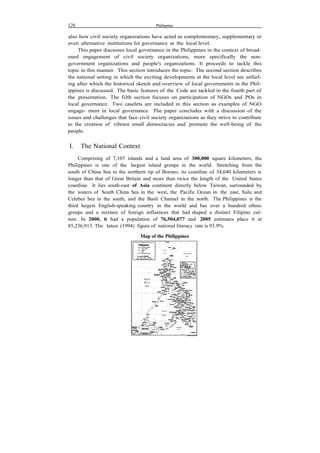
Comprising of 7,107 islands and a land area of 300,000 square kilometers, the
Philippines is one of the largest island groups in the world. Stretching from the
south of China Sea to the northern tip of Borneo, its coastline oJ 34,640 kilometers is
longer than that of Great Britain and more than twice the length of the United States
coastline. It lies south-east of Asia continent directly below Taiwan, surrounded by
the waters of South China Sea in the west, the Pacific Ocean in the east, Sulu and
Celebes Sea in the south, and the Basli Channel in the north. The Philippines is the
third largest English-speaking country in the world and has over a hundred ethnic
groups and a mixture of foreign influences that had shaped a distinct Filipino cul-
ture. In 2000, it had a population of 76,504,077 and 2005 estimates place it at
85,236,913. The latest (1994) figure of national literacy rate is 93.9%.
Map of the Philippines
Philippine 127
The Philippines is a democratic and republican state where sovereignty resides in
the people and all government authority emanates from them. It is a unitary state with
a presidential Jorm of government. The government operates through its three
independent and co-equal departments — the executive, legislature and judiciary.
Regular elections are held to elect officials at the national down to local levels.
The Philippines is politically and geographically subdivided into provinces, cities,
municipalities and barangays which are scattered across its three big island groups,
Luzon, Visayas and Mindanao. During the martial law period, administra- tive regions
composed of these subdivisions were created in line with the govern- ment's
administrative reform to decentralize national government. From an initial number of
13, the regions grew to 16 to date. Among others, the reform was charac- terized by the
establishment of field offices of national government agencies at the regional, provincial,
city and municipal levels ostensibly to reduce red tape and speed up the provision of
public services, address regional disparities and facilitate regional growth and
development.
II. A Historical Sketch of Philippine Local Governments
Local governments in the Philippines did not come about until the country was
conquered and subjugated by Spanish forces in 1521. Before then, it was an archipel- ago
of small nation states called barangays (villages). The barangays were small
independent communities with a simple governing system headed by a datu, who was
assisted by a council of elders in looking after the affairs of the community. In the
southern part of the country, a more elaborate structure of sultanate system existed.
The conquest of the country by the Spanish forces saw the superimposition of a central
government over these independent small communities, in the process forced a nation
into being.
The rulers later grouped and organized these barangays into towns, cities and
provinces to suit colonial objectives and integrated them in a highly centralized
government that was run from Manila. Historical accounts tell us that the conquer- ors
were less successful in making headways in the south where they were fiercely rebuffed
by the native Muslims.
The Americans who took over in early 1900s maintained the set-up as a conven- ient
controlling mechanism over their new colony. These local units were retained in the
Philippine Constitutions (1935, 1973 and 1987) as the platform for structuring local
governments in the country. The Malolos Constitution produced by the Fili- pino
batipuneros (revolutionaries) during the Philippine—Spain war in the late 18th century
also used these divisions as the core units of the budding republic.
Four subdivisions comprise the local governments in the country today. These are
the provinces, cities, municipalities and barangays. Democratically elected offi- cials
govern these local units. The Philippine Congress creates, merges or abolishes provinces,
cities and municipalities, subject to certain criteria. The Local Govern- ment Code
accordingly allocates the powers, functions and resources to each of these units. When
regarded as a hierarchy, Philippine local governments consist of three
128 Philippine
tiers. At the top is the province. The second level consists of the cities and munici-
palities while the barangays form the lowest tier. As of March 2005, the Philippines has
79 provinces, 117 cities, 1,500 municipalities and 41, 975 barangays. The province is the
largest unit. It is composed of municipalities and in some cases includes com- ponent
cities. Given their vantage position, provinces perform developmental and coordinative
functions and services that benefit the component municipalities. They can
significantly address, for instance, comparative advantage and equity issues in
implementing development programs for the province. To a certain extent, provinces
exercise general supervision over their component municipalities and
Table 1 Number of Local Government Units by Island Groups and Regions
Group/Region Provinces Cities Municipalities Barangays
Luzon
NCR 13 4 1,693
CAR 6 1 76 1,176
I 4 8 117 3,265
E 5 3 90 2,311
IH 12 118 3,102
IV—A 5 11 132 4,012
IV—B 5 2 71 1,457
V 6 7 107 3,471
Subtotal 38 57 715 20,487
Visayas
VI 6 16 117 4,050
VII 4 12 120 3,003
VIH 6 4 139 4,390
Subtotal 16 32 376 11,443
Mindanao
IX 3 5 67 1,903
X 5 8 85 2,020
V 4 5 43 1,160
XII 4 5 45 1,194
CARAGA 4 3 70 1,308
ARMM 5 1 99 2,459
Subtotal 25 27 409 10,044
Total 79 116 1,500 41,974
The statistical data in the table were assembled from various Philippine official sources.
Philippine i2g
cities.
The cities and municipalities are the units that directly provide generally all basic
services to the residents in the community. Primary health care, lighting of the streets,
collection and disposal of waste and garbage, health and maternal care, con- struction of
local roads and other local infrastructures, local parks, and operation of public markets
are but a few of the basic services that cities and municipalities provide.
Cities in the Philippines are further classified as component, independent and
highly urbanized. The component cities are administratively supervised by the province
that has territorial jurisdiction over them and their residents vote for the provincial
officials. On the other hand, the independent and highly urbanized cities are
independent of the province and their residents do not vote for the provincial officials.
Otherwise, all cities perform the functions and services provided by the province and
municipality. This means that cities have broader responsibilities and powers,
compared to provinces.
The smallest units are the barangays or villages. They comprise the cities and
municipalities. Being the smallest units, barangays have residual powers only and these
are performed in support of the services that their mother units provide. For instance,
barangays are assigned to assist in the distribution of planting materials, maintain
barangay health center and day care center and other infrastructure facili- ties within
their community.
Local governments are also classified according to their income. The income
classification serves as basis for fixing the maximum tax ceilings that local govern-
ments may impose. It is also used as basis for determining administrative and statu-
tory aids, financial grants and other forms oJ assistance to local governments. The
implementation of salary laws and administrative issuances on allowances and
emoluments that local government officials and personnel may be entitled to also uses
this classification.
The President has general supervision over local governments. In practice the
responsibility to supervise is delegated to the Department of Interior and Local
Government. In the southern part of the country where the Autonomous Region of
Muslim Mindanao exists, the regional government acts as the direct superintending
authority over the local governments instead of the President. In Metro Manila, there is
the Metro Manila Development Authority but it serves as an administrative agency
whose mandate is to take care of specific metro-wide public services like garbage
disposal, flood control, traffic management, and metro-wide physical plan- ning. These
activities have to be coordinated however with the local government units comprising
the metropolis. While the highest policymaking body of Metro Manila Development
Authority is composed of the local chief executives of the met- ropolitan units, the
Authority does not have political or administrative control over them. Unlike in the
autonomous region where the component units are under the supervision of the regional
government, it is not the case in Metro manila. It is still the President through the
Department of Interior and Local Government that has direct general supervision over
these metropolitan local governments.
Autonomous Region
of Muslim Mindanao
130 Philippine
Figure 1 Local Government Structure in the Philippines
National Government
Province Province
Urbanized City
Independent
City
Municipality Municipality
Component
City
Barangay
Barangay Barangay Barangay Barangay
In general, the powers and functions of local governments range from the provi-
sion of basic services and facilities to revenue generation, regulatory functions and other
governmental and corporate powers. Their powers and functions include levying and
collecting fees, taxes and other impositions, budgeting, development planning, land use
planning, enacting and implementing ordinances, enforcement of building code,
reclassification of agricultural lands, regulation oJ real estate trade, and provision of
basic services, facilities and infrastructure within their jurisdic- tions. These include,
among others, primary health care, social welfare, garbage collection and disposal,
extension services, provincial and city hospitals, health cen- ters, markets, waterworks,
slaughterhouses, sewerage and drainage, roads and bridges, and parks.
III. Laying the Ground for Democratic Local Governance
The long history of centralized administration in the hands of the invaders
which continued even after political independence was gained in 1946 had shaped the
character of local governments in the country and their relation to the national
government. Undeniably, local governments were given incremental authorities and
resources over time to manage local affairs. Direction towards decentralization was in
fact discernible in the 50s and 60s. Yet for the most part, local governments tended to
be submissive to and dependent on national government especially for fiscal
resources. And the nearly two decades of dictatorial rule further deepened local
government acquiescence to the higher authority particularly the President.
Parenthetically, national politicians relied upon local political leaders for their elec-
toral victories. But beyond this, the balance of relationship tipped towards the cen- tral
government. National government continued to hold sway over local govern- ments
through issuances and guidelines on particular local functions and activities. The
enactment of the Code in 1991 was a significant development welcomed by local
governments and local autonomy advocates including those who are engaged in
grassroots development initiatives, not the least of which are civil society organi- zations
such as non-government organizations and people's organizations. Decen-
Philippine 131
tralization was one of the democratization thrusts of the post-EDSA government under
Aquino and the passage of the Code became the centerpiece of this decentrali- zation
policy. It may be argued that the Code was not only a corrective measure to a long
history of centralization that governed central-local relations in the country but also it
echoes the struggle of social movements, NGOs and people's organizations for genuine
people empowerment during the dark days of martial law.
Expanded Governance framework
The Code is monumental in that in one fell swoop, it vested local governments with
ample powers and resources that enable them to explore and exploit the sub- stance of
devolution and local autonomy. Apart from consolidating all laws perti- nent to local
government, which is an achievement by itselJ, the Code is significant in a number of
ways.
The Code devolves to local government units the responsibility for delivery of
certain basic services that earlier were provided by the national government agen- cies.
These basic services include the following: health (field health and hospital services and
other tertiary services); social services (social welfare services); envi- ronment
(community based forestry projects), agriculture (agricultural extension and on-site
research); puhlic works (funded by local funds); education (school build- ing program);
tourism (facilities, promotion and development); telecommunications services and
housing projects (for provinces and cities).
It should be noted that devolution involved only certain aspects of the con- cerned
services and these are generally the services that are deemed essential and within the
capacity of the local governments to provide. And even the distribution of devolved
functions among the local government units varies such that the more complex and
expensive services are assigned to higher levels. In the case of health services, for
instance, the barangays take charge of the upkeep of health centers, the municipalities
are responsible for primary health care, maternal and child care and communicable and
non-communicable disease control services and the provinces manage and operate
hospitals and tertiary health services. The cities provide the services performed by both
municipalities and provinces.
These new responsibilities could have been daunting for local governments
especially those with limited financial capacity. The case of health service in par- ticular
is worth mentioning. Its implementation met some setback as some prov- inces found
the hospitals too costly to maintain. There were efforts from health workers to return
the responsibility to the national health department but these did not succeed as then
President Ramos promptly vetoed the Congressional bill recentralizing health.
The Code has prepared for these potential difficulties by increasing the local
government share in the national internal revenue collections. From IU, the inter- nal
revenue allotments (IRA) were increased to 40a. Since 1991, the IRA shares of the local
governments have increased significantly in absolute values from 9.4 bil- lion pesos in
1991 to an estimated 141 billion pesos in 2003. But as a percentage of the total national
budget, the IRA share is miniscule, ranging from about 7â in 1992 to
132 Philippine
14a in 1997.
Not only was the transfer of functions matched by increased funds, the national
government personnel who performed the devolved functions were also transferred to
the local units and the movement initially involved more than 70,000 personnel. Most of
these personnel were residents anyway in their respective work assignments and so
physical dislocation was minimized. The transfer also included the attendant personal
costs outside of the allocations that went to the direct cost of providing the devolved
functions. This meant that the devolved personnel were assured of their salaries.
Through these “safety nets” the financial apprehensions that were encountered in
the initial years of implementing the Code were overcome. The Local Develop- ment
Assistance Program reported that by 1993, all cities and municipalities received more than
what it actually cost them in delivering the devolved services. Even provinces which
initially suffered negative net transfers owing to heavy costs of maintaining devolved
hospitals eventually caught up such that by 1995 and 1996, all local government units were
experiencing substantially increased resources (Rood: 1998).
The Code has also enhanced local government financial capacity in a number of
ways. Aside from increased IRA, local governments now enjoy broadened taxing and
other revenue raising powers in terms, for example, of increased tax rates and greater
elbow room for imposition of fees and charges. A new source of income has also been
included in the form of share in the proceeds from the development and utilization oJ
national wealth located within the territorial jurisdiction of the local units concerned.
They are also given share from the income of government-owned or controlled
corporations that are operating within their respective areas.
Also, local governments are now authorized to float bonds and enter into build
-operate-transfer agreements with the private sector as a way of sourcing local pro- jects.
A number of local governments have actually used this scheme to finance their
projects such as public market and housing. They can also access foreign and local
grants directly and secure loans from domestic sources without need Jor prior approval
of higher authority, unless in instances that involve national security.
Certain regulatory powers have also been devolved to the local governments. The
more significant ones include the power to reclassify agricultural lands subject to
certain requirements and the power to approve housing subdivision plans.
Beyond the powers that have been specified by the Code, local governments have
the opportunity to further flex their authority. This is found in the General Welfare
Provision which says that:
Every local government shall exercise the powers expressly granted, those nec-
essarily implied therefrom, as well as powers necessary, appropriate, or inciden-
tal Jor its efficient and effective governance, and those which are essential to the
promotion of the general welfare. Within their respective territorial jurisdiction,
local government units shall ensure and support, among other things, the pres-
ervation and enrichment of culture, promote health and safety, enhance the
Philippine 133
right of the people to a balanced ecology, encourage and support the develop- ment
of appropriate and sell-reliant scientific and technological capabilities, improve
public morals, enhance economic prosperity and social justice, promote full
employment among their residents, maintain peace and order, and preserve the
comfort and convenience of their inhabitants (Sec. 16).
This provision Jinds a strong ally in the Rules of Interpretation:
The general welfare provisions, any provision on the powers of an LGU, and any
question regarding the devolution of powers shall be liberally interpreted and
Tesoloed in favor of the LGU. Any fair and reasonable doubt on the powers of LGUs
shall be libeTally interpreted and resoliied in favor of the local government unit
concerned (Sec. 5a).
The general welfare provisions in this Code shall be liberally interpreted to give
more powers to local government units in accelerating economic development and
upgrading the quality of life for the people in the community (Sec. 5c).
While others may find limiting the Code's specifications of what local govern- ments
should be able to do, though these may be seen, too, as a guarantee that no less than the
minimum level of services should be provided to the people, the Gen- eral Welfare
Provision clause tries to balance that and with ample support from the Rules of
Interpretation. For all intents and purposes, these twin provisions afford local
governments greater latitude to flesh out and maximize the meaning and sub- stance of
local autonomy in pursuit of public good. These give them greater space to explore
creative strategies that will contribute toward a responsive and account- able
government. They can practically do whatever they deem is beneficial for their
constituencies, limited only by expressed prohibition of law.
This is really an exciting challenge to local governments. They can demonstrate
their mettle and creativity in pushing the limits of local empowerment and breaking
new grounds as they fulfill their mandate to their constituents and secure a better life
for all.
Democratic impetus
The spirit of devolution ushered in by the Code goes beyond the transfer of powers
and functions or the broadening of fiscal resources. A revolutionary provi- sion that is
making profound changes in the way local affairs are managed is the institutionalization
of mechanisms in the legal-political framework that encourage and promote direct
participation of the people in governance process. One writer noted that in all of
Southeast Asia, it is the Philippines that has created a “most supportive statutory
environment for local participation” via the Code (George in Sillman and Noble: 1998, p.
223). On this aspect, the Code indeed offers many entry points for the involvement of
citizens in local governance.
The importance attached to citizen participation and civil society organizations
J34 Philippine
such as the non-government organizations (NGOs) and people's organizations (POs) is
quite obvious in that a whole chapter (Chapter 3 under Title I) in the Code is devoted to
how this sector can be involved in the governance structures and proc- esses. This is not
to mention that other provisions such as those found in Recall (Title Chapter 5), Local
Initiative and Referendum (Title IX Chapter 2) and Local Special Bodies (Title IV to Title
VII) and sectoral representation in the local council from the women, workers, and
marginalized group open up opportunities for people participation in local governance.
The Code urges local governments to “promote the establishment and operation of
people's organizations, NGOs and the private sector, to make them active partners in the
pursuit of local autonomy” (Section 31). To give flesh to this intention, the Code has
necessitated the membership of NGOs and POs, after due accreditation, in the various
local special bodies. This is significant because membership in these bodies would allow
the sector to substantially participate in formulating, planning, implementing and
evaluating local policies and programs. To the extent that the NGOs and people's
organizations can meaningfully affect the content and implemen- tation of public
decisions through these local bodies in a way that respond to the sector's interest and
public welfare issues, democratization and local empowerment will indeed be
significantly realized.
For instance, the local development council reserves at least one-Jourth of its total
membership to NGO representatives. This is an important body for it sets the direction
of social and economic development of the area and decides on the priority programs
and projects that the local government will undertake. However, reports that some
councils have not convened or, if at all, have met only rarely, the opportu- nity to
participate in this important body cannot just be ignored.
Another vital body is the prequalification, bids and awards committee. This is a
powerful committee for it evaluates and recommends public tenders for local infra-
structure projects. This is an area where NGOs and POs can contribute in making
administrative processes fair, transparent and accountable. Other local bodies where the
NGOs and POs are represented are the local school board, local health board and the local
peace and order council. The school board is particularly significant for it has power of
the purse that it can use to fund education projects. This budgetary power comes from
the special education fund which is an automatic allocation from the proceeds of special
levy on real property. The board determines what projects to support under this fund
and authorizes fund releases, subject to the usual audit- ing rules and regulations.
It is worth noting, too, that apart from participation in processes, financial assis-
tance and other forms of incentives await the NGOs/POs when they undertake eco-
nomic, social, environmental and cultural projects in the community. These incen- tives
are given in the form of local tax exemptions, tax relief and other forms of schemes. This
is a laudable provision. It is common knowledge that NGOs and people's organizations
are non-proJit non-earning entities usually dependent on donor Junds or other external
contributions. Thus, any form of assistance, financial or otherwise, that will support
their involvement in local activities will encourage
Philippine 135
and promote participation.
Truly, the Code can be said to be one of the very first, if not the first, Philippine laws
that explicitly gives flesh to people participation in governance. People partici- pation
particularly in government programs and projects is not entirely new in the Philippines.
But its practice was more contingent on the principles and attitudes espoused by the
programs and its implementors and which oftentimes tilted towards tokenism
especially during martial rule.
The recognition of the NGOs' and POs' political and developmental role reflects the
state's acknowledgement of the meaningful contribution that this sector can bring to the
whole process of governance and development. Some quarters add that it is also an
indication of government's incapacity to perform its functions so NGOs are needed to Jill
in the gap left by the government. The entry of NGOs and POs in the local scene is also
viewed as a way of checking against possible capture by local elite of their enhanced
power and resources that result from devolution. Whatever the reasons, the Code
creates tremendous opportunities for expanded democratic governance to take root and
thus should be taken advantage of in a meaningful and responsible way. It is a learning
opportunity for the local government and the NGOs/ POs as they dialogue, argue,
negotiate, agree and collaborate on issues affecting the community .and the people.
N. Engaging the Non-government Organizations and People's
Organizations in Local Governance
This section looks at the involvement of NGOs and people's organizations (POs) in
local governance as spurred by the implementation of the Code. This will be done by a
limited review of the literature on the NGO/PO participation in local govern- ance and
presentation of two caselets. The caselets are included as examples of NGO/ PO and local
government interactions that are increasingly taking place in many parts of the country.
But before discussing this topic further, some clarifications of the terms NGOs and
POs as these are generally understood in the Philippine setting will be made. A brief
historical sketch of their origins will also be presented to contextualize their
development within the changing socio-political environment in the country.
Though fewer then in number compared to today, non-government organiza- tions
in the country started to gain wider recognition in the 70s during martial law as they
tried to respond to people's needs, especially the poor, that government failed to meet
either through sheer neglect or ineptitude. The NGO antecedents had, of course, been in
existence in the country as Jar back as colonial times though their orientation was more
towards charity or philanthropic work and they were invaria- bly called charitable
institutions and social welfare agencies (Carino: 2003; David: 1998).
Not only were the NGOs recognized Jor their socio-economic development ac- tivities
at the grassroots level. Their political role has also been significant in their efforts to link
people's voice to government policy agenda through advocacy and to
J3d Philippine
build people's capacity through the founding oJ people's organizations that can stand
and act on their own behalf. It is the combination of these activities that they do for
people and community that distinguish them as “development NGOs” or non-
government development organizations (NGDO) or what David (1998) calls “genu- ine”
NGOs.
These efforts did not, for sure, take place in a convivial atmosphere as NGOs were
often the object of government's suspicion of undermining the martial law government,
imputing them with labels like “activists,” “subversives,” “commu- nists,” or “leftists.” On
hindsight, it is perhaps this repressive environment that also stimulated the growth and
tenacity of NGOs in the country that by the time the EDSA people revolt occurred in
1986, their place in development and political advo- cacy was already firmly rooted and
recognized in local and national community. The NGOs and POs undoubtedly were a
critical component of the social movements that peacefully (read: without bloodshed)
overthrew the authoritarian regime in 1986. The provisions in the post-EDSA
Constitution and Local Government Code enshrining their role and participation in
government and development are thus affirmation of the important role this element of
civil society has played and con- tinuously play in Philippine society and politics. Today,
NGOs and POs enjoy a stature fully recognized in Philippine legal and policy frameworks
and in the devel- opment community here and abroad. No less than the 1987
Constitution provides that “The State shall encourage nongovernmental, community-
based, or sectoral organizations that promote the welfare of the nation.”
They are officially recognized as partners of government in development activi- ties.
The NGO literature often cites the Philippines as a country that has the most vibrant
NGO community and the highest per capita NGO in this part of the world. They are
active elements of contemporary civil society in the Philippines.
But how are NGOs delineated and generally understood in the Philippine con- text?
The Philippine government, through the National Economic and Development Authority
which is the government's central planning agency, officially defines NGOs as non-
profit, voluntary organizations that are committed to the task of socio- economic
developments and established primarily for service. Such service may involve assisting
citizens or people's organizations in various ways by educating, training, or giving
financial assistance to them (NEDA: 1993).
One may note that the legal definition confines the role of NGOs as service providers
in the area of social and economic development and skirts their more political role that
they have historically played in the 70s and 80s. This character of the NGO is too
important to be missed for it is salient to the experience in demo- cratic governance that
is evolving today at both the national and local level.
The usage of NGOs in the Philippines refers to private, non-profit, voluntary
organizations engaged in development work that benefits the poor and marginal- ized.
They are intermediary organizations between the people and government. They speak
for or on behalf of the poor and marginalized without necessarily being part of the group
or being members of the communities they serve (Carino: 2003; Aldaba: 1993). As
intermediaries between the citizens and state, NGOs may be
Philippine 137
further distinguished as either grassroots support organizations or complex struc- tures
of networks, coalitions or taskforces (Milliman and Noble: 1998). These two form the
second and third level, respectively, of the three-tiered NGO system that silliman and
Noble had devised to describe Philippine NGOs.
Some NGOs have the distinction of being advocacy groups for specific issues or
causes such as the Freedom from Debt Coalition, Haribon Foundation and Task Force
Detainees of the Philippines. Still, there are NGOs that started as such then eventually
became sectoral political parties by virtue of their participation in elec- toral politics,
though they continue to preserve their NGO roots.
NGOs and POs in the Philippines are increasingly differentiated according to their
functions and membership (Carino: 2003; Aldaba: 1993). Thus, there are NGOs that have
community organizing as its major function and others are involved in training,
education and information, participatory research, economic livelihood and other
activities. They may also be identified according to the sector that they focus on such as
environment, coastal resource management, housing, agriculture, health, appropriate
technology, education, and other sectors.
People's organizations, on the other hand, are community-based composed of
community members who have banded together in pursuit of their common inter- ests
and welfare. They correspond to the first level called grassroots organizations in
Silliman's and Noble's configuration oJ Philippine NGO community. POs come from a
broad spectrum of sectoral groupings that encompass farmers, fisherfolks, women,
urban poor, drivers, workers in the formal and informal sector, and similar groups.
These groups are also called the basic sectors, which, under the Social Re- form and
Poverty Alleviation Program of the national government are also the dis- advantaged
sector of Philippine society. The cooperatives composed of community members are also
considered part of this group.
By Buendia's account (cited in Carino: 2003), there were about 71,034 POs in the
country between 1987 and 1999 that were accredited by government agencies, though
overlaps may not be discounted due to multiple registration with different agencies. The
POs embrace rural workers' associations, associations of agrarian reform beneficiaries,
women's organizations, fisherfolks organizations, indigenous people's councils, urban
poor organizations, trade unions, working women organiza- tions, etc.
Like the NGOs, there are POs that also advocate particular causes and convic- tions.
Whether the first or second type, POs represents themselves and are bound by their
collective mission and purpose. This is clearly the intention of the 1987 Consti- tution
when it defined people's organizations as “bona fide associations of citizens with
demonstrated capacity to promote the public interest and with identifiable leadership,
membership, and structure” (Sec. 15).
The importance of people's organizations in democratic governance resonates in the
Constitution. Section 15 is unequivocal in calling upon the State to “respect the role of
independent people's organizations to pursue and protect, within the demo- cratic
framework, their legitimate and collective interests and aspirations through peaceful
and lawful means.” It also enshrines their right to effective and reasonable
138 Philippine
participation at all levels of social, political and economic decision-making and for this
purpose, calls upon the State to pass laws that will facilitate the creation of adequate
consultation mechanisms.
It is more than a decade now since the Code was implemented in 1992. How has the
landscape of local governance, politics and development evolved given the NGO- PO
friendly governance framework?
It may be said that local governance in the Philippines has never been the same
since then, if only to take account of the veritable presence of civil society organiza- tions
in the thousands oJ local government units around the country. It depicts diverse
experiences of engagement between local government and citizens and civil society
organizations as they come and work together to chart their destiny. Many of these
experiences provide inspiration and valuable lessons and insights for the deepening of
democracy in the country.
The NGOs and POs participate in myriad ways in governance and development
process at the grassroots level. They are involved in community organisation which
often is their major strength and which they are popularly known for since martial law
years. George (1998) points out in his case study of Jour Philippine municipali- ties that
community organizing has significantly contributed to the effective partici- pation of the
poor in local politics. Community organizing built the confidence, trust and solidarity of
the people to collectively undertake economic projects and pursue political advocacies.
The importance of community organizing by NGOs and POs was also noted in preparing
communities to participate more meaningfully in gov- ernment-initiated projects
(Bautista: 1999)
It is not uncommon to find that NGOs and POs working at the grassroots level
establish linkages with other entities. Linkage building is a source of strength of NGO
work for a number of reasons. It provides alliance and solidarity for the vari- ous
development and advocacy efforts they do. It is also a way of tapping and mo- bilizing
funding support for their activities. In an analysis oJ politics and participa- tion in four
municipalities, George (1998) observed that the most successful NGOs and POs were
those that had established partnerships with local and Manila-based NGOs, government
officials who were receptive to their ideas and PO federations. The alliances enhanced
the public image and resources of NGOs and POs.
In tandem with the POs, many NGOs also act as policy advocates in making demands
on local government, as one of the two caselets below show. Others act as channels of
funds from external donors to POs to support their projects. They also provide link to
networks and alliances at higher levels of the NGO community (Sillman and Noble:
1998).
In engaging the local governments, the NGOs and POs facilitate the process of
regime reorientation from a patrimonial to developmental state (George: 1998). As local
governments work with civil society to tackle the social, political and economic issues in
the community, the government is itself strengthened through a develop- ment of a pro-
active stance in development and good governance.
The review done by Aldaba (1993) showed that NGOs and POs are engaged in
practically every aspect of development. They have projects dealing with various
Philippine 139
sectoral concerns. They are involved in health service delivery, environmental man-
agement, integrated area development, housing and infrastructure, local govern-
ment capacity building, local government planning and fiscal management, disaster
relief operations and gender-related concerns. Many NGOs organize and support
cooperatives and small-scale economic activities to assist the poor raise their eco-
nomic status and improve their well-being. They are harbingers of development
that is more participatory and more inclusive. It is interesting to note that in the
cases reviewed by Aldaba, NGO engagement in these activities is done mostly in
partnership with the local government.
What is equally interesting is the pattern that is discerned in the Galing Pook
Awards (literally, Community Excellence Awards). This is an awards program run
by, an NGO, the Galing Pook Foundation in partnership with the Local Government
Academy of the Department oJ Interior and Local Government and Ford Founda-
tion. The program recognizes outstanding projects implemented by local govern-
ment units. Many of the recipients received their awards Jor projects that they had
implemented in collaboration with the citizens, NGOs and POs in their community.
The awards were for wide-ranging projects such as ecotourism, social awareness,
gender sensitivity, children's welfare, integrated area development, livelihood,
health, agriculture, peace and security, and the list goes on. These experiences sug-
gest that not only has local governance been enhanced by the participation of civil
society organizations, they also demonstrate that successful partnerships can de-
velop between the NGOs and POs to address common objectives.
At this point, two caselets will be presented to show examples of how NGO and
PO participation is beginning to transform old habits of governance at the local level
to one that is participatory and inclusive. The first case is about advocacy for
coastal resource management and the second case is on engagement of the urban
poor with the city government for pro-poor policies and programs.
Case No. 1
Prieto Diaz is a small fishing municipality in the province of Sorsogon at the far end of
Luzon island. A local priest had earlier helped organize a people's organization composed
of small fishermen, the Samahan ng Maliliit na Mangingisda sa Muntopar
(SAMAMAMU). The name literally means association of squall fishermen of Muntopar.
The priest had invited Tambuyog, a development NGO to assist the area and continue on
the organizing work he had started. (Tambuyog is a local word and literally means water
buffalo's horn. In olden times, horns are used by town criers to announce public meetings.
As used by Tambuyog, the horn symbolizes the call for unity.)
In 1994, Tambuyog chose the municipality as a site for its project on sustainable coastal
area development or SCAD. The project was an integrated approach to building commu-
nity-based coastal resource management and used research, training and education, organ-
izational development, gender development and advocacy as strategies. Tambuyog had
already experience in capacity building for environmental management in previous pro-
jects. The NGO chose SAMAMAMU as its main partner in implementing SCAD in the
municipality.
A long series of community organising work — group self-assessment, teambuilding, meet-
J40 Philippine
Case No. 2
The Naga City Urban Poor Federation (NCUPF), a coalition of urban poor people's organi-
zations, started with a group of urban poor residents who decided to come together one day to
confront the many issues affecting the sector. From a succession of meetings, con- sultations
and organizing among the urban poor across the different barangays (villages) in the city was
formed an ad hoc body representing nine urban poor communities that later on would
become the NCUPF.
In the first three years of its existence beginning August of 1986, NCUPF activities focused on
participating in discussions and community organizing around issues that were na- tional in
character, though some of these had direct implications on them as a sector. These issues
concerned the plebiscite on the 198T Constitution, the proposed Urban Devel- opment and
Housing Act, and the implementation of the community mortgage program.
ings, community assemblies and discussions, information gathering and situational analy- sis
through participatory research, training PO leaders, dialogues with stakeholders, trans-
forming the organization into a cooperative to make it sustainable, lobbying with local
officials. — were carried out to capacitate and mobilize the people for coastal resource
management. One concrete output of the collaboration and advocacy work of Tambuyog and
SAMAMAMU was the crafting of a bottoms-up community-owned five-year develop- ment
plan for SCAD. The advocacy and mobilization done by Tambuyog and SAMAMAMU
included not only lobbying with local officials and dialoguing with key stakeholders but also
campaigning, particularly by SAMAMAMU, during the 1995 elec- tions for the incumbent
mayor and other candidates sympathetic to the fishermen's cause. Their electoral support for
the winning candidates accorded them some influence in local decision-making.
While these organizing efforts were taking place, the national agency Department of Envi-
ronment and Natural Resources had a national project called Coastal Environment Project
(CEP). The implementation of the project in Prieto Diaz was contracted out to FDFI (not
spelled out in the original case). FDFI formulated its own version of coastal management plan
for the municipality which SAMAMAMU objected to because it did not benefit from the same
intensive consultation process that their own plan went through. There were also provisions
in the plan that the fisher folks considered not feasible or unacceptable. All these objections
anyway were articulated during the public presentation (in a workshop) of the CEP plan. The
FDFI had to revise their first draft based on the workshop's discus- sions.
At the municipal level, Tambuyog and SAMAMAMU lobbied with local authorities for a more
comprehensive review and discussion of the local policy framework on coastal man- agement.
The outcome of this advocacy was the creation of an inter-agency and multi- sectoral task
force that would be responsible for reviewing and enforcing the municipal fishery code. The
task force was also in-charge of formulating and implementing the municipality's coastal
resource management plan. Tambuyog and SAMAMAMU became members of the group. The
membership of Tambuyog and SAMAMAMU in the task force gave them a venue through
which they were able to effectively advocate the inclusion of issues affecting the fishermen in
the task force deliberations. It was also through their advocacy that the people's SCAD five-
year plan was integrated in the final version of the municipal coastal management plan.
Ultimately. the plan was a fusion of the SCAD and CEP management plans.
This summary was adapted from a case study prepared by Quirino L. Dela Cruz and Rizalito Lopez (See
reference list for complete bibliographic entry.)
Philippine
When the newly installed President Aquino visited the city, the group presented their demand
for the creation of local and national offices for the urban poor. It was by engag- ing in these
political activities and analyzing the pro-urban poor provisions of the Consti- tution and the
urban poor reform bill that they realized the importance of participating in the local
policymaking process.
In 1989, the NCUPF successfully initiated the adoption of the community mortgage pro- gram
by the city government and the creation of the Urban Poor Affairs Office. As of 199?, NCUPF
was comprised of 59 local organizations and a member of the Bicol Urban Poor Coordinating
Council. It has three representatives in the Urban Development and Housing Board. It is a
member of the People's Council which sits in the local development council as member.
The NCUPF had used a variety of methods to make the local government listen to them and
act on their demands. These included holding regular meetings and consultations among
themselves to discuss their problems and actions, attending government-initiated fora on
issues that directly concerned them, writing petitions to stop evictions, lobbying and initiating
dialogues and negotiations with local authorities.
They also used election forums to compel candidates to support in writing urban poor
programs. They also sought the legislative support of council members who were sympa-
thetic to their cause.
The advocacy and organizing activities of the NCUPF have resulted in the implementation of
pro-poor policies and ordinances in Naga City. Foremost of these were the resolution of land
tenure problem of the urban poor, provision of basic services to the urban poor com- munities,
cessation of arbitrary eviction and demolition, provision of resettlement sites, conversion of
blighted areas into socialized housing, and representation of the urban poor in the local
council. The NCUPF collaborated with other local organizations to form the People's Council.
The people's council sits as member of the city council and participates and votes in its
deliberations. In 1995, the Naga Gity council approved an ordinance that effectively
institutionalized the participation of citizens' organizations in local government processes and
activities.
The picture will not be complete without saying something about the city government. The
local government that was installed after the EDSA people revolt was decidedly open to the
participation of citizens in the local government programs and policies. The local mayor and
progressive-minded councilors took concrete steps to encourage and institu- tionalize people's
participation by creating venues and mechanisms through which the poor could have a say in
policy and decision-making. Under the leadership of the local mayor, the Urban Poor Affairs
Office was established to attend specifically to the needs of the sector. Local programs that
were implemented installed consultative channels that institutionalized multi-sectoral and
village level consultation meetings and discussions. The local development council and local
special bodies had representatives from the non- government organizations and people's
organizations. It implemented programs that func- tioned on the basis of partnership between
the local government and NGOs and POs. All these concerted efforts between the local
government, the NGOs and POS were institution- alized through the passage of the local
ordinance called “in Ordinance Initiating a System for a Partnership in Local Governance
between the City Government and the People of Naga."
This summary was written based on a case study prepared by Jocelyn Vicente Angeles. (See reference
list for complete bibliographic entry.)
142 Philippine
Concluding Remarks
The passage of the Local Government Code had created more opportunities than
heretofore imagined for the participation of citizens and civil society organizations in
local governance. The policy and legal framework for participatory and inclusive local
governance has been set in place. It has opened up and provided multiple entry-points
through which the citizens, POs and NGOs can take a share in the exer- cise of public
power and control.
From the foregoing discussion here and extant literature, there is growing evi- dence
that the democratic space opened up by the Local Government Code is decid- edly being
filled up by the engagement of NGOs and POs with their local govern- ment in charting
their common future. Their engagement is seen in various aspects of local governance.
They are able to get seats in the local governing bodies. Service delivery is another area
where NGOs and POs are effectively engaged. Involvement in policy development is an
important role that NGOs and POs are beginning to realize if they are to meaningfully
influence local decision making.
There are positive signs of a greater awareness and action on the part of local
governments on the need for involving the people in various aspects of local govern-
ance. The Galing Pook Award, for instance, confirms the many successful partner- ships
of local government authorities, NGOs and POs in undertaking local projects that
redound to people's benefit and the greater community. The participation oJ the NGOs
and POs ensures that community issues and concerns are brought into the agenda of
local policymaking and are acted upon by the authorities.
The active participation of civil society, NGOs and POs in the process of govern- ance
is a positive trend that must be recognized and encouraged. If anything, civil society
involvement in governance operationalizes the values of participation, trans- parency
and accountability. In most general terms therefore, the fundamental strat- egy to
further bring to life citizen engagement in the process of governance is to identify and
nurture areas for meaningful partnership between civil society and government. These
areas may range from forming local policies, identification and design of projects to their
implementation, monitoring and evaluation. Joint service delivery with civil society
playing a supplementary, complementary role, or even as alternative mechanisms
altogether in the delivery oJ services may contribute to the general strategy oJ cementing
the civil society-government partnership.
Looking back, it is inevitable that the transition Jrom authoritarian regime to
democratic system in the Philippines will ultimately result in giving back the power to
where it rightfully belongs — the people. The Code has set the enabling frame- work for
such process to take place. But ultimately, the fruition of this potential remains in the
hands of those who will creatively and responsibly make democracy work — the local
government and the citizens, POs and NGOs working in the commuities. With local
democracy evolving further, it behooves these actors from both ends to strengthen their
interactions through the various modes initiated by the Code that ultimately can
deepen democracy in the country. Where local
Philippine 1d3
governments are concerned, the challenge is not only how it can further open up its
governance structure and processes to the people but how to do it successfully and
in a sustainable manner. An even bigger challenge perhaps for local politicians is
acceptance of the diminution of local decision-making powers as they share these
with the citizens, POs and NGOs. And for some of them, all these challenges may
require developing new attitudes, learning new skills and becoming more account-
able in their decisions and actions.
Some lingering issues remain to be addressed, too, with respect to NGO/PO
effectiveness in the broader process of democratic governance. Among these are:
• Developing and Strengthening Partnerships
The direction towards developing and strengthening partnerships with local
governments is important if only to overcome the traditional suspicion be- tween
government and non-government organizations. Both sectors must recognize the
potentials ot synergizing their efforts towards the general goal of development
and democratic governance. This may necessitate in both sectors some
“retooling” or “sensitizing” within the context of such partner- ship in order for
both to recognize and appreciate the nuances of each other's unique systems.
At the level of inter-NGO relationships, the emerging problems with their rowing
competition that results from zealousness to protect their own turf have to be
addressed to maintain inter-NGO cooperation or at least minimize these problems
to the level of healthy competition.
• NGO buTeaucratization
The growing bureaucratization of NGOs spawns critical issues that may erode its
original essence as a development catalyst and change agent. These issues include
reduced flexibility, relative fast turnover of personnel, staff compensa- tion, red
tape, negation of NGO ethos, and even corruption.
• Autonom y and Independence of NGOs
NGOs have always prided themselves in their independence and they can get
things done on their own with minimal or no interference by and assistance from
the government. Their being xow-government organizations frees them from the
common problems encountered by the government bureaucracies such as red
tape and even graft and corruption. The argument goes like this: if they
participate in formal structure and mechanisms of government, will they not be
compromising their independence and in effect be co-opted by the very structures
they are wary ot? Will not the use of resources made available by the government
to NGOs compromise their autonomy and make them beholden to government
authorities?
•Deepening the Bench of NGO Leaders
Deepening the bench of NGO leaders has become an imperative in the NGO
community over recent years. A number of prominent and pioneer leaders in the
NGO community have begun to move on: some have been recruited to leadership
positions in government, a number of whom became cabinet
Id4 Philippine
members during the Aquino, Ramos and Macapagal administrations. Some have
retired from active involvement in civil society. Deepening the bench therefore
involves recruitment and training of what has been called a “succe ssor
generation” to take on leadership and responsible positions in the move- ment.
Given the active involvement of civil society in governance processes, it is not
inconceivable to see this trend continue with civil society serving as one of the
major recruitment grounds for leaders and officials in government.
•Dej:iendence on External Donors
Another major concern within the civil society community is sustainability vis-
à-vis dependence and support of the donor community. In other words, this is
mostly true for so-called “donor-driven” NGOs whose main source of support is the
donor-community. The question is raised: what will happen when fund sources
are withdrawn or dry up? Will the initiatives and advocacies of such NGOs be
sustained and continued? Indeed, many civil society organisations have long been
enjoying financial assistance from the international community.
Silliman (1998) however deems that the Philippine non-governmental organiza-
tions are facing a challenge that imperils their autonomy. Foreign financial assis- tance
is the lifeblood of the NGO community, but ironically, grassroots support organizations
face the dilemma that, while they are encouraging self-reliance among their beneficiary
groups, they are themselves becoming more dependent on donor agencies in the
developed countries. Additionally, the acceptance of grants from external donors carries
with it a loss in program autonomy.
References
Aldaba, Fernando T. (1993) “The Role of NGOs in Philippine Social Transformation,” Philip-
pine Politics and Societ y. (January): 2—57.
Alegre, Alan (ed.) (1996) Trends and Traditions. Challenges and Choices: A Strategic Stud y of
Philippine NGOs. Buezon City: Ateneo Center for Social Policy and Public Affairs.
Brillantes, Alex B. Jr. (1998) “Dentralized Democratic Governance under the Local Govern- ment
Code: A Governmental Perspective,” Philippine Journal of Public Administration. 42 (1 & 2)
(January—April) Quezon City: UPCPA.
Buendia, Emmanuel E. (2001) “People's Participation in Governance.” Unpublished disserta-
tion submitted in partial fulfillment of the requirements of the degree of Doctor of Public
Administration. Buezon City: National College of Public Administration and Govern- ance,
University of the Philippines.
Cariño, Ledivina V. (ed) (2002) Between the State and the Market: The Nonprofit Sector and
Civil Society in the Philippines. Center for Leadership, Citizenship and Democracy, National
College of Public Administration and Governance, University of the Philip- pines.
Constantino-David, Karina (1998) “From the Present Looking Back: A History of Philippine
NGOs” in G. Sidney Silliman and Lela Garner Noble (eds.) Organizing for Democracy: NGOS,
C*ai/ Soc:iet y, and the Philippine State. 8uezon City: Ateneo De Manila University Press.
Philippine 145
Galing Pook Foundation (2003) Gauiad Galing Pool: fi Trf#ufe to Innovation and Excellence in
Local Gooernnnce.
George, Terrence R. (1998) “Local Governance: People Power in the Provinces?” in G. Sidney
Silliman and Lela Garner Noble (eds.) Organizing for Democracy: NGOS. Ciiiil Societ y. and
the Philif›pine State. Quezon City: Ateneo De Manila University Press.
Jocelyn Vicente Angeles (1997) “The Role of the Naga City Urban Poor Federation in the
Passage of Pro-Poor Ordinances and Policies”, Marlou A. Wui and Glenda S. Lopez (eds.) State-
Civil Society: Relations in Policy-Making Quezon City: Third World Studies Center. National
Economic and Development Authority, Republic of the Philippines. (1993) Medium Term
Philippine Develoment Plan Buizon, Antonio B. (1989) “A Survey of Government Policies and
Programmes on Non-Governmental Organizations in the Philippines,” in Antonio B. $uizon
and Rhoda U. Reyes (eds.) A Strategic Assessment of Non-Government-
al Organizations iii the Philippines. Manila: Asian Non-Governmental Organizations Coa-
lition for Agrarian Reforms and Rural Development.
Republic of the Philippines (1991) The Local Government Code, (198T) The 1987 Philippine
Constitution.
Rood, Steven. (1998) “An Assessment of the State of Knowledge Concerning Decentralized
Govenance under the Philippine 1991 Local Government Code,” Philippine Journal of Public
Administration (January-April) v. 42 nos. 1-2
Milliman, G. Sidney and Lela Garner Noble (eds.) (1998) Organizing for Democracy: NGOs,
Civil Society, and the Philippine State. Quezon City.- Ateneo De Manila University Press.
Silliman, G. Sidney and Lela Garner Noble (eds.) (1998) “Citizen Movements and Philippine
Democracy,” in G. Sidney Milliman and Lela Garner Noble (eds.) Organizing for Democ-
rac y: NGOs, Ciilil Societ y and the Philippine State. Cluezon City: Ateneo de Manila Univer-
sity Press.
Victoria A. Bautista (1999) Combating Poverty Through the Comprehensive and Integrated
Delivery of Social Services (CIDSS). Quezon City: UP-NCPAG
http://www.di1g.gov.ph
http://www.ga1ingpook.org/awardees.htm
http://www.gov.ph/aboutphi1/general.asp
http://www.nscb.gov.ph

local governance in the Philippines.docx

  • 1.
    Towards Greater Local DemocraticGovernance: A View from the Philippines Alex B. Brillantes Jr. and Wilhelmina L. Cabo Professor and Dean and Assistant Professor, respectively, of the National College of Public Administration and Governance, University of the Philippines Republic of the Phillippines
  • 3.
    Towards Greater LocalOemocratic Governance: A View from the Philippines Introduction Five years after the historic and jubilant EDSA people power revolution, an- other revolution begun to take shape, quietly this time, in the landscape of Philip- pine politics and governance. The revolution swept across the country from one end to the other, from the smallest barangay (village) to municipalities, cities and prov- inces. It can be said to have hardened the voice of the EDSA people power because its essence breathed life to small democracies in urban and rural communities so the people can directly take part in the making of public decisions that affect their life. It continues to take place in many parts of the country to this day in the form of the Local Government Code, that was passed by Congress in 1991 and was considered by many as a revolutionary piece of legislation and one of the most significant accom- plishments of the Aquino administration. It not only altered the balance of power between the national government and the local government but also the Code was perhaps more significant in laying the enabling framework and environment for local empowerment and democratic governance to take roots in thousands of com- munities around the country. Local governments essentially are the bedrock of Philippine democracy. Physi- cally close to the grassroots, they serve as access points oJ citizens in having their voices heard and acted upon. Local governments play a significant role in the far flung and isolated areas of the country since they are the links in the chain of gov- ernance that are in direct contact with the people. Their role as frontline institutions is even more crucial in an archipelagic country like the Philippines that is composed of more than 7000 islands. Thus for many people, local governments are THE gov- ernment. What also animate local governance today are the ubiquitous civil society or- ganizations particularly the non-government organizations (NGOs) and people's organizations (POs) that engage the citizens and local governments in many aspects of local governance. These organizations have given voice to the many problems and aspirations of the common people. Their presence has been felt in many aspects of community governance — in urban housing, livelihood projects, capacity build- ing, health, development planning and other local concerns. And where government appears ineffective or unresponsive, NGOs and POs are thrust to somehow fill the gap. Thus, when one speaks of decentralized governance and empowerment in the country today, the talk will include not only how most local governments have taken full advantage of the greater powers and resources offered by the Code but
  • 4.
    126 Philippine also howcivil society organizations have acted as complementary, supplementary or even alternative institutions for governance at the local level. This paper discusses local governance in the Philippines in the context of broad- ened engagement of civil society organizations, more specifically the non- government organizations and people's organizations. It proceeds to tackle this topic in this manner. This section introduces the topic. The second section describes the national setting in which the exciting developments at the local level are unfurl- ing after which the historical sketch and overview of local governments in the Phil- ippines is discussed. The basic features of the Code are tackled in the fourth part of the presentation. The fiJth section focuses on participation of NGOs and POs in local governance. Two caselets are included in this section as examples of NGO engage- ment in local governance. The paper concludes with a discussion of the issues and challenges that face civil society organizations as they strive to contribute to the creation of vibrant small democracies and promote the well-being of the people. I. The National Context Comprising of 7,107 islands and a land area of 300,000 square kilometers, the Philippines is one of the largest island groups in the world. Stretching from the south of China Sea to the northern tip of Borneo, its coastline oJ 34,640 kilometers is longer than that of Great Britain and more than twice the length of the United States coastline. It lies south-east of Asia continent directly below Taiwan, surrounded by the waters of South China Sea in the west, the Pacific Ocean in the east, Sulu and Celebes Sea in the south, and the Basli Channel in the north. The Philippines is the third largest English-speaking country in the world and has over a hundred ethnic groups and a mixture of foreign influences that had shaped a distinct Filipino cul- ture. In 2000, it had a population of 76,504,077 and 2005 estimates place it at 85,236,913. The latest (1994) figure of national literacy rate is 93.9%. Map of the Philippines
  • 5.
    Philippine 127 The Philippinesis a democratic and republican state where sovereignty resides in the people and all government authority emanates from them. It is a unitary state with a presidential Jorm of government. The government operates through its three independent and co-equal departments — the executive, legislature and judiciary. Regular elections are held to elect officials at the national down to local levels. The Philippines is politically and geographically subdivided into provinces, cities, municipalities and barangays which are scattered across its three big island groups, Luzon, Visayas and Mindanao. During the martial law period, administra- tive regions composed of these subdivisions were created in line with the govern- ment's administrative reform to decentralize national government. From an initial number of 13, the regions grew to 16 to date. Among others, the reform was charac- terized by the establishment of field offices of national government agencies at the regional, provincial, city and municipal levels ostensibly to reduce red tape and speed up the provision of public services, address regional disparities and facilitate regional growth and development. II. A Historical Sketch of Philippine Local Governments Local governments in the Philippines did not come about until the country was conquered and subjugated by Spanish forces in 1521. Before then, it was an archipel- ago of small nation states called barangays (villages). The barangays were small independent communities with a simple governing system headed by a datu, who was assisted by a council of elders in looking after the affairs of the community. In the southern part of the country, a more elaborate structure of sultanate system existed. The conquest of the country by the Spanish forces saw the superimposition of a central government over these independent small communities, in the process forced a nation into being. The rulers later grouped and organized these barangays into towns, cities and provinces to suit colonial objectives and integrated them in a highly centralized government that was run from Manila. Historical accounts tell us that the conquer- ors were less successful in making headways in the south where they were fiercely rebuffed by the native Muslims. The Americans who took over in early 1900s maintained the set-up as a conven- ient controlling mechanism over their new colony. These local units were retained in the Philippine Constitutions (1935, 1973 and 1987) as the platform for structuring local governments in the country. The Malolos Constitution produced by the Fili- pino batipuneros (revolutionaries) during the Philippine—Spain war in the late 18th century also used these divisions as the core units of the budding republic. Four subdivisions comprise the local governments in the country today. These are the provinces, cities, municipalities and barangays. Democratically elected offi- cials govern these local units. The Philippine Congress creates, merges or abolishes provinces, cities and municipalities, subject to certain criteria. The Local Govern- ment Code accordingly allocates the powers, functions and resources to each of these units. When regarded as a hierarchy, Philippine local governments consist of three
  • 6.
    128 Philippine tiers. Atthe top is the province. The second level consists of the cities and munici- palities while the barangays form the lowest tier. As of March 2005, the Philippines has 79 provinces, 117 cities, 1,500 municipalities and 41, 975 barangays. The province is the largest unit. It is composed of municipalities and in some cases includes com- ponent cities. Given their vantage position, provinces perform developmental and coordinative functions and services that benefit the component municipalities. They can significantly address, for instance, comparative advantage and equity issues in implementing development programs for the province. To a certain extent, provinces exercise general supervision over their component municipalities and Table 1 Number of Local Government Units by Island Groups and Regions Group/Region Provinces Cities Municipalities Barangays Luzon NCR 13 4 1,693 CAR 6 1 76 1,176 I 4 8 117 3,265 E 5 3 90 2,311 IH 12 118 3,102 IV—A 5 11 132 4,012 IV—B 5 2 71 1,457 V 6 7 107 3,471 Subtotal 38 57 715 20,487 Visayas VI 6 16 117 4,050 VII 4 12 120 3,003 VIH 6 4 139 4,390 Subtotal 16 32 376 11,443 Mindanao IX 3 5 67 1,903 X 5 8 85 2,020 V 4 5 43 1,160 XII 4 5 45 1,194 CARAGA 4 3 70 1,308 ARMM 5 1 99 2,459 Subtotal 25 27 409 10,044 Total 79 116 1,500 41,974 The statistical data in the table were assembled from various Philippine official sources.
  • 7.
    Philippine i2g cities. The citiesand municipalities are the units that directly provide generally all basic services to the residents in the community. Primary health care, lighting of the streets, collection and disposal of waste and garbage, health and maternal care, con- struction of local roads and other local infrastructures, local parks, and operation of public markets are but a few of the basic services that cities and municipalities provide. Cities in the Philippines are further classified as component, independent and highly urbanized. The component cities are administratively supervised by the province that has territorial jurisdiction over them and their residents vote for the provincial officials. On the other hand, the independent and highly urbanized cities are independent of the province and their residents do not vote for the provincial officials. Otherwise, all cities perform the functions and services provided by the province and municipality. This means that cities have broader responsibilities and powers, compared to provinces. The smallest units are the barangays or villages. They comprise the cities and municipalities. Being the smallest units, barangays have residual powers only and these are performed in support of the services that their mother units provide. For instance, barangays are assigned to assist in the distribution of planting materials, maintain barangay health center and day care center and other infrastructure facili- ties within their community. Local governments are also classified according to their income. The income classification serves as basis for fixing the maximum tax ceilings that local govern- ments may impose. It is also used as basis for determining administrative and statu- tory aids, financial grants and other forms oJ assistance to local governments. The implementation of salary laws and administrative issuances on allowances and emoluments that local government officials and personnel may be entitled to also uses this classification. The President has general supervision over local governments. In practice the responsibility to supervise is delegated to the Department of Interior and Local Government. In the southern part of the country where the Autonomous Region of Muslim Mindanao exists, the regional government acts as the direct superintending authority over the local governments instead of the President. In Metro Manila, there is the Metro Manila Development Authority but it serves as an administrative agency whose mandate is to take care of specific metro-wide public services like garbage disposal, flood control, traffic management, and metro-wide physical plan- ning. These activities have to be coordinated however with the local government units comprising the metropolis. While the highest policymaking body of Metro Manila Development Authority is composed of the local chief executives of the met- ropolitan units, the Authority does not have political or administrative control over them. Unlike in the autonomous region where the component units are under the supervision of the regional government, it is not the case in Metro manila. It is still the President through the Department of Interior and Local Government that has direct general supervision over these metropolitan local governments.
  • 8.
    Autonomous Region of MuslimMindanao 130 Philippine Figure 1 Local Government Structure in the Philippines National Government Province Province Urbanized City Independent City Municipality Municipality Component City Barangay Barangay Barangay Barangay Barangay In general, the powers and functions of local governments range from the provi- sion of basic services and facilities to revenue generation, regulatory functions and other governmental and corporate powers. Their powers and functions include levying and collecting fees, taxes and other impositions, budgeting, development planning, land use planning, enacting and implementing ordinances, enforcement of building code, reclassification of agricultural lands, regulation oJ real estate trade, and provision of basic services, facilities and infrastructure within their jurisdic- tions. These include, among others, primary health care, social welfare, garbage collection and disposal, extension services, provincial and city hospitals, health cen- ters, markets, waterworks, slaughterhouses, sewerage and drainage, roads and bridges, and parks. III. Laying the Ground for Democratic Local Governance The long history of centralized administration in the hands of the invaders which continued even after political independence was gained in 1946 had shaped the character of local governments in the country and their relation to the national government. Undeniably, local governments were given incremental authorities and resources over time to manage local affairs. Direction towards decentralization was in fact discernible in the 50s and 60s. Yet for the most part, local governments tended to be submissive to and dependent on national government especially for fiscal resources. And the nearly two decades of dictatorial rule further deepened local government acquiescence to the higher authority particularly the President. Parenthetically, national politicians relied upon local political leaders for their elec- toral victories. But beyond this, the balance of relationship tipped towards the cen- tral government. National government continued to hold sway over local govern- ments through issuances and guidelines on particular local functions and activities. The enactment of the Code in 1991 was a significant development welcomed by local governments and local autonomy advocates including those who are engaged in grassroots development initiatives, not the least of which are civil society organi- zations such as non-government organizations and people's organizations. Decen-
  • 9.
    Philippine 131 tralization wasone of the democratization thrusts of the post-EDSA government under Aquino and the passage of the Code became the centerpiece of this decentrali- zation policy. It may be argued that the Code was not only a corrective measure to a long history of centralization that governed central-local relations in the country but also it echoes the struggle of social movements, NGOs and people's organizations for genuine people empowerment during the dark days of martial law. Expanded Governance framework The Code is monumental in that in one fell swoop, it vested local governments with ample powers and resources that enable them to explore and exploit the sub- stance of devolution and local autonomy. Apart from consolidating all laws perti- nent to local government, which is an achievement by itselJ, the Code is significant in a number of ways. The Code devolves to local government units the responsibility for delivery of certain basic services that earlier were provided by the national government agen- cies. These basic services include the following: health (field health and hospital services and other tertiary services); social services (social welfare services); envi- ronment (community based forestry projects), agriculture (agricultural extension and on-site research); puhlic works (funded by local funds); education (school build- ing program); tourism (facilities, promotion and development); telecommunications services and housing projects (for provinces and cities). It should be noted that devolution involved only certain aspects of the con- cerned services and these are generally the services that are deemed essential and within the capacity of the local governments to provide. And even the distribution of devolved functions among the local government units varies such that the more complex and expensive services are assigned to higher levels. In the case of health services, for instance, the barangays take charge of the upkeep of health centers, the municipalities are responsible for primary health care, maternal and child care and communicable and non-communicable disease control services and the provinces manage and operate hospitals and tertiary health services. The cities provide the services performed by both municipalities and provinces. These new responsibilities could have been daunting for local governments especially those with limited financial capacity. The case of health service in par- ticular is worth mentioning. Its implementation met some setback as some prov- inces found the hospitals too costly to maintain. There were efforts from health workers to return the responsibility to the national health department but these did not succeed as then President Ramos promptly vetoed the Congressional bill recentralizing health. The Code has prepared for these potential difficulties by increasing the local government share in the national internal revenue collections. From IU, the inter- nal revenue allotments (IRA) were increased to 40a. Since 1991, the IRA shares of the local governments have increased significantly in absolute values from 9.4 bil- lion pesos in 1991 to an estimated 141 billion pesos in 2003. But as a percentage of the total national budget, the IRA share is miniscule, ranging from about 7â in 1992 to
  • 10.
    132 Philippine 14a in1997. Not only was the transfer of functions matched by increased funds, the national government personnel who performed the devolved functions were also transferred to the local units and the movement initially involved more than 70,000 personnel. Most of these personnel were residents anyway in their respective work assignments and so physical dislocation was minimized. The transfer also included the attendant personal costs outside of the allocations that went to the direct cost of providing the devolved functions. This meant that the devolved personnel were assured of their salaries. Through these “safety nets” the financial apprehensions that were encountered in the initial years of implementing the Code were overcome. The Local Develop- ment Assistance Program reported that by 1993, all cities and municipalities received more than what it actually cost them in delivering the devolved services. Even provinces which initially suffered negative net transfers owing to heavy costs of maintaining devolved hospitals eventually caught up such that by 1995 and 1996, all local government units were experiencing substantially increased resources (Rood: 1998). The Code has also enhanced local government financial capacity in a number of ways. Aside from increased IRA, local governments now enjoy broadened taxing and other revenue raising powers in terms, for example, of increased tax rates and greater elbow room for imposition of fees and charges. A new source of income has also been included in the form of share in the proceeds from the development and utilization oJ national wealth located within the territorial jurisdiction of the local units concerned. They are also given share from the income of government-owned or controlled corporations that are operating within their respective areas. Also, local governments are now authorized to float bonds and enter into build -operate-transfer agreements with the private sector as a way of sourcing local pro- jects. A number of local governments have actually used this scheme to finance their projects such as public market and housing. They can also access foreign and local grants directly and secure loans from domestic sources without need Jor prior approval of higher authority, unless in instances that involve national security. Certain regulatory powers have also been devolved to the local governments. The more significant ones include the power to reclassify agricultural lands subject to certain requirements and the power to approve housing subdivision plans. Beyond the powers that have been specified by the Code, local governments have the opportunity to further flex their authority. This is found in the General Welfare Provision which says that: Every local government shall exercise the powers expressly granted, those nec- essarily implied therefrom, as well as powers necessary, appropriate, or inciden- tal Jor its efficient and effective governance, and those which are essential to the promotion of the general welfare. Within their respective territorial jurisdiction, local government units shall ensure and support, among other things, the pres- ervation and enrichment of culture, promote health and safety, enhance the
  • 11.
    Philippine 133 right ofthe people to a balanced ecology, encourage and support the develop- ment of appropriate and sell-reliant scientific and technological capabilities, improve public morals, enhance economic prosperity and social justice, promote full employment among their residents, maintain peace and order, and preserve the comfort and convenience of their inhabitants (Sec. 16). This provision Jinds a strong ally in the Rules of Interpretation: The general welfare provisions, any provision on the powers of an LGU, and any question regarding the devolution of powers shall be liberally interpreted and Tesoloed in favor of the LGU. Any fair and reasonable doubt on the powers of LGUs shall be libeTally interpreted and resoliied in favor of the local government unit concerned (Sec. 5a). The general welfare provisions in this Code shall be liberally interpreted to give more powers to local government units in accelerating economic development and upgrading the quality of life for the people in the community (Sec. 5c). While others may find limiting the Code's specifications of what local govern- ments should be able to do, though these may be seen, too, as a guarantee that no less than the minimum level of services should be provided to the people, the Gen- eral Welfare Provision clause tries to balance that and with ample support from the Rules of Interpretation. For all intents and purposes, these twin provisions afford local governments greater latitude to flesh out and maximize the meaning and sub- stance of local autonomy in pursuit of public good. These give them greater space to explore creative strategies that will contribute toward a responsive and account- able government. They can practically do whatever they deem is beneficial for their constituencies, limited only by expressed prohibition of law. This is really an exciting challenge to local governments. They can demonstrate their mettle and creativity in pushing the limits of local empowerment and breaking new grounds as they fulfill their mandate to their constituents and secure a better life for all. Democratic impetus The spirit of devolution ushered in by the Code goes beyond the transfer of powers and functions or the broadening of fiscal resources. A revolutionary provi- sion that is making profound changes in the way local affairs are managed is the institutionalization of mechanisms in the legal-political framework that encourage and promote direct participation of the people in governance process. One writer noted that in all of Southeast Asia, it is the Philippines that has created a “most supportive statutory environment for local participation” via the Code (George in Sillman and Noble: 1998, p. 223). On this aspect, the Code indeed offers many entry points for the involvement of citizens in local governance. The importance attached to citizen participation and civil society organizations
  • 12.
    J34 Philippine such asthe non-government organizations (NGOs) and people's organizations (POs) is quite obvious in that a whole chapter (Chapter 3 under Title I) in the Code is devoted to how this sector can be involved in the governance structures and proc- esses. This is not to mention that other provisions such as those found in Recall (Title Chapter 5), Local Initiative and Referendum (Title IX Chapter 2) and Local Special Bodies (Title IV to Title VII) and sectoral representation in the local council from the women, workers, and marginalized group open up opportunities for people participation in local governance. The Code urges local governments to “promote the establishment and operation of people's organizations, NGOs and the private sector, to make them active partners in the pursuit of local autonomy” (Section 31). To give flesh to this intention, the Code has necessitated the membership of NGOs and POs, after due accreditation, in the various local special bodies. This is significant because membership in these bodies would allow the sector to substantially participate in formulating, planning, implementing and evaluating local policies and programs. To the extent that the NGOs and people's organizations can meaningfully affect the content and implemen- tation of public decisions through these local bodies in a way that respond to the sector's interest and public welfare issues, democratization and local empowerment will indeed be significantly realized. For instance, the local development council reserves at least one-Jourth of its total membership to NGO representatives. This is an important body for it sets the direction of social and economic development of the area and decides on the priority programs and projects that the local government will undertake. However, reports that some councils have not convened or, if at all, have met only rarely, the opportu- nity to participate in this important body cannot just be ignored. Another vital body is the prequalification, bids and awards committee. This is a powerful committee for it evaluates and recommends public tenders for local infra- structure projects. This is an area where NGOs and POs can contribute in making administrative processes fair, transparent and accountable. Other local bodies where the NGOs and POs are represented are the local school board, local health board and the local peace and order council. The school board is particularly significant for it has power of the purse that it can use to fund education projects. This budgetary power comes from the special education fund which is an automatic allocation from the proceeds of special levy on real property. The board determines what projects to support under this fund and authorizes fund releases, subject to the usual audit- ing rules and regulations. It is worth noting, too, that apart from participation in processes, financial assis- tance and other forms of incentives await the NGOs/POs when they undertake eco- nomic, social, environmental and cultural projects in the community. These incen- tives are given in the form of local tax exemptions, tax relief and other forms of schemes. This is a laudable provision. It is common knowledge that NGOs and people's organizations are non-proJit non-earning entities usually dependent on donor Junds or other external contributions. Thus, any form of assistance, financial or otherwise, that will support their involvement in local activities will encourage
  • 13.
    Philippine 135 and promoteparticipation. Truly, the Code can be said to be one of the very first, if not the first, Philippine laws that explicitly gives flesh to people participation in governance. People partici- pation particularly in government programs and projects is not entirely new in the Philippines. But its practice was more contingent on the principles and attitudes espoused by the programs and its implementors and which oftentimes tilted towards tokenism especially during martial rule. The recognition of the NGOs' and POs' political and developmental role reflects the state's acknowledgement of the meaningful contribution that this sector can bring to the whole process of governance and development. Some quarters add that it is also an indication of government's incapacity to perform its functions so NGOs are needed to Jill in the gap left by the government. The entry of NGOs and POs in the local scene is also viewed as a way of checking against possible capture by local elite of their enhanced power and resources that result from devolution. Whatever the reasons, the Code creates tremendous opportunities for expanded democratic governance to take root and thus should be taken advantage of in a meaningful and responsible way. It is a learning opportunity for the local government and the NGOs/ POs as they dialogue, argue, negotiate, agree and collaborate on issues affecting the community .and the people. N. Engaging the Non-government Organizations and People's Organizations in Local Governance This section looks at the involvement of NGOs and people's organizations (POs) in local governance as spurred by the implementation of the Code. This will be done by a limited review of the literature on the NGO/PO participation in local govern- ance and presentation of two caselets. The caselets are included as examples of NGO/ PO and local government interactions that are increasingly taking place in many parts of the country. But before discussing this topic further, some clarifications of the terms NGOs and POs as these are generally understood in the Philippine setting will be made. A brief historical sketch of their origins will also be presented to contextualize their development within the changing socio-political environment in the country. Though fewer then in number compared to today, non-government organiza- tions in the country started to gain wider recognition in the 70s during martial law as they tried to respond to people's needs, especially the poor, that government failed to meet either through sheer neglect or ineptitude. The NGO antecedents had, of course, been in existence in the country as Jar back as colonial times though their orientation was more towards charity or philanthropic work and they were invaria- bly called charitable institutions and social welfare agencies (Carino: 2003; David: 1998). Not only were the NGOs recognized Jor their socio-economic development ac- tivities at the grassroots level. Their political role has also been significant in their efforts to link people's voice to government policy agenda through advocacy and to
  • 14.
    J3d Philippine build people'scapacity through the founding oJ people's organizations that can stand and act on their own behalf. It is the combination of these activities that they do for people and community that distinguish them as “development NGOs” or non- government development organizations (NGDO) or what David (1998) calls “genu- ine” NGOs. These efforts did not, for sure, take place in a convivial atmosphere as NGOs were often the object of government's suspicion of undermining the martial law government, imputing them with labels like “activists,” “subversives,” “commu- nists,” or “leftists.” On hindsight, it is perhaps this repressive environment that also stimulated the growth and tenacity of NGOs in the country that by the time the EDSA people revolt occurred in 1986, their place in development and political advo- cacy was already firmly rooted and recognized in local and national community. The NGOs and POs undoubtedly were a critical component of the social movements that peacefully (read: without bloodshed) overthrew the authoritarian regime in 1986. The provisions in the post-EDSA Constitution and Local Government Code enshrining their role and participation in government and development are thus affirmation of the important role this element of civil society has played and con- tinuously play in Philippine society and politics. Today, NGOs and POs enjoy a stature fully recognized in Philippine legal and policy frameworks and in the devel- opment community here and abroad. No less than the 1987 Constitution provides that “The State shall encourage nongovernmental, community- based, or sectoral organizations that promote the welfare of the nation.” They are officially recognized as partners of government in development activi- ties. The NGO literature often cites the Philippines as a country that has the most vibrant NGO community and the highest per capita NGO in this part of the world. They are active elements of contemporary civil society in the Philippines. But how are NGOs delineated and generally understood in the Philippine con- text? The Philippine government, through the National Economic and Development Authority which is the government's central planning agency, officially defines NGOs as non- profit, voluntary organizations that are committed to the task of socio- economic developments and established primarily for service. Such service may involve assisting citizens or people's organizations in various ways by educating, training, or giving financial assistance to them (NEDA: 1993). One may note that the legal definition confines the role of NGOs as service providers in the area of social and economic development and skirts their more political role that they have historically played in the 70s and 80s. This character of the NGO is too important to be missed for it is salient to the experience in demo- cratic governance that is evolving today at both the national and local level. The usage of NGOs in the Philippines refers to private, non-profit, voluntary organizations engaged in development work that benefits the poor and marginal- ized. They are intermediary organizations between the people and government. They speak for or on behalf of the poor and marginalized without necessarily being part of the group or being members of the communities they serve (Carino: 2003; Aldaba: 1993). As intermediaries between the citizens and state, NGOs may be
  • 15.
    Philippine 137 further distinguishedas either grassroots support organizations or complex struc- tures of networks, coalitions or taskforces (Milliman and Noble: 1998). These two form the second and third level, respectively, of the three-tiered NGO system that silliman and Noble had devised to describe Philippine NGOs. Some NGOs have the distinction of being advocacy groups for specific issues or causes such as the Freedom from Debt Coalition, Haribon Foundation and Task Force Detainees of the Philippines. Still, there are NGOs that started as such then eventually became sectoral political parties by virtue of their participation in elec- toral politics, though they continue to preserve their NGO roots. NGOs and POs in the Philippines are increasingly differentiated according to their functions and membership (Carino: 2003; Aldaba: 1993). Thus, there are NGOs that have community organizing as its major function and others are involved in training, education and information, participatory research, economic livelihood and other activities. They may also be identified according to the sector that they focus on such as environment, coastal resource management, housing, agriculture, health, appropriate technology, education, and other sectors. People's organizations, on the other hand, are community-based composed of community members who have banded together in pursuit of their common inter- ests and welfare. They correspond to the first level called grassroots organizations in Silliman's and Noble's configuration oJ Philippine NGO community. POs come from a broad spectrum of sectoral groupings that encompass farmers, fisherfolks, women, urban poor, drivers, workers in the formal and informal sector, and similar groups. These groups are also called the basic sectors, which, under the Social Re- form and Poverty Alleviation Program of the national government are also the dis- advantaged sector of Philippine society. The cooperatives composed of community members are also considered part of this group. By Buendia's account (cited in Carino: 2003), there were about 71,034 POs in the country between 1987 and 1999 that were accredited by government agencies, though overlaps may not be discounted due to multiple registration with different agencies. The POs embrace rural workers' associations, associations of agrarian reform beneficiaries, women's organizations, fisherfolks organizations, indigenous people's councils, urban poor organizations, trade unions, working women organiza- tions, etc. Like the NGOs, there are POs that also advocate particular causes and convic- tions. Whether the first or second type, POs represents themselves and are bound by their collective mission and purpose. This is clearly the intention of the 1987 Consti- tution when it defined people's organizations as “bona fide associations of citizens with demonstrated capacity to promote the public interest and with identifiable leadership, membership, and structure” (Sec. 15). The importance of people's organizations in democratic governance resonates in the Constitution. Section 15 is unequivocal in calling upon the State to “respect the role of independent people's organizations to pursue and protect, within the demo- cratic framework, their legitimate and collective interests and aspirations through peaceful and lawful means.” It also enshrines their right to effective and reasonable
  • 16.
    138 Philippine participation atall levels of social, political and economic decision-making and for this purpose, calls upon the State to pass laws that will facilitate the creation of adequate consultation mechanisms. It is more than a decade now since the Code was implemented in 1992. How has the landscape of local governance, politics and development evolved given the NGO- PO friendly governance framework? It may be said that local governance in the Philippines has never been the same since then, if only to take account of the veritable presence of civil society organiza- tions in the thousands oJ local government units around the country. It depicts diverse experiences of engagement between local government and citizens and civil society organizations as they come and work together to chart their destiny. Many of these experiences provide inspiration and valuable lessons and insights for the deepening of democracy in the country. The NGOs and POs participate in myriad ways in governance and development process at the grassroots level. They are involved in community organisation which often is their major strength and which they are popularly known for since martial law years. George (1998) points out in his case study of Jour Philippine municipali- ties that community organizing has significantly contributed to the effective partici- pation of the poor in local politics. Community organizing built the confidence, trust and solidarity of the people to collectively undertake economic projects and pursue political advocacies. The importance of community organizing by NGOs and POs was also noted in preparing communities to participate more meaningfully in gov- ernment-initiated projects (Bautista: 1999) It is not uncommon to find that NGOs and POs working at the grassroots level establish linkages with other entities. Linkage building is a source of strength of NGO work for a number of reasons. It provides alliance and solidarity for the vari- ous development and advocacy efforts they do. It is also a way of tapping and mo- bilizing funding support for their activities. In an analysis oJ politics and participa- tion in four municipalities, George (1998) observed that the most successful NGOs and POs were those that had established partnerships with local and Manila-based NGOs, government officials who were receptive to their ideas and PO federations. The alliances enhanced the public image and resources of NGOs and POs. In tandem with the POs, many NGOs also act as policy advocates in making demands on local government, as one of the two caselets below show. Others act as channels of funds from external donors to POs to support their projects. They also provide link to networks and alliances at higher levels of the NGO community (Sillman and Noble: 1998). In engaging the local governments, the NGOs and POs facilitate the process of regime reorientation from a patrimonial to developmental state (George: 1998). As local governments work with civil society to tackle the social, political and economic issues in the community, the government is itself strengthened through a develop- ment of a pro- active stance in development and good governance. The review done by Aldaba (1993) showed that NGOs and POs are engaged in practically every aspect of development. They have projects dealing with various
  • 17.
    Philippine 139 sectoral concerns.They are involved in health service delivery, environmental man- agement, integrated area development, housing and infrastructure, local govern- ment capacity building, local government planning and fiscal management, disaster relief operations and gender-related concerns. Many NGOs organize and support cooperatives and small-scale economic activities to assist the poor raise their eco- nomic status and improve their well-being. They are harbingers of development that is more participatory and more inclusive. It is interesting to note that in the cases reviewed by Aldaba, NGO engagement in these activities is done mostly in partnership with the local government. What is equally interesting is the pattern that is discerned in the Galing Pook Awards (literally, Community Excellence Awards). This is an awards program run by, an NGO, the Galing Pook Foundation in partnership with the Local Government Academy of the Department oJ Interior and Local Government and Ford Founda- tion. The program recognizes outstanding projects implemented by local govern- ment units. Many of the recipients received their awards Jor projects that they had implemented in collaboration with the citizens, NGOs and POs in their community. The awards were for wide-ranging projects such as ecotourism, social awareness, gender sensitivity, children's welfare, integrated area development, livelihood, health, agriculture, peace and security, and the list goes on. These experiences sug- gest that not only has local governance been enhanced by the participation of civil society organizations, they also demonstrate that successful partnerships can de- velop between the NGOs and POs to address common objectives. At this point, two caselets will be presented to show examples of how NGO and PO participation is beginning to transform old habits of governance at the local level to one that is participatory and inclusive. The first case is about advocacy for coastal resource management and the second case is on engagement of the urban poor with the city government for pro-poor policies and programs. Case No. 1 Prieto Diaz is a small fishing municipality in the province of Sorsogon at the far end of Luzon island. A local priest had earlier helped organize a people's organization composed of small fishermen, the Samahan ng Maliliit na Mangingisda sa Muntopar (SAMAMAMU). The name literally means association of squall fishermen of Muntopar. The priest had invited Tambuyog, a development NGO to assist the area and continue on the organizing work he had started. (Tambuyog is a local word and literally means water buffalo's horn. In olden times, horns are used by town criers to announce public meetings. As used by Tambuyog, the horn symbolizes the call for unity.) In 1994, Tambuyog chose the municipality as a site for its project on sustainable coastal area development or SCAD. The project was an integrated approach to building commu- nity-based coastal resource management and used research, training and education, organ- izational development, gender development and advocacy as strategies. Tambuyog had already experience in capacity building for environmental management in previous pro- jects. The NGO chose SAMAMAMU as its main partner in implementing SCAD in the municipality. A long series of community organising work — group self-assessment, teambuilding, meet-
  • 18.
    J40 Philippine Case No.2 The Naga City Urban Poor Federation (NCUPF), a coalition of urban poor people's organi- zations, started with a group of urban poor residents who decided to come together one day to confront the many issues affecting the sector. From a succession of meetings, con- sultations and organizing among the urban poor across the different barangays (villages) in the city was formed an ad hoc body representing nine urban poor communities that later on would become the NCUPF. In the first three years of its existence beginning August of 1986, NCUPF activities focused on participating in discussions and community organizing around issues that were na- tional in character, though some of these had direct implications on them as a sector. These issues concerned the plebiscite on the 198T Constitution, the proposed Urban Devel- opment and Housing Act, and the implementation of the community mortgage program. ings, community assemblies and discussions, information gathering and situational analy- sis through participatory research, training PO leaders, dialogues with stakeholders, trans- forming the organization into a cooperative to make it sustainable, lobbying with local officials. — were carried out to capacitate and mobilize the people for coastal resource management. One concrete output of the collaboration and advocacy work of Tambuyog and SAMAMAMU was the crafting of a bottoms-up community-owned five-year develop- ment plan for SCAD. The advocacy and mobilization done by Tambuyog and SAMAMAMU included not only lobbying with local officials and dialoguing with key stakeholders but also campaigning, particularly by SAMAMAMU, during the 1995 elec- tions for the incumbent mayor and other candidates sympathetic to the fishermen's cause. Their electoral support for the winning candidates accorded them some influence in local decision-making. While these organizing efforts were taking place, the national agency Department of Envi- ronment and Natural Resources had a national project called Coastal Environment Project (CEP). The implementation of the project in Prieto Diaz was contracted out to FDFI (not spelled out in the original case). FDFI formulated its own version of coastal management plan for the municipality which SAMAMAMU objected to because it did not benefit from the same intensive consultation process that their own plan went through. There were also provisions in the plan that the fisher folks considered not feasible or unacceptable. All these objections anyway were articulated during the public presentation (in a workshop) of the CEP plan. The FDFI had to revise their first draft based on the workshop's discus- sions. At the municipal level, Tambuyog and SAMAMAMU lobbied with local authorities for a more comprehensive review and discussion of the local policy framework on coastal man- agement. The outcome of this advocacy was the creation of an inter-agency and multi- sectoral task force that would be responsible for reviewing and enforcing the municipal fishery code. The task force was also in-charge of formulating and implementing the municipality's coastal resource management plan. Tambuyog and SAMAMAMU became members of the group. The membership of Tambuyog and SAMAMAMU in the task force gave them a venue through which they were able to effectively advocate the inclusion of issues affecting the fishermen in the task force deliberations. It was also through their advocacy that the people's SCAD five- year plan was integrated in the final version of the municipal coastal management plan. Ultimately. the plan was a fusion of the SCAD and CEP management plans. This summary was adapted from a case study prepared by Quirino L. Dela Cruz and Rizalito Lopez (See reference list for complete bibliographic entry.)
  • 19.
    Philippine When the newlyinstalled President Aquino visited the city, the group presented their demand for the creation of local and national offices for the urban poor. It was by engag- ing in these political activities and analyzing the pro-urban poor provisions of the Consti- tution and the urban poor reform bill that they realized the importance of participating in the local policymaking process. In 1989, the NCUPF successfully initiated the adoption of the community mortgage pro- gram by the city government and the creation of the Urban Poor Affairs Office. As of 199?, NCUPF was comprised of 59 local organizations and a member of the Bicol Urban Poor Coordinating Council. It has three representatives in the Urban Development and Housing Board. It is a member of the People's Council which sits in the local development council as member. The NCUPF had used a variety of methods to make the local government listen to them and act on their demands. These included holding regular meetings and consultations among themselves to discuss their problems and actions, attending government-initiated fora on issues that directly concerned them, writing petitions to stop evictions, lobbying and initiating dialogues and negotiations with local authorities. They also used election forums to compel candidates to support in writing urban poor programs. They also sought the legislative support of council members who were sympa- thetic to their cause. The advocacy and organizing activities of the NCUPF have resulted in the implementation of pro-poor policies and ordinances in Naga City. Foremost of these were the resolution of land tenure problem of the urban poor, provision of basic services to the urban poor com- munities, cessation of arbitrary eviction and demolition, provision of resettlement sites, conversion of blighted areas into socialized housing, and representation of the urban poor in the local council. The NCUPF collaborated with other local organizations to form the People's Council. The people's council sits as member of the city council and participates and votes in its deliberations. In 1995, the Naga Gity council approved an ordinance that effectively institutionalized the participation of citizens' organizations in local government processes and activities. The picture will not be complete without saying something about the city government. The local government that was installed after the EDSA people revolt was decidedly open to the participation of citizens in the local government programs and policies. The local mayor and progressive-minded councilors took concrete steps to encourage and institu- tionalize people's participation by creating venues and mechanisms through which the poor could have a say in policy and decision-making. Under the leadership of the local mayor, the Urban Poor Affairs Office was established to attend specifically to the needs of the sector. Local programs that were implemented installed consultative channels that institutionalized multi-sectoral and village level consultation meetings and discussions. The local development council and local special bodies had representatives from the non- government organizations and people's organizations. It implemented programs that func- tioned on the basis of partnership between the local government and NGOs and POs. All these concerted efforts between the local government, the NGOs and POS were institution- alized through the passage of the local ordinance called “in Ordinance Initiating a System for a Partnership in Local Governance between the City Government and the People of Naga." This summary was written based on a case study prepared by Jocelyn Vicente Angeles. (See reference list for complete bibliographic entry.)
  • 20.
    142 Philippine Concluding Remarks Thepassage of the Local Government Code had created more opportunities than heretofore imagined for the participation of citizens and civil society organizations in local governance. The policy and legal framework for participatory and inclusive local governance has been set in place. It has opened up and provided multiple entry-points through which the citizens, POs and NGOs can take a share in the exer- cise of public power and control. From the foregoing discussion here and extant literature, there is growing evi- dence that the democratic space opened up by the Local Government Code is decid- edly being filled up by the engagement of NGOs and POs with their local govern- ment in charting their common future. Their engagement is seen in various aspects of local governance. They are able to get seats in the local governing bodies. Service delivery is another area where NGOs and POs are effectively engaged. Involvement in policy development is an important role that NGOs and POs are beginning to realize if they are to meaningfully influence local decision making. There are positive signs of a greater awareness and action on the part of local governments on the need for involving the people in various aspects of local govern- ance. The Galing Pook Award, for instance, confirms the many successful partner- ships of local government authorities, NGOs and POs in undertaking local projects that redound to people's benefit and the greater community. The participation oJ the NGOs and POs ensures that community issues and concerns are brought into the agenda of local policymaking and are acted upon by the authorities. The active participation of civil society, NGOs and POs in the process of govern- ance is a positive trend that must be recognized and encouraged. If anything, civil society involvement in governance operationalizes the values of participation, trans- parency and accountability. In most general terms therefore, the fundamental strat- egy to further bring to life citizen engagement in the process of governance is to identify and nurture areas for meaningful partnership between civil society and government. These areas may range from forming local policies, identification and design of projects to their implementation, monitoring and evaluation. Joint service delivery with civil society playing a supplementary, complementary role, or even as alternative mechanisms altogether in the delivery oJ services may contribute to the general strategy oJ cementing the civil society-government partnership. Looking back, it is inevitable that the transition Jrom authoritarian regime to democratic system in the Philippines will ultimately result in giving back the power to where it rightfully belongs — the people. The Code has set the enabling frame- work for such process to take place. But ultimately, the fruition of this potential remains in the hands of those who will creatively and responsibly make democracy work — the local government and the citizens, POs and NGOs working in the commuities. With local democracy evolving further, it behooves these actors from both ends to strengthen their interactions through the various modes initiated by the Code that ultimately can deepen democracy in the country. Where local
  • 21.
    Philippine 1d3 governments areconcerned, the challenge is not only how it can further open up its governance structure and processes to the people but how to do it successfully and in a sustainable manner. An even bigger challenge perhaps for local politicians is acceptance of the diminution of local decision-making powers as they share these with the citizens, POs and NGOs. And for some of them, all these challenges may require developing new attitudes, learning new skills and becoming more account- able in their decisions and actions. Some lingering issues remain to be addressed, too, with respect to NGO/PO effectiveness in the broader process of democratic governance. Among these are: • Developing and Strengthening Partnerships The direction towards developing and strengthening partnerships with local governments is important if only to overcome the traditional suspicion be- tween government and non-government organizations. Both sectors must recognize the potentials ot synergizing their efforts towards the general goal of development and democratic governance. This may necessitate in both sectors some “retooling” or “sensitizing” within the context of such partner- ship in order for both to recognize and appreciate the nuances of each other's unique systems. At the level of inter-NGO relationships, the emerging problems with their rowing competition that results from zealousness to protect their own turf have to be addressed to maintain inter-NGO cooperation or at least minimize these problems to the level of healthy competition. • NGO buTeaucratization The growing bureaucratization of NGOs spawns critical issues that may erode its original essence as a development catalyst and change agent. These issues include reduced flexibility, relative fast turnover of personnel, staff compensa- tion, red tape, negation of NGO ethos, and even corruption. • Autonom y and Independence of NGOs NGOs have always prided themselves in their independence and they can get things done on their own with minimal or no interference by and assistance from the government. Their being xow-government organizations frees them from the common problems encountered by the government bureaucracies such as red tape and even graft and corruption. The argument goes like this: if they participate in formal structure and mechanisms of government, will they not be compromising their independence and in effect be co-opted by the very structures they are wary ot? Will not the use of resources made available by the government to NGOs compromise their autonomy and make them beholden to government authorities? •Deepening the Bench of NGO Leaders Deepening the bench of NGO leaders has become an imperative in the NGO community over recent years. A number of prominent and pioneer leaders in the NGO community have begun to move on: some have been recruited to leadership positions in government, a number of whom became cabinet
  • 22.
    Id4 Philippine members duringthe Aquino, Ramos and Macapagal administrations. Some have retired from active involvement in civil society. Deepening the bench therefore involves recruitment and training of what has been called a “succe ssor generation” to take on leadership and responsible positions in the move- ment. Given the active involvement of civil society in governance processes, it is not inconceivable to see this trend continue with civil society serving as one of the major recruitment grounds for leaders and officials in government. •Dej:iendence on External Donors Another major concern within the civil society community is sustainability vis- à-vis dependence and support of the donor community. In other words, this is mostly true for so-called “donor-driven” NGOs whose main source of support is the donor-community. The question is raised: what will happen when fund sources are withdrawn or dry up? Will the initiatives and advocacies of such NGOs be sustained and continued? Indeed, many civil society organisations have long been enjoying financial assistance from the international community. Silliman (1998) however deems that the Philippine non-governmental organiza- tions are facing a challenge that imperils their autonomy. Foreign financial assis- tance is the lifeblood of the NGO community, but ironically, grassroots support organizations face the dilemma that, while they are encouraging self-reliance among their beneficiary groups, they are themselves becoming more dependent on donor agencies in the developed countries. Additionally, the acceptance of grants from external donors carries with it a loss in program autonomy. References Aldaba, Fernando T. (1993) “The Role of NGOs in Philippine Social Transformation,” Philip- pine Politics and Societ y. (January): 2—57. Alegre, Alan (ed.) (1996) Trends and Traditions. Challenges and Choices: A Strategic Stud y of Philippine NGOs. Buezon City: Ateneo Center for Social Policy and Public Affairs. Brillantes, Alex B. Jr. (1998) “Dentralized Democratic Governance under the Local Govern- ment Code: A Governmental Perspective,” Philippine Journal of Public Administration. 42 (1 & 2) (January—April) Quezon City: UPCPA. Buendia, Emmanuel E. (2001) “People's Participation in Governance.” Unpublished disserta- tion submitted in partial fulfillment of the requirements of the degree of Doctor of Public Administration. Buezon City: National College of Public Administration and Govern- ance, University of the Philippines. Cariño, Ledivina V. (ed) (2002) Between the State and the Market: The Nonprofit Sector and Civil Society in the Philippines. Center for Leadership, Citizenship and Democracy, National College of Public Administration and Governance, University of the Philip- pines. Constantino-David, Karina (1998) “From the Present Looking Back: A History of Philippine NGOs” in G. Sidney Silliman and Lela Garner Noble (eds.) Organizing for Democracy: NGOS, C*ai/ Soc:iet y, and the Philippine State. 8uezon City: Ateneo De Manila University Press.
  • 23.
    Philippine 145 Galing PookFoundation (2003) Gauiad Galing Pool: fi Trf#ufe to Innovation and Excellence in Local Gooernnnce. George, Terrence R. (1998) “Local Governance: People Power in the Provinces?” in G. Sidney Silliman and Lela Garner Noble (eds.) Organizing for Democracy: NGOS. Ciiiil Societ y. and the Philif›pine State. Quezon City: Ateneo De Manila University Press. Jocelyn Vicente Angeles (1997) “The Role of the Naga City Urban Poor Federation in the Passage of Pro-Poor Ordinances and Policies”, Marlou A. Wui and Glenda S. Lopez (eds.) State- Civil Society: Relations in Policy-Making Quezon City: Third World Studies Center. National Economic and Development Authority, Republic of the Philippines. (1993) Medium Term Philippine Develoment Plan Buizon, Antonio B. (1989) “A Survey of Government Policies and Programmes on Non-Governmental Organizations in the Philippines,” in Antonio B. $uizon and Rhoda U. Reyes (eds.) A Strategic Assessment of Non-Government- al Organizations iii the Philippines. Manila: Asian Non-Governmental Organizations Coa- lition for Agrarian Reforms and Rural Development. Republic of the Philippines (1991) The Local Government Code, (198T) The 1987 Philippine Constitution. Rood, Steven. (1998) “An Assessment of the State of Knowledge Concerning Decentralized Govenance under the Philippine 1991 Local Government Code,” Philippine Journal of Public Administration (January-April) v. 42 nos. 1-2 Milliman, G. Sidney and Lela Garner Noble (eds.) (1998) Organizing for Democracy: NGOs, Civil Society, and the Philippine State. Quezon City.- Ateneo De Manila University Press. Silliman, G. Sidney and Lela Garner Noble (eds.) (1998) “Citizen Movements and Philippine Democracy,” in G. Sidney Milliman and Lela Garner Noble (eds.) Organizing for Democ- rac y: NGOs, Ciilil Societ y and the Philippine State. Cluezon City: Ateneo de Manila Univer- sity Press. Victoria A. Bautista (1999) Combating Poverty Through the Comprehensive and Integrated Delivery of Social Services (CIDSS). Quezon City: UP-NCPAG http://www.di1g.gov.ph http://www.ga1ingpook.org/awardees.htm http://www.gov.ph/aboutphi1/general.asp http://www.nscb.gov.ph