This document presents a novel method for image segmentation using a Local Binary Fitting (LBF) algorithm enhanced by Cooperative Quantum Particle Swarm Optimization (CQPso-LF), addressing challenges with contour initialization in complex medical images. By incorporating a particle swarm optimization approach, the proposed technique improves the accuracy and efficiency of segmentation by selecting optimal contour seeds and minimizing fitting energy. Experimental results demonstrate the effectiveness of this hybrid approach on both simple and complex medical images.
![TELKOMNIKA, Vol.15, No.1, March 2017, pp. 531~539
ISSN: 1693-6930, accredited A by DIKTI, Decree No: 58/DIKTI/Kep/2013
DOI: 10.12928/TELKOMNIKA.v15i1.3159 531
Received September 15, 2016; Revised December 28, 2016; Accepted January 16, 2017
Local Binary Fitting Segmentation by Cooperative
Quantum Particle Optimization
Desheng Li*
1
, Qian He
2
, Liu Chunli
3
, Yu Hongjie
4
1,3,4
Information and Network Engineering, Anhui Science and Technology University, Fengyang County,
Chuzhou City, Anhui Province, 233100, China, +86-18225735618
1,2
Guangxi Colleges and Universities Key Laboratory of Cloud Computing and Complex Systems, Guilin
University of Electronic Technology, Guilin City, Guangxi Zhuang
Autonomous Region, 541004, China
*Corresponding author, e-mail: ldsyy2006@126.com
Abstract
Recently, sophisticated segmentation techniques, such as level set method, which using valid
numerical calculation methods to process the evolution of the curve by solving linear or nonlinear elliptic
equations to divide the image availably, has become being more popular and effective. In Local Binary
Fitting (LBF) algorithm, a simple contour is initialized in an image and then the steepest-descent algorithm
is employed to constrain it to minimize the fitting energy functional. Hence, the initial position of the contour
is difficult or impossible to be well chosen for the final performance. To overcoming this drawback, this
work treats the energy fitting problem as a meta-heuristic optimization algorithm and imports a varietal
particle swarm optimization (PSO) method into the inner optimization process. The experimental results of
segmentations on medical images show that the proposed method is not only effective to both simple and
complex medical images with adequate stochastic effects, but also shows the accuracy and high
efficiency.
Keywords: local binary fitting; segmentation; particle swarm optimization; Lévy flights; active contour
Copyright © 2017 Universitas Ahmad Dahlan. All rights reserved.
1. Introduction
Image segmentation plays an important part of image processing, and is also the
premise and basis of image analysis and image understanding and recognition. The classic
image segmentation method based on two fundamental properties of pixels: discontinuity and
similarity. Some sophisticated segmentation techniques, such as Level Set method in PDF [1-3],
which using valid numerical calculation methods to process the evolution of the curve by solving
linear or nonlinear elliptic equations to divide the image availably. Especially, some level set
methods, such as LBF method [4], are sensitive to size of the local image contours, shapes, and
initial positions. In addition, the most current level set models are usually non-convex energy
functional; whose solutions are the local minima rather than global ones. So it is difficult to
achieve the desired segmentation results, but also affects the effectiveness of the algorithm.
The image segmentation algorithm based on level set is essentially an optimization
problem, which minimizing the energy functional. Hence, the variational level set model of
energy functional minimization problem could be formalized into meta-heuristic optimization
problem, and by using the particle swarm optimization method and level set competitive image
segmentation method. Then the particle swarm optimization method could be used to segment
the image with the competition of level set method [5].
However, the current study shows that the particle swarm optimization has not been
deeply embedded in the level set method as an organic integrity. It is possible to use PSO to
replace some unnecessary convolution operations and take the advantages of strong searching
capability and fast convergence speed. Moreover, most research also not combine the
regularization model into it and promote the global performance. On the other side, the image
segmentation algorithm based on level set is essentially an optimization problem, which
minimizing the energy functional. Hence, the variational level set model of energy functional
minimization problem could be formalized into meta-heuristic optimization problem, and by
using the particle swarm optimization method and level set competitive image segmentation](https://image.slidesharecdn.com/633159-200907071127/85/Local-Binary-Fitting-Segmentation-by-Cooperative-Quantum-Particle-Optimization-1-320.jpg)
![TELKOMNIKA, Vol.15, No.1, March 2017, pp. 531~539
ISSN: 1693-6930, accredited A by DIKTI, Decree No: 58/DIKTI/Kep/2013
DOI: 10.12928/TELKOMNIKA.v15i1.3159 531
Received September 15, 2016; Revised December 28, 2016; Accepted January 16, 2017
Local Binary Fitting Segmentation by Cooperative
Quantum Particle Optimization
Desheng Li*
1
, Qian He
2
, Liu Chunli
3
, Yu Hongjie
4
1,3,4
Information and Network Engineering, Anhui Science and Technology University, Fengyang County,
Chuzhou City, Anhui Province, 233100, China, +86-18225735618
1,2
Guangxi Colleges and Universities Key Laboratory of Cloud Computing and Complex Systems, Guilin
University of Electronic Technology, Guilin City, Guangxi Zhuang
Autonomous Region, 541004, China
*Corresponding author, e-mail: ldsyy2006@126.com
Abstract
Recently, sophisticated segmentation techniques, such as level set method, which using valid
numerical calculation methods to process the evolution of the curve by solving linear or nonlinear elliptic
equations to divide the image availably, has become being more popular and effective. In Local Binary
Fitting (LBF) algorithm, a simple contour is initialized in an image and then the steepest-descent algorithm
is employed to constrain it to minimize the fitting energy functional. Hence, the initial position of the contour
is difficult or impossible to be well chosen for the final performance. To overcoming this drawback, this
work treats the energy fitting problem as a meta-heuristic optimization algorithm and imports a varietal
particle swarm optimization (PSO) method into the inner optimization process. The experimental results of
segmentations on medical images show that the proposed method is not only effective to both simple and
complex medical images with adequate stochastic effects, but also shows the accuracy and high
efficiency.
Keywords: local binary fitting; segmentation; particle swarm optimization; Lévy flights; active contour
Copyright © 2017 Universitas Ahmad Dahlan. All rights reserved.
1. Introduction
Image segmentation plays an important part of image processing, and is also the
premise and basis of image analysis and image understanding and recognition. The classic
image segmentation method based on two fundamental properties of pixels: discontinuity and
similarity. Some sophisticated segmentation techniques, such as Level Set method in PDF [1-3],
which using valid numerical calculation methods to process the evolution of the curve by solving
linear or nonlinear elliptic equations to divide the image availably. Especially, some level set
methods, such as LBF method [4], are sensitive to size of the local image contours, shapes, and
initial positions. In addition, the most current level set models are usually non-convex energy
functional; whose solutions are the local minima rather than global ones. So it is difficult to
achieve the desired segmentation results, but also affects the effectiveness of the algorithm.
The image segmentation algorithm based on level set is essentially an optimization
problem, which minimizing the energy functional. Hence, the variational level set model of
energy functional minimization problem could be formalized into meta-heuristic optimization
problem, and by using the particle swarm optimization method and level set competitive image
segmentation method. Then the particle swarm optimization method could be used to segment
the image with the competition of level set method [5].
However, the current study shows that the particle swarm optimization has not been
deeply embedded in the level set method as an organic integrity. It is possible to use PSO to
replace some unnecessary convolution operations and take the advantages of strong searching
capability and fast convergence speed. Moreover, most research also not combine the
regularization model into it and promote the global performance. On the other side, the image
segmentation algorithm based on level set is essentially an optimization problem, which
minimizing the energy functional. Hence, the variational level set model of energy functional
minimization problem could be formalized into meta-heuristic optimization problem, and by
using the particle swarm optimization method and level set competitive image segmentation](https://image.slidesharecdn.com/633159-200907071127/75/Local-Binary-Fitting-Segmentation-by-Cooperative-Quantum-Particle-Optimization-1-2048.jpg)
![TELKOMNIKA ISSN: 1693-6930
Local Binary Fitting Segmentation by Cooperative Quantum Particle… (Desheng Li)
533
( ) ∫ *∫ ( )| ( ) ( )| ( ( ))
( )
+
∫ *∫ ( )| ( ) ( )| ( ( ))( )
+
(2)
To guarantee the smoothness of the contour curve and the level set function, an arc
length rule term ( ) and a penalty term ( ) are imported in the energy functional. Hence, the
final definition of the energy functional ( ) can be written in the form:
( ) ( ) ( ) ( ) (3)
Then, the minimization problem could be converted to solving a level set evolution
equation. Concretely, in the level sec model, the contour curve can be represented by the
zero level set of a Lipschitz function . In order to minimize the energy functional
( ) with respect to ( ), we use the below gradient decent flow:
( )( ) (4)
Subsequently, the complete curve evolution equation is as follows:
( (| |
)) ( ) (| |
) ( )( )
(5)
where the coefficients and weight the two integral over regions inside/outside the contour.
( ) and ( ) are defined as follows:
( ) ∫ ( )| ( ) ( )| (7)
( ) ∫ ( )| ( ) ( )| (8)
In general, Heaviside function is approximated by a smooth function which is
defined by the following formula:
( ) {
(9)
( ) * ( )+
(10)
The fitting functions ( ) and ( ) will be updated according to the following equation:
( )
( ) [ ( ) ( )]
( ) ( )
(11)
( )
( ) [ ( ) ( )]
( ) [ ( )]
(12)
2.3. LBF Algorithm
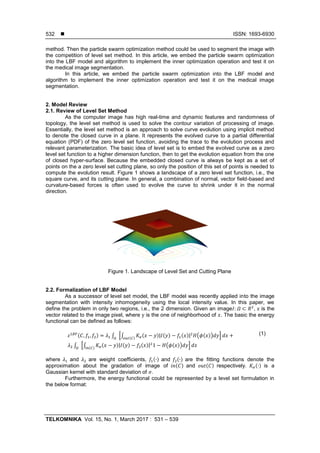
The main procedure of LBF can be summarized as following Algo. 1. Firstly, the initial
level set function is simply defined as a binary function:
( ) {
(13)
Algorithm 1. The pseudo-code of LBF
Initialization:](https://image.slidesharecdn.com/633159-200907071127/85/Local-Binary-Fitting-Segmentation-by-Cooperative-Quantum-Particle-Optimization-3-320.jpg)
![ ISSN: 1693-6930
TELKOMNIKA Vol. 15, No. 1, March 2017 : 531 – 539
534
Read the input image .
Build the initial level set function .
Initialize the iteration number .
Scale parameter in Gaussian kernel.
Repeat:
Compute Heaviside function according to Eq. (9);
Compute Dirac function according to Eq. (12);
Compute according to Eq. (6) and (7);
Upate the value of ( ) and ( ) using (10) and (11);
Upate the level set function as according to Eq. (5);
Until | | ;
Output the segmentation result .
3. Particle Swarm Optimization (CQPSO-LF) CQPSO-LF aided LBF Algorithm
3.1. CQPSO-LF Algorithm
Lévy flights [6], named after the French mathematician Paul Pierre Lévy, are Markov
processes. After a large number of steps, the distance from the origin of the random walk tends
to a stable distribution. Lévy flights, which can be characterized by an inverse square
distribution of step length, may optimize the random search process when targets are scarce
and scarcity of resources. In contrast, Brownian motion is usually suit for the case when need to
locate abundant prey or targets. These traits of two random walks inspired us to improve our
swarm intelligence optimization, where Lévy flights can improve the ability of “exploration” while
Brownian motion benefits the “exploitation”.
Mathematically, Lévy flights are a kind of random walk whose step lengths meet a
heavy-tailed Lévy alpha-stable distribution, often in terms of a power-law formula, ( ) | | ,
where 0<β≤2 is an index. A typical version of Lévy distribution can be defined as [7].
As the change of β, this can evolve into one of Lévy distribution, normal distribution and
Cauchy distribution. The increments of Lévy flights are distributed according to a heavy-tailed
probability distribution. Figure 2 shows an example of this kind of distribution.
3/2
1
[ ] ,
2 2( ) ( )
( , , )
0 ;
0, 0.
exp
s s
L s
s
s
(12)
(a) (b)
Figure 2. An Instance of 2D Lévy Flights in 500 Steps
Taking the 2D-Lévy flights for instance, the step lengths and distance 00 steps of
random walks obeying a Lévy distribution are shown as in Figure 2(a) and Figure 2 (b)
respectively. Note that the Lévy flights are often efficient in exploring unknown and large-scale
0 50 100 150 200 250 300 350 400 450 500
0
20
40
60
80
100
120
140
160
180
-150 -100 -50 0 50 100
-250
-200
-150
-100
-50
0
50](https://image.slidesharecdn.com/633159-200907071127/85/Local-Binary-Fitting-Segmentation-by-Cooperative-Quantum-Particle-Optimization-4-320.jpg)
![TELKOMNIKA ISSN: 1693-6930
Local Binary Fitting Segmentation by Cooperative Quantum Particle… (Desheng Li)
535
search space than Brownian walks. One reason for this argument is that the variance of Lévy
flights ( ) increases faster than that of Brownian random walks, i.e.,
( ) . Also, compared to Gaussian distribution, Lévy distribution is advantageous since the
probability of returning to a previously visited site is smaller than for a Gaussian distribution,
irrespective of the value of μ chosen.
From the update strategy of CQPSO-LF in our previous work [8,9] , we can draw a
conclusion that all particles in CQPSO-LF will converge to a common point, leaving the diversity
of the population extremely low and particles stagnated without further search before the
iterations is over. To overcome the problem, we exert a disturbance generated by Lévy flights
on the mean best position, global best position and electoral best position when the swarm is
evolving as shown in the following Eq.(14)-Eq.(16). To the local attractor, the hop steps in Lévy
flights promise the random traversal in the search space. However, to the global and electoral
best location, they only need a slightly disturbance, i.e., the angles meet a uniform distribution,
to exploit the particles nearby.
(14)
(15)
(16)
where , , is a pre-specified parameter, is a number in a sequence by Lévy flights,
angle is the angles of directions in Lévy flights.
Differently with other similar methods, we use the output parameters of Lévy flights to
intervene the position change directly, which can be seen in the Eq.(17) as follow, where
and are the output parameters of Lévy flights which are random generated,
while are the parametric empirical coefficient.
( ) ( ) (
) |( ) | ( )
(17)
3.2. CQPSO-LF Aided LBF Algorithm (LBF-CQPSO-LF)
The original LBF algorithm is a deterministic algorithm that is also sensitive to size of
the local image contours, shapes, and initial positions. At first, a simple contour is initialized in
an image and then the steepest-descent algorithm is employed to constrain it to minimize the
fitting energy functional. So the initial position of the contour is difficult or impossible to well
choice for the final performance. In light of this shortcoming, we propose a new hybrid model in
this article to utilize a population based swarm intelligence algorithm to select the good
candidate contours with the global minimum of the fitting energy functional. Meanwhile, the level
set method is also used to evolve the candidate contours and also get the cost function. During
the iterations, the initial seeds are elected by the CQPSO-LF algorithm to achieve the best
performance segmenta- -tion of the image. The whole framework of the CQPSO-LF aided LBF
Algorithm (LBF-CQPSO-LF) is described in the Algorithm 2.
Algorithm 2. The pseudo-code of LBF-CQPSO-LF
Initialization:
Read the input image .
Build the initial level set function .
Initialize the iteration number .
Scale parameter in Gaussian kernel.
While iteration <TH
For k=1 to
Compute Heaviside function;
Compute Dirac function;
Compute ;
Upate the value of ( ) and ( );
Upate the level set function as ;](https://image.slidesharecdn.com/633159-200907071127/85/Local-Binary-Fitting-Segmentation-by-Cooperative-Quantum-Particle-Optimization-5-320.jpg)
![ ISSN: 1693-6930
TELKOMNIKA Vol. 15, No. 1, March 2017 : 531 – 539
538
(a) (b)
Figure 7. Shape of Kernel Function
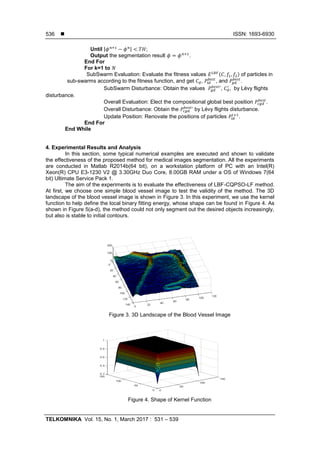
To evaluate the performance of proposed algorithm, LBF-CQPSO-LF, we adopted an
index called Segmentation Performance Measure (SPM) imported in literature [10] as an
benchmark, where the Automatically Segmented Image (ASI) is used to compare with the
Manually Segmented Image (MSI) to calculate the similarity by the Equation (18). Table 1
presents the quantitative segmentation performance of blood vessel and endocrine system
sample images by SPM and running time. It can be seen that the proposed algorithm could
reach high SPM, i.e., achieve desired initialization insensitive segmentation performance for
both simple and complex medical images.
( )
| | | |
(18)
Table 1. The Performance of LBF-CQPSO-LF
Test Run Iterations No.
SPM (%) Time taken (s)
Blood Vessel Endocrine System Blood Vessel Endocrine System
1 250 99.2579 97.3581 186.51 347.26
2 200 99.1547 98.156 157.03 291.08
3 300 99.3768 98.8245 201.65 414.73
4 150 98.6287 97.0689 86.49 156.4
7. Conclusion
In this article, a novel level set model aided by PSO was proposed to solve automated
medical image segmentation. The experimental result of segmentations on medical images
shows that the proposed method is not only effective to both simple and complex images with
adequate stochastic effects, but also shows the accuracy and high efficiency. However, our
methodstill has some limitations. For example, as our method stochastic algorithm naturally, so
it is hard to control the speed of convergence and stability. As our future studies, we will
investigate how to expand this method to the three-dimension case and consider multi-phase
level sets circumstance. Moreover, as the limitation of slow convergence, we aim to promote the
rate of convergence according to some approximate methods.
Acknowledgment
The research was supported by Natural Science Foundation of Anhui Province
(1708085MF161), Key Project of Natural Science Research of Universities in Anhui
(KJ2015A236), Key Project of Supporting Program for Outstanding Young Talents in
Universities of 2016 (Gxyqzd2016214), and was partially supported by grants of Natural
Science Foundation of Anhui province (No. 1508085MC55).](https://image.slidesharecdn.com/633159-200907071127/85/Local-Binary-Fitting-Segmentation-by-Cooperative-Quantum-Particle-Optimization-8-320.jpg)
![TELKOMNIKA ISSN: 1693-6930
Local Binary Fitting Segmentation by Cooperative Quantum Particle… (Desheng Li)
539
References
[1] Li C, Xu C, Gui C, Fox MD. Level Set Evolution without Re-Initialization: A New Variational
Formulation. IEEE Computer Society Conference on Computer Vision and Pattern Recognition, San
Diego. 2005; 1: 430-436.
[2] Luo Z, Xi Z, Wang J. Locating Liver Lesion with Local CV Level Set and Image Registration.
TELKOMNIKA Indonesian Journal of Electrical Engineering. 2014; 12(6): 4563-4571.
[3] Yin X, Chen X, Lei E, Wen M. PDF Based Icing Image Recognition Applied to Online Early Warning
System for Transmission Lines. TELKOMNIKA Indonesian Journal of Electrical Engineering. 2015;
13(3): 441-448.
[4] Li C, Kao C, Gore JC, Ding Z. Minimization of region-scalable fitting energy for image segmentation.
IEEE Transactions on Image Processing. 2008; 17(10): 1940-1949.
[5] Mekhmoukh A, Mokrani K. Improved Fuzzy C-Means based Particle Swarm Optimization (PSO)
initialization and outlier rejection with level set methods for MR brain image segmentation. Computer
Methods & Programs in Biomedicine. 2015; 122(2): 266-281.
[6] Shlesinger Micheal F, Zaslavsky GM, Frisch U. Lévy Flights and Related Topics in Physics. Lecture
Notes in Physics. 1995; 450.
[7] Yang XS. Engineering Optimization: An Introduction with Metaheuristic Applications, John Wiley and
Sons, 2010.
[8] Li D, He Q, Chen Y. Velocity control of longitudinal vibration ultrasonic motor using improved Elman
neural network trained by CQPSO with Lévy flights. Journal of Vibroengineering. 2014; 16(2): 35-747.
[9] Li D. Cooperative Quantum-Behaved Particle Swarm Optimization with Dynamic Varying Search
Areas and Lévy Flight Disturbance. The Scientific World Journal. 2014; 2014(3): 1-11.
[10] Mandal D, Chatterjee A, Maitra M. Robust medical image segmentation using particle swarm
optimization aided level set based global fitting energy active contour approach. Engineering
Applications of Artificial Intelligence. 2014; 35(2): 199-214.](https://image.slidesharecdn.com/633159-200907071127/85/Local-Binary-Fitting-Segmentation-by-Cooperative-Quantum-Particle-Optimization-9-320.jpg)


