By: Rose Ann J. Raquiza-Perante - Level 1
Resident
Local
O B J E C T I V E S
• To define what local anesthetics are
• To review the fundamental principles of basic pharmacology of local anesthetics, anatomy
of the nerve, electrophysiology of neural conduction and mechanism of molecular blockade
• To understand the pharmacodynamics and pharmacokinetics of local anesthetics
• To discuss the clinical applications of local anesthetics
• To identify the adverse effects, potential complications and toxicity of local anesthetics, and
discuss the strategies for prevention and management
• To review the recent advancements and emergent trends in local anesthetics
L O C A L A N E S T H E T I C S
• Local anesthetics are drugs used to block the
conduction of impulses in electrically excitable
tissues
• one of the most important uses is to provide
anesthesia and analgesia by blocking the
transmission of pain sensation along nerve fibers
B A S I C S T R U C T U R E
Most clinically relevant local anesthetic
consist of lipid soluble, aromatic benzene
ring connected to an amide group or an
ester moiety
Local anesthetics are divided into 2
categories based on their type of linkage
Amino amides
Aminoesters
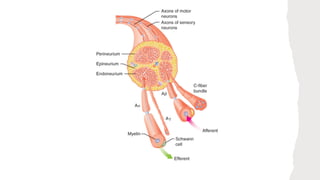
A N ATO M Y O F T H E N E R V E S
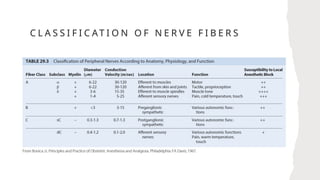
C L A S S I F I C AT I O N O F N E R V E F I B E R S
E L E C T R O P H Y S I O L O G Y O F
N E U R A L C O N D U C T I O N A N D
V O L TA G E G AT E S O D I U M
C H A N N E L S
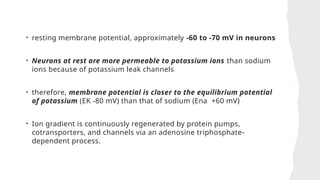
• resting membrane potential, approximately -60 to -70 mV in neurons
• Neurons at rest are more permeable to potassium ions than sodium
ions because of potassium leak channels
• therefore, membrane potential is closer to the equilibrium potential
of potassium (EK -80 mV) than that of sodium (Ena +60 mV)
• Ion gradient is continuously regenerated by protein pumps,
cotransporters, and channels via an adenosine triphosphate-
dependent process.
A C T I O N P O T E N T I A L S
• are electrical impulses conducted along nerve fibers
• brief, localized spikes of positive charge, or depolarizations, on the cell
membrane caused by rapid influx of sodium ions down its electrochemical
gradient
• initiated by local membrane depolarization
• is triggered in an “all-or-none” fashion
• short refractory period that ensues after each action potential prevents the
retrograde spread of action potential on previously activated membranes
V O L TA G E G AT E D S O D I U M C H A N N E L S
• Are the most important channel responsible for generation of action
potential
• is a made up of complex that has one principal alpha subunit and one
or more auxiliary beta subunits
• The alpha subunit is a single-polypeptide transmembrane protein
that contains most of the key components of the channel function.
• Beta Subunits are short polypeptide proteins with a single
transmembrane domain, perhaps play a role in modulation of channel
expression, localization, and function
• In the absence of a stimulus, voltage-gated sodium channels
exist predominantly in the resting or closed state
• On membrane depolarization, positive charges on the
membrane interact with charged amino acid residues in the
voltage-sensing regions converting it to the open state
• Sodium ions rush through the opened pore, which is lined with
negatively charged residues.
• Ion selectivity is determined by these amino acid residues;
changes in their composition can lead to increased permeability
for other cations, such as potassium and calcium
• Within milliseconds after opening, channels undergo a
transition to the inactivated state.
• Depending on the frequency and voltage of the initial
depolarizing stimulus, the channel may undergo either fast or
slow inactivation
M O L E C U L A R M E C H A N I S M S
O F L O C A L A N E S T H E T I C S
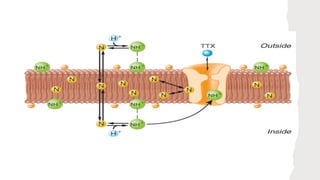
• Local anesthetics block the transmission of nerve impulses by
targeting the function of voltage-gated sodium channels
• Local anesthetics reversibly bind the intracellular portion of
voltage gated sodium channels
• Several local anesthetic can also bind to the other receptors e.g.
voltage gated potassium channels and nicotinic Ach receptors
• Tonic Blockade
 refers to the reduction of number of sodium channels for a given drug
concentration present in the open state equilibrium
• Use Dependent Blockade
 repetitive stimulation of sodium channels often leads to steady state
equilibrium resulting in a greater number of channels being blocked at the
same drug concentration
 Modulated-receptor Theory: local anesthetic bind to the open or inactivated
channels more avidly than the resting channels
 Guarded receptor Theory: assumes that the intrinsic binding affinity remains
essentially constant regardless of channel conformation
M E C H A N I S M O F N E R V E
B LO C K A D E
• Local anesthetics block peripheral nerves by disrupting
the transmission of action potentials along nerve fibers
• Entails diffusion of drugs to tissues and generation of
concentration gradient
• degree of nerve blockade depends on the local
anesthetic concentration and volume
• Minimal concentration is necessary to effect complete of
nerve blockade which reflects the potency of the local
anesthetic and the intrinsic conduction properties of nerve
• individual types of nerve fibers differ in their minimal
blocking concentration
• pattern of stimulation (tonic vs. use-dependent
blockade) influences the degree of conduction failure
• Local anesthetic volume also affects the degree of nerve
blockade
• Sufficient volume is needed to suppress the regeneration of
nerve impulse over a critical length of nerve fiber
• If the exposure distance is inadequate, action potentials can
skip over a long segment of nerve and resume nerve
conduction
• Not all sensory and motor modalities are blocked equally by
local anesthetics
• application of local anesthetics produces an ordered
progression of sensory and motor deficits:
• temperature sensation
• Proprioception motor function,
• sharp pain,
• finally light touch
PHARMACODYNAMICS
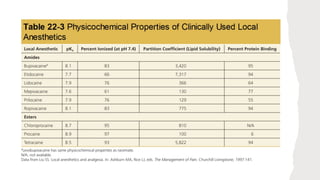
• Lipophilic and Hydrophilic Balance
• “Lipophilicity” expresses the tendency of a compound to associate with
membrane lipids, and is the the most important physiochemical property of local
anesthetics
• Lipid solubility is conferred by the composition of alkyl substitution on the amide
and the benzene groups
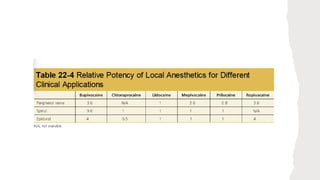
• These agents are more potent and produce longer-lasting blocks
S T R U C T U R E - A C T I V I T Y R E L A T I O N S H I P S A N D
P H Y S I C O C H E M I C A L P R O P E R T I E S
• The lipophilic property of local anesthetics may act at two levels:
• first is at the level of cellular entry as greater lipid solubility facilitates passage
through the lipid membrane barriers
• second is at the level of binding to the sodium channels
• A ratio with high concentration of the lipid soluble form
favors intracellular entry
• In aqueous solution, at a certain hydrogen ion concentration, local
anesthetic is in constant equilibrium between the protonated
cationic form and the lipid soluble neutral form (base)
• The ratio of the two forms depends on the pKa or the dissociation
constant of the local anesthetics and the surrounding pH
• pKa of most local anesthetic is > the physiologic pH (> 7.4)
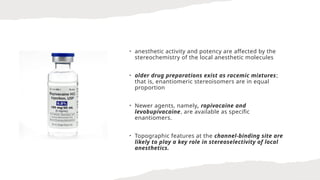
• anesthetic activity and potency are affected by the
stereochemistry of the local anesthetic molecules
• older drug preparations exist as racemic mixtures;
that is, enantiomeric stereoisomers are in equal
proportion
• Newer agents, namely, ropivacaine and
levobupivacaine, are available as specific
enantiomers.
• Topographic features at the channel-binding site are
likely to play a key role in stereoselectivity of local
anesthetics.
A D D I T I V E S T O I N C R E A S E
L O C A L A N E S T H E T I C
A C T I V I T Y
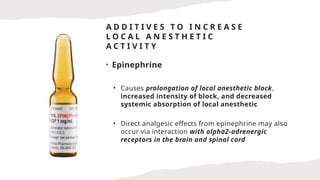
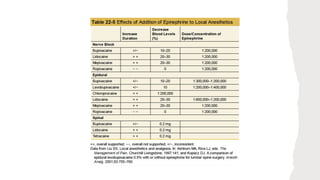
• Epinephrine
• Causes prolongation of local anesthetic block,
increased intensity of block, and decreased
systemic absorption of local anesthetic
• Direct analgesic effects from epinephrine may also
occur via interaction with alpha2-adrenergic
receptors in the brain and spinal cord
• Alkalinization of Local Anesthetic Solution
• hasten onset of neural block
• Causes an increase of the ratio of local anesthetic
existing as the lipid-soluble neutral form
• clinically used local anesthetics cannot be alkalinized
beyond a pH of 6.05 to 8 before precipitation occurs and
these pH values will only increase the neutral form to about
10%
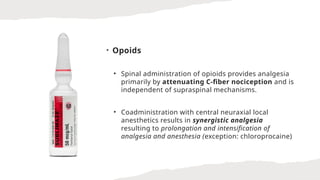
• Opoids
• Spinal administration of opioids provides analgesia
primarily by attenuating C-fiber nociception and is
independent of supraspinal mechanisms.
• Coadministration with central neuraxial local
anesthetics results in synergistic analgesia
resulting to prolongation and intensification of
analgesia and anesthesia (exception: chloroprocaine)
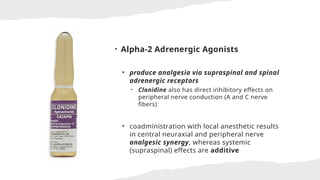
• Alpha-2 Adrenergic Agonists
• produce analgesia via supraspinal and spinal
adrenergic receptors
• Clonidine also has direct inhibitory effects on
peripheral nerve conduction (A and C nerve
fibers)
• coadministration with local anesthetic results
in central neuraxial and peripheral nerve
analgesic synergy, whereas systemic
(supraspinal) effects are additive
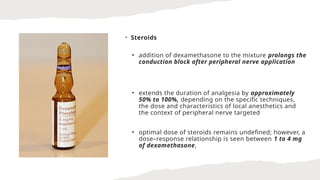
• Steroids
• addition of dexamethasone to the mixture prolongs the
conduction block after peripheral nerve application
• extends the duration of analgesia by approximately
50% to 100%, depending on the specific techniques,
the dose and characteristics of local anesthetics and
the context of peripheral nerve targeted
• optimal dose of steroids remains undefined; however, a
dose–response relationship is seen between 1 to 4 mg
of dexamethasone,
• Liposomes
• designed to provide extended duration of
analgesia beyond currently achievable without
catheters
• formulated to be released in a gradual,
sustained fashion, ensuring continuous
bioavailability at the site of action, and thereby
prolonging the effects and decreasing risk of
systemic spread and toxicity
PHARMACOKINETICS
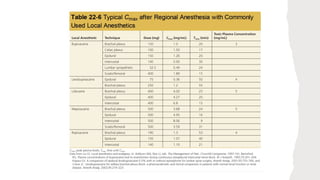
S Y S T E M I C A B S O R P T I O N
• rate and extent of systemic absorption depends on the site of
injection, the dose, the drug’s intrinsic pharmacokinetic
properties, and the addition of a vasoactive agent
• vascularity of the tissue markedly influences the rate of drug
absorption,
• rate of systemic absorption is greatest with intercostal nerve
blocks, then caudal and epidural injections, brachial plexus
block, and femoral and sciatic nerve blocks
S Y S T E M I C A B S O R P T I O N
• rate and extent of systemic absorption depends on the site of
injection, the dose, the drug’s intrinsic pharmacokinetic
properties, and the addition of a vasoactive agent
• vascularity of the tissue markedly influences the rate of drug
absorption,
• rate of systemic absorption is greatest with intercostal nerve
blocks, then caudal and epidural injections, brachial plexus
block, and femoral and sciatic nerve blocks
S Y S T E M I C A B S O R P T I O N
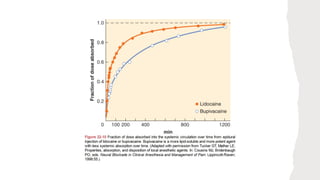
• the rate of systemic absorption and the peak plasma level are
directly proportional to the dose of local anesthetic deposited
• This relationship is nearly linear and independent of the drug
concentration and the speed of injection
• The more potent lipid-soluble agents are associated with a
slower rate of absorption than less lipid-soluble compounds
D I S T R I B U T I O N
• Systemic absorption of local anesthetics leads to rapid
distribution throughout the body
• regional differences in local anesthetic concentrations are
seen among individual organ systems
• The pattern of distribution is largely dependent on organ
perfusion, the
• partition coefficient between compartments, and plasma
protein binding
E L I M I N AT I O N
• metabolic pathway for clearance of local anesthetics is primarily
determined by their chemical linkage:
• Aminoesters are hydrolyzed by plasma cholinesterases
• Aminoamides are transformed by hepatic carboxylesterases
and cytochrome P450 enzymes.
• Severe liver disease may slow the clearance of aminoamide local
anesthetics and significant drug levels may therefore accumulate
CLINICAL
PHARMACOKINETICS
• primary benefit of understanding the systemic pharmacokinetics
of local anesthetics is the ability to predict the peak plasma level
(Cmax) after the agents are administered, thereby avoiding the
administration of toxic doses
• increased systemic plasma levels of local anesthetics in the very
young and in the elderly owing to decreased clearance and
increased absorption;
• Pathophysiologic states such as cardiac and hepatic disease will
alter expected pharmacokinetic parameters
C L I N I C A L U S E S O F LO C A L
A N E S T H E T I C S
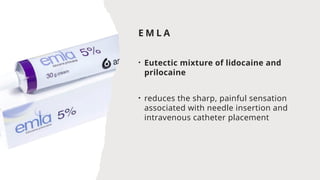
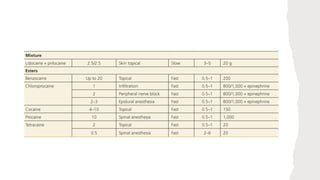
E M L A
• Eutectic mixture of lidocaine and
prilocaine
• reduces the sharp, painful sensation
associated with needle insertion and
intravenous catheter placement
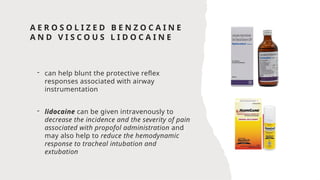
A E R O S O L I Z E D B E N Z O C A I N E
A N D V I S C O U S L I D O C A I N E
- can help blunt the protective reflex
responses associated with airway
instrumentation
- lidocaine can be given intravenously to
decrease the incidence and the severity of pain
associated with propofol administration and
may also help to reduce the hemodynamic
response to tracheal intubation and
extubation
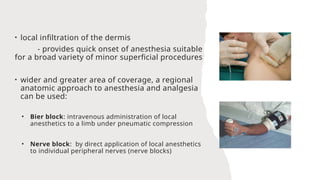
• local infiltration of the dermis
- provides quick onset of anesthesia suitable
for a broad variety of minor superficial procedures
• wider and greater area of coverage, a regional
anatomic approach to anesthesia and analgesia
can be used:
• Bier block: intravenous administration of local
anesthetics to a limb under pneumatic compression
• Nerve block: by direct application of local anesthetics
to individual peripheral nerves (nerve blocks)
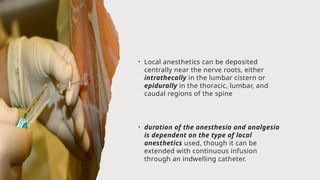
• Local anesthetics can be deposited
centrally near the nerve roots, either
intrathecally in the lumbar cistern or
epidurally in the thoracic, lumbar, and
caudal regions of the spine
• duration of the anesthesia and analgesia
is dependent on the type of local
anesthetics used, though it can be
extended with continuous infusion
through an indwelling catheter.
TOXICITY OF LOCAL
ANESTHETICS
L O C A L A N E S T H E T I C S Y S T E M I C T O X I C I T Y
( L A S T )
• Is a result of Accumulation of local anesthetics in the systemic circulation
from either inadvertent injection or unanticipated rapid absorption into
the blood stream leading to toxic levels with serious and devastating
consequences
• both the CNS and the cardiovascular system appear especially vulnerable
to the deleterious effects of LAST
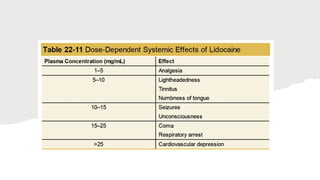
C N S T O X I C I T Y
• Local anesthetics readily cross the blood–brain barrier and, as a result,
CNS toxicity can arise quickly after intravascular injections
• effects on the CNS are determined by the plasma concentration of the
local anesthetics
• potential for CNS toxicity correlates directly with the potency of local
anesthetics
• Highly potent lipid-soluble agents can cause CNS toxicity at doses that are
a fraction of those of less potent agents
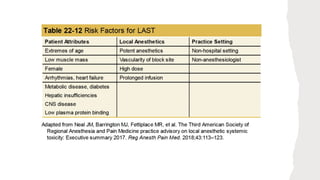
• potential for CNS toxicity is further modified by other
factors:
• a decrease in protein binding and clearance of local
anesthetics, systemic acidosis, hypercapnia, and hypercarbia
can all increase the risk for CNS toxicity.
• Conversely, coadministration of CNS depressive
agents, such as barbiturates and benzodiazepines,
may decrease the likelihood for seizures.
C A R D I O V A S C U L A R T O X I C I T Y
• correlates closely with the potency, or lipid solubility, of local
anesthetics
• more potent agents such as bupivacaine, ropivacaine, and
levobupivacaine are more likely to be associated with life-
threatening outcomes, such as cardiovascular collapse and
complete heart block
• ropivacaine and levobupivacaine may offer a safer
cardiovascular toxicity profile than bupivacaine.
• systemic bupivacaine has been shown to impair regulation by the
CNS on the cardiovascular system
• Disruption to the arterial baroreflex in the brainstem by
bupivacaine can lead to attenuation of the heart rhythm response to
changes in blood pressure
• In blood vessels, vasoconstriction occurs at subclinical doses in the
periphery but vasodilation at higher doses.
• In the pulmonary vasculature, increasing local anesthetic
concentrations produce marked pulmonary artery hypertension
• Elevated concentrations of local anesthetics have been shown to slow
cardiac electrical conductivity and decrease cardiac contractility.
• Although all local anesthetics disturb the cardiac conduction system
via a dose Dependent block of sodium channels (seen clinically as
a prolongation of the PR interval and duration of the QRS complex),
• Bupivacaine
- has a greater affinity for binding sodium channels in the
inactive or resting state than lidocaine
- the dissociation of bupivacaine from sodium channel binding
during diastole occurs more slowly than lidocaine which results
to prevention of a complete recovery of channels at the end of
each cardiac cycle
- Exerts a greater degree of direct myocardial depression than
less potent agents
• It is widely accepted that local anesthetics bind and disrupt
the normal function of the heart-specific voltage gated
sodium channel in cardiac myoctes
• Local anesthetics have been shown to antagonize the currents
of other cations, primarily calcium and potassium.
• The degree of antagonism between bupivacaine and less
potent agents appears to differ and may account for the
differences observed in the severity of the disturbance on the
cardiac membrane potentials.
C L I N I C A L P R E S E N TAT I O N
O F L A S T
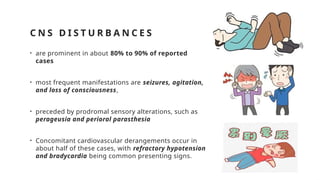
C N S D I S T U R B A N C E S
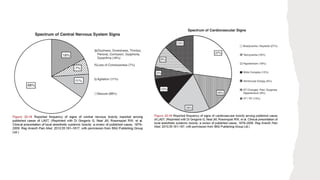
• are prominent in about 80% to 90% of reported
cases
• most frequent manifestations are seizures, agitation,
and loss of consciousness,
• preceded by prodromal sensory alterations, such as
perageusia and perioral parasthesia
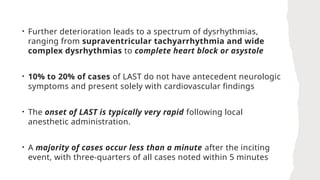
• Concomitant cardiovascular derangements occur in
about half of these cases, with refractory hypotension
and bradycardia being common presenting signs.
• Further deterioration leads to a spectrum of dysrhythmias,
ranging from supraventricular tachyarrhythmia and wide
complex dysrhythmias to complete heart block or asystole
• 10% to 20% of cases of LAST do not have antecedent neurologic
symptoms and present solely with cardiovascular findings
• The onset of LAST is typically very rapid following local
anesthetic administration.
• A majority of cases occur less than a minute after the inciting
event, with three-quarters of all cases noted within 5 minutes
P R E V E N T I O N A N D T R E AT M E N T O F
L A S T
• The best management for LAST starts with prevention and risk
reduction
• Effective treatment depends on early recognition and rapid
intervention to prevent worsening outcomes.
• tissue vascularity is an important determinant of the rate of systemic
absorption;
• the anatomic target and location should be among the considerations
for the choice and doses of local anesthetic.
• judicious dosing of local anesthetics is advisable in individuals
at extremes of age, as decreased levels of plasma binding
proteins may result in potentially greater fraction of unbound
local anesthetics circulating systemically.
• Infants younger than 6 months of age are found to be at sixfold
greater risk for LAST than older children
• Pregnant women are also likely at an increased risk
• Several practice may help minimize the risk of direct
intravascular injection
 careful aspiration before each injection
 small, incremental administration (3 to 5 mL) with continuous heart
rate monitoring;
 direct visualization and confirmation of the local anesthetic deposit
with ultrasonographic guidance
 incorporation of a vasoactive agent such as epinephrine to both
decrease the rate of systemic absorption and serve an
intravascular reporter
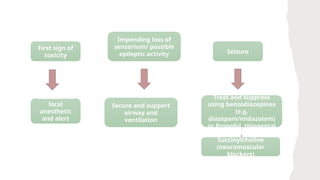
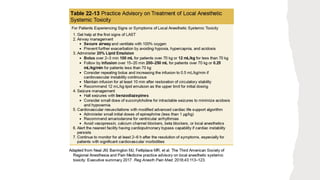
T R E AT M E N T O F S Y S T E M I C
T O X I C I T Y F R O M L O C A L
A N E S T H E T I C
First sign of
toxicity
Cessation of
local
anesthetic
and alert
assistance
Impending loss of
sensorium/ possible
epileptic activity
Secure and support
airway and
ventilation
Seizure
Treat and suppress
using benzodiazepines
(e.g.
diazepam/midazolam)
or Propofol, thiopental
Succinylcholine
(neuromuscular
blockers)
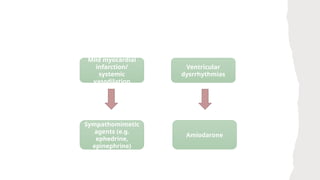
Mild myocardial
infarction/
systemic
vasodilation
Sympathomimetic
agents (e.g.
ephedrine,
epinephrine)
Amiodarone
Ventricular
dysrrhythmias
• Cardiovascular collapse from severe cardiac dysrhythmias is
the dreaded complication associated with LAST
• Emergent cardiopulmonary bypass was the only effective life-
saving measure, fortunately the introduction of lipid
resuscitation therapy has largely supplanted that need
• use of intravenous lipid emulsion hastens the return of
normal cardiac function and improving survival after local
anesthetic induced cardiotoxicity
N E U R A L T O X I C I T Y
• direct application of local anesthetics can result in histopathologic
changes consistent with neuronal injury.
• The degree of neural injury appears to correlate with intraneural
placement of local anesthetic, as well as the drug concentration and
the duration of exposure to the local anesthetics.
• In large concentrations, all clinically important local anesthetics can
produce dose-dependent abnormalities in nerve fibers;
• in clinically relevant concentrations, they appear generally safe
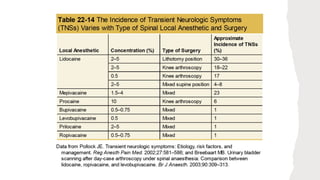
T R A N S I E N T N E U R O L O G I C S Y M P T O M S
A F T E R S P I N A L A N E S T H E S I A
• 4% to 40% incidence
• Includes pain or sensory abnormalities in the lower back, buttocks or lower
extremities, but did not result to permanent neurologic injury after lidocaine spinal
anesthesia
• Increased risk for is associated with lidocaine, the lithotomy position, and ambulatory
anesthesia, but not with baricity of solution or dose of local anesthetic
• Other potential etiologies include patient positioning, sciatic nerve stretch, muscle
spasm, and myofascial strain
• effective treatment includes nonsteroidal anti-inflammatory agents and trigger
point injections
M Y O T O X I C I T Y O F L O C A L A N E S T H E T I C S
• Local anesthetics can cause myotoxicity in clinically relevant
concentrations and manifest clinically as muscle pain and
dysfunction
• Injuries are subclinical and reversible
• changes are drug specific (tetracaine and procaine produce the
least injury; bupivacaine the most)
• It is both dose-and duration-dependent and seem to affect the
young more than the old
ALLERGIC REACTIONS
• relatively common, but true immunologic reactions are rare
• The immune-mediated hypersensitivity reaction may be type I
(immunoglobulin E) or type IV (cellular immunity).
• Symptoms can manifest within 12 to 48 hours of exposure and most
commonly present as contact dermatitis (dermal erythema, pruritus,
papules, and vesicles).
• Usually associated with aminoester agents, likely due to their
metabolism to para-aminobenzoic acid,
• Evaluation with skin-pricks, intradermal injections, or subcutaneous
provocative dose challenges are recommended for individuals with
suspected local anesthetic allergy
F U T U R E T H E R A P E U T I C S A N D
M O DA L I T I E S
N E O S A X I T O X I N
• Member of the new classes of molecules is the site 1 sodium channel blockers
• They belong to a group of potent paralytic neurotoxins that reversibly
antagonize voltage-gated sodium channels
• they bind to the channel alpha subunit extracellularly and have select affinity
for channel isoforms
• When injected subcutaneously, it produced hypoesthesia of a modest duration
• in combination with bupivacaine and epinephrine, it extended the duration of
hypoesthesia almost fivefold compared to bupivacaine alone
N E O S A X I T O X I N
• Systemic adsorption can result in a dose-dependent decrease
in respiratory and skeletal muscle strength
• due to its relatively poor affinity for the cardiac sodium
channel (Nav 1.5), cardiac outputs were maintained and no
significant cardiac arrhythmias or arrests were seen with
systemic infusion
• With scant evidence of either myotoxicity or neurotoxicity
with local injections
M O D U L AT I O N O F L A R G E - P O R E T R P V 1
A N D T R P A 1
• TRPV1 and TRPA1 are membrane channels belonging to the transient
receptor potential family.
• these channels permit passage of large, nonspecific cationic molecules
into the cell in response to heat, capsaicin, or other noxious stimuli
• The strategy exploits the finding that their presence is restricted to
primary sensory nociceptor neurons.
• Application of permanently charged lidocaine QX-314, results in selective
blockade of those sensory, but not motor or autonomic, neurons.
M O D U L AT I O N O F L A R G E - P O R E T R P V 1
A N D T R P A 1
• coadministration of capsaicin and QX-314 on sciatic nerves produced a
long-lasting sensory block with minimal motor deficit
• addition of lidocaine further prolonged the duration of the block at the
expense of an initial short and concomitant period of nonselective motor
block.
• the duration of the sensory block was much longer than the motor block,
leading to a differential blockade of approximately 16 hours).
T H A N K Y O U !
R E F E R E N C E S
• Cullen, B., Stock, M., Ortega, R., Sharar, S., Holt, N., Connor, C., & Nathan, N.
(2024). Barash, Cullen, and Stoelting's Clinical Anesthesia. Wolters Kluwer.
• Gropper, M., Eriksson, L., Fleisher, L., Wiener-Kronish, J., Cohen, N., & Leslie, K.
(2019). Miller's Anesthesia. Elsevier.

LOCAL ANESTHETICS ANESTHESIA BARASH. . .

  • 1.
    By: Rose AnnJ. Raquiza-Perante - Level 1 Resident Local
  • 2.
    O B JE C T I V E S • To define what local anesthetics are • To review the fundamental principles of basic pharmacology of local anesthetics, anatomy of the nerve, electrophysiology of neural conduction and mechanism of molecular blockade • To understand the pharmacodynamics and pharmacokinetics of local anesthetics • To discuss the clinical applications of local anesthetics • To identify the adverse effects, potential complications and toxicity of local anesthetics, and discuss the strategies for prevention and management • To review the recent advancements and emergent trends in local anesthetics
  • 3.
    L O CA L A N E S T H E T I C S • Local anesthetics are drugs used to block the conduction of impulses in electrically excitable tissues • one of the most important uses is to provide anesthesia and analgesia by blocking the transmission of pain sensation along nerve fibers
  • 4.
    B A SI C S T R U C T U R E Most clinically relevant local anesthetic consist of lipid soluble, aromatic benzene ring connected to an amide group or an ester moiety Local anesthetics are divided into 2 categories based on their type of linkage Amino amides Aminoesters
  • 5.
    A N ATOM Y O F T H E N E R V E S
  • 7.
    C L AS S I F I C AT I O N O F N E R V E F I B E R S
  • 8.
    E L EC T R O P H Y S I O L O G Y O F N E U R A L C O N D U C T I O N A N D V O L TA G E G AT E S O D I U M C H A N N E L S
  • 9.
    • resting membranepotential, approximately -60 to -70 mV in neurons • Neurons at rest are more permeable to potassium ions than sodium ions because of potassium leak channels • therefore, membrane potential is closer to the equilibrium potential of potassium (EK -80 mV) than that of sodium (Ena +60 mV) • Ion gradient is continuously regenerated by protein pumps, cotransporters, and channels via an adenosine triphosphate- dependent process.
  • 10.
    A C TI O N P O T E N T I A L S • are electrical impulses conducted along nerve fibers • brief, localized spikes of positive charge, or depolarizations, on the cell membrane caused by rapid influx of sodium ions down its electrochemical gradient • initiated by local membrane depolarization • is triggered in an “all-or-none” fashion • short refractory period that ensues after each action potential prevents the retrograde spread of action potential on previously activated membranes
  • 11.
    V O LTA G E G AT E D S O D I U M C H A N N E L S • Are the most important channel responsible for generation of action potential • is a made up of complex that has one principal alpha subunit and one or more auxiliary beta subunits • The alpha subunit is a single-polypeptide transmembrane protein that contains most of the key components of the channel function. • Beta Subunits are short polypeptide proteins with a single transmembrane domain, perhaps play a role in modulation of channel expression, localization, and function
  • 12.
    • In theabsence of a stimulus, voltage-gated sodium channels exist predominantly in the resting or closed state • On membrane depolarization, positive charges on the membrane interact with charged amino acid residues in the voltage-sensing regions converting it to the open state • Sodium ions rush through the opened pore, which is lined with negatively charged residues.
  • 13.
    • Ion selectivityis determined by these amino acid residues; changes in their composition can lead to increased permeability for other cations, such as potassium and calcium • Within milliseconds after opening, channels undergo a transition to the inactivated state. • Depending on the frequency and voltage of the initial depolarizing stimulus, the channel may undergo either fast or slow inactivation
  • 14.
    M O LE C U L A R M E C H A N I S M S O F L O C A L A N E S T H E T I C S
  • 15.
    • Local anestheticsblock the transmission of nerve impulses by targeting the function of voltage-gated sodium channels • Local anesthetics reversibly bind the intracellular portion of voltage gated sodium channels • Several local anesthetic can also bind to the other receptors e.g. voltage gated potassium channels and nicotinic Ach receptors
  • 17.
    • Tonic Blockade refers to the reduction of number of sodium channels for a given drug concentration present in the open state equilibrium • Use Dependent Blockade  repetitive stimulation of sodium channels often leads to steady state equilibrium resulting in a greater number of channels being blocked at the same drug concentration  Modulated-receptor Theory: local anesthetic bind to the open or inactivated channels more avidly than the resting channels  Guarded receptor Theory: assumes that the intrinsic binding affinity remains essentially constant regardless of channel conformation
  • 18.
    M E CH A N I S M O F N E R V E B LO C K A D E
  • 19.
    • Local anestheticsblock peripheral nerves by disrupting the transmission of action potentials along nerve fibers • Entails diffusion of drugs to tissues and generation of concentration gradient • degree of nerve blockade depends on the local anesthetic concentration and volume
  • 20.
    • Minimal concentrationis necessary to effect complete of nerve blockade which reflects the potency of the local anesthetic and the intrinsic conduction properties of nerve • individual types of nerve fibers differ in their minimal blocking concentration • pattern of stimulation (tonic vs. use-dependent blockade) influences the degree of conduction failure
  • 21.
    • Local anestheticvolume also affects the degree of nerve blockade • Sufficient volume is needed to suppress the regeneration of nerve impulse over a critical length of nerve fiber • If the exposure distance is inadequate, action potentials can skip over a long segment of nerve and resume nerve conduction
  • 22.
    • Not allsensory and motor modalities are blocked equally by local anesthetics • application of local anesthetics produces an ordered progression of sensory and motor deficits: • temperature sensation • Proprioception motor function, • sharp pain, • finally light touch
  • 23.
  • 24.
    • Lipophilic andHydrophilic Balance • “Lipophilicity” expresses the tendency of a compound to associate with membrane lipids, and is the the most important physiochemical property of local anesthetics • Lipid solubility is conferred by the composition of alkyl substitution on the amide and the benzene groups • These agents are more potent and produce longer-lasting blocks
  • 25.
    S T RU C T U R E - A C T I V I T Y R E L A T I O N S H I P S A N D P H Y S I C O C H E M I C A L P R O P E R T I E S • The lipophilic property of local anesthetics may act at two levels: • first is at the level of cellular entry as greater lipid solubility facilitates passage through the lipid membrane barriers • second is at the level of binding to the sodium channels • A ratio with high concentration of the lipid soluble form favors intracellular entry
  • 26.
    • In aqueoussolution, at a certain hydrogen ion concentration, local anesthetic is in constant equilibrium between the protonated cationic form and the lipid soluble neutral form (base) • The ratio of the two forms depends on the pKa or the dissociation constant of the local anesthetics and the surrounding pH • pKa of most local anesthetic is > the physiologic pH (> 7.4)
  • 29.
    • anesthetic activityand potency are affected by the stereochemistry of the local anesthetic molecules • older drug preparations exist as racemic mixtures; that is, enantiomeric stereoisomers are in equal proportion • Newer agents, namely, ropivacaine and levobupivacaine, are available as specific enantiomers. • Topographic features at the channel-binding site are likely to play a key role in stereoselectivity of local anesthetics.
  • 30.
    A D DI T I V E S T O I N C R E A S E L O C A L A N E S T H E T I C A C T I V I T Y • Epinephrine • Causes prolongation of local anesthetic block, increased intensity of block, and decreased systemic absorption of local anesthetic • Direct analgesic effects from epinephrine may also occur via interaction with alpha2-adrenergic receptors in the brain and spinal cord
  • 32.
    • Alkalinization ofLocal Anesthetic Solution • hasten onset of neural block • Causes an increase of the ratio of local anesthetic existing as the lipid-soluble neutral form • clinically used local anesthetics cannot be alkalinized beyond a pH of 6.05 to 8 before precipitation occurs and these pH values will only increase the neutral form to about 10%
  • 33.
    • Opoids • Spinaladministration of opioids provides analgesia primarily by attenuating C-fiber nociception and is independent of supraspinal mechanisms. • Coadministration with central neuraxial local anesthetics results in synergistic analgesia resulting to prolongation and intensification of analgesia and anesthesia (exception: chloroprocaine)
  • 34.
    • Alpha-2 AdrenergicAgonists • produce analgesia via supraspinal and spinal adrenergic receptors • Clonidine also has direct inhibitory effects on peripheral nerve conduction (A and C nerve fibers) • coadministration with local anesthetic results in central neuraxial and peripheral nerve analgesic synergy, whereas systemic (supraspinal) effects are additive
  • 35.
    • Steroids • additionof dexamethasone to the mixture prolongs the conduction block after peripheral nerve application • extends the duration of analgesia by approximately 50% to 100%, depending on the specific techniques, the dose and characteristics of local anesthetics and the context of peripheral nerve targeted • optimal dose of steroids remains undefined; however, a dose–response relationship is seen between 1 to 4 mg of dexamethasone,
  • 36.
    • Liposomes • designedto provide extended duration of analgesia beyond currently achievable without catheters • formulated to be released in a gradual, sustained fashion, ensuring continuous bioavailability at the site of action, and thereby prolonging the effects and decreasing risk of systemic spread and toxicity
  • 37.
  • 38.
    S Y ST E M I C A B S O R P T I O N • rate and extent of systemic absorption depends on the site of injection, the dose, the drug’s intrinsic pharmacokinetic properties, and the addition of a vasoactive agent • vascularity of the tissue markedly influences the rate of drug absorption, • rate of systemic absorption is greatest with intercostal nerve blocks, then caudal and epidural injections, brachial plexus block, and femoral and sciatic nerve blocks
  • 39.
    S Y ST E M I C A B S O R P T I O N • rate and extent of systemic absorption depends on the site of injection, the dose, the drug’s intrinsic pharmacokinetic properties, and the addition of a vasoactive agent • vascularity of the tissue markedly influences the rate of drug absorption, • rate of systemic absorption is greatest with intercostal nerve blocks, then caudal and epidural injections, brachial plexus block, and femoral and sciatic nerve blocks
  • 41.
    S Y ST E M I C A B S O R P T I O N • the rate of systemic absorption and the peak plasma level are directly proportional to the dose of local anesthetic deposited • This relationship is nearly linear and independent of the drug concentration and the speed of injection • The more potent lipid-soluble agents are associated with a slower rate of absorption than less lipid-soluble compounds
  • 43.
    D I ST R I B U T I O N • Systemic absorption of local anesthetics leads to rapid distribution throughout the body • regional differences in local anesthetic concentrations are seen among individual organ systems • The pattern of distribution is largely dependent on organ perfusion, the • partition coefficient between compartments, and plasma protein binding
  • 44.
    E L IM I N AT I O N • metabolic pathway for clearance of local anesthetics is primarily determined by their chemical linkage: • Aminoesters are hydrolyzed by plasma cholinesterases • Aminoamides are transformed by hepatic carboxylesterases and cytochrome P450 enzymes. • Severe liver disease may slow the clearance of aminoamide local anesthetics and significant drug levels may therefore accumulate
  • 45.
  • 46.
    • primary benefitof understanding the systemic pharmacokinetics of local anesthetics is the ability to predict the peak plasma level (Cmax) after the agents are administered, thereby avoiding the administration of toxic doses • increased systemic plasma levels of local anesthetics in the very young and in the elderly owing to decreased clearance and increased absorption; • Pathophysiologic states such as cardiac and hepatic disease will alter expected pharmacokinetic parameters
  • 47.
    C L IN I C A L U S E S O F LO C A L A N E S T H E T I C S
  • 48.
    E M LA • Eutectic mixture of lidocaine and prilocaine • reduces the sharp, painful sensation associated with needle insertion and intravenous catheter placement
  • 49.
    A E RO S O L I Z E D B E N Z O C A I N E A N D V I S C O U S L I D O C A I N E - can help blunt the protective reflex responses associated with airway instrumentation - lidocaine can be given intravenously to decrease the incidence and the severity of pain associated with propofol administration and may also help to reduce the hemodynamic response to tracheal intubation and extubation
  • 50.
    • local infiltrationof the dermis - provides quick onset of anesthesia suitable for a broad variety of minor superficial procedures • wider and greater area of coverage, a regional anatomic approach to anesthesia and analgesia can be used: • Bier block: intravenous administration of local anesthetics to a limb under pneumatic compression • Nerve block: by direct application of local anesthetics to individual peripheral nerves (nerve blocks)
  • 51.
    • Local anestheticscan be deposited centrally near the nerve roots, either intrathecally in the lumbar cistern or epidurally in the thoracic, lumbar, and caudal regions of the spine • duration of the anesthesia and analgesia is dependent on the type of local anesthetics used, though it can be extended with continuous infusion through an indwelling catheter.
  • 54.
  • 55.
    L O CA L A N E S T H E T I C S Y S T E M I C T O X I C I T Y ( L A S T ) • Is a result of Accumulation of local anesthetics in the systemic circulation from either inadvertent injection or unanticipated rapid absorption into the blood stream leading to toxic levels with serious and devastating consequences • both the CNS and the cardiovascular system appear especially vulnerable to the deleterious effects of LAST
  • 56.
    C N ST O X I C I T Y • Local anesthetics readily cross the blood–brain barrier and, as a result, CNS toxicity can arise quickly after intravascular injections • effects on the CNS are determined by the plasma concentration of the local anesthetics • potential for CNS toxicity correlates directly with the potency of local anesthetics • Highly potent lipid-soluble agents can cause CNS toxicity at doses that are a fraction of those of less potent agents
  • 58.
    • potential forCNS toxicity is further modified by other factors: • a decrease in protein binding and clearance of local anesthetics, systemic acidosis, hypercapnia, and hypercarbia can all increase the risk for CNS toxicity. • Conversely, coadministration of CNS depressive agents, such as barbiturates and benzodiazepines, may decrease the likelihood for seizures.
  • 59.
    C A RD I O V A S C U L A R T O X I C I T Y • correlates closely with the potency, or lipid solubility, of local anesthetics • more potent agents such as bupivacaine, ropivacaine, and levobupivacaine are more likely to be associated with life- threatening outcomes, such as cardiovascular collapse and complete heart block • ropivacaine and levobupivacaine may offer a safer cardiovascular toxicity profile than bupivacaine.
  • 60.
    • systemic bupivacainehas been shown to impair regulation by the CNS on the cardiovascular system • Disruption to the arterial baroreflex in the brainstem by bupivacaine can lead to attenuation of the heart rhythm response to changes in blood pressure • In blood vessels, vasoconstriction occurs at subclinical doses in the periphery but vasodilation at higher doses. • In the pulmonary vasculature, increasing local anesthetic concentrations produce marked pulmonary artery hypertension
  • 61.
    • Elevated concentrationsof local anesthetics have been shown to slow cardiac electrical conductivity and decrease cardiac contractility. • Although all local anesthetics disturb the cardiac conduction system via a dose Dependent block of sodium channels (seen clinically as a prolongation of the PR interval and duration of the QRS complex),
  • 62.
    • Bupivacaine - hasa greater affinity for binding sodium channels in the inactive or resting state than lidocaine - the dissociation of bupivacaine from sodium channel binding during diastole occurs more slowly than lidocaine which results to prevention of a complete recovery of channels at the end of each cardiac cycle - Exerts a greater degree of direct myocardial depression than less potent agents
  • 63.
    • It iswidely accepted that local anesthetics bind and disrupt the normal function of the heart-specific voltage gated sodium channel in cardiac myoctes • Local anesthetics have been shown to antagonize the currents of other cations, primarily calcium and potassium. • The degree of antagonism between bupivacaine and less potent agents appears to differ and may account for the differences observed in the severity of the disturbance on the cardiac membrane potentials.
  • 64.
    C L IN I C A L P R E S E N TAT I O N O F L A S T
  • 65.
    C N SD I S T U R B A N C E S • are prominent in about 80% to 90% of reported cases • most frequent manifestations are seizures, agitation, and loss of consciousness, • preceded by prodromal sensory alterations, such as perageusia and perioral parasthesia • Concomitant cardiovascular derangements occur in about half of these cases, with refractory hypotension and bradycardia being common presenting signs.
  • 67.
    • Further deteriorationleads to a spectrum of dysrhythmias, ranging from supraventricular tachyarrhythmia and wide complex dysrhythmias to complete heart block or asystole • 10% to 20% of cases of LAST do not have antecedent neurologic symptoms and present solely with cardiovascular findings • The onset of LAST is typically very rapid following local anesthetic administration. • A majority of cases occur less than a minute after the inciting event, with three-quarters of all cases noted within 5 minutes
  • 68.
    P R EV E N T I O N A N D T R E AT M E N T O F L A S T
  • 69.
    • The bestmanagement for LAST starts with prevention and risk reduction • Effective treatment depends on early recognition and rapid intervention to prevent worsening outcomes. • tissue vascularity is an important determinant of the rate of systemic absorption; • the anatomic target and location should be among the considerations for the choice and doses of local anesthetic.
  • 70.
    • judicious dosingof local anesthetics is advisable in individuals at extremes of age, as decreased levels of plasma binding proteins may result in potentially greater fraction of unbound local anesthetics circulating systemically. • Infants younger than 6 months of age are found to be at sixfold greater risk for LAST than older children • Pregnant women are also likely at an increased risk
  • 72.
    • Several practicemay help minimize the risk of direct intravascular injection  careful aspiration before each injection  small, incremental administration (3 to 5 mL) with continuous heart rate monitoring;  direct visualization and confirmation of the local anesthetic deposit with ultrasonographic guidance  incorporation of a vasoactive agent such as epinephrine to both decrease the rate of systemic absorption and serve an intravascular reporter
  • 73.
    T R EAT M E N T O F S Y S T E M I C T O X I C I T Y F R O M L O C A L A N E S T H E T I C
  • 74.
    First sign of toxicity Cessationof local anesthetic and alert assistance Impending loss of sensorium/ possible epileptic activity Secure and support airway and ventilation Seizure Treat and suppress using benzodiazepines (e.g. diazepam/midazolam) or Propofol, thiopental Succinylcholine (neuromuscular blockers)
  • 75.
  • 76.
    • Cardiovascular collapsefrom severe cardiac dysrhythmias is the dreaded complication associated with LAST • Emergent cardiopulmonary bypass was the only effective life- saving measure, fortunately the introduction of lipid resuscitation therapy has largely supplanted that need • use of intravenous lipid emulsion hastens the return of normal cardiac function and improving survival after local anesthetic induced cardiotoxicity
  • 78.
    N E UR A L T O X I C I T Y • direct application of local anesthetics can result in histopathologic changes consistent with neuronal injury. • The degree of neural injury appears to correlate with intraneural placement of local anesthetic, as well as the drug concentration and the duration of exposure to the local anesthetics. • In large concentrations, all clinically important local anesthetics can produce dose-dependent abnormalities in nerve fibers; • in clinically relevant concentrations, they appear generally safe
  • 79.
    T R AN S I E N T N E U R O L O G I C S Y M P T O M S A F T E R S P I N A L A N E S T H E S I A • 4% to 40% incidence • Includes pain or sensory abnormalities in the lower back, buttocks or lower extremities, but did not result to permanent neurologic injury after lidocaine spinal anesthesia • Increased risk for is associated with lidocaine, the lithotomy position, and ambulatory anesthesia, but not with baricity of solution or dose of local anesthetic • Other potential etiologies include patient positioning, sciatic nerve stretch, muscle spasm, and myofascial strain • effective treatment includes nonsteroidal anti-inflammatory agents and trigger point injections
  • 81.
    M Y OT O X I C I T Y O F L O C A L A N E S T H E T I C S • Local anesthetics can cause myotoxicity in clinically relevant concentrations and manifest clinically as muscle pain and dysfunction • Injuries are subclinical and reversible • changes are drug specific (tetracaine and procaine produce the least injury; bupivacaine the most) • It is both dose-and duration-dependent and seem to affect the young more than the old
  • 82.
  • 83.
    • relatively common,but true immunologic reactions are rare • The immune-mediated hypersensitivity reaction may be type I (immunoglobulin E) or type IV (cellular immunity). • Symptoms can manifest within 12 to 48 hours of exposure and most commonly present as contact dermatitis (dermal erythema, pruritus, papules, and vesicles). • Usually associated with aminoester agents, likely due to their metabolism to para-aminobenzoic acid, • Evaluation with skin-pricks, intradermal injections, or subcutaneous provocative dose challenges are recommended for individuals with suspected local anesthetic allergy
  • 84.
    F U TU R E T H E R A P E U T I C S A N D M O DA L I T I E S
  • 85.
    N E OS A X I T O X I N • Member of the new classes of molecules is the site 1 sodium channel blockers • They belong to a group of potent paralytic neurotoxins that reversibly antagonize voltage-gated sodium channels • they bind to the channel alpha subunit extracellularly and have select affinity for channel isoforms • When injected subcutaneously, it produced hypoesthesia of a modest duration • in combination with bupivacaine and epinephrine, it extended the duration of hypoesthesia almost fivefold compared to bupivacaine alone
  • 86.
    N E OS A X I T O X I N • Systemic adsorption can result in a dose-dependent decrease in respiratory and skeletal muscle strength • due to its relatively poor affinity for the cardiac sodium channel (Nav 1.5), cardiac outputs were maintained and no significant cardiac arrhythmias or arrests were seen with systemic infusion • With scant evidence of either myotoxicity or neurotoxicity with local injections
  • 87.
    M O DU L AT I O N O F L A R G E - P O R E T R P V 1 A N D T R P A 1 • TRPV1 and TRPA1 are membrane channels belonging to the transient receptor potential family. • these channels permit passage of large, nonspecific cationic molecules into the cell in response to heat, capsaicin, or other noxious stimuli • The strategy exploits the finding that their presence is restricted to primary sensory nociceptor neurons. • Application of permanently charged lidocaine QX-314, results in selective blockade of those sensory, but not motor or autonomic, neurons.
  • 88.
    M O DU L AT I O N O F L A R G E - P O R E T R P V 1 A N D T R P A 1 • coadministration of capsaicin and QX-314 on sciatic nerves produced a long-lasting sensory block with minimal motor deficit • addition of lidocaine further prolonged the duration of the block at the expense of an initial short and concomitant period of nonselective motor block. • the duration of the sensory block was much longer than the motor block, leading to a differential blockade of approximately 16 hours).
  • 89.
    T H AN K Y O U !
  • 90.
    R E FE R E N C E S • Cullen, B., Stock, M., Ortega, R., Sharar, S., Holt, N., Connor, C., & Nathan, N. (2024). Barash, Cullen, and Stoelting's Clinical Anesthesia. Wolters Kluwer. • Gropper, M., Eriksson, L., Fleisher, L., Wiener-Kronish, J., Cohen, N., & Leslie, K. (2019). Miller's Anesthesia. Elsevier.

Editor's Notes

  • #4 The typical local anesthetic molecule, exemplified by lidocaine and procaine (Fig. 29.1), contains a tertiary amine attached to a substituted aromatic ring by an intermediate chain that almost always contains either an ester (see Fig. 29.1) or an amide linkage  Each of these components contributes distinct clinical properties to the molecule aromatic ring system give lipophilic character while the tertiary amine is relatively hydrophilic and affects how they are metabolized. Aminoesters are hydrolyzed by plasma cholinesterases and aminoamides are degraded by hepatic carboxylesterases improves the lipid solubility of the compound Greater lipid solubility enhances diffusion through nerve sheaths, as well as the neural membranes of individual axons comprising a nerve trunk. This property correlates with potency  terminal amine may exist in a tertiary form (3 bonds) that is lipid soluble or as a quaternary form (4 bonds) that is positively charged and renders the molecule water soluble terminal amine acts as an “on-off switch” allowing the local anesthetic to exist in either lipid-soluble or water-soluble conformations
  • #5 Local anesthetics are used to block nerves in the peripheral nervous system (PNS) and central nervous system (CNS)
  • #6 Nerves are the functional and structural units of the peripheral nervous system (PNS). They are composed of groups of individual specialized cells called neurons (or nerve cells), which transmit motor and sensory information back and forth between the PNS and central nervous system (CNS). Transmission is initiated via electrochemical impulses known as action potentials. They are composed of groups of individual specialized cells called neurons (or nerve cells), which transmit motor and sensory information back and forth between the PNS and CNS In the PNS, nerves contain both afferent and efferent fibers, which are bundled into one or more fascicles and organized within three tissue layers. Individual nerve fibers within each fascicle are surrounded by the endoneurium, a loose connective tissue containing glial cells, fibroblasts, and blood capillaries. A dense layer of collagenous connective tissue called the perineurium surrounds each fascicle. A final layer of dense connective tissue, the epineurium, encases groups of fascicles into a cylindrical sheath These layers of tissue offer protection to the surrounded nerve fibers and act as barriers to passive diffusion of local anesthetics
  • #7 Nerve fibers are commonly classified according to their size, conduction velocity, and function (Table 22-1). In general, nerve fibers with crosssectional diameter greater than 1 mm are myelinated. Both a larger nerve size and the presence of myelin sheath are associated with faster conduction velocity.5 Nerve fibers with large diameters have better intrinsic electric conductance. Myelin improves the electrical insulation of nerve fibers and permits more rapid impulse transmission via saltatory conduction. Largediameter myelinated fibers, many of which are classified as A fibers, are typically involved in motor and sensory functions in which speed of nerve transmission is critical. In contrast, small-diameter nonmyelinated C fibers have slower conduction velocity and relay sensory information such as pain, temperature, and autonomic functions. Aα fibres supply skeletal muscle; Aβ fibres transmit tactile sensation; Aγ fibres provide innervation to muscle spindles; Aδ fibres transmit nociception and cold.  Myelinated B fibres are autonomic preganglionic nerves and the slower conducting, unmyelinated C fibres transmit dull pain from skin and viscera

  • #8 Transmission of electrical impulses along the cell membrane forms the basis of signal transduction along nerve fibers. resting membrane potential, approximately -60 to -70 mV in neurons derived predominantly from a difference in the intracellular and extracellular concentrations of potassium and sodium ions
  • #9 Energy necessary for the propagation and maintenance of the electric potential is maintained on the cell surface by ionic disequilibria across the semipermeable cell membrane resting membrane potential, approximately -60 to -70 mV in neurons derived predominantly from a difference in the intracellular and extracellular concentrations of potassium and sodium ions
  • #10 Transmission of electrical impulses along the cell membrane forms the basis of signal transduction along nerve fibers. The spike in membrane potential peaks around +50 mV, at which point the influx of sodium is replaced with an efflux of potassium, causing a reversal of membrane potential, or repolarization. When a certain charge threshold is reached, an actionpotential is triggered and further depolarization occurs in an “all-or-none” fashion.
  • #11 flow of ions responsible for action potentials is mediated by a variety of channels and pumps, the most important of which are the voltage Gated They are essentital for the influx of sodium ions during the rapid depolarization phase of the action potential sodium channels
  • #13 Slow or fast inactivation refers to the duration in which the channel remains refractory to repeat depolarization before resetting to the closed state. Fast inactivation completes within a millisecond and is sensitive to the action of local anesthetics. Slow activation, lasting seconds to minutes, is distinct from fast activation. It is resistant to the action of local anesthetics and its mechanism is less well understood, occurs after prolonged depolarization and is believed to be important in regulating membrane excitability.
  • #15 Several local anesthetics can also bind to other receptors such as voltage-gated potassium channels and nicotinic acetylcholine receptors and their amphipathic nature may enable hem to interact with plasma membranes it is widely accepted that local anesthetics induce anesthesia and analgesia through direct interactions with the sodium channels.
  • #16 Diagram of the bilayer lipid membrane of conductive tissue with the sodium channel spanning the membrane. Tertiary amine local anesthetics exist as both neutral base (N) and protonated, charged form (NH+) in equilibrium. The neutral base (N) is more lipid soluble, preferentially partitions into the lipophilic membrane interior, and easily passes through the membrane. The charged form (NH+) is more water soluble and binds to the sodium channel at the negatively charged membrane surface. Both forms can affect the function of the sodium channel. The N form can cause membrane expansion and closure of the sodium channel. The NH+ form will directly inhibit the sodium channel by binding with a local anesthetic receptor. The natural “local anesthetic” tetrodotoxin (TTX) binds at the external surface of the sodium channel and has no interaction with the clinically used local anesthetics. Early experiments with giant squid axons demonstrated that a derivative of lidocaine with a permanent positive charge and that cannot cross the plasma membrane (QX-314) blocks ion current through voltage-gated sodium channels only with intra-axoplasmic injections, but not with external application.
  • #17 Application of local anesthetics typically produces a concentration dependent decrease in the peak sodium current Modulated: local anesthetics bind to the open or the inactivated channels more avidly than the resting channels Guarded: rather, the apparent affinity is associated with increased access to the recognition site resulting from channel gating
  • #19 To get to its site of action, principally the voltage-gated sodium channels, local anesthetics have to reach the targeted nerve membrane Even with close proximity, only about 1% to 2% of injected local anesthetics ultimately penetrate into the nerve perineural sheath encasing nerve fibers appears to be an important determinant nerves that have been desheathed in vitro require about a 100-fold lower local anesthetic concentration (in 0.7 to 0.9 mM range for lidocaine) than nerves in vivo (the typical 2% lidocaine used clinically is equivalent to 75 mM concentration)
  • #20 It reflects the potency of the local anesthetics and the intrinsic conduction properties of nerve fibers, which in turn likely depend on the drug’s binding affinity to the ion channels and the degree of drug saturation necessary to halt the transmission of action potentials. individual types of nerve fibers differ in their minimal blocking concentration, such that some A fibers are blocked by lower drug concentrations than C fibers Likewise, the pattern of stimulation (tonic vs. use-dependent blockade) influences the degree of conduction failure; repetitive stimulations, which can lead to a shift in steady-state equilibrium of blocked sodium channels, are associated with higher conduction failure than tonic stimulation at a given drug concentration.
  • #21 sufficient volume is needed to suppress the regeneration of nerve impulse over a critical length of nerve fiber According to the model of decremental as membrane depolarization from an action potential passively decays with distance along nerve fibers, the presence of local anesthetics decreases the ability of adjacent membrane or successive nodes of Ranvier to regenerate impulses Transmission stops once the membrane depolarization falls below the threshold for action potential activation.
  • #22 According to the model of decremental as membrane depolarization from an action potential passively decays with distance along nerve fibers, the presence of local anesthetics decreases the ability of adjacent membrane or successive nodes of Ranvier to regenerate impulses Transmission stops once the membrane depolarization falls below the threshold for action potential activation.
  • #24 The intrinsic potency and duration of action of local anesthetics are clearly dependent on certain features of the molecule.  improves the lipid solubility of the compound Greater lipid solubility enhances diffusion through nerve sheaths, as well as the neural membranes of individual axons comprising a nerve trunk. This property correlates with potency  Clinically, the proportion of the lipid-soluble form can be increased by alkalization of local anesthetic solution and thus accelerate the onset of action
  • #25 A ratio with high concentration of the lipid soluble form favors intracellular entry, as the cellular membrane restricts passage of the cationic form, but not the lipid-soluble form proportion of the lipid-soluble form can be increased by alkalization of local anesthetic solution and thus accelerate the onset of action.
  • #26 By definition, the pKa of a molecule represents the pH at which 50% of the molecules exist in the lipid-soluble tertiary form and 50% in the quaternary, water-soluble form. The pKa of all local anesthetics is >7.4 (physiologic pH), and therefore a greater proportion the molecules exists water-soluble form when injected into tissue having normal pH of 7.4. The clinical caveat is that the higher the pKa for a local anesthetic, the fewer molecules are available in their lipid-soluble form. This will delay onset. Furthermore, the acidic environment associated with inflamed tissues lowers their pH well below 7.4 and favors the quaternary, water-soluble configuration even further. This has been suggested as one explanation for difficulty when attempting to anesthetize inflamed or infected tissues.1,2 In these situations, for example, bupivacaine (pKa 8.1) would be less desirable than mepivacaine (pKa 7.6). Clinically, the proportion of the lipid-soluble form can be increased by alkalization of local anesthetic solution and thus accelerate the onset of action
  • #27  The clinical caveat is that the higher the pKa for a local anesthetic, the fewer molecules are available in their lipid-soluble form. This will delay onset. Furthermore, the acidic environment associated with inflamed tissues lowers their pH well below 7.4 and favors the quaternary, water-soluble configuration even further. This has been suggested as one explanation for difficulty when attempting to anesthetize inflamed or infected tissues.1,2 In these situations, for example, bupivacaine (pKa 8.1) would be less desirable than mepivacaine (pKa 7.6). The partition coefficient is the measure of the lipophilicity of a drug and an indication of its ability to cross the cell membrane. It is defined as the ratio between un-ionized drug distributed between the organic and aqueous layers at equilibrium. 
  • #29 They were initially developed as less cardiotoxic alternatives to bupivacaine. Although the desired improvement in the safety index has been generally supported in clinical studies, this is at the expense of a slight decrease in potency overall and shorter duration of action compared with racemic mixtures
  • #30 vasoconstrictive effects augment local anesthetics by antagonizing inherent vasodilating effects of local anesthetics, decreasing systemic absorption and intraneural clearance, and perhaps by redistributing intraneural local anesthetic smallest dose is suggested because epinephrine combined with local may have toxic effects on tissue, the cardiovascular system, peripheral nerves, and the spinal cord Alpha sympathomimetic drug, adrenergic Alpha 1 N<E Alpha 2 E>N B1= N=E B2: E>>NE
  • #32  pKa of commonly used local anesthetics ranges from 7.6 to 8.9 and less than 3% of the commercially prepared local anesthetics exist as the lipid-soluble neutral form alkalinization of local anesthetics appears limited as a clinically useful adjuvant to improving anesthesia
  • #33 Opioids have multiple central and peripheral mechanisms of analgesic action An chlorprocaine, which appears to decrease the effectiveness of opioids coadministered epidurally. Nonetheless, clinical studies support the practice of central neuraxial coadministration of local anesthetics and opioids for However, although some studies have reported favorable outcomes for such coadministration, others have failed to demonstrate any increased efficacy. A problem that has plagued many studies is the lack of adequate controls for differentiating the analgesic effects of opioids acting peripherally versus a more central mechanism resulting from systemically absorbed opioids
  • #34 clonidine improves the duration of analgesia by about 2 hours, regardless of whether an intermediate- or long-acting local anesthetic is used results from clinical trials indicate that clonidine can enhance local anesthetic effects when used for intrathecal and epidural anesthesia and peripheral nerve blocks
  • #35 effects on block duration correlate with the potency of the glucocorticoid activity and appear to be steroid receptor dependent and locally mediated extends the duration of analgesia by approximately 50% to 100%, depending on the specific techniques, the dose and characteristics of local anesthetics and the context of peripheral nerve targeted with a possible ceiling effect observed for dosages greater than 4 mg
  • #36 however, coalesced clinical evidence is mixed and clouded with uncertainty
  • #37 Plasma concentration of local anesthetics is a function of the dose administered and the rates of systemic absorption, tissue distribution, and drug elimination. Elevated levels may produce unintended effects in other electric-sensitive systems, most importantly, the cardiovascular system and the CNS. Having a thorough understanding of the factors involved would enable one to maximize the local anesthetic potential while avoiding possible complications arising from systemic local anesthetic toxicity.
  • #38 vascularity of the tissue markedly influences the rate of drug absorption, deposition of local anesthetics in vessel-rich tissues results in higher peak plasma levels in a shorter period of time. Decreasing systemic absorption of local anesthetics increases their safety margin in clinical uses Thus, the same amount of local anesthetics injected would result in unequal peak plasma levels depending on the site of drug delivery.
  • #39 vascularity of the tissue markedly influences the rate of drug absorption, deposition of local anesthetics in vessel-rich tissues results in higher peak plasma levels in a shorter period of time. Decreasing systemic absorption of local anesthetics increases their safety margin in clinical uses Thus, the same amount of local anesthetics injected would result in unequal peak plasma levels depending on the site of drug delivery.
  • #40  Cmax is the highest concentration of a drug in the blood, cerebrospinal fluid, or target organ after a dose is given Tmax The time it takes for a drug to reach the maximum concentration (Cmax) after administration of a drug that needs to be absorbed Tmax is governed by the rate of drug absorption and the rate of drug elimination. At Tmax, these are equa
  • #41 the rate of systemic absorption and the peak plasma level are directly proportional to the dose of local anesthetic deposited. The rate of systemic absorption differs with individual local anesthetics. In general, more potent lipid-soluble agents are associated with a slower rate of absorption than less lipid-soluble compounds. Sequestration into lipid-rich compartments may not be the only explanation. At low concentrations, more potent agents appear to cause more vasoconstriction than less potent agents, thereby decreasing the rate of vascular absorption. At high concentrations, vasodilatory effects seem to predominate for most local anesthetics.

  • #42 The rate of systemic absorption differs with individual local anesthetics. In general, more potent lipid-soluble agents are associated with a slower rate of absorption than less lipid-soluble compounds
  • #43 The steady-state drug concentration in plasma can be readily derived from the apparent volume of distribution Organs that are well perfused, such as the heart and the brain, have higher drug concentrations. Unfortunately, they are also the organs most seriously affected by local anesthetic toxicity.
  • #45 Plasma concentration of local anesthetics is a function of the dose administered and the rates of systemic absorption, tissue distribution, and drug elimination. Elevated levels may produce unintended effects in other electric-sensitive systems, most importantly, the cardiovascular system and the CNS. Having a thorough understanding of the factors involved would enable one to maximize the local anesthetic potential while avoiding possible complications arising from systemic local anesthetic toxicity.
  • #46 pharmacokinetics are difficult to predict in any given circumstance because both physical and pathophysiologic characteristics will affect the individual pharmacokinetics. All of these factors should be considered when using local anesthetics and minimizing systemic toxicity, the commonly accepted maximal dosages (Table 22-9) notwithstanding
  • #48 There are a myriad of uses of local anesthetics in the modern practice of anesthesia. They all take advantage of their ability to attenuate or block pain and other noxious stimuli
  • #49 There are a myriad of uses of local anesthetics in the modern practice of anesthesia. They all take advantage of their ability to attenuate or block pain and other noxious stimuli
  • #55  Local anesthetics are generally safe, but they are not without potential for harm Effects can follow the use of any local anesthetics and via a variety of routes of administration
  • #56 At low plasma concentration, mild disturbances to the sensory systems appear. As the plasma concentration increases, CNS excitation and seizure activities predominate If the plasma concentration is sufficiently large or the increase is rapid, the CNS excitation may progress to generalized CNS depression and coma, leading to respiratory depression and arrest.
  • #57 At low plasma concentration, mild disturbances to the sensory systems appear. As the plasma concentration increases, CNS excitation and seizure activities predominate If the plasma concentration is sufficiently large or the increase is rapid, the CNS excitation may progress to generalized CNS depression and coma, leading to respiratory depression and arrest. potential for CNS toxicity is further modified by other factors. For example, a decrease in protein binding and clearance of local anesthetics, systemic acidosis, hypercapnia, and hypercarbia can all increase the risk for CNS toxicity.
  • #59 although all local anesthetics can give rise to hypotension, dysrhythmias, and myocardial depression In animal models, both ropivacaine and levobupivacaine appear to exhibit 30% to 40% less cardiovascular toxicity than bupivacaine on a milligram-tomilligram basis
  • #60 The underlying pathophysiology responsible for local anesthetic-induced cardiovascular collapse has not been fully established. Local anesthetics also act on smooth muscle endothelium surrounding blood vessels The increase in the pulmonary vascular resistance occurs prior to any significant decrease in the cardiac output, suggesting that the result is primarily an effect of local anesthetic intoxication, rather than secondarily to a decline in cardiac contractility.
  • #61 Although all local anesthetics disturb the cardiac conduction system via a dose Dependent block of sodium channels (seen clinically as a prolongation of the PR interval and duration of the QRS complex),
  • #62 bupivacaine has an inherently greater affinity for binding sodium channels in the inactive or resting state than lidocaine Second, although all local anesthetics bind sodium channels during cardiac systole and dissociate in diastole the dissociation of bupivacaine during diastole occurs more slowly than lidocaine. his slow rate of dissociation prevents a complete recovery of the channels at the end of each cardiac cycle (at the physiologic heart rate of 60 to 80 beats/min), thereby leading to more blocked channels and worsening of the conduction defect. In contrast, lidocaine fully dissociates from the channels during diastole, resulting in fewer channels being blocked and less conduction delay
  • #65 The latter can be severe and profound, and often resistant to intervention
  • #67 Few cases reported to present hours later are usually associated with use of continuous infusion catheters. More recent studies revealed a shift of cases toward more delayed onset. The reason for the shift is unclear; it may be due to a general increased awareness and practice of avoiding direct intravascular injections and a greater utilization of indwelling catheters to obviate the need for single large volume local anesthetic injection
  • #69 An understanding of the pharmacokinetics of local anesthetics and the various factors that influence their systemic spread, such as absorption, distribution, metabolism and elimination, is crucial to maintaining safe practices.
  • #70 Pregnant women are also likely at an increased risk, owing to the change in hormonal milieu, relative decreased plasma protein binding, and increased cardiac output, all which likely contribute to accelerated absorption and distribution several practices may help minimize the risk of direct intravascular injection and decrease systemic absorption
  • #72 No outcome studies have demonstrated efficacies of these measures in the prevention of LAST; nonetheless, together with broader awareness and education, they may partly be responsible for the gradual decline of yearly incidence of LAST observed over the last decade
  • #74 impending loss of sensorium and possible development of epileptic activity : airway, and ventilation should be secured and supported in order to prevent exacerbation of LAST due to hypoxia, hypercapnia, and acidosis Seizures should be promptly treated and suppressed, as generalized and uncontrolled muscular contractions can vastly increase the body’s metabolic demand and the resultant metabolic acidosis may make resuscitation more difficult. Benzodiazepines, such as midazolam or diazepam, are the preferred agents for preventing and terminating seizures. If benzodiazepines are not available, small doses of hypnotic agents such as propofol and thiopental, may be administered with caution, as they can further accentuate cardiovascular dysfunction associated with LAST.125 If seizure activity is prolonged, succinylcholine or other neuromuscular blockers can be administered, not only to facilitate pulmonary ventilation but also to disrupt muscular activity and reduce metabolic load. However, muscle relaxants do not reduce the electrical excitation in the CNS, and cerebral metabolic stress may continue unabated.
  • #75 Hemodynamic management is guided by principles of advanced cardiac life support, with some exceptions. Mild myocardial depression and systemic vasodilation can be corrected with sympathomimetic agents such as ephedrine or epinephrine. Vasopressin, calcium channel blockers, and beta blockers have all been associated with possible worse hemodynamic outcome and therefore, should not be used Ventricular dysrhythmias can be managed with amiodarone; however, other classes of antiarrhythmics, especially those involving sodium and calcium channel blockades, should be avoided altogether
  • #76 Emergent cardiopulmonary bypass was the only effective life-saving measure for this otherwise fatal outcome, lack of timely access and availability made resuscitation effort difficult, if not impossible Laboratory evidence and successive clinical reports of dramatic rescues have supported the use of intravenous lipid emulsion in hastening the return of normal cardiac function and improving survival after local anestheticinduced cardiotoxicity. With emphasis on timing of administration over exact dosing, current society practice advisories unequivocally recommend initiation of lipid resuscitation therapy at the first sign of dysrhythmia from suspected LAST
  • #78 The causative mechanisms remain speculative, but studies in animals and tissue cultures show evidence of demyelination, Wallerian degeneration, dysregulation of axonal transport, disruption of the blood–nerve barrier, decreased blood flow to the vasanervorum, and loss of cell membrane integrity Although the clinical use of local anesthetics appears to be safe, it behooves the practitioner to be mindful of their potential deleterious effects on nerves
  • #79 However, evidence for a direct linear relation between nerve toxicity and symptoms is scant Finally, effective treatment for TNS includes nonsteroidal anti-inflammatory agents and trigger point injections. These are regimens more effective for alleviating myofascial pain than for neuropathic pain
  • #81 disturbances in the oxidative function of mitochondria and dysregulation of intracellular calcium homeostasis as possible subcellular pathologic mechanisms
  • #83 Type I hypersensitivity reactions can result in anaphylaxis and potentially be life-threatening the incidence is estimated to be less than 1% Type IV hypersensitivity reactions are delayed-type reactions mediated by T lymphocytes. Preservatives, such as methylparaben and metabisulfite may also trigger allergic responses
  • #84 Properties of ideal local anesthetics include selectivity for nociception, long duration of action, and absence of systemic and local tissue toxicities.