Name-Aayush Kumar
Dept-BSC(IT) Faculty of Mathematics and
Computer Science
Roll.No.-1615090001
 Create predicative model to classify each
borrower as defaulter or not using the data
collected when the loan has been given.
 Minimize the risk of borrowers defaulting the
loans using created model.
 Technical feasibility: We are well verse in technical
skill required to accomplished project.
 Tenure feasibility : We are estimating and believe that
we would complete it on time.
 Financial feasibility : We are using Open source SW
except Microsoft office tool so no financial constraint as well.
 Lending Club is a US peer-to-peer lending
company.it operates an online lending platform that
enables borrowers to obtain a loan, and investors to
purchase notes backed by payments made on
loans.
 We would be creating predicative model for this
company as case study for our project purpose.
 To classify if the borrower will default the loan using
borrower’s finance history. That means, given a set of new
predictor variables, we need to predict the target variable as
1 -> Defaulter
0 -> Non-Defaulter.
The metric we use to choose the best model is ‘False
Negative Rate’.
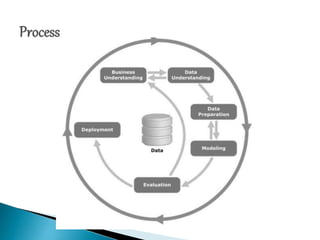
 We would be using CRISP-DM methodology
.The CRISP-DM methodology provides a
structured approach to planning a data
mining project. It is a robust and well-proven
methodology.
 We would be using classification algorithm
for solving our problem. It establish relation
between input features and output feature.
 Data Collection – Lending Club maintains all its data year-
wise. For this project, we have collected data from the lending club
website for the years 2012-14. The dataset consists of 360,000
observations and 145 features.
 Data Preparation – Out of the 145 features in our dataset,
many of them were empty. We have removed all such features.
Also, the features which didn’t seem relevant to our goal were
removed.
 Analysis and Modelling – Data will be divided into two
parts. Training data and validation data. The plan is to develop a
logistic regression model. The model will be developed on training
data and tested on validation data.
 Inference – This phase will provide the interpretation of the
study.
 MS Office
 Jupyter notebook
 Python
 Numpy
 Pandas
 Matplotlib
 Sckit learn
 Flask
 Power BI
The dataset had many empty and irrelevant features They have been removed.
● String values have been formatted to integers.
● Categorical values have been transformed to numerical.
● Redundant variables have been dropped.
● Filled NAN values with mean values of corresponding columns.
● All the numerical values have been scaled to a range between -1 and 1.
Now, using correlation matrix of the dataset and in depth reference to Lending Club’s data
dictionary, we chose 20 best features related to our objective. Now the dataset shape
has been reduced to (140000,20).
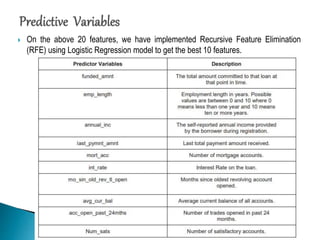
 On the above 20 features, we have implemented Recursive Feature Elimination
(RFE) using Logistic Regression model to get the best 10 features.
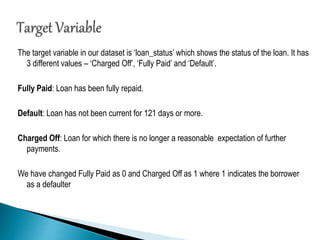
The target variable in our dataset is ‘loan_status’ which shows the status of the loan. It has
3 different values – ‘Charged Off’, ‘Fully Paid’ and ‘Default’.
Fully Paid: Loan has been fully repaid.
Default: Loan has not been current for 121 days or more.
Charged Off: Loan for which there is no longer a reasonable expectation of further
payments.
We have changed Fully Paid as 0 and Charged Off as 1 where 1 indicates the borrower
as a defaulter
 Random Forests Classification.
 MultiLayer Perceptron:
 Support Vector Machine:
 Logistic Regression
 Hyper Parameter tuning and Advanced Algorithms
 For our Loan default prediction project, False Negatives
Rate is the best metric to evaluate the model. Lower the
number of false negatives, better the model is.
 In this project, False negative is when model predicting “a
borrower will not default a loan even though he will “. Our
model cannot afford having higher False Negatives as it
leads to negative impact on the investors and the credibility
of the company. So, we evaluated our models using the
number of False negatives and accuracies.
● Our problem can be expressed as Supervised learning problem
where we have target variable specified. We have used supervised
learning algorithms like K-nearest neighbors, support vector
machines and logistic regression.
● We had 140,000 observations of data, which took a lot of time for
training. By implementing learning curve for our data, we realized
that our models do not learn after 7000 observations. So, we
downsized it. Thanks to the lecture on Feature Selection and Data
Preparation.
● Our data has been preprocessed using techniques like scaling, filling
null values.
Loan  default  prediction with  machine  language

Loan default prediction with machine language

  • 1.
    Name-Aayush Kumar Dept-BSC(IT) Facultyof Mathematics and Computer Science Roll.No.-1615090001
  • 2.
     Create predicativemodel to classify each borrower as defaulter or not using the data collected when the loan has been given.  Minimize the risk of borrowers defaulting the loans using created model.
  • 3.
     Technical feasibility:We are well verse in technical skill required to accomplished project.  Tenure feasibility : We are estimating and believe that we would complete it on time.  Financial feasibility : We are using Open source SW except Microsoft office tool so no financial constraint as well.
  • 4.
     Lending Clubis a US peer-to-peer lending company.it operates an online lending platform that enables borrowers to obtain a loan, and investors to purchase notes backed by payments made on loans.  We would be creating predicative model for this company as case study for our project purpose.
  • 5.
     To classifyif the borrower will default the loan using borrower’s finance history. That means, given a set of new predictor variables, we need to predict the target variable as 1 -> Defaulter 0 -> Non-Defaulter. The metric we use to choose the best model is ‘False Negative Rate’.
  • 6.
     We wouldbe using CRISP-DM methodology .The CRISP-DM methodology provides a structured approach to planning a data mining project. It is a robust and well-proven methodology.  We would be using classification algorithm for solving our problem. It establish relation between input features and output feature.
  • 8.
     Data Collection– Lending Club maintains all its data year- wise. For this project, we have collected data from the lending club website for the years 2012-14. The dataset consists of 360,000 observations and 145 features.  Data Preparation – Out of the 145 features in our dataset, many of them were empty. We have removed all such features. Also, the features which didn’t seem relevant to our goal were removed.  Analysis and Modelling – Data will be divided into two parts. Training data and validation data. The plan is to develop a logistic regression model. The model will be developed on training data and tested on validation data.  Inference – This phase will provide the interpretation of the study.
  • 9.
     MS Office Jupyter notebook  Python  Numpy  Pandas  Matplotlib  Sckit learn  Flask  Power BI
  • 10.
    The dataset hadmany empty and irrelevant features They have been removed. ● String values have been formatted to integers. ● Categorical values have been transformed to numerical. ● Redundant variables have been dropped. ● Filled NAN values with mean values of corresponding columns. ● All the numerical values have been scaled to a range between -1 and 1. Now, using correlation matrix of the dataset and in depth reference to Lending Club’s data dictionary, we chose 20 best features related to our objective. Now the dataset shape has been reduced to (140000,20).
  • 11.
     On theabove 20 features, we have implemented Recursive Feature Elimination (RFE) using Logistic Regression model to get the best 10 features.
  • 12.
    The target variablein our dataset is ‘loan_status’ which shows the status of the loan. It has 3 different values – ‘Charged Off’, ‘Fully Paid’ and ‘Default’. Fully Paid: Loan has been fully repaid. Default: Loan has not been current for 121 days or more. Charged Off: Loan for which there is no longer a reasonable expectation of further payments. We have changed Fully Paid as 0 and Charged Off as 1 where 1 indicates the borrower as a defaulter
  • 13.
     Random ForestsClassification.  MultiLayer Perceptron:  Support Vector Machine:  Logistic Regression  Hyper Parameter tuning and Advanced Algorithms
  • 14.
     For ourLoan default prediction project, False Negatives Rate is the best metric to evaluate the model. Lower the number of false negatives, better the model is.  In this project, False negative is when model predicting “a borrower will not default a loan even though he will “. Our model cannot afford having higher False Negatives as it leads to negative impact on the investors and the credibility of the company. So, we evaluated our models using the number of False negatives and accuracies.
  • 15.
    ● Our problemcan be expressed as Supervised learning problem where we have target variable specified. We have used supervised learning algorithms like K-nearest neighbors, support vector machines and logistic regression. ● We had 140,000 observations of data, which took a lot of time for training. By implementing learning curve for our data, we realized that our models do not learn after 7000 observations. So, we downsized it. Thanks to the lecture on Feature Selection and Data Preparation. ● Our data has been preprocessed using techniques like scaling, filling null values.