B.J.P.S Samiti’s
M.V.HERWADKAR ENGLISH MEDIUM HIGH SCHOOL
Program:
Semester:
Course: NAME OF THE COURSE
1
MAJOR LANDFORMS
Mrs Varada Phadke
M.V.HERWADKAR ENGLISH MEDIUM SCHOOL 2
MAJOR LANDFORMS
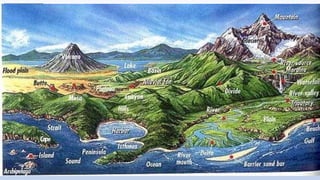
When we look around we find that the land surface is
not the same everywhere. In some places the land is
high and in other places it is low. Some areas are
almost flat and in other places the land is hilly. In some
places the land is very low. Hence many types of relief
features can be seen on the Earth’s surface. There are
mountains, hills, valleys, plains, deserts and islands.
The different types of land surfaces are known as
landforms.
M.V.HERWADKAR ENGLISH MEDIUM SCHOOL 3
The landforms are not permanent. They are changing.
The landforms that you see today were not there some
years ago.
The land surface changes due to the work of internal
and external forces.
Land forms make a significant influence in the human
life and their activities .
M.V.HERWADKAR ENGLISH MEDIUM SCHOOL 4
Types of landforms
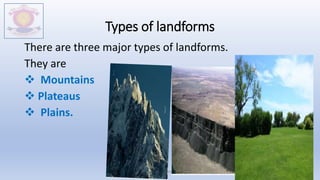
There are three major types of landforms.
They are
 Mountains
 Plateaus
 Plains.
M.V.HERWADKAR ENGLISH MEDIUM SCHOOL 5
Mountains
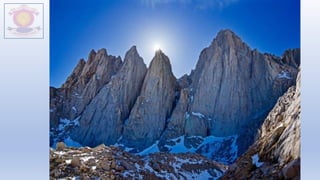
Mountains are mighty and important landforms.
They are the uplifted portions of the Earth’s surface
and are much higher than the surrounding areas.
They have steep slopes and small peaks, rising to
more than 1000 metres above sea level.
A peak is the highest point of a mountain.
M.V.HERWADKAR ENGLISH MEDIUM SCHOOL 6
M.V.HERWADKAR ENGLISH MEDIUM SCHOOL 7
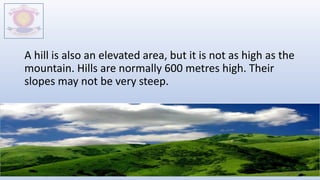
A hill is also an elevated area, but it is not as high as the
mountain. Hills are normally 600 metres high. Their
slopes may not be very steep.
M.V.HERWADKAR ENGLISH MEDIUM SCHOOL 8
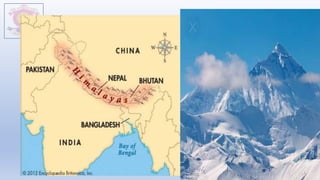
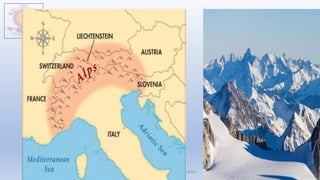
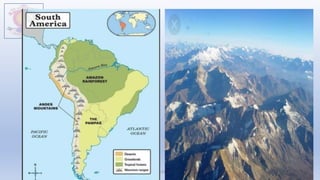
A line of mountains, with or without peaks, is known
as a ‘mountain range’.
Some of the important mountain ranges are
The Himalayas (in Asia),
 The Alps (in Europe) and
 The Andes (in South America).
M.V.HERWADKAR ENGLISH MEDIUM SCHOOL 9
M.V.HERWADKAR ENGLISH MEDIUM SCHOOL 10
M.V.HERWADKAR ENGLISH MEDIUM SCHOOL 11
M.V.HERWADKAR ENGLISH MEDIUM SCHOOL 12
Types of mountains
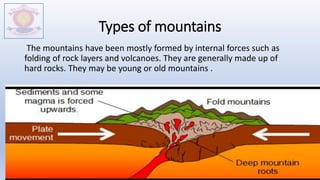
The mountains have been mostly formed by internal forces such as
folding of rock layers and volcanoes. They are generally made up of
hard rocks. They may be young or old mountains .
M.V.HERWADKAR ENGLISH MEDIUM SCHOOL 13
•Young mountains, created several dozen million
years ago, have steep slopes and high-pointed
peaks. The youngest mountains, also the highest
in the world, are within the Himalayas massif in
Asia. Old mountains, in contrast, have rounded
peaks and slopes made gentler by hundreds of
millions of years of erosion.
M.V.HERWADKAR ENGLISH MEDIUM SCHOOL 14
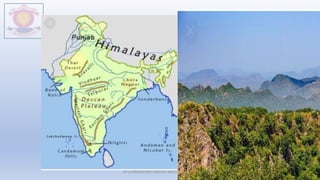
• The Himalayas and the Alps are young mountains. The Appalatian (N.
America) and the Aravallis (India) are old mountains. The higher
slopes of the high mountains are covered with snow. On the basis of
formation, mountains are divided into three types-fold mountains,
block mountains and volcanic mountains.
M.V.HERWADKAR ENGLISH MEDIUM SCHOOL 15
M.V.HERWADKAR ENGLISH MEDIUM SCHOOL 16
M.V.HERWADKAR ENGLISH MEDIUM SCHOOL 17
• Fold mountains are formed due to the folding of rock layers. They are
the highest mountains The Himalayas and the Alps are fold mountains
M.V.HERWADKAR ENGLISH MEDIUM SCHOOL 18
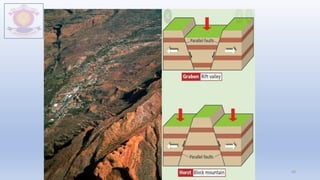
• Block mountains are formed when large areas of land are broken and
lifted up. Block mountains are not very high. Example of block
mountains are Sierra Nevada (South America) Vosges mountain
(Europe).
M.V.HERWADKAR ENGLISH MEDIUM SCHOOL 19
M.V.HERWADKAR ENGLISH MEDIUM SCHOOL 20
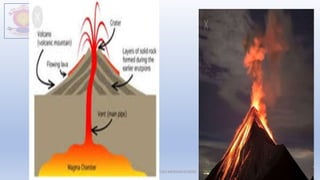
• Volcanic mountains are formed due to the accumulation of volcanic
material. They have a broad base and conical peaks. Mt. Kilimanjaro
in Africa and Mt. Fujiyama in Japan are examples of volcanic
mountains.
M.V.HERWADKAR ENGLISH MEDIUM SCHOOL 21
M.V.HERWADKAR ENGLISH MEDIUM SCHOOL 22
Importance of mountains
Form natural boundaries between countries
 Storehouse of resources
Provide water for the generation of hydro-electricity
are sources of rivers
Have good effect on climate
• Have scenic beauty, hence they are tourist centres
• Are ideal for plantation crops
M.V.HERWADKAR ENGLISH MEDIUM SCHOOL 23
Plateaus
M.V.HERWADKAR ENGLISH MEDIUM SCHOOL 24
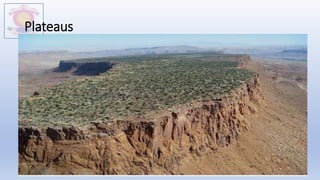
• Plateaus are elevated flat lands with steep sides. They are also called
tablelands. Generally they rise above the surrounding areas. They
have uneven surface. Some plateaus are very vast, e. g. the Deccan
Plateau in India. Some plateaus are at higher elevation, e.g. the
Plateau of Tibet. It is the world’s highest plateau and is known as the
‘Roof of the World’. Some plateaus are located at lower level. The
plateaus consist of hard rocks which are rich in minerals. South
eastern parts of Karnataka are located on a plateau.
M.V.HERWADKAR ENGLISH MEDIUM SCHOOL 25
Types of Plateaus
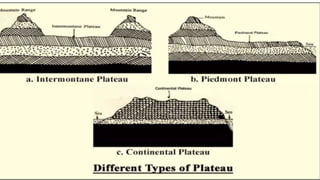
Plateaus can be divided into three types:
 Intermontane Plateaus,
 Piedmont Plateaus and
Continental Plateau
M.V.HERWADKAR ENGLISH MEDIUM SCHOOL 26
M.V.HERWADKAR ENGLISH MEDIUM SCHOOL 27
M.V.HERWADKAR ENGLISH MEDIUM SCHOOL 28
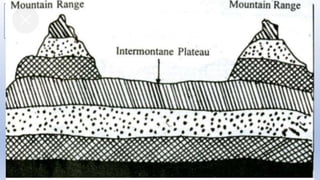
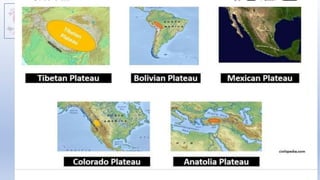
Intermontane Plateaus
• Intermontane Plateaus are enclosed by high mountain
ranges, e.g. Tibetan Plateau (Asia) and Bolivian
Plateau (South America).
M.V.HERWADKAR ENGLISH MEDIUM SCHOOL 29
Piedmont Plateaus
• Piedmont Plateaus have mountains on one side and
plains or ocean on the other, e.g. Patagonian Plateau
[South America]
M.V.HERWADKAR ENGLISH MEDIUM SCHOOL 30
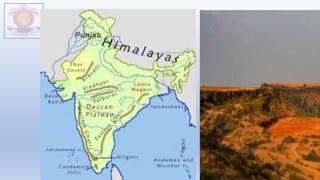
Continental Plateaus
• Continental Plateaus are formed by extensive uplift of
continents or spread of lava, e.g. North Western
Deccan Plateau (India).
M.V.HERWADKAR ENGLISH MEDIUM SCHOOL 31
M.V.HERWADKAR ENGLISH MEDIUM SCHOOL 32
M.V.HERWADKAR ENGLISH MEDIUM SCHOOL 33
Importance of plateaus
 A storehouse of minerals.
 Very suitable for the generation of hydro-electricity
 Have fertile soil which is suitable for agriculture
 Are useful for animal rearing.
M.V.HERWADKAR ENGLISH MEDIUM SCHOOL 34
M.V.HERWADKAR ENGLISH MEDIUM SCHOOL 35
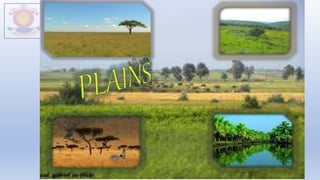
Plains
• Extensive areas of flat or undulating land, usually
lowlands are called plains. They are of great economic
importance.
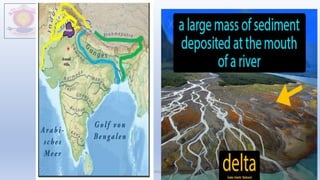
• Most plains have been formed by the deposition of
sediments carried by rivers. Some plains have been
formed by glaciers, winds, waves, etc. There are many
plains along river valleys and in coastal areas, e.g. the
Ganges plain and its delta.
M.V.HERWADKAR ENGLISH MEDIUM SCHOOL 36
M.V.HERWADKAR ENGLISH MEDIUM SCHOOL 37
• There are three types of plains.
 They are Structural Plains,
 Erosional Plains and
Depositional Plains
M.V.HERWADKAR ENGLISH MEDIUM SCHOOL 38
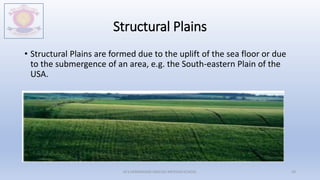
Structural Plains
• Structural Plains are formed due to the uplift of the sea floor or due
to the submergence of an area, e.g. the South-eastern Plain of the
USA.
M.V.HERWADKAR ENGLISH MEDIUM SCHOOL 39
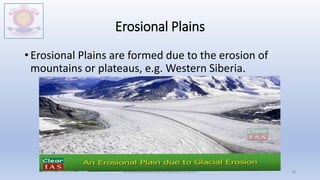
Erosional Plains
• Erosional Plains are formed due to the erosion of
mountains or plateaus, e.g. Western Siberia.
M.V.HERWADKAR ENGLISH MEDIUM SCHOOL 40
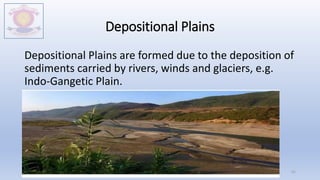
Depositional Plains
Depositional Plains are formed due to the deposition of
sediments carried by rivers, winds and glaciers, e.g.
Indo-Gangetic Plain.
M.V.HERWADKAR ENGLISH MEDIUM SCHOOL 41
Importance of plains
 Have vast level land and fertile soil
Are very useful for agriculture and industries
Are favourable for the development of transport.
 Have been centres of civilization
Encourage the growth of towns and cities
M.V.HERWADKAR ENGLISH MEDIUM SCHOOL 42
Deserts
M.V.HERWADKAR ENGLISH MEDIUM SCHOOL 43
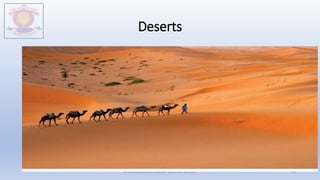
• Mountains, plateaus and plains differ from each other
because of relief. Deserts are a result of climate. Deserts
are hot during the day and quite cold at night. Deserts get
very little rainfall and therefore deserts are mainly dry.
Therefore extensive dry lands are called deserts. Deserts
occupy about 15 of the Earth’s surface. Deserts can be
rocky, or sandy. Deserts are found in every continent
except Europe and Antarctica. Sahara desert is the largest
desert in the world.
M.V.HERWADKAR ENGLISH MEDIUM SCHOOL 44
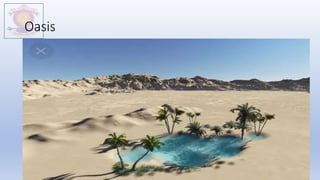
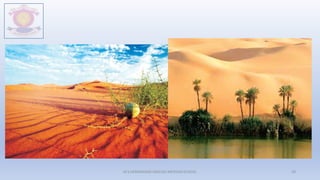
• Oases are places in the desert where underground
water comes to the surface through springs. They help
in the growth of plants and human settlements.
M.V.HERWADKAR ENGLISH MEDIUM SCHOOL 45
Oasis
M.V.HERWADKAR ENGLISH MEDIUM SCHOOL 46
Importance of deserts
Deserts are inhabited by nomads who go from place to
place with their herds of animals. The desert soil is not
very fertile. But wherever water is available, crops can
be grown. e.g. Nile valley of Egypt. Most deserts are
rich in minerals, e.g. petroleum in the Kuwait, Saudi
Arabia, etc.
M.V.HERWADKAR ENGLISH MEDIUM SCHOOL 47
Islands
M.V.HERWADKAR ENGLISH MEDIUM SCHOOL 48
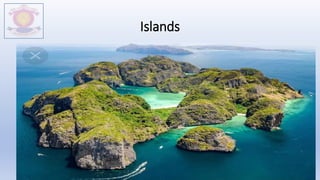
• An island is an area of land surrounded by water.
Islands are found in oceans, seas, lakes or rivers. Very
small islands are known as islets.
• A group of islands is known as ‘archipelago’, e.g.
Tierra-del Fuego, Indonesian Islands.
M.V.HERWADKAR ENGLISH MEDIUM SCHOOL 49
M.V.HERWADKAR ENGLISH MEDIUM SCHOOL 50
Types of islands
• There are two main types of islands- continental
islands and oceanic islands. Continental islands are
formed due to separation from the mainland, e.g
Greenland, Iceland, etc. Oceanic islands are formed in
the ocean and are of volcanic origin. Hence they are
known as volcanic islands, e.g. Hawaii, Java. However
some islands are formed by coral polyps. They are
known as coral islands, e.g. Lakshadweep Islands
(India).
M.V.HERWADKAR ENGLISH MEDIUM SCHOOL 51
M.V.HERWADKAR ENGLISH MEDIUM SCHOOL 52
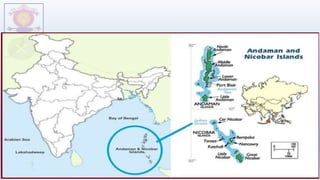
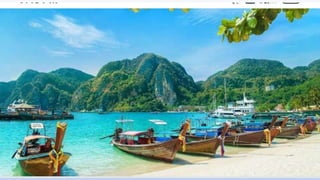
• The Andaman and Nicobar Islands and Lakshadweep
Islands are the major islands of India. There are some
islands along the coast of Karnataka, e.g. St. Mary’s
Island (Coconut Island), etc
M.V.HERWADKAR ENGLISH MEDIUM SCHOOL 53
M.V.HERWADKAR ENGLISH MEDIUM SCHOOL 54
M.V.HERWADKAR ENGLISH MEDIUM SCHOOL 55
Importance of islands
• Some islands have pleasant climate. They are tourist
attractions. Some have plantation agriculture. Fishing
is a very important occupation of the people
M.V.HERWADKAR ENGLISH MEDIUM SCHOOL 56
Major Natural Regions of the World
• Meaning of natural regions :
Areas having similar natural features are called
‘Natural Regions”. Every natural region has its own
distinct characteristics. They have similar climatic
conditions, relief features, soil, vegetation, animal life,
human occupations, etc. The variations within the
regions are less than the variations between the
regions. There is no definite boundary separating one
region from another. There is a gradual change from
one region to another .
M.V.HERWADKAR ENGLISH MEDIUM SCHOOL 57
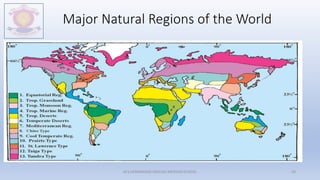
Major Natural Regions of the World
M.V.HERWADKAR ENGLISH MEDIUM SCHOOL 58
• Importance of natural regions :
The study of natural regions is very important for a
comparative study of the natural environment of the
different parts of the world. It helps us to know the
human response to it.
M.V.HERWADKAR ENGLISH MEDIUM SCHOOL 59
Types of natural regions
1. Equatorial Region or Amazon type
2. Tropical Grassland Region or the Sudan type
3. Tropical Monsoon Regions
4. Tropical Desert Regions or the Sahara type
5. Tropical Deserts or the Sahara type
M.V.HERWADKAR ENGLISH MEDIUM SCHOOL 60
6. Temperate Deserts Regions
7. The Mediterranean Regions
8. The warm Temperate Regions or China type
9. Cool Temperate Oceanic Regions
(West European type)
10. Temperate Grassland Regions or Prairie Type
M.V.HERWADKAR ENGLISH MEDIUM SCHOOL 61
11. Cool Temperate East Coastal Regions or St.
Lawrence type.
12. The Cold Continental Region or Taiga Type
13. The Cold Desert or Tundra type
M.V.HERWADKAR ENGLISH MEDIUM SCHOOL 62
• Do You know?
● The highest peak in the world is Mt. Everest.
● The plateaus of Africa are famous for gold and
diamonds.
● The Gangetic delta is the largest delta in the world. It
is also known as Sundarbans.
M.V.HERWADKAR ENGLISH MEDIUM SCHOOL 63
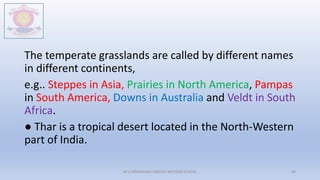
The temperate grasslands are called by different names
in different continents,
e.g.. Steppes in Asia, Prairies in North America, Pampas
in South America, Downs in Australia and Veldt in South
Africa.
● Thar is a tropical desert located in the North-Western
part of India.
M.V.HERWADKAR ENGLISH MEDIUM SCHOOL 64

L.NO 7 Major landforms 6TH.pptx

  • 1.
    B.J.P.S Samiti’s M.V.HERWADKAR ENGLISHMEDIUM HIGH SCHOOL Program: Semester: Course: NAME OF THE COURSE 1 MAJOR LANDFORMS Mrs Varada Phadke
  • 2.
  • 3.
    MAJOR LANDFORMS When welook around we find that the land surface is not the same everywhere. In some places the land is high and in other places it is low. Some areas are almost flat and in other places the land is hilly. In some places the land is very low. Hence many types of relief features can be seen on the Earth’s surface. There are mountains, hills, valleys, plains, deserts and islands. The different types of land surfaces are known as landforms. M.V.HERWADKAR ENGLISH MEDIUM SCHOOL 3
  • 4.
    The landforms arenot permanent. They are changing. The landforms that you see today were not there some years ago. The land surface changes due to the work of internal and external forces. Land forms make a significant influence in the human life and their activities . M.V.HERWADKAR ENGLISH MEDIUM SCHOOL 4
  • 5.
    Types of landforms Thereare three major types of landforms. They are  Mountains  Plateaus  Plains. M.V.HERWADKAR ENGLISH MEDIUM SCHOOL 5
  • 6.
    Mountains Mountains are mightyand important landforms. They are the uplifted portions of the Earth’s surface and are much higher than the surrounding areas. They have steep slopes and small peaks, rising to more than 1000 metres above sea level. A peak is the highest point of a mountain. M.V.HERWADKAR ENGLISH MEDIUM SCHOOL 6
  • 7.
  • 8.
    A hill isalso an elevated area, but it is not as high as the mountain. Hills are normally 600 metres high. Their slopes may not be very steep. M.V.HERWADKAR ENGLISH MEDIUM SCHOOL 8
  • 9.
    A line ofmountains, with or without peaks, is known as a ‘mountain range’. Some of the important mountain ranges are The Himalayas (in Asia),  The Alps (in Europe) and  The Andes (in South America). M.V.HERWADKAR ENGLISH MEDIUM SCHOOL 9
  • 10.
  • 11.
  • 12.
  • 13.
    Types of mountains Themountains have been mostly formed by internal forces such as folding of rock layers and volcanoes. They are generally made up of hard rocks. They may be young or old mountains . M.V.HERWADKAR ENGLISH MEDIUM SCHOOL 13
  • 14.
    •Young mountains, createdseveral dozen million years ago, have steep slopes and high-pointed peaks. The youngest mountains, also the highest in the world, are within the Himalayas massif in Asia. Old mountains, in contrast, have rounded peaks and slopes made gentler by hundreds of millions of years of erosion. M.V.HERWADKAR ENGLISH MEDIUM SCHOOL 14
  • 15.
    • The Himalayasand the Alps are young mountains. The Appalatian (N. America) and the Aravallis (India) are old mountains. The higher slopes of the high mountains are covered with snow. On the basis of formation, mountains are divided into three types-fold mountains, block mountains and volcanic mountains. M.V.HERWADKAR ENGLISH MEDIUM SCHOOL 15
  • 16.
  • 17.
  • 18.
    • Fold mountainsare formed due to the folding of rock layers. They are the highest mountains The Himalayas and the Alps are fold mountains M.V.HERWADKAR ENGLISH MEDIUM SCHOOL 18
  • 19.
    • Block mountainsare formed when large areas of land are broken and lifted up. Block mountains are not very high. Example of block mountains are Sierra Nevada (South America) Vosges mountain (Europe). M.V.HERWADKAR ENGLISH MEDIUM SCHOOL 19
  • 20.
  • 21.
    • Volcanic mountainsare formed due to the accumulation of volcanic material. They have a broad base and conical peaks. Mt. Kilimanjaro in Africa and Mt. Fujiyama in Japan are examples of volcanic mountains. M.V.HERWADKAR ENGLISH MEDIUM SCHOOL 21
  • 22.
  • 23.
    Importance of mountains Formnatural boundaries between countries  Storehouse of resources Provide water for the generation of hydro-electricity are sources of rivers Have good effect on climate • Have scenic beauty, hence they are tourist centres • Are ideal for plantation crops M.V.HERWADKAR ENGLISH MEDIUM SCHOOL 23
  • 24.
  • 25.
    • Plateaus areelevated flat lands with steep sides. They are also called tablelands. Generally they rise above the surrounding areas. They have uneven surface. Some plateaus are very vast, e. g. the Deccan Plateau in India. Some plateaus are at higher elevation, e.g. the Plateau of Tibet. It is the world’s highest plateau and is known as the ‘Roof of the World’. Some plateaus are located at lower level. The plateaus consist of hard rocks which are rich in minerals. South eastern parts of Karnataka are located on a plateau. M.V.HERWADKAR ENGLISH MEDIUM SCHOOL 25
  • 26.
    Types of Plateaus Plateauscan be divided into three types:  Intermontane Plateaus,  Piedmont Plateaus and Continental Plateau M.V.HERWADKAR ENGLISH MEDIUM SCHOOL 26
  • 27.
  • 28.
  • 29.
    Intermontane Plateaus • IntermontanePlateaus are enclosed by high mountain ranges, e.g. Tibetan Plateau (Asia) and Bolivian Plateau (South America). M.V.HERWADKAR ENGLISH MEDIUM SCHOOL 29
  • 30.
    Piedmont Plateaus • PiedmontPlateaus have mountains on one side and plains or ocean on the other, e.g. Patagonian Plateau [South America] M.V.HERWADKAR ENGLISH MEDIUM SCHOOL 30
  • 31.
    Continental Plateaus • ContinentalPlateaus are formed by extensive uplift of continents or spread of lava, e.g. North Western Deccan Plateau (India). M.V.HERWADKAR ENGLISH MEDIUM SCHOOL 31
  • 32.
  • 33.
  • 34.
    Importance of plateaus A storehouse of minerals.  Very suitable for the generation of hydro-electricity  Have fertile soil which is suitable for agriculture  Are useful for animal rearing. M.V.HERWADKAR ENGLISH MEDIUM SCHOOL 34
  • 35.
  • 36.
    Plains • Extensive areasof flat or undulating land, usually lowlands are called plains. They are of great economic importance. • Most plains have been formed by the deposition of sediments carried by rivers. Some plains have been formed by glaciers, winds, waves, etc. There are many plains along river valleys and in coastal areas, e.g. the Ganges plain and its delta. M.V.HERWADKAR ENGLISH MEDIUM SCHOOL 36
  • 37.
  • 38.
    • There arethree types of plains.  They are Structural Plains,  Erosional Plains and Depositional Plains M.V.HERWADKAR ENGLISH MEDIUM SCHOOL 38
  • 39.
    Structural Plains • StructuralPlains are formed due to the uplift of the sea floor or due to the submergence of an area, e.g. the South-eastern Plain of the USA. M.V.HERWADKAR ENGLISH MEDIUM SCHOOL 39
  • 40.
    Erosional Plains • ErosionalPlains are formed due to the erosion of mountains or plateaus, e.g. Western Siberia. M.V.HERWADKAR ENGLISH MEDIUM SCHOOL 40
  • 41.
    Depositional Plains Depositional Plainsare formed due to the deposition of sediments carried by rivers, winds and glaciers, e.g. Indo-Gangetic Plain. M.V.HERWADKAR ENGLISH MEDIUM SCHOOL 41
  • 42.
    Importance of plains Have vast level land and fertile soil Are very useful for agriculture and industries Are favourable for the development of transport.  Have been centres of civilization Encourage the growth of towns and cities M.V.HERWADKAR ENGLISH MEDIUM SCHOOL 42
  • 43.
  • 44.
    • Mountains, plateausand plains differ from each other because of relief. Deserts are a result of climate. Deserts are hot during the day and quite cold at night. Deserts get very little rainfall and therefore deserts are mainly dry. Therefore extensive dry lands are called deserts. Deserts occupy about 15 of the Earth’s surface. Deserts can be rocky, or sandy. Deserts are found in every continent except Europe and Antarctica. Sahara desert is the largest desert in the world. M.V.HERWADKAR ENGLISH MEDIUM SCHOOL 44
  • 45.
    • Oases areplaces in the desert where underground water comes to the surface through springs. They help in the growth of plants and human settlements. M.V.HERWADKAR ENGLISH MEDIUM SCHOOL 45
  • 46.
  • 47.
    Importance of deserts Desertsare inhabited by nomads who go from place to place with their herds of animals. The desert soil is not very fertile. But wherever water is available, crops can be grown. e.g. Nile valley of Egypt. Most deserts are rich in minerals, e.g. petroleum in the Kuwait, Saudi Arabia, etc. M.V.HERWADKAR ENGLISH MEDIUM SCHOOL 47
  • 48.
  • 49.
    • An islandis an area of land surrounded by water. Islands are found in oceans, seas, lakes or rivers. Very small islands are known as islets. • A group of islands is known as ‘archipelago’, e.g. Tierra-del Fuego, Indonesian Islands. M.V.HERWADKAR ENGLISH MEDIUM SCHOOL 49
  • 50.
  • 51.
    Types of islands •There are two main types of islands- continental islands and oceanic islands. Continental islands are formed due to separation from the mainland, e.g Greenland, Iceland, etc. Oceanic islands are formed in the ocean and are of volcanic origin. Hence they are known as volcanic islands, e.g. Hawaii, Java. However some islands are formed by coral polyps. They are known as coral islands, e.g. Lakshadweep Islands (India). M.V.HERWADKAR ENGLISH MEDIUM SCHOOL 51
  • 52.
  • 53.
    • The Andamanand Nicobar Islands and Lakshadweep Islands are the major islands of India. There are some islands along the coast of Karnataka, e.g. St. Mary’s Island (Coconut Island), etc M.V.HERWADKAR ENGLISH MEDIUM SCHOOL 53
  • 54.
  • 55.
  • 56.
    Importance of islands •Some islands have pleasant climate. They are tourist attractions. Some have plantation agriculture. Fishing is a very important occupation of the people M.V.HERWADKAR ENGLISH MEDIUM SCHOOL 56
  • 57.
    Major Natural Regionsof the World • Meaning of natural regions : Areas having similar natural features are called ‘Natural Regions”. Every natural region has its own distinct characteristics. They have similar climatic conditions, relief features, soil, vegetation, animal life, human occupations, etc. The variations within the regions are less than the variations between the regions. There is no definite boundary separating one region from another. There is a gradual change from one region to another . M.V.HERWADKAR ENGLISH MEDIUM SCHOOL 57
  • 58.
    Major Natural Regionsof the World M.V.HERWADKAR ENGLISH MEDIUM SCHOOL 58
  • 59.
    • Importance ofnatural regions : The study of natural regions is very important for a comparative study of the natural environment of the different parts of the world. It helps us to know the human response to it. M.V.HERWADKAR ENGLISH MEDIUM SCHOOL 59
  • 60.
    Types of naturalregions 1. Equatorial Region or Amazon type 2. Tropical Grassland Region or the Sudan type 3. Tropical Monsoon Regions 4. Tropical Desert Regions or the Sahara type 5. Tropical Deserts or the Sahara type M.V.HERWADKAR ENGLISH MEDIUM SCHOOL 60
  • 61.
    6. Temperate DesertsRegions 7. The Mediterranean Regions 8. The warm Temperate Regions or China type 9. Cool Temperate Oceanic Regions (West European type) 10. Temperate Grassland Regions or Prairie Type M.V.HERWADKAR ENGLISH MEDIUM SCHOOL 61
  • 62.
    11. Cool TemperateEast Coastal Regions or St. Lawrence type. 12. The Cold Continental Region or Taiga Type 13. The Cold Desert or Tundra type M.V.HERWADKAR ENGLISH MEDIUM SCHOOL 62
  • 63.
    • Do Youknow? ● The highest peak in the world is Mt. Everest. ● The plateaus of Africa are famous for gold and diamonds. ● The Gangetic delta is the largest delta in the world. It is also known as Sundarbans. M.V.HERWADKAR ENGLISH MEDIUM SCHOOL 63
  • 64.
    The temperate grasslandsare called by different names in different continents, e.g.. Steppes in Asia, Prairies in North America, Pampas in South America, Downs in Australia and Veldt in South Africa. ● Thar is a tropical desert located in the North-Western part of India. M.V.HERWADKAR ENGLISH MEDIUM SCHOOL 64