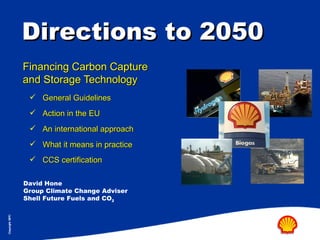
Directions to 2050 Financing Carbon Capture and Storage Technology General Guidelines  Action in the EU An international approach  What it means in practice  CCS certification   David Hone Group Climate Change Adviser Shell Future Fuels and CO 2
General Guidelines for CCS Support Underlying price for CO 2  must be in place Recognition of the demonstration nature of the technology Clear demonstration objectives in place A timeline for action Funding commensurate with the task at hand A focus on delivery of fewer complete projects, rather than limited funding for many. A robust approach to CO 2  storage certification (and MRV) based on 2006 IPCC GHG Inventory Guidelines.
General Guidelines for CCS Support EU-ETS recognises CCS Demonstration programme announced in 2007 Funding available through to 2015 300 million EUA  (~ €6-9 billion) 10-12 projects only EU CCS Directive Now in place in the EU ( on the way in the USA & Australia ) Underlying price for CO 2  must be in place Recognition of the demonstration nature of the technology Clear demonstration objectives in place A timeline for action Funding commensurate with the task at hand A focus on delivery of fewer complete projects, rather than limited funding for many. A robust approach to CO 2  storage certification (and MRV) based on 2006 IPCC GHG Inventory Guidelines.
Replicating the model internationally Create a “ sector-based ” mechanism within the Copenhagen Agreement Large scale preparatory step towards absolute targets in developing countries Clear purpose and end-point Built on the foundation elements of the international agreement (e.g. mechanisms, MRV) Negotiated separately (by a limited number of parties) as “satellites” to the main agreement Typically focussed on a sector Technology capacity building, funding and financing Best practice capacity building
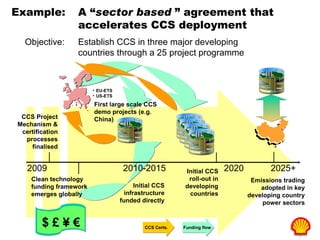
Example:  A “ sector based  ” agreement that accelerates CCS deployment Funding flow CCS Certs. 2009 2010-2015   2020  2025+ Objective:  Establish CCS in three major developing countries through a 25 project programme Emissions trading adopted in key developing country power sectors Initial CCS roll-out in developing countries First large scale CCS demo projects (e.g. China) Initial CCS infrastructure funded directly Clean technology funding framework emerges globally CCS Project Mechanism & certification processes finalised $ £  ¥ € EU-ETS US-ETS
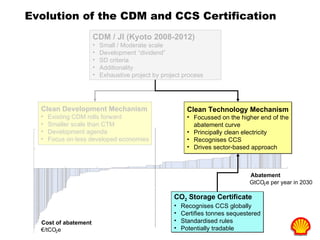
Evolution of the CDM and CCS Certification CDM / JI (Kyoto 2008-2012) Small / Moderate scale Development “dividend” SD criteria Additionality Exhaustive project by project process Cost of abatement € /tCO 2 e Abatement GtCO 2 e per year in 2030 CO 2  Storage Certificate Recognises CCS globally Certifies tonnes sequestered Standardised rules Potentially tradable Clean Development Mechanism Existing CDM rolls forward Smaller scale than CTM Development agenda Focus on less developed economies Clean Technology Mechanism Focussed on the higher end of the abatement curve Principally clean electricity Recognises CCS Drives sector-based approach
CO 2  Storage Certificate With an eye on the future: Develop a [tradable] carbon sequestration unit (CSU) that is based on internationally accepted criteria for the longevity of storage.  Applies anywhere in the world Awarded on the basis of ensuring long-term storage as per the 2006 IPCC Guidelines for National Gas Inventories.  Could also support a CCS project in the CDM.   Best developed by a body dedicated to CCS, e.g. the Global CCS Institute (Australian), IPAC (Canadian) or Carbon Sequestration Leadership Forum (CSLF). Underpins the necessary development of institutional capacity building for CCS measurement, reporting and verification. Opens up the possibility of a range of policy options for the expanded deployment of CCS.
http://blogs.shell.com/climatechange

Bergen CCS Conference Presentation

  • 1.
    Directions to 2050Financing Carbon Capture and Storage Technology General Guidelines Action in the EU An international approach What it means in practice CCS certification David Hone Group Climate Change Adviser Shell Future Fuels and CO 2
  • 2.
    General Guidelines forCCS Support Underlying price for CO 2 must be in place Recognition of the demonstration nature of the technology Clear demonstration objectives in place A timeline for action Funding commensurate with the task at hand A focus on delivery of fewer complete projects, rather than limited funding for many. A robust approach to CO 2 storage certification (and MRV) based on 2006 IPCC GHG Inventory Guidelines.
  • 3.
    General Guidelines forCCS Support EU-ETS recognises CCS Demonstration programme announced in 2007 Funding available through to 2015 300 million EUA (~ €6-9 billion) 10-12 projects only EU CCS Directive Now in place in the EU ( on the way in the USA & Australia ) Underlying price for CO 2 must be in place Recognition of the demonstration nature of the technology Clear demonstration objectives in place A timeline for action Funding commensurate with the task at hand A focus on delivery of fewer complete projects, rather than limited funding for many. A robust approach to CO 2 storage certification (and MRV) based on 2006 IPCC GHG Inventory Guidelines.
  • 4.
    Replicating the modelinternationally Create a “ sector-based ” mechanism within the Copenhagen Agreement Large scale preparatory step towards absolute targets in developing countries Clear purpose and end-point Built on the foundation elements of the international agreement (e.g. mechanisms, MRV) Negotiated separately (by a limited number of parties) as “satellites” to the main agreement Typically focussed on a sector Technology capacity building, funding and financing Best practice capacity building
  • 5.
    Example: A“ sector based ” agreement that accelerates CCS deployment Funding flow CCS Certs. 2009 2010-2015 2020 2025+ Objective: Establish CCS in three major developing countries through a 25 project programme Emissions trading adopted in key developing country power sectors Initial CCS roll-out in developing countries First large scale CCS demo projects (e.g. China) Initial CCS infrastructure funded directly Clean technology funding framework emerges globally CCS Project Mechanism & certification processes finalised $ £ ¥ € EU-ETS US-ETS
  • 6.
    Evolution of theCDM and CCS Certification CDM / JI (Kyoto 2008-2012) Small / Moderate scale Development “dividend” SD criteria Additionality Exhaustive project by project process Cost of abatement € /tCO 2 e Abatement GtCO 2 e per year in 2030 CO 2 Storage Certificate Recognises CCS globally Certifies tonnes sequestered Standardised rules Potentially tradable Clean Development Mechanism Existing CDM rolls forward Smaller scale than CTM Development agenda Focus on less developed economies Clean Technology Mechanism Focussed on the higher end of the abatement curve Principally clean electricity Recognises CCS Drives sector-based approach
  • 7.
    CO 2 Storage Certificate With an eye on the future: Develop a [tradable] carbon sequestration unit (CSU) that is based on internationally accepted criteria for the longevity of storage. Applies anywhere in the world Awarded on the basis of ensuring long-term storage as per the 2006 IPCC Guidelines for National Gas Inventories. Could also support a CCS project in the CDM. Best developed by a body dedicated to CCS, e.g. the Global CCS Institute (Australian), IPAC (Canadian) or Carbon Sequestration Leadership Forum (CSLF). Underpins the necessary development of institutional capacity building for CCS measurement, reporting and verification. Opens up the possibility of a range of policy options for the expanded deployment of CCS.
  • 8.