Labor Market Information/LMI: How to Demystify Labor Market & Economic Statistics Tuesday, June 29, 2010 Presentation by Gary Crossley to the IAWP 97 th  Educational Conference 2Work www.LovetoWork.org [email_address] Phone -- 843/452-4121
The Secret Behind the LMI Magic Is it in the way they count? Do they know someone special? What secret potion do they use to produce those numbers? Maybe it is their astrological signs? Do they read palms on the side? Where do they keep the Ouija boards?
Outline Education Application & Assessment Communication Help Understanding Solutions Q & A
Education BLS Programs Census LMI Training Understanding Data
BLS Core Programs QCEW, Quarterly Census of Employment & Wages CES. Current Employment Statistics LAUS, Local Area Unemployment Statistics MLS, Mass Layoff Statistics OES, Occupational Employment Statistics
BLS Cooperative Programs The Quarterly Census of Employment and Wages (QCEW)
Quarterly Census of Employment and Wages Produces employment, total payroll, weekly wages and employing units All data by industry (North American Industry Classification System/NAICS) Geographic areas:  state, county, MSA Called “covered” employment By place of work
Data Sources for QCEW UI quarterly contribution reports  UCFE federal agency employment Supplementary employer surveys by state LMI offices Multiple establishment detail (MWR) Industrial coding (annual refile survey) Follow-ups triggered by edits
Uses of QCEW Data Employment benchmarks for all BLS federal/state employer survey programs — CES, OES and OSHA Critical for Bureau of Economic Analysis: Personal income, and state and national product Local planning - Only consistent source of county employment and wages by industry Analysis requiring universe or detailed data
BLS Cooperative Programs Current Employment Statistics (CES)
Information from CES Industry employment Hours worked per week Average hourly wages Average weekly wages Production workers Data available only for state and  select  MSAs Data produced on a monthly and annual basis By place of work
CES/QCEW Coverage Differences The following categories of workers are included in CES estimates but not included in QCEW: Full commission salespersons Elected and appointed government officials Teachers in summer months who are paid on 12-month contracts
Data Sources for CES Covered employment from QCEW, supplemented with non-covered adjustments, is used to benchmark levels. A monthly employer survey is a major part of the program, using a variety of collection methods. Adjusted for birth-death factors
Uses of CES A primary economic indicator of employment, earnings, and working hours for national, state, and selected areas Total employment growth used by Federal Reserve Incorporated in preliminary estimates of National Product and Income Incorporated into productivity estimates
BLS Cooperative Programs Local Area Unemployment Statistics - LAUS -
Information from LAUS Total employment Total unemployment Unemployment rate Demographic breakouts:  sex, race, age, educational attainment, ethnicity Place of residence
LAUS Source Information Current Population Survey – 60,000 households Interview 15+ age groups but publish 16+ States:  Monthly model estimates Substate:  Handbook “building-block” method (CPS, CES, UI, Census)
BLS Cooperative Programs Mass Layoff Statistics (MLS)
Information from MLS Intent:  To track serious layoffs and closings by industry At least 50 initial claims for UI for a 5-week period Some states use a cut-off figure of 25 claims Data available by industry, state and reason
Background Material -BLS  Statistical Programs  BLS Handbook of Methods Download: www.bls.gov/opub/hom
BLS Cooperative Programs Occupational Employment Statistics (OES)
Information from OES Employment by occupation Occupational breakout by industry Wage rate ranges by occupation Collected twice a year and published annually Available for state and MSAs (workforce areas in some states) Data “aged” to bring up to date - ECI
OES Staffing Estimates Data developed with most current 3 years of data Surveys conducted twice annually Employment by occupation tallied for each detailed industry Staffing ratios developed representing each occupation’s share of industry employment
State and Area Occupational Projections   Partially funded by ETA  but tied to OES Composed of adjusted OES staffing ratios applied to industry employment projections Short-term projections —  2 years out Long-term projections:  10 years out Technical assistance available at the following site:  dev.projectionscentral.com
Cheat Sheet   BLS  Program Quarterly Census of Employment and Wages CES -- Current  Employment Survey LAUS -- Local Area  Unemployment Statistics MLS -- Mass Layoff  Statistics OES -- Occupational  Employment Statistics Other titles Wage Record Monthly Employment Unemployment Rate Labor Force Data Mass Layoffs Wages by Job Title Frequency Quarterly Monthly Monthly Monthly Previously once a year.  Data now gathered in May  and November Sample No, universe of all  businesses that are  required to report Yes,  firms in sample are  based on the QCEW  universe. No, Composite model  which uses as one of the  inputs responses from the  Current Population Survey,  a household survey that  measures the national  unemployment rate. No, universe of all  businesses that have a  qualifying event. Yes,  firms in sample are  based on the ES-202  universe. Measures Quarterly report of all  employment and firms  (Industry and Employment) Indicator of rapid changes  in employment available on  a monthly basis (Industry,  Employment and  Manufacturing Production  Workers wages).  Is used  for industrial projections. Consistent measure of  available, able and actively  seeking work for all  counties (Unemployment  Rate) Shows the demographic  characteristics of those  involved in a mass layoff.  Definition of mass layoff  event varies by state. Occupational data by  Industry, geographic area  as well as wage data.  Is a  component for projections. Time Lag Not available until 5 months  after the end of the quarter Usually, 6 weeks. Usually, 6 weeks. Usually, 6 weeks. Approximately one year,  should be shorter with new  reporting method. Updates? Of the data, rarely Preliminary data, then  revised.  Benchmarked at  the end of the year Benchmarked at the end of  the year Of the data, rarely Uses the ECI (Employment  Cost Index) to bring data up- to-date Geography Subject to rules of  confidentiality.  May include  county, metropolitan areas  and state Subject to rules of  confidentiality. Metropolitan  areas and state County, metropolitan areas  and state.  In addition, the  different counties in an area  can be added together to  create Labor Market Areas. Subject to rules of  confidentiality.  In some  states, county,  metropolitan areas and  state data are available. Subject to rules of  confidentiality. Metropolitan  areas and state are  available.  In addition, each  state may produce four sub- areas. Comparison of Bureau of Labor Statistics Programs done in Labor Market Information Shops
Census Some States are also State Data Centers MOU for Data Sharing which adds other Census Data on Businesses & Workers Local Employment Dynamics Quarterly Workforce Indicators Community Hot Reports
Employment Dynamics Longitudinal Employer-Household Dynamics/LEHD from Census:  Uses UI and Census data to measure detailed workforce activity by area LEHD/LED also produces Quarterly Workforce Indicators LED Contact:  Jeremy Wu, Census Bureau www.lehd.did.census.gov
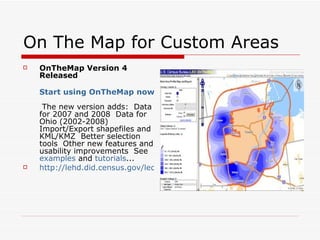
On The Map for Custom Areas OnTheMap Version 4 Released Start using OnTheMap now!   The new version adds:  Data for 2007 and 2008  Data for Ohio (2002-2008)  Import/Export shapefiles and KML/KMZ  Better selection tools  Other new features and usability improvements  See  examples  and  tutorials ...  http://lehd.did.census.gov/led/whatsnew.html#042110
LMI Training Institute Now operated by the C2ER organization –The Council for Community and Economic Research Variety of training both for LMI staff and data users www.lmiontheweb.org
LMI Concepts & Definitions Adjusting for Seasonal Patterns Data Collection Definitions of Labor Market Concepts Statistical Error Sampling  Trend Analysis & Projection Models
Unadjusted Data
Seasonally Adjusted Data
Data Collection Employer Establishment Surveys Household Surveys Administrative Data Specific Follow-up Targeted Surveys Education/Training Completers Green Industries Dislocated Workers
Labor Market Concepts Employed & Unemployed Whys Use the Reference Week of the 12 th  of each month? Who and How is Unemployment Counted? Underemployment, Discouraged Workers, & Alternate Measures of Unemployment
Labor Force Terms and Concepts Employed Worked at least one hour for pay During the week that includes the 12 th Unemployed   No job attachment Able, available for and actively seeking work Can be experienced or  a new or re-entrant
Labor Force Terms and Concepts So what is so special about the week of the 12 th ???  Fewest holidays so it is the most “normal” workweek on average for the year
Labor Force Terms and Concepts Labor Force 16+ years old Employed + Unemployed Unemployment Rate Unemployed ÷ Labor Force Expressed as % Labor Force Participation Rate Labor Force ÷ Working Age Population
Labor Force Terms and Concepts Discouraged Workers Harder to define and sometimes undercounted Generally are on long-term layoff with no immediate prospects Underemploy-ment Also hard to define and count Basically can be anyone working below their skill level Underemployed by choice?
Alternative Unemployment Measures Alternative Measures of Labor Underutilization for States, Second Quarter of 2009 through First Quarter of 2010 Averages Six alternative measures of labor underutilization have long been available on a monthly basis from the Current Population Survey (CPS) for the United States as a whole. They are published in the Bureau of Labor Statistics' monthly  Employment Situation  news release. (See  table 15 .) The official concept of unemployment (as measured in the CPS by U-3 in the U-1 to U-6 range of alternatives) includes all jobless persons who are available to take a job and have actively sought work in the past four weeks. This concept has been thoroughly reviewed and validated since the inception of the CPS in 1940. The other measures are provided to data users and analysts who want more narrowly (U-1 and U-2) or broadly (U-4 through U-6) defined measures. http://www.bls.gov/lau/stalt.htm
Application & Assessment So what that LMI Has All those data? What does it matter? Assessment is all about measurement Using information to help customers (both labor supply and business demand) Limits of data
LMI Matters One pagers on how states have used workforce information projects & products to help economic recovery, answer program questions, and/or shape future state/local initiatives For each submittal – data used, impact, cost & how funded, when produced, and link to report/research Green jobs, training issues, economic impact, assessing disasters, in-demand industries, etc.
Communication Meet each other half way to learn how to talk with each other (leave each other’s jargon and acronyms at the respective offices) LMI must take their products and make them usable to end users Products need to be useful in terms of timeliness, accuracy, and relevance
Help Each Other Develop Web Sites to Help Folks Help Themselves Always explore new ways to do things Learn from other states and national technical assistance Use the data to tell a story – job skill requirement changes, unemployment & earnings by education
Solutions Use all Resources Data Explained Partner with other groups (higher education, associations, etc.) to address issues  Creative technology to map, spot trends, and apply data to solve problems in your areas All Labor Markets are Local!
Number of employees and wages by NAICS code  Pay quarterly into UI Trust Fund  Grouped by size of employment and type of employment Location by address Forecast of industry trends (growth over 2-yr, 10-yr period) Industries Occupations Number in occupation Wages by occupation Organized by O*Net/SOC code Analyzed by assessment tools Grouped by education & experience Grouped by job family Linked to training program Cross-walked to industry patterns Forecast of average annual openings (growth + net replacement) Geographic Areas C ounties Metro-Statistical Areas  Workforce Dev Areas State
DataExplained.com Web Site Devoted to Understanding Data, Research, Statistical Reports Founder and CEO Scott Moore MN Researcher & Labor Employee Current Business, Moore Data, LLC Making Sense of Data Applied Employment Topics www.dataexplained.com
Deep Water Horizon Rig Employment Off-Shore Moratorium The economic impact of shutting down a deep water drilling rig is no doubt massively expensive. But employment impact is different. As a benchmark, the employment on the BP rig was  126 persons . It is reported that wages average about 100k per year for those workers. However, I could not find that person anywhere, except in the management ranks according to  National OES  data! Furthermore, most if not all support workers, according to the  BLS , make less than 1/2 that unsubstantiated amount. Interestingly, as soon as we get into a multiplier discussion, the numbers start off ridiculously high and go up from there.  But a multiplier over two is not reasonable or supported in any research and especially not in this case.  One primary reason is the service nature of the JOBS we are talking about, NOT the industry multipliers.
LMI Resources Workforce Information Council,  www.workforceinfocouncil.org   Bureau of Labor Statistics,  www.bls.gov   LMI Training Institute,  www.lmiontheweb.org   O*Net Resource Center,  www.onetcenter.org   Department of Labor WIN WIN,  http://winwin.workforce3one.org/   Census,  www.census.gov   State LMI Web Sites Universities, Associations, & Institutes
Summary EACH of US can use these principles to communicate better with each other Maybe IAWP can share best practices between the various agency programs to help solve workforce issues Use and share resources between the states/areas to learn from each other
Labor Market Information/LMI: How to Demystify Labor Market & Economic Statistics Questions and State Sharing 2Work www.LovetoWork.org [email_address] Phone -- 843/452-4121

Lmi Demystify62910

  • 1.
    Labor Market Information/LMI:How to Demystify Labor Market & Economic Statistics Tuesday, June 29, 2010 Presentation by Gary Crossley to the IAWP 97 th Educational Conference 2Work www.LovetoWork.org [email_address] Phone -- 843/452-4121
  • 2.
    The Secret Behindthe LMI Magic Is it in the way they count? Do they know someone special? What secret potion do they use to produce those numbers? Maybe it is their astrological signs? Do they read palms on the side? Where do they keep the Ouija boards?
  • 3.
    Outline Education Application& Assessment Communication Help Understanding Solutions Q & A
  • 4.
    Education BLS ProgramsCensus LMI Training Understanding Data
  • 5.
    BLS Core ProgramsQCEW, Quarterly Census of Employment & Wages CES. Current Employment Statistics LAUS, Local Area Unemployment Statistics MLS, Mass Layoff Statistics OES, Occupational Employment Statistics
  • 6.
    BLS Cooperative ProgramsThe Quarterly Census of Employment and Wages (QCEW)
  • 7.
    Quarterly Census ofEmployment and Wages Produces employment, total payroll, weekly wages and employing units All data by industry (North American Industry Classification System/NAICS) Geographic areas: state, county, MSA Called “covered” employment By place of work
  • 8.
    Data Sources forQCEW UI quarterly contribution reports UCFE federal agency employment Supplementary employer surveys by state LMI offices Multiple establishment detail (MWR) Industrial coding (annual refile survey) Follow-ups triggered by edits
  • 9.
    Uses of QCEWData Employment benchmarks for all BLS federal/state employer survey programs — CES, OES and OSHA Critical for Bureau of Economic Analysis: Personal income, and state and national product Local planning - Only consistent source of county employment and wages by industry Analysis requiring universe or detailed data
  • 10.
    BLS Cooperative ProgramsCurrent Employment Statistics (CES)
  • 11.
    Information from CESIndustry employment Hours worked per week Average hourly wages Average weekly wages Production workers Data available only for state and select MSAs Data produced on a monthly and annual basis By place of work
  • 12.
    CES/QCEW Coverage DifferencesThe following categories of workers are included in CES estimates but not included in QCEW: Full commission salespersons Elected and appointed government officials Teachers in summer months who are paid on 12-month contracts
  • 13.
    Data Sources forCES Covered employment from QCEW, supplemented with non-covered adjustments, is used to benchmark levels. A monthly employer survey is a major part of the program, using a variety of collection methods. Adjusted for birth-death factors
  • 14.
    Uses of CESA primary economic indicator of employment, earnings, and working hours for national, state, and selected areas Total employment growth used by Federal Reserve Incorporated in preliminary estimates of National Product and Income Incorporated into productivity estimates
  • 15.
    BLS Cooperative ProgramsLocal Area Unemployment Statistics - LAUS -
  • 16.
    Information from LAUSTotal employment Total unemployment Unemployment rate Demographic breakouts: sex, race, age, educational attainment, ethnicity Place of residence
  • 17.
    LAUS Source InformationCurrent Population Survey – 60,000 households Interview 15+ age groups but publish 16+ States: Monthly model estimates Substate: Handbook “building-block” method (CPS, CES, UI, Census)
  • 18.
    BLS Cooperative ProgramsMass Layoff Statistics (MLS)
  • 19.
    Information from MLSIntent: To track serious layoffs and closings by industry At least 50 initial claims for UI for a 5-week period Some states use a cut-off figure of 25 claims Data available by industry, state and reason
  • 20.
    Background Material -BLS Statistical Programs BLS Handbook of Methods Download: www.bls.gov/opub/hom
  • 21.
    BLS Cooperative ProgramsOccupational Employment Statistics (OES)
  • 22.
    Information from OESEmployment by occupation Occupational breakout by industry Wage rate ranges by occupation Collected twice a year and published annually Available for state and MSAs (workforce areas in some states) Data “aged” to bring up to date - ECI
  • 23.
    OES Staffing EstimatesData developed with most current 3 years of data Surveys conducted twice annually Employment by occupation tallied for each detailed industry Staffing ratios developed representing each occupation’s share of industry employment
  • 24.
    State and AreaOccupational Projections Partially funded by ETA but tied to OES Composed of adjusted OES staffing ratios applied to industry employment projections Short-term projections — 2 years out Long-term projections: 10 years out Technical assistance available at the following site: dev.projectionscentral.com
  • 25.
    Cheat Sheet BLS Program Quarterly Census of Employment and Wages CES -- Current Employment Survey LAUS -- Local Area Unemployment Statistics MLS -- Mass Layoff Statistics OES -- Occupational Employment Statistics Other titles Wage Record Monthly Employment Unemployment Rate Labor Force Data Mass Layoffs Wages by Job Title Frequency Quarterly Monthly Monthly Monthly Previously once a year. Data now gathered in May and November Sample No, universe of all businesses that are required to report Yes, firms in sample are based on the QCEW universe. No, Composite model which uses as one of the inputs responses from the Current Population Survey, a household survey that measures the national unemployment rate. No, universe of all businesses that have a qualifying event. Yes, firms in sample are based on the ES-202 universe. Measures Quarterly report of all employment and firms (Industry and Employment) Indicator of rapid changes in employment available on a monthly basis (Industry, Employment and Manufacturing Production Workers wages). Is used for industrial projections. Consistent measure of available, able and actively seeking work for all counties (Unemployment Rate) Shows the demographic characteristics of those involved in a mass layoff. Definition of mass layoff event varies by state. Occupational data by Industry, geographic area as well as wage data. Is a component for projections. Time Lag Not available until 5 months after the end of the quarter Usually, 6 weeks. Usually, 6 weeks. Usually, 6 weeks. Approximately one year, should be shorter with new reporting method. Updates? Of the data, rarely Preliminary data, then revised. Benchmarked at the end of the year Benchmarked at the end of the year Of the data, rarely Uses the ECI (Employment Cost Index) to bring data up- to-date Geography Subject to rules of confidentiality. May include county, metropolitan areas and state Subject to rules of confidentiality. Metropolitan areas and state County, metropolitan areas and state. In addition, the different counties in an area can be added together to create Labor Market Areas. Subject to rules of confidentiality. In some states, county, metropolitan areas and state data are available. Subject to rules of confidentiality. Metropolitan areas and state are available. In addition, each state may produce four sub- areas. Comparison of Bureau of Labor Statistics Programs done in Labor Market Information Shops
  • 26.
    Census Some Statesare also State Data Centers MOU for Data Sharing which adds other Census Data on Businesses & Workers Local Employment Dynamics Quarterly Workforce Indicators Community Hot Reports
  • 27.
    Employment Dynamics LongitudinalEmployer-Household Dynamics/LEHD from Census: Uses UI and Census data to measure detailed workforce activity by area LEHD/LED also produces Quarterly Workforce Indicators LED Contact: Jeremy Wu, Census Bureau www.lehd.did.census.gov
  • 28.
    On The Mapfor Custom Areas OnTheMap Version 4 Released Start using OnTheMap now! The new version adds:  Data for 2007 and 2008  Data for Ohio (2002-2008)  Import/Export shapefiles and KML/KMZ  Better selection tools  Other new features and usability improvements  See examples and tutorials ... http://lehd.did.census.gov/led/whatsnew.html#042110
  • 29.
    LMI Training InstituteNow operated by the C2ER organization –The Council for Community and Economic Research Variety of training both for LMI staff and data users www.lmiontheweb.org
  • 30.
    LMI Concepts &Definitions Adjusting for Seasonal Patterns Data Collection Definitions of Labor Market Concepts Statistical Error Sampling Trend Analysis & Projection Models
  • 31.
  • 32.
  • 33.
    Data Collection EmployerEstablishment Surveys Household Surveys Administrative Data Specific Follow-up Targeted Surveys Education/Training Completers Green Industries Dislocated Workers
  • 34.
    Labor Market ConceptsEmployed & Unemployed Whys Use the Reference Week of the 12 th of each month? Who and How is Unemployment Counted? Underemployment, Discouraged Workers, & Alternate Measures of Unemployment
  • 35.
    Labor Force Termsand Concepts Employed Worked at least one hour for pay During the week that includes the 12 th Unemployed No job attachment Able, available for and actively seeking work Can be experienced or a new or re-entrant
  • 36.
    Labor Force Termsand Concepts So what is so special about the week of the 12 th ??? Fewest holidays so it is the most “normal” workweek on average for the year
  • 37.
    Labor Force Termsand Concepts Labor Force 16+ years old Employed + Unemployed Unemployment Rate Unemployed ÷ Labor Force Expressed as % Labor Force Participation Rate Labor Force ÷ Working Age Population
  • 38.
    Labor Force Termsand Concepts Discouraged Workers Harder to define and sometimes undercounted Generally are on long-term layoff with no immediate prospects Underemploy-ment Also hard to define and count Basically can be anyone working below their skill level Underemployed by choice?
  • 39.
    Alternative Unemployment MeasuresAlternative Measures of Labor Underutilization for States, Second Quarter of 2009 through First Quarter of 2010 Averages Six alternative measures of labor underutilization have long been available on a monthly basis from the Current Population Survey (CPS) for the United States as a whole. They are published in the Bureau of Labor Statistics' monthly Employment Situation news release. (See table 15 .) The official concept of unemployment (as measured in the CPS by U-3 in the U-1 to U-6 range of alternatives) includes all jobless persons who are available to take a job and have actively sought work in the past four weeks. This concept has been thoroughly reviewed and validated since the inception of the CPS in 1940. The other measures are provided to data users and analysts who want more narrowly (U-1 and U-2) or broadly (U-4 through U-6) defined measures. http://www.bls.gov/lau/stalt.htm
  • 40.
    Application & AssessmentSo what that LMI Has All those data? What does it matter? Assessment is all about measurement Using information to help customers (both labor supply and business demand) Limits of data
  • 41.
    LMI Matters Onepagers on how states have used workforce information projects & products to help economic recovery, answer program questions, and/or shape future state/local initiatives For each submittal – data used, impact, cost & how funded, when produced, and link to report/research Green jobs, training issues, economic impact, assessing disasters, in-demand industries, etc.
  • 42.
    Communication Meet eachother half way to learn how to talk with each other (leave each other’s jargon and acronyms at the respective offices) LMI must take their products and make them usable to end users Products need to be useful in terms of timeliness, accuracy, and relevance
  • 43.
    Help Each OtherDevelop Web Sites to Help Folks Help Themselves Always explore new ways to do things Learn from other states and national technical assistance Use the data to tell a story – job skill requirement changes, unemployment & earnings by education
  • 44.
    Solutions Use allResources Data Explained Partner with other groups (higher education, associations, etc.) to address issues Creative technology to map, spot trends, and apply data to solve problems in your areas All Labor Markets are Local!
  • 45.
    Number of employeesand wages by NAICS code Pay quarterly into UI Trust Fund Grouped by size of employment and type of employment Location by address Forecast of industry trends (growth over 2-yr, 10-yr period) Industries Occupations Number in occupation Wages by occupation Organized by O*Net/SOC code Analyzed by assessment tools Grouped by education & experience Grouped by job family Linked to training program Cross-walked to industry patterns Forecast of average annual openings (growth + net replacement) Geographic Areas C ounties Metro-Statistical Areas Workforce Dev Areas State
  • 46.
    DataExplained.com Web SiteDevoted to Understanding Data, Research, Statistical Reports Founder and CEO Scott Moore MN Researcher & Labor Employee Current Business, Moore Data, LLC Making Sense of Data Applied Employment Topics www.dataexplained.com
  • 47.
    Deep Water HorizonRig Employment Off-Shore Moratorium The economic impact of shutting down a deep water drilling rig is no doubt massively expensive. But employment impact is different. As a benchmark, the employment on the BP rig was 126 persons . It is reported that wages average about 100k per year for those workers. However, I could not find that person anywhere, except in the management ranks according to  National OES data! Furthermore, most if not all support workers, according to the BLS , make less than 1/2 that unsubstantiated amount. Interestingly, as soon as we get into a multiplier discussion, the numbers start off ridiculously high and go up from there.  But a multiplier over two is not reasonable or supported in any research and especially not in this case.  One primary reason is the service nature of the JOBS we are talking about, NOT the industry multipliers.
  • 48.
    LMI Resources WorkforceInformation Council, www.workforceinfocouncil.org Bureau of Labor Statistics, www.bls.gov LMI Training Institute, www.lmiontheweb.org O*Net Resource Center, www.onetcenter.org Department of Labor WIN WIN, http://winwin.workforce3one.org/ Census, www.census.gov State LMI Web Sites Universities, Associations, & Institutes
  • 49.
    Summary EACH ofUS can use these principles to communicate better with each other Maybe IAWP can share best practices between the various agency programs to help solve workforce issues Use and share resources between the states/areas to learn from each other
  • 50.
    Labor Market Information/LMI:How to Demystify Labor Market & Economic Statistics Questions and State Sharing 2Work www.LovetoWork.org [email_address] Phone -- 843/452-4121