MOA And AOA
Course: LLB II
Subject: company Law
Unit: I
contents
1. Memorandum of association
2. Article of Association
Memorandum of AssociationMemorandum of Association
• It is theIt is the chartercharter of the companyof the company
• It contains theIt contains the fundamental conditions upon whichfundamental conditions upon which
the company can be incorporatedthe company can be incorporated
• It contains theIt contains the objectsobjects of the company’s formationof the company’s formation
• The company has toThe company has to act within objects specifiedact within objects specified inin
the MOAthe MOA
• ItIt defines as well as confinesdefines as well as confines the powers of thethe powers of the
companycompany
• Any thing done beyond the objects specified in theAny thing done beyond the objects specified in the
MOA will beMOA will be ultra vires. Their transactions will beultra vires. Their transactions will be
null and voidnull and void
• The outsider haveThe outsider have to transactto transact looking into the MOAlooking into the MOA
Definition of Memo:
The purpose of the memorandum is to enable
the members of the company, its creditors, and
the public to know what its powers are and what
is the range of its activities. The memorandum
contains rules regarding the capital structure,
the liability of the members, the objects of the
company, and all other important matters
relating to the company.
Conditions of the MOAConditions of the MOA
• It should beIt should be printedprinted
• Divided intoDivided into paragraph and numbers consecutivelyparagraph and numbers consecutively
• SignedSigned by at least seven persons or two in case of publicby at least seven persons or two in case of public
and private company respectively.and private company respectively.
• The signature should be in theThe signature should be in the presence of a witness, whopresence of a witness, who
will have to attestwill have to attest the signaturethe signature
• Members have to takeMembers have to take shares and write the number ofshares and write the number of
sharesshares taken with full address (1)taken with full address (1)
The MOA of the LimitedThe MOA of the Limited
CompanyCompany
• The name of the company with ‘The name of the company with ‘limited’limited’ as theas the
last wordlast word
• The name of theThe name of the state where the registeredstate where the registered
officeoffice of the company is to be situatedof the company is to be situated
• The objects of the company stating theThe objects of the company stating the ‘Main‘Main
objects’ and the ‘other objects’objects’ and the ‘other objects’
• The declaration about theThe declaration about the liability of theliability of the
membersmembers isis limitedlimited ( limited by shares or( limited by shares or
guarantee)guarantee)
• The amount of theThe amount of the authorized share capital,authorized share capital,
divided into shares of fixed amounts.divided into shares of fixed amounts.
Contents of the Memorandum
• Name Clause
• Registered Office / Situation Clause
• Object Clause- main objects and other
objects
• Liability Clause- limited by share or
guarantee
• Capital Clause.
• Association Clause
Name Clause
• A company not to be registered under a name
which is undesirable, identical or too nearly
resembles another company. [Section 20]
• It must not be misleading or intended to deceive
with reference to its object.
• A mere similarity of name does not give right to
injunction, there should be likelihood of deception
or confusion.
• The name and address must be printed or affixed
outside every office in English and local language.
• Inadvertent mistake in name can be changed by
passing an ordinary resolution and by obtaining
written approval of Central Government.
Situation Clause
• Only the state in which the Registered Office
is situated is mentioned.
• Exact address can be filled with RoC
separately in Form 18 within 30 days of
incorporation.
Object Clause
• Must divide object clause into two sub-
clauses - Main Objects and Other Objects.
• It determines the purpose and capacity of the
company hence carry great importance.
• Acts beyond this ambit are ultra vires and
hence void. Even the entire body of
shareholders cannot ratify such acts.
• Subscribers enjoy unrestricted freedom to
choose the objects.
Doctrine of ultra vires
• An act or transaction, which may not be illegal,
is beyond company's power by not being
within the object of the Memorandum.
• An act ultra vires the company is incapable of
ratification.
• Act which is intra vires the company but
outside the authority of directors may be
ratified by the company in proper form.
• The shareholders can ratify an act ultra vires
the directors.
TheThe consequences of theconsequences of the ultra viresultra vires
transactions are as followstransactions are as follows::
a)a)InjunctionInjunction
b)b)Directors’ personal liability.Directors’ personal liability.
c)c) If a property has been purchased and it is anIf a property has been purchased and it is an
ultra viresultra vires act, the company can have a rightact, the company can have a right
over that property.over that property.
d)d)The doctrine to be used exclusively for theThe doctrine to be used exclusively for the
companies’ interest.companies’ interest.
e)e)But the others cannot use this doctrine as a toolBut the others cannot use this doctrine as a tool
to attack the companyto attack the company
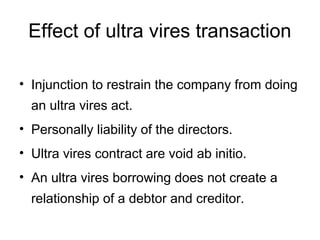
Effect of ultra vires transaction
• Injunction to restrain the company from doing
an ultra vires act.
• Personally liability of the directors.
• Ultra vires contract are void ab initio.
• An ultra vires borrowing does not create a
relationship of a debtor and creditor.
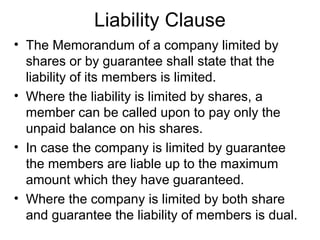
Liability Clause
• The Memorandum of a company limited by
shares or by guarantee shall state that the
liability of its members is limited.
• Where the liability is limited by shares, a
member can be called upon to pay only the
unpaid balance on his shares.
• In case the company is limited by guarantee
the members are liable up to the maximum
amount which they have guaranteed.
• Where the company is limited by both share
and guarantee the liability of members is dual.
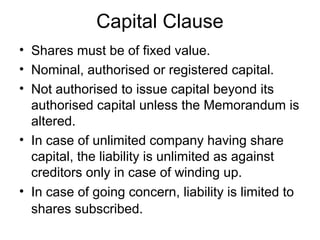
Capital Clause
• Shares must be of fixed value.
• Nominal, authorised or registered capital.
• Not authorised to issue capital beyond its
authorised capital unless the Memorandum is
altered.
• In case of unlimited company having share
capital, the liability is unlimited as against
creditors only in case of winding up.
• In case of going concern, liability is limited to
shares subscribed.
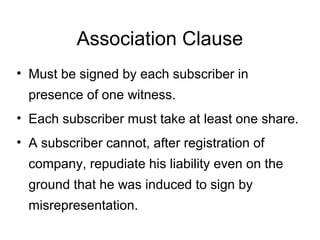
Association Clause
• Must be signed by each subscriber in
presence of one witness.
• Each subscriber must take at least one share.
• A subscriber cannot, after registration of
company, repudiate his liability even on the
ground that he was induced to sign by
misrepresentation.
Alteration of the Memorandum:
For the purpose of alteration, the provisions of the memo can be divided
into two classes :
(i) provisions the inclusion of which is made compulsory by the Act
(e.g., the name, objects, place of registered office etc.)
(ii) other provisions which the organisers of the -company have
thought it desirable to include.
Provisions coming under the first category are called "Conditions
contained in the Memorandum". The "conditions" can be altered in
the manner stated below:
Alteration of the Memorandum:
1.Change of name:
• A company may change its name by special resolution provided the
Company Law Board approves of the change
• When the name is validly changed, the Registrar shall enter the new
name in the Register of companies and shall issue a fresh Certificate
of Incorporation.
• Change of name does not affect the rights and obligations of the
company and pending suits by or against the company. (2)
2. Change of Object:
The object clause of the memo can be changed for the purpose of enabling the
company, for example :
(a) to carry on its business more economically or more efficiently;
(b) to attain its main purpose by new or improved means ;
(c) to enlarge or change the local area of its operation;
The following procedure must be adopted for changing the object clause :
(i) A special resolution must be passed.
(ii) A petition must be filed to the Company Law Board for confirmation of the change.
(iii) Notice must be given to all persons whose interests will be affected by the change.
(iv) The consent of the creditors of the Company must be obtained or other claims paid
off or secured; etc. (3)
. 3.Change in the location of the registered office from
one State to another
The procedure to be adopted is the same as in the
case of alteration of object.
The alteration must be registered with the Registrar of
Companies of the 'State in which the registered office
of the Company was originally situated and also the
Registrar of the 'State to which the office is being
transferred.
4. Alteration of the Capital Clause
Alteration of the capital clause can be done in the following methods
(i) Alteration, including Increase of Capital:
(ii) Reduction of Capital
(iii) Variation of Shareholders' Rights
(iv) Creation of Reserve Capital.
Alteration of the Articles Of Association:
Although alteration of articles is permitted, there are certain restrictions on the nature and extent
of the alterations that can be made, for example:
 Articles can be altered by special resolution only. If the articles of the company prescribed a
different procedure, e.g., an ordinary resolution, it will not be followed. Confirmation by the
Court is not necessary.
 No change is permitted which will violate the provisions of the Companies Act.
 No change is permitted which is contrary to the conditions contained in the Memorandum of
Association of the Company.
 The alterations must not 'contain anything illegal.
 The liability of the members or any class of members, cannot be increased without their
consent.
 But any alteration made bona fide, in the interests of the company as a whole, is valid and
binding even though the private interests of some members may be affected.
The legal effects of the Memorandum:
The Contractual Powers of a Company
A Company or a Corporation is a legal person capable of suing and of being sued. But the
contractual powers of a company are limited in two ways :
(i) natural possibility and
(ii) legal possibility.
Forms of Contracts and Deeds of a Company
• The Doctrine of Ultra Vires
• The Memorandum of Association determines the constitution and the powers of 'the
Company.
• The important rules concerning the legal effects of the memorandum can be summed up as
follows, for example:
• The terms of the memorandum constitute a binding contract between the Company and the
members.
• All acts done by the directors or members beyond the powers given in the memo, are ultra
vires and not binding on the Company.
• The members cannot ratify ultra vires acts, even by an unanimous resolution.
• If an act is within the powers given by the memo (intra vires the memo) but contrary to some
provision of the articles (ultra vires the articles) members can change the articles and ratify
the act.
• Directors entering into ultra vires contracts may be liable to the third party for breach of
warranty of authority.
Limitation on Alteration
• Must not exceed the power in the Memorandum.
• Must not be inconsistent with the provisions of the Act.
• Must not include anything illegal or opposed to public
policy.
• Must be bona fide for the benefit of the company.
• Must not constitute fraud on minority.
• Cannot be altered so as to have retrospective effects.
• In case of listed companies approval of Stock Exchange is
required.
AOAAOA
• AOA plays aAOA plays a subsidiary partsubsidiary part to the MOAto the MOA
• Any thingAny thing done beyond the AOA will be considered to be irregular anddone beyond the AOA will be considered to be irregular and
may be ratified by the shareholdersmay be ratified by the shareholders..
• The content of the AOA may differ from company to company as theThe content of the AOA may differ from company to company as the
Act has not specified any specific provisionsAct has not specified any specific provisions
• Flexibility is allowed to the persons who form the company to adoptFlexibility is allowed to the persons who form the company to adopt
the AOA within the requirements of the company lawthe AOA within the requirements of the company law
• The AOA will have to be conversant with the MOA, as they areThe AOA will have to be conversant with the MOA, as they are
contemporaneous documents to be read together.contemporaneous documents to be read together.
• AnyAny ambiguity and uncertainty in one of them may be removed byambiguity and uncertainty in one of them may be removed by
reference to the other. (4)reference to the other. (4)
Contents of the AOA may be asContents of the AOA may be as
follows:follows:
• Share capitalShare capital
• Lien on sharesLien on shares
• Calls on sharesCalls on shares
• Transfer and transmission of sharesTransfer and transmission of shares
• Forfeiture of the sharesForfeiture of the shares
• Surrender of the sharesSurrender of the shares
• General meetingsGeneral meetings
• Alteration of the capitalAlteration of the capital
• Directors etc..Directors etc..
• Dividends and reservesDividends and reserves
• Account and auditAccount and audit
• Borrowing powersBorrowing powers
• Winding upWinding up
• Adoption of the preliminary contracts etc….Adoption of the preliminary contracts etc….
Articles of Association
• Articles are by-laws or rules and regulations
for the govern the management of its
internal affairs and conduct of business.
• It also includes regulation contained in
Table A of Schedule I.
• Deals with the rights of the members inter
se.
• Articles are subordinate to and controlled
by Memorandum.
Articles of Association
• Unlimited companies, companies limited by guarantee and
private companies must have their own Articles of
Associations.
• Must be printed, divided into paragraphs, numbered
consecutively, stamped adequately, signed by each
subscriber to Memorandum and duly witnessed. (5)
Articles of AssociationArticles of Association
• It is the companiesIt is the companies bye- laws or rules to governbye- laws or rules to govern the management ofthe management of
the company for itsthe company for its internal affairs and the conduct of its businessinternal affairs and the conduct of its business..
• AOA defines theAOA defines the powers of its officers and also establishes a contractpowers of its officers and also establishes a contract
between the company and the members and between the membersbetween the company and the members and between the members
inter seinter se
• It can be originally framed and altered by the company underIt can be originally framed and altered by the company under
previous or existing provisions of law. (6)previous or existing provisions of law. (6)
Alteration of Articles
• Subject to the provisions of the Act and
Memorandum, a company, by special
resolution alter the Articles. [Section 31]
• The alteration binds members in the same
way as original Articles.
• A company cannot in any manner deprive
itself of the powers to alter its Articles.
references
• 1. gospelonetoone.blogspot.com
• 1.http://www.mca.gov.in/Ministry/pdf/Companies_Act_1956_13jun201
1.pdf pg:30
• 2.http://www.mca.gov.in/Ministry/pdf/Companies_Act_1956_13jun201
1.pdf pg:30
• 3.http://www.mca.gov.in/Ministry/pdf/Companies_Act_1956_13jun201
1.pdf pg:30
• 4.http://www.mca.gov.in/Ministry/pdf/Companies_Act_1956_13jun201
1.pdf pg:35
• 5.http://www.mca.gov.in/Ministry/pdf/Companies_Act_1956_13jun201
1.pdf pg:35
• 6.http://www.mca.gov.in/Ministry/pdf/Companies_Act_1956_13jun201
1.pdf pg:35
Thank you

Llb ii cl u 1.2 memorandum and article, prospectus

  • 1.
    MOA And AOA Course:LLB II Subject: company Law Unit: I
  • 2.
    contents 1. Memorandum ofassociation 2. Article of Association
  • 3.
    Memorandum of AssociationMemorandumof Association • It is theIt is the chartercharter of the companyof the company • It contains theIt contains the fundamental conditions upon whichfundamental conditions upon which the company can be incorporatedthe company can be incorporated • It contains theIt contains the objectsobjects of the company’s formationof the company’s formation • The company has toThe company has to act within objects specifiedact within objects specified inin the MOAthe MOA • ItIt defines as well as confinesdefines as well as confines the powers of thethe powers of the companycompany • Any thing done beyond the objects specified in theAny thing done beyond the objects specified in the MOA will beMOA will be ultra vires. Their transactions will beultra vires. Their transactions will be null and voidnull and void • The outsider haveThe outsider have to transactto transact looking into the MOAlooking into the MOA
  • 4.
    Definition of Memo: Thepurpose of the memorandum is to enable the members of the company, its creditors, and the public to know what its powers are and what is the range of its activities. The memorandum contains rules regarding the capital structure, the liability of the members, the objects of the company, and all other important matters relating to the company.
  • 5.
    Conditions of theMOAConditions of the MOA • It should beIt should be printedprinted • Divided intoDivided into paragraph and numbers consecutivelyparagraph and numbers consecutively • SignedSigned by at least seven persons or two in case of publicby at least seven persons or two in case of public and private company respectively.and private company respectively. • The signature should be in theThe signature should be in the presence of a witness, whopresence of a witness, who will have to attestwill have to attest the signaturethe signature • Members have to takeMembers have to take shares and write the number ofshares and write the number of sharesshares taken with full address (1)taken with full address (1)
  • 6.
    The MOA ofthe LimitedThe MOA of the Limited CompanyCompany • The name of the company with ‘The name of the company with ‘limited’limited’ as theas the last wordlast word • The name of theThe name of the state where the registeredstate where the registered officeoffice of the company is to be situatedof the company is to be situated • The objects of the company stating theThe objects of the company stating the ‘Main‘Main objects’ and the ‘other objects’objects’ and the ‘other objects’ • The declaration about theThe declaration about the liability of theliability of the membersmembers isis limitedlimited ( limited by shares or( limited by shares or guarantee)guarantee) • The amount of theThe amount of the authorized share capital,authorized share capital, divided into shares of fixed amounts.divided into shares of fixed amounts.
  • 7.
    Contents of theMemorandum • Name Clause • Registered Office / Situation Clause • Object Clause- main objects and other objects • Liability Clause- limited by share or guarantee • Capital Clause. • Association Clause
  • 8.
    Name Clause • Acompany not to be registered under a name which is undesirable, identical or too nearly resembles another company. [Section 20] • It must not be misleading or intended to deceive with reference to its object. • A mere similarity of name does not give right to injunction, there should be likelihood of deception or confusion. • The name and address must be printed or affixed outside every office in English and local language. • Inadvertent mistake in name can be changed by passing an ordinary resolution and by obtaining written approval of Central Government.
  • 9.
    Situation Clause • Onlythe state in which the Registered Office is situated is mentioned. • Exact address can be filled with RoC separately in Form 18 within 30 days of incorporation.
  • 10.
    Object Clause • Mustdivide object clause into two sub- clauses - Main Objects and Other Objects. • It determines the purpose and capacity of the company hence carry great importance. • Acts beyond this ambit are ultra vires and hence void. Even the entire body of shareholders cannot ratify such acts. • Subscribers enjoy unrestricted freedom to choose the objects.
  • 11.
    Doctrine of ultravires • An act or transaction, which may not be illegal, is beyond company's power by not being within the object of the Memorandum. • An act ultra vires the company is incapable of ratification. • Act which is intra vires the company but outside the authority of directors may be ratified by the company in proper form. • The shareholders can ratify an act ultra vires the directors.
  • 12.
    TheThe consequences oftheconsequences of the ultra viresultra vires transactions are as followstransactions are as follows:: a)a)InjunctionInjunction b)b)Directors’ personal liability.Directors’ personal liability. c)c) If a property has been purchased and it is anIf a property has been purchased and it is an ultra viresultra vires act, the company can have a rightact, the company can have a right over that property.over that property. d)d)The doctrine to be used exclusively for theThe doctrine to be used exclusively for the companies’ interest.companies’ interest. e)e)But the others cannot use this doctrine as a toolBut the others cannot use this doctrine as a tool to attack the companyto attack the company
  • 13.
    Effect of ultravires transaction • Injunction to restrain the company from doing an ultra vires act. • Personally liability of the directors. • Ultra vires contract are void ab initio. • An ultra vires borrowing does not create a relationship of a debtor and creditor.
  • 14.
    Liability Clause • TheMemorandum of a company limited by shares or by guarantee shall state that the liability of its members is limited. • Where the liability is limited by shares, a member can be called upon to pay only the unpaid balance on his shares. • In case the company is limited by guarantee the members are liable up to the maximum amount which they have guaranteed. • Where the company is limited by both share and guarantee the liability of members is dual.
  • 15.
    Capital Clause • Sharesmust be of fixed value. • Nominal, authorised or registered capital. • Not authorised to issue capital beyond its authorised capital unless the Memorandum is altered. • In case of unlimited company having share capital, the liability is unlimited as against creditors only in case of winding up. • In case of going concern, liability is limited to shares subscribed.
  • 16.
    Association Clause • Mustbe signed by each subscriber in presence of one witness. • Each subscriber must take at least one share. • A subscriber cannot, after registration of company, repudiate his liability even on the ground that he was induced to sign by misrepresentation.
  • 17.
    Alteration of theMemorandum: For the purpose of alteration, the provisions of the memo can be divided into two classes : (i) provisions the inclusion of which is made compulsory by the Act (e.g., the name, objects, place of registered office etc.) (ii) other provisions which the organisers of the -company have thought it desirable to include. Provisions coming under the first category are called "Conditions contained in the Memorandum". The "conditions" can be altered in the manner stated below:
  • 18.
    Alteration of theMemorandum: 1.Change of name: • A company may change its name by special resolution provided the Company Law Board approves of the change • When the name is validly changed, the Registrar shall enter the new name in the Register of companies and shall issue a fresh Certificate of Incorporation. • Change of name does not affect the rights and obligations of the company and pending suits by or against the company. (2)
  • 19.
    2. Change ofObject: The object clause of the memo can be changed for the purpose of enabling the company, for example : (a) to carry on its business more economically or more efficiently; (b) to attain its main purpose by new or improved means ; (c) to enlarge or change the local area of its operation; The following procedure must be adopted for changing the object clause : (i) A special resolution must be passed. (ii) A petition must be filed to the Company Law Board for confirmation of the change. (iii) Notice must be given to all persons whose interests will be affected by the change. (iv) The consent of the creditors of the Company must be obtained or other claims paid off or secured; etc. (3)
  • 20.
    . 3.Change inthe location of the registered office from one State to another The procedure to be adopted is the same as in the case of alteration of object. The alteration must be registered with the Registrar of Companies of the 'State in which the registered office of the Company was originally situated and also the Registrar of the 'State to which the office is being transferred.
  • 21.
    4. Alteration ofthe Capital Clause Alteration of the capital clause can be done in the following methods (i) Alteration, including Increase of Capital: (ii) Reduction of Capital (iii) Variation of Shareholders' Rights (iv) Creation of Reserve Capital. Alteration of the Articles Of Association: Although alteration of articles is permitted, there are certain restrictions on the nature and extent of the alterations that can be made, for example:  Articles can be altered by special resolution only. If the articles of the company prescribed a different procedure, e.g., an ordinary resolution, it will not be followed. Confirmation by the Court is not necessary.  No change is permitted which will violate the provisions of the Companies Act.  No change is permitted which is contrary to the conditions contained in the Memorandum of Association of the Company.  The alterations must not 'contain anything illegal.  The liability of the members or any class of members, cannot be increased without their consent.  But any alteration made bona fide, in the interests of the company as a whole, is valid and binding even though the private interests of some members may be affected.
  • 22.
    The legal effectsof the Memorandum: The Contractual Powers of a Company A Company or a Corporation is a legal person capable of suing and of being sued. But the contractual powers of a company are limited in two ways : (i) natural possibility and (ii) legal possibility. Forms of Contracts and Deeds of a Company • The Doctrine of Ultra Vires • The Memorandum of Association determines the constitution and the powers of 'the Company. • The important rules concerning the legal effects of the memorandum can be summed up as follows, for example: • The terms of the memorandum constitute a binding contract between the Company and the members. • All acts done by the directors or members beyond the powers given in the memo, are ultra vires and not binding on the Company. • The members cannot ratify ultra vires acts, even by an unanimous resolution. • If an act is within the powers given by the memo (intra vires the memo) but contrary to some provision of the articles (ultra vires the articles) members can change the articles and ratify the act. • Directors entering into ultra vires contracts may be liable to the third party for breach of warranty of authority.
  • 23.
    Limitation on Alteration •Must not exceed the power in the Memorandum. • Must not be inconsistent with the provisions of the Act. • Must not include anything illegal or opposed to public policy. • Must be bona fide for the benefit of the company. • Must not constitute fraud on minority. • Cannot be altered so as to have retrospective effects. • In case of listed companies approval of Stock Exchange is required.
  • 24.
    AOAAOA • AOA playsaAOA plays a subsidiary partsubsidiary part to the MOAto the MOA • Any thingAny thing done beyond the AOA will be considered to be irregular anddone beyond the AOA will be considered to be irregular and may be ratified by the shareholdersmay be ratified by the shareholders.. • The content of the AOA may differ from company to company as theThe content of the AOA may differ from company to company as the Act has not specified any specific provisionsAct has not specified any specific provisions • Flexibility is allowed to the persons who form the company to adoptFlexibility is allowed to the persons who form the company to adopt the AOA within the requirements of the company lawthe AOA within the requirements of the company law • The AOA will have to be conversant with the MOA, as they areThe AOA will have to be conversant with the MOA, as they are contemporaneous documents to be read together.contemporaneous documents to be read together. • AnyAny ambiguity and uncertainty in one of them may be removed byambiguity and uncertainty in one of them may be removed by reference to the other. (4)reference to the other. (4)
  • 25.
    Contents of theAOA may be asContents of the AOA may be as follows:follows: • Share capitalShare capital • Lien on sharesLien on shares • Calls on sharesCalls on shares • Transfer and transmission of sharesTransfer and transmission of shares • Forfeiture of the sharesForfeiture of the shares • Surrender of the sharesSurrender of the shares • General meetingsGeneral meetings • Alteration of the capitalAlteration of the capital • Directors etc..Directors etc.. • Dividends and reservesDividends and reserves • Account and auditAccount and audit • Borrowing powersBorrowing powers • Winding upWinding up • Adoption of the preliminary contracts etc….Adoption of the preliminary contracts etc….
  • 26.
    Articles of Association •Articles are by-laws or rules and regulations for the govern the management of its internal affairs and conduct of business. • It also includes regulation contained in Table A of Schedule I. • Deals with the rights of the members inter se. • Articles are subordinate to and controlled by Memorandum.
  • 27.
    Articles of Association •Unlimited companies, companies limited by guarantee and private companies must have their own Articles of Associations. • Must be printed, divided into paragraphs, numbered consecutively, stamped adequately, signed by each subscriber to Memorandum and duly witnessed. (5)
  • 28.
    Articles of AssociationArticlesof Association • It is the companiesIt is the companies bye- laws or rules to governbye- laws or rules to govern the management ofthe management of the company for itsthe company for its internal affairs and the conduct of its businessinternal affairs and the conduct of its business.. • AOA defines theAOA defines the powers of its officers and also establishes a contractpowers of its officers and also establishes a contract between the company and the members and between the membersbetween the company and the members and between the members inter seinter se • It can be originally framed and altered by the company underIt can be originally framed and altered by the company under previous or existing provisions of law. (6)previous or existing provisions of law. (6)
  • 29.
    Alteration of Articles •Subject to the provisions of the Act and Memorandum, a company, by special resolution alter the Articles. [Section 31] • The alteration binds members in the same way as original Articles. • A company cannot in any manner deprive itself of the powers to alter its Articles.
  • 30.
    references • 1. gospelonetoone.blogspot.com •1.http://www.mca.gov.in/Ministry/pdf/Companies_Act_1956_13jun201 1.pdf pg:30 • 2.http://www.mca.gov.in/Ministry/pdf/Companies_Act_1956_13jun201 1.pdf pg:30 • 3.http://www.mca.gov.in/Ministry/pdf/Companies_Act_1956_13jun201 1.pdf pg:30 • 4.http://www.mca.gov.in/Ministry/pdf/Companies_Act_1956_13jun201 1.pdf pg:35 • 5.http://www.mca.gov.in/Ministry/pdf/Companies_Act_1956_13jun201 1.pdf pg:35 • 6.http://www.mca.gov.in/Ministry/pdf/Companies_Act_1956_13jun201 1.pdf pg:35
  • 31.