Grammar 101


   Punctuation Marks -
Commas, Exclamation Marks
   and Quotation Marks
Learning Objectives

    To understand how punctuation marks help in
    making a sentence easier to read.

    To learn the applications of commas,
    exclamation marks and quotation marks when
    constructing sentences.
Introduction

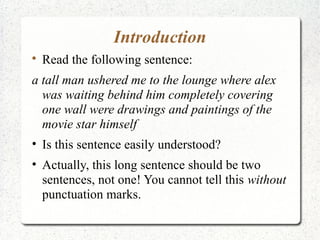
    Read the following sentence:
a tall man ushered me to the lounge where alex
  was waiting behind him completely covering
  one wall were drawings and paintings of the
  movie star himself
• Is this sentence easily understood?
• Actually, this long sentence should be two
  sentences, not one! You cannot tell this without
  punctuation marks.
The Importance of Punctuation

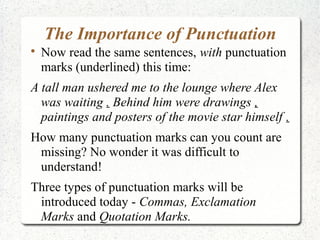
    Now read the same sentences, with punctuation
    marks (underlined) this time:
A tall man ushered me to the lounge where Alex
  was waiting . Behind him were drawings ,
  paintings and posters of the movie star himself .
How many punctuation marks can you count are
 missing? No wonder it was difficult to
 understand!
Three types of punctuation marks will be
 introduced today - Commas, Exclamation
 Marks and Quotation Marks.
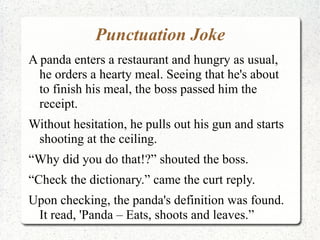
Punctuation Joke
A panda enters a restaurant and hungry as usual,
  he orders a hearty meal. Seeing that he's about
  to finish his meal, the boss passed him the
  receipt.
Without hesitation, he pulls out his gun and starts
 shooting at the ceiling.
“Why did you do that!?” shouted the boss.
“Check the dictionary.” came the curt reply.
Upon checking, the panda's definition was found.
 It read, 'Panda – Eats, shoots and leaves.”
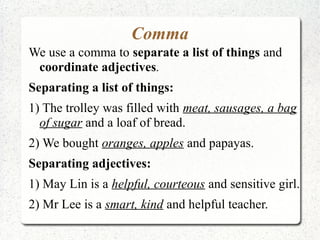
Comma
We use a comma to separate a list of things and
 coordinate adjectives.
Separating a list of things:
1) The trolley was filled with meat, sausages, a bag
  of sugar and a loaf of bread.
2) We bought oranges, apples and papayas.
Separating adjectives:
1) May Lin is a helpful, courteous and sensitive girl.
2) Mr Lee is a smart, kind and helpful teacher.
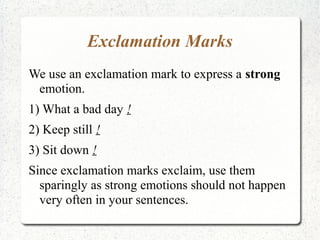
Exclamation Marks
We use an exclamation mark to express a strong
 emotion.
1) What a bad day !
2) Keep still !
3) Sit down !
Since exclamation marks exclaim, use them
  sparingly as strong emotions should not happen
  very often in your sentences.
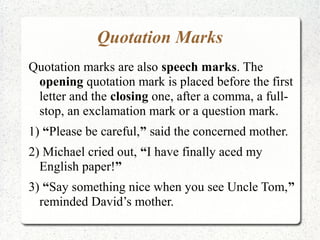
Quotation Marks
Quotation marks are also speech marks. The
 opening quotation mark is placed before the first
 letter and the closing one, after a comma, a full-
 stop, an exclamation mark or a question mark.
1) “Please be careful,” said the concerned mother.
2) Michael cried out, “I have finally aced my
  English paper!”
3) “Say something nice when you see Uncle Tom,”
  reminded David’s mother.
Punctuate when necessary
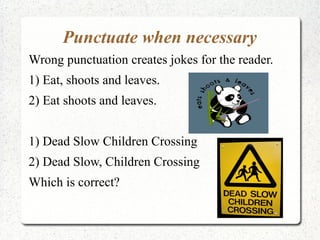
Wrong punctuation creates jokes for the reader.
1) Eat, shoots and leaves.
2) Eat shoots and leaves.


1) Dead Slow Children Crossing
2) Dead Slow, Children Crossing
Which is correct?
Learning Activity
•   With the following sentences, insert the
    proper punctuation mark – comma, question
    and exclamation marks – in the brackets.
“The match has started (1)” blared the radio.
Back when television was still in its infancy (2)
   the whole Lee family was huddled in front of
   the radio (3) listening to the match between
   Singapore and Malaysia.
“Who do you think will win ? (4) asked Mrs Lee.
Learning Activity Answers
•   The answers are provided below.
“The match has started !” blared the radio.
Back when television was still in its infancy , the
   whole Lee family was huddled in front of the
   radio , listening to the match between
   Singapore and Malaysia.
“Who do you think will win ? ” asked Mrs Lee.
Discussion
•   What is the purpose of punctuation marks?
•   What are the three punctuation marks we have
    discussed today?
•   What is the function of each? Briefly describe
    them.
In summary
•   Punctuation marks help you to make the
    meaning in your sentences clearer.
•   We have discussed comma, exclamation and
    speech marks.
•   Comma is for separating things, exclamation
    marks express strong emotions and speech
    marks denote speeches.

LL Lower Pri A - Punctuation marks

  • 1.
    Grammar 101 Punctuation Marks - Commas, Exclamation Marks and Quotation Marks
  • 2.
    Learning Objectives  To understand how punctuation marks help in making a sentence easier to read.  To learn the applications of commas, exclamation marks and quotation marks when constructing sentences.
  • 3.
    Introduction  Read the following sentence: a tall man ushered me to the lounge where alex was waiting behind him completely covering one wall were drawings and paintings of the movie star himself • Is this sentence easily understood? • Actually, this long sentence should be two sentences, not one! You cannot tell this without punctuation marks.
  • 4.
    The Importance ofPunctuation  Now read the same sentences, with punctuation marks (underlined) this time: A tall man ushered me to the lounge where Alex was waiting . Behind him were drawings , paintings and posters of the movie star himself . How many punctuation marks can you count are missing? No wonder it was difficult to understand! Three types of punctuation marks will be introduced today - Commas, Exclamation Marks and Quotation Marks.
  • 5.
    Punctuation Joke A pandaenters a restaurant and hungry as usual, he orders a hearty meal. Seeing that he's about to finish his meal, the boss passed him the receipt. Without hesitation, he pulls out his gun and starts shooting at the ceiling. “Why did you do that!?” shouted the boss. “Check the dictionary.” came the curt reply. Upon checking, the panda's definition was found. It read, 'Panda – Eats, shoots and leaves.”
  • 6.
    Comma We use acomma to separate a list of things and coordinate adjectives. Separating a list of things: 1) The trolley was filled with meat, sausages, a bag of sugar and a loaf of bread. 2) We bought oranges, apples and papayas. Separating adjectives: 1) May Lin is a helpful, courteous and sensitive girl. 2) Mr Lee is a smart, kind and helpful teacher.
  • 7.
    Exclamation Marks We usean exclamation mark to express a strong emotion. 1) What a bad day ! 2) Keep still ! 3) Sit down ! Since exclamation marks exclaim, use them sparingly as strong emotions should not happen very often in your sentences.
  • 8.
    Quotation Marks Quotation marksare also speech marks. The opening quotation mark is placed before the first letter and the closing one, after a comma, a full- stop, an exclamation mark or a question mark. 1) “Please be careful,” said the concerned mother. 2) Michael cried out, “I have finally aced my English paper!” 3) “Say something nice when you see Uncle Tom,” reminded David’s mother.
  • 9.
    Punctuate when necessary Wrongpunctuation creates jokes for the reader. 1) Eat, shoots and leaves. 2) Eat shoots and leaves. 1) Dead Slow Children Crossing 2) Dead Slow, Children Crossing Which is correct?
  • 10.
    Learning Activity • With the following sentences, insert the proper punctuation mark – comma, question and exclamation marks – in the brackets. “The match has started (1)” blared the radio. Back when television was still in its infancy (2) the whole Lee family was huddled in front of the radio (3) listening to the match between Singapore and Malaysia. “Who do you think will win ? (4) asked Mrs Lee.
  • 11.
    Learning Activity Answers • The answers are provided below. “The match has started !” blared the radio. Back when television was still in its infancy , the whole Lee family was huddled in front of the radio , listening to the match between Singapore and Malaysia. “Who do you think will win ? ” asked Mrs Lee.
  • 12.
    Discussion • What is the purpose of punctuation marks? • What are the three punctuation marks we have discussed today? • What is the function of each? Briefly describe them.
  • 13.
    In summary • Punctuation marks help you to make the meaning in your sentences clearer. • We have discussed comma, exclamation and speech marks. • Comma is for separating things, exclamation marks express strong emotions and speech marks denote speeches.