Liver Abscess
(PLA vs ALA)
Henderi Saputra
Definition
• Hepatic abscess can be defined as an encapsulated collection of
suppurative material within the liver parenchyma, which may be infected
by bacterial, fungal, and/or parasitic micro-organisms.
• PLA = Pyogenic Liver Abscess
• ALA = Amoebic Liver Abscess
Incidence
• PLA
22:100.000, and it will rise because of
aggressive management approach to
hepatobiliary and pancreatic cancer os
well as major improvements in
diagnostic imaging
• ALA
500 million people are carriers, 50
million people have active disease,
50.000 to 100.000 die annually
Etiopathogenesis
Amoebic Liver Abscess (ALA)
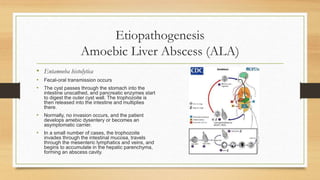
• Entamoeba histolytica
• Fecal-oral transmission occurs
• The cyst passes through the stomach into the
intestine unscathed, and pancreatic enzymes start
to digest the outer cyst wall. The trophozoite is
then released into the intestine and multiplies
there.
• Normally, no invasion occurs, and the patient
develops amebic dysentery or becomes an
asymptomatic carrier.
• In a small number of cases, the trophozoite
invades through the intestinal mucosa, travels
through the mesenteric lymphatics and veins, and
begins to accumulate in the hepatic parenchyma,
forming an abscess cavity.
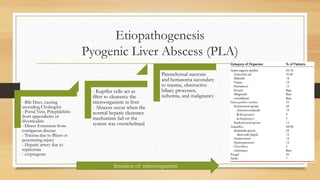
Etiopathogenesis
Pyogenic Liver Abscess (PLA)
- Bile Duct, causing
ascending Cholangitis
- Portal Vein, Pylephlebitis
from appendicitis or
diverticulitis
- Direct Extension from
contiguous disease
- Trauma due to Blunt or
penetrating injury
- Hepatic artery due to
septicemia
- cryptogenic
- Kupffer cells act as
filter to clearance the
microorganism in liver
- Abscess occur when the
normal hepatic clearance
mechanism fail or the
system was overwhelmed
Parenchymal necrosis
and hematoma secondary
to trauma, obstructive
biliary processes,
ischemia, and malignancy
Invasion of microorganism
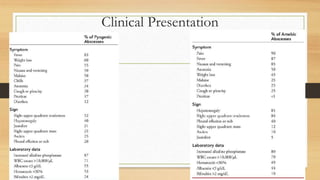
Clinical Presentation
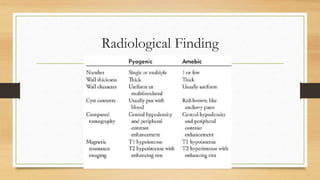
Radiological Finding
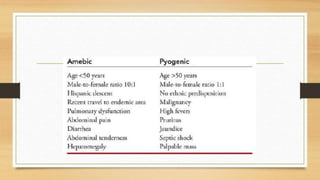
Diagnosis
• PLA
• The clinical presentation of pyogenic liver
abscess is usually subacute and
nonspecific, leading to delays in
presentation, diagnosis, and treatment.
• The classic triad of fever, jaundice, and
right upper quadrant tenderness was
maybe present
• HLA
• The definitive diagnosis of amebic liver
abscess is by detection of E. histolytica
trophozoites in the pus and by finding
serum antibodies to the ameba.
The ALA treatment
systemic administration of amebicides as soon as possible.
Guided percutaneous drainage is performed in case of large abscesses, those located in the left lobe, and
when there is no response to medical treatment or liver failure is present.
Therapeutic aspiration may occasionally be required as an adjunct to antiparasitic treatment. Drainage should
be considered in patients who have no clinical response to drug therapy within 5 to 7 days or those with a
high risk of abscess rupture defined as having a cavity diameter >5 cm or lesions located in the left lobe.
Surgical treatment is performed if percutaneous drainage fails or complications arise.
The treatment of choice for PLA
echo or CT-guided percutaneous drainage in association with antibiotics
The absolute contraindications for guided drainage
• associated disease
• significant coagulopathy
Relative contraindications for guided drainage
• ascites,
• very viscous purulent material,
• multiple small abscesses,
• risk of damaging vital structures, especially those in the left lobe
Surgery
• percutaneous treatment fails,
• there are absolute or relative contraindications for percutaneus drainage
• abscesses with rupture or haemorrhage
Antibiotic treatment without drainage is controversial
• It should be applied only in patients with small abscesses and always considering each individual case
Patients in whom percutaneous drainage
is not appropriate include those with
• (1) multiple large abscesses;
• (2) a known intra-abdominal source that requires surgery;
• (3) an abscess of unknown etiology;
• (4) ascites; and
• (5) abscesses that would require transpleural drainage
Advantages of the transperitoneal
approach include the ability to
• (1) treat the inciting pathology in the remainder of the abdomen/pelvis;
• (2) gain access and exposure of the entire liver for evaluation and treatment; and
• (3) access the biliary tree for cholangiography and bile duct exploration
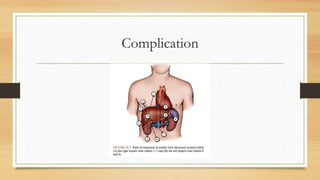
Complication
Tugas
• Sistem pertahanan Usus
• Jalur Limfatik Colon
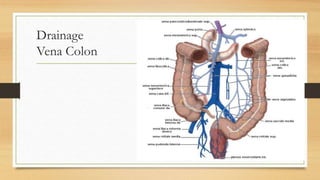
• Jalur vena colon
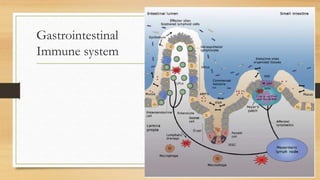
Gastrointestinal
Immune system
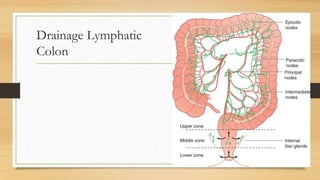
Drainage Lymphatic
Colon
Drainage
Vena Colon

Liver Abscess | Surgery Department .pptx

  • 1.
    Liver Abscess (PLA vsALA) Henderi Saputra
  • 2.
    Definition • Hepatic abscesscan be defined as an encapsulated collection of suppurative material within the liver parenchyma, which may be infected by bacterial, fungal, and/or parasitic micro-organisms. • PLA = Pyogenic Liver Abscess • ALA = Amoebic Liver Abscess
  • 3.
    Incidence • PLA 22:100.000, andit will rise because of aggressive management approach to hepatobiliary and pancreatic cancer os well as major improvements in diagnostic imaging • ALA 500 million people are carriers, 50 million people have active disease, 50.000 to 100.000 die annually
  • 4.
    Etiopathogenesis Amoebic Liver Abscess(ALA) • Entamoeba histolytica • Fecal-oral transmission occurs • The cyst passes through the stomach into the intestine unscathed, and pancreatic enzymes start to digest the outer cyst wall. The trophozoite is then released into the intestine and multiplies there. • Normally, no invasion occurs, and the patient develops amebic dysentery or becomes an asymptomatic carrier. • In a small number of cases, the trophozoite invades through the intestinal mucosa, travels through the mesenteric lymphatics and veins, and begins to accumulate in the hepatic parenchyma, forming an abscess cavity.
  • 5.
    Etiopathogenesis Pyogenic Liver Abscess(PLA) - Bile Duct, causing ascending Cholangitis - Portal Vein, Pylephlebitis from appendicitis or diverticulitis - Direct Extension from contiguous disease - Trauma due to Blunt or penetrating injury - Hepatic artery due to septicemia - cryptogenic - Kupffer cells act as filter to clearance the microorganism in liver - Abscess occur when the normal hepatic clearance mechanism fail or the system was overwhelmed Parenchymal necrosis and hematoma secondary to trauma, obstructive biliary processes, ischemia, and malignancy Invasion of microorganism
  • 6.
  • 7.
  • 9.
    Diagnosis • PLA • Theclinical presentation of pyogenic liver abscess is usually subacute and nonspecific, leading to delays in presentation, diagnosis, and treatment. • The classic triad of fever, jaundice, and right upper quadrant tenderness was maybe present • HLA • The definitive diagnosis of amebic liver abscess is by detection of E. histolytica trophozoites in the pus and by finding serum antibodies to the ameba.
  • 10.
    The ALA treatment systemicadministration of amebicides as soon as possible. Guided percutaneous drainage is performed in case of large abscesses, those located in the left lobe, and when there is no response to medical treatment or liver failure is present. Therapeutic aspiration may occasionally be required as an adjunct to antiparasitic treatment. Drainage should be considered in patients who have no clinical response to drug therapy within 5 to 7 days or those with a high risk of abscess rupture defined as having a cavity diameter >5 cm or lesions located in the left lobe. Surgical treatment is performed if percutaneous drainage fails or complications arise.
  • 11.
    The treatment ofchoice for PLA echo or CT-guided percutaneous drainage in association with antibiotics The absolute contraindications for guided drainage • associated disease • significant coagulopathy Relative contraindications for guided drainage • ascites, • very viscous purulent material, • multiple small abscesses, • risk of damaging vital structures, especially those in the left lobe Surgery • percutaneous treatment fails, • there are absolute or relative contraindications for percutaneus drainage • abscesses with rupture or haemorrhage Antibiotic treatment without drainage is controversial • It should be applied only in patients with small abscesses and always considering each individual case
  • 12.
    Patients in whompercutaneous drainage is not appropriate include those with • (1) multiple large abscesses; • (2) a known intra-abdominal source that requires surgery; • (3) an abscess of unknown etiology; • (4) ascites; and • (5) abscesses that would require transpleural drainage
  • 13.
    Advantages of thetransperitoneal approach include the ability to • (1) treat the inciting pathology in the remainder of the abdomen/pelvis; • (2) gain access and exposure of the entire liver for evaluation and treatment; and • (3) access the biliary tree for cholangiography and bile duct exploration
  • 14.
  • 16.
    Tugas • Sistem pertahananUsus • Jalur Limfatik Colon • Jalur vena colon
  • 17.
  • 18.
  • 19.