Affiliated Hangzhou First People's Hospital Zhejiang University School
of Medicine
Bei Lu
Nov.12 2018
Department of Hepatopancreatobiliary
Surgery
Email: 18668121616@163.com
WeChat ID: lubei1124
Hepatic abscesses may be bacterial, parasitic, or fungal in
origin. Unless otherwise indicated, the remarks in this
section refer to bacterial abscesses.
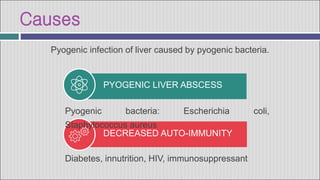
Causes
DECREASED AUTO-IMMUNITY
Diabetes, innutrition, HIV, immunosuppressant
PYOGENIC LIVER ABSCESS
Pyogenic bacteria: Escherichia coli,
Staphylococcus aureus
Pyogenic infection of liver caused by pyogenic bacteria.
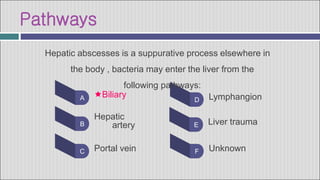
A Biliary
B
Hepatic
artery
C Portal vein
D Lymphangion
E Liver trauma
Hepatic abscesses is a suppurative process elsewhere in
the body , bacteria may enter the liver from the
following pathways:
Pathways
F Unknown
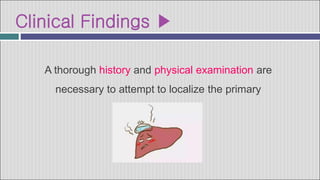
Clinical Findings ▶
A thorough history and physical examination are
necessary to attempt to localize the primary
causative site.
▶ Symptoms
increasing
toxicity
nausea and
vomiting
1
several weeks
of higher fever
and chills
2
right upper
quadrant pain,
radiative pain
3
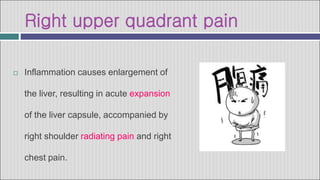
Right upper quadrant pain
 Inflammation causes enlargement of
the liver, resulting in acute expansion
of the liver capsule, accompanied by
right shoulder radiating pain and right
chest pain.
Signs
enlarged liver
and tenderness
1
percussion
tenderness over
hepatic region
2
jaundice
3
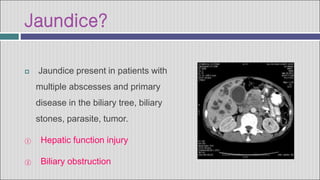
Jaundice?
 Jaundice present in patients with
multiple abscesses and primary
disease in the biliary tree, biliary
stones, parasite, tumor.
① Hepatic function injury
② Biliary obstruction
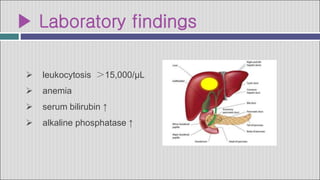
▶ Laboratory findings
 leukocytosis >15,000/μL
 anemia
 serum bilirubin ↑
 alkaline phosphatase ↑
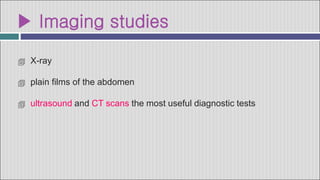
▶ Imaging studies
 X-ray
 plain films of the abdomen
 ultrasound and CT scans the most useful diagnostic tests
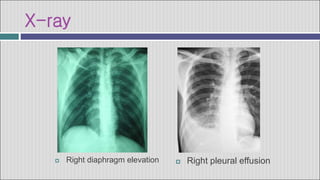
X-ray
 Right pleural effusion
 Right diaphragm elevation
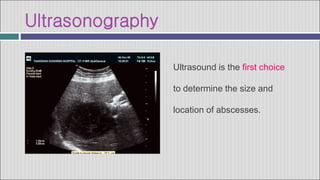
Ultrasonography
Ultrasound is the first choice
to determine the size and
location of abscesses.
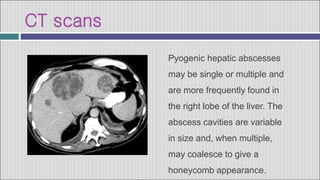
CT scans
Pyogenic hepatic abscesses
may be single or multiple and
are more frequently found in
the right lobe of the liver. The
abscess cavities are variable
in size and, when multiple,
may coalesce to give a
honeycomb appearance.
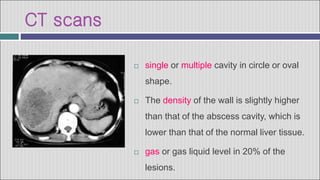
CT scans
 single or multiple cavity in circle or oval
shape.
 The density of the wall is slightly higher
than that of the abscess cavity, which is
lower than that of the normal liver tissue.
 gas or gas liquid level in 20% of the
lesions.
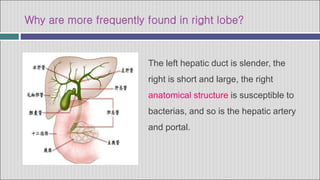
Why are more frequently found in right lobe?
The left hepatic duct is slender, the
right is short and large, the right
anatomical structure is susceptible to
bacterias, and so is the hepatic artery
and portal.
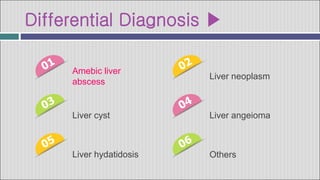
Differential Diagnosis ▶
Amebic liver
abscess
Liver cyst
Liver hydatidosis
Liver neoplasm
Liver angeioma
Others
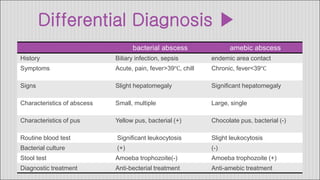
Differential Diagnosis ▶
bacterial abscess amebic abscess
History Biliary infection, sepsis endemic area contact
Symptoms Acute, pain, fever>39℃, chill Chronic, fever<39℃
Signs Slight hepatomegaly Significant hepatomegaly
Characteristics of abscess Small, multiple Large, single
Characteristics of pus Yellow pus, bacterial (+) Chocolate pus, bacterial (-)
Routine blood test Significant leukocytosis Slight leukocytosis
Bacterial culture (+) (-)
Stool test Amoeba trophozoite(-) Amoeba trophozoite (+)
Diagnostic treatment Anti-becterial treatment Anti-amebic treatment
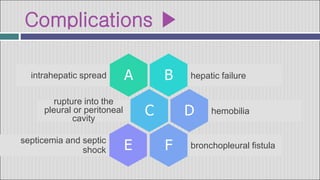
Complications ▶
A B
C D
E
intrahepatic spread hepatic failure
rupture into the
pleural or peritoneal
cavity
hemobilia
septicemia and septic
shock F bronchopleural fistula
Treatment ▶
The current cornerstones of treatment include correction of
the underlying cause, needle aspiration, and IV antibiotic
therapy.
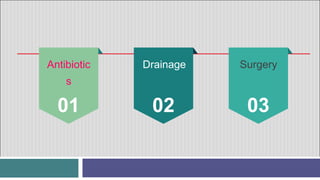
01
Antibiotic
s
02
Drainage
03
Surgery
A B C
On presentation,
percutaneous
aspiration and culture
of the aspirate may
be beneficial to guide
subsequent antibiotic
therapy.
Initial antibiotic
therapy needs to
cover gram-
negative as well as
anaerobic
organisms.
Antibiotic therapy
must be continued
for at least 8 weeks.
Antibiotics
Drainage
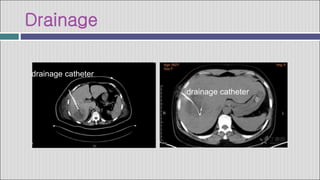
drainage catheter
drainage catheter
Drainage
 Aspiration and placement of a drainage catheter under ultrasound
or CT guidance is beneficial for only a minority of pyogenic
abscesses, because most are quite viscous and drainage is
ineffective.
 Aspiration and IV antibiotic therapy can be expected to be effective
in 80 to 90% of patients.
Surgical intervention
If this initial mode of therapy fails, the patients should undergo surgical
therapy, including laparoscopic or open drainage.
 It must be kept in mind throughout the evaluation and treatment of
the presumed pyogenic abscess that a necrotic hepatic malignancy
must not be mistaken for a hepatic abscess. Therefore, early
diagnosis and progression to surgical resection should be
advocated for patients who do not respond to initial antibiotic
therapy.
Prognosis ▶
□ Pleural effusion, leukocytosis over 20,000/ L, hypoalbuminemia, and
polymicrobial
infection correlate with a poor outcome.
□ Benign biliary disease remains a major cause of this disease.
□ Multiple hepatic abscesses are associated with a worse prognosis.
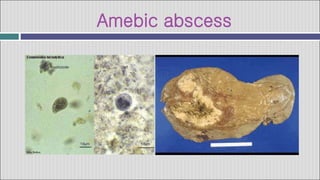
Amebic abscess
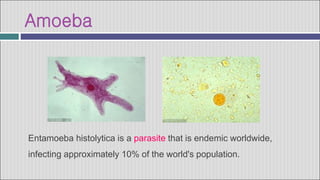
Amoeba
Entamoeba histolytica is a parasite that is endemic worldwide,
infecting approximately 10% of the world's population.
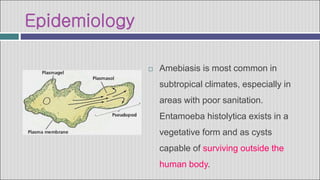
Epidemiology
 Amebiasis is most common in
subtropical climates, especially in
areas with poor sanitation.
Entamoeba histolytica exists in a
vegetative form and as cysts
capable of surviving outside the
human body.
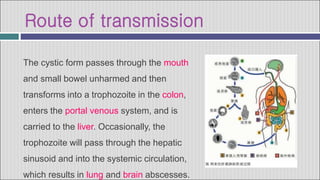
Route of transmission
The cystic form passes through the mouth
and small bowel unharmed and then
transforms into a trophozoite in the colon,
enters the portal venous system, and is
carried to the liver. Occasionally, the
trophozoite will pass through the hepatic
sinusoid and into the systemic circulation,
which results in lung and brain abscesses.
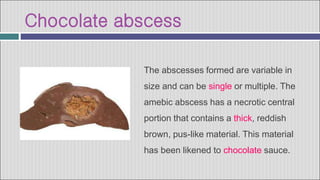
Chocolate abscess
The abscesses formed are variable in
size and can be single or multiple. The
amebic abscess has a necrotic central
portion that contains a thick, reddish
brown, pus-like material. This material
has been likened to chocolate sauce.
Diagnosis
 Amebiasis should be
considered in patients who
have traveled to an 1endemic
area and present with right
upper quadrant 2pain, 3fever,
4hepatomegaly.
Treatment
 Metronidazole 750 mg tid for 7 to 10 days is the treatment of choice
and is successful in 95% of cases.
 Defervescence usually occurs in 3 to 5 days.
 The time necessary for the abscess to resolve depends on the initial
size at presentation and varies from 30 to 300 days.
The

【中医药】Hepatic Abscess.ppt

  • 1.
    Affiliated Hangzhou FirstPeople's Hospital Zhejiang University School of Medicine Bei Lu Nov.12 2018 Department of Hepatopancreatobiliary Surgery Email: 18668121616@163.com WeChat ID: lubei1124
  • 2.
    Hepatic abscesses maybe bacterial, parasitic, or fungal in origin. Unless otherwise indicated, the remarks in this section refer to bacterial abscesses.
  • 3.
    Causes DECREASED AUTO-IMMUNITY Diabetes, innutrition,HIV, immunosuppressant PYOGENIC LIVER ABSCESS Pyogenic bacteria: Escherichia coli, Staphylococcus aureus Pyogenic infection of liver caused by pyogenic bacteria.
  • 4.
    A Biliary B Hepatic artery C Portalvein D Lymphangion E Liver trauma Hepatic abscesses is a suppurative process elsewhere in the body , bacteria may enter the liver from the following pathways: Pathways F Unknown
  • 5.
    Clinical Findings ▶ Athorough history and physical examination are necessary to attempt to localize the primary causative site.
  • 6.
    ▶ Symptoms increasing toxicity nausea and vomiting 1 severalweeks of higher fever and chills 2 right upper quadrant pain, radiative pain 3
  • 7.
    Right upper quadrantpain  Inflammation causes enlargement of the liver, resulting in acute expansion of the liver capsule, accompanied by right shoulder radiating pain and right chest pain.
  • 8.
  • 9.
    Jaundice?  Jaundice presentin patients with multiple abscesses and primary disease in the biliary tree, biliary stones, parasite, tumor. ① Hepatic function injury ② Biliary obstruction
  • 10.
    ▶ Laboratory findings leukocytosis >15,000/μL  anemia  serum bilirubin ↑  alkaline phosphatase ↑
  • 11.
    ▶ Imaging studies X-ray  plain films of the abdomen  ultrasound and CT scans the most useful diagnostic tests
  • 12.
    X-ray  Right pleuraleffusion  Right diaphragm elevation
  • 13.
    Ultrasonography Ultrasound is thefirst choice to determine the size and location of abscesses.
  • 14.
    CT scans Pyogenic hepaticabscesses may be single or multiple and are more frequently found in the right lobe of the liver. The abscess cavities are variable in size and, when multiple, may coalesce to give a honeycomb appearance.
  • 15.
    CT scans  singleor multiple cavity in circle or oval shape.  The density of the wall is slightly higher than that of the abscess cavity, which is lower than that of the normal liver tissue.  gas or gas liquid level in 20% of the lesions.
  • 16.
    Why are morefrequently found in right lobe? The left hepatic duct is slender, the right is short and large, the right anatomical structure is susceptible to bacterias, and so is the hepatic artery and portal.
  • 17.
    Differential Diagnosis ▶ Amebicliver abscess Liver cyst Liver hydatidosis Liver neoplasm Liver angeioma Others
  • 18.
    Differential Diagnosis ▶ bacterialabscess amebic abscess History Biliary infection, sepsis endemic area contact Symptoms Acute, pain, fever>39℃, chill Chronic, fever<39℃ Signs Slight hepatomegaly Significant hepatomegaly Characteristics of abscess Small, multiple Large, single Characteristics of pus Yellow pus, bacterial (+) Chocolate pus, bacterial (-) Routine blood test Significant leukocytosis Slight leukocytosis Bacterial culture (+) (-) Stool test Amoeba trophozoite(-) Amoeba trophozoite (+) Diagnostic treatment Anti-becterial treatment Anti-amebic treatment
  • 19.
    Complications ▶ A B CD E intrahepatic spread hepatic failure rupture into the pleural or peritoneal cavity hemobilia septicemia and septic shock F bronchopleural fistula
  • 20.
    Treatment ▶ The currentcornerstones of treatment include correction of the underlying cause, needle aspiration, and IV antibiotic therapy.
  • 21.
  • 22.
    A B C Onpresentation, percutaneous aspiration and culture of the aspirate may be beneficial to guide subsequent antibiotic therapy. Initial antibiotic therapy needs to cover gram- negative as well as anaerobic organisms. Antibiotic therapy must be continued for at least 8 weeks. Antibiotics
  • 23.
  • 24.
    Drainage  Aspiration andplacement of a drainage catheter under ultrasound or CT guidance is beneficial for only a minority of pyogenic abscesses, because most are quite viscous and drainage is ineffective.  Aspiration and IV antibiotic therapy can be expected to be effective in 80 to 90% of patients.
  • 25.
    Surgical intervention If thisinitial mode of therapy fails, the patients should undergo surgical therapy, including laparoscopic or open drainage.
  • 26.
     It mustbe kept in mind throughout the evaluation and treatment of the presumed pyogenic abscess that a necrotic hepatic malignancy must not be mistaken for a hepatic abscess. Therefore, early diagnosis and progression to surgical resection should be advocated for patients who do not respond to initial antibiotic therapy.
  • 27.
    Prognosis ▶ □ Pleuraleffusion, leukocytosis over 20,000/ L, hypoalbuminemia, and polymicrobial infection correlate with a poor outcome. □ Benign biliary disease remains a major cause of this disease. □ Multiple hepatic abscesses are associated with a worse prognosis.
  • 28.
  • 29.
    Amoeba Entamoeba histolytica isa parasite that is endemic worldwide, infecting approximately 10% of the world's population.
  • 30.
    Epidemiology  Amebiasis ismost common in subtropical climates, especially in areas with poor sanitation. Entamoeba histolytica exists in a vegetative form and as cysts capable of surviving outside the human body.
  • 31.
    Route of transmission Thecystic form passes through the mouth and small bowel unharmed and then transforms into a trophozoite in the colon, enters the portal venous system, and is carried to the liver. Occasionally, the trophozoite will pass through the hepatic sinusoid and into the systemic circulation, which results in lung and brain abscesses.
  • 32.
    Chocolate abscess The abscessesformed are variable in size and can be single or multiple. The amebic abscess has a necrotic central portion that contains a thick, reddish brown, pus-like material. This material has been likened to chocolate sauce.
  • 33.
    Diagnosis  Amebiasis shouldbe considered in patients who have traveled to an 1endemic area and present with right upper quadrant 2pain, 3fever, 4hepatomegaly.

  • 34.
    Treatment  Metronidazole 750mg tid for 7 to 10 days is the treatment of choice and is successful in 95% of cases.  Defervescence usually occurs in 3 to 5 days.  The time necessary for the abscess to resolve depends on the initial size at presentation and varies from 30 to 300 days.
  • 35.