VIVEKANANDHA ARTS AND SCIENCE COLLEGE FOR
WOMEN
VEERACHIPALAYAM637303,SANGAKIRI, SALEMDT
AFFLICTEDBY PERIYAR UNIVERSITYSALEM
DEPARTMENT OF MICROBIOLOGY
SUBJECT : ENVIRONMENTAL MICROBIOLOGY
TOPIC: LITHOSPHERE
SUBMITTED BY:
P. NIKOSHIYA CYPRUS,
III- BSC. MICROBIOLOGY,
DEPARTMENT OF MICROBIOLOGY,
VIAAS, SANGAKIRI.
SUBJECT INCHARGE :
Dr. R. MYTHILI RAVICHANDRAN,
HEAD OF THE DEPARTMENT,
DEPARTMENT OF MICROBIOLOGY,
VIAAS, SANGAKIRI.
:
SYNOPSIS
Lithosphere
1.Composition
2. Soil microbes
3. Factors influencing their microbiology
4. Energy flow the ecosystem
5. Food chain
6. Food web
LITHOSPHERE
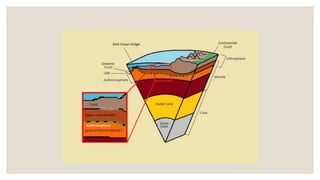
The lithosphere is the
outermost solid layer of
the Earth, comprising the
crust and the uppermost
part of the mantle. It is
broken into several large
plates that float on the
semi-fluid asthenosphere
below, causing
earthquakes and volcanic
activity.
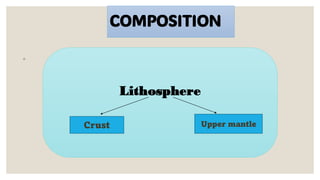
COMPOSITION
◦
Lithosphere
Crust Upper mantle
Crust
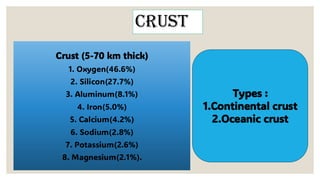
Crust (5-70 km thick)
1. Oxygen(46.6%)
2. Silicon(27.7%)
3. Aluminum(8.1%)
4. Iron(5.0%)
5. Calcium(4.2%)
6. Sodium(2.8%)
7. Potassium(2.6%)
8. Magnesium(2.1%).
Types :
1.Continental crust
2.Oceanic crust
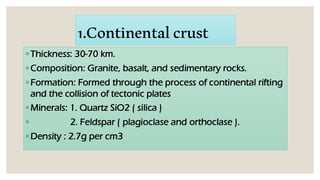
1.Continentalcrust
◦ Thickness: 30-70 km.
◦ Composition: Granite, basalt, and sedimentary rocks.
◦ Formation: Formed through the process of continental rifting
and the collision of tectonic plates
◦ Minerals: 1. Quartz SiO2 ( silica )
◦ 2. Feldspar ( plagioclase and orthoclase ).
◦ Density : 2.7g per cm3
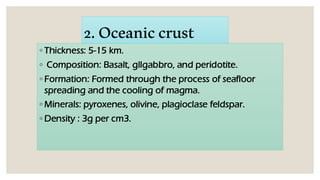
2.Oceaniccrust
◦ Thickness: 5-15 km.
◦ Composition: Basalt, gllgabbro, and peridotite.
◦ Formation: Formed through the process of seafloor
spreading and the cooling of magma.
◦ Minerals: pyroxenes, olivine, plagioclase feldspar.
◦ Density : 3g per cm3.
Upper mantle
◦ Upper Mantle (35-410 km thick)
◦ Depth: 660 km
◦ Minerals:
1. Olivine((Mg,Fe)2SiO4)
2. Pyroxene((Ca,Na,Fe,Mg)2Si2O6)
3. Garnet (X3Y2(SiO4)3): rocks(peridotite and
dunite).
SOIL MICROBES
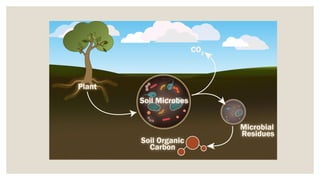
Lithosphere Soil Microbes
Soil microbes play a crucial role in the lithosphere,
contributing to various processes that shape our planet.
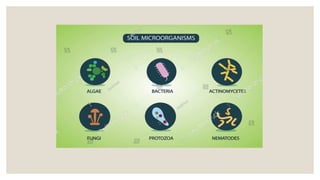
Types of Soil Microbes
1. Bacteria: Decomposers, nitrogen fixers, and nutrient cyclers.
2. Fungi: Decomposers, nutrient cyclers, and symbiotic partners
with plants.
3. Archaea: Methane producers, nitrogen fixers, and
decomposers.
4. Protists: Decomposers, nutrient cyclers, and predators of
other microbes.
Roles of Soil Microbes
1. Decomposition: Breaking down organic matter, releasing
nutrients.
2. Nutrient Cycling: Converting nutrients into forms available to
plants.
3. Nitrogen Fixation: Converting atmospheric nitrogen into plant-
available forms
4. Soil Structure: Producing compounds that improve soil
aggregation and water infiltration.
5. Plant-Microbe Interactions: Forming symbiotic relationships with
plants, promoting growth and health.
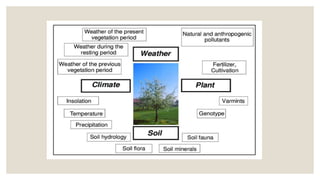
FACTORS INFLUENCE THEIR DISTRIBUTION
1.Soil Factors:
Texture (sand, clay and slit ) – it aeration and humidity.
PH ( very important for enzyme activity )Acid- fungi, Alkaline – bacteria.
Moisture ( microbial metabolism )dry soil- growth of aerobic, water logged
soil- growth of anaerobic
Aeration – upper layer of soil(aerobic), lower layer of soil( anaerobic).
Temperature (20-30°c)
Organic matter( carbon )- high humus.
2.Biological factors:
Rhizosphere ( root surface ). Plant produce amino acids, sugars- it is
symbiotic ( ex: Rhizobium – nitrogen fixation ).
Microbial interaction.
Soil fauna – insects and earthworm.
3. Environmental factors :
Climate – induce microbial population, warm and humid climate.
Season – moisture
Light – ex. Algae ( phototrophs and photoautotrophs)
4.Human activities :
Agricultural practices – based upon the
nature source of Pesticides and fertilizer. Using
chemical pesticides reduce or destroy soil
population.
Land alternating ( Forest change to
agricultural land).
Pollution ( Heavy metals, phosphorus, blue
baby syndrome )
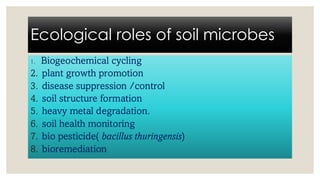
Ecological roles of soil microbes
1. Biogeochemical cycling
2. plant growth promotion
3. disease suppression /control
4. soil structure formation
5. heavy metal degradation.
6. soil health monitoring
7. bio pesticide( bacillus thuringensis)
8. bioremediation
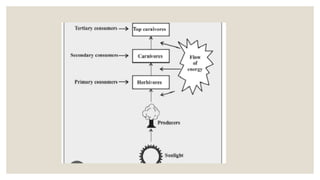
Energy flow the ecosystem
Energy flow in ecosystems refers to the transfer of energy from one trophic level to
another. It's a fundamental concept in ecology, as it explains how energy is
converted and utilized within ecosystems.
Energy Sources
1. Solar Energy: The primary source of energy for most ecosystems is solar
radiation.
2. Chemical Energy: Some ecosystems, like deep-sea vents, rely on chemical
energy from hydrothermal fluids.
Energy Flow Models
1. Linear Energy Flow Model: Energy flows in a linear sequence from producers to
consumers.
2. Pyramid of Energy Model: Energy flow is represented as a pyramid, with
producers at the base and top predators at the apex.
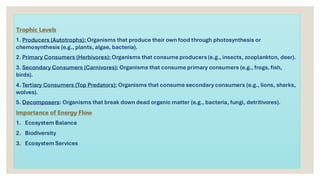
Trophic Levels
1. Producers (Autotrophs): Organisms that produce their own food through photosynthesis or
chemosynthesis (e.g., plants, algae, bacteria).
2. Primary Consumers (Herbivores): Organisms that consume producers (e.g., insects, zooplankton, deer).
3. Secondary Consumers (Carnivores): Organisms that consume primary consumers (e.g., frogs, fish,
birds).
4. Tertiary Consumers (Top Predators): Organisms that consume secondary consumers (e.g., lions, sharks,
wolves).
5. Decomposers: Organisms that break down dead organic matter (e.g., bacteria, fungi, detritivores).
Importance of Energy Flow
1. Ecosystem Balance
2. Biodiversity
3. Ecosystem Services
Food chain
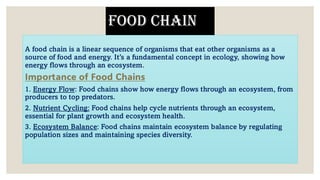
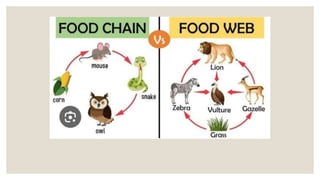
A food chain is a linear sequence of organisms that eat other organisms as a
source of food and energy. It’s a fundamental concept in ecology, showing how
energy flows through an ecosystem.
Importance of Food Chains
1. Energy Flow: Food chains show how energy flows through an ecosystem, from
producers to top predators.
2. Nutrient Cycling: Food chains help cycle nutrients through an ecosystem,
essential for plant growth and ecosystem health.
3. Ecosystem Balance: Food chains maintain ecosystem balance by regulating
population sizes and maintaining species diversity.
Food web
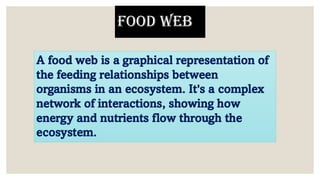
A food web is a graphical representation of
the feeding relationships between
organisms in an ecosystem. It's a complex
network of interactions, showing how
energy and nutrients flow through the
ecosystem.
Thank you!

Lithosphere and its types slideshare/ ppt

  • 1.
    VIVEKANANDHA ARTS ANDSCIENCE COLLEGE FOR WOMEN VEERACHIPALAYAM637303,SANGAKIRI, SALEMDT AFFLICTEDBY PERIYAR UNIVERSITYSALEM DEPARTMENT OF MICROBIOLOGY SUBJECT : ENVIRONMENTAL MICROBIOLOGY TOPIC: LITHOSPHERE SUBMITTED BY: P. NIKOSHIYA CYPRUS, III- BSC. MICROBIOLOGY, DEPARTMENT OF MICROBIOLOGY, VIAAS, SANGAKIRI. SUBJECT INCHARGE : Dr. R. MYTHILI RAVICHANDRAN, HEAD OF THE DEPARTMENT, DEPARTMENT OF MICROBIOLOGY, VIAAS, SANGAKIRI.
  • 2.
    : SYNOPSIS Lithosphere 1.Composition 2. Soil microbes 3.Factors influencing their microbiology 4. Energy flow the ecosystem 5. Food chain 6. Food web
  • 3.
    LITHOSPHERE The lithosphere isthe outermost solid layer of the Earth, comprising the crust and the uppermost part of the mantle. It is broken into several large plates that float on the semi-fluid asthenosphere below, causing earthquakes and volcanic activity.
  • 5.
  • 7.
    Crust Crust (5-70 kmthick) 1. Oxygen(46.6%) 2. Silicon(27.7%) 3. Aluminum(8.1%) 4. Iron(5.0%) 5. Calcium(4.2%) 6. Sodium(2.8%) 7. Potassium(2.6%) 8. Magnesium(2.1%). Types : 1.Continental crust 2.Oceanic crust
  • 8.
    1.Continentalcrust ◦ Thickness: 30-70km. ◦ Composition: Granite, basalt, and sedimentary rocks. ◦ Formation: Formed through the process of continental rifting and the collision of tectonic plates ◦ Minerals: 1. Quartz SiO2 ( silica ) ◦ 2. Feldspar ( plagioclase and orthoclase ). ◦ Density : 2.7g per cm3
  • 9.
    2.Oceaniccrust ◦ Thickness: 5-15km. ◦ Composition: Basalt, gllgabbro, and peridotite. ◦ Formation: Formed through the process of seafloor spreading and the cooling of magma. ◦ Minerals: pyroxenes, olivine, plagioclase feldspar. ◦ Density : 3g per cm3.
  • 10.
    Upper mantle ◦ UpperMantle (35-410 km thick) ◦ Depth: 660 km ◦ Minerals: 1. Olivine((Mg,Fe)2SiO4) 2. Pyroxene((Ca,Na,Fe,Mg)2Si2O6) 3. Garnet (X3Y2(SiO4)3): rocks(peridotite and dunite).
  • 11.
    SOIL MICROBES Lithosphere SoilMicrobes Soil microbes play a crucial role in the lithosphere, contributing to various processes that shape our planet. Types of Soil Microbes 1. Bacteria: Decomposers, nitrogen fixers, and nutrient cyclers. 2. Fungi: Decomposers, nutrient cyclers, and symbiotic partners with plants. 3. Archaea: Methane producers, nitrogen fixers, and decomposers. 4. Protists: Decomposers, nutrient cyclers, and predators of other microbes.
  • 13.
    Roles of SoilMicrobes 1. Decomposition: Breaking down organic matter, releasing nutrients. 2. Nutrient Cycling: Converting nutrients into forms available to plants. 3. Nitrogen Fixation: Converting atmospheric nitrogen into plant- available forms 4. Soil Structure: Producing compounds that improve soil aggregation and water infiltration. 5. Plant-Microbe Interactions: Forming symbiotic relationships with plants, promoting growth and health.
  • 15.
    FACTORS INFLUENCE THEIRDISTRIBUTION 1.Soil Factors: Texture (sand, clay and slit ) – it aeration and humidity. PH ( very important for enzyme activity )Acid- fungi, Alkaline – bacteria. Moisture ( microbial metabolism )dry soil- growth of aerobic, water logged soil- growth of anaerobic Aeration – upper layer of soil(aerobic), lower layer of soil( anaerobic). Temperature (20-30°c) Organic matter( carbon )- high humus.
  • 16.
    2.Biological factors: Rhizosphere (root surface ). Plant produce amino acids, sugars- it is symbiotic ( ex: Rhizobium – nitrogen fixation ). Microbial interaction. Soil fauna – insects and earthworm. 3. Environmental factors : Climate – induce microbial population, warm and humid climate. Season – moisture Light – ex. Algae ( phototrophs and photoautotrophs)
  • 17.
    4.Human activities : Agriculturalpractices – based upon the nature source of Pesticides and fertilizer. Using chemical pesticides reduce or destroy soil population. Land alternating ( Forest change to agricultural land). Pollution ( Heavy metals, phosphorus, blue baby syndrome )
  • 19.
    Ecological roles ofsoil microbes 1. Biogeochemical cycling 2. plant growth promotion 3. disease suppression /control 4. soil structure formation 5. heavy metal degradation. 6. soil health monitoring 7. bio pesticide( bacillus thuringensis) 8. bioremediation
  • 20.
    Energy flow theecosystem Energy flow in ecosystems refers to the transfer of energy from one trophic level to another. It's a fundamental concept in ecology, as it explains how energy is converted and utilized within ecosystems. Energy Sources 1. Solar Energy: The primary source of energy for most ecosystems is solar radiation. 2. Chemical Energy: Some ecosystems, like deep-sea vents, rely on chemical energy from hydrothermal fluids. Energy Flow Models 1. Linear Energy Flow Model: Energy flows in a linear sequence from producers to consumers. 2. Pyramid of Energy Model: Energy flow is represented as a pyramid, with producers at the base and top predators at the apex.
  • 21.
    Trophic Levels 1. Producers(Autotrophs): Organisms that produce their own food through photosynthesis or chemosynthesis (e.g., plants, algae, bacteria). 2. Primary Consumers (Herbivores): Organisms that consume producers (e.g., insects, zooplankton, deer). 3. Secondary Consumers (Carnivores): Organisms that consume primary consumers (e.g., frogs, fish, birds). 4. Tertiary Consumers (Top Predators): Organisms that consume secondary consumers (e.g., lions, sharks, wolves). 5. Decomposers: Organisms that break down dead organic matter (e.g., bacteria, fungi, detritivores). Importance of Energy Flow 1. Ecosystem Balance 2. Biodiversity 3. Ecosystem Services
  • 23.
    Food chain A foodchain is a linear sequence of organisms that eat other organisms as a source of food and energy. It’s a fundamental concept in ecology, showing how energy flows through an ecosystem. Importance of Food Chains 1. Energy Flow: Food chains show how energy flows through an ecosystem, from producers to top predators. 2. Nutrient Cycling: Food chains help cycle nutrients through an ecosystem, essential for plant growth and ecosystem health. 3. Ecosystem Balance: Food chains maintain ecosystem balance by regulating population sizes and maintaining species diversity.
  • 24.
    Food web A foodweb is a graphical representation of the feeding relationships between organisms in an ecosystem. It's a complex network of interactions, showing how energy and nutrients flow through the ecosystem.
  • 26.