Mathematical Modeling and Analysis of Capacity Fade in Lithium-Ion
Batteries across Cycling Periods.
Prepared by
Md. Omar Faruk
1615034
EEED, IU (as part of final year enlisted thesis/project work)
CONTENTS
1) Introduction: The Problem
2) Comsol Multiphsics 6.0
3) Geometry
4) Result & Discussion
5) Conclusion
CONTENTS OVERVIEW
Introduction: The Problem
Citation: Deshpande, Abhishek & Phul, Saksham & Krishnamurthy, Balaji. (2015). A Generalized Mathematical model to understand the capacity fading in lithium ion
batteries-Effects of solvent and lithium transport. Journal of Electrochemical Science and Engineering. 5. 10.5599/jese.197.
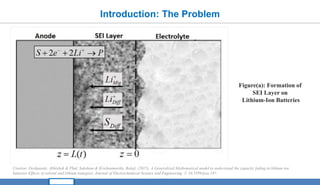
Figure(a): Formation of
SEI Layer on
Lithium-Ion Batteries
Comsol Multiphsics 6.0
Figure(b): 1D Li-ion Battery Geometry Constructed in Comsol Multiphysics 6.0
Figure(01): Cell voltage during discharge.
Result & Discussion (1)
Figure 2: Capacity versus total accumulated cycling time.
Result & Discussion (2)
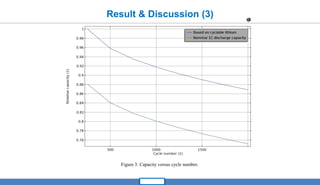
Figure 3: Capacity versus cycle number.
Result & Discussion (3)
Figure 4: Electrolyte volume fraction versus cycle number.
Result & Discussion (4)
Figure 5: SEI film potential drop versus cycle number.
Result & Discussion (5)
Conclusions
∞ Research on capacity fade in lithium-ion batteries: The study explores the intricate processes and factors
contributing to the gradual degradation of lithium-ion batteries, focusing on capacity fade.
∞ Key findings and implications: The research reveals the nature of capacity fade and the role of factors
such as Solid Electrolyte Interphase (SEI) formation. These insights offer predictive capabilities and
applications across diverse sectors.
∞ Contribution to sustainable energy transition: As a critical component of the energy transition, this
research aids in extending the longevity of lithium-ion batteries, fostering sustainability in the transition to
cleaner energy sources.
∞ Ongoing quest for resilient energy solutions: The research represents a milestone in the journey to
understand and mitigate capacity fade, aiming to create more effective and sustainable energy storage
solutions for a brighter future.
_end
• That’s all, thanks everyone for your time and patience.

Lithium Ion Battery Characteristics simulation on Comsol.pptx

  • 1.
    Mathematical Modeling andAnalysis of Capacity Fade in Lithium-Ion Batteries across Cycling Periods. Prepared by Md. Omar Faruk 1615034 EEED, IU (as part of final year enlisted thesis/project work)
  • 2.
    CONTENTS 1) Introduction: TheProblem 2) Comsol Multiphsics 6.0 3) Geometry 4) Result & Discussion 5) Conclusion CONTENTS OVERVIEW
  • 3.
    Introduction: The Problem Citation:Deshpande, Abhishek & Phul, Saksham & Krishnamurthy, Balaji. (2015). A Generalized Mathematical model to understand the capacity fading in lithium ion batteries-Effects of solvent and lithium transport. Journal of Electrochemical Science and Engineering. 5. 10.5599/jese.197. Figure(a): Formation of SEI Layer on Lithium-Ion Batteries
  • 4.
    Comsol Multiphsics 6.0 Figure(b):1D Li-ion Battery Geometry Constructed in Comsol Multiphysics 6.0
  • 5.
    Figure(01): Cell voltageduring discharge. Result & Discussion (1)
  • 6.
    Figure 2: Capacityversus total accumulated cycling time. Result & Discussion (2)
  • 7.
    Figure 3: Capacityversus cycle number. Result & Discussion (3)
  • 8.
    Figure 4: Electrolytevolume fraction versus cycle number. Result & Discussion (4)
  • 9.
    Figure 5: SEIfilm potential drop versus cycle number. Result & Discussion (5)
  • 10.
    Conclusions ∞ Research oncapacity fade in lithium-ion batteries: The study explores the intricate processes and factors contributing to the gradual degradation of lithium-ion batteries, focusing on capacity fade. ∞ Key findings and implications: The research reveals the nature of capacity fade and the role of factors such as Solid Electrolyte Interphase (SEI) formation. These insights offer predictive capabilities and applications across diverse sectors. ∞ Contribution to sustainable energy transition: As a critical component of the energy transition, this research aids in extending the longevity of lithium-ion batteries, fostering sustainability in the transition to cleaner energy sources. ∞ Ongoing quest for resilient energy solutions: The research represents a milestone in the journey to understand and mitigate capacity fade, aiming to create more effective and sustainable energy storage solutions for a brighter future.
  • 11.
    _end • That’s all,thanks everyone for your time and patience.