Understanding Conflict By Kamilah Reed ELAR-8
What is Conflict? In literature, conflict is the opposition of persons or forces that brings about dramatic action central to the plot of a story.
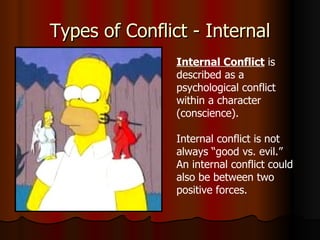
Types of Conflict - Internal Internal Conflict  is described as a psychological conflict within a character (conscience). Internal conflict is not always “good vs. evil.”  An internal conflict could also be between two positive forces.
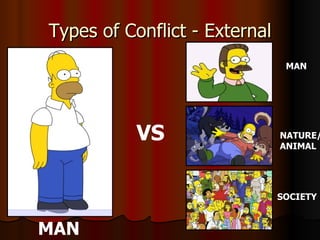
Types of Conflict - External VS MAN MAN NATURE/ ANIMAL SOCIETY
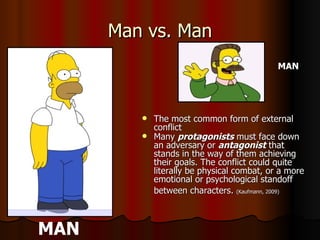
Man vs. Man The most common form of external conflict  Many  protagonists  must face down an adversary or  antagonist  that stands in the way of them achieving their goals. The conflict could quite literally be physical combat, or a more emotional or psychological standoff between characters.  (Kaufmann, 2009)   MAN MAN
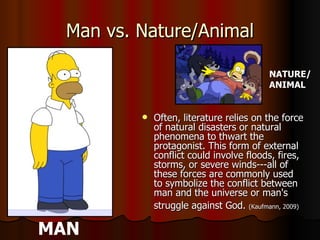
Man vs. Nature/Animal Often, literature relies on the force of natural disasters or natural phenomena to thwart the protagonist. This form of external conflict could involve floods, fires, storms, or severe winds---all of these forces are commonly used to symbolize the conflict between man and the universe or man's struggle against God.  (Kaufmann, 2009)   MAN NATURE/ ANIMAL
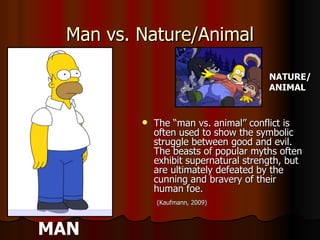
The “man vs. animal” conflict is often used to show the symbolic struggle between good and evil.  The beasts of popular myths often exhibit supernatural strength, but are ultimately defeated by the cunning and bravery of their human foe.    (Kaufmann, 2009)   Man vs. Nature/Animal NATURE/ ANIMAL MAN
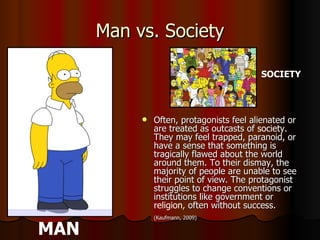
Man vs. Society Often, protagonists feel alienated or are treated as outcasts of  society . They may feel trapped, paranoid, or have a sense that something is tragically flawed about the world around them. To their dismay, the majority of people are unable to see their point of view. The protagonist struggles to change conventions or institutions like government or  religion , often without success.  (Kaufmann, 2009)   MAN SOCIETY
AND NOW… Let’s read a story!
SOURCES Kaufmann, K. (Producer). (2009).  Types of external conflict . [Web]. Retrieved from http://www.ehow.com/facts_5454690_types-external-conflict.html

Literature Conflict

  • 1.
    Understanding Conflict ByKamilah Reed ELAR-8
  • 2.
    What is Conflict?In literature, conflict is the opposition of persons or forces that brings about dramatic action central to the plot of a story.
  • 3.
    Types of Conflict- Internal Internal Conflict is described as a psychological conflict within a character (conscience). Internal conflict is not always “good vs. evil.” An internal conflict could also be between two positive forces.
  • 4.
    Types of Conflict- External VS MAN MAN NATURE/ ANIMAL SOCIETY
  • 5.
    Man vs. ManThe most common form of external conflict Many protagonists must face down an adversary or antagonist that stands in the way of them achieving their goals. The conflict could quite literally be physical combat, or a more emotional or psychological standoff between characters. (Kaufmann, 2009) MAN MAN
  • 6.
    Man vs. Nature/AnimalOften, literature relies on the force of natural disasters or natural phenomena to thwart the protagonist. This form of external conflict could involve floods, fires, storms, or severe winds---all of these forces are commonly used to symbolize the conflict between man and the universe or man's struggle against God. (Kaufmann, 2009) MAN NATURE/ ANIMAL
  • 7.
    The “man vs.animal” conflict is often used to show the symbolic struggle between good and evil. The beasts of popular myths often exhibit supernatural strength, but are ultimately defeated by the cunning and bravery of their human foe. (Kaufmann, 2009) Man vs. Nature/Animal NATURE/ ANIMAL MAN
  • 8.
    Man vs. SocietyOften, protagonists feel alienated or are treated as outcasts of society . They may feel trapped, paranoid, or have a sense that something is tragically flawed about the world around them. To their dismay, the majority of people are unable to see their point of view. The protagonist struggles to change conventions or institutions like government or religion , often without success. (Kaufmann, 2009) MAN SOCIETY
  • 9.
    AND NOW… Let’sread a story!
  • 10.
    SOURCES Kaufmann, K.(Producer). (2009). Types of external conflict . [Web]. Retrieved from http://www.ehow.com/facts_5454690_types-external-conflict.html