LITASCO SA
LUKOIL INTERNATIONAL TRADING AND SUPPLY COMPANY
International Oil Market and Oil Trading
''Current and future trends in commodity trading'‘
HES – Geneva - September 24th, 2010
Commodities Trading Program 2010-2011
2
SUMMARY
LUKOIL and LITASCO – Presentation
What does an oil company do ?
How do we see the business developing ?
Vision and strategy
3
LUKOIL GROUP - KEY FACTS 2009
Preliminary data, Bod 13/01 and Litasco SA analysis **at closing 12/01/10 (RTS&MICEX)
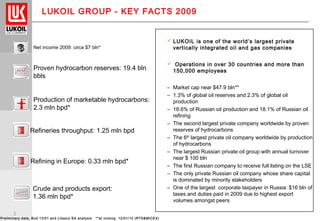
Refineries throughput: 1.25 mln bpd
Net income 2009: circa $7 bln*
Production of marketable hydrocarbons:
2.3 mln bpd*
Proven hydrocarbon reserves: 19.4 bln
bbls
Crude and products export:
1.36 mln bpd*
Refining in Europe: 0.33 mln bpd*
 LUKOIL is one of the world’s largest private
vertically integrated oil and gas companies
 Operations in over 30 countries and more than
150,000 employees
– Market cap near $47.9 bln**
– 1.3% of global oil reserves and 2.3% of global oil
production
– 18.6% of Russian oil production and 18.1% of Russian oil
refining
– The second largest private company worldwide by proven
reserves of hydrocarbons
– The 6th
largest private oil company worldwide by production
of hydrocarbons
– The largest Russian private oil group with annual turnover
near $ 100 bln
– The first Russian company to receive full listing on the LSE
– The only private Russian oil company whose share capital
is dominated by minority stakeholders
– One of the largest corporate taxpayer in Russia: $16 bln of
taxes and duties paid in 2009 due to highest export
volumes amongst peers
4
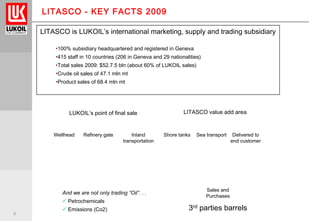
LITASCO - KEY FACTS 2009
LITASCO is LUKOIL’s international marketing, supply and trading subsidiary
•100% subsidiary headquartered and registered in Geneva
•415 staff in 10 countries (206 in Geneva and 29 nationalities)
•Total sales 2009: $52.7.5 bln (about 60% of LUKOIL sales)
•Crude oil sales of 47.1 mln mt
•Product sales of 68.4 mln mt
LUKOIL’s point of final sale
Refinery gate Delivered to
end customer
Inland
transportation
Shore tanks Sea transport
LITASCO value add area
Wellhead
3rd parties barrels
Sales and
Purchases
And we are not only trading “Oil”. . .
 Petrochemicals
 Emissions (Co2)
5
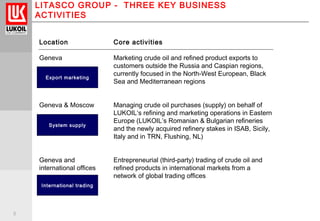
LITASCO GROUP - THREE KEY BUSINESS
ACTIVITIES
Export marketing
System supply
Location
Geneva
Geneva & Moscow
Geneva and
international offices
Core activities
Marketing crude oil and refined product exports to
customers outside the Russia and Caspian regions,
currently focused in the North-West European, Black
Sea and Mediterranean regions
Managing crude oil purchases (supply) on behalf of
LUKOIL‘s refining and marketing operations in Eastern
Europe (LUKOIL’s Romanian & Bulgarian refineries
and the newly acquired refinery stakes in ISAB, Sicily,
Italy and in TRN, Flushing, NL)
Entrepreneurial (third-party) trading of crude oil and
refined products in international markets from a
network of global trading offices
International trading
6
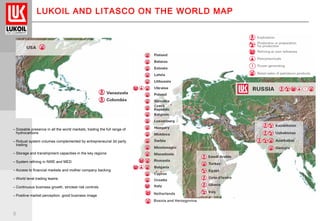
LUKOIL AND LITASCO ON THE WORLD MAP
Netherlands
– Sizeable presence in all the world markets, trading the full range of
hydrocarbons
– Robust system volumes complemented by entrepreneurial 3d party
trading
– Storage and transhipment capacities in the key regions
– System refining in NWE and MED
– Access to financial markets and mother company backing
– World level trading teams
– Continuous business growth, strictest risk controls
– Positive market perception, good business image
Bosnia and Herzegovina
7
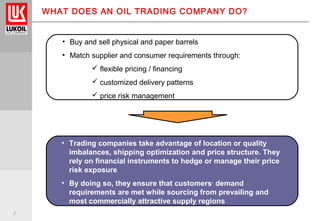
WHAT DOES AN OIL TRADING COMPANY DO?
• Buy and sell physical and paper barrels
• Match supplier and consumer requirements through:
 flexible pricing / financing
 customized delivery patterns
 price risk management
• Trading companies take advantage of location or quality
imbalances, shipping optimization and price structure. They
rely on financial instruments to hedge or manage their price
risk exposure
• By doing so, they ensure that customers’ demand
requirements are met while sourcing from prevailing and
most commercially attractive supply regions
8
GLOBAL OIL DEMAND VS PRODUCTION BY REGION
THROUGH 2030
26.7
17.4 18
4.8
16
3.5
16
3.4
8.1
9 9.24.9
12.9
6.3
17.2
6.9
18.9
17.6
7.7
24.3
8.4
30.8
8.7
7.1
26.5
8.2
31.1
9.5
33.7
3.2
4
4.3
17
5.9 7.7
7 9.7
7.8 12.3
13.9
2824.2
15.5
0.90.90.6
12.4
14.9
Mln bbls per day
OECD North America
OECD Europe
OECD Asia
Non-OECD Europe
& Eurasia
Non-OECD Asia
Middle East
Africa
Central and S. America
Demand Production Demand Production Demand Production
86.3
90.46 90.46
86.5
101.5 103.0
112.5 112.9
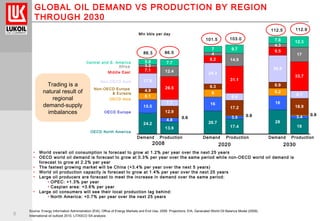
• World overall oil consumption is forecast to grow at 1.2% per year over the next 25 years
• OECD world oil demand is forecast to grow at 0.3% per year over the same period while non-OECD world oil demand is
forecast to grow at 2.2% per year
• The fastest growing market will be China (+3.4% per year over the next 5 years)
• World oil production capacity is forecast to grow at 1.4% per year over the next 25 years
• Large oil producers are forecast to meet the increase in demand over the same period:
• OPEC: +1.3% per year
• Caspian area: +3.6% per year
• Large oil consumers will see their local production lag behind:
• North America: +0.7% per year over the next 25 years
2008 2020 2030
Trading is a
natural result of
regional
demand-supply
imbalances
Source: Energy Information Administration (EIA), Office of Energy Markets and End Use, 2009. Projections: EIA, Generated World Oil Balance Model (2009),
International oil outlook 2010, LITASCO SA analysis
9
KEY OIL MARKET PARTICIPANTS CHANGE MARKET
NATURE
Oil
companies
Oil traders
Financial
institutions
Hedge
funds
Financial
institutions
Oil companies
Oil traders
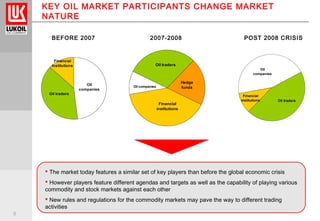
 The market today features a similar set of key players than before the global economic crisis
 However players feature different agendas and targets as well as the capability of playing various
commodity and stock markets against each other
 New rules and regulations for the commodity markets may pave the way to different trading
activities
BEFORE 2007 2007-2008
Oil traders
Oil
companies
Financial
institutions
POST 2008 CRISIS
10
MAIN CATEGORIES OF PARTICIPANTS IN THE OIL MARKET
Participation in the market
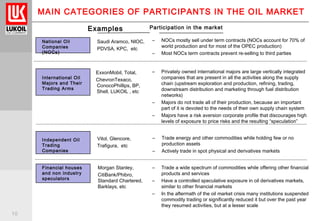
National Oil
Companies
(NOCs)
– Trade energy and other commodities while holding few or no
production assets
– Actively trade in spot physical and derivatives markets
International Oil
Majors and Their
Trading Arms
– Privately owned international majors are large vertically integrated
companies that are present in all the activities along the supply
chain (upstream exploration and production, refining, trading,
downstream distribution and marketing through fuel distribution
networks)
– Majors do not trade all of their production, because an important
part of it is devoted to the needs of their own supply chain system
– Majors have a risk aversion corporate profile that discourages high
levels of exposure to price risks and the resulting “speculation”
– Trade a wide spectrum of commodities while offering other financial
products and services
– Have a controlled speculative exposure in oil derivatives markets,
similar to other financial markets
– In the aftermath of the oil market crisis many institutions suspended
commodity trading or significantly reduced it but over the past year
they resumed activities, but at a lesser scale
Independent Oil
Trading
Companies
Financial houses
and non industry
speculators
Examples
Morgan Stanley,
CitiBank/Phibro,
Standard Chartered,
Barklays, etc
Saudi Aramco, NIOC,
PDVSA, KPC, etc
ExxonMobil, Total,
ChevronTexaco,
ConocoPhillips, BP,
Shell, LUKOIL , etc
Vitol, Glencore,
Trafigura, etc
– NOCs mostly sell under term contracts (NOCs account for 70% of
world production and for most of the OPEC production)
– Most NOCs term contracts prevent re-selling to third parties
11
PHYSICAL COMMODITY MARKETS & DERIVATIVES
MARLETS
 Crude oil and all major refined petroleum products trade on international
markets
 Liquid and transparent futures markets allow participants to « hedge » their
spot and term supply contracts prices in the forward months
 Appropriate financial instruments enable industry participants to manage their
price risk exposure and offer additional profit opportunities
 The main price indexes known to the general public today are WTI and
BRENT
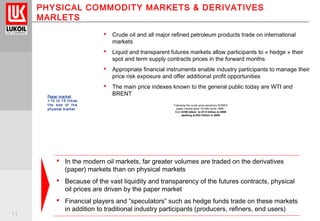
 In the modern oil markets, far greater volumes are traded on the derivatives
(paper) markets than on physical markets
 Because of the vast liquidity and transparency of the futures contracts, physical
oil prices are driven by the paper market
 Financial players and “speculators” such as hedge funds trade on these markets
in addition to traditional industry participants (producers, refiners, end users)
Paper market
= 10 to 15 times
the size of the
physical market
Following the crude price dynamics NYMEX
paper market grew 10+fold since 1999 :
from $700 billion to $7.5 trillion in 2009
peaking at $23 trillion in 2008
12
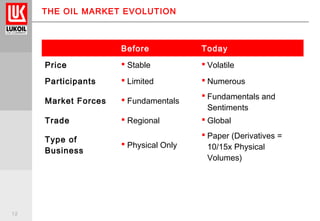
THE OIL MARKET EVOLUTION
Before Today
Price  Stable  Volatile
Participants  Limited  Numerous
Market Forces  Fundamentals
 Fundamentals and
Sentiments
Trade  Regional  Global
Type of
Business
 Physical Only
 Paper (Derivatives =
10/15x Physical
Volumes)
13
13
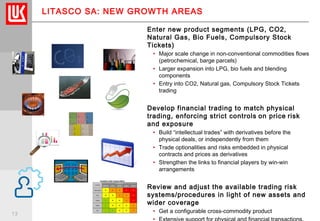
LITASCO SA: NEW GROWTH AREAS
Enter new product segments (LPG, CO2,
Natural Gas, Bio Fuels, Compulsory Stock
Tickets)
• Major scale change in non-conventional commodities flows
(petrochemical, barge parcels)
• Larger expansion into LPG, bio fuels and blending
components
• Entry into CO2, Natural gas, Compulsory Stock Tickets
trading
Develop financial trading to match physical
trading, enforcing strict controls on price risk
and exposure
• Build “intellectual trades” with derivatives before the
physical deals, or independently from them
• Trade optionalities and risks embedded in physical
contracts and prices as derivatives
• Strengthen the links to financial players by win-win
arrangements
Review and adjust the available trading risk
systems/procedures in light of new assets and
wider coverage
• Get a configurable cross-commodity product
• Extensive support for physical and financial transactions,
14
Merci, thank you, спасибо !
www.lukoil.com
www.litasco.com

Litasco

  • 1.
    LITASCO SA LUKOIL INTERNATIONALTRADING AND SUPPLY COMPANY International Oil Market and Oil Trading ''Current and future trends in commodity trading'‘ HES – Geneva - September 24th, 2010 Commodities Trading Program 2010-2011
  • 2.
    2 SUMMARY LUKOIL and LITASCO– Presentation What does an oil company do ? How do we see the business developing ? Vision and strategy
  • 3.
    3 LUKOIL GROUP -KEY FACTS 2009 Preliminary data, Bod 13/01 and Litasco SA analysis **at closing 12/01/10 (RTS&MICEX) Refineries throughput: 1.25 mln bpd Net income 2009: circa $7 bln* Production of marketable hydrocarbons: 2.3 mln bpd* Proven hydrocarbon reserves: 19.4 bln bbls Crude and products export: 1.36 mln bpd* Refining in Europe: 0.33 mln bpd*  LUKOIL is one of the world’s largest private vertically integrated oil and gas companies  Operations in over 30 countries and more than 150,000 employees – Market cap near $47.9 bln** – 1.3% of global oil reserves and 2.3% of global oil production – 18.6% of Russian oil production and 18.1% of Russian oil refining – The second largest private company worldwide by proven reserves of hydrocarbons – The 6th largest private oil company worldwide by production of hydrocarbons – The largest Russian private oil group with annual turnover near $ 100 bln – The first Russian company to receive full listing on the LSE – The only private Russian oil company whose share capital is dominated by minority stakeholders – One of the largest corporate taxpayer in Russia: $16 bln of taxes and duties paid in 2009 due to highest export volumes amongst peers
  • 4.
    4 LITASCO - KEYFACTS 2009 LITASCO is LUKOIL’s international marketing, supply and trading subsidiary •100% subsidiary headquartered and registered in Geneva •415 staff in 10 countries (206 in Geneva and 29 nationalities) •Total sales 2009: $52.7.5 bln (about 60% of LUKOIL sales) •Crude oil sales of 47.1 mln mt •Product sales of 68.4 mln mt LUKOIL’s point of final sale Refinery gate Delivered to end customer Inland transportation Shore tanks Sea transport LITASCO value add area Wellhead 3rd parties barrels Sales and Purchases And we are not only trading “Oil”. . .  Petrochemicals  Emissions (Co2)
  • 5.
    5 LITASCO GROUP -THREE KEY BUSINESS ACTIVITIES Export marketing System supply Location Geneva Geneva & Moscow Geneva and international offices Core activities Marketing crude oil and refined product exports to customers outside the Russia and Caspian regions, currently focused in the North-West European, Black Sea and Mediterranean regions Managing crude oil purchases (supply) on behalf of LUKOIL‘s refining and marketing operations in Eastern Europe (LUKOIL’s Romanian & Bulgarian refineries and the newly acquired refinery stakes in ISAB, Sicily, Italy and in TRN, Flushing, NL) Entrepreneurial (third-party) trading of crude oil and refined products in international markets from a network of global trading offices International trading
  • 6.
    6 LUKOIL AND LITASCOON THE WORLD MAP Netherlands – Sizeable presence in all the world markets, trading the full range of hydrocarbons – Robust system volumes complemented by entrepreneurial 3d party trading – Storage and transhipment capacities in the key regions – System refining in NWE and MED – Access to financial markets and mother company backing – World level trading teams – Continuous business growth, strictest risk controls – Positive market perception, good business image Bosnia and Herzegovina
  • 7.
    7 WHAT DOES ANOIL TRADING COMPANY DO? • Buy and sell physical and paper barrels • Match supplier and consumer requirements through:  flexible pricing / financing  customized delivery patterns  price risk management • Trading companies take advantage of location or quality imbalances, shipping optimization and price structure. They rely on financial instruments to hedge or manage their price risk exposure • By doing so, they ensure that customers’ demand requirements are met while sourcing from prevailing and most commercially attractive supply regions
  • 8.
    8 GLOBAL OIL DEMANDVS PRODUCTION BY REGION THROUGH 2030 26.7 17.4 18 4.8 16 3.5 16 3.4 8.1 9 9.24.9 12.9 6.3 17.2 6.9 18.9 17.6 7.7 24.3 8.4 30.8 8.7 7.1 26.5 8.2 31.1 9.5 33.7 3.2 4 4.3 17 5.9 7.7 7 9.7 7.8 12.3 13.9 2824.2 15.5 0.90.90.6 12.4 14.9 Mln bbls per day OECD North America OECD Europe OECD Asia Non-OECD Europe & Eurasia Non-OECD Asia Middle East Africa Central and S. America Demand Production Demand Production Demand Production 86.3 90.46 90.46 86.5 101.5 103.0 112.5 112.9 • World overall oil consumption is forecast to grow at 1.2% per year over the next 25 years • OECD world oil demand is forecast to grow at 0.3% per year over the same period while non-OECD world oil demand is forecast to grow at 2.2% per year • The fastest growing market will be China (+3.4% per year over the next 5 years) • World oil production capacity is forecast to grow at 1.4% per year over the next 25 years • Large oil producers are forecast to meet the increase in demand over the same period: • OPEC: +1.3% per year • Caspian area: +3.6% per year • Large oil consumers will see their local production lag behind: • North America: +0.7% per year over the next 25 years 2008 2020 2030 Trading is a natural result of regional demand-supply imbalances Source: Energy Information Administration (EIA), Office of Energy Markets and End Use, 2009. Projections: EIA, Generated World Oil Balance Model (2009), International oil outlook 2010, LITASCO SA analysis
  • 9.
    9 KEY OIL MARKETPARTICIPANTS CHANGE MARKET NATURE Oil companies Oil traders Financial institutions Hedge funds Financial institutions Oil companies Oil traders  The market today features a similar set of key players than before the global economic crisis  However players feature different agendas and targets as well as the capability of playing various commodity and stock markets against each other  New rules and regulations for the commodity markets may pave the way to different trading activities BEFORE 2007 2007-2008 Oil traders Oil companies Financial institutions POST 2008 CRISIS
  • 10.
    10 MAIN CATEGORIES OFPARTICIPANTS IN THE OIL MARKET Participation in the market National Oil Companies (NOCs) – Trade energy and other commodities while holding few or no production assets – Actively trade in spot physical and derivatives markets International Oil Majors and Their Trading Arms – Privately owned international majors are large vertically integrated companies that are present in all the activities along the supply chain (upstream exploration and production, refining, trading, downstream distribution and marketing through fuel distribution networks) – Majors do not trade all of their production, because an important part of it is devoted to the needs of their own supply chain system – Majors have a risk aversion corporate profile that discourages high levels of exposure to price risks and the resulting “speculation” – Trade a wide spectrum of commodities while offering other financial products and services – Have a controlled speculative exposure in oil derivatives markets, similar to other financial markets – In the aftermath of the oil market crisis many institutions suspended commodity trading or significantly reduced it but over the past year they resumed activities, but at a lesser scale Independent Oil Trading Companies Financial houses and non industry speculators Examples Morgan Stanley, CitiBank/Phibro, Standard Chartered, Barklays, etc Saudi Aramco, NIOC, PDVSA, KPC, etc ExxonMobil, Total, ChevronTexaco, ConocoPhillips, BP, Shell, LUKOIL , etc Vitol, Glencore, Trafigura, etc – NOCs mostly sell under term contracts (NOCs account for 70% of world production and for most of the OPEC production) – Most NOCs term contracts prevent re-selling to third parties
  • 11.
    11 PHYSICAL COMMODITY MARKETS& DERIVATIVES MARLETS  Crude oil and all major refined petroleum products trade on international markets  Liquid and transparent futures markets allow participants to « hedge » their spot and term supply contracts prices in the forward months  Appropriate financial instruments enable industry participants to manage their price risk exposure and offer additional profit opportunities  The main price indexes known to the general public today are WTI and BRENT  In the modern oil markets, far greater volumes are traded on the derivatives (paper) markets than on physical markets  Because of the vast liquidity and transparency of the futures contracts, physical oil prices are driven by the paper market  Financial players and “speculators” such as hedge funds trade on these markets in addition to traditional industry participants (producers, refiners, end users) Paper market = 10 to 15 times the size of the physical market Following the crude price dynamics NYMEX paper market grew 10+fold since 1999 : from $700 billion to $7.5 trillion in 2009 peaking at $23 trillion in 2008
  • 12.
    12 THE OIL MARKETEVOLUTION Before Today Price  Stable  Volatile Participants  Limited  Numerous Market Forces  Fundamentals  Fundamentals and Sentiments Trade  Regional  Global Type of Business  Physical Only  Paper (Derivatives = 10/15x Physical Volumes)
  • 13.
    13 13 LITASCO SA: NEWGROWTH AREAS Enter new product segments (LPG, CO2, Natural Gas, Bio Fuels, Compulsory Stock Tickets) • Major scale change in non-conventional commodities flows (petrochemical, barge parcels) • Larger expansion into LPG, bio fuels and blending components • Entry into CO2, Natural gas, Compulsory Stock Tickets trading Develop financial trading to match physical trading, enforcing strict controls on price risk and exposure • Build “intellectual trades” with derivatives before the physical deals, or independently from them • Trade optionalities and risks embedded in physical contracts and prices as derivatives • Strengthen the links to financial players by win-win arrangements Review and adjust the available trading risk systems/procedures in light of new assets and wider coverage • Get a configurable cross-commodity product • Extensive support for physical and financial transactions,
  • 14.
    14 Merci, thank you,спасибо ! www.lukoil.com www.litasco.com

Editor's Notes

  • #3 Net income for 3Q2008 is $5.6 bln
  • #4 Net income for 3Q2008 is $5.6 bln
  • #8 <number>
  • #11 <number>
  • #12 Oil price determination (locus of price) lies in the futures market due to its high volumes of trades and liquidity Crude oil and all major refined petroleum products trade on international markets Liquid and transparent futures market allows participants to « hedge » their spot and term supply contracts prices These financial instruments enable industry participants to manage their price risk exposure and offer additional profit opportunities
  • #15 <number>