Professionalising your job seeking experience
1 – Unemployment in Europe and the talent shortage
2 – Creating your brand
3 – Finding and applying to a position
4 – The job interview and the follow-up
5 – CERN’s recruitment process
1 – Unemployment in Europe and the talent shortage
2 – Creating your brand
3 – Finding and applying to a position
4 – The job interview and the follow-up
5 – CERN’s recruitment process
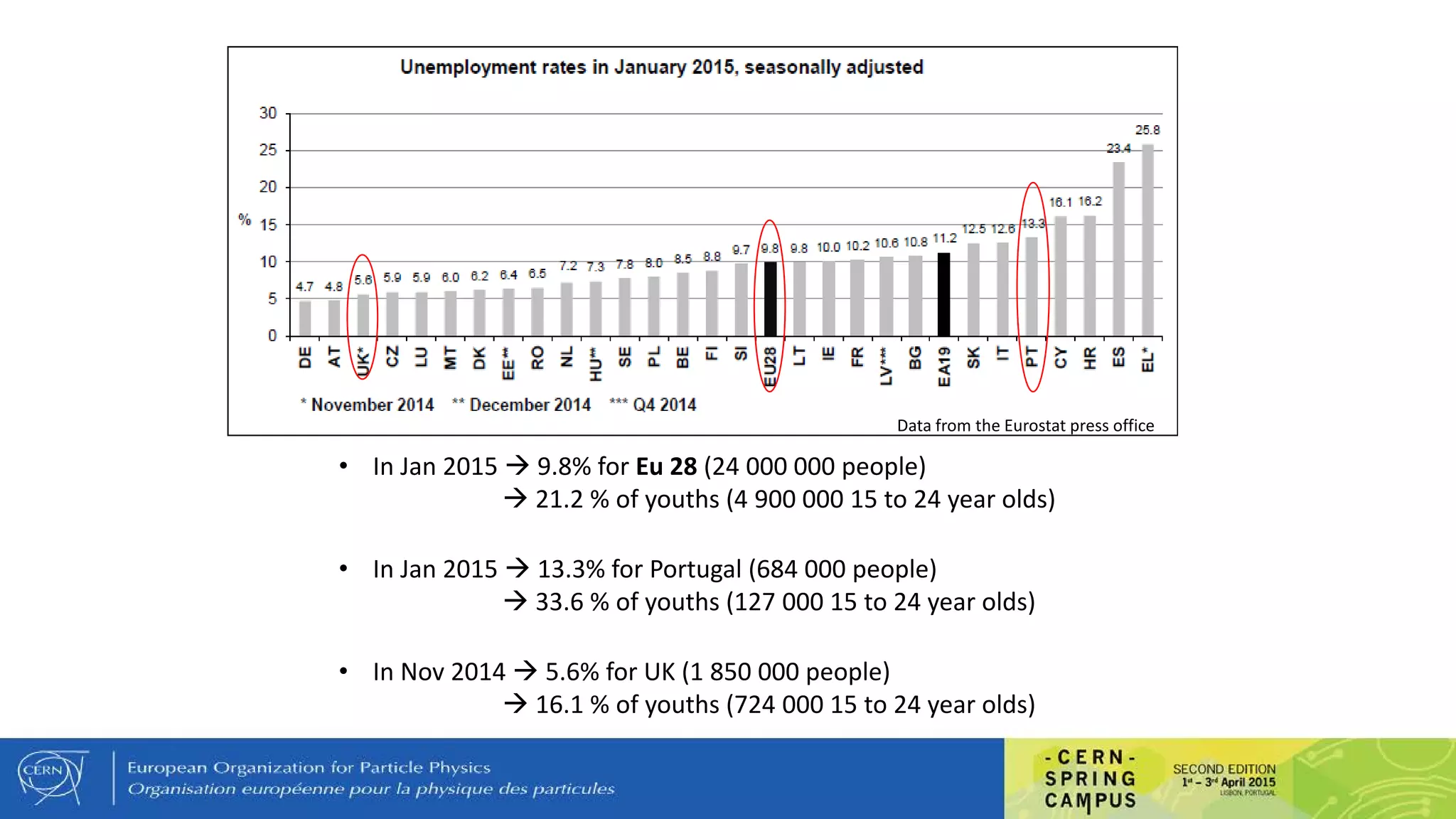
• In Jan 2015  9.8% for Eu 28 (24 000 000 people)
 21.2 % of youths (4 900 000 15 to 24 year olds)
Data from the Eurostat press office
• In Jan 2015  13.3% for Portugal (684 000 people)
 33.6 % of youths (127 000 15 to 24 year olds)
• In Nov 2014  5.6% for UK (1 850 000 people)
 16.1 % of youths (724 000 15 to 24 year olds)
0
5
10
15
20
25
30
35
40
2005 2006 2007 2008 2009 2010 2011 2012 2013
female male
15-24 female 15-24 male EU 28 unemployment data (%)
from 2005 to 2013
(the World Bank)
0
5
10
15
20
25
30
35
40
2005 2006 2007 2008 2009 2010 2011 2012 2013
female male
15-24 female 15-24 male
Portugal unemployment data (%)
from 2005 to 2013
(the World Bank)
0
5
10
15
20
25
30
35
40
2005 2006 2007 2008 2009 2010 2011 2012 2013
f m
15-24 f 15-24 m
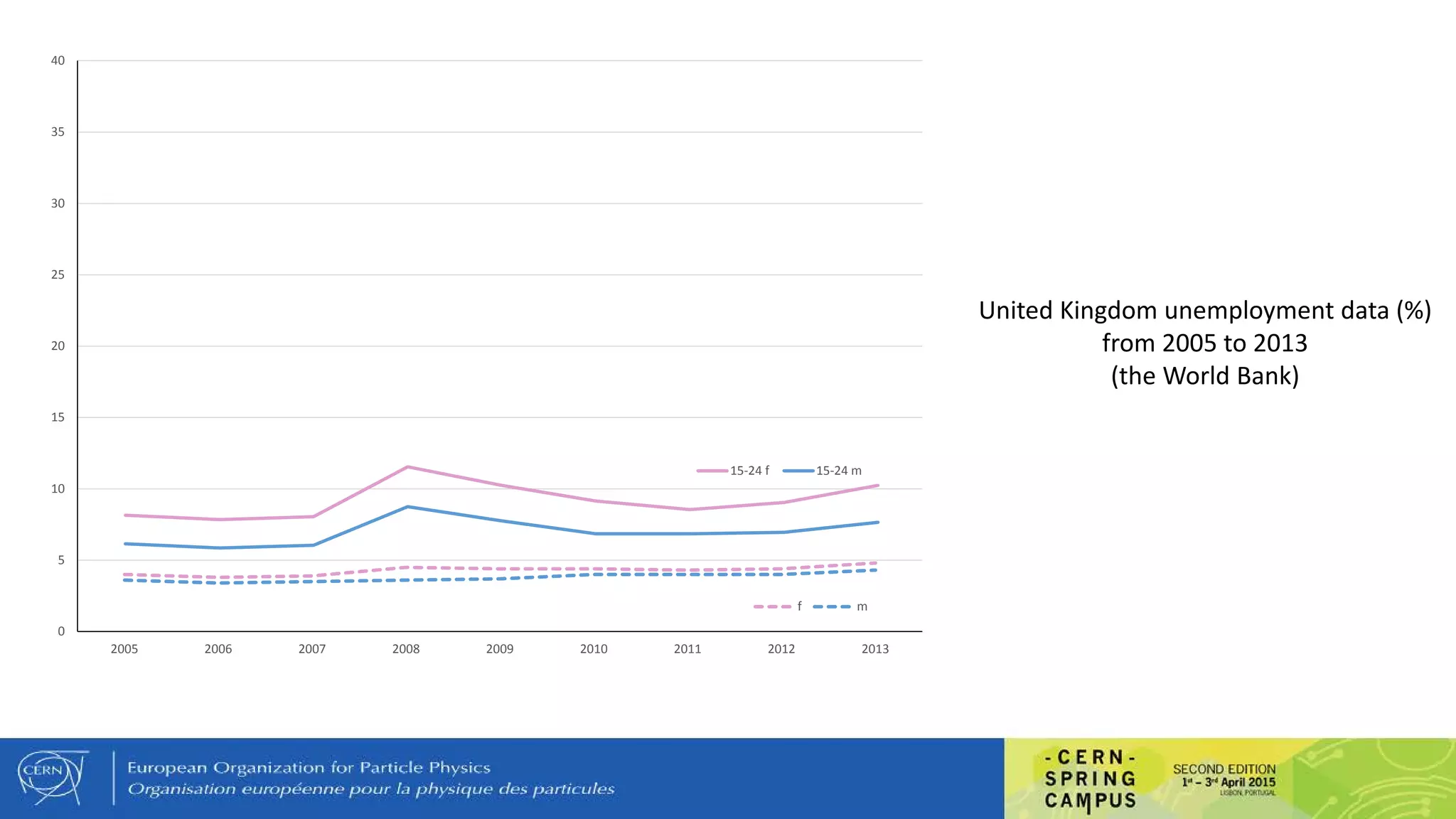
United Kingdom unemployment data (%)
from 2005 to 2013
(the World Bank)
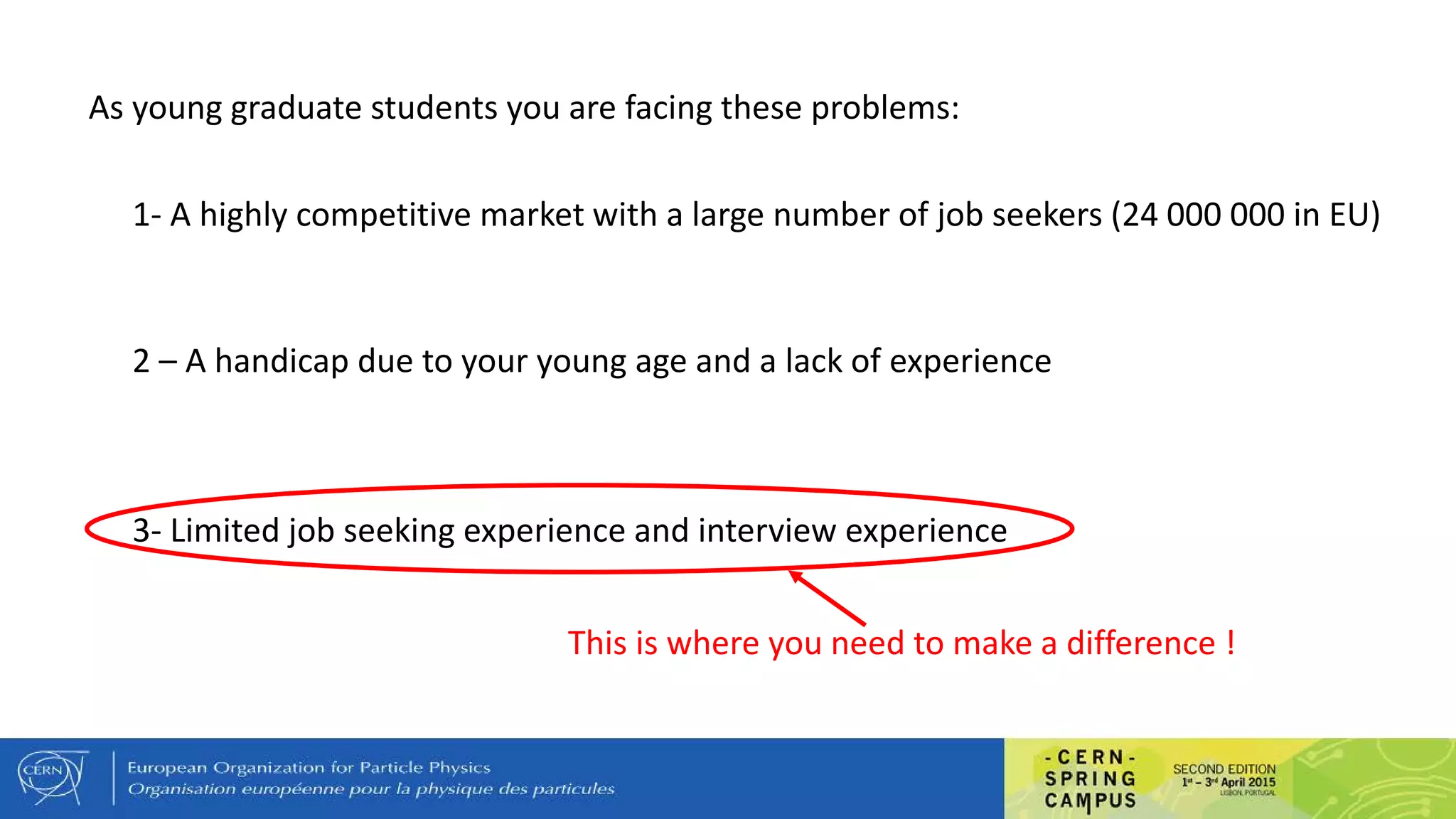
As young graduate students you are facing these problems:
1- A highly competitive market with a large number of job seekers (24 000 000 in EU)
2 – A handicap due to your young age and a lack of experience
3- Limited job seeking experience and interview experience
This is where you need to make a difference !
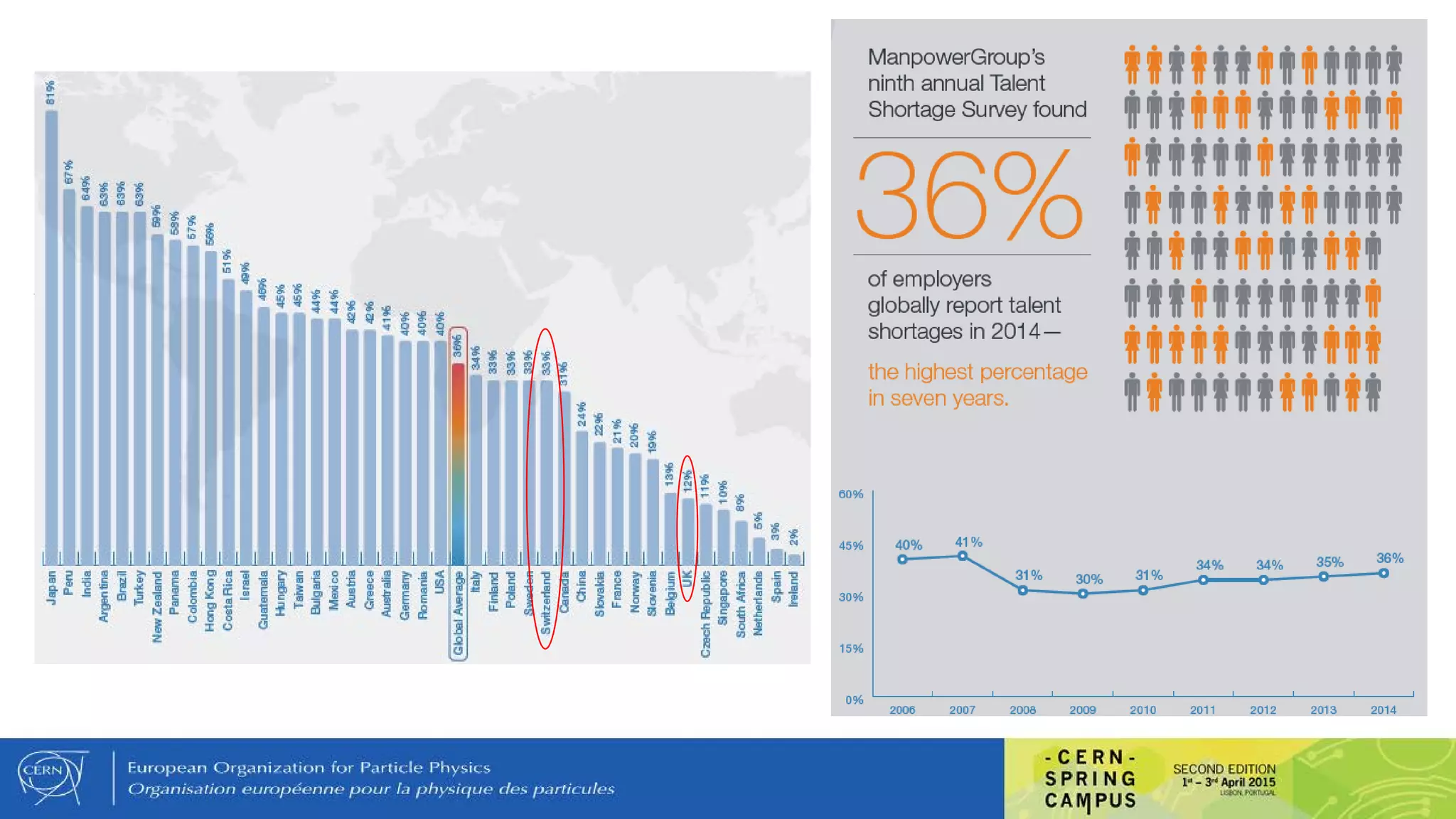
The second largest talent acquisition company in the world has
reveiled a paradox….
Based on a survey sent to 37 000 employers in 42 different countries…
What jobs are we talking about : Highly qualified engineers? R&D scientists?
Why are you having difficulty filling these jobs? (16 272 answers)
Do you know how to sell your technical skills?
How do you sell your experience and internships?
What are your soft skills?
Find a compromise between salary
And value of first experience
What is your stategy to overcome this? (16 272 answers)
What is your ability to learn?
How can you sell this?
1 – Unemployment in Europe and the talent shortage
2 – Creating your brand
3 – Finding and applying to a position
4 – The job interview and the follow-up
5 – CERN’s recruitment process
Professional vs. ‘Private’
GET IT RIGHT!
Social media profiles are an extension of your resume and should be used to help –
not hurt – your chances of landing the next job opportunity.
Check your online identity :
• Run searches for your name on search engines and social media sites.
• If top results are from non-professional sources  update your professional
profiles.
• Leave no room for confusion. If you have a common name, look for ways to
differentiate yourself (middle name initial, title...)
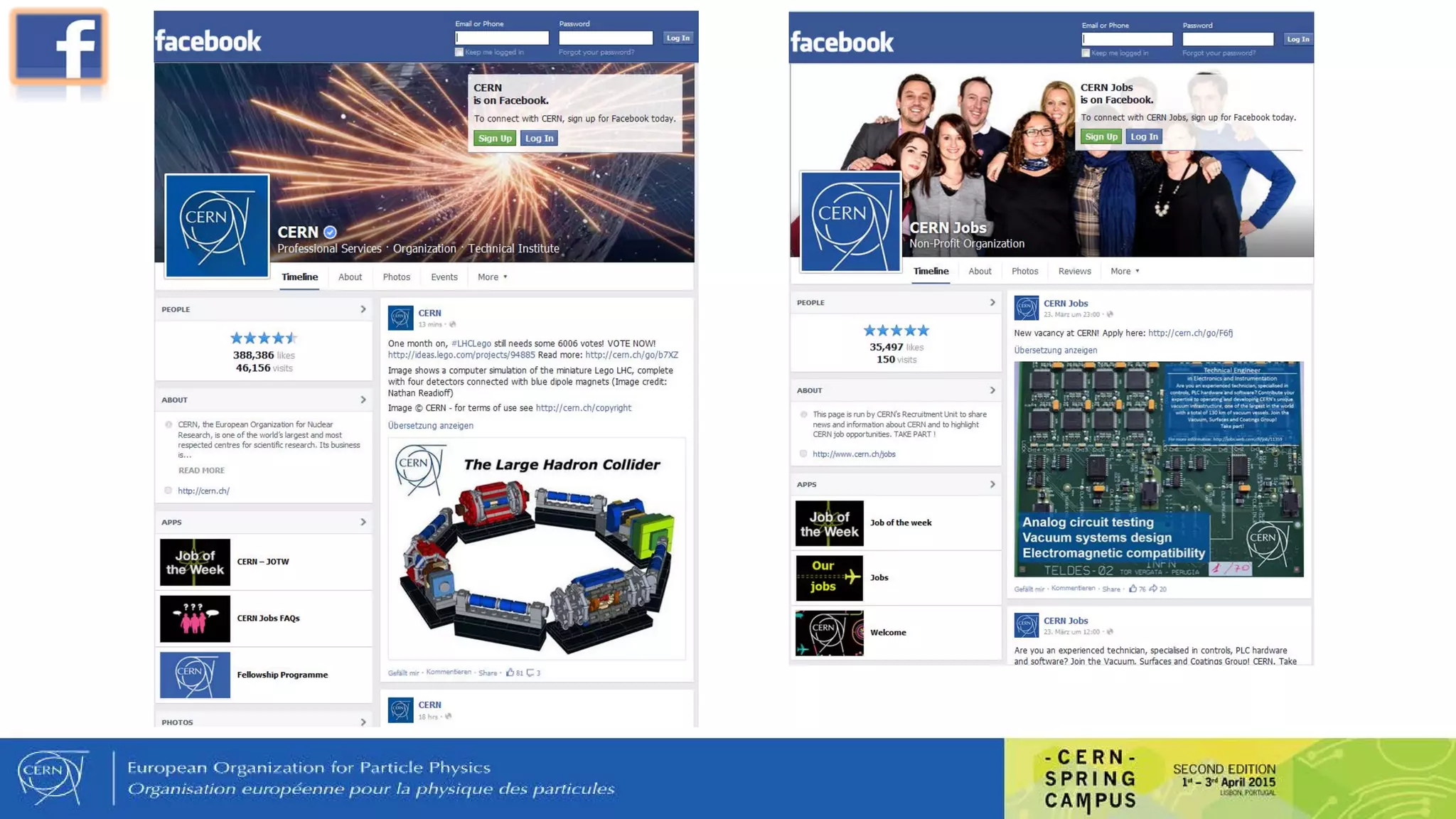
LinkedIn has high visibility in Google search results
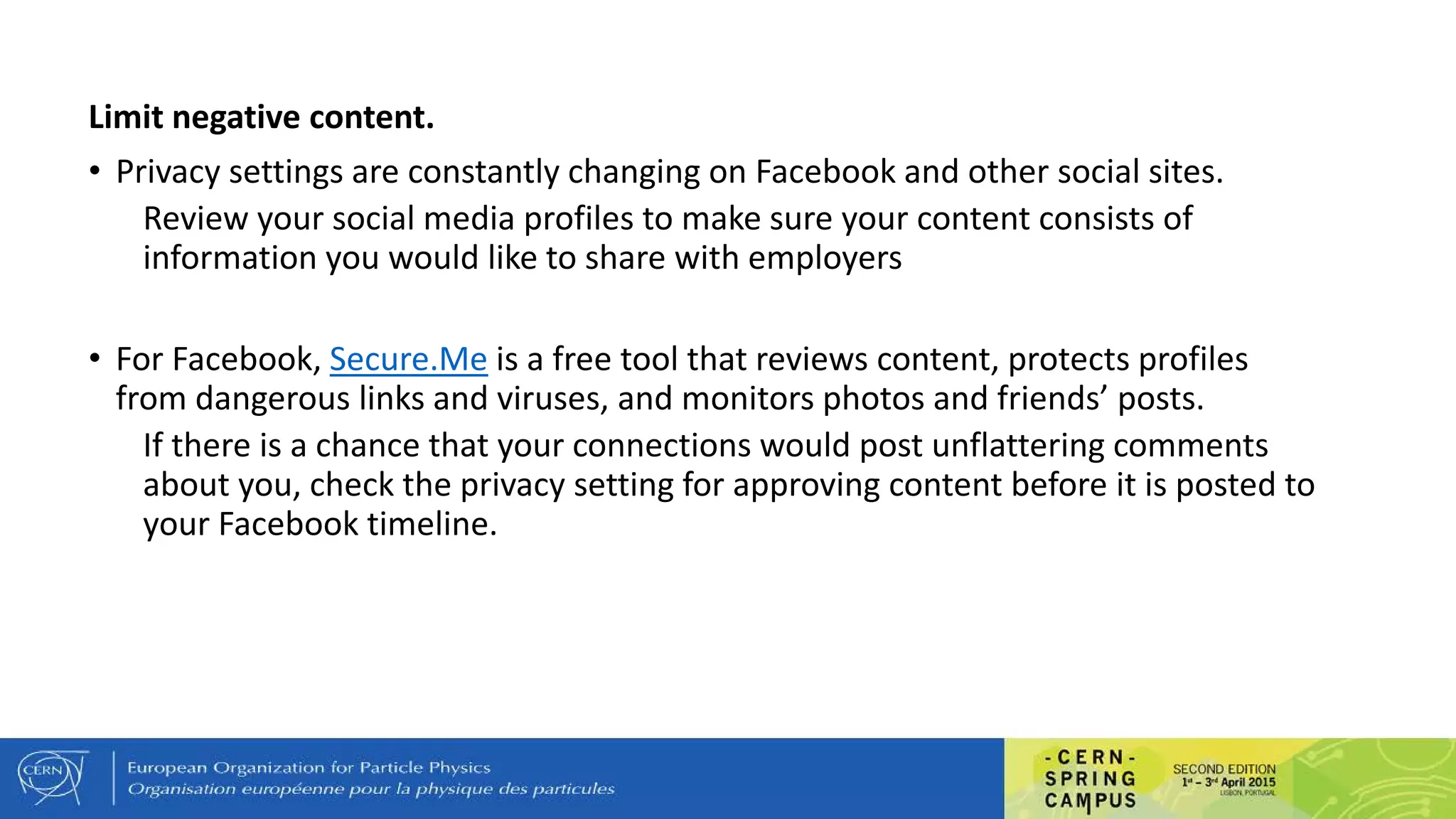
Limit negative content.
• Privacy settings are constantly changing on Facebook and other social sites.
Review your social media profiles to make sure your content consists of
information you would like to share with employers
• For Facebook, Secure.Me is a free tool that reviews content, protects profiles
from dangerous links and viruses, and monitors photos and friends’ posts.
If there is a chance that your connections would post unflattering comments
about you, check the privacy setting for approving content before it is posted to
your Facebook timeline.
1 – Unemployment in Europe and the talent shortage
2 – Creating your brand
3 – Finding and applying to a position
4 – The job interviews and the follow-up
5 – CERN’s recruitment process
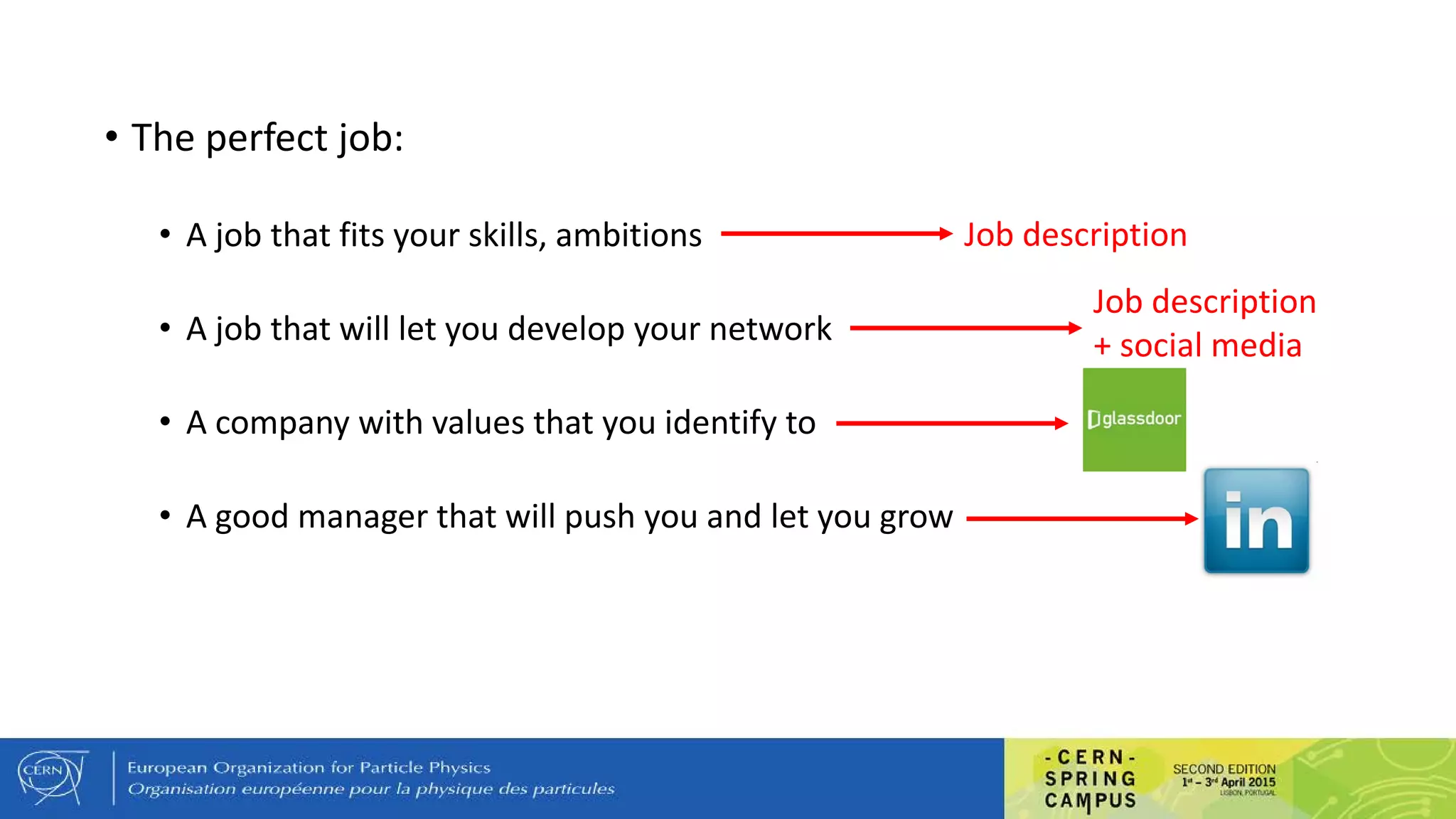
• The perfect job:
• A job that fits your skills, ambitions
• A job that will let you develop your network
• A company with values that you identify to
• A good manager that will push you and let you grow
Job description
?
Job description
+ social media
?
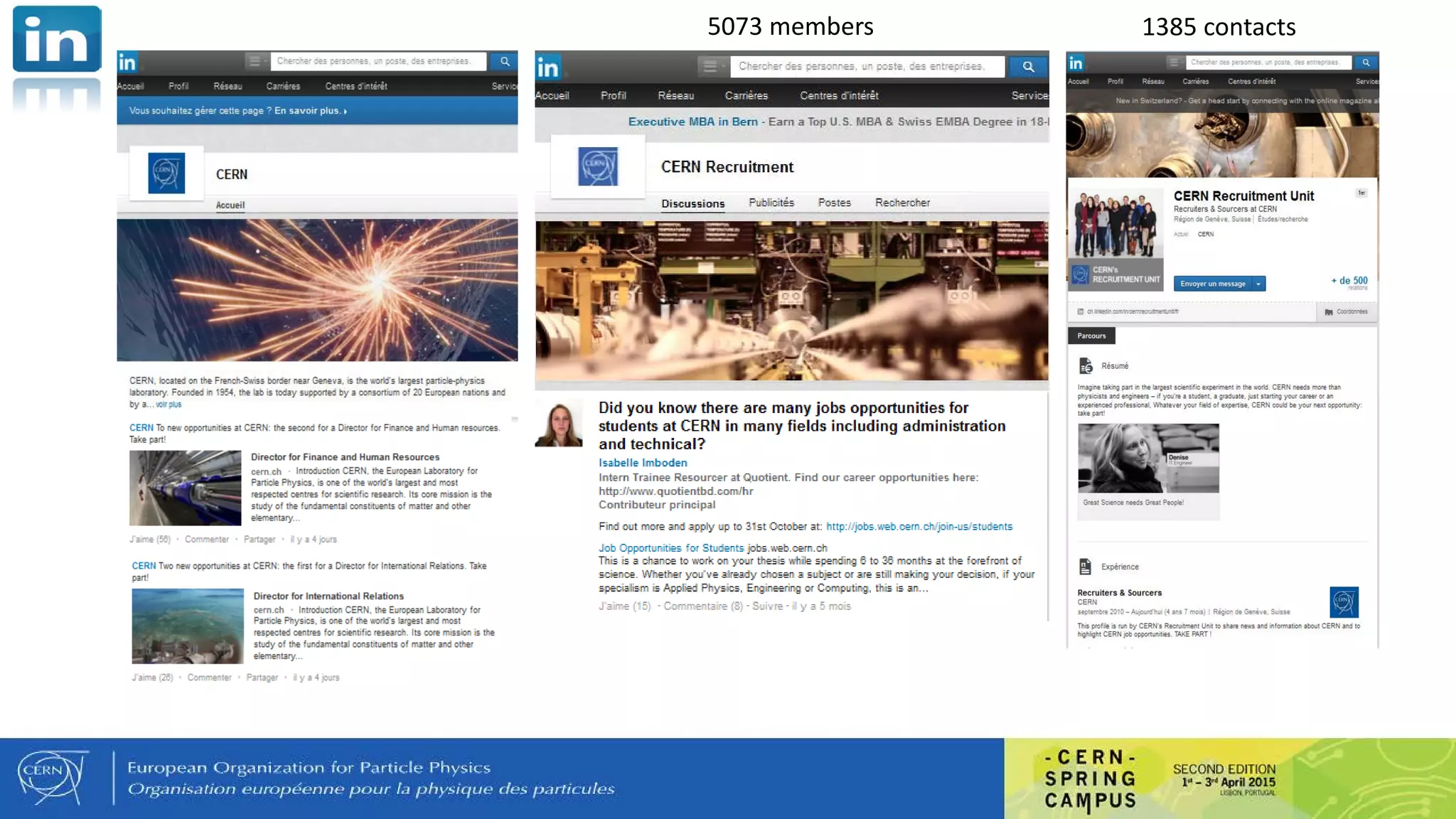
1385 contacts5073 members
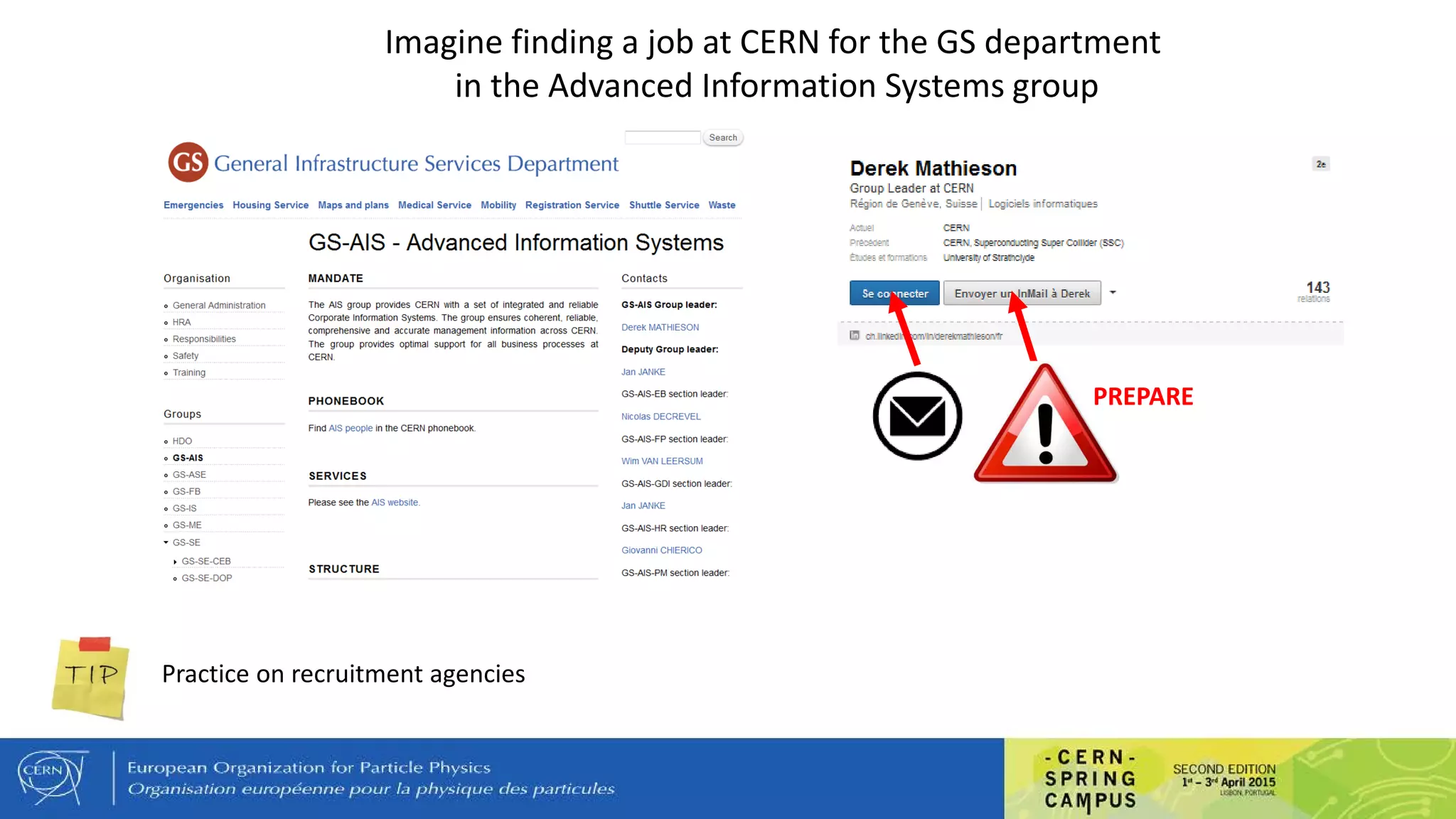
Imagine finding a job at CERN for the GS department
in the Advanced Information Systems group
PREPARE
Practice on recruitment agencies
Now that you have researched the position, the company and the manager….
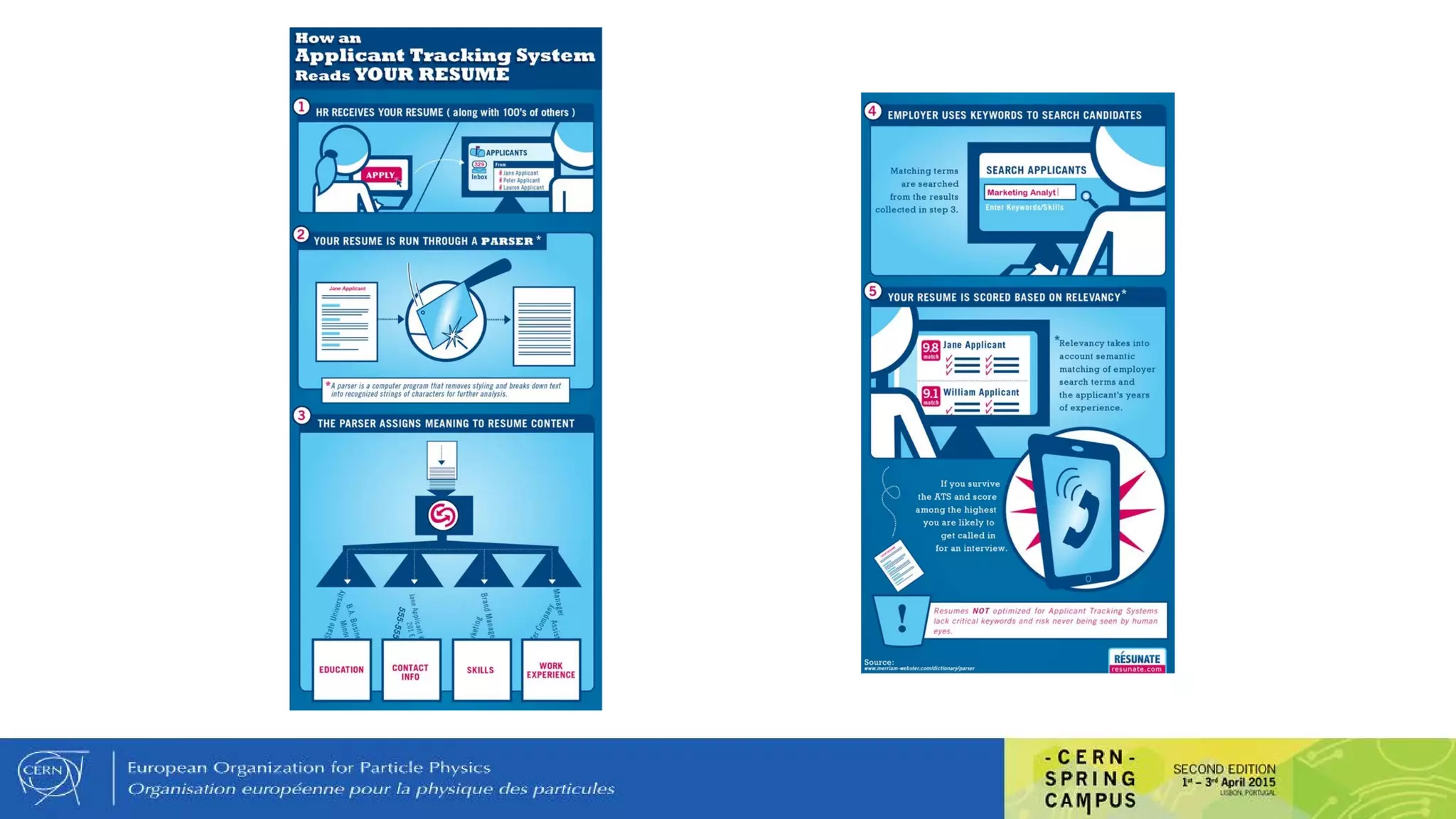
At CERN, we average 100+ applications per position
How to get to the top of the pile? Here are your two main enemies:
The HR assistant
or
The recruiter
The ATS
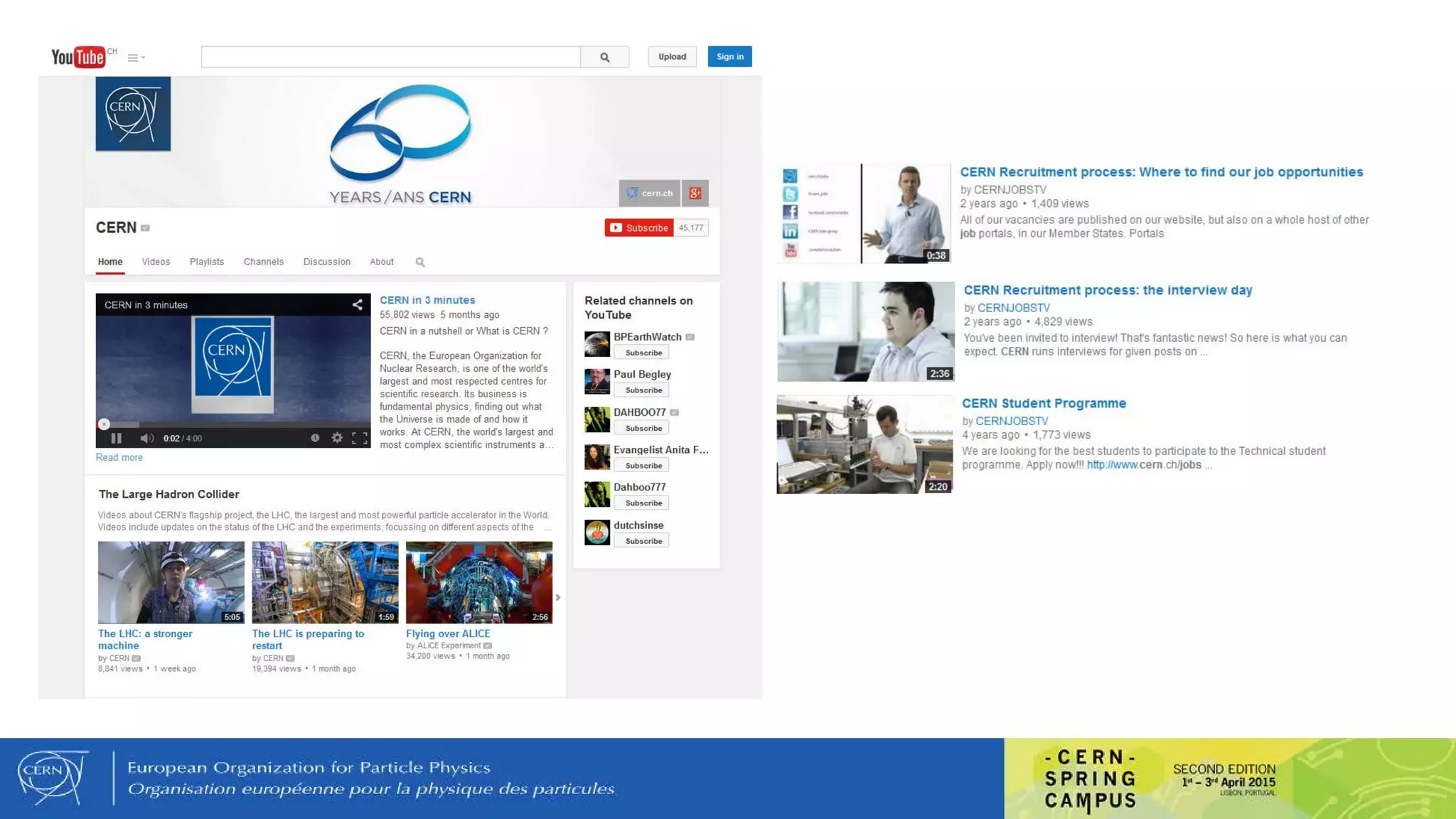
How to Hack Your Resume to Fool Keyword-Hunting Robots &
Land Yourself More Interviews (The Evil Way).
http://www.wonderhowto.com/
This will lead to the generalisation of application forms making this ‘solution’ obsolete
No room for your personal touch
No room for your personal interests
Standing out will be even more difficult
Did you know that on average a recruiter spends just 30-60 seconds to read your
application? (excluding completely irrelevant applications)
• First impression: Clear, easy to read?
• Is it relevant / tailored to the position?
• Is it complete?
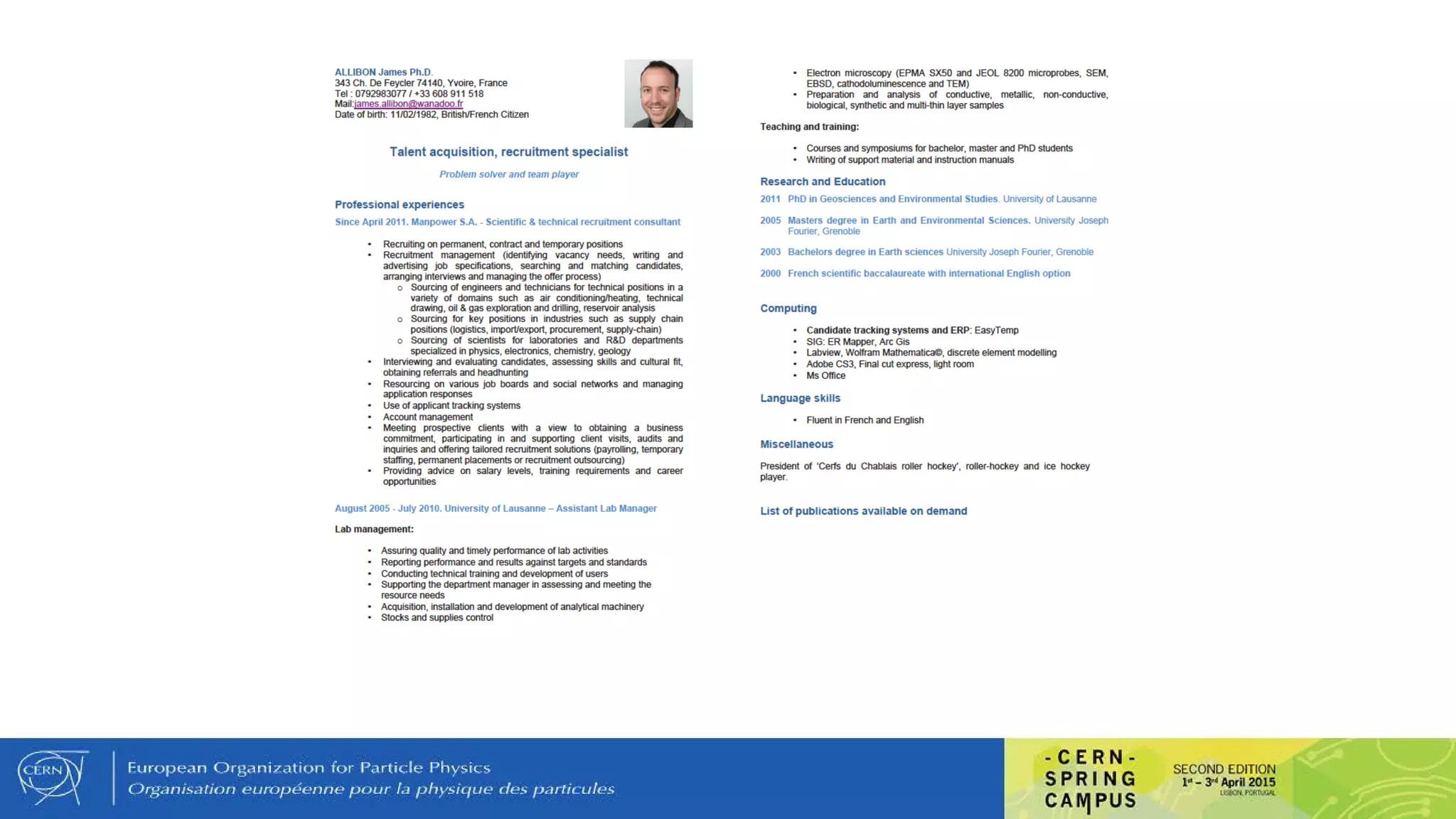
Should you put your picture on your CV? Are we hiring on looks or on competencies?
If you do : make it professional looking
What first impression do you want to give?
Your CV is like your signature, it also gives a first impression:
• How much effort have you put in to your application?
Avoid using standard CV templates you find on the web.
It is not an art contest either!
Grammar, spelling, layout
• Are you concise?
Bullet points
Don’t use a narrative style: recruiters have little time to read it.
Look for standard CV tips in the countries that you are applying to.
• Have you understood the job you are applying for? Are you a ‘serial-applicant’?
Keep it relevant
keep any job-unrelated material to a minimum.
tailor your wording to the job and emphasise those experiences that are relevant to it!
• The sooner the recruiter identifies key words that relate to the job, the higher the
probability you will make it through the first stage.
Flatter the recruiter – give them the impression they have undertood everything.
Get a parent or friend that is not in your domain to tell you what they understand from your CV
One example of a CV structure:
• Personal details + Title. (‘CV’ is not a title)
• List your key competencies, relevant for the job
• Relevant work experience, in reverse chronological order
Refer as much as possible to specific achievements
• Educational background, languages, trainings: only if relevant for the job.
• Keep it short (two A4 pages max)
1 – Unemployment in Europe and the talent shortage
2 – Creating your brand
3 – Finding and applying to a position
4 – The job interviews and the follow-up
5 – CERN’s recruitment process
The dreaded asynchronous interview
https://cern.sonru.com/interviews/33523/playback?candidate
_id=252506
https://cern.sonru.com/interviews/33522/playback?candidate
_id=252506
• Behave and dress as you would for a face to face interview
• Make sure you are not disturbed
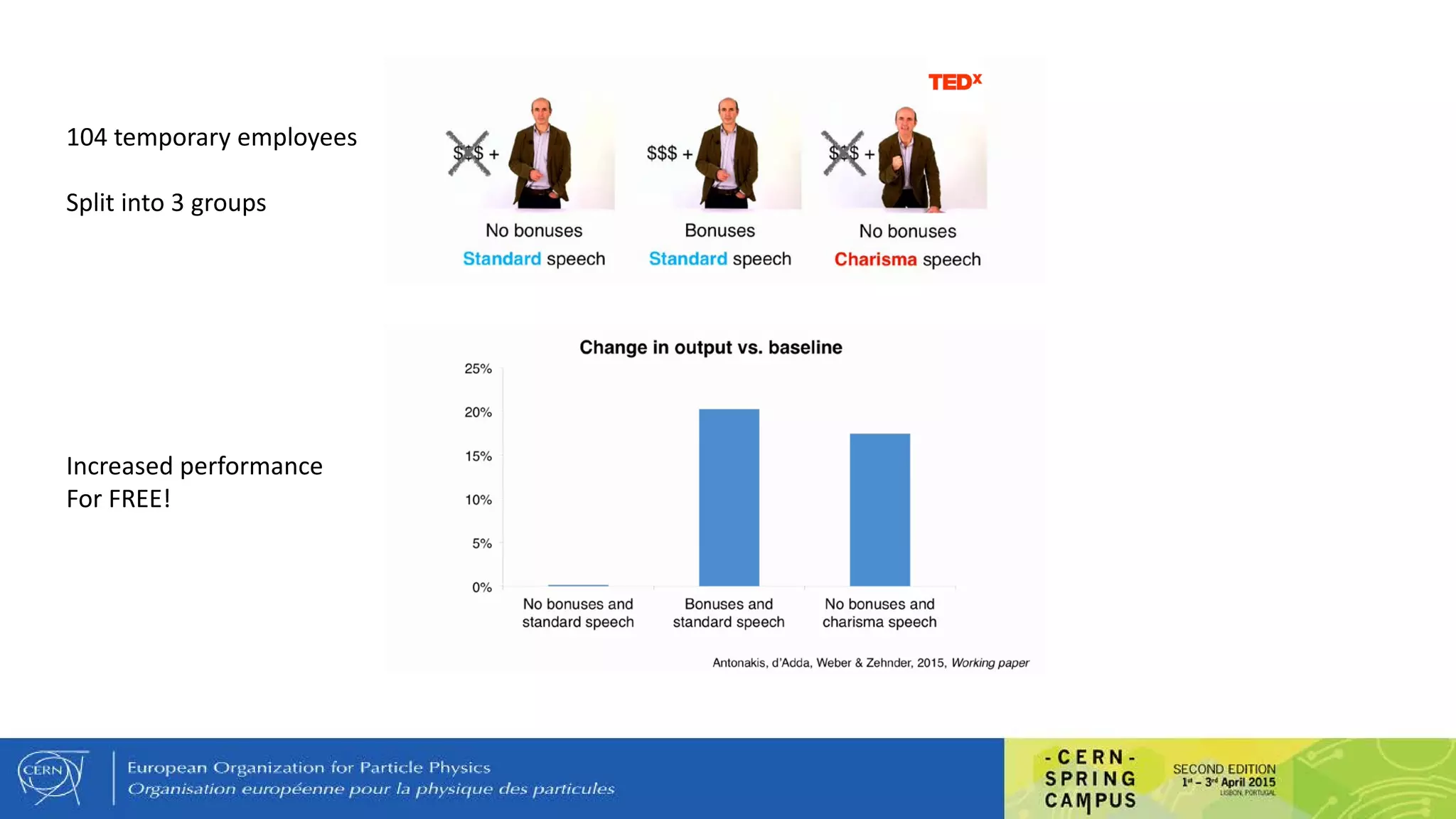
104 temporary employees
Split into 3 groups
Increased performance
For FREE!
• Believe in what you are saying
• Keep in mind that the viewers can see you
• Keep in mind that your body language has an impact on your voice
• You should know the job description and how your competencies match the requirements
Preparation
• Use a good example whenever you can and explain why this example is relevant
Think about achievements or examples beforehand
The interview
The general or ice-breaking questions:
‘Why did you apply to this position?’
‘What motivates you the most about this position?’
‘What attracts you to our company?’
‘What are our company’s values?
‘What awards did our company win last year?’
if you have studied the job description
and the company !
These are easy !
Practice by writing your answers down – you’ll remember them!
Technical questions are straight forward:
‘How would you proceed to detect a fault on a low voltage electrical substation?’
‘What is your experience with C++?’
Rephrasing the question can help save time!
• You know the answer, or your education can help you
find it!
Think BEFORE you answer
• Not knowing the answer is not eliminatory.
Technical questions can be used to determine whether you need complementary training
Behavioural or competency based questions are what you need to prepare for:
Describe an occasion where you had multiple competing deadlines.
What problems are you currently working on that came as a surprise? Could you have anticipated these?
What is the worst communication problem you have experienced? How did you solve it? Did this have a negative impact on
your work?
Describe s situation where you have submitted a good idea to your superior and he or she did not take action on it? What
did you do.
Describe a time when you generated a new approach to an existing work procedure
Describe the skills and personal qualities you believe are valuable, and those you have personally contributed, to a group
task or project.
• If you dont’t understand our question, we can rephrase
• If we don’t understand your answer – you MUST rephrase
You need to have multiple and different good answers for every question
in case we aren’t convinced
• Provide examples
• Use ‘I’ and ‘we’ appropriately
• Avoid : ‘to be truthful’, ‘honest’…
Practice— until you can tell each story smoothly, without thinking about it
The follow-up
ALWAYS follow-up:
- ‘Thank you for the opportunity…’
- ‘From the interview I understand that this position requires… and will involve…’
- Reiterate your motivation and availability for further questions / interviews
1 – Unemployment in Europe and the talent shortage
2 – Creating your brand
3 – Finding and applying to a position
4 – The job interviews and the follow-up
5 – CERN’s recruitment process
~ 150 staff positions
~ 200 fellows
~ 150 technical students
~ 50 administrative students
~ 50 doctoral students
~150 summer students
Eligibility : from apprenticeship to PhD
Selection : vacancies published on the WEB
Features : - competitive salaries incl. social benefits
- training possibilities (language courses, technical training)
Per Year
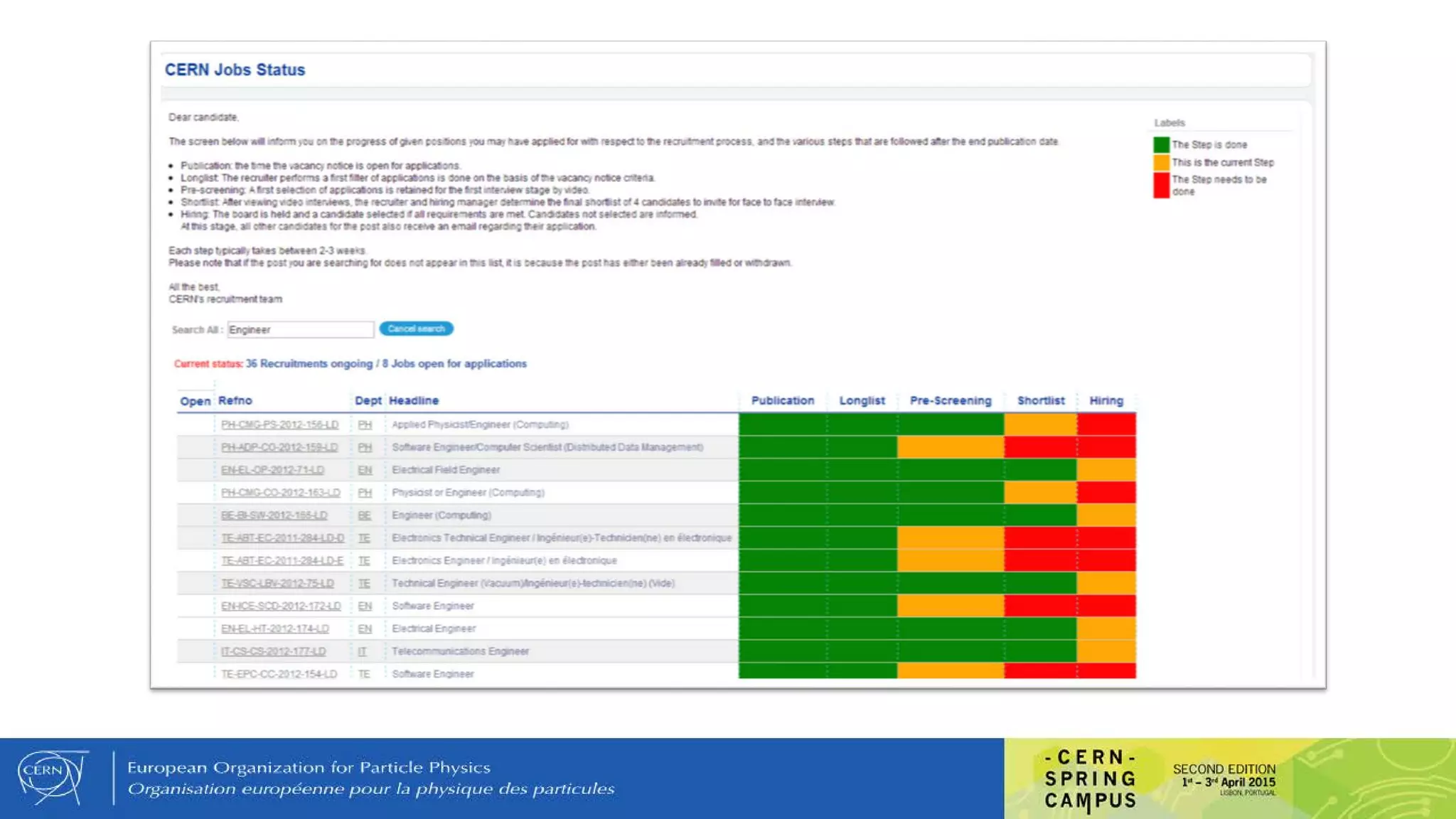
Acknowledgement of receipt e-mail
Upload your CV, Diplomas and other requested documents
Video Interview2-3 weeks
after end of publication
Technical test
Panel interview
3-4 weeks
after video interview
deadline
Successful applicant is hired
Max. 2 weeks
after panel interview
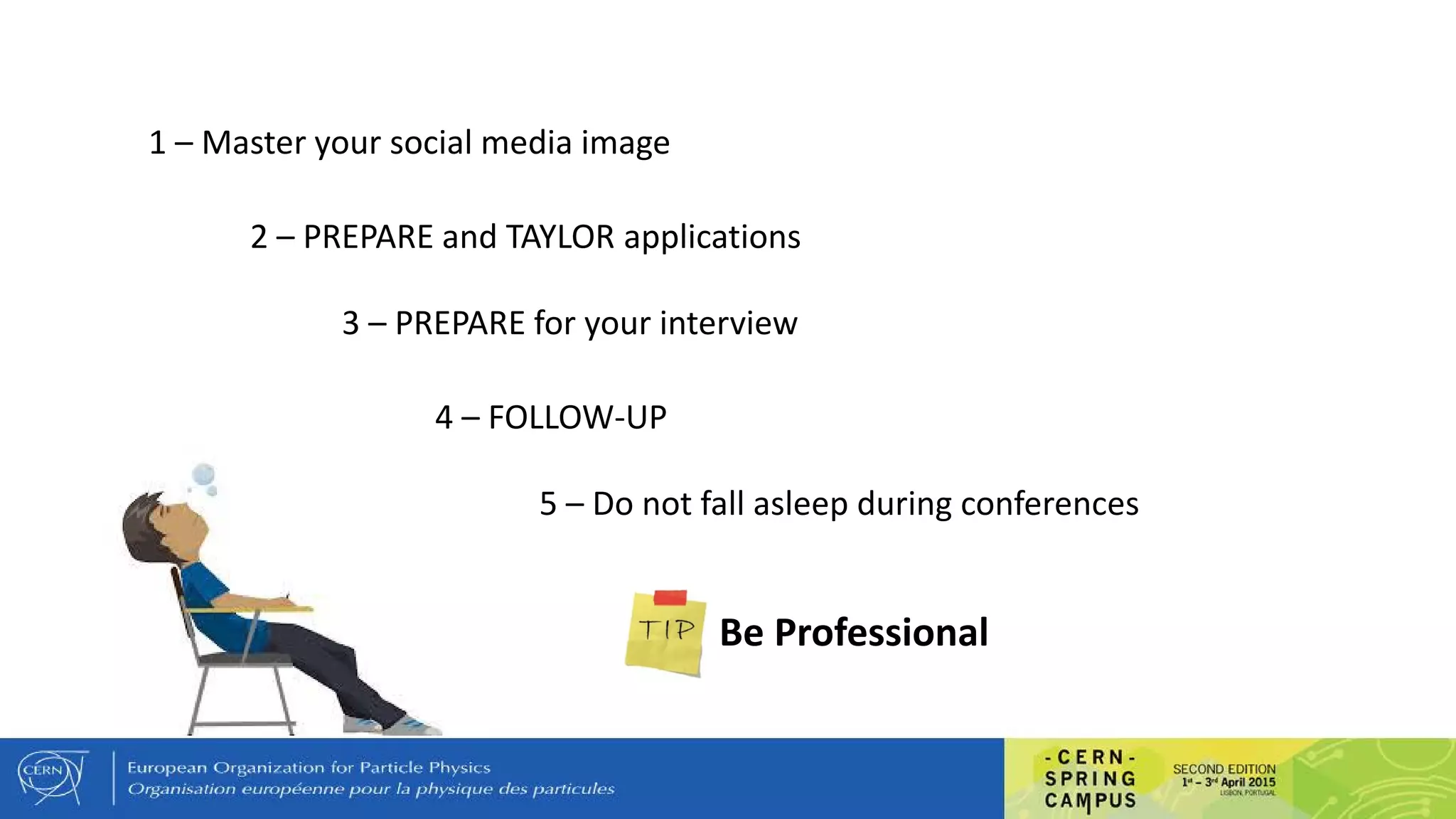
1 – Master your social media image
2 – PREPARE and TAYLOR applications
3 – PREPARE for your interview
4 – FOLLOW-UP
5 – Do not fall asleep during conferences
Be Professional
Questions?

LISBON-spring campus 2015-JAL

  • 1.
    Professionalising your jobseeking experience
  • 2.
    1 – Unemploymentin Europe and the talent shortage 2 – Creating your brand 3 – Finding and applying to a position 4 – The job interview and the follow-up 5 – CERN’s recruitment process
  • 3.
    1 – Unemploymentin Europe and the talent shortage 2 – Creating your brand 3 – Finding and applying to a position 4 – The job interview and the follow-up 5 – CERN’s recruitment process
  • 4.
    • In Jan2015  9.8% for Eu 28 (24 000 000 people)  21.2 % of youths (4 900 000 15 to 24 year olds) Data from the Eurostat press office • In Jan 2015  13.3% for Portugal (684 000 people)  33.6 % of youths (127 000 15 to 24 year olds) • In Nov 2014  5.6% for UK (1 850 000 people)  16.1 % of youths (724 000 15 to 24 year olds)
  • 5.
    0 5 10 15 20 25 30 35 40 2005 2006 20072008 2009 2010 2011 2012 2013 female male 15-24 female 15-24 male EU 28 unemployment data (%) from 2005 to 2013 (the World Bank)
  • 6.
    0 5 10 15 20 25 30 35 40 2005 2006 20072008 2009 2010 2011 2012 2013 female male 15-24 female 15-24 male Portugal unemployment data (%) from 2005 to 2013 (the World Bank)
  • 7.
    0 5 10 15 20 25 30 35 40 2005 2006 20072008 2009 2010 2011 2012 2013 f m 15-24 f 15-24 m United Kingdom unemployment data (%) from 2005 to 2013 (the World Bank)
  • 8.
    As young graduatestudents you are facing these problems: 1- A highly competitive market with a large number of job seekers (24 000 000 in EU) 2 – A handicap due to your young age and a lack of experience 3- Limited job seeking experience and interview experience This is where you need to make a difference !
  • 9.
    The second largesttalent acquisition company in the world has reveiled a paradox…. Based on a survey sent to 37 000 employers in 42 different countries…
  • 10.
    What jobs arewe talking about : Highly qualified engineers? R&D scientists?
  • 11.
    Why are youhaving difficulty filling these jobs? (16 272 answers) Do you know how to sell your technical skills? How do you sell your experience and internships? What are your soft skills? Find a compromise between salary And value of first experience
  • 12.
    What is yourstategy to overcome this? (16 272 answers) What is your ability to learn? How can you sell this?
  • 13.
    1 – Unemploymentin Europe and the talent shortage 2 – Creating your brand 3 – Finding and applying to a position 4 – The job interview and the follow-up 5 – CERN’s recruitment process
  • 14.
  • 15.
    Social media profilesare an extension of your resume and should be used to help – not hurt – your chances of landing the next job opportunity.
  • 16.
    Check your onlineidentity : • Run searches for your name on search engines and social media sites. • If top results are from non-professional sources  update your professional profiles. • Leave no room for confusion. If you have a common name, look for ways to differentiate yourself (middle name initial, title...) LinkedIn has high visibility in Google search results
  • 19.
    Limit negative content. •Privacy settings are constantly changing on Facebook and other social sites. Review your social media profiles to make sure your content consists of information you would like to share with employers • For Facebook, Secure.Me is a free tool that reviews content, protects profiles from dangerous links and viruses, and monitors photos and friends’ posts. If there is a chance that your connections would post unflattering comments about you, check the privacy setting for approving content before it is posted to your Facebook timeline.
  • 21.
    1 – Unemploymentin Europe and the talent shortage 2 – Creating your brand 3 – Finding and applying to a position 4 – The job interviews and the follow-up 5 – CERN’s recruitment process
  • 24.
    • The perfectjob: • A job that fits your skills, ambitions • A job that will let you develop your network • A company with values that you identify to • A good manager that will push you and let you grow Job description ? Job description + social media ?
  • 25.
  • 29.
    Imagine finding ajob at CERN for the GS department in the Advanced Information Systems group PREPARE Practice on recruitment agencies
  • 30.
    Now that youhave researched the position, the company and the manager….
  • 31.
    At CERN, weaverage 100+ applications per position
  • 32.
    How to getto the top of the pile? Here are your two main enemies: The HR assistant or The recruiter The ATS
  • 34.
    How to HackYour Resume to Fool Keyword-Hunting Robots & Land Yourself More Interviews (The Evil Way). http://www.wonderhowto.com/
  • 35.
    This will leadto the generalisation of application forms making this ‘solution’ obsolete No room for your personal touch No room for your personal interests Standing out will be even more difficult
  • 36.
    Did you knowthat on average a recruiter spends just 30-60 seconds to read your application? (excluding completely irrelevant applications) • First impression: Clear, easy to read? • Is it relevant / tailored to the position? • Is it complete?
  • 38.
    Should you putyour picture on your CV? Are we hiring on looks or on competencies? If you do : make it professional looking What first impression do you want to give?
  • 39.
    Your CV islike your signature, it also gives a first impression: • How much effort have you put in to your application? Avoid using standard CV templates you find on the web. It is not an art contest either! Grammar, spelling, layout • Are you concise? Bullet points Don’t use a narrative style: recruiters have little time to read it. Look for standard CV tips in the countries that you are applying to.
  • 40.
    • Have youunderstood the job you are applying for? Are you a ‘serial-applicant’? Keep it relevant keep any job-unrelated material to a minimum. tailor your wording to the job and emphasise those experiences that are relevant to it! • The sooner the recruiter identifies key words that relate to the job, the higher the probability you will make it through the first stage. Flatter the recruiter – give them the impression they have undertood everything. Get a parent or friend that is not in your domain to tell you what they understand from your CV
  • 41.
    One example ofa CV structure: • Personal details + Title. (‘CV’ is not a title) • List your key competencies, relevant for the job • Relevant work experience, in reverse chronological order Refer as much as possible to specific achievements • Educational background, languages, trainings: only if relevant for the job. • Keep it short (two A4 pages max)
  • 42.
    1 – Unemploymentin Europe and the talent shortage 2 – Creating your brand 3 – Finding and applying to a position 4 – The job interviews and the follow-up 5 – CERN’s recruitment process
  • 43.
    The dreaded asynchronousinterview https://cern.sonru.com/interviews/33523/playback?candidate _id=252506 https://cern.sonru.com/interviews/33522/playback?candidate _id=252506 • Behave and dress as you would for a face to face interview • Make sure you are not disturbed
  • 44.
    104 temporary employees Splitinto 3 groups Increased performance For FREE!
  • 45.
    • Believe inwhat you are saying • Keep in mind that the viewers can see you • Keep in mind that your body language has an impact on your voice • You should know the job description and how your competencies match the requirements Preparation • Use a good example whenever you can and explain why this example is relevant Think about achievements or examples beforehand
  • 46.
    The interview The generalor ice-breaking questions: ‘Why did you apply to this position?’ ‘What motivates you the most about this position?’ ‘What attracts you to our company?’ ‘What are our company’s values? ‘What awards did our company win last year?’ if you have studied the job description and the company ! These are easy ! Practice by writing your answers down – you’ll remember them!
  • 47.
    Technical questions arestraight forward: ‘How would you proceed to detect a fault on a low voltage electrical substation?’ ‘What is your experience with C++?’ Rephrasing the question can help save time! • You know the answer, or your education can help you find it! Think BEFORE you answer • Not knowing the answer is not eliminatory. Technical questions can be used to determine whether you need complementary training
  • 48.
    Behavioural or competencybased questions are what you need to prepare for: Describe an occasion where you had multiple competing deadlines. What problems are you currently working on that came as a surprise? Could you have anticipated these? What is the worst communication problem you have experienced? How did you solve it? Did this have a negative impact on your work? Describe s situation where you have submitted a good idea to your superior and he or she did not take action on it? What did you do. Describe a time when you generated a new approach to an existing work procedure Describe the skills and personal qualities you believe are valuable, and those you have personally contributed, to a group task or project.
  • 49.
    • If youdont’t understand our question, we can rephrase • If we don’t understand your answer – you MUST rephrase You need to have multiple and different good answers for every question in case we aren’t convinced • Provide examples • Use ‘I’ and ‘we’ appropriately • Avoid : ‘to be truthful’, ‘honest’… Practice— until you can tell each story smoothly, without thinking about it
  • 50.
    The follow-up ALWAYS follow-up: -‘Thank you for the opportunity…’ - ‘From the interview I understand that this position requires… and will involve…’ - Reiterate your motivation and availability for further questions / interviews
  • 51.
    1 – Unemploymentin Europe and the talent shortage 2 – Creating your brand 3 – Finding and applying to a position 4 – The job interviews and the follow-up 5 – CERN’s recruitment process
  • 52.
    ~ 150 staffpositions ~ 200 fellows ~ 150 technical students ~ 50 administrative students ~ 50 doctoral students ~150 summer students Eligibility : from apprenticeship to PhD Selection : vacancies published on the WEB Features : - competitive salaries incl. social benefits - training possibilities (language courses, technical training) Per Year
  • 54.
    Acknowledgement of receipte-mail Upload your CV, Diplomas and other requested documents Video Interview2-3 weeks after end of publication Technical test Panel interview 3-4 weeks after video interview deadline Successful applicant is hired Max. 2 weeks after panel interview
  • 56.
    1 – Masteryour social media image 2 – PREPARE and TAYLOR applications 3 – PREPARE for your interview 4 – FOLLOW-UP 5 – Do not fall asleep during conferences Be Professional
  • 57.