LIQUIDATION OF COMPANIES
Liquidation or ‘winding up’ of the company is a legal tem and refers to the procedure through which the
affairs of the company are wound up by law.
Features of Liquidation
1. Any company, when found necessary, can be liquidated.
2. Liquidation of a company should be distinguished from the insolvency of a trader or of a firm.
3. When liquidation takes place, assets of the company are realized, capital is collected and out of the
proceeds claims of creditors are settled if any surplus is left, it is returned to the shareholders of the
company according to their rights.
4. The job of realizing various assets and paying various liabilities in a systematic manner is performed
by a person called liquidator.
Modes of Winding of the Company
1. Compulsory winding up by the court of law
2. Voluntary winding up by the creditors or members
3. Winding up under the supervision of court
Compulsory Winding up
The circumstances for compulsory winding up have been listed as follows:
a. If by a special resolution, the company has resolved to be wound up by the court.
b. If the default has been made by the company in delivering the statutory report to the registrar or in
holding the statutory meeting.
c. If the company suspends its business for more than a year or does not commence business within
one year of its incorporation.
d. If the number of members of the company are reduced to below seven members in case of the
public company and below two in case of the private members.
e. If according to the court of law, it is just and equitable that the company should be wound up.
Voluntary Winding Up
a. Voluntary winding up by the Members: At the general meeting of the company, a special resolution
is passed which is called ‘resolution for voluntary winding up’. Then a liquidator is appointed and he
prepares the accounts of winding up and calls the meeting of the members of the company. The
liquidator presents the account of liquidation to the members. After one week of the meeting, the
liquidator sends the copy of the accounts and the statement to the registrar of company. The
registrar registers the accounts and the statement and after 3 months of this registration is company
is fully wound up.
b. Voluntary winding up by the Creditors: If in voluntary liquidation, the directors do not make the
declaration of the solvency, then this winding up is called winding up by the creditors.
c. Winding up under the Supervision of the Court: Sec 522 of the Companies Act, 1956 calls for the
voluntary winding up of the company under the supervision of the court. Such an order is passed by
the court on the application of any creditor or contributory or liquidator or the company itself when
the liquidator under voluntary winding up is prejudiced or is negligent in collecting the assets of the
company or the resolution of winding up was obtained by fraud. The main purpose of this winding
up is to protect the interest of the creditors and the shareholders of the company.
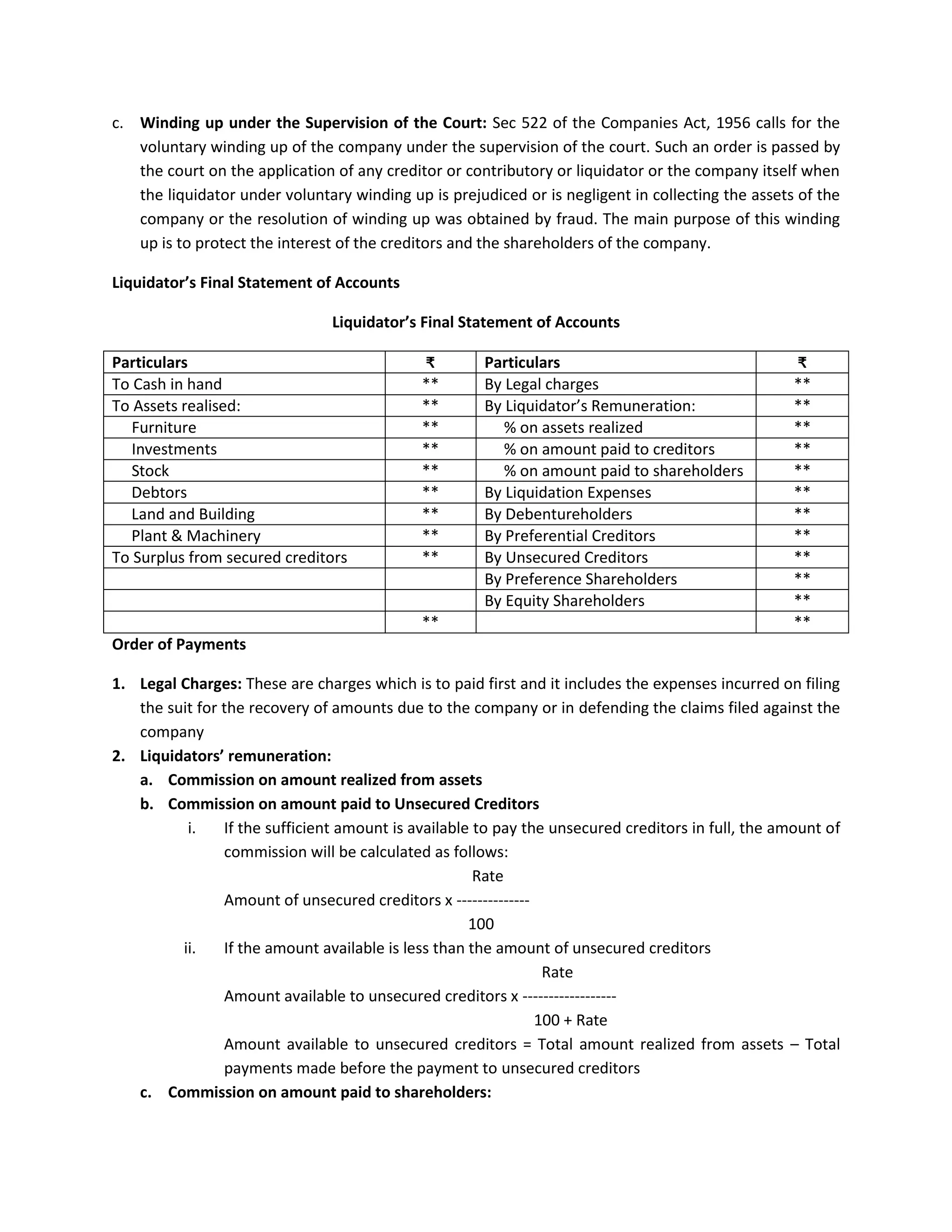
Liquidator’s Final Statement of Accounts
Particulars ₹ Particulars ₹
To Cash in hand ** By Legal charges **
To Assets realised: ** By Liquidator’s Remuneration: **
Furniture ** % on assets realized **
Investments ** % on amount paid to creditors **
Stock ** % on amount paid to shareholders **
Debtors ** By Liquidation Expenses **
Land and Building ** By Debentureholders **
Plant & Machinery ** By Preferential Creditors **
To Surplus from secured creditors ** By Unsecured Creditors **
By Preference Shareholders **
By Equity Shareholders **
** **
Order of Payments
1. Legal Charges: These are charges which is to paid first and it includes the expenses incurred on filing
the suit for the recovery of amounts due to the company or in defending the claims filed against the
company
2. Liquidators’ remuneration:
a. Commission on amount realized from assets
b. Commission on amount paid to Unsecured Creditors
i. If the sufficient amount is available to pay the unsecured creditors in full, the amount of
commission will be calculated as follows:
Rate
Amount of unsecured creditors x --------------
100
ii. If the amount available is less than the amount of unsecured creditors
Rate
Amount available to unsecured creditors x ------------------
100 + Rate
Amount available to unsecured creditors = Total amount realized from assets – Total
payments made before the payment to unsecured creditors
c. Commission on amount paid to shareholders:
i. Commission on amount paid to shareholders. This includes both Preference and Equity
Shareholders. Commission is calculated as follows:
Rate
Amount available to shareholders x ------------------
100 + Rate
Amount available to shareholders = Total amount realized from assets – Total payments
made before the payment to preference shareholders
ii. Commission on amount paid to equity shareholders. This includes only Equity
Shareholders. Commission is calculated as follows:
Rate
Amount available to shareholders x ------------------
100 + Rate
Amount available to equity shareholders = Total amount realized from assets – Total
payments made before the payment to equity shareholders
3. Liquidation Expenses: These expenses are paid after the payment of remuneration to the
liquidator
4. Debentureholders or other creditors: Debentureholders are paid for the interest on debentures.
5. Preferential Creditors
6. Unsecured Creditors
7. Preference Shareholders
8. Equity Shareholders
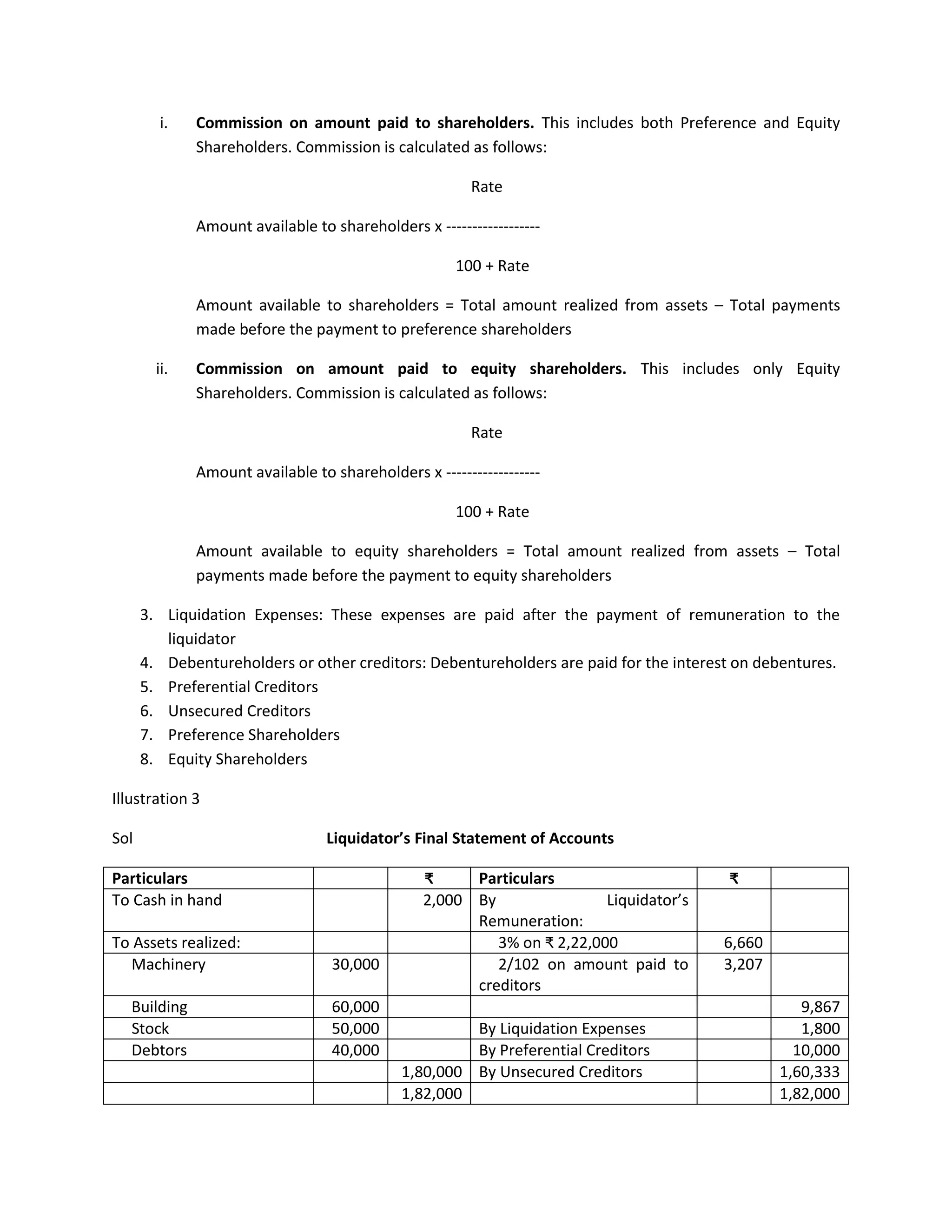
Illustration 3
Sol Liquidator’s Final Statement of Accounts
Particulars ₹ Particulars ₹
To Cash in hand 2,000 By Liquidator’s
Remuneration:
To Assets realized: 3% on ₹ 2,22,000 6,660
Machinery 30,000 2/102 on amount paid to
creditors
3,207
Building 60,000 9,867
Stock 50,000 By Liquidation Expenses 1,800
Debtors 40,000 By Preferential Creditors 10,000
1,80,000 By Unsecured Creditors 1,60,333
1,82,000 1,82,000
Working Notes:
1. Calculation of Liquidator’s remuneration based on unsecured creditors
₹
Total amount available 1,82,000
Less: Liquidator’s remuneration on assets realized 6,660
Liquidation expenses 1,800
Preferential Creditors 10,000
---------------------
Amount available for unsecured creditors 1,63,540
=============
Calculation of actual amount of Unsecured Creditors ₹
Balance of creditors secured on investments 20,000
(₹ 60,000 - ₹ 40,000)
Bank Overdraft 4,000
Bills Payable 2,000
Unsecured creditors 1,40,000
------------------
Total Unsecured Creditors 1,66,000
===========
Amount available for unsecured creditors i.e. ₹ 1,63,540 is less than the actual amount of unsecured
creditors. So, the liquidator’s remuneration will be
Rate
Liquidator’s remuneration = Amount available for unsecured creditors x -----------------
100 + Rate
2
= ₹ 1,63,540 x ----------- = ₹ 3,206.667 or ₹ 3,207
102
2. Further Payments: ₹
Amount available for unsecured creditors 1,63,540
Less: Liquidator’s remuneration on unsecured creditors 3,207
--------------
Amount paid to unsecured creditors 1,60,333
==========
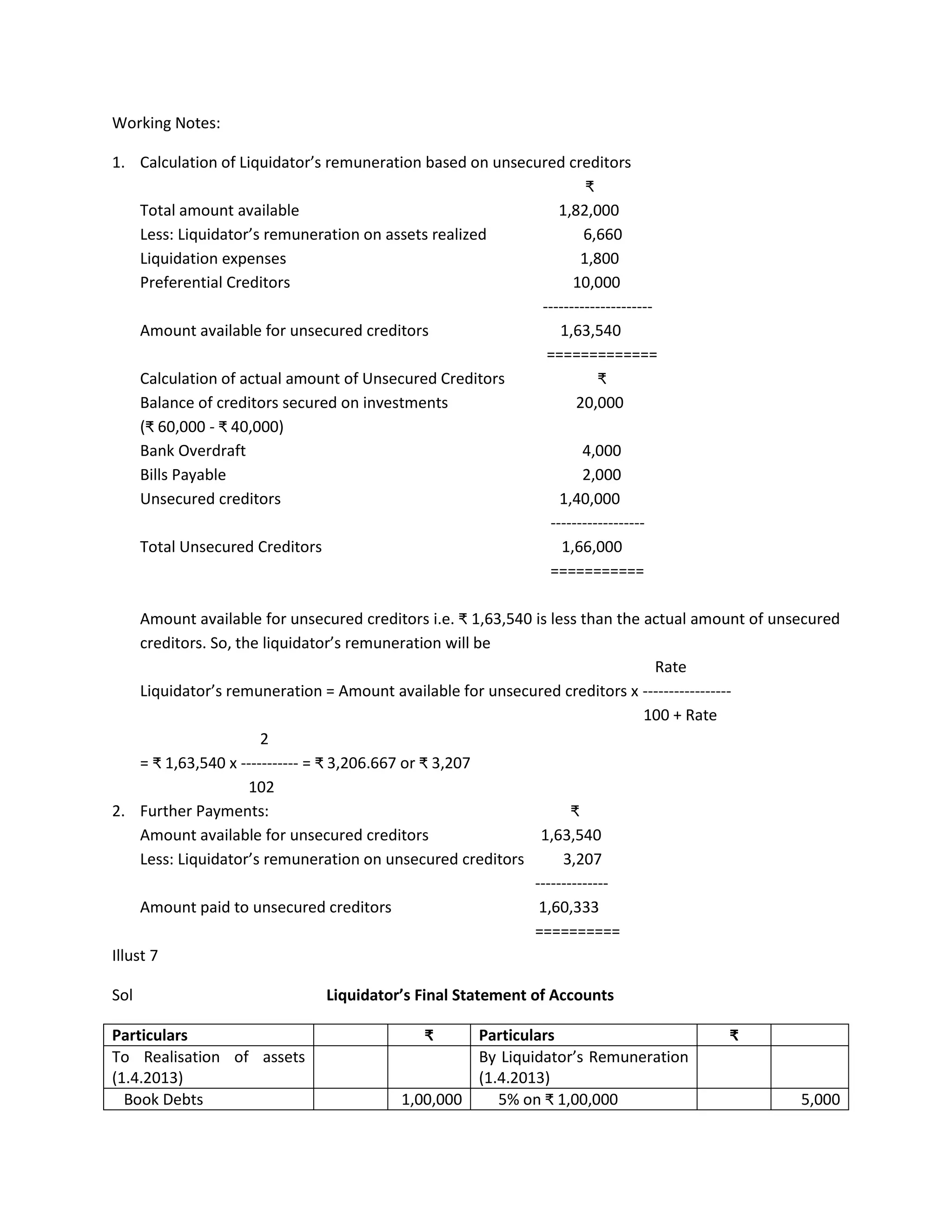
Illust 7
Sol Liquidator’s Final Statement of Accounts
Particulars ₹ Particulars ₹
To Realisation of assets
(1.4.2013)
By Liquidator’s Remuneration
(1.4.2013)
Book Debts 1,00,000 5% on ₹ 1,00,000 5,000
By Liquidation Expenses 4,000
By Loan to Bank (5:26) 14,677
By Trade Creditors 76,323
1,00,000 1,00,000
To Realisation of assets
(1.6.2013)
By Liquidator’s Remuneration
(1.6.2013)
Book Debts 1,00,000 5% on ₹ 1,00,000 5,000
To Surplus from Fixed
Assets (₹ 2,00,000 - ₹
35,323)
1,64,677 2/102 on ₹ 6,000 118
5,118
By Creditors 1,83,677
By Preference Share Capital 70,000
By Equity Share Capital 5,882
2,64,677 2,64,677
To Realisation of assets
(1.8.2013)
By Liquidator’s Remuneration
(1.8.2013)
Book Debts 50,000 5% on ₹ 50,000 2,500
2/102 on ₹ 47,500 931
3,431
By Return of Equity Share
Capital
46,569
50,000 50,000
Working Notes:
1. On 01.04.2013, after making the payment of liquidator’s remuneration and liquidation expenses,
the balance of ₹ 91,000 will be distributed between loan and trade creditors in the ratio 5:26.
2. On 01.06.2013 the amount available to the equity shareholders would be:
₹
Total amount available (₹ 1,00,000 + ₹ 1,64,677) 2,64,677
Less: Liquidator’s remuneration 5,000
Creditors (₹ 2,60,000 - ₹ 76,323) 1,83,677
Preference Share Capital 70,000
----------------------
6,000
=============
3. On 01.08.2013 the amount available to the equity shareholders would be:
₹
Total amount available 50,000
Less: Liquidator’s remuneration 5,000
----------------------
Amount available to equity shareholders 47,500
=============

LIQUIDATION OF COMPANIES.docx

  • 1.
    LIQUIDATION OF COMPANIES Liquidationor ‘winding up’ of the company is a legal tem and refers to the procedure through which the affairs of the company are wound up by law. Features of Liquidation 1. Any company, when found necessary, can be liquidated. 2. Liquidation of a company should be distinguished from the insolvency of a trader or of a firm. 3. When liquidation takes place, assets of the company are realized, capital is collected and out of the proceeds claims of creditors are settled if any surplus is left, it is returned to the shareholders of the company according to their rights. 4. The job of realizing various assets and paying various liabilities in a systematic manner is performed by a person called liquidator. Modes of Winding of the Company 1. Compulsory winding up by the court of law 2. Voluntary winding up by the creditors or members 3. Winding up under the supervision of court Compulsory Winding up The circumstances for compulsory winding up have been listed as follows: a. If by a special resolution, the company has resolved to be wound up by the court. b. If the default has been made by the company in delivering the statutory report to the registrar or in holding the statutory meeting. c. If the company suspends its business for more than a year or does not commence business within one year of its incorporation. d. If the number of members of the company are reduced to below seven members in case of the public company and below two in case of the private members. e. If according to the court of law, it is just and equitable that the company should be wound up. Voluntary Winding Up a. Voluntary winding up by the Members: At the general meeting of the company, a special resolution is passed which is called ‘resolution for voluntary winding up’. Then a liquidator is appointed and he prepares the accounts of winding up and calls the meeting of the members of the company. The liquidator presents the account of liquidation to the members. After one week of the meeting, the liquidator sends the copy of the accounts and the statement to the registrar of company. The registrar registers the accounts and the statement and after 3 months of this registration is company is fully wound up. b. Voluntary winding up by the Creditors: If in voluntary liquidation, the directors do not make the declaration of the solvency, then this winding up is called winding up by the creditors.
  • 2.
    c. Winding upunder the Supervision of the Court: Sec 522 of the Companies Act, 1956 calls for the voluntary winding up of the company under the supervision of the court. Such an order is passed by the court on the application of any creditor or contributory or liquidator or the company itself when the liquidator under voluntary winding up is prejudiced or is negligent in collecting the assets of the company or the resolution of winding up was obtained by fraud. The main purpose of this winding up is to protect the interest of the creditors and the shareholders of the company. Liquidator’s Final Statement of Accounts Liquidator’s Final Statement of Accounts Particulars ₹ Particulars ₹ To Cash in hand ** By Legal charges ** To Assets realised: ** By Liquidator’s Remuneration: ** Furniture ** % on assets realized ** Investments ** % on amount paid to creditors ** Stock ** % on amount paid to shareholders ** Debtors ** By Liquidation Expenses ** Land and Building ** By Debentureholders ** Plant & Machinery ** By Preferential Creditors ** To Surplus from secured creditors ** By Unsecured Creditors ** By Preference Shareholders ** By Equity Shareholders ** ** ** Order of Payments 1. Legal Charges: These are charges which is to paid first and it includes the expenses incurred on filing the suit for the recovery of amounts due to the company or in defending the claims filed against the company 2. Liquidators’ remuneration: a. Commission on amount realized from assets b. Commission on amount paid to Unsecured Creditors i. If the sufficient amount is available to pay the unsecured creditors in full, the amount of commission will be calculated as follows: Rate Amount of unsecured creditors x -------------- 100 ii. If the amount available is less than the amount of unsecured creditors Rate Amount available to unsecured creditors x ------------------ 100 + Rate Amount available to unsecured creditors = Total amount realized from assets – Total payments made before the payment to unsecured creditors c. Commission on amount paid to shareholders:
  • 3.
    i. Commission onamount paid to shareholders. This includes both Preference and Equity Shareholders. Commission is calculated as follows: Rate Amount available to shareholders x ------------------ 100 + Rate Amount available to shareholders = Total amount realized from assets – Total payments made before the payment to preference shareholders ii. Commission on amount paid to equity shareholders. This includes only Equity Shareholders. Commission is calculated as follows: Rate Amount available to shareholders x ------------------ 100 + Rate Amount available to equity shareholders = Total amount realized from assets – Total payments made before the payment to equity shareholders 3. Liquidation Expenses: These expenses are paid after the payment of remuneration to the liquidator 4. Debentureholders or other creditors: Debentureholders are paid for the interest on debentures. 5. Preferential Creditors 6. Unsecured Creditors 7. Preference Shareholders 8. Equity Shareholders Illustration 3 Sol Liquidator’s Final Statement of Accounts Particulars ₹ Particulars ₹ To Cash in hand 2,000 By Liquidator’s Remuneration: To Assets realized: 3% on ₹ 2,22,000 6,660 Machinery 30,000 2/102 on amount paid to creditors 3,207 Building 60,000 9,867 Stock 50,000 By Liquidation Expenses 1,800 Debtors 40,000 By Preferential Creditors 10,000 1,80,000 By Unsecured Creditors 1,60,333 1,82,000 1,82,000
  • 4.
    Working Notes: 1. Calculationof Liquidator’s remuneration based on unsecured creditors ₹ Total amount available 1,82,000 Less: Liquidator’s remuneration on assets realized 6,660 Liquidation expenses 1,800 Preferential Creditors 10,000 --------------------- Amount available for unsecured creditors 1,63,540 ============= Calculation of actual amount of Unsecured Creditors ₹ Balance of creditors secured on investments 20,000 (₹ 60,000 - ₹ 40,000) Bank Overdraft 4,000 Bills Payable 2,000 Unsecured creditors 1,40,000 ------------------ Total Unsecured Creditors 1,66,000 =========== Amount available for unsecured creditors i.e. ₹ 1,63,540 is less than the actual amount of unsecured creditors. So, the liquidator’s remuneration will be Rate Liquidator’s remuneration = Amount available for unsecured creditors x ----------------- 100 + Rate 2 = ₹ 1,63,540 x ----------- = ₹ 3,206.667 or ₹ 3,207 102 2. Further Payments: ₹ Amount available for unsecured creditors 1,63,540 Less: Liquidator’s remuneration on unsecured creditors 3,207 -------------- Amount paid to unsecured creditors 1,60,333 ========== Illust 7 Sol Liquidator’s Final Statement of Accounts Particulars ₹ Particulars ₹ To Realisation of assets (1.4.2013) By Liquidator’s Remuneration (1.4.2013) Book Debts 1,00,000 5% on ₹ 1,00,000 5,000
  • 5.
    By Liquidation Expenses4,000 By Loan to Bank (5:26) 14,677 By Trade Creditors 76,323 1,00,000 1,00,000 To Realisation of assets (1.6.2013) By Liquidator’s Remuneration (1.6.2013) Book Debts 1,00,000 5% on ₹ 1,00,000 5,000 To Surplus from Fixed Assets (₹ 2,00,000 - ₹ 35,323) 1,64,677 2/102 on ₹ 6,000 118 5,118 By Creditors 1,83,677 By Preference Share Capital 70,000 By Equity Share Capital 5,882 2,64,677 2,64,677 To Realisation of assets (1.8.2013) By Liquidator’s Remuneration (1.8.2013) Book Debts 50,000 5% on ₹ 50,000 2,500 2/102 on ₹ 47,500 931 3,431 By Return of Equity Share Capital 46,569 50,000 50,000 Working Notes: 1. On 01.04.2013, after making the payment of liquidator’s remuneration and liquidation expenses, the balance of ₹ 91,000 will be distributed between loan and trade creditors in the ratio 5:26. 2. On 01.06.2013 the amount available to the equity shareholders would be: ₹ Total amount available (₹ 1,00,000 + ₹ 1,64,677) 2,64,677 Less: Liquidator’s remuneration 5,000 Creditors (₹ 2,60,000 - ₹ 76,323) 1,83,677 Preference Share Capital 70,000 ---------------------- 6,000 ============= 3. On 01.08.2013 the amount available to the equity shareholders would be: ₹ Total amount available 50,000 Less: Liquidator’s remuneration 5,000 ---------------------- Amount available to equity shareholders 47,500
  • 6.