Indonesian Journal of Electrical Engineering and Computer Science
Vol. 21, No. 1, January 2021, pp. 538~545
ISSN: 2502-4752, DOI: 10.11591/ijeecs.v21.i1. pp538-545  538
Journal homepage: http://ijeecs.iaescore.com
Lion optimization algorithm for team orienteering problem
with time window
Esam Taha Yassen, Alaa Abdulkhar Jihad, Sudad H. Abed
Computer Center, University of Anbar, Al_Anbar, Iraq
Article Info ABSTRACT
Article history:
Received May 20, 2020
Revised Jul 22, 2020
Accepted Aug 2, 2020
Over the last decade, many nature-inspired algorithms have been received
considerable attention among practitioners and researchers to handle several
optimization problems. Lion optimization algorithm (LA) is inspired by a
distinctive lifestyle of lions and their collective behavior in their social
groups. LA has been presented as a powerful optimization algorithm to solve
various optimization problems. In this paper, the LA is proposed to
investigate its performance in solving one of the most popular and
widespread real-life optimization problems called team orienteering problem
with time windows (TOPTW). However, as any population-based
metaheuristic, the LA is very efficient in exploring the search space, but
inefficient in exploiting it. So, this paper proposes enhancing LA to tackle
the TOPTW by utilizing its strong ability to explore the search space and
improving its exploitation ability. This enhancement is achieved via
improving a process of territorial defense to generate a trespass strong
nomadic lion to prevail a pride by fighting its males. As a result of this
improving process, an enhanced LA (ILA) emerged. The obtained solutions
have been compared with the best known and standard results obtained in the
former studies. The conducted experimental test verifies the effectiveness of
the ILA in solving the TOPTW as it obtained a very competitive results
compared to the LA and the state-of-the-art methods across all tested
instances.
Keywords:
Lion optimization algorithm
Nature-inspired algorithms
Population-based metaheuristic
Team orienteering problem
This is an open access article under the CC BY-SA license.
Corresponding Author:
Esam Taha Yassen
Computer Center
University of Anbar
Al_Anbar, Iraq
Email: co.esamtaha@uoanbar.edu.iq
1. INTRODUCTION
It is often very difficult for tourists who plan to visit a place for few days to visit all the sites they
are fascinated with. Consequently, tourists need to determine what they consider to be the most valued
attractions. The task of making a practicable plan to visit the most exciting places within the limited available
time is surely difficult [1].
As described above, the problem was first introduced as the Orienteering Problem (OP) by
Tsiligrides [2] (also, the problem is sometimes named as the Selective Traveling Salesman Problem, see
Laporte and Martello [3]). Orienteering is a sport in which a player (competitor) has to select a path from a
starting point (all competitors start out form the same point) to a final destination, going through control
points alongside the path. A score is associated with every control point. A travel cost is associated with each
pair of control points. The competitor has to select a group of control points to visit; hence the overall score
is maximized, while the total travel cost does not exceed a given threshold [4].
Indonesian J Elec Eng & Comp Sci ISSN: 2502-4752 
Lion optimization algorithm for team orienteering problem with time window (Esam Taha Yassen)
539
The Team Orienteering Problem (TOP) describes as a generalization of the OP in which the
competitors are organized in teams [5]. The TOP is known as a model of numerous real life applications, like
the multi-vehicle version of the home fuel delivery problem [6, 7], selecting college football players [8], the
sport game of team orienteering [9], several applications related to pick up and delivery services including
public carriers and private fleets [10], and the routing technicians scheduling service [11].
Several variants of the TOP exist, and of them is the one that considers Time Window constraints
(TOPTW). These constraints are inspired by several practical conditions and usually appear in routing
problems in which every location must be visited within a previously identified time interval (the earliest and
the latest time) at which the service should begin [5]. A list of places (points) is assigned in the TOPTW and
every place is given a score, a service time and a time window (open and close). The aim is to maximize the
total number of gained scores by with fixed number. These routes should be with a limited length and should
also permit visiting locations at the precise time allocating a group of routes [5].
For TOPTW, an Ant Colony System is suggested by Montemanni and Gambardella [5]. Further
improve Ant Colony System is proposed by Montemanni et. al. [4]. The algorithm includes two extra operations
to enhance the ability of Ant Colony System. These operations focus on utilizing the best obtained solutions
during the construction phase and applying the local search procedure on those solutions [4]. Two different
versions of Simulated Annealing are introduced by Lin and Yu [12]; FastSA and SlowSA. FastSA is mainly
applied when the quick responses are needed, while SlowSA is concerned about the solutions’ qualities in
exchange for more computational time [12]. The hybridization of the Greedy Randomized Adaptive Search
Procedure (GRASP) and Evolutionary Local Search is proposed by Labadie et al [13] for the TOPTW. Hu and
Lim [14] introduced a hybrid algorithm based on local search, Simulated Annealing and Route Combination.
Within a particular number of iterations, this hybridization is iteratively incorporated those three components
[14]. Cura [15] proposes hybridization based on an Artificial Bee Colony and simulated annealing in order to
improve the TOPTW solution quality [15]. In order to achieve the balance between diversification and
intensification, Gunawan et. al. [16] suggest an Iterated Local Search based on swap, 2-opt, insert and replace
neighborhood structures. Additionally, they implemented the combination between acceptance criterion and
perturbation mechanisms. A hybridization between Simulated Annealing and Iterated Local Search is proposed
by Gunawan et. al. [17, 18] to solve the TOPTW. A hybrid artificial bee colony algorithm is introduced by Yu
et. al. [19] to obtain an optimal solutions for small instances and near-optimal solutions for larger instances.
Based on the above and to the best knowledge of the researchers, the need to utilize a new algorithm is
still necessary. Lion Optimization Algorithm (LA) which is inspired by special lifestyle of lions and their
collective behavior in their social groups [20]. LA has been presented as a powerful optimization algorithm to
solve various optimization problems. This stimulates the current study to propose LA for solving the TOPTW.
2. LION ALGORITHM
Natural computation is an effective computing area that aims at developing search, optimization and
machine learning algorithms by analyzing natural phenomena and model it to problem solving conditions
[21]. Lion’s algorithm is proposed based on the lions’ social behavior, which is to be the strongest in every
generation. LA searches an optimal solution based on two unique lions’ behaviors, namely territorial defense
and territorial takeover. Territorial defense happens between the occupant males and wandering males while
the territorial takeover happens between the old resident male and new mature resident male [20, 22].
Definition 1: A Lion represents a solution to be identified, while the cubs are solutions produced from
current solutions [20].
Definition 2: Territorial Defense is meant to be the procedure of assessing the current solution (territorial
lion) and produced solution (nomadic lion). More specifically; the current solution is replaced by the new
solution whenever the new solution sounds better than the current one. Hence, all the obtained solutions of
old solution are vanished [20].
Definition 3: Territorial Takeover is defined as the act of retaining the best derived male and female
solutions. These solutions are rather more efficient than new solutions. Thus, current solutions are vanished
in the pride [20].
Algirithm 1. Lion Algorithm [20]
Step 1: Pride Generation
Step 1.1: Generate territorial male and female subject to solution constraints
Step 2: Mating
Step 2.1: Crossover
Step 2.2: Mutation
Step 2.3: Gender grouping
Step 2.4: Kill sick/ weak cubs
Step 2.5: Update Pride
 ISSN: 2502-4752
Indonesian J Elec Eng & Comp Sci, Vol. 21, No. 1, January 2021 : 538 - 545
540
Step 3: Territorial Defense
Step 3.1: Keep the record of cubs’ age
Step 3.2: Do
Step 3.2.1: Generate and Trespass Nomadic lion
Until stronger Nomadic lion trespasses
Until Cubs get matured
Step 4: Territorial Takeover
Step 4.1: Selection of best lion and lionesses
Step 4.2: Go to Step 2 until termination criteria is met
LA can be commonly classified into four major steps on the basis of the nature of the functions they
perform. These steps are, (i) Pride Generation, which is in charge of producing solutions, (ii) Mating, which
denotes the process of generating new solutions, (iii) Territorial Defense and (iv) Territorial Takeover, which
both aim to substitute the new most excellent quality solution with the identified poorest quality solution.
This process keeps iterating to allow heuristic search meeting the nearer solution to the preferable one [20].
Definition 4: A constantly altering solution pool and as well as altering size is representing pride. It starts
with a couple of random solutions, one of these solutions refers to the male while the other one refers to the
female. In that pool, the action of updating the generated solutions and the vanishing of undesirable ones take
place [20].
Definition 5: Mating refers to the process of generating the new finest solutions from the existing solutions
that involve crossover and mutation for generating new solutions, gathering genders that help to discover
divergence within the solutions. Assuring that the newly generated solutions are the best by eliminating sick/
weak cubs [20].
The LA’s search procedure primarily concentrates on detecting the best solutions, which solve the objective
function i.e. minimize or maximize the objective function.
Definition 6: Gender grouping is the action that splits the obtained solution pool into a pair of collections,
where there is a collection that includes the male cubs and the other includes the females [20].
3. IMPROVED LION ALGORITHM
Despite the positive characteristics of LA and its successful application to address various problems,
it still suffers from slow convergence problem when addressing constraint problems especially TOPTW. As
any population-based metaheuristic [23-25], this problem is attributed to the fact that LA is effective in
exploring the search space but ineffective in exploiting it. In order to improve this issue, an Improved Lion
Algorithm (ILA) is proposed. In ILA, a territorial defense (algorithm 1, step 3) is improved through replacing
the traditional process of generate and trespass nomadic lion with a new one. More precisely, instead of
randomly generate a nomadic lion; a new process aims to introduce a strong nomadic lion to take over a pride
by fighting its males. This aim is achieved via utilizing different criteria during the search to select which
solution is the best to handle the pride. According to TOPTW, four criteria have a significant effect on the
performance of the generated solution; closing time window (C_time), opening time window (O_time), profit
of the location (Prof) and distance between two vertexes (Dist). As a result of these criteria, five generating
heuristics are emerged to select the most appropriate one which is adopted to generate the strong nomadic
lion. These heuristics are: Heu1, Heu2, Heu3, Heu4 and Heu5. The generation process is the same for all
heuristics, only the adopting criteria change from one heuristic to another.
a) Heu1: This generating heuristic deals with two criteria out of four which are the closing time window
C_time and distance Dist. In this method, the goal is to search for a location with the nearest distance
Dist and close time C_time to be adopted in the generated solution.
b) Heu2: In this method three criteria have been taking into consideration. Those three criteria are open
time window O_time, close time window C_time and distance Dist. this method tries to select a location
with the largest open time window O_time and the nearest distance Dist and close time C_time.
c) Heu3: This method deals with three criteria which are Prof, C_time, and Dist. This method tries to
select a location based on a threshold number that can be obtained by the multiply the Dist by the result
of dividing the Prof on C_time.
d) Heu4: This method deals with two criteria which are Prof and Dist. trying to find a threshold number
by dividing the Prof by Dist to decide whether to select a location or not.
e) Heu5: This method deals with only two criteria which are the Prof and Dist. In this method, the aim is
to select a location with the largest profit and nearest distance.
The following algorithm illustrates the process of generating a nomadic lion (Solution) (Algorithm 2).
Indonesian J Elec Eng & Comp Sci ISSN: 2502-4752 
Lion optimization algorithm for team orienteering problem with time window (Esam Taha Yassen)
541
Algoritm 2. Generating a nomadic lion
Repate
for each player (i)
select_vertex = null
thresholdselect_vertex = 0
for each unvisited Vertex (uver)
get the criteria values (C_timeuver, O_timeuver, Distuver, Profuver)
Normalize these values
calculate the thresholduver according to the selected heuristic (Heu1,
Heu2, Heu3, Heu4 and Heu5)
randomly generate ratio number
if ratio < thresholduver and thresholduver better than
thresholdselect_vertex
select_vertex = uver
Add this select_vertex to the path of playeri :
Path=Path ∪ select_vertex
Until no vertex can be visited
Return Solution
4. EXPERIMENTAL SETUP
The proposed algorithms (LA and ILA) are programmed and executed with C# which was running
on a PC equipped with windows7, Intel processor core i7 CPU 2.10GHz, RAM 8.00GB. In this work, the
appropriate values for the parameters of the proposed algorithms are determined based on a preliminary test
or as suggested by previous studies. The proposed algorithms, during the preliminary test, are executed 10
runs on some instances. Finally, the parameter settings that have been adopted in this work are summarized
in Table 1.
Table 1. The parameter settings
Parameter Value
gen_max 300
k 2
Agemat 5
4.1. The toptw benchmark
In order to evaluate the performance of LA and ILA, a larger benchmark is adopted. This
benchmark is provided by Vansteenwegen et. al. [1] based on Solomon’s and Cordeau et al.’s benchmarks;
the instances of these benchmarks can be publicly found at (https://www.mech.kuleuven.be/en/cib/op). It
should be taken into consideration that the benchmarks used in this work contain instances with different
situations related to nodes’ positions, scores, service times and the density of time windows. Those
benchmarks were designed for the Vehicle Routing Problem with Time Windows (VRPTW) and the Multi
Depot Periodic VRPTW respectively. Hence, these benchmarks are very realistic. Additionally, these
benchmarks have been adopted by most studies to evaluate the effectiveness of their heuristics [26].
The Solomon’s benchmark involves 56 instances each of them has 100 nodes. According to the
distribution of nodes, the Solomon’s instances are categorized into three classes (R, C and RC). Class C
contains clustered nodes in which the distances between nodes are short. Class R contains randomly
distributed customers in which the distances between nodes are comparatively longer than class C. Class RC
contains mixed distribution nodes (clustered and randomized). The Cordeau et al.’s benchmark involves 20
instances each of them has different number of nodes; varying from 48 to 288 nodes (pr01–pr20) [1].
4.2. Results and discussion
In order to investigate the performance of the LA and ILA for TOPTW, we conduct three sets of
experiments. In the first experiments, the efficiency of LA in solving VRPTW is evaluated. In the second
experimental test, the effect of the process that generates a nomadic lion on the LA’s performance is
analyzed. Finally, the results of ILA are compared with those of standard LA. The proposed algorithms were
executed for 11 independent runs. Then, the best (Max), average (Avr) and minimum (Min) are reported. The
proposed algorithms are tested on Solomon’s and Cordeau et al.’s benchmarks.
4.2.1. The Standard LA results
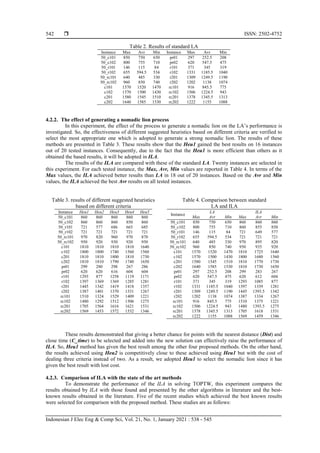
In this experiment, the effectiveness of LA in solving the TOPTW is investigated. Table 2 presents
the Max, Avr and Min for LA over 11 runs.
 ISSN: 2502-4752
Indonesian J Elec Eng & Comp Sci, Vol. 21, No. 1, January 2021 : 538 - 545
542
Table 2. Results of standard LA
Instance Max Avr Min Instance Max Avr Min
50_c101 850 750 650 pr01 297 252.5 208
50_c102 800 755 710 pr02 620 547.5 475
50_r101 146 115 84 r101 371 345 319
50_r102 655 594.5 534 r102 1331 1185.5 1040
50_rc101 640 485 330 r201 1309 1249.5 1190
50_rc102 960 850 740 r202 1202 1138 1074
c101 1570 1520 1470 rc101 916 845.5 775
c102 1570 1500 1430 rc102 1506 1224.5 943
c201 1580 1545 1510 rc201 1378 1345.5 1313
c202 1640 1585 1530 rc202 1222 1155 1088
4.2.2. The effect of generating a nomadic lion process
In this experiment, the effect of the process to generate a nomadic lion on the LA’s performance is
investigated. So, the effectiveness of different suggested heuristics based on different criteria are verified to
select the most appropriate one which is adopted to generate a strong nomadic lion. The results of these
methods are presented in Table 3. These results show that the Heu1 gained the best results on 16 instances
out of 20 tested instances. Consequently, due to the fact that the Heu1 is more efficient than others as it
obtained the based results, it will be adopted in ILA.
The results of the ILA are compared with these of the standard LA. Twenty instances are selected in
this experiment. For each tested instance, the Max, Avr, Min values are reported in Table 4. In terms of the
Max values, the ILA achieved better results than LA in 18 out of 20 instances. Based on the Avr and Min
values, the ILA achieved the best Avr results on all tested instances.
Table 3. results of different suggested heuristics
based on different criteria
Instance Heu1 Heu2 Heu3 Heu4 Heu5
50_c101 860 860 860 860 860
50_c102 860 860 860 850 860
50_r101 721 577 686 665 685
50_r102 721 721 721 721 721
50_rc101 970 820 960 970 870
50_rc102 950 920 930 920 950
c101 1810 1810 1810 1810 1640
c102 1800 1800 1740 1560 1560
c201 1810 1810 1800 1810 1730
c202 1810 1810 1790 1740 1650
pr01 299 280 298 267 286
pr02 620 620 616 604 604
r101 1293 877 1258 1119 1171
r102 1397 1369 1369 1285 1281
r201 1445 1342 1419 1418 1357
r202 1387 1401 1370 1331 1267
rc101 1510 1324 1529 1409 1221
rc102 1480 1292 1512 1506 1275
rc201 1705 1564 1616 1621 1531
rc202 1569 1453 1572 1532 1346
Table 4. Comparison between standard
LA and ILA
Instance
LA ILA
Max Avr Min Max Avr Min
50_c101 850 750 650 860 860 860
50_c102 800 755 710 860 855 850
50_r101 146 115 84 721 649 577
50_r102 655 594.5 534 721 721 721
50_rc101 640 485 330 970 895 820
50_rc102 960 850 740 950 935 920
c101 1570 1520 1470 1810 1725 1640
c102 1570 1500 1430 1800 1680 1560
c201 1580 1545 1510 1810 1770 1730
c202 1640 1585 1530 1810 1730 1650
pr01 297 252.5 208 299 283 267
pr02 620 547.5 475 620 612 604
r101 371 345 319 1293 1085 877
r102 1331 1185.5 1040 1397 1339 1281
r201 1309 1249.5 1190 1445 1393.5 1342
r202 1202 1138 1074 1387 1334 1267
rc101 916 845.5 775 1510 1375 1221
rc102 1506 1224.5 943 1480 1393.5 1275
rc201 1378 1345.5 1313 1705 1618 1531
rc202 1222 1155 1088 1569 1459 1346
These results demonstrated that giving a better chance for points with the nearest distance (Dist) and
close time (C_time) to be selected and added into the new solution can effectively raise the performance of
ILA. So, Heu1 method has given the best result among the other four proposed methods. On the other hand,
the results achieved using Heu2 is competitively close to these achieved using Heu1 but with the cost of
dealing three criteria instead of two. As a result, we adopted Heu1 to select the nomadic lion since it has
given the best result with lost cost.
4.2.3. Comparison of ILA with the state of the art methods
To demonstrate the performance of the ILA in solving TOPTW, this experiment compares the
results obtained by ILA with those found and presented by the other algorithms in literature and the best-
known results obtained in the literature. Five of the recent studies which achieved the best known results
were selected for comparison with the proposed method. These studies are as follows:
Indonesian J Elec Eng & Comp Sci ISSN: 2502-4752 
Lion optimization algorithm for team orienteering problem with time window (Esam Taha Yassen)
543
a) I3CH: iterative three-component heuristic [27].
b) GVNS: granular variable neighborhood search based on linear programming [28].
c) SSA: slow version of the simulated annealing heuristic [29].
d) ABC: artificial bee colony algorithm [30].
e) ILS: iterated local search algorithm [31].
In terms of Max, Table 5 reveals that ILA has attained competitive results over all instances and better
results in some others. Finally, the obtained results have shown that the ILA outperformed the standard LA.
Table 5. Comparison among different heuristics
Instance I3CH GVNS SSA ABC ILS ILA
50_c101 - - - - - 860
50_c102 - - - - - 860
50_r101 - - - - - 721
50_r102 - - - - - 721
50_rc101 - - - - - 970
50_rc102 - - - - - 950
c101 1810 1754 1770 1786 1720 1810
c102 1810 1794 1810 1810 1790 1800
c201 1810 1810 1810 1810 1810 1810
c202 1810 1810 1810 1810 1810 1810
pr01 - - - - 608 299
pr02 - - - - 1180 620
r101 1458 1432.2 1455 1457.4 1441 1293
r102 1458 1441.2 1458 1455.4 1450 1397
r201 1458 1458 1458 1458 1458 1445
r202 1458 1450.2 1458 1458 1443 1387
rc101 1724 1690.2 1712 1713.6 1686 1510
rc102 1724 1685 1718 1705.2 1659 1480
rc201 1724 1724 1724 1451.2 1724 1705
rc202 1719 1702.8 1714 1724 1686 1569
“−” indicates that the results have not been reported.
5. CONCLUSION
In this paper, the LA was adopted to tackle the TOPTW. Through analyzing the LA results, it was
observed that it succeeded in tackling the TOPTW via improving the pride quality. But, the ability of LA is
gradually decreased. This is due to the fact that LA suffers from slow convergence which prevents it from
improving the quality of obtained solutions. This problem often occurred because of the LA is satisfying at
exploring the search space but not at exploiting it. In order to enhance the exploitation ability of LA, a new
process for generating a trespassing nomadic lion was introduced and resulted in the improved LA denoted as
(ILA). Instead of randomly generating a nomadic lion, this process works to generate a strong nomadic lion
to take over a pride by fighting its males. The obtained results have shown that the performance of ILA is
much better than the standard LA due to the fact that generating a strong nomadic lion can assist the
exploitation ability of ILA. Thus, this work concludes that the proposed ILA successes in addressing the
TOPTW, and it can be applied to solve other combinatorial optimization problems.
REFERENCES
[1] P. Vansteenwegen, W. Souffriau, and D. Van Oudheusden, "The orienteering problem: A survey," European
Journal of Operational Research, vol. 209, no. 1, pp. 1-10, 2011.
[2] T. Tsiligirides, "Heuristic methods applied to orienteering," Journal of the Operational Research Society, vol. 35,
no. 9, pp. 797-809, 1984.
[3] G. Laporte and S. Martello, "The selective travelling salesman problem," Discrete applied mathematics, vol. 26,
no. 2-3, pp. 193-207, 1990.
[4] R. Montemanni, D. Weyland, and L. Gambardella, "An enhanced ant colony system for the team orienteering
problem with time windows," 2011 International Symposium on Computer Science and Society, pp. 381-384, 2011.
[5] R. Montemanni and L. M. Gambardella, "An ant colony system for team orienteering problems with time
windows," Foundation Of Computing And Decision Sciences, vol. 34, no. 4, pp. 287-306, 2009.
[6] B. L. Golden, L. Levy, and R. Vohra, "The orienteering problem," Naval Research Logistics (NRL), vol. 34, no. 3,
pp. 307-318, 1987.
[7] B. L. Golden, Q. Wang, and L. Liu, "A multifaceted heuristic for the orienteering problem," Naval Research
Logistics (NRL), vol. 35, no. 3, pp. 359-366, 1988.
 ISSN: 2502-4752
Indonesian J Elec Eng & Comp Sci, Vol. 21, No. 1, January 2021 : 538 - 545
544
[8] S. Butt and D. Ryan, "A heuristic for the multiple path maximum collection problem," Computers and Operations
Research, vol. 26, pp. 427-441, 1999.
[9] I.-M. Chao, B. L. Golden, and E. A. Wasil, "The team orienteering problem," European journal of operational
research, vol. 88, no. 3, pp. 464-474, 1996.
[10] R. W. Hall and M. Racer, "Transportation with common carrier and private fleets: system assignment and shipment
frequency optimization," IIE transactions, vol. 27, no. 2, pp. 217-225, 1995.
[11] H. Tang and E. Miller-Hooks, "A tabu search heuristic for the team orienteering problem," Computers &
Operations Research, vol. 32, no. 6, pp. 1379-1407, 2005.
[12] S.-W. Lin and F. Y. Vincent, "A simulated annealing heuristic for the team orienteering problem with time
windows," European Journal of Operational Research, vol. 217, no. 1, pp. 94-107, 2012.
[13] N. Labadie, J. Melechovský, and R. W. Calvo, "Hybridized evolutionary local search algorithm for the team
orienteering problem with time windows," Journal of Heuristics, vol. 17, no. 6, pp. 729-753, 2011.
[14] Q. Hu and A. Lim, "An iterative three-component heuristic for the team orienteering problem with time windows,"
European Journal of Operational Research, vol. 232, no. 2, pp. 276-286, 2014.
[15] T. Cura, "An artificial bee colony algorithm approach for the team orienteering problem with time windows,"
Computers & Industrial Engineering, vol. 74, pp. 270-290, 2014.
[16] A. Gunawan, H. C. Lau, and K. Lu, "An iterated local search algorithm for solving the orienteering problem with
time windows," European conference on evolutionary computation in combinatorial optimization, pp. 61-73, 2015.
[17] A. Gunawan, et al, "SAILS: hybrid algorithm for the team orienteering problem with time windows," MISTA 2015:
Proceedings of the 7th Multidisciplinary International Scheduling Conference, pp. 276-295, 2015.
[18] A. Gunawan, H. C. Lau, P. Vansteenwegen, and K. Lu, "Well-tuned algorithms for the team orienteering problem
with time windows," Journal of the Operational Research Society, vol. 68, no. 8, pp. 861-876, 2017.
[19] F. Y. Vincent, P. Jewpanya, S.-W. Lin, and A. P. Redi, "Team orienteering problem with time windows and time-
dependent scores," Computers & Industrial Engineering, vol. 127, pp. 213-224, 2019.
[20] B. Rajakumar, "The Lion's Algorithm: a new nature-inspired search algorithm," Procedia Technology, vol. 6,
pp. 126-135, 2012.
[21] J. Liu and K. C. Tsui, "Toward nature-inspired computing," Communications of the ACM, vol. 49, no. 10,
pp. 59-64, 2006.
[22] M. Yazdani and F. Jolai, "Lion optimization algorithm (LOA): a nature-inspired metaheuristic algorithm," Journal
of computational design and engineering, vol. 3, no. 1, pp. 24-36, 2016.
[23] Harikishore, S., & Sumalatha, V., "Ant colony optimization based energy efficiency for improving opportunistic
routing in multimedia wireless mesh network," Indonesian Journal of Electrical Engineering and Computer
Science, vol. 16, no. 3, pp. 1371-1378, 2019.
[24] Rasheed, M., Omar, R., Sulaiman, M., & Halim, W. A., "Particle swarm optimisation (PSO) algorithm with
reduced numberof switches in multilevel inverter (MLI)," Indonesian Journal of Electrical Engineering and
Computer Science, vol. 14, no. 3, pp. 1114-1124, 2019.
[25] Alhamdani, I. M., & Ibrahim, Y. I., "Swarm intelligent hyperdization biometric," Indonesian Journal of Electrical
Engineering and Computer Science, vol. 18, no. 1, pp. 385-395, 2020.
[26] E. T. Yassen, M. Ayob, M. Z. Ahmad Nazri, and N. R. Sabar, "A hybrid meta-heuristic algorithm for vehicle
routing problem with time windows," International Journal on Artificial Intelligence Tools, vol. 24, no. 6,
pp. 1550021, 2015.
[27] H. Qian and L. Andrew, “An iterative three-component heuristic for the team orienteering problem with time
windows,” European Journal of Operational Research, vol. 232, pp. 276–286, 2014.
[28] N. Labadie, et al., “The team orienteering problem with time windows: An lp-based granular variable neighborhood
search,” European Journal of Operational Research, vol. 220, no. 1, pp. 15–27, 2012.
[29] S.-W. Lin and V. F. Yu, “A simulated annealing heuristic for the team orienteering problem with time windows,”
European Journal of Operational Research, vol. 217, no. 1, pp. 94–107, 2012.
[30] T. Cura, “An artificial bee colony algorithm approach for the team orienteering problem with time windows,”
Computers & Industrial Engineering, vol. 74, pp. 270–290, 2014.
[31] P. Vansteenwegen, et al, “Iterated local search for the team orienteering problem with time windows,” Computers
& Operations Research, vol. 36, no. 12, pp. 3281–3290, 2009.
BIOGRAPHIES OF AUTHORS
Esam Taha Yassen is a lecturer in the college of Computer and Information Technology at the
University of Anbar, Iraq since 2002. He has obtained his PhD in Computer Science at The
University Kebangsaan Malaysia (UKM) in 2015. His main research areas include meta-
heuristics, hyper-heuristics and combinatorial Optimization problems especially, routing and
scheduling. He has been served as a programme committee for four international conferences
and reviewers for high impact journals. e is a researcher in ata ining and ptimi ation
esearch roup , entre for Artificial Intelligent AIT , U . urrentl , he is the
manager of omputers entre in Universit of An ar.
Indonesian J Elec Eng & Comp Sci ISSN: 2502-4752 
Lion optimization algorithm for team orienteering problem with time window (Esam Taha Yassen)
545
Alaa Abdalqahar Jihad was born in Anbar-Iraq in 1985. He received his B.Sc. from Faculty of
Computer Science at Anbar University, Iraq in 2009. The MSc. degree Faculty of Computer
Science at Anbar University, Iraq 2012. His research interests are, Data Warehouse, Data
Mining, Artificial Intelligent, Machine Learning and Natural Language Processing.
Sudad H. Abed is a full-time instructor in the University of Anbar. He received his master
degree in computer science from Ball State University in 2016. His research area of interest is
machine learning, neural networks, deep learning, and data analytics. He has a solid experience
in web application development and currently servers as the director of the software
development department in the University of Anbar.

Lion optimization algorithm for team orienteering problem with time window

  • 1.
    Indonesian Journal ofElectrical Engineering and Computer Science Vol. 21, No. 1, January 2021, pp. 538~545 ISSN: 2502-4752, DOI: 10.11591/ijeecs.v21.i1. pp538-545  538 Journal homepage: http://ijeecs.iaescore.com Lion optimization algorithm for team orienteering problem with time window Esam Taha Yassen, Alaa Abdulkhar Jihad, Sudad H. Abed Computer Center, University of Anbar, Al_Anbar, Iraq Article Info ABSTRACT Article history: Received May 20, 2020 Revised Jul 22, 2020 Accepted Aug 2, 2020 Over the last decade, many nature-inspired algorithms have been received considerable attention among practitioners and researchers to handle several optimization problems. Lion optimization algorithm (LA) is inspired by a distinctive lifestyle of lions and their collective behavior in their social groups. LA has been presented as a powerful optimization algorithm to solve various optimization problems. In this paper, the LA is proposed to investigate its performance in solving one of the most popular and widespread real-life optimization problems called team orienteering problem with time windows (TOPTW). However, as any population-based metaheuristic, the LA is very efficient in exploring the search space, but inefficient in exploiting it. So, this paper proposes enhancing LA to tackle the TOPTW by utilizing its strong ability to explore the search space and improving its exploitation ability. This enhancement is achieved via improving a process of territorial defense to generate a trespass strong nomadic lion to prevail a pride by fighting its males. As a result of this improving process, an enhanced LA (ILA) emerged. The obtained solutions have been compared with the best known and standard results obtained in the former studies. The conducted experimental test verifies the effectiveness of the ILA in solving the TOPTW as it obtained a very competitive results compared to the LA and the state-of-the-art methods across all tested instances. Keywords: Lion optimization algorithm Nature-inspired algorithms Population-based metaheuristic Team orienteering problem This is an open access article under the CC BY-SA license. Corresponding Author: Esam Taha Yassen Computer Center University of Anbar Al_Anbar, Iraq Email: co.esamtaha@uoanbar.edu.iq 1. INTRODUCTION It is often very difficult for tourists who plan to visit a place for few days to visit all the sites they are fascinated with. Consequently, tourists need to determine what they consider to be the most valued attractions. The task of making a practicable plan to visit the most exciting places within the limited available time is surely difficult [1]. As described above, the problem was first introduced as the Orienteering Problem (OP) by Tsiligrides [2] (also, the problem is sometimes named as the Selective Traveling Salesman Problem, see Laporte and Martello [3]). Orienteering is a sport in which a player (competitor) has to select a path from a starting point (all competitors start out form the same point) to a final destination, going through control points alongside the path. A score is associated with every control point. A travel cost is associated with each pair of control points. The competitor has to select a group of control points to visit; hence the overall score is maximized, while the total travel cost does not exceed a given threshold [4].
  • 2.
    Indonesian J ElecEng & Comp Sci ISSN: 2502-4752  Lion optimization algorithm for team orienteering problem with time window (Esam Taha Yassen) 539 The Team Orienteering Problem (TOP) describes as a generalization of the OP in which the competitors are organized in teams [5]. The TOP is known as a model of numerous real life applications, like the multi-vehicle version of the home fuel delivery problem [6, 7], selecting college football players [8], the sport game of team orienteering [9], several applications related to pick up and delivery services including public carriers and private fleets [10], and the routing technicians scheduling service [11]. Several variants of the TOP exist, and of them is the one that considers Time Window constraints (TOPTW). These constraints are inspired by several practical conditions and usually appear in routing problems in which every location must be visited within a previously identified time interval (the earliest and the latest time) at which the service should begin [5]. A list of places (points) is assigned in the TOPTW and every place is given a score, a service time and a time window (open and close). The aim is to maximize the total number of gained scores by with fixed number. These routes should be with a limited length and should also permit visiting locations at the precise time allocating a group of routes [5]. For TOPTW, an Ant Colony System is suggested by Montemanni and Gambardella [5]. Further improve Ant Colony System is proposed by Montemanni et. al. [4]. The algorithm includes two extra operations to enhance the ability of Ant Colony System. These operations focus on utilizing the best obtained solutions during the construction phase and applying the local search procedure on those solutions [4]. Two different versions of Simulated Annealing are introduced by Lin and Yu [12]; FastSA and SlowSA. FastSA is mainly applied when the quick responses are needed, while SlowSA is concerned about the solutions’ qualities in exchange for more computational time [12]. The hybridization of the Greedy Randomized Adaptive Search Procedure (GRASP) and Evolutionary Local Search is proposed by Labadie et al [13] for the TOPTW. Hu and Lim [14] introduced a hybrid algorithm based on local search, Simulated Annealing and Route Combination. Within a particular number of iterations, this hybridization is iteratively incorporated those three components [14]. Cura [15] proposes hybridization based on an Artificial Bee Colony and simulated annealing in order to improve the TOPTW solution quality [15]. In order to achieve the balance between diversification and intensification, Gunawan et. al. [16] suggest an Iterated Local Search based on swap, 2-opt, insert and replace neighborhood structures. Additionally, they implemented the combination between acceptance criterion and perturbation mechanisms. A hybridization between Simulated Annealing and Iterated Local Search is proposed by Gunawan et. al. [17, 18] to solve the TOPTW. A hybrid artificial bee colony algorithm is introduced by Yu et. al. [19] to obtain an optimal solutions for small instances and near-optimal solutions for larger instances. Based on the above and to the best knowledge of the researchers, the need to utilize a new algorithm is still necessary. Lion Optimization Algorithm (LA) which is inspired by special lifestyle of lions and their collective behavior in their social groups [20]. LA has been presented as a powerful optimization algorithm to solve various optimization problems. This stimulates the current study to propose LA for solving the TOPTW. 2. LION ALGORITHM Natural computation is an effective computing area that aims at developing search, optimization and machine learning algorithms by analyzing natural phenomena and model it to problem solving conditions [21]. Lion’s algorithm is proposed based on the lions’ social behavior, which is to be the strongest in every generation. LA searches an optimal solution based on two unique lions’ behaviors, namely territorial defense and territorial takeover. Territorial defense happens between the occupant males and wandering males while the territorial takeover happens between the old resident male and new mature resident male [20, 22]. Definition 1: A Lion represents a solution to be identified, while the cubs are solutions produced from current solutions [20]. Definition 2: Territorial Defense is meant to be the procedure of assessing the current solution (territorial lion) and produced solution (nomadic lion). More specifically; the current solution is replaced by the new solution whenever the new solution sounds better than the current one. Hence, all the obtained solutions of old solution are vanished [20]. Definition 3: Territorial Takeover is defined as the act of retaining the best derived male and female solutions. These solutions are rather more efficient than new solutions. Thus, current solutions are vanished in the pride [20]. Algirithm 1. Lion Algorithm [20] Step 1: Pride Generation Step 1.1: Generate territorial male and female subject to solution constraints Step 2: Mating Step 2.1: Crossover Step 2.2: Mutation Step 2.3: Gender grouping Step 2.4: Kill sick/ weak cubs Step 2.5: Update Pride
  • 3.
     ISSN: 2502-4752 IndonesianJ Elec Eng & Comp Sci, Vol. 21, No. 1, January 2021 : 538 - 545 540 Step 3: Territorial Defense Step 3.1: Keep the record of cubs’ age Step 3.2: Do Step 3.2.1: Generate and Trespass Nomadic lion Until stronger Nomadic lion trespasses Until Cubs get matured Step 4: Territorial Takeover Step 4.1: Selection of best lion and lionesses Step 4.2: Go to Step 2 until termination criteria is met LA can be commonly classified into four major steps on the basis of the nature of the functions they perform. These steps are, (i) Pride Generation, which is in charge of producing solutions, (ii) Mating, which denotes the process of generating new solutions, (iii) Territorial Defense and (iv) Territorial Takeover, which both aim to substitute the new most excellent quality solution with the identified poorest quality solution. This process keeps iterating to allow heuristic search meeting the nearer solution to the preferable one [20]. Definition 4: A constantly altering solution pool and as well as altering size is representing pride. It starts with a couple of random solutions, one of these solutions refers to the male while the other one refers to the female. In that pool, the action of updating the generated solutions and the vanishing of undesirable ones take place [20]. Definition 5: Mating refers to the process of generating the new finest solutions from the existing solutions that involve crossover and mutation for generating new solutions, gathering genders that help to discover divergence within the solutions. Assuring that the newly generated solutions are the best by eliminating sick/ weak cubs [20]. The LA’s search procedure primarily concentrates on detecting the best solutions, which solve the objective function i.e. minimize or maximize the objective function. Definition 6: Gender grouping is the action that splits the obtained solution pool into a pair of collections, where there is a collection that includes the male cubs and the other includes the females [20]. 3. IMPROVED LION ALGORITHM Despite the positive characteristics of LA and its successful application to address various problems, it still suffers from slow convergence problem when addressing constraint problems especially TOPTW. As any population-based metaheuristic [23-25], this problem is attributed to the fact that LA is effective in exploring the search space but ineffective in exploiting it. In order to improve this issue, an Improved Lion Algorithm (ILA) is proposed. In ILA, a territorial defense (algorithm 1, step 3) is improved through replacing the traditional process of generate and trespass nomadic lion with a new one. More precisely, instead of randomly generate a nomadic lion; a new process aims to introduce a strong nomadic lion to take over a pride by fighting its males. This aim is achieved via utilizing different criteria during the search to select which solution is the best to handle the pride. According to TOPTW, four criteria have a significant effect on the performance of the generated solution; closing time window (C_time), opening time window (O_time), profit of the location (Prof) and distance between two vertexes (Dist). As a result of these criteria, five generating heuristics are emerged to select the most appropriate one which is adopted to generate the strong nomadic lion. These heuristics are: Heu1, Heu2, Heu3, Heu4 and Heu5. The generation process is the same for all heuristics, only the adopting criteria change from one heuristic to another. a) Heu1: This generating heuristic deals with two criteria out of four which are the closing time window C_time and distance Dist. In this method, the goal is to search for a location with the nearest distance Dist and close time C_time to be adopted in the generated solution. b) Heu2: In this method three criteria have been taking into consideration. Those three criteria are open time window O_time, close time window C_time and distance Dist. this method tries to select a location with the largest open time window O_time and the nearest distance Dist and close time C_time. c) Heu3: This method deals with three criteria which are Prof, C_time, and Dist. This method tries to select a location based on a threshold number that can be obtained by the multiply the Dist by the result of dividing the Prof on C_time. d) Heu4: This method deals with two criteria which are Prof and Dist. trying to find a threshold number by dividing the Prof by Dist to decide whether to select a location or not. e) Heu5: This method deals with only two criteria which are the Prof and Dist. In this method, the aim is to select a location with the largest profit and nearest distance. The following algorithm illustrates the process of generating a nomadic lion (Solution) (Algorithm 2).
  • 4.
    Indonesian J ElecEng & Comp Sci ISSN: 2502-4752  Lion optimization algorithm for team orienteering problem with time window (Esam Taha Yassen) 541 Algoritm 2. Generating a nomadic lion Repate for each player (i) select_vertex = null thresholdselect_vertex = 0 for each unvisited Vertex (uver) get the criteria values (C_timeuver, O_timeuver, Distuver, Profuver) Normalize these values calculate the thresholduver according to the selected heuristic (Heu1, Heu2, Heu3, Heu4 and Heu5) randomly generate ratio number if ratio < thresholduver and thresholduver better than thresholdselect_vertex select_vertex = uver Add this select_vertex to the path of playeri : Path=Path ∪ select_vertex Until no vertex can be visited Return Solution 4. EXPERIMENTAL SETUP The proposed algorithms (LA and ILA) are programmed and executed with C# which was running on a PC equipped with windows7, Intel processor core i7 CPU 2.10GHz, RAM 8.00GB. In this work, the appropriate values for the parameters of the proposed algorithms are determined based on a preliminary test or as suggested by previous studies. The proposed algorithms, during the preliminary test, are executed 10 runs on some instances. Finally, the parameter settings that have been adopted in this work are summarized in Table 1. Table 1. The parameter settings Parameter Value gen_max 300 k 2 Agemat 5 4.1. The toptw benchmark In order to evaluate the performance of LA and ILA, a larger benchmark is adopted. This benchmark is provided by Vansteenwegen et. al. [1] based on Solomon’s and Cordeau et al.’s benchmarks; the instances of these benchmarks can be publicly found at (https://www.mech.kuleuven.be/en/cib/op). It should be taken into consideration that the benchmarks used in this work contain instances with different situations related to nodes’ positions, scores, service times and the density of time windows. Those benchmarks were designed for the Vehicle Routing Problem with Time Windows (VRPTW) and the Multi Depot Periodic VRPTW respectively. Hence, these benchmarks are very realistic. Additionally, these benchmarks have been adopted by most studies to evaluate the effectiveness of their heuristics [26]. The Solomon’s benchmark involves 56 instances each of them has 100 nodes. According to the distribution of nodes, the Solomon’s instances are categorized into three classes (R, C and RC). Class C contains clustered nodes in which the distances between nodes are short. Class R contains randomly distributed customers in which the distances between nodes are comparatively longer than class C. Class RC contains mixed distribution nodes (clustered and randomized). The Cordeau et al.’s benchmark involves 20 instances each of them has different number of nodes; varying from 48 to 288 nodes (pr01–pr20) [1]. 4.2. Results and discussion In order to investigate the performance of the LA and ILA for TOPTW, we conduct three sets of experiments. In the first experiments, the efficiency of LA in solving VRPTW is evaluated. In the second experimental test, the effect of the process that generates a nomadic lion on the LA’s performance is analyzed. Finally, the results of ILA are compared with those of standard LA. The proposed algorithms were executed for 11 independent runs. Then, the best (Max), average (Avr) and minimum (Min) are reported. The proposed algorithms are tested on Solomon’s and Cordeau et al.’s benchmarks. 4.2.1. The Standard LA results In this experiment, the effectiveness of LA in solving the TOPTW is investigated. Table 2 presents the Max, Avr and Min for LA over 11 runs.
  • 5.
     ISSN: 2502-4752 IndonesianJ Elec Eng & Comp Sci, Vol. 21, No. 1, January 2021 : 538 - 545 542 Table 2. Results of standard LA Instance Max Avr Min Instance Max Avr Min 50_c101 850 750 650 pr01 297 252.5 208 50_c102 800 755 710 pr02 620 547.5 475 50_r101 146 115 84 r101 371 345 319 50_r102 655 594.5 534 r102 1331 1185.5 1040 50_rc101 640 485 330 r201 1309 1249.5 1190 50_rc102 960 850 740 r202 1202 1138 1074 c101 1570 1520 1470 rc101 916 845.5 775 c102 1570 1500 1430 rc102 1506 1224.5 943 c201 1580 1545 1510 rc201 1378 1345.5 1313 c202 1640 1585 1530 rc202 1222 1155 1088 4.2.2. The effect of generating a nomadic lion process In this experiment, the effect of the process to generate a nomadic lion on the LA’s performance is investigated. So, the effectiveness of different suggested heuristics based on different criteria are verified to select the most appropriate one which is adopted to generate a strong nomadic lion. The results of these methods are presented in Table 3. These results show that the Heu1 gained the best results on 16 instances out of 20 tested instances. Consequently, due to the fact that the Heu1 is more efficient than others as it obtained the based results, it will be adopted in ILA. The results of the ILA are compared with these of the standard LA. Twenty instances are selected in this experiment. For each tested instance, the Max, Avr, Min values are reported in Table 4. In terms of the Max values, the ILA achieved better results than LA in 18 out of 20 instances. Based on the Avr and Min values, the ILA achieved the best Avr results on all tested instances. Table 3. results of different suggested heuristics based on different criteria Instance Heu1 Heu2 Heu3 Heu4 Heu5 50_c101 860 860 860 860 860 50_c102 860 860 860 850 860 50_r101 721 577 686 665 685 50_r102 721 721 721 721 721 50_rc101 970 820 960 970 870 50_rc102 950 920 930 920 950 c101 1810 1810 1810 1810 1640 c102 1800 1800 1740 1560 1560 c201 1810 1810 1800 1810 1730 c202 1810 1810 1790 1740 1650 pr01 299 280 298 267 286 pr02 620 620 616 604 604 r101 1293 877 1258 1119 1171 r102 1397 1369 1369 1285 1281 r201 1445 1342 1419 1418 1357 r202 1387 1401 1370 1331 1267 rc101 1510 1324 1529 1409 1221 rc102 1480 1292 1512 1506 1275 rc201 1705 1564 1616 1621 1531 rc202 1569 1453 1572 1532 1346 Table 4. Comparison between standard LA and ILA Instance LA ILA Max Avr Min Max Avr Min 50_c101 850 750 650 860 860 860 50_c102 800 755 710 860 855 850 50_r101 146 115 84 721 649 577 50_r102 655 594.5 534 721 721 721 50_rc101 640 485 330 970 895 820 50_rc102 960 850 740 950 935 920 c101 1570 1520 1470 1810 1725 1640 c102 1570 1500 1430 1800 1680 1560 c201 1580 1545 1510 1810 1770 1730 c202 1640 1585 1530 1810 1730 1650 pr01 297 252.5 208 299 283 267 pr02 620 547.5 475 620 612 604 r101 371 345 319 1293 1085 877 r102 1331 1185.5 1040 1397 1339 1281 r201 1309 1249.5 1190 1445 1393.5 1342 r202 1202 1138 1074 1387 1334 1267 rc101 916 845.5 775 1510 1375 1221 rc102 1506 1224.5 943 1480 1393.5 1275 rc201 1378 1345.5 1313 1705 1618 1531 rc202 1222 1155 1088 1569 1459 1346 These results demonstrated that giving a better chance for points with the nearest distance (Dist) and close time (C_time) to be selected and added into the new solution can effectively raise the performance of ILA. So, Heu1 method has given the best result among the other four proposed methods. On the other hand, the results achieved using Heu2 is competitively close to these achieved using Heu1 but with the cost of dealing three criteria instead of two. As a result, we adopted Heu1 to select the nomadic lion since it has given the best result with lost cost. 4.2.3. Comparison of ILA with the state of the art methods To demonstrate the performance of the ILA in solving TOPTW, this experiment compares the results obtained by ILA with those found and presented by the other algorithms in literature and the best- known results obtained in the literature. Five of the recent studies which achieved the best known results were selected for comparison with the proposed method. These studies are as follows:
  • 6.
    Indonesian J ElecEng & Comp Sci ISSN: 2502-4752  Lion optimization algorithm for team orienteering problem with time window (Esam Taha Yassen) 543 a) I3CH: iterative three-component heuristic [27]. b) GVNS: granular variable neighborhood search based on linear programming [28]. c) SSA: slow version of the simulated annealing heuristic [29]. d) ABC: artificial bee colony algorithm [30]. e) ILS: iterated local search algorithm [31]. In terms of Max, Table 5 reveals that ILA has attained competitive results over all instances and better results in some others. Finally, the obtained results have shown that the ILA outperformed the standard LA. Table 5. Comparison among different heuristics Instance I3CH GVNS SSA ABC ILS ILA 50_c101 - - - - - 860 50_c102 - - - - - 860 50_r101 - - - - - 721 50_r102 - - - - - 721 50_rc101 - - - - - 970 50_rc102 - - - - - 950 c101 1810 1754 1770 1786 1720 1810 c102 1810 1794 1810 1810 1790 1800 c201 1810 1810 1810 1810 1810 1810 c202 1810 1810 1810 1810 1810 1810 pr01 - - - - 608 299 pr02 - - - - 1180 620 r101 1458 1432.2 1455 1457.4 1441 1293 r102 1458 1441.2 1458 1455.4 1450 1397 r201 1458 1458 1458 1458 1458 1445 r202 1458 1450.2 1458 1458 1443 1387 rc101 1724 1690.2 1712 1713.6 1686 1510 rc102 1724 1685 1718 1705.2 1659 1480 rc201 1724 1724 1724 1451.2 1724 1705 rc202 1719 1702.8 1714 1724 1686 1569 “−” indicates that the results have not been reported. 5. CONCLUSION In this paper, the LA was adopted to tackle the TOPTW. Through analyzing the LA results, it was observed that it succeeded in tackling the TOPTW via improving the pride quality. But, the ability of LA is gradually decreased. This is due to the fact that LA suffers from slow convergence which prevents it from improving the quality of obtained solutions. This problem often occurred because of the LA is satisfying at exploring the search space but not at exploiting it. In order to enhance the exploitation ability of LA, a new process for generating a trespassing nomadic lion was introduced and resulted in the improved LA denoted as (ILA). Instead of randomly generating a nomadic lion, this process works to generate a strong nomadic lion to take over a pride by fighting its males. The obtained results have shown that the performance of ILA is much better than the standard LA due to the fact that generating a strong nomadic lion can assist the exploitation ability of ILA. Thus, this work concludes that the proposed ILA successes in addressing the TOPTW, and it can be applied to solve other combinatorial optimization problems. REFERENCES [1] P. Vansteenwegen, W. Souffriau, and D. Van Oudheusden, "The orienteering problem: A survey," European Journal of Operational Research, vol. 209, no. 1, pp. 1-10, 2011. [2] T. Tsiligirides, "Heuristic methods applied to orienteering," Journal of the Operational Research Society, vol. 35, no. 9, pp. 797-809, 1984. [3] G. Laporte and S. Martello, "The selective travelling salesman problem," Discrete applied mathematics, vol. 26, no. 2-3, pp. 193-207, 1990. [4] R. Montemanni, D. Weyland, and L. Gambardella, "An enhanced ant colony system for the team orienteering problem with time windows," 2011 International Symposium on Computer Science and Society, pp. 381-384, 2011. [5] R. Montemanni and L. M. Gambardella, "An ant colony system for team orienteering problems with time windows," Foundation Of Computing And Decision Sciences, vol. 34, no. 4, pp. 287-306, 2009. [6] B. L. Golden, L. Levy, and R. Vohra, "The orienteering problem," Naval Research Logistics (NRL), vol. 34, no. 3, pp. 307-318, 1987. [7] B. L. Golden, Q. Wang, and L. Liu, "A multifaceted heuristic for the orienteering problem," Naval Research Logistics (NRL), vol. 35, no. 3, pp. 359-366, 1988.
  • 7.
     ISSN: 2502-4752 IndonesianJ Elec Eng & Comp Sci, Vol. 21, No. 1, January 2021 : 538 - 545 544 [8] S. Butt and D. Ryan, "A heuristic for the multiple path maximum collection problem," Computers and Operations Research, vol. 26, pp. 427-441, 1999. [9] I.-M. Chao, B. L. Golden, and E. A. Wasil, "The team orienteering problem," European journal of operational research, vol. 88, no. 3, pp. 464-474, 1996. [10] R. W. Hall and M. Racer, "Transportation with common carrier and private fleets: system assignment and shipment frequency optimization," IIE transactions, vol. 27, no. 2, pp. 217-225, 1995. [11] H. Tang and E. Miller-Hooks, "A tabu search heuristic for the team orienteering problem," Computers & Operations Research, vol. 32, no. 6, pp. 1379-1407, 2005. [12] S.-W. Lin and F. Y. Vincent, "A simulated annealing heuristic for the team orienteering problem with time windows," European Journal of Operational Research, vol. 217, no. 1, pp. 94-107, 2012. [13] N. Labadie, J. Melechovský, and R. W. Calvo, "Hybridized evolutionary local search algorithm for the team orienteering problem with time windows," Journal of Heuristics, vol. 17, no. 6, pp. 729-753, 2011. [14] Q. Hu and A. Lim, "An iterative three-component heuristic for the team orienteering problem with time windows," European Journal of Operational Research, vol. 232, no. 2, pp. 276-286, 2014. [15] T. Cura, "An artificial bee colony algorithm approach for the team orienteering problem with time windows," Computers & Industrial Engineering, vol. 74, pp. 270-290, 2014. [16] A. Gunawan, H. C. Lau, and K. Lu, "An iterated local search algorithm for solving the orienteering problem with time windows," European conference on evolutionary computation in combinatorial optimization, pp. 61-73, 2015. [17] A. Gunawan, et al, "SAILS: hybrid algorithm for the team orienteering problem with time windows," MISTA 2015: Proceedings of the 7th Multidisciplinary International Scheduling Conference, pp. 276-295, 2015. [18] A. Gunawan, H. C. Lau, P. Vansteenwegen, and K. Lu, "Well-tuned algorithms for the team orienteering problem with time windows," Journal of the Operational Research Society, vol. 68, no. 8, pp. 861-876, 2017. [19] F. Y. Vincent, P. Jewpanya, S.-W. Lin, and A. P. Redi, "Team orienteering problem with time windows and time- dependent scores," Computers & Industrial Engineering, vol. 127, pp. 213-224, 2019. [20] B. Rajakumar, "The Lion's Algorithm: a new nature-inspired search algorithm," Procedia Technology, vol. 6, pp. 126-135, 2012. [21] J. Liu and K. C. Tsui, "Toward nature-inspired computing," Communications of the ACM, vol. 49, no. 10, pp. 59-64, 2006. [22] M. Yazdani and F. Jolai, "Lion optimization algorithm (LOA): a nature-inspired metaheuristic algorithm," Journal of computational design and engineering, vol. 3, no. 1, pp. 24-36, 2016. [23] Harikishore, S., & Sumalatha, V., "Ant colony optimization based energy efficiency for improving opportunistic routing in multimedia wireless mesh network," Indonesian Journal of Electrical Engineering and Computer Science, vol. 16, no. 3, pp. 1371-1378, 2019. [24] Rasheed, M., Omar, R., Sulaiman, M., & Halim, W. A., "Particle swarm optimisation (PSO) algorithm with reduced numberof switches in multilevel inverter (MLI)," Indonesian Journal of Electrical Engineering and Computer Science, vol. 14, no. 3, pp. 1114-1124, 2019. [25] Alhamdani, I. M., & Ibrahim, Y. I., "Swarm intelligent hyperdization biometric," Indonesian Journal of Electrical Engineering and Computer Science, vol. 18, no. 1, pp. 385-395, 2020. [26] E. T. Yassen, M. Ayob, M. Z. Ahmad Nazri, and N. R. Sabar, "A hybrid meta-heuristic algorithm for vehicle routing problem with time windows," International Journal on Artificial Intelligence Tools, vol. 24, no. 6, pp. 1550021, 2015. [27] H. Qian and L. Andrew, “An iterative three-component heuristic for the team orienteering problem with time windows,” European Journal of Operational Research, vol. 232, pp. 276–286, 2014. [28] N. Labadie, et al., “The team orienteering problem with time windows: An lp-based granular variable neighborhood search,” European Journal of Operational Research, vol. 220, no. 1, pp. 15–27, 2012. [29] S.-W. Lin and V. F. Yu, “A simulated annealing heuristic for the team orienteering problem with time windows,” European Journal of Operational Research, vol. 217, no. 1, pp. 94–107, 2012. [30] T. Cura, “An artificial bee colony algorithm approach for the team orienteering problem with time windows,” Computers & Industrial Engineering, vol. 74, pp. 270–290, 2014. [31] P. Vansteenwegen, et al, “Iterated local search for the team orienteering problem with time windows,” Computers & Operations Research, vol. 36, no. 12, pp. 3281–3290, 2009. BIOGRAPHIES OF AUTHORS Esam Taha Yassen is a lecturer in the college of Computer and Information Technology at the University of Anbar, Iraq since 2002. He has obtained his PhD in Computer Science at The University Kebangsaan Malaysia (UKM) in 2015. His main research areas include meta- heuristics, hyper-heuristics and combinatorial Optimization problems especially, routing and scheduling. He has been served as a programme committee for four international conferences and reviewers for high impact journals. e is a researcher in ata ining and ptimi ation esearch roup , entre for Artificial Intelligent AIT , U . urrentl , he is the manager of omputers entre in Universit of An ar.
  • 8.
    Indonesian J ElecEng & Comp Sci ISSN: 2502-4752  Lion optimization algorithm for team orienteering problem with time window (Esam Taha Yassen) 545 Alaa Abdalqahar Jihad was born in Anbar-Iraq in 1985. He received his B.Sc. from Faculty of Computer Science at Anbar University, Iraq in 2009. The MSc. degree Faculty of Computer Science at Anbar University, Iraq 2012. His research interests are, Data Warehouse, Data Mining, Artificial Intelligent, Machine Learning and Natural Language Processing. Sudad H. Abed is a full-time instructor in the University of Anbar. He received his master degree in computer science from Ball State University in 2016. His research area of interest is machine learning, neural networks, deep learning, and data analytics. He has a solid experience in web application development and currently servers as the director of the software development department in the University of Anbar.