WDR 
DNR 
BLC 
Defog 
Corridor mode 
Smart IR 
ROI 
EIS 
SVC 
Tripwire detection 
Intrusion detection 
Abandoned 
Missing 
Scene change 
Defocus detection 
Face detection 
Audio detection 
IP66/IP67 
ICR 
Multi-streaming 
ONVIF 
AWB 
AGC 
Table of contents
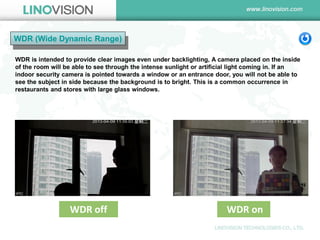
WDR (Wide Dynamic Range) 
WDR is intended to provide clear images even under backlighting, A camera placed on the inside of the room will be able to see through the intense sunlight or artificial light coming in. If an indoor security camera is pointed towards a window or an entrance door, you will not be able to see the subject in side because the background is to bright. This is a common occurrence in restaurants and stores with large glass windows. 
WDR off 
WDR on
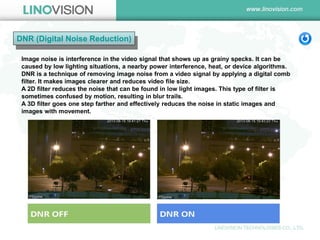
DNR (Digital Noise Reduction) 
Image noise is interference in the video signal that shows up as grainy specks. It can be caused by low lighting situations, a nearby power interference, heat, or device algorithms. 
DNR is a technique of removing image noise from a video signal by applying a digital comb filter. It makes images clearer and reduces video file size. 
A 2D filter reduces the noise that can be found in low light images. This type of filter is sometimes confused by motion, resulting in blur trails. 
A 3D filter goes one step farther and effectively reduces the noise in static images and images with movement.
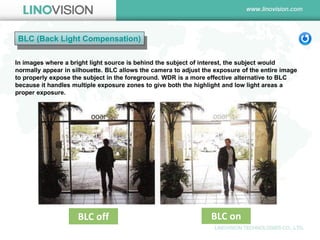
BLC (Back Light Compensation) 
In images where a bright light source is behind the subject of interest, the subject would normally appear in silhouette. BLC allows the camera to adjust the exposure of the entire image to properly expose the subject in the foreground. WDR is a more effective alternative to BLC because it handles multiple exposure zones to give both the highlight and low light areas a proper exposure. 
BLC off 
BLC on
Defog 
Defog off 
Defog on 
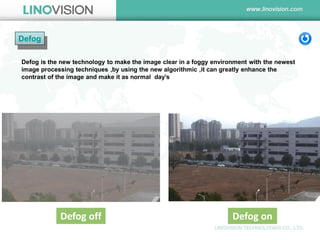
Defog is the new technology to make the image clear in a foggy environment with the newest image processing techniques ,by using the new algorithmic ,it can greatly enhance the contrast of the image and make it as normal day’s
Corridor mode 
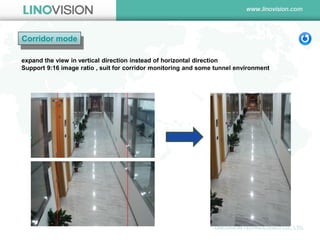
expand the view in vertical direction instead of horizontal direction 
Support 9:16 image ratio , suit for corridor monitoring and some tunnel environment
Smart IR 
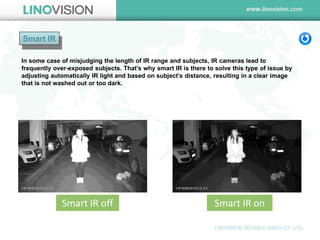
In some case of misjudging the length of IR range and subjects, IR cameras lead to frequently over-exposed subjects. That’s why smart IR is there to solve this type of issue by adjusting automatically IR light and based on subject’s distance, resulting in a clear image that is not washed out or too dark. 
Smart IR off 
Smart IR on
ROI (Region of interest) 
ROI off 
ROI on 
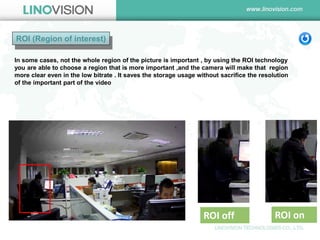
In some cases, not the whole region of the picture is important , by using the ROI technology you are able to choose a region that is more important ,and the camera will make that region more clear even in the low bitrate . It saves the storage usage without sacrifice the resolution of the important part of the video
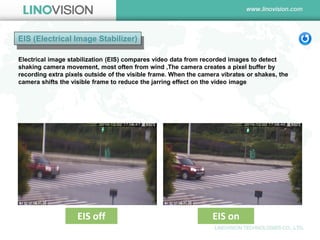
EIS (Electrical Image Stabilizer) 
Electrical image stabilization (EIS) compares video data from recorded images to detect shaking camera movement, most often from wind ,The camera creates a pixel buffer by recording extra pixels outside of the visible frame. When the camera vibrates or shakes, the camera shifts the visible frame to reduce the jarring effect on the video image 
EIS off 
EIS on
SVC (Scalable Video Coding) 
Co-working with NVR support SVC decode, the stream or record can be further compressed by dropping frame, saving 75% storage usage and reduce 75% transport pressure at most. 
Benefits: 
• Better network compatibility, protect the data from losing in a bad network 
• NVR can replay in a low bitrate, saving the resource of network 
• To a SVC stream, get a 30fps stream for preview while get a 15fps stream for record.
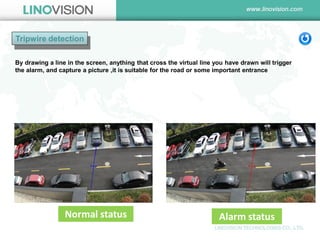
Tripwire detection 
Alarm status 
Normal status 
By drawing a line in the screen, anything that cross the virtual line you have drawn will trigger the alarm, and capture a picture ,it is suitable for the road or some important entrance
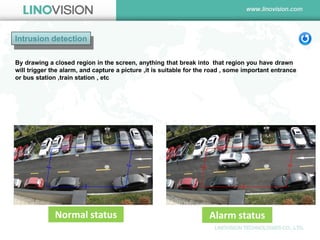
Intrusion detection 
Alarm status 
Normal status 
By drawing a closed region in the screen, anything that break into that region you have drawn will trigger the alarm, and capture a picture ,it is suitable for the road , some important entrance or bus station ,train station , etc
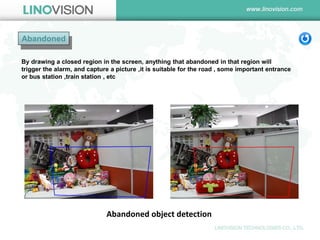
Abandoned 
Abandoned object detection 
By drawing a closed region in the screen, anything that abandoned in that region will trigger the alarm, and capture a picture ,it is suitable for the road , some important entrance or bus station ,train station , etc
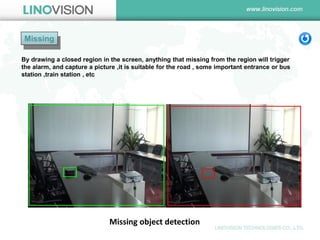
Missing 
Missing object detection 
By drawing a closed region in the screen, anything that missing from the region will trigger the alarm, and capture a picture ,it is suitable for the road , some important entrance or bus station ,train station , etc
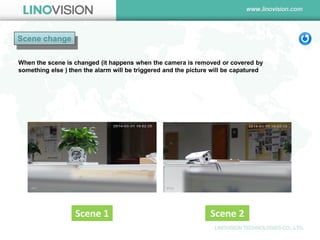
Scene change 
Scene 1 
Scene 2 
When the scene is changed (it happens when the camera is removed or covered by something else ) then the alarm will be triggered and the picture will be capatured
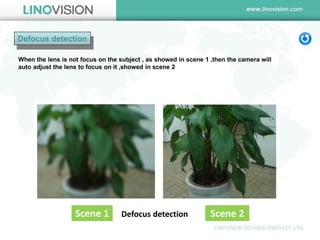
Defocus detection 
Defocus detection 
When the lens is not focus on the subject , as showed in scene 1 ,then the camera will auto adjust the lens to focus on it ,showed in scene 2 
Scene 1 
Scene 2
Face detection 
Face detection 
The camera will auto recognize the human face appeared in the scene
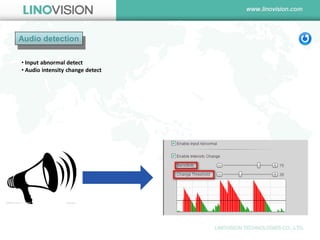
Audio detection 
• Input abnormal detect 
• Audio intensity change detect
IP66/IP67 
In most cases, the Ingress Protection Rating consists of the letters IP followed by two digits. 
I P [Solid Particle Protection] [Liquid Ingress Protection]
IP66/IP67 
I P [Solid Particle Protection] [Liquid Ingress Protection]
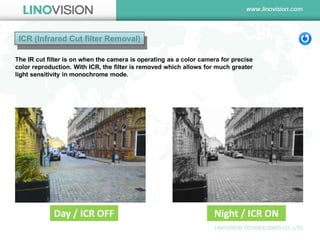
ICR (Infrared Cut filter Removal) 
The IR cut filter is on when the camera is operating as a color camera for precise color reproduction. With ICR, the filter is removed which allows for much greater light sensitivity in monochrome mode. 
Day / ICR OFF 
Night / ICR ON
Multi-streaming 
Multi-streaming means that your device outputs two or more types of video streams, with different properties, to different users or devices. It allows a user to get video in a different resolution, frame rate, or compression type to meet requirements of quality, storage constraints, bandwidth, or CPU usage. 
The property differences could be 
•Compression type (such as H.264 and MPEG-4) 
•Resolution (to reduce bandwidth needs) 
•Frame rate (to supply appropriate-sized video to devices like smart phones without reducing resolution)
ONVIF (Open Standard Compliance) 
ONVIF is an open industry forum for the development of a global standard for the interface of IP-based physical security products. The ONVIF specification will ensure interoperability between products regardless of manufacturer. 
linovision's IP cameras are fully compliant with the ONVIF standard, ensuring compatibility with software and hardware from over 200 companies like Sony, Panasonic, Samsung, and Cisco. 
•Increased flexibility and greater freedom of choice. The standard enables end users to select interoperable products from a variety of different brands that comply with the ONVIF standard 
•Future-proof systems and more secure investments. The standard will ensure that interoperable products are available from a large variety of vendors, no matter how the market develops 
•Reduced total cost of ownership. Interoperable products result in less integration costs, and enable end-users to choose the most suitable combination of IP-based physical security products for their specific needs, regardless of
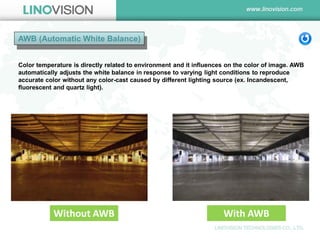
AWB (Automatic White Balance) 
Color temperature is directly related to environment and it influences on the color of image. AWB automatically adjusts the white balance in response to varying light conditions to reproduce accurate color without any color-cast caused by different lighting source (ex. Incandescent, fluorescent and quartz light). 
Without AWB 
With AWB
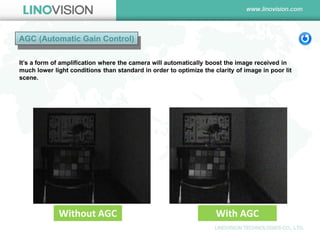
AGC (Automatic Gain Control) 
It’s a form of amplification where the camera will automatically boost the image received in much lower light conditions than standard in order to optimize the clarity of image in poor lit scene. 
Without AGC 
With AGC

Linovision intelligent ipc key features introduction

  • 1.
    WDR DNR BLC Defog Corridor mode Smart IR ROI EIS SVC Tripwire detection Intrusion detection Abandoned Missing Scene change Defocus detection Face detection Audio detection IP66/IP67 ICR Multi-streaming ONVIF AWB AGC Table of contents
  • 2.
    WDR (Wide DynamicRange) WDR is intended to provide clear images even under backlighting, A camera placed on the inside of the room will be able to see through the intense sunlight or artificial light coming in. If an indoor security camera is pointed towards a window or an entrance door, you will not be able to see the subject in side because the background is to bright. This is a common occurrence in restaurants and stores with large glass windows. WDR off WDR on
  • 3.
    DNR (Digital NoiseReduction) Image noise is interference in the video signal that shows up as grainy specks. It can be caused by low lighting situations, a nearby power interference, heat, or device algorithms. DNR is a technique of removing image noise from a video signal by applying a digital comb filter. It makes images clearer and reduces video file size. A 2D filter reduces the noise that can be found in low light images. This type of filter is sometimes confused by motion, resulting in blur trails. A 3D filter goes one step farther and effectively reduces the noise in static images and images with movement.
  • 4.
    BLC (Back LightCompensation) In images where a bright light source is behind the subject of interest, the subject would normally appear in silhouette. BLC allows the camera to adjust the exposure of the entire image to properly expose the subject in the foreground. WDR is a more effective alternative to BLC because it handles multiple exposure zones to give both the highlight and low light areas a proper exposure. BLC off BLC on
  • 5.
    Defog Defog off Defog on Defog is the new technology to make the image clear in a foggy environment with the newest image processing techniques ,by using the new algorithmic ,it can greatly enhance the contrast of the image and make it as normal day’s
  • 6.
    Corridor mode expandthe view in vertical direction instead of horizontal direction Support 9:16 image ratio , suit for corridor monitoring and some tunnel environment
  • 7.
    Smart IR Insome case of misjudging the length of IR range and subjects, IR cameras lead to frequently over-exposed subjects. That’s why smart IR is there to solve this type of issue by adjusting automatically IR light and based on subject’s distance, resulting in a clear image that is not washed out or too dark. Smart IR off Smart IR on
  • 8.
    ROI (Region ofinterest) ROI off ROI on In some cases, not the whole region of the picture is important , by using the ROI technology you are able to choose a region that is more important ,and the camera will make that region more clear even in the low bitrate . It saves the storage usage without sacrifice the resolution of the important part of the video
  • 9.
    EIS (Electrical ImageStabilizer) Electrical image stabilization (EIS) compares video data from recorded images to detect shaking camera movement, most often from wind ,The camera creates a pixel buffer by recording extra pixels outside of the visible frame. When the camera vibrates or shakes, the camera shifts the visible frame to reduce the jarring effect on the video image EIS off EIS on
  • 10.
    SVC (Scalable VideoCoding) Co-working with NVR support SVC decode, the stream or record can be further compressed by dropping frame, saving 75% storage usage and reduce 75% transport pressure at most. Benefits: • Better network compatibility, protect the data from losing in a bad network • NVR can replay in a low bitrate, saving the resource of network • To a SVC stream, get a 30fps stream for preview while get a 15fps stream for record.
  • 11.
    Tripwire detection Alarmstatus Normal status By drawing a line in the screen, anything that cross the virtual line you have drawn will trigger the alarm, and capture a picture ,it is suitable for the road or some important entrance
  • 12.
    Intrusion detection Alarmstatus Normal status By drawing a closed region in the screen, anything that break into that region you have drawn will trigger the alarm, and capture a picture ,it is suitable for the road , some important entrance or bus station ,train station , etc
  • 13.
    Abandoned Abandoned objectdetection By drawing a closed region in the screen, anything that abandoned in that region will trigger the alarm, and capture a picture ,it is suitable for the road , some important entrance or bus station ,train station , etc
  • 14.
    Missing Missing objectdetection By drawing a closed region in the screen, anything that missing from the region will trigger the alarm, and capture a picture ,it is suitable for the road , some important entrance or bus station ,train station , etc
  • 15.
    Scene change Scene1 Scene 2 When the scene is changed (it happens when the camera is removed or covered by something else ) then the alarm will be triggered and the picture will be capatured
  • 16.
    Defocus detection Defocusdetection When the lens is not focus on the subject , as showed in scene 1 ,then the camera will auto adjust the lens to focus on it ,showed in scene 2 Scene 1 Scene 2
  • 17.
    Face detection Facedetection The camera will auto recognize the human face appeared in the scene
  • 18.
    Audio detection •Input abnormal detect • Audio intensity change detect
  • 19.
    IP66/IP67 In mostcases, the Ingress Protection Rating consists of the letters IP followed by two digits. I P [Solid Particle Protection] [Liquid Ingress Protection]
  • 20.
    IP66/IP67 I P[Solid Particle Protection] [Liquid Ingress Protection]
  • 21.
    ICR (Infrared Cutfilter Removal) The IR cut filter is on when the camera is operating as a color camera for precise color reproduction. With ICR, the filter is removed which allows for much greater light sensitivity in monochrome mode. Day / ICR OFF Night / ICR ON
  • 22.
    Multi-streaming Multi-streaming meansthat your device outputs two or more types of video streams, with different properties, to different users or devices. It allows a user to get video in a different resolution, frame rate, or compression type to meet requirements of quality, storage constraints, bandwidth, or CPU usage. The property differences could be •Compression type (such as H.264 and MPEG-4) •Resolution (to reduce bandwidth needs) •Frame rate (to supply appropriate-sized video to devices like smart phones without reducing resolution)
  • 23.
    ONVIF (Open StandardCompliance) ONVIF is an open industry forum for the development of a global standard for the interface of IP-based physical security products. The ONVIF specification will ensure interoperability between products regardless of manufacturer. linovision's IP cameras are fully compliant with the ONVIF standard, ensuring compatibility with software and hardware from over 200 companies like Sony, Panasonic, Samsung, and Cisco. •Increased flexibility and greater freedom of choice. The standard enables end users to select interoperable products from a variety of different brands that comply with the ONVIF standard •Future-proof systems and more secure investments. The standard will ensure that interoperable products are available from a large variety of vendors, no matter how the market develops •Reduced total cost of ownership. Interoperable products result in less integration costs, and enable end-users to choose the most suitable combination of IP-based physical security products for their specific needs, regardless of
  • 24.
    AWB (Automatic WhiteBalance) Color temperature is directly related to environment and it influences on the color of image. AWB automatically adjusts the white balance in response to varying light conditions to reproduce accurate color without any color-cast caused by different lighting source (ex. Incandescent, fluorescent and quartz light). Without AWB With AWB
  • 25.
    AGC (Automatic GainControl) It’s a form of amplification where the camera will automatically boost the image received in much lower light conditions than standard in order to optimize the clarity of image in poor lit scene. Without AGC With AGC