This project has received funding from the European Union’s Horizon 2020 research and innovation programme
under grant agreement No 731015.
John P. McCrae1, Thierry Declerck2
Linked Open Data
Cloud
1Insight Centre for Data Analytics, National University of Ireland Galway
2Austrian Centre for Digital Humanities
This project has received funding from the European Union’s Horizon 2020 research and innovation
Hitchhiker’s guide to the Linked
Open Data Cloud
DBpedia
• Largest node in the linked open data cloud
• “Nucleus for a web of open data”
• Most data is derived by parsing Wikipedia
• E.g., https://en.wikipedia.org/wiki/C++
• => http://dbpedia.org/resource/C++
• Uses transparent content negotiation
This project has received funding from the European Union’s Horizon 2020 research and innovation
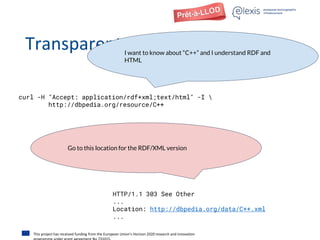
Transparent content negotiationI want to know about “C++” and I understand RDF and
HTML
curl -H "Accept: application/rdf+xml;text/html" -I 
http://dbpedia.org/resource/C++
HTTP/1.1 303 See Other
...
Location: http://dbpedia.org/data/C++.xml
...
Go to this location for the RDF/XML version
This project has received funding from the European Union’s Horizon 2020 research and innovation
Transparent content negotiationI want to know about “C++” and I only know HTML
curl -H "Accept: text/html" -I 
http://dbpedia.org/resource/C++
HTTP/1.1 303 See Other
...
Location: http://dbpedia.org/page/C++
...
Go to this location for the HTML version
Use
/resource/
URL to refer
to concept
This project has received funding from the European Union’s Horizon 2020 research and innovation
DBpedia Pages
Links to other
resources
Ontology
properties
This project has received funding from the European Union’s Horizon 2020 research and innovation
DBpedia ontologyAxioms
Labels
External
Links
This project has received funding from the European Union’s Horizon 2020 research and innovation
WikiData RDF Version:
https://www.wikidata.org/entity/Q2407
BabelNet
Dictionary
compiled from
• Wikipedia
• (Open
Mulitlingual)
WordNet
• Wiktionary
• OmegaWiki
• WikiData
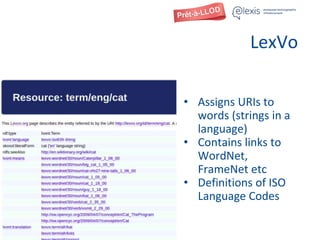
LexVo
• Assigns URIs to
words (strings in a
language)
• Contains links to
WordNet,
FrameNet etc
• Definitions of ISO
Language Codes
Domain datasets
100’s of domain
specific datasets
This project has received funding from the European Union’s Horizon 2020 research and innovation
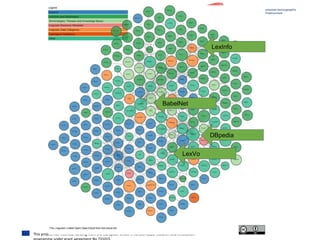
LexInfo
LexVo
BabelNet
DBpedia
Reusing URIs
Why reuse URIs
• Data interoperability
• Queries work over multiple datasets
• Semantic definitions allows alignments to be reasoned
• (Often) the creators of the URIs have good idea on how data
should be structured
Challenges of interoperability
Susanne Penn
The AT
DT
Fulton NP1s
NNP
County NNL1cb
NNP
Grand JJ
NNP
Jury NN1c
Differences in
Granularity
Linguistic
Differences
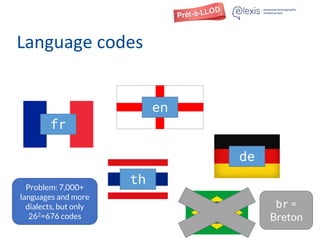
Language codes
fr
en
de
thProblem: 7,000+
languages and more
dialects, but only
262=676 codes br?
br =
Breton
ISO Language Codes
fr-CA
Québécois
ang
Anglo-Saxon
pms
Piedmontese
3-Letter codes with
region cover
minority, historical
languages, right?
Variability
How to tag this talk?
• en?
• en-Latn? (As it is not written in Cyrillic)
• en-LV or en-428 (As it is presented in Latvia)
• en-GB or en-826 (As is is composed in British
English)
• en-Latn-GB?Region subtags are used to indicate linguistic variations associated
with or appropriate to a specific country, territory, or region. Typically,
a region subtag is used to indicate variations such as regional
dialects or usage, or region-specific spelling conventions. It can also
be used to indicate that content is expressed in a way that is
appropriate for use throughout a region, for instance, Spanish content
tailored to be useful throughout Latin America.
-- RFC 5646
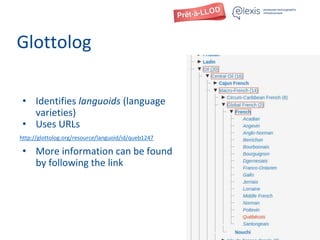
Glottolog
• Identifies languoids (language
varieties)
• Uses URLs
http://glottolog.org/resource/languoid/id/queb1247
• More information can be found
by following the link
Linked Open Vocabularies
http://lov.linkeddata.es/
ISOcat
• Effort to standardize linguistic vocabulary from ISO Technical
Committee
• Standardized “Data Categories” in a “Registry”
• Discontinued in December 2014
Problems with ISOcat
According to Schuurman et al.
• Too easy to get a login
• “Out-of-control”
• Entries were copies of other entries
• “People sometimes copied an entry, just in order to
make sure the original owner would not change the
entry without them knowing it”
• Complexity - Too many obligatory and overly
technical fields
As an alternative the CLARIN concept registry is (still)
being introduced.
I. Schuurman, M. Windhouwer, O. Ohren, D. Zeman, CLARIN Concept Registry: The new semantic registry, in
CLARIN 2015 Selected Papers (2015), pp. 62–70
LexInfo
• Ontology for “associat[ing] linguistic information
with respect to any level of linguistic description
and expressivity to elements in an ontology”
• Expands OntoLex-Lemon with a set of general
categories
LexInfo - Properties and Values
Properties and
open-world
(non-exhaustive)
list of values
LexInfo - Verb Frames
Verb frames
with formal
definitions
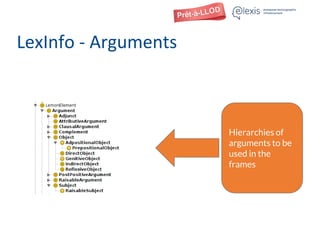
LexInfo - Arguments
Hierarchies of
arguments to be
used in the
frames
OLiA
Ontologies of Linguistic Annotation
• Modular architecture for describing
annotation schemes:
• Reference Model: Common
terminology (similar to LexInfo)
• Annotation Model: Describes a
particular annotation scheme
• Linking Model: Describes the
linking between the reference and
annotation
GOLD - General Ontology Linguistic
Description
• Quite popular
• Defines many terms
• ‘Loose’ semantics
• Sometimes has range and domains on properties
• Not clear how this fits together
Submitting to the LOD Cloud
This project has received funding from the European Union’s Horizon 2020 research and innovation
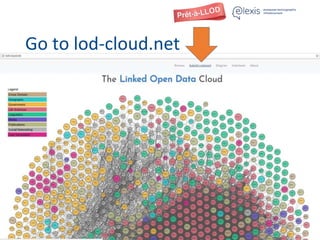
Go to lod-cloud.net
This project has received funding from the European Union’s Horizon 2020 research and innovation
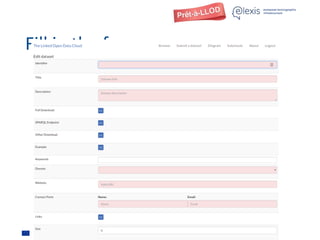
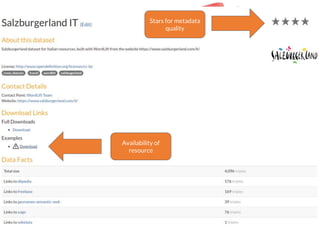
Fill in the form
Fields
• Identifier
• unique alphanumeric string
• Title
• Full name in English
• Description
• 2-10 sentence description in English
• Full Download
• A link to the complete dataset, ideally as compressed N-
Triples
• SPARQL Endpoint
• If available
• Other Download
• Other formats for download or partial downloads
Fields (2)
• Example
• A single resource that resolves
• Keywords
• Domain
• Defines the colour in the diagram
• Website
• Contact Point
• Links
• Number of triples linking to another dataset in the cloud
• Size
• Number of triples in this dataset
• Namespace, DOI, Image (if desired)
Stars for metadata
quality
Availability of
resource
Services using linked data
Service-oriented architectures
• It is implemented a self-contained operation unit.
• It is a black box for its consumers, which only need
to know the interface, not the implementation.
• It may consist of other underlying services.
Interoperability is a significant challenge here
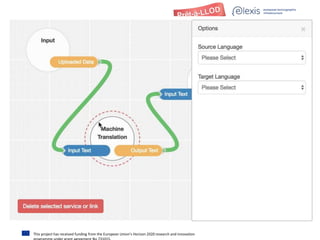
Service chains
Translation
DE => EN
Parser (EN)
Sentiment
Analysis (EN)
Often tricky to do in
practice!
Issues with service chains
• Services are often components of pipelines without
clear usage to the end user
• The technology readiness level of services is often
quite low, with little documentation or graphical
user interface,
• Services are hard to install often requiring
compiling from source or specialized libraries not
found in major software repositories.
Teanga
• RDF and Linked Data to provide
service interoperability
• Docker to enable easy install
and usage
• Attractive Web Front-End
(Bootstrap, AngularJS, NodeJS)
• Graceful control of errors
This project has received funding from the European Union’s Horizon 2020 research and innovation
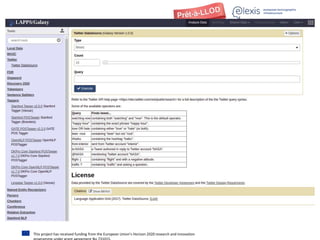
LAPPS Grid
Defines key vocabularies for service interoperability
• LAPPS Interchange Format (JSON-LD)
• Web Service Exchange Vocabulary
• Human-in-the-loop workflow construction using
Galaxy
This project has received funding from the European Union’s Horizon 2020 research and innovation
Summary
Summary
• Linked Open Data Cloud
• Big
• Many relevant tools
• Fragmented
• Interoperability is less terrible than other systems
Thanks.
This publication has emanated from research supported in part by a research grant from Science
Foundation Ireland (SFI) under Grant Number SFI/12/RC/2289, co-funded by the European Regional
Development Fund

Linked Open Data Cloud

  • 1.
    This project hasreceived funding from the European Union’s Horizon 2020 research and innovation programme under grant agreement No 731015. John P. McCrae1, Thierry Declerck2 Linked Open Data Cloud 1Insight Centre for Data Analytics, National University of Ireland Galway 2Austrian Centre for Digital Humanities
  • 2.
    This project hasreceived funding from the European Union’s Horizon 2020 research and innovation
  • 3.
    Hitchhiker’s guide tothe Linked Open Data Cloud
  • 4.
    DBpedia • Largest nodein the linked open data cloud • “Nucleus for a web of open data” • Most data is derived by parsing Wikipedia • E.g., https://en.wikipedia.org/wiki/C++ • => http://dbpedia.org/resource/C++ • Uses transparent content negotiation
  • 5.
    This project hasreceived funding from the European Union’s Horizon 2020 research and innovation Transparent content negotiationI want to know about “C++” and I understand RDF and HTML curl -H "Accept: application/rdf+xml;text/html" -I http://dbpedia.org/resource/C++ HTTP/1.1 303 See Other ... Location: http://dbpedia.org/data/C++.xml ... Go to this location for the RDF/XML version
  • 6.
    This project hasreceived funding from the European Union’s Horizon 2020 research and innovation Transparent content negotiationI want to know about “C++” and I only know HTML curl -H "Accept: text/html" -I http://dbpedia.org/resource/C++ HTTP/1.1 303 See Other ... Location: http://dbpedia.org/page/C++ ... Go to this location for the HTML version Use /resource/ URL to refer to concept
  • 7.
    This project hasreceived funding from the European Union’s Horizon 2020 research and innovation DBpedia Pages Links to other resources Ontology properties
  • 8.
    This project hasreceived funding from the European Union’s Horizon 2020 research and innovation DBpedia ontologyAxioms Labels External Links
  • 9.
    This project hasreceived funding from the European Union’s Horizon 2020 research and innovation WikiData RDF Version: https://www.wikidata.org/entity/Q2407
  • 10.
    BabelNet Dictionary compiled from • Wikipedia •(Open Mulitlingual) WordNet • Wiktionary • OmegaWiki • WikiData
  • 11.
    LexVo • Assigns URIsto words (strings in a language) • Contains links to WordNet, FrameNet etc • Definitions of ISO Language Codes
  • 12.
    Domain datasets 100’s ofdomain specific datasets
  • 13.
    This project hasreceived funding from the European Union’s Horizon 2020 research and innovation LexInfo LexVo BabelNet DBpedia
  • 14.
  • 15.
    Why reuse URIs •Data interoperability • Queries work over multiple datasets • Semantic definitions allows alignments to be reasoned • (Often) the creators of the URIs have good idea on how data should be structured
  • 16.
    Challenges of interoperability SusannePenn The AT DT Fulton NP1s NNP County NNL1cb NNP Grand JJ NNP Jury NN1c Differences in Granularity Linguistic Differences
  • 17.
    Language codes fr en de thProblem: 7,000+ languagesand more dialects, but only 262=676 codes br? br = Breton
  • 18.
    ISO Language Codes fr-CA Québécois ang Anglo-Saxon pms Piedmontese 3-Lettercodes with region cover minority, historical languages, right?
  • 19.
    Variability How to tagthis talk? • en? • en-Latn? (As it is not written in Cyrillic) • en-LV or en-428 (As it is presented in Latvia) • en-GB or en-826 (As is is composed in British English) • en-Latn-GB?Region subtags are used to indicate linguistic variations associated with or appropriate to a specific country, territory, or region. Typically, a region subtag is used to indicate variations such as regional dialects or usage, or region-specific spelling conventions. It can also be used to indicate that content is expressed in a way that is appropriate for use throughout a region, for instance, Spanish content tailored to be useful throughout Latin America. -- RFC 5646
  • 20.
    Glottolog • Identifies languoids(language varieties) • Uses URLs http://glottolog.org/resource/languoid/id/queb1247 • More information can be found by following the link
  • 21.
  • 22.
    ISOcat • Effort tostandardize linguistic vocabulary from ISO Technical Committee • Standardized “Data Categories” in a “Registry” • Discontinued in December 2014
  • 23.
    Problems with ISOcat Accordingto Schuurman et al. • Too easy to get a login • “Out-of-control” • Entries were copies of other entries • “People sometimes copied an entry, just in order to make sure the original owner would not change the entry without them knowing it” • Complexity - Too many obligatory and overly technical fields As an alternative the CLARIN concept registry is (still) being introduced. I. Schuurman, M. Windhouwer, O. Ohren, D. Zeman, CLARIN Concept Registry: The new semantic registry, in CLARIN 2015 Selected Papers (2015), pp. 62–70
  • 24.
    LexInfo • Ontology for“associat[ing] linguistic information with respect to any level of linguistic description and expressivity to elements in an ontology” • Expands OntoLex-Lemon with a set of general categories
  • 25.
    LexInfo - Propertiesand Values Properties and open-world (non-exhaustive) list of values
  • 26.
    LexInfo - VerbFrames Verb frames with formal definitions
  • 27.
    LexInfo - Arguments Hierarchiesof arguments to be used in the frames
  • 28.
    OLiA Ontologies of LinguisticAnnotation • Modular architecture for describing annotation schemes: • Reference Model: Common terminology (similar to LexInfo) • Annotation Model: Describes a particular annotation scheme • Linking Model: Describes the linking between the reference and annotation
  • 29.
    GOLD - GeneralOntology Linguistic Description • Quite popular • Defines many terms • ‘Loose’ semantics • Sometimes has range and domains on properties • Not clear how this fits together
  • 30.
  • 31.
    This project hasreceived funding from the European Union’s Horizon 2020 research and innovation Go to lod-cloud.net
  • 32.
    This project hasreceived funding from the European Union’s Horizon 2020 research and innovation Fill in the form
  • 33.
    Fields • Identifier • uniquealphanumeric string • Title • Full name in English • Description • 2-10 sentence description in English • Full Download • A link to the complete dataset, ideally as compressed N- Triples • SPARQL Endpoint • If available • Other Download • Other formats for download or partial downloads
  • 34.
    Fields (2) • Example •A single resource that resolves • Keywords • Domain • Defines the colour in the diagram • Website • Contact Point • Links • Number of triples linking to another dataset in the cloud • Size • Number of triples in this dataset • Namespace, DOI, Image (if desired)
  • 35.
  • 36.
  • 37.
    Service-oriented architectures • Itis implemented a self-contained operation unit. • It is a black box for its consumers, which only need to know the interface, not the implementation. • It may consist of other underlying services. Interoperability is a significant challenge here
  • 38.
    Service chains Translation DE =>EN Parser (EN) Sentiment Analysis (EN) Often tricky to do in practice!
  • 39.
    Issues with servicechains • Services are often components of pipelines without clear usage to the end user • The technology readiness level of services is often quite low, with little documentation or graphical user interface, • Services are hard to install often requiring compiling from source or specialized libraries not found in major software repositories.
  • 40.
    Teanga • RDF andLinked Data to provide service interoperability • Docker to enable easy install and usage • Attractive Web Front-End (Bootstrap, AngularJS, NodeJS) • Graceful control of errors
  • 41.
    This project hasreceived funding from the European Union’s Horizon 2020 research and innovation
  • 42.
    This project hasreceived funding from the European Union’s Horizon 2020 research and innovation
  • 43.
    This project hasreceived funding from the European Union’s Horizon 2020 research and innovation
  • 44.
    LAPPS Grid Defines keyvocabularies for service interoperability • LAPPS Interchange Format (JSON-LD) • Web Service Exchange Vocabulary • Human-in-the-loop workflow construction using Galaxy
  • 45.
    This project hasreceived funding from the European Union’s Horizon 2020 research and innovation
  • 46.
  • 47.
    Summary • Linked OpenData Cloud • Big • Many relevant tools • Fragmented • Interoperability is less terrible than other systems
  • 48.
    Thanks. This publication hasemanated from research supported in part by a research grant from Science Foundation Ireland (SFI) under Grant Number SFI/12/RC/2289, co-funded by the European Regional Development Fund