L I N K E D L IST
       Dr. S. Lovelyn Rose
       PSG College of Technology
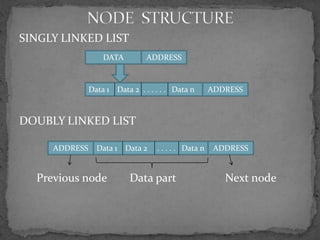
SINGLY LINKED LIST
                   DATA         ADDRESS


               Data 1 Data 2 . . . . . . Data n       ADDRESS


DOUBLY LINKED LIST

     ADDRESS     Data 1 Data 2     . . . . . Data n    ADDRESS


  Previous node            Data part                     Next node
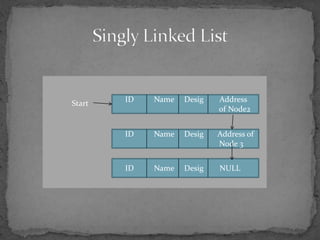
Start   ID   Name   Desig   Address
                            of Node2


        ID   Name   Desig   Address of
                            Node 3


        ID   Name   Desig   NULL
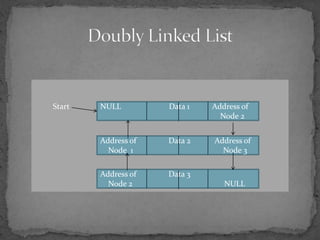
Start   NULL         Data 1   Address of
                                Node 2


        Address of   Data 2   Address of
          Node 1                Node 3

        Address of   Data 3
          Node 2                 NULL
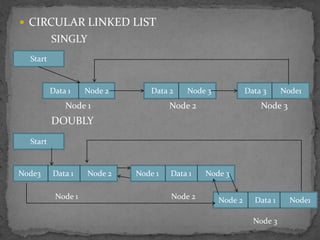
 CIRCULAR LINKED LIST
          SINGLY
  Start


          Data 1    Node 2       Data 2   Node 3            Data 3     Node1
              Node 1                  Node 2                    Node 3
          DOUBLY
  Start


Node3     Data 1    Node 2   Node 1   Data 1   Node 3

           Node 1                     Node 2       Node 2     Data 1     Node1

                                                              Node 3
struct node
{
  int x;
                     x   c[10]   next
   char c[10];
struct node *next;
}*current;
create_node()
{
  current=(struct node *)malloc(sizeof(struct node));
  current->x=10; current->c=“try”; current->next=null;
  return current;
}
Allocation               x    c[10]     next


Assignment                10    try     NULL
Create a linked list for maintaining the employee details
  such as Ename,Eid,Edesig.
Steps:
1)Identify the node structure struct node
                                 {
2)Allocate space for the node
                                   int Eid;
3)Insert the node in the list      char Ename[10],Edesig[10];
                                     struct node *next;
                                  } *current;


     EID        EName        EDesig          next
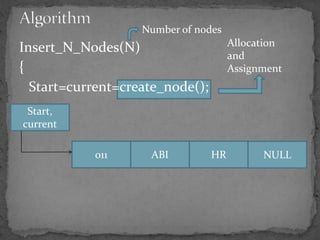
Number of nodes
                                      Allocation
Insert_N_Nodes(N)
                                      and
{                                     Assignment
  Start=current=create_node();
 Start,
current

            011     ABI          HR         NULL
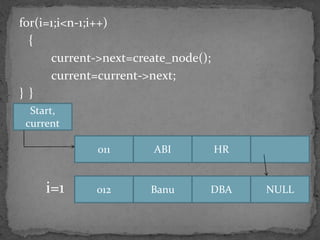
for(i=1;i<n-1;i++)
  {
      current->next=create_node();
      current=current->next;
} }
  Start,
 current

             011       ABI           HR


     i=1     012       Banu      DBA      NULL
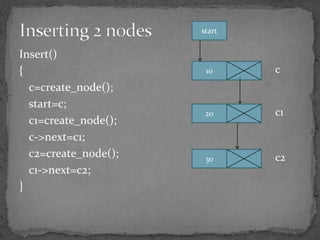
start


Insert()
{                      10     c
  c=create_node();
  start=c;
                       20     c1
  c1=create_node();
  c->next=c1;
  c2=create_node();    30     c2
  c1->next=c2;
}
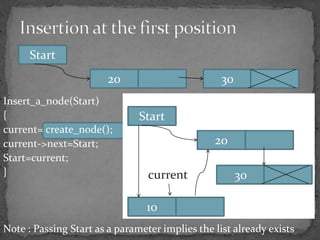
Start
                        20                        30
Insert_a_node(Start)
{                              Start
current= create_node();                     10
current->next=Start;                             20
Start=current;
}                                current               30

                                 10
Note : Passing Start as a parameter implies the list already exists
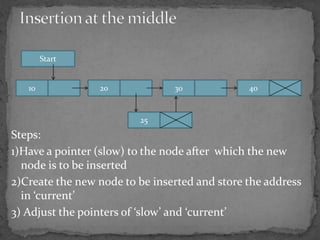
Start


   10            20             30             40


                         25
Steps:
1)Have a pointer (slow) to the node after which the new
  node is to be inserted
2)Create the new node to be inserted and store the address
  in ‘current’
3) Adjust the pointers of ‘slow’ and ‘current’
 Use two pointers namely, fast and slow
 Move the ‘slow’ pointer by one element in the list
 For every single movement of ‘slow’, move ‘fast’ by 2
  elements
 When ‘fast’ points to the last element, ‘slow’ would be
  pointing to the middle element
 This required moving through the list only once
 So the middle element is found in a time complexity of
  O(n)
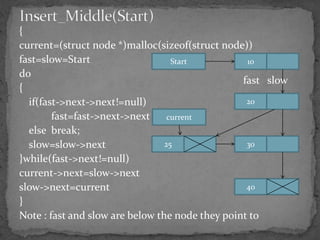
{
current=(struct node *)malloc(sizeof(struct node))
fast=slow=Start                    Start          10
do
                                                 fast slow
{
  if(fast->next->next!=null)                      20
        fast=fast->next->next     current
  else break;
  slow=slow->next                25               30
}while(fast->next!=null)
current->next=slow->next
slow->next=current                                40
}
Note : fast and slow are below the node they point to
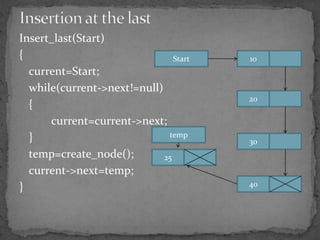
Insert_last(Start)
{                               Start   10
  current=Start;
  while(current->next!=null)
                                        20
  {
      current=current->next;
  }                           temp
                                        30
  temp=create_node();        25
  current->next=temp;
}                                       40
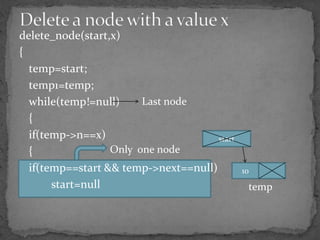
delete_node(start,x)
{
  temp=start;
  temp1=temp;
  while(temp!=null)     Last node
  {
  if(temp->n==x)                      start
  {               Only one node
  if(temp==start && temp->next==null)         10
       start=null                              temp
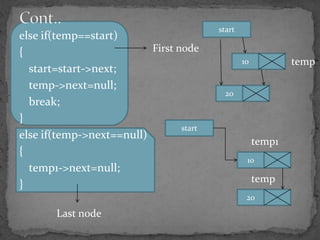
start
else if(temp==start)
{                         First node
                                                 10           temp
  start=start->next;
  temp->next=null;
                                           20
  break;
}
                                 start
else if(temp->next==null)
                                                      temp1
{
                                                  10
  temp1->next=null;
                                                      temp
}
                                                  20

       Last node
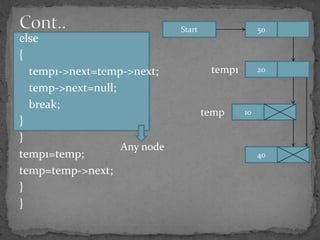
Start                 50
else
{
  temp1->next=temp->next;              temp1        20

  temp->next=null;
  break;
                                      temp     10
}
}
                   Any node
temp1=temp;                                         40

temp=temp->next;
}
}
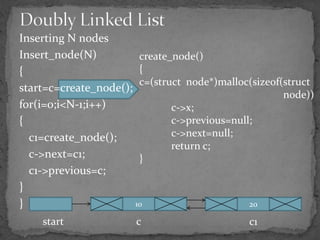
Inserting N nodes
Insert_node(N)          create_node()
{                       {
                        c=(struct node*)malloc(sizeof(struct
start=c=create_node();
                                                      node))
for(i=0;i<N-1;i++)             c->x;
{                              c->previous=null;
  c1=create_node();            c->next=null;
                               return c;
  c->next=c1;           }
  c1->previous=c;
}
}                      10                      20

    start              c                      c1
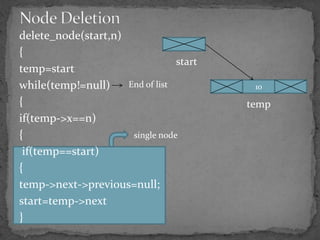
delete_node(start,n)
{
                                 start
temp=start
while(temp!=null)    End of list          10

{                                        temp
if(temp->x==n)
{                     single node
 if(temp==start)
{
temp->next->previous=null;
start=temp->next
}
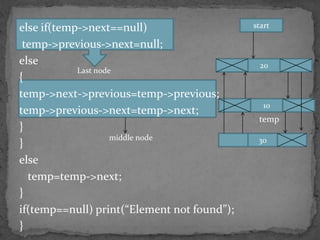
else if(temp->next==null)                    start

 temp->previous->next=null;
else                                           20
            Last node
{
temp->next->previous=temp->previous;
                                                10
temp->previous->next=temp->next;
                                              temp
}
                     middle node              30
}
else
  temp=temp->next;
}
if(temp==null) print(“Element not found”);
}
 Download the file from
http://www.slideshare.net/lovelynrose/linked-list-17752737

Also visit my blogs :

  http://datastructuresinterview.blogspot.in/

  http://talkcoimbatore.blogspot.in/

  http://simpletechnical.blogspot.in/

Linked list without animation

  • 1.
    L I NK E D L IST Dr. S. Lovelyn Rose PSG College of Technology
  • 2.
    SINGLY LINKED LIST DATA ADDRESS Data 1 Data 2 . . . . . . Data n ADDRESS DOUBLY LINKED LIST ADDRESS Data 1 Data 2 . . . . . Data n ADDRESS Previous node Data part Next node
  • 3.
    Start ID Name Desig Address of Node2 ID Name Desig Address of Node 3 ID Name Desig NULL
  • 4.
    Start NULL Data 1 Address of Node 2 Address of Data 2 Address of Node 1 Node 3 Address of Data 3 Node 2 NULL
  • 5.
     CIRCULAR LINKEDLIST SINGLY Start Data 1 Node 2 Data 2 Node 3 Data 3 Node1 Node 1 Node 2 Node 3 DOUBLY Start Node3 Data 1 Node 2 Node 1 Data 1 Node 3 Node 1 Node 2 Node 2 Data 1 Node1 Node 3
  • 6.
    struct node { int x; x c[10] next char c[10]; struct node *next; }*current;
  • 7.
    create_node() { current=(structnode *)malloc(sizeof(struct node)); current->x=10; current->c=“try”; current->next=null; return current; } Allocation x c[10] next Assignment 10 try NULL
  • 8.
    Create a linkedlist for maintaining the employee details such as Ename,Eid,Edesig. Steps: 1)Identify the node structure struct node { 2)Allocate space for the node int Eid; 3)Insert the node in the list char Ename[10],Edesig[10]; struct node *next; } *current; EID EName EDesig next
  • 9.
    Number of nodes Allocation Insert_N_Nodes(N) and { Assignment Start=current=create_node(); Start, current 011 ABI HR NULL
  • 10.
    for(i=1;i<n-1;i++) { current->next=create_node(); current=current->next; } } Start, current 011 ABI HR i=1 012 Banu DBA NULL
  • 11.
    start Insert() { 10 c c=create_node(); start=c; 20 c1 c1=create_node(); c->next=c1; c2=create_node(); 30 c2 c1->next=c2; }
  • 12.
    Start 20 30 Insert_a_node(Start) { Start current= create_node(); 10 current->next=Start; 20 Start=current; } current 30 10 Note : Passing Start as a parameter implies the list already exists
  • 13.
    Start 10 20 30 40 25 Steps: 1)Have a pointer (slow) to the node after which the new node is to be inserted 2)Create the new node to be inserted and store the address in ‘current’ 3) Adjust the pointers of ‘slow’ and ‘current’
  • 14.
     Use twopointers namely, fast and slow  Move the ‘slow’ pointer by one element in the list  For every single movement of ‘slow’, move ‘fast’ by 2 elements  When ‘fast’ points to the last element, ‘slow’ would be pointing to the middle element  This required moving through the list only once  So the middle element is found in a time complexity of O(n)
  • 15.
    { current=(struct node *)malloc(sizeof(structnode)) fast=slow=Start Start 10 do fast slow { if(fast->next->next!=null) 20 fast=fast->next->next current else break; slow=slow->next 25 30 }while(fast->next!=null) current->next=slow->next slow->next=current 40 } Note : fast and slow are below the node they point to
  • 16.
    Insert_last(Start) { Start 10 current=Start; while(current->next!=null) 20 { current=current->next; } temp 30 temp=create_node(); 25 current->next=temp; } 40
  • 17.
    delete_node(start,x) { temp=start; temp1=temp; while(temp!=null) Last node { if(temp->n==x) start { Only one node if(temp==start && temp->next==null) 10 start=null temp
  • 18.
    start else if(temp==start) { First node 10 temp start=start->next; temp->next=null; 20 break; } start else if(temp->next==null) temp1 { 10 temp1->next=null; temp } 20 Last node
  • 19.
    Start 50 else { temp1->next=temp->next; temp1 20 temp->next=null; break; temp 10 } } Any node temp1=temp; 40 temp=temp->next; } }
  • 20.
    Inserting N nodes Insert_node(N) create_node() { { c=(struct node*)malloc(sizeof(struct start=c=create_node(); node)) for(i=0;i<N-1;i++) c->x; { c->previous=null; c1=create_node(); c->next=null; return c; c->next=c1; } c1->previous=c; } } 10 20 start c c1
  • 21.
    delete_node(start,n) { start temp=start while(temp!=null) End of list 10 { temp if(temp->x==n) { single node if(temp==start) { temp->next->previous=null; start=temp->next }
  • 22.
    else if(temp->next==null) start temp->previous->next=null; else 20 Last node { temp->next->previous=temp->previous; 10 temp->previous->next=temp->next; temp } middle node 30 } else temp=temp->next; } if(temp==null) print(“Element not found”); }
  • 23.
     Download thefile from http://www.slideshare.net/lovelynrose/linked-list-17752737 Also visit my blogs : http://datastructuresinterview.blogspot.in/ http://talkcoimbatore.blogspot.in/ http://simpletechnical.blogspot.in/