Link Labs
LTE Cat-M1 and NB1 – Beyond the Hype
November 2017
Agenda
• About Link Labs
• Technology overview of LTE Cat-M1 and NB1 (NB-IoT)
• Low power operations
• Design considerations
• Business considerations
• Planning for the future
• Q&A
2
How to ask a question
Many questions were submitted before the webinar
To submit additional questions visit http://forum.link-labs.com/
3
About Link
Labs
4
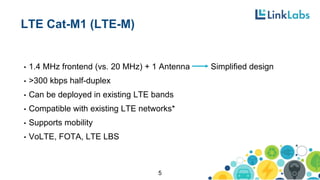
LTE Cat-M1 (LTE-M)
• 1.4 MHz frontend (vs. 20 MHz) + 1 Antenna Simplified design
• >300 kbps half-duplex
• Can be deployed in existing LTE bands
• Compatible with existing LTE networks*
• Supports mobility
• VoLTE, FOTA, LTE LBS
5
LTE Cat-NB1 (NB-IoT)
• 200 kHz frontend chipsets could be less expensive than Cat-M1
• <250 kbps half-duplex (multi-tone uplink), <20 kbps uplink (single tone)
• Can be deployed in existing LTE bands, in guard bands, re-farmed
spectrum, or other standalone bands
• Requires new basestation hardware
• Does not currently support mobility
6
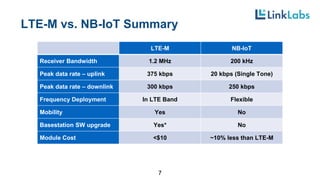
LTE-M vs. NB-IoT Summary
7
LTE-M NB-IoT
Receiver Bandwidth 1.2 MHz 200 kHz
Peak data rate – uplink 375 kbps 20 kbps (Single Tone)
Peak data rate – downlink 300 kbps 250 kbps
Frequency Deployment In LTE Band Flexible
Mobility Yes No
Basestation SW upgrade Yes* No
Module Cost <$10 ~10% less than LTE-M
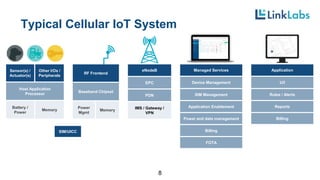
Typical Cellular IoT System
8
RF Frontend
Baseband Chipset
Power
Mgmt
Memory
SIM/UICC
Sensor(s) /
Actuator(s)
Other I/Os /
Peripherals
Host Application
Processor
Battery /
Power
Memory
eNodeB
EPC
PDN
IMS / Gateway /
VPN
Managed Services
Device Management
SIM Management
Application Enablement
Power and data management
Billing
FOTA
Application
U/I
Rules / Alerts
Reports
Billing
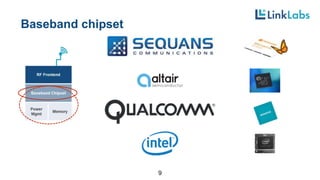
Baseband chipset
9
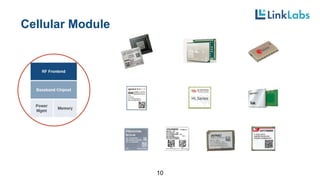
Cellular Module
10
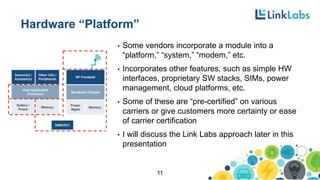
Hardware “Platform”
• Some vendors incorporate a module into a
“platform,” “system,” “modem,” etc.
• Incorporates other features, such as simple HW
interfaces, proprietary SW stacks, SIMs, power
management, cloud platforms, etc.
• Some of these are “pre-certified” on various
carriers or give customers more certainty or ease
of carrier certification
• I will discuss the Link Labs approach later in this
presentation
11
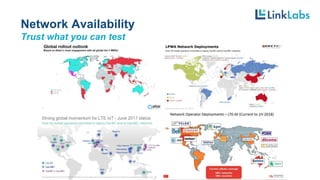
Network Availability
Trust what you can test
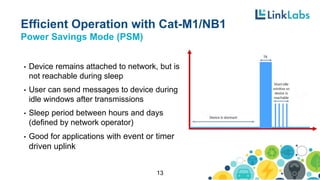
Efficient Operation with Cat-M1/NB1
Power Savings Mode (PSM)
• Device remains attached to network, but is
not reachable during sleep
• User can send messages to device during
idle windows after transmissions
• Sleep period between hours and days
(defined by network operator)
• Good for applications with event or timer
driven uplink
13
Efficient Operation with Cat-M1/NB1
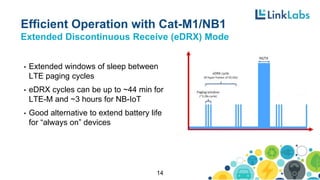
Extended Discontinuous Receive (eDRX) Mode
• Extended windows of sleep between
LTE paging cycles
• eDRX cycles can be up to ~44 min for
LTE-M and ~3 hours for NB-IoT
• Good alternative to extend battery life
for “always on” devices
14
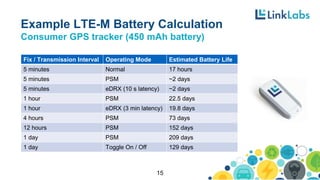
Example LTE-M Battery Calculation
Consumer GPS tracker (450 mAh battery)
15
Fix / Transmission Interval Operating Mode Estimated Battery Life
5 minutes Normal 17 hours
5 minutes PSM ~2 days
5 minutes eDRX (10 s latency) ~2 days
1 hour PSM 22.5 days
1 hour eDRX (3 min latency) 19.8 days
4 hours PSM 73 days
12 hours PSM 152 days
1 day PSM 209 days
1 day Toggle On / Off 129 days
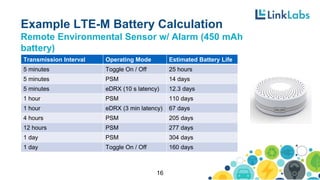
Example LTE-M Battery Calculation
Remote Environmental Sensor w/ Alarm (450 mAh
battery)
16
Transmission Interval Operating Mode Estimated Battery Life
5 minutes Toggle On / Off 25 hours
5 minutes PSM 14 days
5 minutes eDRX (10 s latency) 12.3 days
1 hour PSM 110 days
1 hour eDRX (3 min latency) 67 days
4 hours PSM 205 days
12 hours PSM 277 days
1 day PSM 304 days
1 day Toggle On / Off 160 days
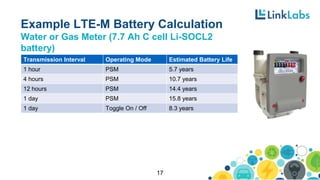
Example LTE-M Battery Calculation
Water or Gas Meter (7.7 Ah C cell Li-SOCL2
battery)
17
Transmission Interval Operating Mode Estimated Battery Life
1 hour PSM 5.7 years
4 hours PSM 10.7 years
12 hours PSM 14.4 years
1 day PSM 15.8 years
1 day Toggle On / Off 8.3 years
LTE-M Battery Considerations
• Chemistry, chemistry, chemistry
• Cost
• Test, test, test
18
Cost considerations
• Design
• Components
• Certification and testing
• Cellular service
• Managed services
19
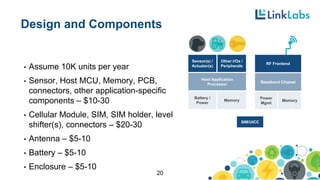
Design and Components
20
• Assume 10K units per year
• Sensor, Host MCU, Memory, PCB,
connectors, other application-specific
components – $10-30
• Cellular Module, SIM, SIM holder, level
shifter(s), connectors – $20-30
• Antenna – $5-10
• Battery – $5-10
• Enclosure – $5-10
RF Frontend
Baseband Chipset
Power
Mgmt
Memory
SIM/UICC
Sensor(s) /
Actuator(s)
Other I/Os /
Peripherals
Host Application
Processor
Battery /
Power
Memory
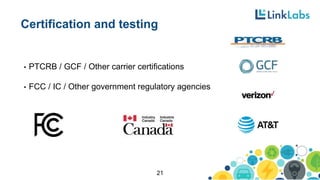
Certification and testing
• PTCRB / GCF / Other carrier certifications
• FCC / IC / Other government regulatory agencies
21
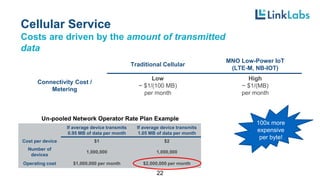
100x more
expensive
per byte!
Cellular Service
Costs are driven by the amount of transmitted
data
22
Traditional Cellular
MNO Low-Power IoT
(LTE-M, NB-IOT)
Connectivity Cost /
Metering
Low
~ $1/(100 MB)
per month
High
~ $1/(MB)
per month
If average device transmits
0.95 MB of data per month
If average device transmits
1.05 MB of data per month
Cost per device $1 $2
Number of
devices
1,000,000 1,000,000
Operating cost $1,000,000 per month $2,000,000 per month
Un-pooled Network Operator Rate Plan Example
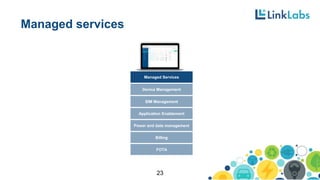
Managed services
23
Managed Services
Device Management
SIM Management
Application Enablement
Power and data management
Billing
FOTA
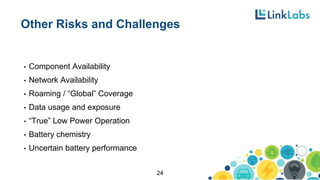
Other Risks and Challenges
• Component Availability
• Network Availability
• Roaming / “Global” Coverage
• Data usage and exposure
• “True” Low Power Operation
• Battery chemistry
• Uncertain battery performance
24
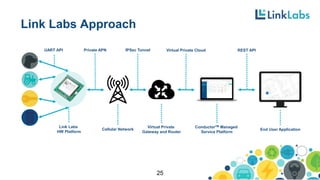
Link Labs Approach
25
UART API Private APN IPSec Tunnel
Link Labs
HW Platform
Cellular Network
Virtual Private
Gateway and Router
REST API
End User Application
ConductorTM Managed
Service Platform
Virtual Private Cloud
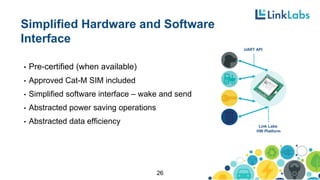
Simplified Hardware and Software
Interface
• Pre-certified (when available)
• Approved Cat-M SIM included
• Simplified software interface – wake and send
• Abstracted power saving operations
• Abstracted data efficiency
26
UART API
Link Labs
HW Platform
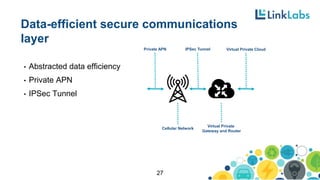
Data-efficient secure communications
layer
• Abstracted data efficiency
• Private APN
• IPSec Tunnel
27
Private APN IPSec Tunnel
Cellular Network
Virtual Private
Gateway and Router
Virtual Private Cloud
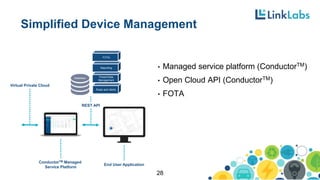
Simplified Device Management
• Managed service platform (ConductorTM)
• Open Cloud API (ConductorTM)
• FOTA
28
Power/Data
Management
REST API
End User Application
ConductorTM Managed
Service Platform
Virtual Private Cloud
Reporting
FOTA
Rules and Alerts
Database
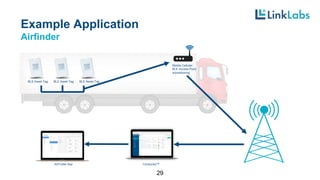
Example Application
Airfinder
29
AirFinder App
BLE Asset Tag BLE Asset TagBLE Asset Tag
Mobile Cellular-
BLE Access Point
w/positioning
ConductorTM
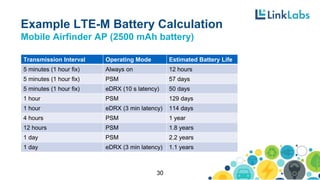
Example LTE-M Battery Calculation
Mobile Airfinder AP (2500 mAh battery)
30
Transmission Interval Operating Mode Estimated Battery Life
5 minutes (1 hour fix) Always on 12 hours
5 minutes (1 hour fix) PSM 57 days
5 minutes (1 hour fix) eDRX (10 s latency) 50 days
1 hour PSM 129 days
1 hour eDRX (3 min latency) 114 days
4 hours PSM 1 year
12 hours PSM 1.8 years
1 day PSM 2.2 years
1 day eDRX (3 min latency) 1.1 years
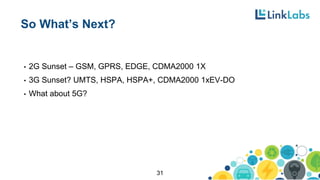
So What’s Next?
• 2G Sunset – GSM, GPRS, EDGE, CDMA2000 1X
• 3G Sunset? UMTS, HSPA, HSPA+, CDMA2000 1xEV-DO
• What about 5G?
31
Where you can find us
• www.link-labs.com
• store.link-labs.com
• https://www.digikey.com/en/supplier-centers/l/link-labs
• https://www.futureelectronics.com/en/manufacturers/link-
labs/Pages/index.aspx
• https://www.arrow.com/en/manufacturers/link-labs
32
Thank You
Contact
sales@link-labs.com

Link labs LTE-M NB-IOT Hype Webinar slides

  • 1.
    Link Labs LTE Cat-M1and NB1 – Beyond the Hype November 2017
  • 2.
    Agenda • About LinkLabs • Technology overview of LTE Cat-M1 and NB1 (NB-IoT) • Low power operations • Design considerations • Business considerations • Planning for the future • Q&A 2
  • 3.
    How to aska question Many questions were submitted before the webinar To submit additional questions visit http://forum.link-labs.com/ 3
  • 4.
  • 5.
    LTE Cat-M1 (LTE-M) •1.4 MHz frontend (vs. 20 MHz) + 1 Antenna Simplified design • >300 kbps half-duplex • Can be deployed in existing LTE bands • Compatible with existing LTE networks* • Supports mobility • VoLTE, FOTA, LTE LBS 5
  • 6.
    LTE Cat-NB1 (NB-IoT) •200 kHz frontend chipsets could be less expensive than Cat-M1 • <250 kbps half-duplex (multi-tone uplink), <20 kbps uplink (single tone) • Can be deployed in existing LTE bands, in guard bands, re-farmed spectrum, or other standalone bands • Requires new basestation hardware • Does not currently support mobility 6
  • 7.
    LTE-M vs. NB-IoTSummary 7 LTE-M NB-IoT Receiver Bandwidth 1.2 MHz 200 kHz Peak data rate – uplink 375 kbps 20 kbps (Single Tone) Peak data rate – downlink 300 kbps 250 kbps Frequency Deployment In LTE Band Flexible Mobility Yes No Basestation SW upgrade Yes* No Module Cost <$10 ~10% less than LTE-M
  • 8.
    Typical Cellular IoTSystem 8 RF Frontend Baseband Chipset Power Mgmt Memory SIM/UICC Sensor(s) / Actuator(s) Other I/Os / Peripherals Host Application Processor Battery / Power Memory eNodeB EPC PDN IMS / Gateway / VPN Managed Services Device Management SIM Management Application Enablement Power and data management Billing FOTA Application U/I Rules / Alerts Reports Billing
  • 9.
  • 10.
  • 11.
    Hardware “Platform” • Somevendors incorporate a module into a “platform,” “system,” “modem,” etc. • Incorporates other features, such as simple HW interfaces, proprietary SW stacks, SIMs, power management, cloud platforms, etc. • Some of these are “pre-certified” on various carriers or give customers more certainty or ease of carrier certification • I will discuss the Link Labs approach later in this presentation 11
  • 12.
  • 13.
    Efficient Operation withCat-M1/NB1 Power Savings Mode (PSM) • Device remains attached to network, but is not reachable during sleep • User can send messages to device during idle windows after transmissions • Sleep period between hours and days (defined by network operator) • Good for applications with event or timer driven uplink 13
  • 14.
    Efficient Operation withCat-M1/NB1 Extended Discontinuous Receive (eDRX) Mode • Extended windows of sleep between LTE paging cycles • eDRX cycles can be up to ~44 min for LTE-M and ~3 hours for NB-IoT • Good alternative to extend battery life for “always on” devices 14
  • 15.
    Example LTE-M BatteryCalculation Consumer GPS tracker (450 mAh battery) 15 Fix / Transmission Interval Operating Mode Estimated Battery Life 5 minutes Normal 17 hours 5 minutes PSM ~2 days 5 minutes eDRX (10 s latency) ~2 days 1 hour PSM 22.5 days 1 hour eDRX (3 min latency) 19.8 days 4 hours PSM 73 days 12 hours PSM 152 days 1 day PSM 209 days 1 day Toggle On / Off 129 days
  • 16.
    Example LTE-M BatteryCalculation Remote Environmental Sensor w/ Alarm (450 mAh battery) 16 Transmission Interval Operating Mode Estimated Battery Life 5 minutes Toggle On / Off 25 hours 5 minutes PSM 14 days 5 minutes eDRX (10 s latency) 12.3 days 1 hour PSM 110 days 1 hour eDRX (3 min latency) 67 days 4 hours PSM 205 days 12 hours PSM 277 days 1 day PSM 304 days 1 day Toggle On / Off 160 days
  • 17.
    Example LTE-M BatteryCalculation Water or Gas Meter (7.7 Ah C cell Li-SOCL2 battery) 17 Transmission Interval Operating Mode Estimated Battery Life 1 hour PSM 5.7 years 4 hours PSM 10.7 years 12 hours PSM 14.4 years 1 day PSM 15.8 years 1 day Toggle On / Off 8.3 years
  • 18.
    LTE-M Battery Considerations •Chemistry, chemistry, chemistry • Cost • Test, test, test 18
  • 19.
    Cost considerations • Design •Components • Certification and testing • Cellular service • Managed services 19
  • 20.
    Design and Components 20 •Assume 10K units per year • Sensor, Host MCU, Memory, PCB, connectors, other application-specific components – $10-30 • Cellular Module, SIM, SIM holder, level shifter(s), connectors – $20-30 • Antenna – $5-10 • Battery – $5-10 • Enclosure – $5-10 RF Frontend Baseband Chipset Power Mgmt Memory SIM/UICC Sensor(s) / Actuator(s) Other I/Os / Peripherals Host Application Processor Battery / Power Memory
  • 21.
    Certification and testing •PTCRB / GCF / Other carrier certifications • FCC / IC / Other government regulatory agencies 21
  • 22.
    100x more expensive per byte! CellularService Costs are driven by the amount of transmitted data 22 Traditional Cellular MNO Low-Power IoT (LTE-M, NB-IOT) Connectivity Cost / Metering Low ~ $1/(100 MB) per month High ~ $1/(MB) per month If average device transmits 0.95 MB of data per month If average device transmits 1.05 MB of data per month Cost per device $1 $2 Number of devices 1,000,000 1,000,000 Operating cost $1,000,000 per month $2,000,000 per month Un-pooled Network Operator Rate Plan Example
  • 23.
    Managed services 23 Managed Services DeviceManagement SIM Management Application Enablement Power and data management Billing FOTA
  • 24.
    Other Risks andChallenges • Component Availability • Network Availability • Roaming / “Global” Coverage • Data usage and exposure • “True” Low Power Operation • Battery chemistry • Uncertain battery performance 24
  • 25.
    Link Labs Approach 25 UARTAPI Private APN IPSec Tunnel Link Labs HW Platform Cellular Network Virtual Private Gateway and Router REST API End User Application ConductorTM Managed Service Platform Virtual Private Cloud
  • 26.
    Simplified Hardware andSoftware Interface • Pre-certified (when available) • Approved Cat-M SIM included • Simplified software interface – wake and send • Abstracted power saving operations • Abstracted data efficiency 26 UART API Link Labs HW Platform
  • 27.
    Data-efficient secure communications layer •Abstracted data efficiency • Private APN • IPSec Tunnel 27 Private APN IPSec Tunnel Cellular Network Virtual Private Gateway and Router Virtual Private Cloud
  • 28.
    Simplified Device Management •Managed service platform (ConductorTM) • Open Cloud API (ConductorTM) • FOTA 28 Power/Data Management REST API End User Application ConductorTM Managed Service Platform Virtual Private Cloud Reporting FOTA Rules and Alerts Database
  • 29.
    Example Application Airfinder 29 AirFinder App BLEAsset Tag BLE Asset TagBLE Asset Tag Mobile Cellular- BLE Access Point w/positioning ConductorTM
  • 30.
    Example LTE-M BatteryCalculation Mobile Airfinder AP (2500 mAh battery) 30 Transmission Interval Operating Mode Estimated Battery Life 5 minutes (1 hour fix) Always on 12 hours 5 minutes (1 hour fix) PSM 57 days 5 minutes (1 hour fix) eDRX (10 s latency) 50 days 1 hour PSM 129 days 1 hour eDRX (3 min latency) 114 days 4 hours PSM 1 year 12 hours PSM 1.8 years 1 day PSM 2.2 years 1 day eDRX (3 min latency) 1.1 years
  • 31.
    So What’s Next? •2G Sunset – GSM, GPRS, EDGE, CDMA2000 1X • 3G Sunset? UMTS, HSPA, HSPA+, CDMA2000 1xEV-DO • What about 5G? 31
  • 32.
    Where you canfind us • www.link-labs.com • store.link-labs.com • https://www.digikey.com/en/supplier-centers/l/link-labs • https://www.futureelectronics.com/en/manufacturers/link- labs/Pages/index.aspx • https://www.arrow.com/en/manufacturers/link-labs 32
  • 33.