Elements of Design
ACADEMICS SUPPORT
INIFD CORPORATE
Line
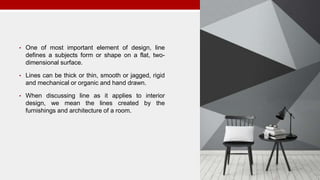
• One of most important element of design, line
defines a subjects form or shape on a flat, two-
dimensional surface.
• Lines can be thick or thin, smooth or jagged, rigid
and mechanical or organic and hand drawn.
• When discussing line as it applies to interior
design, we mean the lines created by the
furnishings and architecture of a room.
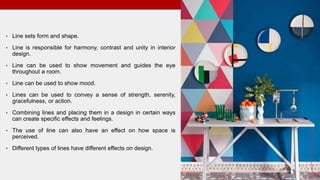
• Line sets form and shape.
• Line is responsible for harmony, contrast and unity in interior
design.
• Line can be used to show movement and guides the eye
throughout a room.
• Line can be used to show mood.
• Lines can be used to convey a sense of strength, serenity,
gracefulness, or action.
• Combining lines and placing them in a design in certain ways
can create specific effects and feelings.
• The use of line can also have an effect on how space is
perceived.
• Different types of lines have different effects on design.
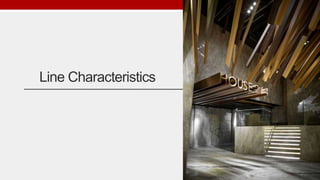
Line Characteristics
• A mark, or stroke that is longer then it is wide. It is the path of a point moving in space.
Objects and things are perceived by the line that describes them. Characteristics of line
include:
• Width-thick, thin, tapering, uneven
• Length-long, short, continuous, broken
• Direction-horizontal, vertical, diagonal, curving, perpendicular, oblique, parallel, radial,
zigzag
• Focus-sharp, blurry, fuzzy, choppy
• Feeling-sharp, jagged, graceful, smooth ... can you think of others?
• Direction of the line - The Direction of the
line is the strongest of the aspects because
it leads the eye and creates focus.
Vertical Lines
• Awake
• Alert
• Defy Gravity
• Rigid
• Firm
• Stable
• Strong.
Vertical lines lead the eye up,
• Adding height
• Formality
• Growth
• Spirituality
• Grandeur
• Strength to a design.
Can be seen in:
• Tall furniture
• Columns
• Pillars
• Striped wallpaper
• Long narrow draperies
Horizontal lines
• Restful
• Yield to gravity
• Create quiet
• Repose
• Passivity
• Calmness
• Serenity.
Horizontal lines lead the eye to the left or right, suggesting
informality
• Calm
• Peace
• Gentleness
• Gravity
• Restfulness.
• Horizontal lines can make buildings, rooms, and furniture
seem wider and shorter.
Can be seen in:
• Long, low roofs
• Long, low furniture pieces such as sofas and chests
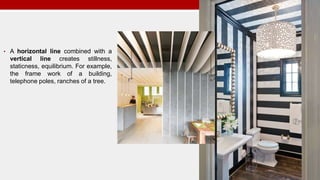
• A horizontal line combined with a
vertical line creates stillness,
staticness, equilibrium. For example,
the frame work of a building,
telephone poles, ranches of a tree.
Diagonal Lines
• Undecided
• Unstable
• Busy
• Active,
• Dynamic
• Restless
• Dramatic
• Sporty
• Lengthening
• Reduce horizontal or vertical shapes.
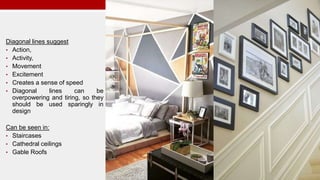
Diagonal lines suggest
• Action,
• Activity,
• Movement
• Excitement
• Creates a sense of speed
• Diagonal lines can be
overpowering and tiring, so they
should be used sparingly in
design
Can be seen in:
• Staircases
• Cathedral ceilings
• Gable Roofs
• Often a diagonal line needs opposing
diagonal to appear balanced.
• If joining diagonal lines are pointing down
they tend to lift up, or make object appear
lighter and more youthful.
• If they are pointing up the lines will have
the opposite effect causing the object to
appear heavier, somber or droopy.
• Curved Lines -A kind of line which is not
required to be straight. Curved lines are often
called irregular lines. A curved line refers to a
line that is always bending and changing
directions gradually. A curved line seems
gracious and flexible, as when a person takes
position in relaxation and play. They are found in
tied- back curtains and in the legs and corners of
furniture's.
Too many curved lines create
• A busy look
• Represent freedom
• Natural
• Flow
• Appearance of softness
• A soothing feeling.
• Curved lines create natural flow and
freedom.
Can be seen in:
• Doorway arches
• Ruffled curtains
• Curved furniture
• Rounded accessories
• Staircases
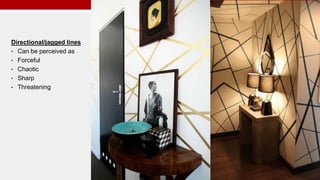
Directional/jagged lines
• Can be perceived as
• Forceful
• Chaotic
• Sharp
• Threatening
Thin lines
• Can be experienced by
 Unstable
 weak
• Thick lines
• Can be experienced by
 Rigid
 Dependent
 dominating
Line + texture
• Moods can be modified by aspects as
well:
• An assertive straight path can be
modified with shaped and become
delicate or ephemeral.
Porous Lacy

Line.pptx

  • 1.
    Elements of Design ACADEMICSSUPPORT INIFD CORPORATE Line
  • 2.
    • One ofmost important element of design, line defines a subjects form or shape on a flat, two- dimensional surface. • Lines can be thick or thin, smooth or jagged, rigid and mechanical or organic and hand drawn. • When discussing line as it applies to interior design, we mean the lines created by the furnishings and architecture of a room.
  • 3.
    • Line setsform and shape. • Line is responsible for harmony, contrast and unity in interior design. • Line can be used to show movement and guides the eye throughout a room. • Line can be used to show mood. • Lines can be used to convey a sense of strength, serenity, gracefulness, or action. • Combining lines and placing them in a design in certain ways can create specific effects and feelings. • The use of line can also have an effect on how space is perceived. • Different types of lines have different effects on design.
  • 4.
  • 5.
    • A mark,or stroke that is longer then it is wide. It is the path of a point moving in space. Objects and things are perceived by the line that describes them. Characteristics of line include: • Width-thick, thin, tapering, uneven • Length-long, short, continuous, broken • Direction-horizontal, vertical, diagonal, curving, perpendicular, oblique, parallel, radial, zigzag • Focus-sharp, blurry, fuzzy, choppy • Feeling-sharp, jagged, graceful, smooth ... can you think of others?
  • 6.
    • Direction ofthe line - The Direction of the line is the strongest of the aspects because it leads the eye and creates focus.
  • 7.
    Vertical Lines • Awake •Alert • Defy Gravity • Rigid • Firm • Stable • Strong.
  • 8.
    Vertical lines leadthe eye up, • Adding height • Formality • Growth • Spirituality • Grandeur • Strength to a design. Can be seen in: • Tall furniture • Columns • Pillars • Striped wallpaper • Long narrow draperies
  • 9.
    Horizontal lines • Restful •Yield to gravity • Create quiet • Repose • Passivity • Calmness • Serenity.
  • 10.
    Horizontal lines leadthe eye to the left or right, suggesting informality • Calm • Peace • Gentleness • Gravity • Restfulness. • Horizontal lines can make buildings, rooms, and furniture seem wider and shorter. Can be seen in: • Long, low roofs • Long, low furniture pieces such as sofas and chests
  • 11.
    • A horizontalline combined with a vertical line creates stillness, staticness, equilibrium. For example, the frame work of a building, telephone poles, ranches of a tree.
  • 12.
    Diagonal Lines • Undecided •Unstable • Busy • Active, • Dynamic • Restless • Dramatic • Sporty • Lengthening • Reduce horizontal or vertical shapes.
  • 13.
    Diagonal lines suggest •Action, • Activity, • Movement • Excitement • Creates a sense of speed • Diagonal lines can be overpowering and tiring, so they should be used sparingly in design Can be seen in: • Staircases • Cathedral ceilings • Gable Roofs
  • 14.
    • Often adiagonal line needs opposing diagonal to appear balanced. • If joining diagonal lines are pointing down they tend to lift up, or make object appear lighter and more youthful. • If they are pointing up the lines will have the opposite effect causing the object to appear heavier, somber or droopy.
  • 15.
    • Curved Lines-A kind of line which is not required to be straight. Curved lines are often called irregular lines. A curved line refers to a line that is always bending and changing directions gradually. A curved line seems gracious and flexible, as when a person takes position in relaxation and play. They are found in tied- back curtains and in the legs and corners of furniture's.
  • 16.
    Too many curvedlines create • A busy look • Represent freedom • Natural • Flow • Appearance of softness • A soothing feeling. • Curved lines create natural flow and freedom. Can be seen in: • Doorway arches • Ruffled curtains • Curved furniture • Rounded accessories • Staircases
  • 17.
    Directional/jagged lines • Canbe perceived as • Forceful • Chaotic • Sharp • Threatening
  • 18.
    Thin lines • Canbe experienced by  Unstable  weak
  • 19.
    • Thick lines •Can be experienced by  Rigid  Dependent  dominating
  • 20.
    Line + texture •Moods can be modified by aspects as well: • An assertive straight path can be modified with shaped and become delicate or ephemeral.
  • 21.