T E C H N O L O G Y   W H I T E   P A P E R


                Portfolio: White Paper 1
Technical overview


                Wireless operators are facing exponential growth in adoption rates, as well as device
                capabilities. As this trend continues, existing networks and architectures will not be able
                to deliver the required performance — or maintain costs at an economically sustainable
                level. To address these challenges, lightRadio™ offers a new wireless networking paradigm,
                which can add sufficient capacity, in the right location, with the right technology, to
                optimize the end-user experience along with operator economics. This paper provides
                an overview of the lightRadio paradigm developed by Alcatel-Lucent and Bells Labs,
                including technology components, transport options — and the total cost of ownership
                savings that can be realized.


                This paper is one in a series authored by Alcatel-Lucent that discuss the current state
                of wireless networks and the benefits of transitioning to a lightRadio architecture that
                supports data and video traffic, now and well into the future.
Table of contents

              1	    1.	Introduction

              1	    2.	The	consequences	of	accelerating	wireless	demand

              3	    3.	The	lightRadio	paradigm
              3       3.1 Business enabler 1: Seamless increase in spectral bandwidth
              4       3.2 Business enabler 2: Optimization of cell site capacity
              5       3.3 Business enabler 3: Optimization of technology evolution
              6       3.4 Business enabler 4: Maximal utilization of new spectral bands
              7       3.5 Business enabler 5: Optimization of antenna configuration

              8	    4.	Transport	options	for	lightRadio
              10      4.1 IP backhaul options
              11      4.2 CPRI interconnect options

              12	   5.	Total	cost	of	ownership	savings

              12	   6.	Conclusion

              13	   7.	Acronyms

              13	   8.	References	

              13	   9.	Authors
1. Introduction
              The wireless industry is at a turning point. The confluence of end-user demand and proliferation
              of devices with advanced media capabilities is manifestly at odds with the cost and performance
              of existing wireless networks and architectures. Recognizing this dichotomy, along with emerging
              trends in key underlying technologies, Alcatel-Lucent and Bell Labs are creating a new wireless
              networking paradigm: lightRadio. This paper outlines the essential elements of a lightRadio
              network and the dramatic impact they can have on network economics and end-user experience.

2. The consequences of accelerating wireless demand
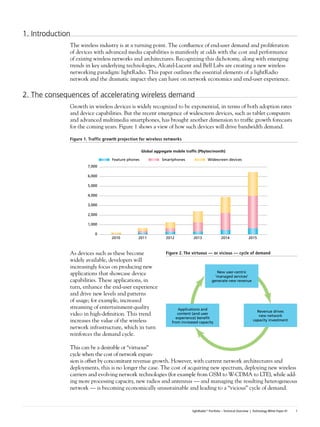
              Growth in wireless devices is widely recognized to be exponential, in terms of both adoption rates
              and device capabilities. But the recent emergence of widescreen devices, such as tablet computers
              and advanced multimedia smartphones, has brought another dimension to traffic growth forecasts
              for the coming years. Figure 1 shows a view of how such devices will drive bandwidth demand.

              Figure 1. Traffic growth projection for wireless networks

                                                    Global aggregate mobile traffic (Pbytes/month)

                                   Feature phones              Smartphones                Widescreen devices
                       7,000

                       6,000

                       5,000

                       4,000

                       3,000

                       2,000

                       1,000

                          0
                                   2010         2011             2012           2013                2014                2015


              As devices such as these become                    Figure 2. The virtuous — or vicious — cycle of demand
              widely available, developers will
              increasingly focus on producing new
              applications that showcase device                                                 New user-centric
                                                                                               ‘managed services’
              capabilities. These applications, in                                           generate new revenue
              turn, enhance the end-user experience
              and drive new levels and patterns
              of usage; for example, increased
              streaming of entertainment-quality                       Applications and
                                                                                                                             Revenue drives
              video in high-definition. This trend                     content (and user
                                                                                                                              new network
                                                                      experience) benefit
              increases the value of the wireless                   from increased capacity
                                                                                                                           capacity investment

              network infrastructure, which in turn
              reinforces the demand cycle.

              This can be a desirable or “virtuous”
              cycle when the cost of network expan-
              sion is offset by concomitant revenue growth. However, with current network architectures and
              deployments, this is no longer the case. The cost of acquiring new spectrum, deploying new wireless
              carriers and evolving network technologies (for example from GSM to W-CDMA to LTE), while add-
              ing more processing capacity, new radios and antennas — and managing the resulting heterogeneous
              network — is becoming economically unsustainable and leading to a “vicious” cycle of demand.


                                                                               lightRadio™ Portfolio – Technical Overview | Technology White Paper #1   1
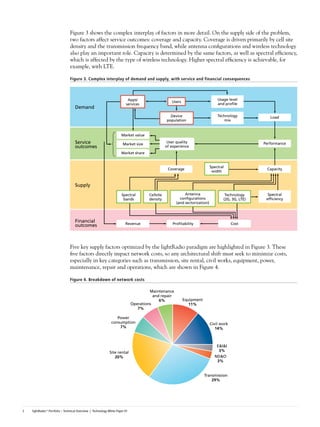
Figure 3 shows the complex interplay of factors in more detail. On the supply side of the problem,
                               two factors affect service outcomes: coverage and capacity. Coverage is driven primarily by cell site
                               density and the transmission frequency band, while antenna configurations and wireless technology
                               also play an important role. Capacity is determined by the same factors, as well as spectral efficiency,
                               which is affected by the type of wireless technology. Higher spectral efficiency is achievable, for
                               example, with LTE.

                               Figure 3. Complex interplay of demand and supply, with service and financial consequences


                                                                         Apps/                                                   Usage level
                                                                                                    Users
                                                                        services                                                 and profile
                                   Demand
                                                                                                   Device                        Technology            Load
                                                                                                 population                          mix


                                                                     Market value
                                   Service                            Market size
                                                                                                  User quality                                      Performance
                                   outcomes                                                      of experience
                                                                     Market share


                                                                                                                             Spectral
                                                                                                  Coverage                                           Capacity
                                                                                                                              width


                                   Supply
                                                                     Spectral         Cellsite              Antenna                  Technology       Spectral
                                                                      bands           density            configurations              (2G, 3G, LTE)    efficiency
                                                                                                       (and sectorization)


                                   Financial                            Revenue                      Profitability                         Cost
                                   outcomes


                               Five key supply factors optimized by the lightRadio paradigm are highlighted in Figure 3. These
                               five factors directly impact network costs, so any architectural shift must seek to minimize costs,
                               especially in key categories such as transmission, site rental, civil works, equipment, power,
                               maintenance, repair and operations, which are shown in Figure 4.

                               Figure 4. Breakdown of network costs

                                                                                      Maintenance
                                                                                        and repair
                                                                                           6%               Equipment
                                                                             Operations                        11%
                                                                                7%

                                                                 Power
                                                              consumption                                                    Civil work
                                                                  7%                                                            14%


                                                                                                                                E&I&I
                                                            Site rental                                                          3%
                                                               20%                                                             ND&O
                                                                                                                                3%


                                                                                                                        Transmission
                                                                                                                            29%


2   lightRadio™ Portfolio – Technical Overview | Technology White Paper #1
Design of the lightRadio product family focused on the entirety of network costs over time, including
              the long-term total cost of ownership. Consequently, the lightRadio solution architecture is economi-
              cally attractive — and can leverage each operator’s unique existing assets and capabilities. This paper
              will quantify the total cost of ownership savings associated with the lightRadio networking paradigm.

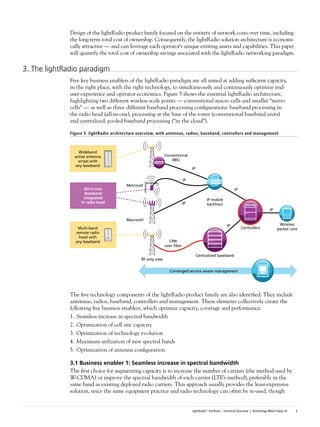
3. The lightRadio paradigm
              Five key business enablers of the lightRadio paradigm are all aimed at adding sufficient capacity,
              in the right place, with the right technology, to simultaneously and continuously optimize end-
              user experience and operator economics. Figure 5 shows the essential lightRadio architecture,
              highlighting two different wireless scale points — conventional macro cells and smaller “metro
              cells” — as well as three different baseband processing configurations: baseband processing in
              the radio head (all-in-one), processing at the base of the tower (conventional baseband units)
              and centralized, pooled baseband processing (“in the cloud”).

              Figure 5. lightRadio architecture overview, with antennas, radios, baseband, controllers and management


                  Wideband
                active antenna                                   Conventional
                  arrays with                                        BBU
                any baseband
                                                                                  IP

                                                                             IP
                                         Metrocell
                     All-in-one:                                                                                IP
                      Baseband
                     integrated                                                             IP mobile
                   in radio head                                             IP             backhaul
                                                                                                                                          IP

                                         Macrocell
                                                                                                           IP                                    Wireless
                 Multi-band                                                                                          Controllers                packet core
                remote radio
                  head with
                any baseband                                       CPRI
                                                                 over fiber

                                                                                       Centralized baseband
                                                 RF only sites

                                                                   Converged service aware management


              The five technology components of the lightRadio product family are also identified. They include
              antennas, radios, baseband, controllers and management. These elements collectively create the
              following five business enablers, which optimize capacity, coverage and performance:
              1. Seamless increase in spectral bandwidth
              2. Optimization of cell site capacity
              3. Optimization of technology evolution
              4. Maximum utilization of new spectral bands
              5. Optimization of antenna configuration

              3.1	Business	enabler	1:	Seamless	increase	in	spectral	bandwidth
              The first choice for augmenting capacity is to increase the number of carriers (the method used by
              W-CDMA) or improve the spectral bandwidth of each carrier (LTE’s method), preferably in the
              same band as existing deployed radio carriers. This approach usually provides the least-expensive
              solution, since the same equipment practice and radio technology can often be re-used, though


                                                                                  lightRadio™ Portfolio – Technical Overview | Technology White Paper #1   3
with expanded capacity. If spectral bandwidth increases are in a new frequency band, there is no
                               clear advantage to using the same generation of wireless technology, since new antennas, radios
                               and baseband equipment will be required. However, capacity needs to be matched not only to
                               the demand in specific locations but also to the device population and related usage intensity.
                               Therefore, a combination of existing and emerging technologies is required. lightRadio makes
                               this possible with optimal economics.

                               lightRadio enables operators to “get it right” when deploying a solution to match user demand or
                               expectations, while continuously optimizing the overall solution — all the way from the antenna
                               to baseband processing and controller elements.

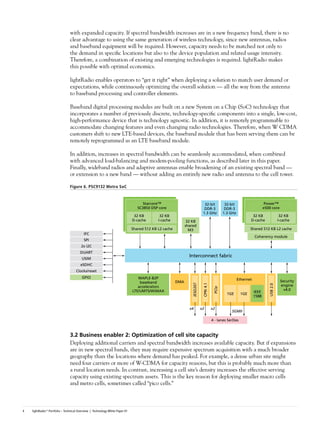
                               Baseband digital processing modules are built on a new System on a Chip (SoC) technology that
                               incorporates a number of previously discrete, technology-specific components into a single, low-cost,
                               high-performance device that is technology agnostic. In addition, it is remotely programmable to
                               accommodate changing features and even changing radio technologies. Therefore, when W CDMA
                               customers shift to new LTE-based devices, the baseband module that has been serving them can be
                               remotely reprogrammed as an LTE baseband module.

                               In addition, increases in spectral bandwidth can be seamlessly accommodated, when combined
                               with advanced load-balancing and modem-pooling functions, as described later in this paper.
                               Finally, wideband radios and adaptive antennas enable broadening of an existing spectral band —
                               or extension to a new band — without adding an entirely new radio and antenna to the cell tower.

                               Figure 6. PSC9132 Metro SoC


                                                                                   Starcore™                                32-bit             32-bit                      Power™
                                                                                SC3850 DSP core                             DDR-3              DDR-3                      e500 core
                                                                                                                           1.3 GHz            1.3 GHz
                                                                              32 KB         32 KB                                                               32 KB                   32 KB
                                                                             D-cache       I-cache           32 KB                                             D-cache                 I-cache
                                                                                                            shared
                                                                             Shared 512 KB L2 cache           M3                                               Shared 512 KB L2 cache
                                         IFC
                                                                                                                                                                   Coherency module
                                         SPI
                                       2x I2C
                                       DUART
                                                                                                              Interconnect fabric
                                        USIM
                                       eSDHC
                                    Clocks/reset
                                        GPIO                                    MAPLE-B2P                                                               Ethernet                        Security
                                                                                 baseband             DMA
                                                                                                                JESD207

                                                                                                                           CPRI 4.1


                                                                                                                                                                                        engine
                                                                                                                                                                             USB 2.0


                                                                                accelerators
                                                                                                                                       PCle


                                                                             LTE/UMTS/WiMAX                                                                                               v4.0
                                                                                                                                                                   IEEE
                                                                                                                                                1GE      1GE
                                                                                                                                                                   1588


                                                                                                              x4          x2          x2
                                                                                                                                                  SGMII

                                                                                                                                      4 - lanes SerDes


                               3.2	Business	enabler	2:	Optimization	of	cell	site	capacity
                               Deploying additional carriers and spectral bandwidth increases available capacity. But if expansions
                               are in new spectral bands, they may require expensive spectrum acquisition with a much broader
                               geography than the locations where demand has peaked. For example, a dense urban site might
                               need four carriers or more of W-CDMA for capacity reasons, but this is probably much more than
                               a rural location needs. In contrast, increasing a cell site’s density increases the effective serving
                               capacity using existing spectrum assets. This is the key reason for deploying smaller macro cells
                               and metro cells, sometimes called “pico cells.”


4   lightRadio™ Portfolio – Technical Overview | Technology White Paper #1
Deployment of smaller macro cells offers sectorized, consistent performance throughout the cell,
in all directions. However, finding new sites in dense urban areas can be difficult. Increasingly, the
location of the radio and antenna provides no space for a conventional rack-mounted baseband unit
in a temperature-controlled enclosure at the base of the tower. Thus, one of two approaches can be
taken for macro cells:
• Put all baseband processing into a single unified multi-technology base station
• Transport baseband radio signals to a centralized location where the baseband processing
   equipment can be located.

These approaches are complementary. The choice depends on the availability of necessary backhaul
bandwidth, the dynamism or elasticity of demand patterns and the operational costs. Therefore,
both approaches are supported by the lightRadio paradigm.

Outside of urban areas, sites are often served by microwave, when backhauling of Common Public
Radio Interface (CPRI) signals to a central location is not cost effective and a more traditional
baseband unit (BBU) provides the best fit. Considering an operator’s entire network footprint —
and the many infrastructure configurations comprising the network — it is clearly undesirable to
change the available features when a user moves between cells or locations or, equally, to invest in
network assets that will have a limited effective lifetime. Consequently, consistent functionality and
re-usable common hardware and software components are a primary part of the lightRadio product
family. These advantages are provided by common digital baseband components across different
products and radio technologies.

Another way to increase cell site density is to introduce smaller cells, or “metro cells,” at cost-
effective site locations with the requisite backhaul and power sources. Metro cells do not typically
provide 360 contiguous coverage, but they augment a macro network in “hot spots” that have high
traffic density. In the lightRadio paradigm, metro cells are built on the same SoC technology as the
macro cells discussed earlier, and they leverage the same backhaul resources.

3.3	Business	enabler	3:	Optimization	of	technology	evolution
Deployment of new wireless technology, often in new frequency bands, provides another means for
increasing capacity and optimizing network economics. For example, an operator may deploy LTE
in a new frequency band, such as 700 MHz or 2.6 GHz, in a new antenna configuration such as a 4
x 4 multiple-input multiple-output antenna system (MIMO). This deployment anticipates, and may
even fuel, the user-device population’s shift from 3G to LTE, while it diverts traffic from overloaded
3G carriers. With the higher spectral efficiency of LTE, the operator will have more effective
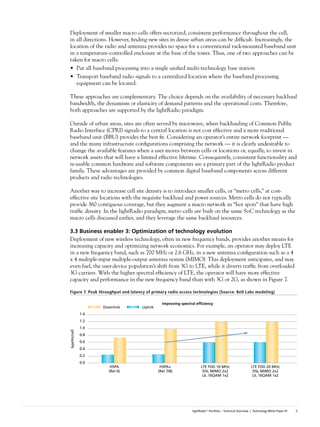
capacity and performance in the new frequency band than with 3G or 2G, as shown in Figure 7.

Figure 7. Peak throughput and latency of primary radio access technologies (Source: Bell Labs modeling)

                                               Improving spectral efficiency
                    Downlink        Uplink
              1.4
              1.2
              1.0
bps/Hz/cell


              0.8
              0.6
              0.4
              0.2
              0.0
                       HSPA                   HSPA+                  LTE FDD 10 MHz                       LTE FDD 20 MHz
                      (Rel 6)                (Rel 7/8)                DSL MIMO 2x2                         DSL MIMO 2x2
                                                                      UL 16QAM 1x2                         UL 16QAM 1x2


                                                               lightRadio™ Portfolio – Technical Overview | Technology White Paper #1   5
This progression will continue with LTE-Advanced, which provides carrier aggregation (“bonding”
                               together separate frequency bands) and advanced methods for coordinating multiple base stations,
                               such as coordinated multipoint transmission and reception (CoMP) and dynamic inter-cell interfer-
                               ence coordination (ICIC). CoMP will increase the effective spectral efficiency and positively affect
                               end-user performance.

                               This technology evolution is not unique to the lightRadio concept. But lightRadio supports both
                               current and anticipated wireless technologies in the following unique way: The baseband module
                               (whether in the centralized or remote architecture) is dynamically reprogrammable to support
                               multiple combinations of W-CDMA and LTE technologies and their evolution. Thus, an operator
                               could start with a baseband that is 100 percent W-CDMA and evolve over time by simple remote
                               software reconfiguration until, at some stage, the same hardware is used 100 percent for LTE.

                               lightRadio also optimally supports the developments anticipated in LTE-Advanced and 3G by
                               allowing seamless migration of baseband processing from the remote site to a centralized baseband
                               processing pool. Digital modules from the remote baseband unit could even be redeployed in the
                               centralized processing site, or they could be configured to operate as a coordinated pool of resources
                               at the remote site.

                               In addition, Alcatel-Lucent innovations extend the concept of self-optimizing networks (SON).
                               They apply a new layer of understanding, called “wireless IP intelligence,” to optimization across
                               the entire network, including the RAN, packet core and both licensed and unlicensed spectrum
                               assets, such as WiFi access points. This end-to-end optimization is critical for responding to rapidly
                               changing demand patterns — and helps anticipate the need for coherent metro cell and macro cell
                               optimization, as metro cells are installed opportunistically in demand “hot-spots.”

                               3.4	Business	enabler	4:	Maximal	utilization	of	new	spectral	bands
                               Deployment of capacity in new spectral bands usually carries significant costs for spectrum
                               acquisition and new equipment. If the new band is lower in frequency than existing bands, such
                               as 700 MHz, coverage will improve, because lower frequency bands exhibit superior propagation
                               characteristics and cell reach. Deployments in higher frequency bands, such as 2.6 GHz, will have
                               more limited reach, which can result in coverage holes between base stations, particularly when
                               sites were chosen based on a lower-frequency spectral band. For example, at 2600 MHz, LTE has
                               one-third the cell radius of W-CDMA at 900 MHz.1 Thus, deployment in higher bands may create
                               “patchy” services where there are frequent fallbacks from LTE to 3G, or even 2G. Or significant
                               additional expense may be incurred to fill in these coverage holes. Operators are moving to four-
                               and even eight-branch receive diversity2 to help cover the link budget gap.

                               Again, lightRadio has a unique advantage, because it allows the capital expenditure associated
                               with multi-band deployment to be dramatically reduced through use of “wideband” radios that can
                               operate across multiple spectral bands. Further, the wideband radios can assist with some additional
                               mechanical tower loading issues, in particular for new sites.


                               1
                                   WCDMA at 900 MHz, 40W MC-RRH, xCEM, UL cell edge target rate PS64 HSUPA, Cat 3 HSUPA UE. LTE at 2600 MHz, 10 MHz BW, UL cell
                                   edge target rate PS128, average across all morphologies.
                               2
                                   Receive diversity provides protection against fading by using another copy of the signal from the user on an additional antenna (a different
                                   “branch”) because the fading and noise are uncorrelated between the different antennas. This also allows the user to transmit at lower
                                   power, which decreases interference. However receive diversity requires additional receiver chains in both the RF and baseband components,
                                   and improvements tail off rapidly with increased branches, since the improvements are less than linear. Improvements from averaging out the
                                   RF noise however (introduced by the RF chain in a receiver) do increase linearly.


6   lightRadio™ Portfolio – Technical Overview | Technology White Paper #1
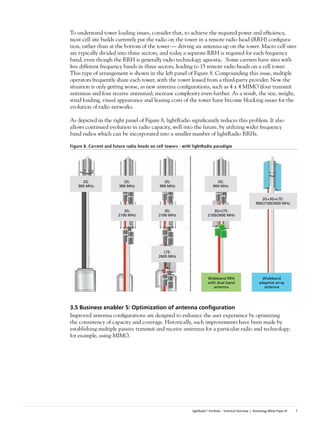
To understand tower loading issues, consider that, to achieve the required power and efficiency,
most cell site builds currently put the radio on the tower in a remote radio head (RRH) configura-
tion, rather than at the bottom of the tower — driving an antenna up on the tower. Macro cell sites
are typically divided into three sectors, and today a separate RRH is required for each frequency
band, even though the RRH is generally radio technology agnostic. Some carriers have sites with
five different frequency bands in three sectors, leading to 15 remote radio heads on a cell tower.
This type of arrangement is shown in the left panel of Figure 8. Compounding this issue, multiple
operators frequently share each tower, with the tower leased from a third-party provider. Now the
situation is only getting worse, as new antenna configurations, such as 4 x 4 MIMO (four transmit
antennas and four receive antennas), increase complexity even further. As a result, the size, weight,
wind loading, visual appearance and leasing costs of the tower have become blocking issues for the
evolution of radio networks.

As depicted in the right panel of Figure 8, lightRadio significantly reduces this problem. It also
allows continued evolution in radio capacity, well into the future, by utilizing wider frequency
band radios which can be incorporated into a smaller number of lightRadio RRHs.

Figure 8. Current and future radio heads on cell towers - with lightRadio paradigm


      2G:                 2G:                  2G:                             2G:
    900 MHz             900 MHz              900 MHz                         900 MHz


                                                                                                               2G+3G+LTE:
                                                                                                            900/2100/2600 MHz
                           3G:                 3G:                          3G+LTE:
                        2100 MHz            2100 MHz                     2100/2600 MHz


                                               LTE:
                                            2600 MHz


                                                                         Wideband RRH                           Wideband
                                                                         with dual band                       adaptive array
                                                                            antenna                             antenna


3.5	Business	enabler	5:	Optimization	of	antenna	configuration
Improved antenna configurations are designed to enhance the user experience by optimizing
the consistency of capacity and coverage. Historically, such improvements have been made by
establishing multiple passive transmit and receive antennas for a particular radio and technology;
for example, using MIMO.


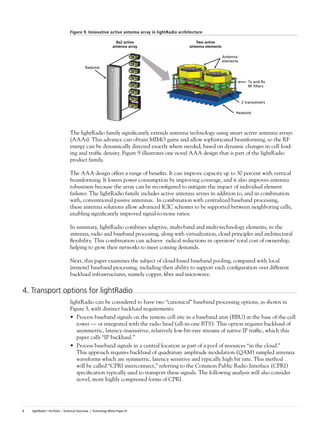
                                                              lightRadio™ Portfolio – Technical Overview | Technology White Paper #1   7
Figure 9. Innovative active antenna array in lightRadio architecture

                                                                8x2 active                     Two active
                                                              antenna array                 antenna elements

                                                                                                               Antenna
                                                                                                               elements
                                          Radome


                                                                                                                             Tx and Rx
                                                                                                                             RF filters


                                                                                                                          2 transceivers

                                                                                                                     Heatsink


                               The lightRadio family significantly extends antenna technology using smart active antenna arrays
                               (AAAs). This advance can obtain MIMO gains and allow sophisticated beamforming, so the RF
                               energy can be dynamically directed exactly where needed, based on dynamic changes in cell load-
                               ing and traffic density. Figure 9 illustrates one novel AAA design that is part of the lightRadio
                               product family.

                               The AAA design offers a range of benefits. It can improve capacity up to 30 percent with vertical
                               beamforming. It lowers power consumption by improving coverage, and it also improves antenna
                               robustness because the array can be reconfigured to mitigate the impact of individual element
                               failures. The lightRadio family includes active antenna arrays in addition to, and in combination
                               with, conventional passive antennas. In combination with centralized baseband processing,
                               these antenna solutions allow advanced ICIC schemes to be supported between neighboring cells,
                               enabling significantly improved signal-to-noise ratios.

                               In summary, lightRadio combines adaptive, multi-band and multi-technology elements, in the
                               antenna, radio and baseband processing, along with virtualization, cloud principles and architectural
                               flexibility. This combination can achieve radical reductions in operators’ total cost of ownership,
                               helping to grow their networks to meet coming demands.

                               Next, this paper examines the subject of cloud-based baseband pooling, compared with local
                               (remote) baseband processing, including their ability to support each configuration over different
                               backhaul infrastructures, namely copper, fiber and microwave.

4. Transport options for lightRadio
                               lightRadio can be considered to have two “canonical” baseband processing options, as shown in
                               Figure 5, with distinct backhaul requirements:
                               • Process baseband signals on the remote cell site in a baseband unit (BBU) at the base of the cell
                                  tower — or integrated with the radio head (all-in-one BTS). This option requires backhaul of
                                  asymmetric, latency-insensitive, relatively low-bit-rate streams of native IP traffic, which this
                                  paper calls “IP backhaul.”
                               • Process baseband signals in a central location as part of a pool of resources “in the cloud.”
                                  This approach requires backhaul of quadrature amplitude modulation (QAM) sampled antenna
                                  waveforms which are symmetric, latency sensitive and typically high bit rate. This method
                                  will be called “CPRI interconnect,” referring to the Common Public Radio Interface (CPRI)
                                  specification typically used to transport these signals. The following analysis will also consider
                                  novel, more highly compressed forms of CPRI.


8   lightRadio™ Portfolio – Technical Overview | Technology White Paper #1
To minimize capital expenditures, operators need to reuse their existing infrastructure assets
                                          (which may be leased from another provider). Copper pairs are still used quite extensively in North
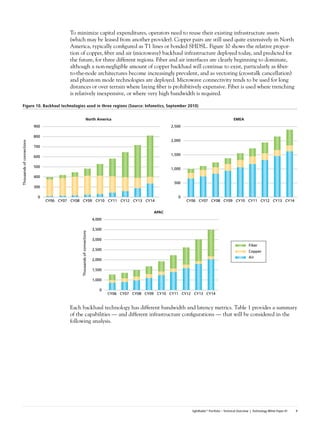
                                          America, typically configured as T1 lines or bonded SHDSL. Figure 10 shows the relative propor-
                                          tion of copper, fiber and air (microwave) backhaul infrastructure deployed today, and predicted for
                                          the future, for three different regions. Fiber and air interfaces are clearly beginning to dominate,
                                          although a non-negligible amount of copper backhaul will continue to exist, particularly as fiber-
                                          to-the-node architectures become increasingly prevalent, and as vectoring (crosstalk cancellation)
                                          and phantom mode technologies are deployed. Microwave connectivity tends to be used for long
                                          distances or over terrain where laying fiber is prohibitively expensive. Fiber is used where trenching
                                          is relatively inexpensive, or where very high bandwidth is required.

  Figure 10. Backhaul technologies used in three regions (Source: Infonetics, September 2010)


                                                                North America                                                                      EMEA
                           900                                                                             2,500

                           800
                                                                                                           2,000
Thousands of connections


                           700

                                                                                                           1,500
                           600

                           500
                                                                                                           1,000

                           400
                                                                                                             500
                           300

                             0                                                                                 0
                                 CY06 CY07 CY08 CY09 CY10 CY11 CY12 CY13 CY14                                      CY06 CY07 CY08 CY09 CY10 CY11 CY12 CY13 CY14


                                                                                                    APAC
                                                                          4,000

                                                                          3,500
                                               Thousands of connections


                                                                          3,000
                                                                                                                                                              Fiber
                                                                          2,500                                                                               Copper
                                                                                                                                                              Air
                                                                          2,000

                                                                          1,500

                                                                          1,000

                                                                             0
                                                                                  CY06 CY07 CY08 CY09 CY10 CY11 CY12 CY13 CY14


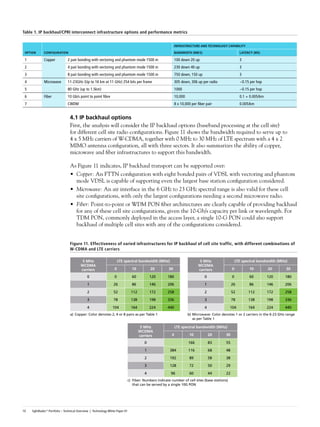
                                          Each backhaul technology has different bandwidth and latency metrics. Table 1 provides a summary
                                          of the capabilities — and different infrastructure configurations — that will be considered in the
                                          following analysis.


                                                                                                                     lightRadio™ Portfolio – Technical Overview | Technology White Paper #1   9
Table 1. IP backhaul/CPRI interconnect infrastructure options and performance metrics


                                                                                                             InFRaSTRuCTuRe and TeChnOLOgy CaPaBILITy

 OPTIOn      COnFIguRaTIOn                                                                                   BandwIdTh (MB/S)                           LaTenCy (MS)

 1           Copper            2 pair bonding with vectoring and phantom mode 1500 m                         100 down 20 up                             3
 2                             4 pair bonding with vectoring and phantom mode 1500 m                         230 down 40 up                             3
 3                             8 pair bonding with vectoring and phantom mode 1500 m                         750 down, 150 up                           3
 4           Microwave         11-23GHz (Up to 16 km at 11 GHz) 254 bits per frame                           305 down, 306 up per radio                 ~0.15 per hop
 5                             80 GHz (up to 1.5km)                                                          1000                                       ~0.15 per hop
 6           Fiber             10 Gb/s point to point fibre                                                  10,000                                     0.1 + 0.005/km
 7                             CWDM                                                                          8 x 10,000 per fiber pair                  0.005/km


                                4.1	IP	backhaul	options
                                First, the analysis will consider the IP backhaul options (baseband processing at the cell site)
                                for different cell site radio configurations. Figure 11 shows the bandwidth required to serve up to
                                4 x 5 MHz carriers of W-CDMA, together with 0 MHz to 30 MHz of LTE spectrum with a 4 x 2
                                MIMO antenna configuration, all with three sectors. It also summarizes the ability of copper,
                                microwave and fiber infrastructures to support this bandwidth.

                                As Figure 11 indicates, IP backhaul transport can be supported over:
                                • Copper: An FTTN configuration with eight bonded pairs of VDSL with vectoring and phantom
                                  mode VDSL is capable of supporting even the largest base station configuration considered.
                                • Microwave: An air interface in the 6 GHz to 23 GHz spectral range is also valid for these cell
                                  site configurations, with only the largest configurations needing a second microwave radio.
                                • Fiber: Point-to-point or WDM PON fiber architectures are clearly capable of providing backhaul
                                  for any of these cell site configurations, given the 10-Gb/s capacity per link or wavelength. For
                                  TDM PON, commonly deployed in the access layer, a single 10-G PON could also support
                                  backhaul of multiple cell sites with any of the configurations considered.


                                Figure 11. effectiveness of varied infrastructures for IP backhaul of cell site traffic, with different combinations of
                                w-CdMa and LTe carriers

                                         5 MHz                       LTE spectral bandwidth (MHz)                           5 MHz                     LTE spectral bandwidth (MHz)
                                        WCDMA                                                                               WCDMA
                                        carriers                 0              10           20        30                   carriers              0          10          20      30

                                             0                   0              60           120       180                       0                0          60          120     180

                                             1                  26              86           146       206                       1                26         86          146     206

                                             2                  52              112          172       258                       2                52         112         172     258

                                             3                  78              138          198       336                       3                78         138         198     336

                                             4                 104              164          224       440                       4              104          164         224     440
                                a) Copper: Color denotes 2, 4 or 8 pairs as per Table 1                               b) Microwave: Color denotes 1 or 2 carriers in the 6-23 GHz range
                                                                                                                         as per Table 1

                                                                                      5 MHz                  LTE spectral bandwidth (MHz)
                                                                                      WCDMA
                                                                                      carriers           0             10            20      30

                                                                                         0                            166            83      55

                                                                                         1              384           116            68      48

                                                                                         2              192            89            58      38

                                                                                         3              128            72            50      29

                                                                                         4               96            60            44      22
                                                                              c) Fiber: Numbers indicate number of cell sites (base stations)
                                                                                 that can be served by a single 10G PON


10   lightRadio™ Portfolio – Technical Overview | Technology White Paper #1
4.2	CPRI	interconnect	options
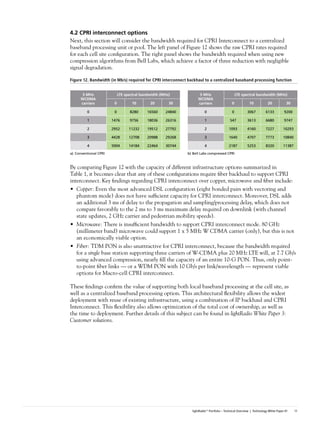
Next, this section will consider the bandwidth required for CPRI Interconnect to a centralized
baseband processing unit or pool. The left panel of Figure 12 shows the raw CPRI rates required
for each cell site configuration. The right panel shows the bandwidth required when using new
compression algorithms from Bell Labs, which achieve a factor of three reduction with negligible
signal degradation.

Figure 12. Bandwidth (in Mb/s) required for CPRI interconnect backhaul to a centralized baseband processing function


       5 MHz                LTE spectral bandwidth (MHz)            5 MHz                        LTE spectral bandwidth (MHz)
      WCDMA                                                         WCDMA
      carriers          0          10        20        30           carriers                 0           10            20           30

         0              0         8280      16560    24840              0                    0          3067         6133          9200

         1             1476       9756      18036    26316              1                  547          3613         6680          9747

         2             2952       11232     19512    27792              2                 1093          4160         7227         10293

         3             4428       12708     20988    29268              3                 1640          4707         7773         10840

         4             5904       14184     22464    30744              4                 2187          5253         8320         11387

a) Conventional CPRI                                         b) Bell Labs compressed CPRI


By comparing Figure 12 with the capacity of different infrastructure options summarized in
Table 1, it becomes clear that any of these configurations require fiber backhaul to support CPRI
interconnect. Key findings regarding CPRI interconnect over copper, microwave and fiber include:
• Copper: Even the most advanced DSL configuration (eight bonded pairs with vectoring and
   phantom mode) does not have sufficient capacity for CPRI interconnect. Moreover, DSL adds
   an additional 3 ms of delay to the propagation and sampling/processing delay, which does not
   compare favorably to the 2 ms to 3 ms maximum delay required on downlink (with channel
   state updates, 2 GHz carrier and pedestrian mobility speeds).
• Microwave: There is insufficient bandwidth to support CPRI interconnect mode. 80 GHz
   (millimeter band) microwave could support 1 x 5 MHz W CDMA carrier (only), but this is not
   an economically viable option.
• Fiber: TDM PON is also unattractive for CPRI interconnect, because the bandwidth required
   for a single base station supporting three carriers of W-CDMA plus 20 MHz LTE will, at 7.7 Gb/s
   using advanced compression, nearly fill the capacity of an entire 10-G PON. Thus, only point-
   to-point fiber links — or a WDM PON with 10 Gb/s per link/wavelength — represent viable
   options for Macro-cell CPRI interconnect.

These findings confirm the value of supporting both local baseband processing at the cell site, as
well as a centralized baseband processing option. This architectural flexibility allows the widest
deployment with reuse of existing infrastructure, using a combination of IP backhaul and CPRI
Interconnect. This flexibility also allows optimization of the total cost of ownership, as well as
the time to deployment. Further details of this subject can be found in lightRadio White Paper 3:
Customer solutions.


                                                                lightRadio™ Portfolio – Technical Overview | Technology White Paper #1    11
5. Total cost of ownership savings
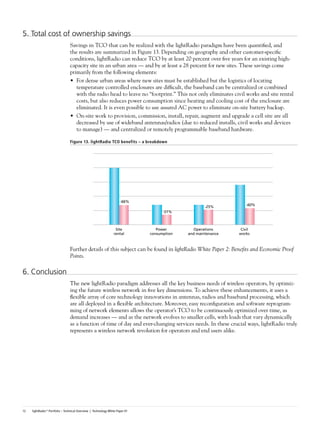
                                Savings in TCO that can be realized with the lightRadio paradigm have been quantified, and
                                the results are summarized in Figure 13. Depending on geography and other customer-specific
                                conditions, lightRadio can reduce TCO by at least 20 percent over five years for an existing high-
                                capacity site in an urban area — and by at least a 28 percent for new sites. These savings come
                                primarily from the following elements:
                                • For dense urban areas where new sites must be established but the logistics of locating
                                   temperature controlled enclosures are difficult, the baseband can be centralized or combined
                                   with the radio head to leave no “footprint.” This not only eliminates civil works and site rental
                                   costs, but also reduces power consumption since heating and cooling cost of the enclosure are
                                   eliminated. It is even possible to use assured AC power to eliminate on-site battery backup.
                                • On-site work to provision, commission, install, repair, augment and upgrade a cell site are all
                                   decreased by use of wideband antennas/radios (due to reduced installs, civil works and devices
                                   to manage) — and centralized or remotely programmable baseband hardware.

                                Figure 13. lightRadio TCO benefits – a breakdown


                                                                     -66%
                                                                                                                 -60%
                                                                                                    -25%
                                                                                    -51%


                                                                 Site            Power        Operations      Civil
                                                                rental        consumption   and maintenance   works


                                Further details of this subject can be found in lightRadio White Paper 2: Benefits and Economic Proof
                                Points.

6. Conclusion
                                The new lightRadio paradigm addresses all the key business needs of wireless operators, by optimiz-
                                ing the future wireless network in five key dimensions. To achieve these enhancements, it uses a
                                flexible array of core technology innovations in antennas, radios and baseband processing, which
                                are all deployed in a flexible architecture. Moreover, easy reconfiguration and software reprogram-
                                ming of network elements allows the operator’s TCO to be continuously optimized over time, as
                                demand increases — and as the network evolves to smaller cells, with loads that vary dynamically
                                as a function of time of day and ever-changing services needs. In these crucial ways, lightRadio truly
                                represents a wireless network revolution for operators and end users alike.


12   lightRadio™ Portfolio – Technical Overview | Technology White Paper #1
7. Acronyms
                AAA         Active Antenna Array
                BBU         Baseband (Digital processing) unit
                BTS         Base station (Antenna + Radio + Baseband)
                CDMA        Code Division Multiple Access
                CO          Central Office
                CoMP        Coordinated Multipoint Transmission and Reception
                CPRI        Common Public Radio Interface
                CWDM        Coarse Wave Division Multiplexing
                DSL         Digital Subscriber Line
                DWDM        Dense Wave Division Multiplexing
                E1          European Multiplexed Carrier 2 Mb/s over copper pair
                FTTN        Fibre to the Node
                G.Vector    ITU-T standard G.993.5 DSL crosstalk reduction method
                GGSN        Gateway GPRS Support Node (for W-CDMA)
                GigE        Gigabit Ethernet
                GSM         Global Standard for Mobile communication
                LTE         Long Term Evolution
                LTE-A       Long Term Evolution –Advanced
                MIMO        Multiple Input Multiple Output antenna system
                MME         Mobility Management Entity (for LTE)
                PGW         Packet Gateway (for LTE)
                PON         Passive Optical Network
                RAN         Radio Access Network
                RNC         Radio Network Controller (W-CDMA)
                RRH         Remote Radio Head
                SGSN        Serving GPRS Support Node (for W-CDMA)
                SGW         Serving Gateway (LTE)
                SOC         System On a Chip
                T1          North American Multiplexed Carrier, 1.54 Mb/s on copper
                VDSL        Very high bit rate Digital Subscriber Line
                VPLS        Virtual Private LAN Service
                W-CDMA      Wideband Code Division Multiple Access
                WDM         Wave Division Multiplexing


8. References
                lightRadio White Paper 2: Benefits and Economic Proof Points
                lightRadio White Paper 3: Customer solutions

9. Authors
                Jonathan	Segel,	Corporate	CTO	Group,	Bell	Labs,	Alcatel-Lucent
                jonathan.segel@alcatel-lucent.com

                Marcus	Weldon,	Corporate	CTO	Group,	Bell	Labs,	Alcatel-Lucent
                marcus.weldon@alcatel-lucent.com


                                                                                   lightRadio™ Portfolio – Technical Overview | Technology White Paper #1   13
www.alcatel-lucent.com                    Alcatel, Lucent, Alcatel-Lucent and the Alcatel-Lucent logo
are trademarks of Alcatel-Lucent. All other trademarks are the property of their respective owners.
The information presented is subject to change without notice. Alcatel-Lucent assumes no responsibility
for inaccuracies contained herein. Copyright © 2011 Alcatel-Lucent. All rights reserved.
CPG0591110105 (02)

Lightradio 1-tech-overview

  • 1.
    T E CH N O L O G Y W H I T E P A P E R Portfolio: White Paper 1 Technical overview Wireless operators are facing exponential growth in adoption rates, as well as device capabilities. As this trend continues, existing networks and architectures will not be able to deliver the required performance — or maintain costs at an economically sustainable level. To address these challenges, lightRadio™ offers a new wireless networking paradigm, which can add sufficient capacity, in the right location, with the right technology, to optimize the end-user experience along with operator economics. This paper provides an overview of the lightRadio paradigm developed by Alcatel-Lucent and Bells Labs, including technology components, transport options — and the total cost of ownership savings that can be realized. This paper is one in a series authored by Alcatel-Lucent that discuss the current state of wireless networks and the benefits of transitioning to a lightRadio architecture that supports data and video traffic, now and well into the future.
  • 2.
    Table of contents 1 1. Introduction 1 2. The consequences of accelerating wireless demand 3 3. The lightRadio paradigm 3 3.1 Business enabler 1: Seamless increase in spectral bandwidth 4 3.2 Business enabler 2: Optimization of cell site capacity 5 3.3 Business enabler 3: Optimization of technology evolution 6 3.4 Business enabler 4: Maximal utilization of new spectral bands 7 3.5 Business enabler 5: Optimization of antenna configuration 8 4. Transport options for lightRadio 10 4.1 IP backhaul options 11 4.2 CPRI interconnect options 12 5. Total cost of ownership savings 12 6. Conclusion 13 7. Acronyms 13 8. References 13 9. Authors
  • 3.
    1. Introduction The wireless industry is at a turning point. The confluence of end-user demand and proliferation of devices with advanced media capabilities is manifestly at odds with the cost and performance of existing wireless networks and architectures. Recognizing this dichotomy, along with emerging trends in key underlying technologies, Alcatel-Lucent and Bell Labs are creating a new wireless networking paradigm: lightRadio. This paper outlines the essential elements of a lightRadio network and the dramatic impact they can have on network economics and end-user experience. 2. The consequences of accelerating wireless demand Growth in wireless devices is widely recognized to be exponential, in terms of both adoption rates and device capabilities. But the recent emergence of widescreen devices, such as tablet computers and advanced multimedia smartphones, has brought another dimension to traffic growth forecasts for the coming years. Figure 1 shows a view of how such devices will drive bandwidth demand. Figure 1. Traffic growth projection for wireless networks Global aggregate mobile traffic (Pbytes/month) Feature phones Smartphones Widescreen devices 7,000 6,000 5,000 4,000 3,000 2,000 1,000 0 2010 2011 2012 2013 2014 2015 As devices such as these become Figure 2. The virtuous — or vicious — cycle of demand widely available, developers will increasingly focus on producing new applications that showcase device New user-centric ‘managed services’ capabilities. These applications, in generate new revenue turn, enhance the end-user experience and drive new levels and patterns of usage; for example, increased streaming of entertainment-quality Applications and Revenue drives video in high-definition. This trend content (and user new network experience) benefit increases the value of the wireless from increased capacity capacity investment network infrastructure, which in turn reinforces the demand cycle. This can be a desirable or “virtuous” cycle when the cost of network expan- sion is offset by concomitant revenue growth. However, with current network architectures and deployments, this is no longer the case. The cost of acquiring new spectrum, deploying new wireless carriers and evolving network technologies (for example from GSM to W-CDMA to LTE), while add- ing more processing capacity, new radios and antennas — and managing the resulting heterogeneous network — is becoming economically unsustainable and leading to a “vicious” cycle of demand. lightRadio™ Portfolio – Technical Overview | Technology White Paper #1 1
  • 4.
    Figure 3 showsthe complex interplay of factors in more detail. On the supply side of the problem, two factors affect service outcomes: coverage and capacity. Coverage is driven primarily by cell site density and the transmission frequency band, while antenna configurations and wireless technology also play an important role. Capacity is determined by the same factors, as well as spectral efficiency, which is affected by the type of wireless technology. Higher spectral efficiency is achievable, for example, with LTE. Figure 3. Complex interplay of demand and supply, with service and financial consequences Apps/ Usage level Users services and profile Demand Device Technology Load population mix Market value Service Market size User quality Performance outcomes of experience Market share Spectral Coverage Capacity width Supply Spectral Cellsite Antenna Technology Spectral bands density configurations (2G, 3G, LTE) efficiency (and sectorization) Financial Revenue Profitability Cost outcomes Five key supply factors optimized by the lightRadio paradigm are highlighted in Figure 3. These five factors directly impact network costs, so any architectural shift must seek to minimize costs, especially in key categories such as transmission, site rental, civil works, equipment, power, maintenance, repair and operations, which are shown in Figure 4. Figure 4. Breakdown of network costs Maintenance and repair 6% Equipment Operations 11% 7% Power consumption Civil work 7% 14% E&I&I Site rental 3% 20% ND&O 3% Transmission 29% 2 lightRadio™ Portfolio – Technical Overview | Technology White Paper #1
  • 5.
    Design of thelightRadio product family focused on the entirety of network costs over time, including the long-term total cost of ownership. Consequently, the lightRadio solution architecture is economi- cally attractive — and can leverage each operator’s unique existing assets and capabilities. This paper will quantify the total cost of ownership savings associated with the lightRadio networking paradigm. 3. The lightRadio paradigm Five key business enablers of the lightRadio paradigm are all aimed at adding sufficient capacity, in the right place, with the right technology, to simultaneously and continuously optimize end- user experience and operator economics. Figure 5 shows the essential lightRadio architecture, highlighting two different wireless scale points — conventional macro cells and smaller “metro cells” — as well as three different baseband processing configurations: baseband processing in the radio head (all-in-one), processing at the base of the tower (conventional baseband units) and centralized, pooled baseband processing (“in the cloud”). Figure 5. lightRadio architecture overview, with antennas, radios, baseband, controllers and management Wideband active antenna Conventional arrays with BBU any baseband IP IP Metrocell All-in-one: IP Baseband integrated IP mobile in radio head IP backhaul IP Macrocell IP Wireless Multi-band Controllers packet core remote radio head with any baseband CPRI over fiber Centralized baseband RF only sites Converged service aware management The five technology components of the lightRadio product family are also identified. They include antennas, radios, baseband, controllers and management. These elements collectively create the following five business enablers, which optimize capacity, coverage and performance: 1. Seamless increase in spectral bandwidth 2. Optimization of cell site capacity 3. Optimization of technology evolution 4. Maximum utilization of new spectral bands 5. Optimization of antenna configuration 3.1 Business enabler 1: Seamless increase in spectral bandwidth The first choice for augmenting capacity is to increase the number of carriers (the method used by W-CDMA) or improve the spectral bandwidth of each carrier (LTE’s method), preferably in the same band as existing deployed radio carriers. This approach usually provides the least-expensive solution, since the same equipment practice and radio technology can often be re-used, though lightRadio™ Portfolio – Technical Overview | Technology White Paper #1 3
  • 6.
    with expanded capacity.If spectral bandwidth increases are in a new frequency band, there is no clear advantage to using the same generation of wireless technology, since new antennas, radios and baseband equipment will be required. However, capacity needs to be matched not only to the demand in specific locations but also to the device population and related usage intensity. Therefore, a combination of existing and emerging technologies is required. lightRadio makes this possible with optimal economics. lightRadio enables operators to “get it right” when deploying a solution to match user demand or expectations, while continuously optimizing the overall solution — all the way from the antenna to baseband processing and controller elements. Baseband digital processing modules are built on a new System on a Chip (SoC) technology that incorporates a number of previously discrete, technology-specific components into a single, low-cost, high-performance device that is technology agnostic. In addition, it is remotely programmable to accommodate changing features and even changing radio technologies. Therefore, when W CDMA customers shift to new LTE-based devices, the baseband module that has been serving them can be remotely reprogrammed as an LTE baseband module. In addition, increases in spectral bandwidth can be seamlessly accommodated, when combined with advanced load-balancing and modem-pooling functions, as described later in this paper. Finally, wideband radios and adaptive antennas enable broadening of an existing spectral band — or extension to a new band — without adding an entirely new radio and antenna to the cell tower. Figure 6. PSC9132 Metro SoC Starcore™ 32-bit 32-bit Power™ SC3850 DSP core DDR-3 DDR-3 e500 core 1.3 GHz 1.3 GHz 32 KB 32 KB 32 KB 32 KB D-cache I-cache 32 KB D-cache I-cache shared Shared 512 KB L2 cache M3 Shared 512 KB L2 cache IFC Coherency module SPI 2x I2C DUART Interconnect fabric USIM eSDHC Clocks/reset GPIO MAPLE-B2P Ethernet Security baseband DMA JESD207 CPRI 4.1 engine USB 2.0 accelerators PCle LTE/UMTS/WiMAX v4.0 IEEE 1GE 1GE 1588 x4 x2 x2 SGMII 4 - lanes SerDes 3.2 Business enabler 2: Optimization of cell site capacity Deploying additional carriers and spectral bandwidth increases available capacity. But if expansions are in new spectral bands, they may require expensive spectrum acquisition with a much broader geography than the locations where demand has peaked. For example, a dense urban site might need four carriers or more of W-CDMA for capacity reasons, but this is probably much more than a rural location needs. In contrast, increasing a cell site’s density increases the effective serving capacity using existing spectrum assets. This is the key reason for deploying smaller macro cells and metro cells, sometimes called “pico cells.” 4 lightRadio™ Portfolio – Technical Overview | Technology White Paper #1
  • 7.
    Deployment of smallermacro cells offers sectorized, consistent performance throughout the cell, in all directions. However, finding new sites in dense urban areas can be difficult. Increasingly, the location of the radio and antenna provides no space for a conventional rack-mounted baseband unit in a temperature-controlled enclosure at the base of the tower. Thus, one of two approaches can be taken for macro cells: • Put all baseband processing into a single unified multi-technology base station • Transport baseband radio signals to a centralized location where the baseband processing equipment can be located. These approaches are complementary. The choice depends on the availability of necessary backhaul bandwidth, the dynamism or elasticity of demand patterns and the operational costs. Therefore, both approaches are supported by the lightRadio paradigm. Outside of urban areas, sites are often served by microwave, when backhauling of Common Public Radio Interface (CPRI) signals to a central location is not cost effective and a more traditional baseband unit (BBU) provides the best fit. Considering an operator’s entire network footprint — and the many infrastructure configurations comprising the network — it is clearly undesirable to change the available features when a user moves between cells or locations or, equally, to invest in network assets that will have a limited effective lifetime. Consequently, consistent functionality and re-usable common hardware and software components are a primary part of the lightRadio product family. These advantages are provided by common digital baseband components across different products and radio technologies. Another way to increase cell site density is to introduce smaller cells, or “metro cells,” at cost- effective site locations with the requisite backhaul and power sources. Metro cells do not typically provide 360 contiguous coverage, but they augment a macro network in “hot spots” that have high traffic density. In the lightRadio paradigm, metro cells are built on the same SoC technology as the macro cells discussed earlier, and they leverage the same backhaul resources. 3.3 Business enabler 3: Optimization of technology evolution Deployment of new wireless technology, often in new frequency bands, provides another means for increasing capacity and optimizing network economics. For example, an operator may deploy LTE in a new frequency band, such as 700 MHz or 2.6 GHz, in a new antenna configuration such as a 4 x 4 multiple-input multiple-output antenna system (MIMO). This deployment anticipates, and may even fuel, the user-device population’s shift from 3G to LTE, while it diverts traffic from overloaded 3G carriers. With the higher spectral efficiency of LTE, the operator will have more effective capacity and performance in the new frequency band than with 3G or 2G, as shown in Figure 7. Figure 7. Peak throughput and latency of primary radio access technologies (Source: Bell Labs modeling) Improving spectral efficiency Downlink Uplink 1.4 1.2 1.0 bps/Hz/cell 0.8 0.6 0.4 0.2 0.0 HSPA HSPA+ LTE FDD 10 MHz LTE FDD 20 MHz (Rel 6) (Rel 7/8) DSL MIMO 2x2 DSL MIMO 2x2 UL 16QAM 1x2 UL 16QAM 1x2 lightRadio™ Portfolio – Technical Overview | Technology White Paper #1 5
  • 8.
    This progression willcontinue with LTE-Advanced, which provides carrier aggregation (“bonding” together separate frequency bands) and advanced methods for coordinating multiple base stations, such as coordinated multipoint transmission and reception (CoMP) and dynamic inter-cell interfer- ence coordination (ICIC). CoMP will increase the effective spectral efficiency and positively affect end-user performance. This technology evolution is not unique to the lightRadio concept. But lightRadio supports both current and anticipated wireless technologies in the following unique way: The baseband module (whether in the centralized or remote architecture) is dynamically reprogrammable to support multiple combinations of W-CDMA and LTE technologies and their evolution. Thus, an operator could start with a baseband that is 100 percent W-CDMA and evolve over time by simple remote software reconfiguration until, at some stage, the same hardware is used 100 percent for LTE. lightRadio also optimally supports the developments anticipated in LTE-Advanced and 3G by allowing seamless migration of baseband processing from the remote site to a centralized baseband processing pool. Digital modules from the remote baseband unit could even be redeployed in the centralized processing site, or they could be configured to operate as a coordinated pool of resources at the remote site. In addition, Alcatel-Lucent innovations extend the concept of self-optimizing networks (SON). They apply a new layer of understanding, called “wireless IP intelligence,” to optimization across the entire network, including the RAN, packet core and both licensed and unlicensed spectrum assets, such as WiFi access points. This end-to-end optimization is critical for responding to rapidly changing demand patterns — and helps anticipate the need for coherent metro cell and macro cell optimization, as metro cells are installed opportunistically in demand “hot-spots.” 3.4 Business enabler 4: Maximal utilization of new spectral bands Deployment of capacity in new spectral bands usually carries significant costs for spectrum acquisition and new equipment. If the new band is lower in frequency than existing bands, such as 700 MHz, coverage will improve, because lower frequency bands exhibit superior propagation characteristics and cell reach. Deployments in higher frequency bands, such as 2.6 GHz, will have more limited reach, which can result in coverage holes between base stations, particularly when sites were chosen based on a lower-frequency spectral band. For example, at 2600 MHz, LTE has one-third the cell radius of W-CDMA at 900 MHz.1 Thus, deployment in higher bands may create “patchy” services where there are frequent fallbacks from LTE to 3G, or even 2G. Or significant additional expense may be incurred to fill in these coverage holes. Operators are moving to four- and even eight-branch receive diversity2 to help cover the link budget gap. Again, lightRadio has a unique advantage, because it allows the capital expenditure associated with multi-band deployment to be dramatically reduced through use of “wideband” radios that can operate across multiple spectral bands. Further, the wideband radios can assist with some additional mechanical tower loading issues, in particular for new sites. 1 WCDMA at 900 MHz, 40W MC-RRH, xCEM, UL cell edge target rate PS64 HSUPA, Cat 3 HSUPA UE. LTE at 2600 MHz, 10 MHz BW, UL cell edge target rate PS128, average across all morphologies. 2 Receive diversity provides protection against fading by using another copy of the signal from the user on an additional antenna (a different “branch”) because the fading and noise are uncorrelated between the different antennas. This also allows the user to transmit at lower power, which decreases interference. However receive diversity requires additional receiver chains in both the RF and baseband components, and improvements tail off rapidly with increased branches, since the improvements are less than linear. Improvements from averaging out the RF noise however (introduced by the RF chain in a receiver) do increase linearly. 6 lightRadio™ Portfolio – Technical Overview | Technology White Paper #1
  • 9.
    To understand towerloading issues, consider that, to achieve the required power and efficiency, most cell site builds currently put the radio on the tower in a remote radio head (RRH) configura- tion, rather than at the bottom of the tower — driving an antenna up on the tower. Macro cell sites are typically divided into three sectors, and today a separate RRH is required for each frequency band, even though the RRH is generally radio technology agnostic. Some carriers have sites with five different frequency bands in three sectors, leading to 15 remote radio heads on a cell tower. This type of arrangement is shown in the left panel of Figure 8. Compounding this issue, multiple operators frequently share each tower, with the tower leased from a third-party provider. Now the situation is only getting worse, as new antenna configurations, such as 4 x 4 MIMO (four transmit antennas and four receive antennas), increase complexity even further. As a result, the size, weight, wind loading, visual appearance and leasing costs of the tower have become blocking issues for the evolution of radio networks. As depicted in the right panel of Figure 8, lightRadio significantly reduces this problem. It also allows continued evolution in radio capacity, well into the future, by utilizing wider frequency band radios which can be incorporated into a smaller number of lightRadio RRHs. Figure 8. Current and future radio heads on cell towers - with lightRadio paradigm 2G: 2G: 2G: 2G: 900 MHz 900 MHz 900 MHz 900 MHz 2G+3G+LTE: 900/2100/2600 MHz 3G: 3G: 3G+LTE: 2100 MHz 2100 MHz 2100/2600 MHz LTE: 2600 MHz Wideband RRH Wideband with dual band adaptive array antenna antenna 3.5 Business enabler 5: Optimization of antenna configuration Improved antenna configurations are designed to enhance the user experience by optimizing the consistency of capacity and coverage. Historically, such improvements have been made by establishing multiple passive transmit and receive antennas for a particular radio and technology; for example, using MIMO. lightRadio™ Portfolio – Technical Overview | Technology White Paper #1 7
  • 10.
    Figure 9. Innovativeactive antenna array in lightRadio architecture 8x2 active Two active antenna array antenna elements Antenna elements Radome Tx and Rx RF filters 2 transceivers Heatsink The lightRadio family significantly extends antenna technology using smart active antenna arrays (AAAs). This advance can obtain MIMO gains and allow sophisticated beamforming, so the RF energy can be dynamically directed exactly where needed, based on dynamic changes in cell load- ing and traffic density. Figure 9 illustrates one novel AAA design that is part of the lightRadio product family. The AAA design offers a range of benefits. It can improve capacity up to 30 percent with vertical beamforming. It lowers power consumption by improving coverage, and it also improves antenna robustness because the array can be reconfigured to mitigate the impact of individual element failures. The lightRadio family includes active antenna arrays in addition to, and in combination with, conventional passive antennas. In combination with centralized baseband processing, these antenna solutions allow advanced ICIC schemes to be supported between neighboring cells, enabling significantly improved signal-to-noise ratios. In summary, lightRadio combines adaptive, multi-band and multi-technology elements, in the antenna, radio and baseband processing, along with virtualization, cloud principles and architectural flexibility. This combination can achieve radical reductions in operators’ total cost of ownership, helping to grow their networks to meet coming demands. Next, this paper examines the subject of cloud-based baseband pooling, compared with local (remote) baseband processing, including their ability to support each configuration over different backhaul infrastructures, namely copper, fiber and microwave. 4. Transport options for lightRadio lightRadio can be considered to have two “canonical” baseband processing options, as shown in Figure 5, with distinct backhaul requirements: • Process baseband signals on the remote cell site in a baseband unit (BBU) at the base of the cell tower — or integrated with the radio head (all-in-one BTS). This option requires backhaul of asymmetric, latency-insensitive, relatively low-bit-rate streams of native IP traffic, which this paper calls “IP backhaul.” • Process baseband signals in a central location as part of a pool of resources “in the cloud.” This approach requires backhaul of quadrature amplitude modulation (QAM) sampled antenna waveforms which are symmetric, latency sensitive and typically high bit rate. This method will be called “CPRI interconnect,” referring to the Common Public Radio Interface (CPRI) specification typically used to transport these signals. The following analysis will also consider novel, more highly compressed forms of CPRI. 8 lightRadio™ Portfolio – Technical Overview | Technology White Paper #1
  • 11.
    To minimize capitalexpenditures, operators need to reuse their existing infrastructure assets (which may be leased from another provider). Copper pairs are still used quite extensively in North America, typically configured as T1 lines or bonded SHDSL. Figure 10 shows the relative propor- tion of copper, fiber and air (microwave) backhaul infrastructure deployed today, and predicted for the future, for three different regions. Fiber and air interfaces are clearly beginning to dominate, although a non-negligible amount of copper backhaul will continue to exist, particularly as fiber- to-the-node architectures become increasingly prevalent, and as vectoring (crosstalk cancellation) and phantom mode technologies are deployed. Microwave connectivity tends to be used for long distances or over terrain where laying fiber is prohibitively expensive. Fiber is used where trenching is relatively inexpensive, or where very high bandwidth is required. Figure 10. Backhaul technologies used in three regions (Source: Infonetics, September 2010) North America EMEA 900 2,500 800 2,000 Thousands of connections 700 1,500 600 500 1,000 400 500 300 0 0 CY06 CY07 CY08 CY09 CY10 CY11 CY12 CY13 CY14 CY06 CY07 CY08 CY09 CY10 CY11 CY12 CY13 CY14 APAC 4,000 3,500 Thousands of connections 3,000 Fiber 2,500 Copper Air 2,000 1,500 1,000 0 CY06 CY07 CY08 CY09 CY10 CY11 CY12 CY13 CY14 Each backhaul technology has different bandwidth and latency metrics. Table 1 provides a summary of the capabilities — and different infrastructure configurations — that will be considered in the following analysis. lightRadio™ Portfolio – Technical Overview | Technology White Paper #1 9
  • 12.
    Table 1. IPbackhaul/CPRI interconnect infrastructure options and performance metrics InFRaSTRuCTuRe and TeChnOLOgy CaPaBILITy OPTIOn COnFIguRaTIOn BandwIdTh (MB/S) LaTenCy (MS) 1 Copper 2 pair bonding with vectoring and phantom mode 1500 m 100 down 20 up 3 2 4 pair bonding with vectoring and phantom mode 1500 m 230 down 40 up 3 3 8 pair bonding with vectoring and phantom mode 1500 m 750 down, 150 up 3 4 Microwave 11-23GHz (Up to 16 km at 11 GHz) 254 bits per frame 305 down, 306 up per radio ~0.15 per hop 5 80 GHz (up to 1.5km) 1000 ~0.15 per hop 6 Fiber 10 Gb/s point to point fibre 10,000 0.1 + 0.005/km 7 CWDM 8 x 10,000 per fiber pair 0.005/km 4.1 IP backhaul options First, the analysis will consider the IP backhaul options (baseband processing at the cell site) for different cell site radio configurations. Figure 11 shows the bandwidth required to serve up to 4 x 5 MHz carriers of W-CDMA, together with 0 MHz to 30 MHz of LTE spectrum with a 4 x 2 MIMO antenna configuration, all with three sectors. It also summarizes the ability of copper, microwave and fiber infrastructures to support this bandwidth. As Figure 11 indicates, IP backhaul transport can be supported over: • Copper: An FTTN configuration with eight bonded pairs of VDSL with vectoring and phantom mode VDSL is capable of supporting even the largest base station configuration considered. • Microwave: An air interface in the 6 GHz to 23 GHz spectral range is also valid for these cell site configurations, with only the largest configurations needing a second microwave radio. • Fiber: Point-to-point or WDM PON fiber architectures are clearly capable of providing backhaul for any of these cell site configurations, given the 10-Gb/s capacity per link or wavelength. For TDM PON, commonly deployed in the access layer, a single 10-G PON could also support backhaul of multiple cell sites with any of the configurations considered. Figure 11. effectiveness of varied infrastructures for IP backhaul of cell site traffic, with different combinations of w-CdMa and LTe carriers 5 MHz LTE spectral bandwidth (MHz) 5 MHz LTE spectral bandwidth (MHz) WCDMA WCDMA carriers 0 10 20 30 carriers 0 10 20 30 0 0 60 120 180 0 0 60 120 180 1 26 86 146 206 1 26 86 146 206 2 52 112 172 258 2 52 112 172 258 3 78 138 198 336 3 78 138 198 336 4 104 164 224 440 4 104 164 224 440 a) Copper: Color denotes 2, 4 or 8 pairs as per Table 1 b) Microwave: Color denotes 1 or 2 carriers in the 6-23 GHz range as per Table 1 5 MHz LTE spectral bandwidth (MHz) WCDMA carriers 0 10 20 30 0 166 83 55 1 384 116 68 48 2 192 89 58 38 3 128 72 50 29 4 96 60 44 22 c) Fiber: Numbers indicate number of cell sites (base stations) that can be served by a single 10G PON 10 lightRadio™ Portfolio – Technical Overview | Technology White Paper #1
  • 13.
    4.2 CPRI interconnect options Next, this sectionwill consider the bandwidth required for CPRI Interconnect to a centralized baseband processing unit or pool. The left panel of Figure 12 shows the raw CPRI rates required for each cell site configuration. The right panel shows the bandwidth required when using new compression algorithms from Bell Labs, which achieve a factor of three reduction with negligible signal degradation. Figure 12. Bandwidth (in Mb/s) required for CPRI interconnect backhaul to a centralized baseband processing function 5 MHz LTE spectral bandwidth (MHz) 5 MHz LTE spectral bandwidth (MHz) WCDMA WCDMA carriers 0 10 20 30 carriers 0 10 20 30 0 0 8280 16560 24840 0 0 3067 6133 9200 1 1476 9756 18036 26316 1 547 3613 6680 9747 2 2952 11232 19512 27792 2 1093 4160 7227 10293 3 4428 12708 20988 29268 3 1640 4707 7773 10840 4 5904 14184 22464 30744 4 2187 5253 8320 11387 a) Conventional CPRI b) Bell Labs compressed CPRI By comparing Figure 12 with the capacity of different infrastructure options summarized in Table 1, it becomes clear that any of these configurations require fiber backhaul to support CPRI interconnect. Key findings regarding CPRI interconnect over copper, microwave and fiber include: • Copper: Even the most advanced DSL configuration (eight bonded pairs with vectoring and phantom mode) does not have sufficient capacity for CPRI interconnect. Moreover, DSL adds an additional 3 ms of delay to the propagation and sampling/processing delay, which does not compare favorably to the 2 ms to 3 ms maximum delay required on downlink (with channel state updates, 2 GHz carrier and pedestrian mobility speeds). • Microwave: There is insufficient bandwidth to support CPRI interconnect mode. 80 GHz (millimeter band) microwave could support 1 x 5 MHz W CDMA carrier (only), but this is not an economically viable option. • Fiber: TDM PON is also unattractive for CPRI interconnect, because the bandwidth required for a single base station supporting three carriers of W-CDMA plus 20 MHz LTE will, at 7.7 Gb/s using advanced compression, nearly fill the capacity of an entire 10-G PON. Thus, only point- to-point fiber links — or a WDM PON with 10 Gb/s per link/wavelength — represent viable options for Macro-cell CPRI interconnect. These findings confirm the value of supporting both local baseband processing at the cell site, as well as a centralized baseband processing option. This architectural flexibility allows the widest deployment with reuse of existing infrastructure, using a combination of IP backhaul and CPRI Interconnect. This flexibility also allows optimization of the total cost of ownership, as well as the time to deployment. Further details of this subject can be found in lightRadio White Paper 3: Customer solutions. lightRadio™ Portfolio – Technical Overview | Technology White Paper #1 11
  • 14.
    5. Total costof ownership savings Savings in TCO that can be realized with the lightRadio paradigm have been quantified, and the results are summarized in Figure 13. Depending on geography and other customer-specific conditions, lightRadio can reduce TCO by at least 20 percent over five years for an existing high- capacity site in an urban area — and by at least a 28 percent for new sites. These savings come primarily from the following elements: • For dense urban areas where new sites must be established but the logistics of locating temperature controlled enclosures are difficult, the baseband can be centralized or combined with the radio head to leave no “footprint.” This not only eliminates civil works and site rental costs, but also reduces power consumption since heating and cooling cost of the enclosure are eliminated. It is even possible to use assured AC power to eliminate on-site battery backup. • On-site work to provision, commission, install, repair, augment and upgrade a cell site are all decreased by use of wideband antennas/radios (due to reduced installs, civil works and devices to manage) — and centralized or remotely programmable baseband hardware. Figure 13. lightRadio TCO benefits – a breakdown -66% -60% -25% -51% Site Power Operations Civil rental consumption and maintenance works Further details of this subject can be found in lightRadio White Paper 2: Benefits and Economic Proof Points. 6. Conclusion The new lightRadio paradigm addresses all the key business needs of wireless operators, by optimiz- ing the future wireless network in five key dimensions. To achieve these enhancements, it uses a flexible array of core technology innovations in antennas, radios and baseband processing, which are all deployed in a flexible architecture. Moreover, easy reconfiguration and software reprogram- ming of network elements allows the operator’s TCO to be continuously optimized over time, as demand increases — and as the network evolves to smaller cells, with loads that vary dynamically as a function of time of day and ever-changing services needs. In these crucial ways, lightRadio truly represents a wireless network revolution for operators and end users alike. 12 lightRadio™ Portfolio – Technical Overview | Technology White Paper #1
  • 15.
    7. Acronyms AAA Active Antenna Array BBU Baseband (Digital processing) unit BTS Base station (Antenna + Radio + Baseband) CDMA Code Division Multiple Access CO Central Office CoMP Coordinated Multipoint Transmission and Reception CPRI Common Public Radio Interface CWDM Coarse Wave Division Multiplexing DSL Digital Subscriber Line DWDM Dense Wave Division Multiplexing E1 European Multiplexed Carrier 2 Mb/s over copper pair FTTN Fibre to the Node G.Vector ITU-T standard G.993.5 DSL crosstalk reduction method GGSN Gateway GPRS Support Node (for W-CDMA) GigE Gigabit Ethernet GSM Global Standard for Mobile communication LTE Long Term Evolution LTE-A Long Term Evolution –Advanced MIMO Multiple Input Multiple Output antenna system MME Mobility Management Entity (for LTE) PGW Packet Gateway (for LTE) PON Passive Optical Network RAN Radio Access Network RNC Radio Network Controller (W-CDMA) RRH Remote Radio Head SGSN Serving GPRS Support Node (for W-CDMA) SGW Serving Gateway (LTE) SOC System On a Chip T1 North American Multiplexed Carrier, 1.54 Mb/s on copper VDSL Very high bit rate Digital Subscriber Line VPLS Virtual Private LAN Service W-CDMA Wideband Code Division Multiple Access WDM Wave Division Multiplexing 8. References lightRadio White Paper 2: Benefits and Economic Proof Points lightRadio White Paper 3: Customer solutions 9. Authors Jonathan Segel, Corporate CTO Group, Bell Labs, Alcatel-Lucent jonathan.segel@alcatel-lucent.com Marcus Weldon, Corporate CTO Group, Bell Labs, Alcatel-Lucent marcus.weldon@alcatel-lucent.com lightRadio™ Portfolio – Technical Overview | Technology White Paper #1 13
  • 16.
    www.alcatel-lucent.com Alcatel, Lucent, Alcatel-Lucent and the Alcatel-Lucent logo are trademarks of Alcatel-Lucent. All other trademarks are the property of their respective owners. The information presented is subject to change without notice. Alcatel-Lucent assumes no responsibility for inaccuracies contained herein. Copyright © 2011 Alcatel-Lucent. All rights reserved. CPG0591110105 (02)