Lifting & Rigging Safety
Training
NAVI MUMBAI INTERNATIONAL AIRPORT
PROJECT
Lifting & Rigging Safety Training
• Introduction
• Objective
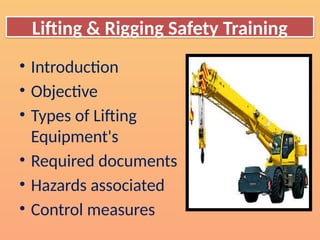
• Types of Lifting
Equipment's
• Required documents
• Hazards associated
• Control measures
• An operation concerned with the lifting or lowering of a
load‘ manually or mechanically. A 'load' is the item or
items being lifted, which includes a person or people.
• Lifting of objects generally takes place at construction sites,
shipyards, factories and other industrial situations such as
offloading with a forklift truck, containers at a warehouse
or at a commercial area.
• Incorrect lifting methods however, can lead to major
accidents and fatalities.
• The process of carrying out correct and safe lifting
operations involves a range of requirements which must be
considered during the planning of any lifting operation.
Introduction
The main Objective is to:
- To ensure safe lifting and rigging techniques
are implemented and followed at site.
- To assess the risks involved and steps to
overcome the risks.
- To ensure personnel safety.
- To create awareness regarding lifting
operations and lifting equipment.
Lifting and Rigging Safety Training
Lifting Equipment's
Lifting equipment is any work equipment for lifting and lowering
loads, and includes any accessories used in doing so (such as
attachments to support, fix or anchor the equipment).
Examples of lifting equipment include:
• Overhead cranes and their supporting runways
• Wheel Mounted Cranes
• Tower Cranes
• Crawler Cranes
• Hiab/ Boom truck
• Fork lifts
• Lifting accessories or lifing gears
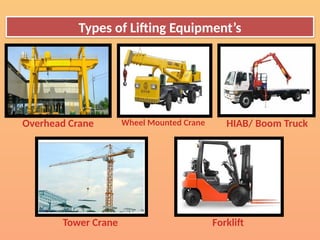
Types of Lifting Equipment’s
Overhead Crane Wheel Mounted Crane HIAB/ Boom Truck
Tower Crane Forklift
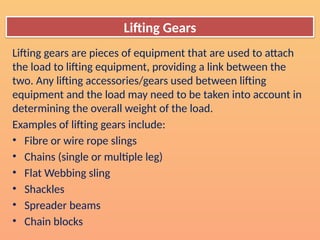
Lifting gears are pieces of equipment that are used to attach
the load to lifting equipment, providing a link between the
two. Any lifting accessories/gears used between lifting
equipment and the load may need to be taken into account in
determining the overall weight of the load.
Examples of lifting gears include:
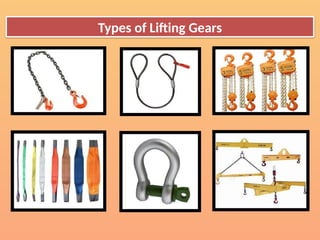
• Fibre or wire rope slings
• Chains (single or multiple leg)
• Flat Webbing sling
• Shackles
• Spreader beams
• Chain blocks
Lifting Gears
Types of Lifting Gears
Required Documents
• Valid Registration Certificate
• Valid PUC
• Valid Driving License
• Operators Competency Certificate
• Valid Insurance
• Valid Load Test Certificate (Form-11)
• Loose Lifting Gear Certificate
• Incompetent people involved.
• Lack of administrative controls by management.
• Unauthorized entry.
• Working under suspended load.
• Overloading (loads exceeding SWL).
• Toppling of Crane.
• Struck between objects or being trapped in moving
parts of equipment.
• Inappropriate lifting plan.
• Weather Conditions.
• Electrical hazards.
• Musculoskeletal hazards.
• Noise & Vibrations.
• Fatigue.
• Housekeeping.
Hazards Associated with Lifting
Control Measures
The Employer is responsible for ensuring that lifting operations
within his scope of work are carried out safely and must identify
one person to be in control of the lifting operation from the initial
stage itself.
The main ways to control the hazards include:
• Elimination
• Substitution
• Engineering controls
• Administrative controls
• PPE
ELIMINATION
Elimination is the process of removing the hazard from the
workplace. It is the most effective way to control a risk
because the hazard is no longer present. It is the preferred
way to control a hazard and should be used whenever
possible.
SUBSTITUTION
Substitution is a hazard control strategy in which a material
or process is replaced with another that is less hazardous. It
is the second most effective method to control workplace
hazards
Control Measures
ENGINEERING CONTROLS
Engineering controls are methods that are built into
the design of a plant, equipment or process to
minimize the hazard.
ADMINISTRATIVE CONTROLS
Administrative controls (or work practice controls) are
changes in work procedures such as written safety
policies, rules, supervision, schedules, and training
with the goal of reducing the duration, frequency, and
severity of exposure to hazardous chemicals or
situations.
Control Measures
PPE- PERSONAL PROTECTIVE EQUIPMENT
• PPE is barrier between the hazard and
person. PPE should only be used when
other measures are not sufficiently
effective or not possible.
• PPE may seem the easiest or cheapest
way out. Personal protection
equipment is a form of physical
protection to reduce exposure to
ergonomic-related risk factors.
• It is the last line of defence and without
PPE injury may very likely occur.
Control Measures
LIFTING PLAN
• The lifting equipment
• Normal lifting or Tandem lifting
• Shackles, turnbuckles, and slings being used
• The weight being lifted (Man/Material)
• Center of gravity of the load being lifted
• Crane capacity and crane load charts
• Height, width, and length of the lift
• Atmospheric and environmental conditions when the process is being
performed
• Edges and corners of the load.
• Sling angles(Vertical, Choker, Basket)
• Load angle factor
• Floor loading capacity (Paved/unpaved, even/uneven surface)
Control Measures
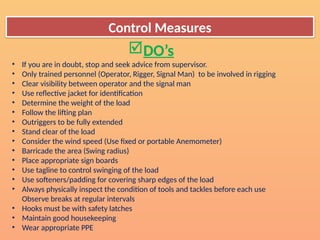
Control Measures
DO’s
• If you are in doubt, stop and seek advice from supervisor.
• Only trained personnel (Operator, Rigger, Signal Man) to be involved in rigging
• Clear visibility between operator and the signal man
• Use reflective jacket for identification
• Determine the weight of the load
• Follow the lifting plan
• Outriggers to be fully extended
• Stand clear of the load
• Consider the wind speed (Use fixed or portable Anemometer)
• Barricade the area (Swing radius)
• Place appropriate sign boards
• Use tagline to control swinging of the load
• Use softeners/padding for covering sharp edges of the load
• Always physically inspect the condition of tools and tackles before each use
Observe breaks at regular intervals
• Hooks must be with safety latches
• Maintain good housekeeping
• Wear appropriate PPE
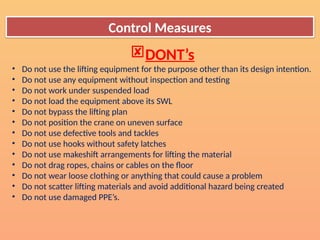
Control Measures
DONT’s
• Do not use the lifting equipment for the purpose other than its design intention.
• Do not use any equipment without inspection and testing
• Do not work under suspended load
• Do not load the equipment above its SWL
• Do not bypass the lifting plan
• Do not position the crane on uneven surface
• Do not use defective tools and tackles
• Do not use hooks without safety latches
• Do not use makeshift arrangements for lifting the material
• Do not drag ropes, chains or cables on the floor
• Do not wear loose clothing or anything that could cause a problem
• Do not scatter lifting materials and avoid additional hazard being created
• Do not use damaged PPE’s.
Always Remember………..
Make Safety Personal
THANK YOU

Lifting and Rigging Safety Training.pptx

  • 1.
    Lifting & RiggingSafety Training NAVI MUMBAI INTERNATIONAL AIRPORT PROJECT
  • 2.
    Lifting & RiggingSafety Training • Introduction • Objective • Types of Lifting Equipment's • Required documents • Hazards associated • Control measures
  • 3.
    • An operationconcerned with the lifting or lowering of a load‘ manually or mechanically. A 'load' is the item or items being lifted, which includes a person or people. • Lifting of objects generally takes place at construction sites, shipyards, factories and other industrial situations such as offloading with a forklift truck, containers at a warehouse or at a commercial area. • Incorrect lifting methods however, can lead to major accidents and fatalities. • The process of carrying out correct and safe lifting operations involves a range of requirements which must be considered during the planning of any lifting operation. Introduction
  • 4.
    The main Objectiveis to: - To ensure safe lifting and rigging techniques are implemented and followed at site. - To assess the risks involved and steps to overcome the risks. - To ensure personnel safety. - To create awareness regarding lifting operations and lifting equipment. Lifting and Rigging Safety Training
  • 5.
    Lifting Equipment's Lifting equipmentis any work equipment for lifting and lowering loads, and includes any accessories used in doing so (such as attachments to support, fix or anchor the equipment). Examples of lifting equipment include: • Overhead cranes and their supporting runways • Wheel Mounted Cranes • Tower Cranes • Crawler Cranes • Hiab/ Boom truck • Fork lifts • Lifting accessories or lifing gears
  • 6.
    Types of LiftingEquipment’s Overhead Crane Wheel Mounted Crane HIAB/ Boom Truck Tower Crane Forklift
  • 7.
    Lifting gears arepieces of equipment that are used to attach the load to lifting equipment, providing a link between the two. Any lifting accessories/gears used between lifting equipment and the load may need to be taken into account in determining the overall weight of the load. Examples of lifting gears include: • Fibre or wire rope slings • Chains (single or multiple leg) • Flat Webbing sling • Shackles • Spreader beams • Chain blocks Lifting Gears
  • 8.
  • 9.
    Required Documents • ValidRegistration Certificate • Valid PUC • Valid Driving License • Operators Competency Certificate • Valid Insurance • Valid Load Test Certificate (Form-11) • Loose Lifting Gear Certificate
  • 10.
    • Incompetent peopleinvolved. • Lack of administrative controls by management. • Unauthorized entry. • Working under suspended load. • Overloading (loads exceeding SWL). • Toppling of Crane. • Struck between objects or being trapped in moving parts of equipment. • Inappropriate lifting plan. • Weather Conditions. • Electrical hazards. • Musculoskeletal hazards. • Noise & Vibrations. • Fatigue. • Housekeeping. Hazards Associated with Lifting
  • 11.
    Control Measures The Employeris responsible for ensuring that lifting operations within his scope of work are carried out safely and must identify one person to be in control of the lifting operation from the initial stage itself. The main ways to control the hazards include: • Elimination • Substitution • Engineering controls • Administrative controls • PPE
  • 12.
    ELIMINATION Elimination is theprocess of removing the hazard from the workplace. It is the most effective way to control a risk because the hazard is no longer present. It is the preferred way to control a hazard and should be used whenever possible. SUBSTITUTION Substitution is a hazard control strategy in which a material or process is replaced with another that is less hazardous. It is the second most effective method to control workplace hazards Control Measures
  • 13.
    ENGINEERING CONTROLS Engineering controlsare methods that are built into the design of a plant, equipment or process to minimize the hazard. ADMINISTRATIVE CONTROLS Administrative controls (or work practice controls) are changes in work procedures such as written safety policies, rules, supervision, schedules, and training with the goal of reducing the duration, frequency, and severity of exposure to hazardous chemicals or situations. Control Measures
  • 14.
    PPE- PERSONAL PROTECTIVEEQUIPMENT • PPE is barrier between the hazard and person. PPE should only be used when other measures are not sufficiently effective or not possible. • PPE may seem the easiest or cheapest way out. Personal protection equipment is a form of physical protection to reduce exposure to ergonomic-related risk factors. • It is the last line of defence and without PPE injury may very likely occur. Control Measures
  • 15.
    LIFTING PLAN • Thelifting equipment • Normal lifting or Tandem lifting • Shackles, turnbuckles, and slings being used • The weight being lifted (Man/Material) • Center of gravity of the load being lifted • Crane capacity and crane load charts • Height, width, and length of the lift • Atmospheric and environmental conditions when the process is being performed • Edges and corners of the load. • Sling angles(Vertical, Choker, Basket) • Load angle factor • Floor loading capacity (Paved/unpaved, even/uneven surface) Control Measures
  • 16.
    Control Measures DO’s • Ifyou are in doubt, stop and seek advice from supervisor. • Only trained personnel (Operator, Rigger, Signal Man) to be involved in rigging • Clear visibility between operator and the signal man • Use reflective jacket for identification • Determine the weight of the load • Follow the lifting plan • Outriggers to be fully extended • Stand clear of the load • Consider the wind speed (Use fixed or portable Anemometer) • Barricade the area (Swing radius) • Place appropriate sign boards • Use tagline to control swinging of the load • Use softeners/padding for covering sharp edges of the load • Always physically inspect the condition of tools and tackles before each use Observe breaks at regular intervals • Hooks must be with safety latches • Maintain good housekeeping • Wear appropriate PPE
  • 17.
    Control Measures DONT’s • Donot use the lifting equipment for the purpose other than its design intention. • Do not use any equipment without inspection and testing • Do not work under suspended load • Do not load the equipment above its SWL • Do not bypass the lifting plan • Do not position the crane on uneven surface • Do not use defective tools and tackles • Do not use hooks without safety latches • Do not use makeshift arrangements for lifting the material • Do not drag ropes, chains or cables on the floor • Do not wear loose clothing or anything that could cause a problem • Do not scatter lifting materials and avoid additional hazard being created • Do not use damaged PPE’s.
  • 18.
  • 19.