A LIFE ON EARTHPART TWO
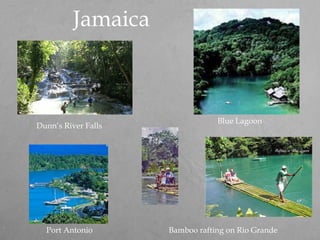
JamaicaBlue LagoonDunn’s River Falls    Port AntonioBamboo rafting on Rio Grande
1984 - Winter Term Sabbatical in Costa RicaA grant to visit the Associated Colleges Costa Rica was parlayed into joining a tour of the National Parks and the Dartmouth expedition to Cocos Island. Poas volcano National ParkManuel Antonio National ParkThrilling to watch Leatherback turtleslay their eggs on the Pacific beach – done at night
Dartmouth College Ecology tour traveled via fishing boat to Cocos Island, some 300 km from Costa Rica’s Pacific coast.Cocos Island National Park was designated a World by in 1997. In 2002, the World Heritage Site designation was extended to include an expanded marine zone of 1,997 km².Cocos Island is an oceanic island of both volcanic and tectonic origin. It is the only emergent island of the Cocos Plate, one of the minor tectonic plates
Mexico CityOpera HouseMexico City CathedralAngel de la Independencia— A victory column located on a roundabout over Paseo de la ReformaTeotihuacán -Avenue of the Dead
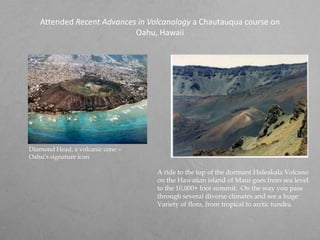
Attended Recent Advances in Volcanology a Chautauqua course on Oahu, HawaiiDiamond Head, a volcanic cone –Oahu’s signature iconA ride to the top of the dormant Haleakala Volcano on the Hawaiian island of Maui goes from sea level to the 10,000+ foot summit.  On the way you pass through several diverse climates and see a huge Variety of flora, from tropical to arctic tundra.
Welcome aboard one of the most popular train excursions in North America. This one day wilderness excursion will take you 114 miles north of Sault Ste. Marie, over towering trestles, alongside pristine northern lakes and rivers, and through the awesome granite rock formations and mixed forests of the Canadian Shield.
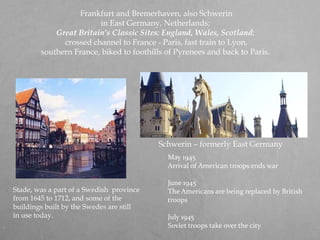
 Frankfurt and Bremerhaven, also Schwerin in East Germany, Netherlands; Great Britain’s Classic Sites: England, Wales, Scotland; crossed channel to France - Paris, fast train to Lyon, southern France, biked to foothills of Pyrenees and back to Paris.May 1945 Arrival of American troops ends war June 1945 The Americans are being replaced by British troops July 1945 Soviet troops take over the citySchwerin – formerly East Germany Stade, was a part of a Swedish  province from 1645 to 1712, and some of the buildings built by the Swedes are still in use today.
Great Britain’s Classic Sites: England, Wales, Scotland The Geological Society of London is housed in the east wing of Burlington House, Piccadilly, London.Aberystwyth is one of the liveliest university towns in Wales.  Silurian turbidites forming the  hills at the far end of town.Sussex
The island of Arran is a popular destination for geologists, who come to see intrusive igneous sills and dikes as well as sedimentary and metasedimentary rocks ranging in age from Precambrian to Mesozoic.
EdinboroughAbout 1 km from the city center, the remnants of the long extinct volcano of Arthur’s Seat rise from the low ground on whichEdinborough is built.
Hutton's Unconformity, Siccar PointFamous for Hutton's observations that provided evidence for geological evolution. Here, Silurian greywackes, laid down approximately 425 million years ago are underneath Devonian sandstone deposited approximately 345 million years ago
Hadrian’s WallThe Whin Sill is a tabular layer of igneous rock, or sill, in the northeast of England. The Romans certainly appreciated and exploited the geology.  Emperor Hadrian chose the narrowest route across northern England for his Wall, and took advantage of the natural defenses of the crags between Walltown and Sewingshields. These crags mark the outcrop of the Whin Sill, one of the most important features of northern England geology.
Paris and LyonUsed the fast train from Paris to LyonSaw the parade on Bastille Day               July 14, 1991
Carcassonne and Montpelier
Pau
Back to ParisQuick train ride to see the cathedral at Chartres
1992 - Spring Term Sabbatical.  Hawaii, flew Air Micronesia to Johnston Island, Marshall Island (Majuro), Kwajalein, Kosrae, Pohnpei, Truk, Guam, Yap and Palaua.Yap has traditional dress, stone money and great diving for stingrays
PalauPalau's famed "Rock Islands"Jellyfish Lake
Papua New Guinea:  Port Moresby, Mt. Hagen, Mendi, Tari, Wabeg, Goroka, back to Port Moresby.A Sing Sing festival participant, Mt Hagen.
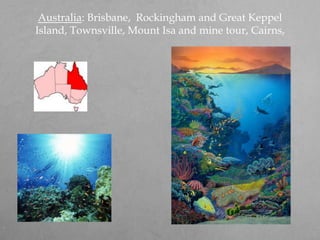
Australia: Brisbane,  Rockingham and Great Keppel Island, Townsville, Mount Isa and mine tour, Cairns,
Great Barrier Reef National Park, Daintree Rainforest and Cape Tribulation National Park and World Heritage Area, Lake Barrine National Park, Hypipamee National Park, Jourama Falls National Park. Townsville, and Magnetic Island, another visit to Great Barrier Reef National Park out of Airlie Beach, and Mapleton Falls National Park.The Daintree River ferry is the gateway to the solitary place on the planet where two World Heritage areas unite.  The Daintree Rainforest and Great Barrier Reef - majestic and unsurpassed in biological significance.
Hypipamee National ParkMt Hypipamee crater is a diatreme formed by an explosive eruption of volcanic gases which blasted through solid granite.  Angular blocks of granite as large as refrigerators can be found in the surrounding rainforest, giving testimony to the power of the explosion that hurled them there.
Queensland National ParksMagnetic IslandJourama Falls
New Zealand. Rotorua and TongariroPohutu Geyser at WhakarewarewaBubbling Geothermal Mud at Whakarewarewa Mount Ngauruhoe, Tongariro National Park
Nova Scotia Bay of Fundylow tideCabot Trailhigh tide
The Newfoundland StoryRocks on the Island of Newfoundland are divided into three zones - Western, Central and Eastern. The Western Zone has been part of North America for at least the last billion years (1000 million), but the other two zones are relative newcomers.Geological Subdivisions of Newfoundland.The bringing together of ancient oceans and continents has given Newfoundland three geological zones: the Western, Central and Eastern zones. Each of these zones has distinct rock types and geological histories.
Newfoundland preserves evidence of the closing of the Iapetus ocean, the collision of the continents and the resulting deformation.
Layered limestones and shales at Green Point, Gros Morne National Park.The rocks of the coastal terrace and cliffs at Green Point originated offshore in the Iapetus Ocean about 500 million years ago. These fossil-bearing limestones and shales were transported from about 100 km to the east of this site during the collision of ancient continents. Now they lie tipped at 115 degrees, just past the vertical. This is one of the rock sequences that geologists have studies in theirattempt to reconstruct the ancient continental margin of eastern North America.
The Mohorovicic Discontinuity, which reflects the different densities of the crust and the mantle, normally occurs at a depth of 35 km beneath the continents and about 10 km beneath the oceans. But here you can literally stand with one foot on the gabbro of the ocean crust and the other on the peridotite of the ocean mantle. It is because of this unusual sequence of rocks and other aspects of Gros Morne's geology and landscape that in 1988 Gros Morne was declared a UNESCO World Heritage Site..
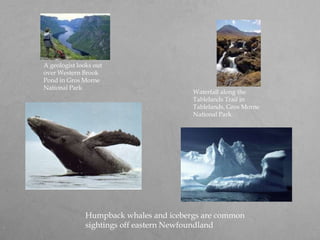
A geologist looks out over Western Brook Pond in Gros Morne National Park Waterfall along the Tablelands Trail in Tablelands, Gros Morne National Park.Humpback whales and icebergs are common sightings off eastern Newfoundland
1994 – Indonesia: Bali, Lombok, East Java.Mount Batur (Gunung Batur) is an active volcano located at the center of two concentric calderas north west of Mount Agung, Bali, Indonesia. The south east side of the larger 10×13 km caldera contains a caldera lake. The inner 7.5-kilometer-wide caldera, which was formed during emplacement of the Bali (or Ubud) ignimbrite, has been dated at about 23,670 and 28,500 years ago
East JavaMount Bromo (Indonesian: Gunung Bromo), is an active volcano and part of the Tengger massif, in East Java, Indonesia. At 2,329 metres (7,641 ft) it is not the highest peak of the massif, but is the most well known. The massif area is one of the most visited tourist attractions in East Java, Indonesia.

Lifonearth2

  • 1.
    A LIFE ONEARTHPART TWO
  • 2.
    JamaicaBlue LagoonDunn’s RiverFalls Port AntonioBamboo rafting on Rio Grande
  • 3.
    1984 - WinterTerm Sabbatical in Costa RicaA grant to visit the Associated Colleges Costa Rica was parlayed into joining a tour of the National Parks and the Dartmouth expedition to Cocos Island. Poas volcano National ParkManuel Antonio National ParkThrilling to watch Leatherback turtleslay their eggs on the Pacific beach – done at night
  • 4.
    Dartmouth College Ecologytour traveled via fishing boat to Cocos Island, some 300 km from Costa Rica’s Pacific coast.Cocos Island National Park was designated a World by in 1997. In 2002, the World Heritage Site designation was extended to include an expanded marine zone of 1,997 km².Cocos Island is an oceanic island of both volcanic and tectonic origin. It is the only emergent island of the Cocos Plate, one of the minor tectonic plates
  • 5.
    Mexico CityOpera HouseMexicoCity CathedralAngel de la Independencia— A victory column located on a roundabout over Paseo de la ReformaTeotihuacán -Avenue of the Dead
  • 6.
    Attended Recent Advancesin Volcanology a Chautauqua course on Oahu, HawaiiDiamond Head, a volcanic cone –Oahu’s signature iconA ride to the top of the dormant Haleakala Volcano on the Hawaiian island of Maui goes from sea level to the 10,000+ foot summit. On the way you pass through several diverse climates and see a huge Variety of flora, from tropical to arctic tundra.
  • 7.
    Welcome aboard oneof the most popular train excursions in North America. This one day wilderness excursion will take you 114 miles north of Sault Ste. Marie, over towering trestles, alongside pristine northern lakes and rivers, and through the awesome granite rock formations and mixed forests of the Canadian Shield.
  • 8.
    Frankfurt andBremerhaven, also Schwerin in East Germany, Netherlands; Great Britain’s Classic Sites: England, Wales, Scotland; crossed channel to France - Paris, fast train to Lyon, southern France, biked to foothills of Pyrenees and back to Paris.May 1945 Arrival of American troops ends war June 1945 The Americans are being replaced by British troops July 1945 Soviet troops take over the citySchwerin – formerly East Germany Stade, was a part of a Swedish province from 1645 to 1712, and some of the buildings built by the Swedes are still in use today.
  • 9.
    Great Britain’s ClassicSites: England, Wales, Scotland The Geological Society of London is housed in the east wing of Burlington House, Piccadilly, London.Aberystwyth is one of the liveliest university towns in Wales. Silurian turbidites forming the hills at the far end of town.Sussex
  • 10.
    The island ofArran is a popular destination for geologists, who come to see intrusive igneous sills and dikes as well as sedimentary and metasedimentary rocks ranging in age from Precambrian to Mesozoic.
  • 11.
    EdinboroughAbout 1 kmfrom the city center, the remnants of the long extinct volcano of Arthur’s Seat rise from the low ground on whichEdinborough is built.
  • 12.
    Hutton's Unconformity, SiccarPointFamous for Hutton's observations that provided evidence for geological evolution. Here, Silurian greywackes, laid down approximately 425 million years ago are underneath Devonian sandstone deposited approximately 345 million years ago
  • 13.
    Hadrian’s WallThe WhinSill is a tabular layer of igneous rock, or sill, in the northeast of England. The Romans certainly appreciated and exploited the geology. Emperor Hadrian chose the narrowest route across northern England for his Wall, and took advantage of the natural defenses of the crags between Walltown and Sewingshields. These crags mark the outcrop of the Whin Sill, one of the most important features of northern England geology.
  • 14.
    Paris and LyonUsedthe fast train from Paris to LyonSaw the parade on Bastille Day July 14, 1991
  • 15.
  • 16.
  • 17.
    Back to ParisQuicktrain ride to see the cathedral at Chartres
  • 18.
    1992 - SpringTerm Sabbatical. Hawaii, flew Air Micronesia to Johnston Island, Marshall Island (Majuro), Kwajalein, Kosrae, Pohnpei, Truk, Guam, Yap and Palaua.Yap has traditional dress, stone money and great diving for stingrays
  • 19.
    PalauPalau's famed "RockIslands"Jellyfish Lake
  • 20.
    Papua New Guinea: Port Moresby, Mt. Hagen, Mendi, Tari, Wabeg, Goroka, back to Port Moresby.A Sing Sing festival participant, Mt Hagen.
  • 21.
    Australia: Brisbane, Rockingham and Great Keppel Island, Townsville, Mount Isa and mine tour, Cairns,
  • 22.
    Great Barrier ReefNational Park, Daintree Rainforest and Cape Tribulation National Park and World Heritage Area, Lake Barrine National Park, Hypipamee National Park, Jourama Falls National Park. Townsville, and Magnetic Island, another visit to Great Barrier Reef National Park out of Airlie Beach, and Mapleton Falls National Park.The Daintree River ferry is the gateway to the solitary place on the planet where two World Heritage areas unite. The Daintree Rainforest and Great Barrier Reef - majestic and unsurpassed in biological significance.
  • 23.
    Hypipamee National ParkMtHypipamee crater is a diatreme formed by an explosive eruption of volcanic gases which blasted through solid granite. Angular blocks of granite as large as refrigerators can be found in the surrounding rainforest, giving testimony to the power of the explosion that hurled them there.
  • 24.
  • 25.
    New Zealand. Rotoruaand TongariroPohutu Geyser at WhakarewarewaBubbling Geothermal Mud at Whakarewarewa Mount Ngauruhoe, Tongariro National Park
  • 26.
    Nova Scotia Bayof Fundylow tideCabot Trailhigh tide
  • 27.
    The Newfoundland StoryRockson the Island of Newfoundland are divided into three zones - Western, Central and Eastern. The Western Zone has been part of North America for at least the last billion years (1000 million), but the other two zones are relative newcomers.Geological Subdivisions of Newfoundland.The bringing together of ancient oceans and continents has given Newfoundland three geological zones: the Western, Central and Eastern zones. Each of these zones has distinct rock types and geological histories.
  • 28.
    Newfoundland preserves evidenceof the closing of the Iapetus ocean, the collision of the continents and the resulting deformation.
  • 29.
    Layered limestones andshales at Green Point, Gros Morne National Park.The rocks of the coastal terrace and cliffs at Green Point originated offshore in the Iapetus Ocean about 500 million years ago. These fossil-bearing limestones and shales were transported from about 100 km to the east of this site during the collision of ancient continents. Now they lie tipped at 115 degrees, just past the vertical. This is one of the rock sequences that geologists have studies in theirattempt to reconstruct the ancient continental margin of eastern North America.
  • 30.
    The Mohorovicic Discontinuity,which reflects the different densities of the crust and the mantle, normally occurs at a depth of 35 km beneath the continents and about 10 km beneath the oceans. But here you can literally stand with one foot on the gabbro of the ocean crust and the other on the peridotite of the ocean mantle. It is because of this unusual sequence of rocks and other aspects of Gros Morne's geology and landscape that in 1988 Gros Morne was declared a UNESCO World Heritage Site..
  • 31.
    A geologist looksout over Western Brook Pond in Gros Morne National Park Waterfall along the Tablelands Trail in Tablelands, Gros Morne National Park.Humpback whales and icebergs are common sightings off eastern Newfoundland
  • 32.
    1994 – Indonesia:Bali, Lombok, East Java.Mount Batur (Gunung Batur) is an active volcano located at the center of two concentric calderas north west of Mount Agung, Bali, Indonesia. The south east side of the larger 10×13 km caldera contains a caldera lake. The inner 7.5-kilometer-wide caldera, which was formed during emplacement of the Bali (or Ubud) ignimbrite, has been dated at about 23,670 and 28,500 years ago
  • 34.
    East JavaMount Bromo(Indonesian: Gunung Bromo), is an active volcano and part of the Tengger massif, in East Java, Indonesia. At 2,329 metres (7,641 ft) it is not the highest peak of the massif, but is the most well known. The massif area is one of the most visited tourist attractions in East Java, Indonesia.

Editor's Notes