













AFRICAN UNION
HANDBOOK 2014
AFRICAN UNION HANDBOOK 2014
AFRICAN UNION
HANDBOOK
A GUIDE FOR THOSE WORKING WITH AND WITHIN THE AFRICAN UNION
First published in 2014
First edition
© African Union Commission and New Zealand Crown Copyright Reserved 2014
ISSN: 2350-3319 (Print)
ISSN: 2350-3335 (Online)
Jointly published by the African Union Commission and New Zealand Ministry of Foreign
Affairs and Trade/Manat Aorere
African Union
PO Box 3243
Roosevelt Street
(Old Airport Area), W21K19, Addis Ababa, Ethiopia

Website: www.au.int
Email: Dinfo@africa-union.org
Ministry of Foreign Affairs and Trade/Manat Aorere
Private Bag 18–901, Wellington, New Zealand
Website: www.mfat.govt.nz
Email: cmd@mfat.govt.nz
A PDF version of this book is available on the websites above.
The African Union Commission and New Zealand Ministry of Foreign Affairs and Trade shall not be under
any liability to any person or organisation in respect of any loss or damage (including consequential loss or
damage), however caused, which may be incurred or which arises directly or indirectly from reliance on
information in this publication.
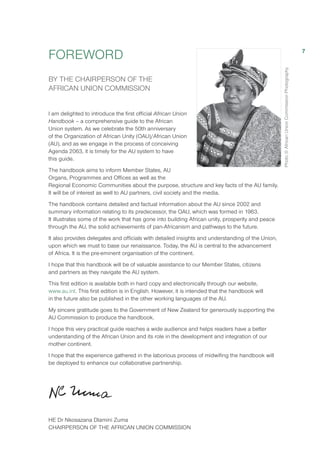
Photo page 7 © AUC – 2013, all rights reserved. Any redistribution or reproduction of part or all in any form
is prohibited. You may not, except with AUC express written permission, copy, reproduce, distribute or
exploit the content. Nor may you transmit it or store it in any other website or other form of electronic
retrieval system. Directorate of Information and Communication, African Union Commission Photography.
Cover image: Courtesy of Getty Images. ©BeholdingEye.
2
CONTENTS
ABBREVIATIONS.. . . . . . . . . . . . . . . . . . . . . . . . . . . . . . . . . . . . . . . . . . . . . . . . . . . . . . . . . . . . . . . . . . . . . . . . . . . . . . . . . . . . . . . . . . . . . . . . . . . . . . . . . . . . . . . . . . . . . . . . . . . . . . . . . . . . . . . . . . . . . . . . . . . . . . . . . . . . . . . . . . . . . . . . . . . . . . . . . . . . . . . . . . . . 5
FOREWORDS.. . . . . . . . . . . . . . . . . . . . . . . . . . . . . . . . . . . . . . . . . . . . . . . . . . . . . . . . . . . . . . . . . . . . . . . . . . . . . . . . . . . . . . . . . . . . . . . . . . . . . . . . . . . . . . . . . . . . . . . . . . . . . . . . . . . . . . . . . . . . . . . . . . . . . . . . . . . . . . . . . . . . . . . . . . . . . . . . . . . . . . . . . . . . . . . . . . . . 7
Chairperson of the African Union Commission.. . . . . . . . . . . . . . . . . . . . . . . . . . . . . . . . . . . . . . . . . . . . . . . . . . . . . . . . . . . . . . . . . . . . . . . . . . . . . . . . . . . . . . . . . . . . . . . . . . . . . . . . . . . . . . . . 7
New Zealand Minister of Foreign Affairs.. .. .. .. .. .. .. .. .. .. .. .. .. .. .. .. .. .. .. .. .. .. .. .. .. .. .. .. .. .. .. .. .. .. .. .. .. .. .. .. .. .. .. .. .. .. .. .. .. .. .. .. .. .. .. .. .. .. .. .. .. .. .. .. 8
WHAT THIS BOOK DOES.. .. .. .. .. .. .. .. .. .. .. .. .. .. .. .. .. .. .. .. .. .. .. .. .. .. .. .. .. .. .. .. .. .. .. .. .. .. .. .. .. .. .. .. .. .. .. .. .. .. .. .. .. .. .. .. .. .. .. .. .. .. .. .. .. .. .. .. .. .. .. .. .. .. .. .. .. .. .. .. .. .. .. .. .. 9
HISTORY OF THE OAU AND AU .. . . . . . . . . . . . . . . . . . . . . . . . . . . . . . . . . . . . . . . . . . . . . . . . . . . . . . . . . . . . . . . . . . . . . . . . . . . . . . . . . . . . . . . . . . . . . . . . . . . . . . . . . . . . . . . . . . . . . . . . . . . . . . . . . . . . . . . . . . . . . . . . . . . . . 10
ASSEMBLY.. .. .. .. .. .. .. .. .. .. .. .. .. .. .. .. .. .. .. .. .. .. .. .. .. .. .. .. .. .. .. .. .. .. .. .. .. .. .. .. .. .. .. .. .. .. .. .. .. .. .. .. .. .. .. .. .. .. .. .. .. .. .. .. .. .. .. .. .. .. .. .. .. .. .. .. .. .. .. .. .. .. .. .. .. .. .. .. .. .. .. .. .. .. .. .. 11
EXECUTIVE COUNCIL.. .. .. .. .. .. .. .. .. .. .. .. .. .. .. .. .. .. .. .. .. .. .. .. .. .. .. .. .. .. .. .. .. .. .. .. .. .. .. .. .. .. .. .. .. .. .. .. .. .. .. .. .. .. .. .. .. .. .. .. .. .. .. .. .. .. .. .. .. .. .. .. .. .. .. .. .. .. .. .. 17
SPECIALISED TECHNICAL COMMITTEES .. .. .. .. .. .. .. .. .. .. .. .. .. .. .. .. .. .. .. .. .. .. .. .. .. .. .. .. .. .. .. .. .. .. .. .. .. .. .. .. .. .. .. .. .. .. .. .. .. . 23
PEACE AND SECURITY COUNCIL.. . . . . . . . . . . . . . . . . . . . . . . . . . . . . . . . . . . . . . . . . . . . . . . . . . . . . . . . . . . . . . . . . . . . . . . . . . . . . . . . . . . . . . . . . . . . . . . . . . . . . . . . . . . . . . . . . . . . . . . . . . . . 27
African Peace and Security Architecture (APSA).. . . . . . . . . . . . . . . . . . . . . . . . . . . . . . . . . . . . . . . . . . . . . . . . . . . . . . . . . . . . . . . . . . . . . . . . . . . . . . . . . . . . . . . . . . . . . . . . . . . . . . . . . 28
PSC Subsidiary Bodies.. .. .. .. .. .. .. .. .. .. .. .. .. .. .. .. .. .. .. .. .. .. .. .. .. .. .. .. .. .. .. .. .. .. .. .. .. .. .. .. .. .. .. .. .. .. .. .. .. .. .. .. .. .. .. .. .. .. .. .. .. .. .. .. .. .. .. .. .. .. .. .. .. .. .. .. .. .. .. .. ..  32
Continental Early Warning System (CEWS).. . . . . . . . . . . . . . . . . . . . . . . . . . . . . . . . . . . . . . . . . . . . . . . . . . . . . . . . . . . . . . . . . . . . . . . . . . . . . . . . . . . . . . . . . . . . . . . . . . . . . . . . . . . . . . . . . . . . . 33
Panel of the Wise.. .. .. .. .. .. .. .. .. .. .. .. .. .. .. .. .. .. .. .. .. .. .. .. .. .. .. .. .. .. .. .. .. .. .. .. .. .. .. .. .. .. .. .. .. .. .. .. .. .. .. .. .. .. .. .. .. .. .. .. .. .. .. .. .. .. .. .. .. .. .. .. .. .. .. .. .. .. .. .. .. .. .. .. .. .. .. .. .34
African Standby Force (ASF).. .. .. .. .. .. .. .. .. .. .. .. .. .. .. .. .. .. .. .. .. .. .. .. .. .. .. .. .. .. .. .. .. .. .. .. .. .. .. .. .. .. .. .. .. .. .. .. .. .. .. .. .. .. .. .. .. .. .. .. .. .. .. .. .. .. .. .. .. .. .. .. .. .. .. .37
Peace Support Operations (PSOs).. . . . . . . . . . . . . . . . . . . . . . . . . . . . . . . . . . . . . . . . . . . . . . . . . . . . . . . . . . . . . . . . . . . . . . . . . . . . . . . . . . . . . . . . . . . . . . . . . . . . . . . . . . . . . . . . . . . . . . . . . . . . . . . . . . . . . . . . . 39
Peace Fund .. . . . . . . . . . . . . . . . . . . . . . . . . . . . . . . . . . . . . . . . . . . . . . . . . . . . . . . . . . . . . . . . . . . . . . . . . . . . . . . . . . . . . . . . . . . . . . . . . . . . . . . . . . . . . . . . . . . . . . . . . . . . . . . . . . . . . . . . . . . . . . . . . . . . . . . . . . . . . . . . . . . . . . . . . . . . . . . . . . . . . . . . . . . 43
High-Level Panels .. . . . . . . . . . . . . . . . . . . . . . . . . . . . . . . . . . . . . . . . . . . . . . . . . . . . . . . . . . . . . . . . . . . . . . . . . . . . . . . . . . . . . . . . . . . . . . . . . . . . . . . . . . . . . . . . . . . . . . . . . . . . . . . . . . . . . . . . . . . . . . . . . . . . . . . . . . . . . . . . . . . . . . . . . . . . . 44
AFRICAN UNION COMMISSION .. .. .. .. .. .. .. .. .. .. .. .. .. .. .. .. .. .. .. .. .. .. .. .. .. .. .. .. .. .. .. .. .. .. .. .. .. .. .. .. .. .. .. .. .. .. .. .. .. .. .. .. .. .. .. .. .. .. .. .. .. .. .. .. . 45
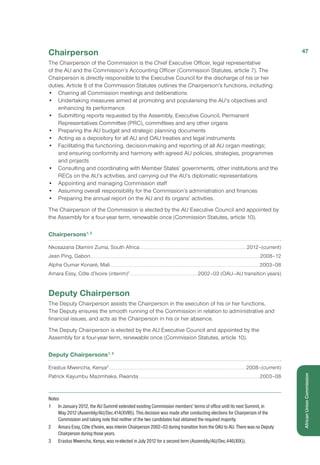
Chairperson.. .. .. .. .. .. .. .. .. .. .. .. .. .. .. .. .. .. .. .. .. .. .. .. .. .. .. .. .. .. .. .. .. .. .. .. .. .. .. .. .. .. .. .. .. .. .. .. .. .. .. .. .. .. .. .. .. .. .. .. .. .. .. .. .. .. .. .. .. .. .. .. .. .. .. .. .. .. .. .. .. .. .. .. .. .. .. .. .. .. .. .. .. .. .47
Deputy Chairperson.. . . . . . . . . . . . . . . . . . . . . . . . . . . . . . . . . . . . . . . . . . . . . . . . . . . . . . . . . . . . . . . . . . . . . . . . . . . . . . . . . . . . . . . . . . . . . . . . . . . . . . . . . . . . . . . . . . . . . . . . . . . . . . . . . . . . . . . . . . . . . . . . . . . . . . . . . . . . . . . . . . . . . . . . . 47
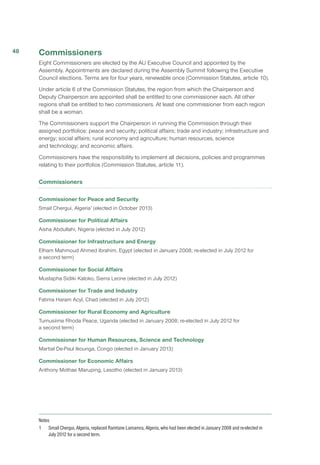
Commissioners .. . . . . . . . . . . . . . . . . . . . . . . . . . . . . . . . . . . . . . . . . . . . . . . . . . . . . . . . . . . . . . . . . . . . . . . . . . . . . . . . . . . . . . . . . . . . . . . . . . . . . . . . . . . . . . . . . . . . . . . . . . . . . . . . . . . . . . . . . . . . . . . . . . . . . . . . . . . . . . . . . . . . . . . . . . . . . . . . . . . 48
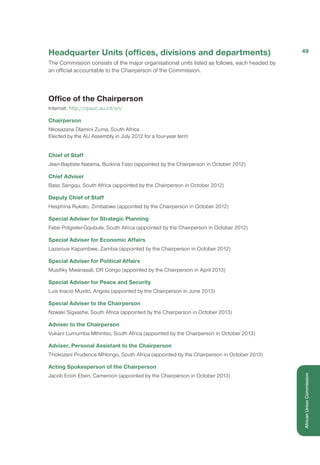
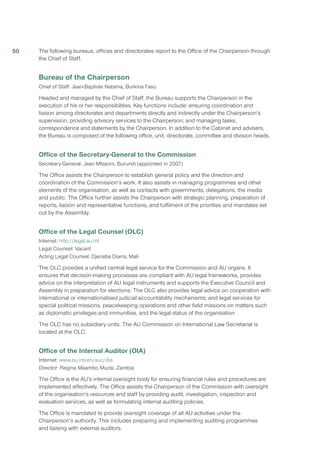
Headquarter Units (offices, divisions and departments).. . . . . . . . . . . . . . . . . . . . . . . . . . . . . . . . . . . . . . . . . . . . . . . . . . . . . . . . . . . . . . . . . . . . . . . . . . . . . . . . . . . . . . . . . 49
Permanent Representational and Specialised Offices.. . . . . . . . . . . . . . . . . . . . . . . . . . . . . . . . . . . . . . . . . . . . . . . . . . . . . . . . . . . . . . . . . . . . . . . . . . . . . . . . . . . . . . . . . . . . . 60
Special Representative and Liaison Offices.. . . . . . . . . . . . . . . . . . . . . . . . . . . . . . . . . . . . . . . . . . . . . . . . . . . . . . . . . . . . . . . . . . . . . . . . . . . . . . . . . . . . . . . . . . . . . . . . . . . . . . . . . . . . . . . . . . . . . 61
Special Envoys of the Chairperson of the Commission .. . . . . . . . . . . . . . . . . . . . . . . . . . . . . . . . . . . . . . . . . . . . . . . . . . . . . . . . . . . . . . . . . . . . . . . . . . . . . . . . . . . . . . . . . 64
PAN-AFRICAN PARLIAMENT.. . . . . . . . . . . . . . . . . . . . . . . . . . . . . . . . . . . . . . . . . . . . . . . . . . . . . . . . . . . . . . . . . . . . . . . . . . . . . . . . . . . . . . . . . . . . . . . . . . . . . . . . . . . . . . . . . . . . . . . . . . . . . . . . . . . . . . . . . . . . 67
JUDICIAL AND HUMAN RIGHTS INSTITUTIONS.. . . . . . . . . . . . . . . . . . . . . . . . . . . . . . . . . . . . . . . . . . . . . . . . . . . . . . . . . . . . . . . . . . . . . . . . . . . . . . . . . . . 73
African Commission on Human and Peoples’ Rights.. . . . . . . . . . . . . . . . . . . . . . . . . . . . . . . . . . . . . . . . . . . . . . . . . . . . . . . . . . . . . . . . . . . . . . . . . . . . . . . . . . . . . . . . . . . . . . . 74
African Court on Human and Peoples’ Rights.. . . . . . . . . . . . . . . . . . . . . . . . . . . . . . . . . . . . . . . . . . . . . . . . . . . . . . . . . . . . . . . . . . . . . . . . . . . . . . . . . . . . . . . . . . . . . . . . . . . . . . . . . . . . . . . 78
African Court of Justice/African Court of Human Rights and Justice.. . . . . . . . . . . . . . . . . . . . . . . . . . . . . . . . . . . . . . . . . . . . . . . . . . . . . . . . . . . 80
African Committee of Experts on the Rights and Welfare of the Child (ACERWC).. .. .. .. .. .. .. .. .. .. .. .. .. .. ..  80
FINANCIAL INSTITUTIONS .. . . . . . . . . . . . . . . . . . . . . . . . . . . . . . . . . . . . . . . . . . . . . . . . . . . . . . . . . . . . . . . . . . . . . . . . . . . . . . . . . . . . . . . . . . . . . . . . . . . . . . . . . . . . . . . . . . . . . . . . . . . . . . . . . . . . . . . . . . . . . . . 83
African Central Bank (ACB).. . . . . . . . . . . . . . . . . . . . . . . . . . . . . . . . . . . . . . . . . . . . . . . . . . . . . . . . . . . . . . . . . . . . . . . . . . . . . . . . . . . . . . . . . . . . . . . . . . . . . . . . . . . . . . . . . . . . . . . . . . . . . . . . . . . . . . . . . . . . . . . . . . . . . . . . . 84
African Investment Bank (AIB).. . . . . . . . . . . . . . . . . . . . . . . . . . . . . . . . . . . . . . . . . . . . . . . . . . . . . . . . . . . . . . . . . . . . . . . . . . . . . . . . . . . . . . . . . . . . . . . . . . . . . . . . . . . . . . . . . . . . . . . . . . . . . . . . . . . . . . . . . . . . . . . . . . . 84
African Monetary Fund (AMF).. . . . . . . . . . . . . . . . . . . . . . . . . . . . . . . . . . . . . . . . . . . . . . . . . . . . . . . . . . . . . . . . . . . . . . . . . . . . . . . . . . . . . . . . . . . . . . . . . . . . . . . . . . . . . . . . . . . . . . . . . . . . . . . . . . . . . . . . . . . . . . . . . . . 85
3
PERMANENT REPRESENTATIVES COMMITTEE .. .. .. .. .. .. .. .. .. .. .. .. .. .. .. .. .. .. .. .. .. .. .. .. .. .. .. .. .. .. .. .. .. .. .. .. .. .. .. .. .. 87
ECONOMIC, SOCIAL AND CULTURAL COUNCIL .. .. .. .. .. .. .. .. .. .. .. .. .. .. .. .. .. .. .. .. .. .. .. .. .. .. .. .. .. .. .. .. .. .. .. .. .. .. 103
NEW PARTNERSHIP FOR AFRICA’S DEVELOPMENT (NEPAD).. .. .. .. .. .. .. .. .. .. .. .. .. .. .. .. .. .. .. 109
AFRICAN PEER REVIEW MECHANISM (APRM) .. . . . . . . . . . . . . . . . . . . . . . . . . . . . . . . . . . . . . . . . . . . . . . . . . . . . . . . . . . . . . . . . . . . . . . . . . . . . . . . . .113
REGIONAL ECONOMIC COMMUNITIES .. .. .. .. .. .. .. .. .. .. .. .. .. .. .. .. .. .. .. .. .. .. .. .. .. .. .. .. .. .. .. .. .. .. .. .. .. .. .. .. .. .. .. .. .. .. .. .. .. .. .. ..117
AFRICAN DEVELOPMENT BANK.. . . . . . . . . . . . . . . . . . . . . . . . . . . . . . . . . . . . . . . . . . . . . . . . . . . . . . . . . . . . . . . . . . . . . . . . . . . . . . . . . . . . . . . . . . . . . . . . . . . . . . . . . . . . . . . . . . . . . . . . . . . . 129
UNITED NATIONS ECONOMIC COMMISSION FOR AFRICA.. . . . . . . . . . . . . . . . . . . . . . . . . . . . . . . . . . . . . . . . . . . . . . 133
OTHER BODIES RELATED TO THE AU.. .. .. .. .. .. .. .. .. .. .. .. .. .. .. .. .. .. .. .. .. .. .. .. .. .. .. .. .. .. .. .. .. .. .. .. .. .. .. .. .. .. .. .. .. .. .. .. .. .. .. .. .. .. 137
Committee of Intelligence and Security Services of Africa (CISSA).. .. .. .. .. .. .. .. .. .. .. .. .. .. .. .. .. .. .. .. .. .. .. .. .. .. .. .. .. .. .. 138
AU Advisory Board on Corruption.. .. .. .. .. .. .. .. .. .. .. .. .. .. .. .. .. .. .. .. .. .. .. .. .. .. .. .. .. .. .. .. .. .. .. .. .. .. .. .. .. .. .. .. .. .. .. .. .. .. .. .. .. .. .. .. .. .. .. .. .. .. .. .. .. .. .. .. 139
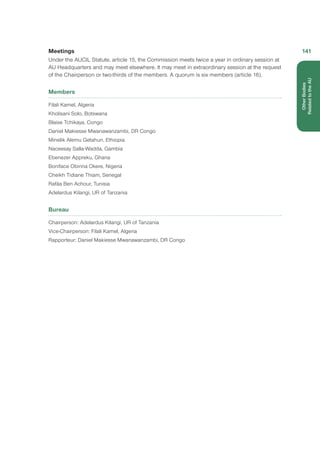
AU Commission on International Law (AUCIL).. .. .. .. .. .. .. .. .. .. .. .. .. .. .. .. .. .. .. .. .. .. .. .. .. .. .. .. .. .. .. .. .. .. .. .. .. .. .. .. .. .. .. .. .. .. .. .. .. .. .. .. .. .. 140
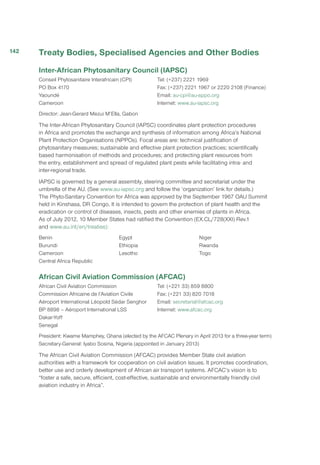
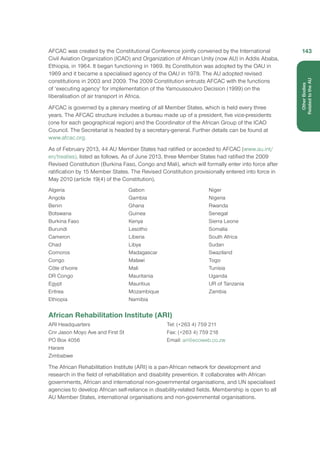
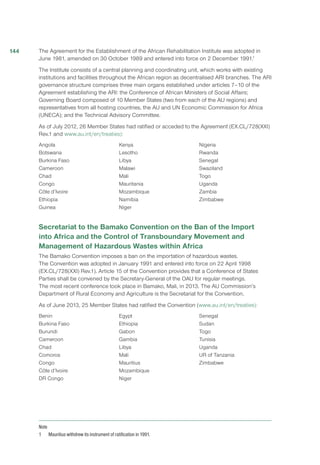
Treaty Bodies, Specialised Agencies and Other Bodies.. . . . . . . . . . . . . . . . . . . . . . . . . . . . . . . . . . . . . . . . . . . . . . . . . . . . . . . . . . . . . . . . . . . . . . . . . . . . . . . . . . . . . . 142
EXTERNAL PARTNERSHIPS.. .. .. .. .. .. .. .. .. .. .. .. .. .. .. .. .. .. .. .. .. .. .. .. .. .. .. .. .. .. .. .. .. .. .. .. .. .. .. .. .. .. .. .. .. .. .. .. .. .. .. .. .. .. .. .. .. .. .. .. .. .. .. .. .. .. .. .. .. 153
United Nations Liaison and Representational Offices .. . . . . . . . . . . . . . . . . . . . . . . . . . . . . . . . . . . . . . . . . . . . . . . . . . . . . . . . . . . . . . . . . . . . . . . . . . . . . . . . . . . . . . . . . . 154
Continent and Country Partnerships .. . . . . . . . . . . . . . . . . . . . . . . . . . . . . . . . . . . . . . . . . . . . . . . . . . . . . . . . . . . . . . . . . . . . . . . . . . . . . . . . . . . . . . . . . . . . . . . . . . . . . . . . . . . . . . . . . . . . . . . . . . . . . . . . 155
Non-African States and Organisations accredited to the AU.. . . . . . . . . . . . . . . . . . . . . . . . . . . . . . . . . . . . . . . . . . . . . . . . . . . . . . . . . . . . . . . . . . . . . . . . . . . . .157
BUDGET.. . . . . . . . . . . . . . . . . . . . . . . . . . . . . . . . . . . . . . . . . . . . . . . . . . . . . . . . . . . . . . . . . . . . . . . . . . . . . . . . . . . . . . . . . . . . . . . . . . . . . . . . . . . . . . . . . . . . . . . . . . . . . . . . . . . . . . . . . . . . . . . . . . . . . . . . . . . . . . . . . . . . . . . . . . . . . . . . . . . . . . . . . . . . . . . . . . 159
ACRONYMS.. . . . . . . . . . . . . . . . . . . . . . . . . . . . . . . . . . . . . . . . . . . . . . . . . . . . . . . . . . . . . . . . . . . . . . . . . . . . . . . . . . . . . . . . . . . . . . . . . . . . . . . . . . . . . . . . . . . . . . . . . . . . . . . . . . . . . . . . . . . . . . . . . . . . . . . . . . . . . . . . . . . . . . . . . . . . . . . . . . . . . . . . 167
APPENDICES.. . . . . . . . . . . . . . . . . . . . . . . . . . . . . . . . . . . . . . . . . . . . . . . . . . . . . . . . . . . . . . . . . . . . . . . . . . . . . . . . . . . . . . . . . . . . . . . . . . . . . . . . . . . . . . . . . . . . . . . . . . . . . . . . . . . . . . . . . . . . . . . . . . . . . . . . . . . . . . . . . . . . . . . . . . . . . . . . . . . . 173
Appendix I: Constitutive Act of the African Union.. .. .. .. .. .. .. .. .. .. .. .. .. .. .. .. .. .. .. .. .. .. .. .. .. .. .. .. .. .. .. .. .. .. .. .. .. .. .. .. .. .. .. .. .. .. .. .. .. .. ..  174
Appendix II: Protocol on Amendments to the Constitutive Act of the African Union.. . . . . . . . . . . . . . . . . . . . . . . . 183
INDEX.. . . . . . . . . . . . . . . . . . . . . . . . . . . . . . . . . . . . . . . . . . . . . . . . . . . . . . . . . . . . . . . . . . . . . . . . . . . . . . . . . . . . . . . . . . . . . . . . . . . . . . . . . . . . . . . . . . . . . . . . . . . . . . . . . . . . . . . . . . . . . . . . . . . . . . . . . . . . . . . . . . . . . . . . . . . . . . . . . . . . . . . . . . . . . . . . . . . . . . . . . . 187
4
ABBREVIATIONS
African Union Member State names
Unless otherwise noted, the full names on the left are as listed in the African Union (AU)
Constitutive Act of 2000, plus the Republic of South Sudan, which joined the AU in 2011.
The names on the right are abbreviations used in this handbook.
People’s Democratic Republic of Algeria	 Algeria
Republic of Angola	 Angola
Republic of Benin	 Benin
Republic of Botswana	 Botswana
Burkina Faso	 Burkina Faso
Republic of Burundi	 Burundi
Republic of Cameroon	 Cameroon
Republic of Cape Verde	 Cape Verde
Central African Republic	 Central African Republic
Republic of Chad	 Chad
Union of the Comoros*	 Comoros
Republic of the Congo	 Congo
Republic of Cote d’Ivoire	 Côte d’Ivoire
Democratic Republic of Congo	 DR Congo
Republic of Djibouti	 Djibouti
Arab Republic of Egypt	 Egypt
State of Eritrea	 Eritrea
Federal Democratic Republic of Ethiopia	 Ethiopia
Republic of Equatorial Guinea	 Equatorial Guinea
Gabonese Republic	 Gabon
Republic of The Gambia	 Gambia
Republic of Ghana	 Ghana
Republic of Guinea	 Guinea	
Republic of Guinea Bissau	 Guinea Bissau
Republic of Kenya	 Kenya
Lesotho	Lesotho
Republic of Liberia	 Liberia
State of Libya*	 Libya
Republic of Madagascar	 Madagascar
Republic of Malawi	 Malawi
Republic of Mali	 Mali
Islamic Republic of Mauritania	 Mauritania
Note
*	 Name changed since 2000.
5
Republic of Mauritius	 Mauritius
Republic of Mozambique	 Mozambique
Republic of Namibia	 Namibia
Republic of Niger	 Niger
Federal Republic of Nigeria	 Nigeria
Republic of Rwanda	 Rwanda
Sahrawi Arab Democratic Republic	 Sahrawi Republic
Republic of Sao Tome and Principe	 São Tomé and Príncipe
Republic of Senegal	 Senegal
Republic of Seychelles	 Seychelles
Republic of Sierra Leone	 Sierra Leone
Republic of Somalia	 Somalia
Republic of South Africa	 South Africa
Republic of South Sudan	 South Sudan
Republic of Sudan	 Sudan
Swaziland	Swaziland
United Republic of Tanzania	 UR of Tanzania
Togolese Republic	 Togo
Republic of Tunisia	 Tunisia
Republic of Uganda	 Uganda
Republic of Zambia	 Zambia
Republic of Zimbabwe	 Zimbabwe
Other commonly used abbreviations
AU	 African Union
Assembly	 AU Assembly of Heads of State and Government
	 (unless otherwise specified)
Commission	 AU Commission (unless otherwise specified)
Continent	 Continent and Islands of Africa
ECOSOCC 	 AU Economic, Social and Cultural Council
OAU	 Organization of African Unity
PRC	 AU Permanent Representatives Committee
PSC	 AU Peace and Security Council
RECs	 African Regional Economic Communities
UN 	 United Nations
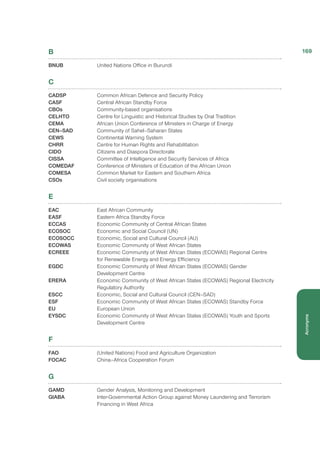
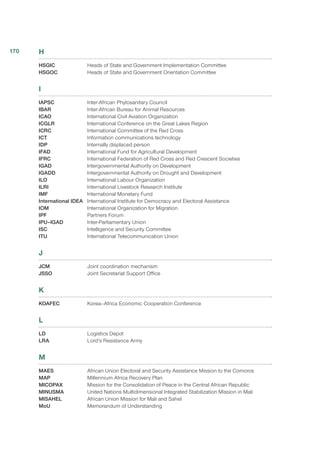
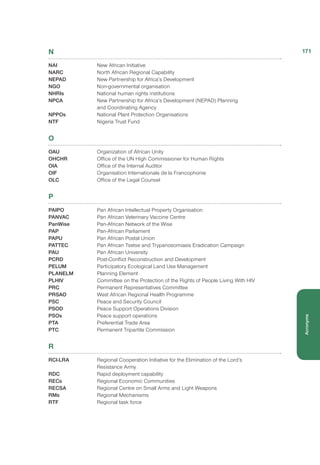
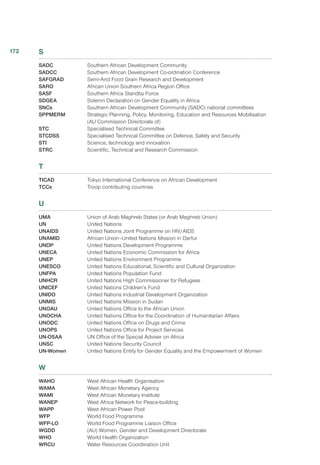
A fuller list of acronyms is available towards the end of this book.
Languages
Under article 11 of the Protocol to the AU Constitutive Act, the official languages of the AU and
all its institutions are Arabic, English, French, Portuguese, Spanish, Kiswahili and any other
African language. The AU’s working languages are Arabic, English, French and Portuguese.
6
FOREWORD
BY THE CHAIRPERSON OF THE
AFRICAN UNION COMMISSION
I am delighted to introduce the first official African Union
Handbook – a comprehensive guide to the African
Union system. As we celebrate the 50th anniversary
of the Organization of African Unity (OAU)/African Union
(AU), and as we engage in the process of conceiving
Agenda 2063, it is timely for the AU system to have
this guide.
The handbook aims to inform Member States, AU
Organs, Programmes and Offices as well as the
Regional Economic Communities about the purpose, structure and key facts of the AU family.
It will be of interest as well to AU partners, civil society and the media.
The handbook contains detailed and factual information about the AU since 2002 and
summary information relating to its predecessor, the OAU, which was formed in 1963.
It illustrates some of the work that has gone into building African unity, prosperity and peace
through the AU, the solid achievements of pan-Africanism and pathways to the future.
It also provides delegates and officials with detailed insights and understanding of the Union,
upon which we must to base our renaissance. Today, the AU is central to the advancement
of Africa. It is the pre-eminent organisation of the continent.
I hope that this handbook will be of valuable assistance to our Member States, citizens
and partners as they navigate the AU system.
This first edition is available both in hard copy and electronically through our website,
www.au.int. This first edition is in English. However, it is intended that the handbook will
in the future also be published in the other working languages of the AU.
My sincere gratitude goes to the Government of New Zealand for generously supporting the
AU Commission to produce the handbook.
I hope this very practical guide reaches a wide audience and helps readers have a better
understanding of the African Union and its role in the development and integration of our
mother continent.
I hope that the experience gathered in the laborious process of midwifing the handbook will
be deployed to enhance our collaborative partnership.
HE Dr Nkosazana Dlamini Zuma
CHAIRPERSON OF THE AFRICAN UNION COMMISSION
Photo©AfricanUnionCommissionPhotography
7
FOREWORD
BY THE NEW ZEALAND MINISTER
OF FOREIGN AFFAIRS
New Zealand salutes the countries of Africa on this 50th
anniversary year of the formation of the Organization of
African Unity.
New Zealand is proud to contribute to the 50th
anniversary celebrations by partnering with the African
Union Commission to produce this first edition African
Union Handbook. 
New Zealand has published the annual United Nations
Handbook since 1961. We know first-hand the importance of strong global and regional
multilateral systems for all states, large and small. I am therefore delighted that we have been
able to share our knowledge and experience to jointly produce a handbook for the African
Union members, staff of the Commission and others who follow the work of the Union. 
It is a time for those of us outside Africa as well as for the people of the continent to reflect
on the outstanding achievements of this organisation as well as the many people it has
represented. It is also an opportunity to look ahead and focus on Africa’s enormous
future potential.
Opportunities for Africa to play a key role in global economic growth are unprecedented.
At the same time, more than ever before, new generations of Africans are able to look forward
to a more peaceful and secure future for themselves and their communities. 
We trust this handbook will quickly become a valuable reference tool for every person working
in or with the African Union, and for those looking to better understand or increase their
participation and engagement with this organisation. 
This is a first edition. Like the United Nations Handbook, this publication will benefit from
regular updates and the use of innovative technology to make its information more accessible
to users.
Warmest congratulations and best wishes to the African Union as it leads the way into the next
50 years of African unity.
Hon Murray McCully
NEW ZEALAND MINISTER OF FOREIGN AFFAIRS
8
WHAT THIS BOOK DOES
This handbook is published by the African Union (AU) in partnership with the New Zealand
Government, publisher of the annual United Nations Handbook for more than 50 years.
Modelled on the United Nations Handbook, it is intended as a ready reference guide
for people working in all parts of the AU system (Member States, government officials,
Commission staff) as well as the AU’s many partners and wider civil society.
The book has at its heart information about the principal organs established by the AU
Constitutive Act and subsequent protocols: the Assembly, Executive Council, Peace and
Security Council, Pan-African Parliament, Justice and Financial Institutions, Permanent
Representatives Committee and AU Commission. It also contains information about the
subsidiary organs and programmes established in accordance with the Constitutive Act as
well as regional and other arrangements, such as the Regional Economic Communities, which
are closely integrated with the AU.
Non-governmental organisations, inter-governmental organisations and political groups are not
included except where they have a formal agreement with the AU.
The handbook focuses on the AU’s current organs and structure and is not intended to be a
historical record. However, as many of the AU organs and structures are directly inherited from
its predecessor, the Organization of African Unity (OAU), key details about the original OAU
structure are included where possible with notes on significant changes during the transition
to the AU.
The information in this book is intended to be accurate as at 1 September 2013 unless
otherwise stated.
All money values are in US dollars unless otherwise stated.
Website, email and postal/physical addresses are included where possible, along with
telephone and fax numbers. The primary contact details for AU Headquarters in Addis
Ababa are:
PO Box 3243

Roosevelt Street
(Old Airport Area)
W21K19

Addis Ababa

Ethiopia

Tel: (+251 11) 551 7700

Fax: (+251 11) 551 7844

Internet: www.au.int
The AU Handbook project has been based in the Directorate of Information and
Communications in the AU Commission.
The publishers are indebted to the AU Member States, AU Commission staff and others from
the many AU subsidiary and partner institutions that provided considerable assistance to
ensure this book is as up to date and comprehensive as possible. They also acknowledge the
work of the New Zealand members of the African Union Handbook team and the research
contributions of Alemayehu Behabtu and Mariame Camara.
9
HISTORY OF THE OAU AND AU
The Organization of African Unity and the African Union
The Organization of African Unity (OAU) was established in 1963 by agreement of the 32
African states that had achieved independence at that time. A further 21 members joined
gradually, reaching a total of 53 by the time of the AU’s creation in 2002.1
In 2011, South
Sudan became the 54th African Union (AU) member.
The OAU’s main objectives, as set out in the OAU Charter, were to promote the unity and
solidarity of African states; coordinate and intensify their cooperation and efforts to achieve a
better life for the peoples of Africa; safeguard the sovereignty and territorial integrity of Member
States; rid the continent of colonisation and apartheid; promote international cooperation
within the United Nations framework; and harmonise members’ political, diplomatic,
economic, educational, cultural, health, welfare, scientific, technical and defence policies.
The OAU operated on the basis of its Charter and, more recently, the 1991 Treaty Establishing
the African Economic Community (known as the Abuja Treaty). Its major organs were the
Assembly of Heads of State and Government, Council of Ministers, General Secretariat and
Commission of Mediation, Conciliation and Arbitration. The Commission of Mediation,
Conciliation and Arbitration was replaced by the Mechanism for Conflict Prevention,
Management and Resolution in 1993. 
Transition to the African Union
Through the 1990s, leaders debated the need to amend the OAU’s structures to reflect the
challenges of a changing world. In 1999, the OAU Heads of State and Government issued the
Sirte Declaration calling for the establishment of a new African Union. The vision for the Union
was to build on the OAU’s work by establishing a body that could accelerate the process of
integration in Africa, support the empowerment of African states in the global economy and
address the multifaceted social, economic and political problems facing the continent.
Three summits were held in the lead up to the official launching of the African Union, the:
•	 Lome Summit (2000), which adopted the AU Constitutive Act
•	 Lusaka Summit (2001), which drew the road map for implementation of the AU 
•	 Durban Summit (2002), which launched the AU and convened its first Assembly of Heads
of State and Government.
A significant number of OAU structures were carried forward into the AU. Similarly, many of the
OAU’s core commitments, decisions and strategy frameworks continue to frame AU policies.
However, while the footprint of the OAU is still strong, the AU Constitutive Act and protocols
established a significant number of new structures, both at the level of major organs and
through a range of new technical and subsidiary committees. Many of these have evolved
since 2002 and some are still under development.
Note
1	 Morocco left the OAU in November 1984 following the admission of the Sahrawi Republic in 1982 as the Government
of Western Sahara.
10
AFRICAN UNION HANDBOOK 2014
ASSEMBLY
ASSEMBLY
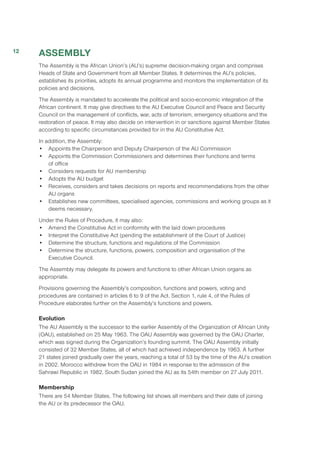
The Assembly is the African Union’s (AU’s) supreme decision-making organ and comprises
Heads of State and Government from all Member States. It determines the AU’s policies,
establishes its priorities, adopts its annual programme and monitors the implementation of its
policies and decisions.
The Assembly is mandated to accelerate the political and socio-economic integration of the
African continent. It may give directives to the AU Executive Council and Peace and Security
Council on the management of conflicts, war, acts of terrorism, emergency situations and the
restoration of peace. It may also decide on intervention in or sanctions against Member States
according to specific circumstances provided for in the AU Constitutive Act.
In addition, the Assembly:
•	 Appoints the Chairperson and Deputy Chairperson of the AU Commission
•	 Appoints the Commission Commissioners and determines their functions and terms
of office
•	 Considers requests for AU membership
•	 Adopts the AU budget
•	 Receives, considers and takes decisions on reports and recommendations from the other
AU organs

•	 Establishes new committees, specialised agencies, commissions and working groups as it
deems necessary.
Under the Rules of Procedure, it may also:
•	 Amend the Constitutive Act in conformity with the laid down procedures
•	 Interpret the Constitutive Act (pending the establishment of the Court of Justice)
•	 Determine the structure, functions and regulations of the Commission
•	 Determine the structure, functions, powers, composition and organisation of the
Executive Council.
The Assembly may delegate its powers and functions to other African Union organs as
appropriate.
Provisions governing the Assembly’s composition, functions and powers, voting and
procedures are contained in articles 6 to 9 of the Act. Section 1, rule 4, of the Rules of
Procedure elaborates further on the Assembly’s functions and powers.
Evolution
The AU Assembly is the successor to the earlier Assembly of the Organization of African Unity
(OAU), established on 25 May 1963. The OAU Assembly was governed by the OAU Charter,
which was signed during the Organization’s founding summit. The OAU Assembly initially
consisted of 32 Member States, all of which had achieved independence by 1963. A further
21 states joined gradually over the years, reaching a total of 53 by the time of the AU’s creation
in 2002. Morocco withdrew from the OAU in 1984 in response to the admission of the
Sahrawi Republic in 1982. South Sudan joined the AU as its 54th member on 27 July 2011.
Membership
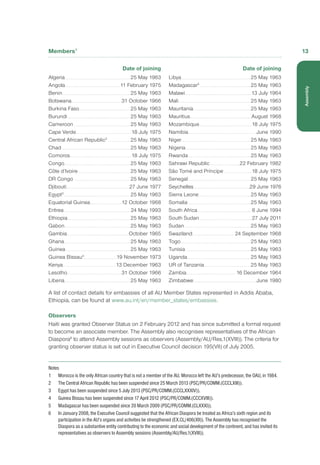
There are 54 Member States. The following list shows all members and their date of joining
the AU or its predecessor the OAU.
12
Members1
		
Date of joining
Algeria.. .. .. .. .. .. .. .. .. .. .. .. .. .. .. .. .. .. .. .. .. .. .. .. .. .. .. .. .. .. .. .. .. 25 May 1963
Angola.. .. .. .. .. .. .. .. .. .. .. .. .. .. .. .. .. .. .. .. .. .. .. .. .. .. .. .. 11 February 1975
Benin.. . . . . . . . . . . . . . . . . . . . . . . . . . . . . . . . . . . . . . . . . . . . . . . . . . . . . . . . . . . . . . . . . . . . .25 May 1963
Botswana.. . . . . . . . . . . . . . . . . . . . . . . . . . . . . . . . . . . . . . . . . . . . . . . . . 31 October 1966
Burkina Faso.. . . . . . . . . . . . . . . . . . . . . . . . . . . . . . . . . . . . . . . . . . . . . . . . . . .25 May 1963
Burundi.. . . . . . . . . . . . . . . . . . . . . . . . . . . . . . . . . . . . . . . . . . . . . . . . . . . . . . . . . . . . . . .25 May 1963
Cameroon.. . . . . . . . . . . . . . . . . . . . . . . . . . . . . . . . . . . . . . . . . . . . . . . . . . . . . . . . .25 May 1963
Cape Verde.. . . . . . . . . . . . . . . . . . . . . . . . . . . . . . . . . . . . . . . . . . . . . . . . . . . . . . . 18 July 1975
Central African Republic2
.. .. .. .. .. .. .. .. .. .. .. 25 May 1963
Chad.. . . . . . . . . . . . . . . . . . . . . . . . . . . . . . . . . . . . . . . . . . . . . . . . . . . . . . . . . . . . . . . . . . . . .25 May 1963
Comoros.. . . . . . . . . . . . . . . . . . . . . . . . . . . . . . . . . . . . . . . . . . . . . . . . . . . . . . . . . . . . . 18 July 1975
Congo.. . . . . . . . . . . . . . . . . . . . . . . . . . . . . . . . . . . . . . . . . . . . . . . . . . . . . . . . . . . . . . . . . . .25 May 1963
Côte d’Ivoire.. . . . . . . . . . . . . . . . . . . . . . . . . . . . . . . . . . . . . . . . . . . . . . . . . . . . .25 May 1963
DR Congo .. .. .. .. .. .. .. .. .. .. .. .. .. .. .. .. .. .. .. .. .. .. .. .. .. .. .. .. 25 May 1963
Djibouti.. . . . . . . . . . . . . . . . . . . . . . . . . . . . . . . . . . . . . . . . . . . . . . . . . . . . . . . . . . . . . . . 27 June 1977
Egypt3
.. . . . . . . . . . . . . . . . . . . . . . . . . . . . . . . . . . . . . . . . . . . . . . . . . . . . . . . . . . . . . . . . . . .25 May 1963
Equatorial Guinea.. . . . . . . . . . . . . . . . . . . . . . . . . . . . . . . 12 October 1968
Eritrea.. . . . . . . . . . . . . . . . . . . . . . . . . . . . . . . . . . . . . . . . . . . . . . . . . . . . . . . . . . . . . . . . . . .24 May 1993
Ethiopia.. . . . . . . . . . . . . . . . . . . . . . . . . . . . . . . . . . . . . . . . . . . . . . . . . . . . . . . . . . . . . . .25 May 1963
Gabon.. . . . . . . . . . . . . . . . . . . . . . . . . . . . . . . . . . . . . . . . . . . . . . . . . . . . . . . . . . . . . . . . . . .25 May 1963
Gambia.. .. .. .. .. .. .. .. .. .. .. .. .. .. .. .. .. .. .. .. .. .. .. .. .. .. .. .. .. .. .. October 1965
Ghana.. . . . . . . . . . . . . . . . . . . . . . . . . . . . . . . . . . . . . . . . . . . . . . . . . . . . . . . . . . . . . . . . . . .25 May 1963
Guinea.. . . . . . . . . . . . . . . . . . . . . . . . . . . . . . . . . . . . . . . . . . . . . . . . . . . . . . . . . . . . . . . . .25 May 1963
Guinea Bissau4
.. . . . . . . . . . . . . . . . . . . . . . . . . . . . . . . . .19 November 1973
Kenya.. .. .. .. .. .. .. .. .. .. .. .. .. .. .. .. .. .. .. .. .. .. .. .. .. .. .. 13 December 1963
Lesotho.. . . . . . . . . . . . . . . . . . . . . . . . . . . . . . . . . . . . . . . . . . . . . . . . . . . . . 31 October 1966
Liberia.. . . . . . . . . . . . . . . . . . . . . . . . . . . . . . . . . . . . . . . . . . . . . . . . . . . . . . . . . . . . . . . . . . .25 May 1963
Date of joining
Libya.. .. .. .. .. .. .. .. .. .. .. .. .. .. .. .. .. .. .. .. .. .. .. .. .. .. .. .. .. .. .. .. .. .. .. 25 May 1963
Madagascar5
.. . . . . . . . . . . . . . . . . . . . . . . . . . . . . . . . . . . . . . . . . . . . . . . . . . .25 May 1963
Malawi.. .. .. .. .. .. .. .. .. .. .. .. .. .. .. .. .. .. .. .. .. .. .. .. .. .. .. .. .. .. .. .. .. .13 July 1964
Mali.. . . . . . . . . . . . . . . . . . . . . . . . . . . . . . . . . . . . . . . . . . . . . . . . . . . . . . . . . . . . . . . . . . . . . . . . .25 May 1963
Mauritania.. .. .. .. .. .. .. .. .. .. .. .. .. .. .. .. .. .. .. .. .. .. .. .. .. .. .. .. .. 25 May 1963
Mauritius.. . . . . . . . . . . . . . . . . . . . . . . . . . . . . . . . . . . . . . . . . . . . . . . . . . . . . . . . . . . . . August 1968
Mozambique.. .. .. .. .. .. .. .. .. .. .. .. .. .. .. .. .. .. .. .. .. .. .. .. .. .. .18 July 1975
Namibia.. . . . . . . . . . . . . . . . . . . . . . . . . . . . . . . . . . . . . . . . . . . . . . . . . . . . . . . . . . . . . . . . . . . . June 1990
Niger.. .. .. .. .. .. .. .. .. .. .. .. .. .. .. .. .. .. .. .. .. .. .. .. .. .. .. .. .. .. .. .. .. .. .. 25 May 1963
Nigeria.. .. .. .. .. .. .. .. .. .. .. .. .. .. .. .. .. .. .. .. .. .. .. .. .. .. .. .. .. .. .. .. .. 25 May 1963
Rwanda.. . . . . . . . . . . . . . . . . . . . . . . . . . . . . . . . . . . . . . . . . . . . . . . . . . . . . . . . . . . . . . .25 May 1963
Sahrawi Republic.. . . . . . . . . . . . . . . . . . . . . . . . . . . . . 22 February 1982
São Tomé and Príncipe.. . . . . . . . . . . . . . . . . . . . . . . . . . . 18 July 1975
Senegal.. . . . . . . . . . . . . . . . . . . . . . . . . . . . . . . . . . . . . . . . . . . . . . . . . . . . . . . . . . . . . . .25 May 1963
Seychelles.. . . . . . . . . . . . . . . . . . . . . . . . . . . . . . . . . . . . . . . . . . . . . . . . . . . . . . . 29 June 1976
Sierra Leone.. . . . . . . . . . . . . . . . . . . . . . . . . . . . . . . . . . . . . . . . . . . . . . . . . . . . .25 May 1963
Somalia.. . . . . . . . . . . . . . . . . . . . . . . . . . . . . . . . . . . . . . . . . . . . . . . . . . . . . . . . . . . . . . .25 May 1963
South Africa.. . . . . . . . . . . . . . . . . . . . . . . . . . . . . . . . . . . . . . . . . . . . . . . . . . . . . 6 June 1994
South Sudan.. .. .. .. .. .. .. .. .. .. .. .. .. .. .. .. .. .. .. .. .. .. .. .. .. .. . 27 July 2011
Sudan.. . . . . . . . . . . . . . . . . . . . . . . . . . . . . . . . . . . . . . . . . . . . . . . . . . . . . . . . . . . . . . . . . . .25 May 1963
Swaziland.. . . . . . . . . . . . . . . . . . . . . . . . . . . . . . . . . . . . . . . . . . .24 September 1968
Togo.. . . . . . . . . . . . . . . . . . . . . . . . . . . . . . . . . . . . . . . . . . . . . . . . . . . . . . . . . . . . . . . . . . . . . . .25 May 1963
Tunisia.. .. .. .. .. .. .. .. .. .. .. .. .. .. .. .. .. .. .. .. .. .. .. .. .. .. .. .. .. .. .. .. .. 25 May 1963
Uganda.. .. .. .. .. .. .. .. .. .. .. .. .. .. .. .. .. .. .. .. .. .. .. .. .. .. .. .. .. .. .. .. 25 May 1963
UR of Tanzania.. . . . . . . . . . . . . . . . . . . . . . . . . . . . . . . . . . . . . . . . . . . . . . .25 May 1963
Zambia.. . . . . . . . . . . . . . . . . . . . . . . . . . . . . . . . . . . . . . . . . . . . . . . . . . 16 December 1964
Zimbabwe.. .. .. .. .. .. .. .. .. .. .. .. .. .. .. .. .. .. .. .. .. .. .. .. .. .. .. .. .. .. .. .. June 1980
A list of contact details for embassies of all AU Member States represented in Addis Ababa,
Ethiopia, can be found at www.au.int/en/member_states/embassies.
Observers
Haiti was granted Observer Status on 2 February 2012 and has since submitted a formal request
to become an associate member. The Assembly also recognises representatives of the African
Diaspora6
to attend Assembly sessions as observers (Assembly/AU/Res.1(XVIII)). The criteria for
granting observer status is set out in Executive Council decision 195(VII) of July 2005.
Notes
1	 Morocco is the only African country that is not a member of the AU. Morocco left the AU’s predecessor, the OAU, in 1984.
2	 The Central African Republic has been suspended since 25 March 2013 (PSC/PR/COMM.(CCCLXIII)).
3	 Egypt has been suspended since 5 July 2013 (PSC/PR/COMM.(CCCLXXXIV)).
4	 Guinea Bissau has been suspended since 17 April 2012 (PSC/PR/COMM.(CCCXVIII)).
5	 Madagascar has been suspended since 20 March 2009 (PSC/PR/COMM.(CLXXXI)).
6	 In January 2008, the Executive Council suggested that the African Diaspora be treated as Africa’s sixth region and its
participation in the AU’s organs and activities be strengthened (EX.CL/406(XII)). The Assembly has recognised the
Diaspora as a substantive entity contributing to the economic and social development of the continent, and has invited its
representatives as observers to Assembly sessions (Assembly/AU/Res.1(XVIII)).
13
Assembly
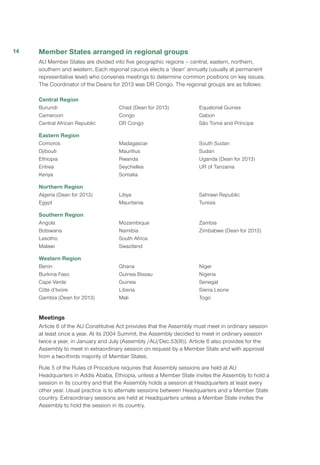
Member States arranged in regional groups
AU Member States are divided into five geographic regions – central, eastern, northern,
southern and western. Each regional caucus elects a ‘dean’ annually (usually at permanent
representative level) who convenes meetings to determine common positions on key issues.
The Coordinator of the Deans for 2013 was DR Congo. The regional groups are as follows:
Central Region
Burundi
Cameroon
Central African Republic
Chad (Dean for 2013)
Congo
DR Congo
Equatorial Guinea
Gabon
São Tomé and Príncipe
Eastern Region
Comoros
Djibouti
Ethiopia
Eritrea
Kenya
Madagascar
Mauritius
Rwanda
Seychelles
Somalia
South Sudan
Sudan
Uganda (Dean for 2013)
UR of Tanzania
Northern Region
Algeria (Dean for 2013)
Egypt
Libya
Mauritania
Sahrawi Republic
Tunisia
Southern Region
Angola
Botswana
Lesotho
Malawi
Mozambique
Namibia
South Africa
Swaziland
Zambia
Zimbabwe (Dean for 2013)
Western Region
Benin
Burkina Faso
Cape Verde
Côte d’Ivoire
Gambia (Dean for 2013)
Ghana
Guinea Bissau
Guinea
Liberia
Mali
Niger
Nigeria
Senegal
Sierra Leone
Togo
Meetings
Article 6 of the AU Constitutive Act provides that the Assembly must meet in ordinary session
at least once a year. At its 2004 Summit, the Assembly decided to meet in ordinary session
twice a year, in January and July (Assembly /AU/Dec.53(III)). Article 6 also provides for the
Assembly to meet in extraordinary session on request by a Member State and with approval
from a two-thirds majority of Member States.
Rule 5 of the Rules of Procedure requires that Assembly sessions are held at AU
Headquarters in Addis Ababa, Ethiopia, unless a Member State invites the Assembly to hold a
session in its country and that the Assembly holds a session at Headquarters at least every
other year. Usual practice is to alternate sessions between Headquarters and a Member State
country. Extraordinary sessions are held at Headquarters unless a Member State invites the
Assembly to hold the session in its country.
14
The Assembly agenda consists of items decided at its previous session and items proposed
by the Executive Council, Member States and other AU organs. The agenda is in two parts:
part A items that have already been agreed by the Executive Council and do not require
further discussion; and part B items that require discussion before approval by the Assembly.
Rules about the agenda are set out in rule 8 of the Assembly’s Rules of Procedure.
The Assembly makes decisions by consensus or, where consensus is not possible, by a
two-thirds majority of Member States. Procedural matters, including the question of whether a
matter is one of procedure or not, are decided by a simple majority. Two-thirds of AU members
are required to form a quorum at any Assembly meeting. The Assembly decides its own Rules
of Procedure.
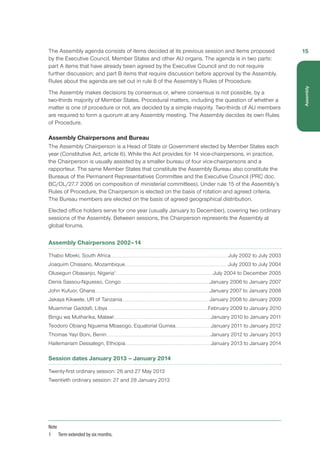
Assembly Chairpersons and Bureau
The Assembly Chairperson is a Head of State or Government elected by Member States each
year (Constitutive Act, article 6). While the Act provides for 14 vice-chairpersons, in practice,
the Chairperson is usually assisted by a smaller bureau of four vice-chairpersons and a
rapporteur. The same Member States that constitute the Assembly Bureau also constitute the
Bureaus of the Permanent Representatives Committee and the Executive Council (PRC doc.
BC/OL/27.7 2006 on composition of ministerial committees). Under rule 15 of the Assembly’s
Rules of Procedure, the Chairperson is elected on the basis of rotation and agreed criteria.
The Bureau members are elected on the basis of agreed geographical distribution.
Elected office holders serve for one year (usually January to December), covering two ordinary
sessions of the Assembly. Between sessions, the Chairperson represents the Assembly at
global forums.
Assembly Chairpersons 2002–14
Thabo Mbeki, South Africa.........................................................................................................................................................................................July 2002 to July 2003
Joaquim Chissano, Mozambique...................................................................................................................................................................July 2003 to July 2004
Olusegun Obasanjo, Nigeria1
.........................................................................................................................................................July 2004 to December 2005
Denis Sassou-Nguesso, Congo............................................................................................................................................January 2006 to January 2007
John Kufuor, Ghana.....................................................................................................................................................................................January 2007 to January 2008
Jakaya Kikwete, UR of Tanzania......................................................................................................................................... January 2008 to January 2009
Muammar Gaddafi, Libya ............................................................................................................................................................February 2009 to January 2010
Bingu wa Mutharika, Malawi........................................................................................................................................................ January 2010 to January 2011
Teodoro Obiang Nguema Mbasogo, Equatorial Guinea.........................................................January 2011 to January 2012
Thomas Yayi Boni, Benin....................................................................................................................................................................January 2012 to January 2013
Hailemariam Dessalegn, Ethiopia......................................................................................................................................January 2013 to January 2014
Session dates January 2013 – January 2014
Twenty-first ordinary session: 26 and 27 May 2013
Twentieth ordinary session: 27 and 28 January 2013
Note
1	 Term extended by six months.
15
Assembly
Bureau for January 2013 – January 2014
Chairperson: Hailemariam Dessalegn, Ethiopia
First Vice-Chairperson: Mohamed Ould Abdel Aziz, Mauritania
Second Vice-Chairperson: Armando Emílio Guebuza, Mozambique
Third Vice-Chairperson: Idriss Déby Itno, Chad
Rapporteur: Thomas Yayi Boni, Benin
Session dates January 2012 – January 2013
Nineteenth ordinary session: 15 and 16 July 2012
Eighteenth ordinary session: 29 and 30 January 2012
Bureau for January 2012 – January 2013
Chairperson: Thomas Yayi Boni, Benin
First Vice-Chairperson: Yoweri Kaguta Museveni, Uganda
Second Vice-Chairperson: Mohamed Moncef Marzouki, Tunisia
Third Vice-Chairperson: Jacob Zuma, South Africa
Rapporteur: Teodoro Obiang Nguema Mbasogo, Equatorial Guinea
Assembly High-Level Committees and Panels
High-Level Committee of Heads of State and Government on the
Post-2015 Development Agenda
The High-Level Committee was established by the AU Assembly at its May 2013 Summit. Its
mandate is to sensitise and coordinate the activities of African leaders and members of the
UN High-Level Panel of Eminent Persons on the Post-2015 Development Agenda, and build
regional and inter-continental alliances on the African common position on the post-2015
development agenda. The Committee is also tasked with assisting to finalise the African
common position and ensure that Africa’s priorities are integrated in the new global agenda.
The Committee is required to report annually to the Assembly. The Committee’s activities are
supported by the AU Commission, New Partnership for Africa’s Development (NEPAD), UN
Economic Commission for Africa (UNECA), African Development Bank (AfDB) and UN
Development Programme (UNDP).
The Committee is headed by Ellen Johnson Sirleaf, Liberia, and comprises two Heads of State
and Government from each African region who are nominated after consultations by the
regional Deans.
High-Level Panel on Alternative Sources of Financing
The High-Level Panel was established by the AU Assembly at its July 2011 Summit. Its
mandate is to investigate and report to the Assembly on possible alternative sources of
financing for the AU. The Panel is chaired by Olusegun Obasanjo, former President of Nigeria.
The two other members are Edem Kodjo, former Prime Minister of Togo and former Secretary-
General of the OAU; and Luisa Diogo, former Prime Minister and Minister of Finance of
Mozambique. The Panel presented its most recent report during the Assembly’s 21st ordinary
meeting in May 2013.
16
AFRICAN UNION HANDBOOK 2014
EXECUTIVE COUNCIL
EXECUTIVE COUNCIL
The Executive Council works in support of the AU Assembly and is responsible to the Assembly.
All Member States participate in the Executive Council, usually at Foreign Minister level.
Article 13 of the AU Constitutive Act mandates the Executive Council to coordinate and take
decisions on policies in areas of common interest to Member States, consider issues referred
to it and monitor the implementation of Assembly policies. The same article sets out a detailed
list of substantive policy areas ranging from foreign trade, energy, agriculture and the
environment to humanitarian response, health, social security and disability.
The Executive Council’s core functions, as set out in rule 5 of the Rules of Procedure, include to:
•	 Prepare the Assembly sessions
•	 Determine the issues to be submitted to the Assembly for decision
•	 Coordinate and harmonise AU policies, activities and initiatives in the areas of common
interest to Member States
•	 Monitor the implementation of policies, decisions and agreements adopted by
the Assembly
•	 Elect the Commissioners to be appointed by the Assembly
•	 Promote cooperation and coordination with the Regional Economic Communities (RECs),
African Development Bank (AfDB), other African institutions and the United Nations
Economic Commission for Africa (UNECA)
•	 Determine policies for cooperation between the AU and Africa’s partners
•	 Consider and make recommendations to the Assembly on the Commission’s structure,
functions and statutes
•	 Ensure the promotion of gender equality in all AU programmes.
Provisions governing the Executive Council’s composition, functions and powers, voting and
procedures are contained in articles 10 and 13 of the Constitutive Act. The Council decides
its own Rules of Procedure. These guide its work and authorise it to give instructions to the
Permanent Representatives Committee (PRC) and assign tasks to the AU Commission.
The Executive Council makes decisions by consensus or, where consensus is not possible, by
a two-thirds majority of Member States. Procedural matters, including the question of whether
a matter is one of procedure or not, are decided by a simple majority. Two-thirds of AU
members are required to form a quorum at any Executive Council meeting.
Evolution
The AU Executive Council is the successor to the OAU’s Council of Ministers.
Structure
All 54 AU Member States have one representative on the Executive Council. Members are
usually Ministers of Foreign Affairs but may be any competent authority or minister as
designated by the Member State’s Government (Constitutive Act, article 10; Rules of
Procedure, rule 3).
The Council is chaired at ministerial level by the same Member State that chairs the Assembly,
usually by that state’s Minister of Foreign Affairs (Rules of Procedure, rule 16). Similar to the
Assembly and the PRC, the Executive Council Bureau consists of a chairperson and four
vice-chairpersons, one of who serves as rapporteur. The Bureau positions are held by the
same states that form the Assembly Bureau. Office holders serve for one year (usually January
to December) covering two summit sessions.
18
Where the Executive Council accepts an invitation from a Member State to host a meeting
away from Headquarters, the host country has the right to preside over the Council (rule
16(2)). The Executive Council can delegate its powers and functions to specialised technical
committees composed of government ministers or senior officials.
Meetings
The Executive Council meets at least twice a year in ordinary session following the Assembly
meeting schedule and location. Meetings are usually held immediately prior to the Assembly
Summit. The Executive Council can also meet in extraordinary session at the request of its
Chairperson, any Member State or the Chairperson of the AU Commission in consultation
with the Chairperson of the Assembly and on approval by two-thirds of all Member States
(Constitutive Act, article 10). All sessions are closed to the public unless the Council decides
otherwise (by simple majority; Rules of Procedure, rule 14).
Extraordinary sessions are held at AU Headquarters in Addis Ababa, Ethiopia, unless a
Member State invites the Council to meet in its country (Rules of Procedure, rule 12).
The Executive Council adopts its agenda at the opening of each session. The provisional
agenda for an ordinary session is drawn up by the PRC. The Chairperson of the Commission
communicates the agenda to Member States at least 30 days before the opening of the
session (Rules of Procedure, rule 9).
Provisional agendas are usually divided into two parts: items for adoption, where the PRC has
reached agreement and Executive Council approval is possible without discussion; and items
for discussion, where agreement has not been reached by the PRC and debate is required.
Additional agenda items can only be for information, not for debate or decision (Rules of
Procedure, rule 10). Extraordinary session agendas can comprise only the item or items
submitted in the request for convening the session (Rules of Procedure, rule 13).
Executive Council Chairpersons 2002–14
Nkosazana Dlamini Zuma, South Africa............................................................................................................................................July 2002 to July 2003
Leonardo Simão, Mozambique..........................................................................................................................................................................July 2003 to July 2004
Oluyemi Adeniji, Nigeria1
........................................................................................................................................................................July 2004 to December 2005
Rodolphe Adada/Denis Sassou-Nguesso, Congo...........................................................................January 2006 to January 2007
Nana Akufo-Addo/Akwasi Osei-Adjei, Ghana...........................................................................................January 2007 to January 2008
Bernard Membe, UR of Tanzania..................................................................................................................................... January 2008 to January 2009
Abdel Rahman Shalgam/Moussa Koussa, Libya.............................................................................February 2009 to January 2010
Etta Elizabeth Banda, Malawi..................................................................................................................................................... January 2010 to January 2011
Micha Ondó Bile, Equatorial Guinea.............................................................................................................................January 2011 to January 2012
Nassirou Bako Arifari, Benin........................................................................................................................................................January 2012 to January 2013
Tedros Adhanom Ghebreyesus, Ethiopia............................................................................................................January 2013 to January 2014
Note
1	 Term extended for six months.
19
ExecutiveCouncil
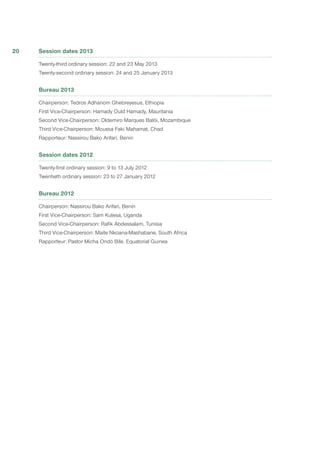
Session dates 2013
Twenty-third ordinary session: 22 and 23 May 2013
Twenty-second ordinary session: 24 and 25 January 2013
Bureau 2013
Chairperson: Tedros Adhanom Ghebreyesus, Ethiopia
First Vice-Chairperson: Hamady Ould Hamady, Mauritania
Second Vice-Chairperson: Oldemiro Marques Balói, Mozambique
Third Vice-Chairperson: Moussa Faki Mahamat, Chad
Rapporteur: Nassirou Bako Arifari, Benin
Session dates 2012
Twenty-first ordinary session: 9 to 13 July 2012
Twentieth ordinary session: 23 to 27 January 2012
Bureau 2012
Chairperson: Nassirou Bako Arifari, Benin
First Vice-Chairperson: Sam Kutesa, Uganda
Second Vice-Chairperson: Rafik Abdessalam, Tunisia
Third Vice-Chairperson: Maite Nkoana-Mashabane, South Africa
Rapporteur: Pastor Micha Ondó Bile, Equatorial Guinea
20
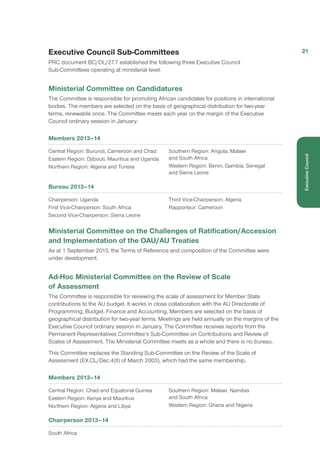
Executive Council Sub-Committees
PRC document BC/OL/27.7 established the following three Executive Council
Sub-Committees operating at ministerial level.
Ministerial Committee on Candidatures
The Committee is responsible for promoting African candidates for positions in international
bodies. The members are selected on the basis of geographical distribution for two-year
terms, renewable once. The Committee meets each year on the margin of the Executive
Council ordinary session in January.
Members 2013–14
Central Region: Burundi, Cameroon and Chad
Eastern Region: Djibouti, Mauritius and Uganda
Northern Region: Algeria and Tunisia
Southern Region: Angola, Malawi
and South Africa
Western Region: Benin, Gambia, Senegal
and Sierra Leone
Bureau 2013–14
Chairperson: Uganda
First Vice-Chairperson: South Africa
Second Vice-Chairperson: Sierra Leone
Third Vice-Chairperson: Algeria
Rapporteur: Cameroon
Ministerial Committee on the Challenges of Ratification/Accession
and Implementation of the OAU/AU Treaties
As at 1 September 2013, the Terms of Reference and composition of the Committee were
under development.
Ad-Hoc Ministerial Committee on the Review of Scale
of Assessment
The Committee is responsible for reviewing the scale of assessment for Member State
contributions to the AU budget. It works in close collaboration with the AU Directorate of
Programming, Budget, Finance and Accounting. Members are selected on the basis of
geographical distribution for two-year terms. Meetings are held annually on the margins of the
Executive Council ordinary session in January. The Committee receives reports from the
Permanent Representatives Committee’s Sub-Committee on Contributions and Review of
Scales of Assessment. The Ministerial Committee meets as a whole and there is no bureau.
This Committee replaces the Standing Sub-Committee on the Review of the Scale of
Assessment (EX.CL/Dec.4(II) of March 2003), which had the same membership.
Members 2013–14
Central Region: Chad and Equatorial Guinea
Eastern Region: Kenya and Mauritius
Northern Region: Algeria and Libya
Southern Region: Malawi, Namibia
and South Africa
Western Region: Ghana and Nigeria
Chairperson 2013–14
South Africa
21
ExecutiveCouncil
22
AFRICAN UNION HANDBOOK 2014
SPECIALISED TECHNICAL
COMMITTEES
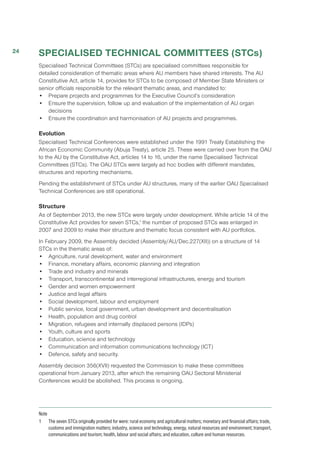
SPECIALISED TECHNICAL COMMITTEES (STCs)
Specialised Technical Committees (STCs) are specialised committees responsible for
detailed consideration of thematic areas where AU members have shared interests. The AU
Constitutive Act, article 14, provides for STCs to be composed of Member State Ministers or
senior officials responsible for the relevant thematic areas, and mandated to:
•	 Prepare projects and programmes for the Executive Council’s consideration
•	 Ensure the supervision, follow up and evaluation of the implementation of AU organ
decisions
•	 Ensure the coordination and harmonisation of AU projects and programmes.
Evolution
Specialised Technical Conferences were established under the 1991 Treaty Establishing the
African Economic Community (Abuja Treaty), article 25. These were carried over from the OAU
to the AU by the Constitutive Act, articles 14 to 16, under the name Specialised Technical
Committees (STCs). The OAU STCs were largely ad hoc bodies with different mandates,
structures and reporting mechanisms.
Pending the establishment of STCs under AU structures, many of the earlier OAU Specialised
Technical Conferences are still operational.
Structure
As of September 2013, the new STCs were largely under development. While article 14 of the
Constitutive Act provides for seven STCs,1
the number of proposed STCs was enlarged in
2007 and 2009 to make their structure and thematic focus consistent with AU portfolios.
In February 2009, the Assembly decided (Assembly/AU/Dec.227(XII)) on a structure of 14
STCs in the thematic areas of:
•	 Agriculture, rural development, water and environment
•	 Finance, monetary affairs, economic planning and integration
•	 Trade and industry and minerals
•	 Transport, transcontinental and interregional infrastructures, energy and tourism
•	 Gender and women empowerment
•	 Justice and legal affairs
•	 Social development, labour and employment
•	 Public service, local government, urban development and decentralisation
•	 Health, population and drug control
•	 Migration, refugees and internally displaced persons (IDPs)
•	 Youth, culture and sports
•	 Education, science and technology
•	 Communication and information communications technology (ICT)
•	 Defence, safety and security.
Assembly decision 356(XVII) requested the Commission to make these committees
operational from January 2013, after which the remaining OAU Sectoral Ministerial
Conferences would be abolished. This process is ongoing.
Note
1	 The seven STCs originally provided for were: rural economy and agricultural matters; monetary and financial affairs; trade,
customs and immigration matters; industry, science and technology, energy, natural resources and environment; transport,
communications and tourism; health, labour and social affairs; and education, culture and human resources.
24
Meetings
In June 2011, the Assembly decided that the STCs should meet at ministerial and expert level
every two years (Assembly/AU/Dec.365(XVII)). Exceptions were made for three STCs to meet
once a year: Gender and Women Empowerment; Agriculture, Rural Development, Water and
Environment; and Defence, Safety and Security.
Recent Ministerial Conference meetings
Pending restructuring of the STCs, the following Ministerial Conferences have presented
reports for the Executive Council’s attention since 2008. (The Conferences, plus their most
recent report to the Executive Council or the related Executive Council decision, are listed).
Ministers Responsible for Road Transport (EX.CL/389(XII))
Ministers Council on Water (EX.CL/388(XII))
Conference of Ministers of Integration (EX.CL/517(XV))
Conference of Ministers Responsible for Sport (EX.CL/557(XVI))
Conference of Ministers Responsible for Fisheries and Aquaculture (EX.CL/627(XVIII))
Conference of Ministers Responsible for Animal Resources (EX.CL/590(XVII))
Conference of Ministers Responsible for Disaster Risk Reduction (EX.CL/607(XVIII))
Conference of Ministers of Health (EX.CL/662(XIX))
Conference of Ministers of Industry (EX.CL/660(XIX))
Conference of Ministers Responsible for Hydrocarbons (Oil and Gas) (EX.CL/Dec.546(XVI))
Conference of Ministers Responsible for Maritime Transport (EX.CL/Dec.542(XVI))
Conference of Ministers of Trade (EX.CL/700(XX))
Conference of Ministers of Justice and/or Attorneys General (EX.CL/731(XXI))
Conference of Ministers of Economy and Finance (EX.CL/724(XXI))
Conference of Ministers of Education of the African Union (COMEDAF) (EX.CL/725(XXI))
Conference of African Ministers in Charge of Border Issues (EX.CL/726(XXI))
Conference of Ministers Responsible for Mineral Resources (EX.CL/749(XXI))
Conference of Ministers in Charge of Gender and Women’s Affairs (EX.CL/723(XXI))
Ministerial Conference on Aviation Safety in Africa (EX.CL/758(XX))
Conference of Ministers in Charge of Communication and Information Technologies (EX.CL/759(XXII))
Conference of the Ministers Responsible for Registration and Vital Statistics (EX.CL/760(XXII))
African Ministerial Conference on the Environment (EX.CL/761(XXII))
Conference of African Ministers in Charge of Youth (EX.CL/762(XXII))
Conference of Ministers in Charge of Drug Control (EX.CL/763(XXII))
Conference of Ministers Responsible for Meteorology (AMCOMET) (EX.CL/764(XXII))
Conference of Ministers of Culture (EX.CL/765(XXII))
Conference of Ministers in Charge of Science and Technology (AMCOST) (EX.CL/766(XXII))
Conference of Ministers in Charge of Energy (CEMA) (EX.CL/767(XXII))
Joint Conference of Ministers of Agriculture and Ministers of Trade (EX.CL/768(XXII))
Conference of Ministers of Social Development (EX.CL/769(XXII))
The STC on Defence, Safety and Security (STCDSS) also holds frequent meetings.
25
SpecialisedTechnical
Committees
26
AFRICAN UNION HANDBOOK 2014
PEACE AND SECURITY COUNCIL
African Peace and Security Architecture (APSA)
The African Peace and Security Architecture (APSA) is the umbrella term for the key AU
mechanisms for promoting peace, security and stability in the African continent (core AU
objectives under article 3 of its Constitutive Act).
APSA has several key elements, including the:
•	 Peace and Security Council, which is the standing decision-making organ of the AU on
matters of peace and security
•	 Continental Early Warning System, which monitors and reports on emerging crises
•	 Panel of the Wise, which is a consultative body established to provide advice
•	 African Standby Force, which is intended to provide rapid deployment
peacekeeping forces
•	 Peace Fund, which is intended to fund peacekeeping and peace support operations.
The various African peace and security mechanisms work in tandem with the peace and
security structures of the Regional Economic Communities (RECs) and Regional Mechanisms
(RMs) set up to support regional peace and security. Collaboration between the AU and
RECs/RMs on peace and security matters is guided by the Memorandum of Understanding
(MoU) on Cooperation in the Area of Peace and Security between the AU, RECs and the
Coordinating Mechanisms of the Regional Standby Brigades of Eastern and Northern Africa.
28
PEACE AND SECURITY COUNCIL (PSC)
The Peace and Security Council (PSC) is the standing organ of the AU for the prevention,
management and resolution of conflicts. It was established to be a collective security and
‘early warning’ arrangement with the ability to facilitate timely and efficient responses to
conflict and crisis situations. The PSC’s core functions are to conduct early warning and
preventive diplomacy, facilitate peace-making, establish peace support operations and, in
certain circumstances, recommend intervention in Member States to promote peace, security
and stability. The PSC also works in support of peace-building and post-conflict reconstruction
as well as humanitarian action and disaster management.
The PSC's authority derives from article 20 (bis) of the Constitutive Act (as inserted by article
9 of the Protocol on Amendments to the Constitutive Act 2003) together with article 2 of
the 2002 Protocol Relating to the Establishment of the Peace and Security Council of the
African Union.
Under article 7 of the Protocol, the PSC’s key powers include to:
•	 Anticipate and prevent disputes and conflicts, as well as policies, which may lead to
genocide and crimes against humanity
•	 Undertake peace-making, peace-building and peace-support missions
•	 Recommend intervention in a Member State in respect of grave circumstances, namely
war crimes, genocide and crimes against humanity
•	 Institute sanctions
•	 Implement the AU’s common defence policy
•	 Ensure implementation of key conventions and instruments to combat international terrorism
•	 Promote coordination between regional mechanisms and the AU regarding peace,
security and stability in Africa
•	 Follow-up promotion of democratic practices, good governance, the rule of law, protection
of human rights and fundamental freedoms, respect for the sanctity of human life and
international humanitarian law
•	 Promote and encourage the implementation of conventions and treaties on arms control
and disarmament
•	 Examine and take action in situations where the national independence and sovereignty
of a Member State is threatened by acts of aggression, including by mercenaries
•	 Support and facilitate humanitarian action in situations of armed conflicts or major
natural disasters.
Evolution
The PSC is the successor to the OAU Central Organ of the Mechanism for Conflict Prevention,
Management and Resolution. The Central Organ was the OAU’s operational body mandated to
make decisions on matters of peace and security. It was composed of nine and later 14 Member
States. Like the PSC, the Organ operated at summit, ministerial and ambassadorial levels.
Structure
The PSC has 15 members. All are elected by the AU Executive Council and endorsed by
the Assembly at its next session. Five members are elected for three-year terms and 10 for
two-year terms, usually to take up office on the first day of April following endorsement by
the Assembly. Retiring members are eligible for immediate re-election.
29
Peaceand
Security Council
Members are elected according to the principle of equitable regional representation and
national rotation. National rotation is agreed within the regional groups. Regional
representation is usually:
•	 Central Region: three seats
•	 Eastern Region: three seats
•	 Northern Region: two seats
•	 Southern Region: three seats
•	 Western Region: four seats.
Article 5(2) of the PSC Protocol lists criteria for members including: contribution to the
promotion and maintenance of peace and security in Africa; participation in conflict resolution,
peace-making and peace-building at regional and continental levels; willingness and ability to
take up responsibility for regional and continental conflict resolution initiatives; contribution to
the Peace Fund and/or Special Fund; respect for constitutional governance, the rule of law
and human rights; and commitment to AU financial obligations.
The PSC Secretariat, established under article 10(4) of the PSC Protocol, provides direct
operational support. The Secretariat sits within the AU Commission’s Peace and Security
Department (see page 55).
Meetings
The PSC meets in continuous session. All members are required to keep a permanent
presence at AU Headquarters. Meetings can be held at three levels: permanent
representatives, ministers or Heads of State and Government. Article 8(2) of the PSC Protocol
requires permanent representatives to meet at least twice a month, and ministers and the
Heads of State and Government at least once a year. Article 8(6) provides that the Chair shall
be held in turn by the members, in the English alphabetical order of country names, for one
calendar month. PSC meetings include closed sessions, open meetings and informal
consultations.
Agenda
The PSC Chairperson is mandated to draft the provisional programme of work and agenda.
The Chairperson may bring to the PSC’s attention any matter that may threaten peace, security
and stability in the continent, and may request briefings from PSC committees and other AU
organs and institutions. The agenda is based on proposals submitted by the Chairperson of
the AU Commission and by Member States. The inclusion of any item on the provisional
agenda may not be opposed by a Member State.
PSC decisions are guided by the principle of consensus. Where consensus is not possible,
decisions on procedural matters are taken by a simple majority and on substantive matters
by a two-thirds majority (PSC Protocol, article 8(13)). A member that is party to a conflict or
situation under consideration by the PSC may not participate in the discussion and decision-
making process relating to that conflict or situation (PSC Protocol, article 8(9)).
30
Members1
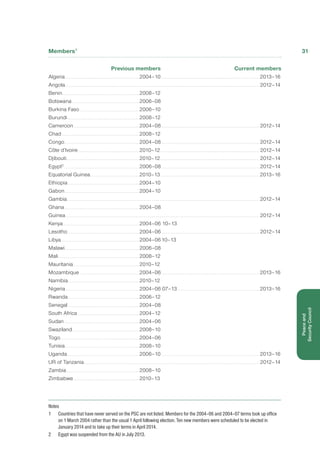
	 Previous members	 Current members
Algeria.. .. .. .. .. .. .. .. .. .. .. .. .. .. .. .. .. .. .. .. .. .. .. .. .. .. .. .. .. .. .. .. .. .. .. .. .. .2004–10.. . . . . . . . . . . . . . . . . . . . . . . . . . . . . . . . . . . . . . . . . . . . . . . . . . . . . . . . . . . . . . . . . . . . . . . . . . . . . . . . . . . . . . . . . . . . . . . . . . .2013–16
Angola.. .. .. .. .. .. .. .. .. .. .. .. .. .. .. .. .. .. .. .. .. .. .. .. .. .. .. .. .. .. .. .. .. .. .. .. .. .. .. .. .. .. .. .. .. .. .. .. .. .. .. .. .. .. .. .. .. .. .. .. .. .. .. .. .. .. .. .. .. .. .. .. .. .. .. .. .. .. .. .. .. .. .. .. .. .. .. .. .. .. .. .. .. .. .. .. .. .. . 2012–14
Benin.. . . . . . . . . . . . . . . . . . . . . . . . . . . . . . . . . . . . . . . . . . . . . . . . . . . . . . . . . . . . . . . . . . . . . . . . . . . . . 2008–12
Botswana.. . . . . . . . . . . . . . . . . . . . . . . . . . . . . . . . . . . . . . . . . . . . . . . . . . . . . . . . . . . . . . . . . . . 2006–08
Burkina Faso.. . . . . . . . . . . . . . . . . . . . . . . . . . . . . . . . . . . . . . . . . . . . . . . . . . . . . . . . . . . 2006–10
Burundi.. . . . . . . . . . . . . . . . . . . . . . . . . . . . . . . . . . . . . . . . . . . . . . . . . . . . . . . . . . . . . . . . . . . . . . . 2008–12
Cameroon.. . . . . . . . . . . . . . . . . . . . . . . . . . . . . . . . . . . . . . . . . . . . . . . . . . . . . . . . . . . . . . . . . 2004–08.. . . . . . . . . . . . . . . . . . . . . . . . . . . . . . . . . . . . . . . . . . . . . . . . . . . . . . . . . . . . . . . . . . . . . . . . . . . . . . . . . . . . . . . . . . . . . . . . . . . 2012–14
Chad.. . . . . . . . . . . . . . . . . . . . . . . . . . . . . . . . . . . . . . . . . . . . . . . . . . . . . . . . . . . . . . . . . . . . . . . . . . . . . 2008–12
Congo.. . . . . . . . . . . . . . . . . . . . . . . . . . . . . . . . . . . . . . . . . . . . . . . . . . . . . . . . . . . . . . . . . . . . . . . . . . . 2004–08.. . . . . . . . . . . . . . . . . . . . . . . . . . . . . . . . . . . . . . . . . . . . . . . . . . . . . . . . . . . . . . . . . . . . . . . . . . . . . . . . . . . . . . . . . . . . . . . . . . . 2012–14
Côte d’Ivoire.. . . . . . . . . . . . . . . . . . . . . . . . . . . . . . . . . . . . . . . . . . . . . . . . . . . . . . . . . . . . . 2010–12.. .. .. .. .. .. .. .. .. .. .. .. .. .. .. .. .. .. .. .. .. .. .. .. .. .. .. .. .. .. .. .. .. .. .. .. .. .. .. .. .. .. .. .. .. .. .. .. .. ..  2012–14
Djibouti.. . . . . . . . . . . . . . . . . . . . . . . . . . . . . . . . . . . . . . . . . . . . . . . . . . . . . . . . . . . . . . . . . . . . . . . . . 2010–12.. .. .. .. .. .. .. .. .. .. .. .. .. .. .. .. .. .. .. .. .. .. .. .. .. .. .. .. .. .. .. .. .. .. .. .. .. .. .. .. .. .. .. .. .. .. .. .. .. ..  2012–14
Egypt2
.. . . . . . . . . . . . . . . . . . . . . . . . . . . . . . . . . . . . . . . . . . . . . . . . . . . . . . . . . . . . . . . . . . . . . . . . . . . 2006–08.. . . . . . . . . . . . . . . . . . . . . . . . . . . . . . . . . . . . . . . . . . . . . . . . . . . . . . . . . . . . . . . . . . . . . . . . . . . . . . . . . . . . . . . . . . . . . . . . . . . 2012–14
Equatorial Guinea.. . . . . . . . . . . . . . . . . . . . . . . . . . . . . . . . . . . . . . . . . . . . . . . . . 2010–13.. .. .. .. .. .. .. .. .. .. .. .. .. .. .. .. .. .. .. .. .. .. .. .. .. .. .. .. .. .. .. .. .. .. .. .. .. .. .. .. .. .. .. .. .. .. .. .. .. .. 2013–16
Ethiopia.. . . . . . . . . . . . . . . . . . . . . . . . . . . . . . . . . . . . . . . . . . . . . . . . . . . . . . . . . . . . . . . . . . . . . . . 2004–10
Gabon.. . . . . . . . . . . . . . . . . . . . . . . . . . . . . . . . . . . . . . . . . . . . . . . . . . . . . . . . . . . . . . . . . . . . . . . . . . . 2004–10
Gambia.. .. .. .. .. .. .. .. .. .. .. .. .. .. .. .. .. .. .. .. .. .. .. .. .. .. .. .. .. .. .. .. .. .. .. .. .. .. .. .. .. .. .. .. .. .. .. .. .. .. .. .. .. .. .. .. .. .. .. .. .. .. .. .. .. .. .. .. .. .. .. .. .. .. .. .. .. .. .. .. .. .. .. .. .. .. .. .. .. .. .. .. .. .. .. .. .. . 2012–14
Ghana.. . . . . . . . . . . . . . . . . . . . . . . . . . . . . . . . . . . . . . . . . . . . . . . . . . . . . . . . . . . . . . . . . . . . . . . . . . . 2004–08
Guinea.. . . . . . . . . . . . . . . . . . . . . . . . . . . . . . . . . . . . . . . . . . . . . . . . . . . . . . . . . . . . . . . . . . . . . . . . . . .. .. .. .. .. .. .. .. .. .. .. .. .. .. .. .. .. .. .. .. .. .. .. .. .. .. .. .. .. .. .. .. .. .. .. .. .. .. .. .. .. .. .. .. .. .. .. .. .. .. .. .. .. .. .. .. .. .. .. .. . 2012–14
Kenya.. .. .. .. .. .. .. .. .. .. .. .. .. .. .. .. .. .. .. .. .. .. .. .. .. .. .. .. .. .. .. .. .. .. .. .. .. .. .2004–06 10–13
Lesotho.. . . . . . . . . . . . . . . . . . . . . . . . . . . . . . . . . . . . . . . . . . . . . . . . . . . . . . . . . . . . . . . . . . . . . . . 2004–06.. . . . . . . . . . . . . . . . . . . . . . . . . . . . . . . . . . . . . . . . . . . . . . . . . . . . . . . . . . . . . . . . . . . . . . . . . . . . . . . . . . . . . . . . . . . . . . . . . . . 2012–14
Libya.. .. .. .. .. .. .. .. .. .. .. .. .. .. .. .. .. .. .. .. .. .. .. .. .. .. .. .. .. .. .. .. .. .. .. .. .. .. .. .2004–0610–13
Malawi.. .. .. .. .. .. .. .. .. .. .. .. .. .. .. .. .. .. .. .. .. .. .. .. .. .. .. .. .. .. .. .. .. .. .. .. .. .2006–08
Mali.. . . . . . . . . . . . . . . . . . . . . . . . . . . . . . . . . . . . . . . . . . . . . . . . . . . . . . . . . . . . . . . . . . . . . . . . . . . . . . . . . 2008–12
Mauritania.. .. .. .. .. .. .. .. .. .. .. .. .. .. .. .. .. .. .. .. .. .. .. .. .. .. .. .. .. .. .. .. .. .2010–12
Mozambique.. .. .. .. .. .. .. .. .. .. .. .. .. .. .. .. .. .. .. .. .. .. .. .. .. .. .. .. .. .. .2004–06.. . . . . . . . . . . . . . . . . . . . . . . . . . . . . . . . . . . . . . . . . . . . . . . . . . . . . . . . . . . . . . . . . . . . . . . . . . . . . . . . . . . . . . . . . . . . . . . . . . .2013–16
Namibia.. . . . . . . . . . . . . . . . . . . . . . . . . . . . . . . . . . . . . . . . . . . . . . . . . . . . . . . . . . . . . . . . . . . . . . . 2010–12
Nigeria.. .. .. .. .. .. .. .. .. .. .. .. .. .. .. .. .. .. .. .. .. .. .. .. .. .. .. .. .. .. .. .. .. .. .. .. .. .2004–06 07–13.. . . . . . . . . . . . . . . . . . . . . . . . . . . . . . . . . . . . . . . . . . . . . . . . . . . . . . . . . . . . . . . . . . . . . . . . . . . . . . . . . . .2013–16
Rwanda.. . . . . . . . . . . . . . . . . . . . . . . . . . . . . . . . . . . . . . . . . . . . . . . . . . . . . . . . . . . . . . . . . . . . . . . 2006–12
Senegal.. . . . . . . . . . . . . . . . . . . . . . . . . . . . . . . . . . . . . . . . . . . . . . . . . . . . . . . . . . . . . . . . . . . . . . . 2004–08
South Africa.. . . . . . . . . . . . . . . . . . . . . . . . . . . . . . . . . . . . . . . . . . . . . . . . . . . . . . . . . . . . . 2004–12
Sudan.. . . . . . . . . . . . . . . . . . . . . . . . . . . . . . . . . . . . . . . . . . . . . . . . . . . . . . . . . . . . . . . . . . . . . . . . . . . 2004–06
Swaziland.. . . . . . . . . . . . . . . . . . . . . . . . . . . . . . . . . . . . . . . . . . . . . . . . . . . . . . . . . . . . . . . . . . . 2008–10
Togo.. . . . . . . . . . . . . . . . . . . . . . . . . . . . . . . . . . . . . . . . . . . . . . . . . . . . . . . . . . . . . . . . . . . . . . . . . . . . . . . 2004–06
Tunisia.. .. .. .. .. .. .. .. .. .. .. .. .. .. .. .. .. .. .. .. .. .. .. .. .. .. .. .. .. .. .. .. .. .. .. .. .. .2008–10
Uganda.. .. .. .. .. .. .. .. .. .. .. .. .. .. .. .. .. .. .. .. .. .. .. .. .. .. .. .. .. .. .. .. .. .. .. .. .2006–10.. . . . . . . . . . . . . . . . . . . . . . . . . . . . . . . . . . . . . . . . . . . . . . . . . . . . . . . . . . . . . . . . . . . . . . . . . . . . . . . . . . . . . . . . . . . . . . . . . . .2013–16
UR of Tanzania.. . . . . . . . . . . . . . . . . . . . . . . . . . . . . . . . . . . . . . . . . . . . . . . . . . . . . . . . .. .. .. .. .. .. .. .. .. .. .. .. .. .. .. .. .. .. .. .. .. .. .. .. .. .. .. .. .. .. .. .. .. .. .. .. .. .. .. .. .. .. .. .. .. .. .. .. .. .. .. .. .. .. .. .. .. .. .. .. . 2012–14
Zambia.. . . . . . . . . . . . . . . . . . . . . . . . . . . . . . . . . . . . . . . . . . . . . . . . . . . . . . . . . . . . . . . . . . . . . . . . . 2008–10
Zimbabwe.. .. .. .. .. .. .. .. .. .. .. .. .. .. .. .. .. .. .. .. .. .. .. .. .. .. .. .. .. .. .. .. .. .2010–13
 
Notes
1	 Countries that have never served on the PSC are not listed. Members for the 2004–06 and 2004–07 terms took up office
on 1 March 2004 rather than the usual 1 April following election. Ten new members were scheduled to be elected in
January 2014 and to take up their terms in April 2014.
2	 Egypt was suspended from the AU in July 2013.
31
Peaceand
Security Council
PSC Subsidiary Bodies
The PSC Protocol, article 8(5), authorises the PSC to establish subsidiary bodies and seek
such military, legal and other forms of expertise as it may require. As of September 2013, the
following two subsidiary committees were operational.
Committee of Experts
The Committee of Experts was established under article 8(5) of the PSC Protocol. It assists
the PSC to elaborate its draft decisions. The Committee is composed of a designated expert
representing each PSC Member State and two Peace and Security Department expert
officers. The Committee meets prior to each PSC meeting.
Military Staff Committee
The Military Staff Committee was established under article 13(8) of the PSC Protocol. It
advises and assists the PSC in all questions relating to military and security requirements
for the promotion and maintenance of peace and security in Africa. The Protocol provides for
the Committee to comprise senior military representatives from the 15 PSC Member States,
chaired by the PSC Chair Member State (and accordingly, rotating monthly). The Committee
can invite any AU Member State to its meetings to assist with its work. Rules of Procedure for
the Committee were expected to be adopted before the end of 2013.
Other committees
The following committees are proposed but (as of September 2013) not fully operational:
•	 Post-Conflict Reconstruction and Development (PCRD) (terms of reference were to be
reviewed before the end of 2013)
•	Sanctions
•	Counter-Terrorism
•	 Resource Mobilisation
•	 Procedures and Mechanisms for Peace Support Operations.
32
Continental Early Warning System (CEWS)
Purpose
The Continental Warning System (CEWS) was established under article 12 of the PSC
Protocol to “facilitate the anticipation and prevention of conflicts”. It gathers information about
potential conflicts or threats to the peace and security of Member States and provides this
information to the PSC, together with recommendations on courses of action. CEWS receives
reports on a daily or weekly basis from operational staff, including field missions, liaison
offices and early warning officers.1
CEWS is managed by the Conflict Prevention and Early Warning Unit of the Department of
Peace and Security. It comprises:
•	 An observation and monitoring centre at the Conflict Management Division in Addis
Ababa, known as the ‘Situation Room’, which operates 24 hours a day
• 	 Early warning units of the Regional Mechanisms, which collect and process data at the
regional level and transmit this to the Situation Room.
Evolution
While CEWS is a new mechanism established under the AU, some early warning functions
were performed by the OAU’s Centre for Conflict Management, which was established in 1994
as part of the OAU’s Mechanism for Conflict Prevention, Management and Resolution. Core
tasks in support of the Mechanism included collecting, analysing and disseminating early
warning data on current and potential conflicts; preparing policy advice; and supporting
political, civilian and military support missions.
Meetings
CEWS convenes periodic and on-demand meetings with the Regional Economic Communities
(RECs) to discuss issues and situations of mutual concern.
Note
1 	 For further information, see the CEWS Handbook on the AU Peace and Security website at www.peaceau.org/uploads/
cews-handook-en.pdf.
33
Peaceand
Security Council
Panel of the Wise
Purpose
The Panel of the Wise supports the PSC and the Chairperson of the AU Commission in the
promotion and maintenance of peace, security and stability in Africa.
The Panel was established under the PSC Protocol, article 11. The PSC subsequently
adopted the ‘Modalities for the Functioning of the Panel of the Wise’ on 12 November 2007 at
its 100th meeting. Under the Modalities, the Panel’s mandate includes advising the PSC and
Chairperson; undertaking all such actions deemed appropriate to support the efforts of the
PSC and Chairperson for preventing conflict; making pronouncements on any issue relating
to the promotion and maintenance of peace, security and stability in Africa; and acting at the
request of the Council or Chairperson, or on its own initiative. The Modalities also provide for
the Panel’s role to include facilitating channels of communication between the PSC or the
Chairperson of the Commission and parties involved in conflict; carrying out fact-finding
missions; and assisting and advising mediation teams.
Evolution
The OAU established the Commission of Mediation, Conciliation and Arbitration on 21 July
1964 as a tool to support peaceful settlement of disputes between OAU Member States
(article 19 of the OAU Charter). However, the Commission was never made operational and
was replaced in 1993 by the broader Mechanism for Conflict Prevention, Management and
Resolution. There was no panel under the Mechanism.
Meetings
The Panel meets when required or at the request of the PSC or AU Commission. It is required
to meet at least three times a year.
Membership
The Panel has five members. Under article 11(2) of the PSC Protocol, members are required
to be “highly respected African personalities of high integrity and independence who have
made outstanding contributions to Africa in the areas of peace, security and development”.
Members cannot hold political office at the time of their appointment or during their term on
the Panel.
Members are appointed by the AU Assembly, on the recommendation of the Chairperson
of the Commission, for three calendar years. Each member is drawn from one of the AU’s
five regional groups. Under the Modalities for the Functioning of the Panel of the Wise, the
office of Chairperson should rotate between members every year. In practice, this position
has not rotated.
Panel members
First Panel: 2007–10
Central Region: Miguel Trovoada, former President of São Tomé and Príncipe
Eastern Region: Salim Ahmed Salim, former Secretary-General of the OAU
Northern Region: Ahmed Ben Bella, former President of Algeria (Chairperson)
Southern Region: Brigalia Bam, former Chairperson of the Independent Electoral Commission
of South Africa
Western Region: Elisabeth Pognon, former President of the Constitutional Court of Benin
34
Second Panel: 2010–131
Central Region: Marie Madeleine Kalala-Ngoy, former Human Rights Minister of DR Congo
Eastern Region: Salim Ahmed Salim, former Secretary-General of the OAU (second term)
Northern Region: Ahmed Ben Bella, former President of Algeria (second term; until April 2012)2
Southern Region: Kenneth Kaunda, former President of Zambia
Western Region: Mary Chinery-Hesse, former UN Under-Secretary-General, former Deputy
Director-General of the International Labour Organization (ILO) and former Chief Advisor to
President John Kufuor (Ghana)
Friends of the Panel of the Wise
During the 2010 AU Summit in Kampala, the Assembly supported (Dec.310(XV)) enhancing
the Panel’s capacity by establishing a team of ‘Friends of the Panel of the Wise’. The Friends
comprise five to 10 eminent African personalities from the AU’s five different regions who are
tasked to support the Panel in its activities such as fact-finding missions, engagement in
formal negotiations and follow up on recommendations. The Friends are appointed by the
Chairperson of the AU Commission and endorsed by the Assembly. They are expected to
attend all Panel meetings.
Friends of the Panel 2010–133
Central Region: Miguel Trovoada, former President of São Tomé and Príncipe and former
Panel of the Wise member
Eastern Region: Vacant
Northern Region: Vacant
Southern Region: Brigalia Bam, former Chairperson of the Independent Electoral Commission
of South Africa and former Panel of the Wise member
Western Region: Elisabeth Pognon, former President of the Constitutional Court of Benin and
former Panel of the Wise member
Notes
1	 The second panel (2010–13) has been extended for one year. Elections for the Third Panel were expected to be held in
January 2014.
2	 Panel member and Chairperson Ahmed Ben Bella died in April 2012 and was not replaced. As of September 2013, the
Panel Chairperson position was vacant and North Africa was not represented.
3 	 As of September 2013, no additional members had been appointed to the 2010–13 Friends of the Panel of the Wise.
35
Peaceand
Security Council
Pan-African Network of the Wise (PanWise)
Establishment of the Pan-African Network of the Wise (PanWise) was endorsed by the AU
Assembly in May 2013 (Assembly/AU/Decl.1(XXI)) to bring the Panel of the Wise together with
regional counterparts with complementary responsibilities. The objective of PanWise is to
strengthen, coordinate and harmonise prevention and peacemaking efforts in Africa under a
single umbrella.
The Panel of the Wise adopted the ‘Framework for the Operationalization of the Pan-African
Network of the Wise (PanWise)’ in 2012, which sets out the modalities of its operation. The AU
Assembly endorsed this in May 2013. PanWise will undertake activities such as mediation,
conciliation and fact-finding missions; the promotion of democratic principles, human rights
and international humanitarian law; joint research with the Regional Economic Communities
(RECs); workshops to share best practices and lessons learned; and joint training and
capacity-building initiatives. The modalities for meetings are still under discussion.
PanWise core members
AU Panel of the Wise/Friends and their sub-regional counterparts
Economic Community of West African States’ (ECOWAS’s) Council of the Wise
Southern African Development Community’s (SADC’s) Mediation Reference Group and
Panel of Elders
Common Market for Eastern and Southern Africa’s (COMESA’s) Committee of Elders
Intergovernmental Authority on Development’s (IGAD’s) Mediation Contact Group
Economic Community of Central African States (ECCAS)
East African Community (EAC)
Arab Maghreb Union (UMA)
Community of Sahel–Saharan States (CEN–SAD)
PanWise associate members
Forum of Former African Heads of State
Association of African Ombudsmen and Mediators (AAOM)
National infrastructures for peace
National mediation councils
Relevant African mediation associations/institutions
36
African Standby Force (ASF)
The PSC Protocol (article 13(1) and (2)) envisages that the African Standby Force (ASF) will
be deployed where the PSC decides on a peace support mission or where intervention is
authorised by the AU Assembly (article 4(h) and (j) of the Constitutive Act). As of September
2013, the ASF was in the process of being operationalised. Article 13 provides for the ASF to
be established for:
•	 Observation and monitoring missions
•	 Other types of peace-support missions
•	 Intervention in a Member State in respect of grave circumstances or at the request of a
Member State in order to restore peace and security
•	 Prevention of a dispute or conflict escalating
•	 Peace-building, including post-conflict disarmament and demobilisation
•	 Humanitarian assistance
• 	 Any other functions mandated by the Peace and Security Council (PSC) or AU Assembly.
Article 13(1) of the PSC Protocol provides for the ASF to be composed of standby
multidisciplinary contingents, with civilian and military components in their countries of origin,
ready for rapid deployment. It is envisaged that the ASF will comprise five regional standby
forces, with formation differing across regions, including full-time Planning Element
(PLANELM), Logistics Depot (LD), Brigade Headquarters and Pledged Brigade Units.
The five regional groupings, some of which are already operational, are envisaged as:
Central African Standby Force (CASF)
Angola (also Southern)
Burundi
Cameroon
Central African Republic
Chad
Congo
DR Congo (also Southern)
Equatorial Guinea
Gabon
São Tomé and Príncipe
Eastern Africa Standby Force (EASF)
Burundi (also Central)
Comoros
Djibouti
Eritrea
Ethiopia
Kenya
Rwanda
Seychelles
Somalia
Sudan
Uganda
North African Regional Capability (NARC)
Algeria
Egypt
Libya
Mauritania
Sahrawi Republic
Tunisia
Southern Africa Standby Force (SASF)
Angola (also Central)
Botswana
DR Congo (also Central)
Lesotho
Madagascar
Malawi
Mauritius
Mozambique
Namibia
South Africa
Swaziland
UR of Tanzania
Zambia
Zimbabwe
continued next page
37
Peaceand
Security Council
Economic Community of West African States (ECOWAS) Standby Force (ESF)
Benin
Burkina Faso
Cape Verde
Côte d’Ivoire
Gambia
Ghana
Guinea
Guinea Bissau
Liberia
Mali
Niger
Nigeria
Senegal
Sierra Leone
Togo
African Capacity for Immediate Response to Crises (ACIRC)
In April 2013, the AU Commission submitted a report to the AU Defence Ministers’ meeting
in Addis Ababa recommending an ‘African capacity for immediate response to crises’ be
established on an interim basis, pending the ASF and its ‘rapid deployment capability’ (RDC)
becoming operational.
The African Capacity for Immediate Response to Crises (ACIRC) was established in principle
by the AU Assembly at its May 2013 Summit. The purpose of the ACIRC is to provide the AU
with a flexible and robust force, voluntarily provided by Member States, made up of: military
and police, and equipment and resources. This force is to be capable of rapid deployment to
effectively respond to emergency situations within the African Peace and Security Architecture
(APSA) framework.
The Chairperson of the AU Commission has been tasked with working out the detailed
modalities for making the ACIRC operational. The Chairperson was scheduled to submit
recommendations to the Specialised Technical Committee on Defence, Safety and Security
(STCDSS) by the end of 2013 and report to the AU Assembly at its January 2014 Summit.
The STCDSS is not formally part of the PSC structure, but takes relevant decisions at
ministerial level on policies relating to the deployment of Member State military and police,
including in peace support operations.
38
Peace Support Operations (PSOs)
Eight AU-led Peace Support Operations (PSOs) have been deployed since 2003. The ASF
policy framework provides for the Peace Support Operations Division (PSOD), under the AU
Commission Department of Peace and Security, to be responsible for the execution of all PSC
decisions about the deployment of PSOs. The Department of Peace and Security is also in
charge of the planning, deployment, sustainment and liquidation of PSOs.
Most operation mandates are renewed periodically and can be revised if necessary. Military,
police and civilian personnel strength numbers vary from month to month because of the
rotation of contingents and personnel.
AU peace support operation funding arrangements vary between the missions but usually
comprise funding from the AU Peace Fund, international partners and, in some cases,
assessed contributions from the UN peacekeeping budget. Some troop contributing countries
(TCCs) bear their own costs.
African Union Mission in Somalia (AMISOM)
Headquarters: Mogadishu, Somalia; and Nairobi, Kenya
Tel: (+254 20) 721 6710 (Kenya)
Internet: http://amisom-au.org
Special Representative of the Chairperson of the AU Commission: Mahamat Saleh Annadif, Chad
(appointed in November 2012)
Force commander: Andrew Gutti, Uganda (appointed in May 2012)
Acting Police Commissioner: Benson Oyo-Nyeko, Uganda
AMISOM was established by the AU Peace and Security Council on 19 January 2007
(PSC/PR/Comm(LXIX)). The Mission was also mandated under UN Security Council (UNSC)
resolution 1744 (2007). AMISOM’s initial mandate was for six months. It has since been
extended several times, most recently until 28 February 2014 (UNSC resolution 2093 of
6 March 2013).
AMISOM is mandated to support dialogue and reconciliation in Somalia, provide protection to
the Transitional Federal Institutions and civilian population, and security for key infrastructure.
AMISOM is expected to provide assistance with implementation of the National Security and
Stabilization Plan as well as contribute to the necessary security conditions for providing
humanitarian assistance.
The authorised strength is 17,731 uniformed personnel until February 2014 (UNSC resolution
1744 (2007)). As of July 2013, there were 41 international and 50 local civilian staff. As of
September 2013, military contingents were from:
Burundi
Djibouti
Kenya
Sierra Leone
Uganda
39
Peaceand
Security Council
African Union–United Nations Mission in Darfur (UNAMID)
Headquarters: El Fasher, Sudan
Tel: (+249 922) 446 000 (Sudan)
or (+390 831) 183 0000 (UN base
in Brindisi, Italy)
Fax: (+249 922) 443 592 or 593 or 594
Email: unamid-enquiries@un.org
Internet: http://unamid.unmissions.org
Joint AU–UN Special Representative: Mohamed Ibn Chambas, Ghana (appointment announced
by the UN Secretary-General and Chairperson of the AU Commission in December 2012)
Force Commander: Lieutenant General Paul Ignace Mella, UR of Tanzania (appointed in June 2013)
Police Commissioner: Hester Andriana Paneras, South Africa (appointed in June 2013)
UNAMID is an AU–UN peace support mission mounted in response to the continuing violence
in Sudan’s Darfur region. It was jointly established by the PSC and UN Security Council
(UNSC) in June 2007 (PSC/PR/Comm(LXXIX) and UNSC resolution 1769 (2007)).
UNAMID’s core mandate is to support early and effective implementation of the Darfur
Peace Agreement, prevent disruption of its implementation and armed attacks, and protect
civilians. Other elements include assistance with mediation; facilitation of access to
humanitarian assistance; promotion of respect for human rights and the rule of law; and
monitoring and reporting on the security situation at Sudan’s borders with Chad and the
Central African Republic.
UNAMID merged the earlier AU Mission in Sudan (AMIS) and UN Mission in Sudan (UNMIS)
peace support operations, which had also supported implementation of the Darfur Peace
Agreement. UNAMID’s initial mandate was for 12 months from 31 July 2007. This has
been extended several times, most recently by UNSC resolution 2113 (30 July 2013) to
31 August 2014.
UNAMID had an initial authorised strength of 19,555 military and 6432 police personnel.
Under UNSC resolution 2063 (2012), UNAMID was decreasing its presence to 16,200 military
and 4690 police personnel over 12–18 months from 31 July 2012. As of 31 August 2013, there
were 19,548 uniformed personnel including 14,481 troops, 347 military observers and 4720
police; and 424 UN volunteers. As of 30 June 2013, UNAMID also had 1064 international and
2910 local civilian staff. As of 31 August 2013, contingents were from:
Military personnel
Bangladesh
Bolivia
Burkina Faso
Burundi
Cambodia
China
Egypt
Ethiopia
Gambia
Germany
Ghana
Indonesia
Iran
Jordan
Kenya
Kyrgyzstan
Lesotho
Malaysia
Mali
Mongolia
Namibia
Nepal
Nigeria
Pakistan
Palau
Peru
Republic of Korea
Rwanda
Senegal
Sierra Leone
South Africa
Thailand
Togo
UR of Tanzania
Yemen
Zambia
Zimbabwe
Police personnel
Bangladesh
Benin
Burkina Faso
Burundi
Cameroon
Côte d’Ivoire
40
Djibouti
Egypt
Ethiopia
Gambia
Germany
Ghana
Indonesia
Jordan
Kyrgyzstan
Madagascar
Malawi
Malaysia
Namibia
Nepal
Nigeria
Pakistan
Palau
Rwanda
Senegal
Sierra Leone
Tajikistan
Togo
Tunisia
Turkey
UR of Tanzania
Yemen
Zambia
Regional Cooperation Initiative for the Elimination of the Lord’s
Resistance Army (RCI-LRA)
Headquarters: Yambio, South Sudan
Special Envoy for the LRA issue: Francisco Madeira, Mozambique (appointed in 2011)
Force Commander: Brigadier Sam Kavuma, Uganda (appointed in June 2013)
The PSC formally designated the Lord’s Resistance Army (LRA) a terrorist group and
authorised establishment of the Regional Cooperation Initiative for the Elimination of the
LRA (RCI-LRA) on 22 November 2011 (PSC/PR/COMM.(CCCXXI)). Members are countries
affected by LRA activities: Central African Republic, DR Congo, South Sudan and Uganda.
The RCI-LRA’s core role is to conduct counter-LRA operations in affected countries and
protect local people.
The Initiative includes a joint coordination mechanism (JCM) composed of affected countries’
Ministers of Defence and chaired by the AU Commissioner for Peace and Security; and a
regional task force (RTF) composed of military forces provided by the affected countries.
On 17 June 2013, the PSC renewed the RCI-LRA’s mandate until 22 May 2014 (PSC/PR/
COMM.2(CCCLXXX)).
The RTF is mandated to generate a total force of 5000 troops, a headquarters structure and
joint operation centre. As of 13 June 2013, the member countries had generated a total of
3350 troops. Troop contingents are drawn from the members of RCI-LRA, namely:
Central African Republic
DR Congo
South Sudan
Uganda
African Union led International Support Mission in Central African
Republic (AFISM-CAR)
PO Box 902
SICA II
Bangui
Central African Republic
Tel: (+236) 2161 5495 or 2161 5496
or 2170 9684
Email: bureauRCA@africa-union.org
Special Representative and Head of Mission: Hawa Ahmed Youssouf, Djibouti (appointed in 2010)
AFISM-CAR was established by the PSC on 19 July 2013 (PSC/PR/COMM.2(CCCLXXXV)).
It is the successor to the earlier Mission for the Consolidation of Peace in the Central African
Republic (MICOPAX), which was supported by the AU, Economic Community of Central
African States (ECCAS), European Union (EU) and the International Organisation of La
Francophonie. The transfer from MICOPAX to AFISM-CAR began on 1 August 2013. The
initial mandate is for six months.
41
Peaceand
Security Council
AFISM-CAR is mandated to contribute to: the protection of civilians and the restoration
of security and public order; stabilisation of the country and restoration of the central
Government’s authority; reform and restructuring of the defence and security sector; and the
creation of conditions conducive for providing humanitarian assistance to people in need.
AFISM-CAR has an authorised strength of 3652, including 3500 uniformed personnel (2475
military and 1025 police) and 152 civilians. The nucleus of the military and police components
is provided by the ECCAS contingents that served in MICOPAX. As of September 2013, these
were to be augmented as needed by other contingents from the AU (yet to be announced).
The MICOPAX contingents were from:
Cameroon
Chad
Congo
DR Congo
Gabon
Past Operations
African Union Mission in Burundi (AMIB)
AMIB was authorised in 2003 by the OAU Central Organ of the Mechanism for Conflict
Prevention, Management and Resolution, which operated pending the creation of the AU
Peace and Security Council (PSC). AMIB was mandated to supervise, observe, monitor and
verify implementation of the ceasefire agreement to consolidate the peace process in Burundi.
(See Central Organ/MEC/AMB/Comm.(XCI) of 2 April 2003.)
Between 2003 and 2004, AMIB performed tasks entrusted to it by the Central Organ including
supporting the activities of the Joint Ceasefire Commission and technical committees
responsible for establishing the new National Defence Force and Police Force. AMIB also
supported the safe passage of people and delivery of humanitarian assistance, and provided
technical assistance for disarmament, demobilisation and reintegration.
From June 2004, AMIB was succeeded by UN missions, most recently the UN Office in Burundi
(BNUB), which was established in 2010. BNUB’s mandate was most recently renewed until
15 February 2013. The authorised uniformed strength of AMIB was 3500 military personnel.
African Union Mission in Sudan (AMIS)
AU PSC Communiqué PSC/PR/Comm(X) established the African Union Mission in Sudan
(AMIS) in May 2004 to monitor the 2004 Humanitarian Ceasefire Agreement between parties to
the conflict in Sudan. PSC/PR/Comm(XVII) of 20 October 2004 transformed AMIS into a full
peacekeeping mission, mandated to contribute to the improvement of general security in Sudan;
provide a secured environment for the delivery of humanitarian relief and the return of refugees;
protect the civilian population in Darfur; monitor compliance of parties to the 2004 Humanitarian
Ceasefire Agreement and the 2006 Darfur Peace Agreement; and provide assistance in the
confidence-building processes to improve the political settlement processes in Darfur.
AMIS had an authorised strength of 3320 personnel including 2341 military personnel (including
450 military observers), 815 police and some civilians.
AMIS was merged with the UN Mission in Sudan (UNMIS) in December 2007 to become the
joint UN–AU Mission in Darfur (UNAMID).
42
African Union Mission for Support to the Elections in Comoros (AMISEC)
AMISEC was established by PSC Communiqué PSC/PRC/Comm.1(XLVII) of 21 March 2006,
at the request of the President of the Comoros, to provide a secure environment for the 2006
elections. AMISEC was mandated until 9 June 2006 to support the reconciliation process;
ensure that a secure environment was established during and after the elections; and ensure
that the Comorian security forces were not involved in the elections. The Mission also had the
duty to protect its personnel and civilians around the polling stations. The Mission’s authorised
strength was 462 military, civilian and police personnel.
African Union Electoral and Security Assistance Mission to the Comoros (MAES)
MAES was established by PSC Communiqué PSC/PRC/Comm.1(XLVII) of 9 May 2007, which
authorised the deployment of the Mission following elections of the Island Governors in
Comoros. MAES was mandated to: support the provision of a secure environment for the
smooth holding of a second set of elections; monitor the electoral processes; encourage
dialogue; and assist and facilitate the restoration of the Union Government’s authority on the
island of Anjouan.
Following further political upheaval, the Mission’s mandate was revised in October 2007 and
extended for a further six months to restore the constitutional authorities and assist with internal
security. On 25 March 2008, immediately prior to the mandate ending, MAES forces conducted
Operation Democracy, led by troops from the UR of Tanzania assisted by forces from Sudan.
African Union led International Support Mission in Mali (AFISMA)
AFISMA was a joint AU operation with the Economic Community of West African States
(ECOWAS) mandated by PSC Communiqué PSC/AHG/COMM/2.(CCCLIII) of 25 January 2013.
AFISMA was also mandated by UN Security Council resolution 2085 of 20 December 2012.
AFISMA’s core mandate was to provide support to the Malian authorities in the restoration of
state authority; support the preservation of Mali’s national unity and territorial integrity; provide
protection to civilians; reduce the threat posed by terrorist groups; support the Malian
authorities in the implementation of the roadmap for transition; and assist the Malian
authorities to reform Mali’s defence and security sectors.
AFISMA transferred its authority to the UN Multidimensional Integrated Stabilization Mission in
Mali (MINUSMA) on 1 July 2013 (UN Security Council resolution 2100 of April 2013).
AFISMA’s authorised strength was 9620 personnel including 171 international and national
civilians and 50 human rights observers.
Peace Fund
The PSC Protocol, article 21, established the Peace Fund to provide “financial resources for
peace support missions and other operational activities related to peace and security”.
The Protocol requires the Fund to be made up of financial appropriations from the regular
AU budget; voluntary contributions from Member States, international partners and other
sources such as the private sector, civil society and individuals; as well as through fund-raising
activities. The Chairperson of the AU Commission is mandated to raise and accept voluntary
contributions from sources outside Africa, in conformity with the AU’s objectives and
principles. The Peace Fund is operational and receives funds for all Peace and Security
Department activities.
43
Peaceand
Security Council
The PSC Protocol also envisaged a revolving trust fund within the broader Peace Fund, which
would provide a standing reserve for specific projects in case of emergencies and unforeseen
priorities. The level of funding required in the Trust Fund is to be determined by the relevant
AU policy organs on recommendation by the PSC. The Trust Fund is not yet operational.
High-Level Panels
High-Level Panel for Egypt
The High-Level Panel for Egypt was established by the PSC on 5 July 2013 (PSC/PR/COMM.
(CCCLXXXIV)). The Panel’s mandate is to interact with the ruling authorities and other
Egyptian stakeholders as well as countries from the Gulf region to establish a constructive
political dialogue aimed at national reconciliation, as well as contributing to efforts towards a
transition that would lead to an early return to constitutional order and consolidate the
democratic process.
The Panel is chaired by Alpha Oumar Konaré, former President of the Republic of Mali and
former Chairperson of the AU Commission. The other members are: Festus Gontebanye
Mogae, former President of the Republic of Botswana; and Dileita Mohamed Dileita, former
Prime Minister of the Republic of Djibouti. The Panel was appointed on 8 July 2013 and is
assisted by a group of experts.
High-Level Implementation Panel for Sudan and South Sudan (AUHIP)
The High-Level Implementation Panel on Sudan and South Sudan (AUHIP) was established
by the PSC on 29 October 2009 at its 207th Heads of State and Government meeting
(PSC/AHG/COMM.1(CCVII)). The Panel’s mandate is to facilitate negotiations relating to South
Sudan’s independence from Sudan, including issues such as oil, security, citizenship, assets
and the common border.
The Panel also assumed the mandate of the earlier High-Level Panel on Darfur, which was
established by the PSC on 21 July 2008 at its 142nd meeting (Communiqué PSC/MIN/
Comm(CXLII)). The earlier Darfur Panel was mandated to examine the situation in depth and
submit recommendations to the AU Executive Council on issues of accountability, potentially
including through truth and/or reconciliation commissions supported by the AU and
international community.
The AUHIP is chaired by Thabo Mbeki, former President of South Africa. The other members
are: Pierre Buyoya, former President of Burundi; and Abdulsalami Alhaji Abubakar, former
President of Nigeria.
The AU has also since appointed a high-level panel of African experts to produce a non-
binding advisory opinion on how the disputes should be resolved. It is chaired by former
International Court of Justice member, Abdul Koroma, Sierra Leone.
Previous High-Level Panels (no longer active)
•	 AU ad hoc High-Level Committee on Libya
•	 High-Level Panel on Côte d’Ivoire
•	 High-Level Panel on Darfur
44
AFRICAN UNION HANDBOOK 2014
AFRICAN UNION COMMISSION
PO Box 3243
Roosevelt Street
(Old Airport Area)

W21K19

Addis Ababa

Ethiopia

Tel: (+251 11) 551 7700

Fax: (+251 11) 551 7844

Email: dinfo@africa-union.org
Internet: www.au.int
The Commission is the African Union’s Secretariat. It is responsible for the AU’s executive
functions and day-to-day management. The Commission’s specific functions, as set out in
article 3 of the Commission Statutes, include to:
•	 Represent the AU and defend its interests under the guidance of and as mandated by the
Assembly and Executive Council
•	 Initiate proposals to be submitted to the AU’s organs as well as implement decisions taken
by them
•	 Act as the custodian of the AU Constitutive Act and OAU/AU legal instruments
•	 Provide operational support for all AU organs
•	 Assist Member States in implementing the AU’s programmes
•	 Work out AU draft common positions and coordinate Member States’ actions in
international negotiations
•	 Manage the AU budget, resources and strategic planning
•	 Elaborate, promote, coordinate and harmonise the AU’s programmes and policies with
those of the Regional Economic Communities (RECs)
•	 Ensure gender mainstreaming in all AU programmes and activities
•	 Take action as delegated by the Assembly and Executive Council.
Evolution
The Commission was established under article 5 of the AU Constitutive Act. It is the successor
to the OAU Secretariat.
Structure
The Commission is composed of a chairperson, deputy chairperson and eight
commissioners,1
plus staff (Constitutive Act, article 20; Commission Statutes, article 2).
As of July 2013, the Commission had 1438 staff including those at Headquarters and
regional offices.
Note
1	 The Chairperson of the Commission, Deputy Chairperson and Commissioners are elected by the AU Executive Council and
formally appointed by the AU Assembly. At the January 2013 AU Summit, the Executive Council noted recommendations
by the Permanent Representatives Committee (PRC) on the ‘Process of Elections of Members of the Commission’. The
Executive Council recommended taking a holistic approach to the issue, and requested the Commission review the Rules
of Procedure across all AU policy organs and propose a methodology to address challenges, gaps and new developments.
The PRC was asked to report to the Executive Council at the January 2014 Summit (EX.CL/754(XXII)).
46
Chairperson
The Chairperson of the Commission is the Chief Executive Officer, legal representative
of the AU and the Commission’s Accounting Officer (Commission Statutes, article 7). The
Chairperson is directly responsible to the Executive Council for the discharge of his or her
duties. Article 8 of the Commission Statutes outlines the Chairperson’s functions, including:
•	 Chairing all Commission meetings and deliberations
•	 Undertaking measures aimed at promoting and popularising the AU’s objectives and
enhancing its performance
•	 Submitting reports requested by the Assembly, Executive Council, Permanent
Representatives Committee (PRC), committees and any other organs
•	 Preparing the AU budget and strategic planning documents
•	 Acting as a depository for all AU and OAU treaties and legal instruments
•	 Facilitating the functioning, decision-making and reporting of all AU organ meetings;
and ensuring conformity and harmony with agreed AU policies, strategies, programmes
and projects
•	 Consulting and coordinating with Member States’ governments, other institutions and the
RECs on the AU’s activities, and carrying out the AU’s diplomatic representations
•	 Appointing and managing Commission staff
•	 Assuming overall responsibility for the Commission’s administration and finances
•	 Preparing the annual report on the AU and its organs’ activities.
The Chairperson of the Commission is elected by the AU Executive Council and appointed by
the Assembly for a four-year term, renewable once (Commission Statutes, article 10).
Chairpersons1, 2
Nkosazana Dlamini Zuma, South Africa.........................................................................................................................................................................2012–(current)
Jean Ping, Gabon...........................................................................................................................................................................................................................................................................2008–12
Alpha Oumar Konaré, Mali...........................................................................................................................................................................................................................................2003–08
Amara Essy, Côte d’Ivoire (interim)2
...........................................................................................................2002–03 (OAU–AU transition years)
Deputy Chairperson
The Deputy Chairperson assists the Chairperson in the execution of his or her functions.
The Deputy ensures the smooth running of the Commission in relation to administrative and
financial issues, and acts as the Chairperson in his or her absence.
The Deputy Chairperson is elected by the AU Executive Council and appointed by the
Assembly for a four-year term, renewable once (Commission Statutes, article 10).
Deputy Chairpersons1, 2
Erastus Mwencha, Kenya3
........................................................................................................................................................................................................................2008–(current)
Patrick Kayumbu Mazimhaka, Rwanda...............................................................................................................................................................................................2003–08
Notes
1	 In January 2012, the AU Summit extended existing Commission members’ terms of office until its next Summit, in
May 2012 (Assembly/AU/Dec.414(XVIII)). This decision was made after conducting elections for Chairperson of the
Commission and taking note that neither of the two candidates had obtained the required majority.
2	 Amara Essy, Côte d’Ivoire, was interim Chairperson 2002–03 during transition from the OAU to AU. There was no Deputy
Chairperson during those years.
3	 Erastus Mwencha, Kenya, was re-elected in July 2012 for a second term (Assembly/AU/Dec.446(XIX)).
47
AfricanUnionCommission
Commissioners
Eight Commissioners are elected by the AU Executive Council and appointed by the
Assembly. Appointments are declared during the Assembly Summit following the Executive
Council elections. Terms are for four years, renewable once (Commission Statutes, article 10).
Under article 6 of the Commission Statutes, the region from which the Chairperson and
Deputy Chairperson are appointed shall be entitled to one commissioner each. All other
regions shall be entitled to two commissioners. At least one commissioner from each region
shall be a woman.
The Commissioners support the Chairperson in running the Commission through their
assigned portfolios: peace and security; political affairs; trade and industry; infrastructure and
energy; social affairs; rural economy and agriculture; human resources, science
and technology; and economic affairs.
Commissioners have the responsibility to implement all decisions, policies and programmes
relating to their portfolios (Commission Statutes, article 11).
Commissioners
Commissioner for Peace and Security
Smail Chergui, Algeria1
(elected in October 2013)
Commissioner for Political Affairs
Aisha Abdullahi, Nigeria (elected in July 2012)
Commissioner for Infrastructure and Energy
Elham Mahmoud Ahmed Ibrahim, Egypt (elected in January 2008; re-elected in July 2012 for
a second term)
Commissioner for Social Affairs
Mustapha Sidiki Kaloko, Sierra Leone (elected in July 2012)
Commissioner for Trade and Industry
Fatima Haram Acyl, Chad (elected in July 2012)
Commissioner for Rural Economy and Agriculture
Tumusiime Rhoda Peace, Uganda (elected in January 2008; re-elected in July 2012 for
a second term)
Commissioner for Human Resources, Science and Technology
Martial De-Paul Ikounga, Congo (elected in January 2013)
Commissioner for Economic Affairs
Anthony Mothae Maruping, Lesotho (elected in January 2013)
Notes
1 	 Smail Chergui, Algeria, replaced Ramtane Lamamra, Algeria, who had been elected in January 2008 and re-elected in
July 2012 for a second term.
48
Headquarter Units (offices, divisions and departments)
The Commission consists of the major organisational units listed as follows, each headed by
an official accountable to the Chairperson of the Commission.
Office of the Chairperson
Internet: http://cpauc.au.int/en/
Chairperson
Nkosazana Dlamini Zuma, South Africa
Elected by the AU Assembly in July 2012 for a four-year term
Chief of Staff
Jean-Baptiste Natama, Burkina Faso (appointed by the Chairperson in October 2012)
Chief Adviser
Baso Sangqu, South Africa (appointed by the Chairperson in October 2012)
Deputy Chief of Staff
Hesphina Rukato, Zimbabwe (appointed by the Chairperson in October 2012)
Special Adviser for Strategic Planning
Febe Potgieter-Gqubule, South Africa (appointed by the Chairperson in October 2012)
Special Adviser for Economic Affairs
Lazarous Kapambwe, Zambia (appointed by the Chairperson in October 2012)
Special Adviser for Political Affairs
Musifiky Mwanasali, DR Congo (appointed by the Chairperson in April 2013)
Special Adviser for Peace and Security
Luis Inacio Muxito, Angola (appointed by the Chairperson in June 2013)
Special Adviser to the Chairperson
Nzwaki Sigxashe, South Africa (appointed by the Chairperson in October 2013)
Adviser to the Chairperson
Vukani Lumumba Mthintso, South Africa (appointed by the Chairperson in October 2013)
Adviser, Personal Assistant to the Chairperson
Thokozani Prudence Mhlongo, South Africa (appointed by the Chairperson in October 2013)
Acting Spokesperson of the Chairperson
Jacob Enoh Eben, Cameroon (appointed by the Chairperson in October 2013)
49
AfricanUnionCommission
The following bureaus, offices and directorates report to the Office of the Chairperson through
the Chief of Staff.
Bureau of the Chairperson
Chief of Staff: Jean-Baptiste Natama, Burkina Faso
Headed and managed by the Chief of Staff, the Bureau supports the Chairperson in the
execution of his or her responsibilities. Key functions include: ensuring coordination and
liaison among directorates and departments directly and indirectly under the Chairperson’s
supervision; providing advisory services to the Chairperson; and managing tasks,
correspondence and statements by the Chairperson. In addition to the Cabinet and advisers,
the Bureau is composed of the following office, unit, directorate, committee and division heads.
Office of the Secretary-General to the Commission
Secretary-General: Jean Mfasoni, Burundi (appointed in 2007)
The Office assists the Chairperson to establish general policy and the direction and
coordination of the Commission’s work. It also assists in managing programmes and other
elements of the organisation, as well as contacts with governments, delegations, the media
and public. The Office further assists the Chairperson with strategic planning, preparation of
reports, liaison and representative functions, and fulfilment of the priorities and mandates set
out by the Assembly.
Office of the Legal Counsel (OLC)
Internet: http://legal.au.int
Legal Counsel: Vacant
Acting Legal Counsel: Djenaba Diarra, Mali
The OLC provides a unified central legal service for the Commission and AU organs. It
ensures that decision-making processes are compliant with AU legal frameworks, provides
advice on the interpretation of AU legal instruments and supports the Executive Council and
Assembly in preparation for elections. The OLC also provides legal advice on cooperation with
international or internationalised judicial accountability mechanisms; and legal services for
special political missions, peacekeeping operations and other field missions on matters such
as diplomatic privileges and immunities, and the legal status of the organisation
The OLC has no subsidiary units. The AU Commission on International Law Secretariat is
located at the OLC.
Office of the Internal Auditor (OIA)
Internet: www.au.int/en/auc/dia
Director: Regina Maambo Muzai, Zambia
The Office is the AU’s internal oversight body for ensuring financial rules and procedures are
implemented effectively. The Office assists the Chairperson of the Commission with oversight
of the organisation’s resources and staff by providing audit, investigation, inspection and
evaluation services, as well as formulating internal auditing policies.
The Office is mandated to provide oversight coverage of all AU activities under the
Chairperson’s authority. This includes preparing and implementing auditing programmes
and liaising with external auditors.
50
The Office issues annual reports and makes recommendations aimed at improving internal
control and organisational efficiency and effectiveness. It submits reports on each audit to the
Chairperson and Deputy Chairperson and, when necessary, to relevant Commissioners.
There are no subsidiary units in the OIA.
Directorate of Women, Gender and Development (WGDD)
Internet: http://wgd.au.int/en
Director: Litha Musyimi-Ogana, Kenya
The Directorate promotes gender equality on the continent and within the AU. It designs
programmes and projects based on policies adopted by AU Member States. It also oversees
the development and harmonisation of gender-related policies; initiates gender-mainstreaming
strategies within the Commission and for AU organs and Member States; and supports
capacity building by providing training on gender policies and instruments.
The Directorate has three divisions: Gender Analysis, Monitoring and Development (GAMD);
Gender Coordination and Outreach; and Women’s Rights. It also acts as the Secretariat for the
African Union Women’s Committee (AUWC) detailed on page 65.
Directorate of Strategic Planning, Policy, Monitoring, Evaluation
and Resource Mobilisation (SPPMERM)
Internet: www.au.int/en/auc/sppme
Director: Mandla Madonsela, Swaziland
The Directorate is mandated to ensure smooth institutional relationships between the AU and
other international institutions, and to coordinate strategic planning among Commission
departments. The Directorate’s functions include to: establish rules and procedures to ensure
coordinated policy development across the Commission; provide strategic planning support;
coordinate administrative programmes and activities; support capacity building; design
monitoring and evaluation procedures for programme assessment; strengthen the AU’s
external partnerships and contribute to the promotion of the AU worldwide.
The Directorate has four divisions: Resource Mobilisation; Planning, Monitoring and
Evaluation; Policy Analysis and Research; and Knowledge Management.
Citizens and Diaspora Directorate (CIDO)
Director: Jinmi Adisa, Nigeria
CIDO is mandated to follow up on partnerships between governments and civil society to
ensure that civil society and the African Diaspora are involved in the AU’s affairs. Its core
functions are to: mainstream civil society and Diaspora participation in the AU’s activities; and
act as the AU Economic, Social and Cultural Council’s (ECOSOCC’s) Secretariat and support
it in implementing its activities.
CIDO has three divisions: Diaspora; Civil Society; and the ECOSOCC Secretariat.
51
AfricanUnionCommission
Directorate of Information and Communication
Internet: http://www.au.int/en/auc/dci
Director: Habiba Mejri-Cheikh, Tunisia
The Directorate develops, plans and conducts activities designed to provide information about
the AU, including its aims and activities, to a wide range of audiences. It uses a variety of
means including print media, internet, new information technology and publications; and
partnerships with Member States, academia, libraries, youth and civil society. The Directorate
disseminates information in the AU’s working languages.
The Directorate also acts as the Commission’s spokesperson; develops outreach and advocacy
programmes; advises senior management on editorial issues for speeches and statements; and
supports each department in designing communication and information strategies.
The Directorate also supports the development of a proposal to establish an AU radio station
and television channel.
There are no subsidiary units in the Directorate.
New Partnership for Africa’s Development (NEPAD) Coordination Unit
Head: Vera Brenda Ngosi, Malawi
The Unit acts as the focal point between the AU Commission and the NEPAD Planning and
Coordinating Agency (NPCA). The Unit supports the Chairperson of the Commission in the
execution of his or her supervisory role over the NPCA and advises on any matter related
to NEPAD. The Unit monitors implementation by Commission departments of AU decisions on
NEPAD and its programmes. In addition, it acts as the Secretariat of the Permanent
Representatives Committee (PRC) Sub-Committee on NEPAD.
There are no subsidiary units in the NEPAD Coordination Unit.
Intelligence and Security Committee (ISC)
Coordinator: Okechukwu Emmanuel Ibe, Nigeria
The ISC is mandated to prepare intelligence analysis and briefings on evolving trends and to
provide early warning signals on peace and security issues on the African continent. It also
monitors and analyses international events that may have an impact on the continent.
The ISC prepares intelligence briefings for the Chairperson of the Commission. It also works
with the Committee of Intelligence and Security Services of Africa (CISSA), AU Commission
Peace and Security Department and Political Affairs Department.
There are no subsidiary units in the ISC.
Protocol Services Division
Internet: www.au.int/en/auc/protocol
Chief of Protocol: Simone Abala, Gabon
The Division oversees matters of diplomatic privileges and immunities, and ceremonial and
consular services. Its role is to develop and implement rules and procedures for protocol
services. It provides services to all Commission staff, including, for example, visa application
processing. It also provides services to the Permanent Delegations of non-African states and
regional and international organisations accredited to the AU.
52
The Division keeps track of protocol information for each AU Member State and provides
assistance to Member States’ representatives and delegations during AU events.
There are no subsidiary units in the Division.
Partnership Management and Coordination Division
Internet: www.au.int/en/auc/partnership
Acting Head: Jacques Mukwende, Rwanda
The Division is responsible for coordinating multilateral-level partnerships between Africa and
other parts of the world. It manages the activities relating to those partnerships; constantly
reviews the content of partnerships; makes necessary adjustments as may be required; and
ensures that the terms and conditions of grants from partners are fully respected.
The Division liaises with the Directorate of Programming, Budget, Finance and Accounting;
Directorate of Strategic Planning Policy, Monitoring, Evaluation and Resource Mobilisation
(SPPMERM); and various other implementing departments/directorates. This is in order to
ensure that appropriate narrative and financial reports are submitted in a timely manner to the
Office of the Chairperson so that the reports can be discussed, approved and submitted to the
partners within the period prescribed in the Grant Agreements.
Office of the Deputy Chairperson
Internet: http://dcpauc.au.int/en/
Deputy Chairperson
Erastus Mwencha, Kenya (elected by the AU Assembly in 2008; re-elected in July 2012 for
a second term)
Deputy Chief of Staff
Anthony Isoe Okara, Kenya (appointed by the Deputy Chairperson in 2008)
Senior Adviser to the Deputy Chairperson
Mohamed Adel Smaoui, Tunisia (appointed by the Deputy Chairperson in 2013)
Adviser to the Deputy Chairperson
Samba Jack, Gambia (appointed by the Deputy Chairperson in 2008)
Adviser to the Deputy Chairperson
Fareed Arthur, Ghana (appointed by the Deputy Chairperson in 2008)
Adviser to the Deputy Chairperson
Patrick Kankya, Uganda (appointed by the Deputy Chairperson in 2008)
Bureau of the Deputy Chairperson
The Bureau of the Deputy Chairperson is mandated to support the Deputy Chairperson to
execute his or her role in the effective running of the Commission, particularly administrative
and financial issues. The Bureau provides further support in the implementation of the
Deputy’s activities as delegated by the Chairperson. The Bureau is composed of the following
directorate heads.
53
AfricanUnionCommission
Directorate of Administration and Human Resources Management
Internet: www.au.int/en/auc/dahrd
Director: Vacant
Acting Director: Rekia Mahamadou, Niger
The Directorate oversees the management of administrative and human resource matters for
the entire Commission. Its roles include developing rules, procedures and policies on human
resources; managing Commission management information systems; managing Commission
facilities, property and inventory systems; and overseeing safety and security matters.
The Directorate has five divisions and one stand-alone unit. The divisions are: Administration
and Facilities Management; Human Resources Management; Security and Safety;
Management Information Systems; and Procurement and Travel. The stand-alone unit is
Passports and Identity.
Directorate of Programming, Budget, Finance and Accounting
Internet: www.au.int/en/auc/dpbfa
Director: Thomas Asare, Ghana
The Directorate oversees management of the Commission’s financial and budgetary matters
for the smooth running of programmes. Its responsibilities are to: develop and implement
policies, rules and regulations for the effective use of budgetary programmes and funds;
monitor implementation of programmes against the allocated budget; coordinate training on
programmatic and budgetary matters; oversee the Commission’s fund-raising activities; follow
up on the conduct of external audits; and research, analyse, document and report on the
Commission’s expenditure. The Directorate has three divisions: Accounting; Budgeting; and
Financial Management.
Directorate of Conference Services
Internet: www.au.int/en/auc/dcs
Director: Khellaf Lamouchi Nedjat, Algeria
The Directorate provides comprehensive support for AU conferences and meetings. It provides
technical secretariat support and advice as well as meetings and document management
services to inter-governmental bodies. This includes interpretation and translation services in the
organisation’s four working languages Arabic, English, French and Portuguese. The Directorate
has two divisions: Interpretation and Translation, and a stand-alone Coordination Unit.
Medical Services Directorate
Internet: www.au.int/en/auc/msd
Director: Yankuba Kassama, Gambia
The Directorate is mandated to provide medical care to AU Commission staff members and
their dependents; AU consultants; and the AU Member State diplomatic corps and their
dependents. The Directorate also oversees medical plans and insurances for the Commission
and regional offices. The Directorate provides health services to participants in AU
conferences, meetings and summits; and assists AU peace support operations in the planning
and management of their health services. The Directorate has two divisions: Medical
Administration and Clinical Services; and Medical Support Services.
54
Departments
Department of Peace and Security
Internet: www.peaceau.org
Director: El-Ghassim Wane, Mauritania
The Department’s mandate is to support the Peace and Security Council (PSC) in carrying
out its responsibilities under the PSC Protocol. The Department’s core objectives are to:
•	 Implement the Common African Defence and Security Policy (CADSP)
•	 Operationalise the African Peace and Security Architecture (APSA)
•	 Support efforts to prevent, manage and resolve conflicts
•	 Promote programmes for the prevention of conflicts
•	 Implement the AU’s Policy Framework on Post-Conflict Reconstruction and Development
(PCRD)
•	 Coordinate, harmonise and promote peace and security programmes in Africa, including
with regional and international partners.
The Department’s divisions are: Conflict Prevention and Early Warning; Conflict Management
and Post-Conflict Reconstruction; Peace Support Operations; Defence and Security; and the
PSC Secretariat.
The peace and security operations supported by the Department are listed in this book on
pages 27–44. Peace and security offices and missions supported by the Department, together
with the names of special representatives, are listed at the end of this chapter. The Department is
also the liaison point for the work of the African Centre for the Study and Research on Terrorism.
African Centre for the Study and Research on Terrorism (ACSRT)
BP 17 Bureau
Mohammadia, Algiers
Algeria
Tel: (+213 21) 520 110
Fax: (+213 21) 520 378
Email: admin@caert.org.dz
Internet: www.caert.org.dz
Representative: Francisco Caetano Jose Madeira, Mozambique
The Centre’s mandate is to build the AU’s capacity to prevent and combat terrorism, with the
ultimate aim of eliminating the threat posed by terrorism to peace, security, stability and
development in Africa.
Department of Political Affairs
Internet: http://pa.au.int/en/
Director: Vacant
Acting Directors: Olabisi Dare, Nigeria, and Mamadou Dia, Senegal
The Department is the Commission body responsible for promoting democratic principles, the
rule of law, respect for human rights, participation of civil society organisations in development
of the continent, and implementation of sustainable solutions to humanitarian crises. Key work
includes promoting AU shared values such as good governance, democracy and human
rights; implementing AU instruments on governance, elections, democracy and humanitarian
affairs; coordinating AU election observation and monitoring missions; providing technical
support to the electoral bodies; coordinating implementation of the African Governance
Architecture and its platform; and implementing humanitarian affairs’ activities.
The Department has two divisions: Democracy, Governance, Human Rights and Elections;
and Humanitarian Affairs, Refugees and Internally Displaced Persons.
55
AfricanUnionCommission
Department of Infrastructure and Energy
Internet: http://ie.au.int/en/
Director: Baba Moussa Aboubakari, Benin
The Department is responsible for supporting the development of infrastructure and energy
resources at the regional and continental levels. Key roles include:
•	 Promoting, coordinating, implementing and monitoring programmes and policies on
transport, telecommunication and information
•	 Encouraging private sector initiatives on energy development, with support from the
Regional Economic Communities (RECs)
•	 Researching and documenting intra-African cooperation on infrastructure and energy, in
collaboration with specialised agencies.
The Department has three divisions: Energy; Information Society; and Transport and Tourism.
Department of Social Affairs
Internet: http://sa.au.int/en/
Director: Olawale I Maiyegun, Nigeria
The Department works to promote the AU’s labour, social development and cultural agenda.
Its core roles include:
•	 Providing support for the implementation of Member States’ policies on labour,
population, health and migration
•	 Developing programmes and strategies on drug control and other issues
•	 Promoting AU instruments for advancing the social and solidarity agenda.
The Department has five divisions: Health, Nutrition and Population; HIV/AIDs, Malaria,
Tuberculosis and Other Infectious Diseases; Labour, Employment and Migration; Social
Welfare, Vulnerable Groups and Drug Control; and Culture and Sport. It also hosts the
Secretariat of the African Committee of Experts on the Rights and Welfare of the Child
(ACERWC).
The Department oversees the following two specialised offices.
African Academy of Languages (ACALAN)
Hamdallaye, ACI 2000
Porte 223 rue 394
Bamako
Mali
Tel: (+223) 2029 0459
Fax: (+223) 2029 0457
Email: acalan@acalan.org
Internet: www.acalan.org
Executive Secretary: Sozinho Francisco Matsinhe, Mozambique
ACALAN seeks to foster the integration and development of the continent by promoting
African languages.
Centre for Linguistic and Historical Studies by Oral Tradition (CELHTO)
PO Box 878
Niamey
Niger
Tel: (+227) 2073 5414
Fax: (+227) 2073 3654
Internet: www.celhto.org
Email: celhtoau@yahoo.fr or celtho@africa-union.org
Acting Coordinator: Benjamin Gnanega, Côte d’Ivoire
CELHTO seeks to contribute to the integration and development of the continent by providing
analysis on African societies and culture to several AU organs.
56
Department of Trade and Industry
Internet: http://ti.au.int/en
Director: Treasure Thembisile Maphanga, Swaziland
The Department’s core mandate is to support the AU in boosting inter-African trade and to
ensure the continent’s competitiveness in the global economy. It supports the continent’s
transformation by promoting diversification and modernisation of production structures.
The Department’s core functions are to: ensure the formulation, implementation and
harmonisation of trade policies to promote inter- and intra-African trade; ensure development
of policies on tariffs, non-tariff barriers and immigration; liaise with relevant stakeholders such
as chambers of commerce, industrial associations, exporters, importers, non-governmental
organisations and the Regional Economic Communities (RECs) to ensure fair trade; provide
support to AU Member States in global trade negotiations; collect, analyse and monitor data
on global trends in trade and the impact on Africa; and keep track of the positions of the RECs
and key stakeholders, aiming to harmonise them at the continental level.
The Department has three divisions: Trade; Industry; and Customs Cooperation.
Department of Rural Economy and Agriculture
Internet: http://rea.au.int/en
Director: Abebe Haile-Gabriel, Ethiopia
The Department’s mandate is to boost AU Member States’ rural economy development and
agricultural productivity by supporting the adoption of measures, strategies, policies and
programmes on agriculture. It works closely with the Regional Economic Communities (RECs)
and other partners. Key tasks include to:
•	 Develop programmes ensuring food security
•	 Promote rural communities’ initiatives and transfer of technologies
•	 Coordinate efforts to eradicate poverty and combat desertification and drought
•	 Promote agricultural products by small-scale producers
•	 Support the harmonisation of policies and strategies between the RECs
•	 Initiate research on climate change, water and sanitation management.
The Department has three divisions: Agriculture and Food Security; Environment and Natural
Resources; and Rural Economy. It also oversees the following specialised technical offices
and works with the Inter-African Phytosanitary Council (IAPSC) (detailed in the Other Bodies
Related to the AU section of this book).
Coordinating Office for the Development Project of the Fouta Djallon Region
Fouta Djallon Region
PO Box 1386
Conakry
Guinea
Email: unafrik@sotelgui.net.gn
Internet: http://rea.au.int/en/RO/FDH
Coordinator: Jean Baptiste Bahama, Burundi
The Office works with several stakeholders, including AU Member States, to raise awareness
of and protect the natural resources and environment in the Fouta Highlands, Guinea. The
Office also aims to improve the livelihoods of African people.
57
AfricanUnionCommission
Inter-African Bureau for Animal Resources (IBAR)
PO Box 30786–00100
Nairobi
Kenya
Tel: (+254 20) 367 4000 or 367 4212
Fax: (+254 20) 367 4341 or 367 4342
Email: communications@au-ibar.org
Internet: www.au-ibar.org
Director: Ahmed Abdou Ali El Sawalhy, Egypt
IBAR develops animal resources for Africa through the coordination of resources (including
fisheries) for human wellbeing and economic development.
Pan African Veterinary Vaccine Centre (PANVAC)
Debre Zeit
Ethiopia
Tel: (+251 11) 433 8001
Email: panvac@ethionet.et
Internet: http://rea.au.int/en/RO/PANVAC
Director: Karim Tounkara, Mali
PANVAC coordinates AU Member States’ efforts in controlling and eradicating animal diseases.
Pan African Tsetse and Trypanosomiasis Eradication Campaign (PATTEC)
PO Box 20032
Addis Ababa
Ethiopia
Tel: (+251 11) 551 7700
Fax: (+251 11) 551 6467
Email: HassaneHM@africa-union.org
Internet: http://pattec.au.int
Coordinator: Mahamat Hassane, Chad
PATTEC was established to initiate and coordinate tsetse and trypanosomiasis eradication
campaign activities.
Semi-Arid Food Grain Research and Development (SAFGRAD)
PO Box 1783
Ouagadougou
Burkina Faso
Tel: (+226) 5030 6071 or 5031 1598
Fax: (+226) 5031 1586 or 5030 8246
Email: au.safgrad@cenatrin.bf
Internet: www.ua-safgrad.org/en
Coordinator: Ahmed Elmekass, Egypt
SAFGRAD leads activities on resilience of rural livelihoods in semi-arid Africa by building
institutional capacity.
58
Department of Human Resources, Science and Technology
Internet: http://hrst.au.int/en
Director: Abdul-Hakim Rajab Elwaer, Libya
The Department ensures the coordination of AU programmes on human resource
development matters. It also has a separate mandate to promote science and technology.
The Department encourages and provides technical support to Member States in the
implementation of policies and programmes in its fields. Key roles include: promoting research
and publication on science and technology; promoting cooperation among Member States on
education and training; encouraging youth participation in the integration of the continent; and
acting as the Secretariat for the Scientific Council for Africa.
The Department has three divisions: Human Resource and Youth; Education; and Science
and Technology.
Scientific, Technical and Research Commission (STRC)
Plot 114 Yakubu Gowon Crescent
Abuja
Nigeria
Tel: (+234) 8065 8916 43
Email: oaustrcl@hyperia.com
Executive Secretary-General: Ahmed Hamdy, Egypt
The AU Commissioner for Human Resources, Science and Technology oversees the STRC,
which implements programmes set out in the AU’s Science and Technology Consolidated
Plan of Action. Activity areas include infectious diseases, pan-African intellectual property,
and documentation and protection of African indigenous knowledge.
Department of Economic Affairs
Internet: http://ea.au.int/en
Director: René N’Guettia Kouassi, Côte d’Ivoire
The Department works towards the African continent’s economic integration. It promotes
investment and financial institutions and provides econometric analysis and statistics. Key
roles include to: encourage continental growth by the adoption and implementation of policies
supporting economic integration; promote private sector investments among Member States
and the Regional Economic Communities (RECs); promote the establishment of an African
monetary union and common market; and propose policy solutions for resolution of Africa’s
debt problem.
The Department has four divisions: Economic Integration and Regional Cooperation; Private
Sector, Investment and Resource Mobilisation; Economic Policies and Research; and Statistics.
59
AfricanUnionCommission
Permanent Representational and Specialised Offices
The following offices report to the Chief of Staff in the Bureau of the Chairperson.
New York Office
Head of Mission: Tete Antonio, Angola
(appointed by the Chairperson of the Commission in November 2009)
AU Permanent Observer to the United Nations
3 Dag Hammarskjöld Plaza
305 East 47th Street, 5th Floor
New York, NY 10017
United States of America
Tel: (+1 212) 319 5490
Fax: (+1 212) 319 7135 or 319 6509
Email: africanunion@un.int
Geneva Office
Head of Mission: Jean-Marie Ehouzou, Benin
(appointed by the Chairperson of the Commission in May 2012)
AU Permanent Representative to the United
Nations and World Trade Organization
127, Rue des Pâquis 36
CH-1211 Genève 22
Switzerland
Tel: (+41 22) 716 0640
Fax: (+41 22) 731 6818
Email: au-geneva@africa-union.org
or mission-observer.au@africanunion.ch
Washington DC Office
Head of Mission: Amina Salum Ali, UR of Tanzania
(appointed by the Chairperson of the Commission in April 2007)
AU Permanent Representative to the
United States
1919 Pennsylvania Ave, Suite 7001
Washington, DC 20006
United States of America
Tel: (+1 202) 293 8006
Fax: (+1 202) 293 8007
Email: au-washington@africa-union.org
Permanent Mission to the European Union (EU) and African, Caribbean and Pacific
(ACP) states – Brussels Office
Head of Mission: Ajay Kumar Bramdeo, South Africa
(appointed by the Chairperson of the Commission in December 2011)
AU Permanent Representative to the
European Union
Avenue Molière, 186
1050 Brussels
Belgium
Tel: (+32 2) 346 9747 or 346 9748
Fax: (+32 2) 346 9128
Email: au-brussels@africa-union.org
or africanunion@skynet.be
Permanent Delegation to the League of Arab States – Cairo Office
Head of Mission: Nadire Fatheleem (acting), Libya
AU Permanent Representative to the
League of Arab States
7, Maydan Algomhouria Al Motaheda
From Elbatal Ahmed Abdel Aziz Street
Dokki, Cairo
Egypt
Tel: (+20 2) 3762 6154 or 3761 2951
Fax: (+20 2) 3762 6153
Email: au-cairo@africa-union.org
60
African Union Southern Africa Region Office (SARO) – Malawi Office
Head of Mission: Salif Sada Sall, Senegal
(appointed by the Chairperson of the Commission in July 2004)
AU Regional Delegation to Southern Africa
PO Box 30898
Malawi
Tel: (+265) 1 775 335
Fax: (+265) 1 775 330
Email address: oau-saro@malawi.net
Special Representative and Liaison Offices
The following offices work with the Department of Peace and Security as part of the African
Peace and Security Architecture (APSA) structure.
African Union Liaison Office in Comoros
Head of Mission: Mourad Taiati, Algeria
(appointed by the Chairperson of the Commission in March 2004)
BP 1850 Petite Coulee
Comoros
Tel: (+269) 773 3471 or 773 2227
Fax: (+269) 773 3281
Email: aucomoros@yahoo.fr
African Union Liaison Office in Liberia
Special Representative of the Chairperson of the Commission and Head of Office:
Harrison Oluwatoyin Solaja, Nigeria
(appointed by the Chairperson of the Commission in March 2011)
10th Street, Sinkor
PO Box 2881
Monrovia
Liberia
Tel: (+231) 7700 2713
Email: auloliberia@yahoo.com
African Union Mission in Burundi (AMIB)
Special Representative of the Chairperson of the Commission and Head of Mission: Boubacar G
Diarra, Mali
(appointed by the Chairperson of the Commission in January 2013)
Ndamana House Rohero I
Chaussee Prince Louis Rwagasore
PO Box 6864
Bujumbura
Burundi
Tel: (+257 2) 221 3540/41
Fax: (+257 2) 221 3542
Email: miob@usan–bu.net or miab@cbinf.com
African Union Liaison Office in Kinshasa
Special Representative of the Chairperson of the Commission and Head of Office:
Emmanuel Mendoume Nze, Gabon
(appointed by the Chairperson of the Commission in May 2010)
BP 5296, 4660
Avenue Coteaux, Commune de la Gombe
Kinshasa
DR Congo
Tel: (+243) 139 8923
Fax: (+243) 880 7975 or 139 8923
Email: oua–kin@micronet.cd
61
AfricanUnionCommission
African Union Liaison Office in Côte d’Ivoire
Special Representative of the Chairperson of the Commission: Ambroise Niyonsaba, Burundi
(appointed by the Chairperson of the Commission in January 2005)
Deux Plateaux
6 eme Tranche
Cocody
Lot 2500
PO Box 718
Abidjan 27
Côte d’Ivoire
Tel: (+225) 2252 7560
Fax: (+225) 2252 7577
Email: bureauliaison@aviso.ci
or bureauliaisonabj@yahoo.com
African Union Liaison Office in Sudan
Head of Office, AU-Liaison Office in Sudan: Mahmoud Kane, Mauritania
(appointed by the Chairperson of the Commission in March 2008)
Makkah Street, House No 384
Block 21 Riyadh
PO Box 8372
Khartoum
Sudan
Tel: (+249 183) 248 425 or 248 426
Fax: (+249 183) 248 427
Email: aulosudan@ausitroom–psd.org
African Union Liaison Office in the South Sudan (Juba)
Head of Office: Stanislas Nakaha, Burundi
(appointed by the Chairperson of the Commission in April 2010)
Plot No 167
Tongping (1st Class Residential Area)
PO Box 341
Juba
South Sudan
Tel: (+249) 811 820 603
Fax: (+249) 811 820 603
African Union Liaison Office in N’Djamena (Chad)
Head of Office: Kidoulayie Corentin, Burkina Faso
(appointed by the Chairperson of the Commission in February 2007)
Avenue Mobutu Moursal
Immeuble Cebevirha, 2nd Floor
PO Box 5131
N’Djamena
Chad
Tel: (+235) 2251 4233
Fax: (+235) 2251 4236
Email: aundjamena@yahoo.com
or aulondjamena@ausitroom-psd.org
African Union Liaison Office in Central African Republic
Special Representative of the Chairperson of the AU Commission and Head of Mission:
Hawa Ahmed Youssouf, Djibouti
(appointed by the Chairperson of the Commission in January 2010)
PO Box 902
SICA II
Bangui
Central African Republic
Tel: (+236) 21 615 495 or 21 615 496
or 21 709 684
Email: bureauRCA@africa-union.org
62
African Union Liaison Office in Guinea Bissau
Special Representative of the Chairperson of the AU Commission: Ovidio Manuel Barbosa Pequeno,
São Tomé and Príncipe
(appointed by the Chairperson of the Commission in May 2012)
Guinea Bissau
Tel: (+245) 548 2341
Fax: (+245) 325 6471
Email: ua-bissau@googlegroups.com
African Union Liaison Office in Libya
Special Representative of the Chairperson of the AU Commission and Head of Office: Mondher
Rezgui, Tunisia
(appointed by the Chairperson of the Commission in February 2012)
Al Andalus
2 City
PO Box N 565
Tripoli
Libya
Tel: (+218 21) 477 0676
Fax: (+218 21) 477 0676
African Union Mission in Somalia
Special Representative for Somalia and Head of the AU Mission in Somalia (AMISOM): Mahamat
Saleh Annadif, Chad
(appointed by the Chairperson of the Commission in November 2012)
Temporary Office:
KUSCCO Center, 2nd Floor
Kilimanjaro Road
PO Box 20182–00200
Nairobi
Kenya
Tel: (+254) 207 21 6710
Fax: (+254) 207 21 6775
Email: amisomhom@gmail.com
African Union/Southern African Development Community (SADC)
Liaison Office in Madagascar
Head of Office: Vacant
Regus, Batiment A1
Explorer Business Park
Ankorondrano
101 Antananarivo
Madagascar
Tel: (+261) 202 25 1212
Email: ausadcmg@yahoo.com
African Union Mission to Western Sahara
Senior Representative: Yilma Tadesse, Ethiopia
Via Department of Peacekeeping Operations,
UN Headquarters:
PO Box 5846, Grand Central Station
Pouch Unit 3B
New York, NY 10163 – 5846
United States of America
Tel: (+1 212) 963 1952 ext 5303
(via MINURSO through UN phone exchange)
Postal and telecommunications via
the UN Mission for the Referendum in
Western Sahara (MINURSO) Headquarters:
c/– UN MINURSO Headquarters
Laayoune
Western Sahara
63
AfricanUnionCommission
African Union Mission for Mali and Sahel (MISAHEL)
Special Representative of the Chairperson of the AU Commission: Pierre Buyoya, Burundi
(appointed by the Chairperson of the Commission in January 2013)
Hamdallaye
360 Street
ACI 2000
Bamako
Mali
Tel: (+223) 7238 8488
or 7881 4740
Special Envoys of the Chairperson of the Commission
Envoy on Migrations of Mbororo Nomadic Pastoralists
Abdoulaye Bathily, Senegal (appointed by the Chairperson of the Commission in December 2007)
Chairperson of the High-Level Implementation Panel for Sudan and South Sudan
(AUHIP)
Thabo Mbeki, South Africa (appointed by the Chairperson of the Commission in July 2008)
Special Envoy of the Chairperson of the Commission to Guinea
Ibrahima Fall, Senegal (appointed by the Chairperson of the Commission in 2009)
Special Envoy of the African Union for the Lord’s Resistance Army (LRA) Issue
Francisco Madeira, Mozambique (appointed by the Chairperson of the Commission in
November 2011)
AU Representative on the tripartite team for Humanitarian Assistance to South
Kordofan and Blue Nile State
Teferra Shiawl-Kidanekal, Ethiopia (appointed by the Chairperson of the Commission in 2012)
AU High Representative for Mali and the Sahel
Pierre Buyoya, Burundi (appointed by the Chairperson of the Commission in October 2012)
Special Representative for the Great Lake Regions
Boubacar G Diarra, Mali (appointed by the Chairperson of the Commission in November 2012)
African Union–United Nations Joint Special Representative for Darfur
Mohamed Ibn Chambas, Ghana (appointed by the Chairperson of the Commission in
December 2012)
High Representative of the Chairperson of the Commission for the Operationalisation
of the African Standby Force (ASF)
Sekouba Konate, Guinea (appointed by the Chairperson of the Commission in December 2012)
Chairperson of the High-Level Panel for Egypt
Alpha Oumar Konaré, Mali (appointed by the Chairperson of the Commission in July 2013)
Special Representative for Women, Children and Armed Conflicts
Bineta Diop, Senegal (appointed by the Chairperson of the Commission in July 2013)
Special Envoy for Tunisia
Pedro Pires, Cape Verde (appointed by the Chairperson of the Commission in August 2013)
64
Other Commission Bodies
Technical Committee of Experts for the Implementation of the
Diaspora Legacy Projects
The Technical Committee of Experts was established by the AU Assembly at its May 2013
Summit. The Committee is mandated to coordinate and monitor implementation of the
five ‘Legacy Projects’, which were adopted at the May 2012 Global African Diaspora Summit
and endorsed in July 2012 by the AU Assembly. The Legacy Projects are designed to
increase awareness of African Diaspora development and facilitate development of
partnerships between the Diaspora and continent, including by encouraging African Diaspora
communities to contribute to the overall development of their countries of origin. The
Committee is to be self-funding. As of September 2013, the Committee’s terms of reference
were under development.
The Committee comprises the heads or representatives of the following institutions and sectors:
•	 AU Commission
•	 New Partnership for Africa’s Development (NEPAD) Planning and Coordinating
Agency (NPCA)
•	 African Development Bank (AfDB)
•	 United Nations Development Programme (UNDP)
•	 United Nations Economic Commission for Africa (UNECA)
•	 Regional Economic Communities (RECs)
•	 Africa Capacity Building Institute
•	 Private sector
•	 African Diaspora
•	 Implementing agencies (to be identified).
African Union Women’s Committee (AUWC) 
The African Union Women’s Committee (AUWC) was inaugurated in April 2006 in Addis
Ababa, Ethiopia, as an advisory committee to the Chairperson of the AU Commission and
the Commission as a whole on issues of gender and development. It replaces the African
Women’s Committee on Peace and Development (AWCPD).
The AUWC’s functions are to:
• 	 Examine emerging issues, trends and new approaches to issues affecting the situation of
women or equality of women and men, and make recommendations to the Chairperson
• 	 Study progress in the implementation of the Heads of State and Government’s Solemn
Declaration on Gender Equality in Africa (SDGEA) and other AU gender equality policies,
and make recommendations to the Chairperson on their content and implementation.
Structure
The AUWC is composed of African women appointed by the Chairperson of the Commission,
taking into account the principle of equitable regional representation and rotation; the
importance of having expertise in different disciplines covered by the SDGEA; and
representation of young women and women with disabilities. Members serve in their individual
capacity for three-year renewable terms.
The AUWC works closely with the AU Directorate of Women, Gender and Development (WGDD),
which is its Secretariat.
65
AfricanUnionCommission
Meetings 
The AUWC meets at least once a year in ordinary session. It can also meet in an extraordinary
session at the request of any member and on the approval by two-thirds of all the members, or
at the request of the Chairperson.
The AUWC’s first meeting was held in April 2006 at AU Headquarters in Addis Ababa during
which the Committee defined its terms of reference (with a three-year mandate) and its Rules
of Procedure, and elected its three-person Bureau for three-year terms, renewable once. The
Bureau is due to elect new members at its next sitting.
Members 2010–13
Meriem Belaala, Algeria (Présidente, SOS Femmes en Détresse)
Athaliah Molokomme, Botswana (Attorney General)
Petronille Vaweka, DR Congo (Commissaire de District de l’Ituri)
Beatrice Hamujuni-Smith, Diaspora (Consultant)
Maimouna Mills, Diaspora (Journalist)
Honorine Nzet-Biteghe, Gabon (Minister of Family and Social Affairs; Présidente, l’Observatoire des
droits de la Femme et de la Parité (ODEFPA))
Macaria Barai, Guinea Bissau (Managing Director, Western Union)
Diarra Afoussatou Thiéro, Mali (Judge, Supreme Court)
Alcinda Abreu, Mozambique (Minister of Environment and former Minister of Foreign Affairs)
Aloisea Inyumba, Rwanda (Senator)1
Bineta Diop, Senegal (Executive Director, Femme Africa Solidarite (FAS))
Nana Claris Pratt, Sierra Leone (Focal Point, Mano River Women Peace Network (MARWOPNET)
and Secretary-General of the National Organisation for Women)
Faiza Mohamed, Somalia (Africa Regional Director, Equality Now, Africa Regional Office)
Baleka Mbete, South Africa (former Deputy President, former Speaker of the Parliament and current
National Chairperson of the ANC)
Saida Agrebi, Tunisia (Member of Pan-African Parliament; Présidente, Association Tunisienne
des Mères)
Auxilia Ponga, Zambia (Gender specialist, UNDP, and formerly Commonwealth Secretariat)
Bureau members 2010–13
Chairperson: Alcinda Abreu, Mozambique (Minister of Environment and former Minister of
Foreign Affairs)
Vice-Chairperson: Bineta Diop, Senegal (Executive Director, Femme Africa Solidarite (FAS))
Rapporteur: Athaliah Molokomme, Botswana (Attorney General)
Note
1	 Died in December 2012.
66
AFRICAN UNION HANDBOOK 2014
PAN-AFRICAN PARLIAMENT
PAN-AFRICAN PARLIAMENT (PAP)
Gallagher Estate
Private Bag X16
Midrand 1685
Gauteng Province
South Africa
Tel: (+27 11) 545 5000
Fax: (+27 11) 545 5136
Email: secretariat@panafricanparliament.org
Internet: www.pan-african-parliament.org

President: Bethel Nnaemeka Amadi, Nigeria (elected for the duration of the Third Parliament,
May 2012 to May 2015)
The Pan-African Parliament (PAP) is one of the nine organs proposed in the1991 Treaty
Establishing the African Economic Community (Abuja Treaty). Its purpose, as set out in article
17 of the AU Constitutive Act, is “to ensure the full participation of African peoples in the
development and economic integration of the continent”. The Parliament is intended as a
platform for people from all African states to be involved in discussions and decision-making on
the problems and challenges facing the continent. The Parliament sits in Midrand, South Africa.
While the long-term aim is for the Parliament to exercise full legislative powers, its current
mandate is to exercise advisory and consultative powers. The Parliament has 245 members
representing the 49 AU Member States that have ratified the Protocol establishing it. Under
rule 7 of the PAP Rules of Procedure, a parliamentarian’s tenure of office begins on the date
he or she is elected or designated as a Member of Parliament. A parliamentarian’s term should
correspond to his or her own national parliament term or any other deliberative organ that
elected or designated the parliamentarian.	
The long-term aim is for the Parliament to hold direct elections by universal suffrage.
The PAP’s functions are set out in the 2001 Protocol to the Abuja Treaty relating to the
Pan-African Parliament. These include to:
•	 Facilitate effective implementation of the OAU/African Economic Community’s (AEC’s)
policies and objectives and, ultimately, the AU
•	 Work towards the harmonisation or coordination of Member States’ laws
•	 Make recommendations aimed at contributing to the attainment of the OAU/AEC’s
objectives and draw attention to the challenges facing the integration process in Africa
as well as the strategies for dealing with them
•	 Request OAU/AEC officials to attend its sessions, produce documents or assist in the
discharge of its duties
•	 Promote the OAU/AEC’s programmes and objectives in Member States’ constituencies
•	 Encourage good governance, transparency and accountability in Member States
•	 Familiarise the peoples of Africa with the objectives and policies aimed at integrating the
African continent within the framework of the AU’s establishment
•	 Promote the coordination and harmonisation of policies, measures, programmes and
activities of Africa’s parliamentary forums.
Provisions governing the PAP’s composition, functions, powers, voting and procedures are
contained in its Rules of Procedure. These provisions also apply to all its organs, permanent
committees and caucuses.
Evolution
The PAP originated with the Abuja Treaty (1991), which called for the establishment of a
parliament to ensure that the peoples of Africa are fully involved in the economic development
and integration of the continent. The Sirte Declaration (1999) repeated the call for early
establishment. The Protocol Establishing the Pan-African Parliament was adopted at the
2001 OAU Summit in Sirte, Libya. The Parliament’s first session was held in March 2004.
68
Structure
The Pan-African Parliament has 245 representatives who are elected by the legislatures of 49
of the 54 AU states, rather than being elected directly by the people of AU Member States. In
addition to the full Assembly of Parliament, the PAP has 10 permanent committees, as listed in
the following pages.
The 49 Member States that have ratified the protocol are:
Algeria
Angola
Benin
Botswana
Burkina Faso
Burundi
Cameroon
Cape Verde
Central African Republic1
Chad
Congo
Côte d’Ivoire
DR Congo
Djibouti
Egypt2
Equatorial Guinea
Ethiopia
Gabon
Gambia
Ghana
Guinea3
Guinea Bissau4
Kenya
Lesotho
Liberia
Libya
Madagascar5
Malawi
Mali
Mauritania
Mauritius
Mozambique
Namibia
Niger
Nigeria
Rwanda
Sahrawi Republic
Senegal
Sierra Leone
Somalia
South Africa
Sudan
Swaziland
Togo
Tunisia
Uganda
UR of Tanzania
Zambia
Zimbabwe
Meetings
Under rule 28 of the PAP’s Rules of Procedure, the Parliament should meet at least twice in
ordinary session within a one-year period. Parliamentary sessions can last for up to one
month. Under rule 29, the PAP can meet in extraordinary session.
Parliaments and Presidents since 2004
First Parliament: March 2004 to October 2009
President: Gertrude Mongella, UR of Tanzania
Second Parliament: May 2009 to May 2012
President: Idriss Ndele Moussa, Chad
Third Parliament: May 2012 to May 2015
President: Bethel Nnaemeka Amadi, Nigeria
Notes
1	 The Central African Republic was suspended from the AU in March 2013.
2	 Egypt was suspended from the AU in July 2013.
3	 Guinea was suspended from the AU in December 2008. The AU Peace and Security Council lifted sanctions in December
2010. As of September 2013, Guinea was still under sanction by the PAP.
4	 Guinea Bissau was suspended from the AU in April 2012.
5	 Madagascar was suspended from the AU in March 2009.
69
Pan-AfricanParliament
Office holders: Third Parliament (May 2012 to May 2015)
President: Bethel Nnaemeka Amadi, Nigeria (Western Region)
Vice-President, Central Region: Roger Nkodo Dang, Cameroon
Vice-President, Eastern Region: Juliana Kantengwa, Rwanda
Vice-President, Northern Region: Suilma Hay Emhamed Elkaid, Sahrawi Republic
Vice-President, Southern Region: Loide Kasingo, Namibia
Permanent Committees and Caucuses
The PAP has nine permanent committees and one ad hoc committee, all of which discuss
thematic issues. Under rule 28 of the PAP Rules of Procedure on ordinary sessions, the
permanent committees meet twice a year (March and August) for statutory meetings. The
permanent committees can meet more often during parliamentary sessions or for non-
statutory meetings.
The committees are listed as follows. Membership lists can be found at
www.pan-africanparliament.org (follow the link for ‘Documents & Resources’ and
click on the tab of the relevant committee).
Committee on Education, Culture, Tourism and Human Resources
The Committee considers issues concerned with the development of human resources in
Member States. It assists the Parliament with policy development and implementation of
programmes on issues of access to education, promotion of culture and tourism, and human
resource development.
Committee on Cooperation, International Relations and Conflict Resolution
The Committee considers policy issues on international cooperation and international relations
on behalf of the Parliament and AU. It also deals with conventions and protocols linking the
Parliament with regional and international institutions. The Committee examines revisions of
AU protocols and treaties, and provides assistance to the Parliament in its conflict prevention
and resolution efforts. 
Committee on Gender, Family, Youth and People with Disabilities
The Committee considers issues relating to the promotion of gender equality and assists the
Parliament to oversee the development of AU policies and activities relating to family, youth
and people with disabilities.
Committee on Monetary and Financial Affairs
The Committee examines the Parliamentary Budget draft estimates. It also examines the AU
budget and makes recommendations. The Committee reports to the Parliament on any
problems involved in the implementation of the annual AU and PAP budgets. It advises the
Parliament on economic, monetary and investment policies.
Committee on Trade, Customs and Immigration Matters
The Committee deals with matters relating to the development of policy for cross-border,
regional and continental concerns within the areas of trade (primarily external trade), customs
and immigration. It assists the Parliament to oversee relevant organs or institutions and AU
policies relating to trade.
70
Committee on Health, Labour and Social Affairs
The Committee works to support the implementation of social development, labour and health
policies and programmes throughout the AU, including through regional and international
cooperation strategies.
Committee on Transport, Industry, Communications, Energy, Science and Technology
The Committee deals with the development of transport and communications infrastructure.
It assists the Parliament to oversee the development and implementation of AU policies
relating to transport, communication, energy, science and technology, and industry.
Committee on Rules, Privileges and Discipline
The Committee assists the Parliament Bureau to interpret and apply the PAP Rules of
Procedure, as well as matters relating to privileges and discipline. It considers requests for
‘waivers of immunity’ submitted under the Rules of Procedure and examines cases of
indiscipline. The Committee also considers proposals for amending the Rules of Procedure.
Committee on Justice and Human Rights
The Committee assists the Parliament in its role of harmonising and coordinating Member
States’ laws. It advocates for respect within the AU of the principles of freedom, civil liberties,
justice, human and peoples’ rights, and fundamental rights.
Committee on Rural Economy, Agriculture, Natural Resources and Environment
The Committee considers the development of common regional and continental policies in
the agricultural sector. It provides assistance to the Parliament to oversee and promote the
harmonisation of policies for rural and agricultural development as well as the AU’s natural
resources and environment policies.
Caucuses
Under rule 83 of the Rules of Procedure, each region should form a regional caucus
composed of its members. There are five caucuses:
•	 Central Africa
•	 Eastern Africa
•	 Northern Africa
•	 Southern Africa
•	 Western Africa.
The Rules of Procedure also provide for other types of caucuses to be established to deal with
issues of common interest, as it deems necessary. There are two such caucuses:
•	Women
•	Youth.
Under rule 28, the caucuses meet in ordinary session twice a year during parliamentary sessions.
Each caucus has a bureau comprising a chairperson, deputy chairperson and rapporteur.
Membership lists for each bureau can be found at www.pan-africanparliament.org (follow the
tabs ‘About PAP’, ‘Structure of the PAP’ and ‘Permanent Committees’).
Trust Fund
The Pan-African Parliament Trust Fund was established on 26 May 2005 to promote good
governance; transparency and democracy; peace, security and stability; gender equality; and
development in the integration of African people within Africa and other nations. The Fund is
also expected to support the fight against HIV/AIDS, hunger and poverty in Africa.
71
Pan-AfricanParliament
72
AFRICAN UNION HANDBOOK 2014
JUDICIAL AND HUMAN
RIGHTS INSTITUTIONS
JUDICIAL AND HUMAN RIGHTS INSTITUTIONS
African Commission on Human and Peoples’ Rights
31 Bijilo Annex Layout, Kombo North District
Western Region
PO Box 673
Banjul
Gambia
Tel: (+220) 441 0505 or 441 0506
Fax: (+220) 441 0504
Email: au-banjul@africa-union.org
Internet: www.achpr.org
Purpose
The Commission was established in 1987 to oversee and interpret the African Charter
on Human and Peoples’ Rights (also known as the Banjul Charter). The Charter is an
international human rights instrument that is intended to promote and protect human rights
and basic freedoms in the African continent.
Under the Charter, the Commission is charged with three major functions, the:
•	 Promotion of human and peoples’ rights (article 45(1))
•	 Protection of human and peoples’ rights (article 45(2))
• 	 Interpretation of the Charter (article 45(3)).
The Charter provides for a ‘communication procedure’, under which states, organisations and
individuals may take a complaint to the Commission alleging that a State Party to the Charter
has violated one or more of the rights contained in the Charter.
Following consideration of complaints, the Commission can make recommendations to the
State Party concerned and to the AU Assembly. The Commission’s mandate is quasi-judicial
and, as such, its final recommendations are not legally binding and there is no mechanism
that can compel states to abide by its recommendations.
The Commission may use its ‘good offices’ to secure a settlement at any stage of the
proceedings. In emergency situations, where the life of a victim is in imminent danger, the
Commission can invoke provisional measures under rule 111 of its Rules of Procedure
requesting the state to delay any action pending its final decision on the matter.
Article 62 of the Charter requires each State Party to submit a report every two years on the
legislative or other measures taken with a view to giving effect to the rights and freedoms
guaranteed by the Charter.
Evolution
In July 1979, the OAU Assembly adopted a resolution calling on the Secretary-General to form
a committee of experts to draft an African Charter on Human and Peoples’ Rights providing,
among other things, for mechanisms to promote and protect the rights embodied in the
Charter. The group’s draft was unanimously adopted at a 1981 meeting of the OAU Heads of
State and Government in Nairobi, Kenya, and the Charter came into force on 21 October 1986.
This date is now celebrated as African Human Rights Day. The full Charter text is available on
the Commission’s website under ‘Legal Instruments’.
The Charter provided for a Human Rights Commission to be established within the OAU. The
Commission was officially inaugurated on 2 November 1987 in Addis Ababa, Ethiopia, after its
members had been elected by the OAU Assembly in July of the same year. The Commission’s
Headquarters moved to Banjul, Gambia, in 1989.
74
Structure
The Commission consists of 11 members elected by the AU Assembly from experts
nominated by State Parties to the Charter. The Assembly considers equitable geographical
and gender representation in electing the Commission members. Terms are for six years,
and members are eligible for re-election. The Commissioners serve in their personal
capacities. In April 2005, the AU issued nomination guidelines excluding senior civil servants
and diplomatic representatives.
The Commission elects a chairperson and vice-chairperson as the Bureau. Terms are for two
years, renewable once. The Bureau coordinates the Commission’s activities and supervises
and assesses the Secretariat’s work. The Bureau is also empowered to take decisions
between sessions on matters of emergency.
The Secretariat provides administrative, technical and logistical support to the Commission.
Staff are appointed by the Chairperson of the AU Commission.
Meetings
The Commission holds two ordinary sessions a year, usually for 10 to 15 days each in March/
April and October/November. Extraordinary sessions may also be held. The working sessions
may be open or closed to the public. The Commission may invite states, national liberation
movements, specialised institutions, national human rights institutions (NHRIs), non-
governmental organisations (NGOs) or individuals to take part in its sessions.
Ordinary session agendas are usually drawn up by the Commission’s Secretariat in
consultation with the Bureau. The Chairperson, Commissioners, State Parties, AU organs, 
AU-recongised NHRIs and NGOs, and UN specialised institutions of which State Parties to the
African Charter are members may suggest items for inclusion on the agenda. The Bureau
decides which items are included. In the case of extraordinary sessions, the provisional
agenda includes only the items contained in the notification of the extraordinary session
issued by the Chairperson. The provisional agenda must be circulated to Commission
members no later than 60 days before the session, and in the case of other stakeholders,
45 days. Certain items of the provisional agenda and documents relating to those items may
be distributed 30 days prior to the session.
The Commission submits a report of its activities to all AU Assembly ordinary sessions, which
is considered by the Executive Council on behalf of the Assembly. The Commission may
publish information about its protective activities only after the Executive Council and
Assembly have adopted the report. The Executive Council can withhold authorisation for
publication of these reports and has done so.
Commissioners
(As detailed on the Commission website: 1 September 2013)
Commissioner Appointed Function States (for
promotional
activities)
Catherine Dupe
Atoki, Nigeria
2007 Commission Chairperson
Chairperson: Committee for the
Prevention of Torture in Africa
Egypt
Ethiopia
Gambia
Liberia
Sudan
continued next page
75
JudicialandHuman
Rights Institutions
Commissioner Appointed Function States (for
promotional
activities)
Faith Pansy
Tlakula,
South Africa
2005 Member: Working Group on Rights
of Older Persons and People with
Disabilities
Chairperson: Working Group on Specific
Issues Related to the work of the African
Commission
Special Rapporteur on Freedom of
Expression and Access to Information
Lesotho
Mauritius
Namibia
Sierra Leone
South Sudan
Swaziland
Lucy Asuagbor,
Cameroon
2010 Member: Working Group on Specific
Issues Related to the work of the African
Commission
Member: Working Group on Indigenous
Populations/Communities in Africa
Chairperson: Committee on the Protection
of the Rights of People Living With HIV
(PLHIV) and Those at Risk, Vulnerable to
and Affected by HIV
Malawi
Nigeria
Rwanda
Uganda
Zimbabwe
Maya Sahli Fadel,
Algeria
2011 Special Rapporteur on Refugees, Asylum
Seekers, Migrants and Internally
Displaced Persons
Member: Working Group on Economic,
Social and Cultural Rights
Member: Working Group on Death
Penalty and Extra-Judicial, Summary
or Arbitrary Killings in Africa
Burkina Faso
Guinea
Senegal
Tunisia
Med S K Kaggwa,
Uganda
2011 Member: Working Group on Specific
Issues Related to the work of the African
Commission
Special Rapporteur on Prisons and
Conditions of Detention
Member: Working Group on Death
Penalty and Extra-Judicial, Summary
or Arbitrary Killings in Africa
Botswana
Eritrea
Somalia
South Africa
Zambia
Mohamed Bechir
Khalfallah, Tunisia
2009 Chairperson: Working Group on
Economic, Social and Cultural Rights
Central African
Republic
Chad
Mauritania
Sahrawi
Republic
Pacifique
Manirakiza,
Burundi
2011 Member: Working Group on Indigenous
Populations/Communities in Africa
Chairperson: Working Group on Extractive
Industries, Environment and Human
Rights Violations
Member: Working Group on
Communications
Benin
Guinea Bissau
Kenya
Mozambique
UR of Tanzania
76
Commissioner Appointed Function States (for
promotional
activities)
Reine Alapini-
Gansou, Benin
2005 Special Rapporteur on Human Rights
Defenders
Member: Committee on the Protection of
the Rights of People Living With HIV
(PLHIV) and Those at Risk, Vulnerable to
and Affected by HIV
Member: Working Group on
Communications
Member: Working Group on Rights
of Older Persons and People with
Disabilities
Member: Advisory Committee on
Budgetary and Staff Matters
Cameroon
Cape Verde
DR Congo
Mali
Togo
 
Soyata Maiga, Mali 2007 Member: Working Group on Specific
Issues Related to the Work of the African
Commission
Member: Committee on the Protection of
the Rights of People Living With HIV
(PLHIV) and Those at Risk, Vulnerable to
and Affected by HIV
Chairperson: Working Group on
Indigenous Populations/Communities in
Africa
Member: Advisory Committee on
Budgetary and Staff Matters 

Member: Working Group on Economic,
Social and Cultural Rights 

Special Rapporteur on Rights of Women
Member: Working Group on Indigenous
Populations/Communities in Africa
Angola
Congo
Equatorial
Guinea
Libya
Niger
Yeung Kam John
Yeung Sik Yuen,
Mauritius
2007 Member: Working Group on Extractive
Industries, Environment and Human
Rights Violations
Chairperson: Working Group on Rights of
Older Persons and People with Disabilities
Comoros
Ghana
Madagascar
São Tomé and
Príncipe
Seychelles
Zainabo Sylvie
Kayitesi, Rwanda
2007 Commission Vice-chairperson
Member: Working Group on Extractive
Industries, Environment and Human
Rights Violations
Chairperson: Working Group on
Communications 

Member: Advisory Committee on
Budgetary and Staff Matters 

Chairperson: Working Group on Death
Penalty and Extra-Judicial, Summary or
Arbitrary Killings in Africa
Algeria
Burundi
Côte d’Ivoire
Djibouti
Gabon
77
JudicialandHuman
Rights Institutions
African Court on Human and Peoples’ Rights
Dodoma Road
PO Box 6274
Arusha
UR of Tanzania
Tel: (+255 732) 979 509 or 979 551
Fax: (+255 732) 979 503
Email: registrar@african-court.org
or info@african-court.org
Internet: www.african-court.org
Registrar: Robert Eno, Cameroon (appointed in January 2012)
The African Court on Human and Peoples’ Rights has jurisdiction over all cases and disputes
submitted to it concerning the interpretation and application of the:
• 	 African Charter on Human and Peoples’ Rights, which is the main African human rights
instrument
• 	 Protocol that established the Court
• 	 Any other relevant human rights instrument ratified by the State Party concerned.
The Court was established in 1998 to complement and reinforce the functions of the African
Commission on Human and Peoples’ Rights. The Court can make binding decisions, including
orders of compensation or reparation, while the Commission can only make recommendations.
Under article 5 of the Protocol establishing the Court, the Commission, State Parties to the
Protocol and African inter-governmental organisations are entitled to submit cases to the
Court. Non-governmental organisations with observer status before the Commission and
individuals from State Parties that have made a declaration accepting the jurisdiction of the
Court can also institute cases directly in accordance with article 34(6).
As of September 2013, the following 26 states had ratified the Protocol:
Algeria
Burkina Faso
Burundi
Comoros
Congo
Côte d’Ivoire
Gabon
Gambia
Ghana
Kenya
Lesotho
Libya
Malawi
Mali
Mauritania
Mauritius
Mozambique
Niger
Nigeria
Rwanda
Senegal
South Africa
Togo
Tunisia
Uganda
UR of Tanzania
Seven states have made a declaration accepting the competence of the Court to receive cases
from individuals and non-governmental organisations with observer status before the
Commission:
Burkina Faso
Côte d’Ivoire
Ghana
Malawi
Mali
Rwanda
UR of Tanzania
Evolution
The Court was established by article 1 of the Protocol to the Charter on Human and Peoples’
Rights on the Establishment of an African Court on Human and People’s Rights, which was
adopted in June 1998 by OAU members in Ouagadougou, Burkina Faso. The Protocol came
into force on 25 January 2004, 30 days after it had been ratified by 15 Member States.
The first judges were elected in January 2006, in Khartoum, Sudan, and were sworn in before
the AU Assembly on 2 July 2006, in Banjul, Gambia. The Court officially started operations in
Addis Ababa, Ethiopia, in November 2006. In August 2007, it moved to Arusha, UR of Tanzania.
78
The Court initially dealt mainly with operational and administrative issues. Interim Rules of
Procedure were adopted in June 2008 and final Rules of Court in 2010. The first application was
received in 2008, first judgement delivered in 2009 and first public hearing held in March 2012.
As of September 2013, the Court had finalised 19 cases and had seven cases pending.
Structure
The Court consists of 11 judges elected by the AU Assembly from African jurists nominated by
State Parties to the Protocol. The Assembly considers equitable geographical, legal tradition
and gender representation. The Judges serve in their personal capacities. They are elected by
secret ballot for six-year terms, renewable once (with the exception of some of those elected at
the first election). No two judges may be of the same nationality. The Judges elect a president
and vice-president who serve two-year terms, renewable once.
The composition of the Court and election of judges is governed by articles 11 to 15 of the
Protocol establishing the Court. The President of the Court works on a full-time basis while the
other 10 judges work part-time. A registrar assists the President with managerial and
administrative work.
The Court sits four times a year in two-week ordinary sessions. Extraordinary sessions may
also be held.
President1
Sophia A B Akuffo, Ghana
Elected President on 18 September 2012 for a two-year term
First elected as Judge of the Court in 2006 for a two-year term and re-elected in 2008 for a six-year
term; elected Vice-President in September 2008 for a two-year term and re-elected Vice-President in
September 2010 for a final two-year term
Vice-President
Fatsah Ouguergouz, Algeria
Elected Vice-President on 19 September 2012 for a two-year term
Elected Judge of the Court in 2006 for a four-year term; re-elected Judge of the Court in July 2010
for a six-year term
Judges
In order of precedence:
Bernard Makgabo Ngoepe, South Africa
Elected in 2006 for a two-year term; re-elected in June 2008 for a six-year term
Gérard Niyungeko, Burundi1
Elected in 2006 for a six-year term; re-elected in July 2012 for a six-year term
Augustino S L Ramadhani, UR of Tanzania
Elected in July 2010 for a six-year term
Duncan Tambala, Malawi
Elected in July 2010 for a six-year term
Note
1	 Gérard Niyungeko, Burundi, was the first President of the Court, 2006–08, and re-elected President for
2010–12. Jean Mutsinzi, Rwanda, was President 2008–10.
continued next page
79
JudicialandHuman
Rights Institutions
Elsie Nwanwuri Thompson, Nigeria
Elected in July 2010 for a six-year term
Sylvain Oré, Côte d’Ivoire
Elected in July 2010 for a four-year term
El Hadji Guissé, Senegal
Elected in January 2006 for a four-year term; re-elected in July 2012 for a six-year term
Ben Kioko, Kenya
Elected in July 2012 for a six-year term
Kimelabalou Aba, Togo
Elected 28 January 2013 for an 18-month term
African Court of Justice/African Court of Human Rights
and Justice
The AU Constitutive Act provided for an African Court of Justice to be established as one of
the AU’s principal organs. The Protocol of the Court was adopted in July 2003 and entered
into force in February 2009, 30 days after 15 Member States had ratified it. As at 1 September
2013, the Court had not become operational. Forty-four Member States had signed the
Protocol (most recently South Sudan on 24 January 2013) and 16 had ratified it (most recently
Gambia on 30 April 2009).
In 2008, the AU decided to merge the African Court of Justice with the African Court on
Human and Peoples’ Rights (see previous entry) into an African Court of Human Rights
and Justice. Transition to the new Court will begin after 15 Member States have ratified the
Protocol on the Statute of the African Court of Justice and Human Rights. As at 1 September
2013, 29 states had signed the Protocol (most recently South Sudan on 24 January 2013) and
five had ratified it (most recently Benin on 28 June 2012).
African Committee of Experts on the Rights and Welfare
of the Child (ACERWC)
African Union Commission
Department of Social Affairs
PO Box 3243
Roosevelt Street (Old Airport Area)
W21K19, Addis Ababa
Ethiopia
Tel: (+ 251 1) 551 3522
Fax: (+ 251 1) 553 5716
Internet: http://acerwc.org
The Committee draws its mandate from articles 32–46 of the African Charter on the Rights
and Welfare of the Child (ACRWC), which was adopted by the OAU Heads of State and
Government on 11 July 1990 and came into force on 29 November 1999. The Charter
provides for an 11-member committee of experts.
The Committee’s functions, as set out in article 42 of the Charter, include to;
1.	 Promote and protect the rights enshrined in the Charter, particularly:
(i) 	 collect and document information, commission inter-disciplinary assessment of
situations on African problems in the fields of the rights and welfare of the child,
organise meetings, encourage national and local institutions concerned with the
rights and welfare of the child, and where necessary give its views and make
recommendations to governments

80
(ii) 	 formulate and lay down principles and rules aimed at protecting the rights and welfare
of children in Africa
(iii) 	cooperate with other African, international and regional institutions and organisations
concerned with the promotion and protection of the rights and welfare of the child
2.	 Monitor the implementation and ensure protection of the rights enshrined in the Charter
3.	 Interpret the provisions of the Charter at the request of a State Party, an AU/OAU institution
or any other person or institution recognised by the AU/OAU
4.	 Perform other tasks as entrusted by the Assembly.
Meetings
The Committee is convened as necessary, but usually no more than once a year.
Membership
The 11 members serve in their personal capacities and are elected by the Assembly in a
secret ballot from a list of people nominated by States Parties to the Charter (ACRWC Charter,
article 34). Candidates are required to be of high moral standing, integrity, impartiality and
competence in matters of the rights and welfare of the child. Terms are usually for five years.
Members may not be re-elected. Bureau members are elected from within the Committee for
two-year terms (ACRWC Charter, article 38).
Members 2010–15
Fatima Delladj-Sebaa, Algeria
Benyam Dawit Mezmur, Ethiopia
Amal Muhammad El Henqari, Libya
Félicité Muhimpundu, Rwanda
Clement Julius Mashamba, UR of Tanzania
Alfas Muvavarigwa Chitakunye, Zimbabwe
Members 2011–16
Julia Sloth-Nielsen, South Africa
Members 2013–16
Joseph Ndayisenga, Burundi
Azza Ashmawy, Egypt
Sidikou Aissatou Alassane Moulaye, Niger
Suzanne aho-Assouma, Togo
Bureau
Chairperson: Benyam Dawit Mezmur, Ethiopia
First Vice-President: Fatima Delladj-Sebaa, Algeria
Second Vice-President: Julia Sloth-Nielsen, South Africa
Third Vice-President: Clement Julius Mashamba, UR of Tanzania
Rapporteur: Alfas Muvavarigwa Chitakunye, Zimbabwe
81
JudicialandHuman
Rights Institutions
82
AFRICAN UNION HANDBOOK 2014
FINANCIAL INSTITUTIONS
Article 19 of the AU Constitutive Act provides for three specific financial organs to be created,
the African Central Bank (ACB), African Investment Bank (AIB) and African Monetary Fund
(AMF). The role of these institutions is to implement the economic integration called for in
the 1991 Treaty Establishing the African Economic Community (Abuja Treaty). The 1999
Sirte Declaration, under which the OAU decided to create the AU, called for the speedy
establishment of all institutions proposed in the Abuja Treaty. All three institutions are in the
process of being established.
African Central Bank (ACB)
Purpose
The ACB’s purpose will be to build a common monetary policy and single African currency as
a way to accelerate economic integration as envisaged in articles 6 and 44 of the Abuja Treaty.
The ACB’s objectives will be to:
•	 Promote international monetary cooperation through a permanent institution
•	 Promote exchange stability and avoid competitive exchange rates depreciation
•	 Assist in the establishment of a multilateral system of payments in respect of current
transactions between members and eliminate foreign exchange restrictions that hamper
the growth of world trade.
It is proposed that the ACB Headquarters will be in Abuja, Nigeria.
Steering Committee
AU Executive Council decision 329 (X) established a steering committee composed of
technical experts to advance the ACB’s establishment. The Steering Committee works in
consultation with the Regional Economic Communities (RECs) and the Association of African
Central Banks (AACB), and under the direction of the AU Commission’s Department for
Economic Affairs. The Committee’s mandate includes identifying the ACB’s sources of
funding and making recommendations on its management and institutional framework.
African Investment Bank (AIB)
Purpose
The AIB’s purpose will be to foster economic growth and accelerate economic integration in
Africa, as envisaged by articles 6 and 44 of the Abuja Treaty. The AIB’s objectives will be to:
•	 Promote public and private sector investment activities intended to advance AU Member
State regional integration
•	 Utilise available resources for the implementation of investment projects contributing to
strengthening of the private sector and modernisation of rural sector activities and
infrastructures
•	 Mobilise resources from capital markets inside and outside Africa for the financing of
investment projects in African countries
•	 Provide technical assistance as may be needed in African countries for the study,
preparation, financing and execution of investment projects.
The AIB will be located in Libya (see Assembly/AU/Dec.64(IV)).
84
Steering Committee
AU Executive Council decision 329 (X) established a technical-level steering committee tasked
to advance the AIB’s establishment. The Steering Committee works in consultation with the
Regional Economic Communities (RECs) and the Association of African Central Banks
(AACB), and under the direction of the AU Commission’s Department for Economic Affairs.
The Committee’s mandate includes identifying the AIB’s sources of funding and making
recommendations on its management and institutional framework.
African Monetary Fund (AMF)
Purpose
The AMF’s purpose will be to facilitate the integration of African economies by eliminating
trade restrictions and providing greater monetary integration, as envisaged under articles 6
and 44 of the Abuja Treaty. The Fund is expected to serve as a pool for central bank reserves
and AU Member States’ national currencies. The Fund will prioritise regional macroeconomic
objectives in its lending policies.
The specific AMF objectives include:
•	 Providing financial assistance to AU Member States
•	 Acting as a clearing house as well as undertaking macro-economic surveillance within
the continent
•	 Coordinating the monetary policies of Member States and promoting cooperation
between their monetary authorities
•	 Encouraging capital movements between Member States.
The Headquarters of the AMF will be in Yaoundé, Cameroon (see EX.CL/Dec.329 (X)).
A technical-level steering committee was established in 2008 to advance the Fund’s
establishment. Proposals, including a draft statute, were presented at the sixth joint annual
meeting of the UN Economic Commission for Africa (UNECA) Conference of African Ministers
of Finance, Planning and Economic Development and AU Ministers of Economy and Finance,
held in Abidjan, Côte d’Ivoire, in March 2013. As of September 2013, Member States were
conducting consultations on the draft. An extraordinary Conference of African Ministers of
Economy and Finance was scheduled for October/November 2013 to consider the revised
Statute (E/ECA/CM/46/3 and AU/CAMEF/MIN/Rpt(VIII) of 26 March 2013).
85
FinancialInstitutions
86
AFRICAN UNION HANDBOOK 2014
PERMANENT
REPRESENTATIVES COMMITTEE
PERMANENT REPRESENTATIVES COMMITTEE (PRC)
The Permanent Representatives Committee (PRC) conducts the day-to-day business of the
AU on behalf of the Assembly and Executive Council. It reports to the Executive Council,
prepares the Council’s work and acts on its instructions (under article 21 of the Constitutive
Act). All AU Member States are members of the PRC.
Rule 4 of the PRC Rules of Procedure specifies that its powers and functions are to:
•	 Act as an advisory body to the AU Executive Council
•	 Prepare its Rules of Procedure and submit them to the Executive Council
•	 Prepare Executive Council meetings, including the agenda and draft decisions
•	 Make recommendations on areas of common interest to Member States particularly on
issues on the Executive Council agenda
•	 Facilitate communication between the AU Commission and Member States’ capitals
•	 Consider the AU’s programme and budget as well as the Commission’s administrative,
budgetary and financial matters, and make recommendations to the Executive Council
•	 Consider the Commission’s financial report and make recommendations to the
Executive Council
•	 Consider the Board of External Auditors’ report and submit written comments to the
Executive Council
•	 Monitor the implementation of the AU budget
•	 Propose the composition of AU organ bureaus, ad hoc committees and sub-committees
•	 Consider matters relating to the AU’s programmes and projects, particularly issues relating
to the socio-economic development and integration of the continent, and make
recommendations to the Executive Council
•	 Monitor the implementation of policies, decisions and agreements adopted by the
Executive Council
•	 Participate in the preparation of the AU programme of activities and calendar of meetings;
consider any matter assigned to it by the Executive Council; and carry out any other
functions that may be assigned to it by the Executive Council.
Rule 4 also provides that the PRC may set up ad hoc committees and temporary working
groups as it deems necessary.
Structure
All Member States are represented on the PRC at the level of Permanent Representative.
Similar to the Assembly and Executive Council, the PRC Bureau consists of a chairperson and
four vice-chairpersons, one of who serves as rapporteur. The Bureau positions are held by the
same states that form the Assembly and Executive Council Bureaus. Office holders serve for
one year (usually January to December). In addition to the official Bureau, a larger informal
bureau of 15 Member States traditionally convenes to support arrangements for the Assembly
Summit sessions.
Meetings
The PRC meets at AU Headquarters at least once a month, extraordinary sessions may also
be held. The quorum is two-thirds of the Member States eligible to vote. The agenda for
each session is drawn up by the Chairperson in consultation with the PRC Bureau and AU
Commission. Sessions are closed except when the PRC decides otherwise (by simple majority).
The PRC takes all its decisions by consensus or, failing that, by a two-thirds majority of
Member States. Questions of procedure require a simple majority vote. Whether a question is
one of procedure or not is also determined by a simple majority vote.
PRC meetings are governed by rules 5–9 of the Rules of Procedure, and decision taking by
rule 13.
88
Office holders 2013
Chairperson: Kongit Sinegiorgis, Ethiopia
First Vice-Chairperson: Mohamed Saleh Rzeizim, Mauritania
Second Vice-Chairperson: Manuel Jose Gonçalves, Mozambique
Third Vice-Chairperson: Chérif Mahamat Zene (until August 2013) / Ahmat Awad Sakhine
(from September 2013), Chad
Rapporteur: Ferdinand Pentecôte Montcho, Benin
Sub-Committees
Advisory Sub-Committee on Administrative, Budgetary
and Financial Matters
Purpose
The Advisory Sub-Committee on Administrative, Budgetary and Financial Matters oversees
the financial and administrative management of the AU. Membership is open to all Member
States. Under its draft terms of reference, the Sub-Committee’s core tasks include to:
•	 Review the draft programme of activities and budgetary estimates presented by
the Commission
•	 Review all administrative and other matters with financial implications
•	 Review administration of the programme budget and, in particular, the financial and
accounting transactions of the Commission and regional offices
•	 Consider requests by the Commission for transfers of authorised budgetary funds to cope
with any urgent decisions or projects
•	 Consider unforeseen urgent expenditure
•	 Consider requests related to the working capital or other funds
•	 Review the Commission’s financial report for the preceding year and make
recommendations to the Permanent Representatives Committee (PRC).
The Sub-Committee reports on each of its meetings and makes recommendations to the
PRC. It may draft reports for review by the Executive Council on any issues concerning
administrative, budgetary, management and financial matters. The Sub-Committee drafts the
AU’s financial rules and regulations, which are then submitted to the PRC for transmission to
the Executive Council.
Evolution
The Sub-Committee is the successor to the OAU Sub-Committee of the same name.
Meetings
Sub-Committee sessions are held at AU Headquarters at least once a month and extraordinary
sessions may also be held. The quorum is two-thirds of the Member States. The Chairperson
draws up the agenda in consultation with the PRC Bureau, Sub-Committee Bureau and AU
Commission. Sessions are closed except when the Sub-Committee decides by simple majority
to hold open sessions.
Meetings are governed by rules 5–9 of the PRC Rules of Procedure.
Membership
All Member States are members of this committee.
89
Permanent
RepresentativesCommittee
Bureau January 2013 to January 2014
Chairperson: Representative to be named (Mokhtar Chaouachi, Tunisia, until June 2013)
First Vice-Chairperson: Kongit Sinegiorgis, Ethiopia
Second Vice-Chairperson: Andrew Hama Mtetwa, Zimbabwe
Third Vice-Chairperson: Elysée Nimpagaritse (until August 2013) / Alain Aimé Nyamitwe
(from September 2013), Burundi
Rapporteur: Albert Francis Yankey, Ghana
Sub-Committee on Audit Matters
Purpose
The PRC established the Sub-Committee on Audit Matters during its 25th ordinary session,
held in Addis Ababa in January 2013. The Sub-Committee’s mandate is to assist the AU
in handling financial reporting processes, internal control, audit and the monitoring of
compliance with rules and regulations. Under its terms of reference, the Sub-Committee’s
core tasks include to:
•	 Consider the work of all oversight bodies employed and/or appointed by the AU
•	 Institute investigations into any matters
•	 Seek any information it requires from AU employees
•	 Retain, at the AU’s expense, such outside counsel, experts and other advisers as the
Sub-Committee may deem appropriate.
Meetings
Sub-Committee sessions are held at AU Headquarters at least once a month and extraordinary
sessions may also be held. The quorum is two-thirds of the Member States. The Chairperson
draws up the agenda in consultation with the PRC Bureau, Sub-Committee Bureau and AU
Commission. Sessions are closed except when the Sub-Committee decides by simple majority
to hold open sessions.
Meetings are governed by rules 5–9 of the PRC Rules of Procedure.
Membership
The Sub-Committee is composed of 15 members based on the agreed geographical
distribution noted in the following list. According to Executive Council decision 752 (XXII),
the composition of the Sub-Committee is determined by consultation amongst AU regional
group Deans.
The PRC was due to consider the Sub-Committee’s membership criteria and composition and
report back to the Executive Council in January 2014.
Members January 2013 to January 2014
Central Region (3 seats)
Fernand Poukré-Kono, Central African Republic
Chérif Mahamat Zene (until August 2013) /
Ahmat Awad Sakhine (from September 2013),
Chad
Gérard Mapango Kemishanga, DR Congo
Eastern Region (3 seats)
Kongit Sinegiorgis, Ethiopia
Joseph Nourrice, Seychelles
Representative to be named (Joram Mukama
Biswaro, UR of Tanzania, until August 2013)
90
Northern Region (2 seats)
Representative to be named
Southern Region (3 seats)
Nyolosi Mphale, Lesotho
Ndumiso Ntshinga, South Africa
Representative to be named
Western Region (4 seats)
Momodou Sajo Jallow, Gambia
Albert Francis Yankey, Ghana
Amoko Virginie Kouvahe, Togo
Representative to be named
Bureau1
Chairperson: Fernand Poukré-Kono, Central African Republic
First Vice-Chairperson: Western region – representative to be named
Second Vice-Chairperson: Eastern region – representative to be named
Third Vice-Chairperson: Ndumiso Ntshinga, South Africa
Third Vice-Chairperson: Nyolosi Mphale, Lesotho
Rapporteur: Northern Region – representative to be named
Sub-Committee on Contributions
Purpose
The Sub-Committee is responsible for decisions relating to Member States and other
contributors to the AU budget. Under its draft terms of reference, the Sub-Committee is
mandated to:
•	 Advise the Assembly on the apportionment of the organisation’s expenses among
members broadly according to capacity to pay
•	 Advise the Assembly on treatment of Member States in arrears of their contributions
to the organisation.
The Sub-Committee also supports the Ministerial Committee on the Review of Scale
of Assessment, as required.
Evolution
Under Article XXIII of the OAU Charter, Member States contributed to the OAU budget in
accordance with the UN scales of assessment. This system was reviewed in 1986, when the
OAU Council of Ministers created a Sub-Committee on Contributions to recommend proposals
to address concerns about the ability of Member States to meet the UN assessment levels.
The AU Sub-Committee on Contributions is the direct successor to the OAU’s committee.
Meetings
Sub-Committee sessions are held at AU Headquarters at least once a month and extraordinary
sessions may also be held. The quorum is two-thirds of the Member States. The Chairperson
draws up the agenda in consultation with the PRC Bureau, Sub-Committee Bureau and AU
Commission. Sessions are closed except when the Sub-Committee decides by simple majority
to hold open sessions.
Meetings are governed by rules 5–9 of the PRC Rules of Procedure.
Note
1	 The Sub-Committee has two Third Vice-Chairpersons.
91
Permanent
RepresentativesCommittee
Membership
The Sub-Committee is composed of 15 members based on agreed geographical distribution
as noted in the following list. In accordance with established practice, the composition of the
Sub-Committee is determined by consultation amongst AU regional group Deans.
Members January 2013 to January 2014
Central Region (3 seats)
Chérif Mahamat Zene (until August 2013) /
Ahmat Awad Sakhine (from September 2013),
Chad
Gérard Mapango Kemishanga, DR Congo
André William Anguilé, Gabon
Eastern Region (3 seats)
Joseph Nsengimana, Rwanda
Joseph Nourrice, Seychelles
Abdelrahman Sirelkhatim Mohamed Osman,
Sudan
Northern Region (2 seats)
Abd-El-Naceur Belaid (until April 2013) /
Rachid Benlounes (from May 2013), Algeria
Mohamed B S Enwies, Libya
Southern Region (3 seats)
Arcanjo Maria do Nascimento, Angola
Ndumiso Ntshinga, South Africa
Carlton M Dlamini, Swaziland
Western Region (4 seats)
Minata Samate Cessouma, Burkina Faso
Bulus Zom Lolo, Nigeria
Andrew Gbebay Bangali, Sierra Leone
Amoko Virginie Kouvahe, Togo
Bureau
Chairperson: Amoko Virginie Kouvahe, Togo
First Vice-Chairperson: Gérard Mapango Kemishanga, DR Congo
Second Vice-Chairperson: Mohamed B S Enwies, Libya
Third Vice-Chairperson: Carlton M Dlamini, Swaziland
Rapporteur: Joseph Nsengimana, Rwanda
Sub-Committee on Economic and Trade Matters
Purpose
The Sub-Committee is responsible for examining trade and economic activities between
Member States with a view to fast-tracking the economic and trade integration process in the
continent. It considers both bilateral and multilateral trade and economic issues.
Meetings
Sub-Committee sessions are held at AU Headquarters at least once a month and extraordinary
sessions may also be held. The quorum is two-thirds of the Member States. The Chairperson
draws up the agenda in consultation with the PRC Bureau, Sub-Committee Bureau and AU
Commission. Sessions are closed except when the Sub-Committee decides by simple majority
to hold open sessions. Sub-Committee meetings are governed by rules 5–9 of the PRC Rules
of Procedure.
Membership
The Sub-Committee is composed of 15 members based on agreed geographical distribution
as noted in the following list. In accordance with established practice, the composition of the
Sub-Committee is agreed in consultation amongst AU regional group Deans.
92
Members January 2013 to January 2014
Central Region (3 seats)
Chérif Mahamat Zene (until August 2013) /
Ahmat Awad Sakhine (from September 2013),
Chad
Lazare Makayat-Safouesse, Congo
Ruben Maye Nsue Mangue (until August 2013) /
Simeon Oyono Esono (from September 2013),
Equatorial Guinea
Eastern Region (3 seats)
Mahendr Dosieah, Mauritius
Joseph Nsengimana, Rwanda
Arop Deng Kuol, South Sudan
Northern Region (2 seats)
Mohamed Fathi Ahmed Edrees, Egypt
Representative to be named (Mokhtar
Chaouachi, Tunisia, until June 2013)
Southern Region (3 seats)
Arcanjo Maria do Nascimento, Angola
Mmamosadinyana Josephine Molefe, Botswana
Francis Zaza Simenda (until April 2013) /
Susan Sikaneta (from May 2013), Zambia
Western Region (4 seats)
Georges Aboua, Côte d’Ivoire
Diallo Amina Djibo, Niger
Bassirou Sene, Senegal
Andrew Gbebay Bangali, Sierra Leone
Bureau
Chairperson: Francis Zaza Simenda (until April 2013) / Susan Sikaneta (from May 2013), Zambia
First Vice-Chairperson: Lazare Makayat-Safouesse, Congo
Second Vice-Chairperson: Bassirou Sene, Senegal
Third Vice-Chairperson: Joseph Nsengimana, Rwanda
Rapporteur: Representative to be named (Mokhtar Chaouachi, Tunisia, until June 2013)
Sub-Committee on Headquarters and Host Agreements
Purpose
The Sub-Committee on Headquarters and Host Agreements is responsible for the relationship
between the AU and host countries. Its mandate includes to:
•	 Liaise with Commission officials on issues relating to and arising from Headquarters and
other Agreements, including issues of privileges and immunities
•	 Undertake a review of Headquarters and similar Agreements and make recommendations
for their amendment or revision
•	 Initiate, when necessary, meetings with host government authorities with a view to
resolving any problems
•	 Play a ‘good offices’ role to deal with any misunderstandings in the implementation of
Agreements.
Evolution
The Sub-Committee is the successor of the OAU Committee of the same name and with the
same mandate.
93
Permanent
RepresentativesCommittee
Meetings
Sub-Committee sessions are held at AU Headquarters at least once a month and extraordinary
sessions may also be held. The quorum is two-thirds of the Member States. The Chairperson
draws up the agenda in consultation with the PRC Bureau, Sub-Committee Bureau and AU
Commission. Sessions are closed except when the Sub-Committee decides by simple majority
to hold open sessions.
Meetings are governed by rules 5–9 of the PRC Rules of Procedure.
Membership
The Sub-Committee consists of 15 members based on agreed geographical distribution as
noted in the following list. In accordance with the established practice, the composition of the
Sub-Committee is determined by consultation amongst AU regional group Deans.
Members January 2013 to January 2014
Central Region (3 seats)
Elysée Nimpagaritse, Burundi
Lazare Makayat-Safouesse, Congo
André William Anguilé, Gabon
Eastern Region (3 seats)
Girma Asmerom Tesfay, Eritrea
Kongit Sinegiorgis, Ethiopia
Representative to be named (Monica Kathini
Juma, Kenya, until August 2013)
Northern Region (2 seats)
M Hamadi Meimou, Mauritania
Sidi Mohamed Omar (until April 2013) /
Lamine Baali (from May 2013),
Sahrawi Republic
Southern Region (3 seats)
Mmamosadinyana Josephine Molefe, Botswana
Nyolosi Mphale, Lesotho
Anna N Mutelo, Namibia
Western Region (4 seats)
Vivienne Titi Wreh, Liberia
Bassirou Sene, Senegal
Andrew Gbebay Bangali, Sierra Leone
Amoko Virginie Kouvahe, Togo
Bureau
Chairperson: M Hamadi Meimou, Mauritania
First Vice-Chairperson: Nyolosi Mphale, Lesotho
Second Vice-Chairperson: Kongit Sinegiorgis, Ethiopia
Third Vice-Chairperson: André William Anguilé, Gabon
Rapporteur: Andrew Gbebay Bangali, Sierra Leone
94
Sub-Committee on Multilateral Cooperation and Strategic
Partnerships
Purpose
The Sub-Committee is responsible for matters relating to Africa’s strategic multilateral
and bilateral partnerships with the rest of the world.
Meetings
Sub-Committee sessions are held at AU Headquarters at least once a month and extraordinary
sessions may also be held. The quorum is two-thirds of the Member States. The Chairperson
draws up the agenda in consultation with the PRC Bureau, Sub-Committee Bureau and AU
Commission. Sessions are closed except when the Sub-Committee decides by simple majority
to hold open sessions.
Meetings are governed by rules 5–9 of the PRC Rules of Procedure.
Membership
The Sub-Committee is composed of 15 members based on agreed geographical distribution
as noted in the following list. In accordance with established practice, the composition of the
Sub-Committee is determined in consultation amongst AU regional group Deans.
Members January 2013 to January 2014
Central (3 seats)
Elysée Nimpagaritse, Burundi
Chérif Mahamat Zene (until August 2013) /
Ahmat Awad Sakhine (from September 2013),
Chad
André William Anguilé, Gabon
Eastern Region (3 seats)
Assoumani Youssouf Mondoha, Comoros
Representative to be named (Monica Kathini
Juma, Kenya, until August 2013)
Joseph Nsengimana, Rwanda
Northern Region (2 seats)
Mohamed Fathi Ahmed Edrees, Egypt
M Hamadi Meimou, Mauritania
Southern Region (3 seats)
Mmamosadinyana Josephine Molefe, Botswana
Representative to be named (Mbuya Issac
Munlo, Malawi, until August 2013)
Ndumiso Ntshinga, South Africa
Western Region (4 seats)
Minata Samate Cessouma, Burkina Faso
Georges Aboua, Côte d’Ivoire
Bulus Zom Lolo, Nigeria
Amoko Virginie Kouvahe, Togo
Bureau
Chairperson: Chérif Mahamat Zene (until August 2013) /
Ahmat Awad Sakhine (from September 2013), Chad
First Vice-Chairperson: Mohamed Fathi Ahmed Edrees, Egypt
Second Vice-Chairperson: Assoumani Youssouf Mondoha, Comoros
Third Vice-Chairperson: Amoko Virginie Kouvahe, Togo
Rapporteur: Ndumiso Ntshinga, South Africa
95
Permanent
RepresentativesCommittee
Sub-Committee on New Partnership for Africa’s Development
(NEPAD)
Purpose
The Sub-Committee oversees and supports activities promoting the New Partnership for
Africa’s Development (NEPAD), which is the AU’s strategic framework for pan-African
socio-economic development. See page 110 for more information about NEPAD. The
Sub-Committee is mandated to:
•	 Monitor progress in implementation of the strategic plan devised by the Steering
Committee (on NEPAD) for marketing NEPAD at national, sub-regional, regional and
international levels, and make periodic reports to the Permanent Representatives
Committee (PRC)
•	 Follow up on progress on priority areas and policy guidelines outlined in the plan of action
for the implementation of NEPAD, and report periodically to the PRC
•	 Devise strategies for the popularisation of NEPAD jointly with the Commission and
NEPAD Secretariat
•	 Assist in identifying priority areas/sectors that could reverse Africa’s marginalisation and
lay a basis for sustainable long-term development
•	 Devise ways and means of mobilising resources for the implementation of NEPAD policies,
programmes and projects in collaboration with the Commission and NEPAD Secretariat
•	 Monitor implementation of policies and programmes with a view to ensuring commitments
to NEPAD resources are honoured.
Evolution
The NEPAD programme was introduced and endorsed by Member States in July 2001 during
the transition from the OAU to the AU. The AU Assembly formally adopted the Declaration on
the Implementation of NEPAD in 2002. The Sub-Committee was established by the AU in 2010
to deal with NEPAD matters.
Meetings
Sub-Committee sessions are held at AU Headquarters at least once a month and extraordinary
sessions may also be held. The quorum is two-thirds of the Member States. The Chairperson
draws up the agenda in consultation with the PRC Bureau, Sub-Committee Bureau and AU
Commission. Sessions are closed except when the Sub-Committee decides by simple majority
to hold open sessions.
Meetings are governed by rules 5–9 of the PRC Rules of Procedure.
Membership
The Sub-Committee is composed of 15 members based on agreed geographical distribution
as noted in the following list. In accordance with established practice, the composition of the
Sub-Committee is determined in consultation amongst AU regional group Deans.
96
Members January 2013 to January 2014
Central Region (3 seats)
Elysée Nimpagaritse, Burundi
Jacques-Alfred Ndoumbè-Eboulè, Cameroon
Chérif Mahamat Zene (until August 2013) /
Ahmat Awad Sakhine (from September 2013),
Chad
Eastern Region (3 seats)
Kongit Sinegiorgis, Ethiopia
Representative to be named
(Monica Kathini Juma, Kenya,
until August 2013)
Joseph Nsengimana, Rwanda
Northern Region (2 seats)
Abd-El-Naceur Belaid (until April 2013) /
Rachid Benlounes (from May 2013), Algeria
Mohamed Fathi Ahmed Edrees, Egypt
Southern Region (3 seats)
Nyolosi Mphale, Lesotho
Manuel Jose Goncalves, Mozambique
Anna N Mutelo, Namibia
Western Region (4 seats)
Ferdinand Pentecôte Montcho, Benin
Boubacar Gouro Diall, Mali
Bulus Zom Lolo, Nigeria
Bassirou Sene, Senegal
Bureau
Chairperson: Bassirou Sene, Senegal
First Vice-Chairperson: Joseph Nsengimana, Rwanda
Second Vice-Chairperson: Jacques-Alfred Ndoumbè-Eboulè, Cameroon
Third Vice-Chairperson: Anna N Mutelo, Namibia
Rapporteur: Abd-El-Naceur Belaid (until April 2013) / Rachid Benlounes (from May 2013), Algeria
97
Permanent
RepresentativesCommittee
Sub-Committee on Programmes and Conferences
Purpose
The Sub-Committee oversees the scheduling and organisation of AU conferences and
meetings. Its mandate includes to:
•	 Make recommendations concerning the scheduling of statutory meetings
•	 Review the draft calendar of meetings and arrange practical timetabling
•	 Liaise with the Advisory Sub-Committee on Administrative, Budgetary and Financial
Matters on the administrative and financial implications of conferences
•	 Monitor the implementation of all AU resolutions, rules and regulations relating to the
organisation, servicing and documentation of meetings and conferences.
Evolution
The Sub-Committee is the successor to the OAU Sub-Committee on Programmes and
Conferences.
Meetings
Sub-Committee sessions are held at AU Headquarters at least once a month and extraordinary
sessions may also be held. The quorum is two-thirds of the Member States. The Chairperson
draws up the agenda in consultation with the PRC Bureau, Sub-Committee Bureau and AU
Commission. Sessions are closed except when the Sub-Committee decides by simple majority
to hold open sessions.
Meetings are governed by rules 5–9 of the PRC Rules of Procedure.
Membership
Membership is open to all AU members.
Bureau January 2013 to January 2014
Chairperson: Mohamed B S Enwies, Libya
First Vice-Chairperson: representative to be named (Mbuya Issac Munlo, Malawai, until August 2013)
Second Vice-Chairperson: Jacques-Alfred Ndoumbè-Eboulè, Cameroon
Third Vice-Chairperson: Diallo Amina Djibo, Niger
Rapporteur: Representative to be named (Monica Kathini Juma, Kenya, until August 2013)
Sub-Committee on Refugees
Purpose
The Sub-Committee is responsible for developing AU policies on refugees, displaced persons
and returnees. Its mandate includes to:
•	 Assist AU deliberative organs in designing, developing, defining, harmonising and
coordinating policy on matters affecting refugees, displaced persons and returnees, as
well as in matters relating to humanitarian law promotion on the continent
•	 Follow up, analyse and evaluate the situation of refugees, displaced persons and returnees
and provide policy recommendations and solutions to the Executive Council for AU action
•	 Collaborate and work with the AU Commission and UN humanitarian agencies, regional
organisations, the Regional Economic Communities (RECs) and concerned non-
governmental organisations
•	 Maintain permanent contacts with Member States through the AU Commission
98
•	 Sensitise Member States and the entire international community to the problems of
refugees, displaced persons and returnees, with a view to enlisting both their assistance
to these people and their effective contribution towards a lasting resolution of the issues
•	 Participate in meetings of the UN High Commissioner for Refugees (UNHCR), International
Committee of the Red Cross (ICRC) and other humanitarian organisations.
Evolution
The Sub-Committee is the successor to the OAU Commission on Refugees, which was
established in 1964 by the Council of Ministers. It was composed of 10 members tasked to
examine the issue of refugees and formulate recommendations to the Council, including on
the issue of integration of refugees in their countries of asylum. In 1980, the membership was
extended and in 1997 opened to all Member States.
Meetings
Sub-Committee sessions are held at AU Headquarters at least once a month and extraordinary
sessions may also be held. The quorum is two-thirds of the Member States. The Chairperson
draws up the agenda in consultation with the PRC Bureau, Sub-Committee Bureau and AU
Commission. Sessions are closed except when the Sub-Committee decides by simple majority
to hold open sessions.
Meetings are governed by rules 5–9 of the PRC Rules of Procedure.
Membership
Membership is open to all AU members.
Bureau January 2013 to January 2014
Chairperson: Manuel Jose Goncalves, Mozambique
First Vice-Chairperson: Sidi Mohamed Omar (until April 2013) / Lamine Baali (from May 2013),
Saharawi Republic
Second Vice-Chairperson: Lazare Makayat-Safouesse, Congo
Third Vice-Chairperson: Mull Sebujja Katende, Uganda
Rapporteur: Cheick A T Camara (until February 2013) / Sidibé Fatoumata Kaba (from May 2013),
Guinea
Policy Sub-Committee of the Special Emergency Assistance Fund
for Drought and Famine Relief in Africa
Purpose
The Sub-Committee of the Special Emergency Assistance Fund for Drought and Famine Relief
in Africa oversees all matters relating to the operation of the Fund of the same name. Its
mandate includes to:
•	 Act as the supreme organ of the Fund
•	 Determine the Fund’s operational policy including the criteria for approval of loans and the
terms and conditions for withdrawals from the Fund
•	 Approve administrative and other expenses related to the operation of the Fund
•	 Select beneficiary countries and decide on the amounts of grants and loans
•	 Initiate effective measures for mobilising resources for the Fund from both public and
private sources and including African and non-African sources
99
Permanent
RepresentativesCommittee
•	 Make recommendations regarding the management and administration of the Fund’s
resources by the African Development Bank
•	 Make recommendations regarding the Statute of the Fund and its rules and operating
procedures
•	 Report on its activities annually to the AU Executive Council in consultation with the
Chairperson of the Commission.
Evolution
The Sub-Committee originated in the Lagos Plan of Action recommendation to establish a
Special Emergency Assistance Fund for Drought and Famine in Africa. In the mid 1980s, the
Council of Ministers called for the Fund to become operational and the OAU created an
interim policy committee to act as the supreme organ of the Fund, determine policy and draw
up the criteria for approval of loans or grants from the Fund. The Interim Policy Committee
became the Sub-Committee of Special Emergency Assistance when the AU was created.
Meetings
Sub-Committee sessions are held at AU Headquarters at least once a month and extraordinary
sessions may also be held. The quorum is two-thirds of the Member States. The Chairperson
draws up the agenda in consultation with the PRC Bureau, Sub-Committee Bureau and AU
Commission. Sessions are closed except when the Sub-Committee decides by simple majority
to hold open sessions.
Meetings are governed by rules 5–9 of the PRC Rules of Procedure.
Membership
The Sub-Committee is composed of 15 members based on agreed geographical distribution
as noted in the following list. In accordance with established practice, the composition of the
Sub-Committee is determined by consultation amongst AU regional group Deans.
Members January 2013 to January 2014
Central Region (3 seats)
Elysée Nimpagaritse, Burundi
Lazare Makayat-Safouesse, Congo
Gérard Mapango Kemishanga, DR Congo
Eastern Region (3 seats)
Mohamed Idriss Farah, Djibouti
Representative to be named
(Monica Kathini Juma, Kenya,
until August 2013)
Mull Sebujja Katende, Uganda
Northern Region (2 seats)
Abd-El-Naceur Belaid (until April 2013) /
Rachid Benlounes (from May 2013), Algeria
M Hamadi Meimou, Mauritania
Southern Region (3 seats)
Carlton M Dlamini, Swaziland
Francis Zaza Simenda (until April 2013) /
Susan Sikaneta (from May 2013), Zambia
Andrew Hama Mtetwa, Zimbabwe
Western Region (4 seats)
Ferdinand Pentecôte Montcho, Benin
Momodou Sajo Jallow, Gambia
Cheick A T Camara (until February 2013) /
Sidibé Fatoumata Kaba (from May 2013),
Guinea
Boubacar Gouro Diall, Mali
100
Bureau
Chairperson: Mohamed Idriss Farah, Djibouti
First Vice-Chairperson: Elysée Nimpagaritse, Burundi
Second Vice-Chairperson: Boubacar Gouro Diall, Mali
Third Vice-Chairperson: Abd-El-Naceur Belaid (until April 2013) /
Rachid Benlounes (from May 2013), Algeria
Rapporteur: Andrew Hama Mtetwa, Zimbabwe
Sub-Committee on Structures
Purpose
The Sub-Committee on Structures oversees organisational review of the African Union.
It is responsible for ensuring that relationships between the AU and its organs are functioning
well in order to meet its core objectives. The Sub-Committee’s mandate includes:
•	 Evaluating and making proposals on organisational structures
•	 Reviewing: AU staff service conditions; criteria for recruitment including policies and
practices around the equivalency of academic qualifications; work methods and
procedures including with a view to ensuring fair remuneration for equal jobs; and the
Staff Regulations and Rules
•	 Keeping the structure within the Commission under regular review to ensure that activities
are programme oriented and harmonised to avoid duplication
•	 Making recommendations on ways to improve coordination and accountability within
Headquarters and between Headquarters and regional offices.
Evolution
The Sub-Committee is the successor to the OAU’s Ad Hoc Committee of Experts, which had
been established in 1997 to replace earlier technical and ad-hoc expert committees that
focused on structural reforms.
Meetings
Sub-Committee sessions are held at AU Headquarters at least once a month and extraordinary
sessions may also be held. The quorum is two-thirds of the Member States. The Chairperson
draws up the agenda in consultation with the PRC Bureau, Sub-Committee Bureau and AU
Commission. Sessions are closed except when the Sub-Committee decides by simple majority
to hold open sessions.
Meetings are governed by rules 5–9 of the PRC Rules of Procedure.
Membership
Membership has been open to all AU members since 2012 (PRC/Rpt(XXIV, para 37(ii)).
The Sub-Committee previously comprised 15 members.
Bureau January 2013 to January 2014
Chairperson: Minata Samate Cessouma, Burkina Faso
First Vice-Chairperson: Representative to be named (Joram Mukama Biswaro, UR of Tanzania,
until August 2013)
Second Vice-Chairperson: Arcanjo Maria Do Nascimento, Angola
Third Vice-Chairperson: Mohamed B S Enwies, Libya
Rapporteur: Ruben Maye Nsue Mangue (until August 2013) /
Simeon Oyono Esono (from September 2013), Equatorial Guinea
101
Permanent
RepresentativesCommittee
102
AFRICAN UNION HANDBOOK 2014
ECONOMIC, SOCIAL AND
CULTURAL COUNCIL
ECONOMIC, SOCIAL AND CULTURAL COUNCIL
(ECOSOCC)
ECOSOCC Secretariat
African Union Headquarters
PO Box 3243
Roosevelt Street (Old Airport Area)
W21K19

Addis Ababa
Ethiopia
Tel: (+251 11) 518 2152
Email: ECOSOCC@africa-union.org
Purpose
The Economic, Social and Cultural Council (ECOSOCC) was established in 2004 as an
advisory organ to the AU composed of civil society organisations (CSOs). The principle of
ECOSOCC is for civil society to organise itself to work in partnership with the AU.
ECOSOCC’s mandate includes:
•	 Contributing through advice to the effective translation of the AU’s objectives, principles
and policies into concrete programmes, as well as evaluating these programmes
•	 Undertaking studies and making recommendations
•	 Contributing to the promotion and realisation of the AU’s vision and objectives
•	 Contributing to the promotion of human rights, the rule of law, good governance,
democratic principles, gender equality and child rights
•	 Promoting and supporting the efforts of institutions engaged in reviewing the future of
Africa; and forging pan-African values in order to enhance an African social model and
way of life
•	 Fostering and consolidating partnership between the AU and CSOs
•	 Assuming functions referred to it by other AU organs.
ECOSOCC was established under the provisions of articles 5 and 22 of the AU Constitutive
Act. Its Statutes, adopted by the AU Assembly in July 2004, define it as an advisory organ
composed of different social and professional groups of AU Member States (Assembly/AU/
Dec.42(III)). The first ECOSOCC General Assembly was formally launched on 9 September
2008 in Dar es Salaam, UR of Tanzania.
Structure
Under article 4 of the ECOSOCC Statutes, the Council is composed of 150 CSOs: two CSOs
from each Member State;1
10 CSOs operating at regional level and eight at continental level;
20 CSOs from the African Diaspora, as defined by the Executive Council, and covering the
continents of the world; six CSOs, in ex-officio capacity, nominated by the AU Commission and
based on special considerations, in consultation with Member States. Article 4 also provides
for Member State, regional, continental and Diaspora representatives to be elected on the
basis of 50 percent gender equality and 50 percent aged between 18 and 35. Members are
elected for four-year terms and may be re-elected once.
Note
1	 The ECOSOCC Statutes were adopted before South Sudan became an AU member and, as of September 2013, have not
been amended in regards to the total number of CSO members. Given that the current membership of the AU is now 54, in
practice, therefore, the total number of CSO members would be 152.
104
CSO members include but are not limited to:
•	 Social groups such as those representing women, children, youth, the elderly and people
with disabilities and special needs
•	 Professional groups such as associations of artists, engineers, health practitioners, social
workers, media, teachers, sport associations, legal professionals, social scientists,
academia, business organisations, national chambers of commerce, workers, employers,
industry and agriculture, as well as other private sector interest groups
•	 Non-governmental organisations (NGOs), community-based organisations (CBOs) and
voluntary organisations
•	 Cultural organisations
•	 Social and professional organisations in the African Diaspora (in accordance with the
definition approved by the Executive Council).
ECOSOCC’s highest decision and policy-making body is its General Assembly, which is
composed of all members as provided for in article 4 of the ECOSOCC Statutes. The General
Assembly submits advisory opinions and reports as well as proposals on the budget and
activities; approves and amends the Code of Ethics and Conduct for CSOs affiliated to or
working with the AU; and reviews and makes recommendations on ECOSOCC activities.
The Assembly elects a bureau composed of a presiding officer and five deputies. Bureau
members are elected on the basis of equitable geographical distribution and rotation,
including one member representing the Diaspora. The General Assembly also elects an
18-member standing committee composed of a bureau, chairpersons of the 10 Sectoral
Cluster Committees and two AU Commission representatives. The term of office for the
Standing Committee members is two years.
The Standing Committee coordinates ECOSOCC’s work, prepares its General Assembly
meetings, follows up implementation of the Code of Ethics and Conduct developed for CSOs,
and prepares and submits the ECOSOCC annual report to the AU Assembly. The Committee
held its first meeting in July 2009.
The General Assembly also establishes the Credentials Committee, composed of one CSO
representative from each of the five regions; one CSO representative from the African Diaspora;
one nominated representative for special interest groups such as vulnerable groups, the aged,
physically challenged and people living with HIV/AIDS; and two AU Commission representatives.
The Committee is responsible for examining the credentials of ECOSOCC members and their
representatives. Its Rules of Procedure are adopted by the General Assembly.
Article 11 of the ECOSOCC Statutes established the 10 Sectoral Cluster Committees as key
operational mechanisms to formulate opinions and provide input into AU policies and
programmes. The Committees are: Peace and Security; Political Affairs; Infrastructure and
Energy; Social Affairs and Health; Human Resources, Science and Technology; Trade and
Industry; Rural Economy and Agriculture; Economic Affairs; Women and Gender; and
Cross-Cutting Programmes (such as HIV/AIDS, international cooperation and coordination
with other AU institutions and organs). The ECOSOCC General Assembly may recommend
amendments to the established Sectoral Cluster Committees.
The structure of ECOSOCC is provided for in articles 8–12 of its Statutes. Article 14 provides
for the Secretariat to be within the AU Commission. The Citizens and Diaspora Directorate
(CIDO) office in the AU Commission acts as the Secretariat for ECOSOCC.
105
Economic,Social
andCulturalCouncil
Meetings
The General Assembly should meet in ordinary session once every two years. It may also
meet in extraordinary session. The quorum for General Assembly meetings or of any of its
committees is a simple majority (article 15). Each member has one vote. Decision-making is by
consensus or, where consensus cannot be reached, by two-thirds majority of those present
and voting (article 16). Questions of procedure require a simple majority.
The frequency of committee meetings is yet to be provided in the Rules of Procedure.
First ECOSOCC General Assembly: 2008–12
The mandate of the first ECOSOCC General Assembly session expired in September 2012.
Membership applications for the second ECOSOCC Assembly closed on 15 August 2013.
New members were expected to be appointed in November 2013.
ECOSOCC General Assembly former members (2008–12)
Algeria: Association Algérienne
d’Alphabétisation (IQRAA), Aicha Barki;
Association Nationale de Soutien à l’Enfance
en Difficulté, Karadja Fatima-Zohra.
Angola: União Nacional dos Trabalhadores
de Angola (Confédération Syndicale)
(UNTA-CS), Manuel Augusto Viage;
Angola 2000, Cirilo Calisto Mbonge.
Benin: Réseau de Développement
d’Agriculture Durable (REDAD),
Gandonou Marius; Union Nationale
des syndicats de travailleurs du Benin
(UNSTB), Emmanuel Zounon.
Botswana: Southern Africa Trade Union
Coordination Council (SATUCC), Austin
Muneku; Southern Africa Development
Community Council of Non-Governmental
Organizations, Boichoko Abraham Ditlhake.
Burkina Faso: Compagnie Traces
Théâtre (Traces Théâtre), Sanou Moussa;
Confédération Paysanne du Faso (CPF),
Bassiaka Dao; Réseau des Organisations
Paysannes et des Producteurs Agricoles
de l’Afrique (ROPPA), Djibo Bagna.
Burundi: Observatoire de l’Action
Gouvernementale (OAG), Nduwayo
Onesphore; Association des Femmes
Juristes du Burundi (AFJB), Nahimana Vivine.
Cameroon: Transparency International
Cameroon (TI-C), Charles Nguini; Pan African
Lawyers Union (PALU), Akere Muna; Union
Nationale des Associations et Institutions
pour Personnes Handicapées du Cameroun
(UNAPHAC), Ondoua Abah Gabriel.
Congo: Association Congolaise pour le
Bien Etre Familial (ACBEF), Florent
Mboungou; Association pour les Droits de
l’Homme et l’Univers Carcéral (ADHUC),
Loamba Moke; Bâtonnier de UNAAC (Union
des Avocats de l’Afrique Centrale), Ondziel
Gnelenga Julienne.
Côte d'lvoire: Club Union Africaine
Côte d’Ivoire (Club UA CI), Traoré Wodjofini;
Fédération des Femmes Entrepreneurs
pour le Développement Économique et
Social de la Côte d’Ivoire (FEFEEDES-CI),
Salimata Porquet.
DR Congo: Association des Femmes Chefs
d’Entreprises de la République Démocratique
du Congo (ASSOFE), Odette Gema Diloya;
Union Nationale des Travailleurs du Congo
(UNTC), Ndongala N’sibu Modeste Amédée;
Ligue Congolaise pour la Défense des Droits
des Personnes Handicapées et Invalides,
Martin Ekanda Onyangunga; Centre
d’Accompagnement des Autochtones
Pygmées et Minoritaires Vulnérables (CAMV)
International, Pacifique Mukumba.
106
Djibouti: Réseau Ensemble pour le
Développement durable du District d’Arta
(EDDA), Kassim Abdillahi Waiss; Djitam
Association, Abdikarim Ahmed Hersi.
Egypt: Egyptian Business Women’s
Association, Amany Asfour; Egyptian
Red Crescent Society, Nagwa Metwally;
Arab Association for Development,
Rashad Ahmed Abd El Latif.
Ethiopia: Network of Ethiopian Women’s
Association (NEWA), Saba Guebremedhin;
Ethiopian Teachers Association (ETA),
Yohannes Benti.
Ghana: Women in Law and Development
in Africa (WILDAF), John Burke Baidoo;
HATOF Foundation, Samuel Confidence
Dotse; Organisation of African Trade
Union Unity (OATUU), Hassan Sunmonu;
West Africa Network for Peace-building
(WANEP), Emmanuel Bombande.
Guinea: Agence Internationale pour le
Développement Durable en Afrique (AIDDA),
Kane Yaya; Centre d’Etude et de Recherche
pour l’Intégration régionale et le
Développement de l’Afrique (CERIDA),
Sékou Mohamed Sylla.
Kenya: Maendeleo Ya Wanawake
Organisation (MYWO), Rukia Subow;
Kenyan section of the International
Commission of Jurists, George Kegoro;
Central Organisation of Trade Unions
(COTU-K), Ismael Onyango Noo.
Lesotho: Participatory Ecological Land
Use Management (PELUM), Gladys Faku;
Lesotho Congress of Democratic Unions
(LECODU), Daniel Maraisane.
Libya: Waatasemu Charity Association;
National Organisation of Libyan Youth
(NOLY); General Forum for Arab–African
Non-Governmental Organizations.
Madagascar: Fondation MIEZAKA,
Jean Marie Ralaizanadraoto; Transparency
International – Initiative Madagascar (TI–IM),
Yveline Rakotondramboa.
Malawi: Malawi Congress of Trade Unions,
Prince Mudolo; Centre for Human Rights
and Rehabilitation (CHRR), Undule D K
Mwakasungula.
Mali: Association des Femmes Educatrices
du Mali (AFEM), Fatoumata Touré;
Coordination des Associations et ONG,
Féminines du Mali (CAFO), Oumou Touré;
African Women’s Development and
Communication Network (FEMNET),
Mama Koité Doumbia.
Mauritius: Centre des Dames Mourides
(CDM), Allia B D Syed Hossen Gooljar;
Mauritius Council of Social Service
(MACOSS), Rozy Khedoo; Pan-African
Employers’ Confederation, Azad Jeetun.
Mozambique: Foundation for Community
Development (FDC), Marta Cumbi;
Coordinator Association Rede Da Crianca,
Amélia Fernanda Cardosa.
Niger: Association Nigérienne pour la
Défense des Droits de I’Homme (ANDDH),
Khalid Ikhiri; ONG Dimol SRMSR,
Traoré Salamatou.
Nigeria: Manufacturers Association of
Nigeria (MAN), Alhaji Bashir M Borodo;
National Union of Textile Garment and
Tailoring Workers of Nigeria (NUTGTWN),
Abdulwaheed Omar; Ekiti State University,
Dipo Kolawole.
Rwanda: Plate-Forme de la Sociéte Civile
Rwandaise (PFSCR), Thaddee Karekezi;
Conseil de Concertation des Organisations
d’Appui aux Initiatives de Base (CCOAIB),
Kajombole Nsengiyumva Victor.
Senegal: Conseil des Organisations
non Gouvernementales d’Appui au
Développement (CONGAD), Momar Talla Kane;
Association Culturelle d’Auto Promotion
Educative and Social (ACAPES), Abdoul
Hamidou Sy; Femmes Africa Solidarité (FAS),
Bineta Diop.
107
Economic,Social
andCulturalCouncil
Seychelles: Liaison Unit of Non-Governmental
Organisations (LUNGOS), Steve Lalande;
Seychelles Community Training Institute
(SECTI), Sylviane Valmont.
South Africa: Congress of South African
Trade Unions (COSATU), Bheki Ntshalintshali;
Federation of Unions of South Africa
(FEDUSA), Henry Mushonga; Southern
African Youth Movement, Muzwakhe Alfred
Sigudhla; Pan African Women’s Organisation
(PAWO), Assetou Koite.
Sudan: Alzbair Charity Foundation, M Tarig
Abdel Fatah; Hawa Society for Women
(HSTW), Abla Mahdi Abdelmoniem Ahmed.
Swaziland: Coordination Assembly of
Non-Governmental Organizations (CANGO),
Comfort Mabuza; Swaziland Coalition of
Concerned Civic Organizations (SCCCO),
Musa I N Hlophe.
Togo: Les Amis de la Terre – Togo (ATT),
Todzro Tsivanyo Mensah; Association
Togolaise pour le Bien Etre Familial (ATBEF),
Solange Toussa – Ahossu Sénam.
Tunisia: Jeunes Médecins Sans
Frontières, Mohamed Elyes Ben Marzouk;
Tunisian Mothers Association (TMA).
Uganda: East African Communities
Organisation for Management of Lake Victoria
Resources (Uganda Chapter), Keefa Kaweesa;
Development Network for Indigenous
Voluntary Associations (DENIVA),
Kayemba Patrick.
UR of Tanzania: Tanzania Teachers Union,
Ezekiah T Oluoch; National Organization
for Legal Assistance (NOLA), Clement
Mashamba; African Women Agribusiness
Network (AWAN), Clara Ancilla Ibihya.
Zambia: Transparency International Zambia
(TI–Z), Lee Habasonda; Network of African
Peace Builders (NAPS); Africa Internally
Displaced Persons Voice (Africa IDP Voice),
Joseph Chilengi; Foundation for Democratic
Process (FODEP), Stanley M’Hango.
Diaspora: Emancipation Support Committee,
Khafra Kambon; Afro Costa Rican Research
Centre, Marta Johnson.
108
AFRICAN UNION HANDBOOK 2014
NEW PARTNERSHIP FOR AFRICA’S
DEVELOPMENT (NEPAD)
NEW PARTNERSHIP FOR AFRICA’S
DEVELOPMENT (NEPAD)
Physical Address:
Gateway Park B, International Business Gateway
Cnr Challenger and Colombia Avenues
Halfway House
Midrand
Johannesburg
South Africa
Email: media@nepad.org
Internet: www.nepad.org
Postal Address:
PO Box 1234
Halfway House
Midrand 1685
Johannesburg
South Africa
Tel: (+27 11) 256 3600 or 256 3615
Fax: (+27 11) 206 3762
Heads of State and Government Orientation Committee Chairperson: Macky Sall, Senegal
(elected in January 2013 for a two-year term, renewable once)
NEPAD Agency Chief Executive Officer: Ibrahim Assane Mayaki, Niger (appointed by the AU
Assembly on 2 February 2009)
Purpose
The New Partnership for Africa’s Development (NEPAD) is the pan-African strategic framework
for the socio-economic development of the continent. NEPAD was officially adopted by the AU
in 2002 as the primary mechanism to coordinate the pace and impact of Africa’s development
in the 21st century. Its primary objective is to provide a new mechanism, spearheaded by
African leaders, to:
•	 Eradicate poverty
•	 Place African countries, both individually and collectively, on a path of sustainable growth
and development
•	 Halt the marginalisation of Africa in the globalisation process
•	 Accelerate the empowerment of women
•	 Fully integrate Africa into the global economy.
NEPAD is primarily implemented at the Regional Economic Community (REC) level. It is widely
used by international financial institutions, UN agencies and Africa’s development partners as
a mechanism to support African development efforts.
Evolution
NEPAD evolved from three initiatives designed to address the complex challenges to growth
faced by African states: the Millennium Africa Recovery Plan (MAP), led by former South
African President Thabo Mbeki; the Omega Plan, developed by the former President of
Senegal, Abdoulaye Wade; and the New African Initiative (NAI), which combined the first two
initiatives. In 2001, these were reworked and expanded to provide a framework for all African
states. NEPAD was adopted in 2001 by the OAU 37th Summit and ratified by the AU in 2002 at
its first summit.
The NEPAD Heads of State and Government Implementation Committee (HSGIC), which
was established in 2001, was transformed into the NEPAD Heads of State and Government
Orientation Committee (HSGOC) in 2010. This decision was in line with the integration of
NEPAD into AU structures and processes, and the transformation of the NEPAD Secretariat into
the NEPAD Planning and Coordinating Agency (NPCA) as a technical arm of the AU.
110
Structure
NEPAD is governed by the AU Assembly of Heads of State and Government, HSGOC and the
NEPAD Steering Committee.
The AU Assembly oversees NEPAD and considers and adopts recommendations from the
HSGOC Chairperson.
The HSGOC provides leadership to the NEPAD process and sets policies, priorities and
programmes of action. It oversees the NEPAD Agency and the Steering Committee. HSGOC
currently comprises 20 African states – NEPAD’s five initiating countries (Algeria, Egypt,
Nigeria, Senegal, South Africa) and 15 members elected on the basis of the AU’s five regions,
usually for two-year terms. The Chairperson of the AU Commission also participates in
HSGOC summits. In line with AU Assembly decision 205 (XI) of 2008, the 11th Assembly
endorsed an HSGOC proposal to include the AU Assembly Chairperson’s state as a member
during his or her tenure, if not so already. The HSGOC meets at Heads of State and
Government level.
The NEPAD Steering Committee is responsible for developing the terms of reference for
identified programmes and projects. It provides policy guidance and strategic advice to
the NEPAD Agency, as well as overseeing it. The Committee consists of representatives
nominated by the HSGOC members – two from each of the five NEPAD initiating countries
and one from each of the elected members. In addition, representatives from the eight
AU-recognised RECs, the AU Commission, African Development Bank (AfDB), UN
Development Programme (UNDP), UN Office of the Special Adviser on Africa (UN-OSAA) and
the UN Economic Commission for Africa (UNECA) participate in Steering Committee meetings.
NEPAD Planning and Coordinating Agency
The Agency coordinates and administers NEPAD’s activities. It is a secretariat based in
Midrand, South Africa, and designated as an AU technical body. The Agency’s core mandate
is to facilitate and coordinate the implementation of regional and continental priority
programmes and projects, and to push for partnerships, resource mobilisation, and research
and knowledge management.
The NEPAD Agency’s strategic direction is based on the following thematic areas:
•	 Agriculture and food security
•	 Climate change and natural resource management
•	 Regional integration and infrastructure
•	 Human development
•	 Economic and corporate governance
•	 Cross-cutting issues of gender and capacity development.
The Agency is financed through the AU Commission’s statutory budgets, voluntary
contributions from AU Member States, and support from development partners and the
private sector.
Meetings
The HSGOC usually meets twice annually in the margins of AU summits, which are normally
held in January and July. The Steering Committee normally meets about four times a year
(NEPAD Rules of Procedure, rule 5).
111
NewPartnershipforAfrica’s
Development(NEPAD)
HSGOC members 2013
Initiating states (5)
Algeria
Egypt
Nigeria
Senegal
South Africa
Elected members (15)
Central Region
Cameroon
Chad
Congo
Gabon
Eastern Region
Ethiopia
Rwanda
Uganda
UR of Tanzania
Northern Region
Libya
Mauritania
Southern Region
Malawi
Zambia
Zimbabwe
Western Region
Benin
Mali
Bureau1
Chairperson: Macky Sall, Senegal2
Vice-Chairperson: Abdelaziz Bouteflika, Algeria
Vice-Chairperson: Egypt3
Notes
1 	 Rule 15 of the NEPAD Rules of Procedure provides for a chairperson and two vice-chairpersons only (all Heads of State
and Government).
2 	 Macky Sall, President of Senegal, replaced the late Prime Minister of Ethiopia, Meles Zenawi, in August 2012. Meles
Zenawi had served as HSGOC Chairperson for four years.
3	 On 5 July 2013, the AU Peace and Security Council decided to suspend the participation of Egypt in the AU’s activities until
the restoration of constitutional order (PSC/PR/COMM.(CCCLXXXIV)).
112
AFRICAN UNION HANDBOOK 2014
AFRICAN PEER REVIEW
MECHANISM (APRM)
AFRICAN PEER REVIEW MECHANISM (APRM)
Physical Address:
Gateway Park B
International Business Gateway
Cnr Challenger and Colombia Avenues
Halfway House
Midrand
Johannesburg
South Africa
Postal Address:
PO Box 1234
Halfway House
Midrand 1685
Johannesburg
South Africa
Internet: http://aprm-au.org
Secretariat Chief Executive: Assefa Shifa, Ethiopia
Purpose
The African Peer Review Mechanism (APRM) was established in 2003 as a way for AU
Member States to review their commitments to good governance. The APRM is a self-
monitoring instrument and membership is voluntary.
The Mechanism’s primary objective is to foster the adoption of policies, values, standards
and practices of political and economic governance that lead to political stability, accelerated
sub-regional and continental economic integration, economic growth and sustainable
development.
By joining the APRM, Member States agree to voluntarily and independently review their
compliance with African and international governance commitments. Performance and
progress are measured in four thematic areas: democracy and political governance; economic
governance and management; corporate governance; and socio-economic development.
Reviews include the executive, legislative and judicial branches of government, the private sector,
civil society and media. The first review is carried out within 18 months of a Member State joining
the APRM and then every two to four years. Members can request a review outside of the usual
framework, and the APRM can commission a review at the request of participating Heads of
State and Government if there are signs of political and economic crisis.
Each review leads to a national programme of action for the state concerned to address
problems identified. A monitoring body prepares a six-month and annual report on progress
in implementing the programme of action for the APRM Forum of Heads of State and
Government. Country review reports are made available to the public.
As of September 2013, 35 AU Member States had joined the APRM. Of those, 17 had
completed self-assessments and been peer-reviewed by the Forum.
Evolution
The APRM was initiated in 2002 and established in 2003 by the AU as part of the New
Partnership for Africa’s Development (NEPAD) initiative. It now operates independently
under a memorandum of understanding signed by Member States.
114
Structure
The APRM has structures at both continental and national levels. The following three bodies
are the structures at the continental level.
•	 African Peer Review (APR) Forum: a committee of all participating Member States’ Heads
of State and Government. The Forum is the APRM’s highest decision-making authority.
•	 APR Panel: appointed eminent persons with the responsibility of ensuring the
Mechanism’s independence, professionalism and credibility. Panel members are selected
and appointed by the Forum for a term of up to four years, with the exception of the
Chairperson who is appointed for five years.
•	 APR Secretariat: provides technical, coordinating and administrative support services to
the APRM.
Details of the structure and precise mandate of each body are set out in the APRM Guidelines
available at http://aprm-au.org/sites/default/files/aprm_onp_0.pdf.
At the national level, country guidelines call for members to put structures in place to facilitate
effective implementation of the APRM. Of the countries reviewed so far, the practice has been
to designate structures such as an APRM national focal point, national commission or
governing council, national APR secretariat and technical research institutions.
In addition, the APRM has special support agreements with three Africa-based institutions
designated by the Forum as strategic partners: the African Development Bank (AfDB), UN
Economic Commission for Africa (UNECA) and United Nations Development Programme
(UNDP) Regional Bureau for Africa.
APRM Forum Chairpersons
Ellen Johnson Sirleaf, President of Liberia (appointed 26 May 2013)
Hailemariam Dessalegn, Prime Minister of Ethiopia (2012–13)
Meles Zenawi, Prime Minister of Ethiopia (2007–12)1
Olusegun Obasanjo, President of Nigeria (2003–07)
APRM Panel (appointed for a term of up to four years)
Mustapha Mekideche, Algeria (appointed in January 2012)
Akere T Muna, Cameroon (appointed in January 2010)
Julienne Ondziel Gnelenga, Congo (appointed in January 2010)
Ashraf Rashed, Egypt (appointed in January 2012)
Amos Sawyer, Liberia (appointed in January 2010)
Okon E Uya, Nigeria (appointed in January 2012)
Fatuma Ndangiza Nyirakobwa, Rwanda (appointed in January 2012)
Baleka Mbete, South Africa (appointed in January 2012)
Panel Bureau members
Chairperson: Akere T Muna, Cameroon (since May 2013; appointed for a term of up to five years)
Vice-Chairperson: Fatuma Ndangiza Nyirakobwa, Rwanda (since May 2013)
Note
1	 Meles Zenawi died in 2012.
115
AfricanPeerReview
Mechanism
116
AFRICAN UNION HANDBOOK 2014
REGIONAL ECONOMIC
COMMUNITIES
REGIONAL ECONOMIC COMMUNITIES (RECs)
The Regional Economic Communities (RECs) are regional groupings of African states. The
RECs have developed individually and have differing roles and structures. Generally, the
purpose of the RECs is to facilitate regional economic integration between members of the
individual regions and through the wider African Economic Community (AEC), which was
established under the Abuja Treaty (1991). The 1980 Lagos Plan of Action for the
Development of Africa and the Abuja Treaty proposed the creation of RECs as the basis for
wider African integration, with a view to regional and eventual continental integration. The
RECS are increasingly involved in coordinating AU Member States’ interests in wider areas
such as peace and security, development and governance.
The RECs are closely integrated with the AU’s work and serve as its building blocks. The
relationship between the AU and the RECs is mandated by the Abuja Treaty and the AU
Constitutive Act, and guided by the: 2008 Protocol on Relations between the RECs and the
AU; and the Memorandum of Understanding (MoU) on Cooperation in the Area of Peace and
Security between the AU, RECs and the Coordinating Mechanisms of the Regional Standby
Brigades of Eastern and Northern Africa.
The AU recognises eight RECs, the:
•	 Arab Maghreb Union (UMA)1
•	 Common Market for Eastern and Southern Africa (COMESA)
•	 Community of Sahel–Saharan States (CEN–SAD)
•	 East African Community (EAC)2
•	 Economic Community of Central African States (ECCAS)
•	 Economic Community of West African States (ECOWAS)
•	 Intergovernmental Authority on Development (IGAD)2
•	 Southern African Development Community (SADC).
Structure
The Protocol on Relations between the RECs and the AU provides a coordination framework
between the AEC and the RECs. This framework has the following two elements.
Committee on Coordination
The Committee provides policy advice and oversight of implementation of the Protocol (article
7). It is also tasked with coordinating and monitoring progress made by the RECs in meeting
the regional integration goal stages detailed in article 6 of the Abuja Treaty.
The Committee comprises the Chairperson of the AU Commission, Chief Executives of the
RECs, Executive Secretary of the UN Economic Commission for Africa (UNECA), President of
the African Development Bank (AfDB) and Chief Executives of the AU financial institutions.
Under article 8 of the Protocol, the Committee must meet at least twice a year. It is chaired by
the Chairperson of the AU Commission. Committee decisions are taken by consensus or,
when consensus cannot be reached, by simple majority of the members present and voting.
Committee decisions are forwarded to the Executive Council as policy recommendations.
Committee members may be accompanied to meetings by experts and advisers.
Notes
1	 UMA is not a signatory to the Protocol on Relations between the RECs and the AU.
2	 In October 2013, on the sidelines of an AU Extraordinary Summit, IGAD and EAC Foreign Ministers decided to explore the
possibility of merging these two RECs (see www.mfa.gov.et/PressMore.php?pg=54).
118
Committee of Secretariat Officials
The Committee prepares technical reports for consideration by the Committee on
Coordination (article 9 of the Protocol). It comprises AU Commission senior officials
responsible for community affairs, as well as UNECA and AfDB senior officials.
The Committee meets at least twice a year, prior to Committee on Coordination meetings, and
is chaired by the AU Commission. Committee decisions are reached by consensus or, when
consensus is lacking, by simple majority vote (article 9).
Arab Maghreb Union (UMA)
73 Rue Tensift Agdal
Rabat
Morocco 
Tel: (+212 537) 681 371/72/73/74
Fax: (+212 537) 681 377
Email: sg.uma@maghrebarabe.org
Internet: www.maghrebarabe.org
Presidency: Libya
Secretary-General: Habib Ben Yahia, Tunisia (appointed by the Council of the Presidency on
1 February 2006)
Purpose
The Arab Maghreb Union (UMA) was established under the Marrakech Treaty of 1989 with the
primary purposes of strengthening ties between the five member states; promoting prosperity;
defending national rights; and adopting common policies to promote the free movement of
people, services, goods and capital within the region. 
Article 3 of the Treaty provides that the Union’s objectives are to promote:
• 	 Close diplomatic ties and dialogue between Member States, while safeguarding their
independence
•	 Mechanisms for Member States’ industrial, commercial and social development including
through common sectoral programmes
•	 Measures to support Islamic values and the safeguarding of the National Arabic identity
through mechanisms such as cultural exchange, research and education programmes. 
Structure
UMA is a political-level body supported by a secretariat in Rabat, Morocco. The structures set
out in the Marrakech Treaty are:
•	 Council of the Presidency, which is the supreme decision-making organ
•	 Council of the Prime Ministers, which coordinates policy
•	 Council of Foreign Ministers, which prepares Presidency sessions and examines Follow-up
Committee proposals
•	 Follow-up Committee, a national officials-level committee tasked with implementing
UMA decisions
•	 Four Special Ministerial Committees, which deal with thematic areas
•	 General Secretariat, which is the executive for the Union and Consultative Council. It is
composed of legislative representatives from each country and tasked with sharing
opinions and recommendations on draft Council of the Presidency decisions.
In addition, the Marrakech Treaty provides for a range of other institutions including the:
Judicial Authority, composed of two judges from each state, and with the authority to interpret
or rule on issues relating to UMA; Maghreb University and Academy; and Investment and
External Trade Bank.
119
RegionalEconomic
Communities
Meetings
The Marrakech Treaty provides for the Council of the Presidency to meet once a year in
ordinary session and in extraordinary session as required. The Council of the Presidency is the
only decision-making body. Decisions are taken unanimously. Under the Treaty, the Presidency
should rotate every year although it has not always done so.
In recent years, the UMA institutions have met infrequently. As of September 2013, the most
recent meeting of the Council of the Presidency had taken place in 1994.
Members (5)
Algeria
Libya
Mauritania
Morocco
Tunisia
Community of Sahel–Saharan States (CEN–SAD)
CEN-SAD Secretariat
Place d’Algeria
PO Box 4041
Libya
Tel: (+218 21) 361 4832
Fax: (+218 21) 333 216
Email: censadsg@yahoo.com
or info@cen-sad.org
Internet: www.cen-sad.org
President: Idriss Déby Itno, Chad (appointed by the 12th Conference of Heads of State and
Government in July 2010)
Secretary-General: Ibrahim Sani Abani, Niger (appointed by the Conference of Heads of State and
Government during an extraordinary session in February 2013)
Purpose
The Community of Sahel–Saharan States (CEN–SAD) was formed in 1998 with the primary
objective of promoting the economic, cultural, political and social integration of its Member
States. Article 1 of the Treaty establishing the Community provides that the aims and
objectives of CEN–SAD are to:
•	 Establish a comprehensive economic union with a particular focus in the agricultural,
industrial, social, cultural and energy fields
•	 Adopt measures to promote free movement of individuals and capital
•	 Promote measures to encourage foreign trade, transportation and telecommunications
among Member States
•	 Promote measures to coordinate educational systems
•	 Promote cooperation in cultural, scientific and technical fields.
Structure
CEN–SAD is governed by a Conference of Heads of State and Government. Its structure
includes the:
•	 Executive Council, which meets at ministerial level to implement Conference decisions
•	 Special Ministerial Councils, which deal with thematic issues
•	 General Secretariat, which is the Community’s executive body
•	 Economic, Social and Cultural Council (ESCC), which follows Executive Council directives
•	 Sahel–Saharan Investment and Trade Bank.
Meetings
The Conference of Heads of State and Government meets once a year in ordinary session,
rotating among Member State capitals. It can meet in extraordinary session at the request of
one Member State.
120
CEN–SAD held an Executive Council extraordinary session in June 2012 in Morocco and a
Conference of Heads of State and Government extraordinary session in February 2013 in Chad. 

Members (24) 
Benin
Burkina Faso
Central African Republic
Chad
Côte d’Ivoire
Djibouti
Egypt
Eritrea
Gambia
Ghana
Guinea Bissau
Kenya
Liberia
Libya
Mali
Morocco
Niger
Nigeria
Senegal
Sierra Leone
Somalia
Sudan
Togo
Tunisia 
Common Market for Eastern and Southern Africa (COMESA)
Ben Bella Rd
Lusaka
Zambia
Tel: (+260 211) 229 725/35
Fax: (+260 211) 225 107
Email: comesa@comesa.int
Internet: www.comesa.int
Twitter: twitter.com/comesa_lusaka
Facebook: www.facebook.com/pages/Common-Market-for-Eastern-and-Southern-Africa
Chairperson: Yoweri Museveni, Uganda (appointed on rotation in November 2012 for a one-year term)
Secretary-General: Sindiso Ndema Ngwenya, Zimbabwe (reappointed by the COMESA Authority in
November 2012 for a second-five year term)
Purpose
The Common Market for Eastern and Southern Africa (COMESA) was established in 1993 by
the COMESA Treaty, which has the primary purpose of creating a free trade region. Article 3 of
the Treaty provides that the aims and objectives of COMESA are to: attain sustainable growth
and development of Member States; promote joint development in all fields of economic
activity; cooperate in the creation of an enabling environment for foreign, cross border and
domestic investment; promote peace, security and stability among the Member States; and
cooperate in strengthening relations between the Common Market and the rest of the world.
Evolution
Regional trade integration was first proposed in 1978 by the Lusaka Declaration of Intent and
Commitment to the Establishment of a Preferential Trade Area (PTA) for Eastern and Southern
Africa, which entered into force in 1982. The Common Market envisaged in the PTA was
created in 1993 under the COMESA Treaty.
Structure
COMESA is accountable to the Heads of State and Government of its 20 Member States. Its
structure includes the Council of Ministers, responsible for policy making; 12 technical
committees; and a series of subsidiary advisory bodies. Overall coordination is managed by
the COMESA Secretariat, which is based in Lusaka, Zambia. Several other institutions promote
sub-regional cooperation and development, including the COMESA:
•	 Trade and Development Bank in Nairobi, Kenya
•	 Clearing House in Harare, Zimbabwe
•	 Association of Commercial Banks in Harare, Zimbabwe
•	 Leather Institute in Addis Ababa, Ethiopia
•	 Re-Insurance Company (ZEP-RE) in Nairobi, Kenya.
121
RegionalEconomic
Communities
In addition, a Court of Justice was established under the Treaty to deal with issues pertaining
to COMESA. The Court became formally operational in 1998.
Meetings
COMESA Heads of State and Government meet at an annual summit to take policy decisions
and elect representatives. COMESA may hold extraordinary meetings at the request of any of
its members. Summit decisions are reached by consensus. The office of Chairperson is held
for one year in rotation among the Member States. The Summit discusses business submitted
to it by the Council of Ministers (which meets twice each year) and any other matter that may
have a bearing on COMESA.
Members (20)1
Burundi
Comoros
DR Congo
Djibouti
Egypt
Eritrea
Ethiopia
Kenya
Libya
Madagascar
Malawi
Mauritius
Rwanda
Seychelles
South Sudan
Sudan
Swaziland
Uganda
Zambia
Zimbabwe
East African Community (EAC)
3 EAC Close
East African Community Headquarters
PO Box 1096
Arusha
UR of Tanzania
Tel: (+255 27) 216 2100
Fax: (+255 27) 216 2190
Email: eac@eachq.org
Internet: www.eac.int
Twitter: twitter.com/jumuiya
Facebook: www.facebook.com/proudlyeastafrican
Chairperson: Yoweri Museveni, Uganda (appointed on rotation in November 2012 for a one-year term)
Secretary-General: Richard Sezibera, Rwanda (appointed on 19 April 2011 for a five-year term)
Purpose
The East African Community (EAC) was initiated in 1999 as the regional inter-governmental
organisation of the five East African countries. Article 5 of the Treaty for the Establishment of
the East African Community states that the objectives of the community shall be “to develop
policies and programmes aimed at widening and deepening co-operation among the Partner
States in political, economic, social and cultural fields, research and technology, defence,
security and legal and judicial affairs, for their mutual benefit”. The EAC countries established
a Customs Union in 2005 and a Common Market in 2010. EAC aims to create a monetary
union as the next step in integration and ultimately become a political federation of East
African states.
Note
1	 The following states have left COMESA since 1998: Angola, Lesotho, Mozambique, Namibia and UR of Tanzania.
122
Evolution
The EAC was first formed in 1967 but collapsed in 1977 because of political differences. In
1993, the Agreement for the Establishment of the Permanent Tripartite Commission (PTC) for
East African Co-operation was established, and, in 1996, the Commission’s Secretariat was
launched. In 1997, leaders directed the PTC to upgrade the Agreement establishing the
Commission into a treaty. This Treaty entered into force on 7 July 2000 following its ratification
by the original three partner states – Kenya, Uganda and UR of Tanzania. Rwanda and
Burundi acceded to the EAC Treaty on 18 June 2007 and became full members of the
community from 1 July 2007.
Structure
The EAC is overseen by the Summit of Heads of State and Government, which gives general
direction on the Community’s goals and objectives. Its structure also includes the Council of
Ministers, which is the main decision-making institution; 14 ministerial-level sectoral councils;
East Africa Legislative Assembly; East African Court of Justice; and Coordination Committee.
The Coordination Committee is responsible for regional cooperation and coordinates the
activities of the sectoral councils. The Secretariat, which is the EAC executive organ, ensures
that regulations and directives adopted by the Council are properly implemented.
Meetings
The Summit meets at least once a year and may hold extraordinary meetings at the request of
any of its members. Summit decisions are reached by consensus. The office of Chairperson is
held for one year in rotation among the partner states. The Summit discusses business
submitted to it by the Council (which meets twice a year) and any other matter that may have a
bearing on the EAC.
Members (5)
Burundi
Kenya
Rwanda
Uganda
UR of Tanzania
Economic Community of Central African States (ECCAS)
BP: 2112 Libreville
Gabon
Email: secretariat@ceeac-eccas.org
Internet: www.ceeac-eccas.org
Tel: (+241) 444 731
Fax: (+241) 444 732
President: Idriss Déby Itno, Chad (rotates annually among Member States)
Secretary General: Ahmad Allam-Mi, Chad (appointed by the President on 29 July 2013 for
a four-year term, renewable once)
Purpose
ECCAS was formed in 1983 by the Treaty Establishing the Economic Community of Central
African States. It has the primary objectives of promoting Member States’ economic and social
development and improving people’s living conditions. Article 4 of the Treaty provides that the
Community’s objectives are to:
•	 Achieve collective autonomy
•	 Raise the standard of living of its populations
•	 Maintain economic stability through harmonious cooperation.
123
RegionalEconomic
Communities
The 1999 Malabo Heads of State and Government Conference set out four priority fields for
the organisation. These are to: develop capacities to maintain peace, security and stability as
essential prerequisites for economic and social development; develop physical, economic and
monetary integration; develop a culture of human integration; and establish an autonomous
financing mechanism for ECCAS. 
Evolution
The ECCAS Treaty was signed in October 1983 in Libreville, Gabon, and entered into force in
December 1984. Following internal crises in many member states, ECCAS ceased activities
between 1992 and 1998. ECCAS was revitalised by a Heads of State and Government
decision at the 1998 Summit in Libreville.
Structure
ECCAS is governed by its Conference of Heads of State and Government, which is the
supreme organ. Its structure also includes the:
•	 Council of Ministers, which oversees policy implementation
•	 General Secretariat, which fulfils the Community’s executive functions
•	 Court of Justice which has the jurisdiction to rule on the legality of decisions, directives
and regulations of the Community
•	 Technical specialised committees, which formulate policy recommendations in
thematic areas
•	 Consultative Commission, which operates at expert level to support research and
implementation of ECCAS programmes and decisions.
ECCAS also has three specialised agencies:
•	 Energy Pool of Central Africa
•	 Commission of Forests of Central Africa
•	 Regional Committee of the Gulf of Guinea Fishing.
Meetings
Under article 14 of the ECCAS Treaty, the Conference meets annually. The Council meets
twice a year in ordinary session, once prior to the Conference. It can also meet as required in
extraordinary session. 
Members (10)
Angola
Burundi
Cameroon
Central African Republic
Chad
Congo
DR Congo
Equatorial Guinea
Gabon
São Tomé and Príncipe
124
Economic Community of West African States (ECOWAS)
101, Yakubu Gowon Crescent
Asokoro District PMB
401 Abuja
Nigeria
Tel: (+234 9) 3147 6479
Fax: (+234 9) 3143 005 or 3147 646
Email: info@ecowas.int
Internet: www.ecowas.int
Chairperson: Alassane Ouattara, Côte d’Ivoire
Commission President: Kadre Desire Ouedraogo, Burkina Faso (appointed by the Authority of
Heads of State and Government in February 2012 for a four-year term)
Purpose
The Economic Community of West African States (ECOWAS) was established by the ECOWAS
Treaty in May 1975 with the primary objective of promoting economic integration in “all fields
of economic activity, particularly industry, transport, telecommunications, energy, agriculture,
natural resources, commerce, monetary and financial questions, social and cultural matters”.
Article 3(1) of the ECOWAS Treaty provides that the aims of the Community are to:
•	 Promote cooperation and integration in the region, leading to the establishment of an
economic union in West Africa in order to raise the living standards of its peoples
•	 Maintain and enhance economic stability, foster relations among Member States and
contribute to the progress and development of the African continent. 
Structure
ECOWAS is governed by its Authority of Heads of State and Government. The Authority
Chairperson is elected for a one-year term. ECOWAS’s structure includes the:
•	 Council of Ministers, which oversees policy implementation
•	 Community Parliament, which represents all the peoples of West Africa
•	 Economic and Social Council, which considers economic and social matters
•	 Community Court of Justice, which interprets the ECOWAS Treaty and adjudicates on
matters arising out of obligations under ECOWAS law
•	 Executive Secretariat, which carries out all executive functions
•	 Fund for Cooperation, Compensation and Development
•	 Six specialised technical commissions
•	 Bank for Infrastructure and Development.
In addition, the private sector organisations Ecobank (Ecobank Transnational Inc. (ETI)) and
Ecomarine International (shipping) are associated with the ECOWAS system. ECOWAS also
oversees 12 specialised agencies, the: 
• 	 West African Health Organisation (WAHO)
• 	 West African Monetary Agency (WAMA)
• 	 West African Monetary Institute (WAMI)
• 	 ECOWAS Youth and Sports Development Centre (EYSDC)
• 	 ECOWAS Gender Development Centre (EGDC)
• 	 Water Resources Coordination Unit (WRCU)
• 	 ECOWAS Brown Card
• 	 West African Power Pool (WAPP)
• 	 Inter-Governmental Action Group against Money Laundering and Terrorism Financing in
West Africa (GIABA)
• 	 West African Regional Health Programme (PRSAO)
• 	 ECOWAS Regional Centre for Renewable Energy and Energy Efficiency (ECREEE)
• 	 ECOWAS Regional Electricity Regulatory Authority (ERERA). 
125
RegionalEconomic
Communities
Meetings
The Authority of Heads of State and Government meets at least once a year. It may also meet
in extraordinary session.
Members (15)
Benin
Burkina Faso
Cape Verde
Côte d’Ivoire
Gambia
Ghana
Guinea
Guinea Bissau
Liberia
Mali
Niger
Nigeria
Senegal
Sierra Leone
Togo
Intergovernmental Authority on Development (IGAD)
IGAD Secretariat
Avenue Georges Clemenceau
PO Box 2653 Djibouti
Republic of Djibouti
Tel: (+253) 354 050
Fax: (+253) 356 994
Internet: www.igad.int
Chairperson: Hailemariam Dessalegn, Ethiopia (elected by the IGAD Assembly in January 2013 for
a one-year term)
Head of Secretariat: Mahboub Maalim, Kenya (appointed by the IGAD Assembly on 14 June 2008
for a four-year term; reappointed in July 2012 for a second four-year term)
Purpose
The Intergovernmental Authority on Development (IGAD) was established in 1996 to represent
the interests of states in the Eastern Africa region. Under article 7 of the Agreement
establishing IGAD, its aims and objectives include promoting joint development strategies;
harmonising Member States’ policies; achieving regional food security; initiating sustainable
development of natural resources; promoting peace and stability in the sub-region; and
mobilising resources for the implementation of programmes within the framework of sub-
regional cooperation.
Evolution
IGAD is the successor to the Intergovernmental Authority on Drought and Development
(IGADD), which was founded in 1986 to address the recurring droughts and other natural
disasters that had caused severe hardship in the Eastern Africa region. The revitalised
Authority’s mandate increased to include promoting greater regional political and economic
cooperation as well as addressing peace and security issues. It also implemented a new
organisational structure.
Structure
The IGAD Assembly of Heads of State and Government is the organisation’s supreme
policy-making organ, determining its objectives, guidelines and programmes. IGAD’s structure
also includes the Council of Ministers, which formulates policy, approves the work programme
and the Secretariat’s annual budget; and the Committee of Ambassadors, which facilitates the
Council’s work and guides the Executive Secretary (head of the Secretariat). The Council is
composed of the Ministers of Foreign Affairs and one other minister designated by each
Member State. The Executive Secretary is appointed by the Assembly to run the organisation’s
day-to-day affairs.
126
Other bodies include the:
•	 Inter-Parliamentary Union (IPU–IGAD), which came into existence after its establishing
Protocol came into force in November 2007. It is composed of IGAD Member States’
Speakers of Parliament.
•	 Civil Society Forum, which was established in 2003 to resuscitate the interface between
the IGAD Secretariat and non-governmental and civil society organisations in the region.
•	 Partners Forum (IPF), which was formed in January 1997 to replace and formalise IGAD’s
relationships with the ‘Friends of IGAD’, a group of partners working closely with the
Secretariat.
Meetings
The Assembly Summit meets at least once a year and may hold extraordinary meetings at the
request of any of its members. Summit decisions are reached by consensus. The office of
Chairperson is held for one year in rotation among the Member States. The Summit discusses
business submitted to it by the Council (which meets twice each year) and any other matter
that may have a bearing on IGAD. The Committee of Ambassadors convenes as often as the
need arises.
Members (8)
Djibouti
Eritrea
Ethiopia
Kenya
Somalia
South Sudan
Sudan
Uganda
Southern African Development Community (SADC)
SADC House
Plot No. 54385
Central Business District
Private Bag 0095
Gaborone
Botswana
Tel: (+267) 395 1863
Fax: (+267) 397 2848
Email: registry@sadc.int
Internet: www.sadc.int
Chairperson: Joyce Banda, Malawi (elected by the SADC Assembly in August 2013 for a one-year term)
Head of Secretariat: Tomaz Augusto Salomão, Mozambique (appointed by the SADC Assembly in
August 2005 for a five-year term; reappointed in July 2010 for a second five-year term)
The South African Development Community (SADC) was formed on 17 August 1992.
Under article 5 of the Treaty establishing SADC, as amended in 2001, its objectives include
promoting sustainable and equitable economic growth and development; promoting common
political values and systems; consolidating democracy, peace security and stability; achieving
complementarity between national and regional strategies; maximising productive
employment and use of natural resources; achieving sustainable use of natural resources and
effective protection of the environment; and combating HIV/AIDS and other diseases.
Evolution
SADC is the successor to the Southern African Development Co-ordination Conference
(SADCC), which was established in 1980 in Lusaka, Zambia. The transformation of SADCC
into SADC in 1992 redefined the basis of cooperation among Member States from a loose
association into a legally binding arrangement and formalised the intention to spearhead the
economic integration of the Southern Africa region.
127
RegionalEconomic
Communities
Structure
SADC is accountable to the Summit of Heads of State or Government. Its structure includes
the: Heads of State-level Troika Organ on Politics, Defence and Security Cooperation, which
is responsible for policy direction on regional peace and security issues between Summits;
Council of Ministers, which is responsible for the implementation of Summit policy decisions;
Secretariat, which is the executive body for SADC and headed by an executive secretary;
Tribunal (based in Windhoek, Namibia), which interprets provisions of the SADC Treaty;
Standing Committee of Officials, which offers technical advice to the Council of Ministers; and
SADC national committees (SNCs), which deal with thematic issues. Decision-making is by
consensus, except in the Tribunal, SNCs and Secretariat.
Meetings
The Summit meets at least once a year and may hold extraordinary meetings at the request
of any of its members. Summit decisions are reached by consensus. The office of Chairperson
is held for one year in rotation among the partner states. The Summit discusses business
submitted to it by the Council (which meets twice each year) and any other matter that may
have a bearing on SADC.
Members (15)
Angola
Botswana
DR Congo
Lesotho
Madagascar
Malawi
Mauritius
Mozambique
Namibia
Seychelles
South Africa
Swaziland
UR of Tanzania
Zambia
Zimbabwe
Other Regional Bodies Related to the AU
International Conference on the Great Lakes Region (ICGLR)
The International Conference on the Great Lakes Region (ICGLR) is an inter-governmental
organisation of the countries in the region. It was established in 2003 to address the regional
dimension to conflicts affecting the Great Lakes and give momentum to efforts to promote
sustainable peace and development. The AU is an ICGLR formal partner. The AU Commission
provides technical, diplomatic and financial support to the ICGLR. It also works in cooperation
with the ICGLR in the framework of its activities.
Members (11)
Angola
Burundi
Central African Republic
Congo
DR Congo
Kenya
Rwanda
Sudan
Uganda
UR of Tanzania
Zambia
128
AFRICAN UNION HANDBOOK 2014
AFRICAN DEVELOPMENT BANK
AFRICAN DEVELOPMENT BANK (AfDB) GROUP
Temporary Headquarters
15 Avenue du Ghana
PO Box 323-1002
Tunis-Belvédère
Tunisia
Tel: (+216 71) 103 900
Fax: (+216 71) 351 933
Statutory Headquarters
Rue Joseph Anoma
01 BP 1387 Abidjan 01
Côte d’Ivoire
Tel: (+225 20) 204 444
Fax: (+225 20) 204 959
Email: afdb@afdb.org
Internet: www.afdb.org
President: Donald Kaberuka, Rwanda (elected by the Board of Governors, on the recommendation
of the Board of Directors, in 2005; re-elected May 2010 for a second five-year term)
Purpose
The AfDB Group is a multilateral development finance institution. Its overall objective is
to support African countries’ economic development and social progress by promoting
investment of public and private capital in projects and programmes designed to reduce
poverty and improve living conditions.
The AfDB is required to give special attention to national and multinational projects and
programmes that promote regional integration. It also plays a leading role in the New
Partnership for Africa’s Development (NEPAD) initiative, which aims to reduce the gaps
that exist between Africa and the developed world, and to achieve the Millennium
Development Goals.
The AfDB Group comprises the following three distinct entities under one management.
African Development Bank (AfDB)
The AfDB is the parent institution. It was established in 1963 by the then 23 newly
independent African states. The agreement establishing the AfDB was drawn up under the
auspices of the Economic Commission for Africa and entered into force in 1964. The Bank
began operations in 1966. The AfDB provides non-concessional loans to regional Member
States as well as policy advice and technical assistance to support development efforts.
African Development Fund (ADF)
The ADF was established in 1972 and became operational in 1974. It makes concessional
loans and grants to regional Member States, with a primary focus on poverty reduction.
Nigeria Trust Fund (NTF)
The Government of Nigeria set up the NTF in 1976. It makes concessional loans to regional
member countries.
Membership and governance
With the exception of Sahrawi Republic, all AU member states are shareholders of the
AfDB.1
 Morocco and 25 non-African states (listed as follows) are also shareholders. Article 3 of
the AfDB Agreement, which provides for any independent African state to become a member,
also makes provision for membership from outside the continent and islands of Africa.
Note
1	 South Sudan was admitted as the 54th AfDB member on 1 June 2012.
130
The Board of Governors is the Bank’s supreme organ and mostly comprises Member State
Governments’ Ministers of Finance and Economy. It issues general directives concerning the
Bank’s operational policies.
The Board of Directors comprises 20 members holding the title of executive director.
The Board of Governors elects the Board of Directors for three-year terms, renewable
once. Regional members have 13 directors while states outside the region have seven.
The Board of Governors elects the President, on the Board of Directors’ recommendation,
for a five-year term, renewable once. The President acts as the Bank’s Chief Executive and
conducts its business, as well as being its legal representative.
Non-African shareholding countries (25)
Argentina
Austria
Belgium
Brazil
Canada
China
Denmark
Finland
France
Germany
India
Italy
Japan
Korea
Kuwait
Netherlands
Norway
Portugal
Saudi Arabia
Spain
Sweden
Switzerland
UK
USA
UAE (ADF member only)
131
AfricanDevelopmentBank
132
AFRICAN UNION HANDBOOK 2014
UNITED NATIONS ECONOMIC
COMMISSION FOR AFRICA
UNITED NATIONS ECONOMIC COMMISSION
FOR AFRICA (UNECA)
Menelik II Avenue
PO Box 3001
Addis Ababa
Ethiopia
Tel: (+251 11) 551 7200 (Addis Ababa)
or (+1 212) 963 6905 (New York)
Fax: (+251 11) 551 0365 (Addis Ababa)
or (+1 212) 963 4957 (New York)
Email: ecainfo@uneca.org
Internet: www.uneca.org
AUC-UNECA-AfDB Joint Secretariat Office
Menelik II Avenue
PO Box 3001
Addis Ababa
Ethiopia
Tel: (+251 11) 544 5537
Coordinator: Ibrahima Dia, Mauritania
Executive Secretary: Carlos Lopes, Guinea Bissau (appointed by the UN Secretary-General in
September 2012)
Purpose
UNECA was established by the UN Economic and Social Council (ECOSOC) in 1958 as one
of the UN’s five regional commissions. UNECA’s mandate is to support the economic and
social development of its Member States, foster regional integration and promote international
cooperation for Africa’s development.
UNECA’s work programme focuses on two areas: promoting regional integration in support
of the AU’s vision and priorities; and meeting Africa’s special needs and emerging global
challenges. It also provides technical advisory services to AU governments, inter-governmental
organisations and institutions. UNECA’s work is organised around seven substantive
programme clusters:
•	 Macroeconomic policy
•	 Social development
•	 Regional integration and trade
•	 Natural resource management
•	 Innovation and technology
•	Gender
•	Governance.
Structure
UNECA is headquartered in Addis Ababa, Ethiopia. It coordinates with the AU through its
Partnerships Office and the Joint Secretariat Support Office of the UNECA, AU Commission
and African Development Bank (AfDB). UNECA has five sub-regional offices, one each in
central, east, north, southern and west Africa.
Meetings
UNECA sessions (Conference of African Ministers of Finance, Planning and Economic
Development) are held annually. Since 2008, sessions have been held jointly with the AU
Conference of Ministers of Economy and Finance.
Membership
The geographical scope of UNECA’s work includes the continent and islands of Africa.
Membership is open to members of the UN in this region and to any state in the area that may
become a member of the UN in the future. Under its terms of reference, UNECA may invite UN
Member States to participate in its work in a consultative capacity. Switzerland participates in
a consultative capacity by virtue of ECOSOC res. 925 (XXXIV) (1962).
134
Members (54)
Algeria
Angola
Benin
Botswana
Burkina Faso
Burundi
Cameroon
Cape Verde
Central African Republic
Chad
Comoros
Congo
Côte d’Ivoire
DR Congo
Djibouti
Egypt
Equatorial Guinea
Eritrea
Ethiopia
Gabon
Gambia
Ghana
Guinea
Guinea Bissau
Kenya
Lesotho
Liberia
Libya
Madagascar
Malawi
Mali
Mauritania
Mauritius
Morocco
Mozambique
Namibia
Niger
Nigeria
Rwanda
São Tomé and Príncipe
Senegal
Seychelles
Sierra Leone
Somalia
South Africa
South Sudan
Sudan
Swaziland
Togo
Tunisia
Uganda
UR of Tanzania
Zambia
Zimbabwe
135
UnitedNationsEconomic
CommissionforAfrica
136
AFRICAN UNION HANDBOOK 2014
OTHER BODIES
RELATED TO THE AU
OTHER BODIES RELATED TO THE AU
Committee of Intelligence and Security Services of Africa
(CISSA)
Kirkos Sub-city
Kebele 10, House No. 486
PO Box 3290
Addis Ababa
Ethiopia
Tel: (+251 11) 416 2684
Fax: (+251 11) 416 2052
Email: secretariat@cissaau.org
Website: www.cissaau.org
Executive Secretary: Isaac Moyo, Zimbabwe (elected by the CISSA Conference in 2010
for a five-year term)
Purpose
CISSA is a continent-wide forum for multilateral cooperation on intelligence and security
matters. It facilitates dialogue, analysis, knowledge sharing, coordination and adoption of
common strategies among intelligence and security organisations in Africa. Fifty African states
are CISSA members (see www.cissaau.org under the ‘Membership’ tab).
CISSA was established in August 2004 in Abuja, Nigeria, and endorsed at the January 2005
AU Summit under AU Assembly decision 62 (IV). The same decision provides that CISSA
communicates with the AU through the AU Commission’s Intelligence and Security
Committee, located in the Office of the Chairperson of the Commission.
Structure
CISSA has three permanent bodies: the Conference, comprising heads of intelligence and
security services who meet annually under a chairperson and bureau elected by the members;
Panel of Experts, comprising representatives from each CISSA member state who prepare for
Conference meetings; and a secretariat based in Addis Ababa, Ethiopia, and staffed, on the
principle of equitable regional representation, by officers recruited from CISSA member
intelligence and security services. The Secretariat is headed by an executive secretary elected
by the Conference for a five-year term.
Meetings
The 10th CISSA Conference was held from 1 to 8 May 2013 in Harare, Zimbabwe.
138
AU Advisory Board on Corruption
African Union Commission
Department of Political Affairs
PO Box 3243
Roosevelt Street (Old Airport Area)
W21K19, Addis Ababa
Ethiopia
Tel: (+ 251 1) 551 3522
Fax: (+ 251 1) 553 5716
Internet: http://sp.au.int/ANTICOR
The Advisory Board on Corruption was established as part of the African Union Convention on
Preventing and Combating Corruption, which entered into force in August 2006. Under article
22(5) of the Convention, the Board is mandated to promote and encourage States Parties to
adopt measures and actions to meet the Convention objectives, and to follow up the
application of those measures.
The Convention objectives are to:
•	 Promote and strengthen the development in Africa by each State Party of mechanisms
required to prevent, detect, punish and eradicate corruption and related offences in the
public and private sectors
•	 Promote, facilitate and regulate cooperation among the States Parties to ensure the
effectiveness of those measures and actions in Africa
•	 Coordinate and harmonise anti-corruption policies and legislation between States Parties
•	 Promote socio-economic development by removing obstacles to the enjoyment of
economic, social and cultural rights as well as civil and political rights
•	 Establish the necessary conditions to foster transparency and accountability in the
management of public affairs.
Membership
The Board is composed of 11 members who serve in their personal capacities. Terms are
for two years and members can be re-elected once. Potential members are nominated by
Member States. The AU Executive Council elects the members, taking gender and
geographical representation into account.
Members 2013–15
Jean-Baptiste Elias, Benin
Angela Barumpozako, Burundi
Pierre Nzobabela, Congo
Jacques III Achiaou, Côte d’Ivoire
Ali Sulaiman Mohamed, Ethiopia
Joe Tony Aidoo, Ghana (second term)
Salem Ben-Gharbia, Libya
M’pèrè Diarra, Mali (second term)
Julie Nne Onum-Nwariaku, Nigeria (second term)
Akossiwa Ayena, Togo
Edward Gamaya Hoseah, UR of Tanzania
(second term)
Bureau 2013–15
President: Jean-Baptiste Elias, Benin
Vice-President: M’pèrè Diarra, Mali (second term)
Rapporteur: Angela Barumpozako, Burundi
139
OtherBodies
Related to the AU
AU Commission on International Law (AUCIL)
AUCIL
Office of Legal Affairs of the AU Commission 
PO Box 3243

Roosevelt Street
(Old Airport Area)

W21K19

Addis Ababa

Ethiopia

Tel: (+251 11) 551 7700

Fax: (+251 11) 551 7844

Internet: www.au.int (follow link under ‘AU Organs’)
Purpose
The African Union Commission on International Law (AUCIL) was created in 2009 as an
independent advisory organ in accordance with article 5(2) of the AU Constitutive Act. Article
5(2) provides for the Assembly to establish organs as it deems necessary.
Under article 4 of the AUCIL’s Statute, its objectives include to:
•	 Undertake activities relating to codification and progressive development of international
law in the African continent with particular attention to the laws of the AU
•	 Propose draft framework agreements and model regulations
•	 Assist in the revision of existing treaties and identify areas in which new treaties are required
•	 Conduct studies on legal matters of interest to the AU and its Member States
•	 Encourage the teaching, study, publication and dissemination of literature on international
law, in particular the laws of the AU, with a view to promoting respect for the principles of
international law, the peaceful resolution of conflicts, and respect for the AU and recourse
to its Organs.
Evolution
The AUCIL dates back to AU Executive Council decision 129(V) of July 2004, which took note
of a proposal by a meeting of experts on the review of OAU/AU Treaties on the need to
establish an African Commission on International Law. The Assembly reaffirmed this by its
decision 71(IV) of January 2005 on the AU Non-Aggression and Common Defence Pact.
Article 14 of the Pact undertakes to establish the Commission.
The AUCIL was formally established in February 2009 when its Statute was adopted by the AU
Assembly 12th ordinary session (decision 209(XII)). The Assembly appointed members in July
2009 (decision 249(XIII)), following election and recommendation by the Executive Council.
Structure
The AUCIL consists of 11 members elected by the AU Executive Council and reflecting the
principles of equitable geographical representation, the principal legal systems and gender
representation. The members serve in their personal capacities. They are elected by secret
ballot, usually for five-year terms, renewable once. The terms of five of the first members
expired after three years. No two members may be of the same nationality.
The Commission elects a chairperson, vice-chairperson and rapporteur as the Bureau. Terms
are for two years, renewable once. The Bureau coordinates the Commission’s activities and
between sessions acts on behalf of the Commission under the Chairperson’s guidance.
The Commission’s composition and the election of members is governed by articles 3 and
10–14 of its Statute. Members perform their duties on a part-time basis (article 15).
140
Meetings
Under the AUCIL Statute, article 15, the Commission meets twice a year in ordinary session at
AU Headquarters and may meet elsewhere. It may meet in extraordinary session at the request
of the Chairperson or two-thirds of the members. A quorum is six members (article 16).
Members
Filali Kamel, Algeria
Kholisani Solo, Botswana
Blaise Tchikaya, Congo
Daniel Makiesse Mwanawanzambi, DR Congo
Minelik Alemu Getahun, Ethiopia
Naceesay Salla-Wadda, Gambia

Ebenezer Appreku, Ghana
Boniface Obinna Okere, Nigeria
Cheikh Tidiane Thiam, Senegal
Rafâa Ben Achour, Tunisia
Adelardus Kilangi, UR of Tanzania
Bureau
Chairperson: Adelardus Kilangi, UR of Tanzania
Vice-Chairperson: Filali Kamel, Algeria
Rapporteur: Daniel Makiesse Mwanawanzambi, DR Congo
141
OtherBodies
Related to the AU
Treaty Bodies, Specialised Agencies and Other Bodies
Inter-African Phytosanitary Council (IAPSC)
Conseil Phytosanitaire Interafricain (CPI)
PO Box 4170
Yaoundé
Cameroon
Tel: (+237) 2221 1969
Fax: (+237) 2221 1967 or 2220 2108 (Finance)
Email: au-cpi@au-appo.org
Internet: www.au-iapsc.org
Director: Jean-Gerard Mezui M’Ella, Gabon
The Inter-African Phytosanitary Council (IAPSC) coordinates plant protection procedures
in Africa and promotes the exchange and synthesis of information among Africa’s National
Plant Protection Organisations (NPPOs). Focal areas are: technical justification of
phytosanitary measures; sustainable and effective plant protection practices; scientifically
based harmonisation of methods and procedures; and protecting plant resources from
the entry, establishment and spread of regulated plant pests while facilitating intra- and
inter-regional trade.
IAPSC is governed by a general assembly, steering committee and secretariat under the
umbrella of the AU. (See www.au-iapsc.org and follow the ‘organization’ link for details.)
The Phyto-Sanitary Convention for Africa was approved by the September 1967 OAU Summit
held in Kinshasa, DR Congo. It is intended to govern the protection of plant health and the
eradication or control of diseases, insects, pests and other enemies of plants in Africa.
As of July 2012, 10 Member States had ratified the Convention (EX.CL/728(XXI) Rev.1
and www.au.int/en/treaties):
Benin
Burundi
Cameroon
Central Africa Republic
Egypt
Ethiopia
Lesotho
Niger
Rwanda
Togo
African Civil Aviation Commission (AFCAC)
African Civil Aviation Commission
Commission Africaine de l’Aviation Civile
Aéroport International Léopold Sédar Senghor
BP 8898 – Aéroport International LSS
Dakar-Yoff
Senegal
Tel: (+221 33) 859 8800
Fax: (+221 33) 820 7018
Email: secretariat@afcac.org
Internet: www.afcac.org
President: Kwame Mamphey, Ghana (elected by the AFCAC Plenary in April 2013 for a three-year term)
Secretary-General: Iyabo Sosina, Nigeria (appointed in January 2013)
The African Civil Aviation Commission (AFCAC) provides Member State civil aviation
authorities with a framework for cooperation on civil aviation issues. It promotes coordination,
better use and orderly development of African air transport systems. AFCAC’s vision is to
“foster a safe, secure, efficient, cost-effective, sustainable and environmentally friendly civil
aviation industry in Africa”.
142
AFCAC was created by the Constitutional Conference jointly convened by the International
Civil Aviation Organization (ICAO) and Organization of African Unity (now AU) in Addis Ababa,
Ethiopia, in 1964. It began functioning in 1969. Its Constitution was adopted by the OAU in
1969 and it became a specialised agency of the OAU in 1978. The AU adopted revised
constitutions in 2003 and 2009. The 2009 Constitution entrusts AFCAC with the functions
of ‘executing agency’ for implementation of the Yamoussoukro Decision (1999) on the
liberalisation of air transport in Africa.
AFCAC is governed by a plenary meeting of all Member States, which is held every three
years. The AFCAC structure includes a bureau made up of a president, five vice-presidents
(one for each geographical region) and the Coordinator of the African Group of the ICAO
Council. The Secretariat is headed by a secretary-general. Further details can be found at
www.afcac.org.
As of February 2013, 44 AU Member States had ratified or acceded to AFCAC (www.au.int/
en/treaties), listed as follows. As of June 2013, three Member States had ratified the 2009
Revised Constitution (Burkina Faso, Congo and Mali), which will formally enter into force after
ratification by 15 Member States. The Revised Constitution provisionally entered into force in
May 2010 (article 19(4) of the Constitution).
Algeria
Angola
Benin
Botswana
Burkina Faso
Burundi
Cameron
Chad
Comoros
Congo
Côte d’Ivoire
DR Congo
Egypt
Eritrea
Ethiopia
Gabon
Gambia
Ghana
Guinea
Kenya
Lesotho
Liberia
Libya
Madagascar
Malawi
Mali
Mauritania
Mauritius
Mozambique
Namibia
Niger
Nigeria
Rwanda
Senegal
Sierra Leone
Somalia
South Africa
Sudan
Swaziland
Togo
Tunisia
Uganda
UR of Tanzania
Zambia
African Rehabilitation Institute (ARI)
ARI Headquarters
Cnr Jason Moyo Ave and First St
PO Box 4056
Harare
Zimbabwe
Tel: (+263 4) 759 211
Fax: (+263 4) 759 218
Email: ari@ecoweb.co.zw
The African Rehabilitation Institute (ARI) is a pan-African network for development and
research in the field of rehabilitation and disability prevention. It collaborates with African
governments, African and international non-governmental organisations, and UN specialised
agencies to develop African self-reliance in disability-related fields. Membership is open to all
AU Member States, international organisations and non-governmental organisations.
143
OtherBodies
Related to the AU
The Agreement for the Establishment of the African Rehabilitation Institute was adopted in
June 1981, amended on 30 October 1989 and entered into force on 2 December 1991.1
The Institute consists of a central planning and coordinating unit, which works with existing
institutions and facilities throughout the African region as decentralised ARI branches. The ARI
governance structure comprises three main organs established under articles 7–10 of the
Agreement establishing the ARI: the Conference of African Ministers of Social Affairs;
Governing Board composed of 10 Member States (two from each of the AU regions) and
representatives from all hosting countries, the AU and UN Economic Commission for Africa
(UNECA); and the Technical Advisory Committee.
As of July 2012, 26 Member States had ratified or acceded to the Agreement (EX.CL/728(XXI)
Rev.1 and www.au.int/en/treaties):
Angola
Botswana
Burkina Faso
Cameroon
Chad
Congo
Côte d’Ivoire
Ethiopia
Guinea
Kenya
Lesotho
Libya
Malawi
Mali
Mauritania
Mozambique
Namibia
Niger
Nigeria
Rwanda
Senegal
Swaziland
Togo
Uganda
Zambia
Zimbabwe
Secretariat to the Bamako Convention on the Ban of the Import
into Africa and the Control of Transboundary Movement and
Management of Hazardous Wastes within Africa
The Bamako Convention imposes a ban on the importation of hazardous wastes.
The Convention was adopted in January 1991 and entered into force on 22 April 1998
(EX.CL/728(XXI) Rev.1). Article 15 of the Convention provides that a Conference of States
Parties shall be convened by the Secretary-General of the OAU for regular meetings.
The most recent conference took place in Bamako, Mali, in 2013. The AU Commission’s
Department of Rural Economy and Agriculture is the Secretariat for the Convention.
As of June 2013, 25 Member States had ratified the Convention (www.au.int/en/treaties):
Benin
Burkina Faso
Burundi
Cameroon
Chad
Comoros
Congo
Côte d’Ivoire
DR Congo
Egypt
Ethiopia
Gabon
Gambia
Libya
Mali
Mauritius
Mozambique
Niger
Senegal
Sudan
Togo
Tunisia
Uganda
UR of Tanzania
Zimbabwe
Note
1 	 Mauritius withdrew its instrument of ratification in 1991.
144
Secretariat to the African Convention on Conservation of Nature
and Natural Resources (Maputo Convention)
The Maputo Convention on Conservation of Nature and Natural Resources was formally
adopted by the AU in July 2003. The Maputo Convention replaced the Algiers Convention
of 1968 on the same topic. The Convention will enter into force 30 days after 15 states have
deposited instruments of ratification, acceptance, approval or accession.
The Convention’s key objectives, under article II, are to: enhance environmental protection;
foster the conservation and sustainable use of natural resources; and harmonise and
coordinate policies in these fields with a view to achieving ecologically rational, economically
sound and socially acceptable development policies and programmes. The Maputo
Convention contains stronger institutional tools than the Algiers Convention and is designed
to ensure its implementation.
Article 16 of the Convention provides for the Conference of States Parties to meet at least
every two years. The AU Commission’s Department of Rural Economy and Agriculture
currently acts as the Convention Secretariat.
As of March 2013, 31 Member States had ratified the Algiers Convention and, as of October
2013, 10 had ratified the Maputo Convention (www.au.int/en/treaties). The Member States that
have ratified the Maputo Convention are:
Burundi
Comoros
Côte d’Ivoire
Ghana
Lesotho
Libya
Mali
Niger
Rwanda
South Africa
African Energy Commission (AFREC)
02 Rue Chenoua
BP 791 Hydra
16035 Algiers
Algeria
Tel: (+213 21) 694 868 

Fax: (+213 21) 692 083

Email: afrec@africa-union.org
or afrienergy@yahoo.com

Internet: http://afrec-energy.org
Executive Director: Hussein Elhag
The African Energy Commission (AFREC) is an AU Commission technical agency. It is
responsible for supporting the African energy sector’s functions of developing and managing
energy resources across Africa. AFREC was established by the Convention of the African
Energy Commission, which was adopted by the July 2001 OAU Summit in Lusaka, Zambia.
The Convention entered into force on 13 December 2006. The African Electrotechnical
Standardization Commission (AFSEC), an AFREC subsidiary based in Pretoria, was launched
in February 2008. AFREC’s mandate is to promote cooperation, research and development on
energy issues as well as supporting integration, harmonisation and resource mobilisation for
energy programmes.
As of November 2012, 32 Member States had ratified the Convention (AFREC, September 2013):
Algeria
Angola
Burkina Faso
Burundi
Cameroon
Comoros
Congo
Côte d’Ivoire
Egypt
Ethiopia
Gabon
Gambia
Ghana
Guinea
Kenya
Libya
Mali
Mauritius
continued next page
145
OtherBodies
Related to the AU
Mozambique
Namibia
Niger
Nigeria
Rwanda
Sahrawi Republic
Senegal
Sudan
Swaziland
Togo
Tunisia
UR of Tanzania
Zambia
Zimbabwe
African Commission on Nuclear Energy (AFCONE)
AU Commission
PO Box 3243

Roosevelt Street
(Old Airport Area)

W21K19

Addis Ababa

Ethiopia

Tel: (+251 11) 551 7700

Fax: (+251 11) 551 7844

Chairperson: Abdul Samad Minty, South Africa (elected by the AFCONE Commissioners in May 2010)
Executive Secretary: To be appointed
The African Commission on Nuclear Energy (AFCONE) was established in November 2010,
under article 12 of the African Nuclear Weapons Free Zone Treaty, as a mechanism to ensure
states’ compliance with their treaty obligations. The Commission also promotes peaceful
nuclear cooperation, both regionally and internationally.
Twelve Commissioners were appointed at the first Conference of States Parties to oversee the
Commission, representing Algeria, Burkina Faso, Cameroon, Ethiopia, Kenya, Libya, Mali,
Mauritius, Senegal, South Africa, Togo and Tunisia. The Rules of Procedure provide for the
Commission to meet annually. Pending the establishment of a permanent secretariat in South
Africa, AFCONE is based at the AU Commission’s Department of Infrastructure and Energy in
Addis Ababa.
The purpose of the African Nuclear Weapons Free Zone Treaty (Pelindaba Treaty) is to prohibit
the research, development, manufacture, stockpiling, acquisition, testing, possession, control
or stationing of nuclear weapons, as well as the dumping of radioactive waste. The Treaty
entered into force on 15 July 2009. The first Conference of States Parties was held in May
2010. As of July 2012, 35 Member States had ratified the Treaty (EX.CL/728(XXI) Rev.1):
Algeria
Benin
Botswana
Burkina Faso
Burundi
Cameroon
Chad
Côte d’Ivoire
Equatorial Guinea
Ethiopia
Gabon
Gambia
Ghana
Guinea
Guinea Bissau
Kenya
Lesotho
Libya
Madagascar
Malawi
Mali
Mauritania
Mauritius
Mozambique
Namibia
Nigeria
Rwanda
Senegal
South Africa
Swaziland
Togo
Tunisia
UR of Tanzania
Zambia
Zimbabwe
146
AU Institute for Statistics
The AU Institute for Statistics was approved in 2013 by the AU Assembly at its January Summit
(AU/462(XX)). The Institute’s mandate will be to promote the production of AU official
statistics, mainly by collecting, harmonising and aggregating data published by African
countries’ national statistics institutes. The same Assembly decision determined that the
institute would be based in Tunis, Tunisia. The AU Commission and Government of Tunisia
were expected to report to the January 2014 AU Summit on ways and means of establishing
the Institute. The Statistics Unit from the Department of Economic Affairs is currently working
on a Business Plan for 2014–18.
The Institute will be established under article 7 of the African Charter on Statistics, which
provides that the AU Commission shall institute an appropriate mechanism for implementation,
monitoring and evaluation of the Charter. The Charter was adopted by the AU Assembly on
4 February 2009 in Addis Ababa, Ethiopia, to provide a common legal framework for statistics
development in Africa. It will enter into force 30 days after 15 Member States have deposited
instruments of ratification.
As of 5 July 2013, six states had ratified the Charter (www.au.int/en/treaties):
Burkina Faso
Malawi
Mali
Mauritius
Mozambique
Niger
Pan African Youth Union
Al Salam Street
Taif
Khartoum
Sudan
Tel: (+249 183) 526 694
Fax: (+249 183) 526 695
Internet: www.pyu-upj.org
Facebook: www.facebook.com/pages/Pan-African-Youth-Union
President: South Africa (Bureau President 2011–14; elected by the Congress)
Secretary-General: Mali
The Pan African Youth Union was established in 1963 as a specialised agency responsible for
coordinating regional bodies serving African youth. It was previously known as the Pan African
Youth Movement. In addition to coordinating youth councils throughout Africa, the Union’s
objective is to gather and mobilise young Africans on all continents to realise the ideals and
strategies of the AU, including unity, peace, democracy, sustainable development and
African integration.
The Union promotes the ratification and implementation of the African Youth Charter (2006);
lobbies governments to have national youth policies and legislative frameworks that are
responsive to youth; advocates for youth to be part of national decision-making processes;
and promotes regional and continental integration in youth development efforts.
The Union’s structure includes a congress, executive committee, regional bodies and
specialised committees, for which members are elected for three-year terms. A secretariat
manages administration.
147
OtherBodies
Related to the AU
African Airlines Association (AFRAA)
AFRAA Building
Red Cross Road
South C
PO Box 20116
Nairobi 00200
Kenya
Tel: (+254 20) 232 0144
Fax: (+254 20) 600 1173
Email: afraa@afraa.org
Internet: www.afraa.org
President: Titus Naikuni, Kenya
Secretary-General: Elijah Chingosho, Zimbabwe (appointed by the AFRAA General Assembly
in November 2010)
The African Airlines Association (AFRAA) was established in April 1968 in Accra, Ghana, as a
trade organisation with membership open to African states’ airlines. It was established under
the auspices of the OAU and is an AU specialised agency. The objectives of AFRAA include
to: facilitate the establishment of industry best practices in safety and security; manage and
analyse aviation sector data; provide a platform for consensus building among member
carriers; facilitate joint projects; support human capital development; interact with regulatory
bodies; provide a knowledge exchange forum; facilitate the development of environmental
policies in keeping with industry best practices; and reflect a positive image of African
airlines worldwide.
AFRAA is governed by an annual general assembly composed of member airlines’ chief
executives, presided over by the Association’s President. A 12-member executive committee,
elected on a sub-regional basis, exercises executive authority. The Secretariat, headed by a
secretary-general, provides administrative, coordination and research centre functions.
Airline members are (as listed on the AFRAA website in September 2013):
Afriqiyah Airways
Air Algerie
Air Botswana 
Air Burkina 
Air Madagascar 
Air Mauritius
Air Namibia
Air Seychelles
Air Tanzania
Air Zimbabwe
ASKY Airlines 
Camair-Co
Ceiba Intercontinental Airlines
ECAir
EgyptAir
Ethiopian Airlines 
Interair SA
Kenya Airways
LAM Mozambique Airlines
Libyan Airlines
PrecisionAir 
Royal Air Maroc 
RwandAir
South African Airways
South African Express
Starbow 
Sudan Airways 
TAAG Angola Airlines 
Tunisair (voluntary
suspension for 2012–13)
African Telecommunications Union (ATU)
CCK Building
Waiyaki Way
PO Box 35282 – 00200
Nairobi
Kenya
Tel: (+254) 722 203 132
Fax: (+254 20) 232 2124
Email: sg@atu-uat.org
Internet: www.atu-uat.org
Secretary-General: Abdoulkarim Soumaila, Niger (elected by the third ATU Conference of
Plenipotentiaries in September 2010)
The African Telecommunications Union (ATU) was founded in 1977 as an OAU (now AU)
specialised agency. It is designed as a mechanism to promote the rapid development of
information communications technology (ICT) throughout Africa. The ATU also acts as a forum
for stakeholders in ICT, including AU Member States, to formulate effective policies and
strategies to improve access to information infrastructure and services.
148
The ATU is governed by a Conference of Plenipotentiaries, which oversees the organisation in
line with its Constitution and the Convention of the African Telecommunications Union, signed
by Member States. ATU is administered by a secretariat comprising a secretary-general and
three statutory staff drawn from four sub-regions (central, eastern, southern and western).
The ATU has 44 Member States and 21 associate members (comprising fixed and mobile
telecom operators). As of September 2013, the Member States are:
Algeria
Angola
Benin
Burkina Faso
Burundi
Cameroon
Cape Verde
Central African Republic
Chad
Comoros
Congo
Côte d’Ivoire
DR Congo
Djibouti
Egypt
Equatorial Guinea
Ethiopia
Gabon
Gambia
Ghana
Guinea
Guinea Bissau
Kenya
Lesotho
Liberia
Libya
Madagascar
Malawi
Mali
Mauritania
Mauritius
Niger
Nigeria
São Tomé and Príncipe
Senegal
South Africa
Sudan
Swaziland
Tanzania
Togo
Tunisia
Uganda
Zambia
Zimbabwe
Pan African Postal Union (PAPU)
Plot III, Block Z
Golf Course, Sekei
PO Box 6026
Arusha
UR of Tanzania
Tel: (+255 27) 254 3263
Fax: (+255 27) 254 3265
Email: sc@papu.co.tz or pa@papu.co.tz
Internet: www.upap-papu.org
Administrative Council Chairperson: Ethiopia
Secretary-General: Younouss Djibrine, Cameroon (elected by the Plenipotentiary Conference in
July 2012)
The Pan African Postal Union (PAPU) was established as an OAU specialised agency at the
OAU January 1980 Summit. Its role is to spearhead the development of postal services in
Africa. PAPU’s objectives include: enabling the postal sector to become an essential
component of the digital economy; sensitising African leaders to prioritise the postal section in
national development; supporting the development of a regional ‘universal service model’; and
strengthening Africa’s voice in global postal dialogues.
PAPU is governed by the Plenipotentiary Conference of Ministers Responsible for
Communications and Information Technology, which meets every four years to approve a
programme of activities. An administrative council runs the Union’s affairs between sessions,
with the support of a technical committee. PAPU is administered by a secretariat.
PAPU member countries are:
Algeria
Angola
Benin
Botswana
Burkina Faso
Burundi
Cameroon
Central Africa Republic
Chad
Comoros
Congo
Côte d’Ivoire
DR Congo
Egypt
Equatorial Guinea
continued next page
149
OtherBodies
Related to the AU
Eritrea
Ethiopia
Gabon
Gambia
Ghana
Guinea
Kenya
Lesotho
Liberia
Libya
Madagascar
Malawi
Mali
Mozambique
Namibia
Niger
Nigeria
Senegal
Sierra Leone
Somalia
South Africa
Sudan
Swaziland
Togo
Tunisia
Uganda
UR of Tanzania
Zambia
Zimbabwe
AU Observatory for Science, Technology and Innovation (AOSTI)
PO Box 549
Malabo
Equatorial Guinea
Email: info@aosti.org or aosti@africa-union.org
Internet: www.aosti.org
Director: Philippe Kuhutama Mawoko, DR Congo (appointed by the AU Commission)
The Observatory for Science, Technology and Innovation (AOSTI) was established by the AU
Assembly at its February 2009 Summit (Assembly/AU/Dec.235) to stimulate and promote the
use of science and technology in supporting sustainable development in Africa. AOSTI is
designed as a repository for science, technology and innovation (STI) statistics and provides
analytical support for evidence-based policy-making in Africa.
The objectives of AOSTI include to: enable African countries to use STI capabilities to solve
pressing economic, social, environmental and other development challenges; strengthen
national capacities for STI policy formulation, implementation, evaluation and review; provide
African decision makers with up-to-date STI information; strengthen national capacities in STI;
and reinforce regional and international STI cooperation.
AOSTI is headed by a director, who is supported by a team of senior technical experts.
Pan African University (PAU)
Facebook: www.facebook.com/pauafrica
Purpose
The Pan African University (PAU) is an umbrella education structure designed to foster
high-quality teaching and research in the science and technology sectors. PAU does not have
its own campus but brings together existing African educational centres in a series of thematic
hubs in five geographic sub-regions. The five thematic areas and the regional hubs are:
•	 Space sciences (Southern Africa, with a host institution yet to be identified)
•	 Water and energy sciences, including climate change (North Africa, with the Abou Bakr
Belkaïd University of Tlemcen, Algeria, as a host institution)
•	 Basic sciences, technology and innovation (East Africa, with the Jomo Kenyatta University
of Agriculture and Technology, Kenya, as the host institution)
•	 Life and earth sciences, including health and agriculture (West Africa, with the University
of Ibadan, Nigeria, as the host institution)
•	 Governance, humanities and social sciences (Central Africa, with the University of
Yaounde I, Cameroon, as the host institution).
150
The vision for PAU, as described in the PAU concept note, is to establish a modern
educational structure that aspires to scientific and technological breakthroughs focused on
the continent’s development. The PAU concept note also emphasises the development of a
uniquely African model with integrative teaching and cutting-edge research, linguistic pluralism
and a strategic vision “conceptualised within the context of diverse African cultural values”.
Evolution
PAU originated in January 2006 when the sixth AU Summit declared 2006–15 the Second
Decade of Education for Africa (EX.CL/224(VIII) Rev.2). The subsequent 2007 Addis Ababa
Declaration (Assembly/AU/Decl.5(VIII)) called for “the revitalization of African Universities” and
adopted the Consolidated Plan of Action for Science and Technology in Africa (2008–13). The
Pan African University was approved under this plan by AU Assembly decision 290(XV) at the
Kampala Summit, Uganda, in 2010.
High-level panel
A high-level panel was appointed in 2009 to oversee PAU’s establishment, with one member
from each region. The five members are:
Central Region: Maurice Tchuente, Cameroon
Eastern Region: Ruth Gimbo Mukama, Uganda
Northern Region: Nawel Belhadji Tounsi, Tunisia
Southern Region: Njabulo Ndebele, South Africa
Western Region: Ahmadou Lamine Ndiaye, Senegal
Governance structure
The PAU Statute adopted by the AU Assembly in January 2012 (Assembly/AU/Dec.451(XX)),
provides that the major PAU organs will be the:
•	 Council: the highest governing body, whose members will be appointed by the
Chairperson of the AU Commission for three-year terms, renewable once.
•	 Rectorate: the PAU Chief Executive, to be appointed by the Chairperson of the AU
Commission for a non-renewable five-year term
•	 Senate: in charge of academic affairs and research
•	 Board of Institutes.
As of September 2013, these organs were being established.
In addition, the AU Commission has the overall responsibility of overseeing PAU. The
Commission department working to support PAU’s establishment is the Department of
Human Resources, Science and Technology.
AU Member States have pledged to support and fund PAU. Article 16 of the PAU Statute calls
for establishment of an endowment fund to receive contributions from AU Member States,
Regional Economic Communities (RECs) and AU partners.
151
OtherBodies
Related to the AU
African Risk Capacity (ARC)
Merafe House
11 Naivasha Rd
Sunninghill 1257
Johannesburg
South Africa
Tel: (+27 11) 517 1535
Fax: (+27 11) 517 1642
Email: info@africanriskcapacity.org
Internet: www.africanriskcapacity.org
Interim Director-General: Richard Wilcox, USA (appointed by the inaugural ARC Agency Conference
of the Parties in February 2013)
The African Risk Capacity (ARC) was endorsed by the AU Assembly at its July 2012 Summit
as a specialised agency providing extreme weather insurance to help Member States resist
and recover from natural disasters (Assembly/AU/Dec.417(XIX)). At a conference of
plenipotentiaries in November 2012, the ARC was established as a legal entity after 22
AU Member States signed the ARC Establishment Agreement.
The ARC is designed as an AU-led financial entity, which will use advanced satellite weather
surveillance and software to estimate and trigger readily available funds to African countries hit
by severe drought and related hazards.
Under article 14 of the ARC Establishment Agreement, a governing board composed of eight
members appointed for their technical expertise oversees the ARC. An interim director leads the
Secretariat, which also comprises management, technical and government outreach teams.
Twenty-two AU Member States have signed the ARC Establishment Agreement:
Burkina Faso
Burundi
Central African Republic
Chad
Congo
Comoros
Côte d’Ivoire
Djibouti
Gambia
Guinea
Kenya
Liberia
Libya
Malawi
Mauritania
Mozambique
Niger
Rwanda
Sahrawi Republic
Senegal
Togo
Zimbabwe
Pan African Intellectual Property Organisation (PAIPO)
The AU Assembly agreed at its January 2013 Summit, in Addis Ababa, to establish the Pan
African Intellectual Property Organisation (PAIPO) (A/AU/Dec.453 (XX)). The Organisation
was first called for in 2012 by the AU Conference of Ministers in Charge of Science and
Technology (AMCOST V) in Brazzaville, Congo. The Conference report to the AU Executive
Council (EX.CL/766/XXII) proposed PAIPO’s core mandate would be to promote the
development and use of intellectual property systems across Africa.
The Government of Tunisia has offered to host PAIPO (A/AU/Dec.453 (XX)).
The AU Commission was tasked by the Assembly to convene a meeting by January 2014 of
stakeholders dealing with intellectual property matters to discuss policy issues regarding the
implementation of PAIPO.
152
AFRICAN UNION HANDBOOK 2014
EXTERNAL PARTNERSHIPS
United Nations Liaison and Representational Offices
Partnership between the AU and UN was formalised in a Cooperation Agreement between
the OAU and UN in 1990. In November 2006, the Chairperson of the AU Commission and
the Secretary-General of the UN signed the Declaration ‘Enhancing UN–AU Cooperation:
Framework for the ten-year capacity building programme for the African Union’. The
framework provides for extensive areas of cooperation including: peace and security
(including crime prevention); assistance in institution building, and political and electoral
matters; peacekeeping operations; governance, human rights and the rule of law; peace-
building; humanitarian response, recovery and food security; social, cultural and health issues;
and the environment. (See www.un.org/en/documents, document A/61/630.)
While most UN agencies, funds and programmes have been present in Addis Ababa for some
time, a dedicated UN Office to the African Union (UNOAU) was established in July 2010. The
focus of the Office is to enhance the strategic partnership of both organisations on peace and
security issues and to provide coordinated and coherent UN support to the AU on short-term
operational and planning matters and long-term capacity building. Haile Menkarios, South
Africa, was appointed by the UN Secretary-General in May 2013 as head of the Office and
Special Representative of the UN Secretary-General to the African Union.
UN representation and programmes based in Addis Ababa include the:
Food and Agriculture Organization (FAO)
International Fund for Agricultural Development (IFAD)
International Labour Organization (ILO)
International Livestock Research Institute (ILRI)
International Organization for Migration (IOM)
International Telecommunication Union (ITU)
Office of the UN High Commissioner for Human Rights (OHCHR)
UN Joint Programme on HIV/AIDS (UNAIDS)
UN Development Programme (UNDP)
UN Economic Commission for Africa (UNECA)
UN Environment Programme (UNEP)
UN Educational, Scientific and Cultural Organization (UNESCO)
UN Population Fund (UNFPA)
UN High Commissioner for Refugees (UNHCR)
UN Children’s Fund (UNICEF)
UN Industrial Development Organization (UNIDO)
UN Office to the African Union (UNOAU)
Office for the Coordination of Humanitarian Affairs (UNOCHA)
UN Office on Drugs and Crime (UNODC)
UN Office for Project Services (UNOPS)
UN Entity for Gender Equality and the Empowerment of Women (UN-Women)
World Food Programme (WFP)
World Health Organization (WHO).
The International Monetary Fund (IMF) and World Bank are also represented in Addis Ababa.
154
Continent and Country Partnerships
The following list covers external partnerships where there are formal agreements between the
AU and a partner organisation, region or country.
Partnership between Africa and the Arab World
Formal relations between Africa and the Arab World were launched at a summit in Cairo,
Egypt, in 1977 and revitalised at a summit in Sirte, Libya, in 2010. The Libya Summit adopted
the Africa–Arab Partnership Strategy and the Joint Africa–Arab Action Plan 2011–16 as well
as issuing a declaration summarising common positions on major regional and international
issues. The Partnership’s focal areas are: trade; mining and industry; agriculture; energy and
water resources; transport and communication; financial cooperation; and educational,
scientific and technical cooperation. The partnership’s core structures set out in the Strategy
are a standing commission, working groups and specialised panels, coordinating committee,
ad hoc court and Commission of Conciliation and Arbitration.
The Joint Africa–Arab Heads of State and Government Summit is held every three years with
ministerial-level meetings every 18 months. As of September 2013, two Africa–Arab joint
summits had been held and the third was planned for November 2013 in Kuwait.
Africa–European Union (EU) Partnership
The Africa–EU Partnership began with the first Africa–EU Summit, which was held in 2000 in
Cairo, Egypt. A second summit was held in December 2007 in Lisbon, Portugal, and a third in
November 2010 in Tripoli, Libya. The Partnership’s stated vision is to: reinforce political relations;
strengthen and promote issues of common concern; promote effective multilateralism; and
promote people-centred partnerships. Activities are based on the Joint Africa–Europe Strategy,
which was adopted by Heads of State and Government at the 2007 Summit. An action plan for
2011–13 was adopted at the 2010 Summit. Partnership mechanisms operate at a range of levels
from Heads of State summits to civil society networks.
Africa–South American (ASA) Summit
The first ASA Summit was held in November 2006, in Abuja, Nigeria. A second summit was
held in September 2009 in Isla de Margarita, Venezuela, and a third in February 2013 in
Malabo, Equatorial Guinea. The partnership’s mandate is to facilitate the development of trade
and industry for both regions, including through sharing best practices in priority thematic
areas. The Summit is also a forum for dialogue on peace and security, democracy, governance
and social justice. The ASA partnership’s core structures under development include a
strategic presidential committee, permanent secretariat and executive secretary. A financing
mechanism for partnership programmes is also under development.
Africa–India
The Africa–India Cooperation Agreement was launched by a leaders’ summit in April 2008 in
New Delhi, India. The Summit adopted two documents: the Delhi Declaration and an Africa–
India Framework for Cooperation. A second summit was held on 25 May 2011 in Addis Ababa,
Ethiopia, and a third is scheduled to be held in 2014. The first four-year Africa–India Plan of
Action (2010–13) was launched in New Delhi in March 2010 and a second was adopted in
Addis Ababa in September 2013 for 2014–18. The plan includes cooperation in the economic,
political, science and technology, social development and capacity building, tourism, energy,
infrastructure and media fields.
155
ExternalPartnerships
Africa–Turkey
The Africa–Turkey Partnership was formalised in April 2008 at the Istanbul Summit. A second
summit was scheduled to take place in October 2013. The 2008 Summit adopted two
outcome documents, the Istanbul Declaration and the Framework for Cooperation, which
set out the areas of cooperation between the two parties. The Framework’s focal areas are:
inter-governmental cooperation; trade and investment; agriculture, agribusiness, rural
development, water resources management, and small- and medium-scale enterprises; health;
peace and security; infrastructure, energy and transport; culture, tourism and education;
media, information and communication technology; and environment. An implementation plan
for 2010–14 was adopted in 2010.
China–Africa Cooperation Forum (FOCAC)
The China–Africa Cooperation Forum is a ministerial-level platform for consultation and
dialogue between China and African states, which was inaugurated in October 2000 in
Beijing, China. In addition to the Member States, the AU Commission is a full member. The
Forum is mandated to strengthen consultation, expand cooperation and promote political
dialogue and economic cooperation between China and African states. FOCAC conferences
are held every three years, alternating between China and an African country. FOCAC has held
five sessions since the inaugural meeting in Beijing. The most recent meeting was from
19 to 20 July 2012 in Beijing. The next FOCAC meeting is scheduled for 2015.
Africa–United States1
The African Union and United States signed an assistance agreement in August 2010. The
Agreement formalised cooperation on issues including peace and security, democracy and
governance, agriculture, health, trade and general capacity building. The US and AU held an
inaugural high-level meeting in 2010 as a platform to bring together cabinet-level officials.
Africa–Japan
Africa–Japan cooperation was formalised in 1993 by the Tokyo International Conference
on African Development (TICAD), which established a consultative forum for development
assistance to Africa. TICAD has met every five years since 1993, with TICAD V held in March
2013 in Addis Ababa. The AU Commission became a full partner of the TICAD process at the
TICAD IV forum in 2008 and a Forum co-organiser from 2012. TICAD is overseen by a
follow-up mechanism, which comprises a three-tier structure of secretariat, joint monitoring
committee and follow-up meeting. Each TICAD meeting approves a plan with specific actions
to be undertaken within a five-year period.
Note
1	 The African Growth Opportunity Act (AGOA) is a US domestic law that regulates preferential access for beneficiary
African countries to the US market. AGOA originally covered the period 2000–08, but amendments signed in July 2004
extended it to 2015. As the cooperation is governed by an Act of the US Congress, AGOA is not considered part of the
AU’s strategic partnerships.
156
Africa–Korea
The Korea–Africa Economic Cooperation Conference (KOAFEC) was established at the first
ministerial-level Korea–Africa Partnership Forum, which was held in November 2006 in Seoul,
Republic of Korea. Since then the Forum has been held every three years, most recently in
October 2012 in Seoul. The Ministerial Forum meets to discuss major economic development
issues. Meetings include academics and the business sector from both sides of the
partnership. A consultative group manages the partnership. It is composed of African
Development Bank executive directors, senior African and Republic of Korea Government
officials and the Export-Import Bank of Korea. A secretariat is drawn from the same bodies.
Africa–Australia
The Africa–Australia partnership was formalised by a memorandum of understanding (MoU)
in September 2010. The MoU establishes a framework for cooperation between Australia and
the AU Commission. It prioritises cooperation in relation to: trade and investment; peace and
security; achievement of the Millennium Development Goals; agriculture and food security;
democracy, governance and human rights; and climate change.
Non-African States and Organisations accredited to the AU
The AU Commission Protocol Services Division’s list of non-African Member States and
Organisations accredited to the AU as of January 2013 (in order of original accreditation) is:
European Union,* Denmark, Canada, Cuba, Finland, Netherlands, Czech Republic,
Spain, Japan, United Kingdom, France, China, Portugal, Austria, Germany, Sweden,
Italy, Serbia, Norway, India, Romania, Republic of Korea, Turkey, Greece, Pakistan,
Democratic People’s Republic of Korea, Brazil, Mexico, Russian Federation, Belgium,
Poland, Yemen, Guatemala, Malta, Peru, Venezuela, Chile, Organisation Internationale de la
Francophonie (OIF),* Syria, Holy See, Regional Centre on Small Arms and Light Weapons
(RECSA),* United Nations Office for the Coordination of Humanitarian Affairs (UNOCHA),*
Australia, World Food Programme Liaison Office (WFP-LO),* United Nations Industrial
Development Organization (UNIDO),* United Nations Children’s Fund (UNICEF),*
International Committee of the Red Cross (ICRC),* Colombia, United Nations High
Commissioner for Refugees (UNHCR),* Argentina, Bosnia and Herzegovina, International
Conference on the Great Lakes Region (ICGLR),* Luxembourg, Dominican Republic,
International Institute for Democracy and Electoral Assistance (International IDEA),*
Armenia, New Zealand, Cyprus, Albania, Azerbaijan, United Arab Emirates, Joint Secretariat
Support Office (JSSO) for AU Commission–African Development, Bank–UN Economic
Commission for Africa (AUC–AfDB–UNECA),* Slovenia, African Ombudsman and Mediators
Association (AOMA),* Ecuador, Georgia, Kuwait, Indonesia, Latvia, Cambodia, International
Federation of Red Cross and Red Crescent Societies (IFRC),* Panama, Saudi Arabia,
UN Food and Agriculture Organization (FAO),* Jamaica, Singapore, Africa Capacity Building
Foundation (ACBF),* Lithuania, Trinidad and Tobago, Ireland, Switzerland, League of Arab
States,* Slovak Republic, Iran, United States, Antigua and Barbuda, UN Joint Programme
on HIV/AIDS (UNAIDS),* Iceland, Hungary, Croatia, and Bulgaria.
Note
* 	 Denotes organisations.
157
ExternalPartnerships
158
AFRICAN UNION HANDBOOK 2014
BUDGET
BUDGET AND SCALE OF ASSESSMENT
Budget
Process
The AU Commission’s Directorate of Programming, Budgeting, Finance and Accounting
prepares the budget annually for financial years starting 1 January and ending 31 December.
The Chairperson of the Commission acts as Chief Accounting Officer to the AU. The
budget is considered by the Permanent Representatives Committee’s (PRC’s) Advisory
Sub-Committee on Administrative, Budgetary and Financial Matters, which makes
recommendations to the Assembly through the Executive Council. Issues relating to
Member State contributions are considered by the PRC Sub-Committee on Contributions.
Budget
The budget (in US dollars) for 2014 is $308,048,376, of which $137,884,958 is for operating
costs and $170,163,418 for programmes. A total of $137,949,831 is assessed to Member
States and $170,098,545 is from international partners. The budget was adopted by Executive
Council decision 767(XXIII) of May 2013 and confirmed by Assembly decision 4(XXI) of
May 2013.
The 2013 budget was $278,226,622,1
of which $122,866,637 was assessed to Member States
and $155,359,986 sourced from international partners (Assembly/AU/Dec.438(XIX)).
Note
1	 There is a $1 difference in the total compared with the ‘assessed to Member States’ figure plus ‘sourced from international
partners’ figure because of rounding up and down of numbers.
160
OrganMemberStatesPartnersTotalBudget2014($US)
OperationalProgrammeTotalOperationalProgrammesTotalOperationalProgrammesTotal
AU
Commission
(AUC)
91,508,7075,520,08997,028,796125,881,823125,881,82391,508,707131,401,912222,910,619
Pan-African
Parliament
(PAP)
10,891,64810,891,6483,400,4763,400,47610,891,6483,400,47614,292,124
AfricanCourt
onHumanand
Peoples’
Rights
(AfCHPR)
6,938,0146,938,011,681,5711,681,5716,938,0141,681,5718,619,585
African
Commission
onHumanand
Peoples’
Rights
(ACHPR)
4,076,0444,076,0441,569,4231,569,4234,076,0441,569,4235,645,467
Economic,
Socialand
Cultural
Council
(ECOSSOC)
993,710993,710––993,710–993,710
New
Partnershipfor
Africa’s
Development
(NEPAD)
4,410,0004,410,0006,304,44229,687,80135,992,24310,714,44229,687,80140,402,243
161
Budget
OrganMemberStatesPartnersTotalBudget2014($US)
OperationalProgrammeTotalOperationalProgrammesTotalOperationalProgrammesTotal
AfricanUnion
Commission
onInternational
Law(AUCIL)
371,02444,100415,124203,892203,892371,024247,992619,016
AdvisoryBoard
onCorruption
492,436492,4361,015,4211,015,421492,4361,015,4211,507,857
Peaceand
Security
Council(PSC)
759,253759,253–––759,253759,253
African
Committeeof
Expertsonthe
Rightsand
Welfareofthe
ChildACERWC
45,87345,873353,696353,696–399,569399,569
Sub-total119,681,5836,369,315126,050,8986,304,442163,794,103170,098,545125,986,025170,163,418296,149,443
GeneralFund8,916,3298,916,329–8,916,329–8,916,329
Acquisitionof
Properties
Fund
2,105,9862,105,986–2,105,986–2,105,986
Governmentof
China
876,619876,619–876,619–876,619
Sub-total7,148,933–7,148,933–––7,148,933–7,148,933
GRANDTOTAL131,580,5166,369,315137,949,8316,304,442163,794,103170,098,545137,884,958170,163,418308,048,376
162
Scale of Assessment
The Scale of Assessment for the three years 2014–16 was adopted by Executive Council
decision 776/(XXII) in January 2013 on the basis of a report from the Ad-Hoc Ministerial
Committee on the Review of Scale of Assessment. The new scale is based on a maximum
ceiling rate of 12.898 percent and without a minimum floor rate. The scale for the previous
period (2011–13) had a maximum ceiling of 13.271 percent and also without a minimum
floor rate.
The following table shows the contributions expected from each Member State for 2014:
AU Member States Scale of Assessment Assessment for 2014 (US$)
Algeria 12.898 16,258,044.82
Angola 4.999 6,301,284.39
Benin 0.394 496,640.54
Botswana 0.937 1,181,096.91
Burkina Faso 0.473 596,220.75
Burundi 0.069 86,975.12
Cameroon 1.510 1,903,368.56
Cape Verde 0.110 138,655.99
Central African Republic 0.106 133,613.95
Chad 0.251 316,387.75
Comoros 0.031 39,075.78
Congo 0.627 790,339.13
Côte d’Ivoire 1.490 1,878,158.38
DR Congo 0.554 698,321.97
Djibouti 0.074 93,277.66
Egypt 12.898 16,258,044.82
Equatorial Guinea 0.898 1,131,937.06
Eritrea 0.100 126,050.90
Ethiopia 1.442 1,817,653.95
Gabon 0.949 1,196,223.02
Gambia 0.050 63,025.45
Ghana 1.885 2,376,059.43
Guinea 0.196 247,059.76
Guinea Bissau 0.047 59,243.92
Kenya 1.849 2,330,681.10
Lesotho 0.155 195,378.89
Liberia 0.024 30,252.22
Libya 12.898 16,258,044.82
Madagascar 0.485 611,346.86
Malawi 0.248 312,606.23
continued next page
163
Budget
AU Member States Scale of Assessment Assessment for 2014 (US$)
Mali 0.512 645,380.60
Mauritania 0.225 283,614.52
Mauritius 0.695 876,053.74
Mozambique 0.500 630,254.49
Namibia 0.729 918,911.05
Niger 0.290 365,547.60
Nigeria 12.898 16,258,044.82
Rwanda 0.289 364,287.10
Sahrawi Republic 0.035 44,117.81
São Tomé and Príncipe 0.013 16,386.62
Senegal 0.794 1,000,844.13
Seychelles 0.057 71,849.01
Sierra Leone 0.110 138,655.99
Somalia 0.094 118,487.84
South Africa 12.898 16,258,044.82
South Sudan 0.599 755,044.88
Sudan 2.000 2,521,017.96
Swaziland 0.246 310,085.21
Togo 0.174 219,328.56
Tunisia 3.008 3,791,611.01
Uganda 0.918 1,157,147.24
UR of Tanzania 1.233 1,554,207.57
Zambia 0.812 1,023,533.29
Zimbabwe 0.308 388,236.77
Sub-total 98.084 123,635,762.79
Gap 1.916 2,415,135.21
Total 100.000 126,050,898.00
Sanctions on arrears
Article 23 of the Constitutive Act provides for the possibility of sanctions against Member
States that default on contribution payments. These include denial of the right to speak and
vote at meetings, to present candidates for any AU position or post, or to benefit from any
activity or commitment.
164
Peace Fund
The Peace Fund is made up of financial appropriations from the Regular Budget including
arrears of contributions; voluntary contributions from Member States and other sources
within Africa, including the private sector, civil society and individuals; and through fund-
raising activities.
Due to funding shortages, the mechanism for securing adequate funding for the Fund
was under review in 2013. By declaration 1(XXI) of May 2013, the Assembly requested the
Commission to submit proposals for review in January 2014. The same declaration expressed
commitment by Member States to substantially increase their contribution to the Fund and
encouraged all Member States to make exceptional voluntary contributions to the Peace Fund
on the occasion of the OAU Golden Jubilee in 2013. The Commission was to report on the
response at its summit in January 2014.
165
Budget
166
AFRICAN UNION HANDBOOK 2014
ACRONYMS
ACRONYMS
A
AACB	 Association of African Central Banks
AAOM	 Association of African Ombudsmen and Mediators
ACALAN	 African Academy of Languages
ACB	 African Central Bank
ACBF	 Africa Capacity Building Foundation
ACERWC	 African Committee of Experts on the Rights and Welfare of the Child
ACHPR	 African Commission on Human and Peoples’ Rights
ACIRC	 African Capacity for Immediate Response to Crises
ACP	 African Caribbean and Pacific
ACRWC	 African Charter on the Rights and Welfare of the Child
ACSRT	 African Centre for the Study and Research on Terrorism
ADF	 African Development Fund
AEC	 African Economic Community
AFCAC	 African Civil Aviation Commission
AfCHPR	 African Court on Human and Peoples’ Rights
AFCONE	 African Commission on Nuclear Energy
AfDB	 African Development Bank
AFISMA	 African Union led International Support Mission in Mali
AFISM-CAR	 African Union led International Support Mission in Central African Republic
AFRAA	 African Airlines Association
AFREC	 African Energy Commission
AFSEC	 African Electrotechnical Standardization Commission
AGOA	 African Growth Opportunity Act
AIB	 African Investment Bank
AMCOMET 	 African Union Conference of Ministers Responsible for Meteorology
AMCOST 	 African Union Conference of Ministers in Charge of Science and Technology
AMF	 African Monetary Fund
AMIB	 African Union Mission in Burundi
AMIS	 African Union Mission in Sudan
AMISEC	 African Union Mission for Support to the Elections in Comoros
AMISOM	 African Union Mission in Somalia
AOMA	 African Ombudsman and Mediators Association
AOSTI	 African Union Observatory for Science, Technology and Innovation
APR	 African Peer Review
APRM	 African Peer Review Mechanism
APSA	 African Peace and Security Architecture
ARC	 African Risk Capacity
ARI	 African Rehabilitation Institute
ASA	 Africa–South American (Summit)
ASF	 African Standby Force
ATU	 African Telecommunications Union
AU	 African Union
AUC	 African Union Commission
AUCIL	 African Union Commission on International Law
AUHIP	 High-Level Implementation Panel for Sudan and South Sudan
AUWC	 African Union Women’s Committee 
AWCPD	 African Women’s Committee on Peace and Development
168
B
BNUB	 United Nations Office in Burundi
C
CADSP	 Common African Defence and Security Policy
CASF	 Central African Standby Force
CBOs 	 Community-based organisations
CELHTO	 Centre for Linguistic and Historical Studies by Oral Tradition
CEMA 	 African Union Conference of Ministers in Charge of Energy
CEN–SAD	 Community of Sahel–Saharan States
CEWS	 Continental Warning System
CHRR	 Centre for Human Rights and Rehabilitation
CIDO	 Citizens and Diaspora Directorate
CISSA	 Committee of Intelligence and Security Services of Africa
COMEDAF 	 Conference of Ministers of Education of the African Union
COMESA	 Common Market for Eastern and Southern Africa
CSOs	 Civil society organisations
E
EAC	 East African Community
EASF	 Eastern Africa Standby Force
ECCAS	 Economic Community of Central African States
ECOSOC 	 Economic and Social Council (UN)
ECOSOCC	 Economic, Social and Cultural Council (AU)
ECOWAS	 Economic Community of West African States
ECREEE	 Economic Community of West African States (ECOWAS) Regional Centre
for Renewable Energy and Energy Efficiency
EGDC	 Economic Community of West African States (ECOWAS) Gender
Development Centre
ERERA	 Economic Community of West African States (ECOWAS) Regional Electricity
Regulatory Authority 
ESCC	 Economic, Social and Cultural Council (CEN–SAD)
ESF	 Economic Community of West African States (ECOWAS) Standby Force
EU	 European Union
EYSDC	 Economic Community of West African States (ECOWAS) Youth and Sports
Development Centre
F
FAO	 (United Nations) Food and Agriculture Organization
FOCAC	 China–Africa Cooperation Forum
G
GAMD	 Gender Analysis, Monitoring and Development
GIABA	 Inter-Governmental Action Group against Money Laundering and Terrorism
Financing in West Africa
169
Acronyms
H
HSGIC	 Heads of State and Government Implementation Committee
HSGOC 	 Heads of State and Government Orientation Committee
I
IAPSC	 Inter-African Phytosanitary Council
IBAR	 Inter-African Bureau for Animal Resources
ICAO 	 International Civil Aviation Organization
ICGLR	 International Conference on the Great Lakes Region
ICRC	 International Committee of the Red Cross
ICT	 Information communications technology
IDP	 Internally displaced person
IFAD	 International Fund for Agricultural Development
IFRC	 International Federation of Red Cross and Red Crescent Societies
IGAD	 Intergovernmental Authority on Development
IGADD	 Intergovernmental Authority on Drought and Development
ILO	 International Labour Organization
ILRI	 International Livestock Research Institute
IMF	 International Monetary Fund
International IDEA	 International Institute for Democracy and Electoral Assistance
IOM	 International Organization for Migration
IPF	 Partners Forum
IPU–IGAD	 Inter-Parliamentary Union
ISC	 Intelligence and Security Committee
ITU	 International Telecommunication Union
J
JCM	 Joint coordination mechanism
JSSO	 Joint Secretariat Support Office
K
KOAFEC	 Korea–Africa Economic Cooperation Conference
L
LD	 Logistics Depot
LRA	 Lord’s Resistance Army
M
MAES	 African Union Electoral and Security Assistance Mission to the Comoros
MAP	 Millennium Africa Recovery Plan
MICOPAX	 Mission for the Consolidation of Peace in the Central African Republic
MINUSMA	 United Nations Multidimensional Integrated Stabilization Mission in Mali
MISAHEL	 African Union Mission for Mali and Sahel
MoU	 Memorandum of Understanding
170
N
NAI	 New African Initiative
NARC	 North African Regional Capability
NEPAD	 New Partnership for Africa’s Development
NGO	 Non-governmental organisation
NHRIs 	 National human rights institutions
NPCA	 New Partnership for Africa’s Development (NEPAD) Planning
and Coordinating Agency
NPPOs	 National Plant Protection Organisations
NTF	 Nigeria Trust Fund
O
OAU	 Organization of African Unity
OHCHR	 Office of the UN High Commissioner for Human Rights
OIA	 Office of the Internal Auditor
OIF	 Organisation Internationale de la Francophonie
OLC	 Office of the Legal Counsel
P
PAIPO	 Pan African Intellectual Property Organisation
PANVAC	 Pan African Veterinary Vaccine Centre
PanWise	 Pan-African Network of the Wise
PAP	 Pan-African Parliament
PAPU	 Pan African Postal Union
PATTEC	 Pan African Tsetse and Trypanosomiasis Eradication Campaign
PAU	 Pan African University
PCRD	 Post-Conflict Reconstruction and Development
PELUM	 Participatory Ecological Land Use Management
PLANELM	 Planning Element
PLHIV	 Committee on the Protection of the Rights of People Living With HIV
PRC	 Permanent Representatives Committee
PRSAO	 West African Regional Health Programme
PSC	 Peace and Security Council
PSOD	 Peace Support Operations Division
PSOs	 Peace support operations
PTA	 Preferential Trade Area
PTC	 Permanent Tripartite Commission
R
RCI-LRA	 Regional Cooperation Initiative for the Elimination of the Lord’s
Resistance Army
RDC	 Rapid deployment capability
RECs	 Regional Economic Communities
RECSA	 Regional Centre on Small Arms and Light Weapons
RMs	 Regional Mechanisms
RTF	 Regional task force
171
Acronyms
S
SADC	 Southern African Development Community
SADCC	 Southern African Development Co-ordination Conference
SAFGRAD	 Semi-Arid Food Grain Research and Development
SARO	 African Union Southern Africa Region Office
SASF	 Southern Africa Standby Force
SDGEA	 Solemn Declaration on Gender Equality in Africa
SNCs	 Southern African Development Community (SADC) national committees
SPPMERM	 Strategic Planning, Policy, Monitoring, Education and Resources Mobilisation
(AU Commission Directorate of)
STC	 Specialised Technical Committee
STCDSS	 Specialised Technical Committee on Defence, Safety and Security
STI	 Science, technology and innovation
STRC	 Scientific, Technical and Research Commission
T
TICAD	 Tokyo International Conference on African Development
TCCs	 Troop contributing countries
U
UMA	 Union of Arab Maghreb States (or Arab Maghreb Union)
UN	 United Nations
UNAIDS	 United Nations Joint Programme on HIV/AIDS
UNAMID	 African Union–United Nations Mission in Darfur
UNDP	 United Nations Development Programme
UNECA	 United Nations Economic Commission for Africa
UNEP	 United Nations Environment Programme
UNESCO	 United Nations Educational, Scientific and Cultural Organization
UNFPA	 United Nations Population Fund
UNHCR	 United Nations High Commissioner for Refugees
UNICEF	 United Nations Children’s Fund
UNIDO	 United Nations Industrial Development Organization
UNMIS	 United Nations Mission in Sudan
UNOAU	 United Nations Office to the African Union
UNOCHA	 United Nations Office for the Coordination of Humanitarian Affairs
UNODC	 United Nations Office on Drugs and Crime
UNOPS	 United Nations Office for Project Services
UN-OSAA 	 UN Office of the Special Adviser on Africa
UNSC	 United Nations Security Council
UN-Women	 United Nations Entity for Gender Equality and the Empowerment of Women
W
WAHO	 West African Health Organisation 
WAMA	 West African Monetary Agency
WAMI	 West African Monetary Institute
WANEP	 West Africa Network for Peace-building
WAPP	 West African Power Pool
WFP	 World Food Programme
WFP-LO	 World Food Programme Liaison Office
WGDD	 (AU) Women, Gender and Development Directorate
WHO	 World Health Organization
WRCU	 Water Resources Coordination Unit
172
AFRICAN UNION HANDBOOK 2014
APPENDICES
Appendix I: Constitutive Act of the African Union
We, Heads of State and Government of the Member States of the Organization of African Unity
(OAU):
1.	 The President of the People’s Democratic Republic of Algeria
2.	 The President of the Republic of Angola
3.	 The President of the Republic of Benin
4.	 The President of the Republic of Botswana
5.	 The President of Burkina Faso
6.	 The President of the Republic of Burundi
7.	 The President of the Republic of Cameroon
8.	 The President of the Republic of Cape Verde
9.	 The President of the Central African Republic
10.	The President of the Republic of Chad
11.	The President of the Islamic Federal Republic of the Comoros
12.	The President of the Republic of the Congo
13.	The President of the Republic of Côte d’Ivoire
14.	 The President of the Democratic Republic of Congo
15.	The President of the Republic of Djibouti
16.	The President of the Arab Republic of Egypt
17.	 The President of the State of Eritrea
18.	The Prime Minister of the Federal Democratic Republic of Ethiopia
19.	The President of the Republic of Equatorial Guinea
20.	The President of the Gabonese Republic
21.	The President of the Republic of The Gambia
22.	The President of the Republic of Ghana
23.	The President of the Republic of Guinea
24.	The President of the Republic of Guinea Bissau
25.	The President of the Republic of Kenya
26.	The Prime Minister of Lesotho
27.	The President of the Republic of Liberia
28.	The Leader of the 1st of September Revolution of the Great Socialist People’s Libyan
Arab Jamahiriya
29.	The President of the Republic of Madagascar
30.	The President of the Republic of Malawi
31.	The President of the Republic of Mali
32.	The President of the Islamic Republic of Mauritania
33.	The Prime Minister of the Republic of Mauritius
34.	The President of the Republic of Mozambique
35.	The President of the Republic of Namibia
36.	The President of the Republic of Niger
37.	The President of the Federal Republic of Nigeria
38.	The President of the Republic of Rwanda
39.	The President of the Sahrawi Arab Democratic Republic
40.	The President of the Republic of Sao Tome and Principe
41.	The President of the Republic of Senegal
42.	The President of the Republic of Seychelles
43.	The President of the Republic of Sierra Leone
174
44.	The President of the Republic of Somalia
45.	The President of the Republic of South Africa
46.	The President of the Republic of Sudan
47.	The King of Swaziland
48.	The President of the United Republic of Tanzania
49.	The President of the Togolese Republic
50.	The President of the Republic of Tunisia
51.	The President of the Republic of Uganda
52.	The President of the Republic of Zambia
53.	The President of the Republic of Zimbabwe
INSPIRED by the noble ideals which guided the founding fathers of our Continental
Organization and generations of Pan-Africanists in their determination to promote unity,
solidarity, cohesion and cooperation among the peoples of Africa and African States;
CONSIDERING the principles and objectives stated in the Charter of the Organization of
African Unity and the Treaty establishing the African Economic Community;
RECALLING the heroic struggles waged by our peoples and our countries for political
independence, human dignity and economic emancipation;
CONSIDERING that since its inception, the Organization of African Unity has played a
determining and invaluable role in the liberation of the continent, the affirmation of a common
identity and the process of attainment of the unity of our continent and has provided a unique
framework for our collective action in Africa and in our relations with the rest of the world.
DETERMINED to take up the multifaceted challenges that confront our continent and peoples
in the light of the social, economic and political changes taking place in the world;
CONVINCED of the need to accelerate the process of implementing the Treaty establishing
the African Economic Community in order to promote the socio-economic development of
Africa and to face more effectively the challenges posed by globalization;
GUIDED by our common vision of a united and strong Africa and by the need to build a
partnership between governments and all segments of civil society, in particular women, youth
and the private sector, in order to strengthen solidarity and cohesion among our peoples;
CONSCIOUS of the fact that the scourge of conflicts in Africa constitutes a major impediment
to the socio-economic development of the continent and of the need to promote peace,
security and stability as a prerequisite for the implementation of our development and
integration agenda;
DETERMINED to promote and protect human and peoples’ rights, consolidate democratic
institutions and culture, and to ensure good governance and the rule of law;
FURTHER DETERMINED to take all necessary measures to strengthen our common
institutions and provide them with the necessary powers and resources to enable them
discharge their respective mandates effectively;
RECALLING the Declaration which we adopted at the Fourth Extraordinary Session of our
Assembly in Sirte, the Great Socialist People’s Libyan Arab Jamahiriya, on 9.9. 99, in which we
decided to establish an African Union, in conformity with the ultimate objectives of the Charter
of our Continental Organization and the Treaty establishing the African Economic Community;
175
Appendices
Have agreed as follows:
Article 1: Definitions
In this Constitutive Act:
“Act” means the present Constitutive Act;
“AEC” means the African Economic Community;	
“Assembly” means the Assembly of Heads of State and Government of the Union;
“Charter” means the Charter of the OAU;
“Commission” means the Secretariat of the Union;
“Committee” means a Specialized Technical Committee of the Union;
“Council” means the Economic, Social and Cultural Council of the Union;
“Court ” means the Court of Justice of the Union;
“Executive Council” means the Executive Council of Ministers of the Union;
“Member State” means a Member State of the Union;
“OAU” means the Organization of African Unity;
“Parliament” means the Pan-African Parliament of the Union;
“Union” means the African Union established by the present Constitutive Act.
Article 2: Establishment
The African Union is hereby established in accordance with the provisions of this Act.
Article 3: Objectives
The objectives of the Union shall be to:
(a)	 achieve greater unity and solidarity between the African countries and the peoples of Africa;
(b)	 defend the sovereignty, territorial integrity and independence of its Member States;
(c)	 accelerate the political and socio-economic integration of the continent;
(d)	 promote and defend African common positions on issues of interest to the continent and
its peoples;
(e)	 encourage international cooperation, taking due account of the Charter of the United
Nations and the Universal Declaration of Human Rights;
(f)	 promote peace, security, and stability on the continent;
(g)	 promote democratic principles and institutions, popular participation and good governance;
(h)	 promote and protect human and peoples’ rights in accordance with the African Charter on
Human and Peoples’ Rights and other relevant human rights instruments;
(i)	 establish the necessary conditions which enable the continent to play its rightful role in the
global economy and in international negotiations;
(j)	 promote sustainable development at the economic, social and cultural levels as well as the
integration of African economies;
(k)	 promote co-operation in all fields of human activity to raise the living standards of
African peoples;
(l)	 coordinate and harmonize the policies between the existing and future Regional
Economic Communities for the gradual attainment of the objectives of the Union;
(m)	advance the development of the continent by promoting research in all fields, in particular
in science and technology;
(n)	 work with relevant international partners in the eradication of preventable diseases and the
promotion of good health on the continent.
176
Article 4: Principles
The Union shall function in accordance with the following principles:
(a)	 sovereign equality and interdependence among Member States of the Union;
(b)	 respect of borders existing on achievement of independence;
(c)	 participation of the African peoples in the activities of the Union;
(d)	 establishment of a common defence policy for the African Continent;
(e)	 peaceful resolution of conflicts among Member States of the Union through such
appropriate means as may be decided upon by the Assembly;
(f)	 prohibition of the use of force or threat to use force among Member States of the Union;
(g)	 non-interference by any Member State in the internal affairs of another;
(h)	 the right of the Union to intervene in a Member State pursuant to a decision of the
Assembly in respect of grave circumstances, namely: war crimes, genocide and crimes
against humanity;
(i)	 peaceful co-existence of Member States and their right to live in peace and security;
(j)	 the right of Member States to request intervention from the Union in order to restore peace
and security;
(k)	 promotion of self-reliance within the framework of the Union;
(l)	 promotion of gender equality;
(m)	respect for democratic principles, human rights, the rule of law and good governance;
(n)	 promotion of social justice to ensure balanced economic development;
(o)	 respect for the sanctity of human life, condemnation and rejection of impunity and political
assassination, acts of terrorism and subversive activities;
(p)	 condemnation and rejection of unconstitutional changes of governments.
Article 5: Organs of the Union
1.	 The organs of the Union shall be:
(a)	 The Assembly of the Union;
(b)	 The Executive Council;
(c)	 The Pan-African Parliament;
(d)	 The Court of Justice;
(e)	 The Commission;
(f)	 The Permanent Representatives Committee;
(g)	 The Specialized Technical Committees;
(h)	 The Economic, Social and Cultural Council;
(i)	 The Financial Institutions;
2.	 Other organs that the Assembly may decide to establish.
Article 6: The Assembly
1.	 The Assembly shall be composed of Heads of States and Government or their duly
accredited representatives.
2.	 The Assembly shall be the supreme organ of the Union.
3.	 The Assembly shall meet at least once a year in ordinary session. At the request of any
Member State and on approval by a two-thirds majority of the Member States, the
Assembly shall meet in extraordinary session.
4.	 The Office of the Chairman of the Assembly shall be held for a period of one year by a
Head of State or Government elected after consultations among the Member States.
177
Appendices
Article 7: Decisions of the Assembly
1.	 The Assembly shall take its decisions by consensus or, failing which, by a two-thirds
majority of the Member States of the Union. However, procedural matters, including
the question of whether a matter is one of procedure or not, shall be decided by a
simple majority.
2.	 Two-thirds of the total membership of the Union shall form a quorum at any meeting of the
Assembly.
Article 8: Rules of Procedure of the Assembly
The Assembly shall adopt its own Rules of Procedure.
Article 9: Powers and Functions of the Assembly
1.	 The functions of the Assembly shall be to:
(a)	 determine the common policies of the Union;
(b)	 receive, consider and take decisions on reports and recommendations from the other
organs of the Union;
(c)	 consider requests for Membership of the Union;
(d)	 establish any organ of the Union;
(e)	 monitor the implementation of policies and decisions of the Union as well ensure
compliance by all Member States;
(f)	 adopt the budget of the Union;
(g)	 give directives to the Executive Council on the management of conflicts, war and other
emergency situations and the restoration of peace;
(h)	 appoint and terminate the appointment of the judges of the Court of Justice;
(i)	 appoint the Chairman of the Commission and his or her deputy or deputies and
Commissioners of the Commission and determine their functions and terms of office.
2.	 The Assembly may delegate any of its powers and functions to any organ of the Union.
Article 10: The Executive Council
1.	 The Executive Council shall be composed of the Ministers of Foreign Affairs or such other
Ministers or Authorities as are designated by the Governments of Member States.
2.	 The Executive Council shall meet at least twice a year in ordinary session. It shall also
meet in an extra-ordinary session at the request of any Member State and upon approval
by two-thirds of all Member States.
Article 11: Decisions of the Executive Council
1.	 The Executive Council shall take its decisions by consensus or, failing which, by a two-thirds
majority of the Member States. However, procedural matters, including the question of
whether a matter is one of procedure or not, shall be decided by a simple majority.
2.	 Two-thirds of the total membership of the Union shall form a quorum at any meeting of the
Executive Council.
Article 12: Rules of Procedure of the Executive Council
The Executive Council shall adopt its own Rules of Procedure.
178
Article 13: Functions of the Executive Council
1.	 The Executive Council shall coordinate and take decisions on policies in areas of common
interest to the Member States, including the following:
(a)	 foreign trade;
(b)	 energy, industry and mineral resources;
(c)	 food, agricultural and animal resources, livestock production and forestry;
(d)	 water resources and irrigation;
(e)	 environmental protection, humanitarian action and disaster response and relief;
(f)	 transport and communications;
(g)	 insurance;
(h)	 education, culture, health and human resources development;
(i)	 science and technology;
(j)	 nationality, residency and immigration matters;
(k)	 social security, including the formulation of mother and child care policies, as well as
policies relating to the disabled and the handicapped;
(l)	 establishment of a system of African awards, medals and prizes.
2.	 The Executive Council shall be responsible to the Assembly. It shall consider issues 	
referred to it and monitor the implementation of policies formulated by the Assembly.
3.	 	The Executive Council may delegate any of its powers and functions mentioned in
paragraph 1 of this Article to the Specialized Technical Committees established under
Article 14 of this Act.
Article 14: The Specialized Technical Committees Establishment and Composition
1.	 There is hereby established the following Specialized Technical Committees, which shall
be responsible to the Executive Council:
(a)	 The Committee on Rural Economy and Agricultural Matters;
(b)	 The Committee on Monetary and Financial Affairs;
(c)	 The Committee on Trade, Customs and Immigration Matters;
(d)	 The Committee on Industry, Science and Technology, Energy, Natural Resources
and Environment;
(e)	 The Committee on Transport, Communications and Tourism;
(f)	 The Committee on Health, Labour and Social Affairs; and
(g)	 The Committee on Education, Culture and Human Resources.
2.	 The Assembly shall, whenever it deems appropriate, restructure the existing Committees
or establish other Committees.
3.	 The Specialized Technical Committees shall be composed of Ministers or senior officials
responsible for sectors falling within their respective areas of competence.
Article 15: Functions of the Specialized Technical Committees
Each Committee shall within its field of competence:
(a)	 prepare projects and programmes of the Union and submit it to the Executive Council;
(b)	 ensure the supervision, follow-up and the evaluation of the implementation of decisions
taken by the organs of the Union;
(c)	 ensure the coordination and harmonization of projects and programmes of the Union;
(d)	 submit to the Executive Council either on its own initiative or at the request of the
Executive Council, reports and recommendations on the implementation of the provisions
of this Act; and
(e)	 carry out any other functions assigned to it for the purpose of ensuring the implementation
of the provisions of this Act.
179
Appendices
Article 16: Meetings
Subject to any directives given by the Executive Council, each Committee shall meet as often
as necessary and shall prepare its Rules of Procedure and submit them to the Executive
Council for approval.
Article 17: The Pan-African Parliament
1.	 In order to ensure the full participation of African peoples in the development and
economic integration of the continent, a Pan-African Parliament shall be established.
2.	 The composition, powers, functions and organization of the Pan-African Parliament shall
be defined in a protocol relating thereto.
Article 18: The Court of Justice
1.	 A Court of Justice of the Union shall be established;
2.	 The statute, composition and functions of the Court of Justice shall be defined in a
protocol relating thereto.
Article 19: The Financial Institutions
The Union shall have the following financial institutions whose rules and regulations shall be
defined in protocols relating thereto:
(a)	 The African Central Bank;
(b)	 The African Monetary Fund;
(c)	 The African Investment Bank.
Article 20: The Commission
1.	 There shall be established a Commission of the Union, which shall be the Secretariat of
the Union.
2.	 The Commission shall be composed of the Chairman, his or her deputy or deputies and
the Commissioners. They shall be assisted by the necessary staff for the smooth
functioning of the Commission.
3.	 The structure, functions and regulations of the Commission shall be determined by the
Assembly.
Article 21: The Permanent Representatives Committee
1.	 There shall be established a Permanent Representatives Committee. It shall be composed
of Permanent Representatives to the Union and other Plenipotentiaries of Member States.
2.	 The Permanent Representatives Committee shall be charged with the responsibility of
preparing the work of the Executive Council and acting on the Executive Council’s
instructions. It may set up such sub-committees or working groups as it may deem
necessary.
Article 22: The Economic, Social and Cultural Council
1.	 The Economic, Social and Cultural Council shall be an advisory organ composed of
different social and professional groups of the Member States of the Union.
2.	 The functions, powers, composition and organization of the Economic, Social and Cultural
Council shall be determined by the Assembly.
180
Article 23: Imposition of Sanctions
1.	 The Assembly shall determine the appropriate sanctions to be imposed on any Member
State that defaults in the payment of its contributions to the budget of the Union in the
following manner: denial of the right to speak at meetings, to vote, to present candidates
for any position or post within the Union or to benefit from any activity or commitments,
therefrom;
2.	 Furthermore, any Member State that fails to comply with the decisions and policies
of the Union may be subjected to other sanctions, such as the denial of transport and
communications links with other Member States, and other measures of a political and
economic nature to be determined by the Assembly.
Article 24: The Headquarters of the Union
1.	 The Headquarters of the Union shall be in Addis Ababa in the Federal Democratic
Republic of Ethiopia.
2.	 There may be established such other offices of the Union as the Assembly may, on the
recommendation of the Executive Council, determine.
Article 25: Working Languages
The working languages of the Union and all its institutions shall be, if possible, African
languages, Arabic, English, French and Portuguese.
Article 26: Interpretation
The Court shall be seized with matters of interpretation arising from the application or
implementation of this Act. Pending its establishment, such matters shall be submitted to the
Assembly of the Union, which shall decide by a two-thirds majority.
Article 27: Signature, Ratification and Accession
1.	 This Act shall be open to signature, ratification and accession by the Member States of the
OAU in accordance with their respective constitutional procedures.
2.	 The instruments of ratification shall be deposited with the Secretary-General of the OAU.
3.	 Any Member State of the OAU acceding to this Act after its entry into force shall deposit
the instrument of accession with the Chairman of the Commission.
Article 28: Entry into Force
This Act shall enter into force thirty (30) days after the deposit of the instruments of ratification
by two-thirds of the Member States of the OAU.
Article 29: Admission to Membership
1.	 Any African State may, at any time after the entry into force of this Act, notify the Chairman
of the Commission of its intention to accede to this Act and to be admitted as a member of
the Union.
2.	 The Chairman of the Commission shall, upon receipt of such notification, transmit copies
thereof to all Member States. Admission shall be decided by a simple majority of the
Member States. The decision of each Member State shall be transmitted to the Chairman
of the Commission who shall, upon receipt of the required number of votes, communicate
the decision to the State concerned.
Article 30: Suspension
Governments which shall come to power through unconstitutional means shall not be allowed
to participate in the activities of the Union.
181
Appendices
Article 31: Cessation of Membership
1.	 Any State which desires to renounce its membership shall forward a written notification to
the Chairman of the Commission, who shall inform Member States thereof. At the end of
one year from the date of such notification, if not withdrawn, the Act shall cease to apply
with respect to the renouncing State, which shall thereby cease to belong to the Union.
2.	 During the period of one year referred to in paragraph 1 of this Article, any Member State
wishing to withdraw from the Union shall comply with the provisions of this Act and shall
be bound to discharge its obligations under this Act up to the date of its withdrawal.
Article 32: Amendment and Revision
1.	 Any Member State may submit proposals for the amendment or revision of this Act.
2.	 Proposals for amendment or revision shall be submitted to the Chairman of the
Commission who shall transmit same to Member States within thirty (30) days of
receipt thereof.
3.	 The Assembly, upon the advice of the Executive Council, shall examine these proposals
within a period of one year following notification of Member States, in accordance with the
provisions of paragraph 2 of this Article;
4.	 Amendments or revisions shall be adopted by the Assembly by consensus or, failing
which, by a two-thirds majority and submitted for ratification by all Member States in
accordance with their respective constitutional procedures. They shall enter into force
thirty (30) days after the deposit of the instruments of ratification with the Chairman of the
Commission by a two-thirds majority of the Member States.
Article 33: Transitional Arrangements and Final Provisions
1.	 This Act shall replace the Charter of the Organization of African Unity. However, the
Charter shall remain operative for a transitional period of one year or such further period
as may be determined by the Assembly, following the entry into force of the Act, for the
purpose of enabling the OAU/AEC to undertake the necessary measures regarding the
devolution of its assets and liabilities to the Union and all matters relating thereto.
2.	 The provisions of this Act shall take precedence over and supersede any inconsistent or
contrary provisions of the Treaty establishing the African Economic Community.
3.	 Upon the entry into force of this Act, all necessary measures shall be undertaken to implement
its provisions and to ensure the establishment of the organs provided for under the Act in
accordance with any directives or decisions which may be adopted in this regard by the Parties
thereto within the transitional period stipulated above.
4.	 Pending the establishment of the Commission, the OAU General Secretariat shall be the
interim Secretariat of the Union.
5.	 This Act, drawn up in four (4) original texts in the Arabic, English, French and Portuguese
languages, all four (4) being equally authentic, shall be deposited with the Secretary-
General of the OAU and, after its entry into force, with the Chairman of the Commission
who shall transmit a certified true copy of the Act to the Government of each signatory
State. The Secretary-General of the OAU and the Chairman of the Commission shall
notify all signatory States of the dates of the deposit of the instruments of ratification or
accession and shall upon entry into force of this Act register the same with the Secretariat
of the United Nations.
IN WITNESS WHEREOF, WE have adopted this Act.
Done at Lomé, Togo, this 11th day of July, 2000.
182
Appendix II: Protocol on Amendments to the Constitutive
Act of the African Union
The Member States of the African Union States Parties to the Constitutive Act of the
African Union.
Have agreed to adopt amendments to the Constitutive Act as follows:
Article 1: Definitions
In this Protocol, the following expressions shall have the meanings assigned to them
hereunder unless otherwise specified:
“Act” means the Constitutive Act
“Assembly” means the Assembly of Heads of State and Government of the African Union
“Chairperson” means chairperson of the Assembly
“Court” means the Court of Justice of the Union and Court of Justice has the same meaning
“Union” means the African Union
Article 2: Preamble
In the first paragraph of the Preamble to the Constitutive Act, the replacement of the words
“founding fathers” with “founders”
Article 3: Objectives
In Article 3 of the Act (Objectives), the insertion of three new subparagraphs (i), (p) and (q)
with consequential renumbering of subparagraphs:
The objectives of the Union shall be to:
(i)	 ensure the effective participation of women in decision-making, particularly in the political,
economic and socio-cultural areas;
(p)	 develop and promote common policies on trade, defence and foreign relations to ensure
the defence of the Continent and the strengthening of its negotiating positions;
(q)	 invite and encourage the full participation of the African Diaspora as an important part of
our Continent, in the building of the African Union.
Article 4: Principles
In Article 4 of the Act (Principles), the expansion of subparagraph (h) and the insertion of two
new subparagraphs (q) and (r):
(h)	 the right of the Union to intervene in a Member State pursuant to a decision of the
Assembly in respect of grave circumstances, namely: war crimes, genocide and crimes
against humanity as well as a serious threat to legitimate order to restore peace and
stability to the Member State of the Union upon the recommendation of the Peace and
Security Council;
(q)	 restraint by any Member State from entering into any treaty or alliance that is incompatible
with the principles and objectives of the Union;
(r)	 prohibition of any Member State from allowing the use of its territory as a base for
subversion against another Member State.
183
Appendices
Article 5: Organs of the Union
In Article 5 of the Act (Organs of the Union), the insertion of a new subparagraph (f) with
consequential renumbering of subsequent subparagraphs:
(f)	 The Peace and Security Council
Article 6: The Assembly
In Article 6 of the Act (The Assembly) and where-ever else it occurs in the Act, the substitution
of the word “Chairman” with “Chairperson”; the deletion of the second sentence of
subparagraph 3 and the insertion of new paragraphs 4, 5, 6 and 7.
3.	 The Assembly shall meet at least once a year in ordinary session.
4.	 At the initiative of the Chairperson after due consultation with all Member States, or at the
request of any Member State and upon approval by two-thirds majority of Member States,
the Assembly shall meet in Extraordinary Session.
5.	 The Assembly shall elect its Chairperson from among the Heads of State or Government
at the beginning of each ordinary session and on the basis of rotation for a period of one
year renewable.
6.	 The Chairperson shall be assisted by a Bureau chosen by the Assembly on the basis of
equitable geographical representation.
7.	 Where the Assembly meets at the Headquarters, an election of the Chairperson shall be
held taking into account the principle of rotation.
Article 7: Functions of the Chairperson of the Assembly
The insertion in the Act of a new Article 7 (bis):
1.	 The Chairperson shall represent the Union, during his/her tenure with a view to promoting
the objectives and principles of the African Union as stipulated in Articles 3 and 4 of the
Act. He/She shall also, with the collaboration of the Chairperson of the Commission, carry
out the functions of the Assembly set out in Article 9(e) and (g) of the Act.
2.	 The Chairperson may convene the meeting of the other organs through their Chairpersons
or Chief Executives and in accordance with their respective Rules of Procedure.
Article 8: The Executive Council
In Article 10 of the Act (The Executive Council), the insertion of a new paragraph 3:
3.	 The Chairperson of the Executive Council shall be assisted by a Bureau chosen by the
Executive Council on the basis of equitable geographical representation. 	
Article 9: Peace and Security Council
The insertion in the Act of a new Article 20(bis):
1.	 There is hereby established, a Peace and Security Council (PSC) of the Union, which shall
be the standing decision-making organ for the prevention, management and resolution
of conflicts.
2.	 The functions, powers, composition and organization of the PSC shall be determined by
the Assembly and set out in a protocol relating thereto.
184
Article 10: The Permanent Representatives Committee
In Article 21 of the Act (The Permanent Representatives Committee) the insertion of a new
paragraph 3:
3.	 The Chairperson of the Permanent Representatives Committee shall be assisted by a
Bureau chosen on the basis of equitable geographical representation.
Article 11: Official Languages
In Article 25 of the Act (Working Languages), replace the title “Working Languages” by
“Official Languages” and substitute the existing provision with:
1.	 The official languages of the Union and all its institutions shall be Arabic, English, French,
Portuguese, Spanish, Kiswahili and any other African language.
2.	 The Executive Council shall determine the process and practical modalities for the use of
official languages as working languages.
Article 12: Cessation of Membership
Article 31 of the Act (Cessation of Membership) is deleted.
Article 13: Entry into Force
This Protocol shall enter into force thirty days after the deposit of the instruments of ratification
by a two-thirds majority of the Member States.
Adopted by the 1st Extraordinary Session of the Assembly of the Union in Addis
Ababa, Ethiopia on 3 February 2003
and
by the 2nd Ordinary Session of the Assembly of the Union in Maputo, Mozambique
on 11 July 2003
185
Appendices
186
AFRICAN UNION HANDBOOK 2014
INDEX
INDEX
Bold references refer to the main entry.
A
Abuja Treaty (establishing the African
Economic Community) 10, 24, 68, 84–85,
118, 175, 182
accounting 54, 89
Ad-Hoc Ministerial Committee on the Review
of Scale of Assessment 21, 91, 163
Advisory Board on Corruption (AU) 139
Advisory Sub-Committee on Administrative,
Budgetary and Financial Matters 89–90,
98, 160
Africa and the Arab World, Partnership
between 155
Africa–European Union (EU) Partnership 155
Africa–India Cooperation Agreement 155
Africa–Japan 156
Africa–South America (ASA) Summit 155
Africa–Turkey Partnership 156
Africa–United States 156
African Academy of Languages
(ACALAN) 56
African Airlines Association (AFRAA) 148
African Capacity Building Institute 65
African Capacity for Immediate Response
to Crises (ACIRC) 38
African Central Bank (ACB) 84
African Centre for the Study and Research
on Terrorism (ACSRT) 55
African Charter on Human and Peoples’
Rights 74, 78
African Charter on Statistics 147
African Charter on the Rights and Welfare
of the Child (ACRWC) 80–81
African Civil Aviation Commission
(AFCAC) 142–143
African Commission on Human and Peoples’
Rights 74–75, 78
African Commission on Nuclear Energy
(AFCONE) 146
African Committee of Experts on the
Rights and Welfare of the Child
(ACERWC) 56, 80–81
African Court of Justice/African Court
of Human Rights and Justice 80
African Court on Human and Peoples’
Rights (AfCHPR) 78
African Development Bank (AfDB) 16, 18, 65,
100–111, 115, 118, 130–131, 134
African Development Fund (ADF) 130
African Economic Community (AEC) 68, 118
African Electrotechnical Standardization
Commission (AFSEC) 145
African Energy Commission
(AFREC) 145–146
African Investment Bank (AIB) 84–85
African Monetary Fund (AMF) 85
African Nuclear Weapons Free Zone
Treaty 146
African Peace and Security Architecture
(APSA) 28, 55
African Peer Review (APR) Forum 115
African Peer Review Mechanism
(APRM) 114–115
African Rehabilitation Institute (ARI) 143–144
African Risk Capacity (ARC) 152
African Standby Force (ASF) 28, 37–38, 64
African Telecommunications Union
(ATU) 148–149
African Union, history of 10
African Union Commission see
AU Commission
African Union Commission on International
Law (AUCIL) 140–141
African Union Conference of Ministers
of Economy and Finance 85, 134
African Union Electoral and Security
Assistance Mission to the Comoros
(MAES) 43
African Union Institute for Statistics 147
African Union led International Support
Mission in Central African Republic
(AFISM-CAR) 41–42
African Union led International Support
Mission in Mali (AFISMA) 43
African Union Liaison Office in
Central African Republic 62
African Union Liaison Office in Comoros 61
African Union Liaison Office in Côte d’Ivoire 62
African Union Liaison Office in
Guinea Bissau 63
188
African Union Liaison Office in Kinshasa 61
African Union Liaison Office in Liberia 61
African Union Liaison Office in Libya 63
African Union Liaison Office in N’Djamena
(Chad) 62
African Union Liaison Office in Sudan 62
African Union Liaison Office in the
South Sudan (Juba) 62
African Union Mission for Mali and Sahel
(MISAHEL) 64
African Union Mission for Support to the
Elections in Comoros (AMISEC) 43
African Union Mission in Burundi
(AMIB) 42, 61
African Union Mission in Somalia
(AMISOM) 39, 63
African Union Mission in Sudan (AMIS) 42
African Union Mission to Western Sahara 63
African Union Observatory for Science,
Technology and Innovation (AOSTI) 150
African Union Southern Africa Region Office
(SARO) – Malawi Office 61
African Union Women’s Committee
(AUWC) 51, 65–66
African Union/Southern Development
Community (SADC) Liaison Office in
Madagascar 63
African Union–United Nations Mission
in Darfur (UNAMID) 40–41
African Youth Charter 147
agriculture 18, 24–25, 48, 57, 71, 111, 120,
125, 150
AIDS 56, 71, 105, 127
animal diseases 58
Arab Maghreb Union (UMA) 36, 119–120
armed conflicts see conflicts
Assembly of AU Heads of State
and Government 12–16
chairpersons 15
high-level committees and panels 16
members 12–14
Association of African Central Banks
(AACB) 84–85
Association of African Ombudsmen
and Mediators (AAOM) 36
asylum seekers 76
AU Advisory Board on Corruption 139
AU Budget 12, 21, 46–47, 54, 70, 88–89,
91, 160–162
scale of assessment 163–164
UN peacekeeping 39
AU Commission 46–66
Chairperson 47
Bureau of the Chairperson 50–53
Office of the Chairperson 49
special envoys of the Chairperson 64
Commissioners 48
departments 55–59
Deputy Chairperson 47
Bureau of the Deputy Chairperson 53–54
Office of the Deputy Chairperson 53
headquarter units 49–59
other commission bodies 65–66
permanent representational and
specialised offices 60–61
special representative and liaison
offices 61–64
AU Commission on International Law
(AUCIL) 140–141
AU Conference of Ministers of Economy
and Finance 85, 134
AU Constitutive Act see Constitutive Act
of the African Union
AU Convention on Preventing and
Combating Corruption 139
AU Institute for Statistics 147
AU Observatory for Science, Technology
and Innovation (AOSTI) 150
audit services 50, 90–91
B
Bamako Convention 144
Banjul Charter 74
Budget see AU Budget
Bureau of the Chairperson
(of the AU Commission) 50
Bureau of the Deputy Chairperson
(of the AU Commission) 53
C
Central African Standby Force (CASF) 37
Centre for Linguistic and Historical Studies
by Oral Tradition (CELHTO) 56
189
Index
Chairperson of the AU Commission
see under AU Commission
children 64, 80–81, 104
China–Africa Cooperation Forum
(FOCAC) 156
civil aviation 142–143
civil rights 139
civil society 51, 55, 104, 114, 165
Civil Society Forum 127
civil society organisations (CSOs) 104
climate change 57, 111, 150
Committee of Intelligence and Security
Services of Africa (CISSA) 52, 138
Common African Defence and Security
Policy (CADSP) 55
Common Market for Eastern and Southern
Africa (COMESA) 36, 121–122
Community of Sahel–Saharan States
(CEN–SAD) 36, 120–121
Conference of African Ministers of Finance,
Planning and Economic Development,
UNECA 134
Conference of African Ministers
of Social Affairs 144
Conference of Heads of State and
Government 120–121, 124
Conference of Ministers of Economy
and Finance, AU 85, 134
conference (services) 54, 98
conflicts 12, 29–30, 32–34, 37, 55, 64,
70, 128
conservation 145
Constitutive Act of the African Union
10, 174–182
protocol on amendments to 183–185
Continental Early Warning System
(CEWS) 28, 33
contributions 21, 91, 151, 160, 163–165
Convention for Africa, Phyto-Sanitary 142
Convention of the African Energy
Commission 145
Convention of the African
Telecommunication Union 150
Convention on Conservation of Nature
and Natural Resources 145
Convention on Preventing and Combating
Corruption 139
Convention on the Ban of the Import into
Africa and the Control of Transboundary
Movement and Management of Hazardous
Wastes within Africa 144
Coordinating Office for the Development
Project of Fouta Djallon Region 57
corruption 139
cultural rights 76–77, 139
culture 24–25, 56, 70
customs 57, 70
D
Darfur region 40–42, 44, 64
Declaration, Lusaka 121
Declaration, Sirte 10, 68, 84
Declaration Enhancing UN–AU
Cooperation 154
Declaration on Gender Equality in Africa,
Solemn (SGGEA) 65
Declaration on the Implementation
of NEPAD 96
defence and security 24–25, 29, 38, 55, 138
democratic principles 29, 36, 55, 104, 114
Department of Economic Affairs
(AU Commission) 59, 84–85, 147
Department of Human Resources, Science
and Technology (AU Commission) 59, 151
Department of Infrastructure and Energy
(AU Commission) 56, 146
Department of Peace and Security
(AU Commission) 33, 39, 52, 55
Department of Political Affairs
(AU Commission) 52, 55
Department of Rural Economy and
Agriculture (AU Commission) 57–58,
144–145
Department of Social Affairs
(AU Commission) 56
Department of Trade and Industry
(AU Commission) 57
Deputy Chairperson of the AU Commission
see under AU Commission
desertification 57
190
development 24–25, 56, 110–111, 126–128
economic see economic development
environmental 150
rural 24–25, 57–58
social/socio-economic see
social/socio-economic development
sustainable see sustainable development
women and gender 51, 65
Diaspora participation 51, 65
diplomatic privileges and immunities 50,
52, 93
Directorate, Citizens and Diaspora (CIDO)
(AU Commission) 51, 105
Directorate, Medical Services
(AU Commission) 54
Directorate of Administration and
Human Resources Management
(AU Commission) 54
Directorate of Conference Services
(AU Commission) 54
Directorate of Information and
Communication (AU Commission) 52
Directorate of Programming, Budget,
Finance and Accounting (AU Commission)
21, 53, 54, 160
Directorate of Strategic Planning,
Policy, Monitoring, Evaluation and
Resource Mobilisation (SPPMERM)
(AU Commission) 51, 53
Directorate of Women, Gender and
Development (WGDD) (AU Commission)
51, 65
disability 18, 70, 76–77, 143
disarmament 29, 37
displaced persons 24, 55, 98–99
see also internally displaced persons
disputes 29, 34, 37
droughts 57, 99–101
drug control 24–25, 56
E
early warning 29, 33, 52, 55
East African Community (EAC) 36, 122–123
Eastern Africa Standby Force (EASF) 37
Economic, Social and Cultural Council
(ECOSOCC) 51, 104–108
Economic, Social and Cultural Council
(ESCC) (Community of Sahel–Saharan
States (CEN–SAD)) 120
economic affairs 48–49, 59, 92, 105
Economic Community of Central African
States (ECCAS) 36, 123–124
Economic Community of West African States
(ECOWAS) 36, 38, 125–126
economic development 88, 96, 110, 114,
130, 134
AU Commission 58, 139, 150
Regional Economic Communities
121–128
economic growth 84, 114, 127
economic integration 59, 84–85, 92, 114,
118–127
economic rights 76–77, 139
ECOWAS Standby Force (ESF) 38
education 24–25, 59, 70, 150–151
elections 43, 55, 68, 154
emergency situations 12, 38, 74, 99–101
employment 24, 56, 127
energy 18, 24–25, 48, 56, 71, 105, 120,
124–125, 145–146, 150
environment 18, 24–25, 57, 71, 76–77, 127,
145, 150, 154
environmental development 148, 150
Executive Council 18–20
chairpersons 19
sub-committees 21
External Partnerships
continent and country partnerships
155–157
non-African states and organisations
accredited to the AU 157
UN liaison and representational
offices 154
F
famine relief 99–101
finance 16, 24–25, 43–44, 70, 84–85,
89–91, 98, 125, 130–131
AU Commission 53–54, 59
financial institutions 84–85
fisheries 25, 58
Food and Agriculture Organization (FAO) 154
food security 57, 111, 126, 154
191
Index
Fouta Djallon Region, Coordinating Office
for the Development Project of the 57
freedom of expression 76
Friends of the Panel of the Wise 35
G
gender 24–25, 46, 51, 65, 70–71, 104–105,
111, 125, 134
Geneva Office (AU) 60
genocide 29
globalisation 110
governance 29–30, 55, 104, 111, 114,
118, 134, 150, 154
Great Lakes region 64, 128
H
Heads of State and Government
Implementation Committee (HSGIC) 110
Heads of State and Government Orientation
Committee (HSGOC) 110–111
health 18, 24–25, 54, 56, 71, 105, 150, 154
High-Level Committee of Heads of State
and Government on the Post-2015
Development Agenda 16
High-Level Implementation Panel for Sudan
and South Sudan (AUHIP) 44
High-Level Panel for Egypt 44
High-Level Panel on Alternative Sources
of Financing 21
HIV 56, 71, 76–77, 105, 127
host countries 19, 93–94
human resources 48, 54, 59, 70, 105
human rights 29–30, 36, 40, 55, 71, 74–78,
104, 154
humanitarian affairs 18, 29, 37, 39–40, 42, 55
humanitarian assistance 154
hunger 71
I
immigration 70
immunities 50, 52, 71, 93
indigenous knowledge 59
indigenous populations/communities 76
industry 24–25, 48, 57, 71, 120, 125
infectious diseases 56, 59, 127
information communications technology (ICT)
24–25, 148–149
infrastructure 48, 56, 105, 111, 148
innovation 134, 150
intellectual property 59, 152
Intelligence and Security Committee (ISC)
52, 138
Inter-African Bureau for Animal Resources
(IABR) 58
Inter-African Phytosanitary Council (IAPSC)
57, 142
Inter-Governmental Action Group against
Money Laundering and Terrorism Financing
in West Africa (GIABA) 125
Intergovernmental Authority on Development
(IGAD) 36, 126–127
internally displaced persons (IDPs) 24, 55, 76
see also displaced persons
International Civil Aviation Organization
(ICAO) 143
International Committee of the Red Cross
(ICRC) 99
International Conference on the Great Lakes
Region (ICGLR) 128
International Fund for Agricultural
Development (IFAD) 154
international humanitarian law 29, 36
International Labour Organization (ILO) 154
international law 140–141
International Livestock Research Institute
(ILRI) 154
International Monetary Fund (IMF) 154
International Organization for Migration
(IOM) 154
International Telecommunication Union
(ITU) 154
Inter-Parliamentary Union (IPU-IGAD) 127
interpretation services 54
investment 59, 84–85, 121, 130
J
judges 79–80, 119
judicial and human rights institutions 74–81
justice 24–25, 71, 80, 122–125
192
K
Korea–Africa Economic Cooperation
Conference (KOAFEC) 157
L
labour 24, 56, 71
Lagos Plan of Action 100, 118
languages 6, 52, 54, 56
law 29–30, 40, 50, 55, 104, 154
humanitarian 29, 36, 74–81, 98
international 140–141
Legacy Projects 65
legal matters see law
Lord’s Resistance Army (LRA) 41, 64
Lusaka Declaration 121
M
malaria 56
Maputo Convention 145
Marrakech Treaty 119–120
media 50, 52, 105
meeting (services) 54, 98
mercenaries 29
migration 24, 56, 64, 76
military 32, 37, 38–42
Military Staff Committee 32
Millennium Development Goals 130
minerals 24
Ministerial Committee on Candidatures 21
Ministerial Committee on the Challenges of
Ratification/Accession and Implementation
of the OAU/AU Treaties 21
N
National Plant Protection Organisations
(NPPOs) 142
natural disasters 152
natural resources 57, 71, 111, 125–127,
134, 145
NEPAD 16, 52, 96–97, 110–111, 130
NEPAD Coordination Unit 52
NEPAD Heads of State and Government
Orientation Committee 110–111
NEPAD Planning and Coordinating Agency
(NPCA) 52, 65, 110, 111–112
NEPAD Steering Commitee 111
New Partnership for Africa’s Development
see NEPAD
New York Office (AU) 60
Nigeria Trust Fund (NTF) 130
North African Regional Capability (NARC) 37
nuclear weapons 146
nutrition 56
O
Office for the Coordination of Humanitarian
Affairs (UNOCHA) 154
Office of the Internal Auditor (OIA)
(AU Commission) 50–51
Office of the Legal Counsel (OLC)
(AU Commission) 50
Office of the Secretary-General to the
Commission (AU Commission) 50
Office of the UN High Commissioner
for Human Rights (OHCHR) 154
Office of the UN High Commissioner for
Humanitarian Affairs (UNOCHA) 154
older persons 76–77
organisational structures 101
Organization of African Unity (OAU),
history of 10
other bodies related to the AU 138–141
treaty bodies, specialised bodies
and other bodies 142–152
P
Pan African Intellectual Property
Organisation (PAIPO) 152
Pan African Postal Union (PAPU) 149–150
Pan African Tsetse and Trypanosomiasis
Eradication Campaign (PATTEC) 58
Pan African University (PAU) 150–151
Pan African Veterinary Vaccine Centre
(PANVAC) 58
Pan African Youth Union 147
Pan-African Network of the Wise
(PanWise) 36
Pan-African Parliament (PAP) 68–71
193
Index
Panel of the Wise 28, 34–36
Partnership Management and Coordination
Division (AU Commission) 53
partnerships 51, 53, 95, 104, 111, 154–157
peace and security 12, 28–44, 105, 154
AU Commission 48–49, 52, 55
Regional Economic Communities
118, 121, 124, 126–128
Peace and Security Council (PSC) 28–31, 55
African Capacity for Immediate Response
to Crises (ACIRC) 38
African Peace and Security Architecture
(APSA) 28
African Standby Force (ASF) 37–38
Continental Early Warning System
(CEWS) 33
Friends of the Panel of the Wise 35
high-level panels 44
members 31
Pan-African Network of the Wise
(PanWise) 36
Panel of the Wise 34–35
Peace Fund see Peace Fund
Peace Support Operations
see Peace Support Operations
subsidiary bodies 32
Peace Fund 28, 39, 43–44, 165
Peace Support Operations (PSOs) 29, 32,
37–38, 39–42, 55
past operations 42–43
peace-building 29–30, 37, 154
peacekeeping missions 42, 154
peace-making 29–30
Pelindaba Treaty 146
Permanent Delegation to the League
of Arab States – Cairo Office (AU) 60
Permanent Mission to the European Union
(EU) and African, Caribbean and Pacific
(ACP) states – Brussels Office (AU) 60
Permanent Representatives Committee
(PRC) 18, 21, 52, 88–89, 96
sub-committees 89–101
Phyto-Sanitary Convention for Africa 142
Phytosanitary Council, Inter-African 142
plant protection 142
police 38–43
policy analysis 51
Policy Framework on Post-Conflict
Reconstruction and Development 55
Policy Sub-Committee of the Special
Emergency Assistance Fund for Drought
and Famine Relief in Africa 99–101
political affairs 48–49, 52, 55, 105, 154
political rights 139
population 24, 56
postal services 149–150
Post-Conflict Reconstruction and
Development (PCRD) 55
poverty 57, 71, 110, 130
prisons 76
private sector 56, 59, 65, 84, 114, 125,
139, 165
Protocol Establishing the Pan-African
Parliament 68
Protocol on Amendments to the Constitutive
Act of the African Union 183–185
Protocol on Relations between the RECs
and the AU 118–119
Protocol on the Statute of the African Court
of Justice and Human Rights 80
Protocol Relating to the Establishment
of the Peace and Security Council of the
African Union 29
Protocol Services Division (AU Commission)
52–53
Protocol to the Abuja Treaty relating to the
Pan-African Parliament 68–69
Protocol to the Charter on Human and
Peoples’ Rights on the Establishment of
an African Court on Human and People’s
Rights 78–79
R
radioactive wastes 146
refugees 24, 42, 55, 76, 98–99
Regional Cooperation Initiative for the
Elimination of the Lord’s Resistance
Army (RCI-LRA) 41
Regional Economic Communities 118–128
Arab Maghreb Union (UMA) 36, 119–120
Committee on Coordination 118
Committee on Secretariat Officials 119
Common Market for Eastern and
Southern Africa (COMESA) 36, 121–122
Community of Sahel–Saharan States
(CEN–SAD) 36, 120–121
194
East African Community (EAC) 36,
122–123
Economic Community for Central African
States (ECCAS) 36, 123–124
Economic Community of West African
States (ECOWAS) 36, 125–126
Intergovernmental Authority on
Development (IGAD) 36, 126–127
Southern African Development
Community (SADC) 36, 127–128
regional integration 84, 111, 118, 134, 147
Regional Mechanisms (RMs) 28
rehabilitation 143–144
research 36, 111, 119, 122, 143, 150–151
AU Commission 51, 55–59
resource mobilisation 51, 111, 145
returnees 98–99
rights 76–77, 139
rural development 24–25, 57
rural economy 48, 57–58, 71, 84, 105
S
safety and security 24–25, 54, 148
sanctions 12, 29, 32, 164
sanitation management 57
science 24–25, 48, 59, 71, 105, 150–151
Scientific, Technical and Research
Commission (STRC) 59
Scientific Council for Africa 59
Secretariat to the African Convention
on Conservation of Nature and Natural
Resources 145
Secretariat to the Bamako Convention
on the Ban of the Import into Africa and
the Control of Transboundary Movement
and Management of Hazardous Wastes
within Africa 144
security see defence and security; peace
and security; safety and security
Semi-Arid Food Grain Research and
Development (SAFGRAD) 58
Sirte Declaration 10, 68, 84
social affairs 48, 71, 105, 120, 122, 125, 154
social/socio-economic development 24–25,
88, 96, 110, 114, 119, 123–124, 134, 155
AU Commission 56, 139, 150
social rights 76–77, 139
social sciences 150
Solemn Declaration on Gender Equality
in Africa (SDGEA) 65
Southern Africa Standby Force (SASF) 37
Southern African Development Community
(SADC) 36, 127–128
space sciences 150
Specialised Technical Committees
(STCs) 24–25
sports 24–25
staff 49, 53, 77, 101
statistics 59, 147, 150
STC on Defence, Safety and Security
(STCDSS) 25, 38
strategic planning 49–51
structures 101
Sub-Committee on Audit Matters 90–91
Sub-Committee on Contributions 91–92, 160
Sub-Committee on Economic and Trade
Matters 92–93
Sub-Committee on Headquarters
and Host Agreements 93–94
Sub-Committee on Multilateral Cooperation
and Strategic Partnerships 95
Sub-Committee on New Partnership for
Africa’s Development (NEPAD) 96–97
Sub-Committee on Programmes and
Conferences 98
Sub-Committee on Refugees 98–99
Sub-Committee on Structures 101
sustainable development 110, 114, 121,
126–128, 145, 147, 150
sustainable growth 110, 121, 127
T
Technical Committee of Experts for the
Implementation of the Diaspora Legacy
Projects 65
technology 24–25, 59, 71, 122, 134
AU Commission 48, 57, 150–151
telecommunication 56, 120, 125, 148–149
terrorism 12, 29, 32, 43, 55
Tokyo International Conference on African
Development (TICAD) 156
torture 75
tourism 24, 56, 70
195
Index
trade 18, 24, 70, 84–85, 92–93, 120, 121, 134
AU Commission 48, 57, 142
training 59
translation services 54
transport 24–25, 56, 71, 120, 125
treaty bodies, specialised bodies and other
bodies 142–152
Treaty, COMESA (Common Market for
Eastern and Southern Africa) 121
Treaty, ECOWAS (Economic Community
of West African States) 125
Treaty, Marrakech 119–120
Treaty Establishing the African Economic
Community (Abuja Treaty) 10, 24, 68, 84,
85, 118, 175, 182
Treaty establishing the Community of
Sahel–Saharan States (CEN–SAD) 120
Treaty Establishing the Economic
Community of Central African States
(ECCAS) 123–­124
Treaty establishing SADC (Southern African
Development Community) 127
Treaty for the Establishment of the
East African Community (EAC) 122–123
troop contributing countries (TCCs) 39
trypanosomiasis eradication 58
tsetse eradication 58
tuberculosis 56
U
Union of Arab Maghreb States (UMA) 36,
119–120
UN Children’s Fund (UNICEF) 154
UN Development Programme (UNDP) 16, 65,
111, 115, 154
UN Economic Commission for Africa
(UNECA) 16, 18, 65, 85, 111, 115, 118,
134–135, 154
Conference of African Ministers of
Finance, Planning and Economic
Development 134
UN Educational, Scientific and Cultural
Organization (UNESCO) 154
UN Entity for Gender Equality and the
Empowerment of Women (UN-Women) 154
UN Environment Programme (UNEP) 154
UN Food and Agriculture Organization
(FAO) 154
UN High Commissioner for Refugees
(UNHCR) 99, 154
UN Industrial Development Organization
(UNIDO) 154
UN Joint Programme on HIV/AIDS
(UNAIDS) 154
UN Office for Project Services (UNOPS) 154
UN Office of the Special Adviser on Africa
(UN-OSAA) 111
UN Office of the UN High Commissioner
for Humanitarian Affairs (UNOCHA) 154
UN Office on Drugs and Crime (UNODC) 154
UN Office to the African Union (UNOAU) 154
UN peacekeeping budget 39
UN Population Fund (UNFPA) 154
UN Secretary-General 154
W
war crimes 29
Washington DC Office (AU) 60
water resources 24–25, 57, 125, 150
weather 152
women 24–25, 51, 64–66, 77, 105, 110
World Bank 154
World Food Programme (WFP) 154
World Health Organization (WHO) 154
Y
youth 24–25, 59, 70, 147
196
New Zealand is proud to contribute to the 50th anniversary
celebrations by partnering with the African Union Commission
to produce this first edition African Union Handbook.
New Zealand has published the annual United Nations
Handbook since 1961. We know first-hand the importance of
strong global and regional multilateral systems for all states,
large and small. I am therefore delighted that we have been
able to share our knowledge and experience to jointly produce
a handbook for the African Union members, staff of the
Commission and others who follow the work of the Union.
Warmest congratulations and best wishes to the African Union
as it leads the way into the next 50 years of African unity.
Hon Murray McCully
NEW ZEALAND MINISTER OF FOREIGN AFFAIRS

African union handbook 2014

  • 1.
  • 3.
    AFRICAN UNION HANDBOOK2014 AFRICAN UNION HANDBOOK A GUIDE FOR THOSE WORKING WITH AND WITHIN THE AFRICAN UNION
  • 4.
    First published in2014 First edition © African Union Commission and New Zealand Crown Copyright Reserved 2014 ISSN: 2350-3319 (Print) ISSN: 2350-3335 (Online) Jointly published by the African Union Commission and New Zealand Ministry of Foreign Affairs and Trade/Manat Aorere African Union PO Box 3243
Roosevelt Street
(Old Airport Area), W21K19, Addis Ababa, Ethiopia
 Website: www.au.int Email: Dinfo@africa-union.org Ministry of Foreign Affairs and Trade/Manat Aorere Private Bag 18–901, Wellington, New Zealand Website: www.mfat.govt.nz Email: cmd@mfat.govt.nz A PDF version of this book is available on the websites above. The African Union Commission and New Zealand Ministry of Foreign Affairs and Trade shall not be under any liability to any person or organisation in respect of any loss or damage (including consequential loss or damage), however caused, which may be incurred or which arises directly or indirectly from reliance on information in this publication. Photo page 7 © AUC – 2013, all rights reserved. Any redistribution or reproduction of part or all in any form is prohibited. You may not, except with AUC express written permission, copy, reproduce, distribute or exploit the content. Nor may you transmit it or store it in any other website or other form of electronic retrieval system. Directorate of Information and Communication, African Union Commission Photography. Cover image: Courtesy of Getty Images. ©BeholdingEye. 2
  • 5.
    CONTENTS ABBREVIATIONS.. . .. . . . . . . . . . . . . . . . . . . . . . . . . . . . . . . . . . . . . . . . . . . . . . . . . . . . . . . . . . . . . . . . . . . . . . . . . . . . . . . . . . . . . . . . . . . . . . . . . . . . . . . . . . . . . . . . . . . . . . . . . . . . . . . . . . . . . . . . . . . . . . . . . . . . . . . . . . . . . . . . . . . . . . . . . . . . . . . . . . . . . . . . . 5 FOREWORDS.. . . . . . . . . . . . . . . . . . . . . . . . . . . . . . . . . . . . . . . . . . . . . . . . . . . . . . . . . . . . . . . . . . . . . . . . . . . . . . . . . . . . . . . . . . . . . . . . . . . . . . . . . . . . . . . . . . . . . . . . . . . . . . . . . . . . . . . . . . . . . . . . . . . . . . . . . . . . . . . . . . . . . . . . . . . . . . . . . . . . . . . . . . . . . . . . . . . . 7 Chairperson of the African Union Commission.. . . . . . . . . . . . . . . . . . . . . . . . . . . . . . . . . . . . . . . . . . . . . . . . . . . . . . . . . . . . . . . . . . . . . . . . . . . . . . . . . . . . . . . . . . . . . . . . . . . . . . . . . . . . . . . . 7 New Zealand Minister of Foreign Affairs.. .. .. .. .. .. .. .. .. .. .. .. .. .. .. .. .. .. .. .. .. .. .. .. .. .. .. .. .. .. .. .. .. .. .. .. .. .. .. .. .. .. .. .. .. .. .. .. .. .. .. .. .. .. .. .. .. .. .. .. .. .. .. .. 8 WHAT THIS BOOK DOES.. .. .. .. .. .. .. .. .. .. .. .. .. .. .. .. .. .. .. .. .. .. .. .. .. .. .. .. .. .. .. .. .. .. .. .. .. .. .. .. .. .. .. .. .. .. .. .. .. .. .. .. .. .. .. .. .. .. .. .. .. .. .. .. .. .. .. .. .. .. .. .. .. .. .. .. .. .. .. .. .. .. .. .. .. 9 HISTORY OF THE OAU AND AU .. . . . . . . . . . . . . . . . . . . . . . . . . . . . . . . . . . . . . . . . . . . . . . . . . . . . . . . . . . . . . . . . . . . . . . . . . . . . . . . . . . . . . . . . . . . . . . . . . . . . . . . . . . . . . . . . . . . . . . . . . . . . . . . . . . . . . . . . . . . . . . . . . . . . . 10 ASSEMBLY.. .. .. .. .. .. .. .. .. .. .. .. .. .. .. .. .. .. .. .. .. .. .. .. .. .. .. .. .. .. .. .. .. .. .. .. .. .. .. .. .. .. .. .. .. .. .. .. .. .. .. .. .. .. .. .. .. .. .. .. .. .. .. .. .. .. .. .. .. .. .. .. .. .. .. .. .. .. .. .. .. .. .. .. .. .. .. .. .. .. .. .. .. .. .. .. 11 EXECUTIVE COUNCIL.. .. .. .. .. .. .. .. .. .. .. .. .. .. .. .. .. .. .. .. .. .. .. .. .. .. .. .. .. .. .. .. .. .. .. .. .. .. .. .. .. .. .. .. .. .. .. .. .. .. .. .. .. .. .. .. .. .. .. .. .. .. .. .. .. .. .. .. .. .. .. .. .. .. .. .. .. .. .. .. 17 SPECIALISED TECHNICAL COMMITTEES .. .. .. .. .. .. .. .. .. .. .. .. .. .. .. .. .. .. .. .. .. .. .. .. .. .. .. .. .. .. .. .. .. .. .. .. .. .. .. .. .. .. .. .. .. .. .. .. .. . 23 PEACE AND SECURITY COUNCIL.. . . . . . . . . . . . . . . . . . . . . . . . . . . . . . . . . . . . . . . . . . . . . . . . . . . . . . . . . . . . . . . . . . . . . . . . . . . . . . . . . . . . . . . . . . . . . . . . . . . . . . . . . . . . . . . . . . . . . . . . . . . . 27 African Peace and Security Architecture (APSA).. . . . . . . . . . . . . . . . . . . . . . . . . . . . . . . . . . . . . . . . . . . . . . . . . . . . . . . . . . . . . . . . . . . . . . . . . . . . . . . . . . . . . . . . . . . . . . . . . . . . . . . . . 28 PSC Subsidiary Bodies.. .. .. .. .. .. .. .. .. .. .. .. .. .. .. .. .. .. .. .. .. .. .. .. .. .. .. .. .. .. .. .. .. .. .. .. .. .. .. .. .. .. .. .. .. .. .. .. .. .. .. .. .. .. .. .. .. .. .. .. .. .. .. .. .. .. .. .. .. .. .. .. .. .. .. .. .. .. .. .. .. 32 Continental Early Warning System (CEWS).. . . . . . . . . . . . . . . . . . . . . . . . . . . . . . . . . . . . . . . . . . . . . . . . . . . . . . . . . . . . . . . . . . . . . . . . . . . . . . . . . . . . . . . . . . . . . . . . . . . . . . . . . . . . . . . . . . . . . 33 Panel of the Wise.. .. .. .. .. .. .. .. .. .. .. .. .. .. .. .. .. .. .. .. .. .. .. .. .. .. .. .. .. .. .. .. .. .. .. .. .. .. .. .. .. .. .. .. .. .. .. .. .. .. .. .. .. .. .. .. .. .. .. .. .. .. .. .. .. .. .. .. .. .. .. .. .. .. .. .. .. .. .. .. .. .. .. .. .. .. .. .. .34 African Standby Force (ASF).. .. .. .. .. .. .. .. .. .. .. .. .. .. .. .. .. .. .. .. .. .. .. .. .. .. .. .. .. .. .. .. .. .. .. .. .. .. .. .. .. .. .. .. .. .. .. .. .. .. .. .. .. .. .. .. .. .. .. .. .. .. .. .. .. .. .. .. .. .. .. .. .. .. .. .37 Peace Support Operations (PSOs).. . . . . . . . . . . . . . . . . . . . . . . . . . . . . . . . . . . . . . . . . . . . . . . . . . . . . . . . . . . . . . . . . . . . . . . . . . . . . . . . . . . . . . . . . . . . . . . . . . . . . . . . . . . . . . . . . . . . . . . . . . . . . . . . . . . . . . . . . 39 Peace Fund .. . . . . . . . . . . . . . . . . . . . . . . . . . . . . . . . . . . . . . . . . . . . . . . . . . . . . . . . . . . . . . . . . . . . . . . . . . . . . . . . . . . . . . . . . . . . . . . . . . . . . . . . . . . . . . . . . . . . . . . . . . . . . . . . . . . . . . . . . . . . . . . . . . . . . . . . . . . . . . . . . . . . . . . . . . . . . . . . . . . . . . . . . . . 43 High-Level Panels .. . . . . . . . . . . . . . . . . . . . . . . . . . . . . . . . . . . . . . . . . . . . . . . . . . . . . . . . . . . . . . . . . . . . . . . . . . . . . . . . . . . . . . . . . . . . . . . . . . . . . . . . . . . . . . . . . . . . . . . . . . . . . . . . . . . . . . . . . . . . . . . . . . . . . . . . . . . . . . . . . . . . . . . . . . . . . 44 AFRICAN UNION COMMISSION .. .. .. .. .. .. .. .. .. .. .. .. .. .. .. .. .. .. .. .. .. .. .. .. .. .. .. .. .. .. .. .. .. .. .. .. .. .. .. .. .. .. .. .. .. .. .. .. .. .. .. .. .. .. .. .. .. .. .. .. .. .. .. .. . 45 Chairperson.. .. .. .. .. .. .. .. .. .. .. .. .. .. .. .. .. .. .. .. .. .. .. .. .. .. .. .. .. .. .. .. .. .. .. .. .. .. .. .. .. .. .. .. .. .. .. .. .. .. .. .. .. .. .. .. .. .. .. .. .. .. .. .. .. .. .. .. .. .. .. .. .. .. .. .. .. .. .. .. .. .. .. .. .. .. .. .. .. .. .. .. .. .. .47 Deputy Chairperson.. . . . . . . . . . . . . . . . . . . . . . . . . . . . . . . . . . . . . . . . . . . . . . . . . . . . . . . . . . . . . . . . . . . . . . . . . . . . . . . . . . . . . . . . . . . . . . . . . . . . . . . . . . . . . . . . . . . . . . . . . . . . . . . . . . . . . . . . . . . . . . . . . . . . . . . . . . . . . . . . . . . . . . . . . 47 Commissioners .. . . . . . . . . . . . . . . . . . . . . . . . . . . . . . . . . . . . . . . . . . . . . . . . . . . . . . . . . . . . . . . . . . . . . . . . . . . . . . . . . . . . . . . . . . . . . . . . . . . . . . . . . . . . . . . . . . . . . . . . . . . . . . . . . . . . . . . . . . . . . . . . . . . . . . . . . . . . . . . . . . . . . . . . . . . . . . . . . . . 48 Headquarter Units (offices, divisions and departments).. . . . . . . . . . . . . . . . . . . . . . . . . . . . . . . . . . . . . . . . . . . . . . . . . . . . . . . . . . . . . . . . . . . . . . . . . . . . . . . . . . . . . . . . . 49 Permanent Representational and Specialised Offices.. . . . . . . . . . . . . . . . . . . . . . . . . . . . . . . . . . . . . . . . . . . . . . . . . . . . . . . . . . . . . . . . . . . . . . . . . . . . . . . . . . . . . . . . . . . . . 60 Special Representative and Liaison Offices.. . . . . . . . . . . . . . . . . . . . . . . . . . . . . . . . . . . . . . . . . . . . . . . . . . . . . . . . . . . . . . . . . . . . . . . . . . . . . . . . . . . . . . . . . . . . . . . . . . . . . . . . . . . . . . . . . . . . . 61 Special Envoys of the Chairperson of the Commission .. . . . . . . . . . . . . . . . . . . . . . . . . . . . . . . . . . . . . . . . . . . . . . . . . . . . . . . . . . . . . . . . . . . . . . . . . . . . . . . . . . . . . . . . . 64 PAN-AFRICAN PARLIAMENT.. . . . . . . . . . . . . . . . . . . . . . . . . . . . . . . . . . . . . . . . . . . . . . . . . . . . . . . . . . . . . . . . . . . . . . . . . . . . . . . . . . . . . . . . . . . . . . . . . . . . . . . . . . . . . . . . . . . . . . . . . . . . . . . . . . . . . . . . . . . . 67 JUDICIAL AND HUMAN RIGHTS INSTITUTIONS.. . . . . . . . . . . . . . . . . . . . . . . . . . . . . . . . . . . . . . . . . . . . . . . . . . . . . . . . . . . . . . . . . . . . . . . . . . . . . . . . . . . 73 African Commission on Human and Peoples’ Rights.. . . . . . . . . . . . . . . . . . . . . . . . . . . . . . . . . . . . . . . . . . . . . . . . . . . . . . . . . . . . . . . . . . . . . . . . . . . . . . . . . . . . . . . . . . . . . . . 74 African Court on Human and Peoples’ Rights.. . . . . . . . . . . . . . . . . . . . . . . . . . . . . . . . . . . . . . . . . . . . . . . . . . . . . . . . . . . . . . . . . . . . . . . . . . . . . . . . . . . . . . . . . . . . . . . . . . . . . . . . . . . . . . . 78 African Court of Justice/African Court of Human Rights and Justice.. . . . . . . . . . . . . . . . . . . . . . . . . . . . . . . . . . . . . . . . . . . . . . . . . . . . . . . . . . . 80 African Committee of Experts on the Rights and Welfare of the Child (ACERWC).. .. .. .. .. .. .. .. .. .. .. .. .. .. .. 80 FINANCIAL INSTITUTIONS .. . . . . . . . . . . . . . . . . . . . . . . . . . . . . . . . . . . . . . . . . . . . . . . . . . . . . . . . . . . . . . . . . . . . . . . . . . . . . . . . . . . . . . . . . . . . . . . . . . . . . . . . . . . . . . . . . . . . . . . . . . . . . . . . . . . . . . . . . . . . . . . 83 African Central Bank (ACB).. . . . . . . . . . . . . . . . . . . . . . . . . . . . . . . . . . . . . . . . . . . . . . . . . . . . . . . . . . . . . . . . . . . . . . . . . . . . . . . . . . . . . . . . . . . . . . . . . . . . . . . . . . . . . . . . . . . . . . . . . . . . . . . . . . . . . . . . . . . . . . . . . . . . . . . . . 84 African Investment Bank (AIB).. . . . . . . . . . . . . . . . . . . . . . . . . . . . . . . . . . . . . . . . . . . . . . . . . . . . . . . . . . . . . . . . . . . . . . . . . . . . . . . . . . . . . . . . . . . . . . . . . . . . . . . . . . . . . . . . . . . . . . . . . . . . . . . . . . . . . . . . . . . . . . . . . . . 84 African Monetary Fund (AMF).. . . . . . . . . . . . . . . . . . . . . . . . . . . . . . . . . . . . . . . . . . . . . . . . . . . . . . . . . . . . . . . . . . . . . . . . . . . . . . . . . . . . . . . . . . . . . . . . . . . . . . . . . . . . . . . . . . . . . . . . . . . . . . . . . . . . . . . . . . . . . . . . . . . 85 3
  • 6.
    PERMANENT REPRESENTATIVES COMMITTEE.. .. .. .. .. .. .. .. .. .. .. .. .. .. .. .. .. .. .. .. .. .. .. .. .. .. .. .. .. .. .. .. .. .. .. .. .. .. .. .. .. 87 ECONOMIC, SOCIAL AND CULTURAL COUNCIL .. .. .. .. .. .. .. .. .. .. .. .. .. .. .. .. .. .. .. .. .. .. .. .. .. .. .. .. .. .. .. .. .. .. .. .. .. .. 103 NEW PARTNERSHIP FOR AFRICA’S DEVELOPMENT (NEPAD).. .. .. .. .. .. .. .. .. .. .. .. .. .. .. .. .. .. .. 109 AFRICAN PEER REVIEW MECHANISM (APRM) .. . . . . . . . . . . . . . . . . . . . . . . . . . . . . . . . . . . . . . . . . . . . . . . . . . . . . . . . . . . . . . . . . . . . . . . . . . . . . . . . .113 REGIONAL ECONOMIC COMMUNITIES .. .. .. .. .. .. .. .. .. .. .. .. .. .. .. .. .. .. .. .. .. .. .. .. .. .. .. .. .. .. .. .. .. .. .. .. .. .. .. .. .. .. .. .. .. .. .. .. .. .. .. ..117 AFRICAN DEVELOPMENT BANK.. . . . . . . . . . . . . . . . . . . . . . . . . . . . . . . . . . . . . . . . . . . . . . . . . . . . . . . . . . . . . . . . . . . . . . . . . . . . . . . . . . . . . . . . . . . . . . . . . . . . . . . . . . . . . . . . . . . . . . . . . . . . 129 UNITED NATIONS ECONOMIC COMMISSION FOR AFRICA.. . . . . . . . . . . . . . . . . . . . . . . . . . . . . . . . . . . . . . . . . . . . . . 133 OTHER BODIES RELATED TO THE AU.. .. .. .. .. .. .. .. .. .. .. .. .. .. .. .. .. .. .. .. .. .. .. .. .. .. .. .. .. .. .. .. .. .. .. .. .. .. .. .. .. .. .. .. .. .. .. .. .. .. .. .. .. .. 137 Committee of Intelligence and Security Services of Africa (CISSA).. .. .. .. .. .. .. .. .. .. .. .. .. .. .. .. .. .. .. .. .. .. .. .. .. .. .. .. .. .. .. 138 AU Advisory Board on Corruption.. .. .. .. .. .. .. .. .. .. .. .. .. .. .. .. .. .. .. .. .. .. .. .. .. .. .. .. .. .. .. .. .. .. .. .. .. .. .. .. .. .. .. .. .. .. .. .. .. .. .. .. .. .. .. .. .. .. .. .. .. .. .. .. .. .. .. .. 139 AU Commission on International Law (AUCIL).. .. .. .. .. .. .. .. .. .. .. .. .. .. .. .. .. .. .. .. .. .. .. .. .. .. .. .. .. .. .. .. .. .. .. .. .. .. .. .. .. .. .. .. .. .. .. .. .. .. .. .. .. .. 140 Treaty Bodies, Specialised Agencies and Other Bodies.. . . . . . . . . . . . . . . . . . . . . . . . . . . . . . . . . . . . . . . . . . . . . . . . . . . . . . . . . . . . . . . . . . . . . . . . . . . . . . . . . . . . . . 142 EXTERNAL PARTNERSHIPS.. .. .. .. .. .. .. .. .. .. .. .. .. .. .. .. .. .. .. .. .. .. .. .. .. .. .. .. .. .. .. .. .. .. .. .. .. .. .. .. .. .. .. .. .. .. .. .. .. .. .. .. .. .. .. .. .. .. .. .. .. .. .. .. .. .. .. .. .. 153 United Nations Liaison and Representational Offices .. . . . . . . . . . . . . . . . . . . . . . . . . . . . . . . . . . . . . . . . . . . . . . . . . . . . . . . . . . . . . . . . . . . . . . . . . . . . . . . . . . . . . . . . . . 154 Continent and Country Partnerships .. . . . . . . . . . . . . . . . . . . . . . . . . . . . . . . . . . . . . . . . . . . . . . . . . . . . . . . . . . . . . . . . . . . . . . . . . . . . . . . . . . . . . . . . . . . . . . . . . . . . . . . . . . . . . . . . . . . . . . . . . . . . . . . . 155 Non-African States and Organisations accredited to the AU.. . . . . . . . . . . . . . . . . . . . . . . . . . . . . . . . . . . . . . . . . . . . . . . . . . . . . . . . . . . . . . . . . . . . . . . . . . . . .157 BUDGET.. . . . . . . . . . . . . . . . . . . . . . . . . . . . . . . . . . . . . . . . . . . . . . . . . . . . . . . . . . . . . . . . . . . . . . . . . . . . . . . . . . . . . . . . . . . . . . . . . . . . . . . . . . . . . . . . . . . . . . . . . . . . . . . . . . . . . . . . . . . . . . . . . . . . . . . . . . . . . . . . . . . . . . . . . . . . . . . . . . . . . . . . . . . . . . . . . . 159 ACRONYMS.. . . . . . . . . . . . . . . . . . . . . . . . . . . . . . . . . . . . . . . . . . . . . . . . . . . . . . . . . . . . . . . . . . . . . . . . . . . . . . . . . . . . . . . . . . . . . . . . . . . . . . . . . . . . . . . . . . . . . . . . . . . . . . . . . . . . . . . . . . . . . . . . . . . . . . . . . . . . . . . . . . . . . . . . . . . . . . . . . . . . . . . . 167 APPENDICES.. . . . . . . . . . . . . . . . . . . . . . . . . . . . . . . . . . . . . . . . . . . . . . . . . . . . . . . . . . . . . . . . . . . . . . . . . . . . . . . . . . . . . . . . . . . . . . . . . . . . . . . . . . . . . . . . . . . . . . . . . . . . . . . . . . . . . . . . . . . . . . . . . . . . . . . . . . . . . . . . . . . . . . . . . . . . . . . . . . . . 173 Appendix I: Constitutive Act of the African Union.. .. .. .. .. .. .. .. .. .. .. .. .. .. .. .. .. .. .. .. .. .. .. .. .. .. .. .. .. .. .. .. .. .. .. .. .. .. .. .. .. .. .. .. .. .. .. .. .. .. .. 174 Appendix II: Protocol on Amendments to the Constitutive Act of the African Union.. . . . . . . . . . . . . . . . . . . . . . . . 183 INDEX.. . . . . . . . . . . . . . . . . . . . . . . . . . . . . . . . . . . . . . . . . . . . . . . . . . . . . . . . . . . . . . . . . . . . . . . . . . . . . . . . . . . . . . . . . . . . . . . . . . . . . . . . . . . . . . . . . . . . . . . . . . . . . . . . . . . . . . . . . . . . . . . . . . . . . . . . . . . . . . . . . . . . . . . . . . . . . . . . . . . . . . . . . . . . . . . . . . . . . . . . . . 187 4
  • 7.
    ABBREVIATIONS African Union MemberState names Unless otherwise noted, the full names on the left are as listed in the African Union (AU) Constitutive Act of 2000, plus the Republic of South Sudan, which joined the AU in 2011. The names on the right are abbreviations used in this handbook. People’s Democratic Republic of Algeria Algeria Republic of Angola Angola Republic of Benin Benin Republic of Botswana Botswana Burkina Faso Burkina Faso Republic of Burundi Burundi Republic of Cameroon Cameroon Republic of Cape Verde Cape Verde Central African Republic Central African Republic Republic of Chad Chad Union of the Comoros* Comoros Republic of the Congo Congo Republic of Cote d’Ivoire Côte d’Ivoire Democratic Republic of Congo DR Congo Republic of Djibouti Djibouti Arab Republic of Egypt Egypt State of Eritrea Eritrea Federal Democratic Republic of Ethiopia Ethiopia Republic of Equatorial Guinea Equatorial Guinea Gabonese Republic Gabon Republic of The Gambia Gambia Republic of Ghana Ghana Republic of Guinea Guinea Republic of Guinea Bissau Guinea Bissau Republic of Kenya Kenya Lesotho Lesotho Republic of Liberia Liberia State of Libya* Libya Republic of Madagascar Madagascar Republic of Malawi Malawi Republic of Mali Mali Islamic Republic of Mauritania Mauritania Note * Name changed since 2000. 5
  • 8.
    Republic of Mauritius Mauritius Republic of Mozambique Mozambique Republic of Namibia Namibia Republic of Niger Niger Federal Republic of Nigeria Nigeria Republic of Rwanda Rwanda Sahrawi Arab Democratic Republic Sahrawi Republic Republic of Sao Tome and Principe São Tomé and Príncipe Republic of Senegal Senegal Republic of Seychelles Seychelles Republic of Sierra Leone Sierra Leone Republic of Somalia Somalia Republic of South Africa South Africa Republic of South Sudan South Sudan Republic of Sudan Sudan Swaziland Swaziland United Republic of Tanzania UR of Tanzania Togolese Republic Togo Republic of Tunisia Tunisia Republic of Uganda Uganda Republic of Zambia Zambia Republic of Zimbabwe Zimbabwe Other commonly used abbreviations AU African Union Assembly AU Assembly of Heads of State and Government (unless otherwise specified) Commission AU Commission (unless otherwise specified) Continent Continent and Islands of Africa ECOSOCC AU Economic, Social and Cultural Council OAU Organization of African Unity PRC AU Permanent Representatives Committee PSC AU Peace and Security Council RECs African Regional Economic Communities UN United Nations A fuller list of acronyms is available towards the end of this book. Languages Under article 11 of the Protocol to the AU Constitutive Act, the official languages of the AU and all its institutions are Arabic, English, French, Portuguese, Spanish, Kiswahili and any other African language. The AU’s working languages are Arabic, English, French and Portuguese. 6
  • 9.
    FOREWORD BY THE CHAIRPERSONOF THE AFRICAN UNION COMMISSION I am delighted to introduce the first official African Union Handbook – a comprehensive guide to the African Union system. As we celebrate the 50th anniversary of the Organization of African Unity (OAU)/African Union (AU), and as we engage in the process of conceiving Agenda 2063, it is timely for the AU system to have this guide. The handbook aims to inform Member States, AU Organs, Programmes and Offices as well as the Regional Economic Communities about the purpose, structure and key facts of the AU family. It will be of interest as well to AU partners, civil society and the media. The handbook contains detailed and factual information about the AU since 2002 and summary information relating to its predecessor, the OAU, which was formed in 1963. It illustrates some of the work that has gone into building African unity, prosperity and peace through the AU, the solid achievements of pan-Africanism and pathways to the future. It also provides delegates and officials with detailed insights and understanding of the Union, upon which we must to base our renaissance. Today, the AU is central to the advancement of Africa. It is the pre-eminent organisation of the continent. I hope that this handbook will be of valuable assistance to our Member States, citizens and partners as they navigate the AU system. This first edition is available both in hard copy and electronically through our website, www.au.int. This first edition is in English. However, it is intended that the handbook will in the future also be published in the other working languages of the AU. My sincere gratitude goes to the Government of New Zealand for generously supporting the AU Commission to produce the handbook. I hope this very practical guide reaches a wide audience and helps readers have a better understanding of the African Union and its role in the development and integration of our mother continent. I hope that the experience gathered in the laborious process of midwifing the handbook will be deployed to enhance our collaborative partnership. HE Dr Nkosazana Dlamini Zuma CHAIRPERSON OF THE AFRICAN UNION COMMISSION Photo©AfricanUnionCommissionPhotography 7
  • 10.
    FOREWORD BY THE NEWZEALAND MINISTER OF FOREIGN AFFAIRS New Zealand salutes the countries of Africa on this 50th anniversary year of the formation of the Organization of African Unity. New Zealand is proud to contribute to the 50th anniversary celebrations by partnering with the African Union Commission to produce this first edition African Union Handbook.  New Zealand has published the annual United Nations Handbook since 1961. We know first-hand the importance of strong global and regional multilateral systems for all states, large and small. I am therefore delighted that we have been able to share our knowledge and experience to jointly produce a handbook for the African Union members, staff of the Commission and others who follow the work of the Union.  It is a time for those of us outside Africa as well as for the people of the continent to reflect on the outstanding achievements of this organisation as well as the many people it has represented. It is also an opportunity to look ahead and focus on Africa’s enormous future potential. Opportunities for Africa to play a key role in global economic growth are unprecedented. At the same time, more than ever before, new generations of Africans are able to look forward to a more peaceful and secure future for themselves and their communities.  We trust this handbook will quickly become a valuable reference tool for every person working in or with the African Union, and for those looking to better understand or increase their participation and engagement with this organisation.  This is a first edition. Like the United Nations Handbook, this publication will benefit from regular updates and the use of innovative technology to make its information more accessible to users. Warmest congratulations and best wishes to the African Union as it leads the way into the next 50 years of African unity. Hon Murray McCully NEW ZEALAND MINISTER OF FOREIGN AFFAIRS 8
  • 11.
    WHAT THIS BOOKDOES This handbook is published by the African Union (AU) in partnership with the New Zealand Government, publisher of the annual United Nations Handbook for more than 50 years. Modelled on the United Nations Handbook, it is intended as a ready reference guide for people working in all parts of the AU system (Member States, government officials, Commission staff) as well as the AU’s many partners and wider civil society. The book has at its heart information about the principal organs established by the AU Constitutive Act and subsequent protocols: the Assembly, Executive Council, Peace and Security Council, Pan-African Parliament, Justice and Financial Institutions, Permanent Representatives Committee and AU Commission. It also contains information about the subsidiary organs and programmes established in accordance with the Constitutive Act as well as regional and other arrangements, such as the Regional Economic Communities, which are closely integrated with the AU. Non-governmental organisations, inter-governmental organisations and political groups are not included except where they have a formal agreement with the AU. The handbook focuses on the AU’s current organs and structure and is not intended to be a historical record. However, as many of the AU organs and structures are directly inherited from its predecessor, the Organization of African Unity (OAU), key details about the original OAU structure are included where possible with notes on significant changes during the transition to the AU. The information in this book is intended to be accurate as at 1 September 2013 unless otherwise stated. All money values are in US dollars unless otherwise stated. Website, email and postal/physical addresses are included where possible, along with telephone and fax numbers. The primary contact details for AU Headquarters in Addis Ababa are: PO Box 3243
 Roosevelt Street
(Old Airport Area) W21K19
 Addis Ababa
 Ethiopia
 Tel: (+251 11) 551 7700
 Fax: (+251 11) 551 7844
 Internet: www.au.int The AU Handbook project has been based in the Directorate of Information and Communications in the AU Commission. The publishers are indebted to the AU Member States, AU Commission staff and others from the many AU subsidiary and partner institutions that provided considerable assistance to ensure this book is as up to date and comprehensive as possible. They also acknowledge the work of the New Zealand members of the African Union Handbook team and the research contributions of Alemayehu Behabtu and Mariame Camara. 9
  • 12.
    HISTORY OF THEOAU AND AU The Organization of African Unity and the African Union The Organization of African Unity (OAU) was established in 1963 by agreement of the 32 African states that had achieved independence at that time. A further 21 members joined gradually, reaching a total of 53 by the time of the AU’s creation in 2002.1 In 2011, South Sudan became the 54th African Union (AU) member. The OAU’s main objectives, as set out in the OAU Charter, were to promote the unity and solidarity of African states; coordinate and intensify their cooperation and efforts to achieve a better life for the peoples of Africa; safeguard the sovereignty and territorial integrity of Member States; rid the continent of colonisation and apartheid; promote international cooperation within the United Nations framework; and harmonise members’ political, diplomatic, economic, educational, cultural, health, welfare, scientific, technical and defence policies. The OAU operated on the basis of its Charter and, more recently, the 1991 Treaty Establishing the African Economic Community (known as the Abuja Treaty). Its major organs were the Assembly of Heads of State and Government, Council of Ministers, General Secretariat and Commission of Mediation, Conciliation and Arbitration. The Commission of Mediation, Conciliation and Arbitration was replaced by the Mechanism for Conflict Prevention, Management and Resolution in 1993.  Transition to the African Union Through the 1990s, leaders debated the need to amend the OAU’s structures to reflect the challenges of a changing world. In 1999, the OAU Heads of State and Government issued the Sirte Declaration calling for the establishment of a new African Union. The vision for the Union was to build on the OAU’s work by establishing a body that could accelerate the process of integration in Africa, support the empowerment of African states in the global economy and address the multifaceted social, economic and political problems facing the continent. Three summits were held in the lead up to the official launching of the African Union, the: • Lome Summit (2000), which adopted the AU Constitutive Act • Lusaka Summit (2001), which drew the road map for implementation of the AU  • Durban Summit (2002), which launched the AU and convened its first Assembly of Heads of State and Government. A significant number of OAU structures were carried forward into the AU. Similarly, many of the OAU’s core commitments, decisions and strategy frameworks continue to frame AU policies. However, while the footprint of the OAU is still strong, the AU Constitutive Act and protocols established a significant number of new structures, both at the level of major organs and through a range of new technical and subsidiary committees. Many of these have evolved since 2002 and some are still under development. Note 1 Morocco left the OAU in November 1984 following the admission of the Sahrawi Republic in 1982 as the Government of Western Sahara. 10
  • 13.
  • 14.
    ASSEMBLY The Assembly isthe African Union’s (AU’s) supreme decision-making organ and comprises Heads of State and Government from all Member States. It determines the AU’s policies, establishes its priorities, adopts its annual programme and monitors the implementation of its policies and decisions. The Assembly is mandated to accelerate the political and socio-economic integration of the African continent. It may give directives to the AU Executive Council and Peace and Security Council on the management of conflicts, war, acts of terrorism, emergency situations and the restoration of peace. It may also decide on intervention in or sanctions against Member States according to specific circumstances provided for in the AU Constitutive Act. In addition, the Assembly: • Appoints the Chairperson and Deputy Chairperson of the AU Commission • Appoints the Commission Commissioners and determines their functions and terms of office • Considers requests for AU membership • Adopts the AU budget • Receives, considers and takes decisions on reports and recommendations from the other AU organs
 • Establishes new committees, specialised agencies, commissions and working groups as it deems necessary. Under the Rules of Procedure, it may also: • Amend the Constitutive Act in conformity with the laid down procedures • Interpret the Constitutive Act (pending the establishment of the Court of Justice) • Determine the structure, functions and regulations of the Commission • Determine the structure, functions, powers, composition and organisation of the Executive Council. The Assembly may delegate its powers and functions to other African Union organs as appropriate. Provisions governing the Assembly’s composition, functions and powers, voting and procedures are contained in articles 6 to 9 of the Act. Section 1, rule 4, of the Rules of Procedure elaborates further on the Assembly’s functions and powers. Evolution The AU Assembly is the successor to the earlier Assembly of the Organization of African Unity (OAU), established on 25 May 1963. The OAU Assembly was governed by the OAU Charter, which was signed during the Organization’s founding summit. The OAU Assembly initially consisted of 32 Member States, all of which had achieved independence by 1963. A further 21 states joined gradually over the years, reaching a total of 53 by the time of the AU’s creation in 2002. Morocco withdrew from the OAU in 1984 in response to the admission of the Sahrawi Republic in 1982. South Sudan joined the AU as its 54th member on 27 July 2011. Membership There are 54 Member States. The following list shows all members and their date of joining the AU or its predecessor the OAU. 12
  • 15.
    Members1 Date of joining Algeria.... .. .. .. .. .. .. .. .. .. .. .. .. .. .. .. .. .. .. .. .. .. .. .. .. .. .. .. .. .. .. .. 25 May 1963 Angola.. .. .. .. .. .. .. .. .. .. .. .. .. .. .. .. .. .. .. .. .. .. .. .. .. .. .. .. 11 February 1975 Benin.. . . . . . . . . . . . . . . . . . . . . . . . . . . . . . . . . . . . . . . . . . . . . . . . . . . . . . . . . . . . . . . . . . . . .25 May 1963 Botswana.. . . . . . . . . . . . . . . . . . . . . . . . . . . . . . . . . . . . . . . . . . . . . . . . . 31 October 1966 Burkina Faso.. . . . . . . . . . . . . . . . . . . . . . . . . . . . . . . . . . . . . . . . . . . . . . . . . . .25 May 1963 Burundi.. . . . . . . . . . . . . . . . . . . . . . . . . . . . . . . . . . . . . . . . . . . . . . . . . . . . . . . . . . . . . . .25 May 1963 Cameroon.. . . . . . . . . . . . . . . . . . . . . . . . . . . . . . . . . . . . . . . . . . . . . . . . . . . . . . . . .25 May 1963 Cape Verde.. . . . . . . . . . . . . . . . . . . . . . . . . . . . . . . . . . . . . . . . . . . . . . . . . . . . . . . 18 July 1975 Central African Republic2 .. .. .. .. .. .. .. .. .. .. .. 25 May 1963 Chad.. . . . . . . . . . . . . . . . . . . . . . . . . . . . . . . . . . . . . . . . . . . . . . . . . . . . . . . . . . . . . . . . . . . . .25 May 1963 Comoros.. . . . . . . . . . . . . . . . . . . . . . . . . . . . . . . . . . . . . . . . . . . . . . . . . . . . . . . . . . . . . 18 July 1975 Congo.. . . . . . . . . . . . . . . . . . . . . . . . . . . . . . . . . . . . . . . . . . . . . . . . . . . . . . . . . . . . . . . . . . .25 May 1963 Côte d’Ivoire.. . . . . . . . . . . . . . . . . . . . . . . . . . . . . . . . . . . . . . . . . . . . . . . . . . . . .25 May 1963 DR Congo .. .. .. .. .. .. .. .. .. .. .. .. .. .. .. .. .. .. .. .. .. .. .. .. .. .. .. .. 25 May 1963 Djibouti.. . . . . . . . . . . . . . . . . . . . . . . . . . . . . . . . . . . . . . . . . . . . . . . . . . . . . . . . . . . . . . . 27 June 1977 Egypt3 .. . . . . . . . . . . . . . . . . . . . . . . . . . . . . . . . . . . . . . . . . . . . . . . . . . . . . . . . . . . . . . . . . . .25 May 1963 Equatorial Guinea.. . . . . . . . . . . . . . . . . . . . . . . . . . . . . . . 12 October 1968 Eritrea.. . . . . . . . . . . . . . . . . . . . . . . . . . . . . . . . . . . . . . . . . . . . . . . . . . . . . . . . . . . . . . . . . . .24 May 1993 Ethiopia.. . . . . . . . . . . . . . . . . . . . . . . . . . . . . . . . . . . . . . . . . . . . . . . . . . . . . . . . . . . . . . .25 May 1963 Gabon.. . . . . . . . . . . . . . . . . . . . . . . . . . . . . . . . . . . . . . . . . . . . . . . . . . . . . . . . . . . . . . . . . . .25 May 1963 Gambia.. .. .. .. .. .. .. .. .. .. .. .. .. .. .. .. .. .. .. .. .. .. .. .. .. .. .. .. .. .. .. October 1965 Ghana.. . . . . . . . . . . . . . . . . . . . . . . . . . . . . . . . . . . . . . . . . . . . . . . . . . . . . . . . . . . . . . . . . . .25 May 1963 Guinea.. . . . . . . . . . . . . . . . . . . . . . . . . . . . . . . . . . . . . . . . . . . . . . . . . . . . . . . . . . . . . . . . .25 May 1963 Guinea Bissau4 .. . . . . . . . . . . . . . . . . . . . . . . . . . . . . . . . .19 November 1973 Kenya.. .. .. .. .. .. .. .. .. .. .. .. .. .. .. .. .. .. .. .. .. .. .. .. .. .. .. 13 December 1963 Lesotho.. . . . . . . . . . . . . . . . . . . . . . . . . . . . . . . . . . . . . . . . . . . . . . . . . . . . . 31 October 1966 Liberia.. . . . . . . . . . . . . . . . . . . . . . . . . . . . . . . . . . . . . . . . . . . . . . . . . . . . . . . . . . . . . . . . . . .25 May 1963 Date of joining Libya.. .. .. .. .. .. .. .. .. .. .. .. .. .. .. .. .. .. .. .. .. .. .. .. .. .. .. .. .. .. .. .. .. .. .. 25 May 1963 Madagascar5 .. . . . . . . . . . . . . . . . . . . . . . . . . . . . . . . . . . . . . . . . . . . . . . . . . . .25 May 1963 Malawi.. .. .. .. .. .. .. .. .. .. .. .. .. .. .. .. .. .. .. .. .. .. .. .. .. .. .. .. .. .. .. .. .. .13 July 1964 Mali.. . . . . . . . . . . . . . . . . . . . . . . . . . . . . . . . . . . . . . . . . . . . . . . . . . . . . . . . . . . . . . . . . . . . . . . . .25 May 1963 Mauritania.. .. .. .. .. .. .. .. .. .. .. .. .. .. .. .. .. .. .. .. .. .. .. .. .. .. .. .. .. 25 May 1963 Mauritius.. . . . . . . . . . . . . . . . . . . . . . . . . . . . . . . . . . . . . . . . . . . . . . . . . . . . . . . . . . . . . August 1968 Mozambique.. .. .. .. .. .. .. .. .. .. .. .. .. .. .. .. .. .. .. .. .. .. .. .. .. .. .18 July 1975 Namibia.. . . . . . . . . . . . . . . . . . . . . . . . . . . . . . . . . . . . . . . . . . . . . . . . . . . . . . . . . . . . . . . . . . . . June 1990 Niger.. .. .. .. .. .. .. .. .. .. .. .. .. .. .. .. .. .. .. .. .. .. .. .. .. .. .. .. .. .. .. .. .. .. .. 25 May 1963 Nigeria.. .. .. .. .. .. .. .. .. .. .. .. .. .. .. .. .. .. .. .. .. .. .. .. .. .. .. .. .. .. .. .. .. 25 May 1963 Rwanda.. . . . . . . . . . . . . . . . . . . . . . . . . . . . . . . . . . . . . . . . . . . . . . . . . . . . . . . . . . . . . . .25 May 1963 Sahrawi Republic.. . . . . . . . . . . . . . . . . . . . . . . . . . . . . 22 February 1982 São Tomé and Príncipe.. . . . . . . . . . . . . . . . . . . . . . . . . . . 18 July 1975 Senegal.. . . . . . . . . . . . . . . . . . . . . . . . . . . . . . . . . . . . . . . . . . . . . . . . . . . . . . . . . . . . . . .25 May 1963 Seychelles.. . . . . . . . . . . . . . . . . . . . . . . . . . . . . . . . . . . . . . . . . . . . . . . . . . . . . . . 29 June 1976 Sierra Leone.. . . . . . . . . . . . . . . . . . . . . . . . . . . . . . . . . . . . . . . . . . . . . . . . . . . . .25 May 1963 Somalia.. . . . . . . . . . . . . . . . . . . . . . . . . . . . . . . . . . . . . . . . . . . . . . . . . . . . . . . . . . . . . . .25 May 1963 South Africa.. . . . . . . . . . . . . . . . . . . . . . . . . . . . . . . . . . . . . . . . . . . . . . . . . . . . . 6 June 1994 South Sudan.. .. .. .. .. .. .. .. .. .. .. .. .. .. .. .. .. .. .. .. .. .. .. .. .. .. . 27 July 2011 Sudan.. . . . . . . . . . . . . . . . . . . . . . . . . . . . . . . . . . . . . . . . . . . . . . . . . . . . . . . . . . . . . . . . . . .25 May 1963 Swaziland.. . . . . . . . . . . . . . . . . . . . . . . . . . . . . . . . . . . . . . . . . . .24 September 1968 Togo.. . . . . . . . . . . . . . . . . . . . . . . . . . . . . . . . . . . . . . . . . . . . . . . . . . . . . . . . . . . . . . . . . . . . . . .25 May 1963 Tunisia.. .. .. .. .. .. .. .. .. .. .. .. .. .. .. .. .. .. .. .. .. .. .. .. .. .. .. .. .. .. .. .. .. 25 May 1963 Uganda.. .. .. .. .. .. .. .. .. .. .. .. .. .. .. .. .. .. .. .. .. .. .. .. .. .. .. .. .. .. .. .. 25 May 1963 UR of Tanzania.. . . . . . . . . . . . . . . . . . . . . . . . . . . . . . . . . . . . . . . . . . . . . . .25 May 1963 Zambia.. . . . . . . . . . . . . . . . . . . . . . . . . . . . . . . . . . . . . . . . . . . . . . . . . . 16 December 1964 Zimbabwe.. .. .. .. .. .. .. .. .. .. .. .. .. .. .. .. .. .. .. .. .. .. .. .. .. .. .. .. .. .. .. .. June 1980 A list of contact details for embassies of all AU Member States represented in Addis Ababa, Ethiopia, can be found at www.au.int/en/member_states/embassies. Observers Haiti was granted Observer Status on 2 February 2012 and has since submitted a formal request to become an associate member. The Assembly also recognises representatives of the African Diaspora6 to attend Assembly sessions as observers (Assembly/AU/Res.1(XVIII)). The criteria for granting observer status is set out in Executive Council decision 195(VII) of July 2005. Notes 1 Morocco is the only African country that is not a member of the AU. Morocco left the AU’s predecessor, the OAU, in 1984. 2 The Central African Republic has been suspended since 25 March 2013 (PSC/PR/COMM.(CCCLXIII)). 3 Egypt has been suspended since 5 July 2013 (PSC/PR/COMM.(CCCLXXXIV)). 4 Guinea Bissau has been suspended since 17 April 2012 (PSC/PR/COMM.(CCCXVIII)). 5 Madagascar has been suspended since 20 March 2009 (PSC/PR/COMM.(CLXXXI)). 6 In January 2008, the Executive Council suggested that the African Diaspora be treated as Africa’s sixth region and its participation in the AU’s organs and activities be strengthened (EX.CL/406(XII)). The Assembly has recognised the Diaspora as a substantive entity contributing to the economic and social development of the continent, and has invited its representatives as observers to Assembly sessions (Assembly/AU/Res.1(XVIII)). 13 Assembly
  • 16.
    Member States arrangedin regional groups AU Member States are divided into five geographic regions – central, eastern, northern, southern and western. Each regional caucus elects a ‘dean’ annually (usually at permanent representative level) who convenes meetings to determine common positions on key issues. The Coordinator of the Deans for 2013 was DR Congo. The regional groups are as follows: Central Region Burundi Cameroon Central African Republic Chad (Dean for 2013) Congo DR Congo Equatorial Guinea Gabon São Tomé and Príncipe Eastern Region Comoros Djibouti Ethiopia Eritrea Kenya Madagascar Mauritius Rwanda Seychelles Somalia South Sudan Sudan Uganda (Dean for 2013) UR of Tanzania Northern Region Algeria (Dean for 2013) Egypt Libya Mauritania Sahrawi Republic Tunisia Southern Region Angola Botswana Lesotho Malawi Mozambique Namibia South Africa Swaziland Zambia Zimbabwe (Dean for 2013) Western Region Benin Burkina Faso Cape Verde Côte d’Ivoire Gambia (Dean for 2013) Ghana Guinea Bissau Guinea Liberia Mali Niger Nigeria Senegal Sierra Leone Togo Meetings Article 6 of the AU Constitutive Act provides that the Assembly must meet in ordinary session at least once a year. At its 2004 Summit, the Assembly decided to meet in ordinary session twice a year, in January and July (Assembly /AU/Dec.53(III)). Article 6 also provides for the Assembly to meet in extraordinary session on request by a Member State and with approval from a two-thirds majority of Member States. Rule 5 of the Rules of Procedure requires that Assembly sessions are held at AU Headquarters in Addis Ababa, Ethiopia, unless a Member State invites the Assembly to hold a session in its country and that the Assembly holds a session at Headquarters at least every other year. Usual practice is to alternate sessions between Headquarters and a Member State country. Extraordinary sessions are held at Headquarters unless a Member State invites the Assembly to hold the session in its country. 14
  • 17.
    The Assembly agendaconsists of items decided at its previous session and items proposed by the Executive Council, Member States and other AU organs. The agenda is in two parts: part A items that have already been agreed by the Executive Council and do not require further discussion; and part B items that require discussion before approval by the Assembly. Rules about the agenda are set out in rule 8 of the Assembly’s Rules of Procedure. The Assembly makes decisions by consensus or, where consensus is not possible, by a two-thirds majority of Member States. Procedural matters, including the question of whether a matter is one of procedure or not, are decided by a simple majority. Two-thirds of AU members are required to form a quorum at any Assembly meeting. The Assembly decides its own Rules of Procedure. Assembly Chairpersons and Bureau The Assembly Chairperson is a Head of State or Government elected by Member States each year (Constitutive Act, article 6). While the Act provides for 14 vice-chairpersons, in practice, the Chairperson is usually assisted by a smaller bureau of four vice-chairpersons and a rapporteur. The same Member States that constitute the Assembly Bureau also constitute the Bureaus of the Permanent Representatives Committee and the Executive Council (PRC doc. BC/OL/27.7 2006 on composition of ministerial committees). Under rule 15 of the Assembly’s Rules of Procedure, the Chairperson is elected on the basis of rotation and agreed criteria. The Bureau members are elected on the basis of agreed geographical distribution. Elected office holders serve for one year (usually January to December), covering two ordinary sessions of the Assembly. Between sessions, the Chairperson represents the Assembly at global forums. Assembly Chairpersons 2002–14 Thabo Mbeki, South Africa.........................................................................................................................................................................................July 2002 to July 2003 Joaquim Chissano, Mozambique...................................................................................................................................................................July 2003 to July 2004 Olusegun Obasanjo, Nigeria1 .........................................................................................................................................................July 2004 to December 2005 Denis Sassou-Nguesso, Congo............................................................................................................................................January 2006 to January 2007 John Kufuor, Ghana.....................................................................................................................................................................................January 2007 to January 2008 Jakaya Kikwete, UR of Tanzania......................................................................................................................................... January 2008 to January 2009 Muammar Gaddafi, Libya ............................................................................................................................................................February 2009 to January 2010 Bingu wa Mutharika, Malawi........................................................................................................................................................ January 2010 to January 2011 Teodoro Obiang Nguema Mbasogo, Equatorial Guinea.........................................................January 2011 to January 2012 Thomas Yayi Boni, Benin....................................................................................................................................................................January 2012 to January 2013 Hailemariam Dessalegn, Ethiopia......................................................................................................................................January 2013 to January 2014 Session dates January 2013 – January 2014 Twenty-first ordinary session: 26 and 27 May 2013 Twentieth ordinary session: 27 and 28 January 2013 Note 1 Term extended by six months. 15 Assembly
  • 18.
    Bureau for January2013 – January 2014 Chairperson: Hailemariam Dessalegn, Ethiopia First Vice-Chairperson: Mohamed Ould Abdel Aziz, Mauritania Second Vice-Chairperson: Armando Emílio Guebuza, Mozambique Third Vice-Chairperson: Idriss Déby Itno, Chad Rapporteur: Thomas Yayi Boni, Benin Session dates January 2012 – January 2013 Nineteenth ordinary session: 15 and 16 July 2012 Eighteenth ordinary session: 29 and 30 January 2012 Bureau for January 2012 – January 2013 Chairperson: Thomas Yayi Boni, Benin First Vice-Chairperson: Yoweri Kaguta Museveni, Uganda Second Vice-Chairperson: Mohamed Moncef Marzouki, Tunisia Third Vice-Chairperson: Jacob Zuma, South Africa Rapporteur: Teodoro Obiang Nguema Mbasogo, Equatorial Guinea Assembly High-Level Committees and Panels High-Level Committee of Heads of State and Government on the Post-2015 Development Agenda The High-Level Committee was established by the AU Assembly at its May 2013 Summit. Its mandate is to sensitise and coordinate the activities of African leaders and members of the UN High-Level Panel of Eminent Persons on the Post-2015 Development Agenda, and build regional and inter-continental alliances on the African common position on the post-2015 development agenda. The Committee is also tasked with assisting to finalise the African common position and ensure that Africa’s priorities are integrated in the new global agenda. The Committee is required to report annually to the Assembly. The Committee’s activities are supported by the AU Commission, New Partnership for Africa’s Development (NEPAD), UN Economic Commission for Africa (UNECA), African Development Bank (AfDB) and UN Development Programme (UNDP). The Committee is headed by Ellen Johnson Sirleaf, Liberia, and comprises two Heads of State and Government from each African region who are nominated after consultations by the regional Deans. High-Level Panel on Alternative Sources of Financing The High-Level Panel was established by the AU Assembly at its July 2011 Summit. Its mandate is to investigate and report to the Assembly on possible alternative sources of financing for the AU. The Panel is chaired by Olusegun Obasanjo, former President of Nigeria. The two other members are Edem Kodjo, former Prime Minister of Togo and former Secretary- General of the OAU; and Luisa Diogo, former Prime Minister and Minister of Finance of Mozambique. The Panel presented its most recent report during the Assembly’s 21st ordinary meeting in May 2013. 16
  • 19.
    AFRICAN UNION HANDBOOK2014 EXECUTIVE COUNCIL
  • 20.
    EXECUTIVE COUNCIL The ExecutiveCouncil works in support of the AU Assembly and is responsible to the Assembly. All Member States participate in the Executive Council, usually at Foreign Minister level. Article 13 of the AU Constitutive Act mandates the Executive Council to coordinate and take decisions on policies in areas of common interest to Member States, consider issues referred to it and monitor the implementation of Assembly policies. The same article sets out a detailed list of substantive policy areas ranging from foreign trade, energy, agriculture and the environment to humanitarian response, health, social security and disability. The Executive Council’s core functions, as set out in rule 5 of the Rules of Procedure, include to: • Prepare the Assembly sessions • Determine the issues to be submitted to the Assembly for decision • Coordinate and harmonise AU policies, activities and initiatives in the areas of common interest to Member States • Monitor the implementation of policies, decisions and agreements adopted by the Assembly • Elect the Commissioners to be appointed by the Assembly • Promote cooperation and coordination with the Regional Economic Communities (RECs), African Development Bank (AfDB), other African institutions and the United Nations Economic Commission for Africa (UNECA) • Determine policies for cooperation between the AU and Africa’s partners • Consider and make recommendations to the Assembly on the Commission’s structure, functions and statutes • Ensure the promotion of gender equality in all AU programmes. Provisions governing the Executive Council’s composition, functions and powers, voting and procedures are contained in articles 10 and 13 of the Constitutive Act. The Council decides its own Rules of Procedure. These guide its work and authorise it to give instructions to the Permanent Representatives Committee (PRC) and assign tasks to the AU Commission. The Executive Council makes decisions by consensus or, where consensus is not possible, by a two-thirds majority of Member States. Procedural matters, including the question of whether a matter is one of procedure or not, are decided by a simple majority. Two-thirds of AU members are required to form a quorum at any Executive Council meeting. Evolution The AU Executive Council is the successor to the OAU’s Council of Ministers. Structure All 54 AU Member States have one representative on the Executive Council. Members are usually Ministers of Foreign Affairs but may be any competent authority or minister as designated by the Member State’s Government (Constitutive Act, article 10; Rules of Procedure, rule 3). The Council is chaired at ministerial level by the same Member State that chairs the Assembly, usually by that state’s Minister of Foreign Affairs (Rules of Procedure, rule 16). Similar to the Assembly and the PRC, the Executive Council Bureau consists of a chairperson and four vice-chairpersons, one of who serves as rapporteur. The Bureau positions are held by the same states that form the Assembly Bureau. Office holders serve for one year (usually January to December) covering two summit sessions. 18
  • 21.
    Where the ExecutiveCouncil accepts an invitation from a Member State to host a meeting away from Headquarters, the host country has the right to preside over the Council (rule 16(2)). The Executive Council can delegate its powers and functions to specialised technical committees composed of government ministers or senior officials. Meetings The Executive Council meets at least twice a year in ordinary session following the Assembly meeting schedule and location. Meetings are usually held immediately prior to the Assembly Summit. The Executive Council can also meet in extraordinary session at the request of its Chairperson, any Member State or the Chairperson of the AU Commission in consultation with the Chairperson of the Assembly and on approval by two-thirds of all Member States (Constitutive Act, article 10). All sessions are closed to the public unless the Council decides otherwise (by simple majority; Rules of Procedure, rule 14). Extraordinary sessions are held at AU Headquarters in Addis Ababa, Ethiopia, unless a Member State invites the Council to meet in its country (Rules of Procedure, rule 12). The Executive Council adopts its agenda at the opening of each session. The provisional agenda for an ordinary session is drawn up by the PRC. The Chairperson of the Commission communicates the agenda to Member States at least 30 days before the opening of the session (Rules of Procedure, rule 9). Provisional agendas are usually divided into two parts: items for adoption, where the PRC has reached agreement and Executive Council approval is possible without discussion; and items for discussion, where agreement has not been reached by the PRC and debate is required. Additional agenda items can only be for information, not for debate or decision (Rules of Procedure, rule 10). Extraordinary session agendas can comprise only the item or items submitted in the request for convening the session (Rules of Procedure, rule 13). Executive Council Chairpersons 2002–14 Nkosazana Dlamini Zuma, South Africa............................................................................................................................................July 2002 to July 2003 Leonardo Simão, Mozambique..........................................................................................................................................................................July 2003 to July 2004 Oluyemi Adeniji, Nigeria1 ........................................................................................................................................................................July 2004 to December 2005 Rodolphe Adada/Denis Sassou-Nguesso, Congo...........................................................................January 2006 to January 2007 Nana Akufo-Addo/Akwasi Osei-Adjei, Ghana...........................................................................................January 2007 to January 2008 Bernard Membe, UR of Tanzania..................................................................................................................................... January 2008 to January 2009 Abdel Rahman Shalgam/Moussa Koussa, Libya.............................................................................February 2009 to January 2010 Etta Elizabeth Banda, Malawi..................................................................................................................................................... January 2010 to January 2011 Micha Ondó Bile, Equatorial Guinea.............................................................................................................................January 2011 to January 2012 Nassirou Bako Arifari, Benin........................................................................................................................................................January 2012 to January 2013 Tedros Adhanom Ghebreyesus, Ethiopia............................................................................................................January 2013 to January 2014 Note 1 Term extended for six months. 19 ExecutiveCouncil
  • 22.
    Session dates 2013 Twenty-thirdordinary session: 22 and 23 May 2013 Twenty-second ordinary session: 24 and 25 January 2013 Bureau 2013 Chairperson: Tedros Adhanom Ghebreyesus, Ethiopia First Vice-Chairperson: Hamady Ould Hamady, Mauritania Second Vice-Chairperson: Oldemiro Marques Balói, Mozambique Third Vice-Chairperson: Moussa Faki Mahamat, Chad Rapporteur: Nassirou Bako Arifari, Benin Session dates 2012 Twenty-first ordinary session: 9 to 13 July 2012 Twentieth ordinary session: 23 to 27 January 2012 Bureau 2012 Chairperson: Nassirou Bako Arifari, Benin First Vice-Chairperson: Sam Kutesa, Uganda Second Vice-Chairperson: Rafik Abdessalam, Tunisia Third Vice-Chairperson: Maite Nkoana-Mashabane, South Africa Rapporteur: Pastor Micha Ondó Bile, Equatorial Guinea 20
  • 23.
    Executive Council Sub-Committees PRCdocument BC/OL/27.7 established the following three Executive Council Sub-Committees operating at ministerial level. Ministerial Committee on Candidatures The Committee is responsible for promoting African candidates for positions in international bodies. The members are selected on the basis of geographical distribution for two-year terms, renewable once. The Committee meets each year on the margin of the Executive Council ordinary session in January. Members 2013–14 Central Region: Burundi, Cameroon and Chad Eastern Region: Djibouti, Mauritius and Uganda Northern Region: Algeria and Tunisia Southern Region: Angola, Malawi and South Africa Western Region: Benin, Gambia, Senegal and Sierra Leone Bureau 2013–14 Chairperson: Uganda First Vice-Chairperson: South Africa Second Vice-Chairperson: Sierra Leone Third Vice-Chairperson: Algeria Rapporteur: Cameroon Ministerial Committee on the Challenges of Ratification/Accession and Implementation of the OAU/AU Treaties As at 1 September 2013, the Terms of Reference and composition of the Committee were under development. Ad-Hoc Ministerial Committee on the Review of Scale of Assessment The Committee is responsible for reviewing the scale of assessment for Member State contributions to the AU budget. It works in close collaboration with the AU Directorate of Programming, Budget, Finance and Accounting. Members are selected on the basis of geographical distribution for two-year terms. Meetings are held annually on the margins of the Executive Council ordinary session in January. The Committee receives reports from the Permanent Representatives Committee’s Sub-Committee on Contributions and Review of Scales of Assessment. The Ministerial Committee meets as a whole and there is no bureau. This Committee replaces the Standing Sub-Committee on the Review of the Scale of Assessment (EX.CL/Dec.4(II) of March 2003), which had the same membership. Members 2013–14 Central Region: Chad and Equatorial Guinea Eastern Region: Kenya and Mauritius Northern Region: Algeria and Libya Southern Region: Malawi, Namibia and South Africa Western Region: Ghana and Nigeria Chairperson 2013–14 South Africa 21 ExecutiveCouncil
  • 24.
  • 25.
    AFRICAN UNION HANDBOOK2014 SPECIALISED TECHNICAL COMMITTEES
  • 26.
    SPECIALISED TECHNICAL COMMITTEES(STCs) Specialised Technical Committees (STCs) are specialised committees responsible for detailed consideration of thematic areas where AU members have shared interests. The AU Constitutive Act, article 14, provides for STCs to be composed of Member State Ministers or senior officials responsible for the relevant thematic areas, and mandated to: • Prepare projects and programmes for the Executive Council’s consideration • Ensure the supervision, follow up and evaluation of the implementation of AU organ decisions • Ensure the coordination and harmonisation of AU projects and programmes. Evolution Specialised Technical Conferences were established under the 1991 Treaty Establishing the African Economic Community (Abuja Treaty), article 25. These were carried over from the OAU to the AU by the Constitutive Act, articles 14 to 16, under the name Specialised Technical Committees (STCs). The OAU STCs were largely ad hoc bodies with different mandates, structures and reporting mechanisms. Pending the establishment of STCs under AU structures, many of the earlier OAU Specialised Technical Conferences are still operational. Structure As of September 2013, the new STCs were largely under development. While article 14 of the Constitutive Act provides for seven STCs,1 the number of proposed STCs was enlarged in 2007 and 2009 to make their structure and thematic focus consistent with AU portfolios. In February 2009, the Assembly decided (Assembly/AU/Dec.227(XII)) on a structure of 14 STCs in the thematic areas of: • Agriculture, rural development, water and environment • Finance, monetary affairs, economic planning and integration • Trade and industry and minerals • Transport, transcontinental and interregional infrastructures, energy and tourism • Gender and women empowerment • Justice and legal affairs • Social development, labour and employment • Public service, local government, urban development and decentralisation • Health, population and drug control • Migration, refugees and internally displaced persons (IDPs) • Youth, culture and sports • Education, science and technology • Communication and information communications technology (ICT) • Defence, safety and security. Assembly decision 356(XVII) requested the Commission to make these committees operational from January 2013, after which the remaining OAU Sectoral Ministerial Conferences would be abolished. This process is ongoing. Note 1 The seven STCs originally provided for were: rural economy and agricultural matters; monetary and financial affairs; trade, customs and immigration matters; industry, science and technology, energy, natural resources and environment; transport, communications and tourism; health, labour and social affairs; and education, culture and human resources. 24
  • 27.
    Meetings In June 2011,the Assembly decided that the STCs should meet at ministerial and expert level every two years (Assembly/AU/Dec.365(XVII)). Exceptions were made for three STCs to meet once a year: Gender and Women Empowerment; Agriculture, Rural Development, Water and Environment; and Defence, Safety and Security. Recent Ministerial Conference meetings Pending restructuring of the STCs, the following Ministerial Conferences have presented reports for the Executive Council’s attention since 2008. (The Conferences, plus their most recent report to the Executive Council or the related Executive Council decision, are listed). Ministers Responsible for Road Transport (EX.CL/389(XII)) Ministers Council on Water (EX.CL/388(XII)) Conference of Ministers of Integration (EX.CL/517(XV)) Conference of Ministers Responsible for Sport (EX.CL/557(XVI)) Conference of Ministers Responsible for Fisheries and Aquaculture (EX.CL/627(XVIII)) Conference of Ministers Responsible for Animal Resources (EX.CL/590(XVII)) Conference of Ministers Responsible for Disaster Risk Reduction (EX.CL/607(XVIII)) Conference of Ministers of Health (EX.CL/662(XIX)) Conference of Ministers of Industry (EX.CL/660(XIX)) Conference of Ministers Responsible for Hydrocarbons (Oil and Gas) (EX.CL/Dec.546(XVI)) Conference of Ministers Responsible for Maritime Transport (EX.CL/Dec.542(XVI)) Conference of Ministers of Trade (EX.CL/700(XX)) Conference of Ministers of Justice and/or Attorneys General (EX.CL/731(XXI)) Conference of Ministers of Economy and Finance (EX.CL/724(XXI)) Conference of Ministers of Education of the African Union (COMEDAF) (EX.CL/725(XXI)) Conference of African Ministers in Charge of Border Issues (EX.CL/726(XXI)) Conference of Ministers Responsible for Mineral Resources (EX.CL/749(XXI)) Conference of Ministers in Charge of Gender and Women’s Affairs (EX.CL/723(XXI)) Ministerial Conference on Aviation Safety in Africa (EX.CL/758(XX)) Conference of Ministers in Charge of Communication and Information Technologies (EX.CL/759(XXII)) Conference of the Ministers Responsible for Registration and Vital Statistics (EX.CL/760(XXII)) African Ministerial Conference on the Environment (EX.CL/761(XXII)) Conference of African Ministers in Charge of Youth (EX.CL/762(XXII)) Conference of Ministers in Charge of Drug Control (EX.CL/763(XXII)) Conference of Ministers Responsible for Meteorology (AMCOMET) (EX.CL/764(XXII)) Conference of Ministers of Culture (EX.CL/765(XXII)) Conference of Ministers in Charge of Science and Technology (AMCOST) (EX.CL/766(XXII)) Conference of Ministers in Charge of Energy (CEMA) (EX.CL/767(XXII)) Joint Conference of Ministers of Agriculture and Ministers of Trade (EX.CL/768(XXII)) Conference of Ministers of Social Development (EX.CL/769(XXII)) The STC on Defence, Safety and Security (STCDSS) also holds frequent meetings. 25 SpecialisedTechnical Committees
  • 28.
  • 29.
    AFRICAN UNION HANDBOOK2014 PEACE AND SECURITY COUNCIL
  • 30.
    African Peace andSecurity Architecture (APSA) The African Peace and Security Architecture (APSA) is the umbrella term for the key AU mechanisms for promoting peace, security and stability in the African continent (core AU objectives under article 3 of its Constitutive Act). APSA has several key elements, including the: • Peace and Security Council, which is the standing decision-making organ of the AU on matters of peace and security • Continental Early Warning System, which monitors and reports on emerging crises • Panel of the Wise, which is a consultative body established to provide advice • African Standby Force, which is intended to provide rapid deployment peacekeeping forces • Peace Fund, which is intended to fund peacekeeping and peace support operations. The various African peace and security mechanisms work in tandem with the peace and security structures of the Regional Economic Communities (RECs) and Regional Mechanisms (RMs) set up to support regional peace and security. Collaboration between the AU and RECs/RMs on peace and security matters is guided by the Memorandum of Understanding (MoU) on Cooperation in the Area of Peace and Security between the AU, RECs and the Coordinating Mechanisms of the Regional Standby Brigades of Eastern and Northern Africa. 28
  • 31.
    PEACE AND SECURITYCOUNCIL (PSC) The Peace and Security Council (PSC) is the standing organ of the AU for the prevention, management and resolution of conflicts. It was established to be a collective security and ‘early warning’ arrangement with the ability to facilitate timely and efficient responses to conflict and crisis situations. The PSC’s core functions are to conduct early warning and preventive diplomacy, facilitate peace-making, establish peace support operations and, in certain circumstances, recommend intervention in Member States to promote peace, security and stability. The PSC also works in support of peace-building and post-conflict reconstruction as well as humanitarian action and disaster management. The PSC's authority derives from article 20 (bis) of the Constitutive Act (as inserted by article 9 of the Protocol on Amendments to the Constitutive Act 2003) together with article 2 of the 2002 Protocol Relating to the Establishment of the Peace and Security Council of the African Union. Under article 7 of the Protocol, the PSC’s key powers include to: • Anticipate and prevent disputes and conflicts, as well as policies, which may lead to genocide and crimes against humanity • Undertake peace-making, peace-building and peace-support missions • Recommend intervention in a Member State in respect of grave circumstances, namely war crimes, genocide and crimes against humanity • Institute sanctions • Implement the AU’s common defence policy • Ensure implementation of key conventions and instruments to combat international terrorism • Promote coordination between regional mechanisms and the AU regarding peace, security and stability in Africa • Follow-up promotion of democratic practices, good governance, the rule of law, protection of human rights and fundamental freedoms, respect for the sanctity of human life and international humanitarian law • Promote and encourage the implementation of conventions and treaties on arms control and disarmament • Examine and take action in situations where the national independence and sovereignty of a Member State is threatened by acts of aggression, including by mercenaries • Support and facilitate humanitarian action in situations of armed conflicts or major natural disasters. Evolution The PSC is the successor to the OAU Central Organ of the Mechanism for Conflict Prevention, Management and Resolution. The Central Organ was the OAU’s operational body mandated to make decisions on matters of peace and security. It was composed of nine and later 14 Member States. Like the PSC, the Organ operated at summit, ministerial and ambassadorial levels. Structure The PSC has 15 members. All are elected by the AU Executive Council and endorsed by the Assembly at its next session. Five members are elected for three-year terms and 10 for two-year terms, usually to take up office on the first day of April following endorsement by the Assembly. Retiring members are eligible for immediate re-election. 29 Peaceand Security Council
  • 32.
    Members are electedaccording to the principle of equitable regional representation and national rotation. National rotation is agreed within the regional groups. Regional representation is usually: • Central Region: three seats • Eastern Region: three seats • Northern Region: two seats • Southern Region: three seats • Western Region: four seats. Article 5(2) of the PSC Protocol lists criteria for members including: contribution to the promotion and maintenance of peace and security in Africa; participation in conflict resolution, peace-making and peace-building at regional and continental levels; willingness and ability to take up responsibility for regional and continental conflict resolution initiatives; contribution to the Peace Fund and/or Special Fund; respect for constitutional governance, the rule of law and human rights; and commitment to AU financial obligations. The PSC Secretariat, established under article 10(4) of the PSC Protocol, provides direct operational support. The Secretariat sits within the AU Commission’s Peace and Security Department (see page 55). Meetings The PSC meets in continuous session. All members are required to keep a permanent presence at AU Headquarters. Meetings can be held at three levels: permanent representatives, ministers or Heads of State and Government. Article 8(2) of the PSC Protocol requires permanent representatives to meet at least twice a month, and ministers and the Heads of State and Government at least once a year. Article 8(6) provides that the Chair shall be held in turn by the members, in the English alphabetical order of country names, for one calendar month. PSC meetings include closed sessions, open meetings and informal consultations. Agenda The PSC Chairperson is mandated to draft the provisional programme of work and agenda. The Chairperson may bring to the PSC’s attention any matter that may threaten peace, security and stability in the continent, and may request briefings from PSC committees and other AU organs and institutions. The agenda is based on proposals submitted by the Chairperson of the AU Commission and by Member States. The inclusion of any item on the provisional agenda may not be opposed by a Member State. PSC decisions are guided by the principle of consensus. Where consensus is not possible, decisions on procedural matters are taken by a simple majority and on substantive matters by a two-thirds majority (PSC Protocol, article 8(13)). A member that is party to a conflict or situation under consideration by the PSC may not participate in the discussion and decision- making process relating to that conflict or situation (PSC Protocol, article 8(9)). 30
  • 33.
    Members1 Previous members Current members Algeria.. .. .. .. .. .. .. .. .. .. .. .. .. .. .. .. .. .. .. .. .. .. .. .. .. .. .. .. .. .. .. .. .. .. .. .. .. .2004–10.. . . . . . . . . . . . . . . . . . . . . . . . . . . . . . . . . . . . . . . . . . . . . . . . . . . . . . . . . . . . . . . . . . . . . . . . . . . . . . . . . . . . . . . . . . . . . . . . . . .2013–16 Angola.. .. .. .. .. .. .. .. .. .. .. .. .. .. .. .. .. .. .. .. .. .. .. .. .. .. .. .. .. .. .. .. .. .. .. .. .. .. .. .. .. .. .. .. .. .. .. .. .. .. .. .. .. .. .. .. .. .. .. .. .. .. .. .. .. .. .. .. .. .. .. .. .. .. .. .. .. .. .. .. .. .. .. .. .. .. .. .. .. .. .. .. .. .. .. .. .. .. . 2012–14 Benin.. . . . . . . . . . . . . . . . . . . . . . . . . . . . . . . . . . . . . . . . . . . . . . . . . . . . . . . . . . . . . . . . . . . . . . . . . . . . . 2008–12 Botswana.. . . . . . . . . . . . . . . . . . . . . . . . . . . . . . . . . . . . . . . . . . . . . . . . . . . . . . . . . . . . . . . . . . . 2006–08 Burkina Faso.. . . . . . . . . . . . . . . . . . . . . . . . . . . . . . . . . . . . . . . . . . . . . . . . . . . . . . . . . . . 2006–10 Burundi.. . . . . . . . . . . . . . . . . . . . . . . . . . . . . . . . . . . . . . . . . . . . . . . . . . . . . . . . . . . . . . . . . . . . . . . 2008–12 Cameroon.. . . . . . . . . . . . . . . . . . . . . . . . . . . . . . . . . . . . . . . . . . . . . . . . . . . . . . . . . . . . . . . . . 2004–08.. . . . . . . . . . . . . . . . . . . . . . . . . . . . . . . . . . . . . . . . . . . . . . . . . . . . . . . . . . . . . . . . . . . . . . . . . . . . . . . . . . . . . . . . . . . . . . . . . . . 2012–14 Chad.. . . . . . . . . . . . . . . . . . . . . . . . . . . . . . . . . . . . . . . . . . . . . . . . . . . . . . . . . . . . . . . . . . . . . . . . . . . . . 2008–12 Congo.. . . . . . . . . . . . . . . . . . . . . . . . . . . . . . . . . . . . . . . . . . . . . . . . . . . . . . . . . . . . . . . . . . . . . . . . . . . 2004–08.. . . . . . . . . . . . . . . . . . . . . . . . . . . . . . . . . . . . . . . . . . . . . . . . . . . . . . . . . . . . . . . . . . . . . . . . . . . . . . . . . . . . . . . . . . . . . . . . . . . 2012–14 Côte d’Ivoire.. . . . . . . . . . . . . . . . . . . . . . . . . . . . . . . . . . . . . . . . . . . . . . . . . . . . . . . . . . . . . 2010–12.. .. .. .. .. .. .. .. .. .. .. .. .. .. .. .. .. .. .. .. .. .. .. .. .. .. .. .. .. .. .. .. .. .. .. .. .. .. .. .. .. .. .. .. .. .. .. .. .. .. 2012–14 Djibouti.. . . . . . . . . . . . . . . . . . . . . . . . . . . . . . . . . . . . . . . . . . . . . . . . . . . . . . . . . . . . . . . . . . . . . . . . . 2010–12.. .. .. .. .. .. .. .. .. .. .. .. .. .. .. .. .. .. .. .. .. .. .. .. .. .. .. .. .. .. .. .. .. .. .. .. .. .. .. .. .. .. .. .. .. .. .. .. .. .. 2012–14 Egypt2 .. . . . . . . . . . . . . . . . . . . . . . . . . . . . . . . . . . . . . . . . . . . . . . . . . . . . . . . . . . . . . . . . . . . . . . . . . . . 2006–08.. . . . . . . . . . . . . . . . . . . . . . . . . . . . . . . . . . . . . . . . . . . . . . . . . . . . . . . . . . . . . . . . . . . . . . . . . . . . . . . . . . . . . . . . . . . . . . . . . . . 2012–14 Equatorial Guinea.. . . . . . . . . . . . . . . . . . . . . . . . . . . . . . . . . . . . . . . . . . . . . . . . . 2010–13.. .. .. .. .. .. .. .. .. .. .. .. .. .. .. .. .. .. .. .. .. .. .. .. .. .. .. .. .. .. .. .. .. .. .. .. .. .. .. .. .. .. .. .. .. .. .. .. .. .. 2013–16 Ethiopia.. . . . . . . . . . . . . . . . . . . . . . . . . . . . . . . . . . . . . . . . . . . . . . . . . . . . . . . . . . . . . . . . . . . . . . . 2004–10 Gabon.. . . . . . . . . . . . . . . . . . . . . . . . . . . . . . . . . . . . . . . . . . . . . . . . . . . . . . . . . . . . . . . . . . . . . . . . . . . 2004–10 Gambia.. .. .. .. .. .. .. .. .. .. .. .. .. .. .. .. .. .. .. .. .. .. .. .. .. .. .. .. .. .. .. .. .. .. .. .. .. .. .. .. .. .. .. .. .. .. .. .. .. .. .. .. .. .. .. .. .. .. .. .. .. .. .. .. .. .. .. .. .. .. .. .. .. .. .. .. .. .. .. .. .. .. .. .. .. .. .. .. .. .. .. .. .. .. .. .. .. . 2012–14 Ghana.. . . . . . . . . . . . . . . . . . . . . . . . . . . . . . . . . . . . . . . . . . . . . . . . . . . . . . . . . . . . . . . . . . . . . . . . . . . 2004–08 Guinea.. . . . . . . . . . . . . . . . . . . . . . . . . . . . . . . . . . . . . . . . . . . . . . . . . . . . . . . . . . . . . . . . . . . . . . . . . . .. .. .. .. .. .. .. .. .. .. .. .. .. .. .. .. .. .. .. .. .. .. .. .. .. .. .. .. .. .. .. .. .. .. .. .. .. .. .. .. .. .. .. .. .. .. .. .. .. .. .. .. .. .. .. .. .. .. .. .. . 2012–14 Kenya.. .. .. .. .. .. .. .. .. .. .. .. .. .. .. .. .. .. .. .. .. .. .. .. .. .. .. .. .. .. .. .. .. .. .. .. .. .. .2004–06 10–13 Lesotho.. . . . . . . . . . . . . . . . . . . . . . . . . . . . . . . . . . . . . . . . . . . . . . . . . . . . . . . . . . . . . . . . . . . . . . . 2004–06.. . . . . . . . . . . . . . . . . . . . . . . . . . . . . . . . . . . . . . . . . . . . . . . . . . . . . . . . . . . . . . . . . . . . . . . . . . . . . . . . . . . . . . . . . . . . . . . . . . . 2012–14 Libya.. .. .. .. .. .. .. .. .. .. .. .. .. .. .. .. .. .. .. .. .. .. .. .. .. .. .. .. .. .. .. .. .. .. .. .. .. .. .. .2004–0610–13 Malawi.. .. .. .. .. .. .. .. .. .. .. .. .. .. .. .. .. .. .. .. .. .. .. .. .. .. .. .. .. .. .. .. .. .. .. .. .. .2006–08 Mali.. . . . . . . . . . . . . . . . . . . . . . . . . . . . . . . . . . . . . . . . . . . . . . . . . . . . . . . . . . . . . . . . . . . . . . . . . . . . . . . . . 2008–12 Mauritania.. .. .. .. .. .. .. .. .. .. .. .. .. .. .. .. .. .. .. .. .. .. .. .. .. .. .. .. .. .. .. .. .. .2010–12 Mozambique.. .. .. .. .. .. .. .. .. .. .. .. .. .. .. .. .. .. .. .. .. .. .. .. .. .. .. .. .. .. .2004–06.. . . . . . . . . . . . . . . . . . . . . . . . . . . . . . . . . . . . . . . . . . . . . . . . . . . . . . . . . . . . . . . . . . . . . . . . . . . . . . . . . . . . . . . . . . . . . . . . . . .2013–16 Namibia.. . . . . . . . . . . . . . . . . . . . . . . . . . . . . . . . . . . . . . . . . . . . . . . . . . . . . . . . . . . . . . . . . . . . . . . 2010–12 Nigeria.. .. .. .. .. .. .. .. .. .. .. .. .. .. .. .. .. .. .. .. .. .. .. .. .. .. .. .. .. .. .. .. .. .. .. .. .. .2004–06 07–13.. . . . . . . . . . . . . . . . . . . . . . . . . . . . . . . . . . . . . . . . . . . . . . . . . . . . . . . . . . . . . . . . . . . . . . . . . . . . . . . . . . .2013–16 Rwanda.. . . . . . . . . . . . . . . . . . . . . . . . . . . . . . . . . . . . . . . . . . . . . . . . . . . . . . . . . . . . . . . . . . . . . . . 2006–12 Senegal.. . . . . . . . . . . . . . . . . . . . . . . . . . . . . . . . . . . . . . . . . . . . . . . . . . . . . . . . . . . . . . . . . . . . . . . 2004–08 South Africa.. . . . . . . . . . . . . . . . . . . . . . . . . . . . . . . . . . . . . . . . . . . . . . . . . . . . . . . . . . . . . 2004–12 Sudan.. . . . . . . . . . . . . . . . . . . . . . . . . . . . . . . . . . . . . . . . . . . . . . . . . . . . . . . . . . . . . . . . . . . . . . . . . . . 2004–06 Swaziland.. . . . . . . . . . . . . . . . . . . . . . . . . . . . . . . . . . . . . . . . . . . . . . . . . . . . . . . . . . . . . . . . . . . 2008–10 Togo.. . . . . . . . . . . . . . . . . . . . . . . . . . . . . . . . . . . . . . . . . . . . . . . . . . . . . . . . . . . . . . . . . . . . . . . . . . . . . . . 2004–06 Tunisia.. .. .. .. .. .. .. .. .. .. .. .. .. .. .. .. .. .. .. .. .. .. .. .. .. .. .. .. .. .. .. .. .. .. .. .. .. .2008–10 Uganda.. .. .. .. .. .. .. .. .. .. .. .. .. .. .. .. .. .. .. .. .. .. .. .. .. .. .. .. .. .. .. .. .. .. .. .. .2006–10.. . . . . . . . . . . . . . . . . . . . . . . . . . . . . . . . . . . . . . . . . . . . . . . . . . . . . . . . . . . . . . . . . . . . . . . . . . . . . . . . . . . . . . . . . . . . . . . . . . .2013–16 UR of Tanzania.. . . . . . . . . . . . . . . . . . . . . . . . . . . . . . . . . . . . . . . . . . . . . . . . . . . . . . . . .. .. .. .. .. .. .. .. .. .. .. .. .. .. .. .. .. .. .. .. .. .. .. .. .. .. .. .. .. .. .. .. .. .. .. .. .. .. .. .. .. .. .. .. .. .. .. .. .. .. .. .. .. .. .. .. .. .. .. .. . 2012–14 Zambia.. . . . . . . . . . . . . . . . . . . . . . . . . . . . . . . . . . . . . . . . . . . . . . . . . . . . . . . . . . . . . . . . . . . . . . . . . 2008–10 Zimbabwe.. .. .. .. .. .. .. .. .. .. .. .. .. .. .. .. .. .. .. .. .. .. .. .. .. .. .. .. .. .. .. .. .. .2010–13   Notes 1 Countries that have never served on the PSC are not listed. Members for the 2004–06 and 2004–07 terms took up office on 1 March 2004 rather than the usual 1 April following election. Ten new members were scheduled to be elected in January 2014 and to take up their terms in April 2014. 2 Egypt was suspended from the AU in July 2013. 31 Peaceand Security Council
  • 34.
    PSC Subsidiary Bodies ThePSC Protocol, article 8(5), authorises the PSC to establish subsidiary bodies and seek such military, legal and other forms of expertise as it may require. As of September 2013, the following two subsidiary committees were operational. Committee of Experts The Committee of Experts was established under article 8(5) of the PSC Protocol. It assists the PSC to elaborate its draft decisions. The Committee is composed of a designated expert representing each PSC Member State and two Peace and Security Department expert officers. The Committee meets prior to each PSC meeting. Military Staff Committee The Military Staff Committee was established under article 13(8) of the PSC Protocol. It advises and assists the PSC in all questions relating to military and security requirements for the promotion and maintenance of peace and security in Africa. The Protocol provides for the Committee to comprise senior military representatives from the 15 PSC Member States, chaired by the PSC Chair Member State (and accordingly, rotating monthly). The Committee can invite any AU Member State to its meetings to assist with its work. Rules of Procedure for the Committee were expected to be adopted before the end of 2013. Other committees The following committees are proposed but (as of September 2013) not fully operational: • Post-Conflict Reconstruction and Development (PCRD) (terms of reference were to be reviewed before the end of 2013) • Sanctions • Counter-Terrorism • Resource Mobilisation • Procedures and Mechanisms for Peace Support Operations. 32
  • 35.
    Continental Early WarningSystem (CEWS) Purpose The Continental Warning System (CEWS) was established under article 12 of the PSC Protocol to “facilitate the anticipation and prevention of conflicts”. It gathers information about potential conflicts or threats to the peace and security of Member States and provides this information to the PSC, together with recommendations on courses of action. CEWS receives reports on a daily or weekly basis from operational staff, including field missions, liaison offices and early warning officers.1 CEWS is managed by the Conflict Prevention and Early Warning Unit of the Department of Peace and Security. It comprises: • An observation and monitoring centre at the Conflict Management Division in Addis Ababa, known as the ‘Situation Room’, which operates 24 hours a day • Early warning units of the Regional Mechanisms, which collect and process data at the regional level and transmit this to the Situation Room. Evolution While CEWS is a new mechanism established under the AU, some early warning functions were performed by the OAU’s Centre for Conflict Management, which was established in 1994 as part of the OAU’s Mechanism for Conflict Prevention, Management and Resolution. Core tasks in support of the Mechanism included collecting, analysing and disseminating early warning data on current and potential conflicts; preparing policy advice; and supporting political, civilian and military support missions. Meetings CEWS convenes periodic and on-demand meetings with the Regional Economic Communities (RECs) to discuss issues and situations of mutual concern. Note 1 For further information, see the CEWS Handbook on the AU Peace and Security website at www.peaceau.org/uploads/ cews-handook-en.pdf. 33 Peaceand Security Council
  • 36.
    Panel of theWise Purpose The Panel of the Wise supports the PSC and the Chairperson of the AU Commission in the promotion and maintenance of peace, security and stability in Africa. The Panel was established under the PSC Protocol, article 11. The PSC subsequently adopted the ‘Modalities for the Functioning of the Panel of the Wise’ on 12 November 2007 at its 100th meeting. Under the Modalities, the Panel’s mandate includes advising the PSC and Chairperson; undertaking all such actions deemed appropriate to support the efforts of the PSC and Chairperson for preventing conflict; making pronouncements on any issue relating to the promotion and maintenance of peace, security and stability in Africa; and acting at the request of the Council or Chairperson, or on its own initiative. The Modalities also provide for the Panel’s role to include facilitating channels of communication between the PSC or the Chairperson of the Commission and parties involved in conflict; carrying out fact-finding missions; and assisting and advising mediation teams. Evolution The OAU established the Commission of Mediation, Conciliation and Arbitration on 21 July 1964 as a tool to support peaceful settlement of disputes between OAU Member States (article 19 of the OAU Charter). However, the Commission was never made operational and was replaced in 1993 by the broader Mechanism for Conflict Prevention, Management and Resolution. There was no panel under the Mechanism. Meetings The Panel meets when required or at the request of the PSC or AU Commission. It is required to meet at least three times a year. Membership The Panel has five members. Under article 11(2) of the PSC Protocol, members are required to be “highly respected African personalities of high integrity and independence who have made outstanding contributions to Africa in the areas of peace, security and development”. Members cannot hold political office at the time of their appointment or during their term on the Panel. Members are appointed by the AU Assembly, on the recommendation of the Chairperson of the Commission, for three calendar years. Each member is drawn from one of the AU’s five regional groups. Under the Modalities for the Functioning of the Panel of the Wise, the office of Chairperson should rotate between members every year. In practice, this position has not rotated. Panel members First Panel: 2007–10 Central Region: Miguel Trovoada, former President of São Tomé and Príncipe Eastern Region: Salim Ahmed Salim, former Secretary-General of the OAU Northern Region: Ahmed Ben Bella, former President of Algeria (Chairperson) Southern Region: Brigalia Bam, former Chairperson of the Independent Electoral Commission of South Africa Western Region: Elisabeth Pognon, former President of the Constitutional Court of Benin 34
  • 37.
    Second Panel: 2010–131 CentralRegion: Marie Madeleine Kalala-Ngoy, former Human Rights Minister of DR Congo Eastern Region: Salim Ahmed Salim, former Secretary-General of the OAU (second term) Northern Region: Ahmed Ben Bella, former President of Algeria (second term; until April 2012)2 Southern Region: Kenneth Kaunda, former President of Zambia Western Region: Mary Chinery-Hesse, former UN Under-Secretary-General, former Deputy Director-General of the International Labour Organization (ILO) and former Chief Advisor to President John Kufuor (Ghana) Friends of the Panel of the Wise During the 2010 AU Summit in Kampala, the Assembly supported (Dec.310(XV)) enhancing the Panel’s capacity by establishing a team of ‘Friends of the Panel of the Wise’. The Friends comprise five to 10 eminent African personalities from the AU’s five different regions who are tasked to support the Panel in its activities such as fact-finding missions, engagement in formal negotiations and follow up on recommendations. The Friends are appointed by the Chairperson of the AU Commission and endorsed by the Assembly. They are expected to attend all Panel meetings. Friends of the Panel 2010–133 Central Region: Miguel Trovoada, former President of São Tomé and Príncipe and former Panel of the Wise member Eastern Region: Vacant Northern Region: Vacant Southern Region: Brigalia Bam, former Chairperson of the Independent Electoral Commission of South Africa and former Panel of the Wise member Western Region: Elisabeth Pognon, former President of the Constitutional Court of Benin and former Panel of the Wise member Notes 1 The second panel (2010–13) has been extended for one year. Elections for the Third Panel were expected to be held in January 2014. 2 Panel member and Chairperson Ahmed Ben Bella died in April 2012 and was not replaced. As of September 2013, the Panel Chairperson position was vacant and North Africa was not represented. 3 As of September 2013, no additional members had been appointed to the 2010–13 Friends of the Panel of the Wise. 35 Peaceand Security Council
  • 38.
    Pan-African Network ofthe Wise (PanWise) Establishment of the Pan-African Network of the Wise (PanWise) was endorsed by the AU Assembly in May 2013 (Assembly/AU/Decl.1(XXI)) to bring the Panel of the Wise together with regional counterparts with complementary responsibilities. The objective of PanWise is to strengthen, coordinate and harmonise prevention and peacemaking efforts in Africa under a single umbrella. The Panel of the Wise adopted the ‘Framework for the Operationalization of the Pan-African Network of the Wise (PanWise)’ in 2012, which sets out the modalities of its operation. The AU Assembly endorsed this in May 2013. PanWise will undertake activities such as mediation, conciliation and fact-finding missions; the promotion of democratic principles, human rights and international humanitarian law; joint research with the Regional Economic Communities (RECs); workshops to share best practices and lessons learned; and joint training and capacity-building initiatives. The modalities for meetings are still under discussion. PanWise core members AU Panel of the Wise/Friends and their sub-regional counterparts Economic Community of West African States’ (ECOWAS’s) Council of the Wise Southern African Development Community’s (SADC’s) Mediation Reference Group and Panel of Elders Common Market for Eastern and Southern Africa’s (COMESA’s) Committee of Elders Intergovernmental Authority on Development’s (IGAD’s) Mediation Contact Group Economic Community of Central African States (ECCAS) East African Community (EAC) Arab Maghreb Union (UMA) Community of Sahel–Saharan States (CEN–SAD) PanWise associate members Forum of Former African Heads of State Association of African Ombudsmen and Mediators (AAOM) National infrastructures for peace National mediation councils Relevant African mediation associations/institutions 36
  • 39.
    African Standby Force(ASF) The PSC Protocol (article 13(1) and (2)) envisages that the African Standby Force (ASF) will be deployed where the PSC decides on a peace support mission or where intervention is authorised by the AU Assembly (article 4(h) and (j) of the Constitutive Act). As of September 2013, the ASF was in the process of being operationalised. Article 13 provides for the ASF to be established for: • Observation and monitoring missions • Other types of peace-support missions • Intervention in a Member State in respect of grave circumstances or at the request of a Member State in order to restore peace and security • Prevention of a dispute or conflict escalating • Peace-building, including post-conflict disarmament and demobilisation • Humanitarian assistance • Any other functions mandated by the Peace and Security Council (PSC) or AU Assembly. Article 13(1) of the PSC Protocol provides for the ASF to be composed of standby multidisciplinary contingents, with civilian and military components in their countries of origin, ready for rapid deployment. It is envisaged that the ASF will comprise five regional standby forces, with formation differing across regions, including full-time Planning Element (PLANELM), Logistics Depot (LD), Brigade Headquarters and Pledged Brigade Units. The five regional groupings, some of which are already operational, are envisaged as: Central African Standby Force (CASF) Angola (also Southern) Burundi Cameroon Central African Republic Chad Congo DR Congo (also Southern) Equatorial Guinea Gabon São Tomé and Príncipe Eastern Africa Standby Force (EASF) Burundi (also Central) Comoros Djibouti Eritrea Ethiopia Kenya Rwanda Seychelles Somalia Sudan Uganda North African Regional Capability (NARC) Algeria Egypt Libya Mauritania Sahrawi Republic Tunisia Southern Africa Standby Force (SASF) Angola (also Central) Botswana DR Congo (also Central) Lesotho Madagascar Malawi Mauritius Mozambique Namibia South Africa Swaziland UR of Tanzania Zambia Zimbabwe continued next page 37 Peaceand Security Council
  • 40.
    Economic Community ofWest African States (ECOWAS) Standby Force (ESF) Benin Burkina Faso Cape Verde Côte d’Ivoire Gambia Ghana Guinea Guinea Bissau Liberia Mali Niger Nigeria Senegal Sierra Leone Togo African Capacity for Immediate Response to Crises (ACIRC) In April 2013, the AU Commission submitted a report to the AU Defence Ministers’ meeting in Addis Ababa recommending an ‘African capacity for immediate response to crises’ be established on an interim basis, pending the ASF and its ‘rapid deployment capability’ (RDC) becoming operational. The African Capacity for Immediate Response to Crises (ACIRC) was established in principle by the AU Assembly at its May 2013 Summit. The purpose of the ACIRC is to provide the AU with a flexible and robust force, voluntarily provided by Member States, made up of: military and police, and equipment and resources. This force is to be capable of rapid deployment to effectively respond to emergency situations within the African Peace and Security Architecture (APSA) framework. The Chairperson of the AU Commission has been tasked with working out the detailed modalities for making the ACIRC operational. The Chairperson was scheduled to submit recommendations to the Specialised Technical Committee on Defence, Safety and Security (STCDSS) by the end of 2013 and report to the AU Assembly at its January 2014 Summit. The STCDSS is not formally part of the PSC structure, but takes relevant decisions at ministerial level on policies relating to the deployment of Member State military and police, including in peace support operations. 38
  • 41.
    Peace Support Operations(PSOs) Eight AU-led Peace Support Operations (PSOs) have been deployed since 2003. The ASF policy framework provides for the Peace Support Operations Division (PSOD), under the AU Commission Department of Peace and Security, to be responsible for the execution of all PSC decisions about the deployment of PSOs. The Department of Peace and Security is also in charge of the planning, deployment, sustainment and liquidation of PSOs. Most operation mandates are renewed periodically and can be revised if necessary. Military, police and civilian personnel strength numbers vary from month to month because of the rotation of contingents and personnel. AU peace support operation funding arrangements vary between the missions but usually comprise funding from the AU Peace Fund, international partners and, in some cases, assessed contributions from the UN peacekeeping budget. Some troop contributing countries (TCCs) bear their own costs. African Union Mission in Somalia (AMISOM) Headquarters: Mogadishu, Somalia; and Nairobi, Kenya Tel: (+254 20) 721 6710 (Kenya) Internet: http://amisom-au.org Special Representative of the Chairperson of the AU Commission: Mahamat Saleh Annadif, Chad (appointed in November 2012) Force commander: Andrew Gutti, Uganda (appointed in May 2012) Acting Police Commissioner: Benson Oyo-Nyeko, Uganda AMISOM was established by the AU Peace and Security Council on 19 January 2007 (PSC/PR/Comm(LXIX)). The Mission was also mandated under UN Security Council (UNSC) resolution 1744 (2007). AMISOM’s initial mandate was for six months. It has since been extended several times, most recently until 28 February 2014 (UNSC resolution 2093 of 6 March 2013). AMISOM is mandated to support dialogue and reconciliation in Somalia, provide protection to the Transitional Federal Institutions and civilian population, and security for key infrastructure. AMISOM is expected to provide assistance with implementation of the National Security and Stabilization Plan as well as contribute to the necessary security conditions for providing humanitarian assistance. The authorised strength is 17,731 uniformed personnel until February 2014 (UNSC resolution 1744 (2007)). As of July 2013, there were 41 international and 50 local civilian staff. As of September 2013, military contingents were from: Burundi Djibouti Kenya Sierra Leone Uganda 39 Peaceand Security Council
  • 42.
    African Union–United NationsMission in Darfur (UNAMID) Headquarters: El Fasher, Sudan Tel: (+249 922) 446 000 (Sudan) or (+390 831) 183 0000 (UN base in Brindisi, Italy) Fax: (+249 922) 443 592 or 593 or 594 Email: unamid-enquiries@un.org Internet: http://unamid.unmissions.org Joint AU–UN Special Representative: Mohamed Ibn Chambas, Ghana (appointment announced by the UN Secretary-General and Chairperson of the AU Commission in December 2012) Force Commander: Lieutenant General Paul Ignace Mella, UR of Tanzania (appointed in June 2013) Police Commissioner: Hester Andriana Paneras, South Africa (appointed in June 2013) UNAMID is an AU–UN peace support mission mounted in response to the continuing violence in Sudan’s Darfur region. It was jointly established by the PSC and UN Security Council (UNSC) in June 2007 (PSC/PR/Comm(LXXIX) and UNSC resolution 1769 (2007)). UNAMID’s core mandate is to support early and effective implementation of the Darfur Peace Agreement, prevent disruption of its implementation and armed attacks, and protect civilians. Other elements include assistance with mediation; facilitation of access to humanitarian assistance; promotion of respect for human rights and the rule of law; and monitoring and reporting on the security situation at Sudan’s borders with Chad and the Central African Republic. UNAMID merged the earlier AU Mission in Sudan (AMIS) and UN Mission in Sudan (UNMIS) peace support operations, which had also supported implementation of the Darfur Peace Agreement. UNAMID’s initial mandate was for 12 months from 31 July 2007. This has been extended several times, most recently by UNSC resolution 2113 (30 July 2013) to 31 August 2014. UNAMID had an initial authorised strength of 19,555 military and 6432 police personnel. Under UNSC resolution 2063 (2012), UNAMID was decreasing its presence to 16,200 military and 4690 police personnel over 12–18 months from 31 July 2012. As of 31 August 2013, there were 19,548 uniformed personnel including 14,481 troops, 347 military observers and 4720 police; and 424 UN volunteers. As of 30 June 2013, UNAMID also had 1064 international and 2910 local civilian staff. As of 31 August 2013, contingents were from: Military personnel Bangladesh Bolivia Burkina Faso Burundi Cambodia China Egypt Ethiopia Gambia Germany Ghana Indonesia Iran Jordan Kenya Kyrgyzstan Lesotho Malaysia Mali Mongolia Namibia Nepal Nigeria Pakistan Palau Peru Republic of Korea Rwanda Senegal Sierra Leone South Africa Thailand Togo UR of Tanzania Yemen Zambia Zimbabwe Police personnel Bangladesh Benin Burkina Faso Burundi Cameroon Côte d’Ivoire 40
  • 43.
    Djibouti Egypt Ethiopia Gambia Germany Ghana Indonesia Jordan Kyrgyzstan Madagascar Malawi Malaysia Namibia Nepal Nigeria Pakistan Palau Rwanda Senegal Sierra Leone Tajikistan Togo Tunisia Turkey UR ofTanzania Yemen Zambia Regional Cooperation Initiative for the Elimination of the Lord’s Resistance Army (RCI-LRA) Headquarters: Yambio, South Sudan Special Envoy for the LRA issue: Francisco Madeira, Mozambique (appointed in 2011) Force Commander: Brigadier Sam Kavuma, Uganda (appointed in June 2013) The PSC formally designated the Lord’s Resistance Army (LRA) a terrorist group and authorised establishment of the Regional Cooperation Initiative for the Elimination of the LRA (RCI-LRA) on 22 November 2011 (PSC/PR/COMM.(CCCXXI)). Members are countries affected by LRA activities: Central African Republic, DR Congo, South Sudan and Uganda. The RCI-LRA’s core role is to conduct counter-LRA operations in affected countries and protect local people. The Initiative includes a joint coordination mechanism (JCM) composed of affected countries’ Ministers of Defence and chaired by the AU Commissioner for Peace and Security; and a regional task force (RTF) composed of military forces provided by the affected countries. On 17 June 2013, the PSC renewed the RCI-LRA’s mandate until 22 May 2014 (PSC/PR/ COMM.2(CCCLXXX)). The RTF is mandated to generate a total force of 5000 troops, a headquarters structure and joint operation centre. As of 13 June 2013, the member countries had generated a total of 3350 troops. Troop contingents are drawn from the members of RCI-LRA, namely: Central African Republic DR Congo South Sudan Uganda African Union led International Support Mission in Central African Republic (AFISM-CAR) PO Box 902 SICA II Bangui Central African Republic Tel: (+236) 2161 5495 or 2161 5496 or 2170 9684 Email: bureauRCA@africa-union.org Special Representative and Head of Mission: Hawa Ahmed Youssouf, Djibouti (appointed in 2010) AFISM-CAR was established by the PSC on 19 July 2013 (PSC/PR/COMM.2(CCCLXXXV)). It is the successor to the earlier Mission for the Consolidation of Peace in the Central African Republic (MICOPAX), which was supported by the AU, Economic Community of Central African States (ECCAS), European Union (EU) and the International Organisation of La Francophonie. The transfer from MICOPAX to AFISM-CAR began on 1 August 2013. The initial mandate is for six months. 41 Peaceand Security Council
  • 44.
    AFISM-CAR is mandatedto contribute to: the protection of civilians and the restoration of security and public order; stabilisation of the country and restoration of the central Government’s authority; reform and restructuring of the defence and security sector; and the creation of conditions conducive for providing humanitarian assistance to people in need. AFISM-CAR has an authorised strength of 3652, including 3500 uniformed personnel (2475 military and 1025 police) and 152 civilians. The nucleus of the military and police components is provided by the ECCAS contingents that served in MICOPAX. As of September 2013, these were to be augmented as needed by other contingents from the AU (yet to be announced). The MICOPAX contingents were from: Cameroon Chad Congo DR Congo Gabon Past Operations African Union Mission in Burundi (AMIB) AMIB was authorised in 2003 by the OAU Central Organ of the Mechanism for Conflict Prevention, Management and Resolution, which operated pending the creation of the AU Peace and Security Council (PSC). AMIB was mandated to supervise, observe, monitor and verify implementation of the ceasefire agreement to consolidate the peace process in Burundi. (See Central Organ/MEC/AMB/Comm.(XCI) of 2 April 2003.) Between 2003 and 2004, AMIB performed tasks entrusted to it by the Central Organ including supporting the activities of the Joint Ceasefire Commission and technical committees responsible for establishing the new National Defence Force and Police Force. AMIB also supported the safe passage of people and delivery of humanitarian assistance, and provided technical assistance for disarmament, demobilisation and reintegration. From June 2004, AMIB was succeeded by UN missions, most recently the UN Office in Burundi (BNUB), which was established in 2010. BNUB’s mandate was most recently renewed until 15 February 2013. The authorised uniformed strength of AMIB was 3500 military personnel. African Union Mission in Sudan (AMIS) AU PSC Communiqué PSC/PR/Comm(X) established the African Union Mission in Sudan (AMIS) in May 2004 to monitor the 2004 Humanitarian Ceasefire Agreement between parties to the conflict in Sudan. PSC/PR/Comm(XVII) of 20 October 2004 transformed AMIS into a full peacekeeping mission, mandated to contribute to the improvement of general security in Sudan; provide a secured environment for the delivery of humanitarian relief and the return of refugees; protect the civilian population in Darfur; monitor compliance of parties to the 2004 Humanitarian Ceasefire Agreement and the 2006 Darfur Peace Agreement; and provide assistance in the confidence-building processes to improve the political settlement processes in Darfur. AMIS had an authorised strength of 3320 personnel including 2341 military personnel (including 450 military observers), 815 police and some civilians. AMIS was merged with the UN Mission in Sudan (UNMIS) in December 2007 to become the joint UN–AU Mission in Darfur (UNAMID). 42
  • 45.
    African Union Missionfor Support to the Elections in Comoros (AMISEC) AMISEC was established by PSC Communiqué PSC/PRC/Comm.1(XLVII) of 21 March 2006, at the request of the President of the Comoros, to provide a secure environment for the 2006 elections. AMISEC was mandated until 9 June 2006 to support the reconciliation process; ensure that a secure environment was established during and after the elections; and ensure that the Comorian security forces were not involved in the elections. The Mission also had the duty to protect its personnel and civilians around the polling stations. The Mission’s authorised strength was 462 military, civilian and police personnel. African Union Electoral and Security Assistance Mission to the Comoros (MAES) MAES was established by PSC Communiqué PSC/PRC/Comm.1(XLVII) of 9 May 2007, which authorised the deployment of the Mission following elections of the Island Governors in Comoros. MAES was mandated to: support the provision of a secure environment for the smooth holding of a second set of elections; monitor the electoral processes; encourage dialogue; and assist and facilitate the restoration of the Union Government’s authority on the island of Anjouan. Following further political upheaval, the Mission’s mandate was revised in October 2007 and extended for a further six months to restore the constitutional authorities and assist with internal security. On 25 March 2008, immediately prior to the mandate ending, MAES forces conducted Operation Democracy, led by troops from the UR of Tanzania assisted by forces from Sudan. African Union led International Support Mission in Mali (AFISMA) AFISMA was a joint AU operation with the Economic Community of West African States (ECOWAS) mandated by PSC Communiqué PSC/AHG/COMM/2.(CCCLIII) of 25 January 2013. AFISMA was also mandated by UN Security Council resolution 2085 of 20 December 2012. AFISMA’s core mandate was to provide support to the Malian authorities in the restoration of state authority; support the preservation of Mali’s national unity and territorial integrity; provide protection to civilians; reduce the threat posed by terrorist groups; support the Malian authorities in the implementation of the roadmap for transition; and assist the Malian authorities to reform Mali’s defence and security sectors. AFISMA transferred its authority to the UN Multidimensional Integrated Stabilization Mission in Mali (MINUSMA) on 1 July 2013 (UN Security Council resolution 2100 of April 2013). AFISMA’s authorised strength was 9620 personnel including 171 international and national civilians and 50 human rights observers. Peace Fund The PSC Protocol, article 21, established the Peace Fund to provide “financial resources for peace support missions and other operational activities related to peace and security”. The Protocol requires the Fund to be made up of financial appropriations from the regular AU budget; voluntary contributions from Member States, international partners and other sources such as the private sector, civil society and individuals; as well as through fund-raising activities. The Chairperson of the AU Commission is mandated to raise and accept voluntary contributions from sources outside Africa, in conformity with the AU’s objectives and principles. The Peace Fund is operational and receives funds for all Peace and Security Department activities. 43 Peaceand Security Council
  • 46.
    The PSC Protocolalso envisaged a revolving trust fund within the broader Peace Fund, which would provide a standing reserve for specific projects in case of emergencies and unforeseen priorities. The level of funding required in the Trust Fund is to be determined by the relevant AU policy organs on recommendation by the PSC. The Trust Fund is not yet operational. High-Level Panels High-Level Panel for Egypt The High-Level Panel for Egypt was established by the PSC on 5 July 2013 (PSC/PR/COMM. (CCCLXXXIV)). The Panel’s mandate is to interact with the ruling authorities and other Egyptian stakeholders as well as countries from the Gulf region to establish a constructive political dialogue aimed at national reconciliation, as well as contributing to efforts towards a transition that would lead to an early return to constitutional order and consolidate the democratic process. The Panel is chaired by Alpha Oumar Konaré, former President of the Republic of Mali and former Chairperson of the AU Commission. The other members are: Festus Gontebanye Mogae, former President of the Republic of Botswana; and Dileita Mohamed Dileita, former Prime Minister of the Republic of Djibouti. The Panel was appointed on 8 July 2013 and is assisted by a group of experts. High-Level Implementation Panel for Sudan and South Sudan (AUHIP) The High-Level Implementation Panel on Sudan and South Sudan (AUHIP) was established by the PSC on 29 October 2009 at its 207th Heads of State and Government meeting (PSC/AHG/COMM.1(CCVII)). The Panel’s mandate is to facilitate negotiations relating to South Sudan’s independence from Sudan, including issues such as oil, security, citizenship, assets and the common border. The Panel also assumed the mandate of the earlier High-Level Panel on Darfur, which was established by the PSC on 21 July 2008 at its 142nd meeting (Communiqué PSC/MIN/ Comm(CXLII)). The earlier Darfur Panel was mandated to examine the situation in depth and submit recommendations to the AU Executive Council on issues of accountability, potentially including through truth and/or reconciliation commissions supported by the AU and international community. The AUHIP is chaired by Thabo Mbeki, former President of South Africa. The other members are: Pierre Buyoya, former President of Burundi; and Abdulsalami Alhaji Abubakar, former President of Nigeria. The AU has also since appointed a high-level panel of African experts to produce a non- binding advisory opinion on how the disputes should be resolved. It is chaired by former International Court of Justice member, Abdul Koroma, Sierra Leone. Previous High-Level Panels (no longer active) • AU ad hoc High-Level Committee on Libya • High-Level Panel on Côte d’Ivoire • High-Level Panel on Darfur 44
  • 47.
    AFRICAN UNION HANDBOOK2014 AFRICAN UNION COMMISSION
  • 48.
    AFRICAN UNION COMMISSION POBox 3243
Roosevelt Street
(Old Airport Area)
 W21K19
 Addis Ababa
 Ethiopia
 Tel: (+251 11) 551 7700
 Fax: (+251 11) 551 7844
 Email: dinfo@africa-union.org Internet: www.au.int The Commission is the African Union’s Secretariat. It is responsible for the AU’s executive functions and day-to-day management. The Commission’s specific functions, as set out in article 3 of the Commission Statutes, include to: • Represent the AU and defend its interests under the guidance of and as mandated by the Assembly and Executive Council • Initiate proposals to be submitted to the AU’s organs as well as implement decisions taken by them • Act as the custodian of the AU Constitutive Act and OAU/AU legal instruments • Provide operational support for all AU organs • Assist Member States in implementing the AU’s programmes • Work out AU draft common positions and coordinate Member States’ actions in international negotiations • Manage the AU budget, resources and strategic planning • Elaborate, promote, coordinate and harmonise the AU’s programmes and policies with those of the Regional Economic Communities (RECs) • Ensure gender mainstreaming in all AU programmes and activities • Take action as delegated by the Assembly and Executive Council. Evolution The Commission was established under article 5 of the AU Constitutive Act. It is the successor to the OAU Secretariat. Structure The Commission is composed of a chairperson, deputy chairperson and eight commissioners,1 plus staff (Constitutive Act, article 20; Commission Statutes, article 2). As of July 2013, the Commission had 1438 staff including those at Headquarters and regional offices. Note 1 The Chairperson of the Commission, Deputy Chairperson and Commissioners are elected by the AU Executive Council and formally appointed by the AU Assembly. At the January 2013 AU Summit, the Executive Council noted recommendations by the Permanent Representatives Committee (PRC) on the ‘Process of Elections of Members of the Commission’. The Executive Council recommended taking a holistic approach to the issue, and requested the Commission review the Rules of Procedure across all AU policy organs and propose a methodology to address challenges, gaps and new developments. The PRC was asked to report to the Executive Council at the January 2014 Summit (EX.CL/754(XXII)). 46
  • 49.
    Chairperson The Chairperson ofthe Commission is the Chief Executive Officer, legal representative of the AU and the Commission’s Accounting Officer (Commission Statutes, article 7). The Chairperson is directly responsible to the Executive Council for the discharge of his or her duties. Article 8 of the Commission Statutes outlines the Chairperson’s functions, including: • Chairing all Commission meetings and deliberations • Undertaking measures aimed at promoting and popularising the AU’s objectives and enhancing its performance • Submitting reports requested by the Assembly, Executive Council, Permanent Representatives Committee (PRC), committees and any other organs • Preparing the AU budget and strategic planning documents • Acting as a depository for all AU and OAU treaties and legal instruments • Facilitating the functioning, decision-making and reporting of all AU organ meetings; and ensuring conformity and harmony with agreed AU policies, strategies, programmes and projects • Consulting and coordinating with Member States’ governments, other institutions and the RECs on the AU’s activities, and carrying out the AU’s diplomatic representations • Appointing and managing Commission staff • Assuming overall responsibility for the Commission’s administration and finances • Preparing the annual report on the AU and its organs’ activities. The Chairperson of the Commission is elected by the AU Executive Council and appointed by the Assembly for a four-year term, renewable once (Commission Statutes, article 10). Chairpersons1, 2 Nkosazana Dlamini Zuma, South Africa.........................................................................................................................................................................2012–(current) Jean Ping, Gabon...........................................................................................................................................................................................................................................................................2008–12 Alpha Oumar Konaré, Mali...........................................................................................................................................................................................................................................2003–08 Amara Essy, Côte d’Ivoire (interim)2 ...........................................................................................................2002–03 (OAU–AU transition years) Deputy Chairperson The Deputy Chairperson assists the Chairperson in the execution of his or her functions. The Deputy ensures the smooth running of the Commission in relation to administrative and financial issues, and acts as the Chairperson in his or her absence. The Deputy Chairperson is elected by the AU Executive Council and appointed by the Assembly for a four-year term, renewable once (Commission Statutes, article 10). Deputy Chairpersons1, 2 Erastus Mwencha, Kenya3 ........................................................................................................................................................................................................................2008–(current) Patrick Kayumbu Mazimhaka, Rwanda...............................................................................................................................................................................................2003–08 Notes 1 In January 2012, the AU Summit extended existing Commission members’ terms of office until its next Summit, in May 2012 (Assembly/AU/Dec.414(XVIII)). This decision was made after conducting elections for Chairperson of the Commission and taking note that neither of the two candidates had obtained the required majority. 2 Amara Essy, Côte d’Ivoire, was interim Chairperson 2002–03 during transition from the OAU to AU. There was no Deputy Chairperson during those years. 3 Erastus Mwencha, Kenya, was re-elected in July 2012 for a second term (Assembly/AU/Dec.446(XIX)). 47 AfricanUnionCommission
  • 50.
    Commissioners Eight Commissioners areelected by the AU Executive Council and appointed by the Assembly. Appointments are declared during the Assembly Summit following the Executive Council elections. Terms are for four years, renewable once (Commission Statutes, article 10). Under article 6 of the Commission Statutes, the region from which the Chairperson and Deputy Chairperson are appointed shall be entitled to one commissioner each. All other regions shall be entitled to two commissioners. At least one commissioner from each region shall be a woman. The Commissioners support the Chairperson in running the Commission through their assigned portfolios: peace and security; political affairs; trade and industry; infrastructure and energy; social affairs; rural economy and agriculture; human resources, science and technology; and economic affairs. Commissioners have the responsibility to implement all decisions, policies and programmes relating to their portfolios (Commission Statutes, article 11). Commissioners Commissioner for Peace and Security Smail Chergui, Algeria1 (elected in October 2013) Commissioner for Political Affairs Aisha Abdullahi, Nigeria (elected in July 2012) Commissioner for Infrastructure and Energy Elham Mahmoud Ahmed Ibrahim, Egypt (elected in January 2008; re-elected in July 2012 for a second term) Commissioner for Social Affairs Mustapha Sidiki Kaloko, Sierra Leone (elected in July 2012) Commissioner for Trade and Industry Fatima Haram Acyl, Chad (elected in July 2012) Commissioner for Rural Economy and Agriculture Tumusiime Rhoda Peace, Uganda (elected in January 2008; re-elected in July 2012 for a second term) Commissioner for Human Resources, Science and Technology Martial De-Paul Ikounga, Congo (elected in January 2013) Commissioner for Economic Affairs Anthony Mothae Maruping, Lesotho (elected in January 2013) Notes 1 Smail Chergui, Algeria, replaced Ramtane Lamamra, Algeria, who had been elected in January 2008 and re-elected in July 2012 for a second term. 48
  • 51.
    Headquarter Units (offices,divisions and departments) The Commission consists of the major organisational units listed as follows, each headed by an official accountable to the Chairperson of the Commission. Office of the Chairperson Internet: http://cpauc.au.int/en/ Chairperson Nkosazana Dlamini Zuma, South Africa Elected by the AU Assembly in July 2012 for a four-year term Chief of Staff Jean-Baptiste Natama, Burkina Faso (appointed by the Chairperson in October 2012) Chief Adviser Baso Sangqu, South Africa (appointed by the Chairperson in October 2012) Deputy Chief of Staff Hesphina Rukato, Zimbabwe (appointed by the Chairperson in October 2012) Special Adviser for Strategic Planning Febe Potgieter-Gqubule, South Africa (appointed by the Chairperson in October 2012) Special Adviser for Economic Affairs Lazarous Kapambwe, Zambia (appointed by the Chairperson in October 2012) Special Adviser for Political Affairs Musifiky Mwanasali, DR Congo (appointed by the Chairperson in April 2013) Special Adviser for Peace and Security Luis Inacio Muxito, Angola (appointed by the Chairperson in June 2013) Special Adviser to the Chairperson Nzwaki Sigxashe, South Africa (appointed by the Chairperson in October 2013) Adviser to the Chairperson Vukani Lumumba Mthintso, South Africa (appointed by the Chairperson in October 2013) Adviser, Personal Assistant to the Chairperson Thokozani Prudence Mhlongo, South Africa (appointed by the Chairperson in October 2013) Acting Spokesperson of the Chairperson Jacob Enoh Eben, Cameroon (appointed by the Chairperson in October 2013) 49 AfricanUnionCommission
  • 52.
    The following bureaus,offices and directorates report to the Office of the Chairperson through the Chief of Staff. Bureau of the Chairperson Chief of Staff: Jean-Baptiste Natama, Burkina Faso Headed and managed by the Chief of Staff, the Bureau supports the Chairperson in the execution of his or her responsibilities. Key functions include: ensuring coordination and liaison among directorates and departments directly and indirectly under the Chairperson’s supervision; providing advisory services to the Chairperson; and managing tasks, correspondence and statements by the Chairperson. In addition to the Cabinet and advisers, the Bureau is composed of the following office, unit, directorate, committee and division heads. Office of the Secretary-General to the Commission Secretary-General: Jean Mfasoni, Burundi (appointed in 2007) The Office assists the Chairperson to establish general policy and the direction and coordination of the Commission’s work. It also assists in managing programmes and other elements of the organisation, as well as contacts with governments, delegations, the media and public. The Office further assists the Chairperson with strategic planning, preparation of reports, liaison and representative functions, and fulfilment of the priorities and mandates set out by the Assembly. Office of the Legal Counsel (OLC) Internet: http://legal.au.int Legal Counsel: Vacant Acting Legal Counsel: Djenaba Diarra, Mali The OLC provides a unified central legal service for the Commission and AU organs. It ensures that decision-making processes are compliant with AU legal frameworks, provides advice on the interpretation of AU legal instruments and supports the Executive Council and Assembly in preparation for elections. The OLC also provides legal advice on cooperation with international or internationalised judicial accountability mechanisms; and legal services for special political missions, peacekeeping operations and other field missions on matters such as diplomatic privileges and immunities, and the legal status of the organisation The OLC has no subsidiary units. The AU Commission on International Law Secretariat is located at the OLC. Office of the Internal Auditor (OIA) Internet: www.au.int/en/auc/dia Director: Regina Maambo Muzai, Zambia The Office is the AU’s internal oversight body for ensuring financial rules and procedures are implemented effectively. The Office assists the Chairperson of the Commission with oversight of the organisation’s resources and staff by providing audit, investigation, inspection and evaluation services, as well as formulating internal auditing policies. The Office is mandated to provide oversight coverage of all AU activities under the Chairperson’s authority. This includes preparing and implementing auditing programmes and liaising with external auditors. 50
  • 53.
    The Office issuesannual reports and makes recommendations aimed at improving internal control and organisational efficiency and effectiveness. It submits reports on each audit to the Chairperson and Deputy Chairperson and, when necessary, to relevant Commissioners. There are no subsidiary units in the OIA. Directorate of Women, Gender and Development (WGDD) Internet: http://wgd.au.int/en Director: Litha Musyimi-Ogana, Kenya The Directorate promotes gender equality on the continent and within the AU. It designs programmes and projects based on policies adopted by AU Member States. It also oversees the development and harmonisation of gender-related policies; initiates gender-mainstreaming strategies within the Commission and for AU organs and Member States; and supports capacity building by providing training on gender policies and instruments. The Directorate has three divisions: Gender Analysis, Monitoring and Development (GAMD); Gender Coordination and Outreach; and Women’s Rights. It also acts as the Secretariat for the African Union Women’s Committee (AUWC) detailed on page 65. Directorate of Strategic Planning, Policy, Monitoring, Evaluation and Resource Mobilisation (SPPMERM) Internet: www.au.int/en/auc/sppme Director: Mandla Madonsela, Swaziland The Directorate is mandated to ensure smooth institutional relationships between the AU and other international institutions, and to coordinate strategic planning among Commission departments. The Directorate’s functions include to: establish rules and procedures to ensure coordinated policy development across the Commission; provide strategic planning support; coordinate administrative programmes and activities; support capacity building; design monitoring and evaluation procedures for programme assessment; strengthen the AU’s external partnerships and contribute to the promotion of the AU worldwide. The Directorate has four divisions: Resource Mobilisation; Planning, Monitoring and Evaluation; Policy Analysis and Research; and Knowledge Management. Citizens and Diaspora Directorate (CIDO) Director: Jinmi Adisa, Nigeria CIDO is mandated to follow up on partnerships between governments and civil society to ensure that civil society and the African Diaspora are involved in the AU’s affairs. Its core functions are to: mainstream civil society and Diaspora participation in the AU’s activities; and act as the AU Economic, Social and Cultural Council’s (ECOSOCC’s) Secretariat and support it in implementing its activities. CIDO has three divisions: Diaspora; Civil Society; and the ECOSOCC Secretariat. 51 AfricanUnionCommission
  • 54.
    Directorate of Informationand Communication Internet: http://www.au.int/en/auc/dci Director: Habiba Mejri-Cheikh, Tunisia The Directorate develops, plans and conducts activities designed to provide information about the AU, including its aims and activities, to a wide range of audiences. It uses a variety of means including print media, internet, new information technology and publications; and partnerships with Member States, academia, libraries, youth and civil society. The Directorate disseminates information in the AU’s working languages. The Directorate also acts as the Commission’s spokesperson; develops outreach and advocacy programmes; advises senior management on editorial issues for speeches and statements; and supports each department in designing communication and information strategies. The Directorate also supports the development of a proposal to establish an AU radio station and television channel. There are no subsidiary units in the Directorate. New Partnership for Africa’s Development (NEPAD) Coordination Unit Head: Vera Brenda Ngosi, Malawi The Unit acts as the focal point between the AU Commission and the NEPAD Planning and Coordinating Agency (NPCA). The Unit supports the Chairperson of the Commission in the execution of his or her supervisory role over the NPCA and advises on any matter related to NEPAD. The Unit monitors implementation by Commission departments of AU decisions on NEPAD and its programmes. In addition, it acts as the Secretariat of the Permanent Representatives Committee (PRC) Sub-Committee on NEPAD. There are no subsidiary units in the NEPAD Coordination Unit. Intelligence and Security Committee (ISC) Coordinator: Okechukwu Emmanuel Ibe, Nigeria The ISC is mandated to prepare intelligence analysis and briefings on evolving trends and to provide early warning signals on peace and security issues on the African continent. It also monitors and analyses international events that may have an impact on the continent. The ISC prepares intelligence briefings for the Chairperson of the Commission. It also works with the Committee of Intelligence and Security Services of Africa (CISSA), AU Commission Peace and Security Department and Political Affairs Department. There are no subsidiary units in the ISC. Protocol Services Division Internet: www.au.int/en/auc/protocol Chief of Protocol: Simone Abala, Gabon The Division oversees matters of diplomatic privileges and immunities, and ceremonial and consular services. Its role is to develop and implement rules and procedures for protocol services. It provides services to all Commission staff, including, for example, visa application processing. It also provides services to the Permanent Delegations of non-African states and regional and international organisations accredited to the AU. 52
  • 55.
    The Division keepstrack of protocol information for each AU Member State and provides assistance to Member States’ representatives and delegations during AU events. There are no subsidiary units in the Division. Partnership Management and Coordination Division Internet: www.au.int/en/auc/partnership Acting Head: Jacques Mukwende, Rwanda The Division is responsible for coordinating multilateral-level partnerships between Africa and other parts of the world. It manages the activities relating to those partnerships; constantly reviews the content of partnerships; makes necessary adjustments as may be required; and ensures that the terms and conditions of grants from partners are fully respected. The Division liaises with the Directorate of Programming, Budget, Finance and Accounting; Directorate of Strategic Planning Policy, Monitoring, Evaluation and Resource Mobilisation (SPPMERM); and various other implementing departments/directorates. This is in order to ensure that appropriate narrative and financial reports are submitted in a timely manner to the Office of the Chairperson so that the reports can be discussed, approved and submitted to the partners within the period prescribed in the Grant Agreements. Office of the Deputy Chairperson Internet: http://dcpauc.au.int/en/ Deputy Chairperson Erastus Mwencha, Kenya (elected by the AU Assembly in 2008; re-elected in July 2012 for a second term) Deputy Chief of Staff Anthony Isoe Okara, Kenya (appointed by the Deputy Chairperson in 2008) Senior Adviser to the Deputy Chairperson Mohamed Adel Smaoui, Tunisia (appointed by the Deputy Chairperson in 2013) Adviser to the Deputy Chairperson Samba Jack, Gambia (appointed by the Deputy Chairperson in 2008) Adviser to the Deputy Chairperson Fareed Arthur, Ghana (appointed by the Deputy Chairperson in 2008) Adviser to the Deputy Chairperson Patrick Kankya, Uganda (appointed by the Deputy Chairperson in 2008) Bureau of the Deputy Chairperson The Bureau of the Deputy Chairperson is mandated to support the Deputy Chairperson to execute his or her role in the effective running of the Commission, particularly administrative and financial issues. The Bureau provides further support in the implementation of the Deputy’s activities as delegated by the Chairperson. The Bureau is composed of the following directorate heads. 53 AfricanUnionCommission
  • 56.
    Directorate of Administrationand Human Resources Management Internet: www.au.int/en/auc/dahrd Director: Vacant Acting Director: Rekia Mahamadou, Niger The Directorate oversees the management of administrative and human resource matters for the entire Commission. Its roles include developing rules, procedures and policies on human resources; managing Commission management information systems; managing Commission facilities, property and inventory systems; and overseeing safety and security matters. The Directorate has five divisions and one stand-alone unit. The divisions are: Administration and Facilities Management; Human Resources Management; Security and Safety; Management Information Systems; and Procurement and Travel. The stand-alone unit is Passports and Identity. Directorate of Programming, Budget, Finance and Accounting Internet: www.au.int/en/auc/dpbfa Director: Thomas Asare, Ghana The Directorate oversees management of the Commission’s financial and budgetary matters for the smooth running of programmes. Its responsibilities are to: develop and implement policies, rules and regulations for the effective use of budgetary programmes and funds; monitor implementation of programmes against the allocated budget; coordinate training on programmatic and budgetary matters; oversee the Commission’s fund-raising activities; follow up on the conduct of external audits; and research, analyse, document and report on the Commission’s expenditure. The Directorate has three divisions: Accounting; Budgeting; and Financial Management. Directorate of Conference Services Internet: www.au.int/en/auc/dcs Director: Khellaf Lamouchi Nedjat, Algeria The Directorate provides comprehensive support for AU conferences and meetings. It provides technical secretariat support and advice as well as meetings and document management services to inter-governmental bodies. This includes interpretation and translation services in the organisation’s four working languages Arabic, English, French and Portuguese. The Directorate has two divisions: Interpretation and Translation, and a stand-alone Coordination Unit. Medical Services Directorate Internet: www.au.int/en/auc/msd Director: Yankuba Kassama, Gambia The Directorate is mandated to provide medical care to AU Commission staff members and their dependents; AU consultants; and the AU Member State diplomatic corps and their dependents. The Directorate also oversees medical plans and insurances for the Commission and regional offices. The Directorate provides health services to participants in AU conferences, meetings and summits; and assists AU peace support operations in the planning and management of their health services. The Directorate has two divisions: Medical Administration and Clinical Services; and Medical Support Services. 54
  • 57.
    Departments Department of Peaceand Security Internet: www.peaceau.org Director: El-Ghassim Wane, Mauritania The Department’s mandate is to support the Peace and Security Council (PSC) in carrying out its responsibilities under the PSC Protocol. The Department’s core objectives are to: • Implement the Common African Defence and Security Policy (CADSP) • Operationalise the African Peace and Security Architecture (APSA) • Support efforts to prevent, manage and resolve conflicts • Promote programmes for the prevention of conflicts • Implement the AU’s Policy Framework on Post-Conflict Reconstruction and Development (PCRD) • Coordinate, harmonise and promote peace and security programmes in Africa, including with regional and international partners. The Department’s divisions are: Conflict Prevention and Early Warning; Conflict Management and Post-Conflict Reconstruction; Peace Support Operations; Defence and Security; and the PSC Secretariat. The peace and security operations supported by the Department are listed in this book on pages 27–44. Peace and security offices and missions supported by the Department, together with the names of special representatives, are listed at the end of this chapter. The Department is also the liaison point for the work of the African Centre for the Study and Research on Terrorism. African Centre for the Study and Research on Terrorism (ACSRT) BP 17 Bureau Mohammadia, Algiers Algeria Tel: (+213 21) 520 110 Fax: (+213 21) 520 378 Email: admin@caert.org.dz Internet: www.caert.org.dz Representative: Francisco Caetano Jose Madeira, Mozambique The Centre’s mandate is to build the AU’s capacity to prevent and combat terrorism, with the ultimate aim of eliminating the threat posed by terrorism to peace, security, stability and development in Africa. Department of Political Affairs Internet: http://pa.au.int/en/ Director: Vacant Acting Directors: Olabisi Dare, Nigeria, and Mamadou Dia, Senegal The Department is the Commission body responsible for promoting democratic principles, the rule of law, respect for human rights, participation of civil society organisations in development of the continent, and implementation of sustainable solutions to humanitarian crises. Key work includes promoting AU shared values such as good governance, democracy and human rights; implementing AU instruments on governance, elections, democracy and humanitarian affairs; coordinating AU election observation and monitoring missions; providing technical support to the electoral bodies; coordinating implementation of the African Governance Architecture and its platform; and implementing humanitarian affairs’ activities. The Department has two divisions: Democracy, Governance, Human Rights and Elections; and Humanitarian Affairs, Refugees and Internally Displaced Persons. 55 AfricanUnionCommission
  • 58.
    Department of Infrastructureand Energy Internet: http://ie.au.int/en/ Director: Baba Moussa Aboubakari, Benin The Department is responsible for supporting the development of infrastructure and energy resources at the regional and continental levels. Key roles include: • Promoting, coordinating, implementing and monitoring programmes and policies on transport, telecommunication and information • Encouraging private sector initiatives on energy development, with support from the Regional Economic Communities (RECs) • Researching and documenting intra-African cooperation on infrastructure and energy, in collaboration with specialised agencies. The Department has three divisions: Energy; Information Society; and Transport and Tourism. Department of Social Affairs Internet: http://sa.au.int/en/ Director: Olawale I Maiyegun, Nigeria The Department works to promote the AU’s labour, social development and cultural agenda. Its core roles include: • Providing support for the implementation of Member States’ policies on labour, population, health and migration • Developing programmes and strategies on drug control and other issues • Promoting AU instruments for advancing the social and solidarity agenda. The Department has five divisions: Health, Nutrition and Population; HIV/AIDs, Malaria, Tuberculosis and Other Infectious Diseases; Labour, Employment and Migration; Social Welfare, Vulnerable Groups and Drug Control; and Culture and Sport. It also hosts the Secretariat of the African Committee of Experts on the Rights and Welfare of the Child (ACERWC). The Department oversees the following two specialised offices. African Academy of Languages (ACALAN) Hamdallaye, ACI 2000 Porte 223 rue 394 Bamako Mali Tel: (+223) 2029 0459 Fax: (+223) 2029 0457 Email: acalan@acalan.org Internet: www.acalan.org Executive Secretary: Sozinho Francisco Matsinhe, Mozambique ACALAN seeks to foster the integration and development of the continent by promoting African languages. Centre for Linguistic and Historical Studies by Oral Tradition (CELHTO) PO Box 878 Niamey Niger Tel: (+227) 2073 5414 Fax: (+227) 2073 3654 Internet: www.celhto.org Email: celhtoau@yahoo.fr or celtho@africa-union.org Acting Coordinator: Benjamin Gnanega, Côte d’Ivoire CELHTO seeks to contribute to the integration and development of the continent by providing analysis on African societies and culture to several AU organs. 56
  • 59.
    Department of Tradeand Industry Internet: http://ti.au.int/en Director: Treasure Thembisile Maphanga, Swaziland The Department’s core mandate is to support the AU in boosting inter-African trade and to ensure the continent’s competitiveness in the global economy. It supports the continent’s transformation by promoting diversification and modernisation of production structures. The Department’s core functions are to: ensure the formulation, implementation and harmonisation of trade policies to promote inter- and intra-African trade; ensure development of policies on tariffs, non-tariff barriers and immigration; liaise with relevant stakeholders such as chambers of commerce, industrial associations, exporters, importers, non-governmental organisations and the Regional Economic Communities (RECs) to ensure fair trade; provide support to AU Member States in global trade negotiations; collect, analyse and monitor data on global trends in trade and the impact on Africa; and keep track of the positions of the RECs and key stakeholders, aiming to harmonise them at the continental level. The Department has three divisions: Trade; Industry; and Customs Cooperation. Department of Rural Economy and Agriculture Internet: http://rea.au.int/en Director: Abebe Haile-Gabriel, Ethiopia The Department’s mandate is to boost AU Member States’ rural economy development and agricultural productivity by supporting the adoption of measures, strategies, policies and programmes on agriculture. It works closely with the Regional Economic Communities (RECs) and other partners. Key tasks include to: • Develop programmes ensuring food security • Promote rural communities’ initiatives and transfer of technologies • Coordinate efforts to eradicate poverty and combat desertification and drought • Promote agricultural products by small-scale producers • Support the harmonisation of policies and strategies between the RECs • Initiate research on climate change, water and sanitation management. The Department has three divisions: Agriculture and Food Security; Environment and Natural Resources; and Rural Economy. It also oversees the following specialised technical offices and works with the Inter-African Phytosanitary Council (IAPSC) (detailed in the Other Bodies Related to the AU section of this book). Coordinating Office for the Development Project of the Fouta Djallon Region Fouta Djallon Region PO Box 1386 Conakry Guinea Email: unafrik@sotelgui.net.gn Internet: http://rea.au.int/en/RO/FDH Coordinator: Jean Baptiste Bahama, Burundi The Office works with several stakeholders, including AU Member States, to raise awareness of and protect the natural resources and environment in the Fouta Highlands, Guinea. The Office also aims to improve the livelihoods of African people. 57 AfricanUnionCommission
  • 60.
    Inter-African Bureau forAnimal Resources (IBAR) PO Box 30786–00100 Nairobi Kenya Tel: (+254 20) 367 4000 or 367 4212 Fax: (+254 20) 367 4341 or 367 4342 Email: communications@au-ibar.org Internet: www.au-ibar.org Director: Ahmed Abdou Ali El Sawalhy, Egypt IBAR develops animal resources for Africa through the coordination of resources (including fisheries) for human wellbeing and economic development. Pan African Veterinary Vaccine Centre (PANVAC) Debre Zeit Ethiopia Tel: (+251 11) 433 8001 Email: panvac@ethionet.et Internet: http://rea.au.int/en/RO/PANVAC Director: Karim Tounkara, Mali PANVAC coordinates AU Member States’ efforts in controlling and eradicating animal diseases. Pan African Tsetse and Trypanosomiasis Eradication Campaign (PATTEC) PO Box 20032 Addis Ababa Ethiopia Tel: (+251 11) 551 7700 Fax: (+251 11) 551 6467 Email: HassaneHM@africa-union.org Internet: http://pattec.au.int Coordinator: Mahamat Hassane, Chad PATTEC was established to initiate and coordinate tsetse and trypanosomiasis eradication campaign activities. Semi-Arid Food Grain Research and Development (SAFGRAD) PO Box 1783 Ouagadougou Burkina Faso Tel: (+226) 5030 6071 or 5031 1598 Fax: (+226) 5031 1586 or 5030 8246 Email: au.safgrad@cenatrin.bf Internet: www.ua-safgrad.org/en Coordinator: Ahmed Elmekass, Egypt SAFGRAD leads activities on resilience of rural livelihoods in semi-arid Africa by building institutional capacity. 58
  • 61.
    Department of HumanResources, Science and Technology Internet: http://hrst.au.int/en Director: Abdul-Hakim Rajab Elwaer, Libya The Department ensures the coordination of AU programmes on human resource development matters. It also has a separate mandate to promote science and technology. The Department encourages and provides technical support to Member States in the implementation of policies and programmes in its fields. Key roles include: promoting research and publication on science and technology; promoting cooperation among Member States on education and training; encouraging youth participation in the integration of the continent; and acting as the Secretariat for the Scientific Council for Africa. The Department has three divisions: Human Resource and Youth; Education; and Science and Technology. Scientific, Technical and Research Commission (STRC) Plot 114 Yakubu Gowon Crescent Abuja Nigeria Tel: (+234) 8065 8916 43 Email: oaustrcl@hyperia.com Executive Secretary-General: Ahmed Hamdy, Egypt The AU Commissioner for Human Resources, Science and Technology oversees the STRC, which implements programmes set out in the AU’s Science and Technology Consolidated Plan of Action. Activity areas include infectious diseases, pan-African intellectual property, and documentation and protection of African indigenous knowledge. Department of Economic Affairs Internet: http://ea.au.int/en Director: René N’Guettia Kouassi, Côte d’Ivoire The Department works towards the African continent’s economic integration. It promotes investment and financial institutions and provides econometric analysis and statistics. Key roles include to: encourage continental growth by the adoption and implementation of policies supporting economic integration; promote private sector investments among Member States and the Regional Economic Communities (RECs); promote the establishment of an African monetary union and common market; and propose policy solutions for resolution of Africa’s debt problem. The Department has four divisions: Economic Integration and Regional Cooperation; Private Sector, Investment and Resource Mobilisation; Economic Policies and Research; and Statistics. 59 AfricanUnionCommission
  • 62.
    Permanent Representational andSpecialised Offices The following offices report to the Chief of Staff in the Bureau of the Chairperson. New York Office Head of Mission: Tete Antonio, Angola (appointed by the Chairperson of the Commission in November 2009) AU Permanent Observer to the United Nations 3 Dag Hammarskjöld Plaza 305 East 47th Street, 5th Floor New York, NY 10017 United States of America Tel: (+1 212) 319 5490 Fax: (+1 212) 319 7135 or 319 6509 Email: africanunion@un.int Geneva Office Head of Mission: Jean-Marie Ehouzou, Benin (appointed by the Chairperson of the Commission in May 2012) AU Permanent Representative to the United Nations and World Trade Organization 127, Rue des Pâquis 36 CH-1211 Genève 22 Switzerland Tel: (+41 22) 716 0640 Fax: (+41 22) 731 6818 Email: au-geneva@africa-union.org or mission-observer.au@africanunion.ch Washington DC Office Head of Mission: Amina Salum Ali, UR of Tanzania (appointed by the Chairperson of the Commission in April 2007) AU Permanent Representative to the United States 1919 Pennsylvania Ave, Suite 7001 Washington, DC 20006 United States of America Tel: (+1 202) 293 8006 Fax: (+1 202) 293 8007 Email: au-washington@africa-union.org Permanent Mission to the European Union (EU) and African, Caribbean and Pacific (ACP) states – Brussels Office Head of Mission: Ajay Kumar Bramdeo, South Africa (appointed by the Chairperson of the Commission in December 2011) AU Permanent Representative to the European Union Avenue Molière, 186 1050 Brussels Belgium Tel: (+32 2) 346 9747 or 346 9748 Fax: (+32 2) 346 9128 Email: au-brussels@africa-union.org or africanunion@skynet.be Permanent Delegation to the League of Arab States – Cairo Office Head of Mission: Nadire Fatheleem (acting), Libya AU Permanent Representative to the League of Arab States 7, Maydan Algomhouria Al Motaheda From Elbatal Ahmed Abdel Aziz Street Dokki, Cairo Egypt Tel: (+20 2) 3762 6154 or 3761 2951 Fax: (+20 2) 3762 6153 Email: au-cairo@africa-union.org 60
  • 63.
    African Union SouthernAfrica Region Office (SARO) – Malawi Office Head of Mission: Salif Sada Sall, Senegal (appointed by the Chairperson of the Commission in July 2004) AU Regional Delegation to Southern Africa PO Box 30898 Malawi Tel: (+265) 1 775 335 Fax: (+265) 1 775 330 Email address: oau-saro@malawi.net Special Representative and Liaison Offices The following offices work with the Department of Peace and Security as part of the African Peace and Security Architecture (APSA) structure. African Union Liaison Office in Comoros Head of Mission: Mourad Taiati, Algeria (appointed by the Chairperson of the Commission in March 2004) BP 1850 Petite Coulee Comoros Tel: (+269) 773 3471 or 773 2227 Fax: (+269) 773 3281 Email: aucomoros@yahoo.fr African Union Liaison Office in Liberia Special Representative of the Chairperson of the Commission and Head of Office: Harrison Oluwatoyin Solaja, Nigeria (appointed by the Chairperson of the Commission in March 2011) 10th Street, Sinkor PO Box 2881 Monrovia Liberia Tel: (+231) 7700 2713 Email: auloliberia@yahoo.com African Union Mission in Burundi (AMIB) Special Representative of the Chairperson of the Commission and Head of Mission: Boubacar G Diarra, Mali (appointed by the Chairperson of the Commission in January 2013) Ndamana House Rohero I Chaussee Prince Louis Rwagasore PO Box 6864 Bujumbura Burundi Tel: (+257 2) 221 3540/41 Fax: (+257 2) 221 3542 Email: miob@usan–bu.net or miab@cbinf.com African Union Liaison Office in Kinshasa Special Representative of the Chairperson of the Commission and Head of Office: Emmanuel Mendoume Nze, Gabon (appointed by the Chairperson of the Commission in May 2010) BP 5296, 4660 Avenue Coteaux, Commune de la Gombe Kinshasa DR Congo Tel: (+243) 139 8923 Fax: (+243) 880 7975 or 139 8923 Email: oua–kin@micronet.cd 61 AfricanUnionCommission
  • 64.
    African Union LiaisonOffice in Côte d’Ivoire Special Representative of the Chairperson of the Commission: Ambroise Niyonsaba, Burundi (appointed by the Chairperson of the Commission in January 2005) Deux Plateaux 6 eme Tranche Cocody Lot 2500 PO Box 718 Abidjan 27 Côte d’Ivoire Tel: (+225) 2252 7560 Fax: (+225) 2252 7577 Email: bureauliaison@aviso.ci or bureauliaisonabj@yahoo.com African Union Liaison Office in Sudan Head of Office, AU-Liaison Office in Sudan: Mahmoud Kane, Mauritania (appointed by the Chairperson of the Commission in March 2008) Makkah Street, House No 384 Block 21 Riyadh PO Box 8372 Khartoum Sudan Tel: (+249 183) 248 425 or 248 426 Fax: (+249 183) 248 427 Email: aulosudan@ausitroom–psd.org African Union Liaison Office in the South Sudan (Juba) Head of Office: Stanislas Nakaha, Burundi (appointed by the Chairperson of the Commission in April 2010) Plot No 167 Tongping (1st Class Residential Area) PO Box 341 Juba South Sudan Tel: (+249) 811 820 603 Fax: (+249) 811 820 603 African Union Liaison Office in N’Djamena (Chad) Head of Office: Kidoulayie Corentin, Burkina Faso (appointed by the Chairperson of the Commission in February 2007) Avenue Mobutu Moursal Immeuble Cebevirha, 2nd Floor PO Box 5131 N’Djamena Chad Tel: (+235) 2251 4233 Fax: (+235) 2251 4236 Email: aundjamena@yahoo.com or aulondjamena@ausitroom-psd.org African Union Liaison Office in Central African Republic Special Representative of the Chairperson of the AU Commission and Head of Mission: Hawa Ahmed Youssouf, Djibouti (appointed by the Chairperson of the Commission in January 2010) PO Box 902 SICA II Bangui Central African Republic Tel: (+236) 21 615 495 or 21 615 496 or 21 709 684 Email: bureauRCA@africa-union.org 62
  • 65.
    African Union LiaisonOffice in Guinea Bissau Special Representative of the Chairperson of the AU Commission: Ovidio Manuel Barbosa Pequeno, São Tomé and Príncipe (appointed by the Chairperson of the Commission in May 2012) Guinea Bissau Tel: (+245) 548 2341 Fax: (+245) 325 6471 Email: ua-bissau@googlegroups.com African Union Liaison Office in Libya Special Representative of the Chairperson of the AU Commission and Head of Office: Mondher Rezgui, Tunisia (appointed by the Chairperson of the Commission in February 2012) Al Andalus 2 City PO Box N 565 Tripoli Libya Tel: (+218 21) 477 0676 Fax: (+218 21) 477 0676 African Union Mission in Somalia Special Representative for Somalia and Head of the AU Mission in Somalia (AMISOM): Mahamat Saleh Annadif, Chad (appointed by the Chairperson of the Commission in November 2012) Temporary Office: KUSCCO Center, 2nd Floor Kilimanjaro Road PO Box 20182–00200 Nairobi Kenya Tel: (+254) 207 21 6710 Fax: (+254) 207 21 6775 Email: amisomhom@gmail.com African Union/Southern African Development Community (SADC) Liaison Office in Madagascar Head of Office: Vacant Regus, Batiment A1 Explorer Business Park Ankorondrano 101 Antananarivo Madagascar Tel: (+261) 202 25 1212 Email: ausadcmg@yahoo.com African Union Mission to Western Sahara Senior Representative: Yilma Tadesse, Ethiopia Via Department of Peacekeeping Operations, UN Headquarters: PO Box 5846, Grand Central Station Pouch Unit 3B New York, NY 10163 – 5846 United States of America Tel: (+1 212) 963 1952 ext 5303 (via MINURSO through UN phone exchange) Postal and telecommunications via the UN Mission for the Referendum in Western Sahara (MINURSO) Headquarters: c/– UN MINURSO Headquarters Laayoune Western Sahara 63 AfricanUnionCommission
  • 66.
    African Union Missionfor Mali and Sahel (MISAHEL) Special Representative of the Chairperson of the AU Commission: Pierre Buyoya, Burundi (appointed by the Chairperson of the Commission in January 2013) Hamdallaye 360 Street ACI 2000 Bamako Mali Tel: (+223) 7238 8488 or 7881 4740 Special Envoys of the Chairperson of the Commission Envoy on Migrations of Mbororo Nomadic Pastoralists Abdoulaye Bathily, Senegal (appointed by the Chairperson of the Commission in December 2007) Chairperson of the High-Level Implementation Panel for Sudan and South Sudan (AUHIP) Thabo Mbeki, South Africa (appointed by the Chairperson of the Commission in July 2008) Special Envoy of the Chairperson of the Commission to Guinea Ibrahima Fall, Senegal (appointed by the Chairperson of the Commission in 2009) Special Envoy of the African Union for the Lord’s Resistance Army (LRA) Issue Francisco Madeira, Mozambique (appointed by the Chairperson of the Commission in November 2011) AU Representative on the tripartite team for Humanitarian Assistance to South Kordofan and Blue Nile State Teferra Shiawl-Kidanekal, Ethiopia (appointed by the Chairperson of the Commission in 2012) AU High Representative for Mali and the Sahel Pierre Buyoya, Burundi (appointed by the Chairperson of the Commission in October 2012) Special Representative for the Great Lake Regions Boubacar G Diarra, Mali (appointed by the Chairperson of the Commission in November 2012) African Union–United Nations Joint Special Representative for Darfur Mohamed Ibn Chambas, Ghana (appointed by the Chairperson of the Commission in December 2012) High Representative of the Chairperson of the Commission for the Operationalisation of the African Standby Force (ASF) Sekouba Konate, Guinea (appointed by the Chairperson of the Commission in December 2012) Chairperson of the High-Level Panel for Egypt Alpha Oumar Konaré, Mali (appointed by the Chairperson of the Commission in July 2013) Special Representative for Women, Children and Armed Conflicts Bineta Diop, Senegal (appointed by the Chairperson of the Commission in July 2013) Special Envoy for Tunisia Pedro Pires, Cape Verde (appointed by the Chairperson of the Commission in August 2013) 64
  • 67.
    Other Commission Bodies TechnicalCommittee of Experts for the Implementation of the Diaspora Legacy Projects The Technical Committee of Experts was established by the AU Assembly at its May 2013 Summit. The Committee is mandated to coordinate and monitor implementation of the five ‘Legacy Projects’, which were adopted at the May 2012 Global African Diaspora Summit and endorsed in July 2012 by the AU Assembly. The Legacy Projects are designed to increase awareness of African Diaspora development and facilitate development of partnerships between the Diaspora and continent, including by encouraging African Diaspora communities to contribute to the overall development of their countries of origin. The Committee is to be self-funding. As of September 2013, the Committee’s terms of reference were under development. The Committee comprises the heads or representatives of the following institutions and sectors: • AU Commission • New Partnership for Africa’s Development (NEPAD) Planning and Coordinating Agency (NPCA) • African Development Bank (AfDB) • United Nations Development Programme (UNDP) • United Nations Economic Commission for Africa (UNECA) • Regional Economic Communities (RECs) • Africa Capacity Building Institute • Private sector • African Diaspora • Implementing agencies (to be identified). African Union Women’s Committee (AUWC)  The African Union Women’s Committee (AUWC) was inaugurated in April 2006 in Addis Ababa, Ethiopia, as an advisory committee to the Chairperson of the AU Commission and the Commission as a whole on issues of gender and development. It replaces the African Women’s Committee on Peace and Development (AWCPD). The AUWC’s functions are to: • Examine emerging issues, trends and new approaches to issues affecting the situation of women or equality of women and men, and make recommendations to the Chairperson • Study progress in the implementation of the Heads of State and Government’s Solemn Declaration on Gender Equality in Africa (SDGEA) and other AU gender equality policies, and make recommendations to the Chairperson on their content and implementation. Structure The AUWC is composed of African women appointed by the Chairperson of the Commission, taking into account the principle of equitable regional representation and rotation; the importance of having expertise in different disciplines covered by the SDGEA; and representation of young women and women with disabilities. Members serve in their individual capacity for three-year renewable terms. The AUWC works closely with the AU Directorate of Women, Gender and Development (WGDD), which is its Secretariat. 65 AfricanUnionCommission
  • 68.
    Meetings  The AUWC meetsat least once a year in ordinary session. It can also meet in an extraordinary session at the request of any member and on the approval by two-thirds of all the members, or at the request of the Chairperson. The AUWC’s first meeting was held in April 2006 at AU Headquarters in Addis Ababa during which the Committee defined its terms of reference (with a three-year mandate) and its Rules of Procedure, and elected its three-person Bureau for three-year terms, renewable once. The Bureau is due to elect new members at its next sitting. Members 2010–13 Meriem Belaala, Algeria (Présidente, SOS Femmes en Détresse) Athaliah Molokomme, Botswana (Attorney General) Petronille Vaweka, DR Congo (Commissaire de District de l’Ituri) Beatrice Hamujuni-Smith, Diaspora (Consultant) Maimouna Mills, Diaspora (Journalist) Honorine Nzet-Biteghe, Gabon (Minister of Family and Social Affairs; Présidente, l’Observatoire des droits de la Femme et de la Parité (ODEFPA)) Macaria Barai, Guinea Bissau (Managing Director, Western Union) Diarra Afoussatou Thiéro, Mali (Judge, Supreme Court) Alcinda Abreu, Mozambique (Minister of Environment and former Minister of Foreign Affairs) Aloisea Inyumba, Rwanda (Senator)1 Bineta Diop, Senegal (Executive Director, Femme Africa Solidarite (FAS)) Nana Claris Pratt, Sierra Leone (Focal Point, Mano River Women Peace Network (MARWOPNET) and Secretary-General of the National Organisation for Women) Faiza Mohamed, Somalia (Africa Regional Director, Equality Now, Africa Regional Office) Baleka Mbete, South Africa (former Deputy President, former Speaker of the Parliament and current National Chairperson of the ANC) Saida Agrebi, Tunisia (Member of Pan-African Parliament; Présidente, Association Tunisienne des Mères) Auxilia Ponga, Zambia (Gender specialist, UNDP, and formerly Commonwealth Secretariat) Bureau members 2010–13 Chairperson: Alcinda Abreu, Mozambique (Minister of Environment and former Minister of Foreign Affairs) Vice-Chairperson: Bineta Diop, Senegal (Executive Director, Femme Africa Solidarite (FAS)) Rapporteur: Athaliah Molokomme, Botswana (Attorney General) Note 1 Died in December 2012. 66
  • 69.
    AFRICAN UNION HANDBOOK2014 PAN-AFRICAN PARLIAMENT
  • 70.
    PAN-AFRICAN PARLIAMENT (PAP) GallagherEstate Private Bag X16 Midrand 1685 Gauteng Province South Africa Tel: (+27 11) 545 5000 Fax: (+27 11) 545 5136 Email: secretariat@panafricanparliament.org Internet: www.pan-african-parliament.org
 President: Bethel Nnaemeka Amadi, Nigeria (elected for the duration of the Third Parliament, May 2012 to May 2015) The Pan-African Parliament (PAP) is one of the nine organs proposed in the1991 Treaty Establishing the African Economic Community (Abuja Treaty). Its purpose, as set out in article 17 of the AU Constitutive Act, is “to ensure the full participation of African peoples in the development and economic integration of the continent”. The Parliament is intended as a platform for people from all African states to be involved in discussions and decision-making on the problems and challenges facing the continent. The Parliament sits in Midrand, South Africa. While the long-term aim is for the Parliament to exercise full legislative powers, its current mandate is to exercise advisory and consultative powers. The Parliament has 245 members representing the 49 AU Member States that have ratified the Protocol establishing it. Under rule 7 of the PAP Rules of Procedure, a parliamentarian’s tenure of office begins on the date he or she is elected or designated as a Member of Parliament. A parliamentarian’s term should correspond to his or her own national parliament term or any other deliberative organ that elected or designated the parliamentarian. The long-term aim is for the Parliament to hold direct elections by universal suffrage. The PAP’s functions are set out in the 2001 Protocol to the Abuja Treaty relating to the Pan-African Parliament. These include to: • Facilitate effective implementation of the OAU/African Economic Community’s (AEC’s) policies and objectives and, ultimately, the AU • Work towards the harmonisation or coordination of Member States’ laws • Make recommendations aimed at contributing to the attainment of the OAU/AEC’s objectives and draw attention to the challenges facing the integration process in Africa as well as the strategies for dealing with them • Request OAU/AEC officials to attend its sessions, produce documents or assist in the discharge of its duties • Promote the OAU/AEC’s programmes and objectives in Member States’ constituencies • Encourage good governance, transparency and accountability in Member States • Familiarise the peoples of Africa with the objectives and policies aimed at integrating the African continent within the framework of the AU’s establishment • Promote the coordination and harmonisation of policies, measures, programmes and activities of Africa’s parliamentary forums. Provisions governing the PAP’s composition, functions, powers, voting and procedures are contained in its Rules of Procedure. These provisions also apply to all its organs, permanent committees and caucuses. Evolution The PAP originated with the Abuja Treaty (1991), which called for the establishment of a parliament to ensure that the peoples of Africa are fully involved in the economic development and integration of the continent. The Sirte Declaration (1999) repeated the call for early establishment. The Protocol Establishing the Pan-African Parliament was adopted at the 2001 OAU Summit in Sirte, Libya. The Parliament’s first session was held in March 2004. 68
  • 71.
    Structure The Pan-African Parliamenthas 245 representatives who are elected by the legislatures of 49 of the 54 AU states, rather than being elected directly by the people of AU Member States. In addition to the full Assembly of Parliament, the PAP has 10 permanent committees, as listed in the following pages. The 49 Member States that have ratified the protocol are: Algeria Angola Benin Botswana Burkina Faso Burundi Cameroon Cape Verde Central African Republic1 Chad Congo Côte d’Ivoire DR Congo Djibouti Egypt2 Equatorial Guinea Ethiopia Gabon Gambia Ghana Guinea3 Guinea Bissau4 Kenya Lesotho Liberia Libya Madagascar5 Malawi Mali Mauritania Mauritius Mozambique Namibia Niger Nigeria Rwanda Sahrawi Republic Senegal Sierra Leone Somalia South Africa Sudan Swaziland Togo Tunisia Uganda UR of Tanzania Zambia Zimbabwe Meetings Under rule 28 of the PAP’s Rules of Procedure, the Parliament should meet at least twice in ordinary session within a one-year period. Parliamentary sessions can last for up to one month. Under rule 29, the PAP can meet in extraordinary session. Parliaments and Presidents since 2004 First Parliament: March 2004 to October 2009 President: Gertrude Mongella, UR of Tanzania Second Parliament: May 2009 to May 2012 President: Idriss Ndele Moussa, Chad Third Parliament: May 2012 to May 2015 President: Bethel Nnaemeka Amadi, Nigeria Notes 1 The Central African Republic was suspended from the AU in March 2013. 2 Egypt was suspended from the AU in July 2013. 3 Guinea was suspended from the AU in December 2008. The AU Peace and Security Council lifted sanctions in December 2010. As of September 2013, Guinea was still under sanction by the PAP. 4 Guinea Bissau was suspended from the AU in April 2012. 5 Madagascar was suspended from the AU in March 2009. 69 Pan-AfricanParliament
  • 72.
    Office holders: ThirdParliament (May 2012 to May 2015) President: Bethel Nnaemeka Amadi, Nigeria (Western Region) Vice-President, Central Region: Roger Nkodo Dang, Cameroon Vice-President, Eastern Region: Juliana Kantengwa, Rwanda Vice-President, Northern Region: Suilma Hay Emhamed Elkaid, Sahrawi Republic Vice-President, Southern Region: Loide Kasingo, Namibia Permanent Committees and Caucuses The PAP has nine permanent committees and one ad hoc committee, all of which discuss thematic issues. Under rule 28 of the PAP Rules of Procedure on ordinary sessions, the permanent committees meet twice a year (March and August) for statutory meetings. The permanent committees can meet more often during parliamentary sessions or for non- statutory meetings. The committees are listed as follows. Membership lists can be found at www.pan-africanparliament.org (follow the link for ‘Documents & Resources’ and click on the tab of the relevant committee). Committee on Education, Culture, Tourism and Human Resources The Committee considers issues concerned with the development of human resources in Member States. It assists the Parliament with policy development and implementation of programmes on issues of access to education, promotion of culture and tourism, and human resource development. Committee on Cooperation, International Relations and Conflict Resolution The Committee considers policy issues on international cooperation and international relations on behalf of the Parliament and AU. It also deals with conventions and protocols linking the Parliament with regional and international institutions. The Committee examines revisions of AU protocols and treaties, and provides assistance to the Parliament in its conflict prevention and resolution efforts.  Committee on Gender, Family, Youth and People with Disabilities The Committee considers issues relating to the promotion of gender equality and assists the Parliament to oversee the development of AU policies and activities relating to family, youth and people with disabilities. Committee on Monetary and Financial Affairs The Committee examines the Parliamentary Budget draft estimates. It also examines the AU budget and makes recommendations. The Committee reports to the Parliament on any problems involved in the implementation of the annual AU and PAP budgets. It advises the Parliament on economic, monetary and investment policies. Committee on Trade, Customs and Immigration Matters The Committee deals with matters relating to the development of policy for cross-border, regional and continental concerns within the areas of trade (primarily external trade), customs and immigration. It assists the Parliament to oversee relevant organs or institutions and AU policies relating to trade. 70
  • 73.
    Committee on Health,Labour and Social Affairs The Committee works to support the implementation of social development, labour and health policies and programmes throughout the AU, including through regional and international cooperation strategies. Committee on Transport, Industry, Communications, Energy, Science and Technology The Committee deals with the development of transport and communications infrastructure. It assists the Parliament to oversee the development and implementation of AU policies relating to transport, communication, energy, science and technology, and industry. Committee on Rules, Privileges and Discipline The Committee assists the Parliament Bureau to interpret and apply the PAP Rules of Procedure, as well as matters relating to privileges and discipline. It considers requests for ‘waivers of immunity’ submitted under the Rules of Procedure and examines cases of indiscipline. The Committee also considers proposals for amending the Rules of Procedure. Committee on Justice and Human Rights The Committee assists the Parliament in its role of harmonising and coordinating Member States’ laws. It advocates for respect within the AU of the principles of freedom, civil liberties, justice, human and peoples’ rights, and fundamental rights. Committee on Rural Economy, Agriculture, Natural Resources and Environment The Committee considers the development of common regional and continental policies in the agricultural sector. It provides assistance to the Parliament to oversee and promote the harmonisation of policies for rural and agricultural development as well as the AU’s natural resources and environment policies. Caucuses Under rule 83 of the Rules of Procedure, each region should form a regional caucus composed of its members. There are five caucuses: • Central Africa • Eastern Africa • Northern Africa • Southern Africa • Western Africa. The Rules of Procedure also provide for other types of caucuses to be established to deal with issues of common interest, as it deems necessary. There are two such caucuses: • Women • Youth. Under rule 28, the caucuses meet in ordinary session twice a year during parliamentary sessions. Each caucus has a bureau comprising a chairperson, deputy chairperson and rapporteur. Membership lists for each bureau can be found at www.pan-africanparliament.org (follow the tabs ‘About PAP’, ‘Structure of the PAP’ and ‘Permanent Committees’). Trust Fund The Pan-African Parliament Trust Fund was established on 26 May 2005 to promote good governance; transparency and democracy; peace, security and stability; gender equality; and development in the integration of African people within Africa and other nations. The Fund is also expected to support the fight against HIV/AIDS, hunger and poverty in Africa. 71 Pan-AfricanParliament
  • 74.
  • 75.
    AFRICAN UNION HANDBOOK2014 JUDICIAL AND HUMAN RIGHTS INSTITUTIONS
  • 76.
    JUDICIAL AND HUMANRIGHTS INSTITUTIONS African Commission on Human and Peoples’ Rights 31 Bijilo Annex Layout, Kombo North District Western Region PO Box 673 Banjul Gambia Tel: (+220) 441 0505 or 441 0506 Fax: (+220) 441 0504 Email: au-banjul@africa-union.org Internet: www.achpr.org Purpose The Commission was established in 1987 to oversee and interpret the African Charter on Human and Peoples’ Rights (also known as the Banjul Charter). The Charter is an international human rights instrument that is intended to promote and protect human rights and basic freedoms in the African continent. Under the Charter, the Commission is charged with three major functions, the: • Promotion of human and peoples’ rights (article 45(1)) • Protection of human and peoples’ rights (article 45(2)) • Interpretation of the Charter (article 45(3)). The Charter provides for a ‘communication procedure’, under which states, organisations and individuals may take a complaint to the Commission alleging that a State Party to the Charter has violated one or more of the rights contained in the Charter. Following consideration of complaints, the Commission can make recommendations to the State Party concerned and to the AU Assembly. The Commission’s mandate is quasi-judicial and, as such, its final recommendations are not legally binding and there is no mechanism that can compel states to abide by its recommendations. The Commission may use its ‘good offices’ to secure a settlement at any stage of the proceedings. In emergency situations, where the life of a victim is in imminent danger, the Commission can invoke provisional measures under rule 111 of its Rules of Procedure requesting the state to delay any action pending its final decision on the matter. Article 62 of the Charter requires each State Party to submit a report every two years on the legislative or other measures taken with a view to giving effect to the rights and freedoms guaranteed by the Charter. Evolution In July 1979, the OAU Assembly adopted a resolution calling on the Secretary-General to form a committee of experts to draft an African Charter on Human and Peoples’ Rights providing, among other things, for mechanisms to promote and protect the rights embodied in the Charter. The group’s draft was unanimously adopted at a 1981 meeting of the OAU Heads of State and Government in Nairobi, Kenya, and the Charter came into force on 21 October 1986. This date is now celebrated as African Human Rights Day. The full Charter text is available on the Commission’s website under ‘Legal Instruments’. The Charter provided for a Human Rights Commission to be established within the OAU. The Commission was officially inaugurated on 2 November 1987 in Addis Ababa, Ethiopia, after its members had been elected by the OAU Assembly in July of the same year. The Commission’s Headquarters moved to Banjul, Gambia, in 1989. 74
  • 77.
    Structure The Commission consistsof 11 members elected by the AU Assembly from experts nominated by State Parties to the Charter. The Assembly considers equitable geographical and gender representation in electing the Commission members. Terms are for six years, and members are eligible for re-election. The Commissioners serve in their personal capacities. In April 2005, the AU issued nomination guidelines excluding senior civil servants and diplomatic representatives. The Commission elects a chairperson and vice-chairperson as the Bureau. Terms are for two years, renewable once. The Bureau coordinates the Commission’s activities and supervises and assesses the Secretariat’s work. The Bureau is also empowered to take decisions between sessions on matters of emergency. The Secretariat provides administrative, technical and logistical support to the Commission. Staff are appointed by the Chairperson of the AU Commission. Meetings The Commission holds two ordinary sessions a year, usually for 10 to 15 days each in March/ April and October/November. Extraordinary sessions may also be held. The working sessions may be open or closed to the public. The Commission may invite states, national liberation movements, specialised institutions, national human rights institutions (NHRIs), non- governmental organisations (NGOs) or individuals to take part in its sessions. Ordinary session agendas are usually drawn up by the Commission’s Secretariat in consultation with the Bureau. The Chairperson, Commissioners, State Parties, AU organs,  AU-recongised NHRIs and NGOs, and UN specialised institutions of which State Parties to the African Charter are members may suggest items for inclusion on the agenda. The Bureau decides which items are included. In the case of extraordinary sessions, the provisional agenda includes only the items contained in the notification of the extraordinary session issued by the Chairperson. The provisional agenda must be circulated to Commission members no later than 60 days before the session, and in the case of other stakeholders, 45 days. Certain items of the provisional agenda and documents relating to those items may be distributed 30 days prior to the session. The Commission submits a report of its activities to all AU Assembly ordinary sessions, which is considered by the Executive Council on behalf of the Assembly. The Commission may publish information about its protective activities only after the Executive Council and Assembly have adopted the report. The Executive Council can withhold authorisation for publication of these reports and has done so. Commissioners (As detailed on the Commission website: 1 September 2013) Commissioner Appointed Function States (for promotional activities) Catherine Dupe Atoki, Nigeria 2007 Commission Chairperson Chairperson: Committee for the Prevention of Torture in Africa Egypt Ethiopia Gambia Liberia Sudan continued next page 75 JudicialandHuman Rights Institutions
  • 78.
    Commissioner Appointed FunctionStates (for promotional activities) Faith Pansy Tlakula, South Africa 2005 Member: Working Group on Rights of Older Persons and People with Disabilities Chairperson: Working Group on Specific Issues Related to the work of the African Commission Special Rapporteur on Freedom of Expression and Access to Information Lesotho Mauritius Namibia Sierra Leone South Sudan Swaziland Lucy Asuagbor, Cameroon 2010 Member: Working Group on Specific Issues Related to the work of the African Commission Member: Working Group on Indigenous Populations/Communities in Africa Chairperson: Committee on the Protection of the Rights of People Living With HIV (PLHIV) and Those at Risk, Vulnerable to and Affected by HIV Malawi Nigeria Rwanda Uganda Zimbabwe Maya Sahli Fadel, Algeria 2011 Special Rapporteur on Refugees, Asylum Seekers, Migrants and Internally Displaced Persons Member: Working Group on Economic, Social and Cultural Rights Member: Working Group on Death Penalty and Extra-Judicial, Summary or Arbitrary Killings in Africa Burkina Faso Guinea Senegal Tunisia Med S K Kaggwa, Uganda 2011 Member: Working Group on Specific Issues Related to the work of the African Commission Special Rapporteur on Prisons and Conditions of Detention Member: Working Group on Death Penalty and Extra-Judicial, Summary or Arbitrary Killings in Africa Botswana Eritrea Somalia South Africa Zambia Mohamed Bechir Khalfallah, Tunisia 2009 Chairperson: Working Group on Economic, Social and Cultural Rights Central African Republic Chad Mauritania Sahrawi Republic Pacifique Manirakiza, Burundi 2011 Member: Working Group on Indigenous Populations/Communities in Africa Chairperson: Working Group on Extractive Industries, Environment and Human Rights Violations Member: Working Group on Communications Benin Guinea Bissau Kenya Mozambique UR of Tanzania 76
  • 79.
    Commissioner Appointed FunctionStates (for promotional activities) Reine Alapini- Gansou, Benin 2005 Special Rapporteur on Human Rights Defenders Member: Committee on the Protection of the Rights of People Living With HIV (PLHIV) and Those at Risk, Vulnerable to and Affected by HIV Member: Working Group on Communications Member: Working Group on Rights of Older Persons and People with Disabilities Member: Advisory Committee on Budgetary and Staff Matters Cameroon Cape Verde DR Congo Mali Togo   Soyata Maiga, Mali 2007 Member: Working Group on Specific Issues Related to the Work of the African Commission Member: Committee on the Protection of the Rights of People Living With HIV (PLHIV) and Those at Risk, Vulnerable to and Affected by HIV Chairperson: Working Group on Indigenous Populations/Communities in Africa Member: Advisory Committee on Budgetary and Staff Matters 
 Member: Working Group on Economic, Social and Cultural Rights 
 Special Rapporteur on Rights of Women Member: Working Group on Indigenous Populations/Communities in Africa Angola Congo Equatorial Guinea Libya Niger Yeung Kam John Yeung Sik Yuen, Mauritius 2007 Member: Working Group on Extractive Industries, Environment and Human Rights Violations Chairperson: Working Group on Rights of Older Persons and People with Disabilities Comoros Ghana Madagascar São Tomé and Príncipe Seychelles Zainabo Sylvie Kayitesi, Rwanda 2007 Commission Vice-chairperson Member: Working Group on Extractive Industries, Environment and Human Rights Violations Chairperson: Working Group on Communications 
 Member: Advisory Committee on Budgetary and Staff Matters 
 Chairperson: Working Group on Death Penalty and Extra-Judicial, Summary or Arbitrary Killings in Africa Algeria Burundi Côte d’Ivoire Djibouti Gabon 77 JudicialandHuman Rights Institutions
  • 80.
    African Court onHuman and Peoples’ Rights Dodoma Road PO Box 6274 Arusha UR of Tanzania Tel: (+255 732) 979 509 or 979 551 Fax: (+255 732) 979 503 Email: registrar@african-court.org or info@african-court.org Internet: www.african-court.org Registrar: Robert Eno, Cameroon (appointed in January 2012) The African Court on Human and Peoples’ Rights has jurisdiction over all cases and disputes submitted to it concerning the interpretation and application of the: •  African Charter on Human and Peoples’ Rights, which is the main African human rights instrument • Protocol that established the Court • Any other relevant human rights instrument ratified by the State Party concerned. The Court was established in 1998 to complement and reinforce the functions of the African Commission on Human and Peoples’ Rights. The Court can make binding decisions, including orders of compensation or reparation, while the Commission can only make recommendations. Under article 5 of the Protocol establishing the Court, the Commission, State Parties to the Protocol and African inter-governmental organisations are entitled to submit cases to the Court. Non-governmental organisations with observer status before the Commission and individuals from State Parties that have made a declaration accepting the jurisdiction of the Court can also institute cases directly in accordance with article 34(6). As of September 2013, the following 26 states had ratified the Protocol: Algeria Burkina Faso Burundi Comoros Congo Côte d’Ivoire Gabon Gambia Ghana Kenya Lesotho Libya Malawi Mali Mauritania Mauritius Mozambique Niger Nigeria Rwanda Senegal South Africa Togo Tunisia Uganda UR of Tanzania Seven states have made a declaration accepting the competence of the Court to receive cases from individuals and non-governmental organisations with observer status before the Commission: Burkina Faso Côte d’Ivoire Ghana Malawi Mali Rwanda UR of Tanzania Evolution The Court was established by article 1 of the Protocol to the Charter on Human and Peoples’ Rights on the Establishment of an African Court on Human and People’s Rights, which was adopted in June 1998 by OAU members in Ouagadougou, Burkina Faso. The Protocol came into force on 25 January 2004, 30 days after it had been ratified by 15 Member States. The first judges were elected in January 2006, in Khartoum, Sudan, and were sworn in before the AU Assembly on 2 July 2006, in Banjul, Gambia. The Court officially started operations in Addis Ababa, Ethiopia, in November 2006. In August 2007, it moved to Arusha, UR of Tanzania. 78
  • 81.
    The Court initiallydealt mainly with operational and administrative issues. Interim Rules of Procedure were adopted in June 2008 and final Rules of Court in 2010. The first application was received in 2008, first judgement delivered in 2009 and first public hearing held in March 2012. As of September 2013, the Court had finalised 19 cases and had seven cases pending. Structure The Court consists of 11 judges elected by the AU Assembly from African jurists nominated by State Parties to the Protocol. The Assembly considers equitable geographical, legal tradition and gender representation. The Judges serve in their personal capacities. They are elected by secret ballot for six-year terms, renewable once (with the exception of some of those elected at the first election). No two judges may be of the same nationality. The Judges elect a president and vice-president who serve two-year terms, renewable once. The composition of the Court and election of judges is governed by articles 11 to 15 of the Protocol establishing the Court. The President of the Court works on a full-time basis while the other 10 judges work part-time. A registrar assists the President with managerial and administrative work. The Court sits four times a year in two-week ordinary sessions. Extraordinary sessions may also be held. President1 Sophia A B Akuffo, Ghana Elected President on 18 September 2012 for a two-year term First elected as Judge of the Court in 2006 for a two-year term and re-elected in 2008 for a six-year term; elected Vice-President in September 2008 for a two-year term and re-elected Vice-President in September 2010 for a final two-year term Vice-President Fatsah Ouguergouz, Algeria Elected Vice-President on 19 September 2012 for a two-year term Elected Judge of the Court in 2006 for a four-year term; re-elected Judge of the Court in July 2010 for a six-year term Judges In order of precedence: Bernard Makgabo Ngoepe, South Africa Elected in 2006 for a two-year term; re-elected in June 2008 for a six-year term Gérard Niyungeko, Burundi1 Elected in 2006 for a six-year term; re-elected in July 2012 for a six-year term Augustino S L Ramadhani, UR of Tanzania Elected in July 2010 for a six-year term Duncan Tambala, Malawi Elected in July 2010 for a six-year term Note 1 Gérard Niyungeko, Burundi, was the first President of the Court, 2006–08, and re-elected President for 2010–12. Jean Mutsinzi, Rwanda, was President 2008–10. continued next page 79 JudicialandHuman Rights Institutions
  • 82.
    Elsie Nwanwuri Thompson,Nigeria Elected in July 2010 for a six-year term Sylvain Oré, Côte d’Ivoire Elected in July 2010 for a four-year term El Hadji Guissé, Senegal Elected in January 2006 for a four-year term; re-elected in July 2012 for a six-year term Ben Kioko, Kenya Elected in July 2012 for a six-year term Kimelabalou Aba, Togo Elected 28 January 2013 for an 18-month term African Court of Justice/African Court of Human Rights and Justice The AU Constitutive Act provided for an African Court of Justice to be established as one of the AU’s principal organs. The Protocol of the Court was adopted in July 2003 and entered into force in February 2009, 30 days after 15 Member States had ratified it. As at 1 September 2013, the Court had not become operational. Forty-four Member States had signed the Protocol (most recently South Sudan on 24 January 2013) and 16 had ratified it (most recently Gambia on 30 April 2009). In 2008, the AU decided to merge the African Court of Justice with the African Court on Human and Peoples’ Rights (see previous entry) into an African Court of Human Rights and Justice. Transition to the new Court will begin after 15 Member States have ratified the Protocol on the Statute of the African Court of Justice and Human Rights. As at 1 September 2013, 29 states had signed the Protocol (most recently South Sudan on 24 January 2013) and five had ratified it (most recently Benin on 28 June 2012). African Committee of Experts on the Rights and Welfare of the Child (ACERWC) African Union Commission Department of Social Affairs PO Box 3243 Roosevelt Street (Old Airport Area) W21K19, Addis Ababa Ethiopia Tel: (+ 251 1) 551 3522 Fax: (+ 251 1) 553 5716 Internet: http://acerwc.org The Committee draws its mandate from articles 32–46 of the African Charter on the Rights and Welfare of the Child (ACRWC), which was adopted by the OAU Heads of State and Government on 11 July 1990 and came into force on 29 November 1999. The Charter provides for an 11-member committee of experts. The Committee’s functions, as set out in article 42 of the Charter, include to; 1. Promote and protect the rights enshrined in the Charter, particularly: (i) collect and document information, commission inter-disciplinary assessment of situations on African problems in the fields of the rights and welfare of the child, organise meetings, encourage national and local institutions concerned with the rights and welfare of the child, and where necessary give its views and make recommendations to governments
 80
  • 83.
    (ii) formulateand lay down principles and rules aimed at protecting the rights and welfare of children in Africa (iii) cooperate with other African, international and regional institutions and organisations concerned with the promotion and protection of the rights and welfare of the child 2. Monitor the implementation and ensure protection of the rights enshrined in the Charter 3. Interpret the provisions of the Charter at the request of a State Party, an AU/OAU institution or any other person or institution recognised by the AU/OAU 4. Perform other tasks as entrusted by the Assembly. Meetings The Committee is convened as necessary, but usually no more than once a year. Membership The 11 members serve in their personal capacities and are elected by the Assembly in a secret ballot from a list of people nominated by States Parties to the Charter (ACRWC Charter, article 34). Candidates are required to be of high moral standing, integrity, impartiality and competence in matters of the rights and welfare of the child. Terms are usually for five years. Members may not be re-elected. Bureau members are elected from within the Committee for two-year terms (ACRWC Charter, article 38). Members 2010–15 Fatima Delladj-Sebaa, Algeria Benyam Dawit Mezmur, Ethiopia Amal Muhammad El Henqari, Libya Félicité Muhimpundu, Rwanda Clement Julius Mashamba, UR of Tanzania Alfas Muvavarigwa Chitakunye, Zimbabwe Members 2011–16 Julia Sloth-Nielsen, South Africa Members 2013–16 Joseph Ndayisenga, Burundi Azza Ashmawy, Egypt Sidikou Aissatou Alassane Moulaye, Niger Suzanne aho-Assouma, Togo Bureau Chairperson: Benyam Dawit Mezmur, Ethiopia First Vice-President: Fatima Delladj-Sebaa, Algeria Second Vice-President: Julia Sloth-Nielsen, South Africa Third Vice-President: Clement Julius Mashamba, UR of Tanzania Rapporteur: Alfas Muvavarigwa Chitakunye, Zimbabwe 81 JudicialandHuman Rights Institutions
  • 84.
  • 85.
    AFRICAN UNION HANDBOOK2014 FINANCIAL INSTITUTIONS
  • 86.
    FINANCIAL INSTITUTIONS Article 19of the AU Constitutive Act provides for three specific financial organs to be created, the African Central Bank (ACB), African Investment Bank (AIB) and African Monetary Fund (AMF). The role of these institutions is to implement the economic integration called for in the 1991 Treaty Establishing the African Economic Community (Abuja Treaty). The 1999 Sirte Declaration, under which the OAU decided to create the AU, called for the speedy establishment of all institutions proposed in the Abuja Treaty. All three institutions are in the process of being established. African Central Bank (ACB) Purpose The ACB’s purpose will be to build a common monetary policy and single African currency as a way to accelerate economic integration as envisaged in articles 6 and 44 of the Abuja Treaty. The ACB’s objectives will be to: • Promote international monetary cooperation through a permanent institution • Promote exchange stability and avoid competitive exchange rates depreciation • Assist in the establishment of a multilateral system of payments in respect of current transactions between members and eliminate foreign exchange restrictions that hamper the growth of world trade. It is proposed that the ACB Headquarters will be in Abuja, Nigeria. Steering Committee AU Executive Council decision 329 (X) established a steering committee composed of technical experts to advance the ACB’s establishment. The Steering Committee works in consultation with the Regional Economic Communities (RECs) and the Association of African Central Banks (AACB), and under the direction of the AU Commission’s Department for Economic Affairs. The Committee’s mandate includes identifying the ACB’s sources of funding and making recommendations on its management and institutional framework. African Investment Bank (AIB) Purpose The AIB’s purpose will be to foster economic growth and accelerate economic integration in Africa, as envisaged by articles 6 and 44 of the Abuja Treaty. The AIB’s objectives will be to: • Promote public and private sector investment activities intended to advance AU Member State regional integration • Utilise available resources for the implementation of investment projects contributing to strengthening of the private sector and modernisation of rural sector activities and infrastructures • Mobilise resources from capital markets inside and outside Africa for the financing of investment projects in African countries • Provide technical assistance as may be needed in African countries for the study, preparation, financing and execution of investment projects. The AIB will be located in Libya (see Assembly/AU/Dec.64(IV)). 84
  • 87.
    Steering Committee AU ExecutiveCouncil decision 329 (X) established a technical-level steering committee tasked to advance the AIB’s establishment. The Steering Committee works in consultation with the Regional Economic Communities (RECs) and the Association of African Central Banks (AACB), and under the direction of the AU Commission’s Department for Economic Affairs. The Committee’s mandate includes identifying the AIB’s sources of funding and making recommendations on its management and institutional framework. African Monetary Fund (AMF) Purpose The AMF’s purpose will be to facilitate the integration of African economies by eliminating trade restrictions and providing greater monetary integration, as envisaged under articles 6 and 44 of the Abuja Treaty. The Fund is expected to serve as a pool for central bank reserves and AU Member States’ national currencies. The Fund will prioritise regional macroeconomic objectives in its lending policies. The specific AMF objectives include: • Providing financial assistance to AU Member States • Acting as a clearing house as well as undertaking macro-economic surveillance within the continent • Coordinating the monetary policies of Member States and promoting cooperation between their monetary authorities • Encouraging capital movements between Member States. The Headquarters of the AMF will be in Yaoundé, Cameroon (see EX.CL/Dec.329 (X)). A technical-level steering committee was established in 2008 to advance the Fund’s establishment. Proposals, including a draft statute, were presented at the sixth joint annual meeting of the UN Economic Commission for Africa (UNECA) Conference of African Ministers of Finance, Planning and Economic Development and AU Ministers of Economy and Finance, held in Abidjan, Côte d’Ivoire, in March 2013. As of September 2013, Member States were conducting consultations on the draft. An extraordinary Conference of African Ministers of Economy and Finance was scheduled for October/November 2013 to consider the revised Statute (E/ECA/CM/46/3 and AU/CAMEF/MIN/Rpt(VIII) of 26 March 2013). 85 FinancialInstitutions
  • 88.
  • 89.
    AFRICAN UNION HANDBOOK2014 PERMANENT REPRESENTATIVES COMMITTEE
  • 90.
    PERMANENT REPRESENTATIVES COMMITTEE(PRC) The Permanent Representatives Committee (PRC) conducts the day-to-day business of the AU on behalf of the Assembly and Executive Council. It reports to the Executive Council, prepares the Council’s work and acts on its instructions (under article 21 of the Constitutive Act). All AU Member States are members of the PRC. Rule 4 of the PRC Rules of Procedure specifies that its powers and functions are to: • Act as an advisory body to the AU Executive Council • Prepare its Rules of Procedure and submit them to the Executive Council • Prepare Executive Council meetings, including the agenda and draft decisions • Make recommendations on areas of common interest to Member States particularly on issues on the Executive Council agenda • Facilitate communication between the AU Commission and Member States’ capitals • Consider the AU’s programme and budget as well as the Commission’s administrative, budgetary and financial matters, and make recommendations to the Executive Council • Consider the Commission’s financial report and make recommendations to the Executive Council • Consider the Board of External Auditors’ report and submit written comments to the Executive Council • Monitor the implementation of the AU budget • Propose the composition of AU organ bureaus, ad hoc committees and sub-committees • Consider matters relating to the AU’s programmes and projects, particularly issues relating to the socio-economic development and integration of the continent, and make recommendations to the Executive Council • Monitor the implementation of policies, decisions and agreements adopted by the Executive Council • Participate in the preparation of the AU programme of activities and calendar of meetings; consider any matter assigned to it by the Executive Council; and carry out any other functions that may be assigned to it by the Executive Council. Rule 4 also provides that the PRC may set up ad hoc committees and temporary working groups as it deems necessary. Structure All Member States are represented on the PRC at the level of Permanent Representative. Similar to the Assembly and Executive Council, the PRC Bureau consists of a chairperson and four vice-chairpersons, one of who serves as rapporteur. The Bureau positions are held by the same states that form the Assembly and Executive Council Bureaus. Office holders serve for one year (usually January to December). In addition to the official Bureau, a larger informal bureau of 15 Member States traditionally convenes to support arrangements for the Assembly Summit sessions. Meetings The PRC meets at AU Headquarters at least once a month, extraordinary sessions may also be held. The quorum is two-thirds of the Member States eligible to vote. The agenda for each session is drawn up by the Chairperson in consultation with the PRC Bureau and AU Commission. Sessions are closed except when the PRC decides otherwise (by simple majority). The PRC takes all its decisions by consensus or, failing that, by a two-thirds majority of Member States. Questions of procedure require a simple majority vote. Whether a question is one of procedure or not is also determined by a simple majority vote. PRC meetings are governed by rules 5–9 of the Rules of Procedure, and decision taking by rule 13. 88
  • 91.
    Office holders 2013 Chairperson:Kongit Sinegiorgis, Ethiopia First Vice-Chairperson: Mohamed Saleh Rzeizim, Mauritania Second Vice-Chairperson: Manuel Jose Gonçalves, Mozambique Third Vice-Chairperson: Chérif Mahamat Zene (until August 2013) / Ahmat Awad Sakhine (from September 2013), Chad Rapporteur: Ferdinand Pentecôte Montcho, Benin Sub-Committees Advisory Sub-Committee on Administrative, Budgetary and Financial Matters Purpose The Advisory Sub-Committee on Administrative, Budgetary and Financial Matters oversees the financial and administrative management of the AU. Membership is open to all Member States. Under its draft terms of reference, the Sub-Committee’s core tasks include to: • Review the draft programme of activities and budgetary estimates presented by the Commission • Review all administrative and other matters with financial implications • Review administration of the programme budget and, in particular, the financial and accounting transactions of the Commission and regional offices • Consider requests by the Commission for transfers of authorised budgetary funds to cope with any urgent decisions or projects • Consider unforeseen urgent expenditure • Consider requests related to the working capital or other funds • Review the Commission’s financial report for the preceding year and make recommendations to the Permanent Representatives Committee (PRC). The Sub-Committee reports on each of its meetings and makes recommendations to the PRC. It may draft reports for review by the Executive Council on any issues concerning administrative, budgetary, management and financial matters. The Sub-Committee drafts the AU’s financial rules and regulations, which are then submitted to the PRC for transmission to the Executive Council. Evolution The Sub-Committee is the successor to the OAU Sub-Committee of the same name. Meetings Sub-Committee sessions are held at AU Headquarters at least once a month and extraordinary sessions may also be held. The quorum is two-thirds of the Member States. The Chairperson draws up the agenda in consultation with the PRC Bureau, Sub-Committee Bureau and AU Commission. Sessions are closed except when the Sub-Committee decides by simple majority to hold open sessions. Meetings are governed by rules 5–9 of the PRC Rules of Procedure. Membership All Member States are members of this committee. 89 Permanent RepresentativesCommittee
  • 92.
    Bureau January 2013to January 2014 Chairperson: Representative to be named (Mokhtar Chaouachi, Tunisia, until June 2013) First Vice-Chairperson: Kongit Sinegiorgis, Ethiopia Second Vice-Chairperson: Andrew Hama Mtetwa, Zimbabwe Third Vice-Chairperson: Elysée Nimpagaritse (until August 2013) / Alain Aimé Nyamitwe (from September 2013), Burundi Rapporteur: Albert Francis Yankey, Ghana Sub-Committee on Audit Matters Purpose The PRC established the Sub-Committee on Audit Matters during its 25th ordinary session, held in Addis Ababa in January 2013. The Sub-Committee’s mandate is to assist the AU in handling financial reporting processes, internal control, audit and the monitoring of compliance with rules and regulations. Under its terms of reference, the Sub-Committee’s core tasks include to: • Consider the work of all oversight bodies employed and/or appointed by the AU • Institute investigations into any matters • Seek any information it requires from AU employees • Retain, at the AU’s expense, such outside counsel, experts and other advisers as the Sub-Committee may deem appropriate. Meetings Sub-Committee sessions are held at AU Headquarters at least once a month and extraordinary sessions may also be held. The quorum is two-thirds of the Member States. The Chairperson draws up the agenda in consultation with the PRC Bureau, Sub-Committee Bureau and AU Commission. Sessions are closed except when the Sub-Committee decides by simple majority to hold open sessions. Meetings are governed by rules 5–9 of the PRC Rules of Procedure. Membership The Sub-Committee is composed of 15 members based on the agreed geographical distribution noted in the following list. According to Executive Council decision 752 (XXII), the composition of the Sub-Committee is determined by consultation amongst AU regional group Deans. The PRC was due to consider the Sub-Committee’s membership criteria and composition and report back to the Executive Council in January 2014. Members January 2013 to January 2014 Central Region (3 seats) Fernand Poukré-Kono, Central African Republic Chérif Mahamat Zene (until August 2013) / Ahmat Awad Sakhine (from September 2013), Chad Gérard Mapango Kemishanga, DR Congo Eastern Region (3 seats) Kongit Sinegiorgis, Ethiopia Joseph Nourrice, Seychelles Representative to be named (Joram Mukama Biswaro, UR of Tanzania, until August 2013) 90
  • 93.
    Northern Region (2seats) Representative to be named Representative to be named Southern Region (3 seats) Nyolosi Mphale, Lesotho Ndumiso Ntshinga, South Africa Representative to be named Western Region (4 seats) Momodou Sajo Jallow, Gambia Albert Francis Yankey, Ghana Amoko Virginie Kouvahe, Togo Representative to be named Bureau1 Chairperson: Fernand Poukré-Kono, Central African Republic First Vice-Chairperson: Western region – representative to be named Second Vice-Chairperson: Eastern region – representative to be named Third Vice-Chairperson: Ndumiso Ntshinga, South Africa Third Vice-Chairperson: Nyolosi Mphale, Lesotho Rapporteur: Northern Region – representative to be named Sub-Committee on Contributions Purpose The Sub-Committee is responsible for decisions relating to Member States and other contributors to the AU budget. Under its draft terms of reference, the Sub-Committee is mandated to: • Advise the Assembly on the apportionment of the organisation’s expenses among members broadly according to capacity to pay • Advise the Assembly on treatment of Member States in arrears of their contributions to the organisation. The Sub-Committee also supports the Ministerial Committee on the Review of Scale of Assessment, as required. Evolution Under Article XXIII of the OAU Charter, Member States contributed to the OAU budget in accordance with the UN scales of assessment. This system was reviewed in 1986, when the OAU Council of Ministers created a Sub-Committee on Contributions to recommend proposals to address concerns about the ability of Member States to meet the UN assessment levels. The AU Sub-Committee on Contributions is the direct successor to the OAU’s committee. Meetings Sub-Committee sessions are held at AU Headquarters at least once a month and extraordinary sessions may also be held. The quorum is two-thirds of the Member States. The Chairperson draws up the agenda in consultation with the PRC Bureau, Sub-Committee Bureau and AU Commission. Sessions are closed except when the Sub-Committee decides by simple majority to hold open sessions. Meetings are governed by rules 5–9 of the PRC Rules of Procedure. Note 1 The Sub-Committee has two Third Vice-Chairpersons. 91 Permanent RepresentativesCommittee
  • 94.
    Membership The Sub-Committee iscomposed of 15 members based on agreed geographical distribution as noted in the following list. In accordance with established practice, the composition of the Sub-Committee is determined by consultation amongst AU regional group Deans. Members January 2013 to January 2014 Central Region (3 seats) Chérif Mahamat Zene (until August 2013) / Ahmat Awad Sakhine (from September 2013), Chad Gérard Mapango Kemishanga, DR Congo André William Anguilé, Gabon Eastern Region (3 seats) Joseph Nsengimana, Rwanda Joseph Nourrice, Seychelles Abdelrahman Sirelkhatim Mohamed Osman, Sudan Northern Region (2 seats) Abd-El-Naceur Belaid (until April 2013) / Rachid Benlounes (from May 2013), Algeria Mohamed B S Enwies, Libya Southern Region (3 seats) Arcanjo Maria do Nascimento, Angola Ndumiso Ntshinga, South Africa Carlton M Dlamini, Swaziland Western Region (4 seats) Minata Samate Cessouma, Burkina Faso Bulus Zom Lolo, Nigeria Andrew Gbebay Bangali, Sierra Leone Amoko Virginie Kouvahe, Togo Bureau Chairperson: Amoko Virginie Kouvahe, Togo First Vice-Chairperson: Gérard Mapango Kemishanga, DR Congo Second Vice-Chairperson: Mohamed B S Enwies, Libya Third Vice-Chairperson: Carlton M Dlamini, Swaziland Rapporteur: Joseph Nsengimana, Rwanda Sub-Committee on Economic and Trade Matters Purpose The Sub-Committee is responsible for examining trade and economic activities between Member States with a view to fast-tracking the economic and trade integration process in the continent. It considers both bilateral and multilateral trade and economic issues. Meetings Sub-Committee sessions are held at AU Headquarters at least once a month and extraordinary sessions may also be held. The quorum is two-thirds of the Member States. The Chairperson draws up the agenda in consultation with the PRC Bureau, Sub-Committee Bureau and AU Commission. Sessions are closed except when the Sub-Committee decides by simple majority to hold open sessions. Sub-Committee meetings are governed by rules 5–9 of the PRC Rules of Procedure. Membership The Sub-Committee is composed of 15 members based on agreed geographical distribution as noted in the following list. In accordance with established practice, the composition of the Sub-Committee is agreed in consultation amongst AU regional group Deans. 92
  • 95.
    Members January 2013to January 2014 Central Region (3 seats) Chérif Mahamat Zene (until August 2013) / Ahmat Awad Sakhine (from September 2013), Chad Lazare Makayat-Safouesse, Congo Ruben Maye Nsue Mangue (until August 2013) / Simeon Oyono Esono (from September 2013), Equatorial Guinea Eastern Region (3 seats) Mahendr Dosieah, Mauritius Joseph Nsengimana, Rwanda Arop Deng Kuol, South Sudan Northern Region (2 seats) Mohamed Fathi Ahmed Edrees, Egypt Representative to be named (Mokhtar Chaouachi, Tunisia, until June 2013) Southern Region (3 seats) Arcanjo Maria do Nascimento, Angola Mmamosadinyana Josephine Molefe, Botswana Francis Zaza Simenda (until April 2013) / Susan Sikaneta (from May 2013), Zambia Western Region (4 seats) Georges Aboua, Côte d’Ivoire Diallo Amina Djibo, Niger Bassirou Sene, Senegal Andrew Gbebay Bangali, Sierra Leone Bureau Chairperson: Francis Zaza Simenda (until April 2013) / Susan Sikaneta (from May 2013), Zambia First Vice-Chairperson: Lazare Makayat-Safouesse, Congo Second Vice-Chairperson: Bassirou Sene, Senegal Third Vice-Chairperson: Joseph Nsengimana, Rwanda Rapporteur: Representative to be named (Mokhtar Chaouachi, Tunisia, until June 2013) Sub-Committee on Headquarters and Host Agreements Purpose The Sub-Committee on Headquarters and Host Agreements is responsible for the relationship between the AU and host countries. Its mandate includes to: • Liaise with Commission officials on issues relating to and arising from Headquarters and other Agreements, including issues of privileges and immunities • Undertake a review of Headquarters and similar Agreements and make recommendations for their amendment or revision • Initiate, when necessary, meetings with host government authorities with a view to resolving any problems • Play a ‘good offices’ role to deal with any misunderstandings in the implementation of Agreements. Evolution The Sub-Committee is the successor of the OAU Committee of the same name and with the same mandate. 93 Permanent RepresentativesCommittee
  • 96.
    Meetings Sub-Committee sessions areheld at AU Headquarters at least once a month and extraordinary sessions may also be held. The quorum is two-thirds of the Member States. The Chairperson draws up the agenda in consultation with the PRC Bureau, Sub-Committee Bureau and AU Commission. Sessions are closed except when the Sub-Committee decides by simple majority to hold open sessions. Meetings are governed by rules 5–9 of the PRC Rules of Procedure. Membership The Sub-Committee consists of 15 members based on agreed geographical distribution as noted in the following list. In accordance with the established practice, the composition of the Sub-Committee is determined by consultation amongst AU regional group Deans. Members January 2013 to January 2014 Central Region (3 seats) Elysée Nimpagaritse, Burundi Lazare Makayat-Safouesse, Congo André William Anguilé, Gabon Eastern Region (3 seats) Girma Asmerom Tesfay, Eritrea Kongit Sinegiorgis, Ethiopia Representative to be named (Monica Kathini Juma, Kenya, until August 2013) Northern Region (2 seats) M Hamadi Meimou, Mauritania Sidi Mohamed Omar (until April 2013) / Lamine Baali (from May 2013), Sahrawi Republic Southern Region (3 seats) Mmamosadinyana Josephine Molefe, Botswana Nyolosi Mphale, Lesotho Anna N Mutelo, Namibia Western Region (4 seats) Vivienne Titi Wreh, Liberia Bassirou Sene, Senegal Andrew Gbebay Bangali, Sierra Leone Amoko Virginie Kouvahe, Togo Bureau Chairperson: M Hamadi Meimou, Mauritania First Vice-Chairperson: Nyolosi Mphale, Lesotho Second Vice-Chairperson: Kongit Sinegiorgis, Ethiopia Third Vice-Chairperson: André William Anguilé, Gabon Rapporteur: Andrew Gbebay Bangali, Sierra Leone 94
  • 97.
    Sub-Committee on MultilateralCooperation and Strategic Partnerships Purpose The Sub-Committee is responsible for matters relating to Africa’s strategic multilateral and bilateral partnerships with the rest of the world. Meetings Sub-Committee sessions are held at AU Headquarters at least once a month and extraordinary sessions may also be held. The quorum is two-thirds of the Member States. The Chairperson draws up the agenda in consultation with the PRC Bureau, Sub-Committee Bureau and AU Commission. Sessions are closed except when the Sub-Committee decides by simple majority to hold open sessions. Meetings are governed by rules 5–9 of the PRC Rules of Procedure. Membership The Sub-Committee is composed of 15 members based on agreed geographical distribution as noted in the following list. In accordance with established practice, the composition of the Sub-Committee is determined in consultation amongst AU regional group Deans. Members January 2013 to January 2014 Central (3 seats) Elysée Nimpagaritse, Burundi Chérif Mahamat Zene (until August 2013) / Ahmat Awad Sakhine (from September 2013), Chad André William Anguilé, Gabon Eastern Region (3 seats) Assoumani Youssouf Mondoha, Comoros Representative to be named (Monica Kathini Juma, Kenya, until August 2013) Joseph Nsengimana, Rwanda Northern Region (2 seats) Mohamed Fathi Ahmed Edrees, Egypt M Hamadi Meimou, Mauritania Southern Region (3 seats) Mmamosadinyana Josephine Molefe, Botswana Representative to be named (Mbuya Issac Munlo, Malawi, until August 2013) Ndumiso Ntshinga, South Africa Western Region (4 seats) Minata Samate Cessouma, Burkina Faso Georges Aboua, Côte d’Ivoire Bulus Zom Lolo, Nigeria Amoko Virginie Kouvahe, Togo Bureau Chairperson: Chérif Mahamat Zene (until August 2013) / Ahmat Awad Sakhine (from September 2013), Chad First Vice-Chairperson: Mohamed Fathi Ahmed Edrees, Egypt Second Vice-Chairperson: Assoumani Youssouf Mondoha, Comoros Third Vice-Chairperson: Amoko Virginie Kouvahe, Togo Rapporteur: Ndumiso Ntshinga, South Africa 95 Permanent RepresentativesCommittee
  • 98.
    Sub-Committee on NewPartnership for Africa’s Development (NEPAD) Purpose The Sub-Committee oversees and supports activities promoting the New Partnership for Africa’s Development (NEPAD), which is the AU’s strategic framework for pan-African socio-economic development. See page 110 for more information about NEPAD. The Sub-Committee is mandated to: • Monitor progress in implementation of the strategic plan devised by the Steering Committee (on NEPAD) for marketing NEPAD at national, sub-regional, regional and international levels, and make periodic reports to the Permanent Representatives Committee (PRC) • Follow up on progress on priority areas and policy guidelines outlined in the plan of action for the implementation of NEPAD, and report periodically to the PRC • Devise strategies for the popularisation of NEPAD jointly with the Commission and NEPAD Secretariat • Assist in identifying priority areas/sectors that could reverse Africa’s marginalisation and lay a basis for sustainable long-term development • Devise ways and means of mobilising resources for the implementation of NEPAD policies, programmes and projects in collaboration with the Commission and NEPAD Secretariat • Monitor implementation of policies and programmes with a view to ensuring commitments to NEPAD resources are honoured. Evolution The NEPAD programme was introduced and endorsed by Member States in July 2001 during the transition from the OAU to the AU. The AU Assembly formally adopted the Declaration on the Implementation of NEPAD in 2002. The Sub-Committee was established by the AU in 2010 to deal with NEPAD matters. Meetings Sub-Committee sessions are held at AU Headquarters at least once a month and extraordinary sessions may also be held. The quorum is two-thirds of the Member States. The Chairperson draws up the agenda in consultation with the PRC Bureau, Sub-Committee Bureau and AU Commission. Sessions are closed except when the Sub-Committee decides by simple majority to hold open sessions. Meetings are governed by rules 5–9 of the PRC Rules of Procedure. Membership The Sub-Committee is composed of 15 members based on agreed geographical distribution as noted in the following list. In accordance with established practice, the composition of the Sub-Committee is determined in consultation amongst AU regional group Deans. 96
  • 99.
    Members January 2013to January 2014 Central Region (3 seats) Elysée Nimpagaritse, Burundi Jacques-Alfred Ndoumbè-Eboulè, Cameroon Chérif Mahamat Zene (until August 2013) / Ahmat Awad Sakhine (from September 2013), Chad Eastern Region (3 seats) Kongit Sinegiorgis, Ethiopia Representative to be named (Monica Kathini Juma, Kenya, until August 2013) Joseph Nsengimana, Rwanda Northern Region (2 seats) Abd-El-Naceur Belaid (until April 2013) / Rachid Benlounes (from May 2013), Algeria Mohamed Fathi Ahmed Edrees, Egypt Southern Region (3 seats) Nyolosi Mphale, Lesotho Manuel Jose Goncalves, Mozambique Anna N Mutelo, Namibia Western Region (4 seats) Ferdinand Pentecôte Montcho, Benin Boubacar Gouro Diall, Mali Bulus Zom Lolo, Nigeria Bassirou Sene, Senegal Bureau Chairperson: Bassirou Sene, Senegal First Vice-Chairperson: Joseph Nsengimana, Rwanda Second Vice-Chairperson: Jacques-Alfred Ndoumbè-Eboulè, Cameroon Third Vice-Chairperson: Anna N Mutelo, Namibia Rapporteur: Abd-El-Naceur Belaid (until April 2013) / Rachid Benlounes (from May 2013), Algeria 97 Permanent RepresentativesCommittee
  • 100.
    Sub-Committee on Programmesand Conferences Purpose The Sub-Committee oversees the scheduling and organisation of AU conferences and meetings. Its mandate includes to: • Make recommendations concerning the scheduling of statutory meetings • Review the draft calendar of meetings and arrange practical timetabling • Liaise with the Advisory Sub-Committee on Administrative, Budgetary and Financial Matters on the administrative and financial implications of conferences • Monitor the implementation of all AU resolutions, rules and regulations relating to the organisation, servicing and documentation of meetings and conferences. Evolution The Sub-Committee is the successor to the OAU Sub-Committee on Programmes and Conferences. Meetings Sub-Committee sessions are held at AU Headquarters at least once a month and extraordinary sessions may also be held. The quorum is two-thirds of the Member States. The Chairperson draws up the agenda in consultation with the PRC Bureau, Sub-Committee Bureau and AU Commission. Sessions are closed except when the Sub-Committee decides by simple majority to hold open sessions. Meetings are governed by rules 5–9 of the PRC Rules of Procedure. Membership Membership is open to all AU members. Bureau January 2013 to January 2014 Chairperson: Mohamed B S Enwies, Libya First Vice-Chairperson: representative to be named (Mbuya Issac Munlo, Malawai, until August 2013) Second Vice-Chairperson: Jacques-Alfred Ndoumbè-Eboulè, Cameroon Third Vice-Chairperson: Diallo Amina Djibo, Niger Rapporteur: Representative to be named (Monica Kathini Juma, Kenya, until August 2013) Sub-Committee on Refugees Purpose The Sub-Committee is responsible for developing AU policies on refugees, displaced persons and returnees. Its mandate includes to: • Assist AU deliberative organs in designing, developing, defining, harmonising and coordinating policy on matters affecting refugees, displaced persons and returnees, as well as in matters relating to humanitarian law promotion on the continent • Follow up, analyse and evaluate the situation of refugees, displaced persons and returnees and provide policy recommendations and solutions to the Executive Council for AU action • Collaborate and work with the AU Commission and UN humanitarian agencies, regional organisations, the Regional Economic Communities (RECs) and concerned non- governmental organisations • Maintain permanent contacts with Member States through the AU Commission 98
  • 101.
    • Sensitise MemberStates and the entire international community to the problems of refugees, displaced persons and returnees, with a view to enlisting both their assistance to these people and their effective contribution towards a lasting resolution of the issues • Participate in meetings of the UN High Commissioner for Refugees (UNHCR), International Committee of the Red Cross (ICRC) and other humanitarian organisations. Evolution The Sub-Committee is the successor to the OAU Commission on Refugees, which was established in 1964 by the Council of Ministers. It was composed of 10 members tasked to examine the issue of refugees and formulate recommendations to the Council, including on the issue of integration of refugees in their countries of asylum. In 1980, the membership was extended and in 1997 opened to all Member States. Meetings Sub-Committee sessions are held at AU Headquarters at least once a month and extraordinary sessions may also be held. The quorum is two-thirds of the Member States. The Chairperson draws up the agenda in consultation with the PRC Bureau, Sub-Committee Bureau and AU Commission. Sessions are closed except when the Sub-Committee decides by simple majority to hold open sessions. Meetings are governed by rules 5–9 of the PRC Rules of Procedure. Membership Membership is open to all AU members. Bureau January 2013 to January 2014 Chairperson: Manuel Jose Goncalves, Mozambique First Vice-Chairperson: Sidi Mohamed Omar (until April 2013) / Lamine Baali (from May 2013), Saharawi Republic Second Vice-Chairperson: Lazare Makayat-Safouesse, Congo Third Vice-Chairperson: Mull Sebujja Katende, Uganda Rapporteur: Cheick A T Camara (until February 2013) / Sidibé Fatoumata Kaba (from May 2013), Guinea Policy Sub-Committee of the Special Emergency Assistance Fund for Drought and Famine Relief in Africa Purpose The Sub-Committee of the Special Emergency Assistance Fund for Drought and Famine Relief in Africa oversees all matters relating to the operation of the Fund of the same name. Its mandate includes to: • Act as the supreme organ of the Fund • Determine the Fund’s operational policy including the criteria for approval of loans and the terms and conditions for withdrawals from the Fund • Approve administrative and other expenses related to the operation of the Fund • Select beneficiary countries and decide on the amounts of grants and loans • Initiate effective measures for mobilising resources for the Fund from both public and private sources and including African and non-African sources 99 Permanent RepresentativesCommittee
  • 102.
    • Make recommendationsregarding the management and administration of the Fund’s resources by the African Development Bank • Make recommendations regarding the Statute of the Fund and its rules and operating procedures • Report on its activities annually to the AU Executive Council in consultation with the Chairperson of the Commission. Evolution The Sub-Committee originated in the Lagos Plan of Action recommendation to establish a Special Emergency Assistance Fund for Drought and Famine in Africa. In the mid 1980s, the Council of Ministers called for the Fund to become operational and the OAU created an interim policy committee to act as the supreme organ of the Fund, determine policy and draw up the criteria for approval of loans or grants from the Fund. The Interim Policy Committee became the Sub-Committee of Special Emergency Assistance when the AU was created. Meetings Sub-Committee sessions are held at AU Headquarters at least once a month and extraordinary sessions may also be held. The quorum is two-thirds of the Member States. The Chairperson draws up the agenda in consultation with the PRC Bureau, Sub-Committee Bureau and AU Commission. Sessions are closed except when the Sub-Committee decides by simple majority to hold open sessions. Meetings are governed by rules 5–9 of the PRC Rules of Procedure. Membership The Sub-Committee is composed of 15 members based on agreed geographical distribution as noted in the following list. In accordance with established practice, the composition of the Sub-Committee is determined by consultation amongst AU regional group Deans. Members January 2013 to January 2014 Central Region (3 seats) Elysée Nimpagaritse, Burundi Lazare Makayat-Safouesse, Congo Gérard Mapango Kemishanga, DR Congo Eastern Region (3 seats) Mohamed Idriss Farah, Djibouti Representative to be named (Monica Kathini Juma, Kenya, until August 2013) Mull Sebujja Katende, Uganda Northern Region (2 seats) Abd-El-Naceur Belaid (until April 2013) / Rachid Benlounes (from May 2013), Algeria M Hamadi Meimou, Mauritania Southern Region (3 seats) Carlton M Dlamini, Swaziland Francis Zaza Simenda (until April 2013) / Susan Sikaneta (from May 2013), Zambia Andrew Hama Mtetwa, Zimbabwe Western Region (4 seats) Ferdinand Pentecôte Montcho, Benin Momodou Sajo Jallow, Gambia Cheick A T Camara (until February 2013) / Sidibé Fatoumata Kaba (from May 2013), Guinea Boubacar Gouro Diall, Mali 100
  • 103.
    Bureau Chairperson: Mohamed IdrissFarah, Djibouti First Vice-Chairperson: Elysée Nimpagaritse, Burundi Second Vice-Chairperson: Boubacar Gouro Diall, Mali Third Vice-Chairperson: Abd-El-Naceur Belaid (until April 2013) / Rachid Benlounes (from May 2013), Algeria Rapporteur: Andrew Hama Mtetwa, Zimbabwe Sub-Committee on Structures Purpose The Sub-Committee on Structures oversees organisational review of the African Union. It is responsible for ensuring that relationships between the AU and its organs are functioning well in order to meet its core objectives. The Sub-Committee’s mandate includes: • Evaluating and making proposals on organisational structures • Reviewing: AU staff service conditions; criteria for recruitment including policies and practices around the equivalency of academic qualifications; work methods and procedures including with a view to ensuring fair remuneration for equal jobs; and the Staff Regulations and Rules • Keeping the structure within the Commission under regular review to ensure that activities are programme oriented and harmonised to avoid duplication • Making recommendations on ways to improve coordination and accountability within Headquarters and between Headquarters and regional offices. Evolution The Sub-Committee is the successor to the OAU’s Ad Hoc Committee of Experts, which had been established in 1997 to replace earlier technical and ad-hoc expert committees that focused on structural reforms. Meetings Sub-Committee sessions are held at AU Headquarters at least once a month and extraordinary sessions may also be held. The quorum is two-thirds of the Member States. The Chairperson draws up the agenda in consultation with the PRC Bureau, Sub-Committee Bureau and AU Commission. Sessions are closed except when the Sub-Committee decides by simple majority to hold open sessions. Meetings are governed by rules 5–9 of the PRC Rules of Procedure. Membership Membership has been open to all AU members since 2012 (PRC/Rpt(XXIV, para 37(ii)). The Sub-Committee previously comprised 15 members. Bureau January 2013 to January 2014 Chairperson: Minata Samate Cessouma, Burkina Faso First Vice-Chairperson: Representative to be named (Joram Mukama Biswaro, UR of Tanzania, until August 2013) Second Vice-Chairperson: Arcanjo Maria Do Nascimento, Angola Third Vice-Chairperson: Mohamed B S Enwies, Libya Rapporteur: Ruben Maye Nsue Mangue (until August 2013) / Simeon Oyono Esono (from September 2013), Equatorial Guinea 101 Permanent RepresentativesCommittee
  • 104.
  • 105.
    AFRICAN UNION HANDBOOK2014 ECONOMIC, SOCIAL AND CULTURAL COUNCIL
  • 106.
    ECONOMIC, SOCIAL ANDCULTURAL COUNCIL (ECOSOCC) ECOSOCC Secretariat African Union Headquarters PO Box 3243 Roosevelt Street (Old Airport Area) W21K19
 Addis Ababa Ethiopia Tel: (+251 11) 518 2152 Email: ECOSOCC@africa-union.org Purpose The Economic, Social and Cultural Council (ECOSOCC) was established in 2004 as an advisory organ to the AU composed of civil society organisations (CSOs). The principle of ECOSOCC is for civil society to organise itself to work in partnership with the AU. ECOSOCC’s mandate includes: • Contributing through advice to the effective translation of the AU’s objectives, principles and policies into concrete programmes, as well as evaluating these programmes • Undertaking studies and making recommendations • Contributing to the promotion and realisation of the AU’s vision and objectives • Contributing to the promotion of human rights, the rule of law, good governance, democratic principles, gender equality and child rights • Promoting and supporting the efforts of institutions engaged in reviewing the future of Africa; and forging pan-African values in order to enhance an African social model and way of life • Fostering and consolidating partnership between the AU and CSOs • Assuming functions referred to it by other AU organs. ECOSOCC was established under the provisions of articles 5 and 22 of the AU Constitutive Act. Its Statutes, adopted by the AU Assembly in July 2004, define it as an advisory organ composed of different social and professional groups of AU Member States (Assembly/AU/ Dec.42(III)). The first ECOSOCC General Assembly was formally launched on 9 September 2008 in Dar es Salaam, UR of Tanzania. Structure Under article 4 of the ECOSOCC Statutes, the Council is composed of 150 CSOs: two CSOs from each Member State;1 10 CSOs operating at regional level and eight at continental level; 20 CSOs from the African Diaspora, as defined by the Executive Council, and covering the continents of the world; six CSOs, in ex-officio capacity, nominated by the AU Commission and based on special considerations, in consultation with Member States. Article 4 also provides for Member State, regional, continental and Diaspora representatives to be elected on the basis of 50 percent gender equality and 50 percent aged between 18 and 35. Members are elected for four-year terms and may be re-elected once. Note 1 The ECOSOCC Statutes were adopted before South Sudan became an AU member and, as of September 2013, have not been amended in regards to the total number of CSO members. Given that the current membership of the AU is now 54, in practice, therefore, the total number of CSO members would be 152. 104
  • 107.
    CSO members includebut are not limited to: • Social groups such as those representing women, children, youth, the elderly and people with disabilities and special needs • Professional groups such as associations of artists, engineers, health practitioners, social workers, media, teachers, sport associations, legal professionals, social scientists, academia, business organisations, national chambers of commerce, workers, employers, industry and agriculture, as well as other private sector interest groups • Non-governmental organisations (NGOs), community-based organisations (CBOs) and voluntary organisations • Cultural organisations • Social and professional organisations in the African Diaspora (in accordance with the definition approved by the Executive Council). ECOSOCC’s highest decision and policy-making body is its General Assembly, which is composed of all members as provided for in article 4 of the ECOSOCC Statutes. The General Assembly submits advisory opinions and reports as well as proposals on the budget and activities; approves and amends the Code of Ethics and Conduct for CSOs affiliated to or working with the AU; and reviews and makes recommendations on ECOSOCC activities. The Assembly elects a bureau composed of a presiding officer and five deputies. Bureau members are elected on the basis of equitable geographical distribution and rotation, including one member representing the Diaspora. The General Assembly also elects an 18-member standing committee composed of a bureau, chairpersons of the 10 Sectoral Cluster Committees and two AU Commission representatives. The term of office for the Standing Committee members is two years. The Standing Committee coordinates ECOSOCC’s work, prepares its General Assembly meetings, follows up implementation of the Code of Ethics and Conduct developed for CSOs, and prepares and submits the ECOSOCC annual report to the AU Assembly. The Committee held its first meeting in July 2009. The General Assembly also establishes the Credentials Committee, composed of one CSO representative from each of the five regions; one CSO representative from the African Diaspora; one nominated representative for special interest groups such as vulnerable groups, the aged, physically challenged and people living with HIV/AIDS; and two AU Commission representatives. The Committee is responsible for examining the credentials of ECOSOCC members and their representatives. Its Rules of Procedure are adopted by the General Assembly. Article 11 of the ECOSOCC Statutes established the 10 Sectoral Cluster Committees as key operational mechanisms to formulate opinions and provide input into AU policies and programmes. The Committees are: Peace and Security; Political Affairs; Infrastructure and Energy; Social Affairs and Health; Human Resources, Science and Technology; Trade and Industry; Rural Economy and Agriculture; Economic Affairs; Women and Gender; and Cross-Cutting Programmes (such as HIV/AIDS, international cooperation and coordination with other AU institutions and organs). The ECOSOCC General Assembly may recommend amendments to the established Sectoral Cluster Committees. The structure of ECOSOCC is provided for in articles 8–12 of its Statutes. Article 14 provides for the Secretariat to be within the AU Commission. The Citizens and Diaspora Directorate (CIDO) office in the AU Commission acts as the Secretariat for ECOSOCC. 105 Economic,Social andCulturalCouncil
  • 108.
    Meetings The General Assemblyshould meet in ordinary session once every two years. It may also meet in extraordinary session. The quorum for General Assembly meetings or of any of its committees is a simple majority (article 15). Each member has one vote. Decision-making is by consensus or, where consensus cannot be reached, by two-thirds majority of those present and voting (article 16). Questions of procedure require a simple majority. The frequency of committee meetings is yet to be provided in the Rules of Procedure. First ECOSOCC General Assembly: 2008–12 The mandate of the first ECOSOCC General Assembly session expired in September 2012. Membership applications for the second ECOSOCC Assembly closed on 15 August 2013. New members were expected to be appointed in November 2013. ECOSOCC General Assembly former members (2008–12) Algeria: Association Algérienne d’Alphabétisation (IQRAA), Aicha Barki; Association Nationale de Soutien à l’Enfance en Difficulté, Karadja Fatima-Zohra. Angola: União Nacional dos Trabalhadores de Angola (Confédération Syndicale) (UNTA-CS), Manuel Augusto Viage; Angola 2000, Cirilo Calisto Mbonge. Benin: Réseau de Développement d’Agriculture Durable (REDAD), Gandonou Marius; Union Nationale des syndicats de travailleurs du Benin (UNSTB), Emmanuel Zounon. Botswana: Southern Africa Trade Union Coordination Council (SATUCC), Austin Muneku; Southern Africa Development Community Council of Non-Governmental Organizations, Boichoko Abraham Ditlhake. Burkina Faso: Compagnie Traces Théâtre (Traces Théâtre), Sanou Moussa; Confédération Paysanne du Faso (CPF), Bassiaka Dao; Réseau des Organisations Paysannes et des Producteurs Agricoles de l’Afrique (ROPPA), Djibo Bagna. Burundi: Observatoire de l’Action Gouvernementale (OAG), Nduwayo Onesphore; Association des Femmes Juristes du Burundi (AFJB), Nahimana Vivine. Cameroon: Transparency International Cameroon (TI-C), Charles Nguini; Pan African Lawyers Union (PALU), Akere Muna; Union Nationale des Associations et Institutions pour Personnes Handicapées du Cameroun (UNAPHAC), Ondoua Abah Gabriel. Congo: Association Congolaise pour le Bien Etre Familial (ACBEF), Florent Mboungou; Association pour les Droits de l’Homme et l’Univers Carcéral (ADHUC), Loamba Moke; Bâtonnier de UNAAC (Union des Avocats de l’Afrique Centrale), Ondziel Gnelenga Julienne. Côte d'lvoire: Club Union Africaine Côte d’Ivoire (Club UA CI), Traoré Wodjofini; Fédération des Femmes Entrepreneurs pour le Développement Économique et Social de la Côte d’Ivoire (FEFEEDES-CI), Salimata Porquet. DR Congo: Association des Femmes Chefs d’Entreprises de la République Démocratique du Congo (ASSOFE), Odette Gema Diloya; Union Nationale des Travailleurs du Congo (UNTC), Ndongala N’sibu Modeste Amédée; Ligue Congolaise pour la Défense des Droits des Personnes Handicapées et Invalides, Martin Ekanda Onyangunga; Centre d’Accompagnement des Autochtones Pygmées et Minoritaires Vulnérables (CAMV) International, Pacifique Mukumba. 106
  • 109.
    Djibouti: Réseau Ensemblepour le Développement durable du District d’Arta (EDDA), Kassim Abdillahi Waiss; Djitam Association, Abdikarim Ahmed Hersi. Egypt: Egyptian Business Women’s Association, Amany Asfour; Egyptian Red Crescent Society, Nagwa Metwally; Arab Association for Development, Rashad Ahmed Abd El Latif. Ethiopia: Network of Ethiopian Women’s Association (NEWA), Saba Guebremedhin; Ethiopian Teachers Association (ETA), Yohannes Benti. Ghana: Women in Law and Development in Africa (WILDAF), John Burke Baidoo; HATOF Foundation, Samuel Confidence Dotse; Organisation of African Trade Union Unity (OATUU), Hassan Sunmonu; West Africa Network for Peace-building (WANEP), Emmanuel Bombande. Guinea: Agence Internationale pour le Développement Durable en Afrique (AIDDA), Kane Yaya; Centre d’Etude et de Recherche pour l’Intégration régionale et le Développement de l’Afrique (CERIDA), Sékou Mohamed Sylla. Kenya: Maendeleo Ya Wanawake Organisation (MYWO), Rukia Subow; Kenyan section of the International Commission of Jurists, George Kegoro; Central Organisation of Trade Unions (COTU-K), Ismael Onyango Noo. Lesotho: Participatory Ecological Land Use Management (PELUM), Gladys Faku; Lesotho Congress of Democratic Unions (LECODU), Daniel Maraisane. Libya: Waatasemu Charity Association; National Organisation of Libyan Youth (NOLY); General Forum for Arab–African Non-Governmental Organizations. Madagascar: Fondation MIEZAKA, Jean Marie Ralaizanadraoto; Transparency International – Initiative Madagascar (TI–IM), Yveline Rakotondramboa. Malawi: Malawi Congress of Trade Unions, Prince Mudolo; Centre for Human Rights and Rehabilitation (CHRR), Undule D K Mwakasungula. Mali: Association des Femmes Educatrices du Mali (AFEM), Fatoumata Touré; Coordination des Associations et ONG, Féminines du Mali (CAFO), Oumou Touré; African Women’s Development and Communication Network (FEMNET), Mama Koité Doumbia. Mauritius: Centre des Dames Mourides (CDM), Allia B D Syed Hossen Gooljar; Mauritius Council of Social Service (MACOSS), Rozy Khedoo; Pan-African Employers’ Confederation, Azad Jeetun. Mozambique: Foundation for Community Development (FDC), Marta Cumbi; Coordinator Association Rede Da Crianca, Amélia Fernanda Cardosa. Niger: Association Nigérienne pour la Défense des Droits de I’Homme (ANDDH), Khalid Ikhiri; ONG Dimol SRMSR, Traoré Salamatou. Nigeria: Manufacturers Association of Nigeria (MAN), Alhaji Bashir M Borodo; National Union of Textile Garment and Tailoring Workers of Nigeria (NUTGTWN), Abdulwaheed Omar; Ekiti State University, Dipo Kolawole. Rwanda: Plate-Forme de la Sociéte Civile Rwandaise (PFSCR), Thaddee Karekezi; Conseil de Concertation des Organisations d’Appui aux Initiatives de Base (CCOAIB), Kajombole Nsengiyumva Victor. Senegal: Conseil des Organisations non Gouvernementales d’Appui au Développement (CONGAD), Momar Talla Kane; Association Culturelle d’Auto Promotion Educative and Social (ACAPES), Abdoul Hamidou Sy; Femmes Africa Solidarité (FAS), Bineta Diop. 107 Economic,Social andCulturalCouncil
  • 110.
    Seychelles: Liaison Unitof Non-Governmental Organisations (LUNGOS), Steve Lalande; Seychelles Community Training Institute (SECTI), Sylviane Valmont. South Africa: Congress of South African Trade Unions (COSATU), Bheki Ntshalintshali; Federation of Unions of South Africa (FEDUSA), Henry Mushonga; Southern African Youth Movement, Muzwakhe Alfred Sigudhla; Pan African Women’s Organisation (PAWO), Assetou Koite. Sudan: Alzbair Charity Foundation, M Tarig Abdel Fatah; Hawa Society for Women (HSTW), Abla Mahdi Abdelmoniem Ahmed. Swaziland: Coordination Assembly of Non-Governmental Organizations (CANGO), Comfort Mabuza; Swaziland Coalition of Concerned Civic Organizations (SCCCO), Musa I N Hlophe. Togo: Les Amis de la Terre – Togo (ATT), Todzro Tsivanyo Mensah; Association Togolaise pour le Bien Etre Familial (ATBEF), Solange Toussa – Ahossu Sénam. Tunisia: Jeunes Médecins Sans Frontières, Mohamed Elyes Ben Marzouk; Tunisian Mothers Association (TMA). Uganda: East African Communities Organisation for Management of Lake Victoria Resources (Uganda Chapter), Keefa Kaweesa; Development Network for Indigenous Voluntary Associations (DENIVA), Kayemba Patrick. UR of Tanzania: Tanzania Teachers Union, Ezekiah T Oluoch; National Organization for Legal Assistance (NOLA), Clement Mashamba; African Women Agribusiness Network (AWAN), Clara Ancilla Ibihya. Zambia: Transparency International Zambia (TI–Z), Lee Habasonda; Network of African Peace Builders (NAPS); Africa Internally Displaced Persons Voice (Africa IDP Voice), Joseph Chilengi; Foundation for Democratic Process (FODEP), Stanley M’Hango. Diaspora: Emancipation Support Committee, Khafra Kambon; Afro Costa Rican Research Centre, Marta Johnson. 108
  • 111.
    AFRICAN UNION HANDBOOK2014 NEW PARTNERSHIP FOR AFRICA’S DEVELOPMENT (NEPAD)
  • 112.
    NEW PARTNERSHIP FORAFRICA’S DEVELOPMENT (NEPAD) Physical Address: Gateway Park B, International Business Gateway Cnr Challenger and Colombia Avenues Halfway House Midrand Johannesburg South Africa Email: media@nepad.org Internet: www.nepad.org Postal Address: PO Box 1234 Halfway House Midrand 1685 Johannesburg South Africa Tel: (+27 11) 256 3600 or 256 3615 Fax: (+27 11) 206 3762 Heads of State and Government Orientation Committee Chairperson: Macky Sall, Senegal (elected in January 2013 for a two-year term, renewable once) NEPAD Agency Chief Executive Officer: Ibrahim Assane Mayaki, Niger (appointed by the AU Assembly on 2 February 2009) Purpose The New Partnership for Africa’s Development (NEPAD) is the pan-African strategic framework for the socio-economic development of the continent. NEPAD was officially adopted by the AU in 2002 as the primary mechanism to coordinate the pace and impact of Africa’s development in the 21st century. Its primary objective is to provide a new mechanism, spearheaded by African leaders, to: • Eradicate poverty • Place African countries, both individually and collectively, on a path of sustainable growth and development • Halt the marginalisation of Africa in the globalisation process • Accelerate the empowerment of women • Fully integrate Africa into the global economy. NEPAD is primarily implemented at the Regional Economic Community (REC) level. It is widely used by international financial institutions, UN agencies and Africa’s development partners as a mechanism to support African development efforts. Evolution NEPAD evolved from three initiatives designed to address the complex challenges to growth faced by African states: the Millennium Africa Recovery Plan (MAP), led by former South African President Thabo Mbeki; the Omega Plan, developed by the former President of Senegal, Abdoulaye Wade; and the New African Initiative (NAI), which combined the first two initiatives. In 2001, these were reworked and expanded to provide a framework for all African states. NEPAD was adopted in 2001 by the OAU 37th Summit and ratified by the AU in 2002 at its first summit. The NEPAD Heads of State and Government Implementation Committee (HSGIC), which was established in 2001, was transformed into the NEPAD Heads of State and Government Orientation Committee (HSGOC) in 2010. This decision was in line with the integration of NEPAD into AU structures and processes, and the transformation of the NEPAD Secretariat into the NEPAD Planning and Coordinating Agency (NPCA) as a technical arm of the AU. 110
  • 113.
    Structure NEPAD is governedby the AU Assembly of Heads of State and Government, HSGOC and the NEPAD Steering Committee. The AU Assembly oversees NEPAD and considers and adopts recommendations from the HSGOC Chairperson. The HSGOC provides leadership to the NEPAD process and sets policies, priorities and programmes of action. It oversees the NEPAD Agency and the Steering Committee. HSGOC currently comprises 20 African states – NEPAD’s five initiating countries (Algeria, Egypt, Nigeria, Senegal, South Africa) and 15 members elected on the basis of the AU’s five regions, usually for two-year terms. The Chairperson of the AU Commission also participates in HSGOC summits. In line with AU Assembly decision 205 (XI) of 2008, the 11th Assembly endorsed an HSGOC proposal to include the AU Assembly Chairperson’s state as a member during his or her tenure, if not so already. The HSGOC meets at Heads of State and Government level. The NEPAD Steering Committee is responsible for developing the terms of reference for identified programmes and projects. It provides policy guidance and strategic advice to the NEPAD Agency, as well as overseeing it. The Committee consists of representatives nominated by the HSGOC members – two from each of the five NEPAD initiating countries and one from each of the elected members. In addition, representatives from the eight AU-recognised RECs, the AU Commission, African Development Bank (AfDB), UN Development Programme (UNDP), UN Office of the Special Adviser on Africa (UN-OSAA) and the UN Economic Commission for Africa (UNECA) participate in Steering Committee meetings. NEPAD Planning and Coordinating Agency The Agency coordinates and administers NEPAD’s activities. It is a secretariat based in Midrand, South Africa, and designated as an AU technical body. The Agency’s core mandate is to facilitate and coordinate the implementation of regional and continental priority programmes and projects, and to push for partnerships, resource mobilisation, and research and knowledge management. The NEPAD Agency’s strategic direction is based on the following thematic areas: • Agriculture and food security • Climate change and natural resource management • Regional integration and infrastructure • Human development • Economic and corporate governance • Cross-cutting issues of gender and capacity development. The Agency is financed through the AU Commission’s statutory budgets, voluntary contributions from AU Member States, and support from development partners and the private sector. Meetings The HSGOC usually meets twice annually in the margins of AU summits, which are normally held in January and July. The Steering Committee normally meets about four times a year (NEPAD Rules of Procedure, rule 5). 111 NewPartnershipforAfrica’s Development(NEPAD)
  • 114.
    HSGOC members 2013 Initiatingstates (5) Algeria Egypt Nigeria Senegal South Africa Elected members (15) Central Region Cameroon Chad Congo Gabon Eastern Region Ethiopia Rwanda Uganda UR of Tanzania Northern Region Libya Mauritania Southern Region Malawi Zambia Zimbabwe Western Region Benin Mali Bureau1 Chairperson: Macky Sall, Senegal2 Vice-Chairperson: Abdelaziz Bouteflika, Algeria Vice-Chairperson: Egypt3 Notes 1 Rule 15 of the NEPAD Rules of Procedure provides for a chairperson and two vice-chairpersons only (all Heads of State and Government). 2 Macky Sall, President of Senegal, replaced the late Prime Minister of Ethiopia, Meles Zenawi, in August 2012. Meles Zenawi had served as HSGOC Chairperson for four years. 3 On 5 July 2013, the AU Peace and Security Council decided to suspend the participation of Egypt in the AU’s activities until the restoration of constitutional order (PSC/PR/COMM.(CCCLXXXIV)). 112
  • 115.
    AFRICAN UNION HANDBOOK2014 AFRICAN PEER REVIEW MECHANISM (APRM)
  • 116.
    AFRICAN PEER REVIEWMECHANISM (APRM) Physical Address: Gateway Park B International Business Gateway Cnr Challenger and Colombia Avenues Halfway House Midrand Johannesburg South Africa Postal Address: PO Box 1234 Halfway House Midrand 1685 Johannesburg South Africa Internet: http://aprm-au.org Secretariat Chief Executive: Assefa Shifa, Ethiopia Purpose The African Peer Review Mechanism (APRM) was established in 2003 as a way for AU Member States to review their commitments to good governance. The APRM is a self- monitoring instrument and membership is voluntary. The Mechanism’s primary objective is to foster the adoption of policies, values, standards and practices of political and economic governance that lead to political stability, accelerated sub-regional and continental economic integration, economic growth and sustainable development. By joining the APRM, Member States agree to voluntarily and independently review their compliance with African and international governance commitments. Performance and progress are measured in four thematic areas: democracy and political governance; economic governance and management; corporate governance; and socio-economic development. Reviews include the executive, legislative and judicial branches of government, the private sector, civil society and media. The first review is carried out within 18 months of a Member State joining the APRM and then every two to four years. Members can request a review outside of the usual framework, and the APRM can commission a review at the request of participating Heads of State and Government if there are signs of political and economic crisis. Each review leads to a national programme of action for the state concerned to address problems identified. A monitoring body prepares a six-month and annual report on progress in implementing the programme of action for the APRM Forum of Heads of State and Government. Country review reports are made available to the public. As of September 2013, 35 AU Member States had joined the APRM. Of those, 17 had completed self-assessments and been peer-reviewed by the Forum. Evolution The APRM was initiated in 2002 and established in 2003 by the AU as part of the New Partnership for Africa’s Development (NEPAD) initiative. It now operates independently under a memorandum of understanding signed by Member States. 114
  • 117.
    Structure The APRM hasstructures at both continental and national levels. The following three bodies are the structures at the continental level. • African Peer Review (APR) Forum: a committee of all participating Member States’ Heads of State and Government. The Forum is the APRM’s highest decision-making authority. • APR Panel: appointed eminent persons with the responsibility of ensuring the Mechanism’s independence, professionalism and credibility. Panel members are selected and appointed by the Forum for a term of up to four years, with the exception of the Chairperson who is appointed for five years. • APR Secretariat: provides technical, coordinating and administrative support services to the APRM. Details of the structure and precise mandate of each body are set out in the APRM Guidelines available at http://aprm-au.org/sites/default/files/aprm_onp_0.pdf. At the national level, country guidelines call for members to put structures in place to facilitate effective implementation of the APRM. Of the countries reviewed so far, the practice has been to designate structures such as an APRM national focal point, national commission or governing council, national APR secretariat and technical research institutions. In addition, the APRM has special support agreements with three Africa-based institutions designated by the Forum as strategic partners: the African Development Bank (AfDB), UN Economic Commission for Africa (UNECA) and United Nations Development Programme (UNDP) Regional Bureau for Africa. APRM Forum Chairpersons Ellen Johnson Sirleaf, President of Liberia (appointed 26 May 2013) Hailemariam Dessalegn, Prime Minister of Ethiopia (2012–13) Meles Zenawi, Prime Minister of Ethiopia (2007–12)1 Olusegun Obasanjo, President of Nigeria (2003–07) APRM Panel (appointed for a term of up to four years) Mustapha Mekideche, Algeria (appointed in January 2012) Akere T Muna, Cameroon (appointed in January 2010) Julienne Ondziel Gnelenga, Congo (appointed in January 2010) Ashraf Rashed, Egypt (appointed in January 2012) Amos Sawyer, Liberia (appointed in January 2010) Okon E Uya, Nigeria (appointed in January 2012) Fatuma Ndangiza Nyirakobwa, Rwanda (appointed in January 2012) Baleka Mbete, South Africa (appointed in January 2012) Panel Bureau members Chairperson: Akere T Muna, Cameroon (since May 2013; appointed for a term of up to five years) Vice-Chairperson: Fatuma Ndangiza Nyirakobwa, Rwanda (since May 2013) Note 1 Meles Zenawi died in 2012. 115 AfricanPeerReview Mechanism
  • 118.
  • 119.
    AFRICAN UNION HANDBOOK2014 REGIONAL ECONOMIC COMMUNITIES
  • 120.
    REGIONAL ECONOMIC COMMUNITIES(RECs) The Regional Economic Communities (RECs) are regional groupings of African states. The RECs have developed individually and have differing roles and structures. Generally, the purpose of the RECs is to facilitate regional economic integration between members of the individual regions and through the wider African Economic Community (AEC), which was established under the Abuja Treaty (1991). The 1980 Lagos Plan of Action for the Development of Africa and the Abuja Treaty proposed the creation of RECs as the basis for wider African integration, with a view to regional and eventual continental integration. The RECS are increasingly involved in coordinating AU Member States’ interests in wider areas such as peace and security, development and governance. The RECs are closely integrated with the AU’s work and serve as its building blocks. The relationship between the AU and the RECs is mandated by the Abuja Treaty and the AU Constitutive Act, and guided by the: 2008 Protocol on Relations between the RECs and the AU; and the Memorandum of Understanding (MoU) on Cooperation in the Area of Peace and Security between the AU, RECs and the Coordinating Mechanisms of the Regional Standby Brigades of Eastern and Northern Africa. The AU recognises eight RECs, the: • Arab Maghreb Union (UMA)1 • Common Market for Eastern and Southern Africa (COMESA) • Community of Sahel–Saharan States (CEN–SAD) • East African Community (EAC)2 • Economic Community of Central African States (ECCAS) • Economic Community of West African States (ECOWAS) • Intergovernmental Authority on Development (IGAD)2 • Southern African Development Community (SADC). Structure The Protocol on Relations between the RECs and the AU provides a coordination framework between the AEC and the RECs. This framework has the following two elements. Committee on Coordination The Committee provides policy advice and oversight of implementation of the Protocol (article 7). It is also tasked with coordinating and monitoring progress made by the RECs in meeting the regional integration goal stages detailed in article 6 of the Abuja Treaty. The Committee comprises the Chairperson of the AU Commission, Chief Executives of the RECs, Executive Secretary of the UN Economic Commission for Africa (UNECA), President of the African Development Bank (AfDB) and Chief Executives of the AU financial institutions. Under article 8 of the Protocol, the Committee must meet at least twice a year. It is chaired by the Chairperson of the AU Commission. Committee decisions are taken by consensus or, when consensus cannot be reached, by simple majority of the members present and voting. Committee decisions are forwarded to the Executive Council as policy recommendations. Committee members may be accompanied to meetings by experts and advisers. Notes 1 UMA is not a signatory to the Protocol on Relations between the RECs and the AU. 2 In October 2013, on the sidelines of an AU Extraordinary Summit, IGAD and EAC Foreign Ministers decided to explore the possibility of merging these two RECs (see www.mfa.gov.et/PressMore.php?pg=54). 118
  • 121.
    Committee of SecretariatOfficials The Committee prepares technical reports for consideration by the Committee on Coordination (article 9 of the Protocol). It comprises AU Commission senior officials responsible for community affairs, as well as UNECA and AfDB senior officials. The Committee meets at least twice a year, prior to Committee on Coordination meetings, and is chaired by the AU Commission. Committee decisions are reached by consensus or, when consensus is lacking, by simple majority vote (article 9). Arab Maghreb Union (UMA) 73 Rue Tensift Agdal Rabat Morocco  Tel: (+212 537) 681 371/72/73/74 Fax: (+212 537) 681 377 Email: sg.uma@maghrebarabe.org Internet: www.maghrebarabe.org Presidency: Libya Secretary-General: Habib Ben Yahia, Tunisia (appointed by the Council of the Presidency on 1 February 2006) Purpose The Arab Maghreb Union (UMA) was established under the Marrakech Treaty of 1989 with the primary purposes of strengthening ties between the five member states; promoting prosperity; defending national rights; and adopting common policies to promote the free movement of people, services, goods and capital within the region.  Article 3 of the Treaty provides that the Union’s objectives are to promote: • Close diplomatic ties and dialogue between Member States, while safeguarding their independence • Mechanisms for Member States’ industrial, commercial and social development including through common sectoral programmes • Measures to support Islamic values and the safeguarding of the National Arabic identity through mechanisms such as cultural exchange, research and education programmes.  Structure UMA is a political-level body supported by a secretariat in Rabat, Morocco. The structures set out in the Marrakech Treaty are: • Council of the Presidency, which is the supreme decision-making organ • Council of the Prime Ministers, which coordinates policy • Council of Foreign Ministers, which prepares Presidency sessions and examines Follow-up Committee proposals • Follow-up Committee, a national officials-level committee tasked with implementing UMA decisions • Four Special Ministerial Committees, which deal with thematic areas • General Secretariat, which is the executive for the Union and Consultative Council. It is composed of legislative representatives from each country and tasked with sharing opinions and recommendations on draft Council of the Presidency decisions. In addition, the Marrakech Treaty provides for a range of other institutions including the: Judicial Authority, composed of two judges from each state, and with the authority to interpret or rule on issues relating to UMA; Maghreb University and Academy; and Investment and External Trade Bank. 119 RegionalEconomic Communities
  • 122.
    Meetings The Marrakech Treatyprovides for the Council of the Presidency to meet once a year in ordinary session and in extraordinary session as required. The Council of the Presidency is the only decision-making body. Decisions are taken unanimously. Under the Treaty, the Presidency should rotate every year although it has not always done so. In recent years, the UMA institutions have met infrequently. As of September 2013, the most recent meeting of the Council of the Presidency had taken place in 1994. Members (5) Algeria Libya Mauritania Morocco Tunisia Community of Sahel–Saharan States (CEN–SAD) CEN-SAD Secretariat Place d’Algeria PO Box 4041 Libya Tel: (+218 21) 361 4832 Fax: (+218 21) 333 216 Email: censadsg@yahoo.com or info@cen-sad.org Internet: www.cen-sad.org President: Idriss Déby Itno, Chad (appointed by the 12th Conference of Heads of State and Government in July 2010) Secretary-General: Ibrahim Sani Abani, Niger (appointed by the Conference of Heads of State and Government during an extraordinary session in February 2013) Purpose The Community of Sahel–Saharan States (CEN–SAD) was formed in 1998 with the primary objective of promoting the economic, cultural, political and social integration of its Member States. Article 1 of the Treaty establishing the Community provides that the aims and objectives of CEN–SAD are to: • Establish a comprehensive economic union with a particular focus in the agricultural, industrial, social, cultural and energy fields • Adopt measures to promote free movement of individuals and capital • Promote measures to encourage foreign trade, transportation and telecommunications among Member States • Promote measures to coordinate educational systems • Promote cooperation in cultural, scientific and technical fields. Structure CEN–SAD is governed by a Conference of Heads of State and Government. Its structure includes the: • Executive Council, which meets at ministerial level to implement Conference decisions • Special Ministerial Councils, which deal with thematic issues • General Secretariat, which is the Community’s executive body • Economic, Social and Cultural Council (ESCC), which follows Executive Council directives • Sahel–Saharan Investment and Trade Bank. Meetings The Conference of Heads of State and Government meets once a year in ordinary session, rotating among Member State capitals. It can meet in extraordinary session at the request of one Member State. 120
  • 123.
    CEN–SAD held anExecutive Council extraordinary session in June 2012 in Morocco and a Conference of Heads of State and Government extraordinary session in February 2013 in Chad. 
 Members (24)  Benin Burkina Faso Central African Republic Chad Côte d’Ivoire Djibouti Egypt Eritrea Gambia Ghana Guinea Bissau Kenya Liberia Libya Mali Morocco Niger Nigeria Senegal Sierra Leone Somalia Sudan Togo Tunisia  Common Market for Eastern and Southern Africa (COMESA) Ben Bella Rd Lusaka Zambia Tel: (+260 211) 229 725/35 Fax: (+260 211) 225 107 Email: comesa@comesa.int Internet: www.comesa.int Twitter: twitter.com/comesa_lusaka Facebook: www.facebook.com/pages/Common-Market-for-Eastern-and-Southern-Africa Chairperson: Yoweri Museveni, Uganda (appointed on rotation in November 2012 for a one-year term) Secretary-General: Sindiso Ndema Ngwenya, Zimbabwe (reappointed by the COMESA Authority in November 2012 for a second-five year term) Purpose The Common Market for Eastern and Southern Africa (COMESA) was established in 1993 by the COMESA Treaty, which has the primary purpose of creating a free trade region. Article 3 of the Treaty provides that the aims and objectives of COMESA are to: attain sustainable growth and development of Member States; promote joint development in all fields of economic activity; cooperate in the creation of an enabling environment for foreign, cross border and domestic investment; promote peace, security and stability among the Member States; and cooperate in strengthening relations between the Common Market and the rest of the world. Evolution Regional trade integration was first proposed in 1978 by the Lusaka Declaration of Intent and Commitment to the Establishment of a Preferential Trade Area (PTA) for Eastern and Southern Africa, which entered into force in 1982. The Common Market envisaged in the PTA was created in 1993 under the COMESA Treaty. Structure COMESA is accountable to the Heads of State and Government of its 20 Member States. Its structure includes the Council of Ministers, responsible for policy making; 12 technical committees; and a series of subsidiary advisory bodies. Overall coordination is managed by the COMESA Secretariat, which is based in Lusaka, Zambia. Several other institutions promote sub-regional cooperation and development, including the COMESA: • Trade and Development Bank in Nairobi, Kenya • Clearing House in Harare, Zimbabwe • Association of Commercial Banks in Harare, Zimbabwe • Leather Institute in Addis Ababa, Ethiopia • Re-Insurance Company (ZEP-RE) in Nairobi, Kenya. 121 RegionalEconomic Communities
  • 124.
    In addition, aCourt of Justice was established under the Treaty to deal with issues pertaining to COMESA. The Court became formally operational in 1998. Meetings COMESA Heads of State and Government meet at an annual summit to take policy decisions and elect representatives. COMESA may hold extraordinary meetings at the request of any of its members. Summit decisions are reached by consensus. The office of Chairperson is held for one year in rotation among the Member States. The Summit discusses business submitted to it by the Council of Ministers (which meets twice each year) and any other matter that may have a bearing on COMESA. Members (20)1 Burundi Comoros DR Congo Djibouti Egypt Eritrea Ethiopia Kenya Libya Madagascar Malawi Mauritius Rwanda Seychelles South Sudan Sudan Swaziland Uganda Zambia Zimbabwe East African Community (EAC) 3 EAC Close East African Community Headquarters PO Box 1096 Arusha UR of Tanzania Tel: (+255 27) 216 2100 Fax: (+255 27) 216 2190 Email: eac@eachq.org Internet: www.eac.int Twitter: twitter.com/jumuiya Facebook: www.facebook.com/proudlyeastafrican Chairperson: Yoweri Museveni, Uganda (appointed on rotation in November 2012 for a one-year term) Secretary-General: Richard Sezibera, Rwanda (appointed on 19 April 2011 for a five-year term) Purpose The East African Community (EAC) was initiated in 1999 as the regional inter-governmental organisation of the five East African countries. Article 5 of the Treaty for the Establishment of the East African Community states that the objectives of the community shall be “to develop policies and programmes aimed at widening and deepening co-operation among the Partner States in political, economic, social and cultural fields, research and technology, defence, security and legal and judicial affairs, for their mutual benefit”. The EAC countries established a Customs Union in 2005 and a Common Market in 2010. EAC aims to create a monetary union as the next step in integration and ultimately become a political federation of East African states. Note 1 The following states have left COMESA since 1998: Angola, Lesotho, Mozambique, Namibia and UR of Tanzania. 122
  • 125.
    Evolution The EAC wasfirst formed in 1967 but collapsed in 1977 because of political differences. In 1993, the Agreement for the Establishment of the Permanent Tripartite Commission (PTC) for East African Co-operation was established, and, in 1996, the Commission’s Secretariat was launched. In 1997, leaders directed the PTC to upgrade the Agreement establishing the Commission into a treaty. This Treaty entered into force on 7 July 2000 following its ratification by the original three partner states – Kenya, Uganda and UR of Tanzania. Rwanda and Burundi acceded to the EAC Treaty on 18 June 2007 and became full members of the community from 1 July 2007. Structure The EAC is overseen by the Summit of Heads of State and Government, which gives general direction on the Community’s goals and objectives. Its structure also includes the Council of Ministers, which is the main decision-making institution; 14 ministerial-level sectoral councils; East Africa Legislative Assembly; East African Court of Justice; and Coordination Committee. The Coordination Committee is responsible for regional cooperation and coordinates the activities of the sectoral councils. The Secretariat, which is the EAC executive organ, ensures that regulations and directives adopted by the Council are properly implemented. Meetings The Summit meets at least once a year and may hold extraordinary meetings at the request of any of its members. Summit decisions are reached by consensus. The office of Chairperson is held for one year in rotation among the partner states. The Summit discusses business submitted to it by the Council (which meets twice a year) and any other matter that may have a bearing on the EAC. Members (5) Burundi Kenya Rwanda Uganda UR of Tanzania Economic Community of Central African States (ECCAS) BP: 2112 Libreville Gabon Email: secretariat@ceeac-eccas.org Internet: www.ceeac-eccas.org Tel: (+241) 444 731 Fax: (+241) 444 732 President: Idriss Déby Itno, Chad (rotates annually among Member States) Secretary General: Ahmad Allam-Mi, Chad (appointed by the President on 29 July 2013 for a four-year term, renewable once) Purpose ECCAS was formed in 1983 by the Treaty Establishing the Economic Community of Central African States. It has the primary objectives of promoting Member States’ economic and social development and improving people’s living conditions. Article 4 of the Treaty provides that the Community’s objectives are to: • Achieve collective autonomy • Raise the standard of living of its populations • Maintain economic stability through harmonious cooperation. 123 RegionalEconomic Communities
  • 126.
    The 1999 MalaboHeads of State and Government Conference set out four priority fields for the organisation. These are to: develop capacities to maintain peace, security and stability as essential prerequisites for economic and social development; develop physical, economic and monetary integration; develop a culture of human integration; and establish an autonomous financing mechanism for ECCAS.  Evolution The ECCAS Treaty was signed in October 1983 in Libreville, Gabon, and entered into force in December 1984. Following internal crises in many member states, ECCAS ceased activities between 1992 and 1998. ECCAS was revitalised by a Heads of State and Government decision at the 1998 Summit in Libreville. Structure ECCAS is governed by its Conference of Heads of State and Government, which is the supreme organ. Its structure also includes the: • Council of Ministers, which oversees policy implementation • General Secretariat, which fulfils the Community’s executive functions • Court of Justice which has the jurisdiction to rule on the legality of decisions, directives and regulations of the Community • Technical specialised committees, which formulate policy recommendations in thematic areas • Consultative Commission, which operates at expert level to support research and implementation of ECCAS programmes and decisions. ECCAS also has three specialised agencies: • Energy Pool of Central Africa • Commission of Forests of Central Africa • Regional Committee of the Gulf of Guinea Fishing. Meetings Under article 14 of the ECCAS Treaty, the Conference meets annually. The Council meets twice a year in ordinary session, once prior to the Conference. It can also meet as required in extraordinary session.  Members (10) Angola Burundi Cameroon Central African Republic Chad Congo DR Congo Equatorial Guinea Gabon São Tomé and Príncipe 124
  • 127.
    Economic Community ofWest African States (ECOWAS) 101, Yakubu Gowon Crescent Asokoro District PMB 401 Abuja Nigeria Tel: (+234 9) 3147 6479 Fax: (+234 9) 3143 005 or 3147 646 Email: info@ecowas.int Internet: www.ecowas.int Chairperson: Alassane Ouattara, Côte d’Ivoire Commission President: Kadre Desire Ouedraogo, Burkina Faso (appointed by the Authority of Heads of State and Government in February 2012 for a four-year term) Purpose The Economic Community of West African States (ECOWAS) was established by the ECOWAS Treaty in May 1975 with the primary objective of promoting economic integration in “all fields of economic activity, particularly industry, transport, telecommunications, energy, agriculture, natural resources, commerce, monetary and financial questions, social and cultural matters”. Article 3(1) of the ECOWAS Treaty provides that the aims of the Community are to: • Promote cooperation and integration in the region, leading to the establishment of an economic union in West Africa in order to raise the living standards of its peoples • Maintain and enhance economic stability, foster relations among Member States and contribute to the progress and development of the African continent.  Structure ECOWAS is governed by its Authority of Heads of State and Government. The Authority Chairperson is elected for a one-year term. ECOWAS’s structure includes the: • Council of Ministers, which oversees policy implementation • Community Parliament, which represents all the peoples of West Africa • Economic and Social Council, which considers economic and social matters • Community Court of Justice, which interprets the ECOWAS Treaty and adjudicates on matters arising out of obligations under ECOWAS law • Executive Secretariat, which carries out all executive functions • Fund for Cooperation, Compensation and Development • Six specialised technical commissions • Bank for Infrastructure and Development. In addition, the private sector organisations Ecobank (Ecobank Transnational Inc. (ETI)) and Ecomarine International (shipping) are associated with the ECOWAS system. ECOWAS also oversees 12 specialised agencies, the:  • West African Health Organisation (WAHO) • West African Monetary Agency (WAMA) • West African Monetary Institute (WAMI) • ECOWAS Youth and Sports Development Centre (EYSDC) • ECOWAS Gender Development Centre (EGDC) • Water Resources Coordination Unit (WRCU) • ECOWAS Brown Card • West African Power Pool (WAPP) • Inter-Governmental Action Group against Money Laundering and Terrorism Financing in West Africa (GIABA) • West African Regional Health Programme (PRSAO) • ECOWAS Regional Centre for Renewable Energy and Energy Efficiency (ECREEE) • ECOWAS Regional Electricity Regulatory Authority (ERERA).  125 RegionalEconomic Communities
  • 128.
    Meetings The Authority ofHeads of State and Government meets at least once a year. It may also meet in extraordinary session. Members (15) Benin Burkina Faso Cape Verde Côte d’Ivoire Gambia Ghana Guinea Guinea Bissau Liberia Mali Niger Nigeria Senegal Sierra Leone Togo Intergovernmental Authority on Development (IGAD) IGAD Secretariat Avenue Georges Clemenceau PO Box 2653 Djibouti Republic of Djibouti Tel: (+253) 354 050 Fax: (+253) 356 994 Internet: www.igad.int Chairperson: Hailemariam Dessalegn, Ethiopia (elected by the IGAD Assembly in January 2013 for a one-year term) Head of Secretariat: Mahboub Maalim, Kenya (appointed by the IGAD Assembly on 14 June 2008 for a four-year term; reappointed in July 2012 for a second four-year term) Purpose The Intergovernmental Authority on Development (IGAD) was established in 1996 to represent the interests of states in the Eastern Africa region. Under article 7 of the Agreement establishing IGAD, its aims and objectives include promoting joint development strategies; harmonising Member States’ policies; achieving regional food security; initiating sustainable development of natural resources; promoting peace and stability in the sub-region; and mobilising resources for the implementation of programmes within the framework of sub- regional cooperation. Evolution IGAD is the successor to the Intergovernmental Authority on Drought and Development (IGADD), which was founded in 1986 to address the recurring droughts and other natural disasters that had caused severe hardship in the Eastern Africa region. The revitalised Authority’s mandate increased to include promoting greater regional political and economic cooperation as well as addressing peace and security issues. It also implemented a new organisational structure. Structure The IGAD Assembly of Heads of State and Government is the organisation’s supreme policy-making organ, determining its objectives, guidelines and programmes. IGAD’s structure also includes the Council of Ministers, which formulates policy, approves the work programme and the Secretariat’s annual budget; and the Committee of Ambassadors, which facilitates the Council’s work and guides the Executive Secretary (head of the Secretariat). The Council is composed of the Ministers of Foreign Affairs and one other minister designated by each Member State. The Executive Secretary is appointed by the Assembly to run the organisation’s day-to-day affairs. 126
  • 129.
    Other bodies includethe: • Inter-Parliamentary Union (IPU–IGAD), which came into existence after its establishing Protocol came into force in November 2007. It is composed of IGAD Member States’ Speakers of Parliament. • Civil Society Forum, which was established in 2003 to resuscitate the interface between the IGAD Secretariat and non-governmental and civil society organisations in the region. • Partners Forum (IPF), which was formed in January 1997 to replace and formalise IGAD’s relationships with the ‘Friends of IGAD’, a group of partners working closely with the Secretariat. Meetings The Assembly Summit meets at least once a year and may hold extraordinary meetings at the request of any of its members. Summit decisions are reached by consensus. The office of Chairperson is held for one year in rotation among the Member States. The Summit discusses business submitted to it by the Council (which meets twice each year) and any other matter that may have a bearing on IGAD. The Committee of Ambassadors convenes as often as the need arises. Members (8) Djibouti Eritrea Ethiopia Kenya Somalia South Sudan Sudan Uganda Southern African Development Community (SADC) SADC House Plot No. 54385 Central Business District Private Bag 0095 Gaborone Botswana Tel: (+267) 395 1863 Fax: (+267) 397 2848 Email: registry@sadc.int Internet: www.sadc.int Chairperson: Joyce Banda, Malawi (elected by the SADC Assembly in August 2013 for a one-year term) Head of Secretariat: Tomaz Augusto Salomão, Mozambique (appointed by the SADC Assembly in August 2005 for a five-year term; reappointed in July 2010 for a second five-year term) The South African Development Community (SADC) was formed on 17 August 1992. Under article 5 of the Treaty establishing SADC, as amended in 2001, its objectives include promoting sustainable and equitable economic growth and development; promoting common political values and systems; consolidating democracy, peace security and stability; achieving complementarity between national and regional strategies; maximising productive employment and use of natural resources; achieving sustainable use of natural resources and effective protection of the environment; and combating HIV/AIDS and other diseases. Evolution SADC is the successor to the Southern African Development Co-ordination Conference (SADCC), which was established in 1980 in Lusaka, Zambia. The transformation of SADCC into SADC in 1992 redefined the basis of cooperation among Member States from a loose association into a legally binding arrangement and formalised the intention to spearhead the economic integration of the Southern Africa region. 127 RegionalEconomic Communities
  • 130.
    Structure SADC is accountableto the Summit of Heads of State or Government. Its structure includes the: Heads of State-level Troika Organ on Politics, Defence and Security Cooperation, which is responsible for policy direction on regional peace and security issues between Summits; Council of Ministers, which is responsible for the implementation of Summit policy decisions; Secretariat, which is the executive body for SADC and headed by an executive secretary; Tribunal (based in Windhoek, Namibia), which interprets provisions of the SADC Treaty; Standing Committee of Officials, which offers technical advice to the Council of Ministers; and SADC national committees (SNCs), which deal with thematic issues. Decision-making is by consensus, except in the Tribunal, SNCs and Secretariat. Meetings The Summit meets at least once a year and may hold extraordinary meetings at the request of any of its members. Summit decisions are reached by consensus. The office of Chairperson is held for one year in rotation among the partner states. The Summit discusses business submitted to it by the Council (which meets twice each year) and any other matter that may have a bearing on SADC. Members (15) Angola Botswana DR Congo Lesotho Madagascar Malawi Mauritius Mozambique Namibia Seychelles South Africa Swaziland UR of Tanzania Zambia Zimbabwe Other Regional Bodies Related to the AU International Conference on the Great Lakes Region (ICGLR) The International Conference on the Great Lakes Region (ICGLR) is an inter-governmental organisation of the countries in the region. It was established in 2003 to address the regional dimension to conflicts affecting the Great Lakes and give momentum to efforts to promote sustainable peace and development. The AU is an ICGLR formal partner. The AU Commission provides technical, diplomatic and financial support to the ICGLR. It also works in cooperation with the ICGLR in the framework of its activities. Members (11) Angola Burundi Central African Republic Congo DR Congo Kenya Rwanda Sudan Uganda UR of Tanzania Zambia 128
  • 131.
    AFRICAN UNION HANDBOOK2014 AFRICAN DEVELOPMENT BANK
  • 132.
    AFRICAN DEVELOPMENT BANK(AfDB) GROUP Temporary Headquarters 15 Avenue du Ghana PO Box 323-1002 Tunis-Belvédère Tunisia Tel: (+216 71) 103 900 Fax: (+216 71) 351 933 Statutory Headquarters Rue Joseph Anoma 01 BP 1387 Abidjan 01 Côte d’Ivoire Tel: (+225 20) 204 444 Fax: (+225 20) 204 959 Email: afdb@afdb.org Internet: www.afdb.org President: Donald Kaberuka, Rwanda (elected by the Board of Governors, on the recommendation of the Board of Directors, in 2005; re-elected May 2010 for a second five-year term) Purpose The AfDB Group is a multilateral development finance institution. Its overall objective is to support African countries’ economic development and social progress by promoting investment of public and private capital in projects and programmes designed to reduce poverty and improve living conditions. The AfDB is required to give special attention to national and multinational projects and programmes that promote regional integration. It also plays a leading role in the New Partnership for Africa’s Development (NEPAD) initiative, which aims to reduce the gaps that exist between Africa and the developed world, and to achieve the Millennium Development Goals. The AfDB Group comprises the following three distinct entities under one management. African Development Bank (AfDB) The AfDB is the parent institution. It was established in 1963 by the then 23 newly independent African states. The agreement establishing the AfDB was drawn up under the auspices of the Economic Commission for Africa and entered into force in 1964. The Bank began operations in 1966. The AfDB provides non-concessional loans to regional Member States as well as policy advice and technical assistance to support development efforts. African Development Fund (ADF) The ADF was established in 1972 and became operational in 1974. It makes concessional loans and grants to regional Member States, with a primary focus on poverty reduction. Nigeria Trust Fund (NTF) The Government of Nigeria set up the NTF in 1976. It makes concessional loans to regional member countries. Membership and governance With the exception of Sahrawi Republic, all AU member states are shareholders of the AfDB.1  Morocco and 25 non-African states (listed as follows) are also shareholders. Article 3 of the AfDB Agreement, which provides for any independent African state to become a member, also makes provision for membership from outside the continent and islands of Africa. Note 1 South Sudan was admitted as the 54th AfDB member on 1 June 2012. 130
  • 133.
    The Board ofGovernors is the Bank’s supreme organ and mostly comprises Member State Governments’ Ministers of Finance and Economy. It issues general directives concerning the Bank’s operational policies. The Board of Directors comprises 20 members holding the title of executive director. The Board of Governors elects the Board of Directors for three-year terms, renewable once. Regional members have 13 directors while states outside the region have seven. The Board of Governors elects the President, on the Board of Directors’ recommendation, for a five-year term, renewable once. The President acts as the Bank’s Chief Executive and conducts its business, as well as being its legal representative. Non-African shareholding countries (25) Argentina Austria Belgium Brazil Canada China Denmark Finland France Germany India Italy Japan Korea Kuwait Netherlands Norway Portugal Saudi Arabia Spain Sweden Switzerland UK USA UAE (ADF member only) 131 AfricanDevelopmentBank
  • 134.
  • 135.
    AFRICAN UNION HANDBOOK2014 UNITED NATIONS ECONOMIC COMMISSION FOR AFRICA
  • 136.
    UNITED NATIONS ECONOMICCOMMISSION FOR AFRICA (UNECA) Menelik II Avenue PO Box 3001 Addis Ababa Ethiopia Tel: (+251 11) 551 7200 (Addis Ababa) or (+1 212) 963 6905 (New York) Fax: (+251 11) 551 0365 (Addis Ababa) or (+1 212) 963 4957 (New York) Email: ecainfo@uneca.org Internet: www.uneca.org AUC-UNECA-AfDB Joint Secretariat Office Menelik II Avenue PO Box 3001 Addis Ababa Ethiopia Tel: (+251 11) 544 5537 Coordinator: Ibrahima Dia, Mauritania Executive Secretary: Carlos Lopes, Guinea Bissau (appointed by the UN Secretary-General in September 2012) Purpose UNECA was established by the UN Economic and Social Council (ECOSOC) in 1958 as one of the UN’s five regional commissions. UNECA’s mandate is to support the economic and social development of its Member States, foster regional integration and promote international cooperation for Africa’s development. UNECA’s work programme focuses on two areas: promoting regional integration in support of the AU’s vision and priorities; and meeting Africa’s special needs and emerging global challenges. It also provides technical advisory services to AU governments, inter-governmental organisations and institutions. UNECA’s work is organised around seven substantive programme clusters: • Macroeconomic policy • Social development • Regional integration and trade • Natural resource management • Innovation and technology • Gender • Governance. Structure UNECA is headquartered in Addis Ababa, Ethiopia. It coordinates with the AU through its Partnerships Office and the Joint Secretariat Support Office of the UNECA, AU Commission and African Development Bank (AfDB). UNECA has five sub-regional offices, one each in central, east, north, southern and west Africa. Meetings UNECA sessions (Conference of African Ministers of Finance, Planning and Economic Development) are held annually. Since 2008, sessions have been held jointly with the AU Conference of Ministers of Economy and Finance. Membership The geographical scope of UNECA’s work includes the continent and islands of Africa. Membership is open to members of the UN in this region and to any state in the area that may become a member of the UN in the future. Under its terms of reference, UNECA may invite UN Member States to participate in its work in a consultative capacity. Switzerland participates in a consultative capacity by virtue of ECOSOC res. 925 (XXXIV) (1962). 134
  • 137.
    Members (54) Algeria Angola Benin Botswana Burkina Faso Burundi Cameroon CapeVerde Central African Republic Chad Comoros Congo Côte d’Ivoire DR Congo Djibouti Egypt Equatorial Guinea Eritrea Ethiopia Gabon Gambia Ghana Guinea Guinea Bissau Kenya Lesotho Liberia Libya Madagascar Malawi Mali Mauritania Mauritius Morocco Mozambique Namibia Niger Nigeria Rwanda São Tomé and Príncipe Senegal Seychelles Sierra Leone Somalia South Africa South Sudan Sudan Swaziland Togo Tunisia Uganda UR of Tanzania Zambia Zimbabwe 135 UnitedNationsEconomic CommissionforAfrica
  • 138.
  • 139.
    AFRICAN UNION HANDBOOK2014 OTHER BODIES RELATED TO THE AU
  • 140.
    OTHER BODIES RELATEDTO THE AU Committee of Intelligence and Security Services of Africa (CISSA) Kirkos Sub-city Kebele 10, House No. 486 PO Box 3290 Addis Ababa Ethiopia Tel: (+251 11) 416 2684 Fax: (+251 11) 416 2052 Email: secretariat@cissaau.org Website: www.cissaau.org Executive Secretary: Isaac Moyo, Zimbabwe (elected by the CISSA Conference in 2010 for a five-year term) Purpose CISSA is a continent-wide forum for multilateral cooperation on intelligence and security matters. It facilitates dialogue, analysis, knowledge sharing, coordination and adoption of common strategies among intelligence and security organisations in Africa. Fifty African states are CISSA members (see www.cissaau.org under the ‘Membership’ tab). CISSA was established in August 2004 in Abuja, Nigeria, and endorsed at the January 2005 AU Summit under AU Assembly decision 62 (IV). The same decision provides that CISSA communicates with the AU through the AU Commission’s Intelligence and Security Committee, located in the Office of the Chairperson of the Commission. Structure CISSA has three permanent bodies: the Conference, comprising heads of intelligence and security services who meet annually under a chairperson and bureau elected by the members; Panel of Experts, comprising representatives from each CISSA member state who prepare for Conference meetings; and a secretariat based in Addis Ababa, Ethiopia, and staffed, on the principle of equitable regional representation, by officers recruited from CISSA member intelligence and security services. The Secretariat is headed by an executive secretary elected by the Conference for a five-year term. Meetings The 10th CISSA Conference was held from 1 to 8 May 2013 in Harare, Zimbabwe. 138
  • 141.
    AU Advisory Boardon Corruption African Union Commission Department of Political Affairs PO Box 3243 Roosevelt Street (Old Airport Area) W21K19, Addis Ababa Ethiopia Tel: (+ 251 1) 551 3522 Fax: (+ 251 1) 553 5716 Internet: http://sp.au.int/ANTICOR The Advisory Board on Corruption was established as part of the African Union Convention on Preventing and Combating Corruption, which entered into force in August 2006. Under article 22(5) of the Convention, the Board is mandated to promote and encourage States Parties to adopt measures and actions to meet the Convention objectives, and to follow up the application of those measures. The Convention objectives are to: • Promote and strengthen the development in Africa by each State Party of mechanisms required to prevent, detect, punish and eradicate corruption and related offences in the public and private sectors • Promote, facilitate and regulate cooperation among the States Parties to ensure the effectiveness of those measures and actions in Africa • Coordinate and harmonise anti-corruption policies and legislation between States Parties • Promote socio-economic development by removing obstacles to the enjoyment of economic, social and cultural rights as well as civil and political rights • Establish the necessary conditions to foster transparency and accountability in the management of public affairs. Membership The Board is composed of 11 members who serve in their personal capacities. Terms are for two years and members can be re-elected once. Potential members are nominated by Member States. The AU Executive Council elects the members, taking gender and geographical representation into account. Members 2013–15 Jean-Baptiste Elias, Benin Angela Barumpozako, Burundi Pierre Nzobabela, Congo Jacques III Achiaou, Côte d’Ivoire Ali Sulaiman Mohamed, Ethiopia Joe Tony Aidoo, Ghana (second term) Salem Ben-Gharbia, Libya M’pèrè Diarra, Mali (second term) Julie Nne Onum-Nwariaku, Nigeria (second term) Akossiwa Ayena, Togo Edward Gamaya Hoseah, UR of Tanzania (second term) Bureau 2013–15 President: Jean-Baptiste Elias, Benin Vice-President: M’pèrè Diarra, Mali (second term) Rapporteur: Angela Barumpozako, Burundi 139 OtherBodies Related to the AU
  • 142.
    AU Commission onInternational Law (AUCIL) AUCIL Office of Legal Affairs of the AU Commission  PO Box 3243
 Roosevelt Street
(Old Airport Area)
 W21K19
 Addis Ababa
 Ethiopia
 Tel: (+251 11) 551 7700
 Fax: (+251 11) 551 7844
 Internet: www.au.int (follow link under ‘AU Organs’) Purpose The African Union Commission on International Law (AUCIL) was created in 2009 as an independent advisory organ in accordance with article 5(2) of the AU Constitutive Act. Article 5(2) provides for the Assembly to establish organs as it deems necessary. Under article 4 of the AUCIL’s Statute, its objectives include to: • Undertake activities relating to codification and progressive development of international law in the African continent with particular attention to the laws of the AU • Propose draft framework agreements and model regulations • Assist in the revision of existing treaties and identify areas in which new treaties are required • Conduct studies on legal matters of interest to the AU and its Member States • Encourage the teaching, study, publication and dissemination of literature on international law, in particular the laws of the AU, with a view to promoting respect for the principles of international law, the peaceful resolution of conflicts, and respect for the AU and recourse to its Organs. Evolution The AUCIL dates back to AU Executive Council decision 129(V) of July 2004, which took note of a proposal by a meeting of experts on the review of OAU/AU Treaties on the need to establish an African Commission on International Law. The Assembly reaffirmed this by its decision 71(IV) of January 2005 on the AU Non-Aggression and Common Defence Pact. Article 14 of the Pact undertakes to establish the Commission. The AUCIL was formally established in February 2009 when its Statute was adopted by the AU Assembly 12th ordinary session (decision 209(XII)). The Assembly appointed members in July 2009 (decision 249(XIII)), following election and recommendation by the Executive Council. Structure The AUCIL consists of 11 members elected by the AU Executive Council and reflecting the principles of equitable geographical representation, the principal legal systems and gender representation. The members serve in their personal capacities. They are elected by secret ballot, usually for five-year terms, renewable once. The terms of five of the first members expired after three years. No two members may be of the same nationality. The Commission elects a chairperson, vice-chairperson and rapporteur as the Bureau. Terms are for two years, renewable once. The Bureau coordinates the Commission’s activities and between sessions acts on behalf of the Commission under the Chairperson’s guidance. The Commission’s composition and the election of members is governed by articles 3 and 10–14 of its Statute. Members perform their duties on a part-time basis (article 15). 140
  • 143.
    Meetings Under the AUCILStatute, article 15, the Commission meets twice a year in ordinary session at AU Headquarters and may meet elsewhere. It may meet in extraordinary session at the request of the Chairperson or two-thirds of the members. A quorum is six members (article 16). Members Filali Kamel, Algeria Kholisani Solo, Botswana Blaise Tchikaya, Congo Daniel Makiesse Mwanawanzambi, DR Congo Minelik Alemu Getahun, Ethiopia Naceesay Salla-Wadda, Gambia
 Ebenezer Appreku, Ghana Boniface Obinna Okere, Nigeria Cheikh Tidiane Thiam, Senegal Rafâa Ben Achour, Tunisia Adelardus Kilangi, UR of Tanzania Bureau Chairperson: Adelardus Kilangi, UR of Tanzania Vice-Chairperson: Filali Kamel, Algeria Rapporteur: Daniel Makiesse Mwanawanzambi, DR Congo 141 OtherBodies Related to the AU
  • 144.
    Treaty Bodies, SpecialisedAgencies and Other Bodies Inter-African Phytosanitary Council (IAPSC) Conseil Phytosanitaire Interafricain (CPI) PO Box 4170 Yaoundé Cameroon Tel: (+237) 2221 1969 Fax: (+237) 2221 1967 or 2220 2108 (Finance) Email: au-cpi@au-appo.org Internet: www.au-iapsc.org Director: Jean-Gerard Mezui M’Ella, Gabon The Inter-African Phytosanitary Council (IAPSC) coordinates plant protection procedures in Africa and promotes the exchange and synthesis of information among Africa’s National Plant Protection Organisations (NPPOs). Focal areas are: technical justification of phytosanitary measures; sustainable and effective plant protection practices; scientifically based harmonisation of methods and procedures; and protecting plant resources from the entry, establishment and spread of regulated plant pests while facilitating intra- and inter-regional trade. IAPSC is governed by a general assembly, steering committee and secretariat under the umbrella of the AU. (See www.au-iapsc.org and follow the ‘organization’ link for details.) The Phyto-Sanitary Convention for Africa was approved by the September 1967 OAU Summit held in Kinshasa, DR Congo. It is intended to govern the protection of plant health and the eradication or control of diseases, insects, pests and other enemies of plants in Africa. As of July 2012, 10 Member States had ratified the Convention (EX.CL/728(XXI) Rev.1 and www.au.int/en/treaties): Benin Burundi Cameroon Central Africa Republic Egypt Ethiopia Lesotho Niger Rwanda Togo African Civil Aviation Commission (AFCAC) African Civil Aviation Commission Commission Africaine de l’Aviation Civile Aéroport International Léopold Sédar Senghor BP 8898 – Aéroport International LSS Dakar-Yoff Senegal Tel: (+221 33) 859 8800 Fax: (+221 33) 820 7018 Email: secretariat@afcac.org Internet: www.afcac.org President: Kwame Mamphey, Ghana (elected by the AFCAC Plenary in April 2013 for a three-year term) Secretary-General: Iyabo Sosina, Nigeria (appointed in January 2013) The African Civil Aviation Commission (AFCAC) provides Member State civil aviation authorities with a framework for cooperation on civil aviation issues. It promotes coordination, better use and orderly development of African air transport systems. AFCAC’s vision is to “foster a safe, secure, efficient, cost-effective, sustainable and environmentally friendly civil aviation industry in Africa”. 142
  • 145.
    AFCAC was createdby the Constitutional Conference jointly convened by the International Civil Aviation Organization (ICAO) and Organization of African Unity (now AU) in Addis Ababa, Ethiopia, in 1964. It began functioning in 1969. Its Constitution was adopted by the OAU in 1969 and it became a specialised agency of the OAU in 1978. The AU adopted revised constitutions in 2003 and 2009. The 2009 Constitution entrusts AFCAC with the functions of ‘executing agency’ for implementation of the Yamoussoukro Decision (1999) on the liberalisation of air transport in Africa. AFCAC is governed by a plenary meeting of all Member States, which is held every three years. The AFCAC structure includes a bureau made up of a president, five vice-presidents (one for each geographical region) and the Coordinator of the African Group of the ICAO Council. The Secretariat is headed by a secretary-general. Further details can be found at www.afcac.org. As of February 2013, 44 AU Member States had ratified or acceded to AFCAC (www.au.int/ en/treaties), listed as follows. As of June 2013, three Member States had ratified the 2009 Revised Constitution (Burkina Faso, Congo and Mali), which will formally enter into force after ratification by 15 Member States. The Revised Constitution provisionally entered into force in May 2010 (article 19(4) of the Constitution). Algeria Angola Benin Botswana Burkina Faso Burundi Cameron Chad Comoros Congo Côte d’Ivoire DR Congo Egypt Eritrea Ethiopia Gabon Gambia Ghana Guinea Kenya Lesotho Liberia Libya Madagascar Malawi Mali Mauritania Mauritius Mozambique Namibia Niger Nigeria Rwanda Senegal Sierra Leone Somalia South Africa Sudan Swaziland Togo Tunisia Uganda UR of Tanzania Zambia African Rehabilitation Institute (ARI) ARI Headquarters Cnr Jason Moyo Ave and First St PO Box 4056 Harare Zimbabwe Tel: (+263 4) 759 211 Fax: (+263 4) 759 218 Email: ari@ecoweb.co.zw The African Rehabilitation Institute (ARI) is a pan-African network for development and research in the field of rehabilitation and disability prevention. It collaborates with African governments, African and international non-governmental organisations, and UN specialised agencies to develop African self-reliance in disability-related fields. Membership is open to all AU Member States, international organisations and non-governmental organisations. 143 OtherBodies Related to the AU
  • 146.
    The Agreement forthe Establishment of the African Rehabilitation Institute was adopted in June 1981, amended on 30 October 1989 and entered into force on 2 December 1991.1 The Institute consists of a central planning and coordinating unit, which works with existing institutions and facilities throughout the African region as decentralised ARI branches. The ARI governance structure comprises three main organs established under articles 7–10 of the Agreement establishing the ARI: the Conference of African Ministers of Social Affairs; Governing Board composed of 10 Member States (two from each of the AU regions) and representatives from all hosting countries, the AU and UN Economic Commission for Africa (UNECA); and the Technical Advisory Committee. As of July 2012, 26 Member States had ratified or acceded to the Agreement (EX.CL/728(XXI) Rev.1 and www.au.int/en/treaties): Angola Botswana Burkina Faso Cameroon Chad Congo Côte d’Ivoire Ethiopia Guinea Kenya Lesotho Libya Malawi Mali Mauritania Mozambique Namibia Niger Nigeria Rwanda Senegal Swaziland Togo Uganda Zambia Zimbabwe Secretariat to the Bamako Convention on the Ban of the Import into Africa and the Control of Transboundary Movement and Management of Hazardous Wastes within Africa The Bamako Convention imposes a ban on the importation of hazardous wastes. The Convention was adopted in January 1991 and entered into force on 22 April 1998 (EX.CL/728(XXI) Rev.1). Article 15 of the Convention provides that a Conference of States Parties shall be convened by the Secretary-General of the OAU for regular meetings. The most recent conference took place in Bamako, Mali, in 2013. The AU Commission’s Department of Rural Economy and Agriculture is the Secretariat for the Convention. As of June 2013, 25 Member States had ratified the Convention (www.au.int/en/treaties): Benin Burkina Faso Burundi Cameroon Chad Comoros Congo Côte d’Ivoire DR Congo Egypt Ethiopia Gabon Gambia Libya Mali Mauritius Mozambique Niger Senegal Sudan Togo Tunisia Uganda UR of Tanzania Zimbabwe Note 1 Mauritius withdrew its instrument of ratification in 1991. 144
  • 147.
    Secretariat to theAfrican Convention on Conservation of Nature and Natural Resources (Maputo Convention) The Maputo Convention on Conservation of Nature and Natural Resources was formally adopted by the AU in July 2003. The Maputo Convention replaced the Algiers Convention of 1968 on the same topic. The Convention will enter into force 30 days after 15 states have deposited instruments of ratification, acceptance, approval or accession. The Convention’s key objectives, under article II, are to: enhance environmental protection; foster the conservation and sustainable use of natural resources; and harmonise and coordinate policies in these fields with a view to achieving ecologically rational, economically sound and socially acceptable development policies and programmes. The Maputo Convention contains stronger institutional tools than the Algiers Convention and is designed to ensure its implementation. Article 16 of the Convention provides for the Conference of States Parties to meet at least every two years. The AU Commission’s Department of Rural Economy and Agriculture currently acts as the Convention Secretariat. As of March 2013, 31 Member States had ratified the Algiers Convention and, as of October 2013, 10 had ratified the Maputo Convention (www.au.int/en/treaties). The Member States that have ratified the Maputo Convention are: Burundi Comoros Côte d’Ivoire Ghana Lesotho Libya Mali Niger Rwanda South Africa African Energy Commission (AFREC) 02 Rue Chenoua BP 791 Hydra 16035 Algiers Algeria Tel: (+213 21) 694 868 
 Fax: (+213 21) 692 083
 Email: afrec@africa-union.org or afrienergy@yahoo.com
 Internet: http://afrec-energy.org Executive Director: Hussein Elhag The African Energy Commission (AFREC) is an AU Commission technical agency. It is responsible for supporting the African energy sector’s functions of developing and managing energy resources across Africa. AFREC was established by the Convention of the African Energy Commission, which was adopted by the July 2001 OAU Summit in Lusaka, Zambia. The Convention entered into force on 13 December 2006. The African Electrotechnical Standardization Commission (AFSEC), an AFREC subsidiary based in Pretoria, was launched in February 2008. AFREC’s mandate is to promote cooperation, research and development on energy issues as well as supporting integration, harmonisation and resource mobilisation for energy programmes. As of November 2012, 32 Member States had ratified the Convention (AFREC, September 2013): Algeria Angola Burkina Faso Burundi Cameroon Comoros Congo Côte d’Ivoire Egypt Ethiopia Gabon Gambia Ghana Guinea Kenya Libya Mali Mauritius continued next page 145 OtherBodies Related to the AU
  • 148.
    Mozambique Namibia Niger Nigeria Rwanda Sahrawi Republic Senegal Sudan Swaziland Togo Tunisia UR ofTanzania Zambia Zimbabwe African Commission on Nuclear Energy (AFCONE) AU Commission PO Box 3243
 Roosevelt Street
(Old Airport Area)
 W21K19
 Addis Ababa
 Ethiopia
 Tel: (+251 11) 551 7700
 Fax: (+251 11) 551 7844
 Chairperson: Abdul Samad Minty, South Africa (elected by the AFCONE Commissioners in May 2010) Executive Secretary: To be appointed The African Commission on Nuclear Energy (AFCONE) was established in November 2010, under article 12 of the African Nuclear Weapons Free Zone Treaty, as a mechanism to ensure states’ compliance with their treaty obligations. The Commission also promotes peaceful nuclear cooperation, both regionally and internationally. Twelve Commissioners were appointed at the first Conference of States Parties to oversee the Commission, representing Algeria, Burkina Faso, Cameroon, Ethiopia, Kenya, Libya, Mali, Mauritius, Senegal, South Africa, Togo and Tunisia. The Rules of Procedure provide for the Commission to meet annually. Pending the establishment of a permanent secretariat in South Africa, AFCONE is based at the AU Commission’s Department of Infrastructure and Energy in Addis Ababa. The purpose of the African Nuclear Weapons Free Zone Treaty (Pelindaba Treaty) is to prohibit the research, development, manufacture, stockpiling, acquisition, testing, possession, control or stationing of nuclear weapons, as well as the dumping of radioactive waste. The Treaty entered into force on 15 July 2009. The first Conference of States Parties was held in May 2010. As of July 2012, 35 Member States had ratified the Treaty (EX.CL/728(XXI) Rev.1): Algeria Benin Botswana Burkina Faso Burundi Cameroon Chad Côte d’Ivoire Equatorial Guinea Ethiopia Gabon Gambia Ghana Guinea Guinea Bissau Kenya Lesotho Libya Madagascar Malawi Mali Mauritania Mauritius Mozambique Namibia Nigeria Rwanda Senegal South Africa Swaziland Togo Tunisia UR of Tanzania Zambia Zimbabwe 146
  • 149.
    AU Institute forStatistics The AU Institute for Statistics was approved in 2013 by the AU Assembly at its January Summit (AU/462(XX)). The Institute’s mandate will be to promote the production of AU official statistics, mainly by collecting, harmonising and aggregating data published by African countries’ national statistics institutes. The same Assembly decision determined that the institute would be based in Tunis, Tunisia. The AU Commission and Government of Tunisia were expected to report to the January 2014 AU Summit on ways and means of establishing the Institute. The Statistics Unit from the Department of Economic Affairs is currently working on a Business Plan for 2014–18. The Institute will be established under article 7 of the African Charter on Statistics, which provides that the AU Commission shall institute an appropriate mechanism for implementation, monitoring and evaluation of the Charter. The Charter was adopted by the AU Assembly on 4 February 2009 in Addis Ababa, Ethiopia, to provide a common legal framework for statistics development in Africa. It will enter into force 30 days after 15 Member States have deposited instruments of ratification. As of 5 July 2013, six states had ratified the Charter (www.au.int/en/treaties): Burkina Faso Malawi Mali Mauritius Mozambique Niger Pan African Youth Union Al Salam Street Taif Khartoum Sudan Tel: (+249 183) 526 694 Fax: (+249 183) 526 695 Internet: www.pyu-upj.org Facebook: www.facebook.com/pages/Pan-African-Youth-Union President: South Africa (Bureau President 2011–14; elected by the Congress) Secretary-General: Mali The Pan African Youth Union was established in 1963 as a specialised agency responsible for coordinating regional bodies serving African youth. It was previously known as the Pan African Youth Movement. In addition to coordinating youth councils throughout Africa, the Union’s objective is to gather and mobilise young Africans on all continents to realise the ideals and strategies of the AU, including unity, peace, democracy, sustainable development and African integration. The Union promotes the ratification and implementation of the African Youth Charter (2006); lobbies governments to have national youth policies and legislative frameworks that are responsive to youth; advocates for youth to be part of national decision-making processes; and promotes regional and continental integration in youth development efforts. The Union’s structure includes a congress, executive committee, regional bodies and specialised committees, for which members are elected for three-year terms. A secretariat manages administration. 147 OtherBodies Related to the AU
  • 150.
    African Airlines Association(AFRAA) AFRAA Building Red Cross Road South C PO Box 20116 Nairobi 00200 Kenya Tel: (+254 20) 232 0144 Fax: (+254 20) 600 1173 Email: afraa@afraa.org Internet: www.afraa.org President: Titus Naikuni, Kenya Secretary-General: Elijah Chingosho, Zimbabwe (appointed by the AFRAA General Assembly in November 2010) The African Airlines Association (AFRAA) was established in April 1968 in Accra, Ghana, as a trade organisation with membership open to African states’ airlines. It was established under the auspices of the OAU and is an AU specialised agency. The objectives of AFRAA include to: facilitate the establishment of industry best practices in safety and security; manage and analyse aviation sector data; provide a platform for consensus building among member carriers; facilitate joint projects; support human capital development; interact with regulatory bodies; provide a knowledge exchange forum; facilitate the development of environmental policies in keeping with industry best practices; and reflect a positive image of African airlines worldwide. AFRAA is governed by an annual general assembly composed of member airlines’ chief executives, presided over by the Association’s President. A 12-member executive committee, elected on a sub-regional basis, exercises executive authority. The Secretariat, headed by a secretary-general, provides administrative, coordination and research centre functions. Airline members are (as listed on the AFRAA website in September 2013): Afriqiyah Airways Air Algerie Air Botswana  Air Burkina  Air Madagascar  Air Mauritius Air Namibia Air Seychelles Air Tanzania Air Zimbabwe ASKY Airlines  Camair-Co Ceiba Intercontinental Airlines ECAir EgyptAir Ethiopian Airlines  Interair SA Kenya Airways LAM Mozambique Airlines Libyan Airlines PrecisionAir  Royal Air Maroc  RwandAir South African Airways South African Express Starbow  Sudan Airways  TAAG Angola Airlines  Tunisair (voluntary suspension for 2012–13) African Telecommunications Union (ATU) CCK Building Waiyaki Way PO Box 35282 – 00200 Nairobi Kenya Tel: (+254) 722 203 132 Fax: (+254 20) 232 2124 Email: sg@atu-uat.org Internet: www.atu-uat.org Secretary-General: Abdoulkarim Soumaila, Niger (elected by the third ATU Conference of Plenipotentiaries in September 2010) The African Telecommunications Union (ATU) was founded in 1977 as an OAU (now AU) specialised agency. It is designed as a mechanism to promote the rapid development of information communications technology (ICT) throughout Africa. The ATU also acts as a forum for stakeholders in ICT, including AU Member States, to formulate effective policies and strategies to improve access to information infrastructure and services. 148
  • 151.
    The ATU isgoverned by a Conference of Plenipotentiaries, which oversees the organisation in line with its Constitution and the Convention of the African Telecommunications Union, signed by Member States. ATU is administered by a secretariat comprising a secretary-general and three statutory staff drawn from four sub-regions (central, eastern, southern and western). The ATU has 44 Member States and 21 associate members (comprising fixed and mobile telecom operators). As of September 2013, the Member States are: Algeria Angola Benin Burkina Faso Burundi Cameroon Cape Verde Central African Republic Chad Comoros Congo Côte d’Ivoire DR Congo Djibouti Egypt Equatorial Guinea Ethiopia Gabon Gambia Ghana Guinea Guinea Bissau Kenya Lesotho Liberia Libya Madagascar Malawi Mali Mauritania Mauritius Niger Nigeria São Tomé and Príncipe Senegal South Africa Sudan Swaziland Tanzania Togo Tunisia Uganda Zambia Zimbabwe Pan African Postal Union (PAPU) Plot III, Block Z Golf Course, Sekei PO Box 6026 Arusha UR of Tanzania Tel: (+255 27) 254 3263 Fax: (+255 27) 254 3265 Email: sc@papu.co.tz or pa@papu.co.tz Internet: www.upap-papu.org Administrative Council Chairperson: Ethiopia Secretary-General: Younouss Djibrine, Cameroon (elected by the Plenipotentiary Conference in July 2012) The Pan African Postal Union (PAPU) was established as an OAU specialised agency at the OAU January 1980 Summit. Its role is to spearhead the development of postal services in Africa. PAPU’s objectives include: enabling the postal sector to become an essential component of the digital economy; sensitising African leaders to prioritise the postal section in national development; supporting the development of a regional ‘universal service model’; and strengthening Africa’s voice in global postal dialogues. PAPU is governed by the Plenipotentiary Conference of Ministers Responsible for Communications and Information Technology, which meets every four years to approve a programme of activities. An administrative council runs the Union’s affairs between sessions, with the support of a technical committee. PAPU is administered by a secretariat. PAPU member countries are: Algeria Angola Benin Botswana Burkina Faso Burundi Cameroon Central Africa Republic Chad Comoros Congo Côte d’Ivoire DR Congo Egypt Equatorial Guinea continued next page 149 OtherBodies Related to the AU
  • 152.
    Eritrea Ethiopia Gabon Gambia Ghana Guinea Kenya Lesotho Liberia Libya Madagascar Malawi Mali Mozambique Namibia Niger Nigeria Senegal Sierra Leone Somalia South Africa Sudan Swaziland Togo Tunisia Uganda URof Tanzania Zambia Zimbabwe AU Observatory for Science, Technology and Innovation (AOSTI) PO Box 549 Malabo Equatorial Guinea Email: info@aosti.org or aosti@africa-union.org Internet: www.aosti.org Director: Philippe Kuhutama Mawoko, DR Congo (appointed by the AU Commission) The Observatory for Science, Technology and Innovation (AOSTI) was established by the AU Assembly at its February 2009 Summit (Assembly/AU/Dec.235) to stimulate and promote the use of science and technology in supporting sustainable development in Africa. AOSTI is designed as a repository for science, technology and innovation (STI) statistics and provides analytical support for evidence-based policy-making in Africa. The objectives of AOSTI include to: enable African countries to use STI capabilities to solve pressing economic, social, environmental and other development challenges; strengthen national capacities for STI policy formulation, implementation, evaluation and review; provide African decision makers with up-to-date STI information; strengthen national capacities in STI; and reinforce regional and international STI cooperation. AOSTI is headed by a director, who is supported by a team of senior technical experts. Pan African University (PAU) Facebook: www.facebook.com/pauafrica Purpose The Pan African University (PAU) is an umbrella education structure designed to foster high-quality teaching and research in the science and technology sectors. PAU does not have its own campus but brings together existing African educational centres in a series of thematic hubs in five geographic sub-regions. The five thematic areas and the regional hubs are: • Space sciences (Southern Africa, with a host institution yet to be identified) • Water and energy sciences, including climate change (North Africa, with the Abou Bakr Belkaïd University of Tlemcen, Algeria, as a host institution) • Basic sciences, technology and innovation (East Africa, with the Jomo Kenyatta University of Agriculture and Technology, Kenya, as the host institution) • Life and earth sciences, including health and agriculture (West Africa, with the University of Ibadan, Nigeria, as the host institution) • Governance, humanities and social sciences (Central Africa, with the University of Yaounde I, Cameroon, as the host institution). 150
  • 153.
    The vision forPAU, as described in the PAU concept note, is to establish a modern educational structure that aspires to scientific and technological breakthroughs focused on the continent’s development. The PAU concept note also emphasises the development of a uniquely African model with integrative teaching and cutting-edge research, linguistic pluralism and a strategic vision “conceptualised within the context of diverse African cultural values”. Evolution PAU originated in January 2006 when the sixth AU Summit declared 2006–15 the Second Decade of Education for Africa (EX.CL/224(VIII) Rev.2). The subsequent 2007 Addis Ababa Declaration (Assembly/AU/Decl.5(VIII)) called for “the revitalization of African Universities” and adopted the Consolidated Plan of Action for Science and Technology in Africa (2008–13). The Pan African University was approved under this plan by AU Assembly decision 290(XV) at the Kampala Summit, Uganda, in 2010. High-level panel A high-level panel was appointed in 2009 to oversee PAU’s establishment, with one member from each region. The five members are: Central Region: Maurice Tchuente, Cameroon Eastern Region: Ruth Gimbo Mukama, Uganda Northern Region: Nawel Belhadji Tounsi, Tunisia Southern Region: Njabulo Ndebele, South Africa Western Region: Ahmadou Lamine Ndiaye, Senegal Governance structure The PAU Statute adopted by the AU Assembly in January 2012 (Assembly/AU/Dec.451(XX)), provides that the major PAU organs will be the: • Council: the highest governing body, whose members will be appointed by the Chairperson of the AU Commission for three-year terms, renewable once. • Rectorate: the PAU Chief Executive, to be appointed by the Chairperson of the AU Commission for a non-renewable five-year term • Senate: in charge of academic affairs and research • Board of Institutes. As of September 2013, these organs were being established. In addition, the AU Commission has the overall responsibility of overseeing PAU. The Commission department working to support PAU’s establishment is the Department of Human Resources, Science and Technology. AU Member States have pledged to support and fund PAU. Article 16 of the PAU Statute calls for establishment of an endowment fund to receive contributions from AU Member States, Regional Economic Communities (RECs) and AU partners. 151 OtherBodies Related to the AU
  • 154.
    African Risk Capacity(ARC) Merafe House 11 Naivasha Rd Sunninghill 1257 Johannesburg South Africa Tel: (+27 11) 517 1535 Fax: (+27 11) 517 1642 Email: info@africanriskcapacity.org Internet: www.africanriskcapacity.org Interim Director-General: Richard Wilcox, USA (appointed by the inaugural ARC Agency Conference of the Parties in February 2013) The African Risk Capacity (ARC) was endorsed by the AU Assembly at its July 2012 Summit as a specialised agency providing extreme weather insurance to help Member States resist and recover from natural disasters (Assembly/AU/Dec.417(XIX)). At a conference of plenipotentiaries in November 2012, the ARC was established as a legal entity after 22 AU Member States signed the ARC Establishment Agreement. The ARC is designed as an AU-led financial entity, which will use advanced satellite weather surveillance and software to estimate and trigger readily available funds to African countries hit by severe drought and related hazards. Under article 14 of the ARC Establishment Agreement, a governing board composed of eight members appointed for their technical expertise oversees the ARC. An interim director leads the Secretariat, which also comprises management, technical and government outreach teams. Twenty-two AU Member States have signed the ARC Establishment Agreement: Burkina Faso Burundi Central African Republic Chad Congo Comoros Côte d’Ivoire Djibouti Gambia Guinea Kenya Liberia Libya Malawi Mauritania Mozambique Niger Rwanda Sahrawi Republic Senegal Togo Zimbabwe Pan African Intellectual Property Organisation (PAIPO) The AU Assembly agreed at its January 2013 Summit, in Addis Ababa, to establish the Pan African Intellectual Property Organisation (PAIPO) (A/AU/Dec.453 (XX)). The Organisation was first called for in 2012 by the AU Conference of Ministers in Charge of Science and Technology (AMCOST V) in Brazzaville, Congo. The Conference report to the AU Executive Council (EX.CL/766/XXII) proposed PAIPO’s core mandate would be to promote the development and use of intellectual property systems across Africa. The Government of Tunisia has offered to host PAIPO (A/AU/Dec.453 (XX)). The AU Commission was tasked by the Assembly to convene a meeting by January 2014 of stakeholders dealing with intellectual property matters to discuss policy issues regarding the implementation of PAIPO. 152
  • 155.
    AFRICAN UNION HANDBOOK2014 EXTERNAL PARTNERSHIPS
  • 156.
    EXTERNAL PARTNERSHIPS United NationsLiaison and Representational Offices Partnership between the AU and UN was formalised in a Cooperation Agreement between the OAU and UN in 1990. In November 2006, the Chairperson of the AU Commission and the Secretary-General of the UN signed the Declaration ‘Enhancing UN–AU Cooperation: Framework for the ten-year capacity building programme for the African Union’. The framework provides for extensive areas of cooperation including: peace and security (including crime prevention); assistance in institution building, and political and electoral matters; peacekeeping operations; governance, human rights and the rule of law; peace- building; humanitarian response, recovery and food security; social, cultural and health issues; and the environment. (See www.un.org/en/documents, document A/61/630.) While most UN agencies, funds and programmes have been present in Addis Ababa for some time, a dedicated UN Office to the African Union (UNOAU) was established in July 2010. The focus of the Office is to enhance the strategic partnership of both organisations on peace and security issues and to provide coordinated and coherent UN support to the AU on short-term operational and planning matters and long-term capacity building. Haile Menkarios, South Africa, was appointed by the UN Secretary-General in May 2013 as head of the Office and Special Representative of the UN Secretary-General to the African Union. UN representation and programmes based in Addis Ababa include the: Food and Agriculture Organization (FAO) International Fund for Agricultural Development (IFAD) International Labour Organization (ILO) International Livestock Research Institute (ILRI) International Organization for Migration (IOM) International Telecommunication Union (ITU) Office of the UN High Commissioner for Human Rights (OHCHR) UN Joint Programme on HIV/AIDS (UNAIDS) UN Development Programme (UNDP) UN Economic Commission for Africa (UNECA) UN Environment Programme (UNEP) UN Educational, Scientific and Cultural Organization (UNESCO) UN Population Fund (UNFPA) UN High Commissioner for Refugees (UNHCR) UN Children’s Fund (UNICEF) UN Industrial Development Organization (UNIDO) UN Office to the African Union (UNOAU) Office for the Coordination of Humanitarian Affairs (UNOCHA) UN Office on Drugs and Crime (UNODC) UN Office for Project Services (UNOPS) UN Entity for Gender Equality and the Empowerment of Women (UN-Women) World Food Programme (WFP) World Health Organization (WHO). The International Monetary Fund (IMF) and World Bank are also represented in Addis Ababa. 154
  • 157.
    Continent and CountryPartnerships The following list covers external partnerships where there are formal agreements between the AU and a partner organisation, region or country. Partnership between Africa and the Arab World Formal relations between Africa and the Arab World were launched at a summit in Cairo, Egypt, in 1977 and revitalised at a summit in Sirte, Libya, in 2010. The Libya Summit adopted the Africa–Arab Partnership Strategy and the Joint Africa–Arab Action Plan 2011–16 as well as issuing a declaration summarising common positions on major regional and international issues. The Partnership’s focal areas are: trade; mining and industry; agriculture; energy and water resources; transport and communication; financial cooperation; and educational, scientific and technical cooperation. The partnership’s core structures set out in the Strategy are a standing commission, working groups and specialised panels, coordinating committee, ad hoc court and Commission of Conciliation and Arbitration. The Joint Africa–Arab Heads of State and Government Summit is held every three years with ministerial-level meetings every 18 months. As of September 2013, two Africa–Arab joint summits had been held and the third was planned for November 2013 in Kuwait. Africa–European Union (EU) Partnership The Africa–EU Partnership began with the first Africa–EU Summit, which was held in 2000 in Cairo, Egypt. A second summit was held in December 2007 in Lisbon, Portugal, and a third in November 2010 in Tripoli, Libya. The Partnership’s stated vision is to: reinforce political relations; strengthen and promote issues of common concern; promote effective multilateralism; and promote people-centred partnerships. Activities are based on the Joint Africa–Europe Strategy, which was adopted by Heads of State and Government at the 2007 Summit. An action plan for 2011–13 was adopted at the 2010 Summit. Partnership mechanisms operate at a range of levels from Heads of State summits to civil society networks. Africa–South American (ASA) Summit The first ASA Summit was held in November 2006, in Abuja, Nigeria. A second summit was held in September 2009 in Isla de Margarita, Venezuela, and a third in February 2013 in Malabo, Equatorial Guinea. The partnership’s mandate is to facilitate the development of trade and industry for both regions, including through sharing best practices in priority thematic areas. The Summit is also a forum for dialogue on peace and security, democracy, governance and social justice. The ASA partnership’s core structures under development include a strategic presidential committee, permanent secretariat and executive secretary. A financing mechanism for partnership programmes is also under development. Africa–India The Africa–India Cooperation Agreement was launched by a leaders’ summit in April 2008 in New Delhi, India. The Summit adopted two documents: the Delhi Declaration and an Africa– India Framework for Cooperation. A second summit was held on 25 May 2011 in Addis Ababa, Ethiopia, and a third is scheduled to be held in 2014. The first four-year Africa–India Plan of Action (2010–13) was launched in New Delhi in March 2010 and a second was adopted in Addis Ababa in September 2013 for 2014–18. The plan includes cooperation in the economic, political, science and technology, social development and capacity building, tourism, energy, infrastructure and media fields. 155 ExternalPartnerships
  • 158.
    Africa–Turkey The Africa–Turkey Partnershipwas formalised in April 2008 at the Istanbul Summit. A second summit was scheduled to take place in October 2013. The 2008 Summit adopted two outcome documents, the Istanbul Declaration and the Framework for Cooperation, which set out the areas of cooperation between the two parties. The Framework’s focal areas are: inter-governmental cooperation; trade and investment; agriculture, agribusiness, rural development, water resources management, and small- and medium-scale enterprises; health; peace and security; infrastructure, energy and transport; culture, tourism and education; media, information and communication technology; and environment. An implementation plan for 2010–14 was adopted in 2010. China–Africa Cooperation Forum (FOCAC) The China–Africa Cooperation Forum is a ministerial-level platform for consultation and dialogue between China and African states, which was inaugurated in October 2000 in Beijing, China. In addition to the Member States, the AU Commission is a full member. The Forum is mandated to strengthen consultation, expand cooperation and promote political dialogue and economic cooperation between China and African states. FOCAC conferences are held every three years, alternating between China and an African country. FOCAC has held five sessions since the inaugural meeting in Beijing. The most recent meeting was from 19 to 20 July 2012 in Beijing. The next FOCAC meeting is scheduled for 2015. Africa–United States1 The African Union and United States signed an assistance agreement in August 2010. The Agreement formalised cooperation on issues including peace and security, democracy and governance, agriculture, health, trade and general capacity building. The US and AU held an inaugural high-level meeting in 2010 as a platform to bring together cabinet-level officials. Africa–Japan Africa–Japan cooperation was formalised in 1993 by the Tokyo International Conference on African Development (TICAD), which established a consultative forum for development assistance to Africa. TICAD has met every five years since 1993, with TICAD V held in March 2013 in Addis Ababa. The AU Commission became a full partner of the TICAD process at the TICAD IV forum in 2008 and a Forum co-organiser from 2012. TICAD is overseen by a follow-up mechanism, which comprises a three-tier structure of secretariat, joint monitoring committee and follow-up meeting. Each TICAD meeting approves a plan with specific actions to be undertaken within a five-year period. Note 1 The African Growth Opportunity Act (AGOA) is a US domestic law that regulates preferential access for beneficiary African countries to the US market. AGOA originally covered the period 2000–08, but amendments signed in July 2004 extended it to 2015. As the cooperation is governed by an Act of the US Congress, AGOA is not considered part of the AU’s strategic partnerships. 156
  • 159.
    Africa–Korea The Korea–Africa EconomicCooperation Conference (KOAFEC) was established at the first ministerial-level Korea–Africa Partnership Forum, which was held in November 2006 in Seoul, Republic of Korea. Since then the Forum has been held every three years, most recently in October 2012 in Seoul. The Ministerial Forum meets to discuss major economic development issues. Meetings include academics and the business sector from both sides of the partnership. A consultative group manages the partnership. It is composed of African Development Bank executive directors, senior African and Republic of Korea Government officials and the Export-Import Bank of Korea. A secretariat is drawn from the same bodies. Africa–Australia The Africa–Australia partnership was formalised by a memorandum of understanding (MoU) in September 2010. The MoU establishes a framework for cooperation between Australia and the AU Commission. It prioritises cooperation in relation to: trade and investment; peace and security; achievement of the Millennium Development Goals; agriculture and food security; democracy, governance and human rights; and climate change. Non-African States and Organisations accredited to the AU The AU Commission Protocol Services Division’s list of non-African Member States and Organisations accredited to the AU as of January 2013 (in order of original accreditation) is: European Union,* Denmark, Canada, Cuba, Finland, Netherlands, Czech Republic, Spain, Japan, United Kingdom, France, China, Portugal, Austria, Germany, Sweden, Italy, Serbia, Norway, India, Romania, Republic of Korea, Turkey, Greece, Pakistan, Democratic People’s Republic of Korea, Brazil, Mexico, Russian Federation, Belgium, Poland, Yemen, Guatemala, Malta, Peru, Venezuela, Chile, Organisation Internationale de la Francophonie (OIF),* Syria, Holy See, Regional Centre on Small Arms and Light Weapons (RECSA),* United Nations Office for the Coordination of Humanitarian Affairs (UNOCHA),* Australia, World Food Programme Liaison Office (WFP-LO),* United Nations Industrial Development Organization (UNIDO),* United Nations Children’s Fund (UNICEF),* International Committee of the Red Cross (ICRC),* Colombia, United Nations High Commissioner for Refugees (UNHCR),* Argentina, Bosnia and Herzegovina, International Conference on the Great Lakes Region (ICGLR),* Luxembourg, Dominican Republic, International Institute for Democracy and Electoral Assistance (International IDEA),* Armenia, New Zealand, Cyprus, Albania, Azerbaijan, United Arab Emirates, Joint Secretariat Support Office (JSSO) for AU Commission–African Development, Bank–UN Economic Commission for Africa (AUC–AfDB–UNECA),* Slovenia, African Ombudsman and Mediators Association (AOMA),* Ecuador, Georgia, Kuwait, Indonesia, Latvia, Cambodia, International Federation of Red Cross and Red Crescent Societies (IFRC),* Panama, Saudi Arabia, UN Food and Agriculture Organization (FAO),* Jamaica, Singapore, Africa Capacity Building Foundation (ACBF),* Lithuania, Trinidad and Tobago, Ireland, Switzerland, League of Arab States,* Slovak Republic, Iran, United States, Antigua and Barbuda, UN Joint Programme on HIV/AIDS (UNAIDS),* Iceland, Hungary, Croatia, and Bulgaria. Note * Denotes organisations. 157 ExternalPartnerships
  • 160.
  • 161.
  • 162.
    BUDGET AND SCALEOF ASSESSMENT Budget Process The AU Commission’s Directorate of Programming, Budgeting, Finance and Accounting prepares the budget annually for financial years starting 1 January and ending 31 December. The Chairperson of the Commission acts as Chief Accounting Officer to the AU. The budget is considered by the Permanent Representatives Committee’s (PRC’s) Advisory Sub-Committee on Administrative, Budgetary and Financial Matters, which makes recommendations to the Assembly through the Executive Council. Issues relating to Member State contributions are considered by the PRC Sub-Committee on Contributions. Budget The budget (in US dollars) for 2014 is $308,048,376, of which $137,884,958 is for operating costs and $170,163,418 for programmes. A total of $137,949,831 is assessed to Member States and $170,098,545 is from international partners. The budget was adopted by Executive Council decision 767(XXIII) of May 2013 and confirmed by Assembly decision 4(XXI) of May 2013. The 2013 budget was $278,226,622,1 of which $122,866,637 was assessed to Member States and $155,359,986 sourced from international partners (Assembly/AU/Dec.438(XIX)). Note 1 There is a $1 difference in the total compared with the ‘assessed to Member States’ figure plus ‘sourced from international partners’ figure because of rounding up and down of numbers. 160
  • 163.
  • 164.
    OrganMemberStatesPartnersTotalBudget2014($US) OperationalProgrammeTotalOperationalProgrammesTotalOperationalProgrammesTotal AfricanUnion Commission onInternational Law(AUCIL) 371,02444,100415,124203,892203,892371,024247,992619,016 AdvisoryBoard onCorruption 492,436492,4361,015,4211,015,421492,4361,015,4211,507,857 Peaceand Security Council(PSC) 759,253759,253–––759,253759,253 African Committeeof Expertsonthe Rightsand Welfareofthe ChildACERWC 45,87345,873353,696353,696–399,569399,569 Sub-total119,681,5836,369,315126,050,8986,304,442163,794,103170,098,545125,986,025170,163,418296,149,443 GeneralFund8,916,3298,916,329–8,916,329–8,916,329 Acquisitionof Properties Fund 2,105,9862,105,986–2,105,986–2,105,986 Governmentof China 876,619876,619–876,619–876,619 Sub-total7,148,933–7,148,933–––7,148,933–7,148,933 GRANDTOTAL131,580,5166,369,315137,949,8316,304,442163,794,103170,098,545137,884,958170,163,418308,048,376 162
  • 165.
    Scale of Assessment TheScale of Assessment for the three years 2014–16 was adopted by Executive Council decision 776/(XXII) in January 2013 on the basis of a report from the Ad-Hoc Ministerial Committee on the Review of Scale of Assessment. The new scale is based on a maximum ceiling rate of 12.898 percent and without a minimum floor rate. The scale for the previous period (2011–13) had a maximum ceiling of 13.271 percent and also without a minimum floor rate. The following table shows the contributions expected from each Member State for 2014: AU Member States Scale of Assessment Assessment for 2014 (US$) Algeria 12.898 16,258,044.82 Angola 4.999 6,301,284.39 Benin 0.394 496,640.54 Botswana 0.937 1,181,096.91 Burkina Faso 0.473 596,220.75 Burundi 0.069 86,975.12 Cameroon 1.510 1,903,368.56 Cape Verde 0.110 138,655.99 Central African Republic 0.106 133,613.95 Chad 0.251 316,387.75 Comoros 0.031 39,075.78 Congo 0.627 790,339.13 Côte d’Ivoire 1.490 1,878,158.38 DR Congo 0.554 698,321.97 Djibouti 0.074 93,277.66 Egypt 12.898 16,258,044.82 Equatorial Guinea 0.898 1,131,937.06 Eritrea 0.100 126,050.90 Ethiopia 1.442 1,817,653.95 Gabon 0.949 1,196,223.02 Gambia 0.050 63,025.45 Ghana 1.885 2,376,059.43 Guinea 0.196 247,059.76 Guinea Bissau 0.047 59,243.92 Kenya 1.849 2,330,681.10 Lesotho 0.155 195,378.89 Liberia 0.024 30,252.22 Libya 12.898 16,258,044.82 Madagascar 0.485 611,346.86 Malawi 0.248 312,606.23 continued next page 163 Budget
  • 166.
    AU Member StatesScale of Assessment Assessment for 2014 (US$) Mali 0.512 645,380.60 Mauritania 0.225 283,614.52 Mauritius 0.695 876,053.74 Mozambique 0.500 630,254.49 Namibia 0.729 918,911.05 Niger 0.290 365,547.60 Nigeria 12.898 16,258,044.82 Rwanda 0.289 364,287.10 Sahrawi Republic 0.035 44,117.81 São Tomé and Príncipe 0.013 16,386.62 Senegal 0.794 1,000,844.13 Seychelles 0.057 71,849.01 Sierra Leone 0.110 138,655.99 Somalia 0.094 118,487.84 South Africa 12.898 16,258,044.82 South Sudan 0.599 755,044.88 Sudan 2.000 2,521,017.96 Swaziland 0.246 310,085.21 Togo 0.174 219,328.56 Tunisia 3.008 3,791,611.01 Uganda 0.918 1,157,147.24 UR of Tanzania 1.233 1,554,207.57 Zambia 0.812 1,023,533.29 Zimbabwe 0.308 388,236.77 Sub-total 98.084 123,635,762.79 Gap 1.916 2,415,135.21 Total 100.000 126,050,898.00 Sanctions on arrears Article 23 of the Constitutive Act provides for the possibility of sanctions against Member States that default on contribution payments. These include denial of the right to speak and vote at meetings, to present candidates for any AU position or post, or to benefit from any activity or commitment. 164
  • 167.
    Peace Fund The PeaceFund is made up of financial appropriations from the Regular Budget including arrears of contributions; voluntary contributions from Member States and other sources within Africa, including the private sector, civil society and individuals; and through fund- raising activities. Due to funding shortages, the mechanism for securing adequate funding for the Fund was under review in 2013. By declaration 1(XXI) of May 2013, the Assembly requested the Commission to submit proposals for review in January 2014. The same declaration expressed commitment by Member States to substantially increase their contribution to the Fund and encouraged all Member States to make exceptional voluntary contributions to the Peace Fund on the occasion of the OAU Golden Jubilee in 2013. The Commission was to report on the response at its summit in January 2014. 165 Budget
  • 168.
  • 169.
  • 170.
    ACRONYMS A AACB Association ofAfrican Central Banks AAOM Association of African Ombudsmen and Mediators ACALAN African Academy of Languages ACB African Central Bank ACBF Africa Capacity Building Foundation ACERWC African Committee of Experts on the Rights and Welfare of the Child ACHPR African Commission on Human and Peoples’ Rights ACIRC African Capacity for Immediate Response to Crises ACP African Caribbean and Pacific ACRWC African Charter on the Rights and Welfare of the Child ACSRT African Centre for the Study and Research on Terrorism ADF African Development Fund AEC African Economic Community AFCAC African Civil Aviation Commission AfCHPR African Court on Human and Peoples’ Rights AFCONE African Commission on Nuclear Energy AfDB African Development Bank AFISMA African Union led International Support Mission in Mali AFISM-CAR African Union led International Support Mission in Central African Republic AFRAA African Airlines Association AFREC African Energy Commission AFSEC African Electrotechnical Standardization Commission AGOA African Growth Opportunity Act AIB African Investment Bank AMCOMET African Union Conference of Ministers Responsible for Meteorology AMCOST African Union Conference of Ministers in Charge of Science and Technology AMF African Monetary Fund AMIB African Union Mission in Burundi AMIS African Union Mission in Sudan AMISEC African Union Mission for Support to the Elections in Comoros AMISOM African Union Mission in Somalia AOMA African Ombudsman and Mediators Association AOSTI African Union Observatory for Science, Technology and Innovation APR African Peer Review APRM African Peer Review Mechanism APSA African Peace and Security Architecture ARC African Risk Capacity ARI African Rehabilitation Institute ASA Africa–South American (Summit) ASF African Standby Force ATU African Telecommunications Union AU African Union AUC African Union Commission AUCIL African Union Commission on International Law AUHIP High-Level Implementation Panel for Sudan and South Sudan AUWC African Union Women’s Committee  AWCPD African Women’s Committee on Peace and Development 168
  • 171.
    B BNUB United NationsOffice in Burundi C CADSP Common African Defence and Security Policy CASF Central African Standby Force CBOs Community-based organisations CELHTO Centre for Linguistic and Historical Studies by Oral Tradition CEMA African Union Conference of Ministers in Charge of Energy CEN–SAD Community of Sahel–Saharan States CEWS Continental Warning System CHRR Centre for Human Rights and Rehabilitation CIDO Citizens and Diaspora Directorate CISSA Committee of Intelligence and Security Services of Africa COMEDAF Conference of Ministers of Education of the African Union COMESA Common Market for Eastern and Southern Africa CSOs Civil society organisations E EAC East African Community EASF Eastern Africa Standby Force ECCAS Economic Community of Central African States ECOSOC Economic and Social Council (UN) ECOSOCC Economic, Social and Cultural Council (AU) ECOWAS Economic Community of West African States ECREEE Economic Community of West African States (ECOWAS) Regional Centre for Renewable Energy and Energy Efficiency EGDC Economic Community of West African States (ECOWAS) Gender Development Centre ERERA Economic Community of West African States (ECOWAS) Regional Electricity Regulatory Authority  ESCC Economic, Social and Cultural Council (CEN–SAD) ESF Economic Community of West African States (ECOWAS) Standby Force EU European Union EYSDC Economic Community of West African States (ECOWAS) Youth and Sports Development Centre F FAO (United Nations) Food and Agriculture Organization FOCAC China–Africa Cooperation Forum G GAMD Gender Analysis, Monitoring and Development GIABA Inter-Governmental Action Group against Money Laundering and Terrorism Financing in West Africa 169 Acronyms
  • 172.
    H HSGIC Heads ofState and Government Implementation Committee HSGOC Heads of State and Government Orientation Committee I IAPSC Inter-African Phytosanitary Council IBAR Inter-African Bureau for Animal Resources ICAO International Civil Aviation Organization ICGLR International Conference on the Great Lakes Region ICRC International Committee of the Red Cross ICT Information communications technology IDP Internally displaced person IFAD International Fund for Agricultural Development IFRC International Federation of Red Cross and Red Crescent Societies IGAD Intergovernmental Authority on Development IGADD Intergovernmental Authority on Drought and Development ILO International Labour Organization ILRI International Livestock Research Institute IMF International Monetary Fund International IDEA International Institute for Democracy and Electoral Assistance IOM International Organization for Migration IPF Partners Forum IPU–IGAD Inter-Parliamentary Union ISC Intelligence and Security Committee ITU International Telecommunication Union J JCM Joint coordination mechanism JSSO Joint Secretariat Support Office K KOAFEC Korea–Africa Economic Cooperation Conference L LD Logistics Depot LRA Lord’s Resistance Army M MAES African Union Electoral and Security Assistance Mission to the Comoros MAP Millennium Africa Recovery Plan MICOPAX Mission for the Consolidation of Peace in the Central African Republic MINUSMA United Nations Multidimensional Integrated Stabilization Mission in Mali MISAHEL African Union Mission for Mali and Sahel MoU Memorandum of Understanding 170
  • 173.
    N NAI New AfricanInitiative NARC North African Regional Capability NEPAD New Partnership for Africa’s Development NGO Non-governmental organisation NHRIs National human rights institutions NPCA New Partnership for Africa’s Development (NEPAD) Planning and Coordinating Agency NPPOs National Plant Protection Organisations NTF Nigeria Trust Fund O OAU Organization of African Unity OHCHR Office of the UN High Commissioner for Human Rights OIA Office of the Internal Auditor OIF Organisation Internationale de la Francophonie OLC Office of the Legal Counsel P PAIPO Pan African Intellectual Property Organisation PANVAC Pan African Veterinary Vaccine Centre PanWise Pan-African Network of the Wise PAP Pan-African Parliament PAPU Pan African Postal Union PATTEC Pan African Tsetse and Trypanosomiasis Eradication Campaign PAU Pan African University PCRD Post-Conflict Reconstruction and Development PELUM Participatory Ecological Land Use Management PLANELM Planning Element PLHIV Committee on the Protection of the Rights of People Living With HIV PRC Permanent Representatives Committee PRSAO West African Regional Health Programme PSC Peace and Security Council PSOD Peace Support Operations Division PSOs Peace support operations PTA Preferential Trade Area PTC Permanent Tripartite Commission R RCI-LRA Regional Cooperation Initiative for the Elimination of the Lord’s Resistance Army RDC Rapid deployment capability RECs Regional Economic Communities RECSA Regional Centre on Small Arms and Light Weapons RMs Regional Mechanisms RTF Regional task force 171 Acronyms
  • 174.
    S SADC Southern AfricanDevelopment Community SADCC Southern African Development Co-ordination Conference SAFGRAD Semi-Arid Food Grain Research and Development SARO African Union Southern Africa Region Office SASF Southern Africa Standby Force SDGEA Solemn Declaration on Gender Equality in Africa SNCs Southern African Development Community (SADC) national committees SPPMERM Strategic Planning, Policy, Monitoring, Education and Resources Mobilisation (AU Commission Directorate of) STC Specialised Technical Committee STCDSS Specialised Technical Committee on Defence, Safety and Security STI Science, technology and innovation STRC Scientific, Technical and Research Commission T TICAD Tokyo International Conference on African Development TCCs Troop contributing countries U UMA Union of Arab Maghreb States (or Arab Maghreb Union) UN United Nations UNAIDS United Nations Joint Programme on HIV/AIDS UNAMID African Union–United Nations Mission in Darfur UNDP United Nations Development Programme UNECA United Nations Economic Commission for Africa UNEP United Nations Environment Programme UNESCO United Nations Educational, Scientific and Cultural Organization UNFPA United Nations Population Fund UNHCR United Nations High Commissioner for Refugees UNICEF United Nations Children’s Fund UNIDO United Nations Industrial Development Organization UNMIS United Nations Mission in Sudan UNOAU United Nations Office to the African Union UNOCHA United Nations Office for the Coordination of Humanitarian Affairs UNODC United Nations Office on Drugs and Crime UNOPS United Nations Office for Project Services UN-OSAA UN Office of the Special Adviser on Africa UNSC United Nations Security Council UN-Women United Nations Entity for Gender Equality and the Empowerment of Women W WAHO West African Health Organisation  WAMA West African Monetary Agency WAMI West African Monetary Institute WANEP West Africa Network for Peace-building WAPP West African Power Pool WFP World Food Programme WFP-LO World Food Programme Liaison Office WGDD (AU) Women, Gender and Development Directorate WHO World Health Organization WRCU Water Resources Coordination Unit 172
  • 175.
    AFRICAN UNION HANDBOOK2014 APPENDICES
  • 176.
    Appendix I: ConstitutiveAct of the African Union We, Heads of State and Government of the Member States of the Organization of African Unity (OAU): 1. The President of the People’s Democratic Republic of Algeria 2. The President of the Republic of Angola 3. The President of the Republic of Benin 4. The President of the Republic of Botswana 5. The President of Burkina Faso 6. The President of the Republic of Burundi 7. The President of the Republic of Cameroon 8. The President of the Republic of Cape Verde 9. The President of the Central African Republic 10. The President of the Republic of Chad 11. The President of the Islamic Federal Republic of the Comoros 12. The President of the Republic of the Congo 13. The President of the Republic of Côte d’Ivoire 14. The President of the Democratic Republic of Congo 15. The President of the Republic of Djibouti 16. The President of the Arab Republic of Egypt 17. The President of the State of Eritrea 18. The Prime Minister of the Federal Democratic Republic of Ethiopia 19. The President of the Republic of Equatorial Guinea 20. The President of the Gabonese Republic 21. The President of the Republic of The Gambia 22. The President of the Republic of Ghana 23. The President of the Republic of Guinea 24. The President of the Republic of Guinea Bissau 25. The President of the Republic of Kenya 26. The Prime Minister of Lesotho 27. The President of the Republic of Liberia 28. The Leader of the 1st of September Revolution of the Great Socialist People’s Libyan Arab Jamahiriya 29. The President of the Republic of Madagascar 30. The President of the Republic of Malawi 31. The President of the Republic of Mali 32. The President of the Islamic Republic of Mauritania 33. The Prime Minister of the Republic of Mauritius 34. The President of the Republic of Mozambique 35. The President of the Republic of Namibia 36. The President of the Republic of Niger 37. The President of the Federal Republic of Nigeria 38. The President of the Republic of Rwanda 39. The President of the Sahrawi Arab Democratic Republic 40. The President of the Republic of Sao Tome and Principe 41. The President of the Republic of Senegal 42. The President of the Republic of Seychelles 43. The President of the Republic of Sierra Leone 174
  • 177.
    44. The President ofthe Republic of Somalia 45. The President of the Republic of South Africa 46. The President of the Republic of Sudan 47. The King of Swaziland 48. The President of the United Republic of Tanzania 49. The President of the Togolese Republic 50. The President of the Republic of Tunisia 51. The President of the Republic of Uganda 52. The President of the Republic of Zambia 53. The President of the Republic of Zimbabwe INSPIRED by the noble ideals which guided the founding fathers of our Continental Organization and generations of Pan-Africanists in their determination to promote unity, solidarity, cohesion and cooperation among the peoples of Africa and African States; CONSIDERING the principles and objectives stated in the Charter of the Organization of African Unity and the Treaty establishing the African Economic Community; RECALLING the heroic struggles waged by our peoples and our countries for political independence, human dignity and economic emancipation; CONSIDERING that since its inception, the Organization of African Unity has played a determining and invaluable role in the liberation of the continent, the affirmation of a common identity and the process of attainment of the unity of our continent and has provided a unique framework for our collective action in Africa and in our relations with the rest of the world. DETERMINED to take up the multifaceted challenges that confront our continent and peoples in the light of the social, economic and political changes taking place in the world; CONVINCED of the need to accelerate the process of implementing the Treaty establishing the African Economic Community in order to promote the socio-economic development of Africa and to face more effectively the challenges posed by globalization; GUIDED by our common vision of a united and strong Africa and by the need to build a partnership between governments and all segments of civil society, in particular women, youth and the private sector, in order to strengthen solidarity and cohesion among our peoples; CONSCIOUS of the fact that the scourge of conflicts in Africa constitutes a major impediment to the socio-economic development of the continent and of the need to promote peace, security and stability as a prerequisite for the implementation of our development and integration agenda; DETERMINED to promote and protect human and peoples’ rights, consolidate democratic institutions and culture, and to ensure good governance and the rule of law; FURTHER DETERMINED to take all necessary measures to strengthen our common institutions and provide them with the necessary powers and resources to enable them discharge their respective mandates effectively; RECALLING the Declaration which we adopted at the Fourth Extraordinary Session of our Assembly in Sirte, the Great Socialist People’s Libyan Arab Jamahiriya, on 9.9. 99, in which we decided to establish an African Union, in conformity with the ultimate objectives of the Charter of our Continental Organization and the Treaty establishing the African Economic Community; 175 Appendices
  • 178.
    Have agreed asfollows: Article 1: Definitions In this Constitutive Act: “Act” means the present Constitutive Act; “AEC” means the African Economic Community; “Assembly” means the Assembly of Heads of State and Government of the Union; “Charter” means the Charter of the OAU; “Commission” means the Secretariat of the Union; “Committee” means a Specialized Technical Committee of the Union; “Council” means the Economic, Social and Cultural Council of the Union; “Court ” means the Court of Justice of the Union; “Executive Council” means the Executive Council of Ministers of the Union; “Member State” means a Member State of the Union; “OAU” means the Organization of African Unity; “Parliament” means the Pan-African Parliament of the Union; “Union” means the African Union established by the present Constitutive Act. Article 2: Establishment The African Union is hereby established in accordance with the provisions of this Act. Article 3: Objectives The objectives of the Union shall be to: (a) achieve greater unity and solidarity between the African countries and the peoples of Africa; (b) defend the sovereignty, territorial integrity and independence of its Member States; (c) accelerate the political and socio-economic integration of the continent; (d) promote and defend African common positions on issues of interest to the continent and its peoples; (e) encourage international cooperation, taking due account of the Charter of the United Nations and the Universal Declaration of Human Rights; (f) promote peace, security, and stability on the continent; (g) promote democratic principles and institutions, popular participation and good governance; (h) promote and protect human and peoples’ rights in accordance with the African Charter on Human and Peoples’ Rights and other relevant human rights instruments; (i) establish the necessary conditions which enable the continent to play its rightful role in the global economy and in international negotiations; (j) promote sustainable development at the economic, social and cultural levels as well as the integration of African economies; (k) promote co-operation in all fields of human activity to raise the living standards of African peoples; (l) coordinate and harmonize the policies between the existing and future Regional Economic Communities for the gradual attainment of the objectives of the Union; (m) advance the development of the continent by promoting research in all fields, in particular in science and technology; (n) work with relevant international partners in the eradication of preventable diseases and the promotion of good health on the continent. 176
  • 179.
    Article 4: Principles TheUnion shall function in accordance with the following principles: (a) sovereign equality and interdependence among Member States of the Union; (b) respect of borders existing on achievement of independence; (c) participation of the African peoples in the activities of the Union; (d) establishment of a common defence policy for the African Continent; (e) peaceful resolution of conflicts among Member States of the Union through such appropriate means as may be decided upon by the Assembly; (f) prohibition of the use of force or threat to use force among Member States of the Union; (g) non-interference by any Member State in the internal affairs of another; (h) the right of the Union to intervene in a Member State pursuant to a decision of the Assembly in respect of grave circumstances, namely: war crimes, genocide and crimes against humanity; (i) peaceful co-existence of Member States and their right to live in peace and security; (j) the right of Member States to request intervention from the Union in order to restore peace and security; (k) promotion of self-reliance within the framework of the Union; (l) promotion of gender equality; (m) respect for democratic principles, human rights, the rule of law and good governance; (n) promotion of social justice to ensure balanced economic development; (o) respect for the sanctity of human life, condemnation and rejection of impunity and political assassination, acts of terrorism and subversive activities; (p) condemnation and rejection of unconstitutional changes of governments. Article 5: Organs of the Union 1. The organs of the Union shall be: (a) The Assembly of the Union; (b) The Executive Council; (c) The Pan-African Parliament; (d) The Court of Justice; (e) The Commission; (f) The Permanent Representatives Committee; (g) The Specialized Technical Committees; (h) The Economic, Social and Cultural Council; (i) The Financial Institutions; 2. Other organs that the Assembly may decide to establish. Article 6: The Assembly 1. The Assembly shall be composed of Heads of States and Government or their duly accredited representatives. 2. The Assembly shall be the supreme organ of the Union. 3. The Assembly shall meet at least once a year in ordinary session. At the request of any Member State and on approval by a two-thirds majority of the Member States, the Assembly shall meet in extraordinary session. 4. The Office of the Chairman of the Assembly shall be held for a period of one year by a Head of State or Government elected after consultations among the Member States. 177 Appendices
  • 180.
    Article 7: Decisionsof the Assembly 1. The Assembly shall take its decisions by consensus or, failing which, by a two-thirds majority of the Member States of the Union. However, procedural matters, including the question of whether a matter is one of procedure or not, shall be decided by a simple majority. 2. Two-thirds of the total membership of the Union shall form a quorum at any meeting of the Assembly. Article 8: Rules of Procedure of the Assembly The Assembly shall adopt its own Rules of Procedure. Article 9: Powers and Functions of the Assembly 1. The functions of the Assembly shall be to: (a) determine the common policies of the Union; (b) receive, consider and take decisions on reports and recommendations from the other organs of the Union; (c) consider requests for Membership of the Union; (d) establish any organ of the Union; (e) monitor the implementation of policies and decisions of the Union as well ensure compliance by all Member States; (f) adopt the budget of the Union; (g) give directives to the Executive Council on the management of conflicts, war and other emergency situations and the restoration of peace; (h) appoint and terminate the appointment of the judges of the Court of Justice; (i) appoint the Chairman of the Commission and his or her deputy or deputies and Commissioners of the Commission and determine their functions and terms of office. 2. The Assembly may delegate any of its powers and functions to any organ of the Union. Article 10: The Executive Council 1. The Executive Council shall be composed of the Ministers of Foreign Affairs or such other Ministers or Authorities as are designated by the Governments of Member States. 2. The Executive Council shall meet at least twice a year in ordinary session. It shall also meet in an extra-ordinary session at the request of any Member State and upon approval by two-thirds of all Member States. Article 11: Decisions of the Executive Council 1. The Executive Council shall take its decisions by consensus or, failing which, by a two-thirds majority of the Member States. However, procedural matters, including the question of whether a matter is one of procedure or not, shall be decided by a simple majority. 2. Two-thirds of the total membership of the Union shall form a quorum at any meeting of the Executive Council. Article 12: Rules of Procedure of the Executive Council The Executive Council shall adopt its own Rules of Procedure. 178
  • 181.
    Article 13: Functionsof the Executive Council 1. The Executive Council shall coordinate and take decisions on policies in areas of common interest to the Member States, including the following: (a) foreign trade; (b) energy, industry and mineral resources; (c) food, agricultural and animal resources, livestock production and forestry; (d) water resources and irrigation; (e) environmental protection, humanitarian action and disaster response and relief; (f) transport and communications; (g) insurance; (h) education, culture, health and human resources development; (i) science and technology; (j) nationality, residency and immigration matters; (k) social security, including the formulation of mother and child care policies, as well as policies relating to the disabled and the handicapped; (l) establishment of a system of African awards, medals and prizes. 2. The Executive Council shall be responsible to the Assembly. It shall consider issues referred to it and monitor the implementation of policies formulated by the Assembly. 3. The Executive Council may delegate any of its powers and functions mentioned in paragraph 1 of this Article to the Specialized Technical Committees established under Article 14 of this Act. Article 14: The Specialized Technical Committees Establishment and Composition 1. There is hereby established the following Specialized Technical Committees, which shall be responsible to the Executive Council: (a) The Committee on Rural Economy and Agricultural Matters; (b) The Committee on Monetary and Financial Affairs; (c) The Committee on Trade, Customs and Immigration Matters; (d) The Committee on Industry, Science and Technology, Energy, Natural Resources and Environment; (e) The Committee on Transport, Communications and Tourism; (f) The Committee on Health, Labour and Social Affairs; and (g) The Committee on Education, Culture and Human Resources. 2. The Assembly shall, whenever it deems appropriate, restructure the existing Committees or establish other Committees. 3. The Specialized Technical Committees shall be composed of Ministers or senior officials responsible for sectors falling within their respective areas of competence. Article 15: Functions of the Specialized Technical Committees Each Committee shall within its field of competence: (a) prepare projects and programmes of the Union and submit it to the Executive Council; (b) ensure the supervision, follow-up and the evaluation of the implementation of decisions taken by the organs of the Union; (c) ensure the coordination and harmonization of projects and programmes of the Union; (d) submit to the Executive Council either on its own initiative or at the request of the Executive Council, reports and recommendations on the implementation of the provisions of this Act; and (e) carry out any other functions assigned to it for the purpose of ensuring the implementation of the provisions of this Act. 179 Appendices
  • 182.
    Article 16: Meetings Subjectto any directives given by the Executive Council, each Committee shall meet as often as necessary and shall prepare its Rules of Procedure and submit them to the Executive Council for approval. Article 17: The Pan-African Parliament 1. In order to ensure the full participation of African peoples in the development and economic integration of the continent, a Pan-African Parliament shall be established. 2. The composition, powers, functions and organization of the Pan-African Parliament shall be defined in a protocol relating thereto. Article 18: The Court of Justice 1. A Court of Justice of the Union shall be established; 2. The statute, composition and functions of the Court of Justice shall be defined in a protocol relating thereto. Article 19: The Financial Institutions The Union shall have the following financial institutions whose rules and regulations shall be defined in protocols relating thereto: (a) The African Central Bank; (b) The African Monetary Fund; (c) The African Investment Bank. Article 20: The Commission 1. There shall be established a Commission of the Union, which shall be the Secretariat of the Union. 2. The Commission shall be composed of the Chairman, his or her deputy or deputies and the Commissioners. They shall be assisted by the necessary staff for the smooth functioning of the Commission. 3. The structure, functions and regulations of the Commission shall be determined by the Assembly. Article 21: The Permanent Representatives Committee 1. There shall be established a Permanent Representatives Committee. It shall be composed of Permanent Representatives to the Union and other Plenipotentiaries of Member States. 2. The Permanent Representatives Committee shall be charged with the responsibility of preparing the work of the Executive Council and acting on the Executive Council’s instructions. It may set up such sub-committees or working groups as it may deem necessary. Article 22: The Economic, Social and Cultural Council 1. The Economic, Social and Cultural Council shall be an advisory organ composed of different social and professional groups of the Member States of the Union. 2. The functions, powers, composition and organization of the Economic, Social and Cultural Council shall be determined by the Assembly. 180
  • 183.
    Article 23: Impositionof Sanctions 1. The Assembly shall determine the appropriate sanctions to be imposed on any Member State that defaults in the payment of its contributions to the budget of the Union in the following manner: denial of the right to speak at meetings, to vote, to present candidates for any position or post within the Union or to benefit from any activity or commitments, therefrom; 2. Furthermore, any Member State that fails to comply with the decisions and policies of the Union may be subjected to other sanctions, such as the denial of transport and communications links with other Member States, and other measures of a political and economic nature to be determined by the Assembly. Article 24: The Headquarters of the Union 1. The Headquarters of the Union shall be in Addis Ababa in the Federal Democratic Republic of Ethiopia. 2. There may be established such other offices of the Union as the Assembly may, on the recommendation of the Executive Council, determine. Article 25: Working Languages The working languages of the Union and all its institutions shall be, if possible, African languages, Arabic, English, French and Portuguese. Article 26: Interpretation The Court shall be seized with matters of interpretation arising from the application or implementation of this Act. Pending its establishment, such matters shall be submitted to the Assembly of the Union, which shall decide by a two-thirds majority. Article 27: Signature, Ratification and Accession 1. This Act shall be open to signature, ratification and accession by the Member States of the OAU in accordance with their respective constitutional procedures. 2. The instruments of ratification shall be deposited with the Secretary-General of the OAU. 3. Any Member State of the OAU acceding to this Act after its entry into force shall deposit the instrument of accession with the Chairman of the Commission. Article 28: Entry into Force This Act shall enter into force thirty (30) days after the deposit of the instruments of ratification by two-thirds of the Member States of the OAU. Article 29: Admission to Membership 1. Any African State may, at any time after the entry into force of this Act, notify the Chairman of the Commission of its intention to accede to this Act and to be admitted as a member of the Union. 2. The Chairman of the Commission shall, upon receipt of such notification, transmit copies thereof to all Member States. Admission shall be decided by a simple majority of the Member States. The decision of each Member State shall be transmitted to the Chairman of the Commission who shall, upon receipt of the required number of votes, communicate the decision to the State concerned. Article 30: Suspension Governments which shall come to power through unconstitutional means shall not be allowed to participate in the activities of the Union. 181 Appendices
  • 184.
    Article 31: Cessationof Membership 1. Any State which desires to renounce its membership shall forward a written notification to the Chairman of the Commission, who shall inform Member States thereof. At the end of one year from the date of such notification, if not withdrawn, the Act shall cease to apply with respect to the renouncing State, which shall thereby cease to belong to the Union. 2. During the period of one year referred to in paragraph 1 of this Article, any Member State wishing to withdraw from the Union shall comply with the provisions of this Act and shall be bound to discharge its obligations under this Act up to the date of its withdrawal. Article 32: Amendment and Revision 1. Any Member State may submit proposals for the amendment or revision of this Act. 2. Proposals for amendment or revision shall be submitted to the Chairman of the Commission who shall transmit same to Member States within thirty (30) days of receipt thereof. 3. The Assembly, upon the advice of the Executive Council, shall examine these proposals within a period of one year following notification of Member States, in accordance with the provisions of paragraph 2 of this Article; 4. Amendments or revisions shall be adopted by the Assembly by consensus or, failing which, by a two-thirds majority and submitted for ratification by all Member States in accordance with their respective constitutional procedures. They shall enter into force thirty (30) days after the deposit of the instruments of ratification with the Chairman of the Commission by a two-thirds majority of the Member States. Article 33: Transitional Arrangements and Final Provisions 1. This Act shall replace the Charter of the Organization of African Unity. However, the Charter shall remain operative for a transitional period of one year or such further period as may be determined by the Assembly, following the entry into force of the Act, for the purpose of enabling the OAU/AEC to undertake the necessary measures regarding the devolution of its assets and liabilities to the Union and all matters relating thereto. 2. The provisions of this Act shall take precedence over and supersede any inconsistent or contrary provisions of the Treaty establishing the African Economic Community. 3. Upon the entry into force of this Act, all necessary measures shall be undertaken to implement its provisions and to ensure the establishment of the organs provided for under the Act in accordance with any directives or decisions which may be adopted in this regard by the Parties thereto within the transitional period stipulated above. 4. Pending the establishment of the Commission, the OAU General Secretariat shall be the interim Secretariat of the Union. 5. This Act, drawn up in four (4) original texts in the Arabic, English, French and Portuguese languages, all four (4) being equally authentic, shall be deposited with the Secretary- General of the OAU and, after its entry into force, with the Chairman of the Commission who shall transmit a certified true copy of the Act to the Government of each signatory State. The Secretary-General of the OAU and the Chairman of the Commission shall notify all signatory States of the dates of the deposit of the instruments of ratification or accession and shall upon entry into force of this Act register the same with the Secretariat of the United Nations. IN WITNESS WHEREOF, WE have adopted this Act. Done at Lomé, Togo, this 11th day of July, 2000. 182
  • 185.
    Appendix II: Protocolon Amendments to the Constitutive Act of the African Union The Member States of the African Union States Parties to the Constitutive Act of the African Union. Have agreed to adopt amendments to the Constitutive Act as follows: Article 1: Definitions In this Protocol, the following expressions shall have the meanings assigned to them hereunder unless otherwise specified: “Act” means the Constitutive Act “Assembly” means the Assembly of Heads of State and Government of the African Union “Chairperson” means chairperson of the Assembly “Court” means the Court of Justice of the Union and Court of Justice has the same meaning “Union” means the African Union Article 2: Preamble In the first paragraph of the Preamble to the Constitutive Act, the replacement of the words “founding fathers” with “founders” Article 3: Objectives In Article 3 of the Act (Objectives), the insertion of three new subparagraphs (i), (p) and (q) with consequential renumbering of subparagraphs: The objectives of the Union shall be to: (i) ensure the effective participation of women in decision-making, particularly in the political, economic and socio-cultural areas; (p) develop and promote common policies on trade, defence and foreign relations to ensure the defence of the Continent and the strengthening of its negotiating positions; (q) invite and encourage the full participation of the African Diaspora as an important part of our Continent, in the building of the African Union. Article 4: Principles In Article 4 of the Act (Principles), the expansion of subparagraph (h) and the insertion of two new subparagraphs (q) and (r): (h) the right of the Union to intervene in a Member State pursuant to a decision of the Assembly in respect of grave circumstances, namely: war crimes, genocide and crimes against humanity as well as a serious threat to legitimate order to restore peace and stability to the Member State of the Union upon the recommendation of the Peace and Security Council; (q) restraint by any Member State from entering into any treaty or alliance that is incompatible with the principles and objectives of the Union; (r) prohibition of any Member State from allowing the use of its territory as a base for subversion against another Member State. 183 Appendices
  • 186.
    Article 5: Organsof the Union In Article 5 of the Act (Organs of the Union), the insertion of a new subparagraph (f) with consequential renumbering of subsequent subparagraphs: (f) The Peace and Security Council Article 6: The Assembly In Article 6 of the Act (The Assembly) and where-ever else it occurs in the Act, the substitution of the word “Chairman” with “Chairperson”; the deletion of the second sentence of subparagraph 3 and the insertion of new paragraphs 4, 5, 6 and 7. 3. The Assembly shall meet at least once a year in ordinary session. 4. At the initiative of the Chairperson after due consultation with all Member States, or at the request of any Member State and upon approval by two-thirds majority of Member States, the Assembly shall meet in Extraordinary Session. 5. The Assembly shall elect its Chairperson from among the Heads of State or Government at the beginning of each ordinary session and on the basis of rotation for a period of one year renewable. 6. The Chairperson shall be assisted by a Bureau chosen by the Assembly on the basis of equitable geographical representation. 7. Where the Assembly meets at the Headquarters, an election of the Chairperson shall be held taking into account the principle of rotation. Article 7: Functions of the Chairperson of the Assembly The insertion in the Act of a new Article 7 (bis): 1. The Chairperson shall represent the Union, during his/her tenure with a view to promoting the objectives and principles of the African Union as stipulated in Articles 3 and 4 of the Act. He/She shall also, with the collaboration of the Chairperson of the Commission, carry out the functions of the Assembly set out in Article 9(e) and (g) of the Act. 2. The Chairperson may convene the meeting of the other organs through their Chairpersons or Chief Executives and in accordance with their respective Rules of Procedure. Article 8: The Executive Council In Article 10 of the Act (The Executive Council), the insertion of a new paragraph 3: 3. The Chairperson of the Executive Council shall be assisted by a Bureau chosen by the Executive Council on the basis of equitable geographical representation. Article 9: Peace and Security Council The insertion in the Act of a new Article 20(bis): 1. There is hereby established, a Peace and Security Council (PSC) of the Union, which shall be the standing decision-making organ for the prevention, management and resolution of conflicts. 2. The functions, powers, composition and organization of the PSC shall be determined by the Assembly and set out in a protocol relating thereto. 184
  • 187.
    Article 10: ThePermanent Representatives Committee In Article 21 of the Act (The Permanent Representatives Committee) the insertion of a new paragraph 3: 3. The Chairperson of the Permanent Representatives Committee shall be assisted by a Bureau chosen on the basis of equitable geographical representation. Article 11: Official Languages In Article 25 of the Act (Working Languages), replace the title “Working Languages” by “Official Languages” and substitute the existing provision with: 1. The official languages of the Union and all its institutions shall be Arabic, English, French, Portuguese, Spanish, Kiswahili and any other African language. 2. The Executive Council shall determine the process and practical modalities for the use of official languages as working languages. Article 12: Cessation of Membership Article 31 of the Act (Cessation of Membership) is deleted. Article 13: Entry into Force This Protocol shall enter into force thirty days after the deposit of the instruments of ratification by a two-thirds majority of the Member States. Adopted by the 1st Extraordinary Session of the Assembly of the Union in Addis Ababa, Ethiopia on 3 February 2003 and by the 2nd Ordinary Session of the Assembly of the Union in Maputo, Mozambique on 11 July 2003 185 Appendices
  • 188.
  • 189.
  • 190.
    INDEX Bold references referto the main entry. A Abuja Treaty (establishing the African Economic Community) 10, 24, 68, 84–85, 118, 175, 182 accounting 54, 89 Ad-Hoc Ministerial Committee on the Review of Scale of Assessment 21, 91, 163 Advisory Board on Corruption (AU) 139 Advisory Sub-Committee on Administrative, Budgetary and Financial Matters 89–90, 98, 160 Africa and the Arab World, Partnership between 155 Africa–European Union (EU) Partnership 155 Africa–India Cooperation Agreement 155 Africa–Japan 156 Africa–South America (ASA) Summit 155 Africa–Turkey Partnership 156 Africa–United States 156 African Academy of Languages (ACALAN) 56 African Airlines Association (AFRAA) 148 African Capacity Building Institute 65 African Capacity for Immediate Response to Crises (ACIRC) 38 African Central Bank (ACB) 84 African Centre for the Study and Research on Terrorism (ACSRT) 55 African Charter on Human and Peoples’ Rights 74, 78 African Charter on Statistics 147 African Charter on the Rights and Welfare of the Child (ACRWC) 80–81 African Civil Aviation Commission (AFCAC) 142–143 African Commission on Human and Peoples’ Rights 74–75, 78 African Commission on Nuclear Energy (AFCONE) 146 African Committee of Experts on the Rights and Welfare of the Child (ACERWC) 56, 80–81 African Court of Justice/African Court of Human Rights and Justice 80 African Court on Human and Peoples’ Rights (AfCHPR) 78 African Development Bank (AfDB) 16, 18, 65, 100–111, 115, 118, 130–131, 134 African Development Fund (ADF) 130 African Economic Community (AEC) 68, 118 African Electrotechnical Standardization Commission (AFSEC) 145 African Energy Commission (AFREC) 145–146 African Investment Bank (AIB) 84–85 African Monetary Fund (AMF) 85 African Nuclear Weapons Free Zone Treaty 146 African Peace and Security Architecture (APSA) 28, 55 African Peer Review (APR) Forum 115 African Peer Review Mechanism (APRM) 114–115 African Rehabilitation Institute (ARI) 143–144 African Risk Capacity (ARC) 152 African Standby Force (ASF) 28, 37–38, 64 African Telecommunications Union (ATU) 148–149 African Union, history of 10 African Union Commission see AU Commission African Union Commission on International Law (AUCIL) 140–141 African Union Conference of Ministers of Economy and Finance 85, 134 African Union Electoral and Security Assistance Mission to the Comoros (MAES) 43 African Union Institute for Statistics 147 African Union led International Support Mission in Central African Republic (AFISM-CAR) 41–42 African Union led International Support Mission in Mali (AFISMA) 43 African Union Liaison Office in Central African Republic 62 African Union Liaison Office in Comoros 61 African Union Liaison Office in Côte d’Ivoire 62 African Union Liaison Office in Guinea Bissau 63 188
  • 191.
    African Union LiaisonOffice in Kinshasa 61 African Union Liaison Office in Liberia 61 African Union Liaison Office in Libya 63 African Union Liaison Office in N’Djamena (Chad) 62 African Union Liaison Office in Sudan 62 African Union Liaison Office in the South Sudan (Juba) 62 African Union Mission for Mali and Sahel (MISAHEL) 64 African Union Mission for Support to the Elections in Comoros (AMISEC) 43 African Union Mission in Burundi (AMIB) 42, 61 African Union Mission in Somalia (AMISOM) 39, 63 African Union Mission in Sudan (AMIS) 42 African Union Mission to Western Sahara 63 African Union Observatory for Science, Technology and Innovation (AOSTI) 150 African Union Southern Africa Region Office (SARO) – Malawi Office 61 African Union Women’s Committee (AUWC) 51, 65–66 African Union/Southern Development Community (SADC) Liaison Office in Madagascar 63 African Union–United Nations Mission in Darfur (UNAMID) 40–41 African Youth Charter 147 agriculture 18, 24–25, 48, 57, 71, 111, 120, 125, 150 AIDS 56, 71, 105, 127 animal diseases 58 Arab Maghreb Union (UMA) 36, 119–120 armed conflicts see conflicts Assembly of AU Heads of State and Government 12–16 chairpersons 15 high-level committees and panels 16 members 12–14 Association of African Central Banks (AACB) 84–85 Association of African Ombudsmen and Mediators (AAOM) 36 asylum seekers 76 AU Advisory Board on Corruption 139 AU Budget 12, 21, 46–47, 54, 70, 88–89, 91, 160–162 scale of assessment 163–164 UN peacekeeping 39 AU Commission 46–66 Chairperson 47 Bureau of the Chairperson 50–53 Office of the Chairperson 49 special envoys of the Chairperson 64 Commissioners 48 departments 55–59 Deputy Chairperson 47 Bureau of the Deputy Chairperson 53–54 Office of the Deputy Chairperson 53 headquarter units 49–59 other commission bodies 65–66 permanent representational and specialised offices 60–61 special representative and liaison offices 61–64 AU Commission on International Law (AUCIL) 140–141 AU Conference of Ministers of Economy and Finance 85, 134 AU Constitutive Act see Constitutive Act of the African Union AU Convention on Preventing and Combating Corruption 139 AU Institute for Statistics 147 AU Observatory for Science, Technology and Innovation (AOSTI) 150 audit services 50, 90–91 B Bamako Convention 144 Banjul Charter 74 Budget see AU Budget Bureau of the Chairperson (of the AU Commission) 50 Bureau of the Deputy Chairperson (of the AU Commission) 53 C Central African Standby Force (CASF) 37 Centre for Linguistic and Historical Studies by Oral Tradition (CELHTO) 56 189 Index
  • 192.
    Chairperson of theAU Commission see under AU Commission children 64, 80–81, 104 China–Africa Cooperation Forum (FOCAC) 156 civil aviation 142–143 civil rights 139 civil society 51, 55, 104, 114, 165 Civil Society Forum 127 civil society organisations (CSOs) 104 climate change 57, 111, 150 Committee of Intelligence and Security Services of Africa (CISSA) 52, 138 Common African Defence and Security Policy (CADSP) 55 Common Market for Eastern and Southern Africa (COMESA) 36, 121–122 Community of Sahel–Saharan States (CEN–SAD) 36, 120–121 Conference of African Ministers of Finance, Planning and Economic Development, UNECA 134 Conference of African Ministers of Social Affairs 144 Conference of Heads of State and Government 120–121, 124 Conference of Ministers of Economy and Finance, AU 85, 134 conference (services) 54, 98 conflicts 12, 29–30, 32–34, 37, 55, 64, 70, 128 conservation 145 Constitutive Act of the African Union 10, 174–182 protocol on amendments to 183–185 Continental Early Warning System (CEWS) 28, 33 contributions 21, 91, 151, 160, 163–165 Convention for Africa, Phyto-Sanitary 142 Convention of the African Energy Commission 145 Convention of the African Telecommunication Union 150 Convention on Conservation of Nature and Natural Resources 145 Convention on Preventing and Combating Corruption 139 Convention on the Ban of the Import into Africa and the Control of Transboundary Movement and Management of Hazardous Wastes within Africa 144 Coordinating Office for the Development Project of Fouta Djallon Region 57 corruption 139 cultural rights 76–77, 139 culture 24–25, 56, 70 customs 57, 70 D Darfur region 40–42, 44, 64 Declaration, Lusaka 121 Declaration, Sirte 10, 68, 84 Declaration Enhancing UN–AU Cooperation 154 Declaration on Gender Equality in Africa, Solemn (SGGEA) 65 Declaration on the Implementation of NEPAD 96 defence and security 24–25, 29, 38, 55, 138 democratic principles 29, 36, 55, 104, 114 Department of Economic Affairs (AU Commission) 59, 84–85, 147 Department of Human Resources, Science and Technology (AU Commission) 59, 151 Department of Infrastructure and Energy (AU Commission) 56, 146 Department of Peace and Security (AU Commission) 33, 39, 52, 55 Department of Political Affairs (AU Commission) 52, 55 Department of Rural Economy and Agriculture (AU Commission) 57–58, 144–145 Department of Social Affairs (AU Commission) 56 Department of Trade and Industry (AU Commission) 57 Deputy Chairperson of the AU Commission see under AU Commission desertification 57 190
  • 193.
    development 24–25, 56,110–111, 126–128 economic see economic development environmental 150 rural 24–25, 57–58 social/socio-economic see social/socio-economic development sustainable see sustainable development women and gender 51, 65 Diaspora participation 51, 65 diplomatic privileges and immunities 50, 52, 93 Directorate, Citizens and Diaspora (CIDO) (AU Commission) 51, 105 Directorate, Medical Services (AU Commission) 54 Directorate of Administration and Human Resources Management (AU Commission) 54 Directorate of Conference Services (AU Commission) 54 Directorate of Information and Communication (AU Commission) 52 Directorate of Programming, Budget, Finance and Accounting (AU Commission) 21, 53, 54, 160 Directorate of Strategic Planning, Policy, Monitoring, Evaluation and Resource Mobilisation (SPPMERM) (AU Commission) 51, 53 Directorate of Women, Gender and Development (WGDD) (AU Commission) 51, 65 disability 18, 70, 76–77, 143 disarmament 29, 37 displaced persons 24, 55, 98–99 see also internally displaced persons disputes 29, 34, 37 droughts 57, 99–101 drug control 24–25, 56 E early warning 29, 33, 52, 55 East African Community (EAC) 36, 122–123 Eastern Africa Standby Force (EASF) 37 Economic, Social and Cultural Council (ECOSOCC) 51, 104–108 Economic, Social and Cultural Council (ESCC) (Community of Sahel–Saharan States (CEN–SAD)) 120 economic affairs 48–49, 59, 92, 105 Economic Community of Central African States (ECCAS) 36, 123–124 Economic Community of West African States (ECOWAS) 36, 38, 125–126 economic development 88, 96, 110, 114, 130, 134 AU Commission 58, 139, 150 Regional Economic Communities 121–128 economic growth 84, 114, 127 economic integration 59, 84–85, 92, 114, 118–127 economic rights 76–77, 139 ECOWAS Standby Force (ESF) 38 education 24–25, 59, 70, 150–151 elections 43, 55, 68, 154 emergency situations 12, 38, 74, 99–101 employment 24, 56, 127 energy 18, 24–25, 48, 56, 71, 105, 120, 124–125, 145–146, 150 environment 18, 24–25, 57, 71, 76–77, 127, 145, 150, 154 environmental development 148, 150 Executive Council 18–20 chairpersons 19 sub-committees 21 External Partnerships continent and country partnerships 155–157 non-African states and organisations accredited to the AU 157 UN liaison and representational offices 154 F famine relief 99–101 finance 16, 24–25, 43–44, 70, 84–85, 89–91, 98, 125, 130–131 AU Commission 53–54, 59 financial institutions 84–85 fisheries 25, 58 Food and Agriculture Organization (FAO) 154 food security 57, 111, 126, 154 191 Index
  • 194.
    Fouta Djallon Region,Coordinating Office for the Development Project of the 57 freedom of expression 76 Friends of the Panel of the Wise 35 G gender 24–25, 46, 51, 65, 70–71, 104–105, 111, 125, 134 Geneva Office (AU) 60 genocide 29 globalisation 110 governance 29–30, 55, 104, 111, 114, 118, 134, 150, 154 Great Lakes region 64, 128 H Heads of State and Government Implementation Committee (HSGIC) 110 Heads of State and Government Orientation Committee (HSGOC) 110–111 health 18, 24–25, 54, 56, 71, 105, 150, 154 High-Level Committee of Heads of State and Government on the Post-2015 Development Agenda 16 High-Level Implementation Panel for Sudan and South Sudan (AUHIP) 44 High-Level Panel for Egypt 44 High-Level Panel on Alternative Sources of Financing 21 HIV 56, 71, 76–77, 105, 127 host countries 19, 93–94 human resources 48, 54, 59, 70, 105 human rights 29–30, 36, 40, 55, 71, 74–78, 104, 154 humanitarian affairs 18, 29, 37, 39–40, 42, 55 humanitarian assistance 154 hunger 71 I immigration 70 immunities 50, 52, 71, 93 indigenous knowledge 59 indigenous populations/communities 76 industry 24–25, 48, 57, 71, 120, 125 infectious diseases 56, 59, 127 information communications technology (ICT) 24–25, 148–149 infrastructure 48, 56, 105, 111, 148 innovation 134, 150 intellectual property 59, 152 Intelligence and Security Committee (ISC) 52, 138 Inter-African Bureau for Animal Resources (IABR) 58 Inter-African Phytosanitary Council (IAPSC) 57, 142 Inter-Governmental Action Group against Money Laundering and Terrorism Financing in West Africa (GIABA) 125 Intergovernmental Authority on Development (IGAD) 36, 126–127 internally displaced persons (IDPs) 24, 55, 76 see also displaced persons International Civil Aviation Organization (ICAO) 143 International Committee of the Red Cross (ICRC) 99 International Conference on the Great Lakes Region (ICGLR) 128 International Fund for Agricultural Development (IFAD) 154 international humanitarian law 29, 36 International Labour Organization (ILO) 154 international law 140–141 International Livestock Research Institute (ILRI) 154 International Monetary Fund (IMF) 154 International Organization for Migration (IOM) 154 International Telecommunication Union (ITU) 154 Inter-Parliamentary Union (IPU-IGAD) 127 interpretation services 54 investment 59, 84–85, 121, 130 J judges 79–80, 119 judicial and human rights institutions 74–81 justice 24–25, 71, 80, 122–125 192
  • 195.
    K Korea–Africa Economic Cooperation Conference(KOAFEC) 157 L labour 24, 56, 71 Lagos Plan of Action 100, 118 languages 6, 52, 54, 56 law 29–30, 40, 50, 55, 104, 154 humanitarian 29, 36, 74–81, 98 international 140–141 Legacy Projects 65 legal matters see law Lord’s Resistance Army (LRA) 41, 64 Lusaka Declaration 121 M malaria 56 Maputo Convention 145 Marrakech Treaty 119–120 media 50, 52, 105 meeting (services) 54, 98 mercenaries 29 migration 24, 56, 64, 76 military 32, 37, 38–42 Military Staff Committee 32 Millennium Development Goals 130 minerals 24 Ministerial Committee on Candidatures 21 Ministerial Committee on the Challenges of Ratification/Accession and Implementation of the OAU/AU Treaties 21 N National Plant Protection Organisations (NPPOs) 142 natural disasters 152 natural resources 57, 71, 111, 125–127, 134, 145 NEPAD 16, 52, 96–97, 110–111, 130 NEPAD Coordination Unit 52 NEPAD Heads of State and Government Orientation Committee 110–111 NEPAD Planning and Coordinating Agency (NPCA) 52, 65, 110, 111–112 NEPAD Steering Commitee 111 New Partnership for Africa’s Development see NEPAD New York Office (AU) 60 Nigeria Trust Fund (NTF) 130 North African Regional Capability (NARC) 37 nuclear weapons 146 nutrition 56 O Office for the Coordination of Humanitarian Affairs (UNOCHA) 154 Office of the Internal Auditor (OIA) (AU Commission) 50–51 Office of the Legal Counsel (OLC) (AU Commission) 50 Office of the Secretary-General to the Commission (AU Commission) 50 Office of the UN High Commissioner for Human Rights (OHCHR) 154 Office of the UN High Commissioner for Humanitarian Affairs (UNOCHA) 154 older persons 76–77 organisational structures 101 Organization of African Unity (OAU), history of 10 other bodies related to the AU 138–141 treaty bodies, specialised bodies and other bodies 142–152 P Pan African Intellectual Property Organisation (PAIPO) 152 Pan African Postal Union (PAPU) 149–150 Pan African Tsetse and Trypanosomiasis Eradication Campaign (PATTEC) 58 Pan African University (PAU) 150–151 Pan African Veterinary Vaccine Centre (PANVAC) 58 Pan African Youth Union 147 Pan-African Network of the Wise (PanWise) 36 Pan-African Parliament (PAP) 68–71 193 Index
  • 196.
    Panel of theWise 28, 34–36 Partnership Management and Coordination Division (AU Commission) 53 partnerships 51, 53, 95, 104, 111, 154–157 peace and security 12, 28–44, 105, 154 AU Commission 48–49, 52, 55 Regional Economic Communities 118, 121, 124, 126–128 Peace and Security Council (PSC) 28–31, 55 African Capacity for Immediate Response to Crises (ACIRC) 38 African Peace and Security Architecture (APSA) 28 African Standby Force (ASF) 37–38 Continental Early Warning System (CEWS) 33 Friends of the Panel of the Wise 35 high-level panels 44 members 31 Pan-African Network of the Wise (PanWise) 36 Panel of the Wise 34–35 Peace Fund see Peace Fund Peace Support Operations see Peace Support Operations subsidiary bodies 32 Peace Fund 28, 39, 43–44, 165 Peace Support Operations (PSOs) 29, 32, 37–38, 39–42, 55 past operations 42–43 peace-building 29–30, 37, 154 peacekeeping missions 42, 154 peace-making 29–30 Pelindaba Treaty 146 Permanent Delegation to the League of Arab States – Cairo Office (AU) 60 Permanent Mission to the European Union (EU) and African, Caribbean and Pacific (ACP) states – Brussels Office (AU) 60 Permanent Representatives Committee (PRC) 18, 21, 52, 88–89, 96 sub-committees 89–101 Phyto-Sanitary Convention for Africa 142 Phytosanitary Council, Inter-African 142 plant protection 142 police 38–43 policy analysis 51 Policy Framework on Post-Conflict Reconstruction and Development 55 Policy Sub-Committee of the Special Emergency Assistance Fund for Drought and Famine Relief in Africa 99–101 political affairs 48–49, 52, 55, 105, 154 political rights 139 population 24, 56 postal services 149–150 Post-Conflict Reconstruction and Development (PCRD) 55 poverty 57, 71, 110, 130 prisons 76 private sector 56, 59, 65, 84, 114, 125, 139, 165 Protocol Establishing the Pan-African Parliament 68 Protocol on Amendments to the Constitutive Act of the African Union 183–185 Protocol on Relations between the RECs and the AU 118–119 Protocol on the Statute of the African Court of Justice and Human Rights 80 Protocol Relating to the Establishment of the Peace and Security Council of the African Union 29 Protocol Services Division (AU Commission) 52–53 Protocol to the Abuja Treaty relating to the Pan-African Parliament 68–69 Protocol to the Charter on Human and Peoples’ Rights on the Establishment of an African Court on Human and People’s Rights 78–79 R radioactive wastes 146 refugees 24, 42, 55, 76, 98–99 Regional Cooperation Initiative for the Elimination of the Lord’s Resistance Army (RCI-LRA) 41 Regional Economic Communities 118–128 Arab Maghreb Union (UMA) 36, 119–120 Committee on Coordination 118 Committee on Secretariat Officials 119 Common Market for Eastern and Southern Africa (COMESA) 36, 121–122 Community of Sahel–Saharan States (CEN–SAD) 36, 120–121 194
  • 197.
    East African Community(EAC) 36, 122–123 Economic Community for Central African States (ECCAS) 36, 123–124 Economic Community of West African States (ECOWAS) 36, 125–126 Intergovernmental Authority on Development (IGAD) 36, 126–127 Southern African Development Community (SADC) 36, 127–128 regional integration 84, 111, 118, 134, 147 Regional Mechanisms (RMs) 28 rehabilitation 143–144 research 36, 111, 119, 122, 143, 150–151 AU Commission 51, 55–59 resource mobilisation 51, 111, 145 returnees 98–99 rights 76–77, 139 rural development 24–25, 57 rural economy 48, 57–58, 71, 84, 105 S safety and security 24–25, 54, 148 sanctions 12, 29, 32, 164 sanitation management 57 science 24–25, 48, 59, 71, 105, 150–151 Scientific, Technical and Research Commission (STRC) 59 Scientific Council for Africa 59 Secretariat to the African Convention on Conservation of Nature and Natural Resources 145 Secretariat to the Bamako Convention on the Ban of the Import into Africa and the Control of Transboundary Movement and Management of Hazardous Wastes within Africa 144 security see defence and security; peace and security; safety and security Semi-Arid Food Grain Research and Development (SAFGRAD) 58 Sirte Declaration 10, 68, 84 social affairs 48, 71, 105, 120, 122, 125, 154 social/socio-economic development 24–25, 88, 96, 110, 114, 119, 123–124, 134, 155 AU Commission 56, 139, 150 social rights 76–77, 139 social sciences 150 Solemn Declaration on Gender Equality in Africa (SDGEA) 65 Southern Africa Standby Force (SASF) 37 Southern African Development Community (SADC) 36, 127–128 space sciences 150 Specialised Technical Committees (STCs) 24–25 sports 24–25 staff 49, 53, 77, 101 statistics 59, 147, 150 STC on Defence, Safety and Security (STCDSS) 25, 38 strategic planning 49–51 structures 101 Sub-Committee on Audit Matters 90–91 Sub-Committee on Contributions 91–92, 160 Sub-Committee on Economic and Trade Matters 92–93 Sub-Committee on Headquarters and Host Agreements 93–94 Sub-Committee on Multilateral Cooperation and Strategic Partnerships 95 Sub-Committee on New Partnership for Africa’s Development (NEPAD) 96–97 Sub-Committee on Programmes and Conferences 98 Sub-Committee on Refugees 98–99 Sub-Committee on Structures 101 sustainable development 110, 114, 121, 126–128, 145, 147, 150 sustainable growth 110, 121, 127 T Technical Committee of Experts for the Implementation of the Diaspora Legacy Projects 65 technology 24–25, 59, 71, 122, 134 AU Commission 48, 57, 150–151 telecommunication 56, 120, 125, 148–149 terrorism 12, 29, 32, 43, 55 Tokyo International Conference on African Development (TICAD) 156 torture 75 tourism 24, 56, 70 195 Index
  • 198.
    trade 18, 24,70, 84–85, 92–93, 120, 121, 134 AU Commission 48, 57, 142 training 59 translation services 54 transport 24–25, 56, 71, 120, 125 treaty bodies, specialised bodies and other bodies 142–152 Treaty, COMESA (Common Market for Eastern and Southern Africa) 121 Treaty, ECOWAS (Economic Community of West African States) 125 Treaty, Marrakech 119–120 Treaty Establishing the African Economic Community (Abuja Treaty) 10, 24, 68, 84, 85, 118, 175, 182 Treaty establishing the Community of Sahel–Saharan States (CEN–SAD) 120 Treaty Establishing the Economic Community of Central African States (ECCAS) 123–­124 Treaty establishing SADC (Southern African Development Community) 127 Treaty for the Establishment of the East African Community (EAC) 122–123 troop contributing countries (TCCs) 39 trypanosomiasis eradication 58 tsetse eradication 58 tuberculosis 56 U Union of Arab Maghreb States (UMA) 36, 119–120 UN Children’s Fund (UNICEF) 154 UN Development Programme (UNDP) 16, 65, 111, 115, 154 UN Economic Commission for Africa (UNECA) 16, 18, 65, 85, 111, 115, 118, 134–135, 154 Conference of African Ministers of Finance, Planning and Economic Development 134 UN Educational, Scientific and Cultural Organization (UNESCO) 154 UN Entity for Gender Equality and the Empowerment of Women (UN-Women) 154 UN Environment Programme (UNEP) 154 UN Food and Agriculture Organization (FAO) 154 UN High Commissioner for Refugees (UNHCR) 99, 154 UN Industrial Development Organization (UNIDO) 154 UN Joint Programme on HIV/AIDS (UNAIDS) 154 UN Office for Project Services (UNOPS) 154 UN Office of the Special Adviser on Africa (UN-OSAA) 111 UN Office of the UN High Commissioner for Humanitarian Affairs (UNOCHA) 154 UN Office on Drugs and Crime (UNODC) 154 UN Office to the African Union (UNOAU) 154 UN peacekeeping budget 39 UN Population Fund (UNFPA) 154 UN Secretary-General 154 W war crimes 29 Washington DC Office (AU) 60 water resources 24–25, 57, 125, 150 weather 152 women 24–25, 51, 64–66, 77, 105, 110 World Bank 154 World Food Programme (WFP) 154 World Health Organization (WHO) 154 Y youth 24–25, 59, 70, 147 196
  • 200.
    New Zealand isproud to contribute to the 50th anniversary celebrations by partnering with the African Union Commission to produce this first edition African Union Handbook. New Zealand has published the annual United Nations Handbook since 1961. We know first-hand the importance of strong global and regional multilateral systems for all states, large and small. I am therefore delighted that we have been able to share our knowledge and experience to jointly produce a handbook for the African Union members, staff of the Commission and others who follow the work of the Union. Warmest congratulations and best wishes to the African Union as it leads the way into the next 50 years of African unity. Hon Murray McCully NEW ZEALAND MINISTER OF FOREIGN AFFAIRS