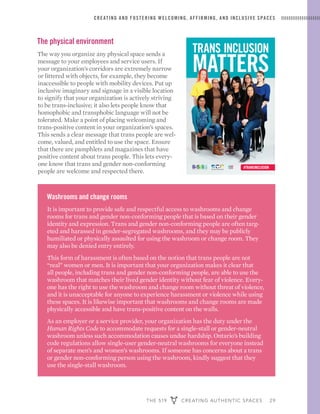
Creating
Authentic Spaces
A GENDER IDENTITY AND GENDER EXPRESSION
TOOLKIT TO SUPPORT THE IMPLEMENTATION
OF INSTITUTIONAL AND SOCIAL CHANGE
Acknowledgements
This toolkit updates the Trans Inclusion Policy and Procedure Toolkit created by The 519 in 2011. It builds
upon the organization’s long history of working with and supporting trans communities. This includes the
ground-breaking work led by Kyle Scanlon in partnership with other staff and community members during
The 519’s Trans Access Project and Project Open Door. The 519 believes that this work is critically import-
ant and fostering environments that are inclusive of all gender identities and gender expressions continues
to be an organizational priority.
The 519 is an organization committed to the health, happiness, and full participation of LGBTQ (lesbian,
gay, bisexual, trans and queer) communities. A City of Toronto agency, we strive to make a real difference in
people’s lives, while working to promote inclusion, understanding, and respect.
Author: Jack Hixson-Vulpe
Copy Editors: Jenn Harris, Lucid Pulp; Ashley Fortier, Metonymy Press
Editorial Consultant: Nichola (Nicki) Ward
The 519 would like to acknowledge the generous work of Toronto trans communities and
everyone who provided any and all feedback and direction.
In particular, we would like to acknowledge the following people:
Matt Caron-Francino
Rainbow Health Ontario
Colin Druhan
Pride at Work Canada
Karen Lior
Toronto Workforce
Innovation Group
Bob Sherman
Ontario Human Rights
Commission
Donna Turner
Rainbow Health Ontario
Zoya Zayler
Accenture
Delia Sinclair Frigault
Davina Hader
Nathan Hoo
Melissa Hudson
Raimi Marx
Christine Newman
Steven Wilson
Danielle Araya,
Barb Besharat,
Rachel Lauren Clark,
Lisa Gore Duplessis,
John Farrell,
Rosalyn Forrester, Luke Fox,
Susan Gapka, Laura Gibbon,
Maura Lawless, Steven Little,
Becky McFarlane,
Monica Notaro, Sawyer Pow,
Jeffrey Reffo
The 519
A generous thank you to N. Nicole Nussbaum, LL.B., for adapting her article to be used in this toolkit.
Finally, we would like to sincerely thank Ron Puccini and TD Bank for their support.
					
For more information about The 519 education and training services please contact
Steven Little
Manager, Education and Training
The 519
SLittle@The519.org
416 355 6772
Design:lightupthesky.ca
Table of Contents
Welcome.  .  .  .  .  .  .  .  .  .  .  .  .  .  .  .  .  .  .  .  .  .  .  .  .  .  .  .  .  .  .  .  .  .  .  .  .  .  .  .  .  .  .  .  .  .  .  .  .  .  .  .  .  .  .  .  .  .  .  .  .  .  .  .  .  .  .  .  .  .  .  .  .  .  .  . 1
Executive summary.  .  .  .  .  .  .  .  .  .  .  .  .  .  .  .  .  .  .  .  .  .  .  .  .  .  .  .  .  .  .  .  .  .  .  .  .  .  .  .  .  .  .  .  .  .  .  .  .  .  .  .  .  .  .  .  .  .  .  .  .  .  .  .  . 2
The toolkit.  .  .  .  .  .  .  .  .  .  .  .  .  .  .  .  .  .  .  .  .  .  .  .  .  .  .  .  .  .  .  .  .  .  .  .  .  .  .  .  .  .  .  .  .  .  .  .  .  .  .  .  .  .  .  .  .  .  .  .  .  .  .  .  .  .  .  .  .  .  .  .  .  . 3
Who is this toolkit for? . . . . . . . . . . . . . . . . . . . . . . . . . . . . . . . . . . . . . . . . . . . . . . . . . . . . . . . . . . . . . . . . 3
Why does this toolkit matter for your organization? . . . . . . . . . . . . . . . . . . . . . . . . . . . . . . . . . . . . 3
Who produced this toolkit? . . . . . . . . . . . . . . . . . . . . . . . . . . . . . . . . . . . . . . . . . . . . . . . . . . . . . . . . . . . . 4
The importance of language . . . . . . . . . . . . . . . . . . . . . . . . . . . . . . . . . . . . . . . . . . . . . . . . . . . . . . . . . . . 4
The importance of context. . . . . . . . . . . . . . . . . . . . . . . . . . . . . . . . . . . . . . . . . . . . . . . . . . . . . . . . . . . . . 5
The importance of understanding oppression as intersectional . . . . . . . . . . . . . . . . . . . . . . . . . . 5
Gender identity, gender expression, and transphobia. .  .  .  .  .  .  .  .  .  .  .  .  .  .  .  .  .  .  .  .  .  .  .  .  .  .  .  .  .  .  . 6
What are some of the barriers that people face due to their trans identity? . . . . . . . . . . . . . . . 6
Why is it important to include the participation of trans people
based on their lived gender identity and expression? . . . . . . . . . . . . . . . . . . . . . . . . . . . . . . . . . . . . 7
Understanding gender identity and gender expression . . . . . . . . . . . . . . . . . . . . . . . . . . . . . . . . . . 8
Full integration: The centre of the circle.  .  .  .  .  .  .  .  .  .  .  .  .  .  .  .  .  .  .  .  .  .  .  .  .  .  .  .  .  .  .  .  .  .  .  .  .  .  .  .  .  .  .  . 9
What is it? . . . . . . . . . . . . . . . . . . . . . . . . . . . . . . . . . . . . . . . . . . . . . . . . . . . . . . . . . . . . . . . . . . . . . . . . . . . . 9
Why is it important? . . . . . . . . . . . . . . . . . . . . . . . . . . . . . . . . . . . . . . . . . . . . . . . . . . . . . . . . . . . . . . . . . . 9
What to avoid . . . . . . . . . . . . . . . . . . . . . . . . . . . . . . . . . . . . . . . . . . . . . . . . . . . . . . . . . . . . . . . . . . . . . . . . 9
Working toward full integration . . . . . . . . . . . . . . . . . . . . . . . . . . . . . . . . . . . . . . . . . . . . . . . . . . . . . . 10
Challenging prejudice.  .  .  .  .  .  .  .  .  .  .  .  .  .  .  .  .  .  .  .  .  .  .  .  .  .  .  .  .  .  .  .  .  .  .  .  .  .  .  .  .  .  .  .  .  .  .  .  .  .  .  .  .  .  .  .  .  .  .  .  .  . 13
What is transphobia? . . . . . . . . . . . . . . . . . . . . . . . . . . . . . . . . . . . . . . . . . . . . . . . . . . . . . . . . . . . . . . . . . 13
Transphobia vs. homophobia. . . . . . . . . . . . . . . . . . . . . . . . . . . . . . . . . . . . . . . . . . . . . . . . . . . . . . . . . . 14
Practical steps in challenging transphobia. . . . . . . . . . . . . . . . . . . . . . . . . . . . . . . . . . . . . . . . . . . . . 14
Facing resistance . . . . . . . . . . . . . . . . . . . . . . . . . . . . . . . . . . . . . . . . . . . . . . . . . . . . . . . . . . . . . . . . . . . . 17
Competing human rights. . . . . . . . . . . . . . . . . . . . . . . . . . . . . . . . . . . . . . . . . . . . . . . . . . . . . . . . . . . . . 18
Taking responsibility and being an effective ally.  .  .  .  .  .  .  .  .  .  .  .  .  .  .  .  .  .  .  .  .  .  .  .  .  .  .  .  .  .  .  .  .  .  .  . 19
Acknowledging mistakes . . . . . . . . . . . . . . . . . . . . . . . . . . . . . . . . . . . . . . . . . . . . . . . . . . . . . . . . . . . .  20
What does allyship look like?.  .  .  .  .  .  .  .  .  .  .  .  .  .  .  .  .  .  .  .  .  .  .  .  .  .  .  .  .  .  .  .  .  .  .  .  .  .  .  .  .  .  .  .  .  .  .  .  .  .  .  .  .  . 22
Compassion and empathy. . . . . . . . . . . . . . . . . . . . . . . . . . . . . . . . . . . . . . . . . . . . . . . . . . . . . . . . . . . . . 22
Active listening. . . . . . . . . . . . . . . . . . . . . . . . . . . . . . . . . . . . . . . . . . . . . . . . . . . . . . . . . . . . . . . . . . . . . . 22
Providing support. . . . . . . . . . . . . . . . . . . . . . . . . . . . . . . . . . . . . . . . . . . . . . . . . . . . . . . . . . . . . . . . . . . . 22
Facilitating frank and upfront discussion. . . . . . . . . . . . . . . . . . . . . . . . . . . . . . . . . . . . . . . . . . . . . . 22
Learning about cisgender privileges. . . . . . . . . . . . . . . . . . . . . . . . . . . . . . . . . . . . . . . . . . . . . . . . . . . 23
Maintaining openness and a willingness to learn . . . . . . . . . . . . . . . . . . . . . . . . . . . . . . . . . . . . . . 23
Saying something. . . . . . . . . . . . . . . . . . . . . . . . . . . . . . . . . . . . . . . . . . . . . . . . . . . . . . . . . . . . . . . . . . . . 23
Thinking big. . . . . . . . . . . . . . . . . . . . . . . . . . . . . . . . . . . . . . . . . . . . . . . . . . . . . . . . . . . . . . . . . . . . . . . . . 23
Creating and fostering welcoming, affirming, and inclusive spaces .  .  .  .  .  .  .  .  .  .  .  .  .  .  .  .  . 25
The verbal and emotional environment. . . . . . . . . . . . . . . . . . . . . . . . . . . . . . . . . . . . . . . . . . . . . . . . 26
The physical environment . . . . . . . . . . . . . . . . . . . . . . . . . . . . . . . . . . . . . . . . . . . . . . . . . . . . . . . . . . . . 29
Privacy of information. . . . . . . . . . . . . . . . . . . . . . . . . . . . . . . . . . . . . . . . . . . . . . . . . . . . . . . . . . . . . . . . 31
Confidentiality. . . . . . . . . . . . . . . . . . . . . . . . . . . . . . . . . . . . . . . . . . . . . . . . . . . . . . . . . . . . . . . . . . . . . . . 33
Kind demeanour. . . . . . . . . . . . . . . . . . . . . . . . . . . . . . . . . . . . . . . . . . . . . . . . . . . . . . . . . . . . . . . . . . . . . 33
Transgender 101: The human rights of trans employees.  .  .  .  .  .  .  .  .  .  .  .  .  .  .  .  .  .  .  .  .  .  .  .  .  .  .  . 36
Common trans employment issues. . . . . . . . . . . . . . . . . . . . . . . . . . . . . . . . . . . . . . . . . . . . . . . . . . . . 36
Conclusion. . . . . . . . . . . . . . . . . . . . . . . . . . . . . . . . . . . . . . . . . . . . . . . . . . . . . . . . . . . . . . . . . . . . . . . . . . . 39
The ins and outs of policy and the Ontario Human Rights Code.  .  .  .  .  .  .  .  .  .  .  .  .  .  .  .  .  .  .  .  . 41
Understanding the Ontario Human Rights Code. . . . . . . . . . . . . . . . . . . . . . . . . . . . . . . . . . . . . . . . 41
So, what does this mean? . . . . . . . . . . . . . . . . . . . . . . . . . . . . . . . . . . . . . . . . . . . . . . . . . . . . . . . . . . . . . 41
Understanding the Ontario Human Rights Code and discrimination . . . . . . . . . . . . . . . . . . . . 43
Why human rights policies? . . . . . . . . . . . . . . . . . . . . . . . . . . . . . . . . . . . . . . . . . . . . . . . . . . . . . . . . . . 47
Overview of policy road map. . . . . . . . . . . . . . . . . . . . . . . . . . . . . . . . . . . . . . . . . . . . . . . . . . . . . . . . .  49
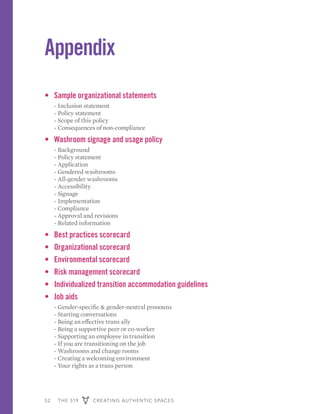
Appendix. .  .  .  .  .  .  .  .  .  .  .  .  .  .  .  .  .  .  .  .  .  .  .  .  .  .  .  .  .  .  .  .  .  .  .  .  .  .  .  .  .  .  .  .  .  .  .  .  .  .  .  .  .  .  .  .  .  .  .  .  .  .  .  .  .  .  .  .  .  .  .  .  . 52
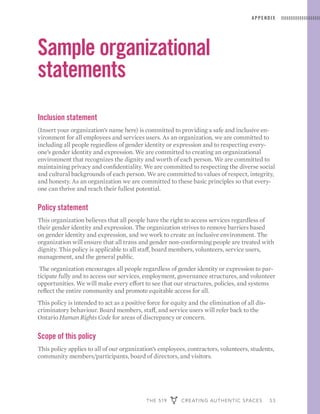
Sample organizational statements. . . . . . . . . . . . . . . . . . . . . . . . . . . . . . . . . . . . . . . . . . . . . . . . . . . . . 53
Washroom signage and usage policy (as taken from The 519) . . . . . . . . . . . . . . . . . . . . . . . . . . . 55
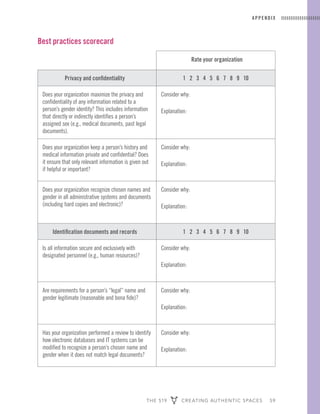
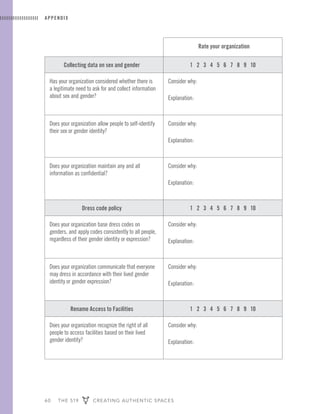
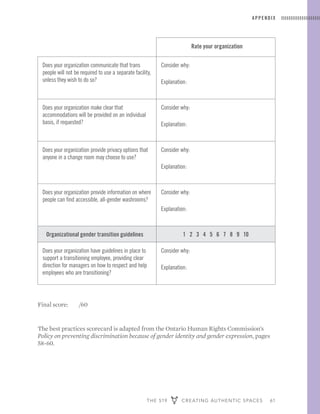
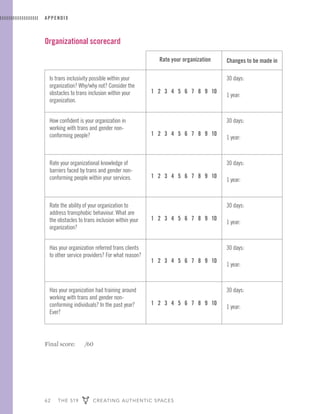
Scorecards. . . . . . . . . . . . . . . . . . . . . . . . . . . . . . . . . . . . . . . . . . . . . . . . . . . . . . . . . . . . . . . . . . . . . . . . . . . 58
	 Best practices scorecard . . . . . . . . . . . . . . . . . . . . . . . . . . . . . . . . . . . . . . . . . . . . . . . . . . . . . . . . . . 59
	 Organizational scorecard . . . . . . . . . . . . . . . . . . . . . . . . . . . . . . . . . . . . . . . . . . . . . . . . . . . . . . . . . 62
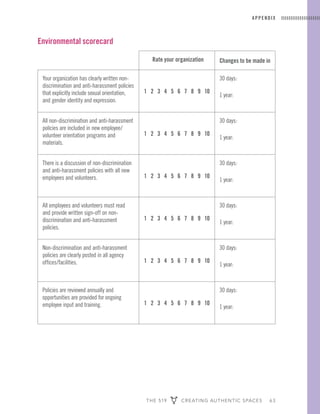
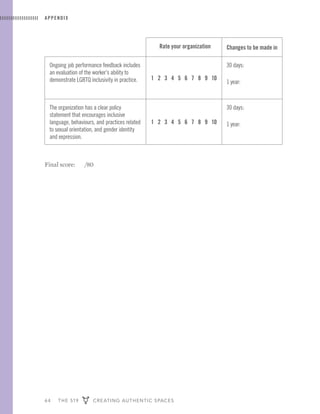
	 Environmental scorecard. . . . . . . . . . . . . . . . . . . . . . . . . . . . . . . . . . . . . . . . . . . . . . . . . . . . . . . . . 63
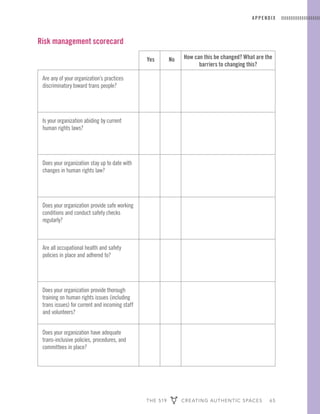
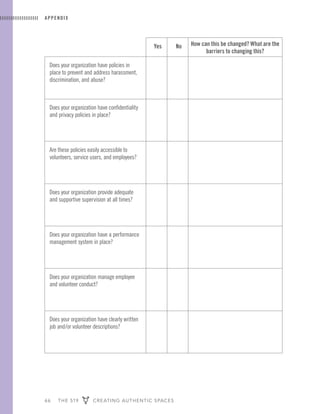
	 Risk management scorecard. . . . . . . . . . . . . . . . . . . . . . . . . . . . . . . . . . . . . . . . . . . . . . . . . . . . . . . 65
	 Individualized transition accommodation guidelines. . . . . . . . . . . . . . . . . . . . . . . . . . . . . . . 68
Job aids.  .  .  .  .  .  .  .  .  .  .  .  .  .  .  .  .  .  .  .  .  .  .  .  .  .  .  .  .  .  .  .  .  .  .  .  .  .  .  .  .  .  .  .  .  .  .  .  .  .  .  .  .  .  .  .  .  .  .  .  .  .  .  .  .  .  .  .  .  .  .  .  .  .  . 70
	 Gender-specific & gender-neutral pronouns. . . . . . . . . . . . . . . . . . . . . . . . . . . . . . . . . . . . . . . . 70
	 Starting conversations. . . . . . . . . . . . . . . . . . . . . . . . . . . . . . . . . . . . . . . . . . . . . . . . . . . . . . . . . . . . 71
	 Being an effective trans ally. . . . . . . . . . . . . . . . . . . . . . . . . . . . . . . . . . . . . . . . . . . . . . . . . . . . . . . 72
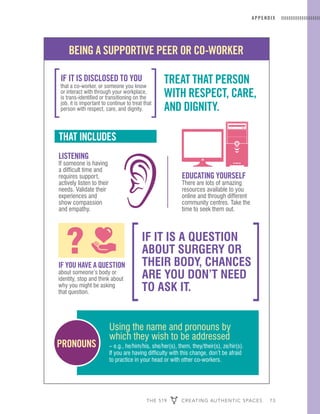
	 Being a supportive peer or co-worker. . . . . . . . . . . . . . . . . . . . . . . . . . . . . . . . . . . . . . . . . . . . . . 73
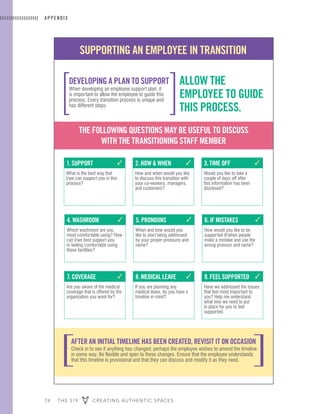
	 Supporting an employee in transition . . . . . . . . . . . . . . . . . . . . . . . . . . . . . . . . . . . . . . . . . . . . . . 74
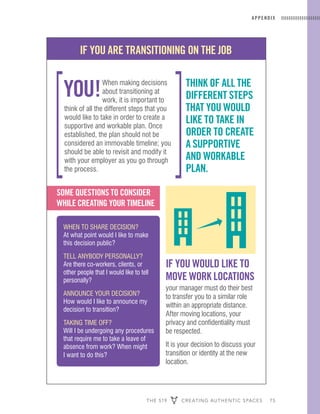
	 If you are transitioning on the job . . . . . . . . . . . . . . . . . . . . . . . . . . . . . . . . . . . . . . . . . . . . . . . . . 75
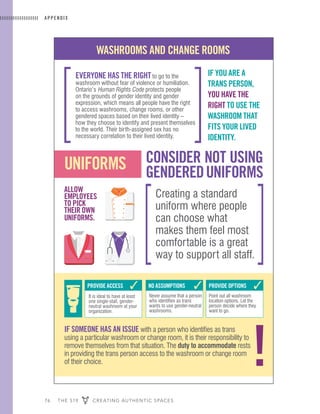
	 Washrooms and change rooms . . . . . . . . . . . . . . . . . . . . . . . . . . . . . . . . . . . . . . . . . . . . . . . . . . . 76
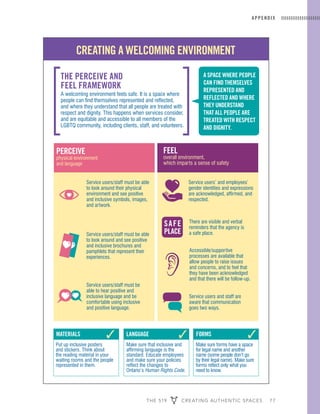
	 Creating a welcoming environment. . . . . . . . . . . . . . . . . . . . . . . . . . . . . . . . . . . . . . . . . . . . . . . . 77
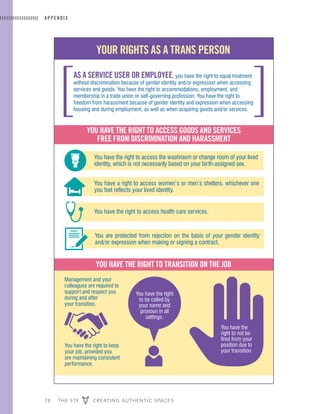
	 Your rights as a trans person. . . . . . . . . . . . . . . . . . . . . . . . . . . . . . . . . . . . . . . . . . . . . . . . . . . . . . 78
Glossary of terms. .  .  .  .  .  .  .  .  .  .  .  .  .  .  .  .  .  .  .  .  .  .  .  .  .  .  .  .  .  .  .  .  .  .  .  .  .  .  .  .  .  .  .  .  .  .  .  .  .  .  .  .  .  .  .  .  .  .  .  .  .  .  .  .  . 79
THE 519 CREATING AUTHENTIC SPACES 1
Welcome
We hope you find this toolkit useful as you move forward
in your process of supporting diverse gender identities and
gender expressions. This work is an ongoing process and
this toolkit provides you with practical steps and ideas of
where to begin, where to go, and what to keep doing.
It is important for every organization in Ontario to strive
to be a place in which all individuals can express their
authentic selves and feel comfortable and safe. It is also
your organization’s legal obligation to create spaces that
are free from discrimination based on gender identity and
gender expression, and to provide equal access to oppor-
tunities and benefits. With that in mind, this toolkit will
serve as your guide toward creating an affirmative work
environment for people who identify as trans and gen-
der non-conforming. A positive, supportive environment
allows all people to express their whole selves; when every-
one is able to do this, we are each able to reach our highest
potential.
This toolkit is to be read alongside the Ontario Human
Rights Commission’s (OHRC) Policy on preventing discrim-
ination because of gender identity and gender expression.
When read together, these two documents will give your
organization a well-rounded awareness of ways to imple-
ment positive structural changes in these areas.
While there is no “one size fits all” route, this guide will be
a road map that will help you better understand the differ-
ent paths your organization can take to abide by the law
and to create a welcoming, safe, and inclusive environment.
Gender Identity:
Each person’s internal
and individual experience
of gender
Gender Expression:
How a person publicly
presents or expresses
their gender
Trans:
An umbrella term that
describes people with
diverse gender identities
and gender expressions
that do not conform to
stereotypical ideas of
what it means to be a
boy/man or girl/woman
GenderNon-Conforming:
People who do not follow
gender stereotypes based
on the sex they were
assigned at birth
2 THE 519 CREATING AUTHENTIC SPACES
Executive summary
This toolkit provides constructive and tangible steps on how to implement anti-
discrimination policies around gender identity and gender expression, 1
as well as strat-
egies and suggestions on creating affirming spaces for people who identify as trans and
gender non-conforming. This toolkit was created with input from the Ontario Human
Rights Commission (OHRC) and through extensive feedback from the Toronto trans com-
munities. The project is intended to update the Trans Inclusion Policy and Procedure Toolkit
created by The 519 in 2011. It should be read alongside the OHRC’s Policy on preventing
discrimination because of gender identity and gender expression.
The toolkit outlines the OHRC’s definition of gender identity and expression; it also ex-
plains different forms of harassment and discrimination and breaks down the various
steps your organization can take to comply with Ontario’s Human Rights Code, such as,
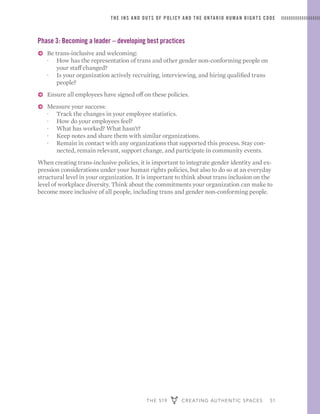
ɅɅ creating trans-positive washrooms and change rooms
ɅɅ addressing issues around name and pronoun changes
ɅɅ supporting an employee who is transitioning while working
ɅɅ supporting equal access and fair hiring practices
We’ve included organizational scorecards to help you better understand where your orga-
nization is succeeding and where it might need a little help. There are also pullout job aids
that can be used to support these changes, including “Being an effective ally” and
“Gender-specific and gender-neutral pronouns.”
While this toolkit provides practical information for preventing discrimination based on
gender identity and gender expression as well as steps to implement structural change,
there is no single route to creating and sustaining this change. The steps suggested in this
toolkit provide an outline of how to do this work, but they are most valuable when used in
conjunction with the input of members of your organization and feedback from your agen-
cy’s broader community.
1	 Gender identity and gender expression are prohibited grounds of discrimination in the Ontario Human Rights
Code.
THE 519 CREATING AUTHENTIC SPACES 3
The toolkit
Who is this toolkit for?
This toolkit is for everyone interested in creating positive, inclusive, and affirming work
environments and service provision; it can be for human resources personnel, front-line
social workers or customer service representatives. It is for organizations focusing on
local, national, or international issues. While this toolkit focuses on inclusive and affirming
practices around gender identity and expression, these steps and suggestions will help you
foster positive spaces for everyone. It is vital that organizations take an integrated ap-
proach to dealing with discrimination and harassment. Organizations cannot be inclusive
if racism, sexism, transphobia, homophobia, ableism, or any other form of discrimination is
present.
This toolkit is primarily written for cisgender individu-
als, but there is important information for trans and gender
non-conforming people, too. Gaining a deeper understanding
of how spaces are required to support you as trans and gender
non-conforming individuals can also help to drive and sustain
change. It is important that you are aware of your rights and
understand that you are to be treated with dignity and respect.
Why does this toolkit matter for your organization?
This is a resource to help you understand and fulfill your legal responsibilities to ensure
that your organization is following Ontario’s Human Rights Code. It will provide you with
the understanding and step-by-step suggestions to create inclusive and affirming environ-
ments for everyone regardless of their gender identity and/or gender expression.
The Ontario Human Rights Code is for everyone. It is a provincial law that gives everybody
equal rights and opportunities without discrimination in areas such as jobs, housing, and
services. The Code’s goal is to prevent discrimination and harassment because of gender
identity, gender expression, race, sex, disability, sexual orientation, and age, to name only
some of the 17 grounds. All other Ontario laws must agree with the Code.
Creating inclusive and affirming environments for people who identify as trans and/or
gender non-conforming allows everyone to bring their most authentic and productive self
to your organization. When people don’t have to live in fear for their physical or mental
well-being, they can spend their time more effectively, working individually or collabora-
tively in an engaging environment. Affirming difference, fostering diversity, and cultivat-
ing inclusivity creates strength in any organization.
Cisgender:
Someone whose gender
identity aligns with the
sex they were assigned
at birth
4 THE 519 CREATING AUTHENTIC SPACES
THE TOOLKIT
Who produced this toolkit?
This toolkit was written by The 519, an organization committed to the health, happiness,
and full participation of the LGBTQ (lesbian, gay, bisexual, trans and queer) communi-
ty. A City of Toronto agency with an innovative model of Service, Space, and Leadership,
we strive to make a real difference in people’s lives, while working to promote inclusion,
understanding, and respect. We respond to the evolving needs of the LGBTQ community,
from counselling services and queer parenting resources to trans programming, and se-
niors’ support. We provide free, accommodating, and non-judgemental space where indi-
viduals, organizations, and non-profit groups can meet, organize, and work toward their
goals. We share knowledge and insight gathered on the ground through consulting and
workshop services, best practice research, and public engagement campaigns.
The 519 Education and Training team provides organizations with the insight, tools, and
understanding to create environments that are LGBTQ-inclusive, respectful, and welcom-
ing. We offer training, workshops and consulting services that help improve the LGBTQ
experience in Toronto and beyond. We create custom curriculums for each organization,
providing training that is relevant to your context. Our training facilitators have lived
experience within the LGBTQ community, and provide meaningful personal insight that
supports the development of LGBTQ-inclusive environments.
This toolkit was written in consultation with the Ontario Human Rights Commission and
members of Toronto’s trans communities.
The importance of language
Using respectful and inclusive language – for example, selecting the pronouns that align
with a person’s self-determined identity – is a powerful way to demonstrate a commitment
to creating welcoming spaces. It is crucial to provide people with the spaces and opportu-
nities to speak openly and honestly about the terms, such as pronouns, that reflect their
identity, and then to use those terms accordingly.
Understanding the importance of language means recognizing that language can be hurt-
ful to some while being empowering to others. For example, while this document uses the
term queer to be inclusive of a wide range of sexual identities, it is important to recognize
that some people don’t identify positively with that term. Although many people feel that
the LGBQ (lesbian, gay, bisexual, and queer) community has reclaimed the term after
many years of it being used disparagingly, and some people use it to identify themselves
proudly, others dislike the word and do not identify with it. When discussing different
sexuality categories, consider using the LGBQ acronym. This provides space for people to
self-identify along a spectrum of sexualities.
This document will use the term trans as an umbrella term to include gender non-
conforming people, while also recognizing the varying ways that people who identify as
trans and people who are gender non-conforming might need different support. The dif-
ferent communities that can identify under the trans umbrella include two-spirit people,
people who cross-dress, and gender non-conforming people. However, not all trans people
THE 519 CREATING AUTHENTIC SPACES 5
THE TOOLKIT
identify as gender non-conforming. Many people who identify as trans do not feel that
they are gender non-conforming, but instead that the process of transitioning is about
affirming their lived gender identity. People who identify as gender non-conforming do
not always identify as trans. This document can be used to support employees or service us-
ers who are undergoing any type of transition around their gender identity and expression.
The importance of context
When starting this work, it is important to look around you and understand the context
and location of your organization. Is your organization part of a multicultural and varied
community? Are you in the heart of a city? Are you in a suburban neighbourhood? Are you
supporting rural communities? What do these different communities look like, and how do
they access your services?
Understanding the needs of your community (this includes
service users, clients, and employees) and how its members
might respond to changes in your organization around trans
inclusion is an important part of starting this work. There
is no formula to follow; instead, there are different steps
you can take at different times to support these important
changes. A great place to start is education sessions, or con-
necting with community members who have lived experi-
ence or are passionate about these issues. Working collabo-
ratively helps a wider range of people.
People in rural or suburban settings are not more homopho-
bic or transphobic than people in cities. People who are
from a certain religion or culture are not necessarily more
homophobic or transphobic than people from another reli-
gion or culture. Trans inclusion is happening everywhere
and in varied contexts; you can research similar organiza-
tions to yours to see what kind of work they have been do-
ing. If you can’t find comparable agencies, reach out to other
organizations that are doing this work. Create supportive
networks to help introduce this work to your area.
The importance of understanding oppression
as intersectional
Just like the OHRC, this toolkit recognizes oppressions as intersectional. This means that
experiences of discrimination and harassment are understood through a lens that recog-
nizes social and historical contexts. As well, this view recognizes experiences of oppres-
sion as informed by multiple parts of someone’s identity (e.g., an experience of harassment
can be based on multiple protected grounds, such as gender identity and race or sexual
orientation and disability). An example of intersectional oppression is a person being
denied a job based on their race and sexual orientation.
Transphobia/
transphobic:
The aversion to, fear,
hatred, or intolerance
of trans people and
communities
Sexual orientation:
Describes preferences in
human sexuality, (e.g.,
gay, straight, lesbian,
bisexual)
Intersectional:
When two or more
oppressions overlap in
the experience of an
individual or group (e.g.,
racism and homophobia)
6 THE 519 CREATING AUTHENTIC SPACES
Gender identity, gender
expression, and transphobia
What are some of the barriers that people face due to their trans identity?
Major barriers faced by trans people are based on a lack of acknowledgement and respect,
often resulting in hostility and violence.
Transphobia is understood by the Ontario Human Rights Code (OHRC) as a set of beliefs
and attitudes, similar to racism and homophobia. It is “the aversion to, fear or hatred or
intolerance of trans people and communities.” 1
While transphobia itself is not a form of
discrimination, discrimination occurs when someone acts on that prejudice.
There has been a lot of inclusivity work done around LGB issues, but the “T” is often
silenced. For example, in many circumstances, people who identify as trans are asked to
self-identify as lesbian, gay, bisexual, or trans. But, what if they are lesbian, gay, or bisex-
ual, and trans? It is important to be inclusive of LGB identities, but equally as important
to recognize that being trans isn’t in the same category. Gender identity and sexual ori-
entation are fundamentally different. Gender identity refers to how you experience your
internal sense of self, sexual orientation refers to the people to whom you are attracted and
describes the spectrum of human sexuality (e.g., gay, straight, lesbian, bisexual).
It is also often believed that trans people just don’t exist in our organizations or are not
accessing our services. Some may ask, why do we need to be inclusive of trans people and
communities? However, people who identify as trans are everywhere, whether you believe
you can recognize them or not. Maybe trans people don’t feel safe working at your organi-
zation; thus, changes to your policies could alter that. Or maybe you are already working
with people who identify as trans and you just aren’t aware.
Oftentimes, people who identify as trans experience hostility and violence if someone else
discloses their trans identity; this leaves them feeling unsafe in many circumstances. This
hostility can come in many forms – including denial of services, termination of employ-
ment, lack of inclusive washrooms, lack of trans-positive support staff, physical violence,
and/or other forms of discrimination or harassment.
Another issue that trans people experience is tokenism (this issue is not limited to trans
people, but is something experienced by all marginalized communities). If a person comes
out as trans at work, they are held up as a “token” of an organization’s inclusivity. However,
1	 Ontario Human Rights Commission, “Appendix B: Glossary for understanding gender identity and gender ex-
pression” Policy on Discrimination and Harassment Because of Gender Identity, online: http://www.ohrc.on.ca/en/
policy-discrimination-and-harassment-because-gender-identity
THE 519 CREATING AUTHENTIC SPACES 7
GENDER IDENTIT Y, GENDER EXPRESSION, AND TRANSPHOBIA
often this person still does not feel safe in the organization because inclusivity work has
not been done adequately.
It is important to remember that trans people are not just trans. We are mothers, fathers,
and parents. We are brown and black people. We are Indigenous peoples. We are people
with disabilities. We are working-class people. We are people with visual impairments.
We are mixed-race people. We are people with hearing impairments. We are middle-class
people. We are straight. We are gay. We are business professionals. We are bisexual. We are
lesbian. We are queer. We are politicians. We are newcomers. We use wheelchairs. We are
neighbours. We speak many languages. We are clients. We are employees. We are bosses.
And we each deserve to be treated with respect.
The most important thing to remember is that any changes that organizations wish to
make cannot be made without meaningful action and input from trans people. We know
what is best for us and there should be nothing about us, without us.
Why is it important to include the participation of trans people based on their
lived gender identity and expression?
Creating an affirming and positive work environment ensures that all of your organiza-
tion’s members and clients are able to be their genuine selves at your workplace and during
the service provision process. It takes a lot of energy for people to constantly hide import-
ant parts of their lives, which can impact someone’s ability to be fully productive at work.
Inclusion contributes to a more engaged work environment. Finally, it supports a broader
social move toward the acceptance of all people.
The Trans PULSE Project, an Ontario-wide community-based research initiative explor-
ing the health and well-being of trans people, surveyed 433 trans people in 2010-2011.
Below are some of the findings:
ɅɅ 71% of trans people have a college or university degree, yet 50% have a personal annual
income of less than $15,000.
ɅɅ 49% of trans people report experiences of verbal harassment because of their trans
identity.
ɅɅ 55% of trans people have at least some difficulty meeting housing-related costs.
ɅɅ 51% of trans people have been diagnosed with depression or anxiety.
These statistics are important to consider and can help cisgender people understand that
people who identify as trans are affected by prejudice based on their gender identity and
expression. There are trans people who are impacted by discrimination in relation to other
parts of their identity, and they may face prejudice on multiple levels. Providing all people
with safe and inclusive spaces in which to work and live is part of a larger shift that re-
quires support from everyone. Making these changes to your organization’s environment
will add momentum to this social shift and ensure that everyone can participate fully in
their work and social environments.
8 THE 519 CREATING AUTHENTIC SPACES
GENDER IDENTIT Y, GENDER EXPRESSION, AND TRANSPHOBIA
These statistics provide some insight into the difficulties faced by trans and gender
non-conforming people. However, despite these hurdles, trans and gender non-conforming
people are also often part of vibrant communities that are working to make change happen
– changes that better their lives every day. It is important to follow their lead.
Understanding gender identity and gender expression
As understood by the OHRC, gender identity is each per-
son’s internal and individual experience of gender. It is their
sense of being a woman, a man, both, neither, or anywhere
along or outside the gender spectrum. A person’s gender
identity may be the same as or different from their birth-
assigned sex. Gender identity is fundamentally different
from a person’s sexual orientation, which instead relates to
the person with whom someone shares their body, heart,
and life.
Gender expression is how a person publicly presents their
gender. This can include behaviour and outward appearance
such as dress, hairstyle, make-up, body language, and voice.
A person’s chosen name and pronoun are also common ways
of expressing gender.
The OHRC understands both gender identity and gender
expression as protected grounds.
It is on the grounds of gender identity and gender expression
that your organization is able to support and protect gender
non-conforming people as well as people who identify as
trans. Where gender identity protects everyone from dis-
crimination based on their trans identity, gender expression
protects everyone’s right to express their gender freely.
An example of this expression would be a cis or trans man who wears a dress to work.
His right to express his gender through wearing a dress is protected. Another example is a
cis or trans woman who chooses to dress in what could be generally described as “men’s
clothing.” She has a right to express her gender through her clothing choice.
Gender spectrum:
The representation of
gender as a continuum,
as opposed to a binary
concept
Birth-assigned sex:
The sexed identity that
is assigned to people
at birth by a medical
practitioner (i.e., male or
female or intersex)
Cis:
Short for cisgender and
can be used as a prefix
THE 519 CREATING AUTHENTIC SPACES 9
Full integration:
The centre of the circle
What is it?
Full integration looks different depending on the workplace. Consider the levels of man-
agement in your organization. What are the board level positions? Who accesses your
services? A fully inclusive organization is open to integrating people who identify as trans
across the organization; it also provides supportive services to trans clients and thinks
about trans people when discussing advertisements or creating events.
Why is it important?
Just like everyone else, people who identify as trans can bring amazing assets to your orga-
nization when they are able to be their genuine selves. Trans people have a wide range of
skill sets, expertise, and experience. We have often had to be especially strong and cre-
ative to flourish in spite of facing discrimination and harassment. We also have particular
perspectives that other people might not possess, and lived experiences that other people
might not have had. Our viewpoints are important to consider and we can provide insights
that other people might not be able to. We are skilled workers, just like the cisgender peo-
ple who might also be applying for a job.
Involving people who identify as trans in your organizational decision-making is a great
and important first step. In order to be a fully inclusive and affirming organization, it is
important to provide space and support for trans people to lead the way. To work on this
goal, see if anyone is able to help with this internally. If your organization lacks trans peo-
ple who are willing to be “out” or to participate, you should access external resources. This
demonstrates a desire to be inclusive and shows that your organization takes trans people’s
needs seriously and respects the opinions of trans people.
As well as involving people who identify as trans at every level of decision-making, full in-
tegration also means reaching out to and encouraging trans people to access your services
by providing safer spaces.
What to avoid
Do not rely on one trans person to voice priorities for all trans communities. Trans people
are just as diverse as cisgender people and their needs are just as varied. No one person
can understand the needs of an entire group of people.
10 THE 519 CREATING AUTHENTIC SPACES
FULL INTEGRATION : THE CENTRE OF THE CIRCLE
Full integration means ensuring that trans people have access to necessary health care, ac-
cess to a work environment free from discrimination, and the right to a life based on their
lived gender identity and expression.
According to the Human Rights Tribunal of Ontario (HRTO), “for transgender people, in-
sisting on their treatment in accordance with their birth gender for all purposes is discrim-
inatory because it fails to take into account their lived gender identity.” 1
Unless requested
by the person who identifies as trans, or if the accommodation would cause undue hardship
(see page 45), segregated treatment is considered discriminatory. All people, at every level of
society, deserve full integration and participation based on their lived gender identity.
1	 Vanderputten v. Seydaco Packaging Corp. [2012] OHRTD no. 1946.
Working toward full integration
Questions to ask
ɅɅ Does your organization have people who identify as trans in leadership positions? Are
there decisions that might have been made differently if trans people had been involved?
ɅɅ Does your organization have trans people on staff? Why/why not?
·· If you do, is your organization providing employees who are trans with adequate
support?
·· What does that support look like?
ɅɅ Have you had people who identify as trans involved in your organization in the past?
·· Why did they leave?
ɅɅ Do people who identify as trans access your services? Why/why not?
·· If they do, is your organization providing your trans clients any gender-specific
support?
·· How are they accessing these services? What does that support look like?
ɅɅ What kinds of barriers do trans people face in your organization?
·· What opportunities can your organization take to increase trans people’s participation?
ɅɅ What do trans-nclusive hiring practices look like?
ɅɅ What do job descriptions at your organization look like? Who is doing interviews and
do they create a safer space? What information are people expected to disclose on
forms?
ɅɅ Does your organization communicate that it is trans-inclusive and an equitable employer?
What to do
ɅɅ Review the amount of input that people who identify as trans have in your organiza-
tion and note areas that require more involvement.
THE 519 CREATING AUTHENTIC SPACES 11
FULL INTEGRATION : THE CENTRE OF THE CIRCLE
ɅɅ Encourage trans people to give honest opinions about their experiences with your
organization. Ensure all information (including any personal documents or experien-
ces) remains confidential, unless explicit consent is otherwise given. Take their input
seriously and make meaningful changes.
ɅɅ If your organization lacks trans people to help make important decisions on all levels,
access outside resources, or consider additional training for trans people who may al-
ready work within your organization.
ɅɅ Seek out a wide range of trans people’s experiences and input.
ɅɅ Ask clients and employees who identify as trans why they chose to get involved with
your organization. Use this information meaningfully to do further accessibility work
and outreach.
Example
Your organization is just starting the process of becoming more trans-inclusive. You
post a general call-out to see if there are any trans and/or gender non-conforming
people working for you, and one person comes forward as trans. It is important to
meaningfully engage with this person’s opinions and perspectives, but do not place
all responsibility to do the work onto this one person. Balance receiving and appre-
ciating their feedback with doing the necessary organizational legwork as cisgender
allies. Ask them about the kinds of support they would like to see. Inquire about
different resources they might recommend and look outside your organization for
additional assistance. Ask the employee if they would be comfortable working with
other people and/or co-workers on this process; if so, take their suggestions seri-
ously. Ensure they are paid for the time and effort that they put into doing this work
for your organization.
12 THE 519 CREATING AUTHENTIC SPACES
ARE YOU SUCCEEDING?
Measuring success can be difficult; consider these questions as a guide:
ɅɅ Are trans and gender non-conforming people accessing your organiza-
tion’s services?
ɅɅ Have you had any positive or negative feedback from trans and gender
non-conforming people who are already accessing your services? Have
there been complaints?
ɅɅ Have people who identify as trans applied to jobs in your organization? Do
you have trans and gender non-conforming people now working in your
organization? Are their experiences positive?
ɅɅ Where do you post notices of job or volunteer opportunities? Think realis-
tically about whom these postings will reach.
ɅɅ What communities do you engage with on a regular basis? How can your
engagement be more reflective of all people?
ɅɅ If you have health care policies, do they take into consideration the needs
of people who identify as trans? Have your answers to these questions
changed over time? Why or why not?
Side note:
When answering these
questions, it can help to
have human rights data
about your employees
and/or service users –
for example, data about
the number of trans or
gender non-conforming
people your organization
employs or services. For
guidance about collecting
human rights-based data
consult, Count me in!
Collecting human rights-
based data, the OHRC’s
guide to collecting human
rights based date.
FULL INTEGRATION : THE CENTRE OF THE CIRCLE
THE 519 CREATING AUTHENTIC SPACES 13
Challenging prejudice
Challenging prejudice can be a difficult thing. It can be hard to know what language to use,
how to talk to someone, or whether you are asking inappropriate questions. Sometimes
prejudice is rooted in a basic lack of knowledge.
A lack of knowledge around transphobia and trans issues can manifest in different ways. It
can involve making common assumptions about men and women or asking disrespectful
and invasive questions. While thinking about policy and making changes to be more inclu-
sive are important first steps toward challenging prejudice, it is essential to remember that
this is an ongoing process.
People who identify as trans are comprised of much more than their gender identity –
trans people experience life just like everyone else and have diverse thoughts and perspec-
tives. Likewise, trans and gender non-conforming people can experience prejudice based
on racism, ableism, classism, and other forms of oppression. It is important to acknowledge
the ways that people’s varied identities can lead to them experiencing intersecting systems
of oppression in their daily lives.
What is transphobia?
Transphobia is the manifestation of beliefs and attitudes that are intolerant of gender
non-conformance, gender variance, and trans people. It is rooted in the idea that there are
only two biological sexes, male and female, which are assigned at birth, and that each sex
has a fixed, appropriate expression of gender. It involves the belief that people who look,
sound, and behave like “real” (meaning cisgender) men and women are better than those
who do not. Transphobia manifests itself through ideas, language, actions, and physical
behaviour. It can be intentional or by mistake – active or passive. These actions, no matter
their intent, exclude and marginalize trans and gender non-conforming people from acc-
essing services and jobs. Furthermore, these discriminatory actions based on transphobia
are in violation of Ontario’s Human Rights Code.
The following are examples of transphobia that happen every day for many trans people:
Misuse of pronouns and names
This occurs when a trans woman is referred to with male pronouns (i.e., he, his) or a trans
man is referred to with female pronouns (i.e., she, her). This can happen by mistake but
it can also be done deliberately. If someone doesn’t “believe” that a trans woman or trans
man is a “real” woman or man, they will enforce their prejudice on that person by continu-
ing to use the wrong pronouns. Please see page 26 for further discussion on this topic.
14 THE 519 CREATING AUTHENTIC SPACES
CHALLENGING PREJUDICE
The misuse of pronouns can also be seen when someone refers to a trans person as “it” or
“that,” which are very offensive, dehumanizing terms. When they occur in the workplace,
these are also examples of harassment under subsection 5 of the Code and create a poi-
soned working environment.
Insisting on calling someone by their legal or birth name is very similar to insisting on us-
ing the wrong pronouns. It demonstrates that you are not allowing this person to proceed
through their transition. No one has the right to take that process away from anyone. This
is also considered a form of harassment under subsection 10 of the Code.
Making assumptions
There are many assumptions that people make about men and women. We assume that
all women menstruate or that all men have penises. We assume that men have deep voices
or that women have less physical strength. These assumptions are incorrect. Women and
men possess a vast array of body forms and features, and everyone should be respected
regardless of physical or other attributes.
Many of these assumptions are displayed through humour. When we laugh at a joke that is
based on a “man” wearing a dress, we are engaging in transphobic behaviour. These types
of jokes create a poisoned environment for all people, trans or cis. It signals to people who
are trans or gender non-conforming that their existence is a joke and not worth taking
seriously.
Transphobia vs. homophobia
It is important to understand that sexual orientation and gender identity are not the same.
Homophobia is fear, hatred, and/or discrimination based on someone’s sexual orientation.
Transphobia is fear, hatred and/or discrimination based on someone’s perceived trans iden-
tity.
Practical steps in challenging transphobia
Practice
If you are having a hard time using the correct pronouns and names of people, make sure
to challenge yourself and repeat the correct pronoun and name over and over again in
your head. Ask to practice someone’s name and pronouns with co-workers who might be
having the same problem. If you make a mistake, take the lead from the person you were
addressing, but make sure to move on and don’t get caught in that moment. Do not give up.
Any feelings of discomfort or confusion are not outweighed by the right of someone to be
respected for who they are.
THE 519 CREATING AUTHENTIC SPACES 15
CHALLENGING PREJUDICE
Unlearn
Do not assume that all men have a specific characteristic or that all women have certain
attributes. All women and men are different from each other. Each person has different
needs.
Be prepared to listen
If you say something that is offensive and someone points it out, do not try to prove them
wrong or explain yourself. Simply thank them for pointing it out and validate what they
have said, then think about the person’s feedback. When someone addresses hurtful
behaviour, they are doing so because they trust and believe in you. Honour that trust by
demonstrating that you are able to accept criticism and grow accordingly. How can you
incorporate their comment into your everyday language and viewpoints?
Don’t assume
Don’t assume that you can tell anything by looking at someone. You cannot tell how far
along someone is in their transition, or if they are trans at all, just by looking at them. Do
not assume what pronoun they use.
People who identify as trans are everywhere; we come in all shapes, sizes, and abilities,
from everywhere in the world, and we express our gender identities in a multitude of ways.
We are part of every race. We are of every sexual orientation. We are part of every social
class. We have all different types of genders. We are part of every generation. And we de-
serve respect.
Say something
If you overhear people at work making transphobic comments or jokes and can address
them personally, do it. Don’t just ignore them. Don’t assume that a trans person should be
the one to address these issues. If you don’t feel you are able to say something in the mo-
ment, consider speaking to the person later, or else think of someone you could approach
(for example, your manager, or a senior employee) about the person’s transphobic behaviour.
Engage in meaningful conversation with cisgender people about how to be better allies.
Challenging myths
There is a very pervasive myth that trans women and men aren’t “real” women or men
compared to those who are cisgender. This notion leads to trans people experiencing vary-
ing degrees of violence, discrimination, and harassment.
People who identify as trans are often at an increased risk of emotional, physical, and sexu-
al violence. These experiences of violence are rooted in the fact that some cisgender people
believe that trans and gender non-conforming people don’t have a right to exist. It is im-
portant to challenge this myth. Trans women and men are just as real as cisgender women
and men. They deserve the same basic rights to dignity, respect, and life.
16 THE 519 CREATING AUTHENTIC SPACES
CHALLENGING PREJUDICE
Questions to ask
ɅɅ How does transphobia affect your employees, co-workers, and clients?
ɅɅ What steps do you need to take to recognize and challenge transphobia and all forms of
oppression?
ɅɅ What is the difference between respectful humour and hurtful, harassing jokes?
ɅɅ How can your organization intervene to support trans people?
ɅɅ What actions can you take to minimize transphobia in your organization?
ɅɅ What steps can your organization take to support trans communities?
What to do
ɅɅ Support all people who speak out against transphobic and oppressive language and
actions in your organization.
ɅɅ Create a service user or employee charter of rights that is posted in a visible place.
ɅɅ Provide people with a clear understanding of how your organization deals with harass-
ment and discrimination. To whom should they report discrimination and harassment?
What are the disciplinary processes? How will your organization support people who
have experienced discrimination and harassment in their work environment?
ɅɅ Review your workplace policies to make sure they cover gender identity and expres-
sion.
ɅɅ Support any trans employees. Recognize and acknowledge the great work that they do
and the skills that they bring to your organization.
ɅɅ Support the trans people who use your services. Recognize the range of experiences
and knowledge that they possess.
ɅɅ Show your organization’s pride at working alongside and with trans and gender
non-conforming communities.
“People who identify as trans are everywhere; we come in all
shapes, sizes, and abilities, from everywhere in the world, and
we express our gender identities in a multitude of ways. We are
part of every race. We are of every sexual orientation. We are
part of every social class. We have all different types of genders.
We are part of every generation. And we deserve respect.”
THE 519 CREATING AUTHENTIC SPACES 17
CHALLENGING PREJUDICE
Facing resistance
It is important to acknowledge that this work can be difficult; you and/or your organiza-
tion may face resistance in trying to start these conversations or changes. It is important to
remember, though, that this work is an integral part of creating safer work environments,
to ensure all people can be their authentic and full selves.
As an employer or service provider, here are some steps you can take to address and curb
resistance:
ɅɅ Create inclusive and affirming policies that are clearly outlined to all current and
incoming employees. Ensure that all incoming staff members are aware of the type of
work environment that your organization maintains; clearly laying out expectations
means that any difficult conversations or discipline should not come as a surprise.
ɅɅ Ensure that your organization’s diversity and inclusion values are plainly stated for all
current employees.
ɅɅ Promote education. Set mandatory educational workshops that relate to diverse and
respectful work environments (for example, workshops on trans inclusion, anti-racism,
and addressing sexism in the workplace).
ɅɅ Provide space for and support employee-run initiatives that address affirming, inclu-
sive, and welcoming work environments.
ɅɅ Support employees who come forward about experiences of transphobia. Do not
disbelieve them because you think that could never happen in your organization, or
because you don’t think the person being accused could say or do what is being alleged.
Creating an environment that validates and supports trans and gender non-conforming
people’s experiences of harassment and discrimination sends a strong message that
this type of behaviour will not be tolerated.
ɅɅ Ensure that all employees are aware of the steps to take when reporting an experience
of harassment or discrimination. Being clear and outlining the process by which peo-
ple report harassment demonstrates that this behaviour is not acceptable.
ɅɅ Clearly outline any disciplinary processes. Being clear about these processes helps to
further discourage such behaviour.
ɅɅ Follow through on reports of harassment and discrimination with the proper proce-
dures.
As an employee, here are some steps you can take to address and curb resistance:
ɅɅ Network with other employees who are supportive of this work. Consider creating an
employee resource group. This will provide you with a network of supportive people
and will also provide support to your organization in creating and sustaining changes
toward a more inclusive, affirming, and welcoming work environment.
ɅɅ Understand the processes and pathways that your organization would like you to take
when reporting harassment and discrimination. It is important to use formal channels
18 THE 519 CREATING AUTHENTIC SPACES
in order to help document the different types of harassment and discrimination that
may be occurring in your workplace or its service provision. Apart from your employ-
er’s formal channels, any employee or service recipient can ask the Human Rights
Legal Support Centre (www.hrlsc.on.ca) for advice, or they can file a complaint – called
an application – to the Human Rights Tribunal of Ontario (www.hrto.ca) within one
year from the last alleged incident.
ɅɅ Be kind and compassionate. Try to recognize that we are all coming from different
places; ignorance and lack of knowledge can be the basis for discrimination. Encour-
age people to educate themselves and support one another. However, do not ignore or
condone harassment or discrimination.
ɅɅ Do your best to be an effective ally and take action in creating inclusive spaces.
ɅɅ Make your allyship visible. Put up safer space stickers in your work area. Make sure
that people know they can talk to you if they need an ally.
ɅɅ Create welcoming and inclusive social environments.
Competing human rights
Competing human rights often arise in situations where parties to a dispute claim that
the enjoyment of one person or group’s human rights and freedoms, as protected by law,
would interfere with another’s rights and freedoms. This can be a very difficult issue to
deal with, but it is important for your organization to help everyone involved to demon-
strate dignity and respect for one another. According to the Ontario Human Rights Com-
mission, cases of competing human rights will be dealt with in their particular context and
on a case-by-case basis. For more information, please see the section “Competing Human
Rights” on page 45.
ARE YOU SUCCEEDING?
Measuring success can be difficult; consider these questions as a guide:
ɅɅ Do your employees understand the differences between gender identity, gender expression,
and sexual orientation?
ɅɅ Do they understand the importance of respecting someone’s gender identity and expression?
ɅɅ Is your organization able to have conversations around including all people based on their gender identity and
expression?
ɅɅ Does your organization address the concerns of all people regardless of gender identity and expression?
ɅɅ What steps has your organization taken to include people of all gender identities and expressions?
CHALLENGING PREJUDICE
THE 519 CREATING AUTHENTIC SPACES 19
Taking responsibility and
being an effective ally
The Ontario Human Right’s Code Policy on preventing discrimination because of gender
identity and gender expression states that organizations have a legal duty and ultimate re-
sponsibility to maintain an environment free from discrimination and harassment because
of gender identity and expression. They are required to take steps to prevent and respond
to violations of the Ontario Human Rights Code or they may be held liable and face mone-
tary penalties or other orders from a tribunal or court. It is unacceptable for an organiza-
tion to choose to remain unaware, or to ignore or fail to address potential or actual human
rights violations, whether or not a complaint is made.
As with all movements for equality, trans movements need allies and supporters. It is
important to understand that trans allies and supporters should take their lead from trans
people. It is also important to understand the role that your organization can take to sup-
port trans-inclusive behaviour.
To be an effective ally, your organization should understand how it can work with and for
trans people. When working toward trans inclusion, the lived, daily experiences of trans
people should be at the forefront of those discussions. In what ways can your organization
better serve its employees and service users? These are the questions your discussion could
focus on.
Allies and supporters should be prepared to take action when they witness instances of
transphobia; they should work to understand the many ways that trans people experience
violence, assault, harassment, and harm and do what they can to stop this. Corresponding-
ly, allies and supporters should learn about the experiences of trans people to understand
ways that they can supportive. It is not solely the role of trans people to dismantle trans-
phobic structures; everyone has a part to play in this process. Likewise, it shouldn’t just be
up to trans people to correct someone when they use the wrong name or pronoun, nor to
review health care policies and address the fact that the policy language is not trans-
inclusive. These are things that everyone is able to do.
Being an ally and supporter also means that cisgender people can make room for trans
people to take on positions of power in an organization. It is important that trans people’s
voices and perspectives guide how your organization can be more trans-inclusive, but it is
also crucial to examine how your organization is structured generally. Ensure that trans
people’s unique expertise, knowledge, and experience are valued as much as those of cis-
gender people.
It is important for all movements to have allies and supporters. Often their voices are seen
as more rational and balanced because they may not seem so directly impacted by the issue
20 THE 519 CREATING AUTHENTIC SPACES
TAKING RESPONSIBILIT Y AND BEING AN EFFECTIVE ALLY
at hand. On an organizational level, you can use this privilege to demonstrate the impor-
tance of trans inclusion. Be a leader in trans-inclusive behaviour and help to set up organi-
zational best practices.
Acknowledging mistakes
Past
There are not many organizations that do not have a history of transphobia or other types
of oppressive behaviour. It is important to recognize this as a reality. We are all always
learning.
Past mistakes give rise to distrust and fear that these mistakes will happen again. It is
important to acknowledge these mistakes in order to regain that trust. Even if someone
doesn’t take personal responsibility for the mistakes, it can be helpful to acknowledge that
these mistakes have an impact. It is important to take responsibility and commit to a new
start rather than ignore the impact and pretend that nothing happened.
Present
While your organization makes these important changes, people will make mistakes. That
is okay. It is important, though, to recognize those mistakes and the impacts that they have
on people. Apologize for them and be prepared to continue to work to rectify any errors.
Don’t pretend that they didn’t happen; doing so will break down any trust that you are
working to build. If someone tells your organization about a mistake, do not react defen-
sively. Listen, seek clarification if needed, and acknowledge the wrong. Make and keep a
commitment to change. Listening to and engaging with people respectfully can go a long
way to building trust.
Furthermore, recognize that in doing this work, people will have different opinions. Not
all trans people wish to address instances of transphobia in the same way. Recognize that
trans communities and people are as diverse as any other. Listen and do your best to work
with everyone. See what mutual ground can be found.
Future
The process of trans inclusion and challenging transphobia, as with facing any type of
discrimination, is an ongoing process; this work continues for as long as your organization
does. Moreover, it is okay to make mistakes; no one person or organization is perfect, and
recognizing that is important. What measures our worth is how we choose to deal with
those mistakes. Just as with past and present mistakes, when someone brings these errors
to your attention, do not get defensive. Understand that they respect you enough to bring
these issues forward. Respect them in turn and do your best to acknowledge any wrong-
doing, whether intentional or not. Recognizing any future mistakes your organization may
make helps to maintain trust with trans (and other) communities.
THE 519 CREATING AUTHENTIC SPACES 21
TAKING RESPONSIBILIT Y AND BEING AN EFFECTIVE ALLY
In recognizing any mistakes – past, present, or future – be transparent and outline the
steps your organization will take and how your organization will involve trans people in
the process. Meaningful apologies can be accompanied by concrete steps from your or-
ganization. Be honest about how long things will take. Trans inclusion does not happen
overnight. If your organization thinks it does, you are not doing it right. Make sure that
your organization is dedicated to the work it takes to be trans-inclusive and doesn’t stop
after one mistake.
Keep in mind that if your mistakes are public, it is important for your organization to be
equally public in its apologies.
Building or rebuilding trust takes time, but it is worth it. Your organization can make a
difference by meaningfully bringing trans people into places of leadership to demonstrate
a commitment to this change.
22 THE 519 CREATING AUTHENTIC SPACES
What does allyship look like?
Compassion and empathy
A really great first step in supporting people is to demonstrate simple compassion and em-
pathy. Ask someone how their day went or how they are doing, and really care about the
answer. Build relationships, and create welcoming and kind social environments; everyone
needs a place to sit and talk sometimes.
Active listening
It is difficult to provide support when you have not taken the time to hear and clarify
someone’s needs. Listen without judgement, and respect and affirm what someone is say-
ing to you. Don’t be afraid to ask clarifying questions.
Providing support
People who identify as trans are strong and have been doing this work for a long time, but
they do need support. Validate trans people in this fight, and take cues from them. When
a trans-identified person discusses a way that you can provide support, if you don’t agree
with it, take the opportunity to understand where they are coming from. When conceptu-
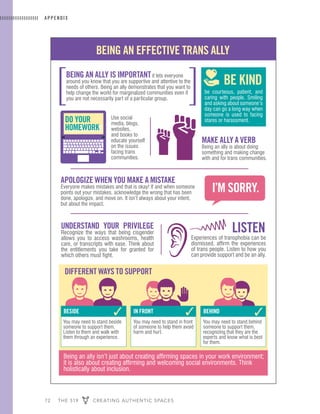
alizing how to provide support, imagine what it means to stand in front of someone, beside
someone, and behind them.
Facilitating frank and upfront discussion
If you are aware of employees or service users who identify as trans, consider approaching
them privately to ask if they would feel safe having open discussions about their exper-
iences with your organization. If so, take any feedback seriously. If they do not wish to
speak directly with you or the organization’s management, ask if they might consider
speaking with an outside facilitator or holding a separate focus group. Make sure that any
information provided is kept confidential and their privacy is protected.
Additionally, don’t automatically defer to one trans person’s view on any situation. Trans
and other gender non-conforming people and communities are wonderful, complicated,
and diverse. It is important that any decisions made by your organization are respectful of
difference.
THE 519 CREATING AUTHENTIC SPACES 23
WHAT DOES ALLYSHIP LOOK LIKE?
Learning about cisgender privileges
Compared with trans people, cisgender people can have very different experiences in
their lives. They don’t necessarily know what it is like to have to fight for the right to be
addressed in a particular way or what it is like not being able to use the washroom due to
fear of harassment or violence. Think about the ways in which your position as a cisgender
person gives you power and privilege every day.
Maintaining openness and a willingness to learn
Invest time and energy into learning about trans issues within your organization and the
broader world. The more you know, the more effective an ally you can be. If someone ad-
dresses an issue with you, listen and be willing to learn. No one is perfect and that is okay.
Saying something
If you witness transphobia, don’t ignore it. Say or do something about it. Don’t put yourself
at risk, but do try to figure out a way to address the issue. Can you address the issue in the
moment? If not, wait until a safe time. Can you address the person who is being trans-
phobic? If not, talk to a manager or a co-worker and strategize about ways to address the
matter.
Thinking big
Being an ally to trans people doesn’t stop at working against transphobia. Just like identi-
ties, oppressions intersect, so while addressing transphobia, you can also address instances
of racism, classism, and sexism (to name just a few).
Make being an ally a verb. It is about listening, learning, and acting.
Questions to ask
ɅɅ Do you think of yourself as a trans ally? Why or why not?
ɅɅ If not, what are your reservations about doing so?
ɅɅ What have you done as a trans ally? What would you like to do more often?
ɅɅ As an ally, what actions can you take to work on trans inclusion in your organization?
ɅɅ What concrete actions have you taken?
ɅɅ What mistakes has your organization made in the past? What steps can you take to
rebuild trust?
ɅɅ What mistakes is your organization currently making? What steps can you take to
address these issues?
24 THE 519 CREATING AUTHENTIC SPACES
ɅɅ What are the mistakes your organization is worried about making? What steps can you
take to proactively address or to minimize the likelihood of these situations?
ɅɅ What external groups can help your organization move forward?
What to do
ɅɅ Address any and all forms of discrimination related to gender identity or expression.
Address all forms of oppression in your workplace and support colleagues who do the
same.
ɅɅ Use your power as an ally to take action and work on trans inclusion in your organization.
ɅɅ Make a list of changes that need to happen in your organization. Commit to tackling
them. Make a list of leaders or committees for each item on the list.
ɅɅ Recognize that this is an ongoing process. Your organization should pledge itself to
continual improvement.
ɅɅ Make sure that your organization is engaging a wide range of trans and gender
non-conforming people or getting support from an organization like The 519, which
works with a diverse array of communities and organizations.
ɅɅ Develop an overall plan that lays out the steps your organization will take to address
and deal with mistakes.
ɅɅ Take positive action to prioritize trans peoples’ needs and make trans inclusivity part
of the default policy in your organization.
ARE YOU SUCCEEDING?
Measuring success can be difficult; consider these questions as a guide:
ɅɅ Is your organization open to critique?
ɅɅ Has your organization made progress around any complaints brought forward? What has your organization
done? Has it been effective?
ɅɅ Has your organization undergone trans-inclusive training? Why or why not?
ɅɅ Does your organization have an overall plan for how to address mistakes?
ɅɅ Has your organization made trans inclusion a priority?
ɅɅ Is inclusion regardless of gender identity or expression a default at all levels of your organization?
ɅɅ How well are trans people represented in your organization? Consider collecting self-identification data from
employees. If you do, be sure to use the OHRC’s guide Count me in! – Collecting human rights-based data,
which explains how to do this type of collection.
WHAT DOES ALLYSHIP LOOK LIKE?
THE 519 CREATING AUTHENTIC SPACES 25
Creating and fostering
welcoming, affirming,
and inclusive spaces
Affirming and positive environments are created verbally, emotionally, and physically;
they are made possible through welcoming, kind actions toward trans people, as well as
through inclusive physical spaces.
Factors affecting the verbal and emotional environment
ɅɅ Names
ɅɅ Pronouns
ɅɅ Questions asked
ɅɅ Privacy of information
ɅɅ Demeanour
ɅɅ Written materials and websites
Factors affecting the physical environment
ɅɅ Toilets
ɅɅ Change rooms
ɅɅ Dress codes
ɅɅ Content in waiting rooms
ɅɅ Forms
“Above all, ensure that each person that your organization
employs and interacts with is treated with dignity and respect. It
is never anyone else’s right to know someone’s transition status.
If you wouldn’t ask a cisgender person about their body or private
life, why would you ask someone who identifies as trans?”
26 THE 519 CREATING AUTHENTIC SPACES
CREATING AND FOSTERING WELCOMING, AFFIRMING, AND INCLUSIVE SPACES
The verbal and emotional environment
Names and pronouns
Trans people may be known under a different name than their legal name. For
example, a person’s paycheque may be made out to their legal name but staff and
service users address them by a different name.
It is important to refer to all people by the name that reflects their lived identity.
This may have been considered someone’s “preferred” name, but the term “pre-
ferred” can imply that using this name is optional, when it is a requirement. If you
need to know someone’s legal name because of official work related reasons, ask for
someone’s legal name. If someone tells you they wish to be addressed by a different
name, be flexible and honour that they shared this with you.
Be respectful and practice using this name in your head. It is hurtful and offensive
to continue to call someone by their legal or birth name without their explicit con-
sent.
Gender-specific pronouns are words like “he”, “she”, “his”, and “hers”. There are
also gender-neutral pronouns such as “ze”, “hir”, and “hirs”. They and them are
also acceptable singular gender-neutral pronouns to use.
Gender-neutral and specific pronouns describe someone’s gender (or non-gender)
in the third person. It is important to never assume what someone’s pronouns are.
While cisgender people may take the use of gender-specific pronouns for granted,
these are often a site of struggle and difficulty for trans and gender non-conforming
people. Using the correct pronoun enables people to feel recognized for who they
are, which is a basic right. Be respectful of people’s pronouns. Just as with a name
change, practice using the pronoun in your head.
If you are unaware of someone’s pronouns, ask yourself why you need to know. Are
you just curious? If so, reconsider asking. If their pronoun choice is somehow im-
portant and relevant information, see if you can figure it out by asking people who
are close to that person. If the person seems receptive, ask them directly. Do not
call attention to the situation when asking, though – be respectful. Ask the person
privately and say something like, “I want to make sure that I am being respectful.
Is there a particular pronoun that you would like me to use?” Ask open-ended ques-
tions. And never ask if someone is a man or a woman.
If you know how someone identifies, you can help others by introducing and model-
ling the person’s correct name and pronoun. Cisgender people should feel empow-
ered to correct pronoun usage in quiet and respectful ways.
THE 519 CREATING AUTHENTIC SPACES 27
CREATING AND FOSTERING WELCOMING, AFFIRMING, AND INCLUSIVE SPACES
Using the wrong name and pronouns is hurtful. If you do use the wrong name or
pronouns, quickly correct yourself. Afterward, consider approaching the person
privately to let them know that you want to be respectful and would like their direc-
tion on how to go about correcting or apologizing in the moment. Also ask how you
can support them if and when you witness other people making mistakes. Here is
an example of something you could say:
“I realize I made a mistake with your name/pronoun. I want to be respectful and
supportive, so what is the best way for me to do that? Would you like me to apolo-
gize in the moment, or correct myself without drawing attention to the mistake?
Would you like me to deal with other people who might make the same mistake? If
so, would you like me to address the issue in the moment or pull the person aside
and give them a reminder?”
Remember that disclosing someone’s trans identity, even if by mistake, can put
them at risk of harm or harassment. It is important to practice using the right name
and pronouns. Practice in your head and practice with other people who are like-
wise aware. Ensure you hold each other accountable.
If you continue to make mistakes or disregard someone’s transition, lived gender
identity, or name, you are creating a poisoned environment and/or engaging in
gender-based harassment prohibited by Ontario’s Human Rights Code. As a result,
you and your organization could be the subject of an application (complaint) to the
Human Rights Tribunal of Ontario.
Example
You are discussing Gayatri’s performance and a manager continues to use he/him
as pronouns even though Gayatri uses she/her as pronouns. Respectfully correct
this person’s language after they are done speaking and continue to model the use
of proper pronoun use by referring to Gayatri as she.
When updating or modifying documents, legal or not, it is important that any
requirements for documents be respectful and non-intrusive; they need not be
medically based. It is important to understand that it is no longer necessary for
a trans person to have had any type of medical intervention in order to justify a
change to documents to reflect the person’s lived gender identity.
“If you find out that someone is trans, either by them telling you or through some
other means, you have no right to ever ask what their birth name is, unless for
work related reasons (e.g., bank account information, medical documents, etc.).
You also have no right to ask about what stage they are at with their transition –
this is invasive and offensive. Consider the following questions for perspective:
28 THE 519 CREATING AUTHENTIC SPACES
CREATING AND FOSTERING WELCOMING, AFFIRMING, AND INCLUSIVE SPACES
do you ask cisgender people about the medication they take? Or the types of med-
ical procedures they have undergone? Do you ask a married person what their last
name was before they were married? These questions are private; if someone choos-
es to disclose this information, recognize that this person trusts you.
If a person who identifies as trans comes out to you, don’t tell them that you would
have never guessed or that they pass well. Be respectful and thank them for trust-
ing you with this information, then ask if there are ways that you can support them
at work. If they say that their work life is great, then receive the information as if
someone was telling you about any other private detail in their life. Do not let your
curiosity override politeness, professionalism, and empathy.
On the phone
Employees should never assume the gender identity of an unknown service user or
co-worker over the phone. Voices come in all different octaves, tones, and tambours.
Someone with a deep voice is not a man, they are just a person with a deep voice.
Don’t use terms like “ma’am” or “sir.” Instead of saying, “Hello, ma’am,” try some-
thing like, “Hello, how are you today?”
If the person on the phone asks you to use a different name, make a note on their
file or in your head for future reference.
Voice authentication
As previously mentioned, the octave of someone’s voice does not make someone a
man or a woman; whether on the phone or in person, it is important to remember
that a voice does not make the person. If you require some sort of identity verifica-
tion, whether to access confidential files or to book an appointment, remember to
ask the same questions you would of anyone else. Verify information like date of
birth, full name on the account, and so on. This is a much more authentic and thor-
ough way of verifying someone’s identity rather than assuming an identity based on
someone’s voice.
Written materials and websites
As with your organization’s physical space, make sure that all written or online
material also demonstrates your commitment to trans inclusion. Consider putting a
note on your organization’s main web page stating that your organization is under-
taking these steps and appreciates any and all feedback.
THE 519 CREATING AUTHENTIC SPACES 29
CREATING AND FOSTERING WELCOMING, AFFIRMING, AND INCLUSIVE SPACES
The physical environment
The way you organize any physical space sends a
message to your employees and service users. If
your organization’s corridors are extremely narrow
or littered with objects, for example, they become
inaccessible to people with mobility devices. Put up
inclusive imaginary and signage in a visible location
to signify that your organization is actively striving
to be trans-inclusive; it also lets people know that
homophobic and transphobic language will not be
tolerated. Make a point of placing welcoming and
trans-positive content in your organization’s spaces.
This sends a clear message that trans people are wel-
come, valued, and entitled to use the space. Ensure
that there are pamphlets and magazines that have
positive content about trans people. This lets every-
one know that trans and gender non-conforming
people are welcome and respected there.
TRANS INCLUSION
MATTERS
inspired by @stonewalluk
Rainbow Health Ontario
#TRANSINCLUSION
Design:lightupthesky.caPhotography:Tanja-Tiziana,doublecrossed.ca
MATTERS
inspired by @stonewalluk
Rainbow Health Ontario
#TRANSINCLUSION
Design:lightupthesky.caPhotography:Tanja-Tiziana,doublecrossed.ca
1938_519_TransInclusion_poster01.indd 1 2015-05-01 11:32 AM
Washrooms and change rooms
It is important to provide safe and respectful access to washrooms and change
rooms for trans and gender non-conforming people that is based on their gender
identity and expression. Trans and gender non-conforming people are often targ-
eted and harassed in gender-segregated washrooms, and they may be publicly
humiliated or physically assaulted for using the washroom or change room. They
may also be denied entry entirely.
This form of harassment is often based on the notion that trans people are not
“real” women or men. It is important that your organization makes it clear that
all people, including trans and gender non-conforming people, are able to use the
washroom that matches their lived gender identity without fear of violence. Every-
one has the right to use the washroom and change room without threat of violence,
and it is unacceptable for anyone to experience harassment or violence while using
these spaces. It is likewise important that washrooms and change rooms are made
physically accessible and have trans-positive content on the walls.
As an employer or a service provider, your organization has the duty under the
Human Rights Code to accommodate requests for a single-stall or gender-neutral
washroom unless such accommodation causes undue hardship. Ontario’s building
code regulations allow single-user gender-neutral washrooms for everyone instead
of separate men’s and women’s washrooms. If someone has concerns about a trans
or gender non-conforming person using the washroom, kindly suggest that they
use the single-stall washroom.
30 THE 519 CREATING AUTHENTIC SPACES
CREATING AND FOSTERING WELCOMING, AFFIRMING, AND INCLUSIVE SPACES
Some helpful tips
ɅɅ Make some washrooms and change rooms gender-neutral; that way, everyone
can use them. However, do not force trans and gender non-conforming people
to use these facilities. They can pick their own based on their lived gender
identity.
ɅɅ Washroom signage should highlight what is inside the room, not who will use
it.
ɅɅ Make sure that signage is clear and accessible (e.g., large font, Braille).
ɅɅ Do not direct people to one washroom or the other – tell them all the options
and let them decide for themselves (e.g., point out all washrooms on a floor).
ɅɅ Provide accessible private facilities if and when possible. These facilities can be
open to anyone who might be uncomfortable changing or using the washroom
in a shared environment.
Dress codes
It is important for all people to be able to express themselves through their clothing. If
your organization has dress codes or uniforms, ensure that there is a gender-neutral option.
Dress code policies need to be inclusive of everyone, including trans people. Organizations
are required to allow trans and gender non-conforming people to dress according to their
expressed gender. Dress codes should also be broad enough to accommodate women who
have a masculine gender expression and men who have a feminine gender expression.
Hiring and employment practices
It is important to ensure that hiring practices do not discriminate against trans people. In
its Policy on preventing discrimination because of gender identity and gender expression, the
OHRC wrote the following about findings made by the Canadian Human Rights Tribunal
(CHRT) in the case of Montreuil v. National Bank of Canada, 2004 CHRT 7: “The CHRT
found that discrimination had happened. It said that where a trans person is qualified and
someone else, no better qualified, is selected (or where the organization rejects the trans
person but continues to seek applicants with the same qualifications), the organization will
need to provide a non-discriminatory explanation for not hiring the trans person.”
Your organization is also required by law to support and maintain the positions of em-
ployees who are transitioning on the job (please see “Transition on the job” job aid in the
appendix). It is important that your organization continues to assign any employee who is
transitioning the same type of job that they had prior to their transition. To assign differ-
ent or lesser jobs could be considered a form of discrimination, unless there is a non-
discriminatory reason for doing so – for example, if the trans employee requests different
work as a form of accommodation during the transition.
THE 519 CREATING AUTHENTIC SPACES 31
CREATING AND FOSTERING WELCOMING, AFFIRMING, AND INCLUSIVE SPACES
Some helpful tips
ɅɅ If your organization relies on people to fill out paperwork and legitimately requires a
person’s legal name, have a section that asks for legal name as well as the name they
would like to be called.
ɅɅ Likewise, if any paperwork has a question that legitimately requires a person’s biolo-
gical sex information, have a blank space that allows them to self-identify their gender.
ɅɅ Never put a trans person’s gender in quotations, e.g., calling someone who is male-to-
female (MTF) a “woman.” This implies that a trans woman is not really a woman and
that her gender is less valid.
ɅɅ Acknowledge diverse identities and use precise language. If your organization talks
about LGBTQ people, make sure to actually discuss the “T.”
ɅɅ Use inclusive language: instead of saying “men and women,” say “people.”
ɅɅ Someone’s trans identity does not make them gay, lesbian, or bisexual; remember that
trans people can be straight, too.
ɅɅ When selecting people for promotional material, are all of your models cisgender?
Reach out to trans communities that your organization works with and ask for repre-
sentatives to appear in your marketing content.
ɅɅ Does your organization have magazines in the waiting room or put up current event
stories on its website? Do your magazines and stories have positive representations of
trans people? Put up trans-positive posters in your office or waiting rooms. Subscribe
to LGBTQ-positive publications.
Privacy of information
Think about what your organization really needs to know. Is it important to know
your employees’ or service users’ gender identity? Is it important to know legal
names? Is it important to know medical history? If so, what type of medical history
do you need to know? Consider what your organization really needs to know and
ask only the questions that are applicable. If your organization does decide that it
really needs to know particular pieces of information, make sure you can answer
why that is. Above all, when collecting information, you must ensure that it is kept
private and confidential.
If Ontario’s privacy legislation applies to your organization, you will need to consid-
er it when collecting, using, disclosing, or retaining information related to gender
identity or expression. According to Municipal Freedom of Information and Pro-
tection of Privacy Act (MFIPPA), R.S.O. 1990, c. M.56, section 41,
(1) 	An institution shall not use personal information in its custody or under its con-
trol except,
32 THE 519 CREATING AUTHENTIC SPACES
CREATING AND FOSTERING WELCOMING, AFFIRMING, AND INCLUSIVE SPACES
	 (a) where the person to whom the information relates has identified that infor-
mation in particular and consented to its use;
	 (b) for the purpose for which it was obtained or compiled or for a consistent
purpose;
	 (c) for a purpose for which the information may be disclosed to the institution
under section 42 […].
Section 41(2) outlines that an educational institution may use personal information
in its alumni records and a hospital may use personal information in its records for
the purpose of its own fundraising activities, if the personal information is reason-
ably necessary for the fundraising activities.
Section 42 outlines the criteria for when and to whom personal information may be
disclosed:
•	 to the person to whom the information relates and who has consented to the
disclosure
•	 for the purpose it was obtained
•	 to comply with law enforcement
•	 to comply with an Act of Legislature and an Act of Parliament
•	 in compelling circumstances affecting the health or safety of an individual
•	 in compassionate circumstances (e.g., to facilitate contact with a spouse or close
relative)
•	 to the Information and Privacy Commissioner
•	 to the Government of Canada to facilitate an audit
•	 to a member of the Legislative Assembly who has received consent from the
individual
•	 to a member of the bargaining agent who has received consent from the indi-
vidual
THE 519 CREATING AUTHENTIC SPACES 33
CREATING AND FOSTERING WELCOMING, AFFIRMING, AND INCLUSIVE SPACES
What if my funders say they
require information based on
gender identity?
Many organizations receive funding
that requires them to submit data
based on various things, including
gender. It is important to allow people
to self-identify on your forms. Consider
having an open-field option when re-
questing information regarding gender.
This practice is appropriate, as gender
identity is based on a sense of self and
cannot be defined by anyone else.
Forms
Is your organization creating new
forms to collect data? Is gender or sex
one of the categories about which you
ask? It is important to question why
you are asking for this information.
Is it actually somehow pertinent to
the services you provide? Is it linked
to funding requirements? Do your
funders really need to know this
information? This is an opportunity
for your organization to have a deeper
conversation about what you actually
need to know. Does knowing the gen-
der identity or assigned sex of some-
one really impact how you provide
them a service?
If you do require this information
because of funding or for another
specific reason, your organization
is expected to respect and abide by
each person’s right to self-define their
gender. Even if other staff members
do not perceive someone as a man or a
woman, they must respect the identi-
fication written on the form.
Confidentiality
Ensure that all information gathered
from employees and service users is kept
confidential. No information should be
given out concerning someone’s gen-
der identity or stage of transition status.
Respect people’s desire for privacy, and
recognize that disclosing private infor-
mation can put people at risk of violence,
discrimination, and harassment. Such
a disclosure signals to people that your
organization does not take such matters
seriously, and you are thus creating an
unsafe environment. To disclose confi-
dential information about someone based
on their trans identity may violate the
Ontario Human Rights Code.
Tips
If you need to know someone’s assigned-
at-birth sex, ask for male, female, intersex.
If you need to know someone’s gender
identity, don’t use only man or wom-
an. Try using man, woman, trans, and/
or consider leaving a blank space where
people can choose to fill in their gender.
Allow each person to define their own
gender.
Kind demeanour
This is important when interacting with
all people. If your organization has a
lot of face-to-face interaction with ser-
vice users, it is important that everyone
receive the same respect. This applies
to employees as well. If employees are
working with a person who identifies as
trans, or they are working with someone
they think may be trans, ensure they un-
derstand that they must treat that person
with equal dignity and respect. Creating
a respectful, welcoming, and affirming
environment is integral to ensuring that
people are able to be their full selves.
34 THE 519 CREATING AUTHENTIC SPACES
CREATING AND FOSTERING WELCOMING, AFFIRMING, AND INCLUSIVE SPACES
If one of your employees is trans-identified, ensure that your organization has put in place
support measures for them to get out of hurtful or dangerous situations. Ensure that these
support mechanisms are in place prior to any incidents.
Above all, ensure that each person that your organization employs and interacts with is
treated with dignity and respect. It is never anyone else’s right to know someone’s tran-
sition status. If you wouldn’t ask a cisgender person about their body or private life, why
would you ask someone who identifies as trans?
Questions to ask
ɅɅ Do people know where to go if they are being harassed at work?
ɅɅ Do people feel safe enough to talk with each other during work hours? Is personal safe-
ty covered during job training?
ɅɅ How is your organization demonstrating a commitment to be inclusive of trans people?
ɅɅ What barriers might trans people face in working with your organization?
ɅɅ How would your staff handle interactions with someone whose gender doesn’t “match”
their voice or presentation?
ɅɅ How inclusive is the language used by your organization in internal and external com-
munication?
ɅɅ What can your organization do to become more welcoming of trans people?
ɅɅ What information does your organization really need to know about its employees and/
or service users?
What to do
ɅɅ Create and implement inclusive policies specifically for gender identity and expression.
ɅɅ Review your organization’s policy on disclosure and ensure that everyone’s privacy is
being protected.
ɅɅ Assess what physical, verbal, and/or written barriers currently exist and are discour-
aging trans people from participating in your organization. Ask current employees and
service users if they would be willing to share their experiences, and if they would like
to be involved in creating changes.
ɅɅ Consider using outside consultants, like The 519, when researching trans issues to help
identify barriers.
ɅɅ Address existing barriers, work to change them, and make sure to follow through on
any suggestions or feedback received.
ɅɅ Be open to addressing new barriers that are brought to your organization’s attention.
THE 519 CREATING AUTHENTIC SPACES 35
CREATING AND FOSTERING WELCOMING, AFFIRMING, AND INCLUSIVE SPACES
ARE YOU SUCCEEDING?
Measuring success can be difficult, so try asking yourself these questions:
ɅɅ Has your organization implemented employment equity policies? What about anti-discrimination and anti-
harassment policies? Do they address gender identity and expression? If so, have staff members signed off
on them?
ɅɅ Do your employees and service users know of these policies and how to access them?
ɅɅ Are these policies enforced?
ɅɅ Has signage in your organization changed?
ɅɅ Are employees or service users able to dress in a manner that allows them to express their gender identity
without fear of reprisal?
ɅɅ Does your organization’s written material demonstrate inclusive language?
ɅɅ Does your organization keep all records confidential? Does your organization understand why it asks for
certain data but not others?
ɅɅ Do all employees respect people’s gender pronouns and names?
36 THE 519 CREATING AUTHENTIC SPACES
Transgender 101: The human
rights of trans employees
By Nicole Nussbaum (Excerpt)
The human right of trans and gender non-conforming people have been recognized in
Canada for many years. These rights were derived under prohibitions of discrimina-
tion and harassment on the grounds of “sex.” With the 2012 passage of Ontario MPP
Cheri DiNovo’s private member’s Bill 33, Toby’s Act (Right to be Free from Discrim-
ination and Harassment Because of Gender Identity or Gender Expression), “gender
identity” and “gender expression” were added to the Ontario Human Rights Code as
explicitly prohibited grounds of discrimination and harassment. While these grounds
will perhaps be used more frequently by trans and gender non-conforming people, the
categories protect all Ontarians’ lived gender identity and gender expression.
The City of Toronto’s Human Rights and Anti-Harassment Policy provides in s.2(4) that
every person has a right to equal treatment with respect to employment with the City
without discrimination or harassment because of sex (including pregnancy, breast feeding
and gender identity). Despite current non-explicit protections afforded under sex and/or
disability, there are currently efforts at both the provincial and federal levels to explicitly
add trans human rights protections. Former Supreme Court of Canada Justice Gérard La
Forest recognized the need for legislative action in his report entitled Promoting Equality:
A New Vision (released in 2000) and advocated for the inclusion of gender identity as a
prohibited ground of discrimination under the Canadian Human Rights Act.
Following these recommendations, MP Bill Siksay introduced Bill C-389, an Act to amend
the Canadian Human Rights Act and the Criminal Code (gender identity and gender
expression), which passed through to second reading before dying when an election was
called for May 2011. A new version, Bill C-279, was reintroduced in the House of Commons
by MP Randall Garrison. After many years and great effort, this bill also died at the Senate
re-port stage when the 2015 election was called.
Explicit protections create a certainty regarding trans human rights and ensure that
trans people as well as employers and service providers know that these protections
exist and can take steps to understand their rights and obligations.
Common trans employment issues
Transitioning, transitioned, and gender non-conforming employees each have their own
unique employment-related rights and needs.
THE 519 CREATING AUTHENTIC SPACES 37
TRANSGENDER 101: THE HUMAN RIGHTS OF TRANS EMPLOYEES
In the case of transitioning employees, it is important to understand that each individual’s
transition is unique. However, from an employment perspective, relevant elements of tran-
sition may encompass either or both social gender transition (including adoption of a name
and pronouns reflecting the employee’s felt gender and legal name change) and/or medical
transition. These elements of transition may occur quickly or over an extended period of
time.
Transitioned employees’ concerns, especially if they are not out as trans, may centre on
privacy, while genderqueer or gender non-conforming employees may be more interested
in being protected from harassment or addressing any gender-based dress code policies.
Discrimination
It is an employer’s obligation under the Code to provide a workplace free from discrim-
ination and harassment. The Ontario Human Rights Commission (OHRC) understands
lived gender identity to include the identities of people who may have a fluid or non-bina-
ry gender identity. Employers may believe, with perhaps the best of intentions, that trans
employees would be more comfortable with private washroom or change room facilities,
or would prefer to be removed from customer-facing positions. They may also feel that a
socially transitioning employee requires a medical leave prior to returning to work, even if
they have not had any form of surgery.
It is, however, settled law that a discriminatory customer or co-worker preference is not a
defense to a discrimination complaint. An employer’s good intentions are not a defense to a
discrimination complaint if the effect of the employer’s conduct is discriminatory. Accord-
ingly, it is important to ask a transitioning employee about what, if any, accommodations
the employee requires to address their transition. If an employee identifies any necessary
job-related accommodations, these accommodations may be advisable only as temporary
measures to allow time for the employee and co-workers to acclimate, though if an em-
ployee receives the employer’s full support, the need for any such measures is generally
obviated.
Harassment
Under the Code, harassment is defined as “engaging in a course of vexatious comment or
conduct that is known or ought reasonably to be known to be unwelcome.” Epithets and
other derogatory terms are obvious examples of harassment, however employers and
co-workers should also understand that use of prior names and unwanted pronouns would
be unwelcome, and could be grounds for a human rights complaint.
When in doubt about an employee or customer’s gender identity, employers and co-work-
ers should ask politely how a person identifies or which pronouns they prefer. Additionally,
managers and employees should be cautioned not to ask about a trans co-worker’s surgi-
cal/genital status except in those very rare social situations where a cis person would be
asked the same question.
38 THE 519 CREATING AUTHENTIC SPACES
TRANSGENDER 101: THE HUMAN RIGHTS OF TRANS EMPLOYEES
Hiring
If a trans person experiences a negative job outcome, networks that a person once had may
be damaged and the individual is often forced to look outside of their field or industry to
find employment. If this is the case, seniority can be a barrier to new employment. Trans
and gender non-conforming job applicants should be considered for employment based on
merit and not on gender identity or expression.
Privacy
While it is outside the scope of this [toolkit] to examine privacy law in any detail, generally
speaking the provincial Personal Health Information Protection Act (PHIPA) and the fed-
eral Personal Information Protection and Electronic Documents Act (PIPEDA) govern an
employer’s obligation to maintain privacy with respect to an employee’s health and person-
al information.
The OHRC Policy on preventing discrimination and harassment because of gender identity or
gender expression also makes it clear that divulging a trans employee’s personal or health
information, such as their gender history, may be a breach of the Code and can expose
an employer to a human rights complaint. In fact, the policy points out that information
about sex/gender should only be collected in circumstances when there is a bona fide need
for it. In any event, employers must keep any such information private and only disclose
such information on a need-to-know basis, wherever possible with the employee’s knowl-
edge and consent.
Not all trans and gender non-conforming employees will transition on the job. Some trans
people will have transitioned several years prior to beginning employment and many
gender non-conforming people do not require a transition to express their gender identity.
In any event, any information that an employer collects regarding an employee’s trans or
gender non-conforming status is personal and/or private medical information and must be
treated as confidential by the employer.
Name and sex-designation change
As one of the first steps in a transition process, trans people often take a name appropri-
ate for their reassigned gender. This can often cause issues related to references and of-
ten requires a trans person to out themselves either to a former or prospective employer.
Section 9 of the Change of Name Act (Ontario) requires that a person whose name has
been changed is entitled to have the change of name noted on any record or document
that mentions the person’s name, upon producing proof of identity and the change of name
certificate or new birth certificate.
Consequently, a former employer is required to provide a reference for a trans person in
the person’s new name. Additionally, all internal and external communications and com-
pany ID should reflect the employee’s lived gender and chosen name, as well as their pre-
ferred salutation and pronoun use.
THE 519 CREATING AUTHENTIC SPACES 39
TRANSGENDER 101: THE HUMAN RIGHTS OF TRANS EMPLOYEES
Washrooms
In Ontario, the OHRC Policy makes it clear that trans people have the legal right to use
washrooms and change rooms appropriate to their lived gender identity.
Court and tribunal decisions have affirmed the rights of trans people to have their lived
gender recognized and respected regardless of what, if any, medical options they have
chosen, and have not found a public decency concern with respect to a trans-inclusive
facility policy. Providing additional voluntary privacy options, such as curtains in shower
or change room spaces, or other such design elements, can make facilities more accessible
and comfortable for everyone.
Dress codes
Dress codes should be gender neutral and uniform options should be provided based on an
employee’s gender identity or gender expression. It is often challenging for an employee
early in transition to have a perfect sense of what may be appropriate workplace attire, or
they may be unable to afford a completely new wardrobe immediately upon their transi-
tion.
Trans employees’ clothing choices are often scrutinized by managers or co-workers.
Managers should consider whether their concerns are based on discomfort around the
wardrobe choices of a trans employee in particular when other cis co-workers would wear
comparable clothing.
Conclusion
Employers and trans employees share the same goals – maintaining a positive and diverse
workplace where people can focus on their work in a supportive environment. Human
rights protections exist for transsexual, transgender, and gender-non-conforming employ-
ees. Implementation of trans-inclusive human resources policies, including trans issues in
diversity training initiatives, proactive monitoring, and institutional buy-in can help avoid
distractions and costly litigation while contributing to a productive and equitable work-
place that benefits everyone.
Suggestions for trans-inclusive human resources policies
Transgender Inclusion in the Workplace (2nd Edition) makes the following suggestions
[with slight adjustments to reflect Canadian standards] for trans-inclusive human resourc-
es policies:
1. 	 Include “gender identity or expression” as a protected category:
	 Prohibit discrimination against transgender employees by including gender identity or
expression among the list of protected categories in your firm-wide non-discrimination
and anti-harassment policies.
40 THE 519 CREATING AUTHENTIC SPACES
TRANSGENDER 101: THE HUMAN RIGHTS OF TRANS EMPLOYEES
2. 	 Establish gender transition guidelines:
	 Institute protocols for gender transitions that clearly delineate responsibilities and
expectations of transitioning employees, their supervisors, colleagues, and other staff.
Utilize senior management to demonstrate the organization’s support for the employee.
3. 	 Provide information and training:
	 Incorporate education about gender identity and gender expression in diversity and
equal employment opportunity compliance training programs.
4. 	 Ensure privacy:
	 Keep the employee’s health status private and confidential, limited to the fewest people
necessary and, to the ex-tent possible, limited to human resources professionals. Even
in these parameters, discussions about specific medical treatments or care should be
limited to need-to-know information.
5. 	 Update personnel records:
	 Change a transitioning employee’s name and gender in all personnel and administra-
tive records, including internal and external personnel directories, email addresses,
and business cards.
6. 	 Grant [washroom] and [change] room access according to an employee’s gender presen-
tation:
	 Permit an employee to use [gender]-segregated facilities that correspond to... [their
lived gender identity]..., regardless of what stage that person is in terms of [their] over-
all transition process.
7. 	 Make dress codes gender-neutral and apply consistently:
	 Dress codes should be modified to avoid gender stereotypes and should apply consis-
tently to all employees. [Permit] trans employees to dress consistently in accordance
with their full-time gender presentation.
8. 	 Remove discriminatory health insurance exclusions:
	 Medically necessary treatments and procedures, such as those defined by the World
Professional Association for Transgender Health’s [Standards of Care for the Health
of Transsexual, Transgender, and Gender Nonconforming People most recent version]
should be included in employer-provided health care and short-term disability cover-
age.
THE 519 CREATING AUTHENTIC SPACES 41
The ins and outs of
policy and the Ontario
Human Rights Code
The following sections relate to understanding the Ontario Human Rights Code (the Code)
and provide an outline of how to go about changing policies within your organization.
The Ontario Human Rights Commission’s (OHRC) policies are helpful to redress and pre-
vent discrimination. As a tool, the Code’s aim is to create awareness of the different forms
of discrimination that exist and how they can manifest. Issues of discrimination or ha-
rassment go through a multi-step process in order to achieve an outcome that restores the
dignity of all involved.
Understanding the Ontario Human Rights Code
The Code specifies that every person has the right to equal treatment without discrim-
ination because of gender identity or gender expression with respect to
2)	 accommodation, i.e., housing (subsection 2(1) of the Code);
3)	 contracting (section 3 of the Code);
4)	 employment (subsection 5(1) of the Code); and
5)	 membership in a trade union, trade or occupational association, or self-governing pro-
fession (section 6 of the Code).
The Code specifies that every person has the right to be free from harassment because of
sexual orientation, gender identity, or gender expression with respect to,
1)	 accommodation (subsections 2(2) and 7(1) of the Code); and
2)	 employment (subsections 5(2) and 7(2) of the Code).
So, what does this mean?
It means that by law, you are required to provide services and working environments that
are free from discrimination and harassment for all people regardless of gender identity
or gender expression. If you do not conform to these requirements, your organization
could be held legally liable. All organizations subject to the Code are required to prevent
42 THE 519 CREATING AUTHENTIC SPACES
THE INS AND OUTS OF POLICY AND THE ONTARIO HUMAN RIGHTS CODE
discrimination and harassment based on gender identity and expression, and they are also
required to accommodate people’s needs based on these matters.
To do so, organizations should learn about the barriers that people face due to their gen-
der identity or expression. Changing and developing policy to reflect this knowledge helps
ensure that all people are treated with dignity and respect. This ensures that each person
secures equal rights and is free from discrimination. The OHRC operates with the idea of
“lived gender identity.” This is the gender a person internally feels and publicly expresses
in their daily life. An example of this would be a transgender woman who has transitioned
from male to female and expresses their gender in their daily life in ways such as using the
women’s washroom.
The Code ensures that all trans people and gender non-conforming people are protected
from discrimination in five general areas, which are expanded below (see page 12 of the
Ontario Human Rights Commission’s Policy on preventing discrimination because of gender
identity and gender expression):
1)	 Receiving goods, services, and using facilities
•	 This should be interpreted broadly and can include access to public or private ser-
vices.
•	 Examples include accessing insurance, schools, health care, shopping malls, and
shelters.
2)	 Occupying housing accommodations
•	 This includes but is not limited to private rental units, cooperative housing, social
housing, and supportive housing.
3)	 When entering into a contract with others
•	 This includes making or rejecting a contract.
•	 Examples include receiving a price from a contractor.
4)	 In employment
•	 This includes but is not limited to full-time, part-time, contract, and volunteer
work; internships and special employment programs; and probationary and tempo-
rary employment.
5)	 Joining or belonging to unions, or professional or vocational associations
•	 This includes membership in trade unions and self-governing professions.
THE 519 CREATING AUTHENTIC SPACES 43
THE INS AND OUTS OF POLICY AND THE ONTARIO HUMAN RIGHTS CODE
To recap, concrete examples of processes for your organization to consider in its role as an
employer include the following:
•	 reviewing any existing policy to ensure there are no barriers to trans people
•	 the interview process – making the hiring process and hiring decisions equal for every-
one regardless of gender identity or expression
•	 never disclosing personal information about someone’s assigned sex
•	 using inclusive and respectful language in dialogue and literature
•	 not assuming or questioning someone’s gender or name
•	 respecting and following any pronoun or name changes
•	 providing privacy regarding any name or pronoun changes
•	 providing safe access to washrooms and change rooms
•	 providing privacy for any medical or personal documents
•	 providing a complaint process and support for anyone experiencing transphobic inci-
dents incidents or issues that may arise in the work environment
•	 providing employees with options for the uniform(s) they wish to wear, based on their
lived gender identity
As a service provider, these processes include but are not limited to the following:
•	 not assuming or questioning someone’s gender or name
•	 never disclosing personal information about someone’s assigned sex
•	 respecting and following any pronoun or name changes
•	 providing respectful services
•	 providing safe access to washrooms and change rooms
•	 providing privacy around any name or pronoun changes
•	 providing privacy around any medical or personal documents
•	 providing a complaint process and support for anyone experiencing transphobic inci-
dents or issues arising within or related to your organization’s space
•	 not dictating what outfits are appropriate based on gender
Understanding the Ontario Human Rights Code and discrimination
According to the OHRC’s Policy on preventing discrimination because of gender identity and
gender expression, there are many forms of discrimination (please see Section 7 of the Poli-
cy). Seven of these forms are named below with accompanying examples.
44 THE 519 CREATING AUTHENTIC SPACES
THE INS AND OUTS OF POLICY AND THE ONTARIO HUMAN RIGHTS CODE
1)	Direct
•	 An organization fires a woman after receiving medical claims for a prostate exam. As
this medical procedure is not associated with “women’s health,” she is being fired be-
cause she transitioned at some point in her life.
2)	Indirect
•	 A company contracting services from a temp agency hires a worker; the company later
discovers the worker is trans. The company tells the agency not to send any more work-
ers who are trans or who do not look like “normal” men or women.
3)	Subtle
•	 After transitioning on the job, a young woman’s performance reviews have started to
show a decline in her work and now contain sexist language. These changes in her
review may not be detectable as discriminatory unless reviewed in the context of her
overall job performance since starting her job.
4)	 Unwanted sexual solicitation
•	 Sexual advances are a form of harassment and discrimination; this includes posting
nude pictures of people or having explicit discussions of sexuality. This also includes
any reprisals for the rejection of a manager or supervisor’s sexual advances. For exam-
ple, an employee has recently transitioned and now identifies as a lesbian. Her man-
ager, who is also a woman, asks her out on a date. Not wanting to complicate things at
work, she turns her manager down. However, the next time she receives her schedule,
she finds that she’s been placed on only night shifts.
5)	Systemic
•	 An organization is in a space that could have fully accessible and gender-neutral wash-
rooms; however, the management continues to ignore these requests from their em-
ployees. Not having accessible and gender-neutral washrooms, when possible, actively
denies people space to access the washroom. This supports structural and systemic
oppression.
6)	Intersectional
•	 People experience discrimination and harassment based on multiple and intersecting
identities. For example, a young trans woman who identifies as mixed-race receives
threatening notes stuck into her locker. The notes tell her to quit her job. After an
investigation by the management, they conclude that she has been experiencing
harassment based on her trans identity and her identity as a mixed-race person.
THE 519 CREATING AUTHENTIC SPACES 45
THE INS AND OUTS OF POLICY AND THE ONTARIO HUMAN RIGHTS CODE
7)	 Poisoned environments
•	 A poisoned environment is considered a form of discrimination. Such a situation may
develop when unwelcome comments and/or modes of conduct persist or are wide-
spread in an organization; this behaviour can come from any person, regardless of
their authority level or status. This can lead to a hostile or oppressive environment (see
page 21 of the OHRC’s Policy).
As an employer, your organization is legally liable if you do not address issues of harass-
ment and discrimination.
Corporate liability (see page 32 of the OHRC’s Policy):
According to the Code, “Organizations have a legal duty and ultimate responsibility to
maintain an environment free from discrimination and harassment because of gender
identity and expression.” It is unacceptable to ignore or fail to address potential or actual
human rights violations, whether or not a complaint is made. Any corporation, trade union,
or occupational association will be held based on “vicarious liability,” as they are respons-
ible for any discrimination, including omissions, committed by their employees or agents
in the course of employment.
Duty to accommodate (see pages 23-27 of the OHRC’s Policy):
Your organization is legally responsible for accommodating all trans and gender non-
conforming people based on their gender identity or expression, unless it would cause
undue hardship. The goal of accommodation is to help everyone have equal opportunities,
access, and benefits. Failure to accommodate may lead to a finding of discrimination under
the Code, and you may be found liable.
The duty to accommodate is founded on the principles of
a)	 respect for human dignity – all people deserve to be treated with dignity and respect
based on their gender identity and expression.
b)	 individualization – there is no set prescription for people who require accommodations
based on their gender identity and expression.
c)	 integration and full participation – all accommodations should be designed to fully
integrate the person based on their gender identity and expression.
Employment, housing, services, and facilities should be designed inclusively to minimize
the need for individual accommodation; however, an organization should prepare itself
to adapt when people have accommodation needs related to their gender identity or ex-
pression. This should always be done in a way that best promotes the full integration and
participation of trans and gender non-conforming people. Most accommodations are not
difficult and will not cause a major organizational burden.
Harassment
According to OHRC, harassment is defined as a course of comments or actions that are
known, or ought reasonably to be known, to be unwelcome. It can involve words or actions
46 THE 519 CREATING AUTHENTIC SPACES
THE INS AND OUTS OF POLICY AND THE ONTARIO HUMAN RIGHTS CODE
that are known or should be known to be offensive, embarrassing, humiliating, demeaning,
or unwelcome, based on a ground of discrimination identified by the Code. Harassment
can occur based on any of the grounds of discrimination.
Examples include jokes and remarks related to a person’s race, gender identity, gender ex-
pression, sex, disability, sexual orientation, creed, age, or any other ground.
Another form of harassment that is often experienced by people who identify as trans is
sexual harassment. According to the OHRC, sexual harassment is “engaging in a course
of vexatious comment or conduct that is known or ought to be known to be unwelcome.”
Examples include demanding hugs, asking repeatedly for dates and not taking “no” for an
answer, unnecessary physical contact, rude language, sex-specific derogatory names, ask-
ing for sex in exchange for a favour, making sex-related comments about a person’s physi-
cal characteristics or actions, sexual jokes, and posting or sharing pornography or sexually
explicit pictures.
Undue hardship
According to the Code, undue hardship can only be demonstrated based on the following:
•	 costly health and safety requirements; or
•	 if the accommodation request results in a “competing human rights” situation. Orga-
nizations have a legal duty to take steps to prevent and respond to situations involving
competing rights. Each competing rights situation is examined and decided on its own
terms, with serious consideration of the specific context.
A question of intent
In a 1985 ruling, Ont. Human Rights Comm. v. Simpsons-Sears, [1985] 2 SCR 536, the
Supreme Court of Canada stated, “The Code aims at the removal of discrimination. This
is to state the obvious. Its main approach, however, is not to punish the discriminator, but
rather to provide relief for the victims of discrimination. It is the result or the effect of
the action complained of which is significant. If it does, in fact, cause discrimination; if its
effect is to impose on one person or group of persons obligations, penalties, or restrictive
conditions not imposed on other members of the community, it is discriminatory.”
In deciding whether discrimination took place, a tribunal or court does not look at whe-
ther a person or organization intended to discriminate, but instead recognizes the effects
of the discrimination and works to redress the issue.
Competing human rights
Competing rights are defined as “situations where parties to a dispute claim that the enjoy-
ment of an individual or group’s human rights and freedoms, as protected by law, would
interfere with another’s rights and freedom” according to the OHRC’s Policy on Competing
Human Rights.
THE 519 CREATING AUTHENTIC SPACES 47
THE INS AND OUTS OF POLICY AND THE ONTARIO HUMAN RIGHTS CODE
In dealing with these situations, it is important for organizations to the following:
a)	 be familiar with the Code and their obligations under it
b)	 train applicable staff around issues of competing human rights
c)	 set out a process on how to address cases of competing human rights
The OHRC’s Policy on Competing Human Rights states that no rights are absolute and that
no one right is more important than another. The law recognizes that all rights should be
given equal consideration and that rights have limits in situations where they “substantial-
ly interfere with the rights of others.”
Competing human rights cases are dealt with on an individual level, as the OHRC rec-
ognizes that these cases can be difficult and require specific solutions. It is important to
approach these cases with mutual respect and consideration for everyone’s dignity. As an
employer, it is important to facilitate the recognition of everyone’s rights and responsibili-
ties, and encourage cooperation and respect in the hopes of finding an agreeable solution.
Why human rights policies?
Human rights policies act as road maps for organizations. Such policies are important
tools that outline specific ways for your organization to function and treat people. How-
ever, policies are dynamic and can change as your organization gains a better understand-
ing of everyone with whom it interacts. Building this consciousness helps your organiza-
tion prevent and address human rights issues, which is a legal responsibility in Ontario.
Additionally, though, a solid grasp and implementation of these policies can attract and re-
tain the best employees and help maximize their performance; it can also minimize frus-
tration, burnout, alienation, turnover, harassment, violence, discrimination, and poisoned
environments.
Human rights policies that address the discrimination and harassment of trans people
are very important. As trans and other gender non-conforming people are disproportion-
ately unemployed and live below the poverty line, these vital policies tell people that your
organization respects their rights in employment, services, and other areas. While creating
these policies, it is also important to more broadly address other forms of discrimination
and harassment.
In this process, it is likewise vital that your human rights policies are representative. You
should ensure that your employees are able to provide feedback and suggestions for these
rules and procedures. If you are a public service organization, it is also important to pro-
vide feedback opportunities for your service users.
The process of creating these policies, and the final product, should be accessible and
understandable to everyone in your organization. These policies, however, should also take
into consideration your agency’s unique culture, size, and complexity. There is no single set
of human rights policies.
48 THE 519 CREATING AUTHENTIC SPACES
THE INS AND OUTS OF POLICY AND THE ONTARIO HUMAN RIGHTS CODE
It is important, though, to have anti-harassment and anti-discrimination policies that spe-
cifically address discrimination and harassment based on gender identity and expression.
This sends a clear message that such poisonous behaviours will not be tolerated in your
organization, that these issues will be taken seriously, and that your organization is striv-
ing to be a positive workplace. Ultimately, it is also your organization’s legal responsibility
in following Ontario’s Human Rights Code.
All human rights policies are to be integrated into existing organizational policies and
procedures, and are to operate on a daily basis. Ensure that all policies clearly distinguish
roles, responsibilities, expectations, and consequences.
Examples of what human rights policies look like
•	 These policies should clearly set out your organization’s commitment to creating safer
work environments. 	
	 Example: “XX organization is committed to creating strategies to address harassment
and discrimination.”
•	 Policies should also clearly set out your objectives.
	 Example: “The goal of this policy is to ensure that all clients and employees understand
that all forms of discrimination and harassment are unacceptable. These actions are
not compatible with the standards of this organization and violate the law.”
•	 These statements are to be followed by clear steps of how your organization will
achieve each goal.
	 Example: “We will provide training and education to ensure everyone is aware of their
rights and responsibilities.”
	 Note: You are welcome to visit the Ontario government’s webpage containing the
wording of the Human Rights Code (http://www.ontario.ca/laws/statute/90h19) and
use the language directly from the Code.
•	 In addition to explicitly stating goals, objectives, and language, it is equally important
to outline organizational roles and responsibilities.
	 Example: “All persons are expected to uphold and abide by this policy. Supervisors
have additional responsibilities to immediately act on observation or allegations of
harassment or discrimination.”
•	 Finally, it is very important to put in place and clearly outline the mechanisms by
which your organization will deal with any potential complaints. This is a significant
step, as it demonstrates your organization’s commitment to trans inclusion and to hu-
man rights generally.
THE 519 CREATING AUTHENTIC SPACES 49
THE INS AND OUTS OF POLICY AND THE ONTARIO HUMAN RIGHTS CODE
What is the timeline for these policy changes?
It is your organization’s legal responsibility to make these changes now. As of 2012, gender
identity and expression were added to the Code as explicitly prohibited grounds of dis-
crimination. For violations prior to 2012, your organization could be held legally responsi-
ble based on the protected grounds of sex.
Overview of policy road map
Phase 1: Start-up
Establish a working group to develop trans-inclusive policies.
ɅɅ Get approval from human resources and/or the board of direc-
tors.
ɅɅ Outline your goals, objectives, and the support from the board
of directors.
ɅɅ Recruit staff and relevant board members.
ɅɅ Assess knowledge base (take the Best Practices Scorecard).
ɅɅ Consult with experts (e.g., The 519, trans and gender non-
conforming people in your organization who wish to help).
Develop trans-inclusive policies for your organization.
ɅɅ Develop a plan and timeline.
ɅɅ Perform a policy review:
·· Review your organization’s policies (include all policies in
your review – employment equity, hiring practices, health
care policies, privacy and confidentiality policies, intake
procedures, dress codes, accommodation policies, etc.).
·· Review other organizations’ policies.
·· Examine the best practices and standards of similar orga-
nizations.
ɅɅ Talk with the trans and gender non-conforming people who are affected by your deci-
sions.
ɅɅ Examine current practices:
·· How are trans people treated in your organization?
·· How are decisions made in your organization? How do these impact trans people?
ɅɅ Discuss findings with the working group:
·· What is going well in your organization? What needs improvement?
Side note:
If you lack support
from human
resources or the
board of directors,
you can remind
them that this is a
legal obligation that
they are required by
law to follow as an
employer in Ontario.
If you continue to
receive resistance,
you can approach
the Ontario Human
Rights Commission
for support on
mediation and next
steps.
50 THE 519 CREATING AUTHENTIC SPACES
THE INS AND OUTS OF POLICY AND THE ONTARIO HUMAN RIGHTS CODE
ɅɅ Draft trans-inclusive policies:
·· Ensure these policies address inclusive washrooms, name changes, privacy of docu-
ments, uniforms, spaces segregated based on gender, and so on.
ɅɅ Finalize trans-inclusive policies:
·· Present new policy for board approval.
·· Identify annual reporting.
Phase 2: Implementation – putting policy into practice
ɅɅ Develop a training plan:
·· Who needs to be trained?
·· Will trainings be different for the board? For employees?
·· What kind of activities would be best for your work environment (e.g., team build-
ing exercise, introspective work, etc.)
·· Do the trainings also communicate the organization’s policies?
ɅɅ Develop a communication plan:
·· Who needs to know about these policies?
·· What is the best way to communicate them?
ɅɅ Host and evaluate training sessions:
·· How can your organization ensure that the training sessions are accessible (think
about psychical location, hosting multiple sessions at different times throughout the
day, using take-home material)?
·· What worked well in the session?
·· What could be improved?
·· What was the outcome?
ɅɅ Monitor policy implementation:
·· Is the policy being implemented regularly?
·· Is the policy being implemented fairly?
·· What are some of the major issues arising?
ɅɅ Review policies (yearly):
·· Are these policies making a difference? How?
·· What are the new statistics in your organization?
ɅɅ Modify and amend policy as needed:
·· Based on the reviews, what changes need to be made?
·· What is working well?
THE 519 CREATING AUTHENTIC SPACES 51
THE INS AND OUTS OF POLICY AND THE ONTARIO HUMAN RIGHTS CODE
Phase 3: Becoming a leader – developing best practices
ɅɅ Be trans-inclusive and welcoming:
·· How has the representation of trans and other gender non-conforming people on
your staff changed?
·· Is your organization actively recruiting, interviewing, and hiring qualified trans
people?
ɅɅ Ensure all employees have signed off on these policies.
ɅɅ Measure your success:
·· Track the changes in your employee statistics.
·· How do your employees feel?
·· What has worked? What hasn’t?
·· Keep notes and share them with similar organizations.
·· Remain in contact with any organizations that supported this process. Stay con-
nected, remain relevant, support change, and participate in community events.
When creating trans-inclusive policies, it is important to integrate gender identity and ex-
pression considerations under your human rights policies, but also to do so at an everyday
structural level in your organization. It is important to think about trans inclusion on the
level of workplace diversity. Think about the commitments your organization can make to
become more inclusive of all people, including trans and gender non-conforming people.
52 THE 519 CREATING AUTHENTIC SPACES
Appendix
•	 Sample organizational statements
	 - Inclusion statement
	 - Policy statement
	 - Scope of this policy
	 - Consequences of non-compliance
•	 Washroom signage and usage policy
	 - Background
	 - Policy statement
	 - Application
	 - Gendered washrooms
	 - All-gender washrooms
	 - Accessibility
	 - Signage
	 - Implementation
	 - Compliance
	 - Approval and revisions
	 - Related information
•	 Best practices scorecard
•	 Organizational scorecard
•	 Environmental scorecard
•	 Risk management scorecard
•	 Individualized transition accommodation guidelines
•	 Job aids
	 - Gender-specific & gender-neutral pronouns
	 - Starting conversations
	 - Being an effective trans ally
	 - Being a supportive peer or co-worker
	 - Supporting an employee in transition
	 - If you are transitioning on the job
	 - Washrooms and change rooms
	 - Creating a welcoming environment
	 - Your rights as a trans person
THE 519 CREATING AUTHENTIC SPACES 53
APPENDIX
Sample organizational
statements
Inclusion statement
(Insert your organization’s name here) is committed to providing a safe and inclusive en-
vironment for all employees and services users. As an organization, we are committed to
including all people regardless of gender identity or expression and to respecting every-
one’s gender identity and expression. We are committed to creating an organizational
environment that recognizes the dignity and worth of each person. We are committed to
maintaining privacy and confidentiality. We are committed to respecting the diverse social
and cultural backgrounds of each person. We are committed to values of respect, integrity,
and honesty. As an organization we are committed to these basic principles so that every-
one can thrive and reach their fullest potential.
Policy statement
This organization believes that all people have the right to access services regardless of
their gender identity and expression. The organization strives to remove barriers based
on gender identity and expression, and we work to create an inclusive environment. The
organization will ensure that all trans and gender non-conforming people are treated with
dignity. This policy is applicable to all staff, board members, volunteers, service users,
management, and the general public.
The organization encourages all people regardless of gender identity or expression to par-
ticipate fully and to access our services, employment, governance structures, and volunteer
opportunities. We will make every effort to see that our structures, policies, and systems
reflect the entire community and promote equitable access for all.
This policy is intended to act as a positive force for equity and the elimination of all dis-
criminatory behaviour. Board members, staff, and service users will refer back to the
Ontario Human Rights Code for areas of discrepancy or concern.
Scope of this policy
This policy applies to all of our organization’s employees, contractors, volunteers, students,
community members/participants, board of directors, and visitors.
54 THE 519 CREATING AUTHENTIC SPACES
APPENDIX
Consequences of non-compliance
The consequences of not following this policy can be harmful to our organization, staff,
service users, and volunteers in the following ways:
ɅɅ by putting services users, board members, staff, and volunteers in unsafe positions
ɅɅ by being in breach of human rights legislation
ɅɅ by breaching regulations regarding practice
Any breach of this policy or the components contained within will be treated as miscon-
duct.
Misconduct will be reviewed and may result in disciplinary steps, up to and including ter-
mination of position (if a staff member or volunteer) or removal from the space.
THE 519 CREATING AUTHENTIC SPACES 55
APPENDIX
Washroom signage and usage
policy (as taken from The 519)
Background
Washroom use can be difficult to navigate for a broad range of people due to gender-
specific washroom designations in most public buildings. Caregivers who wish to assist a
child of a different gender and trans-identified people should be able to use the washroom
of their choice without fear of discrimination from other washroom users.
The 519 chose to take a leadership role in washroom policy by designating four single-stall
washrooms and two multi-stall washrooms as All Gender Washrooms.
Policy statement
The 519 is committed to promoting respect, inclusivity, and equality for all program users,
staff, volunteers, and members of the public. As a community centre serving a diverse com-
munity, we endeavour to provide a space that is welcoming to everyone, regardless of sex-
ual orientation, gender identity, family make-up, or ability. In order to extend this welcom-
ing and affirming nature to our washroom facilities, we have enacted the following Wash-
room Policy in order to provide for a variety of abilities, uses, and gender expressions.
Application
This policy applies to all employees, volunteers, program participants, and visitors to
The 519.
Gendered washrooms
The 519 offers traditional men-only and women-only washrooms on the second and third
floors, and individuals may use the washroom of the gender in which they identify. Indi-
viduals who self-identify as male may use the “Men’s Washroom” and individuals who
self-identify as female may use the “Women’s Washroom.” Self-identity is the only criteria
to determine which washroom a person uses.
56 THE 519 CREATING AUTHENTIC SPACES
APPENDIX
All-gender washrooms
We acknowledge the fact that there are many
individuals using The 519 who will benefit from
“All-Gender Washrooms.”
These would allow for a father and his daugh-
ter, or a mother and her son, to enter the same
washroom together. “All-Gender washrooms”
will also benefit those whose gender identity or
gender expression is more complex than simply
“male” or “female.” For individuals who fall out-
side the gender binary, access to washrooms can
be a constant source of frustration.
To support these families and individuals, and to
recognize the diversity within our communities,
The 519’s first floor multi-stall washrooms are designated “All-Gender Washrooms”. They
are not labelled for men or for women exclusively. Any person may use these facilities.
Accessibility
One washroom on each floor of The 519 has been designed with a variety of accessibility
needs in mind. These washrooms are single-use spaces with door-opening technology,
enough space to manoeuvre mobility devices, and in some cases, a change table. Accessible
washrooms provide additional privacy to the user(s) and allow for families and individuals
requiring the assistance of a support person the space they require to comfortably use the
facility.
Signage
Signage shall be placed on each washroom designating if the washroom is a “Men’s”,
“Women’s” or “All-Gender” washroom. Signage for the “All-Gender Washroom” shall pro-
vide direction to the nearest gendered washroom and vice versa.
Washroom signage shall not utilize images of people, so as to avoid gender stereotyping,
but shall instead indicate which fixtures exist inside the washroom (e.g., toilet, sink, urinal,
change table, etc.). All signage will include Braille.
Implementation
This policy was implemented in April 2010.
THE 519 CREATING AUTHENTIC SPACES 57
APPENDIX
Compliance
There have/has been fewer complaints about transphobia and misgendering regarding
washrooms, compared to before April 2010.
Positive feedback from children’s programs and trans programs in particular.
Approval and revisions
Executive Director
April 8, 2010
January 31, 2013
August 6, 2015
Related information
Anti-Harassment and Discrimination Policy
Values Statement Mission of The 519
Constitution of The 519
58 THE 519 CREATING AUTHENTIC SPACES
APPENDIX
Scorecards
Rate your organization using the following scorecards:
ɅɅ 1 represents that your organization has never considered this aspect.
ɅɅ 5 represents that your organization has discussed this aspect and is starting to make
changes and/or address issues.
ɅɅ 10 represents that your organization has recognized, addressed, and continues to moni-
tor your performance of this aspect.
THE 519 CREATING AUTHENTIC SPACES 59
APPENDIX
Best practices scorecard
Rate your organization
Privacy and confidentiality 1 2 3 4 5 6 7 8 9 10
Does your organization maximize the privacy and
confidentiality of any information related to a
person’s gender identity? This includes information
that directly or indirectly identifies a person’s
assigned sex (e.g., medical documents, past legal
documents).
Consider why:
Explanation:
Does your organization keep a person’s history and
medical information private and confidential? Does
it ensure that only relevant information is given out
if helpful or important?
Consider why:
Explanation:
Does your organization recognize chosen names and
gender in all administrative systems and documents
(including hard copies and electronic)?
Consider why:
Explanation:
Identification documents and records 1 2 3 4 5 6 7 8 9 10
Is all information secure and exclusively with
designated personnel (e.g., human resources)?
Consider why:
Explanation:
Are requirements for a person’s “legal” name and
gender legitimate (reasonable and bona fide)?
Consider why:
Explanation:
Has your organization performed a review to identify
how electronic databases and IT systems can be
modified to recognize a person’s chosen name and
gender when it does not match legal documents?
Consider why:
Explanation:
60 THE 519 CREATING AUTHENTIC SPACES
APPENDIX
Rate your organization
Collecting data on sex and gender 1 2 3 4 5 6 7 8 9 10
Has your organization considered whether there is
a legitimate need to ask for and collect information
about sex and gender?
Consider why:
Explanation:
Does your organization allow people to self-identify
their sex or gender identity?
Consider why:
Explanation:
Does your organization maintain any and all
information as confidential?
Consider why:
Explanation:
Dress code policy 1 2 3 4 5 6 7 8 9 10
Does your organization base dress codes on
genders, and apply codes consistently to all people,
regardless of their gender identity or expression?
Consider why:
Explanation:
Does your organization communicate that everyone
may dress in accordance with their lived gender
identity or gender expression?
Consider why:
Explanation:
Rename Access to Facilities 1 2 3 4 5 6 7 8 9 10
Does your organization recognize the right of all
people to access facilities based on their lived
gender identity?
Consider why:
Explanation:
THE 519 CREATING AUTHENTIC SPACES 61
APPENDIX
Rate your organization
Does your organization communicate that trans
people will not be required to use a separate facility,
unless they wish to do so?
Consider why:
Explanation:
Does your organization make clear that
accommodations will be provided on an individual
basis, if requested?
Consider why:
Explanation:
Does your organization provide privacy options that
anyone in a change room may choose to use?
Consider why:
Explanation:
Does your organization provide information on where
people can find accessible, all-gender washrooms?
Consider why:
Explanation:
Organizational gender transition guidelines 1 2 3 4 5 6 7 8 9 10
Does your organization have guidelines in place to
support a transitioning employee, providing clear
direction for managers on how to respect and help
employees who are transitioning?
Consider why:
Explanation:
Final score: /60
The best practices scorecard is adapted from the Ontario Human Rights Commission’s
Policy on preventing discrimination because of gender identity and gender expression, pages
58-60.
62 THE 519 CREATING AUTHENTIC SPACES
APPENDIX
Organizational scorecard
Rate your organization Changes to be made in
Is trans inclusivity possible within your
organization? Why/why not? Consider the
obstacles to trans inclusion within your
organization.
1 2 3 4 5 6 7 8 9 10
30 days:
1 year:
How confident is your organization in
working with trans and gender non-
conforming people? 1 2 3 4 5 6 7 8 9 10
30 days:
1 year:
Rate your organizational knowledge of
barriers faced by trans and gender non-
conforming people within your services. 1 2 3 4 5 6 7 8 9 10
30 days:
1 year:
Rate the ability of your organization to
address transphobic behaviour. What are
the obstacles to trans inclusion within your
organization?
1 2 3 4 5 6 7 8 9 10
30 days:
1 year:
Has your organization referred trans clients
to other service providers? For what reason?
1 2 3 4 5 6 7 8 9 10
30 days:
1 year:
Has your organization had training around
working with trans and gender non-
conforming individuals? In the past year?
Ever?
1 2 3 4 5 6 7 8 9 10
30 days:
1 year:
Final score: /60
THE 519 CREATING AUTHENTIC SPACES 63
APPENDIX
Environmental scorecard
Rate your organization Changes to be made in
Your organization has clearly written non-
discrimination and anti-harassment policies
that explicitly include sexual orientation,
and gender identity and expression.
1 2 3 4 5 6 7 8 9 10
30 days:
1 year:
All non-discrimination and anti-harassment
policies are included in new employee/
volunteer orientation programs and
materials.
1 2 3 4 5 6 7 8 9 10
30 days:
1 year:
There is a discussion of non-discrimination
and anti-harassment policies with all new
employees and volunteers. 1 2 3 4 5 6 7 8 9 10
30 days:
1 year:
All employees and volunteers must read
and provide written sign-off on non-
discrimination and anti-harassment
policies.
1 2 3 4 5 6 7 8 9 10
30 days:
1 year:
Non-discrimination and anti-harassment
policies are clearly posted in all agency
offices/facilities. 1 2 3 4 5 6 7 8 9 10
30 days:
1 year:
Policies are reviewed annually and
opportunities are provided for ongoing
employee input and training. 1 2 3 4 5 6 7 8 9 10
30 days:
1 year:
64 THE 519 CREATING AUTHENTIC SPACES
APPENDIX
Rate your organization Changes to be made in
Ongoing job performance feedback includes
an evaluation of the worker’s ability to
demonstrate LGBTQ inclusivity in practice. 1 2 3 4 5 6 7 8 9 10
30 days:
1 year:
The organization has a clear policy
statement that encourages inclusive
language, behaviours, and practices related
to sexual orientation, and gender identity
and expression.
1 2 3 4 5 6 7 8 9 10
30 days:
1 year:
Final score: /80
THE 519 CREATING AUTHENTIC SPACES 65
APPENDIX
Risk management scorecard
Yes No How can this be changed? What are the
barriers to changing this?
Are any of your organization’s practices
discriminatory toward trans people?
Is your organization abiding by current
human rights laws?
Does your organization stay up to date with
changes in human rights law?
Does your organization provide safe working
conditions and conduct safety checks
regularly?
Are all occupational health and safety
policies in place and adhered to?
Does your organization provide thorough
training on human rights issues (including
trans issues) for current and incoming staff
and volunteers?
Does your organization have adequate
trans-inclusive policies, procedures, and
committees in place?
66 THE 519 CREATING AUTHENTIC SPACES
APPENDIX
Yes No How can this be changed? What are the
barriers to changing this?
Does your organization have policies in
place to prevent and address harassment,
discrimination, and abuse?
Does your organization have confidentiality
and privacy policies in place?
Are these policies easily accessible to
volunteers, service users, and employees?
Does your organization provide adequate
and supportive supervision at all times?
Does your organization have a performance
management system in place?
Does your organization manage employee
and volunteer conduct?
Does your organization have clearly written
job and/or volunteer descriptions?
THE 519 CREATING AUTHENTIC SPACES 67
APPENDIX
Yes No How can this be changed? What are the
barriers to changing this?
Does your organization follow up when
parameters of the position descriptions are
not respectful or are discriminatory?
Has your organization ever considered its
reputation within the community?
68 THE 519 CREATING AUTHENTIC SPACES
APPENDIX
Individualized transition
accommodation guidelines
These guidelines should address the following:
ɅɅ A main contact person to assist transitioning employees
ɅɅ Expectations as to what kinds of support transitioning employees will receive from
management
ɅɅ Expectations of management and other staff in facilitating a successful workplace tran-
sition
ɅɅ Related policies and practices for assisting with the transition process, such as wash-
room accommodations, health care, dress code, and anti-harassment policies, confi-
dentiality and privacy, individual accommodation needs, recognizing the person’s new
name, and training for management, staff, and clients
For reflection and discussion
ɅɅ How can your organization’s environment best show people support during and after
their transition? How might trans people want to be involved in helping to create a plan
for any staff training?
THE 519 CREATING AUTHENTIC SPACES 69
APPENDIX
Individualized transition accommodation plan
Create a timeline that reflects the unique needs and desires of the person transitioning and their individual
context. This timeline could include the following entries:
When the individual would like to be addressed by a
new name and/or pronoun
Date:
When the individual will begin to express their
gender identity through clothes
Date:
When they will use washrooms and other facilities
based on their gender identity
Date:
When/if they may take time off work for any
transition-related medical needs
Date:
If/when/how any work-related documents, records,
and databases (e.g., business cards, payroll) will
reflect their new name and gender
Date:
Location of documents:
If/when/how employees, clients, service providers,
and others will be informed of their name and
pronoun change
Date:
Creation of a simple document that outlines how to
deal quickly and effectively with any harassment or
discrimination they may experience
Date:
Location of document:
70 THE 519 CREATING AUTHENTIC SPACES
APPENDIX
GENDER-SPECIFIC & GENDER-NEUTRAL PRONOUNS
ASK
You cannot tell someone’s
name or pronoun just by
looking at them.
GENDER-SPECIFIC PRONOUNS
are the ways we refer to each other in the third
person. People who are transitioning in some
way might choose to change their pronouns.
RESPECT
If someone takes the time to
let you know their name and
pronoun, use and respect it.
It’s not up to you to decide
someone else’s identity.
PRACTICE
If you have difficulty using
someone’s pronoun and name,
practice. Ask co-workers,
peers, and friends to point out
when you’ve made a mistake.
If you find yourself unsure
of someone’s pronoun, be
attentive to how others refer
to this person. If you are still unclear or
concerned that people might be using the
incorrect pronoun, politely and privately
ask that person what pronoun they use.
ASK!
Start meetings with
everyone introducing
themselves and stating
their pronoun.
Hi everyone, my
name is Lauren.
My pronouns are
she and her.
THEY
THEM
THEIR
ZE[ZEE]
SIE[SEE]
ZIE[ZEE]
HIR[HEAR]
I saw Lauren come to work today and they seemed
really happy. I wonder if it has anything to do with
their weekend. I hope I see them soon to hear all
about it!
I saw Lauren come to work today and ze seemed
really happy. I wonder if it has anything to do with
hir weekend. I hope I see hir soon to hear all
about it!
SHE HERSHEHIS
All name
tags and
name plates
can also
have a spot
to show
someone’s
pronouns.
PRONOUNS:
LAUREN
She & Her
3 3 3
GENDER-NEUTRALPRONOUNS
THE 519 CREATING AUTHENTIC SPACES 71
APPENDIX
WHEN WRITING AN EMAIL,
it is not required to use a gender-specific
title (i.e., Mr., Ms., Miss., Mrs.), consider
just using the person’s first and last name.
Along with gender-neutral pronouns, you
can use Mx. as a gender-neutral title.
Hi there, how
are you today?
How can I help you today?
What would you like support with?
I would just like to confirm what name you go by. […]
Great, thanks so much for giving me that information.
I will make a note with your account to ensure that other
folks know that this is your name.
Is there anything else you would like to tell me to help
us better meet your needs?
AVOID ASSUMED USE OF GENDERED TITLES
USE THESE TITLES
ONLY AFTER YOU
HAVE CONFIRMED
HOW SOMEONE
WISHES TO BE
ADDRESSED.
SAMPLE CONVERSATIONS THAT REMOVE GENDERED TITLES
TO OPEN AN EMAIL DIALOGUE,
CONSIDER STARTING IT WITH…
DEAR SHONDRA COOPER,
HELLO SHONDRA COOPER,
EMAIL CONVERSATION
STARTING CONVERSATIONS
72 THE 519 CREATING AUTHENTIC SPACES
APPENDIX
BeIng an ally Is IMportantit lets everyone
around you know that you are supportive and attentive to the
needs of others. Being an ally demonstrates that you want to
help change the world for marginalized communities even if
you are not necessarily part of a particular group.
Experiences of transphobia can be
dismissed, affirm the experiences
of trans people. Listen to how you
can provide support and be an ally.
understand your prIvIlege
Recognize the ways that being cisgender
allows you to access washrooms, health
care, or transcripts with ease. Think about
the entitlements you take for granted for
which others must fight.
Use social
media, blogs,
websites,
and books to
educate yourself
on the issues
facing trans
communities.
apologIZe when you Make a MIstake
Everyone makes mistakes and that is okay! If and when someone
points out your mistakes, acknowledge the wrong that has been
done, apologize, and move on. It isn’t always about your intent,
but about the impact.
Make ally a verB
Being an ally is about doing
something and making change
with and for trans communities.
Being an ally isn’t just about creating affirming spaces in your work environment;
it is also about creating affirming and welcoming social environments. Think
holistically about inclusion.
do your
hoMework
lIsten
BeIng an effectIve trans ally
be courteous, patient, and
caring with people. Smiling
and asking about someone’s
day can go a long way when
someone is used to facing
stares or harassment.
Be kInd
dIfferent ways to support
I’M sorry.
BesIde
You may need to stand beside
someone to support them.
Listen to them and walk with
them through an experience.
In front
You may need to stand in front
of someone to help them avoid
harm and hurt.
BehInd
You may need to stand behind
someone to support them,
recognizing that they are the
experts and know what is best
for them.
✓ ✓ ✓
THE 519 CREATING AUTHENTIC SPACES 73
APPENDIX
If It Is dIsclosed to you
that a co-worker, or someone you know
or interact with through your workplace,
is trans-identified or transitioning on the
job, it is important to continue to treat that
person with respect, care, and dignity.
Using the name and pronouns by
which they wish to be addressed
– e.g., he/him/his, she/her(s), them, they/their(s), ze/hir(s).
If you are having difficulty with this change, don’t be afraid
to practice in your head or with other co-workers.
If you have a questIon
about someone’s body or
identity, stop and think about
why you might be asking
that question.
lIstenIng.
If someone is having
a difficult time and
requires support,
actively listen to their
needs. Validate their
experiences and
show compassion
and empathy.
educatIng yourself
There are lots of amazing
resources available to you
online and through different
community centres. Take the
time to seek them out.
treat that person
wIth respect, care,
and dIgnIty.
pronouns
that Includes
IF IT IS A QUESTION
ABOUT SURGERY OR
THEIR BODY, CHANCES
ARE YOU DON’T NEED
TO ASK IT.
?
BeIng a supportIve peer or co-worker
74 THE 519 CREATING AUTHENTIC SPACES
APPENDIX
SUPPORTING AN EMPLOYEE IN TRANSITION
1. SUPPORT
What is the best way that
I/we can support you in this
process?
3 2. HOW & WHEN
How and when would you like
to discuss this transition with
your co-workers, managers,
and customers?
3 3. TIME OFF
Would you like to take a
couple of days off after
this information has been
disclosed?
3
4. WASHROOM
Which washroom are you
most comfortable using? How
can I/we best support you
in feeling comfortable using
these facilities?
3 5. PRONOUNS
When and how would you
like to start being addressed
by your proper pronouns and
name?
3 6. IF MISTAKES
How would you like to be
supported if/when people
make a mistake and use the
wrong pronoun and name?
3
7. COVERAGE
Are you aware of the medical
coverage that is offered by the
organization you work for?
3 8. MEDICAL LEAVE
If you are planning any
medical leave, do you have a
timeline in mind?
3 9. FEEL SUPPORTED
Have we addressed the issues
that feel most important to
you? Help me understand
what else we need to put
in place for you to feel
supported.
3
DEVELOPING A PLAN TO SUPPORT
When developing an employee support plan, it
is important to allow the employee to guide this
process. Every transition process is unique and
has different steps.
ALLOW THE
EMPLOYEE TO GUIDE
THIS PROCESS.
AFTER AN INITIAL TIMELINE HAS BEEN CREATED, REVISIT IT ON OCCASION
Check in to see if anything has changed; perhaps the employee wishes to amend the timeline
in some way. Be flexible and open to these changes. Ensure that the employee understands
that this timeline is provisional and that they can discuss and modify it as they need.
THE FOLLOWING QUESTIONS MAY BE USEFUL TO DISCUSS
WITH THE TRANSITIONING STAFF MEMBER
THE 519 CREATING AUTHENTIC SPACES 75
APPENDIX
If you are transItIonIng on the Job
When making decisions
about transitioning at
work, it is important to
think of all the different steps that you
would like to take in order to create a
supportive and workable plan. Once
established, the plan should not be
considered an immovable timeline; you
should be able to revisit and modify it
with your employer as you go through
the process.
you! thInk of all the
dIfferent steps
that you would
lIke to take In
order to create
a supportIve
and workable
plan.
WHEN TO SHARE DECISION?
At what point would I like to make
this decision public?
TELL ANYBODY PERSONALLY?
Are there co-workers, clients, or
other people that I would like to tell
personally?
ANNOUNCE YOUR DECISION?
How would I like to announce my
decision to transition?
TAKING TIME OFF?
Will I be undergoing any procedures
that require me to take a leave of
absence from work? When might
I want to do this?
If you would lIke to
move work locatIons
your manager must do their best
to transfer you to a similar role
within an appropriate distance.
After moving locations, your
privacy and confidentiality must
be respected.
It is your decision to discuss your
transition or identity at the new
location.
some questIons to consIder
whIle creatIng your tImelIne
76 THE 519 CREATING AUTHENTIC SPACES
APPENDIX
THE 519 CREATING AUTHENTIC SPACES 77
APPENDIX
Creating a WelComing environment
materials
Put up inclusive posters
and stickers. Think about
the reading material in your
waiting rooms and the people
represented in them.
language
Make sure that inclusive and
affirming language is the
standard. Educate employees
and make sure your policies
reflect the changes to
Ontario’s Human Rights Code.
Forms
Make sure forms have a space
for legal name and another
name (some people don’t go
by their legal name). Make sure
forms reflect only what you
need to know.
3 3 3
Service users/staff must be able
to look around their physical
environment and see positive
and inclusive symbols, images,
and artwork.
Service users/staff must be able
to look around and see positive
and inclusive brochures and
pamphlets that represent their
experiences.
Service users/staff must be
able to hear positive and
inclusive language and be
comfortable using inclusive
and positive language.
the PerCeive and
Feel FrameWork
A welcoming environment feels safe. It is a space where
people can find themselves represented and reflected,
and where they understand that all people are treated with
respect and dignity. This happens when services consider,
and are equitable and accessible to all members of the
LGBTQ community, including clients, staff, and volunteers.
a sPaCe Where PeoPle
Can Find themselves
rePresented and
reFleCted and Where
they understand
that all PeoPle are
treated With resPeCt
and dignity.
PerCeive
physical environment
and language
Feel
overall environment,
which imparts a sense of safety
Service users’ and employees’
gender identities and expressions
are acknowledged, affirmed, and
respected.
There are visible and verbal
reminders that the agency is
a safe place.
Accessible/supportive
processes are available that
allow people to raise issues
and concerns, and to feel that
they have been acknowledged
and that there will be follow-up.
Service users and staff are
aware that communication
goes two ways.
saFe
PlaCe
78 THE 519 CREATING AUTHENTIC SPACES
APPENDIX
Your rights as a trans Person
as a service user or emPloYee, you have the right to equal treatment
without discrimination because of gender identity and/or expression when accessing
services and goods. You have the right to accommodations, employment, and
membership in a trade union or self-governing profession. You have the right to
freedom from harassment because of gender identity and expression when accessing
housing and during employment, as well as when acquiring goods and/or services.
You have the right to transition on the job
You have the right
to be called by
your name and
pronoun in all
settings.
You have the
right to not be
fired from your
position due to
your transition.
You have the right to keep
your job, provided you
are maintaining consistent
performance.
You have the right to access the washroom or change room of your lived
identity, which is not necessarily based on your birth-assigned sex.
You have the right to access goods and services
free from discrimination and harassment
You are protected from rejection on the basis of your gender identity
and/or expression when making or signing a contract.
You have the right to access health care services.
You have a right to access women’s or men’s shelters, whichever one
you feel reflects your lived identity.
Management and your
colleagues are required to
support and respect you
during and after
your transition.
THE 519 CREATING AUTHENTIC SPACES 79
Glossary of terms
(Taken from the Ontario Human Rights Commission’s Policy on preventing discrimination
because of gender identity and gender expression.)
Birth-assigned sex: The sexed identity that is assigned to people at birth by a medical
practitioner (i.e., male or female or intersex).
Cisgender and cisnormativity: Most people are “cisgender” (not trans); that is, their
gender identity is in line with or “matches” the sex they were assigned at birth. Cisnor-
mativity (“cis” meaning “the same as”) refers to the commonplace assumption that all
people are cisgender and that everyone accepts this as “the norm.” The term “cisnor-
mativity” is used to describe prejudice against trans people that is less overt or direct
and more widespread or systemic in society, organizations, and institutions. This form
of systemic prejudice may even be unintentional and unrecognized by the people or
organizations responsible.
Cross-dresser: A person who, for various reasons, wears gender atypical clothing. They
may or may not self-identify as a cross-dresser. “Cross-dresser” is a word that tends to
refer to men with sometimes strong preferences for clothing often worn by women.
Gender: Whereas “sex” is a person’s physical characteristics, “gender” is about what it
means to be a man or woman in society. 1
It is the expectations and stereotypes about
behaviours, actions, and roles linked to being a “man” or “woman.” Social norms relat-
ed to gender can vary depending on the culture and can change over time. 2
Gender binary: A social system whereby people are thought to have either one of two gen-
ders: “man” or “woman.” These genders are expected to correspond to birth sex: male
or female. In the gender binary system, there is no room for interpretations, for living
between genders, or for crossing the binary. The gender binary system is rigid and
restrictive for many people who feel that their “birth-assigned sex” does not match up
with their gender, or that their gender is fluid and not fixed. 3
Gender expression: How a person publicly presents or expresses their gender. This can in-
clude behaviour and outward appearance, such as dress, hair, make-up, body language,
and voice. A person’s chosen name and pronoun are also common ways people express
their gender. Others perceive a person’s gender through these attributes.
1	 There are various social and medical theories about what constitutes sex and what constitutes gender, and there
is no consensus or single definition for these terms. See Australian Human Rights Commission (2009) Sex Files,
available online: www.humanrights.gov.au/sex-files-sex- gender-diversity-project-2008.
2	 See World Health Organization (2014) Health Topics: Gender Online, available online: www.who.int/topics/gen-
der/en/ (retrieved February 19). See also Anne Enke (2012) Transfeminist Perspectives in and beyond Transgender
and Gender Studies, Philadelphia: Temple University Press.
3	 N. Teich (2012) Transgender 101: A Simple Guide to a Complex Issue, New York: Columbia University Press, p. 5.
80 THE 519 CREATING AUTHENTIC SPACES
GLOSSARY OF TERMS
	 All people, regardless of their gender identity, have a gender expression and they may
express it in any number of ways. For trans people, their chosen name, preferred pro-
noun, and apparel are common ways they express their gender. People who are trans
may also take medically supportive steps to align their body with their gender identity.
Gender non-conforming/gender variant/genderqueer 4
: Individuals who do not follow
gender stereotypes based on the sex they were assigned at birth. They may identify
and express themselves as “feminine men” or “masculine women,” or as androgynous,
outside of the categories “boy/man” and “girl/woman.” People who are gender non-
conforming may or may not identify as trans.
Gender norms: The gender binary influences what society considers “normal” or accept-
able behaviour, dress, appearance, and roles for women and men. Gender norms are a
prevailing force in our everyday lives. Strength, action, and dominance are stereotyp-
ically seen as “masculine” traits, while vulnerability, passivity, and receptiveness are
stereotypically seen as “feminine” traits. A woman expressing masculine traits may
be chastised as “overly aggressive,” while a man expressing “feminine” traits may be
labelled as “weak.” Gender norms can contribute to power imbalances and gender in-
equality in the home, at work, and in communities. 5
Gender identity: Each person’s internal and individual experience of gender. It is a per-
son’s sense of being a woman, a man, both, neither, or anywhere along the gender
spectrum. A person’s gender identity may be the same as or different from their birth-
assigned sex.
	 For most people, their sex and gender identity align. For some, they do not. A person
may be born male but identify as a woman, or born female but identify as a man. Oth-
er people may identify outside the categories of woman/man, or may see their gender
identity as fluid and moving between different genders at different times in their life.
Difference between sexual orientation and gender identity: Sexual orientation de-
scribes human sexuality, from gay and lesbian to bisexual and heterosexual orienta-
tions.6
A person’s gender identity is fundamentally different from and not related to
their sexual orientation. A person identifying as trans does not predict or reveal any-
thing about their sexual orientation. A trans person may identify as gay, lesbian, queer,
straight, or bisexual – their sexual orientation varies just as much as people who do not
identify as trans.
Gender spectrum: The representation of gender as a continuum, as opposed to a binary
concept.
4	 Jake Pyne et al., “Improving the Health of Trans Communities: Findings from the Trans PULSE Project” (Pre-
sentation to the Trans Health Advocacy Summit, August 24, 2012), available online: http://transpulseproject.ca/
research/improving-the-health-of-trans-communities-findings-from-the-trans-pulse-project/. p. 9, n. 34.
5	 MenEngage (2012) Engaging Men, Changing Gender Norms: Directions for Gender-Transformative Action, available
online: www.menengage.org.
6	 Sexual orientation is also a protected ground under the Code.
THE 519 CREATING AUTHENTIC SPACES 81
GLOSSARY OF TERMS
Intersectionality: When two or more oppressions overlap in the experiences of an indi-
vidual or group, creating interconnected barriers and complex forms of discrimination
that can be insidious, covert, and compounded.
Intersex: A term used to describe a person born with reproductive systems, chromosomes,
and/or hormones that are not easily characterized as male or female. This might
include a woman with XY chromosomes or a man with ovaries instead of testes. In-
tersex characteristics occur in one out of every 1,500 births. Typically intersex people
are assigned one sex, male or female, at birth. Some intersex people identify with their
assigned sex, while others do not. Some choose to identify as intersex. Intersex people
do not typically identify as transgender or transsexual.7
“Lived” gender identity: The gender a person feels internally (“gender identity” along
the gender spectrum) and publicly expresses (“gender expression”) in their daily life,
including at work, while shopping or accessing other services, in their housing environ-
ment, or in the broader community.
Sex: The classification of people as male, female, or intersex. Sex is usually assigned at
birth and is based on an assessment of a person’s reproductive systems, hormones,
chromosomes, and other physical characteristics.
Trans or transgender: An umbrella term that describes people with diverse gender iden-
tities and gender expressions that do not conform to stereotypical ideas about what
it means to be a girl/woman or boy/man in society. “Trans” can mean transcending
beyond, existing between, or crossing over the gender spectrum. It includes but is not
limited to people who identify as transgender, transsexual, cross-dressers, or gender
non-conforming (gender variant or genderqueer).
	 “Trans” includes people whose gender identity is different from the gender associated
with their birth-assigned sex. Trans people may or may not undergo medically sup-
portive treatments, such as hormone therapy and a range of surgical procedures, to
align their bodies with their internally felt gender identity.
	 People who have transitioned from one gender to another may simply identify as
female or male. Others may also identify as trans — as a trans woman or a trans man.
Some people may identify as trans and not use the labels “female” or “male.” Others
may identify as existing between male and female or in different ways beyond the bina-
ry of those terms.
	 Trans people may identify their gender in many ways. There is no single or universal
experience of what it means to be trans. As a result, different trans people face distinct
forms of discrimination in society, and this may relate to whether they identify as male,
female, a person with a trans history, a person in the process of transitioning, a trans
man, a trans woman, transsexual, or gender non-conforming.
7	 Rainbow Health Ontario (n.d.), RHO Fact Sheet: Intersex Health, available online: http://www.rainbowhealthon-
tario.ca/wp-content/uploads/woocommerce_uploads/2014/08/Intersex.pdf
82 THE 519 CREATING AUTHENTIC SPACES
GLOSSARY OF TERMS
Trans man; trans woman: A person whose sex assigned at birth is “female” and identifies
as a man may also identify as a trans man (female-to-male, or FTM). A person whose
sex assigned at birth is “male” and identifies as a woman may also identify as a trans
woman (male-to-female, or MTF).
Transphobia: The aversion to, fear, hatred, or intolerance of trans people and communi-
ties. Like other prejudices, it is based on stereotypes and misconceptions that are used
to justify discrimination, harassment, and violence toward trans people.
Transsexual: A person whose gender identity differs from their sex assigned at birth.
They may or may not undergo medically supportive treatments to align their bodies
with their gender identity, such as hormone therapy, sex reassignment surgery, or other
procedures. They may also undertake other changes to align their external attributes
and appearance with their gender identity.
Transitioning: Refers to a host of activities that some trans people may pursue to affirm
their gender identity. This may include changes to their name, sex designation, dress,
the use of specific pronouns, and possibly medically supportive treatments such as
hormone therapy, sex-reassignment surgery, or other procedures. There is no checklist
or average time for a transition process, and no universal goal or endpoint. Each person
will decide what meets their needs.
Two-spirit: A term used by Aboriginal people to describe from a cultural perspective
people who are gay, lesbian, bisexual, trans, or intersex. It is used to capture a concept
that exists in many different Indigenous cultures and languages. For some, the term
two-spirit describes a societal and spiritual role that certain people played within
traditional societies; they were often mediators, keepers of certain ceremonies; they
transcended accepted roles of men and women, and filled a role as an established mid-
dle gender. 8
8	 2-Spirited People of the 1st Nations (2008) Our Relatives Said: A Wise Practices Guide, available online:
www.2spirits.com.

The519_CreatingAuthenticSpaces_AODA

  • 1.
    Creating Authentic Spaces A GENDERIDENTITY AND GENDER EXPRESSION TOOLKIT TO SUPPORT THE IMPLEMENTATION OF INSTITUTIONAL AND SOCIAL CHANGE
  • 2.
    Acknowledgements This toolkit updatesthe Trans Inclusion Policy and Procedure Toolkit created by The 519 in 2011. It builds upon the organization’s long history of working with and supporting trans communities. This includes the ground-breaking work led by Kyle Scanlon in partnership with other staff and community members during The 519’s Trans Access Project and Project Open Door. The 519 believes that this work is critically import- ant and fostering environments that are inclusive of all gender identities and gender expressions continues to be an organizational priority. The 519 is an organization committed to the health, happiness, and full participation of LGBTQ (lesbian, gay, bisexual, trans and queer) communities. A City of Toronto agency, we strive to make a real difference in people’s lives, while working to promote inclusion, understanding, and respect. Author: Jack Hixson-Vulpe Copy Editors: Jenn Harris, Lucid Pulp; Ashley Fortier, Metonymy Press Editorial Consultant: Nichola (Nicki) Ward The 519 would like to acknowledge the generous work of Toronto trans communities and everyone who provided any and all feedback and direction. In particular, we would like to acknowledge the following people: Matt Caron-Francino Rainbow Health Ontario Colin Druhan Pride at Work Canada Karen Lior Toronto Workforce Innovation Group Bob Sherman Ontario Human Rights Commission Donna Turner Rainbow Health Ontario Zoya Zayler Accenture Delia Sinclair Frigault Davina Hader Nathan Hoo Melissa Hudson Raimi Marx Christine Newman Steven Wilson Danielle Araya, Barb Besharat, Rachel Lauren Clark, Lisa Gore Duplessis, John Farrell, Rosalyn Forrester, Luke Fox, Susan Gapka, Laura Gibbon, Maura Lawless, Steven Little, Becky McFarlane, Monica Notaro, Sawyer Pow, Jeffrey Reffo The 519 A generous thank you to N. Nicole Nussbaum, LL.B., for adapting her article to be used in this toolkit. Finally, we would like to sincerely thank Ron Puccini and TD Bank for their support. For more information about The 519 education and training services please contact Steven Little Manager, Education and Training The 519 SLittle@The519.org 416 355 6772 Design:lightupthesky.ca
  • 3.
    Table of Contents Welcome. . . . . . . . . . . . . . . . . . . . . . . . . . . . . . . . . . . . . . . . . . . . . . . . . . . . . . . . . . . . . . . . . . . . . . . . . . . . 1 Executive summary. . . . . . . . . . . . . . . . . . . . . . . . . . . . . . . . . . . . . . . . . . . . . . . . . . . . . . . . . . . . . . . . . 2 The toolkit. . . . . . . . . . . . . . . . . . . . . . . . . . . . . . . . . . . . . . . . . . . . . . . . . . . . . . . . . . . . . . . . . . . . . . . . . . 3 Who is this toolkit for? . . . . . . . . . . . . . . . . . . . . . . . . . . . . . . . . . . . . . . . . . . . . . . . . . . . . . . . . . . . . . . . . 3 Why does this toolkit matter for your organization? . . . . . . . . . . . . . . . . . . . . . . . . . . . . . . . . . . . . 3 Who produced this toolkit? . . . . . . . . . . . . . . . . . . . . . . . . . . . . . . . . . . . . . . . . . . . . . . . . . . . . . . . . . . . . 4 The importance of language . . . . . . . . . . . . . . . . . . . . . . . . . . . . . . . . . . . . . . . . . . . . . . . . . . . . . . . . . . . 4 The importance of context. . . . . . . . . . . . . . . . . . . . . . . . . . . . . . . . . . . . . . . . . . . . . . . . . . . . . . . . . . . . . 5 The importance of understanding oppression as intersectional . . . . . . . . . . . . . . . . . . . . . . . . . . 5 Gender identity, gender expression, and transphobia. . . . . . . . . . . . . . . . . . . . . . . . . . . . . . . . 6 What are some of the barriers that people face due to their trans identity? . . . . . . . . . . . . . . . 6 Why is it important to include the participation of trans people based on their lived gender identity and expression? . . . . . . . . . . . . . . . . . . . . . . . . . . . . . . . . . . . . 7 Understanding gender identity and gender expression . . . . . . . . . . . . . . . . . . . . . . . . . . . . . . . . . . 8 Full integration: The centre of the circle. . . . . . . . . . . . . . . . . . . . . . . . . . . . . . . . . . . . . . . . . . . . 9 What is it? . . . . . . . . . . . . . . . . . . . . . . . . . . . . . . . . . . . . . . . . . . . . . . . . . . . . . . . . . . . . . . . . . . . . . . . . . . . . 9 Why is it important? . . . . . . . . . . . . . . . . . . . . . . . . . . . . . . . . . . . . . . . . . . . . . . . . . . . . . . . . . . . . . . . . . . 9 What to avoid . . . . . . . . . . . . . . . . . . . . . . . . . . . . . . . . . . . . . . . . . . . . . . . . . . . . . . . . . . . . . . . . . . . . . . . . 9 Working toward full integration . . . . . . . . . . . . . . . . . . . . . . . . . . . . . . . . . . . . . . . . . . . . . . . . . . . . . . 10 Challenging prejudice. . . . . . . . . . . . . . . . . . . . . . . . . . . . . . . . . . . . . . . . . . . . . . . . . . . . . . . . . . . . . . 13 What is transphobia? . . . . . . . . . . . . . . . . . . . . . . . . . . . . . . . . . . . . . . . . . . . . . . . . . . . . . . . . . . . . . . . . . 13 Transphobia vs. homophobia. . . . . . . . . . . . . . . . . . . . . . . . . . . . . . . . . . . . . . . . . . . . . . . . . . . . . . . . . . 14 Practical steps in challenging transphobia. . . . . . . . . . . . . . . . . . . . . . . . . . . . . . . . . . . . . . . . . . . . . 14 Facing resistance . . . . . . . . . . . . . . . . . . . . . . . . . . . . . . . . . . . . . . . . . . . . . . . . . . . . . . . . . . . . . . . . . . . . 17 Competing human rights. . . . . . . . . . . . . . . . . . . . . . . . . . . . . . . . . . . . . . . . . . . . . . . . . . . . . . . . . . . . . 18 Taking responsibility and being an effective ally. . . . . . . . . . . . . . . . . . . . . . . . . . . . . . . . . . . . 19 Acknowledging mistakes . . . . . . . . . . . . . . . . . . . . . . . . . . . . . . . . . . . . . . . . . . . . . . . . . . . . . . . . . . . . 20 What does allyship look like?. . . . . . . . . . . . . . . . . . . . . . . . . . . . . . . . . . . . . . . . . . . . . . . . . . . . . . 22 Compassion and empathy. . . . . . . . . . . . . . . . . . . . . . . . . . . . . . . . . . . . . . . . . . . . . . . . . . . . . . . . . . . . . 22 Active listening. . . . . . . . . . . . . . . . . . . . . . . . . . . . . . . . . . . . . . . . . . . . . . . . . . . . . . . . . . . . . . . . . . . . . . 22 Providing support. . . . . . . . . . . . . . . . . . . . . . . . . . . . . . . . . . . . . . . . . . . . . . . . . . . . . . . . . . . . . . . . . . . . 22 Facilitating frank and upfront discussion. . . . . . . . . . . . . . . . . . . . . . . . . . . . . . . . . . . . . . . . . . . . . . 22 Learning about cisgender privileges. . . . . . . . . . . . . . . . . . . . . . . . . . . . . . . . . . . . . . . . . . . . . . . . . . . 23 Maintaining openness and a willingness to learn . . . . . . . . . . . . . . . . . . . . . . . . . . . . . . . . . . . . . . 23 Saying something. . . . . . . . . . . . . . . . . . . . . . . . . . . . . . . . . . . . . . . . . . . . . . . . . . . . . . . . . . . . . . . . . . . . 23 Thinking big. . . . . . . . . . . . . . . . . . . . . . . . . . . . . . . . . . . . . . . . . . . . . . . . . . . . . . . . . . . . . . . . . . . . . . . . . 23
  • 4.
    Creating and fosteringwelcoming, affirming, and inclusive spaces . . . . . . . . . . . . . . . . . 25 The verbal and emotional environment. . . . . . . . . . . . . . . . . . . . . . . . . . . . . . . . . . . . . . . . . . . . . . . . 26 The physical environment . . . . . . . . . . . . . . . . . . . . . . . . . . . . . . . . . . . . . . . . . . . . . . . . . . . . . . . . . . . . 29 Privacy of information. . . . . . . . . . . . . . . . . . . . . . . . . . . . . . . . . . . . . . . . . . . . . . . . . . . . . . . . . . . . . . . . 31 Confidentiality. . . . . . . . . . . . . . . . . . . . . . . . . . . . . . . . . . . . . . . . . . . . . . . . . . . . . . . . . . . . . . . . . . . . . . . 33 Kind demeanour. . . . . . . . . . . . . . . . . . . . . . . . . . . . . . . . . . . . . . . . . . . . . . . . . . . . . . . . . . . . . . . . . . . . . 33 Transgender 101: The human rights of trans employees. . . . . . . . . . . . . . . . . . . . . . . . . . . . 36 Common trans employment issues. . . . . . . . . . . . . . . . . . . . . . . . . . . . . . . . . . . . . . . . . . . . . . . . . . . . 36 Conclusion. . . . . . . . . . . . . . . . . . . . . . . . . . . . . . . . . . . . . . . . . . . . . . . . . . . . . . . . . . . . . . . . . . . . . . . . . . . 39 The ins and outs of policy and the Ontario Human Rights Code. . . . . . . . . . . . . . . . . . . . . 41 Understanding the Ontario Human Rights Code. . . . . . . . . . . . . . . . . . . . . . . . . . . . . . . . . . . . . . . . 41 So, what does this mean? . . . . . . . . . . . . . . . . . . . . . . . . . . . . . . . . . . . . . . . . . . . . . . . . . . . . . . . . . . . . . 41 Understanding the Ontario Human Rights Code and discrimination . . . . . . . . . . . . . . . . . . . . 43 Why human rights policies? . . . . . . . . . . . . . . . . . . . . . . . . . . . . . . . . . . . . . . . . . . . . . . . . . . . . . . . . . . 47 Overview of policy road map. . . . . . . . . . . . . . . . . . . . . . . . . . . . . . . . . . . . . . . . . . . . . . . . . . . . . . . . . 49 Appendix. . . . . . . . . . . . . . . . . . . . . . . . . . . . . . . . . . . . . . . . . . . . . . . . . . . . . . . . . . . . . . . . . . . . . . . . . . 52 Sample organizational statements. . . . . . . . . . . . . . . . . . . . . . . . . . . . . . . . . . . . . . . . . . . . . . . . . . . . . 53 Washroom signage and usage policy (as taken from The 519) . . . . . . . . . . . . . . . . . . . . . . . . . . . 55 Scorecards. . . . . . . . . . . . . . . . . . . . . . . . . . . . . . . . . . . . . . . . . . . . . . . . . . . . . . . . . . . . . . . . . . . . . . . . . . . 58 Best practices scorecard . . . . . . . . . . . . . . . . . . . . . . . . . . . . . . . . . . . . . . . . . . . . . . . . . . . . . . . . . . 59 Organizational scorecard . . . . . . . . . . . . . . . . . . . . . . . . . . . . . . . . . . . . . . . . . . . . . . . . . . . . . . . . . 62 Environmental scorecard. . . . . . . . . . . . . . . . . . . . . . . . . . . . . . . . . . . . . . . . . . . . . . . . . . . . . . . . . 63 Risk management scorecard. . . . . . . . . . . . . . . . . . . . . . . . . . . . . . . . . . . . . . . . . . . . . . . . . . . . . . . 65 Individualized transition accommodation guidelines. . . . . . . . . . . . . . . . . . . . . . . . . . . . . . . 68 Job aids. . . . . . . . . . . . . . . . . . . . . . . . . . . . . . . . . . . . . . . . . . . . . . . . . . . . . . . . . . . . . . . . . . . . . . . . . . . 70 Gender-specific & gender-neutral pronouns. . . . . . . . . . . . . . . . . . . . . . . . . . . . . . . . . . . . . . . . 70 Starting conversations. . . . . . . . . . . . . . . . . . . . . . . . . . . . . . . . . . . . . . . . . . . . . . . . . . . . . . . . . . . . 71 Being an effective trans ally. . . . . . . . . . . . . . . . . . . . . . . . . . . . . . . . . . . . . . . . . . . . . . . . . . . . . . . 72 Being a supportive peer or co-worker. . . . . . . . . . . . . . . . . . . . . . . . . . . . . . . . . . . . . . . . . . . . . . 73 Supporting an employee in transition . . . . . . . . . . . . . . . . . . . . . . . . . . . . . . . . . . . . . . . . . . . . . . 74 If you are transitioning on the job . . . . . . . . . . . . . . . . . . . . . . . . . . . . . . . . . . . . . . . . . . . . . . . . . 75 Washrooms and change rooms . . . . . . . . . . . . . . . . . . . . . . . . . . . . . . . . . . . . . . . . . . . . . . . . . . . 76 Creating a welcoming environment. . . . . . . . . . . . . . . . . . . . . . . . . . . . . . . . . . . . . . . . . . . . . . . . 77 Your rights as a trans person. . . . . . . . . . . . . . . . . . . . . . . . . . . . . . . . . . . . . . . . . . . . . . . . . . . . . . 78 Glossary of terms. . . . . . . . . . . . . . . . . . . . . . . . . . . . . . . . . . . . . . . . . . . . . . . . . . . . . . . . . . . . . . . . . . 79
  • 5.
    THE 519 CREATINGAUTHENTIC SPACES 1 Welcome We hope you find this toolkit useful as you move forward in your process of supporting diverse gender identities and gender expressions. This work is an ongoing process and this toolkit provides you with practical steps and ideas of where to begin, where to go, and what to keep doing. It is important for every organization in Ontario to strive to be a place in which all individuals can express their authentic selves and feel comfortable and safe. It is also your organization’s legal obligation to create spaces that are free from discrimination based on gender identity and gender expression, and to provide equal access to oppor- tunities and benefits. With that in mind, this toolkit will serve as your guide toward creating an affirmative work environment for people who identify as trans and gen- der non-conforming. A positive, supportive environment allows all people to express their whole selves; when every- one is able to do this, we are each able to reach our highest potential. This toolkit is to be read alongside the Ontario Human Rights Commission’s (OHRC) Policy on preventing discrim- ination because of gender identity and gender expression. When read together, these two documents will give your organization a well-rounded awareness of ways to imple- ment positive structural changes in these areas. While there is no “one size fits all” route, this guide will be a road map that will help you better understand the differ- ent paths your organization can take to abide by the law and to create a welcoming, safe, and inclusive environment. Gender Identity: Each person’s internal and individual experience of gender Gender Expression: How a person publicly presents or expresses their gender Trans: An umbrella term that describes people with diverse gender identities and gender expressions that do not conform to stereotypical ideas of what it means to be a boy/man or girl/woman GenderNon-Conforming: People who do not follow gender stereotypes based on the sex they were assigned at birth
  • 6.
    2 THE 519CREATING AUTHENTIC SPACES Executive summary This toolkit provides constructive and tangible steps on how to implement anti- discrimination policies around gender identity and gender expression, 1 as well as strat- egies and suggestions on creating affirming spaces for people who identify as trans and gender non-conforming. This toolkit was created with input from the Ontario Human Rights Commission (OHRC) and through extensive feedback from the Toronto trans com- munities. The project is intended to update the Trans Inclusion Policy and Procedure Toolkit created by The 519 in 2011. It should be read alongside the OHRC’s Policy on preventing discrimination because of gender identity and gender expression. The toolkit outlines the OHRC’s definition of gender identity and expression; it also ex- plains different forms of harassment and discrimination and breaks down the various steps your organization can take to comply with Ontario’s Human Rights Code, such as, ɅɅ creating trans-positive washrooms and change rooms ɅɅ addressing issues around name and pronoun changes ɅɅ supporting an employee who is transitioning while working ɅɅ supporting equal access and fair hiring practices We’ve included organizational scorecards to help you better understand where your orga- nization is succeeding and where it might need a little help. There are also pullout job aids that can be used to support these changes, including “Being an effective ally” and “Gender-specific and gender-neutral pronouns.” While this toolkit provides practical information for preventing discrimination based on gender identity and gender expression as well as steps to implement structural change, there is no single route to creating and sustaining this change. The steps suggested in this toolkit provide an outline of how to do this work, but they are most valuable when used in conjunction with the input of members of your organization and feedback from your agen- cy’s broader community. 1 Gender identity and gender expression are prohibited grounds of discrimination in the Ontario Human Rights Code.
  • 7.
    THE 519 CREATINGAUTHENTIC SPACES 3 The toolkit Who is this toolkit for? This toolkit is for everyone interested in creating positive, inclusive, and affirming work environments and service provision; it can be for human resources personnel, front-line social workers or customer service representatives. It is for organizations focusing on local, national, or international issues. While this toolkit focuses on inclusive and affirming practices around gender identity and expression, these steps and suggestions will help you foster positive spaces for everyone. It is vital that organizations take an integrated ap- proach to dealing with discrimination and harassment. Organizations cannot be inclusive if racism, sexism, transphobia, homophobia, ableism, or any other form of discrimination is present. This toolkit is primarily written for cisgender individu- als, but there is important information for trans and gender non-conforming people, too. Gaining a deeper understanding of how spaces are required to support you as trans and gender non-conforming individuals can also help to drive and sustain change. It is important that you are aware of your rights and understand that you are to be treated with dignity and respect. Why does this toolkit matter for your organization? This is a resource to help you understand and fulfill your legal responsibilities to ensure that your organization is following Ontario’s Human Rights Code. It will provide you with the understanding and step-by-step suggestions to create inclusive and affirming environ- ments for everyone regardless of their gender identity and/or gender expression. The Ontario Human Rights Code is for everyone. It is a provincial law that gives everybody equal rights and opportunities without discrimination in areas such as jobs, housing, and services. The Code’s goal is to prevent discrimination and harassment because of gender identity, gender expression, race, sex, disability, sexual orientation, and age, to name only some of the 17 grounds. All other Ontario laws must agree with the Code. Creating inclusive and affirming environments for people who identify as trans and/or gender non-conforming allows everyone to bring their most authentic and productive self to your organization. When people don’t have to live in fear for their physical or mental well-being, they can spend their time more effectively, working individually or collabora- tively in an engaging environment. Affirming difference, fostering diversity, and cultivat- ing inclusivity creates strength in any organization. Cisgender: Someone whose gender identity aligns with the sex they were assigned at birth
  • 8.
    4 THE 519CREATING AUTHENTIC SPACES THE TOOLKIT Who produced this toolkit? This toolkit was written by The 519, an organization committed to the health, happiness, and full participation of the LGBTQ (lesbian, gay, bisexual, trans and queer) communi- ty. A City of Toronto agency with an innovative model of Service, Space, and Leadership, we strive to make a real difference in people’s lives, while working to promote inclusion, understanding, and respect. We respond to the evolving needs of the LGBTQ community, from counselling services and queer parenting resources to trans programming, and se- niors’ support. We provide free, accommodating, and non-judgemental space where indi- viduals, organizations, and non-profit groups can meet, organize, and work toward their goals. We share knowledge and insight gathered on the ground through consulting and workshop services, best practice research, and public engagement campaigns. The 519 Education and Training team provides organizations with the insight, tools, and understanding to create environments that are LGBTQ-inclusive, respectful, and welcom- ing. We offer training, workshops and consulting services that help improve the LGBTQ experience in Toronto and beyond. We create custom curriculums for each organization, providing training that is relevant to your context. Our training facilitators have lived experience within the LGBTQ community, and provide meaningful personal insight that supports the development of LGBTQ-inclusive environments. This toolkit was written in consultation with the Ontario Human Rights Commission and members of Toronto’s trans communities. The importance of language Using respectful and inclusive language – for example, selecting the pronouns that align with a person’s self-determined identity – is a powerful way to demonstrate a commitment to creating welcoming spaces. It is crucial to provide people with the spaces and opportu- nities to speak openly and honestly about the terms, such as pronouns, that reflect their identity, and then to use those terms accordingly. Understanding the importance of language means recognizing that language can be hurt- ful to some while being empowering to others. For example, while this document uses the term queer to be inclusive of a wide range of sexual identities, it is important to recognize that some people don’t identify positively with that term. Although many people feel that the LGBQ (lesbian, gay, bisexual, and queer) community has reclaimed the term after many years of it being used disparagingly, and some people use it to identify themselves proudly, others dislike the word and do not identify with it. When discussing different sexuality categories, consider using the LGBQ acronym. This provides space for people to self-identify along a spectrum of sexualities. This document will use the term trans as an umbrella term to include gender non- conforming people, while also recognizing the varying ways that people who identify as trans and people who are gender non-conforming might need different support. The dif- ferent communities that can identify under the trans umbrella include two-spirit people, people who cross-dress, and gender non-conforming people. However, not all trans people
  • 9.
    THE 519 CREATINGAUTHENTIC SPACES 5 THE TOOLKIT identify as gender non-conforming. Many people who identify as trans do not feel that they are gender non-conforming, but instead that the process of transitioning is about affirming their lived gender identity. People who identify as gender non-conforming do not always identify as trans. This document can be used to support employees or service us- ers who are undergoing any type of transition around their gender identity and expression. The importance of context When starting this work, it is important to look around you and understand the context and location of your organization. Is your organization part of a multicultural and varied community? Are you in the heart of a city? Are you in a suburban neighbourhood? Are you supporting rural communities? What do these different communities look like, and how do they access your services? Understanding the needs of your community (this includes service users, clients, and employees) and how its members might respond to changes in your organization around trans inclusion is an important part of starting this work. There is no formula to follow; instead, there are different steps you can take at different times to support these important changes. A great place to start is education sessions, or con- necting with community members who have lived experi- ence or are passionate about these issues. Working collabo- ratively helps a wider range of people. People in rural or suburban settings are not more homopho- bic or transphobic than people in cities. People who are from a certain religion or culture are not necessarily more homophobic or transphobic than people from another reli- gion or culture. Trans inclusion is happening everywhere and in varied contexts; you can research similar organiza- tions to yours to see what kind of work they have been do- ing. If you can’t find comparable agencies, reach out to other organizations that are doing this work. Create supportive networks to help introduce this work to your area. The importance of understanding oppression as intersectional Just like the OHRC, this toolkit recognizes oppressions as intersectional. This means that experiences of discrimination and harassment are understood through a lens that recog- nizes social and historical contexts. As well, this view recognizes experiences of oppres- sion as informed by multiple parts of someone’s identity (e.g., an experience of harassment can be based on multiple protected grounds, such as gender identity and race or sexual orientation and disability). An example of intersectional oppression is a person being denied a job based on their race and sexual orientation. Transphobia/ transphobic: The aversion to, fear, hatred, or intolerance of trans people and communities Sexual orientation: Describes preferences in human sexuality, (e.g., gay, straight, lesbian, bisexual) Intersectional: When two or more oppressions overlap in the experience of an individual or group (e.g., racism and homophobia)
  • 10.
    6 THE 519CREATING AUTHENTIC SPACES Gender identity, gender expression, and transphobia What are some of the barriers that people face due to their trans identity? Major barriers faced by trans people are based on a lack of acknowledgement and respect, often resulting in hostility and violence. Transphobia is understood by the Ontario Human Rights Code (OHRC) as a set of beliefs and attitudes, similar to racism and homophobia. It is “the aversion to, fear or hatred or intolerance of trans people and communities.” 1 While transphobia itself is not a form of discrimination, discrimination occurs when someone acts on that prejudice. There has been a lot of inclusivity work done around LGB issues, but the “T” is often silenced. For example, in many circumstances, people who identify as trans are asked to self-identify as lesbian, gay, bisexual, or trans. But, what if they are lesbian, gay, or bisex- ual, and trans? It is important to be inclusive of LGB identities, but equally as important to recognize that being trans isn’t in the same category. Gender identity and sexual ori- entation are fundamentally different. Gender identity refers to how you experience your internal sense of self, sexual orientation refers to the people to whom you are attracted and describes the spectrum of human sexuality (e.g., gay, straight, lesbian, bisexual). It is also often believed that trans people just don’t exist in our organizations or are not accessing our services. Some may ask, why do we need to be inclusive of trans people and communities? However, people who identify as trans are everywhere, whether you believe you can recognize them or not. Maybe trans people don’t feel safe working at your organi- zation; thus, changes to your policies could alter that. Or maybe you are already working with people who identify as trans and you just aren’t aware. Oftentimes, people who identify as trans experience hostility and violence if someone else discloses their trans identity; this leaves them feeling unsafe in many circumstances. This hostility can come in many forms – including denial of services, termination of employ- ment, lack of inclusive washrooms, lack of trans-positive support staff, physical violence, and/or other forms of discrimination or harassment. Another issue that trans people experience is tokenism (this issue is not limited to trans people, but is something experienced by all marginalized communities). If a person comes out as trans at work, they are held up as a “token” of an organization’s inclusivity. However, 1 Ontario Human Rights Commission, “Appendix B: Glossary for understanding gender identity and gender ex- pression” Policy on Discrimination and Harassment Because of Gender Identity, online: http://www.ohrc.on.ca/en/ policy-discrimination-and-harassment-because-gender-identity
  • 11.
    THE 519 CREATINGAUTHENTIC SPACES 7 GENDER IDENTIT Y, GENDER EXPRESSION, AND TRANSPHOBIA often this person still does not feel safe in the organization because inclusivity work has not been done adequately. It is important to remember that trans people are not just trans. We are mothers, fathers, and parents. We are brown and black people. We are Indigenous peoples. We are people with disabilities. We are working-class people. We are people with visual impairments. We are mixed-race people. We are people with hearing impairments. We are middle-class people. We are straight. We are gay. We are business professionals. We are bisexual. We are lesbian. We are queer. We are politicians. We are newcomers. We use wheelchairs. We are neighbours. We speak many languages. We are clients. We are employees. We are bosses. And we each deserve to be treated with respect. The most important thing to remember is that any changes that organizations wish to make cannot be made without meaningful action and input from trans people. We know what is best for us and there should be nothing about us, without us. Why is it important to include the participation of trans people based on their lived gender identity and expression? Creating an affirming and positive work environment ensures that all of your organiza- tion’s members and clients are able to be their genuine selves at your workplace and during the service provision process. It takes a lot of energy for people to constantly hide import- ant parts of their lives, which can impact someone’s ability to be fully productive at work. Inclusion contributes to a more engaged work environment. Finally, it supports a broader social move toward the acceptance of all people. The Trans PULSE Project, an Ontario-wide community-based research initiative explor- ing the health and well-being of trans people, surveyed 433 trans people in 2010-2011. Below are some of the findings: ɅɅ 71% of trans people have a college or university degree, yet 50% have a personal annual income of less than $15,000. ɅɅ 49% of trans people report experiences of verbal harassment because of their trans identity. ɅɅ 55% of trans people have at least some difficulty meeting housing-related costs. ɅɅ 51% of trans people have been diagnosed with depression or anxiety. These statistics are important to consider and can help cisgender people understand that people who identify as trans are affected by prejudice based on their gender identity and expression. There are trans people who are impacted by discrimination in relation to other parts of their identity, and they may face prejudice on multiple levels. Providing all people with safe and inclusive spaces in which to work and live is part of a larger shift that re- quires support from everyone. Making these changes to your organization’s environment will add momentum to this social shift and ensure that everyone can participate fully in their work and social environments.
  • 12.
    8 THE 519CREATING AUTHENTIC SPACES GENDER IDENTIT Y, GENDER EXPRESSION, AND TRANSPHOBIA These statistics provide some insight into the difficulties faced by trans and gender non-conforming people. However, despite these hurdles, trans and gender non-conforming people are also often part of vibrant communities that are working to make change happen – changes that better their lives every day. It is important to follow their lead. Understanding gender identity and gender expression As understood by the OHRC, gender identity is each per- son’s internal and individual experience of gender. It is their sense of being a woman, a man, both, neither, or anywhere along or outside the gender spectrum. A person’s gender identity may be the same as or different from their birth- assigned sex. Gender identity is fundamentally different from a person’s sexual orientation, which instead relates to the person with whom someone shares their body, heart, and life. Gender expression is how a person publicly presents their gender. This can include behaviour and outward appearance such as dress, hairstyle, make-up, body language, and voice. A person’s chosen name and pronoun are also common ways of expressing gender. The OHRC understands both gender identity and gender expression as protected grounds. It is on the grounds of gender identity and gender expression that your organization is able to support and protect gender non-conforming people as well as people who identify as trans. Where gender identity protects everyone from dis- crimination based on their trans identity, gender expression protects everyone’s right to express their gender freely. An example of this expression would be a cis or trans man who wears a dress to work. His right to express his gender through wearing a dress is protected. Another example is a cis or trans woman who chooses to dress in what could be generally described as “men’s clothing.” She has a right to express her gender through her clothing choice. Gender spectrum: The representation of gender as a continuum, as opposed to a binary concept Birth-assigned sex: The sexed identity that is assigned to people at birth by a medical practitioner (i.e., male or female or intersex) Cis: Short for cisgender and can be used as a prefix
  • 13.
    THE 519 CREATINGAUTHENTIC SPACES 9 Full integration: The centre of the circle What is it? Full integration looks different depending on the workplace. Consider the levels of man- agement in your organization. What are the board level positions? Who accesses your services? A fully inclusive organization is open to integrating people who identify as trans across the organization; it also provides supportive services to trans clients and thinks about trans people when discussing advertisements or creating events. Why is it important? Just like everyone else, people who identify as trans can bring amazing assets to your orga- nization when they are able to be their genuine selves. Trans people have a wide range of skill sets, expertise, and experience. We have often had to be especially strong and cre- ative to flourish in spite of facing discrimination and harassment. We also have particular perspectives that other people might not possess, and lived experiences that other people might not have had. Our viewpoints are important to consider and we can provide insights that other people might not be able to. We are skilled workers, just like the cisgender peo- ple who might also be applying for a job. Involving people who identify as trans in your organizational decision-making is a great and important first step. In order to be a fully inclusive and affirming organization, it is important to provide space and support for trans people to lead the way. To work on this goal, see if anyone is able to help with this internally. If your organization lacks trans peo- ple who are willing to be “out” or to participate, you should access external resources. This demonstrates a desire to be inclusive and shows that your organization takes trans people’s needs seriously and respects the opinions of trans people. As well as involving people who identify as trans at every level of decision-making, full in- tegration also means reaching out to and encouraging trans people to access your services by providing safer spaces. What to avoid Do not rely on one trans person to voice priorities for all trans communities. Trans people are just as diverse as cisgender people and their needs are just as varied. No one person can understand the needs of an entire group of people.
  • 14.
    10 THE 519CREATING AUTHENTIC SPACES FULL INTEGRATION : THE CENTRE OF THE CIRCLE Full integration means ensuring that trans people have access to necessary health care, ac- cess to a work environment free from discrimination, and the right to a life based on their lived gender identity and expression. According to the Human Rights Tribunal of Ontario (HRTO), “for transgender people, in- sisting on their treatment in accordance with their birth gender for all purposes is discrim- inatory because it fails to take into account their lived gender identity.” 1 Unless requested by the person who identifies as trans, or if the accommodation would cause undue hardship (see page 45), segregated treatment is considered discriminatory. All people, at every level of society, deserve full integration and participation based on their lived gender identity. 1 Vanderputten v. Seydaco Packaging Corp. [2012] OHRTD no. 1946. Working toward full integration Questions to ask ɅɅ Does your organization have people who identify as trans in leadership positions? Are there decisions that might have been made differently if trans people had been involved? ɅɅ Does your organization have trans people on staff? Why/why not? ·· If you do, is your organization providing employees who are trans with adequate support? ·· What does that support look like? ɅɅ Have you had people who identify as trans involved in your organization in the past? ·· Why did they leave? ɅɅ Do people who identify as trans access your services? Why/why not? ·· If they do, is your organization providing your trans clients any gender-specific support? ·· How are they accessing these services? What does that support look like? ɅɅ What kinds of barriers do trans people face in your organization? ·· What opportunities can your organization take to increase trans people’s participation? ɅɅ What do trans-nclusive hiring practices look like? ɅɅ What do job descriptions at your organization look like? Who is doing interviews and do they create a safer space? What information are people expected to disclose on forms? ɅɅ Does your organization communicate that it is trans-inclusive and an equitable employer? What to do ɅɅ Review the amount of input that people who identify as trans have in your organiza- tion and note areas that require more involvement.
  • 15.
    THE 519 CREATINGAUTHENTIC SPACES 11 FULL INTEGRATION : THE CENTRE OF THE CIRCLE ɅɅ Encourage trans people to give honest opinions about their experiences with your organization. Ensure all information (including any personal documents or experien- ces) remains confidential, unless explicit consent is otherwise given. Take their input seriously and make meaningful changes. ɅɅ If your organization lacks trans people to help make important decisions on all levels, access outside resources, or consider additional training for trans people who may al- ready work within your organization. ɅɅ Seek out a wide range of trans people’s experiences and input. ɅɅ Ask clients and employees who identify as trans why they chose to get involved with your organization. Use this information meaningfully to do further accessibility work and outreach. Example Your organization is just starting the process of becoming more trans-inclusive. You post a general call-out to see if there are any trans and/or gender non-conforming people working for you, and one person comes forward as trans. It is important to meaningfully engage with this person’s opinions and perspectives, but do not place all responsibility to do the work onto this one person. Balance receiving and appre- ciating their feedback with doing the necessary organizational legwork as cisgender allies. Ask them about the kinds of support they would like to see. Inquire about different resources they might recommend and look outside your organization for additional assistance. Ask the employee if they would be comfortable working with other people and/or co-workers on this process; if so, take their suggestions seri- ously. Ensure they are paid for the time and effort that they put into doing this work for your organization.
  • 16.
    12 THE 519CREATING AUTHENTIC SPACES ARE YOU SUCCEEDING? Measuring success can be difficult; consider these questions as a guide: ɅɅ Are trans and gender non-conforming people accessing your organiza- tion’s services? ɅɅ Have you had any positive or negative feedback from trans and gender non-conforming people who are already accessing your services? Have there been complaints? ɅɅ Have people who identify as trans applied to jobs in your organization? Do you have trans and gender non-conforming people now working in your organization? Are their experiences positive? ɅɅ Where do you post notices of job or volunteer opportunities? Think realis- tically about whom these postings will reach. ɅɅ What communities do you engage with on a regular basis? How can your engagement be more reflective of all people? ɅɅ If you have health care policies, do they take into consideration the needs of people who identify as trans? Have your answers to these questions changed over time? Why or why not? Side note: When answering these questions, it can help to have human rights data about your employees and/or service users – for example, data about the number of trans or gender non-conforming people your organization employs or services. For guidance about collecting human rights-based data consult, Count me in! Collecting human rights- based data, the OHRC’s guide to collecting human rights based date. FULL INTEGRATION : THE CENTRE OF THE CIRCLE
  • 17.
    THE 519 CREATINGAUTHENTIC SPACES 13 Challenging prejudice Challenging prejudice can be a difficult thing. It can be hard to know what language to use, how to talk to someone, or whether you are asking inappropriate questions. Sometimes prejudice is rooted in a basic lack of knowledge. A lack of knowledge around transphobia and trans issues can manifest in different ways. It can involve making common assumptions about men and women or asking disrespectful and invasive questions. While thinking about policy and making changes to be more inclu- sive are important first steps toward challenging prejudice, it is essential to remember that this is an ongoing process. People who identify as trans are comprised of much more than their gender identity – trans people experience life just like everyone else and have diverse thoughts and perspec- tives. Likewise, trans and gender non-conforming people can experience prejudice based on racism, ableism, classism, and other forms of oppression. It is important to acknowledge the ways that people’s varied identities can lead to them experiencing intersecting systems of oppression in their daily lives. What is transphobia? Transphobia is the manifestation of beliefs and attitudes that are intolerant of gender non-conformance, gender variance, and trans people. It is rooted in the idea that there are only two biological sexes, male and female, which are assigned at birth, and that each sex has a fixed, appropriate expression of gender. It involves the belief that people who look, sound, and behave like “real” (meaning cisgender) men and women are better than those who do not. Transphobia manifests itself through ideas, language, actions, and physical behaviour. It can be intentional or by mistake – active or passive. These actions, no matter their intent, exclude and marginalize trans and gender non-conforming people from acc- essing services and jobs. Furthermore, these discriminatory actions based on transphobia are in violation of Ontario’s Human Rights Code. The following are examples of transphobia that happen every day for many trans people: Misuse of pronouns and names This occurs when a trans woman is referred to with male pronouns (i.e., he, his) or a trans man is referred to with female pronouns (i.e., she, her). This can happen by mistake but it can also be done deliberately. If someone doesn’t “believe” that a trans woman or trans man is a “real” woman or man, they will enforce their prejudice on that person by continu- ing to use the wrong pronouns. Please see page 26 for further discussion on this topic.
  • 18.
    14 THE 519CREATING AUTHENTIC SPACES CHALLENGING PREJUDICE The misuse of pronouns can also be seen when someone refers to a trans person as “it” or “that,” which are very offensive, dehumanizing terms. When they occur in the workplace, these are also examples of harassment under subsection 5 of the Code and create a poi- soned working environment. Insisting on calling someone by their legal or birth name is very similar to insisting on us- ing the wrong pronouns. It demonstrates that you are not allowing this person to proceed through their transition. No one has the right to take that process away from anyone. This is also considered a form of harassment under subsection 10 of the Code. Making assumptions There are many assumptions that people make about men and women. We assume that all women menstruate or that all men have penises. We assume that men have deep voices or that women have less physical strength. These assumptions are incorrect. Women and men possess a vast array of body forms and features, and everyone should be respected regardless of physical or other attributes. Many of these assumptions are displayed through humour. When we laugh at a joke that is based on a “man” wearing a dress, we are engaging in transphobic behaviour. These types of jokes create a poisoned environment for all people, trans or cis. It signals to people who are trans or gender non-conforming that their existence is a joke and not worth taking seriously. Transphobia vs. homophobia It is important to understand that sexual orientation and gender identity are not the same. Homophobia is fear, hatred, and/or discrimination based on someone’s sexual orientation. Transphobia is fear, hatred and/or discrimination based on someone’s perceived trans iden- tity. Practical steps in challenging transphobia Practice If you are having a hard time using the correct pronouns and names of people, make sure to challenge yourself and repeat the correct pronoun and name over and over again in your head. Ask to practice someone’s name and pronouns with co-workers who might be having the same problem. If you make a mistake, take the lead from the person you were addressing, but make sure to move on and don’t get caught in that moment. Do not give up. Any feelings of discomfort or confusion are not outweighed by the right of someone to be respected for who they are.
  • 19.
    THE 519 CREATINGAUTHENTIC SPACES 15 CHALLENGING PREJUDICE Unlearn Do not assume that all men have a specific characteristic or that all women have certain attributes. All women and men are different from each other. Each person has different needs. Be prepared to listen If you say something that is offensive and someone points it out, do not try to prove them wrong or explain yourself. Simply thank them for pointing it out and validate what they have said, then think about the person’s feedback. When someone addresses hurtful behaviour, they are doing so because they trust and believe in you. Honour that trust by demonstrating that you are able to accept criticism and grow accordingly. How can you incorporate their comment into your everyday language and viewpoints? Don’t assume Don’t assume that you can tell anything by looking at someone. You cannot tell how far along someone is in their transition, or if they are trans at all, just by looking at them. Do not assume what pronoun they use. People who identify as trans are everywhere; we come in all shapes, sizes, and abilities, from everywhere in the world, and we express our gender identities in a multitude of ways. We are part of every race. We are of every sexual orientation. We are part of every social class. We have all different types of genders. We are part of every generation. And we de- serve respect. Say something If you overhear people at work making transphobic comments or jokes and can address them personally, do it. Don’t just ignore them. Don’t assume that a trans person should be the one to address these issues. If you don’t feel you are able to say something in the mo- ment, consider speaking to the person later, or else think of someone you could approach (for example, your manager, or a senior employee) about the person’s transphobic behaviour. Engage in meaningful conversation with cisgender people about how to be better allies. Challenging myths There is a very pervasive myth that trans women and men aren’t “real” women or men compared to those who are cisgender. This notion leads to trans people experiencing vary- ing degrees of violence, discrimination, and harassment. People who identify as trans are often at an increased risk of emotional, physical, and sexu- al violence. These experiences of violence are rooted in the fact that some cisgender people believe that trans and gender non-conforming people don’t have a right to exist. It is im- portant to challenge this myth. Trans women and men are just as real as cisgender women and men. They deserve the same basic rights to dignity, respect, and life.
  • 20.
    16 THE 519CREATING AUTHENTIC SPACES CHALLENGING PREJUDICE Questions to ask ɅɅ How does transphobia affect your employees, co-workers, and clients? ɅɅ What steps do you need to take to recognize and challenge transphobia and all forms of oppression? ɅɅ What is the difference between respectful humour and hurtful, harassing jokes? ɅɅ How can your organization intervene to support trans people? ɅɅ What actions can you take to minimize transphobia in your organization? ɅɅ What steps can your organization take to support trans communities? What to do ɅɅ Support all people who speak out against transphobic and oppressive language and actions in your organization. ɅɅ Create a service user or employee charter of rights that is posted in a visible place. ɅɅ Provide people with a clear understanding of how your organization deals with harass- ment and discrimination. To whom should they report discrimination and harassment? What are the disciplinary processes? How will your organization support people who have experienced discrimination and harassment in their work environment? ɅɅ Review your workplace policies to make sure they cover gender identity and expres- sion. ɅɅ Support any trans employees. Recognize and acknowledge the great work that they do and the skills that they bring to your organization. ɅɅ Support the trans people who use your services. Recognize the range of experiences and knowledge that they possess. ɅɅ Show your organization’s pride at working alongside and with trans and gender non-conforming communities. “People who identify as trans are everywhere; we come in all shapes, sizes, and abilities, from everywhere in the world, and we express our gender identities in a multitude of ways. We are part of every race. We are of every sexual orientation. We are part of every social class. We have all different types of genders. We are part of every generation. And we deserve respect.”
  • 21.
    THE 519 CREATINGAUTHENTIC SPACES 17 CHALLENGING PREJUDICE Facing resistance It is important to acknowledge that this work can be difficult; you and/or your organiza- tion may face resistance in trying to start these conversations or changes. It is important to remember, though, that this work is an integral part of creating safer work environments, to ensure all people can be their authentic and full selves. As an employer or service provider, here are some steps you can take to address and curb resistance: ɅɅ Create inclusive and affirming policies that are clearly outlined to all current and incoming employees. Ensure that all incoming staff members are aware of the type of work environment that your organization maintains; clearly laying out expectations means that any difficult conversations or discipline should not come as a surprise. ɅɅ Ensure that your organization’s diversity and inclusion values are plainly stated for all current employees. ɅɅ Promote education. Set mandatory educational workshops that relate to diverse and respectful work environments (for example, workshops on trans inclusion, anti-racism, and addressing sexism in the workplace). ɅɅ Provide space for and support employee-run initiatives that address affirming, inclu- sive, and welcoming work environments. ɅɅ Support employees who come forward about experiences of transphobia. Do not disbelieve them because you think that could never happen in your organization, or because you don’t think the person being accused could say or do what is being alleged. Creating an environment that validates and supports trans and gender non-conforming people’s experiences of harassment and discrimination sends a strong message that this type of behaviour will not be tolerated. ɅɅ Ensure that all employees are aware of the steps to take when reporting an experience of harassment or discrimination. Being clear and outlining the process by which peo- ple report harassment demonstrates that this behaviour is not acceptable. ɅɅ Clearly outline any disciplinary processes. Being clear about these processes helps to further discourage such behaviour. ɅɅ Follow through on reports of harassment and discrimination with the proper proce- dures. As an employee, here are some steps you can take to address and curb resistance: ɅɅ Network with other employees who are supportive of this work. Consider creating an employee resource group. This will provide you with a network of supportive people and will also provide support to your organization in creating and sustaining changes toward a more inclusive, affirming, and welcoming work environment. ɅɅ Understand the processes and pathways that your organization would like you to take when reporting harassment and discrimination. It is important to use formal channels
  • 22.
    18 THE 519CREATING AUTHENTIC SPACES in order to help document the different types of harassment and discrimination that may be occurring in your workplace or its service provision. Apart from your employ- er’s formal channels, any employee or service recipient can ask the Human Rights Legal Support Centre (www.hrlsc.on.ca) for advice, or they can file a complaint – called an application – to the Human Rights Tribunal of Ontario (www.hrto.ca) within one year from the last alleged incident. ɅɅ Be kind and compassionate. Try to recognize that we are all coming from different places; ignorance and lack of knowledge can be the basis for discrimination. Encour- age people to educate themselves and support one another. However, do not ignore or condone harassment or discrimination. ɅɅ Do your best to be an effective ally and take action in creating inclusive spaces. ɅɅ Make your allyship visible. Put up safer space stickers in your work area. Make sure that people know they can talk to you if they need an ally. ɅɅ Create welcoming and inclusive social environments. Competing human rights Competing human rights often arise in situations where parties to a dispute claim that the enjoyment of one person or group’s human rights and freedoms, as protected by law, would interfere with another’s rights and freedoms. This can be a very difficult issue to deal with, but it is important for your organization to help everyone involved to demon- strate dignity and respect for one another. According to the Ontario Human Rights Com- mission, cases of competing human rights will be dealt with in their particular context and on a case-by-case basis. For more information, please see the section “Competing Human Rights” on page 45. ARE YOU SUCCEEDING? Measuring success can be difficult; consider these questions as a guide: ɅɅ Do your employees understand the differences between gender identity, gender expression, and sexual orientation? ɅɅ Do they understand the importance of respecting someone’s gender identity and expression? ɅɅ Is your organization able to have conversations around including all people based on their gender identity and expression? ɅɅ Does your organization address the concerns of all people regardless of gender identity and expression? ɅɅ What steps has your organization taken to include people of all gender identities and expressions? CHALLENGING PREJUDICE
  • 23.
    THE 519 CREATINGAUTHENTIC SPACES 19 Taking responsibility and being an effective ally The Ontario Human Right’s Code Policy on preventing discrimination because of gender identity and gender expression states that organizations have a legal duty and ultimate re- sponsibility to maintain an environment free from discrimination and harassment because of gender identity and expression. They are required to take steps to prevent and respond to violations of the Ontario Human Rights Code or they may be held liable and face mone- tary penalties or other orders from a tribunal or court. It is unacceptable for an organiza- tion to choose to remain unaware, or to ignore or fail to address potential or actual human rights violations, whether or not a complaint is made. As with all movements for equality, trans movements need allies and supporters. It is important to understand that trans allies and supporters should take their lead from trans people. It is also important to understand the role that your organization can take to sup- port trans-inclusive behaviour. To be an effective ally, your organization should understand how it can work with and for trans people. When working toward trans inclusion, the lived, daily experiences of trans people should be at the forefront of those discussions. In what ways can your organization better serve its employees and service users? These are the questions your discussion could focus on. Allies and supporters should be prepared to take action when they witness instances of transphobia; they should work to understand the many ways that trans people experience violence, assault, harassment, and harm and do what they can to stop this. Corresponding- ly, allies and supporters should learn about the experiences of trans people to understand ways that they can supportive. It is not solely the role of trans people to dismantle trans- phobic structures; everyone has a part to play in this process. Likewise, it shouldn’t just be up to trans people to correct someone when they use the wrong name or pronoun, nor to review health care policies and address the fact that the policy language is not trans- inclusive. These are things that everyone is able to do. Being an ally and supporter also means that cisgender people can make room for trans people to take on positions of power in an organization. It is important that trans people’s voices and perspectives guide how your organization can be more trans-inclusive, but it is also crucial to examine how your organization is structured generally. Ensure that trans people’s unique expertise, knowledge, and experience are valued as much as those of cis- gender people. It is important for all movements to have allies and supporters. Often their voices are seen as more rational and balanced because they may not seem so directly impacted by the issue
  • 24.
    20 THE 519CREATING AUTHENTIC SPACES TAKING RESPONSIBILIT Y AND BEING AN EFFECTIVE ALLY at hand. On an organizational level, you can use this privilege to demonstrate the impor- tance of trans inclusion. Be a leader in trans-inclusive behaviour and help to set up organi- zational best practices. Acknowledging mistakes Past There are not many organizations that do not have a history of transphobia or other types of oppressive behaviour. It is important to recognize this as a reality. We are all always learning. Past mistakes give rise to distrust and fear that these mistakes will happen again. It is important to acknowledge these mistakes in order to regain that trust. Even if someone doesn’t take personal responsibility for the mistakes, it can be helpful to acknowledge that these mistakes have an impact. It is important to take responsibility and commit to a new start rather than ignore the impact and pretend that nothing happened. Present While your organization makes these important changes, people will make mistakes. That is okay. It is important, though, to recognize those mistakes and the impacts that they have on people. Apologize for them and be prepared to continue to work to rectify any errors. Don’t pretend that they didn’t happen; doing so will break down any trust that you are working to build. If someone tells your organization about a mistake, do not react defen- sively. Listen, seek clarification if needed, and acknowledge the wrong. Make and keep a commitment to change. Listening to and engaging with people respectfully can go a long way to building trust. Furthermore, recognize that in doing this work, people will have different opinions. Not all trans people wish to address instances of transphobia in the same way. Recognize that trans communities and people are as diverse as any other. Listen and do your best to work with everyone. See what mutual ground can be found. Future The process of trans inclusion and challenging transphobia, as with facing any type of discrimination, is an ongoing process; this work continues for as long as your organization does. Moreover, it is okay to make mistakes; no one person or organization is perfect, and recognizing that is important. What measures our worth is how we choose to deal with those mistakes. Just as with past and present mistakes, when someone brings these errors to your attention, do not get defensive. Understand that they respect you enough to bring these issues forward. Respect them in turn and do your best to acknowledge any wrong- doing, whether intentional or not. Recognizing any future mistakes your organization may make helps to maintain trust with trans (and other) communities.
  • 25.
    THE 519 CREATINGAUTHENTIC SPACES 21 TAKING RESPONSIBILIT Y AND BEING AN EFFECTIVE ALLY In recognizing any mistakes – past, present, or future – be transparent and outline the steps your organization will take and how your organization will involve trans people in the process. Meaningful apologies can be accompanied by concrete steps from your or- ganization. Be honest about how long things will take. Trans inclusion does not happen overnight. If your organization thinks it does, you are not doing it right. Make sure that your organization is dedicated to the work it takes to be trans-inclusive and doesn’t stop after one mistake. Keep in mind that if your mistakes are public, it is important for your organization to be equally public in its apologies. Building or rebuilding trust takes time, but it is worth it. Your organization can make a difference by meaningfully bringing trans people into places of leadership to demonstrate a commitment to this change.
  • 26.
    22 THE 519CREATING AUTHENTIC SPACES What does allyship look like? Compassion and empathy A really great first step in supporting people is to demonstrate simple compassion and em- pathy. Ask someone how their day went or how they are doing, and really care about the answer. Build relationships, and create welcoming and kind social environments; everyone needs a place to sit and talk sometimes. Active listening It is difficult to provide support when you have not taken the time to hear and clarify someone’s needs. Listen without judgement, and respect and affirm what someone is say- ing to you. Don’t be afraid to ask clarifying questions. Providing support People who identify as trans are strong and have been doing this work for a long time, but they do need support. Validate trans people in this fight, and take cues from them. When a trans-identified person discusses a way that you can provide support, if you don’t agree with it, take the opportunity to understand where they are coming from. When conceptu- alizing how to provide support, imagine what it means to stand in front of someone, beside someone, and behind them. Facilitating frank and upfront discussion If you are aware of employees or service users who identify as trans, consider approaching them privately to ask if they would feel safe having open discussions about their exper- iences with your organization. If so, take any feedback seriously. If they do not wish to speak directly with you or the organization’s management, ask if they might consider speaking with an outside facilitator or holding a separate focus group. Make sure that any information provided is kept confidential and their privacy is protected. Additionally, don’t automatically defer to one trans person’s view on any situation. Trans and other gender non-conforming people and communities are wonderful, complicated, and diverse. It is important that any decisions made by your organization are respectful of difference.
  • 27.
    THE 519 CREATINGAUTHENTIC SPACES 23 WHAT DOES ALLYSHIP LOOK LIKE? Learning about cisgender privileges Compared with trans people, cisgender people can have very different experiences in their lives. They don’t necessarily know what it is like to have to fight for the right to be addressed in a particular way or what it is like not being able to use the washroom due to fear of harassment or violence. Think about the ways in which your position as a cisgender person gives you power and privilege every day. Maintaining openness and a willingness to learn Invest time and energy into learning about trans issues within your organization and the broader world. The more you know, the more effective an ally you can be. If someone ad- dresses an issue with you, listen and be willing to learn. No one is perfect and that is okay. Saying something If you witness transphobia, don’t ignore it. Say or do something about it. Don’t put yourself at risk, but do try to figure out a way to address the issue. Can you address the issue in the moment? If not, wait until a safe time. Can you address the person who is being trans- phobic? If not, talk to a manager or a co-worker and strategize about ways to address the matter. Thinking big Being an ally to trans people doesn’t stop at working against transphobia. Just like identi- ties, oppressions intersect, so while addressing transphobia, you can also address instances of racism, classism, and sexism (to name just a few). Make being an ally a verb. It is about listening, learning, and acting. Questions to ask ɅɅ Do you think of yourself as a trans ally? Why or why not? ɅɅ If not, what are your reservations about doing so? ɅɅ What have you done as a trans ally? What would you like to do more often? ɅɅ As an ally, what actions can you take to work on trans inclusion in your organization? ɅɅ What concrete actions have you taken? ɅɅ What mistakes has your organization made in the past? What steps can you take to rebuild trust? ɅɅ What mistakes is your organization currently making? What steps can you take to address these issues?
  • 28.
    24 THE 519CREATING AUTHENTIC SPACES ɅɅ What are the mistakes your organization is worried about making? What steps can you take to proactively address or to minimize the likelihood of these situations? ɅɅ What external groups can help your organization move forward? What to do ɅɅ Address any and all forms of discrimination related to gender identity or expression. Address all forms of oppression in your workplace and support colleagues who do the same. ɅɅ Use your power as an ally to take action and work on trans inclusion in your organization. ɅɅ Make a list of changes that need to happen in your organization. Commit to tackling them. Make a list of leaders or committees for each item on the list. ɅɅ Recognize that this is an ongoing process. Your organization should pledge itself to continual improvement. ɅɅ Make sure that your organization is engaging a wide range of trans and gender non-conforming people or getting support from an organization like The 519, which works with a diverse array of communities and organizations. ɅɅ Develop an overall plan that lays out the steps your organization will take to address and deal with mistakes. ɅɅ Take positive action to prioritize trans peoples’ needs and make trans inclusivity part of the default policy in your organization. ARE YOU SUCCEEDING? Measuring success can be difficult; consider these questions as a guide: ɅɅ Is your organization open to critique? ɅɅ Has your organization made progress around any complaints brought forward? What has your organization done? Has it been effective? ɅɅ Has your organization undergone trans-inclusive training? Why or why not? ɅɅ Does your organization have an overall plan for how to address mistakes? ɅɅ Has your organization made trans inclusion a priority? ɅɅ Is inclusion regardless of gender identity or expression a default at all levels of your organization? ɅɅ How well are trans people represented in your organization? Consider collecting self-identification data from employees. If you do, be sure to use the OHRC’s guide Count me in! – Collecting human rights-based data, which explains how to do this type of collection. WHAT DOES ALLYSHIP LOOK LIKE?
  • 29.
    THE 519 CREATINGAUTHENTIC SPACES 25 Creating and fostering welcoming, affirming, and inclusive spaces Affirming and positive environments are created verbally, emotionally, and physically; they are made possible through welcoming, kind actions toward trans people, as well as through inclusive physical spaces. Factors affecting the verbal and emotional environment ɅɅ Names ɅɅ Pronouns ɅɅ Questions asked ɅɅ Privacy of information ɅɅ Demeanour ɅɅ Written materials and websites Factors affecting the physical environment ɅɅ Toilets ɅɅ Change rooms ɅɅ Dress codes ɅɅ Content in waiting rooms ɅɅ Forms “Above all, ensure that each person that your organization employs and interacts with is treated with dignity and respect. It is never anyone else’s right to know someone’s transition status. If you wouldn’t ask a cisgender person about their body or private life, why would you ask someone who identifies as trans?”
  • 30.
    26 THE 519CREATING AUTHENTIC SPACES CREATING AND FOSTERING WELCOMING, AFFIRMING, AND INCLUSIVE SPACES The verbal and emotional environment Names and pronouns Trans people may be known under a different name than their legal name. For example, a person’s paycheque may be made out to their legal name but staff and service users address them by a different name. It is important to refer to all people by the name that reflects their lived identity. This may have been considered someone’s “preferred” name, but the term “pre- ferred” can imply that using this name is optional, when it is a requirement. If you need to know someone’s legal name because of official work related reasons, ask for someone’s legal name. If someone tells you they wish to be addressed by a different name, be flexible and honour that they shared this with you. Be respectful and practice using this name in your head. It is hurtful and offensive to continue to call someone by their legal or birth name without their explicit con- sent. Gender-specific pronouns are words like “he”, “she”, “his”, and “hers”. There are also gender-neutral pronouns such as “ze”, “hir”, and “hirs”. They and them are also acceptable singular gender-neutral pronouns to use. Gender-neutral and specific pronouns describe someone’s gender (or non-gender) in the third person. It is important to never assume what someone’s pronouns are. While cisgender people may take the use of gender-specific pronouns for granted, these are often a site of struggle and difficulty for trans and gender non-conforming people. Using the correct pronoun enables people to feel recognized for who they are, which is a basic right. Be respectful of people’s pronouns. Just as with a name change, practice using the pronoun in your head. If you are unaware of someone’s pronouns, ask yourself why you need to know. Are you just curious? If so, reconsider asking. If their pronoun choice is somehow im- portant and relevant information, see if you can figure it out by asking people who are close to that person. If the person seems receptive, ask them directly. Do not call attention to the situation when asking, though – be respectful. Ask the person privately and say something like, “I want to make sure that I am being respectful. Is there a particular pronoun that you would like me to use?” Ask open-ended ques- tions. And never ask if someone is a man or a woman. If you know how someone identifies, you can help others by introducing and model- ling the person’s correct name and pronoun. Cisgender people should feel empow- ered to correct pronoun usage in quiet and respectful ways.
  • 31.
    THE 519 CREATINGAUTHENTIC SPACES 27 CREATING AND FOSTERING WELCOMING, AFFIRMING, AND INCLUSIVE SPACES Using the wrong name and pronouns is hurtful. If you do use the wrong name or pronouns, quickly correct yourself. Afterward, consider approaching the person privately to let them know that you want to be respectful and would like their direc- tion on how to go about correcting or apologizing in the moment. Also ask how you can support them if and when you witness other people making mistakes. Here is an example of something you could say: “I realize I made a mistake with your name/pronoun. I want to be respectful and supportive, so what is the best way for me to do that? Would you like me to apolo- gize in the moment, or correct myself without drawing attention to the mistake? Would you like me to deal with other people who might make the same mistake? If so, would you like me to address the issue in the moment or pull the person aside and give them a reminder?” Remember that disclosing someone’s trans identity, even if by mistake, can put them at risk of harm or harassment. It is important to practice using the right name and pronouns. Practice in your head and practice with other people who are like- wise aware. Ensure you hold each other accountable. If you continue to make mistakes or disregard someone’s transition, lived gender identity, or name, you are creating a poisoned environment and/or engaging in gender-based harassment prohibited by Ontario’s Human Rights Code. As a result, you and your organization could be the subject of an application (complaint) to the Human Rights Tribunal of Ontario. Example You are discussing Gayatri’s performance and a manager continues to use he/him as pronouns even though Gayatri uses she/her as pronouns. Respectfully correct this person’s language after they are done speaking and continue to model the use of proper pronoun use by referring to Gayatri as she. When updating or modifying documents, legal or not, it is important that any requirements for documents be respectful and non-intrusive; they need not be medically based. It is important to understand that it is no longer necessary for a trans person to have had any type of medical intervention in order to justify a change to documents to reflect the person’s lived gender identity. “If you find out that someone is trans, either by them telling you or through some other means, you have no right to ever ask what their birth name is, unless for work related reasons (e.g., bank account information, medical documents, etc.). You also have no right to ask about what stage they are at with their transition – this is invasive and offensive. Consider the following questions for perspective:
  • 32.
    28 THE 519CREATING AUTHENTIC SPACES CREATING AND FOSTERING WELCOMING, AFFIRMING, AND INCLUSIVE SPACES do you ask cisgender people about the medication they take? Or the types of med- ical procedures they have undergone? Do you ask a married person what their last name was before they were married? These questions are private; if someone choos- es to disclose this information, recognize that this person trusts you. If a person who identifies as trans comes out to you, don’t tell them that you would have never guessed or that they pass well. Be respectful and thank them for trust- ing you with this information, then ask if there are ways that you can support them at work. If they say that their work life is great, then receive the information as if someone was telling you about any other private detail in their life. Do not let your curiosity override politeness, professionalism, and empathy. On the phone Employees should never assume the gender identity of an unknown service user or co-worker over the phone. Voices come in all different octaves, tones, and tambours. Someone with a deep voice is not a man, they are just a person with a deep voice. Don’t use terms like “ma’am” or “sir.” Instead of saying, “Hello, ma’am,” try some- thing like, “Hello, how are you today?” If the person on the phone asks you to use a different name, make a note on their file or in your head for future reference. Voice authentication As previously mentioned, the octave of someone’s voice does not make someone a man or a woman; whether on the phone or in person, it is important to remember that a voice does not make the person. If you require some sort of identity verifica- tion, whether to access confidential files or to book an appointment, remember to ask the same questions you would of anyone else. Verify information like date of birth, full name on the account, and so on. This is a much more authentic and thor- ough way of verifying someone’s identity rather than assuming an identity based on someone’s voice. Written materials and websites As with your organization’s physical space, make sure that all written or online material also demonstrates your commitment to trans inclusion. Consider putting a note on your organization’s main web page stating that your organization is under- taking these steps and appreciates any and all feedback.
  • 33.
    THE 519 CREATINGAUTHENTIC SPACES 29 CREATING AND FOSTERING WELCOMING, AFFIRMING, AND INCLUSIVE SPACES The physical environment The way you organize any physical space sends a message to your employees and service users. If your organization’s corridors are extremely narrow or littered with objects, for example, they become inaccessible to people with mobility devices. Put up inclusive imaginary and signage in a visible location to signify that your organization is actively striving to be trans-inclusive; it also lets people know that homophobic and transphobic language will not be tolerated. Make a point of placing welcoming and trans-positive content in your organization’s spaces. This sends a clear message that trans people are wel- come, valued, and entitled to use the space. Ensure that there are pamphlets and magazines that have positive content about trans people. This lets every- one know that trans and gender non-conforming people are welcome and respected there. TRANS INCLUSION MATTERS inspired by @stonewalluk Rainbow Health Ontario #TRANSINCLUSION Design:lightupthesky.caPhotography:Tanja-Tiziana,doublecrossed.ca MATTERS inspired by @stonewalluk Rainbow Health Ontario #TRANSINCLUSION Design:lightupthesky.caPhotography:Tanja-Tiziana,doublecrossed.ca 1938_519_TransInclusion_poster01.indd 1 2015-05-01 11:32 AM Washrooms and change rooms It is important to provide safe and respectful access to washrooms and change rooms for trans and gender non-conforming people that is based on their gender identity and expression. Trans and gender non-conforming people are often targ- eted and harassed in gender-segregated washrooms, and they may be publicly humiliated or physically assaulted for using the washroom or change room. They may also be denied entry entirely. This form of harassment is often based on the notion that trans people are not “real” women or men. It is important that your organization makes it clear that all people, including trans and gender non-conforming people, are able to use the washroom that matches their lived gender identity without fear of violence. Every- one has the right to use the washroom and change room without threat of violence, and it is unacceptable for anyone to experience harassment or violence while using these spaces. It is likewise important that washrooms and change rooms are made physically accessible and have trans-positive content on the walls. As an employer or a service provider, your organization has the duty under the Human Rights Code to accommodate requests for a single-stall or gender-neutral washroom unless such accommodation causes undue hardship. Ontario’s building code regulations allow single-user gender-neutral washrooms for everyone instead of separate men’s and women’s washrooms. If someone has concerns about a trans or gender non-conforming person using the washroom, kindly suggest that they use the single-stall washroom.
  • 34.
    30 THE 519CREATING AUTHENTIC SPACES CREATING AND FOSTERING WELCOMING, AFFIRMING, AND INCLUSIVE SPACES Some helpful tips ɅɅ Make some washrooms and change rooms gender-neutral; that way, everyone can use them. However, do not force trans and gender non-conforming people to use these facilities. They can pick their own based on their lived gender identity. ɅɅ Washroom signage should highlight what is inside the room, not who will use it. ɅɅ Make sure that signage is clear and accessible (e.g., large font, Braille). ɅɅ Do not direct people to one washroom or the other – tell them all the options and let them decide for themselves (e.g., point out all washrooms on a floor). ɅɅ Provide accessible private facilities if and when possible. These facilities can be open to anyone who might be uncomfortable changing or using the washroom in a shared environment. Dress codes It is important for all people to be able to express themselves through their clothing. If your organization has dress codes or uniforms, ensure that there is a gender-neutral option. Dress code policies need to be inclusive of everyone, including trans people. Organizations are required to allow trans and gender non-conforming people to dress according to their expressed gender. Dress codes should also be broad enough to accommodate women who have a masculine gender expression and men who have a feminine gender expression. Hiring and employment practices It is important to ensure that hiring practices do not discriminate against trans people. In its Policy on preventing discrimination because of gender identity and gender expression, the OHRC wrote the following about findings made by the Canadian Human Rights Tribunal (CHRT) in the case of Montreuil v. National Bank of Canada, 2004 CHRT 7: “The CHRT found that discrimination had happened. It said that where a trans person is qualified and someone else, no better qualified, is selected (or where the organization rejects the trans person but continues to seek applicants with the same qualifications), the organization will need to provide a non-discriminatory explanation for not hiring the trans person.” Your organization is also required by law to support and maintain the positions of em- ployees who are transitioning on the job (please see “Transition on the job” job aid in the appendix). It is important that your organization continues to assign any employee who is transitioning the same type of job that they had prior to their transition. To assign differ- ent or lesser jobs could be considered a form of discrimination, unless there is a non- discriminatory reason for doing so – for example, if the trans employee requests different work as a form of accommodation during the transition.
  • 35.
    THE 519 CREATINGAUTHENTIC SPACES 31 CREATING AND FOSTERING WELCOMING, AFFIRMING, AND INCLUSIVE SPACES Some helpful tips ɅɅ If your organization relies on people to fill out paperwork and legitimately requires a person’s legal name, have a section that asks for legal name as well as the name they would like to be called. ɅɅ Likewise, if any paperwork has a question that legitimately requires a person’s biolo- gical sex information, have a blank space that allows them to self-identify their gender. ɅɅ Never put a trans person’s gender in quotations, e.g., calling someone who is male-to- female (MTF) a “woman.” This implies that a trans woman is not really a woman and that her gender is less valid. ɅɅ Acknowledge diverse identities and use precise language. If your organization talks about LGBTQ people, make sure to actually discuss the “T.” ɅɅ Use inclusive language: instead of saying “men and women,” say “people.” ɅɅ Someone’s trans identity does not make them gay, lesbian, or bisexual; remember that trans people can be straight, too. ɅɅ When selecting people for promotional material, are all of your models cisgender? Reach out to trans communities that your organization works with and ask for repre- sentatives to appear in your marketing content. ɅɅ Does your organization have magazines in the waiting room or put up current event stories on its website? Do your magazines and stories have positive representations of trans people? Put up trans-positive posters in your office or waiting rooms. Subscribe to LGBTQ-positive publications. Privacy of information Think about what your organization really needs to know. Is it important to know your employees’ or service users’ gender identity? Is it important to know legal names? Is it important to know medical history? If so, what type of medical history do you need to know? Consider what your organization really needs to know and ask only the questions that are applicable. If your organization does decide that it really needs to know particular pieces of information, make sure you can answer why that is. Above all, when collecting information, you must ensure that it is kept private and confidential. If Ontario’s privacy legislation applies to your organization, you will need to consid- er it when collecting, using, disclosing, or retaining information related to gender identity or expression. According to Municipal Freedom of Information and Pro- tection of Privacy Act (MFIPPA), R.S.O. 1990, c. M.56, section 41, (1) An institution shall not use personal information in its custody or under its con- trol except,
  • 36.
    32 THE 519CREATING AUTHENTIC SPACES CREATING AND FOSTERING WELCOMING, AFFIRMING, AND INCLUSIVE SPACES (a) where the person to whom the information relates has identified that infor- mation in particular and consented to its use; (b) for the purpose for which it was obtained or compiled or for a consistent purpose; (c) for a purpose for which the information may be disclosed to the institution under section 42 […]. Section 41(2) outlines that an educational institution may use personal information in its alumni records and a hospital may use personal information in its records for the purpose of its own fundraising activities, if the personal information is reason- ably necessary for the fundraising activities. Section 42 outlines the criteria for when and to whom personal information may be disclosed: • to the person to whom the information relates and who has consented to the disclosure • for the purpose it was obtained • to comply with law enforcement • to comply with an Act of Legislature and an Act of Parliament • in compelling circumstances affecting the health or safety of an individual • in compassionate circumstances (e.g., to facilitate contact with a spouse or close relative) • to the Information and Privacy Commissioner • to the Government of Canada to facilitate an audit • to a member of the Legislative Assembly who has received consent from the individual • to a member of the bargaining agent who has received consent from the indi- vidual
  • 37.
    THE 519 CREATINGAUTHENTIC SPACES 33 CREATING AND FOSTERING WELCOMING, AFFIRMING, AND INCLUSIVE SPACES What if my funders say they require information based on gender identity? Many organizations receive funding that requires them to submit data based on various things, including gender. It is important to allow people to self-identify on your forms. Consider having an open-field option when re- questing information regarding gender. This practice is appropriate, as gender identity is based on a sense of self and cannot be defined by anyone else. Forms Is your organization creating new forms to collect data? Is gender or sex one of the categories about which you ask? It is important to question why you are asking for this information. Is it actually somehow pertinent to the services you provide? Is it linked to funding requirements? Do your funders really need to know this information? This is an opportunity for your organization to have a deeper conversation about what you actually need to know. Does knowing the gen- der identity or assigned sex of some- one really impact how you provide them a service? If you do require this information because of funding or for another specific reason, your organization is expected to respect and abide by each person’s right to self-define their gender. Even if other staff members do not perceive someone as a man or a woman, they must respect the identi- fication written on the form. Confidentiality Ensure that all information gathered from employees and service users is kept confidential. No information should be given out concerning someone’s gen- der identity or stage of transition status. Respect people’s desire for privacy, and recognize that disclosing private infor- mation can put people at risk of violence, discrimination, and harassment. Such a disclosure signals to people that your organization does not take such matters seriously, and you are thus creating an unsafe environment. To disclose confi- dential information about someone based on their trans identity may violate the Ontario Human Rights Code. Tips If you need to know someone’s assigned- at-birth sex, ask for male, female, intersex. If you need to know someone’s gender identity, don’t use only man or wom- an. Try using man, woman, trans, and/ or consider leaving a blank space where people can choose to fill in their gender. Allow each person to define their own gender. Kind demeanour This is important when interacting with all people. If your organization has a lot of face-to-face interaction with ser- vice users, it is important that everyone receive the same respect. This applies to employees as well. If employees are working with a person who identifies as trans, or they are working with someone they think may be trans, ensure they un- derstand that they must treat that person with equal dignity and respect. Creating a respectful, welcoming, and affirming environment is integral to ensuring that people are able to be their full selves.
  • 38.
    34 THE 519CREATING AUTHENTIC SPACES CREATING AND FOSTERING WELCOMING, AFFIRMING, AND INCLUSIVE SPACES If one of your employees is trans-identified, ensure that your organization has put in place support measures for them to get out of hurtful or dangerous situations. Ensure that these support mechanisms are in place prior to any incidents. Above all, ensure that each person that your organization employs and interacts with is treated with dignity and respect. It is never anyone else’s right to know someone’s tran- sition status. If you wouldn’t ask a cisgender person about their body or private life, why would you ask someone who identifies as trans? Questions to ask ɅɅ Do people know where to go if they are being harassed at work? ɅɅ Do people feel safe enough to talk with each other during work hours? Is personal safe- ty covered during job training? ɅɅ How is your organization demonstrating a commitment to be inclusive of trans people? ɅɅ What barriers might trans people face in working with your organization? ɅɅ How would your staff handle interactions with someone whose gender doesn’t “match” their voice or presentation? ɅɅ How inclusive is the language used by your organization in internal and external com- munication? ɅɅ What can your organization do to become more welcoming of trans people? ɅɅ What information does your organization really need to know about its employees and/ or service users? What to do ɅɅ Create and implement inclusive policies specifically for gender identity and expression. ɅɅ Review your organization’s policy on disclosure and ensure that everyone’s privacy is being protected. ɅɅ Assess what physical, verbal, and/or written barriers currently exist and are discour- aging trans people from participating in your organization. Ask current employees and service users if they would be willing to share their experiences, and if they would like to be involved in creating changes. ɅɅ Consider using outside consultants, like The 519, when researching trans issues to help identify barriers. ɅɅ Address existing barriers, work to change them, and make sure to follow through on any suggestions or feedback received. ɅɅ Be open to addressing new barriers that are brought to your organization’s attention.
  • 39.
    THE 519 CREATINGAUTHENTIC SPACES 35 CREATING AND FOSTERING WELCOMING, AFFIRMING, AND INCLUSIVE SPACES ARE YOU SUCCEEDING? Measuring success can be difficult, so try asking yourself these questions: ɅɅ Has your organization implemented employment equity policies? What about anti-discrimination and anti- harassment policies? Do they address gender identity and expression? If so, have staff members signed off on them? ɅɅ Do your employees and service users know of these policies and how to access them? ɅɅ Are these policies enforced? ɅɅ Has signage in your organization changed? ɅɅ Are employees or service users able to dress in a manner that allows them to express their gender identity without fear of reprisal? ɅɅ Does your organization’s written material demonstrate inclusive language? ɅɅ Does your organization keep all records confidential? Does your organization understand why it asks for certain data but not others? ɅɅ Do all employees respect people’s gender pronouns and names?
  • 40.
    36 THE 519CREATING AUTHENTIC SPACES Transgender 101: The human rights of trans employees By Nicole Nussbaum (Excerpt) The human right of trans and gender non-conforming people have been recognized in Canada for many years. These rights were derived under prohibitions of discrimina- tion and harassment on the grounds of “sex.” With the 2012 passage of Ontario MPP Cheri DiNovo’s private member’s Bill 33, Toby’s Act (Right to be Free from Discrim- ination and Harassment Because of Gender Identity or Gender Expression), “gender identity” and “gender expression” were added to the Ontario Human Rights Code as explicitly prohibited grounds of discrimination and harassment. While these grounds will perhaps be used more frequently by trans and gender non-conforming people, the categories protect all Ontarians’ lived gender identity and gender expression. The City of Toronto’s Human Rights and Anti-Harassment Policy provides in s.2(4) that every person has a right to equal treatment with respect to employment with the City without discrimination or harassment because of sex (including pregnancy, breast feeding and gender identity). Despite current non-explicit protections afforded under sex and/or disability, there are currently efforts at both the provincial and federal levels to explicitly add trans human rights protections. Former Supreme Court of Canada Justice Gérard La Forest recognized the need for legislative action in his report entitled Promoting Equality: A New Vision (released in 2000) and advocated for the inclusion of gender identity as a prohibited ground of discrimination under the Canadian Human Rights Act. Following these recommendations, MP Bill Siksay introduced Bill C-389, an Act to amend the Canadian Human Rights Act and the Criminal Code (gender identity and gender expression), which passed through to second reading before dying when an election was called for May 2011. A new version, Bill C-279, was reintroduced in the House of Commons by MP Randall Garrison. After many years and great effort, this bill also died at the Senate re-port stage when the 2015 election was called. Explicit protections create a certainty regarding trans human rights and ensure that trans people as well as employers and service providers know that these protections exist and can take steps to understand their rights and obligations. Common trans employment issues Transitioning, transitioned, and gender non-conforming employees each have their own unique employment-related rights and needs.
  • 41.
    THE 519 CREATINGAUTHENTIC SPACES 37 TRANSGENDER 101: THE HUMAN RIGHTS OF TRANS EMPLOYEES In the case of transitioning employees, it is important to understand that each individual’s transition is unique. However, from an employment perspective, relevant elements of tran- sition may encompass either or both social gender transition (including adoption of a name and pronouns reflecting the employee’s felt gender and legal name change) and/or medical transition. These elements of transition may occur quickly or over an extended period of time. Transitioned employees’ concerns, especially if they are not out as trans, may centre on privacy, while genderqueer or gender non-conforming employees may be more interested in being protected from harassment or addressing any gender-based dress code policies. Discrimination It is an employer’s obligation under the Code to provide a workplace free from discrim- ination and harassment. The Ontario Human Rights Commission (OHRC) understands lived gender identity to include the identities of people who may have a fluid or non-bina- ry gender identity. Employers may believe, with perhaps the best of intentions, that trans employees would be more comfortable with private washroom or change room facilities, or would prefer to be removed from customer-facing positions. They may also feel that a socially transitioning employee requires a medical leave prior to returning to work, even if they have not had any form of surgery. It is, however, settled law that a discriminatory customer or co-worker preference is not a defense to a discrimination complaint. An employer’s good intentions are not a defense to a discrimination complaint if the effect of the employer’s conduct is discriminatory. Accord- ingly, it is important to ask a transitioning employee about what, if any, accommodations the employee requires to address their transition. If an employee identifies any necessary job-related accommodations, these accommodations may be advisable only as temporary measures to allow time for the employee and co-workers to acclimate, though if an em- ployee receives the employer’s full support, the need for any such measures is generally obviated. Harassment Under the Code, harassment is defined as “engaging in a course of vexatious comment or conduct that is known or ought reasonably to be known to be unwelcome.” Epithets and other derogatory terms are obvious examples of harassment, however employers and co-workers should also understand that use of prior names and unwanted pronouns would be unwelcome, and could be grounds for a human rights complaint. When in doubt about an employee or customer’s gender identity, employers and co-work- ers should ask politely how a person identifies or which pronouns they prefer. Additionally, managers and employees should be cautioned not to ask about a trans co-worker’s surgi- cal/genital status except in those very rare social situations where a cis person would be asked the same question.
  • 42.
    38 THE 519CREATING AUTHENTIC SPACES TRANSGENDER 101: THE HUMAN RIGHTS OF TRANS EMPLOYEES Hiring If a trans person experiences a negative job outcome, networks that a person once had may be damaged and the individual is often forced to look outside of their field or industry to find employment. If this is the case, seniority can be a barrier to new employment. Trans and gender non-conforming job applicants should be considered for employment based on merit and not on gender identity or expression. Privacy While it is outside the scope of this [toolkit] to examine privacy law in any detail, generally speaking the provincial Personal Health Information Protection Act (PHIPA) and the fed- eral Personal Information Protection and Electronic Documents Act (PIPEDA) govern an employer’s obligation to maintain privacy with respect to an employee’s health and person- al information. The OHRC Policy on preventing discrimination and harassment because of gender identity or gender expression also makes it clear that divulging a trans employee’s personal or health information, such as their gender history, may be a breach of the Code and can expose an employer to a human rights complaint. In fact, the policy points out that information about sex/gender should only be collected in circumstances when there is a bona fide need for it. In any event, employers must keep any such information private and only disclose such information on a need-to-know basis, wherever possible with the employee’s knowl- edge and consent. Not all trans and gender non-conforming employees will transition on the job. Some trans people will have transitioned several years prior to beginning employment and many gender non-conforming people do not require a transition to express their gender identity. In any event, any information that an employer collects regarding an employee’s trans or gender non-conforming status is personal and/or private medical information and must be treated as confidential by the employer. Name and sex-designation change As one of the first steps in a transition process, trans people often take a name appropri- ate for their reassigned gender. This can often cause issues related to references and of- ten requires a trans person to out themselves either to a former or prospective employer. Section 9 of the Change of Name Act (Ontario) requires that a person whose name has been changed is entitled to have the change of name noted on any record or document that mentions the person’s name, upon producing proof of identity and the change of name certificate or new birth certificate. Consequently, a former employer is required to provide a reference for a trans person in the person’s new name. Additionally, all internal and external communications and com- pany ID should reflect the employee’s lived gender and chosen name, as well as their pre- ferred salutation and pronoun use.
  • 43.
    THE 519 CREATINGAUTHENTIC SPACES 39 TRANSGENDER 101: THE HUMAN RIGHTS OF TRANS EMPLOYEES Washrooms In Ontario, the OHRC Policy makes it clear that trans people have the legal right to use washrooms and change rooms appropriate to their lived gender identity. Court and tribunal decisions have affirmed the rights of trans people to have their lived gender recognized and respected regardless of what, if any, medical options they have chosen, and have not found a public decency concern with respect to a trans-inclusive facility policy. Providing additional voluntary privacy options, such as curtains in shower or change room spaces, or other such design elements, can make facilities more accessible and comfortable for everyone. Dress codes Dress codes should be gender neutral and uniform options should be provided based on an employee’s gender identity or gender expression. It is often challenging for an employee early in transition to have a perfect sense of what may be appropriate workplace attire, or they may be unable to afford a completely new wardrobe immediately upon their transi- tion. Trans employees’ clothing choices are often scrutinized by managers or co-workers. Managers should consider whether their concerns are based on discomfort around the wardrobe choices of a trans employee in particular when other cis co-workers would wear comparable clothing. Conclusion Employers and trans employees share the same goals – maintaining a positive and diverse workplace where people can focus on their work in a supportive environment. Human rights protections exist for transsexual, transgender, and gender-non-conforming employ- ees. Implementation of trans-inclusive human resources policies, including trans issues in diversity training initiatives, proactive monitoring, and institutional buy-in can help avoid distractions and costly litigation while contributing to a productive and equitable work- place that benefits everyone. Suggestions for trans-inclusive human resources policies Transgender Inclusion in the Workplace (2nd Edition) makes the following suggestions [with slight adjustments to reflect Canadian standards] for trans-inclusive human resourc- es policies: 1. Include “gender identity or expression” as a protected category: Prohibit discrimination against transgender employees by including gender identity or expression among the list of protected categories in your firm-wide non-discrimination and anti-harassment policies.
  • 44.
    40 THE 519CREATING AUTHENTIC SPACES TRANSGENDER 101: THE HUMAN RIGHTS OF TRANS EMPLOYEES 2. Establish gender transition guidelines: Institute protocols for gender transitions that clearly delineate responsibilities and expectations of transitioning employees, their supervisors, colleagues, and other staff. Utilize senior management to demonstrate the organization’s support for the employee. 3. Provide information and training: Incorporate education about gender identity and gender expression in diversity and equal employment opportunity compliance training programs. 4. Ensure privacy: Keep the employee’s health status private and confidential, limited to the fewest people necessary and, to the ex-tent possible, limited to human resources professionals. Even in these parameters, discussions about specific medical treatments or care should be limited to need-to-know information. 5. Update personnel records: Change a transitioning employee’s name and gender in all personnel and administra- tive records, including internal and external personnel directories, email addresses, and business cards. 6. Grant [washroom] and [change] room access according to an employee’s gender presen- tation: Permit an employee to use [gender]-segregated facilities that correspond to... [their lived gender identity]..., regardless of what stage that person is in terms of [their] over- all transition process. 7. Make dress codes gender-neutral and apply consistently: Dress codes should be modified to avoid gender stereotypes and should apply consis- tently to all employees. [Permit] trans employees to dress consistently in accordance with their full-time gender presentation. 8. Remove discriminatory health insurance exclusions: Medically necessary treatments and procedures, such as those defined by the World Professional Association for Transgender Health’s [Standards of Care for the Health of Transsexual, Transgender, and Gender Nonconforming People most recent version] should be included in employer-provided health care and short-term disability cover- age.
  • 45.
    THE 519 CREATINGAUTHENTIC SPACES 41 The ins and outs of policy and the Ontario Human Rights Code The following sections relate to understanding the Ontario Human Rights Code (the Code) and provide an outline of how to go about changing policies within your organization. The Ontario Human Rights Commission’s (OHRC) policies are helpful to redress and pre- vent discrimination. As a tool, the Code’s aim is to create awareness of the different forms of discrimination that exist and how they can manifest. Issues of discrimination or ha- rassment go through a multi-step process in order to achieve an outcome that restores the dignity of all involved. Understanding the Ontario Human Rights Code The Code specifies that every person has the right to equal treatment without discrim- ination because of gender identity or gender expression with respect to 2) accommodation, i.e., housing (subsection 2(1) of the Code); 3) contracting (section 3 of the Code); 4) employment (subsection 5(1) of the Code); and 5) membership in a trade union, trade or occupational association, or self-governing pro- fession (section 6 of the Code). The Code specifies that every person has the right to be free from harassment because of sexual orientation, gender identity, or gender expression with respect to, 1) accommodation (subsections 2(2) and 7(1) of the Code); and 2) employment (subsections 5(2) and 7(2) of the Code). So, what does this mean? It means that by law, you are required to provide services and working environments that are free from discrimination and harassment for all people regardless of gender identity or gender expression. If you do not conform to these requirements, your organization could be held legally liable. All organizations subject to the Code are required to prevent
  • 46.
    42 THE 519CREATING AUTHENTIC SPACES THE INS AND OUTS OF POLICY AND THE ONTARIO HUMAN RIGHTS CODE discrimination and harassment based on gender identity and expression, and they are also required to accommodate people’s needs based on these matters. To do so, organizations should learn about the barriers that people face due to their gen- der identity or expression. Changing and developing policy to reflect this knowledge helps ensure that all people are treated with dignity and respect. This ensures that each person secures equal rights and is free from discrimination. The OHRC operates with the idea of “lived gender identity.” This is the gender a person internally feels and publicly expresses in their daily life. An example of this would be a transgender woman who has transitioned from male to female and expresses their gender in their daily life in ways such as using the women’s washroom. The Code ensures that all trans people and gender non-conforming people are protected from discrimination in five general areas, which are expanded below (see page 12 of the Ontario Human Rights Commission’s Policy on preventing discrimination because of gender identity and gender expression): 1) Receiving goods, services, and using facilities • This should be interpreted broadly and can include access to public or private ser- vices. • Examples include accessing insurance, schools, health care, shopping malls, and shelters. 2) Occupying housing accommodations • This includes but is not limited to private rental units, cooperative housing, social housing, and supportive housing. 3) When entering into a contract with others • This includes making or rejecting a contract. • Examples include receiving a price from a contractor. 4) In employment • This includes but is not limited to full-time, part-time, contract, and volunteer work; internships and special employment programs; and probationary and tempo- rary employment. 5) Joining or belonging to unions, or professional or vocational associations • This includes membership in trade unions and self-governing professions.
  • 47.
    THE 519 CREATINGAUTHENTIC SPACES 43 THE INS AND OUTS OF POLICY AND THE ONTARIO HUMAN RIGHTS CODE To recap, concrete examples of processes for your organization to consider in its role as an employer include the following: • reviewing any existing policy to ensure there are no barriers to trans people • the interview process – making the hiring process and hiring decisions equal for every- one regardless of gender identity or expression • never disclosing personal information about someone’s assigned sex • using inclusive and respectful language in dialogue and literature • not assuming or questioning someone’s gender or name • respecting and following any pronoun or name changes • providing privacy regarding any name or pronoun changes • providing safe access to washrooms and change rooms • providing privacy for any medical or personal documents • providing a complaint process and support for anyone experiencing transphobic inci- dents incidents or issues that may arise in the work environment • providing employees with options for the uniform(s) they wish to wear, based on their lived gender identity As a service provider, these processes include but are not limited to the following: • not assuming or questioning someone’s gender or name • never disclosing personal information about someone’s assigned sex • respecting and following any pronoun or name changes • providing respectful services • providing safe access to washrooms and change rooms • providing privacy around any name or pronoun changes • providing privacy around any medical or personal documents • providing a complaint process and support for anyone experiencing transphobic inci- dents or issues arising within or related to your organization’s space • not dictating what outfits are appropriate based on gender Understanding the Ontario Human Rights Code and discrimination According to the OHRC’s Policy on preventing discrimination because of gender identity and gender expression, there are many forms of discrimination (please see Section 7 of the Poli- cy). Seven of these forms are named below with accompanying examples.
  • 48.
    44 THE 519CREATING AUTHENTIC SPACES THE INS AND OUTS OF POLICY AND THE ONTARIO HUMAN RIGHTS CODE 1) Direct • An organization fires a woman after receiving medical claims for a prostate exam. As this medical procedure is not associated with “women’s health,” she is being fired be- cause she transitioned at some point in her life. 2) Indirect • A company contracting services from a temp agency hires a worker; the company later discovers the worker is trans. The company tells the agency not to send any more work- ers who are trans or who do not look like “normal” men or women. 3) Subtle • After transitioning on the job, a young woman’s performance reviews have started to show a decline in her work and now contain sexist language. These changes in her review may not be detectable as discriminatory unless reviewed in the context of her overall job performance since starting her job. 4) Unwanted sexual solicitation • Sexual advances are a form of harassment and discrimination; this includes posting nude pictures of people or having explicit discussions of sexuality. This also includes any reprisals for the rejection of a manager or supervisor’s sexual advances. For exam- ple, an employee has recently transitioned and now identifies as a lesbian. Her man- ager, who is also a woman, asks her out on a date. Not wanting to complicate things at work, she turns her manager down. However, the next time she receives her schedule, she finds that she’s been placed on only night shifts. 5) Systemic • An organization is in a space that could have fully accessible and gender-neutral wash- rooms; however, the management continues to ignore these requests from their em- ployees. Not having accessible and gender-neutral washrooms, when possible, actively denies people space to access the washroom. This supports structural and systemic oppression. 6) Intersectional • People experience discrimination and harassment based on multiple and intersecting identities. For example, a young trans woman who identifies as mixed-race receives threatening notes stuck into her locker. The notes tell her to quit her job. After an investigation by the management, they conclude that she has been experiencing harassment based on her trans identity and her identity as a mixed-race person.
  • 49.
    THE 519 CREATINGAUTHENTIC SPACES 45 THE INS AND OUTS OF POLICY AND THE ONTARIO HUMAN RIGHTS CODE 7) Poisoned environments • A poisoned environment is considered a form of discrimination. Such a situation may develop when unwelcome comments and/or modes of conduct persist or are wide- spread in an organization; this behaviour can come from any person, regardless of their authority level or status. This can lead to a hostile or oppressive environment (see page 21 of the OHRC’s Policy). As an employer, your organization is legally liable if you do not address issues of harass- ment and discrimination. Corporate liability (see page 32 of the OHRC’s Policy): According to the Code, “Organizations have a legal duty and ultimate responsibility to maintain an environment free from discrimination and harassment because of gender identity and expression.” It is unacceptable to ignore or fail to address potential or actual human rights violations, whether or not a complaint is made. Any corporation, trade union, or occupational association will be held based on “vicarious liability,” as they are respons- ible for any discrimination, including omissions, committed by their employees or agents in the course of employment. Duty to accommodate (see pages 23-27 of the OHRC’s Policy): Your organization is legally responsible for accommodating all trans and gender non- conforming people based on their gender identity or expression, unless it would cause undue hardship. The goal of accommodation is to help everyone have equal opportunities, access, and benefits. Failure to accommodate may lead to a finding of discrimination under the Code, and you may be found liable. The duty to accommodate is founded on the principles of a) respect for human dignity – all people deserve to be treated with dignity and respect based on their gender identity and expression. b) individualization – there is no set prescription for people who require accommodations based on their gender identity and expression. c) integration and full participation – all accommodations should be designed to fully integrate the person based on their gender identity and expression. Employment, housing, services, and facilities should be designed inclusively to minimize the need for individual accommodation; however, an organization should prepare itself to adapt when people have accommodation needs related to their gender identity or ex- pression. This should always be done in a way that best promotes the full integration and participation of trans and gender non-conforming people. Most accommodations are not difficult and will not cause a major organizational burden. Harassment According to OHRC, harassment is defined as a course of comments or actions that are known, or ought reasonably to be known, to be unwelcome. It can involve words or actions
  • 50.
    46 THE 519CREATING AUTHENTIC SPACES THE INS AND OUTS OF POLICY AND THE ONTARIO HUMAN RIGHTS CODE that are known or should be known to be offensive, embarrassing, humiliating, demeaning, or unwelcome, based on a ground of discrimination identified by the Code. Harassment can occur based on any of the grounds of discrimination. Examples include jokes and remarks related to a person’s race, gender identity, gender ex- pression, sex, disability, sexual orientation, creed, age, or any other ground. Another form of harassment that is often experienced by people who identify as trans is sexual harassment. According to the OHRC, sexual harassment is “engaging in a course of vexatious comment or conduct that is known or ought to be known to be unwelcome.” Examples include demanding hugs, asking repeatedly for dates and not taking “no” for an answer, unnecessary physical contact, rude language, sex-specific derogatory names, ask- ing for sex in exchange for a favour, making sex-related comments about a person’s physi- cal characteristics or actions, sexual jokes, and posting or sharing pornography or sexually explicit pictures. Undue hardship According to the Code, undue hardship can only be demonstrated based on the following: • costly health and safety requirements; or • if the accommodation request results in a “competing human rights” situation. Orga- nizations have a legal duty to take steps to prevent and respond to situations involving competing rights. Each competing rights situation is examined and decided on its own terms, with serious consideration of the specific context. A question of intent In a 1985 ruling, Ont. Human Rights Comm. v. Simpsons-Sears, [1985] 2 SCR 536, the Supreme Court of Canada stated, “The Code aims at the removal of discrimination. This is to state the obvious. Its main approach, however, is not to punish the discriminator, but rather to provide relief for the victims of discrimination. It is the result or the effect of the action complained of which is significant. If it does, in fact, cause discrimination; if its effect is to impose on one person or group of persons obligations, penalties, or restrictive conditions not imposed on other members of the community, it is discriminatory.” In deciding whether discrimination took place, a tribunal or court does not look at whe- ther a person or organization intended to discriminate, but instead recognizes the effects of the discrimination and works to redress the issue. Competing human rights Competing rights are defined as “situations where parties to a dispute claim that the enjoy- ment of an individual or group’s human rights and freedoms, as protected by law, would interfere with another’s rights and freedom” according to the OHRC’s Policy on Competing Human Rights.
  • 51.
    THE 519 CREATINGAUTHENTIC SPACES 47 THE INS AND OUTS OF POLICY AND THE ONTARIO HUMAN RIGHTS CODE In dealing with these situations, it is important for organizations to the following: a) be familiar with the Code and their obligations under it b) train applicable staff around issues of competing human rights c) set out a process on how to address cases of competing human rights The OHRC’s Policy on Competing Human Rights states that no rights are absolute and that no one right is more important than another. The law recognizes that all rights should be given equal consideration and that rights have limits in situations where they “substantial- ly interfere with the rights of others.” Competing human rights cases are dealt with on an individual level, as the OHRC rec- ognizes that these cases can be difficult and require specific solutions. It is important to approach these cases with mutual respect and consideration for everyone’s dignity. As an employer, it is important to facilitate the recognition of everyone’s rights and responsibili- ties, and encourage cooperation and respect in the hopes of finding an agreeable solution. Why human rights policies? Human rights policies act as road maps for organizations. Such policies are important tools that outline specific ways for your organization to function and treat people. How- ever, policies are dynamic and can change as your organization gains a better understand- ing of everyone with whom it interacts. Building this consciousness helps your organiza- tion prevent and address human rights issues, which is a legal responsibility in Ontario. Additionally, though, a solid grasp and implementation of these policies can attract and re- tain the best employees and help maximize their performance; it can also minimize frus- tration, burnout, alienation, turnover, harassment, violence, discrimination, and poisoned environments. Human rights policies that address the discrimination and harassment of trans people are very important. As trans and other gender non-conforming people are disproportion- ately unemployed and live below the poverty line, these vital policies tell people that your organization respects their rights in employment, services, and other areas. While creating these policies, it is also important to more broadly address other forms of discrimination and harassment. In this process, it is likewise vital that your human rights policies are representative. You should ensure that your employees are able to provide feedback and suggestions for these rules and procedures. If you are a public service organization, it is also important to pro- vide feedback opportunities for your service users. The process of creating these policies, and the final product, should be accessible and understandable to everyone in your organization. These policies, however, should also take into consideration your agency’s unique culture, size, and complexity. There is no single set of human rights policies.
  • 52.
    48 THE 519CREATING AUTHENTIC SPACES THE INS AND OUTS OF POLICY AND THE ONTARIO HUMAN RIGHTS CODE It is important, though, to have anti-harassment and anti-discrimination policies that spe- cifically address discrimination and harassment based on gender identity and expression. This sends a clear message that such poisonous behaviours will not be tolerated in your organization, that these issues will be taken seriously, and that your organization is striv- ing to be a positive workplace. Ultimately, it is also your organization’s legal responsibility in following Ontario’s Human Rights Code. All human rights policies are to be integrated into existing organizational policies and procedures, and are to operate on a daily basis. Ensure that all policies clearly distinguish roles, responsibilities, expectations, and consequences. Examples of what human rights policies look like • These policies should clearly set out your organization’s commitment to creating safer work environments. Example: “XX organization is committed to creating strategies to address harassment and discrimination.” • Policies should also clearly set out your objectives. Example: “The goal of this policy is to ensure that all clients and employees understand that all forms of discrimination and harassment are unacceptable. These actions are not compatible with the standards of this organization and violate the law.” • These statements are to be followed by clear steps of how your organization will achieve each goal. Example: “We will provide training and education to ensure everyone is aware of their rights and responsibilities.” Note: You are welcome to visit the Ontario government’s webpage containing the wording of the Human Rights Code (http://www.ontario.ca/laws/statute/90h19) and use the language directly from the Code. • In addition to explicitly stating goals, objectives, and language, it is equally important to outline organizational roles and responsibilities. Example: “All persons are expected to uphold and abide by this policy. Supervisors have additional responsibilities to immediately act on observation or allegations of harassment or discrimination.” • Finally, it is very important to put in place and clearly outline the mechanisms by which your organization will deal with any potential complaints. This is a significant step, as it demonstrates your organization’s commitment to trans inclusion and to hu- man rights generally.
  • 53.
    THE 519 CREATINGAUTHENTIC SPACES 49 THE INS AND OUTS OF POLICY AND THE ONTARIO HUMAN RIGHTS CODE What is the timeline for these policy changes? It is your organization’s legal responsibility to make these changes now. As of 2012, gender identity and expression were added to the Code as explicitly prohibited grounds of dis- crimination. For violations prior to 2012, your organization could be held legally responsi- ble based on the protected grounds of sex. Overview of policy road map Phase 1: Start-up Establish a working group to develop trans-inclusive policies. ɅɅ Get approval from human resources and/or the board of direc- tors. ɅɅ Outline your goals, objectives, and the support from the board of directors. ɅɅ Recruit staff and relevant board members. ɅɅ Assess knowledge base (take the Best Practices Scorecard). ɅɅ Consult with experts (e.g., The 519, trans and gender non- conforming people in your organization who wish to help). Develop trans-inclusive policies for your organization. ɅɅ Develop a plan and timeline. ɅɅ Perform a policy review: ·· Review your organization’s policies (include all policies in your review – employment equity, hiring practices, health care policies, privacy and confidentiality policies, intake procedures, dress codes, accommodation policies, etc.). ·· Review other organizations’ policies. ·· Examine the best practices and standards of similar orga- nizations. ɅɅ Talk with the trans and gender non-conforming people who are affected by your deci- sions. ɅɅ Examine current practices: ·· How are trans people treated in your organization? ·· How are decisions made in your organization? How do these impact trans people? ɅɅ Discuss findings with the working group: ·· What is going well in your organization? What needs improvement? Side note: If you lack support from human resources or the board of directors, you can remind them that this is a legal obligation that they are required by law to follow as an employer in Ontario. If you continue to receive resistance, you can approach the Ontario Human Rights Commission for support on mediation and next steps.
  • 54.
    50 THE 519CREATING AUTHENTIC SPACES THE INS AND OUTS OF POLICY AND THE ONTARIO HUMAN RIGHTS CODE ɅɅ Draft trans-inclusive policies: ·· Ensure these policies address inclusive washrooms, name changes, privacy of docu- ments, uniforms, spaces segregated based on gender, and so on. ɅɅ Finalize trans-inclusive policies: ·· Present new policy for board approval. ·· Identify annual reporting. Phase 2: Implementation – putting policy into practice ɅɅ Develop a training plan: ·· Who needs to be trained? ·· Will trainings be different for the board? For employees? ·· What kind of activities would be best for your work environment (e.g., team build- ing exercise, introspective work, etc.) ·· Do the trainings also communicate the organization’s policies? ɅɅ Develop a communication plan: ·· Who needs to know about these policies? ·· What is the best way to communicate them? ɅɅ Host and evaluate training sessions: ·· How can your organization ensure that the training sessions are accessible (think about psychical location, hosting multiple sessions at different times throughout the day, using take-home material)? ·· What worked well in the session? ·· What could be improved? ·· What was the outcome? ɅɅ Monitor policy implementation: ·· Is the policy being implemented regularly? ·· Is the policy being implemented fairly? ·· What are some of the major issues arising? ɅɅ Review policies (yearly): ·· Are these policies making a difference? How? ·· What are the new statistics in your organization? ɅɅ Modify and amend policy as needed: ·· Based on the reviews, what changes need to be made? ·· What is working well?
  • 55.
    THE 519 CREATINGAUTHENTIC SPACES 51 THE INS AND OUTS OF POLICY AND THE ONTARIO HUMAN RIGHTS CODE Phase 3: Becoming a leader – developing best practices ɅɅ Be trans-inclusive and welcoming: ·· How has the representation of trans and other gender non-conforming people on your staff changed? ·· Is your organization actively recruiting, interviewing, and hiring qualified trans people? ɅɅ Ensure all employees have signed off on these policies. ɅɅ Measure your success: ·· Track the changes in your employee statistics. ·· How do your employees feel? ·· What has worked? What hasn’t? ·· Keep notes and share them with similar organizations. ·· Remain in contact with any organizations that supported this process. Stay con- nected, remain relevant, support change, and participate in community events. When creating trans-inclusive policies, it is important to integrate gender identity and ex- pression considerations under your human rights policies, but also to do so at an everyday structural level in your organization. It is important to think about trans inclusion on the level of workplace diversity. Think about the commitments your organization can make to become more inclusive of all people, including trans and gender non-conforming people.
  • 56.
    52 THE 519CREATING AUTHENTIC SPACES Appendix • Sample organizational statements - Inclusion statement - Policy statement - Scope of this policy - Consequences of non-compliance • Washroom signage and usage policy - Background - Policy statement - Application - Gendered washrooms - All-gender washrooms - Accessibility - Signage - Implementation - Compliance - Approval and revisions - Related information • Best practices scorecard • Organizational scorecard • Environmental scorecard • Risk management scorecard • Individualized transition accommodation guidelines • Job aids - Gender-specific & gender-neutral pronouns - Starting conversations - Being an effective trans ally - Being a supportive peer or co-worker - Supporting an employee in transition - If you are transitioning on the job - Washrooms and change rooms - Creating a welcoming environment - Your rights as a trans person
  • 57.
    THE 519 CREATINGAUTHENTIC SPACES 53 APPENDIX Sample organizational statements Inclusion statement (Insert your organization’s name here) is committed to providing a safe and inclusive en- vironment for all employees and services users. As an organization, we are committed to including all people regardless of gender identity or expression and to respecting every- one’s gender identity and expression. We are committed to creating an organizational environment that recognizes the dignity and worth of each person. We are committed to maintaining privacy and confidentiality. We are committed to respecting the diverse social and cultural backgrounds of each person. We are committed to values of respect, integrity, and honesty. As an organization we are committed to these basic principles so that every- one can thrive and reach their fullest potential. Policy statement This organization believes that all people have the right to access services regardless of their gender identity and expression. The organization strives to remove barriers based on gender identity and expression, and we work to create an inclusive environment. The organization will ensure that all trans and gender non-conforming people are treated with dignity. This policy is applicable to all staff, board members, volunteers, service users, management, and the general public. The organization encourages all people regardless of gender identity or expression to par- ticipate fully and to access our services, employment, governance structures, and volunteer opportunities. We will make every effort to see that our structures, policies, and systems reflect the entire community and promote equitable access for all. This policy is intended to act as a positive force for equity and the elimination of all dis- criminatory behaviour. Board members, staff, and service users will refer back to the Ontario Human Rights Code for areas of discrepancy or concern. Scope of this policy This policy applies to all of our organization’s employees, contractors, volunteers, students, community members/participants, board of directors, and visitors.
  • 58.
    54 THE 519CREATING AUTHENTIC SPACES APPENDIX Consequences of non-compliance The consequences of not following this policy can be harmful to our organization, staff, service users, and volunteers in the following ways: ɅɅ by putting services users, board members, staff, and volunteers in unsafe positions ɅɅ by being in breach of human rights legislation ɅɅ by breaching regulations regarding practice Any breach of this policy or the components contained within will be treated as miscon- duct. Misconduct will be reviewed and may result in disciplinary steps, up to and including ter- mination of position (if a staff member or volunteer) or removal from the space.
  • 59.
    THE 519 CREATINGAUTHENTIC SPACES 55 APPENDIX Washroom signage and usage policy (as taken from The 519) Background Washroom use can be difficult to navigate for a broad range of people due to gender- specific washroom designations in most public buildings. Caregivers who wish to assist a child of a different gender and trans-identified people should be able to use the washroom of their choice without fear of discrimination from other washroom users. The 519 chose to take a leadership role in washroom policy by designating four single-stall washrooms and two multi-stall washrooms as All Gender Washrooms. Policy statement The 519 is committed to promoting respect, inclusivity, and equality for all program users, staff, volunteers, and members of the public. As a community centre serving a diverse com- munity, we endeavour to provide a space that is welcoming to everyone, regardless of sex- ual orientation, gender identity, family make-up, or ability. In order to extend this welcom- ing and affirming nature to our washroom facilities, we have enacted the following Wash- room Policy in order to provide for a variety of abilities, uses, and gender expressions. Application This policy applies to all employees, volunteers, program participants, and visitors to The 519. Gendered washrooms The 519 offers traditional men-only and women-only washrooms on the second and third floors, and individuals may use the washroom of the gender in which they identify. Indi- viduals who self-identify as male may use the “Men’s Washroom” and individuals who self-identify as female may use the “Women’s Washroom.” Self-identity is the only criteria to determine which washroom a person uses.
  • 60.
    56 THE 519CREATING AUTHENTIC SPACES APPENDIX All-gender washrooms We acknowledge the fact that there are many individuals using The 519 who will benefit from “All-Gender Washrooms.” These would allow for a father and his daugh- ter, or a mother and her son, to enter the same washroom together. “All-Gender washrooms” will also benefit those whose gender identity or gender expression is more complex than simply “male” or “female.” For individuals who fall out- side the gender binary, access to washrooms can be a constant source of frustration. To support these families and individuals, and to recognize the diversity within our communities, The 519’s first floor multi-stall washrooms are designated “All-Gender Washrooms”. They are not labelled for men or for women exclusively. Any person may use these facilities. Accessibility One washroom on each floor of The 519 has been designed with a variety of accessibility needs in mind. These washrooms are single-use spaces with door-opening technology, enough space to manoeuvre mobility devices, and in some cases, a change table. Accessible washrooms provide additional privacy to the user(s) and allow for families and individuals requiring the assistance of a support person the space they require to comfortably use the facility. Signage Signage shall be placed on each washroom designating if the washroom is a “Men’s”, “Women’s” or “All-Gender” washroom. Signage for the “All-Gender Washroom” shall pro- vide direction to the nearest gendered washroom and vice versa. Washroom signage shall not utilize images of people, so as to avoid gender stereotyping, but shall instead indicate which fixtures exist inside the washroom (e.g., toilet, sink, urinal, change table, etc.). All signage will include Braille. Implementation This policy was implemented in April 2010.
  • 61.
    THE 519 CREATINGAUTHENTIC SPACES 57 APPENDIX Compliance There have/has been fewer complaints about transphobia and misgendering regarding washrooms, compared to before April 2010. Positive feedback from children’s programs and trans programs in particular. Approval and revisions Executive Director April 8, 2010 January 31, 2013 August 6, 2015 Related information Anti-Harassment and Discrimination Policy Values Statement Mission of The 519 Constitution of The 519
  • 62.
    58 THE 519CREATING AUTHENTIC SPACES APPENDIX Scorecards Rate your organization using the following scorecards: ɅɅ 1 represents that your organization has never considered this aspect. ɅɅ 5 represents that your organization has discussed this aspect and is starting to make changes and/or address issues. ɅɅ 10 represents that your organization has recognized, addressed, and continues to moni- tor your performance of this aspect.
  • 63.
    THE 519 CREATINGAUTHENTIC SPACES 59 APPENDIX Best practices scorecard Rate your organization Privacy and confidentiality 1 2 3 4 5 6 7 8 9 10 Does your organization maximize the privacy and confidentiality of any information related to a person’s gender identity? This includes information that directly or indirectly identifies a person’s assigned sex (e.g., medical documents, past legal documents). Consider why: Explanation: Does your organization keep a person’s history and medical information private and confidential? Does it ensure that only relevant information is given out if helpful or important? Consider why: Explanation: Does your organization recognize chosen names and gender in all administrative systems and documents (including hard copies and electronic)? Consider why: Explanation: Identification documents and records 1 2 3 4 5 6 7 8 9 10 Is all information secure and exclusively with designated personnel (e.g., human resources)? Consider why: Explanation: Are requirements for a person’s “legal” name and gender legitimate (reasonable and bona fide)? Consider why: Explanation: Has your organization performed a review to identify how electronic databases and IT systems can be modified to recognize a person’s chosen name and gender when it does not match legal documents? Consider why: Explanation:
  • 64.
    60 THE 519CREATING AUTHENTIC SPACES APPENDIX Rate your organization Collecting data on sex and gender 1 2 3 4 5 6 7 8 9 10 Has your organization considered whether there is a legitimate need to ask for and collect information about sex and gender? Consider why: Explanation: Does your organization allow people to self-identify their sex or gender identity? Consider why: Explanation: Does your organization maintain any and all information as confidential? Consider why: Explanation: Dress code policy 1 2 3 4 5 6 7 8 9 10 Does your organization base dress codes on genders, and apply codes consistently to all people, regardless of their gender identity or expression? Consider why: Explanation: Does your organization communicate that everyone may dress in accordance with their lived gender identity or gender expression? Consider why: Explanation: Rename Access to Facilities 1 2 3 4 5 6 7 8 9 10 Does your organization recognize the right of all people to access facilities based on their lived gender identity? Consider why: Explanation:
  • 65.
    THE 519 CREATINGAUTHENTIC SPACES 61 APPENDIX Rate your organization Does your organization communicate that trans people will not be required to use a separate facility, unless they wish to do so? Consider why: Explanation: Does your organization make clear that accommodations will be provided on an individual basis, if requested? Consider why: Explanation: Does your organization provide privacy options that anyone in a change room may choose to use? Consider why: Explanation: Does your organization provide information on where people can find accessible, all-gender washrooms? Consider why: Explanation: Organizational gender transition guidelines 1 2 3 4 5 6 7 8 9 10 Does your organization have guidelines in place to support a transitioning employee, providing clear direction for managers on how to respect and help employees who are transitioning? Consider why: Explanation: Final score: /60 The best practices scorecard is adapted from the Ontario Human Rights Commission’s Policy on preventing discrimination because of gender identity and gender expression, pages 58-60.
  • 66.
    62 THE 519CREATING AUTHENTIC SPACES APPENDIX Organizational scorecard Rate your organization Changes to be made in Is trans inclusivity possible within your organization? Why/why not? Consider the obstacles to trans inclusion within your organization. 1 2 3 4 5 6 7 8 9 10 30 days: 1 year: How confident is your organization in working with trans and gender non- conforming people? 1 2 3 4 5 6 7 8 9 10 30 days: 1 year: Rate your organizational knowledge of barriers faced by trans and gender non- conforming people within your services. 1 2 3 4 5 6 7 8 9 10 30 days: 1 year: Rate the ability of your organization to address transphobic behaviour. What are the obstacles to trans inclusion within your organization? 1 2 3 4 5 6 7 8 9 10 30 days: 1 year: Has your organization referred trans clients to other service providers? For what reason? 1 2 3 4 5 6 7 8 9 10 30 days: 1 year: Has your organization had training around working with trans and gender non- conforming individuals? In the past year? Ever? 1 2 3 4 5 6 7 8 9 10 30 days: 1 year: Final score: /60
  • 67.
    THE 519 CREATINGAUTHENTIC SPACES 63 APPENDIX Environmental scorecard Rate your organization Changes to be made in Your organization has clearly written non- discrimination and anti-harassment policies that explicitly include sexual orientation, and gender identity and expression. 1 2 3 4 5 6 7 8 9 10 30 days: 1 year: All non-discrimination and anti-harassment policies are included in new employee/ volunteer orientation programs and materials. 1 2 3 4 5 6 7 8 9 10 30 days: 1 year: There is a discussion of non-discrimination and anti-harassment policies with all new employees and volunteers. 1 2 3 4 5 6 7 8 9 10 30 days: 1 year: All employees and volunteers must read and provide written sign-off on non- discrimination and anti-harassment policies. 1 2 3 4 5 6 7 8 9 10 30 days: 1 year: Non-discrimination and anti-harassment policies are clearly posted in all agency offices/facilities. 1 2 3 4 5 6 7 8 9 10 30 days: 1 year: Policies are reviewed annually and opportunities are provided for ongoing employee input and training. 1 2 3 4 5 6 7 8 9 10 30 days: 1 year:
  • 68.
    64 THE 519CREATING AUTHENTIC SPACES APPENDIX Rate your organization Changes to be made in Ongoing job performance feedback includes an evaluation of the worker’s ability to demonstrate LGBTQ inclusivity in practice. 1 2 3 4 5 6 7 8 9 10 30 days: 1 year: The organization has a clear policy statement that encourages inclusive language, behaviours, and practices related to sexual orientation, and gender identity and expression. 1 2 3 4 5 6 7 8 9 10 30 days: 1 year: Final score: /80
  • 69.
    THE 519 CREATINGAUTHENTIC SPACES 65 APPENDIX Risk management scorecard Yes No How can this be changed? What are the barriers to changing this? Are any of your organization’s practices discriminatory toward trans people? Is your organization abiding by current human rights laws? Does your organization stay up to date with changes in human rights law? Does your organization provide safe working conditions and conduct safety checks regularly? Are all occupational health and safety policies in place and adhered to? Does your organization provide thorough training on human rights issues (including trans issues) for current and incoming staff and volunteers? Does your organization have adequate trans-inclusive policies, procedures, and committees in place?
  • 70.
    66 THE 519CREATING AUTHENTIC SPACES APPENDIX Yes No How can this be changed? What are the barriers to changing this? Does your organization have policies in place to prevent and address harassment, discrimination, and abuse? Does your organization have confidentiality and privacy policies in place? Are these policies easily accessible to volunteers, service users, and employees? Does your organization provide adequate and supportive supervision at all times? Does your organization have a performance management system in place? Does your organization manage employee and volunteer conduct? Does your organization have clearly written job and/or volunteer descriptions?
  • 71.
    THE 519 CREATINGAUTHENTIC SPACES 67 APPENDIX Yes No How can this be changed? What are the barriers to changing this? Does your organization follow up when parameters of the position descriptions are not respectful or are discriminatory? Has your organization ever considered its reputation within the community?
  • 72.
    68 THE 519CREATING AUTHENTIC SPACES APPENDIX Individualized transition accommodation guidelines These guidelines should address the following: ɅɅ A main contact person to assist transitioning employees ɅɅ Expectations as to what kinds of support transitioning employees will receive from management ɅɅ Expectations of management and other staff in facilitating a successful workplace tran- sition ɅɅ Related policies and practices for assisting with the transition process, such as wash- room accommodations, health care, dress code, and anti-harassment policies, confi- dentiality and privacy, individual accommodation needs, recognizing the person’s new name, and training for management, staff, and clients For reflection and discussion ɅɅ How can your organization’s environment best show people support during and after their transition? How might trans people want to be involved in helping to create a plan for any staff training?
  • 73.
    THE 519 CREATINGAUTHENTIC SPACES 69 APPENDIX Individualized transition accommodation plan Create a timeline that reflects the unique needs and desires of the person transitioning and their individual context. This timeline could include the following entries: When the individual would like to be addressed by a new name and/or pronoun Date: When the individual will begin to express their gender identity through clothes Date: When they will use washrooms and other facilities based on their gender identity Date: When/if they may take time off work for any transition-related medical needs Date: If/when/how any work-related documents, records, and databases (e.g., business cards, payroll) will reflect their new name and gender Date: Location of documents: If/when/how employees, clients, service providers, and others will be informed of their name and pronoun change Date: Creation of a simple document that outlines how to deal quickly and effectively with any harassment or discrimination they may experience Date: Location of document:
  • 74.
    70 THE 519CREATING AUTHENTIC SPACES APPENDIX GENDER-SPECIFIC & GENDER-NEUTRAL PRONOUNS ASK You cannot tell someone’s name or pronoun just by looking at them. GENDER-SPECIFIC PRONOUNS are the ways we refer to each other in the third person. People who are transitioning in some way might choose to change their pronouns. RESPECT If someone takes the time to let you know their name and pronoun, use and respect it. It’s not up to you to decide someone else’s identity. PRACTICE If you have difficulty using someone’s pronoun and name, practice. Ask co-workers, peers, and friends to point out when you’ve made a mistake. If you find yourself unsure of someone’s pronoun, be attentive to how others refer to this person. If you are still unclear or concerned that people might be using the incorrect pronoun, politely and privately ask that person what pronoun they use. ASK! Start meetings with everyone introducing themselves and stating their pronoun. Hi everyone, my name is Lauren. My pronouns are she and her. THEY THEM THEIR ZE[ZEE] SIE[SEE] ZIE[ZEE] HIR[HEAR] I saw Lauren come to work today and they seemed really happy. I wonder if it has anything to do with their weekend. I hope I see them soon to hear all about it! I saw Lauren come to work today and ze seemed really happy. I wonder if it has anything to do with hir weekend. I hope I see hir soon to hear all about it! SHE HERSHEHIS All name tags and name plates can also have a spot to show someone’s pronouns. PRONOUNS: LAUREN She & Her 3 3 3 GENDER-NEUTRALPRONOUNS
  • 75.
    THE 519 CREATINGAUTHENTIC SPACES 71 APPENDIX WHEN WRITING AN EMAIL, it is not required to use a gender-specific title (i.e., Mr., Ms., Miss., Mrs.), consider just using the person’s first and last name. Along with gender-neutral pronouns, you can use Mx. as a gender-neutral title. Hi there, how are you today? How can I help you today? What would you like support with? I would just like to confirm what name you go by. […] Great, thanks so much for giving me that information. I will make a note with your account to ensure that other folks know that this is your name. Is there anything else you would like to tell me to help us better meet your needs? AVOID ASSUMED USE OF GENDERED TITLES USE THESE TITLES ONLY AFTER YOU HAVE CONFIRMED HOW SOMEONE WISHES TO BE ADDRESSED. SAMPLE CONVERSATIONS THAT REMOVE GENDERED TITLES TO OPEN AN EMAIL DIALOGUE, CONSIDER STARTING IT WITH… DEAR SHONDRA COOPER, HELLO SHONDRA COOPER, EMAIL CONVERSATION STARTING CONVERSATIONS
  • 76.
    72 THE 519CREATING AUTHENTIC SPACES APPENDIX BeIng an ally Is IMportantit lets everyone around you know that you are supportive and attentive to the needs of others. Being an ally demonstrates that you want to help change the world for marginalized communities even if you are not necessarily part of a particular group. Experiences of transphobia can be dismissed, affirm the experiences of trans people. Listen to how you can provide support and be an ally. understand your prIvIlege Recognize the ways that being cisgender allows you to access washrooms, health care, or transcripts with ease. Think about the entitlements you take for granted for which others must fight. Use social media, blogs, websites, and books to educate yourself on the issues facing trans communities. apologIZe when you Make a MIstake Everyone makes mistakes and that is okay! If and when someone points out your mistakes, acknowledge the wrong that has been done, apologize, and move on. It isn’t always about your intent, but about the impact. Make ally a verB Being an ally is about doing something and making change with and for trans communities. Being an ally isn’t just about creating affirming spaces in your work environment; it is also about creating affirming and welcoming social environments. Think holistically about inclusion. do your hoMework lIsten BeIng an effectIve trans ally be courteous, patient, and caring with people. Smiling and asking about someone’s day can go a long way when someone is used to facing stares or harassment. Be kInd dIfferent ways to support I’M sorry. BesIde You may need to stand beside someone to support them. Listen to them and walk with them through an experience. In front You may need to stand in front of someone to help them avoid harm and hurt. BehInd You may need to stand behind someone to support them, recognizing that they are the experts and know what is best for them. ✓ ✓ ✓
  • 77.
    THE 519 CREATINGAUTHENTIC SPACES 73 APPENDIX If It Is dIsclosed to you that a co-worker, or someone you know or interact with through your workplace, is trans-identified or transitioning on the job, it is important to continue to treat that person with respect, care, and dignity. Using the name and pronouns by which they wish to be addressed – e.g., he/him/his, she/her(s), them, they/their(s), ze/hir(s). If you are having difficulty with this change, don’t be afraid to practice in your head or with other co-workers. If you have a questIon about someone’s body or identity, stop and think about why you might be asking that question. lIstenIng. If someone is having a difficult time and requires support, actively listen to their needs. Validate their experiences and show compassion and empathy. educatIng yourself There are lots of amazing resources available to you online and through different community centres. Take the time to seek them out. treat that person wIth respect, care, and dIgnIty. pronouns that Includes IF IT IS A QUESTION ABOUT SURGERY OR THEIR BODY, CHANCES ARE YOU DON’T NEED TO ASK IT. ? BeIng a supportIve peer or co-worker
  • 78.
    74 THE 519CREATING AUTHENTIC SPACES APPENDIX SUPPORTING AN EMPLOYEE IN TRANSITION 1. SUPPORT What is the best way that I/we can support you in this process? 3 2. HOW & WHEN How and when would you like to discuss this transition with your co-workers, managers, and customers? 3 3. TIME OFF Would you like to take a couple of days off after this information has been disclosed? 3 4. WASHROOM Which washroom are you most comfortable using? How can I/we best support you in feeling comfortable using these facilities? 3 5. PRONOUNS When and how would you like to start being addressed by your proper pronouns and name? 3 6. IF MISTAKES How would you like to be supported if/when people make a mistake and use the wrong pronoun and name? 3 7. COVERAGE Are you aware of the medical coverage that is offered by the organization you work for? 3 8. MEDICAL LEAVE If you are planning any medical leave, do you have a timeline in mind? 3 9. FEEL SUPPORTED Have we addressed the issues that feel most important to you? Help me understand what else we need to put in place for you to feel supported. 3 DEVELOPING A PLAN TO SUPPORT When developing an employee support plan, it is important to allow the employee to guide this process. Every transition process is unique and has different steps. ALLOW THE EMPLOYEE TO GUIDE THIS PROCESS. AFTER AN INITIAL TIMELINE HAS BEEN CREATED, REVISIT IT ON OCCASION Check in to see if anything has changed; perhaps the employee wishes to amend the timeline in some way. Be flexible and open to these changes. Ensure that the employee understands that this timeline is provisional and that they can discuss and modify it as they need. THE FOLLOWING QUESTIONS MAY BE USEFUL TO DISCUSS WITH THE TRANSITIONING STAFF MEMBER
  • 79.
    THE 519 CREATINGAUTHENTIC SPACES 75 APPENDIX If you are transItIonIng on the Job When making decisions about transitioning at work, it is important to think of all the different steps that you would like to take in order to create a supportive and workable plan. Once established, the plan should not be considered an immovable timeline; you should be able to revisit and modify it with your employer as you go through the process. you! thInk of all the dIfferent steps that you would lIke to take In order to create a supportIve and workable plan. WHEN TO SHARE DECISION? At what point would I like to make this decision public? TELL ANYBODY PERSONALLY? Are there co-workers, clients, or other people that I would like to tell personally? ANNOUNCE YOUR DECISION? How would I like to announce my decision to transition? TAKING TIME OFF? Will I be undergoing any procedures that require me to take a leave of absence from work? When might I want to do this? If you would lIke to move work locatIons your manager must do their best to transfer you to a similar role within an appropriate distance. After moving locations, your privacy and confidentiality must be respected. It is your decision to discuss your transition or identity at the new location. some questIons to consIder whIle creatIng your tImelIne
  • 80.
    76 THE 519CREATING AUTHENTIC SPACES APPENDIX
  • 81.
    THE 519 CREATINGAUTHENTIC SPACES 77 APPENDIX Creating a WelComing environment materials Put up inclusive posters and stickers. Think about the reading material in your waiting rooms and the people represented in them. language Make sure that inclusive and affirming language is the standard. Educate employees and make sure your policies reflect the changes to Ontario’s Human Rights Code. Forms Make sure forms have a space for legal name and another name (some people don’t go by their legal name). Make sure forms reflect only what you need to know. 3 3 3 Service users/staff must be able to look around their physical environment and see positive and inclusive symbols, images, and artwork. Service users/staff must be able to look around and see positive and inclusive brochures and pamphlets that represent their experiences. Service users/staff must be able to hear positive and inclusive language and be comfortable using inclusive and positive language. the PerCeive and Feel FrameWork A welcoming environment feels safe. It is a space where people can find themselves represented and reflected, and where they understand that all people are treated with respect and dignity. This happens when services consider, and are equitable and accessible to all members of the LGBTQ community, including clients, staff, and volunteers. a sPaCe Where PeoPle Can Find themselves rePresented and reFleCted and Where they understand that all PeoPle are treated With resPeCt and dignity. PerCeive physical environment and language Feel overall environment, which imparts a sense of safety Service users’ and employees’ gender identities and expressions are acknowledged, affirmed, and respected. There are visible and verbal reminders that the agency is a safe place. Accessible/supportive processes are available that allow people to raise issues and concerns, and to feel that they have been acknowledged and that there will be follow-up. Service users and staff are aware that communication goes two ways. saFe PlaCe
  • 82.
    78 THE 519CREATING AUTHENTIC SPACES APPENDIX Your rights as a trans Person as a service user or emPloYee, you have the right to equal treatment without discrimination because of gender identity and/or expression when accessing services and goods. You have the right to accommodations, employment, and membership in a trade union or self-governing profession. You have the right to freedom from harassment because of gender identity and expression when accessing housing and during employment, as well as when acquiring goods and/or services. You have the right to transition on the job You have the right to be called by your name and pronoun in all settings. You have the right to not be fired from your position due to your transition. You have the right to keep your job, provided you are maintaining consistent performance. You have the right to access the washroom or change room of your lived identity, which is not necessarily based on your birth-assigned sex. You have the right to access goods and services free from discrimination and harassment You are protected from rejection on the basis of your gender identity and/or expression when making or signing a contract. You have the right to access health care services. You have a right to access women’s or men’s shelters, whichever one you feel reflects your lived identity. Management and your colleagues are required to support and respect you during and after your transition.
  • 83.
    THE 519 CREATINGAUTHENTIC SPACES 79 Glossary of terms (Taken from the Ontario Human Rights Commission’s Policy on preventing discrimination because of gender identity and gender expression.) Birth-assigned sex: The sexed identity that is assigned to people at birth by a medical practitioner (i.e., male or female or intersex). Cisgender and cisnormativity: Most people are “cisgender” (not trans); that is, their gender identity is in line with or “matches” the sex they were assigned at birth. Cisnor- mativity (“cis” meaning “the same as”) refers to the commonplace assumption that all people are cisgender and that everyone accepts this as “the norm.” The term “cisnor- mativity” is used to describe prejudice against trans people that is less overt or direct and more widespread or systemic in society, organizations, and institutions. This form of systemic prejudice may even be unintentional and unrecognized by the people or organizations responsible. Cross-dresser: A person who, for various reasons, wears gender atypical clothing. They may or may not self-identify as a cross-dresser. “Cross-dresser” is a word that tends to refer to men with sometimes strong preferences for clothing often worn by women. Gender: Whereas “sex” is a person’s physical characteristics, “gender” is about what it means to be a man or woman in society. 1 It is the expectations and stereotypes about behaviours, actions, and roles linked to being a “man” or “woman.” Social norms relat- ed to gender can vary depending on the culture and can change over time. 2 Gender binary: A social system whereby people are thought to have either one of two gen- ders: “man” or “woman.” These genders are expected to correspond to birth sex: male or female. In the gender binary system, there is no room for interpretations, for living between genders, or for crossing the binary. The gender binary system is rigid and restrictive for many people who feel that their “birth-assigned sex” does not match up with their gender, or that their gender is fluid and not fixed. 3 Gender expression: How a person publicly presents or expresses their gender. This can in- clude behaviour and outward appearance, such as dress, hair, make-up, body language, and voice. A person’s chosen name and pronoun are also common ways people express their gender. Others perceive a person’s gender through these attributes. 1 There are various social and medical theories about what constitutes sex and what constitutes gender, and there is no consensus or single definition for these terms. See Australian Human Rights Commission (2009) Sex Files, available online: www.humanrights.gov.au/sex-files-sex- gender-diversity-project-2008. 2 See World Health Organization (2014) Health Topics: Gender Online, available online: www.who.int/topics/gen- der/en/ (retrieved February 19). See also Anne Enke (2012) Transfeminist Perspectives in and beyond Transgender and Gender Studies, Philadelphia: Temple University Press. 3 N. Teich (2012) Transgender 101: A Simple Guide to a Complex Issue, New York: Columbia University Press, p. 5.
  • 84.
    80 THE 519CREATING AUTHENTIC SPACES GLOSSARY OF TERMS All people, regardless of their gender identity, have a gender expression and they may express it in any number of ways. For trans people, their chosen name, preferred pro- noun, and apparel are common ways they express their gender. People who are trans may also take medically supportive steps to align their body with their gender identity. Gender non-conforming/gender variant/genderqueer 4 : Individuals who do not follow gender stereotypes based on the sex they were assigned at birth. They may identify and express themselves as “feminine men” or “masculine women,” or as androgynous, outside of the categories “boy/man” and “girl/woman.” People who are gender non- conforming may or may not identify as trans. Gender norms: The gender binary influences what society considers “normal” or accept- able behaviour, dress, appearance, and roles for women and men. Gender norms are a prevailing force in our everyday lives. Strength, action, and dominance are stereotyp- ically seen as “masculine” traits, while vulnerability, passivity, and receptiveness are stereotypically seen as “feminine” traits. A woman expressing masculine traits may be chastised as “overly aggressive,” while a man expressing “feminine” traits may be labelled as “weak.” Gender norms can contribute to power imbalances and gender in- equality in the home, at work, and in communities. 5 Gender identity: Each person’s internal and individual experience of gender. It is a per- son’s sense of being a woman, a man, both, neither, or anywhere along the gender spectrum. A person’s gender identity may be the same as or different from their birth- assigned sex. For most people, their sex and gender identity align. For some, they do not. A person may be born male but identify as a woman, or born female but identify as a man. Oth- er people may identify outside the categories of woman/man, or may see their gender identity as fluid and moving between different genders at different times in their life. Difference between sexual orientation and gender identity: Sexual orientation de- scribes human sexuality, from gay and lesbian to bisexual and heterosexual orienta- tions.6 A person’s gender identity is fundamentally different from and not related to their sexual orientation. A person identifying as trans does not predict or reveal any- thing about their sexual orientation. A trans person may identify as gay, lesbian, queer, straight, or bisexual – their sexual orientation varies just as much as people who do not identify as trans. Gender spectrum: The representation of gender as a continuum, as opposed to a binary concept. 4 Jake Pyne et al., “Improving the Health of Trans Communities: Findings from the Trans PULSE Project” (Pre- sentation to the Trans Health Advocacy Summit, August 24, 2012), available online: http://transpulseproject.ca/ research/improving-the-health-of-trans-communities-findings-from-the-trans-pulse-project/. p. 9, n. 34. 5 MenEngage (2012) Engaging Men, Changing Gender Norms: Directions for Gender-Transformative Action, available online: www.menengage.org. 6 Sexual orientation is also a protected ground under the Code.
  • 85.
    THE 519 CREATINGAUTHENTIC SPACES 81 GLOSSARY OF TERMS Intersectionality: When two or more oppressions overlap in the experiences of an indi- vidual or group, creating interconnected barriers and complex forms of discrimination that can be insidious, covert, and compounded. Intersex: A term used to describe a person born with reproductive systems, chromosomes, and/or hormones that are not easily characterized as male or female. This might include a woman with XY chromosomes or a man with ovaries instead of testes. In- tersex characteristics occur in one out of every 1,500 births. Typically intersex people are assigned one sex, male or female, at birth. Some intersex people identify with their assigned sex, while others do not. Some choose to identify as intersex. Intersex people do not typically identify as transgender or transsexual.7 “Lived” gender identity: The gender a person feels internally (“gender identity” along the gender spectrum) and publicly expresses (“gender expression”) in their daily life, including at work, while shopping or accessing other services, in their housing environ- ment, or in the broader community. Sex: The classification of people as male, female, or intersex. Sex is usually assigned at birth and is based on an assessment of a person’s reproductive systems, hormones, chromosomes, and other physical characteristics. Trans or transgender: An umbrella term that describes people with diverse gender iden- tities and gender expressions that do not conform to stereotypical ideas about what it means to be a girl/woman or boy/man in society. “Trans” can mean transcending beyond, existing between, or crossing over the gender spectrum. It includes but is not limited to people who identify as transgender, transsexual, cross-dressers, or gender non-conforming (gender variant or genderqueer). “Trans” includes people whose gender identity is different from the gender associated with their birth-assigned sex. Trans people may or may not undergo medically sup- portive treatments, such as hormone therapy and a range of surgical procedures, to align their bodies with their internally felt gender identity. People who have transitioned from one gender to another may simply identify as female or male. Others may also identify as trans — as a trans woman or a trans man. Some people may identify as trans and not use the labels “female” or “male.” Others may identify as existing between male and female or in different ways beyond the bina- ry of those terms. Trans people may identify their gender in many ways. There is no single or universal experience of what it means to be trans. As a result, different trans people face distinct forms of discrimination in society, and this may relate to whether they identify as male, female, a person with a trans history, a person in the process of transitioning, a trans man, a trans woman, transsexual, or gender non-conforming. 7 Rainbow Health Ontario (n.d.), RHO Fact Sheet: Intersex Health, available online: http://www.rainbowhealthon- tario.ca/wp-content/uploads/woocommerce_uploads/2014/08/Intersex.pdf
  • 86.
    82 THE 519CREATING AUTHENTIC SPACES GLOSSARY OF TERMS Trans man; trans woman: A person whose sex assigned at birth is “female” and identifies as a man may also identify as a trans man (female-to-male, or FTM). A person whose sex assigned at birth is “male” and identifies as a woman may also identify as a trans woman (male-to-female, or MTF). Transphobia: The aversion to, fear, hatred, or intolerance of trans people and communi- ties. Like other prejudices, it is based on stereotypes and misconceptions that are used to justify discrimination, harassment, and violence toward trans people. Transsexual: A person whose gender identity differs from their sex assigned at birth. They may or may not undergo medically supportive treatments to align their bodies with their gender identity, such as hormone therapy, sex reassignment surgery, or other procedures. They may also undertake other changes to align their external attributes and appearance with their gender identity. Transitioning: Refers to a host of activities that some trans people may pursue to affirm their gender identity. This may include changes to their name, sex designation, dress, the use of specific pronouns, and possibly medically supportive treatments such as hormone therapy, sex-reassignment surgery, or other procedures. There is no checklist or average time for a transition process, and no universal goal or endpoint. Each person will decide what meets their needs. Two-spirit: A term used by Aboriginal people to describe from a cultural perspective people who are gay, lesbian, bisexual, trans, or intersex. It is used to capture a concept that exists in many different Indigenous cultures and languages. For some, the term two-spirit describes a societal and spiritual role that certain people played within traditional societies; they were often mediators, keepers of certain ceremonies; they transcended accepted roles of men and women, and filled a role as an established mid- dle gender. 8 8 2-Spirited People of the 1st Nations (2008) Our Relatives Said: A Wise Practices Guide, available online: www.2spirits.com.