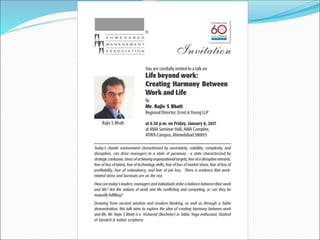
Life beyond work
- Creating harmony between work and life
Speaker: Rajiv Bhatt
Venue: Ahmedabad Management Association
Date: 6th Jan 2017
EY global study on work-life challenges
across generations
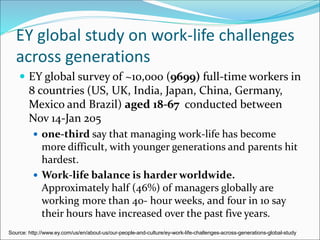
 EY global survey of ~10,000 (9699) full-time workers in
8 countries (US, UK, India, Japan, China, Germany,
Mexico and Brazil) aged 18-67 conducted between
Nov 14-Jan 205
 one-third say that managing work-life has become
more difficult, with younger generations and parents hit
hardest.
 Work-life balance is harder worldwide.
Approximately half (46%) of managers globally are
working more than 40- hour weeks, and four in 10 say
their hours have increased over the past five years.
Source: http://www.ey.com/us/en/about-us/our-people-and-culture/ey-work-life-challenges-across-generations-global-study
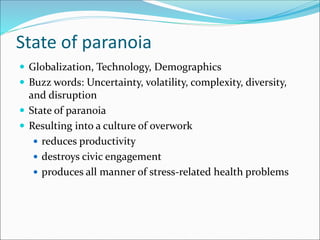
State of paranoia
 Globalization, Technology, Demographics
 Buzz words: Uncertainty, volatility, complexity, diversity,
and disruption
 State of paranoia
 Resulting into a culture of overwork
 reduces productivity
 destroys civic engagement
 produces all manner of stress-related health problems
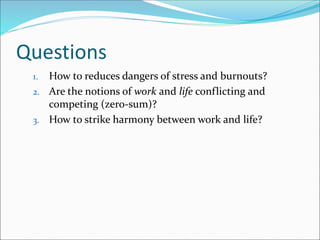
Questions
1. How to reduces dangers of stress and burnouts?
2. Are the notions of work and life conflicting and
competing (zero-sum)?
3. How to strike harmony between work and life?
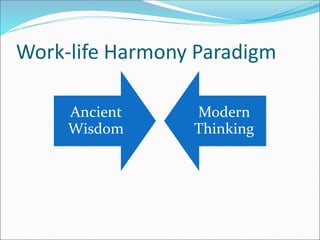
Ancient
Wisdom
Modern
Thinking
Work-life Harmony Paradigm
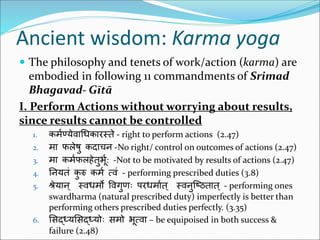
Ancient wisdom: Karma yoga
 The philosophy and tenets of work/action (karma) are
embodied in following 11 commandments of Srimad
Bhagavad- Gītā
I. Perform Actions without worrying about results,
since results cannot be controlled
1. कर्मण्येवाधिकारस्ते - right to perform actions (2.47)
2. र्ा फलेषु कदाचन -No right/ control on outcomes of actions (2.47)
3. र्ा कर्मफलहेतुर्भम: -Not to be motivated by results of actions (2.47)
4. ननयतं कु रु कर्म त्वं - performing prescribed duties (3.8)
5. श्रेयान् स्विर्ो ववगुणः परिर्ामत् स्वनुष्ठितात् - performing ones
swardharma (natural prescribed duty) imperfectly is better than
performing others prescribed duties perfectly. (3.35)
6. सिद्ध्यसिद्ध्ययः िर्य र्भत्वा – be equipoised in both success &
failure (2.48)
Ancient wisdom (cont…)
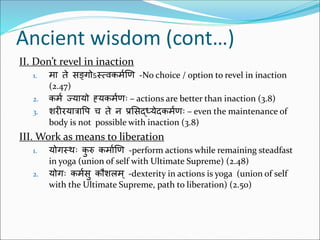
II. Don’t revel in inaction
1. र्ा ते िङ्गयऽस्त्वकर्मणण -No choice / option to revel in inaction
(2.47)
2. कर्म ज्यायय ह्यकर्मणः – actions are better than inaction (3.8)
3. शरीरयात्रावप च ते न प्रसिद्ध्येदकर्मणः – even the maintenance of
body is not possible with inaction (3.8)
III. Work as means to liberation
1. ययगस्थः कु रु कर्ामणण -perform actions while remaining steadfast
in yoga (union of self with Ultimate Supreme) (2.48)
2. ययगः कर्मिु कौशलर्् -dexterity in actions is yoga (union of self
with the Ultimate Supreme, path to liberation) (2.50)
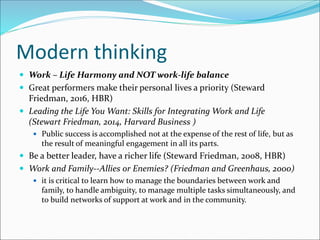
Modern thinking
 Work – Life Harmony and NOT work-life balance
 Great performers make their personal lives a priority (Steward
Friedman, 2016, HBR)
 Leading the Life You Want: Skills for Integrating Work and Life
(Stewart Friedman, 2014, Harvard Business )
 Public success is accomplished not at the expense of the rest of life, but as
the result of meaningful engagement in all its parts.
 Be a better leader, have a richer life (Steward Friedman, 2008, HBR)
 Work and Family--Allies or Enemies? (Friedman and Greenhaus, 2000)
 it is critical to learn how to manage the boundaries between work and
family, to handle ambiguity, to manage multiple tasks simultaneously, and
to build networks of support at work and in the community.
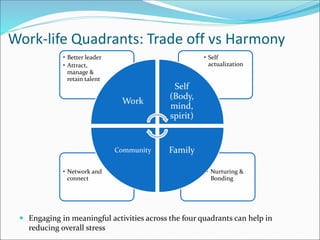
Work-life Quadrants: Trade off vs Harmony
• Nurturing &
Bonding
• Network and
connect
• Self
actualization
• Better leader
• Attract,
manage &
retain talent
Work
Self
(Body,
mind,
spirit)
FamilyCommunity
 Engaging in meaningful activities across the four quadrants can help in
reducing overall stress
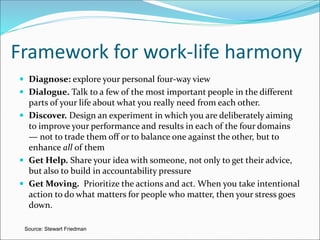
Framework for work-life harmony
 Diagnose: explore your personal four-way view
 Dialogue. Talk to a few of the most important people in the different
parts of your life about what you really need from each other.
 Discover. Design an experiment in which you are deliberately aiming
to improve your performance and results in each of the four domains
— not to trade them off or to balance one against the other, but to
enhance all of them
 Get Help. Share your idea with someone, not only to get their advice,
but also to build in accountability pressure
 Get Moving. Prioritize the actions and act. When you take intentional
action to do what matters for people who matter, then your stress goes
down.
Source: Stewart Friedman
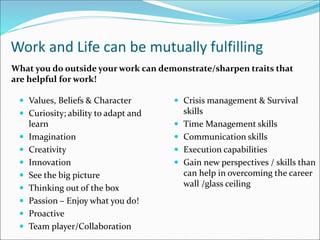
Work and Life can be mutually fulfilling
 Values, Beliefs & Character
 Curiosity; ability to adapt and
learn
 Imagination
 Creativity
 Innovation
 See the big picture
 Thinking out of the box
 Passion – Enjoy what you do!
 Proactive
 Team player/Collaboration
 Crisis management & Survival
skills
 Time Management skills
 Communication skills
 Execution capabilities
 Gain new perspectives / skills than
can help in overcoming the career
wall /glass ceiling
What you do outside your work can demonstrate/sharpen traits that
are helpful for work!
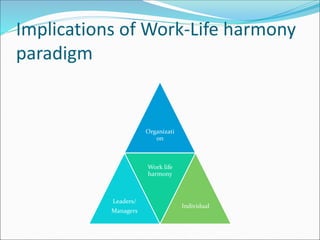
Implications of Work-Life harmony
paradigm
Organizati
on
Leaders/
Managers
Work life
harmony
Individual
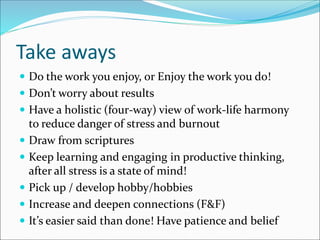
Take aways
 Do the work you enjoy, or Enjoy the work you do!
 Don’t worry about results
 Have a holistic (four-way) view of work-life harmony
to reduce danger of stress and burnout
 Draw from scriptures
 Keep learning and engaging in productive thinking,
after all stress is a state of mind!
 Pick up / develop hobby/hobbies
 Increase and deepen connections (F&F)
 It’s easier said than done! Have patience and belief
Contact: Rajiv Bhatt
Email: bhatt_rajiv@yahoo.com

Life Beyond Work - Summary

  • 1.
    Life beyond work -Creating harmony between work and life Speaker: Rajiv Bhatt Venue: Ahmedabad Management Association Date: 6th Jan 2017
  • 3.
    EY global studyon work-life challenges across generations  EY global survey of ~10,000 (9699) full-time workers in 8 countries (US, UK, India, Japan, China, Germany, Mexico and Brazil) aged 18-67 conducted between Nov 14-Jan 205  one-third say that managing work-life has become more difficult, with younger generations and parents hit hardest.  Work-life balance is harder worldwide. Approximately half (46%) of managers globally are working more than 40- hour weeks, and four in 10 say their hours have increased over the past five years. Source: http://www.ey.com/us/en/about-us/our-people-and-culture/ey-work-life-challenges-across-generations-global-study
  • 4.
    State of paranoia Globalization, Technology, Demographics  Buzz words: Uncertainty, volatility, complexity, diversity, and disruption  State of paranoia  Resulting into a culture of overwork  reduces productivity  destroys civic engagement  produces all manner of stress-related health problems
  • 5.
    Questions 1. How toreduces dangers of stress and burnouts? 2. Are the notions of work and life conflicting and competing (zero-sum)? 3. How to strike harmony between work and life?
  • 6.
  • 7.
    Ancient wisdom: Karmayoga  The philosophy and tenets of work/action (karma) are embodied in following 11 commandments of Srimad Bhagavad- Gītā I. Perform Actions without worrying about results, since results cannot be controlled 1. कर्मण्येवाधिकारस्ते - right to perform actions (2.47) 2. र्ा फलेषु कदाचन -No right/ control on outcomes of actions (2.47) 3. र्ा कर्मफलहेतुर्भम: -Not to be motivated by results of actions (2.47) 4. ननयतं कु रु कर्म त्वं - performing prescribed duties (3.8) 5. श्रेयान् स्विर्ो ववगुणः परिर्ामत् स्वनुष्ठितात् - performing ones swardharma (natural prescribed duty) imperfectly is better than performing others prescribed duties perfectly. (3.35) 6. सिद्ध्यसिद्ध्ययः िर्य र्भत्वा – be equipoised in both success & failure (2.48)
  • 8.
    Ancient wisdom (cont…) II.Don’t revel in inaction 1. र्ा ते िङ्गयऽस्त्वकर्मणण -No choice / option to revel in inaction (2.47) 2. कर्म ज्यायय ह्यकर्मणः – actions are better than inaction (3.8) 3. शरीरयात्रावप च ते न प्रसिद्ध्येदकर्मणः – even the maintenance of body is not possible with inaction (3.8) III. Work as means to liberation 1. ययगस्थः कु रु कर्ामणण -perform actions while remaining steadfast in yoga (union of self with Ultimate Supreme) (2.48) 2. ययगः कर्मिु कौशलर्् -dexterity in actions is yoga (union of self with the Ultimate Supreme, path to liberation) (2.50)
  • 9.
    Modern thinking  Work– Life Harmony and NOT work-life balance  Great performers make their personal lives a priority (Steward Friedman, 2016, HBR)  Leading the Life You Want: Skills for Integrating Work and Life (Stewart Friedman, 2014, Harvard Business )  Public success is accomplished not at the expense of the rest of life, but as the result of meaningful engagement in all its parts.  Be a better leader, have a richer life (Steward Friedman, 2008, HBR)  Work and Family--Allies or Enemies? (Friedman and Greenhaus, 2000)  it is critical to learn how to manage the boundaries between work and family, to handle ambiguity, to manage multiple tasks simultaneously, and to build networks of support at work and in the community.
  • 10.
    Work-life Quadrants: Tradeoff vs Harmony • Nurturing & Bonding • Network and connect • Self actualization • Better leader • Attract, manage & retain talent Work Self (Body, mind, spirit) FamilyCommunity  Engaging in meaningful activities across the four quadrants can help in reducing overall stress
  • 11.
    Framework for work-lifeharmony  Diagnose: explore your personal four-way view  Dialogue. Talk to a few of the most important people in the different parts of your life about what you really need from each other.  Discover. Design an experiment in which you are deliberately aiming to improve your performance and results in each of the four domains — not to trade them off or to balance one against the other, but to enhance all of them  Get Help. Share your idea with someone, not only to get their advice, but also to build in accountability pressure  Get Moving. Prioritize the actions and act. When you take intentional action to do what matters for people who matter, then your stress goes down. Source: Stewart Friedman
  • 12.
    Work and Lifecan be mutually fulfilling  Values, Beliefs & Character  Curiosity; ability to adapt and learn  Imagination  Creativity  Innovation  See the big picture  Thinking out of the box  Passion – Enjoy what you do!  Proactive  Team player/Collaboration  Crisis management & Survival skills  Time Management skills  Communication skills  Execution capabilities  Gain new perspectives / skills than can help in overcoming the career wall /glass ceiling What you do outside your work can demonstrate/sharpen traits that are helpful for work!
  • 13.
    Implications of Work-Lifeharmony paradigm Organizati on Leaders/ Managers Work life harmony Individual
  • 14.
    Take aways  Dothe work you enjoy, or Enjoy the work you do!  Don’t worry about results  Have a holistic (four-way) view of work-life harmony to reduce danger of stress and burnout  Draw from scriptures  Keep learning and engaging in productive thinking, after all stress is a state of mind!  Pick up / develop hobby/hobbies  Increase and deepen connections (F&F)  It’s easier said than done! Have patience and belief
  • 15.
    Contact: Rajiv Bhatt Email:bhatt_rajiv@yahoo.com